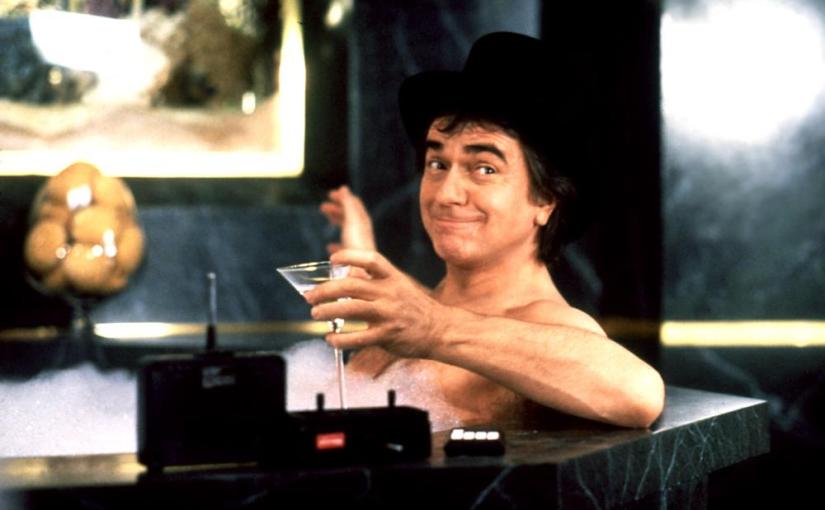
THE UNTOUCHABLES

By Marc S. Sanders

Brian DePalma directed the very loose cinematic adaptation of Eliot Ness’ squad of treasury agents during the 1930s prohibition era. The movie is The Untouchables, based on the famed TV show starring Robert Stack. It’s a gorgeous picture with incredible set designs, props, and Georgio Armani costume wear. It’s also bloody as hell.

Kevin Costner solidified his leading man status as the righteous Eliot Ness who swears by the law he promises to uphold, while making efforts to topple Al Capone’s (a convincing looking Robert DeNiro) massive Chicago empire that thrives on the buy and sell of illegal alcohol. Capone controls the city on all levels, from government officials down to the police force. His power is unlimited, but he has not filed his tax returns in four years. It’s crazy, but that just might bring him down.

Ness teams up with veteran beat cop Jimmy Malone played by Sean Connery, in one of the most celebrated and winning roles the Academy Awards ever bestowed. Malone knows where the underground liquor operations are located. He knows who accepts the bribes and kickbacks too. The question is how involved does he want to get. He’s the grizzled Irish mentor for Ness, and his timing is perfect for David Mamet’s script.

Memorable additions to the team also include a young and tough Andy Garcia and nerdy Charles Martin Smith as the IRS agent happy to pick up a shotgun for the cause.

DePalma’s film carries the epic look. There’s much splendor in the art direction of the film. It’s a glamorous piece of film, but it’s also just a movie.

Mamet’s script takes lots of liberties against the actual occurrences that came through historically. I do not recall hearing that The Untouchables ever took down a deal while riding horseback alongside the Canadian Mounties, for example. A villainous henchman for Capone is Frank Nitti (a happily slimy Billy Drago), always dressed in bad guy white and putting on the bad guy charm. His demise in the film never happened and most certainly not so adventurous or violently, but DePalma and Mamet clearly don’t care. This is lean entertainment for action sequences set in a gorgeous gangster period. The Untouchables is a slick looking gangster flick and nothing more.

A real star of the film is the Oscar nominated score of the film from The Maestro, himself, Ennio Morricone. His opening piece of drum beats with quick piano keys during the credits will get your pulse going. He also has great horn sections that capture the four heroes in tight shots of shining cinematography from Stephen H Burum. For me personally, this is my favorite soundtrack of Morricone’s massive career.

Costner is well cast. He has the handsome hero look to him. Garcia became a well-known and sharp looking tough guy. Smith did not move on to more celebrated material beyond this. He was remembered comedically here, just as he was in American Graffiti. He also directed since this film. As a team though, Costner, Garcia, Smith and Connery have wonderful chemistry together.

DeNiro actually took a step back from the spotlight here. His Al Capone is not so much a character as he is an every so often antagonizing appearance with a couple of well paced lines from Mamet’s famed dialogue. He’s got a memorable moment with a baseball monologue that convinces you of Capone’s strong arm, but his villain does not get too personal with the hero.

The Untouchables holds a special place in my heart. It was the last film I saw before my life changing move from New Jersey to Florida in 1987. Because the move was hard on me from a teenager’s perspective, I found great escape with this film as I memorized the lines of the enormously colorful characters along with getting absorbed by the violence and emotional variety of tones in the score. Having watched the movie many times since it was released, it’s become a kind of therapeutic experience for me. I take in the gorgeous craftsmanship of the film, the humor and the surprise moments many of the beloved characters face.

The Untouchables is not a perfect film I thought it was at age fourteen. It’s almost proud of its admitted inaccuracies, but it remains a favorite and very personal piece for me. I still love the film, all these years later.

ORDINARY PEOPLE

By Marc S. Sanders

Psychiatry is regarded as a stigma within the world of Ordinary People.

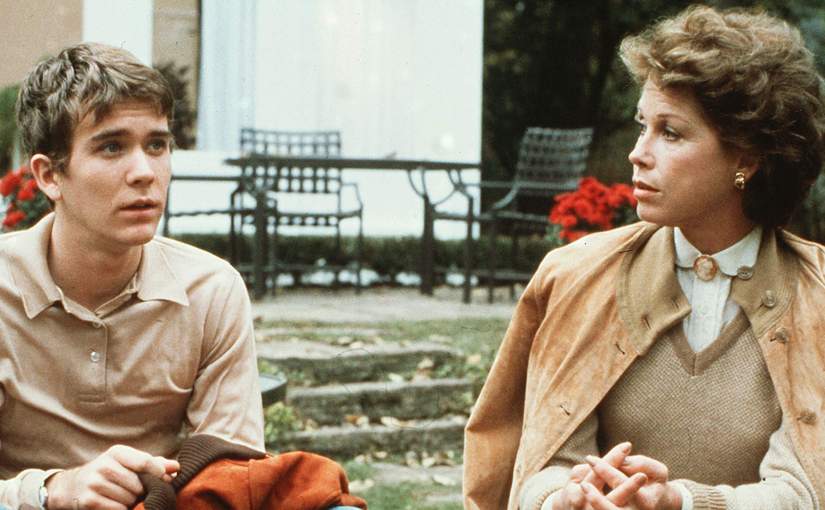
Robert Redford’s Oscar winning directorial debut centers on a troubled high school student named Conrad (Timothy Hutton in an Oscar winning role) who finally gets the gumption to see Dr. Berger (Judd Hirsch) following a suicide attempt brought on by the guilt he carries when he could not rescue his older brother, Buck, in a stormy boating accident. His parents, Beth and Calvin (Mary Tyler Moore and Donald Sutherland), accept this action with differing viewpoints.

For Beth it’s shameful and unnecessary to see a doctor. Her stance is made all the more clear when her own mother frowns upon this, especially with this doctor being a Jew. On the other hand, Calvin looks at it as an opportunity for a breakthrough. This doctor could really be good for Conrad. Beth is embarrassed when Calvin has a few drinks at a neighborhood dinner party and shares these developments with some friends.

For a WASP community, seeing a psychiatrist is not regarded well. It shows that Beth’s image of a perfect lifestyle is tainted. Any problems they have should be resolved in the home. What never occurs to Beth, however, is the resentment she fails to hide for her second son. There’s nothing breaking through Beth’s exterior to allow her true feelings to come out. By contrast, Conrad gradually lets his inner struggle loose and the film shows that it helps, as challenging as it could be.

In 1980, the prior year’s Best Picture winner was Kramer vs Kramer. Three years later it would be Terms Of Endearment. Hollywood was recognizing an audience’s interest in the domestic life. The Vietnam War was now in the past. Reagan economics were taking over and middle-class America seemed to be doing well. Redford’s adaptation of Judith Guest’s novel with a screenplay by Alvin Sargeant showed what was happening behind closed doors. Dramatic moments occur and they can offer a terrible shock in the moment but as days move on, so does everyone around you. You make efforts to do so as well, but you’re still weighed down by that one moment of loss.

Redford directs Hutton with quiet moments of anguish. Quick cut flashbacks offer a glimpse of what’s running through Conrad’s mind. Fortunately, it doesn’t run too long and upstage Hutton’s performance. Timothy Hutton is astonishing with his twitches and stutters and struggle to simply sit still. His blank stare of his blue eyes covey his deep depression. When a girl classmate takes notice of him, you feel the remedy of his sessions starting to make a difference. Where his mother refuses to recognize his need for love, someone else does and you feel better about yourself as well.

There’s always a reason to live. Dr. Berger reminds Conrad of that. Judd Hirsch is right for his role against the waspy wealth of Conrad’s upbringing. He encourages a “not giving a shit” attitude to how people perceive Conrad. We all want a mother’s love, but it doesn’t always work out that way. We want to be accepted at school. That might not work out either. With his sloven stature and chain-smoking manner, Hirsch is very convincing in reminding Conrad to say it’s okay to tell someone to fuck off, and most importantly to stop punishing himself for saying it.

Mary Tyler Moore and Donald Sutherland work incredibly well at conflicting with each other while also convincing us that before this terrible accident they likely complimented one another perfectly. Yet, as the film explains, life gets messy. The question is how best to respond when the mess appears and stays with you. Conrad finds the benefits in seeing a therapist like Dr. Berger. Beth will hear nothing of the idea. A magnificent scene done with one tracking camera comes out of nowhere while Beth and Calvin are playing golf with relatives. A slight mention of their son by Calvin gradually explodes into what really sets Calvin and Beth apart from one another. All of their sub conscious thoughts explode on a crowded golf course in front of the community they’ve absorbed their history and marriage within. Redford gets the best beats out of his actors because the shields that maintain their personas will only hold for so long. It’ll break down at a time when it’s never opportune or convenient. This scene occurs near the end of the film as we see Conrad’s recovery, while Beth and Calvin are still mired in both individual and shared heartache and resentment. It’s a crescendo moment that the film builds to for these characters.

Within film discussions, Ordinary People is often sadly regarded as the film that once again denied Martin Scorsese of a well-deserved Oscar (for arguably his greatest work Raging Bull). I don’t think that’s fair, however. Some might say Ordinary People may be dated. However, now that I’ve finally seen the film, I can’t deny it’s importance. Mental health has become more apparent through all kinds of different social classes. Yet we still hide ourselves, and are encouraged to shelter ourselves under a facade of happiness. That can’t always be true for any of us. We, as humans, all suffer. We all feel pain or embarrassment or sadness. If anything, a piece like Ordinary People reminds us that we are all typical, and must succumb to dealing with issues far beyond our mental capacity at one time or another.

THE FUGITIVE

By Marc S. Sanders

In 1993, Andrew Davis directed the best Alfred Hitchcock film that was not directed by Alfred Hitchcock. The Fugitive with Harrison Ford being pursued by Tommy Lee Jones was a runaway smash. As we now live in an age of cell phones and the World Wide Web, you’d think this film might be somewhat dated but it is the last thing on your mind while watching. This is a tense, taut thriller that never, ever lets up. Another favorite picture of mine.

The opening credits serve as a prologue, showing Dr. Richard Kimble struggle with a one armed man in his home after his wife (Sela Ward) has been assaulted and killed. Kimble becomes the accused and eventual guilty party who is sentenced to death.

Davis is now ready to show his first of many wonderful set pieces. As Kimble’s prison bus careens off the road landing on railroad tracks, an oncoming train collides with the bus. Kimble and another prison inmate now have the opportunity to escape and go on the run. Enter Tommy Lee Jones as Deputy Sam Gerard and his team of smart, intuitive misfits to catch up to Kimble who has made a mad dash into the dense Illinois woods. Because Kimble and Gerard are depicted to be incredibly smart, Kimble only remains a few steps ahead throughout the picture. Later in the film, Kimble makes his way back to Chicago to search for the one armed man and uncover exactly why his wife was murdered.

Location shots are masterfully done in The Fugitive. From the woods to a sewer system (a manufactured set I believe), to the streets of Chicago and Cook County Hospital.

The train crash is one of the all time best moments in film. No miniatures. No CGI. This is a fully loaded train crashing into a bus, and this is where you can not deny the craftsmanship of great filmmaking. Cameras were positioned at multiple angles to capture the mayhem in one take.

The other great set piece occurs during the actual St Patrick’s Day parade in Chicago. Gerard once again gets Kimble in his sights and Kimble manages to blend in with the parade marchers. The quick editing of improvisational camera work is spectacular here. Kimble and Gerard are literally in the same frame and yet Gerard can’t see what’s under his nose. Moments like these can’t be storyboarded. Andrew Davis’ production could not stop the actual parade for another take. It all had to be done on a now or never basis.

I watch The Fugitive and I always think back to Alfred Hitchcock’s best work like The Man Who Knew Too Much and North By Northwest. An innocent man is unexpectedly swept up in a conspiracy where he becomes the target and his adrenaline and instincts must kick in to save himself. The only thing he’s armed with is his mind. There’s also an unusually creepy antagonist, The One-Armed Man. This makes the film incredibly foreboding. I know the film stems from the legendary television series, but Davis treats this villain as if he’s among the ranks of Hitchcock’s use of Martin Landau or James Mason.

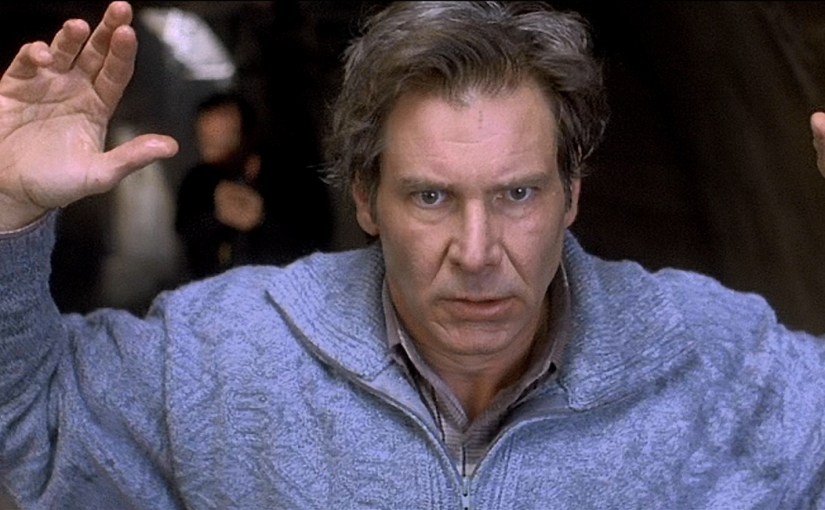
Harrison Ford is great at never glamorizing his role. He doesn’t suddenly become Rambo. He becomes a man of convincing desperation. Ford shines in roles like these such as his other films like Witness, Air Force One, and Frantic.

Tommy Lee Jones gives one of my most favorite performances on film. He plays Gerard with non stop adrenaline. He has exquisite chemistry with his team, including Joe Pantoliano. As well, Gerard is only interested in fetching what has escaped. He has no interest in guilt or innocence, until he realizes that Kimble has no interest in the consequences of escape. Kimble is interested in his innocence. Even Gerard becomes attuned to Kimble’s drive. Here is where the script is wise. There is no dialogue to imply what Gerard is thinking. Tommy Lee Jones has a way of giving a great close up to show what he’s thinking. He trusts the audience will presume what’s driving his intuition.

Davis pulls out all the stops with this film. There’s magnificent action shots of Gerard’s helicopter quickly flying over the ambulance that Kimble is racing away in. A great cat and mouse maze sequence happens within a sewer system. Lighting is perfect, there. Nothing is overly dark. There’s also incredible overhead shots of the dam and ravine that Kimble makes for a getaway with an absolutely surprising dive from an enormous height.

The Fugitive is smart and action packed to the teeth. You are in full focus while watching the ongoing pursuit. This film was nominated for Best Picture. Rare for an action film, but also a testament to its greatness. Tommy Lee Jones deservedly won the Oscar for Supporting Actor.

No doubt for me that The Fugitive is a must-see film for any kind of moviegoer. There are moments to feel scared, to laugh, and to cheer. When it is finally over and the story arrives at its satisfying conclusion, you cannot help but let out a deep breath. You feel like you’ve run a hundred miles, or at least as long as Richard Kimble ran towards his innocence. Your time will be well spent investing in the The Fugitive. An absolutely fascinating picture of great, mounting suspense.

ALL THE PRESIDENT’S MEN

By Marc S. Sanders

People talk too much.

Ten minutes into Alan J Pakula’s film, that’s all I can think about. William Goldman’s dialogue heavy script pounds away at depicting Washington Post reporters Carl Bernstein and Bob Woodward’s uncovering of the Watergate break in, and it shows that simply, people talk too much. So much so that just a stutter or a name in passing conversation will dig the hole deeper and deeper towards self-incrimination, and that of other accomplices. Once a source trips up, then a good reporter can pounce.

Names, dates, slamming doors, rotary phones, typewriters and papers fly fast and furiously during Pakula’s film and that’s what upholds the breakneck pace of the investigative journalism. In a film like this, a crime is depicted and investigated, only the words are the real weapons.

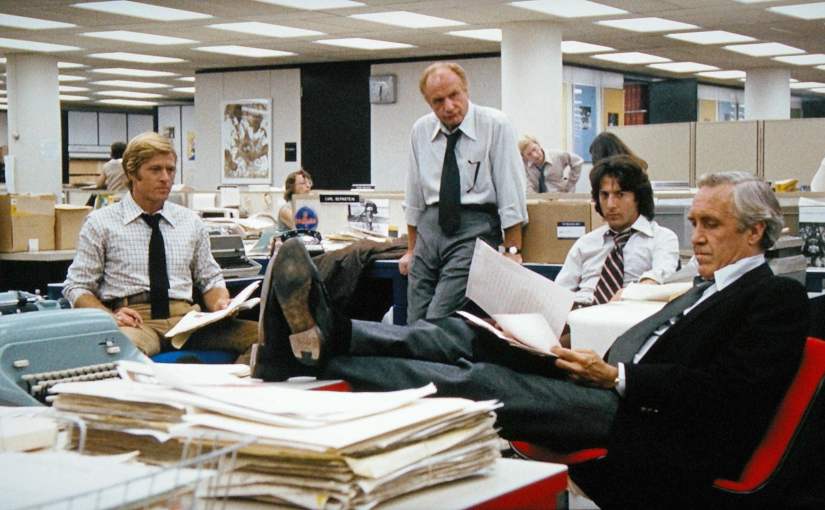
I don’t find All The President’s Men to be a history lesson in the corruption of Nixon’s administration. Rather, I only see what was necessary for Woodward & Bernstein to truthfully prove the corruption took place. The reporters, played by Robert Redford and Dustin Hoffman, seem to run on endless adrenaline of coffee, cigarettes and fast food effectively showing their drive while donning loose ties, wrinkled shirts, and crumpled notepads amid unkept desks and apartments. It’s visually convincing. A story like this doesn’t sleep, nor does it take a vacation. A story like this makes a viewer feel like he/she is still up at 2am, catching a cab to meet a shadowy source in a haunting parking garage; thanks Hal Holbrook for Deep Throat (“Follow the money.”).

Redford has a great scene where Pakula never stops running the camera on close up for over six minutes. All that Redford is doing is dialing, and talking on the phone while maintaining two different conversations. I don’t know if this moment happened in real life but I imagine the best reporters in a pre internet phase had to hold out for opportune times like this to fall into their laps. The cut does not end and Pakula was instinctively wise to do that. The scene itself serves that harrowing pace. Less is more in a moment like this. Props to Redford for maintaining the statuesque momentum.

Equally so, Hoffman has a couple of good moments with Jane Alexander (his eventual costar in Kramer vs Kramer.). She beautifully depicts a victim of intimidating threat, and Hoffman must tread carefully with his questions by strategically letting himself into her home, puffing on a cigarette, sipping cold coffee, speaking softly and eventually getting out his notepad as she gradually breaks down her shell. Alexander doesn’t make it easy and so their scenes work so well in taut suspense of low whispers.

Nixon’s cohorts really are not the antagonists here. In essence, Goldman’s script (based on the reporters’ published book) welcomes the challenge of acquiring factual reporting as the overall conflict. This is best represented by Jason Robards’ portrayal of Post Editor Ben Bradlee. Robards won an Oscar, and he so deserved it. He wouldn’t give “Woodstein” a break until the truth willed itself out by the proper means that are necessary. He’s intimidating in the role but he’s open minded enough to not ignore the young reporters’ instincts. I love watching his scenes; the way he commands an office from a chair with his feet up or fidgets and writes with his red pen. When his boys finally get a solid piece, Bradlee’s character breaks for one moment to knock on a desk and clap his hands as he walks away from his men. They got it. He didn’t relent, and they finally got it. I love that moment. Simply marvelous.

All The President’s Men remains a favorite film of mine. The dialogue moves so fast that after seeing it a number of times I still haven’t connected all the dots, and yet that’s what I appreciate about it. I see something new every time.

THREE BILLBOARDS OUTSIDE EBBING, MISSOURI

By Marc S. Sanders

From February 2017:

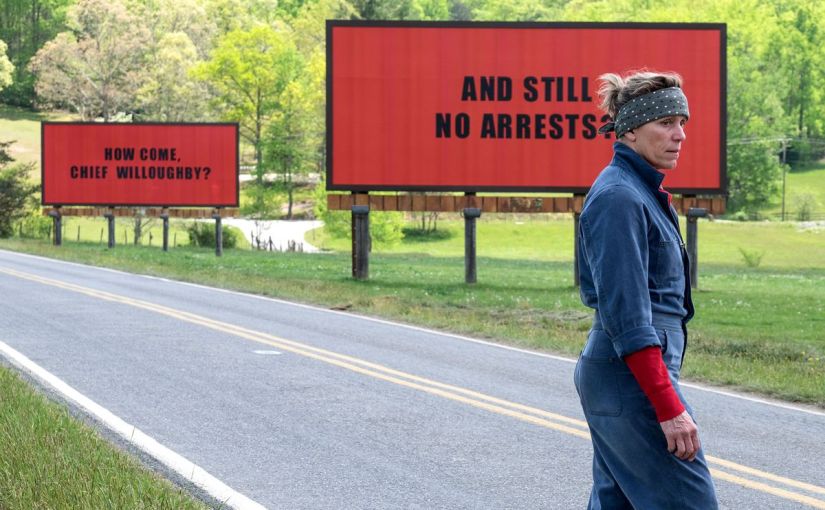
A number of years ago I read Roger Ebert’s review of a Kevin Spacey film called The Life Of David Gale, only after seeing the film myself. Reading his viewpoint assured me that perhaps I do recognize good and bad filmmaking with the absence of influence. Like me, he hated the film because of its contrivances and the complete 180 on Spacey’s character. He said it angered him so much that he wanted to throw his popcorn at the screen. Years later, I feel the same way, for nearly identical reasons after seeing this 2017 Best Picture nominee. I hate Three Billboards Outside Ebbing, Missouri.

I HATED THIS MOVIE. Hated it so much that I’m pissed over how much I hated it. This film is worthy of Best Picture, Actors and Screenplay nominations???? There was nothing better than this dreck???? Not Baby Driver, or Wonder Woman? Not All The Money In The World? Blade Runner 2049?

This film contains great talent trying way too hard to elevate the stupidity of the unjustified actions of their characters so much that suspension of disbelief isn’t just thrown out the window (like one hapless character who earns no justice), it’s burned, beaten, raped, shot, burned again, thrown off a building and drowned.

Consider midway thru the film, Sam Rockwell’s nominated performance as a vile, heinously racist backwoods lawman. He reads a letter and is magically transformed into a do gooder Boy Scout. There’s no way in hell I’d ever believe this. No one should. This guy is the entire KKK in one embodiment. By the time this bastard gets to this “epiphany” he had already committed the most sickening and atrociously violent actions fathomed, and in great detail. Yet magically a letter from a friend and an arson scene that burns him suddenly transform him. Just like that. Uh uh. Too convenient. Too manufactured. Too insulting to a movie going audience.

This film is full of other ridiculous contrivances that are simply too long and spoilery to describe here. (I’d love to spoil the film to salvage anyone from seeing this crap.)

Frances McDormand’s character is also despicably written. Here’s a character entitled to the anger she has after losing a daughter to rape and murder, worthy of attention due to the stubborn intellect she conveys during the act one exposition, yet as the film progresses, she becomes incredibly stupid and downright unlikable. What a thoughtless jerk she is. Nothing to cheer for. Nothing to love to hate. Nothing to laugh at. Nothing to cry over. Nothing. She’s just an asshole who conveniently gets away with her actions, yet everyone knows she’s the culprit.

In a film like this the bad cops are uncaring racists. The good ones are the clueless keystone cops who conveniently can’t see the forest through the trees. I don’t like it, and more importantly I don’t believe it. Unacceptable!!!

What a stupidly shitty movie that has been executed here in exchange for arguably the most interesting idea of all the 9 Best Picture nominees. I salute the idea of the film. It’s the execution that’s deplorable.

The only redemption that can come from this garbage now is if this film does not win one single Oscar. Sadly, I think I’ll be wrong. Congratulations Sam Rockwell, you stole a trophy from three much more entitled actors (Christopher Plummer, Richard Jenkins and I hear Willem Defoe.) Woody Harrelson’s performance in this pic is also up for grabs….for what? He coughs up blood quite well. I have no clue, otherwise.

Don’t believe the hype. Three Billboards… only has a great title, a great concept on paper and a great cast list. Beneath all that is carbon monoxide. Don’t breathe it in. You’ll only feel sick after watching it.

This will likely remain as one of the ten most despised movies I’ve ever seen.

THE GODFATHER PART II

By Marc S. Sanders

The first film to use the number 2 (or Roman numeral II, in this case), in its title and the first sequel to win Best Picture is Francis Ford Coppola’s continuous adaptation of Mario Puzo’s Corleone family legacy in The Godfather Part II. It is worthy of all of the accolades it collected as an individual film. Yet, it does not best the first film.

Unlike the 1972 classic, Part II does not provide much character arc for anyone. We’ve already seen Michael (Al Pacino, silently ferocious here) change from good college boy and war hero to the evil puppet master Mafioso he eventually became. This film shows him exercising his threateningly murderous deeds as he works in conjunction with a sly Nevada Senator, a Jewish Miami mob boss (an excellent performance from Lee Strasberg) from the time of his father’s reign, and another mob guy from New York (Michael V Gazzo). We get a whiff of all these guys early on during a commencement celebration for Michael’s son. Coppola keeps this a running theme of grand openings in all three films. It’s a great method of introductions each time.

Following the party, an assassination attempt is brought against Michael. But who did it? Problem is this is where the foundation of the film is not so strong. It’s never really made clear who betrayed Michael. That’s a little bothersome.

Coppola depicts another storyline altogether with the early 20th century origin of Vito Corleone flawlessly played by Robert DeNiro who hardly speaks any English while communicating in a Sicilian variant of Italian. Young Vito immigrates to America following an escape from the Sicilian Don that murdered his family. In New York we witness his rise to power. Famed Cinematographer Gordon Willis washes out these flashback images to enhance a pictorial history accompanied by Angelo P. Graham’s art direction of early brick and mortar architecture and the muddy streets of early Little Italy, New York. It’s a time travel back to a historical age. It’s magnificent.

Back in the 1950s, Puzo and Coppola bring authentic fiction to real life history as Michael considers a go at a business enterprise in Cuba. However, will the rebellion uprising interfere with his plans, and what will it cost him? As well, there’s a great sequence where he has to testify before a congressional hearing in response to suspicion of criminal activities. Coppola used the infamous McCarthy hearing footage as inspiration for this predecessor to what C-Span would eventually look like.

Yet, there’s another story to become involved with as Michael must contend with his dim witted older brother Fredo. John Cazale is superb as the guy who wanted more but was limited by the influence of competing factions and his loyalty to his brother. Pacino and Cazale always had great chemistry together. A great conversation moment occurs in the third act following a terribly surprising twist. One of the best scenes in the film occurs on the porch of the Corleone compound.

More story elements come into play as Michael attempts to balance his married life with Kay (Diane Keaton). She’s pregnant again. Yet, what will that mean for the future of the family?

The sequel to The Godfather assembles another stellar cast. So good, that the film garnered three Oscar nominations in the Supporting Actor category alone (DeNiro, Gazzo, Strasberg) as well as a nomination for Pacino as Best Actor and Talia Shire (Supporting Actress) as Connie, Michael’s sister. That nom left me a little dubious only because there’s not much material for Shire to play with here.

Coppola’s detail is at the top of his game again. The film, like the first, feels like a true life biography.

Puzo offers heartbreaking moments, most especially in the film’s shocking end which leads to a flashback assembly of characters from the first film. That scene alone plays as a great reminder of what Michael once was before becoming the hideous monster that closes the story. Puzo’s whole Godfather franchise hinges on well defined, crushing tragedy.

The Godfather Part II is nothing short of mesmerizing and wholly engaging. You can watch it over and over again. It’s layered in rich storytelling and narratives that provide endless amounts of material for a family meant to be mired in secrets, deliberately hidden in the dimly lit rooms that Willis photographed.

It’s a treat to be the fly on the wall wherever Michael and his family move to next.

GOODFELLAS

By Marc S. Sanders

Goodfellas is my favorite film by Martin Scorsese. It’s a fast-paced roller coaster narrative of Irish street kid Henry Hill’s experience in the mob, dramatized from his real life as part of the Gambino crime family of New York.

“How am I funny?,” the Lufthansa heist, Spider takes it in the foot and then in the chest, Morrie’s Wigs, the piano montage from Derrick And The Dominos, Billy Batt’s demise followed by an early morning breakfast stopover at mom’s, and Henry’s helicopter paranoia. All of these elements are assembled to depict the perceived glamour and undoing of street level hoods, proud to steal and dress in the finest threads while bedding dames behind their wives’ backs.

Scorsese along with Nicholas Pileggi uncovered something special when they adapted Wiseguy (Pileggi’s book) for the screen. I think they struck a nerve because they showed these guys as men doing a routine living. There was a process to their deeds. Give a cut of your theft to the man above and keep the rest for yourself. Above all else, stay off the fucking phone. Get out of line and get whacked, unless you’re a “made guy.” This is all code, normal to Henry and his cohorts (Robert DeNiro as Jimmy Conway; Joe Pesci as Tommy DiSimone).

Moreover, the wives understood this behavior as well. Henry’s wife Karen (Lorraine Bracco) knew these guys were not 9 to 5 husbands and the more it occurred, the more normal it all seemed. Including when the FBI presented a warrant to search the premises. Just let them in and go back to rocking the baby to sleep while watching Al Jolson on the box.

Scorsese took the best approach by not judging the actions of these raw criminals. They dressed well, but they weren’t reluctant to draw blood if an insult was tossed their way. Pesci, in an Oscar winning best performance, represents that philosophy. Scorsese, with his regular editor, Thelma Schoonmaker, are not shy about the violence. Watch how Jimmy and Tommy beat up a “made guy.” DeNiro just stomps his dress shoes into the guy’s face over and over. Pesci pistol whips him, but before he can shoot him, he breaks the gun…on the guy’s face. The romance of gangster life quickly undoes itself in moments like this. As Henry notes, your friends come at you with smiles before they whack you.

Ray Liotta is Henry, the primary narrator and centerpiece of the film. Most of the story is from his perspective. I’m sorry that Liotta didn’t get much award recognition. He really deserved it. His voiceover narration is superb. It gives a feeling like I’m talking to Henry in a bar with his tales of Mafia code and life in the criminal underworld. His voiceover is conversational. He’s also got great expressions of disregard, anger, and intense, raging fear on screen. When Henry is at his worst, his eyes are dry red, and his skin is pale and craggily. None of that is just makeup at work. That’s Ray Liotta performing with an exhausted energy in character. Watch the scene following his 3rd act incarceration where he argues with Karen over the last of their drug supply being flushed down the toilet. It’s not so much a party anymore. The manic response couldn’t feel more real as he slams his hand against the wall and then crouches up into a weeping ball of helplessness in the corner, on the floor.

Liotta and Bracco have sensational chemistry together in scenes of their courting nature when they first meet, followed by the ongoing, bickering abuse that enters their married life. There’s a great hysteria to them. Bracco got a nomination for her role. She deserved it.

Scorsese is a master at filming basic gestures as well to show the nature of these mob guys and their crimes. A key folded in a paper is then inserted into a knob and a stash is walked off with. A blood-soaked revolver is placed in a tin box and then Schoonmaker cuts over to the customary stomping of a glass at a Jewish wedding. Every prop and detail are connected.

Even better is Martin Scorsese depicting the wise guys’ incarceration midway through the film. Watch how the head mob boss Pauly (Paul Sorvino) slices onion with a razor for dinner complete with steaks broiling, pork sauce bubbling and even lobster ready to be boiled. Scorsese and Pileggi found it important to depict how attractive this life could be, despite a stretch in the joint or the violence that might come. Pay off the right guys and you could live like kings.

The master director doesn’t stop there. His selection of doo wop and rock period music paints the historical palette of the 50s through 80s. Music was being played and life was happening all the while an underhanded way of crime and violence occurred.

One of the best blends of film and song occurs during the classic one-shot steady cam where Henry escorts Karen through the back way of the famed nightclub, Copacabana. It’s one of the greatest scenes ever in movies. The walk journeys downstairs, through the kitchen, past wait staff, cooks, bouncers, people necking and to a front and center table to see Henny Youngman’s stand-up routine. The sequence is accompanied by the song “And Then He Kissed Me.” It’s a great character description to display a young guy, proud of his gangster image, with a whole world ahead of him and everyone offering their respects while he hands out twenty-dollar bills like gift coupons. This young guy had power, and the girl holding his hand couldn’t be more impressed.

Goodfellas is one of the greatest mob movies ever made. It’s one of my favorite films. It’s genuine in its grit and language. Every F-word uttered is necessary to translate the regard for code, or the blatant disregard for the law, loyalty within a crew, or even the ethics of marriage. It astounds me that it didn’t win Best Picture in 1990, losing to Dances With Wolves. Perhaps it got cancelled out with fellow mob nominee The Godfather Part III.

Regardless, the film struck a chord and pioneered a new way of showing criminals in celebration of themselves while sometimes encountering the inconvenience of the law or the women in their lives or worse, the betrayals among themselves. At any given moment you might rat on your friend and not keep your mouth shut.

Without Goodfellas, The Sopranos might not have been as welcomed into the pop culture lexicon. Maybe even the films of Quentin Tarantino or Guy Ritchie or Paul Thomas Anderson, or even other Scorsese projects yet to come.

Goodfellas is an electrifying film of unabashed humor, realistic and shocking violence, and authentic culture within a well established crime syndicate.

Goodfellas is a must see film.

CABARET

By Marc S. Sanders

Is it possible for a musical to be disturbing? Maybe Bob Fosse’s Cabaret favors that argument.

Liza Minnelli won the Academy Award for Best Actress in 1972 for her portrayal of Sally Bowles, a carefree, happy go lucky performer at the underground Kit Kat Club located in Berlin, 1931. She is the lead attraction among a company of dancers doing a different kind of stage vaudeville with its colorful emcee played amazingly by Joel Grey, also an Oscar winner.

The musical numbers are outlandish with caked on makeup and outfits that could make Victoria’s Secret seem like a children’s shop. I gathered from the film that Fosse, who choreographed the numbers as well, offered up the escape of life first, before showing the harsh reality of Berlin in its historical context.

Sally and the Emcee’s performances are first on hand, depicted as silly and showstopping. Thereafter, Sally encounters an English gentleman named Brian Roberts (Michael York) who is a professor of English study attempting to complete his doctorate. As Sally and Brian become closer as friends first, he must reluctantly admit to Sally that he’s a better bed companion with a man than with a woman. Sally doesn’t understand why he didn’t say that in the first place as she attempts to come on to him.

Herein lies the dilemma many faced as the Nazi party was gaining traction in Germany. How necessary is it to hide your true natures to preserve your life? Sally’s underground lifestyle at the club clouds her vision of what’s gradually happening in the world. Nevertheless, they eventually develop a relationship as Brian appears to be bisexual, more specifically.

A side story concerns Brian & Sally’s relationship with a baron named Maximillan (Helmut Griem), who will wine and dine them at his estate only to later abandon the respective relationships he sets up with them to more or less make them feel as cheap as prostitutes. I wasn’t sure what to gather from this extension, however. The irony is that unbeknownst to Sally and Brian they have both been sleeping with Max. Eventually, Sally reveals she’s pregnant but does not know who the father may be, Brian or Max, and an abortion is considered.

An additional side story concerns a wealthy Jewish German heiress named Natalia who falls in love with a German Jew named Fritz living under the guise of a Protestant.

Cabaret is a loose adaptation of The Berlin Stories by Christopher Isherwood (the Brian character) and his experience with stage performer Jean Ross (the Sally character). Isherwood’s stories gradually formed into different iterations of stage plays and short stories before making it to Broadway and Fosse’s celebrated film.

Though Fosse apparently took some questionable liberties and departures from Isherwood’s writings, I think it depicts the personal struggles of love and self identity while the world around them is quickly changing into a scary reality where your own self identity could get you killed.

Fosse gives terrifying glimpses of how the Nazi party seeps it’s way into a decadent Berlin of underground showmanship. Though apparently Berlin really wasn’t so decadent as the film has you believe. Ross and Isherwood have gone on record describing Berlin was a more destitute and poor environment, actually.

In Fosse’s film, a Nazi youth is seen early on being kicked out of the Kit Kat Club. A few minutes later, the night club manager is being beaten in an alley. Fosse juxtaposes scary moments like this against the silly debauchery depicted on stage. It’s as if the Gypsies, homosexuals and Jews in the area are unaware of the evil practice that is gradually taking over outside.

Soon, Fosse makes the swastika more apparent in the streets with propaganda handouts. Most telling is when a young boy is seen at an outdoor beer garden gathering singing a number selfishly entitled “Tomorrow Belongs to Me.” Fosse is frighteningly effective at showing this boy from the neck up. Eventually, he moves the camera down to reveal the boy’s swastika wrapped around his sleeve. The song which seemed to champion beauty and nature now evolves into a march of grandstanding fascism. It completely shocked me. Just as people like Brian and Fritz are reluctant to reveal their backgrounds, both sexually and religiously, the Nazi party is proud to announce their mindset in a converse manner. By the end of the film, the audience at the Kit Kat Club more predominantly shows Nazis in the audience as opposed to just the one shown in the beginning of the film. Hatred has spread its disease.

While Minnelli shines in her role, her showstopping moment really comes at the end when she dangles her carefree attitude while belting out the title song with “Life Is A Cabaret.” Along with Joel Grey’s Emcee closing out the film with the “Finale,” this musical goes against the grain of most musicals’ cheerful close outs or romantic theatrics. Fosse’s mirror image of the Nazi party taking in Sally and Emcee’s performances are chilling. We sense the characters’ time is at an end and wisely the film runs its closing credits among frightening silence with the cold, blurred images of Nazi soldiers staring right at us.

I had never seen the film of Cabaret until now, but I had attended two different stage productions; neither of which I liked. Bob Fosse’s film seems more clear with its content than I ever got from a stage performance. Perhaps it is because the Oscar winning art direction is more apparent than a stage set. We can see the bustling of Berlin change amid a political climate that at first is not taken so seriously. As hurtful and harrowing the relationships of love between Brian with Sally and then with Max, as well as Fritz and Natasha are, none of this will eventually compare to the upcoming demise for Berlin.

As Miguel noted in our recent podcast that focused on musicals, Cabaret won the most Oscars without winning Best Picture (losing to The Godfather). It’s clear how deserving it was of its accolades. The musical numbers are very engaging but the fear of fascism is well developed too. So there is a roller coaster of emotions to absorb from Fosse’s film. I believe in that podcast I noted that Francis Ford Coppola won Best Director. I now realize I was wrong. It was in fact Bob Fosse who took home that prize, and it’s truly evident how deserving that honor was for him.

Again, while I’ve yet to find a stage production I’ve liked, I was terribly moved by the film. Cabaret, the film from 1972, is a sensational and frightening production.

ONCE UPON A TIME…IN HOLLYWOOD (2019)

by Miguel E. Rodriguez

Director: Quentin Tarantino
Cast: Leonardo DiCaprio, Brad Pitt, Margot Robbie, Timothy Olyphant, Dakota Fanning, Bruce Dern, Luke Perry, Al Pacino, Kurt Russell
My Rating: 10/10
Rotten Tomatometer: 84% Certified Fresh

PLOT: A fading television actor and his stunt double strive to achieve fame and success in the film industry during the final years of Hollywood’s first Golden Age in 1969 Los Angeles.


Quentin Tarantino’s ninth film is a little bit like Beethoven’s Ninth Symphony.  It’s big, bombastic, and goes the long way around the barn to get to the finale, but in the end it all makes sense and is a transcendent experience.

Let’s see, where do I start?

First of all, the film’s evocation of 1969 Los Angeles is like Mary Poppins: practically perfect in every way.  I’m no fashion scholar or visual historian, but every exterior shot of the city was pretty convincing to my layman’s eyes.  The movie theatres, the movie posters, the restaurants (anyone else remember “Der Weinerschnitzel”?), the cars, those HUGE sedans sharing the road with VW Bugs and M/G’s…it’s clear they did their homework.

There’s the performances by the two leads.  Tarantino once said he considered himself the luckiest director in modern history because he was able to get DiCaprio and Pitt to work on the same film.  Can’t argue with him on that score.  They carry the film in a way that few other tandems could have.  (Newman and Redford come to mind.) Mind you, DiCaprio and Putt don’t look much like each other, considering one has to be the other’s stuntman, but you get the idea.

Above all, there’s the story.  DiCaprio plays Rick Dalton, a former leading man from ‘50s TV westerns who is now playing colorful bad guys in ‘60s TV westerns.  Brad Pitt plays Cliff Booth, the stuntman who’s been taking the dangerous falls for Dalton for years.  Dalton happens to live next door to Roman Polanski and Sharon Tate on Cielo Drive in the Hollywood Hills.

All the trailers, and all the industry buzz, reveal that the Manson family and Sharon Tate play a part in the film.  That’s no spoiler.  Given what we know about those events, the movie plays like Gimme Shelter, the landmark documentary about the ill-fated concert at Altamont that was actually due to take place a few months after the events of this film.  It’s all very suspenseful, in the sense that we know what’s coming, but we’re just not sure how the movie is going to approach it.  So every scene with poor Sharon Tate in it is overshadowed by the fact that we know her ultimate fate in history.

It’s like the famous Hitchcock analogy of suspense.  Two people are eating at a restaurant when a bomb suddenly goes off under their table…that’s surprise.  Put those same two people at the restaurant, where the audience knows there’s a bomb under the table, but it doesn’t go off right away as the two people eat and converse and have dessert, and we’re wondering will they leave BEFORE the bomb goes off or not…?  That’s suspense.

And that’s the genius of this movie, with Tarantino’s sprawling, winding screenplay.  We get to know Rick Dalton and Cliff Booth intimately, we get the rhythms of their relationship, of Dalton’s mood on set, of Booth’s quiet acceptance of his role as Dalton’s sole support system.  We are treated to lengthy scenes showing Dalton at work on the set of a TV western, so we can appreciate the vast differences between an actor and their characters.  There’s a brilliant backstage scene between Dalton and a child actor who is impossibly, hilariously advanced for her age, and who winds up giving Dalton some goodhearted advice.

And interspersed through it all is Sharon Tate.  Sharon Tate bopping to music at home.  Sharon Tate picking up a female hitchhiker on her way into town.  Sharon Tate almost passing, then backing up to admire with youthful excitement, her name on the marquee of a movie theatre, right next to (gasp) Dean Martin’s name!  Sharon Tate dancing, walking, smiling, drinking…living.  She’s the diner at the restaurant, and the Manson family is the bomb we know will eventually go off.  It casts a pall over the proceedings, but not in a bad way.  It’s an interesting way to bring the reality of the situation into focus from time to time.

And now I have to end this review before I inadvertently give away certain, ah, plot elements that elevate Tarantino’s film from a mere character study or period piece into the heady heights of cinematic transcendence.  I have not myself read any reviews of the film, so I can only guess that whatever negative reviews are out there probably center on the film’s finale, or perhaps on its meandering script.  All I can say, or will say, is that I am firmly on Tarantino’s side on this one.  The way the conclusion was written and filmed is the kind of thing that people will still be talking about years from now.

So just take it from me.  If you’re a movie fan, and ESPECIALLY if you’re a Tarantino fan, this is right up your alley.  It’s easily his most slowly paced movie since Jackie Brown, but that just gives you time to e-e-e-ease into the characters, like putting on a tailored suit piece by piece.  This film, like Beethoven’s Ninth, is a masterpiece.

QUICK TAKE: Syriana (2005)

By Miguel E. Rodriguez

Director: Stephen Gaghan
Cast: George Clooney, Matt Damon, Jeffrey Wright, Christopher Plummer, Chris Cooper, Amanda Peet
My Rating: 8/10
Rotten Tomatometer: 72%

PLOT: A politically charged epic about the state of the oil industry in the hands of those personally involved and affected by it.


Syriana reminds me of one of those puzzles made out of twisted nails, where the challenge is to untangle them, even though it appears to be impossible.  The difference is, with Syriana, I don’t get tired of trying.  At least, not yet.

The movie is a pleasure to watch, but hard to explain.  It’s a convoluted tale that starts with an impending merger between two oil companies, detours into political and legal intrigue, and sprinkles in some religious fanaticism by the time we get to the end.  I’ve watched it five times, and I still have questions about the plot.  I JUST watched it, and I’m still not entirely sure who Christopher Plummer’s character is and why he matters at all to the story.

Normally, a movie this confusing would turn me off.  (Examples: Full Frontal [2002], The Fountain [2006], The Counselor [2013])  But when I watch Syriana, I get the sense that, underneath the twisty plot and maddeningly oblique dialogue, there lurks a great truth.  Maybe the plot is confusing because, really, the situation it’s describing is so confusing in real life.  Maybe any attempt to parse the complexities of U.S. relations with oil-producing countries is a fool’s gambit to begin with.  So the movie just jumps in with both feet and separates the watchers from the listeners.  You’ve really got to ACTIVELY listen for two hours to make ANY sense of the movie.

Maybe that’s not your thing.  Fair enough.  This is the kind of movie that I can’t defend on objective grounds.  You’re either gonna like it or not.  For myself, I get sucked into it every time I watch, even if I don’t understand it all 100%.  So.  There you go.