FARGO

By Marc S. Sanders

The seeds of a crime begin in the dead of winter, in a saloon, located in Fargo, North Dakota.  A car salesman requests two thugs kidnap his wife so that they can demand an eighty-thousand-dollar ransom from his wealthy father-in-law.  The salesman will split the monies with the crooks and all will be well.  Hold on there!  It’s not as simple as it looks.

The Coen Brothers (Joel and Ethan) completed some of their most legendary work when they opted to “adapt” a supposedly true story that sheds blood over the snow-covered plains of northern Minnesota when all of the characters involved choose not to cooperate with one another.  The unpredictable is what keeps their film Fargo so engaging.  With each passing scene, you ask yourself “What next????”

Jerry Lundegaard (William H Macy, in my favorite role of many good ones from him) is the salesman who gets in over his head.  This cockamamie scheme of his stems from a need to land a get rich quick investment, but he doesn’t have the money and his father-in-law Wade Gustafson (Harve Presnell) certainly won’t lend it to him.  Steve Buscemi and Peter Stormare are the hired criminals, Carl and Gaere.  As quick as the agreement is made, Jerry wants to call off the arrangement, but things are already set in motion.  The kidnapping occurs, albeit sloppily, and a late-night pullover on a dark, snow covered back road leads to the bloody shootings of three people. 

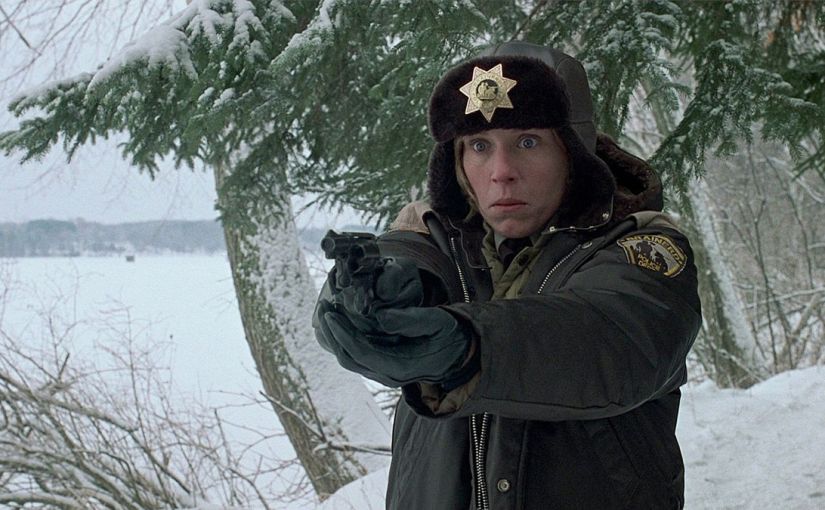
Marge Gunderson (Frances McDormand, in her first Oscar winning role) is awoken early in the morning.  Her sweet husband makes her a quick breakfast and she’s off in a jiff to inspect the crime scene of the three murders.  She is seven months pregnant, but she’s got a job to do.

Murder, kidnapping, fraud, and embezzlement piece together the Coens’ Oscar winning script.  What makes Fargo special though is how out of frame it all seems among these odd and quirky characters.  The Minnesotan dialects and vernacular (“You betcha!!” “You’re darn tootin’!” “Oh, for Pete’s sake!!!”) from Marge and Jerry do not seem standard in a story like this.  Even their names – Lundegaard and Gunderson – seem totally out of place here.  However, the pregnant, sweet natured police officer should not be underestimated, and the puppet master behind this plot should have known better.  In fact, other than Marge, no one should be doing what they’re doing, and yet that’s exactly what spins everything off the rails.

The Coens humanize the characters of their film.  Marge must stop inspecting the grisly crime scene because her morning sickness is about to overtake her.  “No, I think I’m gonna barf!” It is not the blood or the cold winter that’s holding her back.  Natural pregnancy gets in the way.  When clues lead her to Minneapolis for an overnight stay, she takes advantage of meeting with a high school friend.  Their meet-up has nothing to do with the central plot, but the writers insist on showing Marge during her off hours.  It’s a hilarious scene and Frances McDormand’s timing is naturally comedic with a guy who just has an overenthusiastic way about himself.  Marge is not just a smart cop.  She’s got a life outside of her career as a loving wife, friend and soon to be mother.

As well, Jerry insists to Wade not to contact the police and let him deal directly with the kidnappers when they call.  Wade isn’t just going to sit by for long though.  He got to the top of his powerful pyramid by taking things head on.  Jerry just doesn’t have the instinct to realize this is how the cards will fall.  Wade was not to be involved, under any circumstances.  Yet, that’s exactly what is happening.  This is not good Jerry.

Carl and Gaere (These names!!!!  I’m telling ya.), as crooked hoods, have no honor among themselves.  One might betray the other and that could lead to another gory, very gory, yet inventive moment. 

Other than Marge, either no one is particularly smart in Fargo, or they are just not seeing the possible outcomes all the way through.  Still, even the dumbest of folk can make a turn of events gone awry so fascinating.  When one tiny detail gets out of place, then the players improvise. That only twists several other expectations to go off kilter and the dominoes begin to tumble.  Very quickly, as everything has unraveled, it is any wonder how this all began in the first place. 

Fargo demonstrates that crime is hardly committed with a perfect plan.  Fortunately, the imperfections are at least as entertainingly curious as the perfections found in so many other films.  Oh, you betcha!!!!! 

ANATOMY OF A FALL

By Marc S. Sanders

Was Samuel Maleski pushed or did he commit suicide? It appears he fell from the balcony of the French chalet he shares with his wife Sandra Voyter (Sandra Hüller) and their blind son, Daniel (Milo Machado Graner).  That is the focus of Anatomy Of A Fall, one of the films to be recognized in several Oscar categories for 2023 including Best Picture, Best Director for Justine Triet, Screenplay, Editing and an acting nomination for Hüller.

Triet’s film kept my attention right from the start because this newsworthy story has all the elements many would look for in a Netflix documentary or a Dateline program.  New details are introduced in nearly every scene whether it stems from conversations that Sandra has with her attorney Vincent (Swann Arlaud) or as part of the witness interrogations during the thrilling trial scenes that take place a year after she has been indicted for causing her husband’s death.

Sandra is German.  Samuel (Samuel Theis) is French.  To stay on a common ground, they speak to one another in English.  We learn this as the film flashes back to conversations and arguments the pair have prior to the deadly scene that occurs soon after the film begins.  The inconsistency in how they communicate as a married couple will have one ponder how pertinent it is when Sandra is considered a prime suspect in her husband’s death.  Also, it’s curious that Samuel suddenly decided to record a number of their disputes.  More evidence is revealed as the story carries on.

On the surface, the story plays like a typical Law & Order episode.  However, there’s a fresh quality to this kind of supposed crime drama.  A large portion of Triet’s screenplay (co-written with Arthur Harari) takes place in a French courtroom and it’s interesting to see how the procedures of witness questioning varies from what American audiences are accustomed to.  For example, an expert on blood splatters gives testimony and conclusion. While he is still on the stand awaiting further questioning, the Procureur will divert questions directly at Sandra, the accused, for explanations. 

The material witness for both sides is Daniel. After returning from a nature walk with the dog, Snoop, he comes upon his deceased father lying in the snow with blood gushing from the side of his head.  The blind son is thoroughly questioned about if he could hear arguments coming from his parents while loud music was blasting from his father’s upper-level workspace.  He’s probed about his parent’s relationship and how he got along with his mother and his father respectively.  Daniel is also put to the test of reenactments on the day in question.  While he is outside with Snoop, could he hear the argument his parents were having over the loud volume of the music from 50 Cent playing.

A sort of competition between Sandra and Samuel is also noted, as she is a published author. He has been insecure of becoming a writer himself after giving up his job as a literature professor and moving the family into the mountains to restore this chalet as a personal project. 

The performances in Anatomy Of A Fall are outstanding, especially from its lead Sandra Hüller, whose role was specifically written with her in mind.  Of the many great dramatic moments, there’s a specific flashback scene introduced as evidentiary recording.  It is a telling argument between Sandra and Samuel in the kitchen.  Justine Triet directs this long scene as a common occurrence among most marriages but then it begins to elevate.  Just when you think the two spouses are winding down, the intensity cranks back up again only it goes from a lower pitch to a much more aggressive state very quickly.  Their quarrelling becomes erratic, and while we are watching the flashback, it cuts away the moment it gets physical. Triet wisely returns the film to the courtroom observing Sandra listening to her memory all over again while the packed audience focuses.  In particular is the boy Daniel who is learning more about what weighed on his father and mother both individually and as a married couple.  When the argument gets physical the viewer of the film is in the same position as everyone in the courtroom, or more specifically blind Daniel, left to only imagine who breaks what dish and who slaps who.

Vincent, Sandra’s attorney, reminds his client early on that there is the truth and then there is what a jury and a court of public opinion will believe.   Swann Arlaud is not an actor I’m familiar with.  (Actually, I’m not familiar with anyone involved in this film.)  Arlaud is a standout though.  I like how he listens and asks well timed questions of Sandra as she recounts what occurred the day of the incident; where Samuel was and what he was doing along with where she was, interviewing someone about one of her books, on the floor below.  Swann Arlaud has a dubious expression as he absorbs all the information.  Even he knows this could have gone several different ways.  Maybe Samuel did intentionally jump to kill himself.  Perhaps the aggravation that Sandra endured of her husband motivated her to push him over or to hit him bluntly on the head causing his fall over the balcony railing.  There’s evidence to suggest a number of different outcomes. 

Anatomy Of A Fall succeeds on the examination of a crime and how it is tried, particularly in a French court of law.  Fortunately, the script does not offer many definitive answers when it concludes.  There are hanging threads left to consider and wonder.  Yet, it goes in depth with analysis so that when the verdict arrives, I could accept either decision of guilt or innocent.  It’s unfair, but in a murder trial, especially if there’s a possibility that the accused is not guilty, then the victim is somewhat put on trial as well.  Anatomy Of A Fall lends a case for either party.  This film deserves its accolades for its fair and thought-provoking writing as well as the performances of the cast which include a main character that you might or might not find believable.

AMERICAN FICTION

By Marc S. Sanders

Cord Jefferson directs his first film and it’s a winning combination of Tootsie with the prose of Alexander Payne.  

American Fiction follows author/literature professor Thelonius Ellison, otherwise known as Monk (Jeffrey Wright).  He’s encouraged by his university to take some time off as his patience with the mindset of students and colleagues has reached its tipping point.  Upon his return to visit his mother (Leslie Uggams) and sister Lisa (Tracee Ellis Ross), he realizes that mother is beginning to suffer from Alzheimer’s disease.  An unexpected tragedy also strikes, and now Monk has to figure a way to afford round the clock care for mother.

A side story also gnaws at Monk. His literary agent, Arthur (a hilarious John Ortiz) encourages him to write a book about “black life,” much like the current bestselling novelist Sintara Golden (Issa Rae).  Her book is celebrated, particularly by the middle/upper class white demographic, for its “authenticity” in urban black dialect and situations.  Monk is disgusted by this kind of reception.  He may be black, but he’s simply a novelist. Best to take his hard cover novels out of the African Studies section at the bookstore.

After a drunken binge of adopting Sintara’s approach, Monk writes a book, under a gang like pseudonym, as simply a gag to demonstrate how foolish consumers and the top publishers can truly be.  Arthur submits the manuscript to potential publishers and immediately fortune finds him.  A publisher is so moved by the book’s plight, she wants to gear it as a summertime bestseller and Hollywood wants to adapt the story.  It’s also a serious contender for a literary award, of which Monk is on the judging panel.  To Monk’s reluctance, he must don a persona of a fugitive criminal author, unwilling to disclose his identity or location.  White consumerism eats all of this up.  At best, all of this hoopla is covering the cost of his mother’s care. Otherwise, he despises being a part of this charade in front of his new girlfriend, Coraline (Erica Alexander) and his family which also includes his gay, undependable brother, Cliff (Sterling K Brown, another winning actor in this outstanding cast). 

American Fiction works on several levels, but the balance is between satire and relatable drama.  There’s a past that defines Monk’s character.  It defines what irritates him as a black man who is encouraged to digress from the sophisticated intelligence and formal education he possesses.  No one encourages him to live up to his disposition as simply a good writer.  Because he’s black, he can only be regarded as a black writer.   

Jeffrey Wright breaks free of his well-known character actor performances (James Bond films for example) to lead this stellar script adapted from a novel called Erasure by Percival Everett.  He wears multiple hats in this film, which include tender moments shared with Erica Alexander and Leslie Uggams, as well as more challenging debates with the sibling characters while addressing a common family problem of dealing with an elderly parent’s care.  His siblings sardonically address him as “Detective Dictionary” when engaged in a debate. As well, Wright’s comedy works as he’s the irascible author who is flabbergasted at how seriously his little prank takes him so far.  It disgusts him that this novel, this deliberate smack in the face to what readers embrace as black literature, generates a sensation. The further it’s regarded in hype, the deeper Monk has to hide as that urban gangster fugitive.

Thelonius “Monk” Ellison is one of the best characters to come out of 2023.  Ironically, the first film I saw this year was a dreadful comedy called You People with Eddie Murphy and Jonah Hill.  That film attempted to poke fun at what presumed were the stereotypes of blacks and Jews when in fact it had no discernible concept.  American Fiction explores how black life and culture is perceived by a white populace only to genuinely demonstrate an unfair delusion, and it works perfectly.  It’s a very smart script with intelligent and likable characters, and the dialogue is never pandering but absolutely forthright.  

American Fiction pokes fun at perceptions.  How Hollywood addresses black history and culture and a sad truth of what garners attention for fiction with black characters and storylines.  For black actors and authors, like any of their industry peers regardless of race/demographic, there’s more than just stories focusing on life in the ghetto or on a southern plantation.

Cord Jefferson’s screenplay reveals a midlife crisis for Monk that allows a provocation to consider what is genuine in black and white people.  At the same time, while Monk only wants to reveal a false delusion, he also has to live up to unwanted responsibilities as a son, a brother and a boyfriend.  Jeffrey Wright is worthy of an Oscar nomination for his role.  

Nearly every scene in Jefferson’s film can prompt you to hit pause and think about what was just said or demonstrated.  This movie is also very, very funny in its honest truth of what consumers absorb.  Yes! I do believe Hollywood would likely make a revenge slasher horror picture on a Louisiana cotton plantation, complete with Ryan Reynolds as a slave owner getting beheaded by an Afro blade.  

American Fiction is one of the ten best films of 2023. 

THE KING’S SPEECH

By Marc S. Sanders

A man can carry the title of Duke Of York, but that doesn’t make him a super man.  After all, he is just a man like any other, and he can possess annoying hinderances like a stammer for example.  However, when you are part of the Royal Family with a historical lineage of thousands and thousands of years, celebrated and honored in majestic paintings and medals, the inconvenience is never acceptable. 

Colin Firth is Prince Albert George (and forgive me but he has assumed two or three other first names as his birthright that I can not recall.  Phillip, as well I think).  The King’s Speech opens when Albert has been tasked by his father, the King of England, to deliver a speech at Wembley Stadium.  Director Tom Hooper never made a small staircase, a microphone or an audience appear so fearful.  As Albert addresses the crowd, the words do not come out and the only one who can lovingly empathize with him is his devoted wife Elizabeth (Helana Bonham Carter).  The archbishop (Derek Jacobi) puts his head down in disappointment along with all the other formally attired spectators.  It’s a heartbreaking beginning of a story for a well-dressed crippled hero.

Following advisors and doctors who offer ridiculous remedies that allow no alleviation, Elizabeth finally finds an Australian speech therapist who just might be the best last resort for her husband.  Albert is stubbornly reluctant to visit with Dr. Lionel Logue (Geoffrey Rush) who insists that their sessions occur in his office.  Albert does not like that he will also not be addressed formally by Dr. Logue.  Lionel will call him Bertie. 

An unorthodox approach, at least for royalty, is what Lionel insists will aid Bertie.  It is certainly better than his doctor’s recommendation of smoking cigarettes directly into his lungs.  Bertie will lie and roll on the floor.  He’ll hum and bellow unusual noises.  He’ll have to loosen up his physique and even allow Elizabeth to sit on his belly to help him with breathing exercises while working his diaphragm.  The art of swearing is especially helpful.

An interesting fact that Lionel shares with Bertie is that no infant is born with a stammer.  It develops from another source.  Perhaps it is abuse or neglect as a child.  When you are a child of royalty you are not necessarily loved directly by your parents.  A nanny is likely closer to you; maybe even more abusive. 

The King (Michael Gambon) is respected by Bertie, but he is fearful of the future of his monarchy.  The older son, David (Guy Pearce) is next in line to assume the throne, but he is an immature bedhopping playboy, and the threats of Hitler and Stalin are becoming more prominent.  The King begins prepping his Albert by insisting he deliver radio addresses.  The father is not the encouraging type, though.  His disdainful demands are not the cure for Albert’s debilitation.

The King’s Speech advances a couple years during the 1930’s towards the precursors ahead of World War II.  The King has died.  David is behaving just as expected and Albert still suffers with his ability to speak, but Lionel has therapeutically made advances with his student and friend.  He just can’t lose his student.  Otherwise, Bertie will not overcome.

The film’s strength relies on a solid friendship that develops between a common civilian and a man of Royalty.  Geoffrey Rush and Colin Firth work marvelously together.  They are very different personalities with backgrounds that could not be more apart from each other.  The chemistry is a beautiful duet of dialogue from an Oscar winning script from David Seidler. This was Seidler’s first script he ever wrote at the age of eighty. 

The entirety of the picture has a set design from Eve Stuart and Judy Farr that is absolutely grand.  Every room of the palace has the most beautiful furnishings and wallpaper designs.  Tom Hooper uses wide distant lens’ that show the enormities of each room of the castle as well as Prince Albert’s home.  Sometimes he shoots from the floor above, pointing his camera at Albert and Elizabeth.  The majesty of royalty looks down upon the Prince and his speech impediment.  It’s an absorbing setting for the film.  Exterior shots also look authentic with the cars and the dreary coldness of the country and London cobblestones.  I love the hardwood floors that the characters walk upon in the picture, particularly in Lionel’s office.  The resonances of their dress shoes speak more clearly than the Prince. It all seems to echo the overwhelming conflict that our protagonist must overcome, and Colin Firth is terrific at demonstrating his frustrated insecurities.  It’s an Oscar winning performance not only earned for the well-timed stammer but also the mournful facial expressions that are caught in close ups.

The triumphant moment at the end of the film occurs after Albert has succeeded the throne from his incapable brother. He is obligated to address his country in a world-famous speech that eventually brought a defiant England into the second world war to fight off Hitler’s undoubted tyranny.  Tom Hooper’s camera follows a strong hearted, yet nervous Colin Firth walk from one room of the palace to the next until he finally reaches the small makeshift studio where his friend Lionel accompanies him to offer assurance as he speaks to his people and allies across the seas.  I don’t simply see a coach or one who lends confidence.  I see a friend working with another friend.  Again, Geoffrey Rush and Colin Firth make a wonderful pair in a long line of cinematic mentors and their students.

As history has taught us, the King’s speech was simply the beginning of a very dark and bloody experience.  The speech itself became a success, but the real challenge was yet to come.  However, confidence is what allowed a generation to survive.  The irony of The King’s Speech is that the hero a people needed lacked confidence in himself.  By the end of this picture, he is sending his faith, his trust, and his own assurance over to his constituents, who needed it the most in spite of a hindering stammer.  It’s a doubly blessed occasion that a lifelong friendship formed out of a troubling time.

THE LOST WEEKEND (1945)

by Miguel E. Rodriguez

DIRECTOR: Billy Wilder
CAST: Ray Milland, Jane Wyman, Phillip Terry, Howard Da Silva
MY RATING: 8/10
ROTTEN TOMATOMETER: 97% Certified Fresh

PLOT: The desperate life of a chronic alcoholic is followed through a four-day drinking bout.


I don’t drink.  Like, at all.  I’ve never taken drugs, and I’ve never smoked a cigarette.  Luckily, I have never been gripped in the throes of a crippling addiction, unless collecting movies counts as an addiction, in which case I plead the fifth.  I say this, not to brag, but because a lot of my first impressions of Billy Wilder’s The Lost Weekend are tinted by the fact that I don’t know the first thing about being drunk or what it means to suffer from an addiction so crippling that it would force me to hang a liquor bottle outside my window to hide it from my brother.

As it happens, Don Birnam (Ray Milland) DOES suffer from this kind of mid-to-late-stage alcoholism.  We first meet Don as he and his brother, Wick (Phillip Terry), are packing for a long weekend to get away from everything and everyone, including alcohol.  Don is a would-be author who needs a break from…something.  (Whatever he went through is never specified, only hinted at: “It’ll be good for you, Don, after what you’ve been through.”)  Don’s plan to surreptitiously pack the hidden bottle of liquor falls through after the arrival of his almost unbelievably good-hearted girlfriend, Helen (Jane Wyman).  No matter.  He still has a plan, which he confides to the long-suffering but increasingly annoyed bartender, Nat (Howard Da Silva).  He’s bought two bottles of rye.  He’ll hide one badly in his own suitcase and another in his brother’s suitcase.  When Wick discovers the badly hidden bottle in Don’s suitcase, he’ll chew Don out, Don will act suitably contrite, and Wick won’t think about searching his OWN suitcase for a second bottle.  What could go wrong?

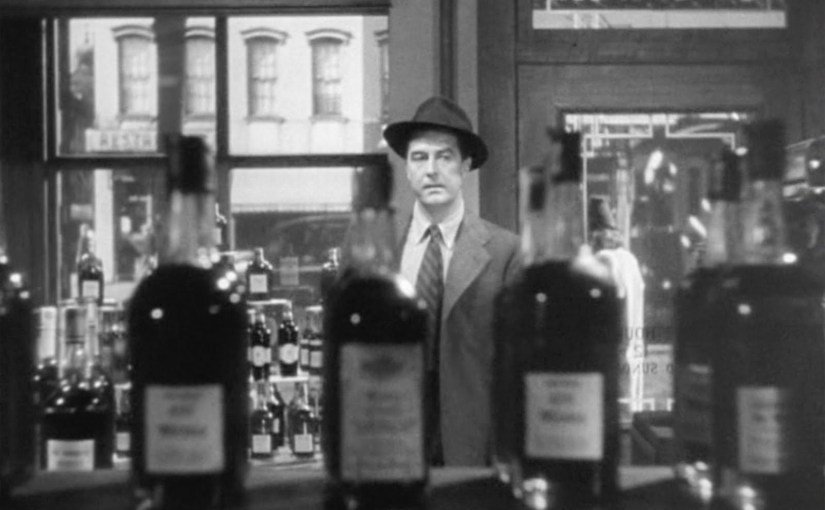
During these first few scenes, when Don lies and lies and drinks shot after shot in a bar and winds up missing the train for his getaway weekend, I found it difficult to sympathize with him.  Oh, he’s clever and loquacious when he’s either about to drink or while he’s drinking.  He has enough knowledge to quote Shakespeare at the right times and wittily proposes to Nat the bartender: “I wish I could take you along, Nat.  You and all that goes with you.”  Under the right circumstances, Don is a fun guy, always good for a laugh…until his seventh or eight or ninth shot of bourbon.  Then the other Don shows up, Don the drunk, Don the liar, the Don who gets so desperate for cash that he’ll walk 70 or 80 New York City blocks trying to find an open pawn shop so he can hock his typewriter for drinking money.

For some reason, it was harder for me to empathize with Don Birnam than it was to empathize with any of the main characters in Darren Aronofsky’s Requiem for a Dream (2000).  In that film, not a single leading character escapes the ravages of addiction, and yet even as they made their mistakes, I empathized with them and grieved when their bad decisions made things worse and worse.  With Don Birnam, however, every bad decision he made just made me like him less and less.  I remember thinking at one point, “He’s brought this all on himself, he deserves what he gets.”  Not a very Christian attitude, but I’m not gonna lie about it: that’s what I felt.

And his girlfriend, Helen…wow.  It’s almost like she needs as much of an intervention as he does.  She loves Don so unconditionally it’s almost unbelievable.  What’s the attraction?  Perhaps it’s symptomatic of the era in which The Lost Weekend was made.  She discovers Don’s alcoholism late in their 3-year dating relationship.  (What did people think in 1945 of someone who dates a man for 3 years?)  Instead of breaking up with him or giving him ultimatums, she devotes herself to “fixing” Don.  Not precisely the course of action I would recommend myself in today’s world, but there you have it.

Director Billy Wilder presents this first half of the movie in a very uninflected tone with little-to-no comic relief.  This flat tone becomes very effective at simply presenting the information without directly commenting on it one way or the other.  There are moments up to this point where the movie seems to side with Don (his struggle to find a bottle whose hiding place he’s forgotten is particularly pathetic), but it’s still not really passing judgment or giving him a pass.

And then…the turning point.  Don accidentally falls down a flight of stairs and knocks himself out after finagling some drinking money out of a young lady he flirts with at his favorite dive.  When he wakes up, he’s lying in a bed in the Alcoholic Ward of the local hospital, face to face with one of the strangest characters I’ve ever met in a Billy Wilder movie, and that’s saying something.  He’s a nurse.  “Name of Nolan.  They call me Bim.  You…can call me Bim.”  The closest I can get to describing Bim’s weirdness is to imagine an evil Waylon Smithers from The Simpsons as a male nurse.  On quaaludes.  To Don’s slowly increasing discomfort, Bim lovingly describes what Don is in for during his stay on the Alcoholic Ward, giving the inside scoop on the various repeat offenders and what to expect during his D.T.’s: “You know that stuff about pink elephants?  That’s the bunk.  It’s little animals.  Little tiny turkeys in straw hats.  Midget monkeys coming through the keyholes.”  This Bim…he has NO bedside manner, man.  “Prohibition…that’s what started most of these guys off.  Whoopee!”  (Nice little social commentary there…classic Wilder.)

Don manages to find his way home once again, having not had a drink for almost a day-and-a-half, if my memory is correct.  And it’s at this point that the movie, Billy Wilder, and Ray Milland finally got me in Don Birnam’s corner.

SPOILER ALERT, SPOILERS COMING.

Don finally has a bout of the D.T.’s.  It’s not turkeys or monkeys or elephants, though…it’s a rat.  A single rat chewing its way out of the wall in front of him.  Then, out of nowhere…a bat finds its way into the apartment and flutters around the room.  Don is understandably distressed.  But then the capper: the bat swoops down to where the mouse’s head is poking through the hole, there is a terrible squealing sound, the bat sort of trembles and scuffles…and a stream of thick blood starts to dribble out of the hole where the bat is presumably chewing the rat’s head off or something.

To say I was surprised is an understatement.  Don starts screaming his head off…and at long last I finally empathized with Don’s situation, and I no longer wanted him to wind up penniless and/or alone and/or dead.  I wanted the movie to find a way to fix him, like Helen tries desperately to do through the entire picture.  From then on, I was on his side, or Helen’s side, or whoever’s side, it didn’t matter, as long as he figured out a way to get out from under the disease that was slowly killing him.

I would not dream of revealing exactly how the movie ends.  It might go the way of Leaving Las Vegas (1996).  Or it might go the way of the vastly underseen Duane Hopwood (2005), featuring David Schwimmer as an alcoholic father on a path of self-destruction, but who manages to turn things around.  (Sorry if I spoiled that for you, but I’m betting it’s not a movie most people will want to seek out.)  I will say that it’s the ending of The Lost Weekend that really showcases the era in which it was made more than anything else.  But it could just as easily have gone the other way and still been just as successful.

The Lost Weekend cleaned up at the 1945 Oscars, winning awards for Best Picture, Best Director, Best Actor, and Best Adapted Screenplay (it was based on a novel).  At the time, it was the most unglamorous movie ever made about alcoholism.  Up to that point, drinking in movies rarely if ever led to hangovers and the D.T.’s and spending the night in the Alcoholic Ward.  It certainly belongs to be mentioned with Wilder’s greatest films.  But you’re gonna wanna watch something a little lighter afterwards.  Stalag 17, maybe.  Or Some Like It Hot.  A laughter chaser.

THE LOST WEEKEND

By Marc S. Sanders

Ever wonder why I write so many reviews?  It’s because I yearn to be a successful playwright/screenwriter.  I’ve directed three original plays that I’ve written over the years.  I will be directing a fourth for the holiday season later this year.  Had a few short plays I wrote performed locally as well.  Still, I suffer from a terrible ordeal that often grinds me into bouts of depression and internal rage.  Writer’s block! 

My father always told me that he stayed away from gambling and casinos. He said it was because he could have an addictive personality and he was not confident he could stop if he started.  I know what he means.  I have an addiction.  One that’s not commonly recognized, but I obsess over something every single day. Without fail, every damn day.  It’s my weakness.  Sorry.  I must keep that to myself, though.  Yet my pursuit of what preoccupies my mind taxes on my motivations to write and stretch the imagination needed for churning out one script after another.  So, a remedy is to write about movies that speak to me in lieu of my next great play. 

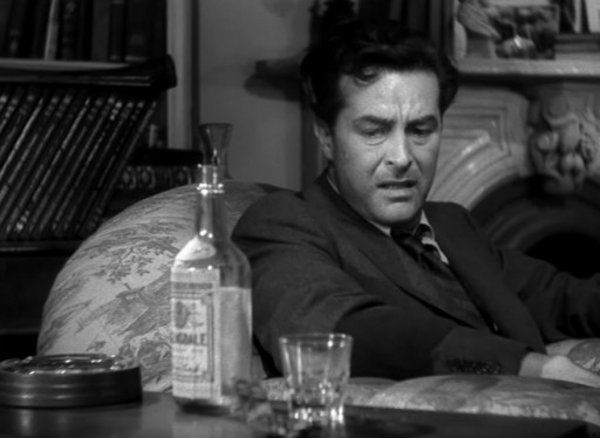
Billy Wilder’s Oscar winning drama The Lost Weekend demonstrates a writer’s inability to exercise his talent when an endless need for alcohol consumes his every waking moment.  Ray Milland delivers an Oscar winning performance as Don Birnam, an alcoholic wannabe writer of the worst kind.  When Wilder’s film opens, Don seems healthy and spry.  He’s clean shaven, well dressed, and ready to pack a bag for a weekend getaway that his brother Wick (Phillip Terry) has arranged for him along with Don’s girlfriend Helen St. James (Jane Wyman).  Wick implies to Don that this trip is just what his brother needs after what he’s recently been through, and he’ll have his typewriter with him to write in calming solitude.  Eventually we get an idea of what Wick has been referring to as Don attempts to sneak a bottle of rye that is strung outside the window of his New York apartment.  Wick catches Don in the act, pours the bottle down the drain and assures him that he won’t find another drop of liquor anywhere.  He doesn’t even have money to go to the corner bar.  So, Wick and Helen leave Don alone for a few hours before it’s time to depart. Don gets ahold of some cash though, and thus begins a spiral into a drunken binge over a four-day weekend.

I read that when this film was released, test audiences laughed at it.  I guess in 1945 people were not attuned or prepared to witness an account of a very real disease like alcoholism.  I’m not certain it was even diagnosed as a disease at that time.  Surely, the addiction was an ailment though, and Billy Wilder uses some effective cinematic devices to demonstrate the journey into madness and desperation for even just a tiny shot glass of gin or rye. 

A repetitive device is to show a tormented performance from Milland within the shadow of bars or fences.  He’s trapped in his own need for swill.  A telling moment occurs when Don is desperately trying to pawn off his typewriter just for some money to buy more alcohol.  Every store in the city is gated and closed on this particular Saturday though.  It’s the Jewish holiday of atonement for past sins, Yom Kippur.  I found that little detail to be interesting.  Surely, it’s a sin to harm yourself whether by alcohol or suicide, for example, and the holiday is a time for speaking to your inner self and Hashem (G-d) for your past transgressions.  Yet, that is no matter to Don.  He’s not ready or wanting to climb out of his dark hole.

Inanimate objects or props are also given much focus.  Early on, Don is seen at the local bar and Billy Wilder brings an inventive visual to explain just how much this character has consumed in under two hours.  The camera focuses on the wet rings on the bar top left by Don’s shot glass.  First there are two rings, then four and soon, fifteen.  Wilder also zooms his lens into the very bottom of the small glass filled with liquor to show how much the audience will drown in Don’s despair over the course of the film.

Other props also work towards Don’s paranoia such as a ceiling lamp bearing the shadow of a hidden bottle.  Milk bottles left in front of his apartment are not collected from one day to the next showing the passage of time for this weekend, and how even the most basic chore is dismissed so Don can extend his stupor.  A lady’s unguarded purse offers temptation.  A tossed lamp shade seems to glare at Don like a hole that he’s in, as he gets weaker and weaker. 

A magnificent scene, one that I can envision a skilled director doing today with quick cuts on digital film, occurs as Don recalls sitting in a crowded opera house watching the toasting scene of La Triviata; one of the most recognizable operas of all time.  Don is one of many in the audience, and yet he’s the only one alone with the production’s props of various drinking glasses and champagne bottles being used on stage that are mere inches away.  Very quickly into the scene, Billy Wilder skillfully draws focus from the opera singers and diverts towards the immense amount of liquor adorning the stage and the cast with quick cuts of Don salivating and perspiring alone in a chair of a crowded theater.  Everyone else is watching the performance.  Don is gazing at the alcohol.  I wouldn’t be surprised if Martin Scorsese had much admiration for such a sequence.

Phillip Terry is very good in his performance.  I’m surprised he’s not promoted as much as the other two stars of the picture.  Wick cares for his brother, but he’s ready to give up on him after six years of this ordeal, with one more transgression played out. He’s exhausted from lying to cover for Don’s weakness.  He represents the outsider of the dilemma who’s been affected by someone else’s ailment. Jane Wyman as Helen serves a nice purpose as well.  The one last hope for Don.  She’s the only one left who holds on to the faith that she can pull Don out of this nightmare.  Wilder presents these characters as side effects in the Oscar winning script written by him and Charles Brackett. 

Another haunting, but effective dimension comes when Don finds himself in the alcoholics’ ward at Bellevue Hospital, shot on location, and the first film to ever do so.  With an eerie use of a theremin in the soundtrack from Miklós Rózsa, Don is surrounded by dark shadows and tormented victims suffering from drying out just like him.  A nurse explains that he still has the DTs to experience like envisioning being surrounded by horrifying images like bugs crawling on him or something comparatively worse.  I recall from childhood seeing this symptom used on an episode of M*A*S*H.  Wilder invents his own kind of imagery and it’s pretty shocking in its grotesqueness.

I ask for forgiveness when I say that The Lost Weekend seems a little melodramatic. Maybe that’s because movies have built themselves into much more graphic and honest depictions of alcoholism since 1945.  The ending seems to welcome a stringy violin to accompany Ray Milland’s final scene with Jane Wyman.  However, I’m completely impressed with how pioneering this movie must have been for its time.  Billy Wilder didn’t shy away from the dramatic side of drinking. 

The Lost Weekend is certainly an effective and important piece on the study of alcoholism.  I’d recommend it as a visual reference to what can happen to the one who suffers, as well as those around him, including the bartender who deals with the regulars he easily knows by name.  While it’s certainly a movie of its time, the message remains the same.  Though I’m no expert on the effects of alcohol, I’ve seen enough friends who deal with the problem to know that the message in Wilder’s film still rings true.  An addiction to drink will dominate a life.

I always say that movies offer another valuable avenue to learn from.  There’s much to learn from The Lost Weekend.

MIDNIGHT COWBOY

By Marc S. Sanders

There’s an irony to John Schlesinger’s Midnight Cowboy.  At first, the film centers on a Texas bumpkin eager to relocate to New York City and succeed as a hustler.  Upon his arrival though, he could not appear any more virginal.  The cowboy’s name is Joe Buck, portrayed by Jon Voight in his Oscar nominated breakthrough role.

The first act of the film follows Joe on his long cross country bus ride.  He’s dressed in his finest country western shirt, stitched with floral patterns.  He’s got his black leather cowboy boots and of course the cowboy hat.  His origin bred Texas twang completes his image.  He meets a variety of comers and goers on the bus and then finally he reaches his destination. 

Schlesinger’s camera follows Voight as he treks through the city.  A man is passed out (heck, maybe he’s dead) on the street in broad daylight.  My Cinemaniac pals that I watched the film with noted how it’s funny that the streetwalkers don’t take one look at the poor fellow.  Rather they’re looking at Joe’s get up as he clearly stands out among the masses. Joe is the only one looking at the guy on the street.

Interspersed within Joe’s travels and entry into the city are quick flashbacks to where he stemmed from.  It does not look like a favorable upbringing spent with his grandmother.  There are flashes of Joe being victimized by possible sodomy.  There also appears to be a gang rape that he might have participated in.  None of it is made completely clear.  Though, it is evident that Joe has been trying to escape that environment for good. 

Eventually Joe encounters a sleazy, squat fellow who calls himself Rico Rizzo (Dustin Hoffman), addressed by others as Ratso.  Joe is so naïve that he’ll trust Ratso to get him some action where he can earn some money.  In exchange, Joe is completely willing to surrender the cash in his wallet.  He’ll learn from that mistake once he’s drained of everything but a few coins, locked out of his hotel room he can’t pay for and denied of his cow skinned suitcase that contains his possessions.  Eventually, he has no choice but to live in a condemned tenement building with Ratso. Joe Buck is about to lose a second virginity as he experiences how hard it is to live within the city.  He’ll also realize the value of friendship as he sees no choice but to take care of Ratso who is very sick.  Hoffman’s appearance shockingly changes as Ratso’s health submits to a harsh, unknown illness.  The sweat all over his face is palpable.  The chilling, sickly feeling he exudes is clearly felt.

Waldo Salt’s award-winning script, based upon a novel by James Leo Herlihy, explores the good nature found within two different walks of life despite the dodgy pasts that follow them. Ratso and Joe are one of the oddest couples in cinematic history.  There’s no way these two would want to be together unless one was trying to take advantage of the other or one was left with his guard down, open to being taken for and deceived.   Jon Voight has a tall youthful stature, a handsome man.  Dustin Hoffman is scrawny and significantly shorter with greasy hair, an uneasy limp and a weird squawk to his voice.  The often-times method actor seems to make himself increasingly hideous. 

Perhaps I needed to see Midnight Cowboy at the time of its release.  It surprises me the film merited the prestigious accolades it collected, including Oscars for Best Picture, Director, and Screenplay.  The two actors also received Oscar nominations.  It remains an honest film of its time in the year 1969.  Yet, it is disturbing and ugly too as it captures the seedy side of New York with experimental drug use and Joe’s victimization for sex.  He gets ripped off by who he thought was a kind woman (Sylvia Miles) looking for an intimate evening with his hustler capabilities.  Later, he’ll surrender himself to a man looking for oral pleasure in a movie theatre.  It’s not the typical glamourous epic of a Hollywood yesteryear.  In fact, for a time it was the only film to be recognized for winning Best Picture with an X rating.

The celebration of Midnight Cowboy’s achievements falls upon the relationship between Joe and Ratso.  Had Joe not been so naïve to how lowlifes operate and had Ratso not become so ill, yet welcoming to Joe when he needed a place to stay, then a friendship would not have gradually developed. 

The ending to Schlesinger’s film is touching, though sad.  As the story began, it also ends on a bus heading towards a new destination – another new way of life, different from what Joe experienced in small town Texas or New York City.  The two characters sit together in the back seat and the other passengers eventually observe them like they had on Joe’s first journey.  Either individually or together Ratso and Joe are simply strange to any sort of environment.  Yet, they’ll learn from each other and that’s where Midnight Cowboy triumphs.

TENDER MERCIES (1983)

by Miguel E. Rodriguez

DIRECTOR: Bruce Beresford
CAST: Robert Duvall, Tess Harper, Betty Buckley, Wilford Brimley, Ellen Barkin
MY RATING: 8/10
ROTTEN TOMATOMETER: 84% Fresh
Everyone’s a Critic Category: “A Movie that Won the Oscar for Best Original Screenplay”

PLOT: A broken-down, middle-aged country singer gets a new wife, reaches out to his long-lost daughter, and tries to put his troubled life back together.


Tender Mercies does not feel like a movie that was released the same year as WarGames, Octopussy, and Return of the Jedi.  It has more in common with the spare, character-driven films of the early ‘70s like Five Easy Pieces [1970] and The Last Picture Show [1971].  It’s a movie where not much seems to happen, at least on the surface.  Underneath the barren landscapes and big skies, however, great truths about life and acceptance are on display.

Anchored by an Oscar-winning performance from Robert Duvall, Tender Mercies tells the story of Mac Sledge (Duvall), whom we see at the opening of the film collapsing in a drunken stupor on the losing end of a fight in a rinky-dink roadside motel in rural Texas.  The next morning, broke and abashed, he makes an arrangement with the widowed motel owner, Rosa Lee (Harper): he’ll do odd jobs at the motel for room, board, and $2 an hour.  Rosa Lee’s son 10-year-old son, Sonny, watches this situation unfold impassively and asks Mac some very direct questions: “Did you used to have money?”  “How’d you lose it?”  “You think my dad would’ve liked you?”

The filmmakers (directed by Bruce Beresford, Oscar-winning screenplay by Horton Foote, who also wrote the screenplay for To Kill a Mockingbird [1962]) make some interesting choices for everything that follows.  There is a gentle scene between Mac and Rosa Lee where he shyly asks her, “You ever think about gettin’ married again?”  She says she has.  “Would you ever think about marryin’ me?”  She says she will think about it.  And in the very next scene, it’s made clear that time has passed, they got married, and have been married for several months.  In another film, that kind of “condensed storytelling” would go into the negative column in my book, but not here.  Instead, it feels…right.  We don’t need to show any further details of their courtship, their wedding, Sonny’s feelings about it one way or the other, etcetera.  Those extra scenes would have delayed the narrative structure, showing us things we don’t need to see, but which we can easily deduce.

There’s another scene (I’ll try to tread lightly here) where Mac gives a heartfelt, but still masterfully underplayed, speech to Rosa Lee about how he was in a bad drunk driving wreck years before, and how God saw fit to bring her into his life, but to do so meant her husband had to die, and so on.  “See, I don’t trust happiness.  I never did, I never will.”

When he finished, and Rosa Lee stood there taking it in, in my head, I imagined her replying with something like, “Well, Mac, you don’t have to trust happiness, you just have to trust me”, or “yourself”, or some similarly corny platitude.  Instead, in what must have been superhuman restraint on the part of the screenwriter, Rosa Lee simply stands there, processes what she just heard…and walks offscreen, leaving Mac alone with his thoughts.

That was a big moment for me.  It seemed to me to be a gesture from the filmmakers that this is not a movie about processed dialogue and ancient story arcs and the kind of emotional beats you might expect from a film.  Instead, it felt like I was looking at real people, reacting realistically to real dialogue.  Rosa Lee could have drawn the scene out, but instead she seems to realize there is nothing she can say that will make things better for Mac.  She loves him, but she knows this is something he’ll need to work out for himself, and no amount of sermonizing will help him towards that goal.  It’s a small moment, and it doesn’t occur until late in the film, but it’s this moment that convinced me Tender Mercies had a lot to say in between the pauses and transitional shots of country roads and straight horizons.

There is a lot more to the story, but the film presents very little of it with the kind of forward momentum we’ve come to expect as moviegoers.  Instead, we are treated to new developments almost as if we are intruding on these people and their lives.  Even in a scene at a crowded Opry house where we see Mac’s previous wife, Dixie (Betty Buckley!), belting some good old-fashioned, Parton-esque country tunes, the shot choices and editing still feel almost like we’re voyeurs as we watch Mac listening to one of Dixie’s ballads, then leaving, not quite in disgust, but clearly uncomfortable.  It’s in the aftermath of this concert we get the first solid information on his estranged daughter (Barkin), who would be about 18 years old by now.  Dixie screams at Mac, “She doesn’t remember you!  All she remembers is a mean drunk!”  This scene was so well-realized that I started having flashbacks to some of the fights my own parents got into before their divorce.

I don’t mean to suggest the movie does not have an arc.  It absolutely does.  But Tender Mercies does such a good job of “burying the lead” that I didn’t fully get what the movie wanted to say until the very last scenes featuring two characters tossing a football back and forth.  Mac’s life seems to be back on track.  His music career seems about to be resurrected.  Mac might still have trust issues when it comes to happiness.  Perhaps all we can do is appreciate the small moments of happiness we have while we can.  If sadness or tragedy comes, let it come.  It will hurt for a time, but it will also make those small moments all the more precious.

If that sounds clichéd, well, maybe it is.  Tender Mercies does a much better job of delivering that message than I could ever do, proving once again: a movie is not about what it’s about, it’s HOW it’s about it.


QUESTION FROM EVERYONE’S A CRITIC

Unless you read the script, you can only judge a screenplay by the movie. Based on the movie, do you feel this script deserved the award for Best Screenplay? Explain.
Great question!  For the record, the other nominees that year were the screenplays for The Big Chill, Fanny and Alexander, Silkwood, and WarGames (that last one kinda surprised me).  I am a little surprised Tender Mercies edged out The Big Chill, a movie with far more prominence than this little Texas character study from an Australian director, but I would say Tender Mercies certainly deserved the award based on the movie by itself.  Much like Lost in Translation [2003], the screenplay relies more on silences and context to deliver its message rather than on showy dialogue or melodramatic plot developments (to be fair, there is one sort-of melodramatic plot twist in Tender Mercies, but it’s handled so well it doesn’t play that way).  Sure, Tarantino and Sorkin might deliver high-quality screenplays that are flashier and certainly wordier, but to craft such a high-quality film in such a minimalist style is admirable and deserves recognition.

WOMEN TALKING

By Marc S. Sanders

In the year 2010, a sect of women must hold congress in the upper level of a barn to debate whether to leave their colony or stand and fight against the oppressive men who rape, beat, and brainwash them into believing they will be denied entry into the kingdom of heaven should they never offer forgiveness and tolerance for the abuse they suffer.  That is the story of Women Talking, written and directed by Sarah Polley, from the novel by Miriam Towes.

From IMDB, Towes based her novel on a true story of vicious serial rapes in an insular, ultraconservative Mennonite community in Bolivia. From 2005 to 2009, nine men in the Manitoba Colony, using livestock tranquilizers, drugged female victims ranging in age from three to sixty and violently raped them at night. When the girls and women awoke bruised and covered in blood, the men of the colony dismissed their reports as “wild female imagination”–even when they became pregnant from the assaults–or punishments from God or by demons for their supposed sins.

Sarah Polley’s film works like a stage play.  She shoots with deliberately dim cinematography as if to have you feel the cold, helpless isolation the women of this fictional community endure.  These women are smart but uneducated in reading or writing.  When they vote for what do, pictures are drawn to display their options.  Two figures with dueling swords are drawn for stay and fight.  A horse is sketched for the choice to leave.  The women cast their ballots by drawing an X under the picture they opt to follow. 

To know that this piece of fiction is inspired by true events is very chilling, and when the film finishes there’s much to ponder and talk about.  It stays with you.  A young educated man named August (Ben Whishaw, in a beautifully reserved performance) from a university is recruited to keep the minutes of the meetings.  Topics of debate include if they should leave with a mass exodus of all the women, do they also take the young boys; most of them products of the numerous rapes they suffered through.  At what age are these boys incapable of trusting they will not be as monstrous as their bastard and abusive fathers?  What about August?  He is harmless and sympathetic to the ladies’ victimizations.  Shouldn’t he be allowed to go too, or because he is a man, is he excluded?  Frances McDormand’s character, whose appearance lives up to the name Scarface Janz, insists upon doing nothing.  She’s convinced they will be denied entrance into heaven by their almighty God.  To not forgive their attackers is a sin.  Is doing nothing an option?    If they stay and fight, how exactly will that be done?  Violence is an unforgivable sin, as described in doctrine.  How else do you fight against the constant attacks of violence, though?

Women Talking deserves an audience.  It’s a very good film because it draws attention to a modern day hardship.  When there are communities like this in the world that most of us are unaware of, how are the members accounted for?  Are they being nourished and educated and living comfortably?  Is everyone safe and protected?  If they are not, then how are they getting the justice they are entitled to, and do they have a chance of survival?  I appreciate when movies can open my eyes to a reality for which I have yet to carry any regard or awareness.  I feel taught having watched a movie like Women Talking

When the movie began, before knowing anything of what the story was about, my first presumption was that maybe this is an Amish or Quaker community based on the farm country setting and the simple wardrobes of the characters.  The time frame was uncertain to me as well.  Horse and buggies are shown, but no automobiles.  So, is this the early twentieth century, perhaps?  Only after the first ten minutes of exposition, did I realize this was something else taking place within a more recent time period.  It is astounding how far we’ve come globally with the rights of women, minorities and the overall oppressed.  Yet, there are those who regrettably remain overlooked.

Polley’s script is rhythmic with strong dialogue, and the cast of actresses (Rooney Mara, Claire Foy, Judith Ivey, Frances McDormand, Jessie Buckley) are quick with their retorts when one makes one statement after the other.  There are lots of fascinating arguments at play here, reminiscent of Sidney Lumet’s 12 Angry Men.  Again, this is gripping material ready for live stage work. 

I did have a problem with the picture, however. The trajectory of the film works on its dialogue of debates.  The actors deliver lines from Polley’s script perfectly.  This is a smart collection of actors.  Still, it is challenging to keep track of what platform each woman stands upon.  When one gets swayed from one argument over to other side, it is also a little tricky to realize when that has occurred.  Who is staunch in their beliefs is also difficult to keep track of.  The dark photography that Polley layers the film with is meant to be morose.  It works.  It places you in the helpless mood of these afflicted women.  When you consider the practicality of the piece though, it makes it hard to identify who is who and what perspective they have.  Often, the characters don’t stand apart from one another.  It might sound trivial.  I may risk putting a stain on the filmmaker’s art.  Nonetheless, but it got in the way of the movie I was watching.

It is a blessing that Women Talking has received Oscar nominations for Best Picture and for Sarah Polley’s screenplay.  Had it not, the film would likely go unnoticed, and it cannot afford to be.  Sarah Polley’s film deserves attention.  Any one of us may never come upon these very private, hidden, and isolated communities that function under an unfair governance.  However, the film demonstrates the vicious dominance that one sex can have over another which still remains all to common.  No matter how much wiser we have become as a people, there are some who still have never gotten the message.

GUESS WHO’S COMING TO DINNER

By Marc S. Sanders

Watching Stanley Kramer’s Guess Who’s Coming To Dinner had me reflect on a brief encounter I had many years ago.  I was a head teller in a bank and approached the drive thru window to collect a customer’s transaction.  The junior teller who was part of my team got there before me and as she reached for the checks and deposit slip she commented “That’s disgusting!”  I was so engrossed in a busy day that it didn’t register until later what she was referring to.  In fact, I’m proud it did not register.  The customers in the car were a mixed couple with two children in the back.  I guess I’m happy to be naturally color blind.  Sadly some others still live with such an ailment.  We’ve come a long way, but I think we have a lot further to go.

Guess Who’s Coming To Dinner is a classic American film that should be watched by anyone with a pulse.  If not for anything else, then to realize that somehow our human nature is held back by prejudices that we can not keep from considering.  So, let’s learn to overcome whatever foolhardy thinking stands in the way of happiness for ourselves and our loved ones.

Sidney Poitier portrays Dr. John Prentice, a gentlemanly successful, polite, and brilliant physician with an educational background from Johns Hopkins, a professorship at Yale and internships with the World Health Organization in Africa and Asia.  He has just flown into San Francisco from a Hawaiian vacation with the young girl he has fallen madly in love with, Joanna Drayton (Katharine Houghton).  Joanna is the daughter of Matt and Christina Drayton (Spencer Tracy, Katharine Hepburn).  She is a highly energetic twentysomething with an optimistic view on life.  Everyone else has to take a second look at the fact that Joanna is paired up with a Negro or a colored man (as the movie indicates).  Even their cab driver has to offer an odd glance while the happy couple kiss in the back seat.  John is even aware that it can be a little startling at first.  Joanna doesn’t give it a second thought as she was raised by liberal parents who taught her that no race or creed is better than any other.  Everyone is equal.

The test for Matt and Christina however is whether a black man can be a husband to their white daughter?  It’s much different when you are on the outside looking in.  How do you respond when such a scenario occurs within your own household.  Even the black loyal housekeeper to the Draytons, Tillie (Isabel Sanford), takes a serious contempt towards the situation, more vocally than Joanna’s parents.  For Tillie, this is a hairbrained stunt by a wild-eyed young girl.  John’s parents fly up to meet Joanna and they have reservations as well.  It does not help that John doesn’t share with his mom and dad that Joanna is white ahead of meeting her in person.  Joanna also did not offer the same courtesy to Matt and Christina about John.  Curiously, for Joanna it should not even make a difference.  For John, he’s hesitant because he knows this will not play out well, initially. John is okay with his new, loving relationship.  He’s wise enough to know that his parents, particularly his father, will not be, however.

What caught my attention more than anything was the difference in age between John and Joanna.  He’s 37.  She’s 23. 

In Stanley Kramer’s film, there isn’t so much a prejudice towards whites or blacks.  It’s more so that there is a reservation toward a mixed race couple.  Should blacks only belong with blacks, and whites only belong with whites?  Of course not.  However, biting sarcasm is tossed into the script suggesting that what Joanna and John are doing would be considered illegal in 14 states.  It wasn’t at the time of the release of this film in 1967, but this was just ahead of when Dr. Martin Luther King Jr was assassinated amidst the civil rights movement spreading throughout the country.  Joanna even makes reference to the fact that she would not let go of John even if her mother was Governor of Alabama, who at the time was Governor Lurleen Burns Wallace, wife of notorious segregationist and former Governor George Wallace.  As well, let’s face it.  While it might be legal on the books, many in the United States were still intolerable of a living situation like this. Legally, a mixed marriage can happen.  Yet not everyone settles for just accepting what is law. 

Spencer Tracy as Joanna’s father Matt is the one who most prominently struggles with this situation.  He’s insisted upon to offer his blessing on John and Joanna’s upcoming nuptials.  However, he’s on a deadline to approve as they are flying out of town later that night and will get married in ten days while John is working in Geneva.  This is all contrived to contain the story within one day where a beginning is offered that must arrive at an end that provides closure.  It’s kind of sitcomy.  Christina warms up to the idea.  She likes John very much.  It’s Matt who has the problem.  It’s also John’s father (Roy Glenn) who takes issue as well.  His mother (Beah Richards) approves if the children are happy simply because she loves her son.

Spencer Tracy closes the film with his reasoning on the subject.  Arguably it is one of the most well thought out soliloquies in film history.  What I took away from it the most is that he stressed his concern for how hundreds of people across this country will look upon John and Joanna with unjustified derision.  Yet, the young couple will have to plow on and survive through those challenges. 

As a film, I could not help but account for a common theme in the picture which did not have so much to do with race as it did with a change in generations.  First, Kramer offers a quick escapist scene where a white delivery truck driver is bopping along to the latest rock music.  Tillie’s daughter joins in and hops in the truck for a ride with the fella.

Matt drives to a diner with Christina and orders an ice cream float.  Upon leaving, he accidentally backs his car into a young black man’s hot rod.  The older white man has to negotiate and accept fault with the younger, frustrated black man.  Once it is settled, Matt vents to his wife that he runs into one of them everywhere he looks.  Times have changed.  Matt has taught his daughter that no race is better than any other.  Does he realize that as well, though? 

Later in the film, Sidney Poitier as John has a stern conversation with his father.  John says in no uncertain terms that he owes nothing to his father.  He does not owe it to his father to not fall in love with a white woman.  His father owes everything to him for having him as a son, and he will commit that same mindset to his own children, if he should ever have any, regardless of the changes that come of that future generation.

There’s a reason Sidney Poitier is noted as a pioneer for black actors in cinema.  He was the first African American man to win an Academy Award for Lillies In The Field.  He also performed in Guess Who’s Coming To Dinner in the same year he made In The Heat Of The Night, which focused on a black Philadelphia cop headlining a murder investigation in the racist state of Mississippi at the time.  Both films were nominated for Best Picture. Heat won.  Poitier was well aware of the racist strife permeating throughout the country.  Per his insistence for his own safety, In The Heat Of The Night had to be shot primarily in the state of Illinois, away from the southern states that were not ready to accept a black man in an authoritative role.  I recall reading that Poitier refused to be cast in roles as the clown where the black man was treated as the punchline for white people’s entertainment.  He kept to a policy of adhering to roles demonstrating the intelligence of black men the same as other colleagues in his profession who were of the Caucasian race.  What an influence he was because of his doctrine.

Guess Who’s Coming To Dinner does not take daring risks with its story.  Every single character is likable, other than the racist colleague memorably dismissed early in the picture by Hepburn.  At times, the story does play like a sitcom ready to welcome a laugh track.  Nevertheless, it is an important film to see nearly sixty years later when racism and prejudice remain uninvitingly prominent.  The script, written by William Rose, is so sensible.  What is so wrong with a man, any man, in love with a woman, any woman?  Yes.  It feels unconventional when your household has consisted of one race for so many years or decades.  However, despite the difference in the pigments of two people’s skin, happiness is what is most important.  Matt testifies towards his unconditional love for Christina in his closing remarks and determines that is the one true factor in a relationship that must always be questioned whether it is the start of something new or something that has reached its twilight years.

As I come to my conclusion, again I reflect to that incident I had working in the bank with that teller.  What exactly was so “disgusting?”

NOTE: On this second viewing of the film, I specifically paid attention to Spencer Tracy’s closing monologue.  George Clooney recalled on Inside The Actor’s Studio with James Lipton, a story he heard.  Tracy was very ill during the making of this picture.  So ill, that Katharine Hepburn contributed financing to making this film to appease the insurance company that was concerned about the actor being unable to finish the project.  She drove him to and from the studio and often left early with him when she could see he could not go on much longer in the shooting days. During Spencer Tracy’s monologue, you can see him looking down frequently as he delivered his dialogue.  He was reading lines and blocking cues on the floor.  Clooney was just so impressed.  Typically, an actor would be directed to avoid looking down so much and focus on the camera in front of him or the other performers in the scene.  Spencer Tracy was just so impressive with his timing in this moment.  His glances down at the floor were embedded into the behavior of the character.  Sadly, Spencer Tracy passed away 17 days after filming was completed on Guess Who’s Coming To Dinner.  He received a posthumous Oscar nomination for Best Actor.  I like to think the challenge he endured lent itself to an adoring, beautiful and unforgettable performance.