GET OUT

By Marc S. Sanders

Consider this for a second.  You’re an African American thirty year old who has recently begun a promising relationship with an affectionate, loving Caucasian woman.  As she attempts to ease your apprehension about meeting her parents for the first time she tells you her dad would have voted for Obama if he could have run for a third term.  When you arrive at their upstate home, one of the first things dad tells you is that if he could, he would have voted for Obama for a third time.  Exactly why is that so important to say?  From her?  And later from him?  Why is it necessary for an audience to hear the statement twice within a span of less than fifteen minutes? While it should sound assuring, it feels anything but trusting.  That’s how smart Jordan Peele’s debut horror/thriller is.  He has a way of delivering two different perspectives with one simple statement.

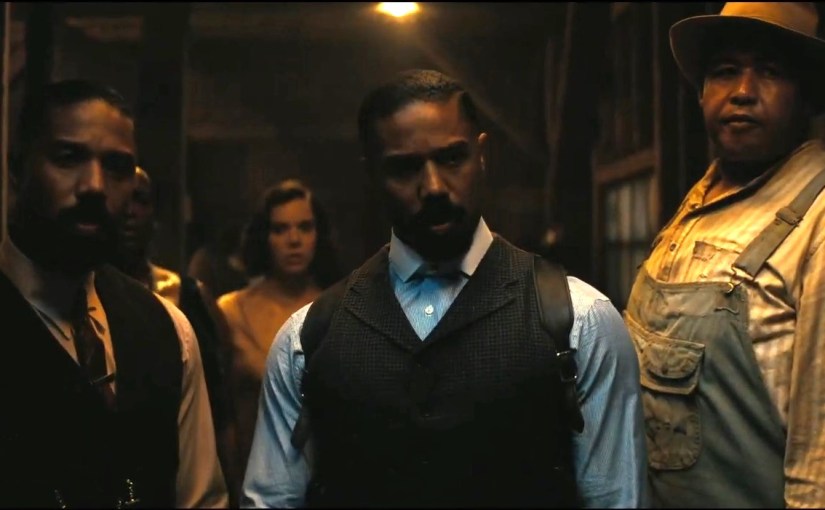
In Get Out, Daniel Kaluuya is Chris.  His girlfriend is Rose played by Allison Williams.  These actors are a perfect pair on screen but that’s about all I want to share with you considering their relationship.  

Chris is meeting Allison’s family at their home for their weekend.  It’s a beautiful, quaint estate off the beaten path from any intrusive neighbors.  Burrowed within the woods, this is a place to escape the stresses of city life.  Just like with any horror film though, the characters do not know they are operating inside a horror film.  The audience always does, and the best filmmakers find those frequent moments to get their viewers to squirm in their seat, tuck their knees under their chin, clench the butt cheeks maybe and say, “Don’t do that!,” “Don’t go in there,!” or maybe they’ll urge you to “GET OUT!!!!”

Nevertheless, the storyteller finds it important to bring up Barack Obama on more than one occasion???? 

Before they even get out of the car, the landscaper, a black gentleman, seems curious to Chris.  Friendly handshakes and welcoming hugs on the porch segue into the furnished home and there’s the maid, a black woman, who is as intriguing as the first black person to be seen.  Wouldn’t you know it but over lunch, you learn that tomorrow there’s the annual party gathering of friends.  Oh my gosh, was that this weekend?  

Jordan Peele doesn’t turn on the creepy music you may expect.  He relies on his visuals and while you are being as observant as Chris, you just might be alarmed and less sensible than he is.  That credit goes to Kaluuya, giving a reserved, contained performance.  This guy does not look like a hero in the least because he has instincts but seems to never look for a fight or a debate or the need to set an example.  An unexpected stop on the drive over demonstrates where Chris stands in a topsy turvy world of political divides in the twenty first century.  He just wants to make life easy.  So, he also will not make waves when that groundskeeper runs directly at him in the middle of the night.  This is just too freaky, but Chris tells us to just get through the weekend.

Rose’s brother seems like a weirdo from a Judd Apatow comedy, but he’s not being a clown.  Dad (Bradley Whitford) is a successful surgeon always ready with a relaxing tone and an open hug.  Mom (Catherine Keener) has done well as a psychiatrist performing hypnosis on her patients.  Yet, a late-night encounter with her leaves Chris feeling uneasy. Visually, it’s disturbing when he reflects on what he thinks he experienced with her.  However, he tries to give the family the benefit of the doubt especially when he shares his concerns with Rose.  Allison Williams is quite good with being convincingly dismissive.  I trust her, and I like her too. 

Then there’s the party the next day.  All the guests, primarily white, arrive exactly at the same time in a convoy of tinted black sedans and SUVs.  Chris doesn’t hide himself despite feeling awkward, and he doesn’t initiate the odd conversations with these middle age WASPs, but he politely keeps engaged with them.  Ironically, the strangest conversation he experiences is when he approaches a fellow black guest who is oddly dressed inconsistently compared to everyone else while his demeanor looks like he’s in a trance.

For comedic effect, Jordan Peele incorporates a best friend for Chris to confide in with opportune cell phone calls.  Lil Rey Howery is Rod and I can say, unequivocally, he is the best endorsement for the TSA. I do not recall seeing Howery in other films of late, but this actor deserves a long career for making a big splash in Peele’s busy picture.  Get Out would never be as inventive if Howery’s role is edited out.  Rod is the only other guy who, from a distance, can tell something is not right, here.

Get Out closes on an airtight ending.  Explanations for everything that is questionable is provided.  Yet, on both occasions that I’ve watched the movie, I think about it long after it’s over.  It takes some of the best elements you might uncover from The Twilight Zone, plus what you might have seen in the original Texas Chainsaw Massacre, and builds new ideas off of those circumstances.  

It is especially fun to read the IMDb trivia about the film to uncover a wealth of appropriate symbolism that does not jump directly at you.   You’ll appreciate how clever Jordan Peele is as a writer.  Froot Loops without milk in a bowl says much about a character.  Another character is engorged with the antler of a taxidermic deer head.  One character scrapes cotton stuffing out of an armchair.  Jordan Peele approaches his scary fiction with an educated eye.  

This movie is inventive.  Its horror does not seem redundant and thankfully the monsters are not vampires and zombies all over again.  There are new tactics at play.  There are fresh approaches to victimize the heroes, and there are creative ways to surprise the audience.  

Get Out is amazing the first time you watch the film.  On a second viewing, Jordan Peele’s story works like a class experiment in social standards while it still has fun by keeping you in triggering suspense.

THE LIFE OF EMILE ZOLA (1937)

by Miguel E. Rodriguez

DIRECTOR: William Dieterle
CAST: Paul Muni, Gale Sondergaard, Joseph Schildkraut, Gloria Holden
MY RATING: 9/10
ROTTEN TOMATOMETER: 92% Certified Fresh

PLOT: Prolific novelist and muckraker Emile Zola becomes involved in fighting the injustice of the infamous Dreyfus affair.


If you want to get me angry at the movies, you can do one of two things (besides leaving your phone on): Make a really terrible movie that makes me sorry I’ll never get those two hours back…or make a really good movie about some kind of social injustice, where those in power are so empirically wrong that any fool can see it, except those in power.  Matewan (1987) comes to mind, as do I, Daniel Blake (2016) and Do the Right Thing (1989).  William Dieterle’s The Life of Emile Zola falls neatly into that category, as well.

I’m tempted to give a play-by-play summary, but that would take too long.  In short, novelist and muckraking author Emile Zola is approached by the wife of Alfred Dreyfus, a French officer wrongly convicted of espionage and sentenced to Devil’s Island.  Mme. Dreyfus convinces Zola of her husband’s innocence, and Zola pens the famous J’Accuse…! article, an open letter published in the paper accusing the French military of antisemitism (Dreyfus was Jewish) and conspiracy.  The last act of the film covers Zola’s trial for libel.

The scenes that really made me angry were the ones where French officers planted, suppressed, or burned incriminating evidence of their own treachery.  Outright lies were paraded as fact, and the actual spy was acquitted in a court-martial of his own, just so the French government could continue the façade of Dreyfus’s guilt.  When the comeuppance arrives for the parties involved, it is immensely satisfying.  No one is drawn and quartered, which is what I would have preferred, but it’s good enough.

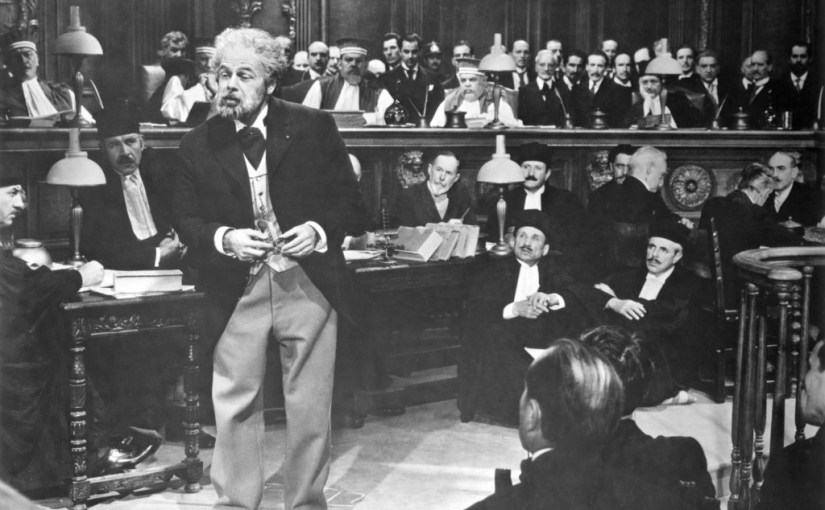
While the actor playing Dreyfus himself (Joseph Schildkraut) won the Oscar for Best Supporting Actor, it seems incredible to me that Paul Muni did not win for Best Actor that same year.  It went to Spencer Tracy for Captains Courageous, and I’m sure Tracy’s performance was exceptional, but Muni as Zola is pretty amazing.  He ages convincingly with Zola, from starving artist to a well-fed member of respected Parisian society, never less than convincing while playing a man much older than himself for much of the film.  The highlight is a late courtroom monologue that runs about six minutes.  It’s not exactly subtle screenwriting, but Muni makes the most of it.

The same could be said about the film’s screenplay as a whole.  It’s not the kind of story where the two sides have equal validity, so the script doesn’t have to be coy about where its sympathies lie.  There may be a few moments that feel like the film is preaching to the choir, but it nevertheless has great power.  That might just be me, though, given my proclivity for rooting against social injustice at the movies.

On the whole, The Life of Emile Zola is the tale of a life well-lived, punctuated by an incident that made Zola’s name immortal, and contains one of the best courtroom sequences I’ve ever seen.  It’s biography at old Hollywood’s best, not 100% historically accurate (as stated in an opening title card), but capturing the emotional essence of the story in a way no history textbook ever could.

THE EXORCIST (1973)

By Marc S. Sanders

Perhaps it is my Jewish upbringing or the fact that I’m not a spiritual person anymore, but what many consider to be the scariest movie of all time really does not alarm me that much.  William Friedkin’s The Exorcist is a superb demonstration in horror though.  Disturbing? Yes.  Unsettling? That’s an understatement.  Scary? A little bit. 

It’s not so much the threat of a random demon or the possibility of Satan on earth that chills me.  It’s this poor, sweet girl who has been unfairly taken advantage of that makes me shudder. 

William Peter Blatty adapted his best-selling novel into his Oscar winning screenplay and it succeeds so well because amidst all of the terror, there’s an education to be had.  Do any of us truly know or have witnessed someone who has been demonically possessed by an entity of pure evil?  I’ll be the first to come clean and say no.  Therefore, I’m intrigued as Friedkin’s film proceeds to observe how the decision to exorcise a demon from the shell of a pre-teen girl arrives.  Nevertheless, to me it is all fantasy.  I might just hold more faith in the Jedi practice of the Force than I do in the ideas of holy water, devilish idols or even what can befall you by flippantly using the name of Christ in vain.

Famous film star Chris MacNeil (Ellen Burstyn) is on location in Georgetown shooting her latest picture.  She resides in a furnished home with her twelve-year-old daughter Regan (Linda Blair), along with an assistant and a butler servant.  Regan is a fun-loving kid and adored by her mom.  Strange behaviors begin happening and all too quickly, the daughter is beyond control with patterns of activity that are anything but recognizable.  I can’t even describe most of the imagery.  I could never do it justice.

Doctors are quick to attribute Regan’s afflictions to a lesion resting on the cerebellum of her brain.  Yet, extreme procedures and x-rays show no medical disruption or disturbances.  I recall Friedkin’s director cut from 2000 inserted the questionable practice of dosing the girl with Prozac.  Before the supernatural is ever considered, the merits of science and medicine must be explored.  

Nevertheless, it is unbelievably bold how this personification puppeteers young Regan with vile actions of vomiting, uttering the ugliest vocabulary and committing terrible bodily harm and atrocities with a crucifix.  Blatty could have drawn the line with the slaps and punches Regan delivers to the doctors and her own mother.  The point would have been clear.  Yet only something that has to be tangibly real with no question of a joke or side humor, has to go this far.  It’s often sickening and demoralizing to the worst degree, but reality never compromises.  The drivers of this fiction wish to move this as far away from what’s not valid. It’s evident how convincing all the footage is within the film.

Following the mysterious death of Chris’ film director, along with an unheard-of recommendation from a physician, the idea of committing an exorcism to release whatever’s possessing the girl is suggested.  The problem is there is no expert on the subject of exorcism.  It seems absurd, and the Catholic Church is never quick to endorse the procession.  

During the first hour of the picture, a second story covers the personal conflict of Father Karras (Jason Miller).  One of his first scenes shows him arriving home to his ailing mother and removing his collar.  It’s a visual sign that the minister is questioning his own faith as he undoes his garb.  Karras may be a priest, but he also specializes in the study of psychology for his parishioners.  As he encounters Regan in her bedroom, he’s gradually assured that he is speaking with the demon who knows too much about himself.

A third story, which actually opens Friedkin’s film, occurs in Iraq where Father Merrin (Max von Sydow) is excavating through an archeological dig.  He doesn’t have much to say but his stoic expression tells us that his discovery of a medallion buried in the rubble, along with particular statue, spell dread.  It’s no accident that Friedkin places this scene often against the backdrop of a sun sparked, blood red sky.  

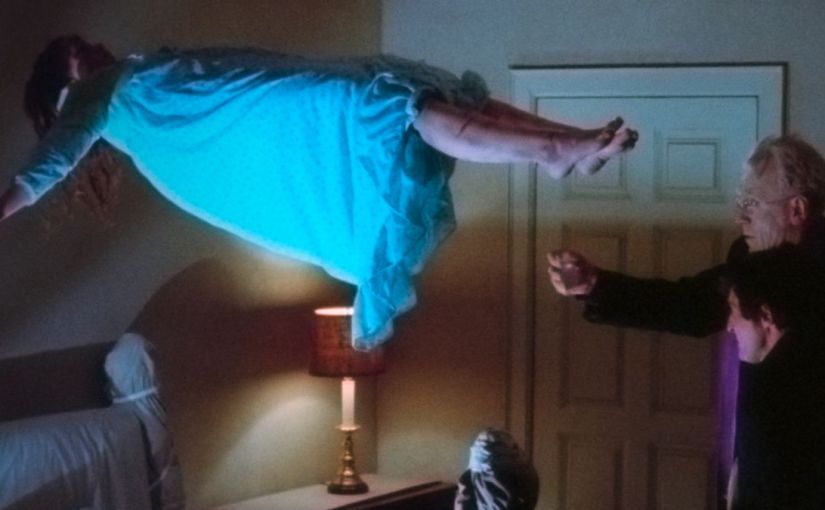
Eventually, all three stories intersect within the coven of Regan’s upstairs bedroom, where this demon taunts, cackles, teases and defies the power of the Bible and the Catholic faith.  This third act is impossible to take your eyes off.  Every second of imagery builds upon the power of the supernatural from moving furniture that charges forward like monsters on the attack, to ceilings and doors that split open.  The bed rumbles.  Demonic imagery appears out of the cold darkness.  It’s such a well-crafted sequence of events that is completely atmospheric.  

On what I believe is only my second viewing of the film, there are few things I noticed.  Chris is not a religious character.  So, when she evokes frustration, first at her ex-husband over the phone, and then at doctors and priests who lack explanations, she’s apt to shout “For Christ’s sake,” or “Jesus Christ.”  Variations of the word fuck is also adjacent to this dialogue.  Chris’ language could be a close second to the abhorrent verbiage coming from her monstrous daughter.  Blatty and Friedkin seem to imply how the son of God and the potential of Satan are so easily taken for granted.  Chris may be corrupted, but it is the innocent, young Regan who is trifled with.  There is nary a thing more disturbing in film than watching a child in peril.

Friedkin’s direction with Father Karras is consistently interesting as well.  Often, he positions his camera on a ground floor or at least pointed up to a level above to witness Karras’ ascents.  His faith is clearly shaken.  So, all he can do is rise and rise again, closer to a heaven that may still be welcoming.  Karras climbs flights of stairs or walks up sidewalk hills, to approach a vile intruder seeking to disrupt the purity of angelic youth.  

Only after I watched the film did I read that Linda Blair’s unforgettable performance was not the only contributing factor to Regan’s demonic possession.  Oscar winner Mercedes McCambridge who originally was not credited, supplied the scratchy, tormented and taunting voice of the demon.  It’s an unbelievable embodiment of a powerful villain.  Linda Blair was Oscar nominated for this role, but because she did not entirely own the performance, she likely lost to another child actor, Tatum O’Neil (Paper Moon).  The craft of Blair’s makeup all the way to her changes in eyes is a gut punch to the psyche.  Regardless, this is one of the most uncompromising and effective child performances I’ve ever seen in a film.

Max von Sydow donned aging makeup on his youthful forty-four-year-old complexion, and he looks straight out of another famous role from later in his career (Minority Report).  Richard Pryor and Saturday Night Live did a hilarious spoof on The Exorcist and for this nonbeliever I related to Pryor’s antics.  Yet, Max von Sydow takes what could have looked like utter silliness and convinces me that the ritual of exorcism is incredibly trying and exhaustively repetitive accompanied with the robes he dons to the holy scripture he reads from.  Merrin specifically instructs Karras not to directly respond to the demon.  Don’t even talk to it.  Merrin sticks to that practice.  Karras, the younger and less experienced sidekick, is drawn into the monster’s personal jibes.

Despite my position on religion and faith, I do not frown on what others value.  People find solace in their perceptions of God, the biblical stories, and the figures who teach. Religion often bestows a fulfilling life cycle.  Religion offers comforts through pain, loss, love and hope.  That’s okay. Everyone must follow their own path towards salvation. I tend to turn towards my personal psyche which I speak to daily.  

I watched The Exorcist off of a 4K streaming print found on HBO MAX, and the picture is positively striking.  Aside from dated fashions and cars of the early 1970s, the picture looks incredibly modern.  The themes of the film remain strong.  Hardly anything has ever matched the horror of The Exorcist.

I value everything in The Exorcist that Father Karras and Father Merrin heed to.  I believe in this story wholeheartedly.  Friedkin and Blatty, plus the cast enhance the authentication of demonic possession and how it operates.  This work of fiction, which Blatty claims to have been inspired by from an account of possession of a young boy during the 1940s, is a thousand percent genuine.  Within the moment and inside the confines of this picture this demon lives by overtaking young Regan.

How much did I believe it? Before bed last night, I made sure my little night light was on and I never walked into a dark room.   Every single light in the whole house was practically turned on.  

It’s not about the fear of God or the Devil.  It’s the fear I had for young Regan.

AMERICAN BEAUTY

By Marc S. Sanders

Lester Burnham declares in less than a year he’ll be dead.  When we meet him, he’s masturbating in the shower, sleeping in the back of the family vehicle on the way to work, and declaring that his wife Carolyn used to be lovely.  Heck, he’s acting like he’s dead already.  His life has nothing new or exciting to pursue.  His daughter, Jane, doesn’t give him the time of day.  He’s threatened with being laid off from his magazine call center job that he’s held on to for nearly twenty-five years.  What’s to live for anymore? 

I guess what’s complimentary about poor Lester is that at least he’s honest with himself.  All the other neighbors, except for the gay couple known as Jim & Jim, are just as unhappy it seems and might as well be dead too.  A common theme running through the suburban landscape of American Beauty centers on a sense of mental awakening. Who revives sad, lost folks like Lester and Carolyn?  Perhaps it’s the generation sneaking up behind them, who are on the cusp of taking their place in young adulthood. 

Lester is played by Kevin Spacey, in his second Oscar winning performance.  Carolyn is portrayed by Annette Bening who is way overdue for a trophy.  Jane the daughter is played by Thora Birch.  The headliners of this cast are outstanding in how different and disagreeable they portray a broken family that is forced to live in an unstimulating home while trudging through a lifeless marriage.  Look at the set designs within this film.  There’s an endless amount of blank walls within the interiors of the homes.  Almost no artwork or pictures are to be found. 

Lester pines and fantasizes about Jane’s best friend Angela (Mena Suvari) getting rained on with red rose petals while she lies naked in a pure white bathtub.  Carolyn, the real estate agent who can’t make a sale, sidles up to the dashing Buddy Kane (Peter Gallagher), her competition. Next door is Chris Cooper in a hospital cornered role as retired Marine Colonel Frank Fitts, with his near comatose wife Barbara played by Allison Janey, and their eighteen-year-old resourceful drug dealing son, Ricky (Wes Bentley). He takes advantage of his camcorder at any opportunity to collect the beautiful images found within the world he occupies and observes.  That could mean he’s capturing Jane in her bedroom window which faces his own.  Later, he’ll show you the freedom of a plastic shopping bag dancing within an autumn breeze.  An old shopping bag has more life among a breeze and brown leaves than Lester, Carolyn, Frank or Barbara.

There is a mystery to American Beauty that seems quite odd.  We know that Lester will die soon, but how and why? Maybe there’s a twist, because that outcome seems more and more impossible as we see Lester discover a spirited mindset to go after what he wants, when he wants and declare that he’s not going to allow himself to take shit from anyone particularly in his boring dead end job or from his unaffectionate wife.  Ricky, the kid with tons of money and electronics equipment, has nothing to lose because he’s not committed to anything at age eighteen and he can just quit an ordinary table-waiting job at any given moment.  Why didn’t Lester have the gumption to ever be like Ricky?   It seems so simple.

There’s a blink and miss it sign hidden in plain sight.  Pinned to the wall of Lester’s work cubicle is the message “Look Closer.”  Director Sam Mendes and writer Alan Ball gives the audience a subtle wink to dig within the cracks of suburban life sidewalks.  These homes may appear perfect on the outside, with neighborly neighbors, but if you watch with a more critical eye you’ll find an emptiness that has been unfilled for too long.  The filmmakers make it easy for you to uncover what eats away at the upper middle-class way of living.  Dinner with Lawrence Welk playing in the background is anything but uplifting.  It’s imprisoning.

When one member of this community opts to seize his moment, no matter if he’s motivated by a kid’s rebelliousness and the drugs he buys off of him, or the fact that he thinks a beautiful teenage blonde has the hots for him, he sets out to change.  He exercises and builds up his body, buys the dream sports car he’s always wanted, quits his job and grows to not caring how this may disturb his unloving wife. 

American Beauty seems to remind us how alive we can be when we are younger and not as restrained by the commitments it takes to live like adults with debts and parenthood and jobs and marriage.  Look closer though because couldn’t we live as well or more aggressively when middle age arrives?

The irony of Alan Ball’s script is that a boring guy like Lester Burnham discovers exciting things about himself just as the end of his life is approaching.  All he needed was stimulation.  He never saw his death coming, and you might forget he told you he will soon be dead, but American Beauty works to show how necessary it is to live each day to the fullest. 

I sound hokey.  I know.  Yet, that’s the direction of this film’s trajectory.  On the side, you observe those people who do not pursue what will fulfill their own lives and desperately need a modification.  Lester was limited to branch out. So is Colonel Fitts and his very sad wife.  So is Carolyn, and Jane and Angela, and maybe so is Ricky.  All of these people uphold facades about themselves to preserve a happiness on the outside when they really feel worse within. 

Sam Mendes is brilliant at drawing upon the subtle messages and insecurities of Alan Ball’s neighborhood characters.   About the only people that Sam and Alan do not dig deeper with is the gay couple.  I guess since they are happily out of the closet, what is left for them to conceal?

I could not help but compare Mendes’ Oscar winning film to Robert Redford’s.  American Beauty is more forthright than Ordinary People. Redford’s film draws out the ugly honesty of the family nucleus when an unexpected tragedy interferes.  Then it takes the entire film before the spouses take off their masks and truly declare how they regard each other.  It’s crushing to realize a sad truth. 

American Beauty rips off the layer right at the beginning, though.  A tragedy does not awaken these people to the natures that embarrass them.  Simply a hellbent, fed up mindset gets one guy going, and if that one member opens his eyes, then so will others because a simple disruption in ordinary life is next to impossible to live with.  Both films are so wise in how they criticize the very people these films were likely catered for.

What do these two Oscar winners say?  They tell the middle class, middle age American to simply look closer.

M*A*S*H

By Marc S. Sanders

Forgive me.  I’m not sure my position on Robert Altman’s film will be fair.  All my life, I think I deliberately eluded seeing the motion picture of M*A*S*H as I have been so accustomed to the classic television show that ran for eleven seasons on CBS.  As I expected the two properties couldn’t be further apart from one another.

Altman’s movie still carries a zippy kind of perspective to the horrors of war.  With their hands and surgical scrubs in the thick of gory, blood red surgery, the characters are so much more apathetic to the turnaround of wounded that arrive at the 4077th American mobile army hospital, located three miles from the explosive front lines of the bloody Korean War.  The well-known characters were first given live action roles here following the published novel by Richard Hooker.  

Most surprising is near the end of the film when two doctors realize they are being sent home. One surgeon who is in the midst of operating on a head injury actually instructs a colleague to take over.  This guy has his hands covered in brains and blood and chooses not to finish saving his patient’s life.  Alan Alda of the television show, as a writer, director or while portraying Hawkeye Pierce, would never respond in such a manner. Yet, this is the approach that Robert Altman chose to follow, having infamously always despised the TV series that eclipsed his film in popularity.

Altman’s movie is a slap in the face to the famed oxymoron called “military intelligence.” In 1970, we say bravo for finally saying something frank and honest while a Vietnam War has carried on far too long for not necessarily any of the right reasons.  It’s not so simple to declare war is hell.  It’s much more complicated and horrifying than that.

The film’s opening bylines are quotes by celebrated military leaders of the time, like MacArthur and Eisenhower.  However, these championed commanders are lampooned as we watch shlubby Hawkeye Pierce (Donald Sutherland) arriving in Korea.  He heads directly towards a General’s jeep and steals it, plain as day.  From there on, M*A*S*H operates like a precursor to Animal House with a series of hijinks and a lack of care for military leadership or the U.S.’s purpose in this conflict.  

About the only time, there is any care or forthright anger from anyone is when the jerky Major Frank Burns (Robert Duvall) chastises an underling.  Trapper (Elliot Gould) and Hawkeye punch his lights out and the schmuck ends up in a straightjacket.  Nonetheless, these guys could care less about criticizing and exposing the truth about the institution they have been drafted to serve.  Their purpose is not to make an ironic statement like a Doonesbury comic strip.  They just punch the commanding officer in the face and drink.  The TV show was at its strongest when it relied on the wit and delivery.  Trapper and Hawkeye never use irony or intelligence to belittle a buffoon.  They punch, or they embarrass an authority who’s taking a shower. Regretfully, it’s the dialogue that’s lacking. Robert Altman encouraged much improv on the set and overlayered conversations within his scenes. He found nothing organized or neat and pretty about war, including daily functioning. Chaos did not only reign on a battlefield.

The pace of M*A*S*H moves episodically, and it is likely what led to the idea of a half hour TV show that dominated the airwaves for the better part of eleven years.  A character called Painless contemplates suicide and so a Last Supper reenactment before he sends himself off is inserted. It’s a funny caption from these halfwits, but a storyline focused on deliberately ending a life does not connect with me in a humorous way here. Burt Reynolds, the dark comedy Heathers, and even more recently Tom Hanks toed the line of humor to be found in death by suicide. I think it worked better in those examples. With the somber, well known theme song of “Suicide Is Painless” that is forever linked with M*A*S*H, I just could not muster the laughs for this bit.

There’s also time to build comedy against another regular army brat like Major “Hot Lips” Houlihan (Sally Kellerman, also the best and most memorable of the cast).  The iterations of shower hijinks has been duplicated so often since the release of this picture. Therefore, this gag is dried up. It does not hold its impact fifty years later after dozens Porky’s movies. As well, there’s golfing off the helicopter pad, heavy drinking and a long, drawn-out final act of an overstayed football competition which leads to one of the first times the F-word was used in a mainstream American film.  

In 1970, Robert Altman delivered a bold, risky and daring film to counteract against a losing Vietnam War and the heroism of John Wayne’s bravado in war pictures.  The chutzpah to lash out against American politics likely felt relatable to many who saw different and more realistic images when they understood their young sons and daughters were not coming home and were thus forever changed.  Richard Hooker’s properties and stories lent an understanding to the animosity of those who forced the war on America’s children and loved ones.  War has never been consistent with the short film propaganda asking you to buy war bonds. M*A*S*H negated the heroism of Hollywood sensationalism found in machine gun fare and overtaking a hill while draped in green fatigues with shiny bronze ammunition hanging off their shoulders. These soldiers of war deserve our country’s utmost respect, but they did so much more than what John Wayne demonstrated. They offered up parts of themselves they would never get back.

M*A*S*H deliberately left out the heroes.  However, seeing the film for the first time, over fifty years later, I wish that at least we could follow the escapades of doctors who also directed a bed side manner to the pawns who were dying while upholding their leaders’ cause.  The doctors of Robert Altman’s interpretation hardly emulate a reason to care. 

The film interpretation of M*A*S*H is outdated of its time of release and the period in which it takes place.  I like to think we live more humanely than not just how our military leaders functioned.  I wished these physicians used their scalpels with a much less obtuse absence of empathy.  Hate the puppet masters, yes. Yet would it kill these guys to still care about the puppets? 

IT HAPPENED ONE NIGHT

By Marc S. Sanders

If you want to stay on top of how the world of American cinema evolved over the last hundred years, within all its categories, you must find time to watch the one film that paved the way for the romantic comedy, as well as the travel comedy.  Frank Capra’s Oscar winning picture, It Happened One Night, is the first of three films to win Oscars for every major category: Best Picture, Director, Screenplay, Actor and Actress. Nearly a hundred years later, the accolades still feel worthy.

Claudette Colbert is wealthy heiress Ellie Andrews who dives off and swims away from the captivity of her father’s yacht and buses from Miami to New York to reunite with her new husband, King Westly (Jameson Thomas).  Her father, Alexander Andrews (Walter Connolly), never approved of this marriage and insists his spoiled daughter get it annulled once she is found.  A ten-thousand-dollar reward is up for grabs to the person who finds her.

Along the way, a rogue reporter, Peter Warne (Clark Gable) ends up next to this young lady on the bus.  Complications ensue where their money gets lost, bags are stolen, buses are missed, and buses get stuck.  Then this trip becomes a walking experience.  Ellie has agreed to stay by Peter’s side though.  He promises to get her to New York as long as he gets to write about her story firsthand amid the constant headlines that recount Alexander’s desperation to get his daughter back.

It’d be easy enough if only Peter and Ellie were not falling for one another.

Sounds familiar, doesn’t it?  Any Nora Ephron script has the elements of It Happened One Night.  Screwball comedies with Cary Grant and Katharine Hepburn seemed to follow a similar blueprint.  To the best of my knowledge, Frank Capra’s film was first though.  

A famous scene has Colbert and Gable on the side of the road trying to hitch a ride.  Colbert’s bare leg does the trick that Gable’s outstretched thumb could not.  Eventually, this scene for the ages evolved into Meg Ryan and Billy Crystal daring to fake an orgasm effectively while dining at Katz’s Delicatessen.

When Harry Met Sally… is what easily comes to mind while watching It Happened One Night.  Peter will tease this spoiled rich girl. Yet, he will also be gentlemanly enough to put up a blanket to divide a cabin room he shares with Ellie, allowing for some privacy.  In the middle of the night though, the two will stay up chatting from either side of their blanket wall, as both acknowledge sad voids within their personal lives.  It’s parallel to how Harry and Sally would chat on the phone from their respective apartment bedrooms while discussing their newly evolving friendship with Casablanca on TV.  

Ellie and Peter become relaxed as their sojourn continues.  They could be left in the middle of nowhere with no money or food, but Gable and Colbert’s chemistry show an easy comfort to each other.  That is what’s expected of any troubled travel film.  At first Ellie does not want to share a rear bench on the bus with Peter.  She’s married to King and the purpose of this runaway trip is to be back in her new husband’s arms.  Plus, this odd fellow on the bus feels unseemly.  His charm is overbearing to the socialite’s proper petiteness.  He’ll resort to munching on a carrot he finds in a patch. She can’t find the appetite for it. Time together breaks down barriers though, just as movies in later decades eventually accomplished with films like Midnight Run and Planes, Trains & Automobiles.  This kind of formula, with ongoing new settings and circumstances, is almost guaranteed to end in positivity once the mutual antagonism is behind the pair.  

For 1934, It Happened One Night was bold in its content, ahead of an eventual ratings system intent on upholding an acceptable level of conservatism.  Colbert’s leg is the most unforgettable.  Later, Peter feels it necessary to spank Ellie.  Then there is the fact that the two share a room together.  Comedic circumstances and shock lend to the humor of this scenario.  Plus, there’s Claudette Colbert undressing down to her slip while a bare-chested Clark Gable is only one side of a blanket away from her.  

Would It Happened One Night endure an endless admiration if moments like these were contained? I doubt it.  Frank Capra’s film hinges on sexual appeal that feels naughty and rebellious.  

The dialogue remains witty.  Clark Gable’s introduction in the film while on the phone with his editor is a precursor to what an outlandish Bill Murray might have done with the script. The material is sometimes quite brash, and the ending, which has been duplicated hundreds of times since, is a perfect example of romantic escapism.  

Over ninety years have passed but unexpected romance is what remains treasured.  When two people with nothing in common begin an unwelcome journey together, it’s still easy to hope they find a way to like each other.  They have to like one another first before they can even concern themselves with falling in love.  The progress of this east coast bus ride allows for the stages to develop naturally.  Frank Capra, Clark Gable and Claudette Colbert were the first to give it a shot and it works brilliantly and beautifully.

ANORA

By Marc S. Sanders

Anora, or Ani as she prefers to be called, had to have been a character that writer/director Sean Baker always intended on loving.  Not in an intimate way though.  Sean Baker had to deeply care about this twenty-three-year-old girl who has no connections or family or solid friendships or kinships.  Baker wrote about Anora, wanting her to be appreciated by someone who would finally embrace her. 

Anora—sorry…Ani…has a good heart.  She may be an exotic dancer at a New York City strip club, but she is someone who has every right to be respected and valued. If you choose to watch the film you’ll know why, as a pertinent prop referenced earlier in the picture suddenly resurfaces when you least expect it.  A minute or two later the closing credits appear amid the sound of flapping windshield wipers and there is no music to cue your emotional response.  You likely will have spent the last two and a half hours laughing loudly, dropping your jaw, and gasping in shock at what unfolds for Ani. In the end though, you’ll realize that you want the best for her, like her creator did when he originally drafted this script and shot the film about Ani’s episodic escapades.

Sean Baker’s film is eye opening right from the start.  Club music blares within the HQ, the name of Ani’s strip joint where she collects an exorbitant amount of dollar bills while she strategically flirts with middle-aged men and frat boys looking for an evening of debauchery.  She has a talent for one on one charm with any customer, as she repeatedly bares her chest and reveals her thong, but she also delivers a very satisfying service.  A young man named Ivan, sometimes it’s Vanya (Mark Eydelshteyn), specifically requests a girl who speaks Russian to cater to his needs.  Ani is the only one who can comply.  Ani and Ivan get to talking, mostly in Russian but limited English too.  She gets invited to his private, deco mansion, which is really owned by his Russian aristocratic parents, and a slap happy relationship of sex and more sex, and money, and drugs and drinking and partying and New Year’s Eve partying and money, and clothes and expensive coats, and travels to Las Vegas ensue.  (Yes! I know that was a run on sentence.  My elaborate text does not even come close to what these twenty-somethings indulge in though.  It must be seen to be believed.)

Anyway, since they’re in Vegas, why not get married?  Vows are taken, the bride is kissed and Ani is emptying her locker at HQ for a promising future of being a spoiled, but loved, aristocratic wife.

In the few times that Ivan calms down, he is only engrossed in his online video games while Anora lies on his chest with an expression of wanting more than to come in second to Call Of Duty. Baker focuses on Ivan’s childish habit a few times.  So be sure to observe how Ani sadly looks upon an inattentive Ivan.

A problem occurs though that neither character could ever expect.  The tabloids have reported that Vanya, this spoiled brat son of a Russian oligarch, has up and married a prostitute. Now the family image is at risk of being shamed.  Mom and dad are on their way back to the states and have summoned Toros (Karren Karagulian), an Armenian Catholic priest and the son’s Godfather, to round up Vanya and the so-called whore to get the marriage annulled immediately.  Not divorced!  Divorce does not happen within the legacy of this family.  An annulment is what is needed. 

Toros rounds up Igor and Nick (Yura Borisov, Paul Weissman) to get over to the house right away, get the marriage license and bring the kids in for the quick annulment at the courthouse.  If only it were that simple.

Watching Anora allowed me to reminisce about other films that catered to outrageous debauchery and led to a domino effect of problems.  Doug Liman’s Go for example, or True Romance written by Quentin Tarantino, or even a super ridiculous comedy known as Very Bad Things with Christian Slater and Cameron Diaz.  The first two examples are very good films because the dialogue is sharp with eclectic casts who elevated simplistic material.  Let’s not talk about the third one, but I will say it is delicious junk food.  With Anora though, just when you think you know where this story should be going it doesn’t.  You think it will turn right, but then it makes a sharp left and Sean Baker knows he just needs to keep the fighting and the screaming and the cursing at an organic natural level.  What do you do when the wards you are put in charge of will not cooperate?  What if one of them goes missing and simply won’t answer his cell phone?

Well, on a cold winter night you may get a broken nose, car sick, and your car might get towed.   Anora is not about big stunts or gratuitous violence.  It’s not mobster movie material either.  Anora works naturally for people in desperate situations, from a handful of different perspectives.

Oh yeah.  Anora—sorry Ani, is played by Mikey Madison and she is bound for marquee attraction over the next twenty or thirty years.  This performance is so concentrated in moments of natural glee, anger, and maybe despair and sadness.  You applaud her character’s strength.  Ani talks like an updated version of Judy Holliday from Born Yesterday, but she’s no dummy and she never succumbs to intimidation.  I’ll confess it right here.  If two hulking Armenian thugs approach me, I’ll do whatever they want me to do. Ani gets all my props though.  She will never settle.  She’s a married woman and no one will deny her of her rights.

Mikey Madison has such wonderous chemistry with Sean Baker’s camera.  There must be over a hundred and fifty close-ups on this young actor and each one is unique.  I was sad for Anora when Ivan would not give her attention.  I was cheerful when the two were overindulging in carefree sex and sin city fun.  I was on Anora’s side when she was restrained. I was admirable of her giving a good fight to the giants that enter her space.  I was exhausted with her as she was forced to sit in Toros’ car while brainstorming where her husband could be.  I was supportive when she makes appeals with the family to offer a good first impression.  She hates her name, but she introduces herself as Anora to Vanya’s steely mother. Ani is willing to make all of this work. Finally, I was angry—very angry–alongside of her whenever she was unfairly treated like garbage. 

Amid all of the chaos that ensues, Sean Baker works like the eyes of the film’s audience. We keep guard over Ani’s condition and state of mind as she’s coerced into looking all over Brooklyn and Coney Island for her new husband that the Armenians need to find before the boy’s parents arrive by noon the next day. 

None of the dialogue is crafty like Quentin Tarantino’s or Neil Simon’s.  I could not quote a single line.  The yelling and conversations and overtalking and interruptions are natural and raw.  Sometimes, the exchanges feel pointless until you arrive at another scene that demonstrates with brilliant insight why certain throwaway moments are preserved in the final print of the film.  It makes complete sense that Sean Baker did not just write, produce and direct this film.  He edited it as well. 

The whole way through the picture I kept wondering how this story would end.  I spelled out variations of doom for any one of the characters.  I considered gratuitous violence or swashbuckling adventure and daring escapes.  Man o’ man, have I become cliché.  Because just as you arrive at the picture’s conclusion, a meaningful prop puts the period at the end of the story and the last audible expression before the picture goes to black comes from Anora. You now realize that this girl, who is as self-reliant as many exotic dancers must be, has feelings too.  As defiant as Anora can be, she can also get pricked and bleed and the big laughs you responded to for most of the film are distant memories. Anora can feel pain like any of us.

When I drove home, I was hurting.  I was hurting for Anora, and my one wish is that I hope Anora will be okay.

Roger Ebert once gave a seminar that lasted for eleven hours as he commented on practically every shot and piece of dialogue in Tarantino’s Pulp Fiction.  My long shot wish is that on a subsequent viewing of Anora, I can deliver a similar kind of observational lecture to others who had already seen the film too.  I believe I could reveal sincerity and perception related to every close up, every chaos-stricken scene of panic or decadence, and especially when that one prop reappears. I’d likely spend a half hour simply discussing the value that this prop carries and what it means to Sean Baker’s film, and especially to Ani.

As messy and gritty as Anora may appear, it is also one of the most adoring and perceptive films to be released in a long time. 

Anora must be in my top five favorite films of 2024.  It might just be my favorite.  There are a few other candidates, but I left feeling so satisfied with Mikey Madison’s performance and Sean Baker’s sloppy, yet astute, little film. 

This is superb filmmaking.

MRS. MINIVER

By Marc S. Sanders

To watch a classic film, usually reserved for Turner Classic Movies, is to get a history lesson while realizing that people’s perceptions have hardly changed.    In the early 1940s as World War II was occurring, happiness in many corners of the world was still moving forward.  Presently, I believe that happens today.  For example, Israeli hostages are only now being released from Hamas.  Until the conflict is over though, a childhood friend of mine chooses to run every Sunday morning.  He declares that he runs because they can’t.  This friend is not a soldier bearing arms.  He is acknowledging a violent and frightening conflict that persists.  On the side, he’s a devoted New York Yankees fan.  In 1942, when William Wyler’s Oscar winning film Mrs. Miniver was released, the well to do characters were performing comparably as Europe was in the thick of staving off the Nazi militia.

Mrs. Miniver opens on a bustling metropolitan district in England.  The title character, Kay Miniver (Greer Garson), is in a mad rush for something.  She hops on and off the double decker bus and weaves her way through the crowd.  Finally, she arrives at the destination.  The glamorous hat she’s had her eye on is still available to purchase.  Her only dilemma now is what will her husband think when he learns of the extravagant purchase.

Upon her arrival home, Clem Miniver (Walter Pidgeon) hides from his wife in a brand new convertible.  When she goes in the house, he makes a decision.  It’s expensive, but he must have the car and so he buys it.

In this tranquil part of England, the most immediate concern among these well to do people is deciding whether or not to treat themselves to gifts that will bring them joy.  Talk of a German invasion seems like a possibility, but the Minivers, with their two young children and their twenty-year-old son at Oxford, insist on living comfortably and happily.

Lady Beldon (May Whitty) is the elderly and intimidating aristocrat who suffers a terrible dilemma.  It seems the bell ringer, Mr. Ballard (Henry Travers), has grown a beautiful rose that looks like no other.  He cherishes it so much that he names the flower “Mrs. Miniver.”  The real person is honored for the personal recognition.  Yet, Lady Beldon’s concern is her yellow rose will not win this year’s prize trophy cup at the village flower festival.  Her granddaughter Carol (Teresa Wright) gracefully asks Kay if she’ll convince Mr. Ballard to withdraw his entry so that her grandmother can win once again.  She’s elderly, she’s accustomed to winning each year, and it would mean the world to her.

This request will also lead to a romance for Carol with the Minivers’ son Vin (Richard Ney), who has just enlisted in the Royal Air Force so he’s ready to fight the Axis forces of World War II.

All of this seems frivolous during the first half of Mrs. Miniver.  These people live comfortably but gradually grow a little more unsettled as they soon hear planes flying overhead their homes while the sounds of battle play off in the distance.   The possibilities of war coming to their front door seems to be an unlikely scenario.  The battles and bloodshed are out of sight, but only partially out of mind. 

I appreciate the editing of this film.  Clem is woken in the middle of the night to join the other neighboring husbands at the local saloon.  They are being requested to join the historic small boat rescue at the battle of Dunkirk.  The men down a drink and sail off without hesitation.  No one gives protest or stands behind their wealth or stature.

Midway through the picture, Kay is reading a bedtime story to her children in a dimly lit room.  We never see the entirety of this cramped space.  The scene simply begins with no transition.  The walls appear to be made of aluminum and then I realize the Minivers have taken shelter in an underground bunker.  Soon, they will be living through one unimaginable night of shelling and bomb dropping. Director William Wyler never turns off the camera through the extended sequence.  The bunker shakes and rattles.  The children cry in fear.  Dirt rains down them.  Books and belongings fall among the family. The pounding explosions carry on outside.  It seems to never end and the concern over a lady’s fashion hat or a beautiful new automobile are distant memories.

When Vin and Carol arrive home from a honeymoon, the Minivers home is wrecked.  So is Clem’s boat following the Dunkirk incident.  However, they happily remain living there with the youngest child playing a welcoming number on the piano.  

Amid all of these episodes, the people of this small English town uphold their positivity, but they never lose sight of what is nearby.  It’s just a house.  The Minivers are surviving and remain together.  Their biggest concern is that one day Vin won’t return from battle. Yet, time and again he does with hugs and kisses for everyone.

I’ve provided a lot of what occurs in Mrs. Miniver because I was not entirely sure of the purpose of all of these happenings until the final act is served and surprising outcomes arrive.  For much of the film, William Wyler delivers an impression of life away from the front lines.  These people live with a devotion to help their country and abandon comfort when necessary. Flower festivals, gleeful children, young romance and materialistic tranquility will carry on regardless of terrible interruptions of war.

Amid turmoil in our present state with political divides, unjust prejudice, natural disasters, and a resurgence of Cold War threats, I can’t help but wonder if many of us live like this family.  I believe we do, and I see nothing wrong with that.  We have to escape and live happily no matter what terrible future might befall us because otherwise what is the purpose of living?  Still, we choose to remain alert and especially empathetic and ready to aid our fellow neighbors when the need arises.

Visually, a shocking set design for the final scene of Mrs. Miniver sends a message that is only enhanced by a sermon delivered by the town minister.  I learned later that this speech was written at the last second by William Wyler and the actor portraying the minister (Henry Wilcoxon).  It perfectly demonstrates the overall purpose of the entire film.  Mrs. Miniver is the story of a fight for ongoing freedom; an independence to live and to treat oneself happily and lovingly.  People perish during the course of the picture.  The minister explains with convincing validity why they had to die so undeservedly and unexpectedly.  It’s an ending that really touched me, and upon the movie’s conclusion a message appears urging Americans to buy war bonds.  

This speech had such an impact at the time that it circulated in propaganda films and on radio airwaves as a means to deliver a shared triumph among the Allied masses.  It reminded people that simply because you live at home, does not mean you are exonerated of the fight for continued freedom.  The fight is not exclusive to hoisting a rifle or dropping bombs from planes.  A unified front of country must be upheld.  

Mrs. Miniver begins as a romanticized film of people living glamorously and happily but it effectively segues to a reality of uncertain times.  I went from questioning what is its purpose to an understanding of a reason to live and to strive.  

A BEAUTIFUL MIND

By Marc S. Sanders

The genius was always easier than living with the monsters in his mind.  So was the dilemma that consistently plagued Nobel Prize winning Professor John Nash.

Ahead of seeing A Beautiful Mind for the first time, what you don’t know about Professor Nash is what will dazzle you the most when Ron Howard uncovers the mysteries he lived with during graduate school and on through his fellowship at MIT and with his enduring and loving marriage to his wife Alicia (Jennifer Connelly in an Oscar winning role).  John Nash is masterfully portrayed by Russell Crowe in a celebrated, nominated performance.

Dr. Nash comes off like a genius savant when Howard’s film introduces him in 1947 at Princeton University.  The director adopts a technique of presenting much of Nash’s depths and highlighting patterns and numbers in magazines or on chalk boards or even within the reflections that appear before his eyes in bright sunlight.  On a clear night, see if you can find an umbrella within a starry sky. 

For many of us, I presume it’s hard to decipher what it means to live the life of a mathematical genius. Ron Howard with Akiva Goldsmith’s hailed adapted screenplay does not expect anyone to comprehend formulas or equations.  The filmmakers simply ask you to witness how discovery is processed.  Nash writes endlessly on his dorm room windows.  He fills up every inch of the chalk boards at his disposal.  He tears apart articles in magazines and wallpapers his room and office with them.  Even when he is not writing, he is computing how situations will end up best towards his and his peers’ advantage. There’s one curvaceous, blond woman standing in the center of a bar for one of the men to hopefully have a tryst with, but then who will be left to pair with the dark-haired ladies that surround her?  Nash finds the logic in all of the men abandoning the blond.  The genius realizes what none of us can see.  Go for what no one would ever expect to have occurred.

Despite the professor’s odd ticks, unwelcome vernacular and his lack of social skills, a well-established livelihood works out for him.  He falls in love with a former student that he marries, Alicia, and he obtains a fellowship for himself and two Princeton comrades to practice out their theories at MIT.  Personal companionship arrives with his former roommate, Charles (an energetic Paul Bettany), and his niece.  On the other hand, John has also been recruited to become a code decipherer for the government and he must answer to a mysterious gentleman named Parcher (Ed Harris) who is using John to stay a step ahead of the Soviets.   John’s work must remain top secret and as his clandestine activities become more threatening and intense, so does the paranoia get increasingly overwhelming.

I’ve only covered the first act of A Beautiful Mind because when the truth of John Nash’s purpose and how he is regarded is revealed, this biography becomes something much further from how it began.  Akiva Goldsmith’s trickery in his script is capable of surprising an audience when some veils are lifted for both the primary subject of this piece and those who come in and out of John Nash’s life.  This is a true story but it’s incredibly surprising that a mathematical wizard like John Nash could be living a whole other life that makes little sense at first.

Ron Howard is doing some fine work here reaching for material that might feel familiar with other cinematic geniuses in film ranging from the fictional Will Hunting to more recently real-life figures like Mark Zuckerberg. Characters like these stand out for their quirkiness and oddities.  With Russell Crowe’s brilliant characterization of awkwardness in his uneven walk and how he carries his papers and briefcase, it is not hard to adapt to the man on film.  What he says and how he speaks would leave any one of us to roll our eyes at his behavior.  You’d likely chortle at John just as his Princeton classmates do.  Later though, you understand how valuable his accomplishments are to a greater good, and at the same time you become alarmed at how Dr. Nash is being used both from his own perspective as well as by those figures who unexpectedly enter his life and will not just leave.

Jennifer Connelly’s role does not amount to much at first.  With her alluring looks that have graced other films in her earlier career, she initially comes off as a token spouse to the main character and you remind the person sitting next to you that is actress Jennifer Connelly who got her start in Labyrinth with David Bowie, and Once Upon A Time In America with Robert DeNiro.  Yet, as more dynamics are revealed about her husband does the character Alicia show through, and she has no choice but to survive with her spouse’s torment.  Connelly has a scene that will crush you when she must unleash her frustrations in the middle of the night as well as sporadically throughout the film. She has to be carefully observant of her husband’s behavior for the safety of their child and herself.  Ron Howard sets up scenes that haunt Alicia only, and his wide camera work is absolutely eye opening as it lends to her personal performance.

It’s fascinating to observe John Nash’s willpower as he persists to live with personal demons while upholding the demands of his genius.  This film works on so many levels of enhanced editing and perspective, but without unforgettable work from Russell Crowe, Jennifer Connelly, and a supporting cast of character actors like Christopher Plummer, Josh Charles, Judd Hirsh, Ed Harris and Paul Bettany it could not sustain its staying power. 

A Beautiful Mind is a thoroughly effective biography.

ON THE WATERFRONT

By Marc S. Sanders

Terry Malloy innocently calls up to his friend Joe’s window and tells him to go to the roof of his apartment building to check on the pigeons.  Only what happens to Joe when he gets there is not what Terry expected setting off a complex dilemma of morality and preservation of life.

In one of Marlon Brando’s most famous roles, Terry Malloy is an ex-prize fighter who now carries out menial tasks for the New Jersey mob bosses that have a foothold over the longshoremen and their union contracts.  Terry listens to what his mobster brother Charley (Rod Steiger) tells him to do.  As long as he keeps his mouth shut, he’ll be selected each day on the dock for work and he’ll never have to lift a finger.  Just let things be and keep quiet.

Charley’s boss is Johnny Friendly (Lee J Cobb), who is ruthless with his control over the area. The guys have to surrender to the demands of Johnny and his toughies because it is no secret what really happened to Joe and who was responsible.  The cops can investigate and ask questions, but they’ll get nowhere.  It’s up to Father Barry (Karl Malden) to talk some sense into the fellas, and considering Terry was one of the last guys to see Joe alive, he’s the best option to overthrow Johnny’s reign.  If Terry shows up for a subpoena, it could put Johnny and his goons out of business.

Another conflict of interest for Terry is that he has taken to Joe’s sister Edie (Eva Marie Saint) who also knows of Johnny’s corruption.  She just has not realized that Terry might have been indirectly responsible.

Marlon Brando looks everything like a movie star should.  His slicked back hair and dark eyes shadowed by his thin eyebrows and the way he carries himself in a plaid winter coat is held in a permanent memory just as James Dean and later pop culture figures like Fonzie, or Tom Cruise and Brad Pitt evolved.  It sounds silly but there’s a reason Madonna lends recognition to the classic actor in her club song Vogue, and this is one of many films in his early career to reference for the honor. 

Eva Marie Saint is wonderful as the young woman in pain and confusion following the death of her brother.  Edie is as least as conflicted as Terry due to her immediate attraction to the tough guy’s charms while still bent on discovering who had her kind brother killed and why.  Brando and Saint have a magnificent scene together when the truth comes out and Leonard Bernstein’s music comes to a halt of silence.

On The Waterfront has an irony of life imitating art.  Mind you, I’m not here to provide a history lesson and wallow in political divisions.  I find it interesting that Terry Malloy’s dilemma is whistle blowing the corruption that occurs, while also being intimidated to keep quiet.  Patterned similarly is what director Elia Kazan infamously became known for when he testified during the Joseph McCarthy hearings against people in Hollywood suspected of having communist ties.  A Union community is designed to protect its members, but sometimes the dynamics lead to just one who is singled out to expose what is not cooperating legally and accordingly.  (Some of the actors were against working on this film because of what Kazan committed but they were bound by studio contracts.)

I am aware of how much On The Waterfront is hailed as a perennial classic.  The cast is an outstanding collection of actors beginning of course with Brando, Malden, Steiger and Cobb.  Following television appearances, this was Eva Marie Saint’s first film, and there are other uncredited actors who had not made their mark yet including Martin Balsam, Michael V Gazzo, and Fred Gwynne.  The film boasts Oscar nominations for five actors (two wins, for Brando and Saint respectively) as well as wins for Best Picture, Director and Screenplay.  All that being said and yet I cannot say I felt invested in the film. 

The characters’ plights and pains simply did not connect with me.  Actually, while I believe I’m expected to yearn for Terry Malloy’s pain and regret where he declares he “…coulda been a contender…,” I felt sorrier for his brother Charley. 

In that well-known scene between the two brothers in the back of the cab, it is Charley who is really torn.  Charley is tied to his mob boss, Johnny Friendly, but he has to convince his brother to do what is best to protect the mob he’s committed to, or it could get both of them killed.  That famous scene is owned more by Steiger than Brando.  An interesting fact is that Rod Steiger had to perform most of that scene without Marlon Brando there.  The lead actor would leave the set at 4pm sharp each day, leaving Steiger to do his half of the scene with a stand in reading Brando’s lines.  It caused a bitter rift between the two actors.  Yet, the next time you catch the film, have a look at who is really doing the heavy lifting.

I might have gotten trapped trying to understand the way the union operates and how the mob manipulates everything to their advantage.  I’m lost in some of the early dialogue and how people go about doing what they do.  Maybe what I should have done is relax my train of thought and take in how the protagonist is pulled in many different ways, none of which seem like a winning solution. 

Out of context there is a selection of great scenes on display.  Karl Malden is magnificent when he urges the longshoremen to stand up to the brutality and intimidation they are under.  His concentration is amazing as he is pelted with trash while holding his composure.  This scene won him his Oscar nomination.

Lee J Cobb is a memorable antagonist. The concluding scene between his Johnny Friendly and Terry stands as a final battle between hero and villain and the residual effects of what was shot of that bout have been honorably repeated in many films thereafter. 

There’s an obvious influence that stemmed from On The Waterfront.  Clearly, much of the material had an enormous influence on future filmmakers like Lumet, Scorsese and Coppola.  Perhaps that’s the reason it did not grab me.  Those future directors turned the motifs that Kazan provided into flashier segments of color and trick camera work.  Even the inclusion of harsh language in those grittier, later films left me with a more convincing authenticity.  Then again, I was shocked to see Terry Malloy tell Father Barry to go to hell.  Pretty bold for 1954, and still somewhat shocking within the context of the piece.

On The Waterfront is actually based on fact from happenings at the docks off of Hoboken, NJ where most of the film was shot.  To watch it today is to look back at what high stakes dramatization and dilemmas of ethics surrounded by death and crime must have looked like.  It does feel outdated to me, showing a period that is long past, but it paints its truth very, very well.