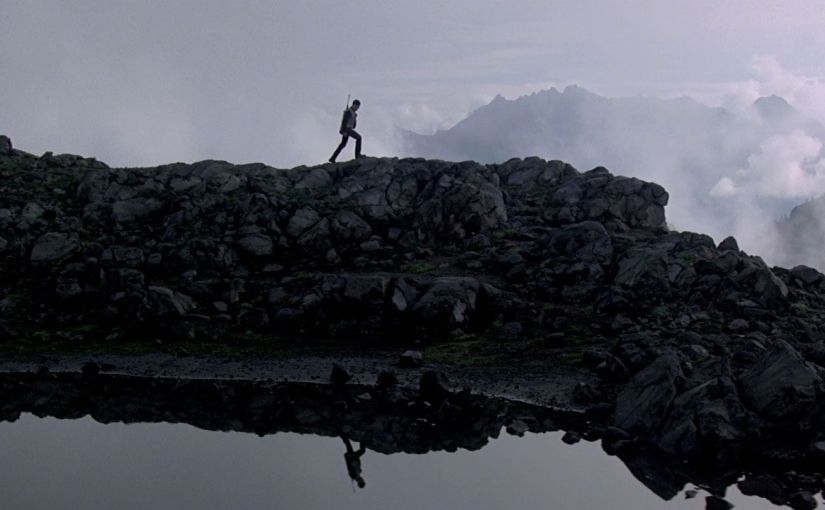
THE DEER HUNTER (1978)

by Miguel E. Rodriguez

THE DEER HUNTER (1978)
Director: Michael Cimino
Cast: Robert De Niro, John Cazale, John Savage, Christopher Walken, Meryl Streep
My Rating: 10/10
Rotten Tomatometer: 86% Certified Fresh

PLOT: An in-depth examination of the ways in which the Vietnam War impacts and disrupts the lives of several friends in a small steel mill town in Pennsylvania

[Author’s note: This will be the first in an ongoing series of reviews inspired by a book given to me as a birthday present by my long-suffering girlfriend.  Entitled Everyone’s a Critic, it challenges readers to watch a movie a week within a given category, then answer questions like, “Why did you choose this particular film” or “Do you feel this film deserved the award? Why or why not?”  Clearly designed to inspire discussion.  This category was “A Film That Has Won Best Picture.” This format is a work in progress, so I hope you’ll bear with me on future installments.

I am going to assume, for the most part, that most readers will have seen the movies being reviewed in this series.  Therefore, some spoilers may or will follow.  You have been warned.]


Once about every couple of years, I like to pick up and read Stephen King’s The Stand in its original uncut version.  My paperback copy runs to 1,141 pages, not including King’s foreword and a brief prologue.  Even Tolstoy would look at that thing and go, “Dude…edit yourself.”  But having read it numerous times now, I cannot imagine what could possibly have been excised from the edited version of King’s novel.  Every detail of that apocalyptic saga feels necessary.  Reading it is like falling into a fully realized alternate universe.

That’s what watching The Deer Hunter is like.  I can still remember the first time I watched it.  I knew its reputation as one of the greatest Vietnam War movies ever made, had heard of its harrowing Russian Roulette scene, and was intensely curious.  I popped it into the VCR, hit play…and for the first 70 minutes I got a slice-of-life drama about steel workers in a tiny Pittsburgh town (Clairton, for the detail-oriented) where, mere days before three friends ship off to Vietnam, one of them is getting married.  And the centerpiece is the wedding reception.  Ever watch a video of a wedding reception?  How high do you think a young teenager would rate its entertainment value on a scale of 1 to 10? 

I could not appreciate, as I do now, how vital this scene is.  Relationships are stated, expanded upon, and brought to a kind of cliffhanger.  Take the mostly non-verbal interplay between Linda (a luminous young Meryl Streep) and Michael (Robert De Niro).  Linda is clearly in a relationship with Nick (Christopher Walken), but it is painfully obvious that Michael and Linda have eyes for each other.  Mike watches intently from the bar as Linda dances at the reception, and whenever their eyes meet you can almost hear their hearts stop beating.  The oblivious Nick even pairs them on the dance floor while he visits the bar himself.  The awkwardness as Michael forces small talk and Linda shyly reciprocates is palpable.  And…is that Nick giving the two of them the eye at one point…?

As a kid, I wondered why this soap opera nonsense was necessary in a Vietnam film.  Of course, I didn’t know what was coming.  That’s the beauty and wonder of The Deer Hunter.  It challenges you to follow along with this miniature melodrama to give meaning to what comes next.

There is a key moment during the reception when an Army soldier wearing a green beret stops by the reception.  Mike, Nick, and Steven (John Savage), who are gung-ho about serving their country, yell their support and let him know how much they’re looking forward to killing the enemy.  The steely-eyed soldier raises his glass, looks away, and says, “Fuck it.”  It’s not terribly subtle, but the ominous nature of this moment always fills me with a sense of foreboding, even having seen the film many times by now.

But even after the reception is over, there is one more small-town pit stop to make before the movie gets to Vietnam.  (In fact, The Deer Hunter spends surprisingly little time in Vietnam.)  Michael and a group of friends including Nicky and Stan (John Cazale) go hunting for deer in the mountains as a kind of ritual before Nick, Mike, and Steven are deployed.  It is in this sequence that Oscar-winning cinematographer Vilmos Zsigmond’s talents are put to stunning use.  We are shown vistas of the Allegheny Mountains that are simply breathtaking, with Mike and his friends seen as mere dots in the mountainsides.  Choral music with a men’s choir singing in Russian is heard on the soundtrack, giving the sequence a majestic aura that must be seen and heard to be believed.

Then the hunt is over, and the boys all have one last drunken night at the bar owned by another friend, John (George Dzundza in an under-appreciated, realistic performance).  Here they all sing along to Frankie Valli and listen somberly as John plays a sad classical tune on his piano.  And then, in one of the film’s masterstrokes of editing, we slam-cut immediately to the jungles of Vietnam – no boot camp, no footage of them being trained or flown over there, just suddenly they’re there and the contrast between the carnage we experience in the first few minutes of Vietnam versus the rhythms of their lives in Clairton could not be more extreme.

In a horrific but mercifully brief sequence, we watch as a Viet Cong soldier calmly walks into a burned-out village, discovers a hidden pit holding terrified villagers, and remorselessly tosses a grenade inside.  We then watch as Mike, now a battle-hardened soldier, emerges from a hiding place with a flamethrower and burns the VC soldier alive.

The effect of this scene cannot be understated.  To witness Michael torching a soldier, even after that soldier committed a brutal act himself, is jarring.  And why is it so jarring?  Because we have seen Mike as a civilian, as a friend, as a would-be lover, during that lengthy sequence at the wedding reception and while hunting with his friends.  Admittedly, you got the sense that he could or would get violent if necessary.  (He’s clearly the alpha male of his “clique.”)  But this…I mean, damn.

Then, in one of those Hollywood conveniences that never get old, Mike is unexpectedly reunited with Nick and Steve who just happened to arrive at that very same village with another platoon of US soldiers.  And then, immediately after being reunited, they are captured by enemy forces, imprisoned with several enemy combatants in a riverside compound, and forced by their sadistic keepers to play Russian roulette with each other as the guards bet on the outcome.  Michael comes up with a horrifyingly logical escape plan: convince the guards to put THREE bullets in the chamber instead of one.

Much has been made regarding the historical inaccuracy of this scene.  To those arguments, I say: who cares?  As someone once said, riffing from Mark Twain, “Never let facts get in the way of truth.”  The truth of the matter is, the Vietnam experience was a modern-day horror show, leaving physical and psychic scars on its participants and on our country.  In my opinion, the Russian roulette scene can be interpreted as a symbol of how those soldiers, or ANY soldiers, must have felt every single day.  Going on a routine patrol in the jungle could have potentially lethal circumstances.  They rolled the dice every time they called in an airstrike, betting they didn’t get firebombed themselves.  Booby traps were everywhere.  How is life in a war zone that much different from being given a one-in-six chance at living or dying?

I’ve already gone into far more spoilers than I am accustomed to, so let’s just say this happens and that happens, Michael winds up making it back home, Steven is grievously wounded in the escape attempt, and Nick goes AWOL when, after making it back to a military hospital in Saigon, he wanders the streets at night and discovers an underground ring of lunatics who run a high-stakes game of Russian roulette.  And we’re still just at the mid-point of the film.

When we see Michael back home, the earlier sequences establishing the rhythms of small-town life and his feelings towards Linda, for example, all come into focus.  We need that reception and the hunting scenes so we can see how much Michael has changed.  For example, when Michael is arriving back home by taxi, still in full military dress, he spots a huge banner: “WELCOME HOME MICHAEL”.  He tells the driver to keep going.  In a hotel room later that night, he sits on the edge of his bed and rocks back and forth, winding up crouching against the wall.  He is completely unable to process how to deal with people anymore.  Or, at least, he doesn’t trust what he will or won’t say.  I watch that scene, and I feel such intense sympathy and empathy.  What he’s feeling, what he’s been through, what he’s seen, is so huge that he knows he’ll never be able to explain it to anyone who hasn’t been there.  He knows he’ll get questions like, “What was it like?  Did you kill anyone?  How are you feeling?  Where’s Nicky?”  I’ll never know what it’s like to fight in a war, but if I had gone through what he’d gone through, I wouldn’t have stopped either.

There is a heartbreaking scene where Linda, who is more than a little distraught that Nicky is AWOL, hesitantly suggests to Michael that they go to bed.  “Can’t we just comfort each other?”  Mike rebuffs her, but in a way that makes it clear he’d like to, regardless.  De Niro’s performance here is staggering.  As he walks out, he makes a statement, showcasing how much he is feeling but also how unable he is to articulate it: “I feel a lot of distance, and I feel far away.”  I knew exactly what he was talking about.

The very end of The Deer Hunter is one of the most emotionally shattering finales of any movie I’ve ever seen.  It ends with a simple song, first sung as a solo, then joined by everyone else at the table.  I will not reveal what happens to get us there.  Is it shameless manipulation?  Yes.  Does it work?  Yes, so I can forgive the “shameless” part.

One of the criticisms I’ve read more than once about The Deer Hunter is how “one-sided” it is.  To which I say, “Well, duh.”  The Deer Hunter is not presented as a history lesson or a lecture on the internal politics in the country of Vietnam during the war.  The Deer Hunter is intended to make us feel something.  It wants to show us what happens to a person who is exposed to the very worst side of human behavior and lives to talk about it.  It wants to remind us that a country can wave a flag and stand for what’s right and be willing to sacrifice its best and brightest souls for a righteous cause…but it must also be prepared for the aftermath.  The Deer Hunter is a somber prayer that our country remembers the cost it demands, and that it will take care of its own when the dust settles.

NOMADLAND (2020)

by Miguel E. Rodriguez

Director: Chloé Zhao
Cast: Frances McDormand, David Strathairn, and a cast of non-professionals/actual “nomads”
My Rating: 8/10
Rotten Tomatometer: 93% Certified Fresh

PLOT: A woman in her sixties, after losing everything in the Great Recession, embarks on a journey through the American West, living as a van-dwelling modern-day nomad.


Nomadland is one of the most visually beautiful films I’ve seen recently.  It mostly reminded me of Brokeback Mountain (2005) with its sprawling vistas of distant mountains, lonely country roads against a looming sky, and desert badlands illuminated by that elusive light that appears only during the “magic hour” so coveted by cinematographers and photographers alike.  It’s beautiful and well-made.  As a message film that won the Academy Award for Best Picture of 2020…I mean…it’s good and admirable, but it didn’t quite get to me like it was clearly trying to.

As a piece of propaganda (intentional or not), I can see Nomadland being effective for anyone who has been disillusioned of the American Dream by financial troubles.  Set in 2011, the film follows Fern (McDormand) as she hits the road in a van after the gypsum mining company her deceased husband worked for folded, displacing an entire town, Empire.  Even the town’s zip code was discontinued.  Fern literally lives out of her van, which doubles as living quarters, bedroom, dining room, and (revealed in a shot that I was stunned to learn was real) bathroom.  She works seasonal jobs throughout the American West at various parks, restaurants, and even an Amazon warehouse during the holidays.

On her travels, she encounters a large community of fellow nomads.  Periodically (I think annually), they gather at a location in the middle of the desert to trade goods, share stories and nomadic tips, and basically support each other for a week or a month or whatever…it’s not made clear exactly how long everyone stays before they go their separate ways once more.  On this occasion, she meets a fellow traveler named Dave (Strathairn) who trades her for a can opener.  Over the course of the film, Fern’s and Dave’s paths will intersect again and again.  I thought we were getting the kernel of a corny love story, but not quite.  The purpose of their relationship is pragmatic, not romantic.

Another traveler Fern meets is Swankie, a lively woman in her seventies who hangs a skull-and-crossbones flag from her van when she wants no visitors.  Honestly, it made me wish I had a similar flag to hang from my neck to communicate the same thing in public.  Anyway, Swankie reinforces Fern’s commitment to this way of living by describing trips to Alaska, a visit to a large community of swallows nesting on a cliff while on a canoe trip, and by revealing one of the real reasons Swankie has adopted this lifestyle in the first place.  All with no bills to pay, other than gas, food, and vehicular upkeep.

The movie follows Fern from one place to another over the course of a little over a year.  We see her working, driving, talking with people she meets, cooking on her tiny gas stove inside her van, dealing with the cold in the winter, reminiscing over old photos and slides.  There are two interesting side trips when she can’t avoid reaching out to…well, I guess “civilization” is the right word.  One occurs because her beloved van breaks down and she has to get to her sister’s to ask her for repair money.  Another occurs when she takes Dave up on an offer to…no, won’t spoil it.

At times, I found myself comparing Nomadland to Cast Away, Robert Zemeckis’ 2000 film where Chuck Noland (Tom Hanks) finds himself stranded on a desert island after a plane crash.  In both situations, the heroes find themselves isolated from civilization.  They must both learn to deal with an alternate way of life, and there is no alternative.  Adapt or die.  (When Swankie learns Fern doesn’t even know how to change a tire, she reprimands her.  “You can die out here.  You’re out in the wilderness, far away from anybody.  You can die out here.  Don’t you understand that?  You have to take it seriously.  You have to have a way to get help.  You have to be able to change your own tire!”  It’s a sobering reminder that, even though she has a cell phone (how she pays the bill is a mystery to me), Fern must be self-sufficient in order to survive.)

Furthering the similarities to Cast Away, there’s even a moment where Fern has an opportunity to sleep in a real bed.  We see her crawl underneath the covers…but in the middle of the night, she creeps back out to her faithful van to get a real night’s sleep, just like Chuck Noland sleeping on the floor of his hotel room.

But what does it all mean?  What is Nomadland trying to say?  I couldn’t shake the idea that Zhao’s film, based on a book of the same name, was an attempt, like Into the Wild (2007), to romanticize the concept of shedding our material needs, stripping ourselves down to the necessities, and getting back in touch with nature.  I have no doubt this notion appeals to many people.  Well, that much is clear because nearly everyone in the film besides McDormand and Strathairn are non-actors who are playing themselves, and they’re all nomads, too.  But is the movie simply showing me how and why a person makes this decision?  Or is it trying to convince me that I should do the same thing?  Is this one of Ebert’s “empathy machines” that allows me to live in someone else’s shoes for 107 minutes and experience life through their eyes, or, like Into the Wild, is it making the case that folks who haven’t made this decision themselves are slaves to a corporate system?

At one point, a gentleman named Bob, who is a real person and is one of the main coordinators of the community that meets once a year in the desert, makes a speech to the nomads who have gathered:

I think of an analogy as a work horse. The work horse that is willing to work itself to death, and then be put out to pasture. And that’s what happens to so many of us. If society was throwing us away and sending us as the work horse out to the pasture, we work horses have to gather together and take care of each other. And that’s what this is all about. The way I see it is that the Titanic is sinking, and economic times are changing. And so my goal is to get the lifeboats out and get as many people into the lifeboats as I can.

I’d be lying if I said his notion wasn’t appealing.  Who wouldn’t want to live a life of seeing the country, parts of which many of us may never see in our lifetimes?  Never being tied down to a job, to familial obligations, bills, taxes, the eternal quest for the almighty Dollar?  I get it.  But…if I didn’t have a job, didn’t earn a living, didn’t pay my bills, and have enough left over to buy a home entertainment system including the Blu-ray of Nomadland…I would never have seen this lovely film in the first place.

So, no, the concept of living as a nomad is not something I would seriously embrace…yet.  Life is good.  I have a job.  I have family.  I have friends who are as good as family.  I have the woman I love beside me.  I’ve seen Alaska, England, Greece, New York, Miami, and Key West.  Nomadland argues that, if any of that would ever change, there is an alternative to depression and slaving away and eking out a living in my retirement years in a 1-bedroom apartment.  Perhaps, on that day, I might re-evaluate my opinion of nomadic living.

But that day is not today.

Tomorrow is not looking good, either.

SCHINDLER’S LIST

By Marc S. Sanders

Oskar Schindler was a handsome, well dressed man. A man of wealth, power, and influence. A successful businessman. He was a womanizer. And Oskar Schindler was a Nazi who saved 1100 Jews from the atrocities of the Holocaust.

On a filmmaking measure alone, Schindler’s List is one of the best pictures to ever be made. Steven Spielberg’s production value is incomparable. Nothing I can recall appears as grand (not sure that’s the appropriate word here???) and authentic as Schindler’s List. How did Spielberg pull off this feat? How did he direct hundreds, thousands maybe, of extras to reenact the vilest human suffering that a generation of people could ever encounter? I’m astounded. Positively astounded.

This evening was only my second time seeing the film. I always put off watching it over the last 30 years; reluctant maybe to see a horrifying truth. The first time I saw the film was on Christmas Day, 1993 at the Hyde Park cinemas in Tampa, Florida with my father. I didn’t realize it at the time, but I was in the beginning stages of the flu with a high fever. Midway through the film, I had to leave the theatre as my illness caught up with me. I mustered the strength to return to watching the remainder of the movie, as I recall I could not go without finishing this masterpiece. I was horrified and yet amazed; amazed that this moment in world history could have ever occurred.

To see a man like Amon Goth (brutally and uncompromisingly played by Ralph Fiennes), a high ranking Nazi, excuse himself from his nude mistress’ bed and perch himself on his balcony to sniper random Jewish prisoners as a means of sport was sickening and twisted to me. Twenty five years later, it is this moment that has always stayed with me, as much of the story and scenes left my memory from so long ago. This moment as well as Spielberg’s choice to highlight a young girl in a red coat amidst a most somber black and white picture have stayed with me all these years. The glimpse of red serves as a truth to Schindler’s naivety. Spielberg is a thinking director. He never follows the manual. He chooses to think outside the box. A glimpse of a child dressed in red in a sea of black and white where mutilated corpses and possessions are aimlessly strewn about. It’s a marvelously telling moment.

Liam Neeson plays Schindler. It will likely be the greatest role of his career. Schindler is a man who even fools the audience until the very end when he reveals that the war has ended and his salvation has rescued these 1100 souls. Finally, his humanity no longer hides and he weeps to his accountant and accomplice, Itzhak Stern (played subtly and beautifully by Ben Kingsley). Schindler weeps for he could have saved more. Neeson is superb in this moment. His commanding stature crumbles, his materialism and wealth have disappeared. Neeson translates all of that clearly, and finally my tears arrive. Prior to this moment, I was numb to the Nazi tactics of gas chambers, careless bloodshed and apathetic separation of families and friends; perhaps because I’ve extensively studied it during my years in Yeshiva. Before Schindler’s List, much of the history on the Holocaust seemed like textbook fare to me. Spielberg made its terrifying and tragic reality real.

Ben Kingsley’s performance is so important as well. The architect behind the list, his portrayal of Stern is countered with contained fear and leveled sensibilities amid the senseless intentions of a dominant force of evil. His instincts kept him alive so that only he could help keep his comrades alive.

Schindler’s List won the Best Picture Oscar for 1993, only 50-52 years following the events of the Holocaust. Many survivors thankfully remained to see Spielberg’s epic premiere. People who I share this planet with experienced the most insane and heinous evil ever encountered. They were well to do people living normally until they were violently pulled from their homes, stripped of their possessions, separated from their families, suffered at the threat of murder, witnesses to other murders and hate crimes, humiliated, beaten, forced into slave labor in tightly contained ghettos and eventually thrust into concentration camps. Yet, these few survivors lived to carry on with their lives and deliver new generations, beyond this morally ugly and evil historic episode.

I’m being redundant as I’ve said it many times before, but isn’t that the point? The Holocaust and the Nazi regime only occurred around 85 years ago. This happened before. This can happen again.

Thank you, Steven Spielberg for Schindler’s List.

I don’t consider myself to be very religious anymore. Because of moments like the Holocaust, I question how a God could ever be possible. Still, for the survivors and those that perished, I can only say Baruch Hashem, and L’Chaim. 

Peace.  Progress.  Love.

EVERYTHING EVERYWHERE ALL AT ONCE

By Marc S. Sanders

Exploring the science fictional context of parallel universes can turn your thought process into a tailspin.  It can leave you up at night trying to find the center of a never-ending spiral.  Maybe that is why this gradually more common story line is reviving itself in current films like the next Doctor Strange installment from Marvel, or DC’s The Flash with multiple Batmans, and the unexpected surprise of Everything Everywhere All At Once.

My first experience with a multi-verse concept happened one Saturday morning in the early 1980’s.  At age 7 or 8, my favorite cartoon, Hanna Barbara’s Superfriends, explored a Universe of Evil.  Following a volcanic eruption, an evil Superman exchanged places with the noble Superman that we all know.  They each found themselves in opposite universes.  For the good Batman, there was an evil Batman, dressed in pink.  (Pink is evil????)  Evil Robin had a mustache itching to twirl.  Aquaman had an eyepatch.  Later, I hypothesized that this simple plot catered for kids was likely inspired by the famous Star Trek episode Mirror, Mirror.  (Evil Spock donned the evil goatee. Mwah ha ha ha ha!!!!!) These two storylines, which I highly recommend you seek out and watch, were very cut and dry in the concept of multiple universes.  There was a Yin and Yang structure of just black and white.  Everything Everywhere All At Once welcomes diverse complexity in its storytelling.  In this film, nothing is black and white.  Instead, everything consists of infinite shades of grey and gray.

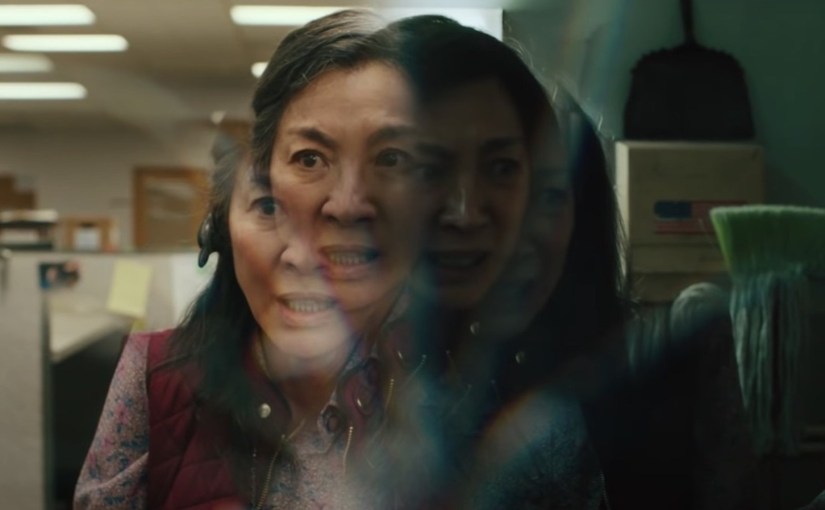
The Wang family are Chinese immigrants buried in demanding and overwhelming tax obligations from the IRS while trying to manage a California laundromat.  Evelyn (Michelle Yeoh) is the matriarch who is married to Waymond (Ke Huy Quan) and they have a daughter Joy (Stephanie Hsu).  Upon visiting the IRS agent assigned to their case, Deidre (Jamie Lee Curtis, who finally found something else to do besides another Halloween retread), odd occurrences take place.  Evelyn is warned by Waymond with suddenly a strange and very different personality to act upon their current situation, like getting off an elevator and turning to the right, not the left.  Just trust me when I say that while you will likely be bewildered for a while as the exposition unravels itself, it will all pay off satisfyingly.  Somehow in another universe that is performing parallel to the one we first see in the film Joy is a villain bent on destroying Evelyn…and that’s not even half of what’s out of place.

I saw this film directed by the “Daniels” (Dan Kwan and Dan Scheinert) with my Cinephile colleagues, Miguel and Thomas.  After it was over, it was no surprise that they knew what I was talking about when I said this film is the reason why good editing is necessary in a film.  Because the Daniels introduce not one or two parallel universes, but SEVERAL, and there is so much happening…well…all at once.  I’d argue most shots in the film last no longer than an average 8-10 seconds because the multiple universe equivalents of Evelyn, Waymond, Joy and Deidre switch on a blink of your eye.  I warn you not to make a quick bathroom exit.  Quick flashes of scenes are relevant towards something else you may see in the next minute or an hour later.

Anyway, I’ll bet you never realized that there is a universe where the people have raw hot dog like fingers.  There’s also a universe where Evelyn is a street sign twirler, and a good thing there is an Evelyn like that to help another Evelyn fend off of a bunch of attackers in a different universe.  There’s also a world where humanity doesn’t exist.  Yet the equivalent of Evelyn and Joy are represented by two rocks.  That’s right.  Rocks with no limbs, no way of speaking vocally.  Yet, the film cleverly has the characters or products of its earth communicate with one another.  There’s even a different variation of the Pixar creation, Ratatouille.  Replace the rat with a racoon and see what transpires.

So, what does this all lead to?  Fortunately, there is a reason for these different worlds to collide and it leads to a valuable lesson in love and understanding within family.  Now that may sound hokey, but the film demonstrates that none of us are the same in what we are affectionate about, or what’s important to us.  How a daughter considers a girlfriend is not going to be easy for a mother to accept as any more than a friend.  The Daniels’ film carries much profoundness among its silliness depicted on the surface.

Having only seen Everything Everywhere All At Once one time so far, I could not help but laugh often and uncontrollably at what I was looking at, and the laughter becomes contagious when watching the film in a crowded theatre.  What made my movie going experience with this film quite fascinating though is that I responded in tune with the rest of the crowd.  Once you get past looking at Michelle Yeoh and Jamie Lee Curtis (two recognizable and accomplished actors) flap their hot dog fingered hands at each other, eventually you recognize the “normalcy” of that particular universe.  You are no longer laughing with them.  Now you are accepting the people and how they function in that specific environment.  Same goes for the rock universe.  The Daniels are brave enough in their direction to just show two inanimate rocks perched on a ledge and communicating with subtitles of very aware and well written dialogue.  It looks completely crazy at first.  Later, you yearn for the impending destiny of those rocks.

Much symbolism is tucked into the Daniels’ script as well.  The most telling is that it focuses on an Asian immigrant family obligated by law to honor American tax codes.  The Deidre character portrayed by Jamie Lee Curtis is not so empathetic to the Wangs’ comprehension of resolving tax violations.  Basically, two different cultures are butting heads with no progress because they have a different viewpoint on how things function.  Wisely, this serves as a springboard to demonstrate how multiple universes will lack perfect chemistry as well when they collide.  None of this is written off as communication barriers.

I imagine on a second viewing, I likely will look at Everything Everywhere All At Once through a different lens.  I won’t laugh as much because I’ve grown acclimated to what were once very odd and strange environments for these characters that dwell within.  Instead, I’ll be even more observant and appreciative of the film as it presents different behaviors and cultures encountering one another.  This is a very good picture that is worth multiple viewings for sure.

In fact, this film is such a pleasant surprise, that I am comfortable suggesting this early on that I will consider it one of the best films of 2022.  If at least Everything Everywhere All At Once does not receive an Oscar nomination for Best Screenplay, then it would be a terrible disappointment.  The imagination of its endless devices is just so inventive.  Heck, I’ll throw my hat out there and strongly suggest nominations for Michelle Yeoh’s performance, along with Best Editing for Paul Rogers (this guy should win the award) and Best Picture of the year.

See Everything Everywhere All At Once in a movie theatre with a crowd and/or a large group of friends.  You may just have a cathartic experience of how human nature responds when getting acclimated to what at first appears to be so foreign.

EVERYTHING EVERYWHERE ALL AT ONCE (2022)

by Miguel E. Rodriguez

Directors: Dan Kwan, Daniel Scheinert
Cast: Michelle Yeoh, Stephanie Hsu, Ke Huy Quan, James Hong, Jamie Lee Curtis
My Rating: 10/10
Rotten Tomatometer: 96% Certified Fresh

PLOT: A middle-aged Asian woman tries to do her family’s taxes with mind-bending results.


Every once in a while, a movie comes along that is so daring and original that any attempt to accurately describe it feels futile.  Scott Pilgrim vs. the World was one of them.  Being John Malkovich was another.  And now comes Everything Everywhere All at Once, a sci-fi action brainteaser that feels as if it were written by Terry Gilliam and Quentin Tarantino and directed by Stephen Chow (Kung Fu Hustle, Shaolin Soccer…two movies that also meet that “indescribable” criterion).  It feels like an episode of Black Mirror crossed with Jackie Chan and a dash of David Lynch and Terrence Malick.  If you can’t find anything to like in this movie, check your pulse.

Evelyn Wang (Michelle Yeoh) opens the film trying to do her family’s taxes.  She and her husband, Waymond (Ke Huy Quan – “Short Round” from Temple of Doom!!), carry stacks and stacks of receipts to their local IRS branch and try to explain to their case worker (a dowdy Jamie Lee Curtis) how a karaoke machine can be deducted as a business expense.  However, before that can happen, after a series of very strange events involving Waymond and a pair of Bluetooth headsets, Evelyn finds herself immersed in a trans-dimensional battle between the forces of good, led by an alternate-universe version of Waymond – the “Alpha Waymond,” if you will – and someone called Jobu Tupaki, a being or person who is hunting for Evelyn in every conceivable parallel universe.  All Evelyn has to do is use these weird headsets to access the infinite multiverse and harness the skills learned by the infinite Evelyns before Jobu Tupaki can track her down and kill her.

To access the multiverse in such a way, one must commit random acts of…randomness, which leads to bizarre scenes of individuals doing some very weird things to access special skills.  What kind of weird things, you ask?  Things involving…sticks of lip balm, putting your shoes on the wrong feet, saying “I love you” to a stranger, or wiping someone else’s nose for them and…well, use your imagination.

That’s seriously just scratching the surface.  I haven’t even mentioned Evelyn and Waymond’s daughter, Joy; their laundromat; Evelyn’s elderly grandfather, Gong Gong (veteran character actor James Hong – 450 film and TV credits and counting); or the divorce papers Waymond has on his person.

This movie is a trippy, joyous, tightrope-walking masterpiece.  There are moments where you can sense it tap-dancing on the line of self-parody, then jumping over it and daring the audience to go along with it.  If there are some people that say they were unable to follow where this movie leads, I can’t really say I’d blame them.  Not many movies would ask you to take it seriously, then include a scene involving two rocks having a conversation via, I guess, ESP.  Or where the two lead characters turn into piñatas.  Or where Jamie Lee Curtis staples a piece of paper to her own head.  Or where the fate of the world might hinge on who gets their hands (in a manner of speaking) on a trophy shaped like…a very specific kind of toy.

HOT DOG FINGERS, people.  HOT.  DOG.  FINGERS.

I’m frankly amazed this movie didn’t collapse on itself.  There are so many ways it could have gone wrong, and so much it wants to say, while trying to be simultaneously massively entertaining and heartbreakingly poignant.

From a technical standpoint, I think it’s the frontrunner for the Best Film Editing Oscar for 2022.  This movie jumps from one parallel universe to the next and the next and back again so frequently that I got whiplash, BUT it was never confusing or mystifying.  It was always crystal clear what I was watching and why I needed to see it.  I could list any number of films or TV shows that have attempted this kind of thing on a much more modest scale and failed.  This is like the Who Framed Roger Rabbit of film editing.  It has been done so well and on such a grand scale that it seems unlikely anyone will try to tell this kind of story in the same way again.

Some may quibble at the mildly melodramatic resolution of the conflict among Evelyn, the “Alpha” universe, and Jobu Tupaki.  I can understand that viewpoint, but honestly, I just rolled with it when it came around.  And so did the theater audience I was with the night I saw it.  We all laughed uproariously on cue, sometimes for something funny, sometimes in sheer disbelief at what we had just seen.  But when the wrap-up started to come together, we all hushed and waited to see what would happen.  Even when it involved a parallel universe with something called Raccacoonie.  (It’s a long story…)

I hope I’ve conveyed how crazy good this movie is while preserving some of its best surprises.  I haven’t felt this urgent about getting the word out about a great movie since I saw Roma.  To call this an entertaining night at the movies does a serious injustice to the words “entertaining” and “movies.”  It’s more than entertaining and, not to get too hyperbolic, this is more than a mere movie.  It’s a masterwork, a collision of grand ambition and even grander moviemaking.  I plan on seeing it at least once more in theaters, if only just to see what I may have missed the first time around.  (And maybe also to tune more carefully into audience reactions at key moments, like the performance trophies, or those two rocks.  Who knew two rocks could be funny?  Like REALLY funny?)

CODA

By Marc S. Sanders

CODA is a film directed by Sian Heder that focuses on a New England fisherman family known as the Rossis.  There is Frank, the dad, Jacki, the mom, Leo, the son, and then there is Ruby, the daughter.  Frank, Jacki and Leo are deaf. Ruby is not.  Ruby is the family interpreter by default.  She’s content with holding the title, but as she is close to finishing high school, it’s seeming less and less fair.  That’s the conflict at play with CODA.  At times, it’ll make you laugh hysterically and it’ll also make you cry for multiple reasons.  You’ll cry as Ruby breaks free from her reserved lifestyle and shyness, and you’ll also cry because Ruby seems likely to miss out on a lifetime of opportunity with her god given talent of singing.

Ruby is portrayed by Emilia Jones.  Watch out for this actor.  She will be the next big sensation.  It amazes me that she was not nominated for an Academy Award.  Jones operates on so many levels in this film.  She learned fluent sign language for the role, in addition to singing gorgeous harmonies, and operating a fishing boat.  Oh yeah.  She has to act the role too, and Ruby Rossi has got to be one of the best protagonists of the last 10 years in film.  She’s an absolute hero. 

Ruby follows a rigid routine of waking up at 3:00am every day.  She goes out on the boat with Frank and Leo to bring in fish to sell on the dock later in the day.  It’s practically necessary to have her there as the one hearing person out in the open sea.  From there, she races her bike over to school.  She’s only adding to her plate when she opts to join the school choir to be close to a school crush named Miles (Ferdia Walsh-Peelo).  

The problem is that Ruby is incredibly shy.  So, when the music teacher known as Mr. V (a brilliantly energetic Lonnie Farmer) requests she sing solo following a long line up of students ahead of her, she retreats in fear.  Mr. V knows there’s something there though, and he gradually uncovers the singing voice Ruby never realized she had.  Suddenly, he’s proposing the idea of preparing an audition where she could attend the Berklee College of Music.  Ruby is reluctant at first, but Mr. V instills confidence in her talents.  However, he doesn’t stand for her tardiness at private rehearsals either.  He demands she takes this seriously, even if she has to tend to her family.  He’ll also make her tough, not willing to let her surrender to those that tease and bully her at school.  I swear that Lonnie Farmer must be a music teacher on the side. What an inspiring individual he portrays.  He’s hilariously intimidating in his classroom, but loved by his students in this film.  He should have gotten an Oscar nomination as well, and he ranks up there with other celebrated teacher characters in film history.  Completely unforgettable.

The Rossis are in the middle of a crisis.  The dock where they keep their boat and sell their fish supply is charging outrageous fees to all of the fisherman.  What makes it harder for this family though is the communication barriers they encounter.  Frank (Troy Kotsur) relies on Ruby to speak on his behalf, even cursing them out when necessary.  In response to the challenge, Jacki (Marlee Matlin) starts to sell their fish privately to circumvent around the overbearing-imposed taxes.  Yet, she also depends on Ruby to speak on her behalf during a news interview or with customers.  On the other hand, Leo (Daniel Durant) insists that Ruby should follow her own path.  Leo reminds everyone that just because he’s deaf doesn’t mean he’s dumb and he can handle the business.

CODA is a coming-of-age picture.  While the title may stand for “child of deaf adults,” Heder’s film focuses further away from deafness being an obstacle as the film moves along.  It lends more attention to Ruby’s dilemma of not being able to be in three places at once.  She’s only living a different life than that of her family, and that’s a problem I’d argue happens for most of us.  Eventually, we all have to leave our nests   

It becomes problematic when she has to deal with doctor visits on behalf of her parents where she embarrassingly has to explain to them the doctor says not have sex in order to heal their jock itch.  Frank and Jacki have sex in the house, completely unaware of how loud they are while Miles is over to practice singing.  Frank loves to play gangster rap at a high volume to feel the beat of the bass.  Imagine how that looks for Ruby when he’s picking her up at school.  These issues are as inconvenient as any family makes someone feel.  Frank, Jacki, Leo and Ruby enjoy their lives.  It’s just hard at times to enjoy their lives together.  Isn’t that the case for any of us?

CODA is so aware of its subjects on singing, deafness, sign language, family, fishing and first love.  Ruby has a multitude of relationships that are explored.  She has to deal with her affections towards Miles.  She has her mentor, Mr. V, to answer to.  Ruby has to understand that Leo can depend on himself, and she has to balance what is best for her while questioning how much she can give of herself to her mom and dad.  What wonderful storytelling conflicts there are to explore here!  Sian Heder’s Oscar nominated script allows enough time in just under two hours to meet the demands of each angle presented. 

I’m always pointing out how much I love random singing or dancing that appears in non-musical films.  CODA is another perfect example.  Ironically, I just read that the film is actually going to be adapted into a stage musical.  It has to happen.  It’ll break through so many glass ceilings on the limitations people have presumed comes with deafness.  Deafness is never a limitation. In the film, however, each time Ruby sings either solo or as a duet with Miles, your pulse will race.  Emilia Jones has vocals that lift your spirits and make you appreciate the gift of actually being able to listen and hear.  So many of us take that for granted.  Sian Heder’s film will remind you not to.  Just watching Frank place his palms on his daughter’s throat while she sings to him, reminds you that the gift of sound, whether you hear it or not, is a beautiful thing.  Frank doesn’t hear the song.  Rather, he feels the vibration of song.

CODA is one of the best pictures of 2021.  When you watch CODA, it’s simply easy to just embrace CODA.

BEN-HUR (1959)

by Miguel E. Rodriguez

Director: William Wyler
Cast: Charlton Heston, Jack Hawkins, Haya Harareet, Stephen Boyd, Hugh Griffith
My Rating: 9/10
Rotten Tomatometer: 86% Certified Fresh

PLOT: After a Jewish prince is betrayed and sent into slavery by a Roman friend in 1st-century Jerusalem, he regains his freedom and returns for revenge.


For my money, 1959’s record-setting production of Ben-Hur would be a better pick for an annual Easter flick over C.B. de Mille’s overblown The Ten Commandments.  Certainly, Commandments shows the actual story of Passover and might lay claim to more special effects sequences, but Ben-Hur feels grander AND more intimate at the same time.  Plus it actually shows Christ and the crucifixion at the end, and what better symbols could you ask for in an Easter film?

Then, of course, there’s that chariot race.  Game, set, and match.

Ben-Hur was created in an era when Hollywood was watching its profits dwindle because of the advent of television, which was keeping more and more people glued to their sets at home instead of paying for a ticket at the box office.  One way to get people back into theaters was to take the “bigger-is-better” approach: do things that were impossible on a TV budget.

Consider these statistics: Three hundred separate sets were built for Ben-Hur.  The chariot race alone required 15,000 extras on 18 acres of backlot at Cinecitta Studios in Rome and took 10 weeks to shoot.  Over a million props were needed, and it took two years to amass them all before shooting.  Approximately 1.25 million feet of expensive 65mm film was exposed and developed at a cost of roughly a dollar per foot.  The budget for the film ballooned to nearly $15 million, equivalent to over $146 million in today’s dollars, an unthinkable amount in the late 1950s.

But when it was released, Ben-Hur made history by being the first film to win eleven Academy Awards, including Best Picture, Best Director, Best Actor, and Best Supporting Actor.  It remains the only film to date to win Best Picture and Best Visual Effects.  At the box office, it raked in $75 million ($731 million when adjusted for inflation), making it one of the most profitable films in Hollywood history at the time.  It remains popular today, ranked in the IMDb’s top 250 most popular movies and listed as the #2 epic film of all time by the American Film Institute.  (#1 is Lawrence of Arabia, naturally.)

How does a 63-year-old film, with a running time of 3 hours and 42 minutes, with a blatantly religious plotline culminating in the crucifixion of Christ and a shamelessly manipulative miracle, and featuring some of the hammiest acting this side of Bollywood, remain as popular as it is?  Because despite its shortcomings, it does what every film should do, long or short, sacred or secular: it tells a rollicking good story, and it does it extremely well.

After a solemn prologue depicting the first Nativity, we jump forward 26 years and meet Judah Ben-Hur (Charlton Heston), a wealthy Judean prince who enjoys a reunion with his old friend, Messala (Stephen Boyd).  They grew up together but went their separate ways, and now Messala is a Roman tribune assigned to keep the peace in Judea.  Poor Judah realizes just how far they’ve grown apart when an accident leads Messala to arrest Judah and his mother and sister, to demonstrate his power and loyalty to Rome.  Judah vows vengeance and is sentenced to die as a galley slave.  But fate intervenes in the form of Quintus Arrius (Jack Hawkins), a Roman general whose life Judah saves in battle.  Arrius befriends Judah and officially adopts him as his own son, giving Judah the means to return to his homeland, wreak his vengeance upon Messala, and rescue his mother and sister from prison.

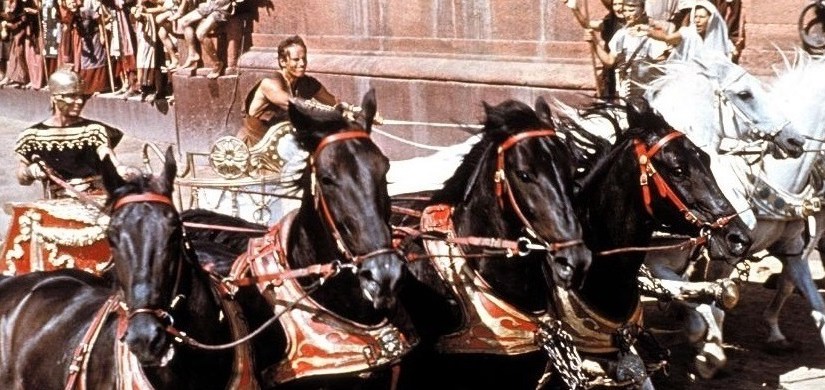
…and that’s just Act One.  Act Two focuses heavily on Judah’s revenge in the form of one of the greatest set pieces in Hollywood history: the chariot race.  Or, more properly, The Chariot Race.  If you’ve never seen it, Google/YouTube it.  Even viewed as a stand-alone scene, it is as breathtaking and thrilling as any car chase ever filmed.  It’s so good that George Lucas cribbed many of its beats for the pod-race sequence in Star Wars: Episode I – The Phantom Menace.  The crashes you see during the race were planned, but they were performed with real stuntmen in real danger.  Note especially one sensational stunt where a 2-wheeled chariot drawn by four horses, at full gallop, approach a crashed chariot in their path.  The horses leap the chariot, then the chariot dangerously rolls over the crash itself, hurling the stuntman so high into the air he nearly topples head over heels over the front of his own chariot.  I am at a loss to imagine how they could possibly accomplish this same scene today without the use of visual effects.

Peppered throughout the story are brief scenes featuring Jesus of Nazareth, although we never hear Him speak, and we never see His face.  In Act One, He offers water to Judah as he is being marched to the galleys, a compassionate act that will resonate through the years.  Later He is glimpsed from a distance delivering the Sermon on the Mount.  And later still, we see His trial, His journey to Golgotha, and His crucifixion.  Everyone involved in those scenes show the appropriate and expected levels of awe and sadness, while the score plays a mournful dirge.  It’s a little ham-handed by today’s standards, especially when compared to modern films like The Passion of the Christ, but it is still effective.

The movie’s highest level of filmmaking, apart from The Chariot Race, is on its best display in the first half of the movie.  Nearly two-and-a-half hours fly by, thanks to superb editing.  It’s never boring or soapy.  (Well…ALMOST never soapy.  The requisite love scenes between Judah and the slave girl Esther, played by the lovely Haya Harareet, are not as easy to watch as the rest of the film, but thankfully there aren’t that many of them.)  Every event and every scene feels crucial to the story.  There’s never a moment that drags.  Like the best epic films, watching Ben-Hur makes me feel like I’m reading a richly detailed novel.

If the film has a major downfall, it’s the story that follows The Chariot Race.  The movie doesn’t exactly grind to a halt, but it doesn’t offer the viewer any kind of climactic punches that can match the visceral effect of Judah’s capture, escape, and victory in the race.  (Sorry if I spoiled that for you, but if you seriously thought he lost that race, seek help.)  Sure, there’s the capture and crucifixion of Jesus and the miraculous aftermath, but while that satisfies the true arc of the story, I still, to this day, feel like the film deflates a little at the end.  There’s simply nothing it can offer that could possibly follow up that damn Chariot Race.  The race is the payoff.  Everything that follows feels anti-climactic.

That quibble aside, Ben-Hur is still as captivating as it ever was, with “old” Hollywood’s full power brought to bear to bring audiences a cinematic experience unlike any other at that time.  No matter where you might stand when it comes to its religious overtones, you can’t deny that the movie is exactly as respectful as it needs to be for this story.  And ultimately, the message of the film isn’t “An eye for an eye.”  It’s “Love thy enemy as thyself.”  It takes Judah Ben-Hur a little while to get there.  But he gets there.

IN THE HEAT OF THE NIGHT

By Marc S. Sanders

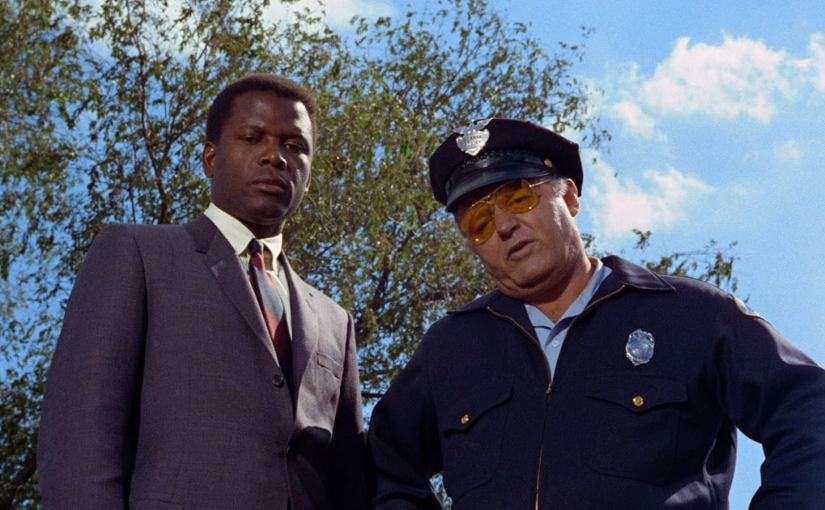
In 1967, just before the assassination of Dr. Martin Luther King Jr, Norman Jewison’s film In The Heat Of The Night won five Academy Awards including Best Picture, Best Actor for Rod Steiger and Best Adapted Screenplay by Sterling Silliphant.  While it is easy to classify the movie as a crime drama/murder mystery/detective story, the setting and themes of racial prejudice overshadow who the killer is or the motive.  As the film progressed, I grew less curious of who bludgeoned white businessman Philip Colbert to death and why.  It was much more important to understand exactly why Steiger’s Mississippi Police Chief Gillespie is so quick to believe that a well dressed and cooperative black man who was simply apprehended for waiting at a train station would be the culprit.  The black man is Virgil Tibbs (Sidney Poitier), a Philadelphia police detective.

After Tibbs has an opportunity to identify himself, Gillespie shamelessly requests his services in solving the crime.  Murder doesn’t happen often in Sparta, Mississippi.  Tibbs’ supervisor speaks highly of his officer’s capabilities.  Tibbs knows how to look for signs of rigor mortis on the deceased.  He knows how to identify that the killer was right-handed and he knows that when another suspect is quickly brought in, that he can’t be the killer either.  Still, many of the heated conversations between Gillespie and Tibbs are the same.  Their back and forths even become redundant at times.  Gillespie, nor the deputies and other residents of Sparta, are apt to listen to a “colored” person.  At one point, Tibbs is put in a cell for not agreeing with Gillespie’s conclusions.  He’s also ordered on two or three occasions to get out of town.  Tibbs is not so willing to surrender though, even if he’s regarded with racial disdain.  The impression is that this murder will not be so challenging for Tibbs to solve, if only he had a little more time and cooperation.  So, the riddle of the crime is not the overall conflict of In The Heat Of The Night.  More so, it is the racial hatred that a deep south Mississippi town has for an educated and skillful black man from up north.  

I read that the film was shot primarily in Sparta, Illinois.  Poitier made that request for his own safety while a tense period within America was occurring against the backdrop of the civil rights movement.  Jewison’s film is quite brave.  In the face of racial divide within the United States, this film still got made.  Yet, it had to be produced with an abundance of caution. 

A telling scene happens in the middle of the picture.  Tibbs requests Gillespie escort him to a wealthy cotton plantation owner’s home.  As they drive up to the home, they pass by the black cotton pickers collecting the crops under the hot sun.  They meet in the estate green house with a Mr. Endicott, who comes off very cordial to Tibbs at first.  However, when a slight accusatory question comes from Tibbs, Endicott slaps him across the face.  Tibbs responds with a slap right back at him.  In Mississippi, a black man better know his place, even if the prime suspect of a murder is a wealthy white man, or more simply just white.  It’s a classic moment in film history.  However, it remains an important scene and maybe its significance should be all the more heightened in modern day 2022 with the Black Lives Matter mentality at the forefront; where police/African American race relations are being tested. 

Three white men were recently sentenced to life in prison without parole for the hate crime killing of a black jogger named Ahmaud Marquez Arbery in the state of Georgia.  All that Mr. Arbery was doing was jogging through a neighborhood.  He didn’t have a weapon.  He hadn’t come in contact with anyone to even slightly suspect a threat.  He was noticed by these three criminals, and because he didn’t belong in that area, he was brutally murdered for the color of his skin.  Evidence would reveal where these men stood with regards to black people as a history of various texts that were clearly racial in nature were later uncovered.  If it wasn’t going to be Mr. Arbery who was murdered, it was eventually going to be another black person who would fall victim to these men. 

Though Dr. King was murdered shortly after the release of In The Heat Of The Night, I’m cautiously optimistic that racial hatred has lessened and the generations that followed learned from the misgivings of their ancestors.  Still, the term “hate crime” is often used in news reports today.  The debate of the Confederate flag and its argument for keeping it flying still has to be pondered.  Fifty years later, I cannot understand why, though. 

I will never forget a vacation I took with my family to Stone Mountain in Georgia back in 2005.  It was fourth of July and we were picnicking on the lawn next to a couple of teenagers while waiting for the fireworks.  I struck up a conversation with a local teenage girl and the flag and the confederacy along with the carving of Confederate leaders (Stonewall Jackson, Robert E. Lee and Jefferson Davis) on the rock sight were brought up.  Her defense of these topics was “It’s history.  Not hate.”  I became much wiser in that moment.  I was just a naïve Jewish guy who was raised in New Jersey.  I was not aware enough.  Much still hadn’t been learned and a whole lot needed to be unlearned.  History is not a reason to celebrate.  History is not meant to honored.  History is meant to be remembered for our rights, and especially our wrongs.  Much of history should not be repeated, and yet that’s what happens all too often.

In The Heat Of The Night is another example of the power of films.  So much is debated about what is taught in our schools.  A proposal of law for “Don’t Say Gay” is likely to be passed in Florida where it’s deemed impermissible to discuss homosexuality in elementary schools.  Books are continuing to be restricted from availability in libraries.  So, if our institutions of learning are being censored, then we have to rely on other mediums.  Movies like Schindler’s List or In The Heat Of The Night or Do The Right Thing offer those opportunities.  Films open a window to view love and hate as well as tolerance and prejudice.  We can never afford to look at our world with rose colored glasses.

THE SHAPE OF WATER

By Marc S. Sanders

I love fantasy and science fiction for one simple rule. A writer/director’s imagination can be limitless. Rules for a good fantasy are normally established in the exposition, and as long as those rules are not violated, a viewer will accept the narrative all the way to the end. The Shape Of Water is loyal to its set up.

Director/Co-Writer, Guillermo Del Toro continues his reputable streak of very adult (yet playful) fantasy. In 50 years, I would not be surprised if Disney/Pixar remade this film and Pan’s Labyrinth for younger PG audiences simply because the roots of the stories are so well played out.

Here is a Cold War love story between an alien and a good soul played by Sally Hawkins doing her best mute. Hawkins is bright eyed and wonderful. She’s a character that doesn’t judge and only recognizes despair for salvation. I thought she was great at conveying her performance through the limits of only facial expression, sign language, sex and self pleasure in a bathtub. Try to avoid snickers at that last description. It really is an honest, necessary reflection of a lonely innocent woman. I appreciated the writing and performance there.

Michael Shannon is back on screen playing a frightening villain…again. The reasons for his ruthless intentions were never clear to me, but either Shannon is that good an actor or he’s gotta be like this in real life. This is not a guy I’d ever want to cut in line at Starbucks, much less audit his books. He’s scary good.

Didn’t find much point to Richard Jenkins lonely neighbor except to drive a van, eat pie, be unemployed and be a token homosexual. Same with Octavia Spencer. Was she channeling a more subtle Whoopi Goldberg from Ghost? Don’t get me wrong. Jenkins and Spencer are fine actors here, and their characters are likable, but they don’t add much to the story except to be Hawkins’ sidekicks. Too much story was devoted to them though unnecessarily. Del Toro and his co-writer might have used them for too much filler.

Del Toro doesn’t stop with the new material as the two hours swim on by at a nice pace. We are treated to a wonderful Busby Berkeley song and dance moment that is just inviting to be spoofed by the Wayans or Zucker brothers, sensual nudity is there, not for perversion, but to send home the message that though this relationship is weird, it’s also the real deal. I bought it all the way through. Racism and gay prejudice are perhaps unnecessary in a film like this but there is key lime pie. Cats are consumed. Cold War espionage is on hand with Russian spies, dirty American government politics is there too, and oh yeah, there’s an amphibious alien who seems like any one of Spielberg’s extra-terrestrials we’ve seen before. Yet, I’ll take this one as well because he’s narrated into a very mature love story that is hard not to like.

As quick as the movie begins, you know how it is going to end. Again I don’t mind. Most of the execution rescues the story’s predictability.

Del Toro won Best Director and the film was awarded Best Picture at the Oscars. It’s not what I would pick, but there could be worse choices from that year’s selections.

I liked The Shape Of Water. Most of it at least.

THE LORD OF THE RINGS: THE RETURN OF THE KING

By Marc S. Sanders

I remember film critic Gene Siskel once said that to take issue with the length of a film is not entirely fair. After all, you are getting more movie for your buck. Would Siskel have felt that way about The Lord Of The Rings: The Return Of The King? Peter Jackson closes out the film adaptation of JRR Tolkien’s sweeping fantasy with an epic that allows you to marvel at everything you see, but does that mean we want to feel as overly exhausted as its main protagonist, Frodo Baggins, feels? Trust me. Poor Frodo looks wiped.

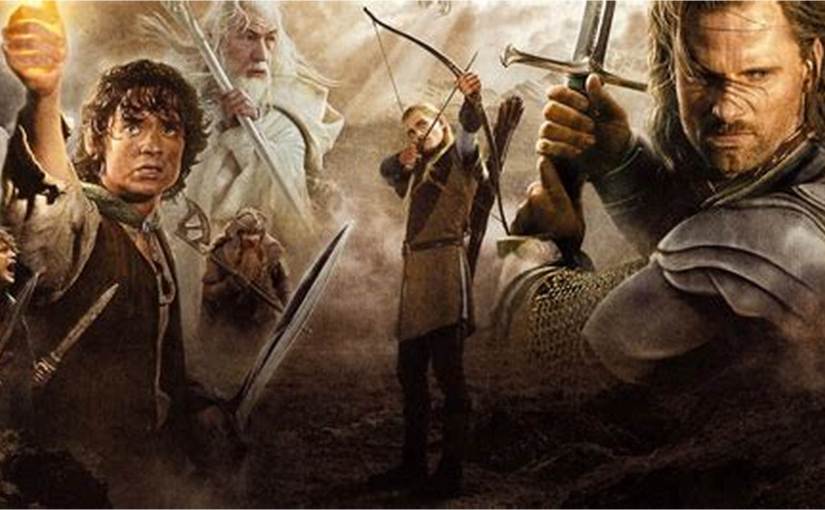
More battles are enacted in the third film. Jackson just changes the dynamics up a little bit. Now armies don elephants with a number of enormous, curved tusks. Another army has a different looking giant troll. Haven’t seen elephants before. Haven’t seen that kind of troll yet either. As well, there is another King who is apprehensive to cooperate in the fight against Sauran and his Orc minions. There’s also a green glowing ghost army. Meanwhile, Frodo and Sam (Elijah Wood and Sean Astin) continue their journey to Mount Doom where the almighty Ring must be destroyed. Gollum (Andy Serkis) remains as their untrustworthy guide.

Jackson seemingly covers every page written by Tolkien. I’m talking about depicting every dream each character has or line they utter or slow motion expression they offer, or walk that they take. Peter Jackson is a completist.

The Return Of The King won Best Picture along with a bevy of other Oscars. Seemingly it should have won anyway. The first two films were recognized with Best Picture nominations as well. For the third film to win was to honor the entire trilogy and its achievements in filmmaking. The Lord Of The Rings trilogy reinvented movie making as a whole. The bar was set so much higher following its release and huge reception of these films.

That being said, it takes endurance to stay with the picture. Most especially with The Return Of The King as the film has multiple endings. Just when you think it’s over, it’s not, and it’s tedious and a little frustrating. Jackson seemed to have too hard a time saying farewell to his digital Middle Earth with its endearing characters.

The length is a problem I have with the film, but none of it seems wasteful either. Every caption and scene carry an importance to it. At least that’s how Jackson wants you to feel. The question is, if a number of momentary scenes had not been woven into the final edit, would I miss it, and my answer would be likely not.