THE GODFATHER PART II

By Marc S. Sanders

The first film to use the number 2 (or Roman numeral II, in this case), in its title and the first sequel to win Best Picture is Francis Ford Coppola’s continuous adaptation of Mario Puzo’s Corleone family legacy in The Godfather Part II. It is worthy of all of the accolades it collected as an individual film. Yet, it does not best the first film.

Unlike the 1972 classic, Part II does not provide much character arc for anyone. We’ve already seen Michael (Al Pacino, silently ferocious here) change from good college boy and war hero to the evil puppet master Mafioso he eventually became. This film shows him exercising his threateningly murderous deeds as he works in conjunction with a sly Nevada Senator, a Jewish Miami mob boss (an excellent performance from Lee Strasberg) from the time of his father’s reign, and another mob guy from New York (Michael V Gazzo). We get a whiff of all these guys early on during a commencement celebration for Michael’s son. Coppola keeps this a running theme of grand openings in all three films. It’s a great method of introductions each time.

Following the party, an assassination attempt is brought against Michael. But who did it? Problem is this is where the foundation of the film is not so strong. It’s never really made clear who betrayed Michael. That’s a little bothersome.

Coppola depicts another storyline altogether with the early 20th century origin of Vito Corleone flawlessly played by Robert DeNiro who hardly speaks any English while communicating in a Sicilian variant of Italian. Young Vito immigrates to America following an escape from the Sicilian Don that murdered his family. In New York we witness his rise to power. Famed Cinematographer Gordon Willis washes out these flashback images to enhance a pictorial history accompanied by Angelo P. Graham’s art direction of early brick and mortar architecture and the muddy streets of early Little Italy, New York. It’s a time travel back to a historical age. It’s magnificent.

Back in the 1950s, Puzo and Coppola bring authentic fiction to real life history as Michael considers a go at a business enterprise in Cuba. However, will the rebellion uprising interfere with his plans, and what will it cost him? As well, there’s a great sequence where he has to testify before a congressional hearing in response to suspicion of criminal activities. Coppola used the infamous McCarthy hearing footage as inspiration for this predecessor to what C-Span would eventually look like.

Yet, there’s another story to become involved with as Michael must contend with his dim witted older brother Fredo. John Cazale is superb as the guy who wanted more but was limited by the influence of competing factions and his loyalty to his brother. Pacino and Cazale always had great chemistry together. A great conversation moment occurs in the third act following a terribly surprising twist. One of the best scenes in the film occurs on the porch of the Corleone compound.

More story elements come into play as Michael attempts to balance his married life with Kay (Diane Keaton). She’s pregnant again. Yet, what will that mean for the future of the family?

The sequel to The Godfather assembles another stellar cast. So good, that the film garnered three Oscar nominations in the Supporting Actor category alone (DeNiro, Gazzo, Strasberg) as well as a nomination for Pacino as Best Actor and Talia Shire (Supporting Actress) as Connie, Michael’s sister. That nom left me a little dubious only because there’s not much material for Shire to play with here.

Coppola’s detail is at the top of his game again. The film, like the first, feels like a true life biography.

Puzo offers heartbreaking moments, most especially in the film’s shocking end which leads to a flashback assembly of characters from the first film. That scene alone plays as a great reminder of what Michael once was before becoming the hideous monster that closes the story. Puzo’s whole Godfather franchise hinges on well defined, crushing tragedy.

The Godfather Part II is nothing short of mesmerizing and wholly engaging. You can watch it over and over again. It’s layered in rich storytelling and narratives that provide endless amounts of material for a family meant to be mired in secrets, deliberately hidden in the dimly lit rooms that Willis photographed.

It’s a treat to be the fly on the wall wherever Michael and his family move to next.
FORREST GUMP

By Marc S. Sanders

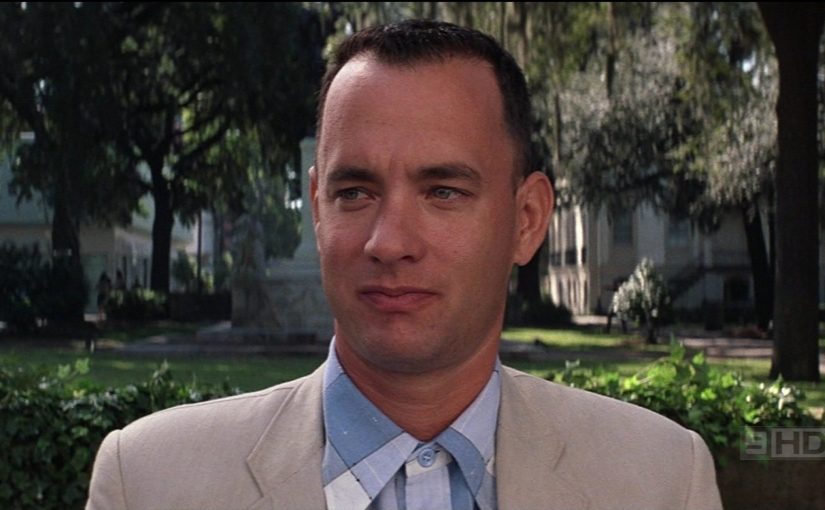
There’s not much that I can say to further praise the merits of Robert Zemekis’ Forrest Gump. It’s a film of legend though it’s a sore spot for die-hard fans of Pulp Fiction, which competed for Best Picture in 1994. Guess which film won. Tom Hanks won the Oscar for the second year in a row, following his outstanding turn in Jonathan Demme’s Philadelphia. Zemekis won Best Director. Eric Roth’s screenplay won as well.

What holds a lasting impression for me about Forrest Gump is the sweeping travel through time of a man with limited intelligence but unlimited willingness to explore and participate, whether it be as a Ping Pong Champion, a Medal of Honor recipient for heroism during the Vietnam War, a millionaire entrepreneur of a shrimping boat business, or a man who just felt like running from one corner to the next of the North American continent. Forrest Gump never knew to compromise a belief he had, probably because he was never aware of the capability to compromise in the first place.

An interesting theme occurs throughout Roth’s screenplay (adapted from the novel by Winston Groom). The people that Forrest encounters are always shouting their ideals and agendas. Yet no one seems to listen. Not just Forrest though. No one at all listens to each other. Lieutenant Dan (Oscar nominee, Gary Sinese) shouts for an immediate evacuation of a hostile territory under attack and no one on the other end of the line, appears to be listening to him. He orders Gump to leave him there, but Forrest does not listen. Forrest only focuses on rescuing his friends, Lt. Dan and Bubba (Mykelti Williamson). What exactly were Americans like the Hippie movements, the War Veterans, the Black Panther party, even the men in the burlesque nightclubs, as well as the various assassinations attempting to accomplish really? Did they accomplish anything? Did any of these parties make an impactful change, or did they just like to hear themselves talk? Did they just want the recognition for only themselves and no one else? When Forrest meets up with his love Jenny (Robin Wright), in a gorgeous caption in front of the Washington Monument (often shown during Oscar film compilations), he has just shared his thoughts over a loudspeaker, unaware that not one of the thousands of war protestors could hear him because the microphone had been unplugged. Later that day, a Black Panther participant only cares to wave his finger and shout his agenda in Forrest’s face. Is Forrest interested? Is he even listening? Is the Jenny, the hippie and her protestor boyfriend listening? Like many Americans, Forrest was only concerned with what was most important to him; Jenny. When Forrest develops a following during his cross country run, everyone is looking for his purpose and his message, and Forrest is unaware that he needed to offer one. Americans are always looking for the next best following. When Forrest passes the Grand Canyon and stops running, the parade of lost souls behind him shouts, “Now what are we supposed to do?” Forrest doesn’t listen. He just walks away and declares he’s tired. America during the mid twentieth century was lost. Forrest was not. Forrest just went in the direction in front of him.

Zemekis pulls an interesting trick of contrasting Forrest against other regulars. The nurse who sits on the bench next to Forrest is more interested in reading a mundane two dimensional issue of “People Magazine.” A man listening to Forrest’s tale of rescue in Vietnam was only concerned with the bullet that struck Forrest in the butt, not the men he saved or the loss of his dear friend Bubba. The old codgers who hang around the local barber shop in Greenbough, Alabama just watch the exploits of Forrest as the years go by. Their hair gets grayer and their skin gets more wrinkled, and life just passes them by while Forrest passes life by. It’s a subtle, yet effective, device that I appreciate on repeat viewings.

Sally Field contributes to the disregard Forrest has for menial issues. If Forrest is going to be denied going to a regular school because his intelligence level falls a few points below average, she will make certain that does not interfere even if it means pleasuring the principal. Mama Gump has the wit and intelligence. Forrest does not. However, their commonality shows in their disregard for what keeps us from living life to the fullest. Without Mama as his influence, Forrest would never have met the President again, and again, and again.

Mama reminds Forrest that “Life is like a box of chocolates…” You know the rest! It doesn’t matter what we get, as long as we get what we pursue.

THE SILENCE OF THE LAMBS

By Marc S. Sanders

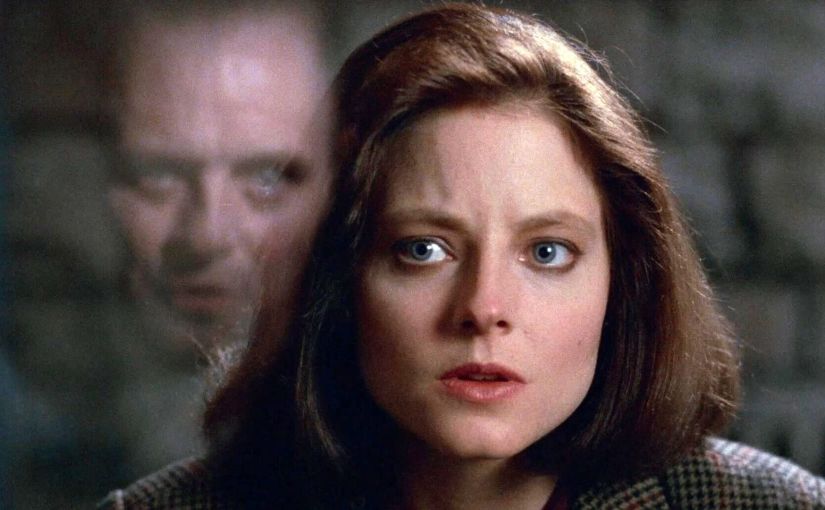
Everyone remembers Anthony Hopkins’ memorable turn as the infamous Dr. Hannibal Lecter in The Silence Of Lambs.  He was “Hannibal The Cannibal;” a renowned and brilliant psychiatrist who was eventually captured for being the one who ate his victims with sophisticated glee.  The real attraction, though, is how director Jonathan Demme delivers the film adaptation of Thomas Harris’ best selling novel through a lens that only finds one strong heroine amid a sea of intimidating men.  The heroine is the intuitive, but petite Clarice Starling.  The men are nearly everyone else cast in the film, and I mean everyone all the way down to the extras; the extras, here, are a perfect example how necessary they are towards any film’s palette.

Ever since the film was released in 1991, the dialogue of Ted Tally’s script is worthy of repeating and mimicking in social circles.  Lecter remains spoofed in nearly every pop culture medium.  Hopkins’ character is unforgettable and he’s been ranked among the greatest film villains of all time with the likes of Darth Vader and Harry Lyme.  It’s a worthy honor.  His timing is subtle and mischievous while he remains silently dangerous.  You can’t take your eyes off the actor and you can’t erase the devilishly fun and evil character from your sub conscious.  Opposite this performance though is Jodie Foster in a top billing role as an FBI trainee named Clarice Starling, assigned to interview and maybe study Lecter as a means to a solid lead in finding a serial killer that has been identified in the media as “Buffalo Bill.”  Bill has been skinning and killing girls with large physicalities, around the east to mid-west portion of the United States.

So, there is a detective story at play here as Hannibal aids Clarice in her search for the killer, but only under his rules.  Demme paints the film with Clarice ably performing her job no matter the towering strength or perverted fantasies found in nearly any man.  An outstanding image early on shows her small frame entering an elevator.  She has been summoned to her supervisor’s office from the outdoor obstacle course.  She is sweaty, and looking tired.  The elevator is full of a dozen men in red uniform polo shirts that hug every muscle; they are strong, fit and healthy.  Clarice stands front and center and she has no reluctance to stand among this exclusive group.  Later in the film, Clarice is invited by her supervisor, Jack Crawford (Scott Glenn in a deservedly dark and quiet performance), to investigate one of Bill’s victims that turned up in the swampy waters of West Virginia.  The coroner’s examination room is filled to the max with sheriffs who believe they serve a purpose to stay there to witness what’s uncovered.  The strength of Clarice is really shown here as she shoos them away.  The men’s facial expressions tell us they don’t care for this request, but Clarice isn’t going to allow them to remain.  Most importantly are her encounters with the head of the Baltimore psychiatric ward that houses Lecter.  He is known as Dr. Chilton played by Anthony Heald.  Chilton – a great character name that clearly colors in the twisted perversion of this guy.  Chilton is happy to boast of his prized attraction, Lecter, as if he’s a rare tiger and he has no reluctance to hit on Clarice when she comes to visit with Lecter.  Always, Clarice will not allow herself to be succumbed, patronized or victimized by any of these towering figures of masculinity in what is unfairly regarded as a man’s world in law enforcement, crime or psychiatry.  Starling easily reminds Chilton that she was a student at the University of West Virginia, not a charm school.  With Tally’s script, Jodie Foster uses these deflective techniques of her character without effort.  Her methods of fencing with these men are a natural ability.  Even when she’s in film transition periods of training at the Academy, Clarice can maintain her stance against a hard-hitting male boxer pounding away at her boxing shield.  She just won’t fall over. As well, she doesn’t wince as the male students give her a glance from behind when she’s jogging on the grounds. 

Demme is an outstanding director who uses these interpretations of this woman to drive his film.  This very same year, 1991, Ridley Scott directed Thelma & Louise.  In that film, the title characters had to realize that they didn’t have to take any shit from a man.  They started out weak, though, and had no choice but to eventually get stronger.  Here, it’s already part of the woman’s instinctive nature. 

Hannibal Lecter is shown to be well versed in the finer things of art, literature, music and, forgive me, cuisine.  At one point, Demme focuses on a picture Lecter has sketched depicting Clarice in an almost angelic nature.  I’ve never forgotten that image.  Nearly all of the settings in The Silence Of The Lambs include stairways that always lead us in the down direction, to an assortment of various hells.  Clarice, the pure angel with nary a fault beyond limited experience as an FBI agent peels the onion away on her quest for a killer by entering into the treacherous depths beneath her; pits of hells.  The opening shot of the film has Clarice pulling herself up with a rope on an obstacle course as if she is ready to enter the heavens, ready to stand above everything, but then she is summoned to Crawford’s office located at the Department of Behavioral Sciences at the FBI.  She has to take an elevator down and then various stairways further down into a labyrinth of claustrophobic offices with no windows, surrounded by cinderblock and populated with men in uncharacteristic suits that don’t appear warm or cuddly.  Crawford may seem like her ally, but really, he’s using her as a sacrificial pawn on a chess board putting her in an arena with psychotically dangerous prisoners, in particular, the worst of them all, Hannibal The Cannibal. 

When Clarice goes to visit Hannibal, she is escorted by Dr. Chilton, who relishes in describing how careful he handles his prized thing, and willingly shows what this monster is truly capable of by providing an unwelcome photograph of how Lecter brutalized a female nurse.  This conversation is played upon a much more frightening descent of unlimited stairways and bars that clang loudly and are painted red and rusted, eventually leading to a stone walled dungeon for these unimaginable beings of death and perversion.  Clarice is left all alone to navigate her way down a long corridor until she reaches Lecter’s cell.

Yet, an even more frightening third descent into hell occurs in the final act as Clarice’s pursuit leads to Buffalo Bill.  Bill’s home is dark, lurid, filthy and maze like; but always seeming to go down further and further into one doorway after another and down one staircase after another, including a deep well where his latest victim is kept.  Like the other descents, Clarice uses her femineity as a tool of strength to survive.  I can claim without any hesitation that Clarice Starling is one of the greatest heroines in the history of film. 

The one man who rattles her, and weakens her, though is Hannibal Lecter.  Watch their tete a tete when they meet for the first time.  Starling demonstrates some overconfidence against Lecter’s seemingly polite demeanor.  With her white trash Virginia dialect, she even gets a little smarmy with the Doctor, but then he disarms her immediately with a comeback that shakes her very core.  Demme’s reliance on close ups for both characters serve this scene and others so well.  Clarice’s encounters with Hannibal are the most important and vital moments in the film because they are the only opportunities for Jonathan Demme and Ted Tally to show the main character’s weakness.  Every hero has to have a weakness if they are to remain compelling.  Clarice is not, in fact, undefeatable. 

The film could have simply worked as a basic detective story.  Put up the clues and the narration of the picture will eventually assemble all together for a resolution where the bad guy is captured.  Yet, Thomas Harris’ character creation uses Hannibal as a defiant obstacle blocking the path for Clarice.  Hannibal lacks much stimulation in a cold, specially designed prison cell.  He’s maybe only honored with impenetrable plexiglass to contain him as opposed to traditional bars.  He needs to be enthralled.  On the surface, Clarice appears as a frail prey that he can take his time munching on.  He’s happy to help Clarice catch Buffalo Bill with the case files she provides, but in exchange he wants to uncover what haunts her psyche.  Such a strong character Clarice is, but she has to be willing to weaken and expose herself to desperately find a dangerous killer.  Can she do it?  She’s never allowed herself to do that before.  And thus, we come to comprehend the obscure title of this film and the book it stems from.  (Anthony Hopkins actually thought it was a children’s fantasy when he was sent the script to read over.)

This write up is not necessarily a review, but a means to honor the careful film and storytelling technique that Jonathan Demme strives for with The Silence Of The Lambs.  You might say, yeah, there’s a lot of walking in this picture, but pay attention to the direction of the walking.  Always going down, somewhat reminiscent as Little Red Riding Hood entering a dark and spooky forest and encountering the biggest and baddest wolf.  Jodie Foster might be in a company of men here, but the film works as a dual of femineity vs masculinity.  It’s strange to believe that Demme actually had Michelle Pfeiffer in mind for the Starling role initially, a more than capable actress, but one who at the time was more glamourous (The Fabulous Baker Boys and The Witches Of Eastwick).  Beyond the silly Disney films, Foster was known for lurid pieces like Taxi Driver and her first Oscar winning role as a rape victim in The Accused.  Clarice Starling is a character beyond a pop culture appearance of the time, and Jodie Foster emanates that portrayal.

The writing of The Silence Of The Lambs is so intelligent.  There’s a witty, yet deliberately poor taste, of sarcasm to Hannibal Lecter as he thrives off his superior intellect over Jack Crawford and the FBI.  It’s only enhanced when he’s dealt a lowly, formally white trash female student to play with.  Ted Tally offers precise timing in the dialogue with Clarice and Hannibal.  Thomas Harris’ drive to further a cameo appearance of Lecter in a prior novel (Red Dragon) with this book is a gift to readers and eventually movie watchers.  The Silence Of The Lambs doesn’t follow formula with a Law & Order technique of ballistics and witness interviews.  It drives into other directions to feed its development. 

Jonathan Demme’s film is pioneering.  I recall seeing it in theatres with other high school friends.  I was not enthused to see it.  The title was too odd.  The picture was primarily a talking piece.  There were gross and unwelcome images within the film.  It’s very ugly at times.  I was frankly accustomed to the likes of Dirty Harry and Lethal Weapon films for my cops pursuing the robbers ideals.  I recall not even liking the film when we left, and I couldn’t comprehend its appeal that followed for the remainder of nearly an entire year, all the way up to when it was awarded the five main categories of Oscar wins (Actress, Actor, Screenplay, Director and Picture).  I definitely wasn’t accustomed to a strong character like Clarice.  Later that year, I saw Thelma & Louise and fell in love with their eventual triumph.  I needed to be spoon-fed their initial weaknesses at first.  Who was this Clarice in this picture, though?  I could not identify her strength that displayed right from the get go.  I wasn’t even 18 years old at the time and now I can say I just wasn’t mature enough for this film back in 1991.  Now, it’s thankfully clearer, though I still appreciate its subtlety so much. Jonathan Demme had such a clear vision of where he was taking this film and because it’s not dated, The Silence Of The Lambs stands as thriller, and an intelligent thought provoking piece that stays with you for a long time after each viewing.

THE STING

By Marc S. Sanders

Find me a better combination of script, cast, direction, score, art direction and costume and I guarantee it’ll take you some time and effort.

The Sting, directed by George Roy Hill and written by David Ward, is the kind of movie where you uncover something new every time you watch it. It’s because the film is all in the minute details to assemble the beginning to the middle to the end. The film is wisely edited in step by step chapters; The Set Up, The Wire, The Shut Out and eventually on to the satisfying The Sting.

The audience is even set up but you’ll have to watch to see how. I dare not spoil it.

Cars, trains, drug stores, diners, a carousel, dames, gangsters, Bunko Cops, Grifters; all are elements needed for the best confidence men superbly played by Robert Redford and Paul Newman, along with a supporting cast like no other, Eileen Brennan, Harold Gould, Charles Durning, Ray Walston, Jack Kehoe and the best villain, or rather “mark,” Robert Shaw.

This is one of my favorite movies. When I first saw it, I was probably age 10 or 12. I understand next to nothing of what was going on. It was the music that drew me in first followed by the sharp suits designed by the legendary Edith Head. The movie’s script is its greatest asset but visually it is just as fun. The 1930s Chicago setting is a character in and of itself. Newman cheats beautifully at poker against a temperamental Shaw, and gets him!!! “You owe me 15 grand pal.” When I first saw it, I didn’t know what he was doing or how he did it. How did he switch hands? I was enamored with the hands that were dealt and the poker chips on the table, but I loved it when the better cheat won out.

The second iteration of the Hill/Newman/Redford trifecta (following “Butch…& Sundance…”) is just plain fun. It was the fun that earned it a Best Picture Oscar.

No other film has come close to duplicating it. Maybe the Clooney/Pitt/Damon version of “Ocean’s 11”? I don’t know. However, if you love that film, you owe it to yourself to watch “The Sting.”

The Sting is…”the quill!”

CABARET

By Marc S. Sanders

Is it possible for a musical to be disturbing? Maybe Bob Fosse’s Cabaret favors that argument.

Liza Minnelli won the Academy Award for Best Actress in 1972 for her portrayal of Sally Bowles, a carefree, happy go lucky performer at the underground Kit Kat Club located in Berlin, 1931. She is the lead attraction among a company of dancers doing a different kind of stage vaudeville with its colorful emcee played amazingly by Joel Grey, also an Oscar winner.

The musical numbers are outlandish with caked on makeup and outfits that could make Victoria’s Secret seem like a children’s shop. I gathered from the film that Fosse, who choreographed the numbers as well, offered up the escape of life first, before showing the harsh reality of Berlin in its historical context.

Sally and the Emcee’s performances are first on hand, depicted as silly and showstopping. Thereafter, Sally encounters an English gentleman named Brian Roberts (Michael York) who is a professor of English study attempting to complete his doctorate. As Sally and Brian become closer as friends first, he must reluctantly admit to Sally that he’s a better bed companion with a man than with a woman. Sally doesn’t understand why he didn’t say that in the first place as she attempts to come on to him.

Herein lies the dilemma many faced as the Nazi party was gaining traction in Germany. How necessary is it to hide your true natures to preserve your life? Sally’s underground lifestyle at the club clouds her vision of what’s gradually happening in the world. Nevertheless, they eventually develop a relationship as Brian appears to be bisexual, more specifically.

A side story concerns Brian & Sally’s relationship with a baron named Maximillan (Helmut Griem), who will wine and dine them at his estate only to later abandon the respective relationships he sets up with them to more or less make them feel as cheap as prostitutes. I wasn’t sure what to gather from this extension, however. The irony is that unbeknownst to Sally and Brian they have both been sleeping with Max. Eventually, Sally reveals she’s pregnant but does not know who the father may be, Brian or Max, and an abortion is considered.

An additional side story concerns a wealthy Jewish German heiress named Natalia who falls in love with a German Jew named Fritz living under the guise of a Protestant.

Cabaret is a loose adaptation of The Berlin Stories by Christopher Isherwood (the Brian character) and his experience with stage performer Jean Ross (the Sally character). Isherwood’s stories gradually formed into different iterations of stage plays and short stories before making it to Broadway and Fosse’s celebrated film.

Though Fosse apparently took some questionable liberties and departures from Isherwood’s writings, I think it depicts the personal struggles of love and self identity while the world around them is quickly changing into a scary reality where your own self identity could get you killed.

Fosse gives terrifying glimpses of how the Nazi party seeps it’s way into a decadent Berlin of underground showmanship. Though apparently Berlin really wasn’t so decadent as the film has you believe. Ross and Isherwood have gone on record describing Berlin was a more destitute and poor environment, actually.

In Fosse’s film, a Nazi youth is seen early on being kicked out of the Kit Kat Club. A few minutes later, the night club manager is being beaten in an alley. Fosse juxtaposes scary moments like this against the silly debauchery depicted on stage. It’s as if the Gypsies, homosexuals and Jews in the area are unaware of the evil practice that is gradually taking over outside.

Soon, Fosse makes the swastika more apparent in the streets with propaganda handouts. Most telling is when a young boy is seen at an outdoor beer garden gathering singing a number selfishly entitled “Tomorrow Belongs to Me.” Fosse is frighteningly effective at showing this boy from the neck up. Eventually, he moves the camera down to reveal the boy’s swastika wrapped around his sleeve. The song which seemed to champion beauty and nature now evolves into a march of grandstanding fascism. It completely shocked me. Just as people like Brian and Fritz are reluctant to reveal their backgrounds, both sexually and religiously, the Nazi party is proud to announce their mindset in a converse manner. By the end of the film, the audience at the Kit Kat Club more predominantly shows Nazis in the audience as opposed to just the one shown in the beginning of the film. Hatred has spread its disease.

While Minnelli shines in her role, her showstopping moment really comes at the end when she dangles her carefree attitude while belting out the title song with “Life Is A Cabaret.” Along with Joel Grey’s Emcee closing out the film with the “Finale,” this musical goes against the grain of most musicals’ cheerful close outs or romantic theatrics. Fosse’s mirror image of the Nazi party taking in Sally and Emcee’s performances are chilling. We sense the characters’ time is at an end and wisely the film runs its closing credits among frightening silence with the cold, blurred images of Nazi soldiers staring right at us.

I had never seen the film of Cabaret until now, but I had attended two different stage productions; neither of which I liked. Bob Fosse’s film seems more clear with its content than I ever got from a stage performance. Perhaps it is because the Oscar winning art direction is more apparent than a stage set. We can see the bustling of Berlin change amid a political climate that at first is not taken so seriously. As hurtful and harrowing the relationships of love between Brian with Sally and then with Max, as well as Fritz and Natasha are, none of this will eventually compare to the upcoming demise for Berlin.

As Miguel noted in our recent podcast that focused on musicals, Cabaret won the most Oscars without winning Best Picture (losing to The Godfather). It’s clear how deserving it was of its accolades. The musical numbers are very engaging but the fear of fascism is well developed too. So there is a roller coaster of emotions to absorb from Fosse’s film. I believe in that podcast I noted that Francis Ford Coppola won Best Director. I now realize I was wrong. It was in fact Bob Fosse who took home that prize, and it’s truly evident how deserving that honor was for him.

Again, while I’ve yet to find a stage production I’ve liked, I was terribly moved by the film. Cabaret, the film from 1972, is a sensational and frightening production.

LA LA LAND (2016)

by Miguel E. Rodriguez

Director: Damien Chazelle
Cast: Ryan Gosling, Emma Stone, John Legend
My Rating: 9/10
Rotten Tomatometer: 91% Certified Fresh

PLOT: While navigating their careers in Los Angeles, a jazz pianist (Gosling) and an actress (Stone) fall in love while attempting to reconcile their aspirations for the future.


SPOILER ALERTS! MULTIPLE SPOILER ALERTS!


La La Land was greeted by the American public in one of two ways.  There was no middle of the road.  You either loved it or hated it.

Critics loved it.  It broke records at the Golden Globes that year and was the odds-on favorite to win Best Picture at the Oscars (Moonlight took the prize instead, and deservedly so).

When it came to the viewing public, people were immediately divided into opposing camps, with each trying to convince the other they were wrong.  “It’s homage!” cried one camp.  “It’s derivative and sad!” cried the other.

Me?  I’m part of the “loved-it” camp.  And after re-watching it tonight, for the first time since seeing it in theatres, I have no plans to change my mind.

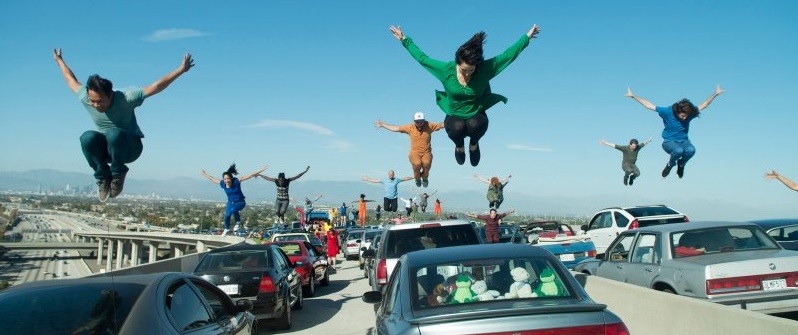
I once wrote that there is no movie more in love with “old Hollywood” than The Artist.  Well, La La Land is more in love with classic movie musicals, specifically, than any other modern movie in recent memory.  It opens with an astonishing musical number, “Another Day of Sun”, set on a Los Angeles overpass.  In a breathtaking feat of choreography and cinematography, scores of dancers perform nifty moves in and around a traffic jam, incorporating a live band inside what looks like a UPS truck, in one single take…or at least what LOOKS like one single take.  Could be some CG in there.  Who cares?  It’s awesome, and it sets the tone right away: this will be like one of those old musicals where people break into song and dance without warning.  You can stay where you are or you can leave now, but this is what’s happening.

After that, we settle in to a tried and true story of boy (Sebastian [Ryan Gosling], a jazz pianist who wants to start his own jazz club) meets girl (Mia [Emma Stone], an aspiring actress looking for a break).  This part of the story was old when Mickey Rooney and Judy Garland did it in countless other films, so yeah, I get it.  I can see why some folks called it derivative.

But that criticism neatly dismisses the underlying subplot about the Old vs. the New.  Sebastian desperately wants to start a jazz club that plays the greats – Monk, Coltrane, Davis – because, as he says in a passionate speech to Mia, jazz is dying.  Nobody wants to hear it anymore.  It’s old.  (He decries a nearby club that combines jazz, samba, and tapas, or some such nonsense.)  “They worship everything and value nothing,” he laments.

But Keith, a fellow musician (played by John Legend) tries to get him to see sense.  (“How are you gonna be a revolutionary if you’re such a traditionalist?”)  History is written by the people who strike out in a new direction.  Sebastian himself uses this philosophy with Mia, who has gotten tired of auditioning for the same teachers and doctors and coroners over and over again.  He tells her to do something different if you’re tired of the same old/same old.  She takes his advice and starts writing a one-woman play about her life.

And here’s where it gets cool.  While the characters in the movie are urging each other to embrace new concepts, La La Land still has one foot firmly in the past, i.e., the grand musical traditions of Gene Kelly and Fred Astaire and Cyd Charisse, etcetera.  Two later numbers stick out in my mind.  One is a twilight duet between Sebastian and Mia, shot on location in the Hollywood Hills when the sky is that perfect shade of somewhere-between-pink-and-purple.  They sing a little and then they do a beautiful dance together, but they’ve just met, so they’re careful to dance ALONE together…watch it and you’ll see what I mean.  Right out of Vincente Minnelli.  (Let’s be clear…Gosling and Stone are not exactly Fred and Ginger, but they do a damn sight better than I could do myself, so I give them props.)

Another number with classic-musical overtones is set during the first giddy months of their relationship.  With little or no singing (can’t remember which), we follow Sebastian and Mia as they tick off Los Angeles landmarks, finishing at the famous Griffith Observatory.  They enter the planetarium, and in a gloriously giddy moment of cinematic fantasy, they rise into the air and dance among the stars and galaxies before falling perfectly into their seats and sharing a kiss.  I no longer remember what I did the first time watching this movie, but this time around, I watched that whole sequence with a goofy grin on my face.  If you can’t enjoy watching people dancing in the stars, well…

At one point, Sebastian tells someone, “You say ‘romantic’ like it’s a dirty word.”  I like that.  This movie is, above all, romantic, in spite of how it ends.  It’s romantic in the sense that it revels in the unreasonable, illogical hope that everything will work out okay in the end.  Sometimes it does, sometimes it doesn’t, but that doesn’t mean you can’t still dream.  (There’s even a song about this exact thing, sung by Emma Stone in a sequence near the end that oozes romance and heartbreak.)

But all of this is nothing…nothing…compared to the emotional roller-coaster of the last thirty minutes of the movie.  It’s here that La La Land gets all serious in the middle of the fluff, because it explores the nature of success and what is necessary to achieve it.  Sebastian is touring with a band that pays well…but it’s not exactly a jazz ensemble.  Mia is just about ready to give up acting…until a casting agent gives her an opportunity to star in a movie shooting in Paris for four months.  These two characters, for whom the audience has been rooting for the previous 90 minutes, are on a downward spiral, and the only way to save their relationship would be for one or the other to completely give up on their dreams.  But neither of them would ask that of the other.  So they go their separate ways.

WHAT?  After all this they don’t wind up together?  Well…what would you have preferred?  An ending that awkwardly keeps them together, with him, say, playing jazz in a French club while she shoots a movie in Paris during the day?  Enjoying success together?  Having kids?  Sure, that kind of ending is POSSIBLE.  (In fact, in one of the many highlights of the movie, you even get a tease of what that might have been like.)  But, hey.  Isn’t that just the traditionalist way of looking at things?  Why not strike out in a different direction?  Do something no one’s doing.  End your movie where each character gets what they’ve always wanted their entire lives…even if that means they don’t get each other.

Boy, that last sentence sounds harsh.  But that’s what this movie’s about, and I think the film’s detractors simply couldn’t get past the grand tradition that demands the two leads wind up together.  They wanted Singin’ in the Rain, and instead they got the musical equivalent of The Remains of the Day.  (Maybe not quite that extreme, but I trust the point is made.)

ANYWAY.  Like I said, I just finished watching this a couple of hours ago, and I am no less convinced of its greatness.  Even though it’s a wrench watching their relationship head towards the rocks, the movie makes up for it at the end with half an hour of glorious, emotional catharsis that left me feeling wrung out, but in a good way.  It’s not quite a tragedy, but not quite a comedy.  Like life itself, it falls somewhere in between.

PARASITE (2019)

by Miguel E. Rodriguez

Director: Bong Joon Ho
Cast: Kang-ho Song, Sun-kyun Lee, Yeo-jeong Jo
My Rating: 10/10
Rotten Tomatometer: 99% Certified Fresh

PLOT: Ki-taek and his family, all unemployed, take peculiar interest in the wealthy and glamorous Parks, as they ingratiate themselves into their lives one by one.


Watching Parasite reminded me of the first time I saw Pulp Fiction.  I told my friends that it was like being on a roller-coaster at night wearing a blindfold: you have no idea where you’re going or what’s coming, but the ride is exhilarating.

That’s Parasite.  The hype is real.  This is one of the best movies I’ve ever seen, and if you plan on seeing it, I would highly recommend you do so BEFORE reading further.  I have no plans to spoil ANYTHING, but the less you know about the movie before going in, the better.

(You’ll have to bear with me, I’m writing this shortly after seeing the movie myself, it’s currently 11:14 PM, and I’m starting to get a little tired, but I want to get this all down before I pass out, so it may get a little “rambly” for a while.  You’ve been warned.)

Parasite is many things.  It’s a social commentary, a black comedy, a family drama, and a Hitchcockian thriller all rolled into one delicious Korean dish.  (The film and filmmakers are Korean.)  The beauty of the movie is that it manages to be all those things without losing track of itself.  I can’t count how many movies I’ve seen that attempted a tonal shift in the middle or at the end, and it just falls flat.  Where lesser movies failed, Parasite succeeds.

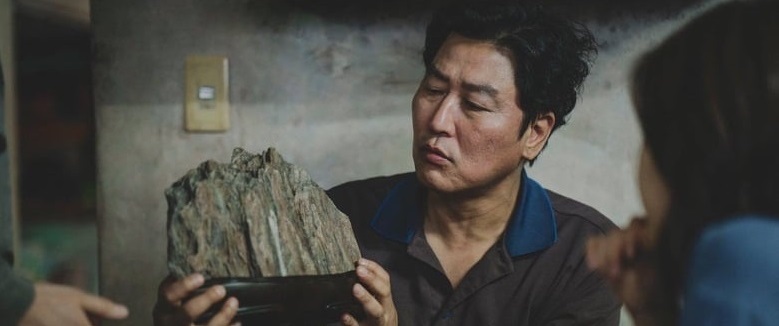
The plot involves a nuclear family, the Kims (father, mother, college-aged son and daughter), living in near-poverty in a sub-basement.  They fold pizza boxes to make a little cash.  They steal wi-fi from a shop next door.  When fumigators spray outside their street-level window, they open it wide to take advantage of the free pest control.  They aren’t starving, but they are desperate.  Yet they don’t appear to be beaten down by their condition.  They’ve become a family of hustlers, not in any criminal manner, but in ways that enable them to get by on the bare minimum until one of them can get a leg up.

Opportunity knocks one day when a friend of the son, Ki-woo, gets him a job as an in-home tutor for the high-school daughter of a wealthy family, the Parks.  Ki-woo changes his name to Kevin, then suggests to Madame Park that her 7-year-old son could use an art tutor.  This gets his sister, Ki-jung hired.  She changes her name to Jessica and finds a creative way to get her father hired as Mr. Park’s personal driver.  Then the Parks’ long-time housekeeper somehow has to be eliminated so the MOTHER can get hired.

Before long the entire family is working for the Parks, though it’s important to note the Park family has no idea their new employees are all related.  This is all done with great humor, not in a farcical way (that will come later), but in such a way that you find yourself rooting for this down-on-its-luck family of con artists to finally get a taste of the good life.

There’s a long scene where the Parks have gone camping, and the Kims gather in the enormous living room of the Parks’ lavish home and just sit and eat and drink and talk and get drunk.  This is the family drama/social commentary part of the movie.  There’s something a little sad about seeing these people who are like any other people, who seem no less deserving than the Parks, but their best-laid plans have come to nothing, and the highlight of their lives is to get hammered in somebody else’s house.  Suppose Kevin falls in love and decides to marry the girl he’s tutoring, when she’s a little older.  Who will they get to be his parents?  Will they need to hire actors?

Trust me, I haven’t spoiled ANYTHING.  Swearsies.  This movie is brilliantly, ingeniously split into two parts.  The first half is prologue.  The second half is genuinely, literally breathtaking.

Something happens that forces the Kim family to examine and re-evaluate their life choices up to the present.  It also forces them to do some very fast thinking indeed, which is where some of the funniest and darkest comedy takes place.  This is where the movie really takes off, where it had me reminiscing about the twists and turns in Pulp Fiction.

And nothing…nothing can prepare you for the finale.  About which I’m saying nothing.  Again.

From a cinephile’s perspective, Parasite is miraculous.  It manages to be several different things all at once, allowing you to savor every individual aspect of it without any one part of it overpowering the other parts.  The screenplay is unbelievably inventive.  The direction is sure-footed and masterful.  The acting is pitch perfect throughout.  It made me think, it made me laugh, it made me cringe, it made me say, “Oh S#i+!” MANY times, and it made me bring my hand to my mouth like a shocked Victorian-era woman many, MANY times.

I say again.  The hype is real.  You owe it to yourself to see this movie whenever you can.

[Ed. note: the Criterion blu-ray of Parasite contains an interesting experiment: a black-and-white version of the film, which is apparently how the director originally envisioned the film, and which might account for its stark imagery in places.]

BROKEBACK MOUNTAIN (2005)

By Miguel E. Rodriguez

Director: Ang Lee
Cast: Heath Ledger, Jake Gyllenhaal, Randy Quaid, Michelle Williams, Anne Hathaway
My Rating: 10/10
Rotten Tomatometer: 87% Certified Fresh

PLOT: The story of a taboo romantic relationship between two cowboys, and their lives over the years.


Brokeback Mountain is the kind of movie that makes me wish I was a better communicator, like Lost in Translation.  I know I love these movies, I know WHY I love these movies, but it’s difficult for me to put into words.

Brokeback is, of course, the movie that will forever be known among the snark peddlers as “that gay cowboy movie,” which is insultingly reductive.  That’s like referring to Star Wars as “that space movie.”  To reduce the movie to those terms is to totally ignore the boundless riches to be had by watching it, I mean really watching it.

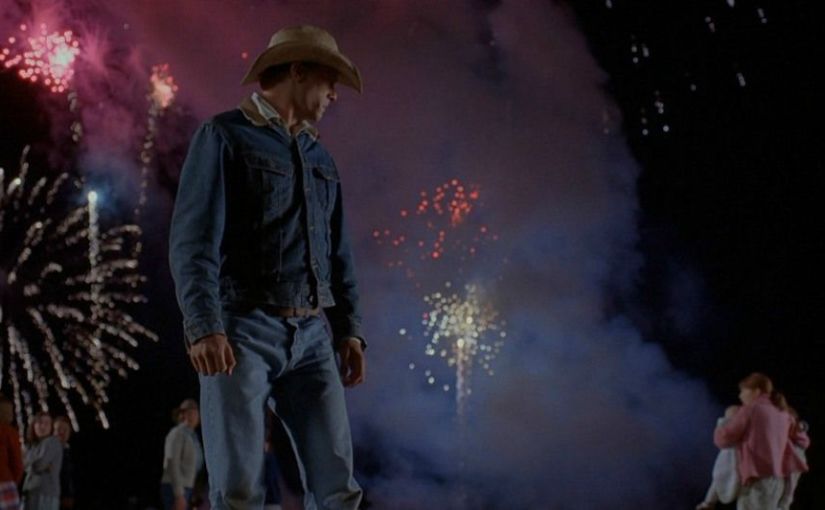
For one thing, damn, just LOOK at it.  Look at the way the skies fill the frame, with clouds hanging heavily over the mountains and the dusty streets and the trailer parks.  Director Ang Lee makes the sky into a tangible character all its own, much like Kubrick did with the Overlook Hotel.  It infuses every outdoor scene with a sense of the largeness of the world around us.  It’s a fitting backdrop for the intimate story presented to us.  In fact, those huge scenic backdrops are kind of a throwback to the ‘70s, to the films of Cimino and Arthur Penn and Bertolucci, when painting a picture with the camera was two-thirds of the story.  Virtually every outdoor scene in Brokeback Mountain is worthy of framing in an art gallery.  Stupendous.

The movie turns on the story of two men who unexpectedly and passionately fall in love in 1963, a time when gay love was still taboo, at least in polite society, and especially in any given cowboy community.  But as the story winds its way through almost twenty years in the lives of these men, it becomes less about the FACT of their affair, and more about the enormous sense of yearning and loss that comes from desperately wanting something that you can’t have.  Who among us has never felt that kind of insane desire?  Not necessarily for a person, even, but for anything at all?  A crippled man who longs to walk, or a blind man who yearns to see.  A dream job.  A dream vacation.  That’s what this movie is about.

Heath Ledger delivers the performance that really put him on the map.  His portrayal of Ennis Del Mar is incredibly subtle, although his Western accent flirts with impenetrability at times.  I love the way he shambles and mumbles through his role, virtually the entire movie, which pays off in that fantastic scene by the lake (“I wish I knew how to quit you!”) when this hulk of a man is torn down by his own unspoken passion.

Again…I’m not a poet, so this really doesn’t quite get at the mood generated by the movie.  It’s no feel-good film, that’s for sure, but it’s worth seeing by anyone who loves world-class storytelling.  Don’t let anyone, or your own preset notions, steer you different.

ROMA (2018)

By Miguel E. Rodriguez

Director: Alfonso Cuarón
Cast: Yalitizia Aparicio, Marina de Tavira, Diego Cortina Autrey
My Rating: 10/10
Rotten Tomatometer: 96% Certified Fresh

PLOT: A year in the life of a middle-class family and their maid in Mexico City in the early 1970s.


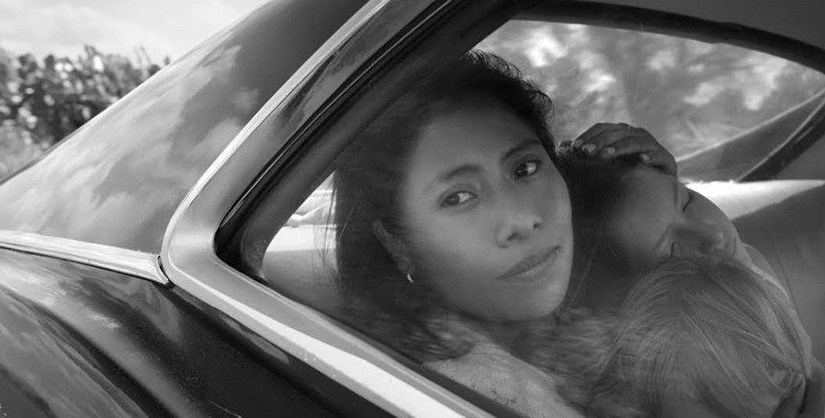
The closing credits of Alfonso Cuarón’s intensely personal, emotionally powerful Roma state unequivocally (in Spanish) that the entire movie was shot on 65mm film.  This is an important choice with a movie that communicates its emotional beats with strong, crisp visuals that don’t feel like a traditional movie.  To me, Roma feels like looking through an old, well-preserved photo album of a family I don’t know.  But the closer I look at the pictures, the more I can intuit how their lives are no less important or vital than my own.

More than most films, Roma exemplifies one of Roger Ebert’s core beliefs about film.  He said that movies “are like a machine that generates empathy. It lets you understand a little bit more about different hopes, aspirations, dreams and fears. It helps us to identify with the people who are sharing this journey with us.”

That’s how I felt watching Roma.  I never really felt like I was watching a film.  Director Cuarón (who served as his own cinematographer) uses his camera and shrewd editing to create the idea that I was looking at a fondly remembered memory instead of a traditional, plot-furthering movie sequence.  I didn’t grow up in Mexico or have a maid, but within just a few seconds of the opening scene – hell, during the opening CREDITS – I was sucked into the world of the film.

Another important element of this movie’s success is the exquisite sound design.  Over the opening credits, we see nothing except a close-up of some sort of tiled surface.  Soapy water spills over it a couple of times. We hear a mixture of street sounds, but not a busy street.  At one point a jet airliner flies far overhead, visible in the sky as reflected in a puddle of water. We can hear birds, and people talking and shouting in the distance, and a street vendor, and the occasional dog barking, and…it succeeds in placing you firmly in the world of the movie. It all feels completely organic, not engineered.

I’ve just realized I haven’t said a word about the plot.  The story, in itself, is nothing extraordinary.  We follow several months in the lives of a middle-class family in Mexico from 1970 to 1971.  They have a maid, Cleo, who discharges her duties with efficiency, who is beloved by the family children, who has a life of her own outside of her employer’s household.  Through various personal upheavals, both in her own life and the life of the family she works for, they all grow incredibly close.  …and I can almost hear your eyes glazing over as you read those words.

But, as is the case with every other film, what’s important is not WHAT this movie’s about, it’s about HOW it tells the story.  And Roma, if nothing else, solidifies Alfonso Cuarón’s standing as one of the great modern masters of cinematic storytelling.  In his hands, this humdrum story of middle-class life becomes a hymn to nostalgia. There’s a brief scene of everyone gathered around a television set, watching a variety show.  The sight of their smiling faces, illuminated by the screen, triggered a memory of my own family sitting around the TV back in ancient history, before VCRs and even cellphones(!), and watching the ABC Movie of the Week, like The Towering Inferno or Grey Lady Down.  It’s rare for a film to affect me like that.

I have to tread carefully here, because I want to mention a key event that occurs in the latter half of the film.  It’s immensely harrowing, all shot in one take (indeed, IMDb tells me it was shot only ONCE and not repeated).  In any other movie, I would say that it’s the kind of thing a screenwriter would throw in as a shamelessly manipulative plot twist, designed solely to elicit unearned emotions from the audience.  In Roma, however, the movie has so thoroughly worked its magic that the event, when it happens, is not shameless, but shocking and heartbreaking.  I was not watching an actor or actress.  I reacted as if I was watching a home movie of a real person going through a traumatic event, and it was devastating.  THAT’S the kind of rare cinematic event that I live for.

Roma is a black-and-white film shot in Spanish, with English subtitles, and which leans heavily on visual storytelling.  This may not be your cup of tea.  But if you like film at all, if you like the kind of movie where you can drink in the visuals like you were at a museum where the pictures breathed and lived and loved, then you owe it to yourself to see Roma as soon as possible.

THE FRENCH CONNECTION

By Marc S. Sanders

Popeye’s in town.

“You been picking yer feet in Poughkeepsie?”

One of the first gritty crime dramas.

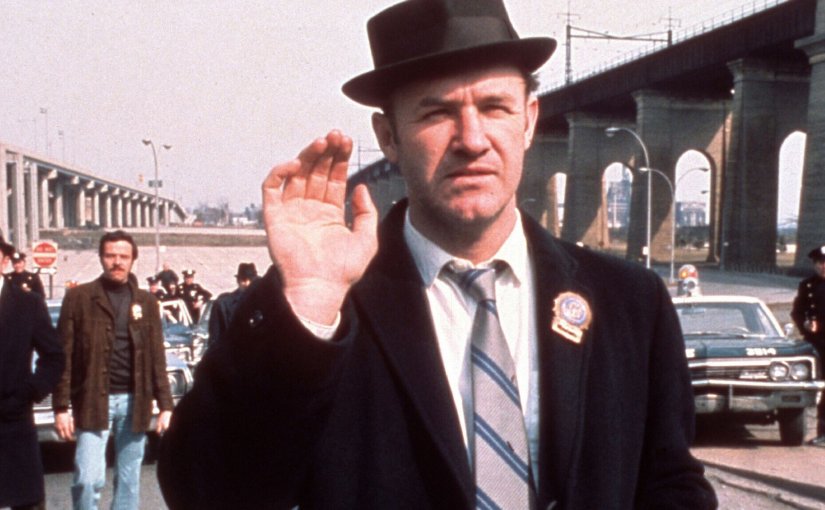
With modern cinema offering huge bravura performances a la Daniel Day Lewis or Christoph Waltz these days, it’s any wonder that today’s generation of movie goers would be puzzled that Gene Hackman won the Best Actor Oscar for this film, The French Connection, which also happened to win Best Picture. His character has no big monologues, no huge crying scenes. In fact for most of the film, he’s slamming guys up against a wall or following them up and down the dirty Brooklyn streets. Yet, his accolades were nothing short of deserved.

Watch as Hackman’s Popeye Doyle gradually exhausts himself in pursuit of “Frog 1.” His character starts out as a thrill seeking detective only to find his limits pushed against a better cat and mouse player. Dialogue isn’t sophisticated here to show his state of mind, but rather his expressions offer everything. Simply look at his close up following the extensive car search (an incredibly satisfying scene for me as a viewer).

If that’s not enough, the car/foot chase through Brooklyn is one that still has not been matched. See how it was done before CGI.

A simple drug deal is plotted perfectly from Marseille to New York, and best of all, it is all true (well mostly).

What’s most curious is the film provides one of the oddest and most unforgiving endings in a film ever. Perhaps you’ll agree (????). But, remember…THAT IS HOW IT HAPPENED!!!!

This was a film from 1971 that was raw in its language, gritty in its setting, spiteful and unafraid of the image it would leave, and that is why it won Best Picture, Best Director and Best Actor.

Bottom line, it would never have been made today. Never!

(Word of advice, ignore the sequel. A prime example of Hollywood shamelessly cashing in.)