BOHEMIAN RHAPSODY

By Marc S. Sanders

The aftermath of Rami Malek’s electrifying performance of Freddie Mercury might just follow the same trajectory of Jessie Eisenberg’s portrayal of Mark Zuckerberg. People will never be able to see past the one accomplishment and every role hereafter will be measured against this moment. Bohemian Rhapsody will likely be Malek’s best film of his career.

Bryan Singer, and more importantly an uncredited director replacement, have assembled a by the numbers music biopic complete with defiance against naysayers, sexual discoveries, band discourse, drugs, booze, illness, a wildly eccentric lead and an altogether sensational soundtrack. This isn’t me complaining however. The film might be formulaic but what else should I expect really?

Though I’m dubious if the compositions really were spawned as depicted, I nevertheless loved every second of Bohemian Rhapsody. Yeah, I doubt “Another One Bites The Dust” finally sprung to life during an in studio scuffle but as soon as the bass began to play, I was in the moment. Movies should always touch you naturally. The emotional response should never feel forced. It should be be triggered. The music of Queen has that effect for me. Not every song. Some lyrics are downright silly. Yet if “We Are The Champions” is going to be re-enacted during a Live Aid concert at Wembley Stadium following a series of setbacks for Mercury, you are going to get caught up in the moment.

The song introductions are the highlights of the film. They carry an energy that leads to lip sync and toe tap. However, the movie doesn’t stop there. I appreciated the strife between Freddie and his disapproving father, his affection for his bandmates and the eventual conflict among them, his struggles with loving Mary, his wife, while coming to grips with his bisexuality, his betrayals among those that used him, and finally his AIDS diagnosis. Every aspect is given enough attention. Still , we are treated to a near full shot for shot re-enactment of Live Aid, one of Freddie’s final performances before his eventual surrender to death.

Called me biased. Yet I’m not a die hard Queen fan. I just found the period set up authentic. The music editing to be well orchestrated and the cast to be spot on. A Mike Myers appearance (look for him but you won’t see how apparent he really is) is inspired.

The film ultimately belongs to Malek. Awards season will be generous to him. He’s comfortable and assured in the attire, the skin, the gravitas and even the teeth of Freddie Mercury. This was a film circulating the press for many years. Everyone seemingly wanted a bio pic. Finally, it has arrived and no one else could have played Freddie Mercury so beautifully as Rami Malek. He’s a miracle!

JOKER

By Marc S. Sanders

It’s important to understand first and foremost, Todd Phillips’ film Joker is really not a Batman story, a comic book story or even the derivative of a Batman comic book story.

Consider the Martin Scorsese pictures Taxi Driver and The King Of Comedy. Both films focus on two different characters descending into a variation of psychological madness. Yet the the titles of each film are pretty random, generic almost. Joaquin Phoenix plays wannabe comedian Arthur Fleck (to my knowledge never a DC comics character before this film) and this latest release from Warner Bros is billed as the origin of the Joker. Nevertheless, other than calling the setting Gotham City and having a billionaire character named Thomas Wayne with a son named Bruce, there is nary any calling to the mythos that fans are so familiar with. Why not just present this film with a title called “The Comedian” for example and run with it? Calling it Joker feels like a shameless cash grab. This is not a Batman villain tale, folks.

Joaquin Phoenix is astonishing in the lead role. He’s in every scene of the film and the method to own the character of Fleck is shown both physically and mentally. The known method actor must have lost at least 75 pounds to show weird, stretching contortions that easily shown his rib cage and pale complexion. Phillips films Phoenix at times where there is no dialogue either grimacing in a mirror, randomly dancing or simply leaning his head against a cold transit bus window. Surprise moments also come with head slamming against walls or glass doors. This was not all direction by Phillips. Phoenix had to have invented some of these instances.

Robert DeNiro is an obvious nod in casting as a Merv Griffin/Johnny Carson role meant to salute the Scorsese films of his heyday. When he was the man bordering on insanity, DeNiro performed with method material. Think back to when he’s Jake LaMotta in Raging Bull bashing his head against a wall while in solitary confinement.

While Joker certainly offers probably the best performance of the year in any category, it’s not a pleasant film to watch. It lacks any sense of wryness or humor. It’s a very depressing film about a man’s inevitable descent into madness. I couldn’t take my eyes off of Phoenix in the role, but like other comic book based films it didn’t leave me wanting more. I’m not eager for a continuation of this character.

If they wanted to a popular comic character story then I wish there could have been some more slight nods to the ingredients of this pop culture legacy. Couldn’t Arthur Fleck have been mugged by Oswald Cobblepot or sidled up alongside Mr. Zzazzz? How about a quick encounter with Selina Kyle or Edward Nygma? There’s just not enough evidence here for me to accept this is a Batman tale. Again Warner Bros banked on the title and not much else.

I got my money’s worth from Phoenix and I’m gunning for him to win the Oscar (not just nominated), but I can’t help but feel a little let down as well.

ONE FLEW OVER THE CUCKOO’S NEST

By Marc S. Sanders

After watching One Flew Over The Cuckoo’s Nest for the first time in many years, I recognized a political dual taking place on the battleground of an insane asylum. Director Milos Foreman sets the stage for one patient to win over the community from the Head Nurse in charge.

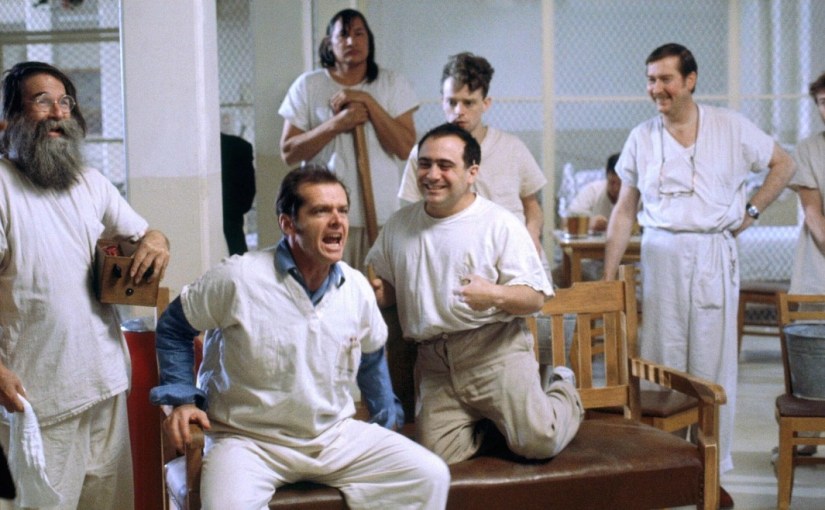
Jack Nicholson is Randall P McMurphy, a criminal who is transferred to the asylum for examination even though there are likely suspicions he’s faking his current condition as a means to escape prison life work detail. Louise Fletcher is his opponent as Nurse Ratched who has maintained an organized control over the floor of 19 men with an assortment of mentally unwell behavior.

McMurphy is a cut up as soon as he joins the gang. At first he appears observant during Ratched’s daily sessions where she asks the men to contribute to the discussion but at the same time she couldn’t be less encouraging. She’s happy to welcome ideas with open arms but don’t disrupt the process. There will also be “Medication Times” and there will be samples of classical and childlike music to subdue the patients as well. McMurphy may request the volume be lowered, but that’s not a simple request that Nurse Ratched will honor.

McMurphy’s experience outside the realm of insanity works as a wake up call for some of the men which consist of introductory performances from great character actors like Christopher Lloyd, Danny DeVito and Vincent Schiavelli. The stand out is Brad Dourif as Billy Bibbit, the stuttering suicidal young man with the baby face who fears his mother’s judgment as Nurse Ratched methodically continues to imply.

McMurphy wins over the crowd eventually. A fascinating scene is when Ratched challenges McMurphy to obtain enough votes among the men in order to watch the World Series. The count of raised hands appears to tie, but then Ratched reminds him that he needs one more vote to win. Before he can get to that point, the session is ended by Ratched. The call for election is lost due to a technicality by the governing control. An election won’t silence the voice of the people as McMurphy quickly encourages the masses to watch a blank television screen imagining his own interpretation of the game. Ratched can only domineer to a certain degree. Here’s the flaw in the Ratched character. At last a breakthrough among these ill men is established as they’ve learned to vote for themselves. They want to watch a baseball game. Ratched won’t stand for progress though.

Questions arise in One Flew Over The Cuckoo’s Nest. Is McMurphy truly faking his mental condition? Is Ratched so drunk on control to disregard doctors’ opinions for his release and keep him institutionalized? If he’s not insane, then why would she want him there? Is it all about Ratched’s obsession with winning?

Ken Kesey wrote the original novel the film is based on. He hated Foreman’s approach particularly with disregarding telling his story from the perspective of the deaf/mute six foot five Native American that McMurphy regards as “Chief” (Will Sampson). Chief seems to be the quiet one who does not take sides until McMurphy demonstrates the ease of obtaining freedom such as when the Chief helps him escape over a barb wire fence and then takes the men on a boating joy ride. I can’t side with Kesey’s insistence that the film be done from the perspective of the silent, yet memorable Chief. Film is a different medium than what’s read on a page. You can’t watch people’s thoughts. What I do find interesting is that Kesey opted for a Native American as McMurphy’s best sidekick. This is a man whose ancestors historically lost their land. McMurphy attempts to rob the rule of the asylum from Nurse Ratched. The political undertones just seem so apparent. The government control, however, is hard pressed to surrender even after McMurphy arranges for his own party of celebration complete with booze and alcohol. Ultimately, and sadly, the fate of McMurphy shows that he eventually becomes a product of his own environment. The Chief however, acknowledges his independence though.

One Flew Over The Cuckoo’s Nest is the second of three films to win the five main Academy Awards (Best Picture, Director, Actor, Actress, and Screenplay). It deserved it, and because of the film’s unsettling and messy nature it’s almost surprising that it was so well received. It’s not a glamorous film. It can show the ugliness of men drowning in their own consciousness.

At the same time, the film shows the subtle yet brutal control of those living fulfilling lives at the expense of the constituents they oversee. Sure, let’s have an open minded community of provoking thoughts, but only if it’s confined to the restrictions that remain in place. Step outside those lines and a more permanent technique will be applied so you adapt to what’s mandated…unless you can bodily lift a concrete water fountain and smash it through a cage bar enclosed window to freedom.

KRAMER VS KRAMER

By Marc S. Sanders

Probably the most personal film for me, the one that I watched for the first time with adult eyes even though I was only age 8 or 9 at the time, was writer/director Robert Benton’s 1979 Best Picture winner Kramer vs Kramer.

Though my parents never divorced, somehow I recognized the character of Ted Kramer, an extremely busy New York City advertising executive who could be having a great day while staying flirtatious but then also having an outburst of frustration when things are not going his way. My father was a busy man and a hard worker. He was a man who was always very proud of his work. He loved his work so much that he wasn’t as present in my life during my adolescent years. My mother on the other hand was my best friend who could make me laugh and demonstrated unconditional and very natural love for me. I learned about humor and love from my mother during those early years. I learned about responsibility from my father and some of his own humor later on. So, as I reflect on this film I imagine what life could have been for me had my mother walked out with no notice, leaving my father to tend to my needs while having to suddenly make sacrifices with his work.

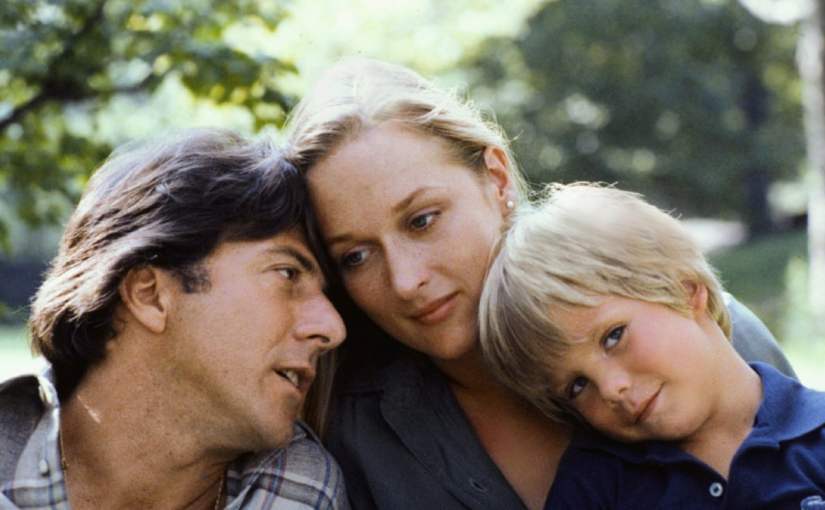
On countless occasions, I’ve written about the importance of a character arc where a protagonist will start out one way and completely change through the middle and end of the film. In Kramer Vs Kramer, the arc is not focused on a character but rather a relationship between father and son. When Billy (Justin Henry in an Oscar nominated performance) at age 6 wakes up to discover mommy is not there, he sees how lost daddy is with waking up and trying to make coffee much less crack an egg properly for french toast. Ted and Billy have been blindsided and without any warning they need to adjust to one another very quickly.

Later, Benton does an insightful tracking shot of their apartment as they wake and we see they’ve grown accustomed to a routine together of getting each other up, setting the table and reading their newspaper and comic books side by side while never uttering a word. Benton realized that the comfort of living with each other does not have to be evoked with dialogue. This routine is offered one last time at the end when an inevitable and unwanted conclusion has befallen Ted and Billy. Again, no dialogue because now as a viewer I’ve become comfortable with this special relationship. Truly, I envisioned my father and I in these three moments.

Meryl Streep is the other Kramer, Joanna. She won the Best Supporting Actress Oscar and its well earned. Benton opens the film on her sad expression in a quiet darkness. When Ted finally comes home with good news from work, Streep is really good at holding her firm stance at leaving the household permanently. It doesn’t matter that Ted has gossip to share of a co-worker’s suicide or that he got a huge promotion. She just up and hurries for the elevator despite Ted’s resistance in allowing her to leave.

Benton follows afterwards with a good long portion of the film to display the struggles that Ted and Billy need to overcome, and in a second act finally has Joanna return stating her desire for Billy to live with her. Ted will not allow that to happen. For a real actor’s showcase, it’s important to watch the scene when they meet for the first time in 18 months. The conversation is cordial and they appear pleased to catch up with one another. Seconds later, the opposite sides on what’s best for themselves, and more importantly Billy, surface and the back and forth is so perfectly timed. Streep and Hoffman have those stutters and talking over one another that seem so natural. The scene ends with a broken glass that was not rehearsed and fortunately Streep’s shocked expression remains before the scene is cut.

Hoffman is extremely good in his role. He runs a gamut of emotions to bring humor, sadness, anger, warmth and love to this part. Another powerful scene is when he desperately must find a new job within three days before Christmas. Benton makes sure that Ted appears completely strong in a disarming situation when he squeezes in a four o’clock Friday afternoon interview during a raucous office Christmas party. I love how Benton focuses a still camera on Ted sitting quietly in a lobby chair amid partiers while waiting to hear if he gets a job offer. This is determination of a very full degree. Nothing will allow Ted to lose his little boy during this custody hearing.

Kramer vs Kramer is a simple and brisk film. It moves with a fast pace, and I believe the reason for that is it takes place in a home with a father, a child and a mother. So, I like to think it was very open to relating to viewers of all ages including my preteen self. There are many different and recognizable facets to Kramer vs Kramer. Billy compares Ted’s rules to what “all the other mothers” do. There’s the school play. Ted running late for work and picking up Billy from a birthday party complete with a goody bag. Of course, there’s also the heightened drama of the courtroom custody hearing. It’s like watching stage work monologues from Streep and Hoffman. It’s brilliant.

I especially took a scene very personally where Billy falls off the monkey bars, and Ted rushing through the streets of New York to get him to the emergency room for stitches. I had a door slammed in my face once that required stitches in my bottom lip. Just like in the film there was blood all over my clothes and there was a terrible fear for this 8-year-old kid who now still feels a bump in that area. Billy’s anguish and Ted’s terrible fear and guilt seem so genuine.

I find it interesting that this film won Best Picture in 1979. A year prior it was The Deer Hunter and Patton was a few years before that. In 1980, Robert Redford’s Ordinary People won the award and in 1983 it was Terms Of Endearment. Hollywood didn’t forget the impacts of hellish war and combat films. However, with the 1980 Reagan years of much decadence and pop culture positivity, a middle-class domestic life was becoming more honest and apparent. These films were not just Father Knows Best. Films like Kramer Vs Kramer were ready to show the hard parts of living a yuppie life. Things seem so normal on the outside when really there’s a struggle to love and live on the inside.

Cinderella like films showed my eight year old eyes that if a prince and princess finally meet and dance together all will be well in the kingdom. However, Kramer Vs Kramer told me that marriage and family life do not equate to happily ever after. Don’t mistake me. I’m not being pessimistic here. What I learned at that young age is that the story really only just begins after the prince and princess fall in love with one another. Thereafter, the conflicts settle in and the happy ending arrives only when the characters adjust to the evolution of their futures together, or if necessary, without one another.

PATTON

By Marc S. Sanders

You may find this hard to believe but as I was watching the epic Best Picture winner of 1970, Patton, I was actually thinking of a dreadful film I had seen the day before called Under The Cherry Moon, featuring and directed by Prince.  How in the hell could that be?  Well, both films are laced with the vanity of their films’ main characters to the umpteenth degree.  However, I’ll save Prince’s piece for another column, when maybe I’m out of excuses to avoid death or a root canal.  The point is both films never tire of the close ups of its featured player to enhance the pride, ego and conceit they do not hesitate to thrive off of.  The difference is that director Franklin J Schaffner knew that to really show what motivated General George S Patton you had to drill for the American warrior’s drive, and Patton’s motivation was truly his own self-worth.  (Prince just wanted one more close up on top of one more close up as a means of self service.  Sorry but that’s not enough of a reason for a character to live.)

Patton is portrayed by George C Scott in an Academy Award winning performance.  No one else could have played this role.  No one else should ever play this role again.  Scott and Patton are symbiont in a camera’s lens.  One can not be imagined without the other.  Schaffner’s film opens in front an American flag that fills the entire screen.  Patton steps up in front.   Somehow, his figure seems like a bigger, more prominent figure than the large backdrop of the stars and stripes.  He delivers a monologue that was aimed at the troops fighting in the second World War, but this is really an introduction to the audience of what to expect for close to the next three hours.  He reminds us that the blood and guts of the Nazis will be used to grease down the tread of our tanks and he will be proud to lead his men on any battlefield that calls for the bloodshed of Hitler’s regime.  In the film’s first five minutes, you know that this biographical character will never sway from what he stands for.

The theme of the film tests the egotism of General Patton.  We see him get dressed in his military uniform before heading in to battle.  His subordinates put his military jacket on.  Another one places his helmet upon the great battalion leader’s head, but it is done with great detail.  This helmet will never fall off.  I can promise you that.  Early in the film, the two star general takes it upon himself to decorate his shirt collar with three stars.  He’s reminded that President Eisenhower has not made his promotion official yet.  Patton proudly dismisses that detail.  None of this has to do with the strategist Patton became known for on the battleground.  George C Scott demonstrates that the General knew when to bestow himself with another honor in his proud military career.  No one else, not even the Commander in Chief, would determine when the General was worthy of another star.

In the heat of battle, Patton happily volunteers historical facts about the regions he is fighting on.  He even insists that he knows for sure what happened before.  He, General George S Patton, was there.  He’s not kidding.  He truly believes that.  History did not deliver General George S Patton.  Rather, General Patton delivered history. 

All throughout the film, Patton is seen in moments of great pride.  He’ll be standing as his jeep caravans his military forces through conflicts in Tunisia and war torn Europe.  General Patton loved to lead, but his leadership was specific to sending a battalion into one conflict after another and what was most important was earning the glory for himself.  The British couldn’t have the accolades.  Certainly, his fellow generals couldn’t either.  Patton is who the Nazis feared.  Patton is the towering six foot tall man who must be seen walking off the bow of a ship into battle when the US back home gets film updates. 

Scott’s character is tested however as Ike loses confidence in the great general.  Patton’s mentality on war does not mesh well with the propaganda of the United States with the other allied countries, particularly Russia.  Patton is not interested in making friends with Russia as he is more concerned with anticipating an eventual disagreement with them and thus, we must be prepared for war.

More significantly, Patton only cared for the bravery of his men.  Early on in the film, Patton arrives at the camp site of a US battalion to take over its leadership.  George C Scott’s presence is all that needs to be said as he visits the mess hall followed by an office and then an infirmary.  Men will no longer show up late for breakfast.  If other men are going to sleep, well then that’s fine as long as it is a means to end with an advantage towards military victory.  Doctors will don their helmets even if it means drilling holes in them to continue properly using stethoscopes, and any man who is being treated for self-inflicted gun shot wounds will not be entitled to a bed for healing.  Get those cowards out immediately.  Hospitals are for those soldiers who proudly shed their blood in the name of the United States of America. 

This last detail is further echoed at a pivotal point in the film.  Patton chastises a crying soldier who is simply terrified of the shelling of war.  No man who dons a military uniform should ever be crying in fear.  Following slapping the boy around, Patton orders that the soldier be sent to the front lines.  My question is how useful is this kid going to be on the front line if he is crippled by his own fears.  Patton would have then slapped me around, most likely.  The front line will certainly wake this kid up and load his weapon to spill some enemy blood. 

The other interesting dynamic to the film falls upon the role of General Omar Bradley played with contradictory delicateness by Karl Malden.  The script by Francis Ford Coppola and Edmund H North display Bradley as a man who came up through the ranks of General Patton.  Yet, because of Patton’s controversial nature as a proud war hero and not a politician representing the ideals of Ike’s administration, Bradley is eventually put in charge of the United States’ positions in the War.  By the time this arrives, the film is only approaching the beginning of its second hour and I could only imagine how Patton is going to take this. He’s advised by his friend Bradley to calm his nature and maybe even question his motivations for battle.  Yet, Patton can only see that his apprentice has taken over and he has been grounded or meant to serve as a decoy to Hitler’s armies.  This is a complete misuse of his skills and his pride as an American symbol.  Patton is relegated to delivering speeches to gracious European women.  This is beneath him.  Adding insult to injury, the dog he proudly walks by his side is a fraidy cat when confronted with a woman’s little yappy pup.  The great general’s ego has been terribly bruised.

General Patton might have been controversial but the film serves as a means to show his imperfections ahead of his historical conquests.  When Patton is questioned as to how he can overthrow Hitler’s positions in various parts of Europe within two days of heavy snowfall, Patton is proud to say that he alone has trained his men to overcome any ordeal they are faced with.  His men are killers; killers of Nazis.  The doubt of other military leaders is proven wrong thanks to the General’s insistence.  Sure, the old general might have been a pain in the ass for the United States, but how would the war have really ended for the Nazis if they hadn’t have had to deal with the great leader?  Periodically, during the course of the film we see how the Nazis try to gage what Patton will do next.  It makes no difference how the United States are censoring their general.  The Nazis stare at a proud photograph of him, knowing he is still out there.  Where is Patton leading his forces to, and how will they ever explain it to their Fuhrer? 

George C Scott is truly a great presence here. Schaffner’s work with the camera must also be recognized.  The film is epic because of its scale.  Years before the age of CGI and a great war film like Steven Spielberg’s Saving Private Ryan, this film from 1970 showed vast settings populated with tons of extras and infinite tanks and vehicles, as well bomber planes.  It’s astounding.  How was this all accomplished?  Other films like …Ryan or The Thin Red Line would show more intimate fights among the opposing forces.  Shootouts and one on one grappling.  Patton shows the enormous battles.  Tanks are overturned, bombs are dropped right in the middle of a sea of extras.  The film was also awarded for its art direction and its hard to question why.  It’s unbelievably impressive.

As the film directly says, Patton lives for the love of war.  Therefore, the ending is a little sad.  The war ended.  The Nazis fell to the triumph of Patton, the United States and their allies.  Schaffner simply offers a wide shot of Scott walking alone into a field of no significance.  Other biographical films would resort to a death bed moment.  That’s too easy an escape sometimes.  In a way, the film could be a tear jerker.  Mind you, I didn’t cry at the end of Patton.  However, any film must have a certain sense of sorrow when a character no longer serves any meaningful purpose in life.  The heart might continue to tick, but the soul no longer has anything left to accomplish.  Coppola and North knew that, as well as Schaffner, and George C Scott knew so as well.  Once the war had ended, a proud (very, very proud) man was put out to pasture.  That has to be more meaningful than any physical passing.

RAIN MAN

By Marc S. Sanders

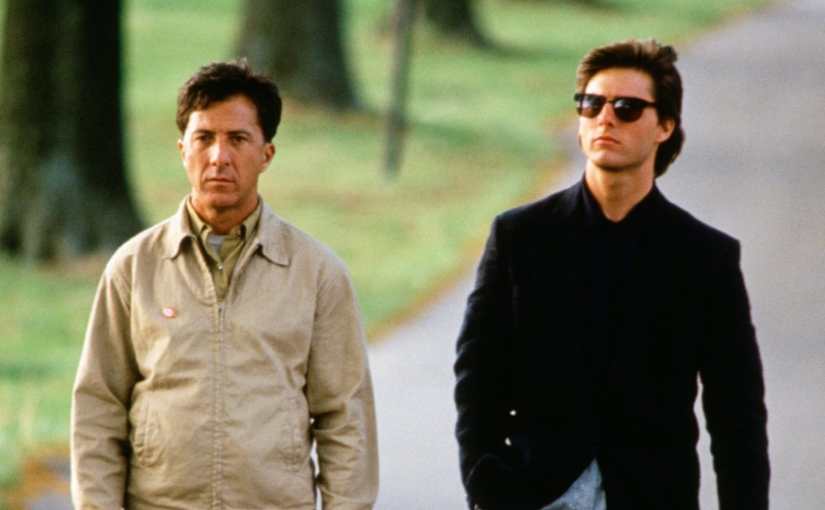
It may surprise some people that I don’t find Dustin Hoffman’s performance of autistic savant Raymond Babbitt to be the best feature in Barry Levinson’s Rain Man.  On the contrary, the best thing about the film is Tom Cruise’s cynical, hyper active portrayal of Raymond’s younger brother Charlie.  I’m not knocking Hoffman.  He’s absolutely memorable, authentic and brilliant.  It’s so brilliant though, that it overshadows what Cruise accomplished with his part. 

Those of you who have read some of my reviews before, may recall how much I praise the best character arcs to be found in stories.  The character starts out one way and by the time the conclusion arrives, this person is completely different; practically unrecognizable.  Hoffman did this in Kramer Vs Kramer and Tootsie, Al Pacino did this in The Godfather.  Bryan Cranston used five seasons of television to do this in Breaking Bad.

Before I ever saw Rain Man for the first time, many years ago, I never knew what autism was.  I don’t even think I ever heard the word autistic before this film arrived.  I guess I was wrapped in my naïve bubble.  Now watching it years later, I see the special talents that autism can present for a person living with it, as well as the challenges that come with a person nearby who cannot comprehend the diagnosis, and carries no patience for it. 

Screenwriters Barry Morrow and Ronald Blass are wise to show an odd pairing of brothers in this film.  The movie begins when Charlie, deep in debt with his high-performance sports car dealership, learns that his estranged father has passed away.  Dad only leaves him with a gorgeous 1949 Buick Roadmaster convertible.  A $3 million estate is awarded to a trust fund meant to support Raymond; the autistic brother Charlie does not recall ever having.  Charlie’s arrogance and desperation to cover his insurmountable debts drive him to yank Raymond out of his care facility and embark on a cross country road trip back home where he intends to settle the estate by how he thinks he deservedly sees it.  During the course of the trip, Charlie gets a quick education about himself and Raymond’s condition. 

Tom Cruise might look like late 1980’s cool and stylish in his linen suits and button up silk shirts with sunglasses, but his glamour does not overshadow how bitter of a guy Charlie really is.  That’s what I embrace in his performance here.  It should have been nominated for an Oscar; definitely a glaring oversight by the Academy.  Charlie looks like a guy always moving at super speed, about to collide with a wall.  He bosses around his assistant salesman with outbursts and disruptive clapping hands.  Levinson is good at showing close edits of that.  He gives no attention to his girlfriend, Sussana (Valerie Golino), even when she is trying her best to have him stop for a second and realize the special condition and attention that Raymond needs.  As Charlie’s journey continues down the back wood roads of western America, he has no choice but to uncover a realization in his own hyperactivity, and even recognize a different kind of hyperactivity that Raymond possesses. 

Raymond is the autistic person whose mental capacity must follow strict guidelines of watching The People’s Court and Jeopardy.  He has to have to certain meals on certain days.  He can not ride in a car when it is raining.  He can not fly on airlines that carry historical statistics of crashing.  Fire alarms and hot faucet water are violently upsetting.  There is a rigid, uncompromising pattern to Raymond’s behavior and lifestyle.  Because he can’t compromise, Rain Man carries some humorous and outrageous scenes where Charlie must adjust to Raymond’s limitations.  I still feel sorry for the woman who has no choice but to surrender her television and living room in the middle of day so that Raymond can watch his program, while her children are deprived of their cartoons.

Hoffman is great in focus and concentration.  Much like when he adopted the persona of a woman in Tootsie, you never see him sway from the performance of severe autism in his Raymond character.  Because he is so straight down the line here from beginning to end, I have to really admire Cruise’s change in character over all.  Rain Man really is a story about Charlie Babbitt.  Not so much Raymond Babbitt. Charlie changes during the course of the film.  Raymond does not. 

There are a lot of eye-opening moments in Levinson’s film.  You get an education in what autism really is, or at least the unique case that Raymond possesses.  He can memorize a phone book in one night or count the number of tooth picks that have fallen on the floor with simply a glance.  Complex multiplication can instantly be done in his head.  It’s fascinating.  Charlie even discovers a way for Raymond to resolve his financial crisis, thereby leading to an energetically satisfying jaunt in Las Vegas. 

Barry Levinson has assembled two fantastic actors for an engaging film that avoids preachiness and sorrow.  Yet, Rain Man is rewardingly sensitive.  Levinson says a million words with simply a close up moment of Hoffman gently leaning his head on Cruise’s temple.  Quiet moments like that which arrive following scatter brained moments earlier make for a range of emotions I treasure in a picture like this.

I look at Rain Man or Magnolia or Born On The Fourth Of July, and I wish Tom Cruise would take a break from the endless Mission: Impossible films.  Heck, there’s even another Top Gun film on its way!  Why doesn’t he focus on the roles that welcome his skills as a very effective actor?  (American Made was a recently oddly different kind of character for him. Great film by the way!)  I have an affection for most of his films, regardless of the category. I really do.  If only his action pictures could take a rest for a change, and allow the acting scenes to come back into play.