A SEPARATION (2011, Iran)

by Miguel E. Rodriguez

Director: Asghar Farhadi
Cast: Payman Maadi, Leila Hatami, Sareh Bayat, Shahab Hosseini
My Rating: 10/10
Rotten Tomatometer: 99% Certified Fresh

PLOT: A married couple in Tehran are faced with a difficult decision – to improve their daughter’s life by moving to another country or to stay in Iran and look after a deteriorating parent who has Alzheimer’s disease.


The above plot description, paraphrased from IMDb, is rather brilliant because it is misleading in all the right ways.  When I read it, I assumed I would be in for a depressing domestic drama, a la Marriage Story or Kramer vs. Kramer.  It won Best Foreign Film at the Oscars that year, so that only strengthened my belief that it would be a fine film, but also a bit of a slog.

Boy, was I wrong.  That plot description covers just the opening four or five minutes of the movie, an incredibly nuanced, brilliantly acted, uncut take of the two spouses, Nader (husband) and Simin (wife) arguing in front of a judge.  Simin wants to move out of the country so their daughter, Termeh, can have a better quality of life.  Nader has no problem with them leaving, per se, but he cannot go because he must stay and take care of his elderly father who suffers from Alzheimer’s.  If Simin wants to go so bad, let her go, he says, but he won’t give permission for Termeh to go with her.  And Simin won’t leave without Termeh.  It’s a pickle.  (For her part, Termeh wishes to stay with her father, but Simin says that’s only because she doesn’t know any better…how depressingly typical of parents going through a separation.)

After this brilliant scene, I was ready for the movie to settle into a series of one scene after another showing Nader and Simin arguing over custody of Termeh.  Instead, the script ingeniously takes a bit of a left turn and focuses on the woman Nader has hired, Razieh, to be caretaker for his sick father, because Simin, in a move unexpected by me, packs up and moves out.  Razieh wears a traditional chador, and so Nader is unable to tell she is pregnant, which might have affected his decision to hire her.

Razieh does her best with Nader’s father, but the long commute and the difficult work takes its toll.  One day, Nader comes home from work and discovers his father has fallen out of bed, with one hand tied to the bedpost with a piece of cloth, and Razieh is nowhere to be found.  He also discovers some money is missing.  When Razieh returns, she is cagey about why she left, but she insists she stole no money.  Nader is furious and tries to throw her out of his house.  When she insists she be paid for the day’s work and continues to maintain her innocence of the theft of the missing money, Nader loses a little control and pushes her out the front door of their third-floor apartment and onto a staircase.  She walks away, but later winds up in the hospital – she has suffered a miscarriage.

What follows is one of the most engrossing social dramas I’ve ever seen in my life.  I suspect part of my insane interest in the story was the fact that it takes place in a country thousands of miles away, in a culture that is utterly alien to me, and yet the people there are just like any parents and children and husbands and wives we meet every day here in the States.  Razieh’s husband, Hodjat, even has a line: “Why do you think we beat our wives and children like animals?  I swear on this Qur’an, we’re humans just like you!”  He’s talking to his accuser, but he was also talking to me.

The film is shot with mostly handheld cameras, a technique that works extremely well by making everything feel like a documentary.  It makes things feel more real in a story that only works the more you empathize with the characters.  I empathized a great deal, not because I am a husband or a father, but because I recognized their situation, faced with an impossible decision where each person is right and wrong simultaneously.  In the ensuing plot developments, which I will not disclose here, I was so wrapped up in the lives of these people that I found myself reacting the way old school sit-com housewives might respond to watching their favorite soap operas while folding laundry.  “No WAY did he just say that!  …oh my god, lady, you’re just making things WORSE!  …jeez, this guy is CRAZY…!”

This was an unexpected reaction for me.  In years past, I have tended to shy away from foreign dramas after watching one called 4 Months, 3 Weeks, and 2 Days about women in ‘80s-era Romania forced to seek illegal abortions due to their country’s ban on the practice.  I’m not denying that film’s power, but it was so insanely depressing that I swore off foreign films for a while.  It’s only in the last couple of years that I’ve started to come back around to giving films like A Separation a chance.  It hasn’t always paid off, but I’m happy to say it did this time, in spades.

I should note that the story is also extremely revealing in terms of the legal system in Iran.  I can’t vouch for its accuracy, of course, but it all feels very authentic.  In a governmental system so intertwined with religion, it’s easy to see how decisions that are made based on religious statutes may be technically correct without being just.  Just another dimension to the film that makes it even more compelling to watch.

But there is another aspect of A Separation that I believe is even more profound than the engrossing domestic drama.  I’m not even sure if it was intended by the filmmaker.  I’ve read snippets of reviews from other top critics, and none of them seem to have touched on my theory.

[SPOILERS FOLLOW]

In my opinion, A Separation could be interpreted as an allegory of the impossible choices faced by anyone living in such a country or circumstances who yearn for a better (or at least different) life elsewhere, but whose ties to their roots and traditions make such a decision extremely difficult.

Look at the husband in the story, Nader.  He states repeatedly that he has no problem with his wife leaving.  If his father weren’t sick, he would be more than happy to go with her.  But his father needs constant care, and so his familial connection dictates his decision.  There is a telling moment when Nader is bathing his father by hand, while the father sits in a wheelchair, virtually oblivious to his surroundings.  Nader dutifully rinses his father’s body and leans him forward to so he can reach the bottom of his back…and he abruptly stops and starts to weep.  Is he weeping for his father?  Or himself?  It’s one of the film’s many “fill-in-the-blank” moments that we must interpret for ourselves.  For me, I believe it was over the fact that his decision to stay, motivated by love and duty, has resulted in years of caretaking.  He’s committed to it.  But it’s also profoundly sad.

Now look at the wife, Simin.  She believes her daughter, Termeh, will be better off in another country where she doesn’t have to worry that some man might take out his anger on Termeh while at school or walking home from school.  But Termeh insists on staying with her father.  Simin’s choices are to stay and be unhappy, or leave…and be unhappy without her daughter.  She adopts a middle ground by simply moving to her mother’s apartment while she works on convincing Termeh to come with her.  In the grand scheme of things, as a function of the allegory I have in mind, she represents the person who wants to leave and is held back, not by duty, but by the fact she won’t leave her daughter behind.  There’s a piece of her in this place, and she’s free to leave it if she wants, but she’ll never be the same.

How many people in other countries and other circumstances are faced with similar choices?  How many people in our own circles are stuck in marriages or family situations where leaving appears to be the best option on one hand but an impossibility on the other?  I could say that I’ve had similar situations in my own past with such a decision, but it was certainly nothing on the level of leaving my roots behind and moving to another country.  I can’t imagine the struggle and conflict for anyone facing that kind of choice.

A Separation takes that struggle and wraps it up in a movie that, even if it weren’t so perfectly symbolic, could stand on its own with any other film from any other country.  At the end of the film, the daughter is asked, point blank, which parent she would rather live with.  In what would ordinarily be a frustrating moment, we are not shown what she chooses.  It is left to us to imagine her choice.  Or maybe not.  Maybe we are meant to see what it’s like to be faced with an impossible choice, when neither option is better than the other and someone will get hurt either way.

The question isn’t, “What will she choose?”  The question is, “What would you do?”

THE PRINCE OF EGYPT (1998)

by Miguel E. Rodriguez

Directors: Brenda Chapman, Steve Hickner, Simon Wells
Cast: Val Kilmer, Ralph Fiennes, Michelle Pfeiffer, Sandra Bullock, Jeff Goldblum, Danny Glover, Patrick Stewart, Helen Mirren, Steve Martin, Martin Short (whew!)
My Rating: 10/10
Rotten Tomatometer: 80% Certified Fresh

PLOT: Egyptian Prince Moses learns of his identity as a Hebrew and, somewhat reluctantly, realizes his destiny to become the chosen deliverer of his people.


I sat down to watch The Prince of Egypt for the umpteenth time today, ostensibly in honor of Passover, but really it’s just an excuse to watch it again.  In the 24 years since its release, it’s become one of my favorite animated films.  I started out thinking it was a gimmicky cash grab.  Then I realized how majestic the score and songs were (by Hans Zimmer and Stephen Schwartz, respectively).  Then I came to appreciate how effectively it humanizes the Exodus story, so it becomes something more than just an excuse for some crazy visual effects.  Then I looked more closely at those visual effects and realized how magnificent they are, too.

So now it’s a treat when I watch it.  But something rare and unexpected happened to me when I watched it today.  Before I get into that, though, for anyone who may still be unfamiliar with this marvelous film…

Moses (Val Kilmer), a prince of Egypt, younger brother to Rameses (Ralph Fiennes) and son to the great Seti (Patrick Stewart), is comfortable with his place in the world.  One day, he comes across Miriam (Sandra Bullock), a Hebrew slave who boldly informs him he is not Egyptian.  He is, in fact, the son of a Hebrew slave woman who set him adrift on the Nile River to spare him from the bloody purges ordered by Seti, the man he calls father.  Disturbed and conflicted, Moses unthinkingly kills an Egyptian slave driver in a heated moment and leaves behind the only family he’s ever known to face his fate in the desert.

There he meets Tzipporah (Michelle Pfeiffer), a Midianite girl on whom he showed mercy earlier, and her family.  Embracing his new Hebrew identity, he marries Tzipporah and becomes a shepherd.  Time passes.  One day, Moses is searching for a lost sheep when he is confronted with a strange sight: a bush that appears to be, not burning, but covered in cold white flames, nevertheless.  To his shock, a voice speaks from the bush.  It is the God of his ancestors, and He is displeased with how His people are being treated in Egypt.  He commands Moses to go to Egypt and tell the pharaoh to let His people go…

Need I go on?  The staff, the plagues, the blood, the angel of death, the pillar of fire…it’s all presented here in spectacular fashion.

When DreamWorks first announced plans to make what basically amounts to a musical version of The Ten Commandments, I was skeptical to say the least.  I even remember what theatre I saw it in: the Ybor Centro movie theater in 1998.  I sat through the movie, and I allowed my skepticism to color my entire viewing experience, right up until the sensational Red Sea parting, which even now is one of the great animated sequences of all time.  But aside from that, I felt The Prince of Egypt was all flash and no substance, a way for an upstart movie studio to get people into theaters with an overabundance of star power and little else going for it.  But after watching it on home video repeatedly…I mean, REPEATEDLY…I started to analyze it a little more.

The first thing that really renewed my interest and appreciation for the film was the humanization of the main characters, particularly the relationship between Moses and Rameses.  Moses is no movie idol in this film.  He’s just a man.  Kind of a scrawny man, too, not classically handsome like his brother, Rameses.  Where Moses looks a little spindly and frail, Rameses looks like he lifts weights, or whatever folks did back then on “arm day.”  I also like how the movie allows these two men to behave and relate to each other like real brothers might.  They race chariots down city streets, needle each other, call each other names, play pranks on the high priests, the whole nine yards.  It’s a dynamic the two men surely must have shared as brothers growing up, but it never gets addressed in other interpretations of the story.  Because we get to see how much they love each other, the scene where Moses reluctantly turns his back on Rameses carries so much more weight than we might be accustomed to seeing.

This dynamic comes full circle when Moses returns to demand freedom for the Hebrew slaves.  Rameses is now pharaoh, and laughs at Moses’ demands, wondering what his “angle” is.  And then, when the plagues are visited upon Egypt and the city has nearly crumbled, the two men share a scene of astonishing power.  Rameses sees his city in ruins, but ruefully remembers how Moses used to get him out of trouble when they were younger.  It’s a wonderfully human moment.

The second element of the film that sparked my renewed interest was the music.  At the end of the opening number, which is itself emotionally powerful on several levels, a solo female voice sings out, “Deliver us!” right at the end of the song.  I can no longer remember a time when that moment didn’t give me goosebumps.  The score by Hans Zimmer is magnificent.  There is one particular motif of a choir of voices that we hear whenever we are in the presence of something holy or mystical, and even that gives me goosebumps.  Another moment that deservers recognition is during the big number, “When You Believe,” as the Hebrews are flowing out of Egypt.  At one point, the song is replaced by a Hebrew folk song, “Ashira L’Adonai,” sung by a little girl.  Her voice is joined by several others, and then a few more, and then a whole choir, and then the whole orchestra comes in for a reprise of the chorus, and if you don’t get goosebumps at that moment, you need a vacation.

The third element that keeps me coming back to this movie is the visuals.  True, the CGI visuals are relatively primitive compared to what was going on at Pixar around the same time.  The chariot race between Moses and Rameses features CG chariots which you may notice have wheels that don’t always turn while the chariot is moving.  This was an aspect of the film that led to my early dismissal of it.  But then came the Angel of Death scene, with a hole literally torn in the sky and sinister tendrils pouring out of it and into the village streets.  And then came the eye-popping Red Sea sequence.  More so than any other version I’ve seen, The Prince of Egypt made me feel in my bones that, yes, THIS is what it would have looked like if uncountable tons of water were parted down the middle, clearing a path large enough for the entire Hebrew nation to walk across.  (Depending on who you ask, that number could have been up to two million people, so we’re talking about a WIDE path.)  As they walk between the two massive walls of water on either side, lightning flashes illuminate sea life swimming alongside them, including some really large fish.  Now THERE’S something you don’t see every day.

So, yeah, the movie is amazing.  People may quibble about its historical inaccuracy, or the liberties it may take with certain religious beliefs.  But that does not diminish its power in the slightest bit.

Which brings me back to what I mentioned in the opening paragraph:

I sat down to watch the movie today, and for reasons I can’t explain, the opening scenes were bringing a lump to my throat.  That solo female voice singing “Deliver us!” nearly brought a tear to my eye.  And it nearly happened again after a wedding song.  And again, when Moses is leading the Hebrews out of Egypt to the strains of “When You Believe.”  And when Moses slams his staff into the shallow waters on the banks of the Red Sea, and those waters shot up into the air and kept going and going…my God, man, I nearly lost it.  I was one thread of self-control away from going full-on blubber-fest.  I mean, I grabbed my chest like a Victorian lady reading a Jane Austen novel.  In the middle of my emotional experience, I kept asking myself, “What is WRONG with me?!”

The answer is, of course, nothing is wrong with me.  I was just in exactly the right frame of mind to have a borderline religious experience while watching a movie.  It’s the same when I watch the finale of Fantasia 2000, when the sprite erupts from the ground in a gesture of pure joy.  Or when Riley learns the importance of experiencing sadness at the end of Inside Out.  Or any number of other transcendent films that can put me right in the middle of the story emotionally.  The Prince of Egypt does exactly that through a well-managed mixture of story, visuals, and music.  It may not be perfect from a technical standpoint, but it gets me where it counts, and that’s all that matters.

THE FORTUNE COOKIE (1966)

by Miguel E. Rodriguez

Director: Billy Wilder
Cast: Jack Lemmon, Walter Matthau, Ron Rich, Judi West
My Rating: 5/10
Rotten Tomatometer: 96%

PLOT: A crooked lawyer persuades his brother-in-law to feign a serious injury.


Billy Wilder’s The Fortune Cookie reminds me of what it might be like to watch Jerry Lee Lewis play “Chopsticks.”  You sense it’s being done as well as it possibly can be done, but you wonder why it’s being done at all.  C’mon, man, let’s hear “Great Balls of Fire!”

Notable for being the first of twelve films Jack Lemmon and Walter Matthau starred in together, The Fortune Cookie tells the story of a hapless TV cameraman, Harry Hinkle (Lemmon), who is covering a Cleveland Browns football game from the sidelines.  A burly punt returner accidentally runs him over during a play and knocks Harry out cold.  While he recuperates in a hospital bed, his thoroughly unscrupulous brother-in-lawyer, Willie (Matthau), concocts a very modern-sounding plan: Harry will fake serious injuries in the hospital so Willie can work his magic with the insurance company and get a big payout.  Harry demurs at first but is enticed to go along when he finds out his ex-wife, for whom he still carries a torch, is very interested in assisting with his recuperation from his “serious” injuries.

Meanwhile, the poor football player who knocked him down, Luther (Ron Rich), is wracked with guilt over the damage he thinks he’s caused.  He pitches in to buy Harry a motorized wheelchair and offers to assist with his rehab back at home.  This gnaws at Harry’s conscience.  Things don’t get any better when he’s brought a lunch of Chinese food at the hospital, and the fortune inside his fortune cookie bears a grim warning…

There’s nothing wrong with The Fortune Cookie that a rewrite or some editing couldn’t have fixed.  That might be considered sacrilege, considering the script was penned by Wilder himself and his legendary writing partner, I.A.L. Diamond, but in watching the film, I was struck by how many scenes involved a semi-static camera just watching people talk, and talk, and talk.  I don’t mind a lot of dialogue in a scene when the characters have something to say, or when the story is being driven forward.  But here, we usually get a five-minute scene when a two-minute scene could have done the job just fine.

Take one scene in particular that almost had me literally nodding off, when Harry’s ex-wife, Sandy (Judi West), has returned home to help with Harry’s rehab.  Harry is still feeling guilty about the sham he’s perpetrating, but he’s so besotted with Sandy that he’s willing to keep up the pretense just to keep her around.  They catch up a little, blah blah blah, he says he never threw away his ring, blah blah blah, she dumps out her purse looking for her ring, blah blah blah, he puts on a little music, he’s happy, she’s happy, and <snoorrrrrrre.>

I could list any number of films, including some of Wilder’s other films, where other characters talked for even longer than Harry and Sandy, but they were so much more interesting!  What happened here?  What went wrong?  Even in the scenes where Willie, the huckster, is rattling off his grand plans and needling the insurance company attorneys, Matthau just comes off as a two-bit hack that no sane person would pay any attention to.

I’m not saying he must be likable, that dreaded word.  There are movies that are very, very good and that contain nothing BUT unlikable characters. (Anyone wanna watch The Godfather?) But here, something is off with the tone.  When I wasn’t bored, I was inflamed with distaste for what Harry was being forced to do, both by Willie and by his own hormones.

The movie does have one saving grace.  The comeuppance, when it, er, comes up, is brought about with the kind of shock comedy scene that Mel Brooks might have loved.  I don’t want to spoil it, but it features the kind of language that would have been right at home in Blazing Saddles.  When I got over the shock of what I had just heard, I sat back in admiration and smiled, and thought to myself, a little ruefully, “Now what would this movie have been like if it had been this nervy all the way through, instead of just here at the end?”

But The Fortune Cookie even mucks up the ending with an “epilogue” scene that’s so gratuitously manipulative, I wouldn’t be surprised if it had been tacked on by the studio who demanded a happy ending, or at least a happier ending.  If the movie had earned it, I’d have been on board, but everything that came before was so humdrum that it felt super-cheesy.

Billy Wilder’s résumé reads like the Pixar catalog: one hit after the other with only a couple of rare misses.  Double Indemnity.  The Lost Weekend.  Sunset Boulevard.  Ace in the Hole.  Stalag 17.  Sabrina.  Witness for the Prosecution.  Some Like It Hot.  The Apartment.  Even One, Two, Three, which may not exactly be his finest moment, but at least it had James Cagney to liven things up.  I ask again: what happened here?  Where is the dynamite chemistry between Lemmon and Matthau that would become legendary in later films?  Where is the zaniness of Some Like It Hot or the earned pathos of The Apartment or the edginess of Ace in the Hole and Stalag 17?

According to the trivia section on IMDb, the opening football game sequences were filmed during an actual Vikings-Browns football game, which the Browns lost, at home, 27-17.  After watching this movie, I felt like those Cleveland fans must have felt: always glad to see my boys play, but man, it would have been WAY cooler if they had won.

EVERYTHING EVERYWHERE ALL AT ONCE (2022)

by Miguel E. Rodriguez

Directors: Dan Kwan, Daniel Scheinert
Cast: Michelle Yeoh, Stephanie Hsu, Ke Huy Quan, James Hong, Jamie Lee Curtis
My Rating: 10/10
Rotten Tomatometer: 96% Certified Fresh

PLOT: A middle-aged Asian woman tries to do her family’s taxes with mind-bending results.


Every once in a while, a movie comes along that is so daring and original that any attempt to accurately describe it feels futile.  Scott Pilgrim vs. the World was one of them.  Being John Malkovich was another.  And now comes Everything Everywhere All at Once, a sci-fi action brainteaser that feels as if it were written by Terry Gilliam and Quentin Tarantino and directed by Stephen Chow (Kung Fu Hustle, Shaolin Soccer…two movies that also meet that “indescribable” criterion).  It feels like an episode of Black Mirror crossed with Jackie Chan and a dash of David Lynch and Terrence Malick.  If you can’t find anything to like in this movie, check your pulse.

Evelyn Wang (Michelle Yeoh) opens the film trying to do her family’s taxes.  She and her husband, Waymond (Ke Huy Quan – “Short Round” from Temple of Doom!!), carry stacks and stacks of receipts to their local IRS branch and try to explain to their case worker (a dowdy Jamie Lee Curtis) how a karaoke machine can be deducted as a business expense.  However, before that can happen, after a series of very strange events involving Waymond and a pair of Bluetooth headsets, Evelyn finds herself immersed in a trans-dimensional battle between the forces of good, led by an alternate-universe version of Waymond – the “Alpha Waymond,” if you will – and someone called Jobu Tupaki, a being or person who is hunting for Evelyn in every conceivable parallel universe.  All Evelyn has to do is use these weird headsets to access the infinite multiverse and harness the skills learned by the infinite Evelyns before Jobu Tupaki can track her down and kill her.

To access the multiverse in such a way, one must commit random acts of…randomness, which leads to bizarre scenes of individuals doing some very weird things to access special skills.  What kind of weird things, you ask?  Things involving…sticks of lip balm, putting your shoes on the wrong feet, saying “I love you” to a stranger, or wiping someone else’s nose for them and…well, use your imagination.

That’s seriously just scratching the surface.  I haven’t even mentioned Evelyn and Waymond’s daughter, Joy; their laundromat; Evelyn’s elderly grandfather, Gong Gong (veteran character actor James Hong – 450 film and TV credits and counting); or the divorce papers Waymond has on his person.

This movie is a trippy, joyous, tightrope-walking masterpiece.  There are moments where you can sense it tap-dancing on the line of self-parody, then jumping over it and daring the audience to go along with it.  If there are some people that say they were unable to follow where this movie leads, I can’t really say I’d blame them.  Not many movies would ask you to take it seriously, then include a scene involving two rocks having a conversation via, I guess, ESP.  Or where the two lead characters turn into piñatas.  Or where Jamie Lee Curtis staples a piece of paper to her own head.  Or where the fate of the world might hinge on who gets their hands (in a manner of speaking) on a trophy shaped like…a very specific kind of toy.

HOT DOG FINGERS, people.  HOT.  DOG.  FINGERS.

I’m frankly amazed this movie didn’t collapse on itself.  There are so many ways it could have gone wrong, and so much it wants to say, while trying to be simultaneously massively entertaining and heartbreakingly poignant.

From a technical standpoint, I think it’s the frontrunner for the Best Film Editing Oscar for 2022.  This movie jumps from one parallel universe to the next and the next and back again so frequently that I got whiplash, BUT it was never confusing or mystifying.  It was always crystal clear what I was watching and why I needed to see it.  I could list any number of films or TV shows that have attempted this kind of thing on a much more modest scale and failed.  This is like the Who Framed Roger Rabbit of film editing.  It has been done so well and on such a grand scale that it seems unlikely anyone will try to tell this kind of story in the same way again.

Some may quibble at the mildly melodramatic resolution of the conflict among Evelyn, the “Alpha” universe, and Jobu Tupaki.  I can understand that viewpoint, but honestly, I just rolled with it when it came around.  And so did the theater audience I was with the night I saw it.  We all laughed uproariously on cue, sometimes for something funny, sometimes in sheer disbelief at what we had just seen.  But when the wrap-up started to come together, we all hushed and waited to see what would happen.  Even when it involved a parallel universe with something called Raccacoonie.  (It’s a long story…)

I hope I’ve conveyed how crazy good this movie is while preserving some of its best surprises.  I haven’t felt this urgent about getting the word out about a great movie since I saw Roma.  To call this an entertaining night at the movies does a serious injustice to the words “entertaining” and “movies.”  It’s more than entertaining and, not to get too hyperbolic, this is more than a mere movie.  It’s a masterwork, a collision of grand ambition and even grander moviemaking.  I plan on seeing it at least once more in theaters, if only just to see what I may have missed the first time around.  (And maybe also to tune more carefully into audience reactions at key moments, like the performance trophies, or those two rocks.  Who knew two rocks could be funny?  Like REALLY funny?)

PETER IBBETSON (1935)

by Miguel E. Rodriguez

Director: Henry Hathaway
Cast: Gary Cooper, Ann Harding, Ida Lupino
My Rating: 9/10
Rotten Tomatometer: No rating

PLOT: A successful architect who longs for the love of his childhood friend is delighted to discover that the Duchess who just hired him is in fact his long-lost beloved.  This being melodrama, there is of course much more to the story.


[SPOILERS FOLLOW]

Peter Ibbetson plays like a long-lost Dickens novel, full of melodramatic flourishes and convenient plot contrivances designed to play the audience like a grand piano.  Is it shameless?  Yes.  Is it maudlin?  Yes.  Do I normally like movies like this?  No.  But there is something about this film and its story that got around my defenses and into my heart and soul.  I’ll try to elaborate on that as much as I can, but I don’t know how well I’m going to do.  Good luck.

The story opens, as the title card helpfully explains, in the middle of the last century, which would make it somewhere around the 1850s.  Somewhere in a well-heeled French countryside, two children from neighboring British families play and quarrel with each other, Mimsey and Gogo.  (I am not making that up, though why parents felt the need to inflict those names on their children is utterly beyond me.)  Gogo, the boy, cruelly teases the girl, Mimsey, who nevertheless gives as good as she gets.  Unfortunately, Gogo’s mother dies after a long illness, and when a distant uncle arrives to take Gogo back to England, he realizes he doesn’t want to leave his precious Mimsey.  Together they try to run away and hide, but it’s no use.  The sight of poor Mimsey weeping in the branches of a tree as Gogo is finally taken away was one of the scenes that started to chip away at my armor of cynicism.

Time passes, and Gogo changes his name to Peter and takes his mother’s last name, Ibbetson.  He becomes a successful architect and a valuable asset for his employer.  (In a very Dickensian touch, Peter’s employer is blind…wholly unnecessary to the plot, but that specificity makes it feel even more realistic amid all the other melodrama.)  Peter is successful, yes, but he is unhappy.  He is a bachelor, and when a very pretty girl more or less hits on him at a museum back in France, he takes her for a drink as a matter of courtesy, not out of any real attraction.  His heart still belongs to the lost love of his childhood, you see.  Mimsey is the touchstone of his past, his Rosebud, his green light at the end of the pier, and she will not be easily eradicated.

Initially, I was unsympathetic to the adult Peter.  How can anyone get on with their life if they’re stuck in the past?  It didn’t work for Kane or Gatsby.  If there’s anything the last thirty or so years of my life has taught me, it’s that the past will only weigh you down if you let it.  I’m not suggesting one should literally forget history, but had I been one of Peter’s associates in the film, I would have been constantly reminding him about being grateful for the present rather than bemoaning the mistakes or regrets of the past.  That way lies madness.

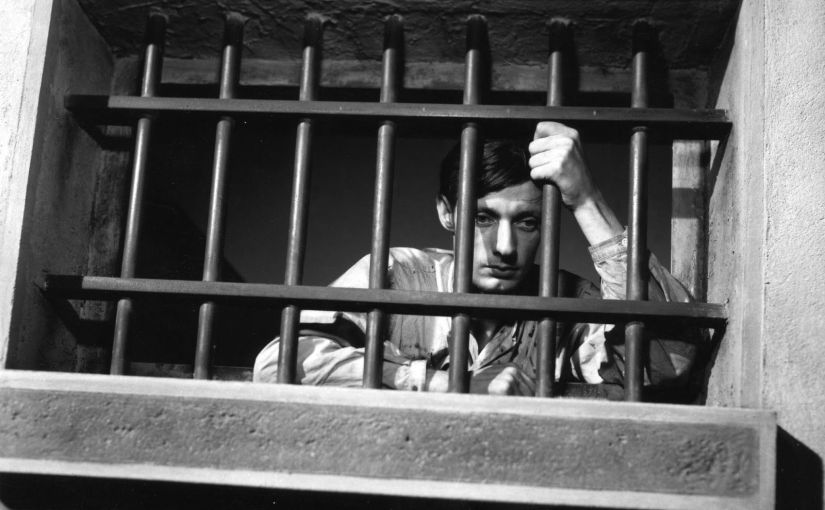
Before I get into more story details, I should mention the style of the film and the acting, which is so mannered and stylized that it feels as if it were a silent film that had a soundtrack added as an afterthought.  Gary Cooper may be a legend, but in this film…let’s be blunt, he is no Cary Grant.  Every sentence feels as if it’s been dragged out of him by way of torture.  His charisma is based solely on his imposing height and his dashing good looks, NOT his speech.  (Sorry, I calls ‘em like I sees ‘em.)  The women are not much better acting-wise, though the Duchess of Towers does have some interesting moments.  However, one of the movie’s highlights are the cinematography and subtle visual effects, especially in the late stages of the film.  Look at that scene involving the peculiar qualities in the bars of the jail cell and explain to me 100% how that was accomplished.  It’s so understated and effective that it took me completely by surprise.  I believe it would raise eyebrows with TODAY’S audiences.

I mention all of this about the style and my mindset because I believe that it all contributes to the reaction I had to the film, at which I’m still perplexed.

One day, Peter is contracted to rebuild the stables of an aristocratic family, the Duke and Duchess of Towers.  When Peter first meets Mary, the Duchess, he experiences an unexplainable connection.  His contract requires him to live in the Towers house for several months.  One day they share a conversation and discover that they shared a dream.  This isn’t a case of two people dreaming about the same thing coincidentally.  They actually shared a dream, Inception style, but without the machinery.  How can this be?

By now, any breathing audience member has already deduced that the Duchess is Mimsey and they are destined for each other.  Alas, Peter and Mary are not as quick on the uptake as we are, and their moment of recognition is delayed until after the peevish Duke confronts them at the dinner table, in a conversation laden with Hays-Code-era double-speak.  “Well, Mr. Ibbetson, are you to be congratulated again?” the Duke asks.  Later, during a second confrontation, the Duke points a gun at Peter and Mary and explains that they will not make love behind his back.  He raises his gun and says, “Get into your lover’s arms.”  Whoa.  Daring stuff for 1935.  It’s during this second confrontation that something goes horribly wrong, and Peter is sent to jail for life.

MORE melodrama?  Hasn’t this movie already had more than its fair share?  Children tearfully separated?  An equally tearful reunion?  Outrageous coincidences?  Shared dreams, for crying out loud?  Oh, you ain’t seen nothing yet.

It’s in the film’s third act, when our hero is in prison, that Peter Ibbetson really started to get to me at some primal level.  Peter and Mary, after being reunited against all odds, are now separated even more cruelly than before.  Peter is so distraught he goes on a hunger strike, chained to his “bed,” which is little more than a wide wooden beam.  (Look at it from a certain angle and he might almost appear to be on a cross, but don’t worry, it’s not that kind of movie.)  When one of his fellow prisoners makes a joke at Mary’s expense, Peter goes a little crazy and starts to throttle him.  Miles away, at the same time, Mary suddenly senses something is wrong.  In the jail, guards use force that’s a tad too excessive to restrain Peter, and at the same exact moment Mary screams.  The two are connected in a mystical way that transcends walls or distance.  They continue to share dreams in which they laugh and walk and talk as if nothing bad had ever happened.  In one dream, he points to a castle in the distance that he has built for his beloved.  I was reminded instantly of the scenes in Inception where Cobb and his wife Mal build entire cities for themselves in their own shared dream.

I’ve already given away too much, far too much than I usually care to.  As much as I want to, I can’t describe the one scene that got me to literally yell, “NO!” at the TV screen.

What fate eventually befalls Peter and Mary, I leave for you to discover.  What remains for me is to try once again to summarize how I felt after the movie was over.  Intellectually, I can see its shortcomings.  The acting is wooden, despite some pretty sharp dialogue.  The music is overwhelmingly romantic and dramatic, commenting on a lot of action unnecessarily, as was the custom back then.  There are one or two odd cuts.  But on an emotional level, the experience of watching Peter Ibbetson was like watching one of Shakespeare’s tragedies.  The only other movies that ever made feel these precise emotions, although not to the exact same degree, are The Remains of the Day and Atonement.  If you know those movies, you know what I’m talking about.

The movie’s final shot is as shamelessly manipulative as these things get.  It’s unabashed romanticism at its best AND its worst.  But you know what?  This movie earns it, and it works.

FOUR LIONS (2010, Great Britain)

by Miguel E. Rodriguez

Director: Christopher Morris
Cast: Riz Ahmed, Arsher Ali, Nigel Lindsay, Kayvan Novak, and a very special guest star
My Rating: 9/10
Rotten Tomatometer: 83% Certified Fresh

PLOT: A small group of incompetent British terrorists set out to train for and commit an act of terror.


The world of cinema has a long history of taking subjects traditionally considered taboo and turning them into comedy.  German concentration camps?  Life Is Beautiful mines it for comedy.  P.O.W. camps?  Ever hear of Hogan’s Heroes?  What about Hitler himself?  The Great Dictator and Look Who’s Back lampoon him perfectly.  Race relations?  Look no further than Blazing Saddles.  In recent years, even 9/11 has become a kind of punchline for jokes, with varying degrees of success.  As with all comedy, context is king.

Such is the case with Four Lions, a British film from director Christopher Morris.  In it, the subject and especially the philosophy of suicide bombers are, forgive the pun, exploded with equal doses of logic and ruthless humor.

Omar (Riz Ahmed) is a member of a “cell” of extremists who imagine themselves to be part of a glorious Jihad against Western civilization, but who, as Omar himself puts it, can’t even “stir their tea without smashing a window.”  In the opening scene, Waj (Kayvan Novak) is trying to make one of those videos claiming responsibility for a terrorist act, but the cameraman points out that the gun he’s holding is too small.  It’s actually a replica of an AK-47, but it’s about half scale.  Waj solves the problem by first saying he has big hands, then by simply moving closer to the camera.  Can’t argue with that logic.

Their leader, Barry (Nigel Lindsay), is a Caucasian man who has converted to Islam and become a true believer – “radicalized”, I think is the word.  (Director Christopher Morris says he’s based on a man who was once a member of a far-right, fascist party in the UK; in an attempt to “out-knowledge” the Asian youths he regularly assaulted, this man studied the Qur’an in depth…and as a result “accidentally” converted himself and became a Muslim.  Talk about truth being stranger than fiction.)  Barry is no prize either.  He knows all the proper buzzwords and catchphrases, but he is convinced the best way to defeat government surveillance when walking outside is to constantly shake your head back and forth.  So your face will come out blurry.  Once again, unassailable logic at work.

The fourth member is Faisal (Adeel Akhtar), who buys up large quantities of bleach and liquid peroxide for bomb-making, but to do so he had to make several trips to the same store.  To make sure no one at the shop suspected, he used different voices every trip, including a woman’s voice.  Barry objects: “You’ve got a beard!”  Faisal explains he covered his beard with his hands when he used the woman’s voice.

“So why has she got her hands on her face, Faisal!?”
“…cos she’s got a beard.”

Again…impeccable logic leading to ridiculous actions.  The movie is chock full of these kinds of perfectly logical reasons for doing absurd things.  A movie with only two dimensions would simply use that same lens, point it towards the actions of suicide bombers, and congratulate itself on its cleverness.  But Four Lions, hilarious though it is, goes another level deeper.

Omar has a wife and young son.  They are both totally on board with Omar’s plans for becoming a suicide bomber.  All three are convinced that his act of martyrdom will ensure his place in Paradise where he will eventually be reunited with his family.  When Omar discusses his plans with his wife, Sofia, she is calm, cool, and collected, as if they were discussing when and where to buy their next house.  When Omar tells his son a bedtime story, he makes changes to the story of The Lion King, so it more closely reflects his own beliefs, and the son smiles and eats it up.  Chilling.

But then Omar’s brother, Ahmed, pays a visit.  Ahmed is what I would call an “orthodox” Muslim, wearing the robes and head coverings and the longer beard.  By contrast, Omar is dressed in far more “Western” gear and trainers.  Ahmed has gotten wind of Omar’s plan and wants to try to talk him out of it because the Qur’an teaches non-violence…but his orthodox beliefs also state he can’t be in the same room as Omar’s wife.  Omar makes a point that, according to Ahmed’s beliefs, there are “60,000 opinions saying we can’t fight back!  We must measure our beard with a ruler and lock our wives in a cupboard!”

What you’ve got here is a key lesson in great comedy.  Be funny, but have a point.  What is the point here?  In my opinion, the point of this scene is to single out the vast contradictions possible in any kind of religion where extremists have staked out territory on the fringes.  A man believes in non-violence but can’t be in the same room as a woman.  Another man believes in martyrdom but has water gun fights with his son and wife.  They’re both right and they’re both wrong.  We tend to see one viewpoint as being hand in hand with the other by default, but Four Lions makes the case that great variety is possible.  A man in a robe and a long beard is not automatically a terrorist.  A man with a loving wife and family is not always the “good guy.”  Nothing is black and white.

But I don’t want to make the movie seem like it’s some kind of grand polemic on religious intolerance.  It has its serious moments, yes, but damn, is it funny.  I’m trying hard to think of another movie where a bunch of terrorists wind up running in a fictional “fun-run” marathon dressed as a ninja turtle, a cowboy riding an ostrich, an upside-down clown, and an orange bear.  (Actually, I’m not quite sure that’s a bear…that would be a question for the police.)  Or where one terrorist’s master plan involves strapping a bomb to a crow.  Or where a short discussion is held to determine exactly which parts of a car are Jewish.  As they say in the clickbait ads, the answer to that question may SURPRISE you!

(Also, if you’re a fan of Star Wars, I apologize in advance for any trauma you may experience…you’ll see what I mean.)

Admittedly, the subject matter of this comedy may turn off some viewers.  That is their right.  But if you’re an admirer of sharp-edged comedy that takes no prisoners and follows its own logic to its inexorable conclusions, Four Lions is gold.

CAVE OF FORGOTTEN DREAMS (2010)

by Miguel E. Rodriguez

Director: Werner Herzog
My Rating: 9/10
Rotten Tomatometer: 96% Certified Fresh

PLOT: Filmmaker Werner Herzog is granted a rare opportunity to film a documentary inside France’s Chauvet Cave, where the walls are covered with the world’s oldest surviving paintings, dating back some 30,000 years.


Over the last several years, I’ve had the opportunity to travel to some amazing places, including London, England, where we toured the famous Tower of London.  When I lived in Virginia, we used to visit colonial Williamsburg, where some structures and artifacts exist from the 1600s.  But at the Tower of London, we saw walls and structures that have existed since the 1400s.  Six-hundred-plus years old, man!  Wild!  We saw Anne Boleyn’s final resting place.  THE Anne Boleyn!  Was buried right there.  Freaky.

Then we traveled to Greece, and that really put the zap on me.  We walk to the Acropolis and a tour guide tells us, “And that rock over there is Mars Hill, where the apostle Paul preached to the Greeks over two thousand years ago.”  TWO THOUSAND YEARS.  And in a museum, we saw artifacts dating back to 5,000 BCE, objects that were so old the archaeologists weren’t even sure what they were for.  Religious totems?  Toys for children?  Purely decorative?  Who knows?  I love this kind of thing!  Looking at things that have survived for millennia, created by people who were probably just satisfying a hobby, for all we know.

Now comes Werner Herzog’s documentary Cave of Forgotten Dreams, in which he was allowed to film inside the famous Chauvet Cave in France.  Inside are the oldest known artistic renderings of any kind on the planet.  How old?  Approximately thirty thousand years old.  To put that number in perspective, when Paleolithic humans made these paintings, the surrounding area was covered with a glacier that was so huge, when it finally melted, the ocean levels rose three hundred feet.  A hunter could have crossed what is now the English Channel by walking on dry land from coast to coast.  It’s an abyss of time that is utterly incomprehensible to me.

These paintings are indescribably cool to observe.  I’d seen photos before, but to see them on film is an indescribably stirring experience.  There are drawings of horses and wild rhinoceros that look as if they were drawn yesterday.  One animal was drawn with a total of eight legs.  A mistake?  No.  It was an attempt by the artist to convey movement or motion.  PROTO CINEMA.  Mind.  Blown.

There are handprints by some of these drawings.  Were they intended as a signature by the artist?  Perhaps so, because further into the cave are more handprints by other drawings, and we can tell they’re handprints from the same person because of a crooked pinky finger.  A maker’s mark from three hundred centuries ago.

I can’t stop.  On the floor of the cave, nearly obscured by eons of calcification and crystals, are visible footprints of a wolf and a 7-year-old child.  Was the wolf stalking the child as prey?  Were they maybe companions?  Or are the footprints separated by years, or decades, or centuries?  Near what used to be the entrance to the cave – the actual entrance was blocked by a rockslide an unknown number of years ago – is a rock with a flat top like a table, and on the table, facing the entrance, is the skull of a cave bear.  Traces of charcoal at the base hint that incense may have been burned there.  Was this a temple?  A holy place?  Or did they just think it looked badass to have a skull on a table?

This stuff fascinated me.  I found myself thinking about, of all things, a scene from Star Trek: First Contact, when Picard, having traveled back in time, is able to reach out and touch the very first vehicle to achieve warp speed.  He explains to a confused Data that touching something old is a way of somehow reaching back across the centuries and identifying yourself with the people who created it.

That’s what these cave paintings are like.  They’re a conduit back through time.  Along with the paintings, archeologists also discovered remnants of what look like flutes.  One enterprising guy recreates one of these instruments and plays it for the camera.  Using a 30,000-year-old design, this guy knocks out the first stanza of The Star-Spangled Banner.  On a flute made from BONE.

Why did Herzog even want to make this movie?  To be a social activist?  The cave is in no environmental or man-made danger.  There are only two weeks out of every year when anyone is even allowed inside the place.  He filmed it in 3-D.  Was he looking for a fast buck by capitalizing on the 3-D craze around that part of the decade?  It only grossed $5.2 million, a pittance, even by documentary standards.  (Although that was the highest box-office return of any independently released documentary of 2011…so there’s that, I guess.)

So why do this?  Because I believe Werner Herzog is one of the last remaining filmmakers who will make a film simply because he feels he must do so.  He latches onto an idea, and it will not release him until he commits it to film.  He doesn’t particularly care if it’s commercially viable or mainstream or anything.  If he gets an idea (and the funding), he finds a way to get it filmed.  It may not reach everyone, but you know what they say: “If you only reach one person, you succeeded.”

Man, did this reach me.  I was fascinated from beginning to end.  There’s one sequence that is nothing but, I think, 5 or 10 minutes of the camera simply regarding the paintings, slowly panning and tilting, just looking at them, while strange, but appropriate, music plays in the background.  Under any other circumstances, this would be boring.  Here, it was almost holy.

NOSTALGIA FOR THE LIGHT (2010, Chile)

by Miguel E. Rodriguez

Director: Patricio Guzmán
My Rating: 10/10
Rotten Tomatometer: 100% Certified Fresh

PLOT: This award-winning documentary juxtaposes the search for answers about the history of the cosmos with Chilean women searching the Atacama Desert for the remains of loved ones killed by a despotic regime decades earlier.


I am going to look at the stars.  They are so far away, and their light takes so long to reach us…all we ever see of stars are their old photographs. – Dr. Manhattan, Watchmen


If Nostalgia for the Light has one flaw, I might point to its rather abrupt ending.  It comes so quickly it almost cuts off the sentence being spoken by the film’s narrator.  Perhaps it’s metaphorical.  The film is over, but there is no resolution.  The riddles of the cosmos remain unanswered, and the bodies of cherished loved ones remain undiscovered.  If they don’t get a resolution, why should we?

The Atacama Desert in Chile is one of the driest places on earth, with an average annual rainfall of 0.5 inches.  With its virtually zero percent humidity, the skies remain remarkably clear at night, making it one of the prime spots on the planet for astronomical observatories.  From these perches, astronomers use massive visible light and radio telescopes to probe the outer reaches of the cosmos, searching for clues to the origins of life, the universe, and everything.  (Sorry, couldn’t resist.)

One astronomer points out that many times, when science finally answers a question, two more pop up to replace it.  He says some people even consider it an exercise in futility.  If every answer only reveals more questions, why bother?  You might as well ask NASA why we sent men to the moon.  Because it’s in man’s nature to know, to try to find out what’s over the next hill or what is beyond the farthest galaxy.

Another scientist explains that the calcium in our very bones literally comes from the stars.  Everything on earth today is descended in one form or another from the Big Bang.  Radio telescopes can measure the calcium levels in distant stars.  (Calcium in stars?  You learn something new every day.)  That calcium came from the Big Bang, and so did Earth’s.  As Carl Sagan said, “We are star stuff.”  We may die, and we will.  The stuff in our bodies remains, and will eventually help a tree to grow, or a vegetable, and so on and so on.  The circle of life, as it were.

All this information in the film is presented in a very straightforward without flash or fanfare, at least in terms of the narration.  Visually, the filmmakers use great editing with the interiors of huge observatory domes and the immense telescopes within, cut together with stunning vistas of starfields, including shots of our own Milky Way.  Indeed, the film’s narration informs us that, night after night, “slowly, impassively, the center of the galaxy passes over Santiago.”

But this is not simply an overblown episode of “Nova.”  Nostalgia for the Light is divided almost schizophrenically into two parts bumping into each other for the duration of the film.  It’s this second part that gives Nostalgia its heart and soul.  I’ve been thinking about it ever since I finished watching it this afternoon.

In 1974, Augusto Pinochet rose to power in Chile.  His dictatorship lasted for 17 years.  During that time, he imprisoned as many as 80,000 people in concentration camps in the Atacama Desert, killing anywhere from 3,000 to 4,000 dissidents.  To cover his tracks, he ordered his military to truck the bodies into the desert and dump them in unmarked mass graves.  It was rumored that he also had many of them thrown into the ocean.  Families were torn apart.  One young woman in the film tells how, when she was 12 months old, her grandparents were forced to reveal the whereabouts of her mother and father, using her as leverage.

For decades since then, women have come to the desert with spades and pickaxes, searching the dry ground for clues to the whereabouts of their loved ones.  The desert is enormous, and there are very few of these women.  In the film, they talk about the people who try to convince them of the futility of their actions.  Not just their friends or family, but public figures, politicians.  They are embarrassing.  They are dredging up a painful past others would prefer to forget.

One of these women wishes the giant telescopes on the distant hilltops could be designed to see through the ground instead of into space, so they wouldn’t have to dig.  They could find the secrets of their past much more quickly.  But of course, that’s exactly what the telescopes are designed to do.  They’re just pointing in a different direction, reaching to a far more distant past.

When I was younger, I was of the belief that a good documentary had to be completely impartial.  It simply documented what was happening without commentary from the filmmakers.  You could use editing to make a point, but it was against the “rules” to editorialize your subject.  And never use a narrator.  Let the audience make up its own mind, right?  The fancy word for this kind of strictly observational filmmaking is “cinéma verité.”

Nowadays, with most modern documentaries I’ve seen, the strictures of “cinéma verité” have gone by the wayside.  Instead of being a passive observer, the director is free to edit together disparate footage and interviews to make their point of view heard loud and clear.  This director, Patricio Guzmán, is using this documentary as a tool for social activism, or at least awareness.  I wouldn’t normally care for this kind of in-your-face, this-is-my-point documentaries.  I have never been a fan of Michael Moore’s films (at least not anything after Roger and Me), and I think Morgan Spurlock’s films are nothing but glorified Jackass stunts.

But Nostalgia for the Light affected me in a way I did not expect.  There is a sequence where an astronomer explains how “the present” isn’t technically real.  Light from the sun takes eight minutes to reach earth.  The light we see from the distant stars are years, decades, centuries old.  What we see in the sky is not the stars’ true position.  It’s where they were years and years ago.  It’s almost as if we’re looking at the memory of light.  This concept, which I’ve heard before, simply boggled my mind this time around.  I don’t know how to explain it.  And then when the film draws parallels between the astronomers searching for answers in the cosmos to the sad, determined women searching for closure in the desert, and the perceived futility of both ventures in the minds of so many…it’s very difficulty to put into words.  I felt that I was watching, or perceiving, something that transcended my poor abilities to describe it.

The astronomers search for answers to better our world and themselves.  The women in the desert search to bring closure to their lives and to the lives of the ones they lost.  They cannot forget, as so many in their country have willingly forgotten.

Director Guzmán also narrates the film, and I believe the crux of the entire film can be explained in one of his lines: “…those who have a memory are able to live in the fragile present moments.  Those who have none don’t live anywhere.”

THE KILLERS (1964)

by Miguel E. Rodriguez

Director: Don Siegel
Cast: Lee Marvin, Angie Dickinson, John Cassavetes, Clu Gulager, and in his final acting role, Ronald Reagan
My Rating: 5/10
Rotten Tomatometer: 80%

PLOT: A hit man and his sadistic partner try to find out why their latest victim, a former race-car driver, did not try to escape.


…well, THAT was disappointing.

Fresh off watching the original The Killers from 1946, I dove into the 1964 remake.  Originally intended for television – indeed, this was supposed to have been the very first made-for-TV movie – it contained so much casual violence and sexual content that no network would touch it, not even the network that commissioned it, NBC.  It was imported to movie screens, pillarbox framing and all, where it cemented Lee Marvin’s status as one of the all-time great Hollywood tough guys.  (How tough?  He reportedly shot a scene while he was literally falling-down drunk.  That’s the take that’s in the film; you’ll know which scene it is when you see it.)

But while Lee Marvin is indeed tough, and even though his partner (Clu Gulager) plays a sociopathic killer who brings tension to every scene he’s in, I couldn’t get as worked up over this remake as I did over the original version.  Those two performances aside, this movie felt cliched and a little boring to me.

The story is the same as the original, with a couple of minor changes.  Two hitmen stroll into a school for the blind (!) and gun down Johnny North (John Cassavetes) in broad daylight.  Afterwards, Charlie, the veteran hitman (Lee Marvin) latches on to something he can’t figure out: why didn’t the target try to escape?  He does his own digging which leads him to a motley assortment of thugs and one duplicitous dame, Sheila (Angie Dickinson), who isn’t just a gold-digger, she’s a gold-strip-miner.  Turns out North was part of a million-dollar heist along with Sheila and some other thugs, including Jack Browning (Ronald Reagan).  The heist was successful, but after a series of double-crosses, no one seems to know where the money is.  With his seriously psycho partner, Lee (Gulager), Charlie tracks down the witnesses, and we get the same flashback structure as the original.  And the more he digs, the less he likes what he finds…

One major factor that didn’t score many points with me was the production’s obvious roots in television.  As you can well imagine, lighting on a movie set is very different from lighting for television.  And this movie looks like a TV movie through and through.  At the time, because of the relatively smaller screens of most televisions, it was believed that a movie shot FOR television needed bright lights and especially colors, so the pictures would be clearly visible on the tiny screens.  Well, in this remake, everything is so brightly lit and colorful it looks an episode of Star Trek or any other TV series of that era.  The very brightness of the surroundings drains a lot of the tension out of scenes that are meant to be disturbing or violent.  Blood doesn’t look like blood; it looks like Sherwin Williams.  I’m aware of the technical limitations of the time, but the shortcomings are just so obvious that it left me cold.

(By comparison, the original 1946 version is steeped in darkness and shadows and pools of light; it’s not only more beautiful, but it also just works better for the story.)

I also had problems with the casting of some of the big character roles, but my momma always said, if you can’t say nothin’ nice, don’t say nothin’ at all.  So that’s all I’ll say about that.

The editing was also a little distracting.  Again, this might be a factor of the period when it was made, as well as the fact that it was intended for TV, not the movies.  But one scene annoyed the heck out of me.  I don’t normally nit-pick bad editing, but here goes.

There’s a scene where someone has to drive a car down the length of a winding dirt road within two minutes, if not faster.  Zoom, off he goes.  And as we cut back and forth to various shots showing the car’s progress, instead of cutting directly to a different vantage point or camera angle, it’s cut with fades, which are normally used to indicate a passage of time.  But when the fades are used in what is basically a race against time, it has the effect of making the scene feel longer than two minutes, even though only 30-40 seconds of real time have elapsed.  It made the whole scene feel “off”, even amateurish.  Director Siegel had already directed 15 or 16 films by this time.  I think he should have known better.  Or his editor should have.

By the time we get to the end of the film, we’ve seen someone get dangled out of a hotel window from seven stories up, six or seven people get shot dead (one by a sniper rifle), more double-crosses than a Luftwaffe squadron, and a future hardline conservative President of the United States play…a villain.  But it all felt like an exercise in futility.  Sure, you get Lee Marvin playing a tough guy, but in three short years he’d get to play a really tough guy in Point Blank.  THAT’S the movie you wanna see. Or go find Dirty Harry, or even Escape from Alcatraz, both directed by Don Siegel, both superior films.

This one?  This one I only got because it came packaged with the 1946 version on the Criterion Blu-ray.  Do with that information what you will.

THE KILLERS (1946)

by Miguel E. Rodriguez

Director: Robert Siodmak
Cast: Burt Lancaster, Ava Gardner, Edmond O’Brien (and William Conrad in a small role…and yes, he was a big fella even then)
My Rating: 8/10
Rotten Tomatometer: 100%

PLOT: An insurance investigator tries to get to the bottom of a strange case involving a man who waited calmly for two men to find him and kill him.


Over the last several months, I’ve been digging a little more into the film noir genre, specifically going back to the ‘40s and ‘50s, and I’ve discovered some gems.  Pickup on South Street (1953), for example, featuring one of the most violent fight scenes to be found outside of a Tarantino film.  Or The Killing (1956), an early Stanley Kubrick film depicting the kind of ruthless behavior that I didn’t think was permitted at the time.  I’m discovering that, for the adventurous moviegoers back then, there were films available to see that might have made their parents or grandparents gasp in horror.

Take the movie I watched today, The Killers (1946), the film noir that introduced Burt Lancaster to the world.  It’s based on a short story by Ernest Hemingway that was also adapted into a film in 1964, starring Lee Marvin, Angie Dickinson, and, in his last film role, Ronald Reagan.  [Watch this space for a review of that film, coming soon.]  At the beginning of this movie, we’re introduced to two thugs who walk into a small town, cloaked in the kinds of shadows and light that only film noir can get away with.  After terrorizing the patrons of a small diner, they walk to a nearby boarding house and up the stairs to a room occupied by Ole Anderson, aka “The Swede” (Lancaster), who has been alerted to their arrival but makes no effort to escape or call the cops.  He simply awaits his fate.

And what a fate.  The two thugs burst into the room and obliterate the Swede in a hail of gunfire that goes on for quite a long time, even by today’s standards.  (Later, the coroner describes the Swede’s body as being nearly “cut in half” by the barrage…yikes.)  This being 1946, we don’t see any of the actual carnage, but the implication is there.

The movie proceeds in a series of flashbacks.  An insurance investigator named Jim (Edmond O’Brien) tries to find out two things: why the Swede named a kindly hotel maid as beneficiary of his life insurance policy, and what happened to the $250,000 payroll that the Swede helped steal from a hat factory.  Now that I think about it, The Killers is almost like a thick-necked, brass-knuckles, gun-toting variation on Citizen Kane.  We never see anything about the Swede that wasn’t directly observed by someone Jim tracks down, and as Jim continues to dig, things just get mysteriouser and mysteriouser.

Figuring prominently in the Swede’s backstory is Kitty Collins, played by the ravishing Ava Gardner.  This was not her first film, but The Killers is the movie that put her on the map for good.  We first see Kitty when the Swede goes to a fancy party with his girlfriend, Lilly.  Alas, Lilly is no match for the sultry Kitty, who is wearing the kind of stunning black gown that inspires poetry when it isn’t simply driving men crazy.  How crazy?  At one point, when Kitty is caught by a cop wearing shoplifted jewelry, the Swede claims responsibility, slugs the cop, and winds up doing three years in jail for her.  Talk about being Kitty-whipped.

Naturally, as Jim, the insurance guy, meets more people, the Swede’s story comes more sharply into focus, but there’s still the mystery of what happened to all that money.  The robbery was indeed pulled off by the Swede with three other guys, but none of them have the money, and the Swede doesn’t have the money, so where is it?  As it turns out, the hat factory they stole from is insured by the same company that provided the Swede’s life insurance policy, so it’s in Jim’s best interest to get to the bottom of everything and recover the money, even if it means getting involved with the same kinds of thugs who killed the Swede in the first place.  That’s okay, though.  Jim is prepared.  He carries his own piece, and he comes up with a cool plan to get the guilty parties to confess as much as possible before they wind up dead…or he does.

The Killers is an example of a film that helped define, or at least refine, the relatively new film noir genre.  Similar films centering on crime, criminals, and punishment had been around since the ‘30s, but the real granddaddy of them all, The Maltese Falcon, had only been released five years earlier in 1941.  Since then, World War II came and went, and as dark as noir had been, it got even darker and more violent than Bogey was when he slapped Peter Lorre around.  With this film, director Robert Siodmak turned everything up to eleven.  The shadows aren’t just dark, they’re black, which of course makes the periodic pools of light that much more striking.

And the characters mean business, too.  Among the bad guys, there’s one named Colfax who doesn’t look like much – sort of like a moderately well-built school principal.  But when a genuine thug threatens to fight him, he doesn’t posture like a bully.  He just sits back in his chair and calmly tells the thug: “You’ve got quite a reputation yourself.  You’re supposed to be a troublemaker.  Okay.  Make some.”  And you just know that if the thug so much as lifts a finger, he’ll get it broken for his trouble.  It’s an interesting scene that reminded me of Goodfellas: “Paulie may have moved slow, but it was only because Paulie didn’t have to move for anybody.”

(I should also mention the flashback involving the payroll robbery.  In today’s films, when we marvel at long takes involving complicated camera moves, it’s good to be reminded that, three-quarters of a century ago, The Killers gave us a heist sequence that starts at ground level, follows the robbers up a staircase, shows the actual robbery, follows them back down into their getaway cars, and even provides a small-scale shootout as they drive away – all in one uncut take, using a camera about the size and weight of a SmartCar.)

While I thoroughly enjoyed The Killers, I wouldn’t quite put it in the same weight class as, say, Out of the Past or The Big Sleep, but it’s got all the right ingredients, it tells a good story well, it gives us Ava Gardner in that gown, and it provided a great springboard for the films that came after.  Good film noir is fine; GREAT film noir is better.  This is one of the great ones.

[P.S.  The scene near the beginning of the film where the two thugs terrorize the people at the diner reminded me strongly of the scene in No Country for Old Men when Anton Chigurh quietly tells the store clerk to “call it.”  They were just as calm and serene and tightly coiled as Chigurh.  Pretty creepy.]