THE LIGHTHOUSE (2019)

by Miguel E. Rodriguez

Director: Robert Eggers
Cast: Robert Pattinson, Willem Dafoe
My Rating: 8/10
Rotten Tomatometer: 90% Certified Fresh

PLOT: Two lighthouse keepers try to maintain their sanity while isolated on a remote New England island in the 1890s.


tone poem
NOUN, a piece of orchestral music typically in one movement, on a descriptive or rhapsodic theme


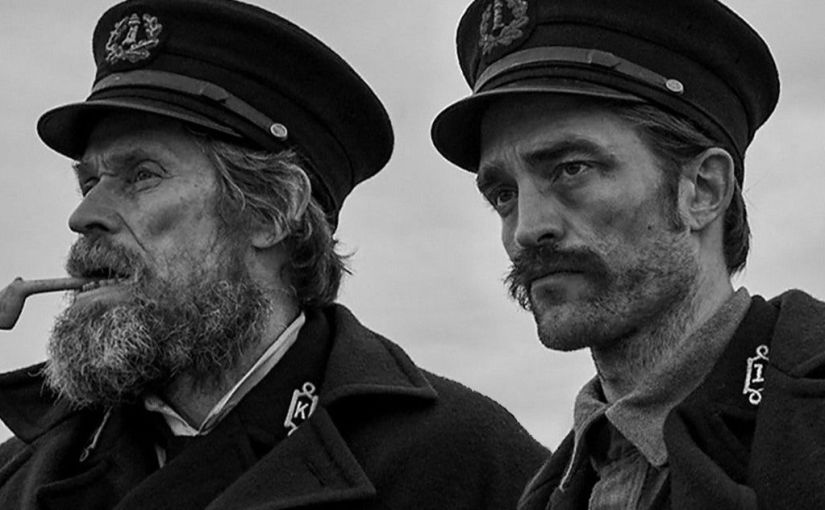
As I watched Robert Eggers’ The Lighthouse, that term “tone poem” kept leaping to my mind.  It’s not told in a standard or familiar fashion.  There are scenes where we’re not sure, until they’re over, whether they’re real or not.  The Willem Dafoe character, Thomas Wake, makes references to behavior in the past by the Robert Pattinson character, Ephraim Winslow, that Winslow never committed…or did he?  We are certain that Wake is the character who is going mad, if he’s not there already.  But what if it’s the other way around?  Or are they both going mad?

The mood or tone of the piece seems to be insanity and how one might get there given the right circumstances.  In many ways, it has quite a bit in common with another sensational tone poem of madness, Stanley Kubrick’s The Shining (1980).

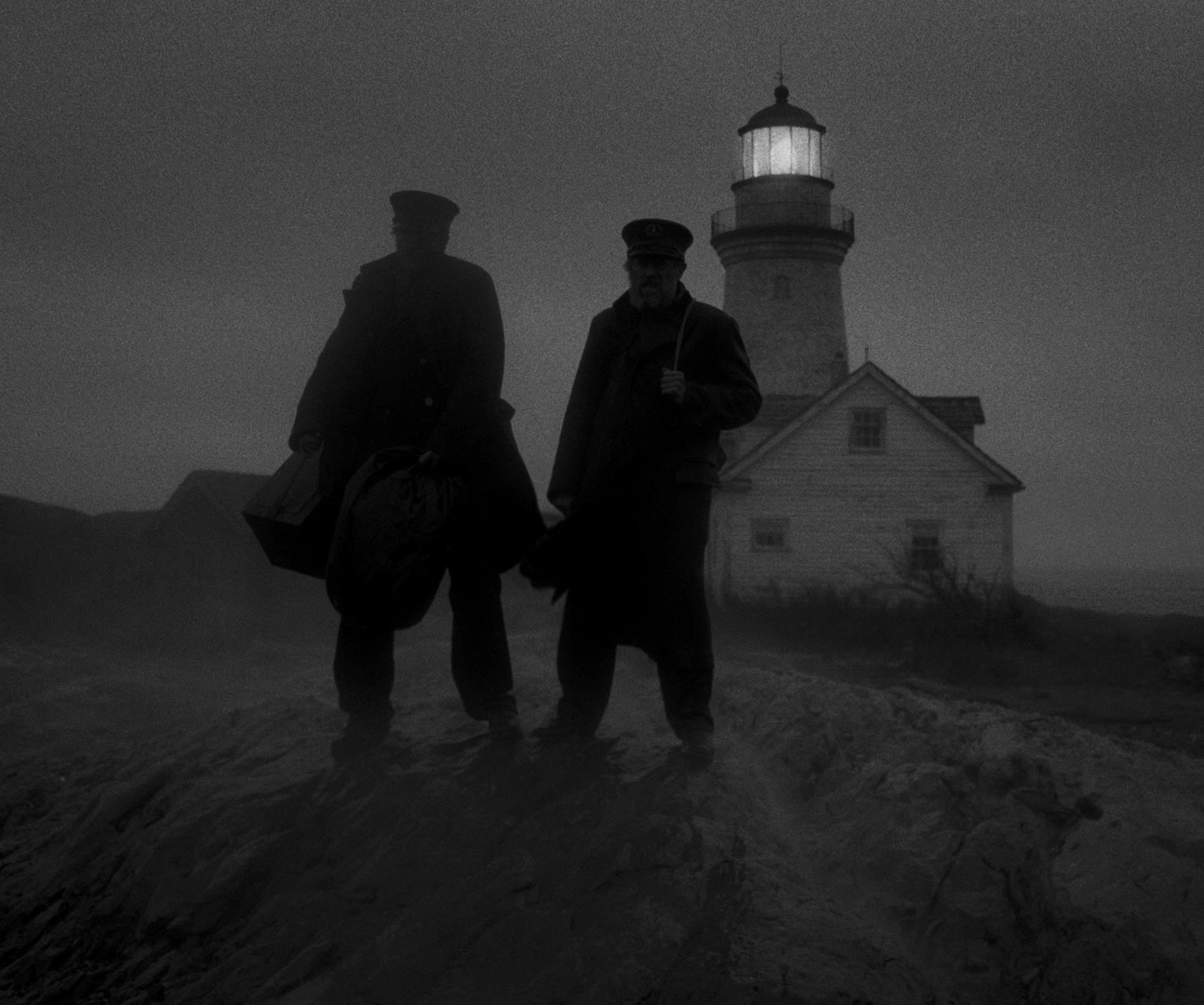
Two men, Wake and Winslow, are lighthouse keepers in the late 19th century.  They are brought to a remote island in the stormy waters off the New England coast and left to fend for themselves for four weeks until the next tender brings supplies.  Wake (Dafoe) is a crusty old veteran lighthouse keeper whose speech and mannerisms appear to be based on Long John Silver, right down to the gimpy leg.  Winslow (Pattinson) is a much younger and, let us be honest, handsomer gentleman who keeps to himself whenever possible.  He tends to his duties, sometimes grudgingly but mostly not, but wonders why Wake flatly refuses to share the duty of tending the actual light source at the top of the lighthouse.  That mystery lies at the heart of the film, but don’t expect all your questions to be answered by the time the credits roll.  Fair warning.

A key decision by director Eggers was to shoot in black-and-white and in a very old screen format, 1:19, so the picture area is a virtually square space in the center of the screen, with black bars on either side.  (The Coen brothers did something similar with their brilliant adaptation of The Tragedy of Macbeth [2021].)  This visual language creates a uniquely claustrophobic atmosphere, especially in scenes taking place in Wake’s and Winslow’s quarters.  The walls are closer together, the ceiling feels lower, and the actors’ faces seem much closer to the screen than normal.  Even exterior shots seem more constricted and confining.  Wide open sky doesn’t look as inviting as it might to someone essentially imprisoned on a storm-lashed island for four weeks.


Like all the best films, The Lighthouse begins its descent into madness slowly and gains momentum as time passes.  Winslow discovers a mermaid figurine stashed inside his mattress.  That night he dreams about a mermaid in the surf.  Or was it a dream?  We glimpse Wake standing naked at the top of the lighthouse, almost as if he’s worshiping the light itself.  When Winslow tries to get a closer look at what Wake is doing up there, he glimpses something…supernatural.  Or does he?  The film is brilliant at not only portraying mounting madness on the screen, but also at conveying the tone of madness in the cinematography and editing.  If we’re not quite sure what is happening, even when we see it happening, that’s on purpose.  The audience is meant to be kept off balance throughout the movie to put us in the heads of the two main characters.

Another factor that I found riveting was the acting workshop on display from both Pattinson and Dafoe.  We’ve seen this kind of thing from Dafoe before.  He chews the scenery with Nicolas Cage-like gusto, spittle flying, prosthetic teeth flashing in manic sneers, and that crazy piratical accent.  If it had been revealed during the film that his character’s last name was Osborne, and that he was a distant relative of Norman Osborne from Spider-Man (2002), I would not have been the least surprised.

But equally impressive is Robert Pattinson’s performance, which must be seen to be believed.  Here is an actor who is set for life after being a part of two of the most profitable film franchises in history (Twilight and Harry Potter) and who has just rebooted a third (The Batman [2022]).  But in this film, he easily keeps pace with Dafoe’s quirkiness, which is not easy.  As his character descends into madness (or does he?), Pattinson dances a jig while singing a sea shanty that devolves into complete gibberish.  He laughs like a loon.  He, ah, takes some time for himself while fondling that mermaid figurine from earlier.  It’s the kind of performance that might be described as “courageous.”  He swings for the fences with abandon.  In so doing, he helps to make The Lighthouse one of the most unique movies I’m ever likely to see.

But what is really going on at the top of that lighthouse?  Why do seagulls pester Winslow so often, seemingly unafraid of him in any way?  Why does he continue to dream about mermaids?  IS he dreaming them?  Is Wake actually a merman?  Did real foghorns sound like that?  Why is one seagull missing an eye?

Well, come on, I’m not actually going to ANSWER those questions, but those are questions that occurred to me.  The movie does answer quite a few of them, but not all.  The point of the movie, like The Shining, isn’t about solving the mystery.  It’s about conveying the mystery, creating a mood of dread, and wallowing in it for a good 110 minutes.  It’s not the happiest movie I’ve ever seen, but it’s definitely one of the most original films of the last ten years or so.

COLOR OUT OF SPACE (2019)

by Miguel E. Rodriguez

Director: Richard Stanley
Cast: Nicolas Cage, Joely Richardson, Madeleine Arthur, Tommy Chong
My Rating: 9/10
Rotten Tomatometer: 86% Certified Fresh

PLOT: A secluded farm is struck by a strange meteorite which has apocalyptic consequences for the family living there and possibly the world.


Some backstory…

Once upon a time, there was a film director named Richard Stanley.  He made a few unremarkable films in the early 1990s, toiling in relative obscurity, until he hit the big time in 1996 when he got the opportunity to direct his dream project: a remake of The Island of Dr. Moreau starring none other than Marlon Brando.  The story of that film’s troubled production inspired a documentary all by itself (Lost Soul: The Doomed Journey of Richard Stanley’s Island of Dr. Moreau [2014]).  Stanley himself was fired after only four days of shooting and replaced by John Frankenheimer.  Rumor has it that Stanley secretly convinced the makeup crew to turn him into one of the background mutants so he could keep tabs on his dream project.  After Moreau bombed, Stanley’s career imploded, and he never directed another feature film.

…until over twenty years later when an enterprising film production company expressed interest in allowing him to direct another dream project: an adaptation of an H.P. Lovecraft story from 1927 called The Colour Out of Space.  To say that Stanley redeemed himself with this film would be an understatement.  This is one of the scariest movies I’ve ever seen.  It was supposed to be the first part of a Lovecraftian trilogy, but alas, Stanley was accused of domestic abuse in March of 2021 and the trilogy was scrapped.  One hopes that someone like Guillermo del Toro or Jordan Peele might pick up the promising threads here.  [insert good mojo dance here]

Anyway, the movie.

Color Out of Space is, at first glance, an amalgam of previous horror films.  One can easily spot elements of The Thing (1982), Annihilation (2018), and David Cronenberg’s The Fly (1986).  But when you consider the screenplay has been adapted from a 95-year-old short story, the movie takes on a prescient nature.  Here are all the elements of a solid contemporary horror film, in a story that was published the same year sound was introduced to motion pictures for the first time.  Remarkable.

The Gardner family lives on a secluded farm in the forests of New England, where the nearest township, Arkham, is an hour’s drive away.  (No, Arkham isn’t a Batman reference, it’s Lovecraftian…which might explain why the very name “Arkham Asylum” has always felt a little creepy all by itself.)  One night, a meteorite lands with a crash in their front yard.  This is no ordinary meteorite.  It glows with an unearthly magenta light, and by the following morning it has disappeared.  Shortly thereafter, the youngest son, Jack, starts hearing strange noises outside.  Mrs. Gardner (Joely Richardson), who is recuperating from cancer surgery, keeps getting disconnected from her business calls.  Nathan Gardner (Nicolas Cage) takes a shower one day and discovers what looks like a cake of soap covering the shower drain.  He picks it up…and experiences something NO ONE wants to experience after picking up a cake of soap.

Things get stranger.  A local hydrologist takes some water samples and urges the Gardner family and their squatter, Ezra (Tommy Chong), who lives in a shack on the Gardner’s vast property, not to drink the water until he gets some test results.  Meanwhile, Jack, the youngest son, takes a peek down their well and watches as an alien-looking egg hatches and releases a magenta-colored praying mantis.  Mrs. Gardner gets distracted by…something…and has a kitchen accident with a knife.  Their daughter, Lavinia (Madeleine Arthur), who dabbles in Wiccan rituals, hears a noise that makes her sick to her stomach.  Time passes in fits and starts.

And the whole time, new vegetation has sprouted up around the well.  All the same magenta color…

Experienced moviegoers might be able to plot the film’s course from A to B to the climax, and they might be right on.  But Color Out of Space has one or two surprises up its sleeve that elevates it into the same level as other modern horror classics like Hereditary (2018) or The Babadook (2014).

There are scenes involving a small herd of alpacas – oh yeah, they raise alpacas – that are as unsettling as anything from John Carpenter.  At one point, mother and son are caught in the “grip” of the alien color/light.  What happens to them sets up one of the biggest jump scares I’ve ever had in my life.  I yelled so loud and long that my girlfriend ran to the back of the house wondering what was happening.

Color Out of Space is one of the most effective horror movies I’ve seen in a long time.  Naysayers may refuse to watch it because of Nicolas Cage’s presence, but I can assure you, his “hammy” talents are put to good use and are always in service of the story.  It’s not for everyone.  It’s not for the squeamish.  But for those who dare…Color Out of Space is a horror-film lover’s dream.

SAINT MAUD (2019, United Kingdom)

by Miguel E. Rodriguez

Director: Rose Glass
Cast: Morfydd Clark, Jennifer Ehle, Lily Frazer
My Rating: 8/10
Rotten Tomatometer: 93% Certified Fresh

PLOT: A pious nurse becomes dangerously obsessed with saving the soul of her dying patient.


This is a review where the less I say about the plot, the better, so this will be a short one.

What happens when a horror movie that’s 84 minutes long is virtually all build-up to a shocking payoff in the last 10 minutes?  You divide audiences and critics, that’s what happens.  The handy-dandy Rotten Tomatoes website gives Saint Maud a hefty 93% critics score…but manages a substandard 65% from audiences.

I get it.  This film is an exercise in tone and mood.  In a word, it’s unsettling.  Look at it in hindsight and not much happens.  But this is one of those films where the destination isn’t really the point…it’s the journey.

Maud (Morfydd Clark) is a private nurse to a terminal cancer victim, Amanda (Jennifer Ehle), who used to be a famous choreographer until she fell ill in her prime.  Maud seems timid and competent, but she is a recent convert to Catholicism and has taken its teachings perhaps a little too much to heart.  For example, when she prays in front of her makeshift altar at home to pray, she sprinkles unpopped popcorn kernels in front of her before she kneels.  This is based on fact: there is an outdated practice called Corporal Mortification where devout Christians would inflict self-harm while praying.  The sight of her knees settling on those kernels made me wince.  And I won’t even mention what she does to the insoles of her shoes.  She also experiences sporadic moments of religious ecstasy (what the filmmakers refer to as “Godgasms”, though that term is never mentioned in the film).  These mini-epiphanies have a disturbing tendency to end just as Maud’s face seems to stretch beyond any human capability.  Creepy.

(A brief prologue also insinuates that something horrific may have happened in Maud’s previous posting, but it’s left mostly in the background.  Mostly.)

Maud is taken with Amanda, perhaps physically, but mostly with the idea that she can help save Amanda’s soul.  Staring death in the face, Amanda has little time for religion, but she humors Maud’s prayers before meals and even seems to experience a tiny bit of religious ecstasy along with Maud.  But beneath everything is this undercurrent of dread or foreboding.  Director Rose Glass is an expert at framing simple scenes in a way that conveys much more than what is visible to the eye.  Lights flicker.  There are subtle focus racks reminiscent of Vertigo.  Occasional voiceovers give a glimpse into Maud’s mind about her faith in God and her doubts.

I could say more about the plot, but I think that would detract from the experience of watching the film.  The tension and suspense leading up to the film’s climactic outburst are expertly sustained.  …and that one single cockroach is creeeepy…

No doubt some viewers will walk away from Saint Maud feeling the same way the Rotten Tomatoes voters felt.  I can’t think of anything that might change your mind if that’s the case.  This movie is a master class in generating a suspenseful atmosphere on a budget.  There are some obvious visual effects, but they are used sparingly and effectively.  There are stretches where we are led to believe, due to years of conditioning from previous films, that something super scary is about to happen…and then it doesn’t.  This happens a lot.  But I don’t think that’s a bad thing.  When done right, suspense in a film is a welcome experience.  To have a film where the entire movie is constructed out of suspense is a minor miracle.

Watch this one with the lights out and the doors unlocked.  I double-dog dare you.

SORRY TO BOTHER YOU (2018)

by Miguel E. Rodriguez

Director: Boots Riley
Cast: LaKeith Stanfield, Tessa Thompson, Jermaine Fowler, Omari Hardwick
My Rating: 6/10
Rotten Tomatometer: 93% Certified Fresh

PLOT: In an alternate present-day version of Oakland, telemarketer Cassius Green discovers a magical key to professional success, propelling him into a universe of greed.


[Author’s Note: In my mind, it’s virtually impossible to discuss Sorry to Bother You without making comparisons to Jordan Peele’s Get Out and Us.  But I will give it the old college try…]


Boots Riley’s directorial debut, Sorry to Bother You, has been described by Riley himself as an absurdist dark comedy combined with magical realism and science fiction.  Talk about your genre mashups.  While other directors have proven this kind of filmmaking is not only possible but profitable (Being John Malkovich [1999], Eternal Sunshine of the Spotless Mind [2004]), Riley’s film feels like he bit off a little more than he could chew.  After it was over, instead of feeling like I had seen something groundbreaking and provocative, I felt like I had just sat through an ambitious student film.  At some point, it lost its way.

Cassius Green (LaKeith Stanfield) is an underachiever with an improbably gorgeous girlfriend named Detroit (Tessa Thompson), a performance artist who specializes in the kind of art that involves water balloons, spent bullet casings, and recitations from The Last Dragon (1985).  All righty, then.  Cassius is hired as a telemarketer at a company where the fact that he falsified his résumé and brought in fake trophies shows initiative.  On his first day on the job, the film shows flashes of promise.  As he makes the calls, his workstation magically drops into the homes of the people he’s calling, a perfect representation of the intrusion these callers make.  After repeated failures, an old-timer named Langston (an underused Danny Glover) gives him a tip: Use your white voice.  “I’m not talking about Will Smith-white.  That’s just proper.”  Now THAT’S funny.

So Cassius starts using a white voice (overdubbed by David Cross) on his calls, and wouldn’t you know it, he becomes the highest-selling telemarketer on the sales floor.  This is not fantasy, as far as I’m concerned.  I recently watched a documentary where a Latino man submitted hundreds of résumés while job hunting with no responses.  In desperation, he changed his name on his résumé from “Jose” to “Joseph.”  Presto…the calls started rolling in.  True story.

Anyway, Cassius gets a promotion and is moved upstairs to be a “Power Caller.”  Meanwhile, the other telemarketers organize and strike for better wages, so Cassius is derided as a scab every time he comes to work.  But then he discovers what he’s actually selling as a Power Caller.  It has something to do with a company called WorryFree, a system whereby workers sign a lifetime contract to live and work in a single communal location with no paychecks.  One of their slogans is, “If you worked here, you’d be home now!”

WorryFree is run by Steve Lift, played by Armie Hammer at his smarmy best.  In the movie’s most pointed satirical moment, Lift invites Cassius to a party where he goads Cassius into rapping for his party guests.  “Come on, you’re from Oakland, I refuse to believe you don’t know how to rap!”  Cassius tries some feeble rhymes, and then he realizes exactly what Lift and his party guests want to hear.  His solution is controversial, provocative, and hilarious.  I won’t spoil it for you…it’s the high point of the film.

Meanwhile, there are other scenes involving the strike, the strikers, an underground movement called Left Eye, a Claymation sequence, horses, and a nearly-naked Detroit wearing a costume that looks inspired by Janet Jackson’s infamous Rolling Stone cover shoot.  It’s all a little haphazard and cluttered and unfocused.

I believe this movie has a point.  I think it comes closest to MAKING its point when it deals specifically with how the telemarketing company and Steve Lift plan to transform their workforce to increase profits, and with how Cassius deals with the conflict between his steadily increasing paychecks and his moral conscience.  But in between those scenes are myriad other plotlines and side notes that were merely distracting rather than world-building.  (For example, did we really need those scenes where Detroit may or may not get involved with another man?  Was it necessary for Steve Lift’s party to devolve into an Eyes Wide Shut situation?  And in the name of M. Night Shyamalan…was that ending really necessary?)

Sorry to Bother You seems to have struck a chord with many viewers.  I am not one of them.  After it was over, I found it impossible not to compare it to other recent films like Get Out, Us, or even BlacKkKlansman.  Those films found their through lines, made their points, AND were also massively entertaining.  Sorry to Bother You feels like it fell short of the finish line with those goals in sight.

THE NAKED CITY (1948)

by Miguel E. Rodriguez

Director: Jules Dassin
Cast: Barry Fitzgerald, Howard Duff, Dorothy Hart, Don Taylor
My Rating: 7/10
Rotten Tomatometer: 85%

PLOT: In almost documentary-like fashion, New York City cops investigate the brutal murder of a young woman.


It’s that narration.

If The Naked City hadn’t included that cockamamie narration, I might have given it a “9” instead of a “7.”  Here is a police procedural ahead of its time, a pre-television-era herald of popular entertainments from Dragnet to Law and Order to CSI.  The story is absorbing and engaging from beginning to end, even if some of the acting is not especially Oscar-worthy.  There are enough twists and turns in the search for a cold-blooded killer – or killers – to keep your attention all the way through.  And over it all, intruding where it’s not wanted, is a Disney-esque narration from the film’s producer, Mark Hellinger, who also produced a superior prison film a year earlier, Brute Force (1947), also directed by Jules Dassin.

Imagine a scene where foot-weary detectives are pounding the streets, making inquiries at jewelry stores, hairdressers, pawnshops, looking for leads.  As we watch the scene progress, we hear the narrator: “Are your feet tired, detective?  Not to worry, only 400 more jewelry shops to go.”

Or another scene where a detective looks wearily through a window at the city laid out below, pondering where to go for the next clue.  Cue the narrator: “There’s your city, Halloran.  Take a good look.  Jean Dexter is dead, and the answer must be somewhere down there…”

I hated the narration in this movie.  It reduced what I was watching to the level of one of those Disney animated shorts where Goofy is playing some kind of sport and the narrator describes the action while Goofy screws it up spectacularly.  Another example, as morning comes to the city: “The city is quiet now, but soon it will be pounding with activity.  This time yesterday, Jean Dexter was just another pretty girl, but now she’s the marmalade on 10,000 pieces of toast.”  Give me a break.  I fully understand how future TV shows made use of this kind of narration, but not to this degree.  It made a crime story sound like an industrial video.

So let us stipulate that I hated the narration.  The rest of this review will discuss the film as if the narration didn’t exist.  It’s best for you, it’s best for me…it’s best for us.

The Naked City opens with the murder of a young woman, Jean Dexter.  The rest of the movie details the police investigation and search for her killer.  In broad strokes, that’s pretty much it.  In its own way, it reminded me a little bit of All the President’s Men (1976) in that we’re focused exclusively on the process of investigation with very little cutting away to other participants.  The lead figures are a very Oyrish Lieutenant Muldoon (Barry Fitzgerald) and the dependable Halloran (Don Taylor).  The chief suspect is Frank Niles (an impossibly young Howard Duff, whom you may recall as Ted Kramer’s attorney in Kramer vs. Kramer [1979]).  Niles raises so many red flags that I started to think he was an obvious red herring.  Under questioning, he lies and lies and lies again, even “forgetting” to tell the police he’s engaged to the dead woman’s best friend.  Can this guy be for real?  We have seen so many criminals in so many TV shows and movies who are so much better at lying to the police…but he’s so bad at it that he must be innocent by default, right?

The investigation continues.  Clues and leads are chased down.  Another murder occurs.  False confessions are heard and dismissed.  The dead girl’s parents come down to the mortuary to identify the body.  (That particular scene was notable for being filmed at an actual New York City mortuary, a first for its time.  In fact, the vast majority of The Naked City was filmed on location in the Big Apple, one of the first major Hollywood productions to do so.  It’s hard to conceive of now, but this caused a minor sensation upon the movie’s release.)

While the mystery of the murder is the real meat of the story, I got the impression that the goal of the film was to bring these mundane police procedures to the masses, to show audiences that, while you work and eat and play and raise your families and go to baseball games, the good guys are on the case whenever something goes wrong.  And this is what they do for just one murder case.  In a city like New York, who knows how many murder cases are being worked on at once?  As the closing narration famously says, “There are eight million stories in the naked city.  This has been one of them.”  (Okay, that’s the one bright spot in the narration, let us never speak of it again.)

I can even draw a direct line between The Naked City and The Silence of the Lambs (1991).  In The Naked City, Halloran uncovers a possible connection between the second murder victim and the prime suspect in the first murder.  (It’s complicated.)  He gets permission from Muldoon to chase it down, despite how unpromising it is.  As he’s following his nose, Muldoon chases down a lead of his own, getting closer to the true mastermind behind this case.  In this way, there is a direct parallel in The Silence of the Lambs where Crawford takes a task force to a suspect’s house while Clarice follows a nearly invisible trail to Jame Gumb’s doorstep.

Everything comes to a head with a foot chase that leads to the Williamsburg Bridge, scenes that must have been a little mind-blowing for 1948 audiences as the camera seemingly defies gravity, climbing higher and higher into the scaffolding with the fleeing suspect.  (It should also be noted that the film perhaps romanticizes inner city life to a degree…as the suspect flees across the bridge, he breaks up a group of children skipping rope on the footpath.  Not the kind of thing I’d expect to see today, for sure.)

The Naked City is about as good as crime dramas in the ‘40s could get without resorting to the darkness and shadows of film noir.  This is, after all, a film about the good guys, not the bad.  Watching cops interrogate witnesses and compare notes about stolen jewelry isn’t quite as “sexy” as watching Bogie draw down on some hoodlums, but hey, that’s the kind of thing that really happens in the big bad city.

LA STRADA (1954, Italy)

by Miguel E. Rodriguez

Director: Federico Fellini
Cast: Anthony Quinn, Giulietta Masina, Richard Basehart
My Rating: 8/10
Rotten Tomatometer: 98% Certified Fresh

PLOT: A child-like woman is sold to a traveling entertainer, consequently enduring physical and emotional pain along the way.


Fellini’s La strada, the very first film to win the Academy Award for Best Foreign Film, is widely considered to be one of the greatest movies of all time, a touchstone of the Italian neo-realist movement that grew out of Bicycle Thieves (1948) and Umberto D. (1952).  Ask anyone who knows me, and they’ll tell you that, while I appreciate these kinds of films, they are not exactly my bread and butter.  There are some Italian movies that I will probably never watch, and I am quite sure I won’t miss them.  However, I am happy I finally sat and watched La strada.

But why?  La strada is not a happy movie by any stretch of the imagination.  It tells the story of a vaudevillian strongman, Zampanò (Anthony Quinn), who entertains street crowds by stretching a chain across his chest muscles until it breaks.  When the movie opens, he is paying the mother of a large family 10,000 lire for Gelsomina (Giulietta Masina), a child-like woman with a hugely expressive face.  For that princely sum, she will leave her family forever and learn a trade as Zampanò’s assistant.

They hit the road.  Zampanò is not a very nice man.  He teaches Gelsomina the basics but refuses to let her learn any more than is necessary.  When they eat dinner at a restaurant, he picks up a local floozy and ditches Gelsomina for the night.  When she tries to run away, he runs after her and beats her.  When they take up with a traveling circus, he refuses to let her perform with anyone else but him.  Gelsomina despairs of her existence, but she has convinced herself she can’t leave because she can’t think of anywhere else to go.

In a traveling circus, Gelsomina meets a carefree acrobat/clown known only as The Fool (Richard Basehart).  The Fool lives up to his name: performing dangerous high-wire acts and recklessly teasing Zampanò for no apparent reason, even heckling Zampanò during his act.  This is not a smart man, but he manages to steal a quiet moment with Gelsomina where, in his own way, he tries to let her know that her life has a purpose because EVERYTHING has a purpose, even a pebble he picks up off the ground.  “I don’t know what this pebble’s purpose is, but it must have one, because if this pebble has no purpose, then everything is pointless.  Even the stars!”

Examine that statement closely enough and it’s not quite as life-affirming as it seems, but it lights a spark in Gelsomina’s otherwise bleak existence.  From then on, she holds fast to that conversation, referring back to it when new hardships or doubts arise.  Meanwhile, Zampanò remains as cold and ruthless as ever, even trying to steal from a convent.

And then something unexpected happens that seems as if it will finally break Zampanò’s hold on Gelsomina, but no.  Gelsomina clings to the belief that her purpose is to be with Zampanò, no matter what happens or how miserable she might become.

…so, yeah, this isn’t exactly a happy film.  This is not the kind of movie I would normally seek out.  But in its bleakness, it achieves a kind of aching beauty, like Atonement (2007) or The Remains of the Day (1993).

A lot of that beauty is achieved through the must-see performance by Giulietta Masina as Gelsomina.  It’s clear that Gelsomina is stuck in a woman’s body but with the emotional maturity of a child.  Is she developmentally disabled?  The movie never makes it clear.  Perhaps she simply chose to retain her innocence while the rest of the world moved on around her.  In that way, she becomes almost like a character in a fairy tale.  I found myself wondering if the movie would have played the same had Gelsomina been a child rather than a grown woman.  It might have played a lot like the sequence in Pinocchio (1940) when he is captured by Stromboli and forced to perform for street crowds.

Masina’s performance as Gelsomina would be the single best reason I can think of to recommend this movie to anyone who might not otherwise watch it.  Her face and eyes light up like candles on a birthday cake when she smiles.  When she frowns, she puts clown makeup to shame.  And when she dons clown makeup herself and dances and plays the trombone, you can’t help but grin a little.  When she weeps because she can’t see The Fool anymore, she sounds like a little girl who’s lost a pet.  It’s one of the greatest performances I’ve ever seen.

That performance is key to the movie.  Zampanò’s cruelty and dismissive nature masks his own fear of Gelsomina’s innocence.  He keeps her down because he doesn’t dare allow himself to believe he might be in the wrong.  Watching the movie, we allow ourselves to hope that perhaps Zampanò will reach a turning point where he throws himself at Gelsomina’s feet, begging forgiveness for his terrible behavior and past misdeeds.  But will it happen in time to make a difference?

On the Criterion Blu-ray of La strada, director Martin Scorsese states in an interview that, if you’ve never seen a Fellini film in your life, you could watch La strada and 8 ½ (1963) and you’d know all there is to know about Fellini and his films.  I’m certainly no Fellini expert, but that sounds accurate to me.  La strada contains all the seeds – the score, the performances, the circus theme – that come to fruition in 8 ½.  But La strada is the more accessible of those two films, in my opinion.  If you’re going to start somewhere, start here.

THE LAST WALTZ (1978)

by Miguel E. Rodriguez

Director: Martin Scorsese
Cast: The Band, Eric Clapton, Neil Diamond, Bob Dylan, Joni Mitchell, Neil Young, Emmylou Harris, Ringo Starr, Dr. John, Van Morrison, Ronnie Hawkins, Muddy Waters, Ronnie Wood
My Rating: 8/10
Rotten Tomatometer: 98% Certified Fresh

PLOT: In 1976, American rockers The Band performed their last concert ever with an unforgettable guest list.  Director Martin Scorsese filmed it, and the rest is history.


I mean, 16 years on the road, the numbers start to scare ya. I mean, I couldn’t live with 20 years on the road. I don’t think I could even discuss it.
– Robbie Robertson, vocals and lead guitar, The Band


Martin Scorsese’s film of The Last Waltz, the Band’s epic final concert in 1976, is a curious exploration of the highs and lows of what it means to be a rock star.  Or not just a rock star, but one of the stars of a touring band, one of those perpetually traveling bands like The Grateful Dead or Phish or, God help us, The Rolling Stones.  In their performances, you can clearly see the heedless joy with which every musician plays their part, whether it’s a rockin’ guitar solo or a yell during the refrain or a keyboardist getting lost in his own world for a minute or two.  There are smiles and grins and humble bows to the cheering audience in the dark.

But Scorsese makes an important choice with The Last Waltz not to show just the highs of live performance.  With intercut interviews, filmed some months after the concert itself, we get quiet, introspective feedback from band members who clearly love performing, but who recognize just how much touring has taken from them.  They have no desire to follow in the footsteps of predecessors who paid the ultimate price for fame.  “You can press your luck,” says Robbie Robertson at one point.  “The road has taken a lot of great ones.  Hank Williams.  Buddy Holly.  Otis Redding.  Janis.  Jimi Hendrix.  Elvis.  It’s a goddamn impossible way of life.”  Here is a man who has decided it’s time to end the show before it jumps the ultimate shark.

In this way, The Last Waltz becomes more than just a concert film or a pretentious exercise in cinéma verité.  It clearly presents both sides and asks the viewer: how much would you give to achieve the fame and fortune of a rock star?  Certainly, the highs are deliriously addictive.  But in their interviews, members of The Band seem diffident or downright dismissive of their fame and fortune.  One band member is happier when they’re OUT of the spotlight.  “And as soon as company came, of course, you know, we’d start having fun.  And you know what happens when you have too much fun.”

But in focusing on their interviews, I don’t want to give the impression that The Last Waltz is anything but entertaining from beginning to end.  Let’s be honest: the concert footage is what’s going to amaze you at the outset.


Scorsese sets the tone right at the start with a title card in huge letters: THIS FILM SHOULD BE PLAYED LOUD.  The ensuing concert footage proves his point.  Especially on the newest Blu-ray from the Criterion Collection, the music coming out of the speakers is crisp and clean and begs to be blasted.  One number in particular, “Mystery Train”, is a pounding rockabilly song that felt and sounded most like I was really there.  The other guest performers do their part.  Muddy Waters gives a lesson on where the blues came from, putting pretenders to shame.  Joni Mitchell brings a more delicate touch with a heartfelt ballad about a wanderer who is imprisoned by the white lines on the road.  Van Morrison, whom I’ve never seen in any concert footage anywhere else, gives a damn good impression of Joe Cocker in his tight flared bellbottoms and low-cut T-shirt over his ample stomach – an image I would never have connected to Morrison.

I could go on, but you get the picture.  On the basis of the music and the performances alone, The Last Waltz is easily in my top three favorite concert films of all time, with first and second place rounded out by Monterey Pop and Gimme Shelter, respectively.  (For the record, I have never really cared for Woodstock…go figure.)  Combine that stirring music with the inside information from the interviews, and you’ve got a movie that captures a moment in time, a so-called “end of an era.”  Punk and disco are right around the corner.  Did The Band know it?  Watching it this time around, I couldn’t help but think of the ending of Peckinpah’s The Wild Bunch, with the gang walking to their certain doom because the world is changing, and they know they can’t change with it.  The Last Waltz isn’t quite that gloomy, of course.  But the sentiment is there.

LION (2016, Australia)

by Miguel E. Rodriguez

LION (2016)
Director: Garth Davis
Cast: Sunny Pawar, David Wenham, Nicole Kidman, Dev Patel, Rooney Mara
My Rating: 9/10
Rotten Tomatometer: 84% Certified Fresh

PLOT: A five-year-old Indian boy is adopted by an Australian couple after getting lost hundreds of kilometers from home. 25 years later, he sets out to find his lost family.


It’s as if Charles Dickens came back to life and concocted the plot of Lion.

In 1986, in Central India, a young boy named Saroo, lives with his family, hovering on the knife edge between poverty and desperation.  He and his older brother, Guddu, steal coal and redeem it for two bags of milk.  Their mother asks where they got it, but they do not answer, and she tactfully does not press the question.  One day, Saroo begs Guddu to take him on a week-long job.  At the train station, Guddu leaves Saroo on a bench while he goes to make sure the job is still waiting.  Saroo dozes off, and when he awakes, the station is empty…and Guddu is nowhere to be found.  Saroo wanders onto a decommissioned train and curls up for another nap.  But when he wakes this time, the train has left the station far behind.  He winds up in Calcutta, 1,600 kilometers from his village, with no way to get home or contact his family.  (The end credits inform us that 80,000 children vanish in India every year.)

Plot-wise, there’s not much to distinguish Lion from any number of similar films.  The dreaded words “soap opera” came to mind as the movie progressed.  We get a nice little wrinkle when, after several months of wandering Calcutta and winding up in a government orphanage-slash-prison, Saroo is adopted by a loving Australian family, John and Sue Brierly (David Wenham and Nicole Kidman), who also adopt another Indian boy, Mantosh, two years after adopting Saroo.  Then we jump to 2008, Saroo is now a strapping young man (Dev Patel) who leaves home to go to university in Melbourne, but the unforgettable smell of a specific Indian pastry brings back memories of his childhood, and he decides to find the family he lost.

So, yeah, just another movie-of-the-week on your basic third-tier cable channel, right?  Not exactly.  What distinguishes Lion is its storytelling.  Just like in comedy, it’s all in the delivery.  This was director Garth Davis’s first feature film, but you wouldn’t know it.  The whole movie feels slick and polished.  The establishing or transitional shots between scenes are intentionally reminiscent of the new online research tool that was all the rage at the time: Google Earth.  It’s very subtle, but it’s there, like it was designed to not be noticed until the movie is almost over.

The performances from the adult cast are all great, but what stood out to me was the boy playing young Saroo.  His name is Sunny Pawar.  He was 8 years old during filming, but he is so small he looks 5 or 6.  His story, from introduction until he grows up into Dev Patel, occupies nearly half of the film’s running time, and during that time he must make us feel sorry for him, empathize with him, and root for him every step of the way.  In the hands of an experienced child actor, we might have viewed his performance as just that: a performance.  But Sunny was a non-actor when he was selected for this part, and that makes all the difference.  The look on his face when he finds himself lost is indescribably real.  There’s a scene where he is trying to make himself understood to a ticket agent (he speaks Hindi, but in Calcutta everyone speaks Bengali).  The adults try to move him out of the line, but for a brief instant, he gets furious and shoves the adult hands and bodies away from him.  The rage in that tiny face and in his body language was utterly convincing.  I think it was that moment when I felt I was watching something a little more elevated than a cable melodrama.


Although the story is a bit trite as far as movies go, there’s something to be said about the universality of its message.  There isn’t a soul who can watch Lion without completely understanding Saroo’s desire to find his real family, along with his desire to keep his adopted mother in the dark about his obsession.  I’m not a parent, but I know some close friends who went the adoption route, and I found myself thinking of them and their children, and how they might feel if they found out their kids were actively searching for their real parents.  Lion addresses this heartbreaking scenario in a marvelous scene between the adult Saroo and his mother, Sue, in which she reveals the real reason she decided to adopt.

Saroo’s girlfriend, Lucy, brings up a terrible, but probable, scenario: what if Saroo completes his search, finds his village, and travels to India…only to find his family isn’t there?  It’s been over 20 years.  He believes his mother and brother searched for him, but he can’t really know that for sure.  Maybe they moved away.  Maybe they’re dead.  Saroo doesn’t care.  For him, that chapter of his life must be closed one way or the other or he will feel lost and adrift for the rest of his life.  Closure is everything.

This is another one of those movies where, as an audience member, we’re put through the wringer for about 100 or so minutes so we can experience the full emotional impact of the film’s climax.  At some point, we can surmise that, yes, Saroo is eventually going to travel to India.  What he finds there, I would not DREAM of revealing.  I think it’s safe to say that many people I know would be reduced to tears by the time the final credits roll.  The finale justifies the overall melodramatic tone of the film, especially because of how well the damn thing was made.

Lion is one of the few true-blue melodramas that I would wholeheartedly recommend, even and especially to anyone who doesn’t think they like soap operas.  Dickens would have approved.

I, DANIEL BLAKE (2016, Great Britain)

by Miguel E. Rodriguez

Director: Ken Loach
Cast: Dave Johns, Hayley Squires, Briana Shann
My Rating: 10/10
Rotten Tomatometer: 92% Certified Fresh

PLOT: After surviving a heart attack, a 59-year-old carpenter fights bureaucratic rules and regulations to receive Employment and Support Allowance from the British government.


I, Daniel Blake made me mad.  Not because it’s a bad film – it’s a SENSATIONAL film, as a matter of fact.  Not because I didn’t like the characters or the story or the direction…everything is top-notch.  What made me mad was the gross injustices on display from an uncaring, monolithic government agency whose sole aim appears to be to discourage the very people it’s supposed to be helping from applying for help in the first place.

Daniel Blake (Dave Johns) is a middle-aged carpenter who has suffered a heart attack and been told by his doctors that he should not go back to work.  For a while, he receives the Employment and Support Allowance from the British government, but after one of his physicals, the Employment office deems him fit for work, directly contradicting his doctor’s orders.  So now, with no other means of financial support, Daniel must prove that he’s looking for work, even though he can’t go back to work, to satisfy the Employment agency’s requirements.

The amount of bureaucratic run-around on display in this movie is stunningly awful, even more so because it has the ring of authenticity.  The end credits of the film send a special thanks to workers within the appropriate governmental departments who provided “invaluable information, but who must remain anonymous.”  It is literally illegal for employees or even ex-employees to speak publicly about employment assistance.  Really?!

For Daniel, the internet is a foreign country, a foreign planet.  Faced with a mouse for the first time in his life, he holds it up to the computer screen to move the cursor.  But these agencies are converting to “digital by default.”  So, learn he must.  On one of his many trips to a local job center, an employee takes pity on him and starts walking him through the online registration process.  She doesn’t get very far before her supervisor calls her into an office to reprimand her for providing extra help to applicants.  (“You don’t want to set a precedent for these people…”)  Despicable.

The horror-story nature of his predicament is tempered by his encounter with a single mother of two, Katie (Hayley Squires), who is going through a horror story of her own.  Late to a meeting because of getting on the wrong bus in an unfamiliar city, she is informed her employment assistance cannot be extended without an appeal.  Katie is in dire straits, but she is a master at keeping her stress hidden from her children.  Daniel and Katie’s friendship provides much-needed moments of warmth during this otherwise chilling cautionary tale.

Ken Loach directs I, Daniel Blake with a calmness that belies the anger at its core.  It feels like a documentary, much like the Paul Greengrass films Bloody Sunday and United 93, but with fewer stylistic fireworks.  There are no “shaky-cam” shots following the main characters, no camera zooms, no gimmickry of any kind.  There is some movement, but it’s kept to a minimum.  The focus is always on the story.  That simplicity is a big part of what makes this film immensely more powerful than many other similar films that rail against corporate bureaucracies.  (I’d name examples, but you get the idea, I think.)

When the film ended, I wanted to throw something.  I had flashbacks to those first early months of the Covid shutdown in 2020.  I was indefinitely “furloughed” from my job and was forced to go online and navigate the notorious Florida Unemployment website.  I once had to make a call to the main line.  I stayed on hold for three – count them – three hours…only to hear a recorded message tell me they were unable to speak to me and to call again later.

At one point, Daniel receives a notice in the mail that his support is being cut off.  He makes a call so he can file an appeal.  After waiting on hold for 90 minutes, the person on the other end tells Daniel he should have gotten a call from the “decision maker.”  Daniel received no such call.  “Well, you should have gotten the call before you got the letter.”  Daniel asks if he can speak to the decision maker anyway.  “Sorry, I can’t transfer you until he’s called you about the letter.”  But he’s already GOTTEN the letter!  I empathized with poor Daniel to such a degree that it was almost painful to watch.

I seem to be simply rehashing the plot.  The effect I, Daniel Blake had on me is hard to put into words.  It’s so well-made, so well-written, so sharply observant of human behavior and the coldness of a government bureaucracy more intent on process than on actual assistance.  I really felt as if Daniel and Katie were real people.  I smiled when Daniel slyly gives Katie £20 to help pay for the electric.  I shook my head in sorrow when Katie gives in to desperation and shoplifts.  I smiled again when Daniel takes a can of black spray paint to the walls of the Employment Office.  And when the end of the film rolled around…well.  I was right there with them, emotionally, when it happened.  You can’t ask for better filmmaking than that.

DAWSON CITY: FROZEN TIME (2016)

by Miguel E. Rodriguez

Director: Bill Morrison
My Rating: 9/10
Rotten Tomatometer: 100% Certified Fresh

PLOT: In 1978, a treasure trove of lost silent films and newsreels is discovered buried under permafrost in the Yukon.


Time travel is real.  To the past, at least.  The future’s another story.  But you experience time travel every time you watch an old movie or look through photo albums.  Light waves from years, decades, or perhaps just minutes ago are captured and stored on paper or your phone (or the “cloud”) so you or someone in the future can look at it and see what you looked like in your high school yearbook, or an old newspaper clipping, or that one candid shot from your cousin’s wedding.

You ever find an old dusty photo album in someone’s attic or a thrift store?  You open it up, and there are people’s faces, and whether you know them or not, there they are.  They may be long dead, but you are a time traveler, looking through a window into the past.

That’s what happened in 1978.  In a small town in the Canadian Yukon called Dawson City, construction workers uncovered an old swimming pool dating back to the 1910s and ‘20s.  Inside it, protected by the harsh permafrost, were hundreds of reels of old cellulose nitrate film.  These reels included old silent films long thought lost, travelogues, and old newsreels, back when the concept of the newsreel was first invented.  Back when cinema was a brand-new art form.

The story of how those films came to be buried for over sixty years is told in Brian Morrison’s documentary.  Dawson City sprouted almost overnight back in 1896 in the wake of the Klondike Gold Rush that brought thousands of prospectors to the area.  When they weren’t prospecting in the hills, all those people needed something to do.  Casinos, restaurants, and dance halls fit the bill, but at some point, someone hit on the idea of building a theater to take advantage of the new art form sweeping the nation: silent films.  Movie distributors down the coast in California included Dawson City on their list of customers, but because Dawson City was so remote, it was decided that it was too expensive to pay to have them shipped back to California.  So they asked the Dawson City officials to just store them away – safely, as cellulose nitrate film was extremely flammable.


At some point, when the storage facility got too full, those old silent films were either chucked into the nearest river or used as landfill for an old swimming pool that was converted into a hockey rink.  And there they stayed until 1978.  When they were uncovered, they were carefully packed away and shipped to facilities in Canada and the U.S. where technicians painstakingly restored the films as best as they could.

What makes Dawson City: Frozen Time so unique and compelling is the fact that this entire history is told with virtually no narration, using only titles and footage from the restored silent films themselves.  (Old photographs are also used, but these are no less haunting than the film clips themselves.)  There is a romance to seeing these relatively ancient images brought to life once more, especially the documentary scenes showing daily life in a rough boomtown.  We see old clips of men trudging up snowbound mountain passes for their shot at striking it rich.  People walking the streets looking curiously at the camera…what is that thing, they’re probably thinking.


We see newsreels featuring the likes of “Shoeless” Joe Jackson before he and seven other players tarnished themselves with the White Sox scandal.  We see a clip of spectators watching a baseball game from hundreds of miles away with the help of a telegraph and a big play-by-play scoreboard that featured little magnetic markers showing the progress of base runners in real time.  (Ever watch a fantasy football play-by-play on your computer or phone?  Same thing.)  I never even knew anything like that existed.

The silent films themselves, like all the other reels, have varying degrees of damage, especially water damage.  To try to watch one of them as an actual cinematic experience would be extremely distracting.  But as a previously closed window into the past, they are fascinating.  In my mind, it was like someone had opened a portal or a wormhole where we can see the past without interacting with it.  The warps and spots and tears only make the experience even more exotic.  It’s as if the fabric of the space-time continuum was being torn for our benefit, but it can only show us so much.

Maybe my imagination ran away with me.  Who knows?  I think this is the kind of documentary you’ll either love or hate.  All I can say is that, for two hours, Dawson City: Frozen Time made me feel as transported as only film can do.  The idea of knowing that these images were just waiting in a landfill to be discovered, and that here I am watching them now, sort of closing the circuit between past and present…it felt profound.  I don’t know if this is streaming anywhere, but if you’re any kind of film fanatic, you owe it to yourself to check this out.