SUNSET BLVD

By Marc S. Sanders

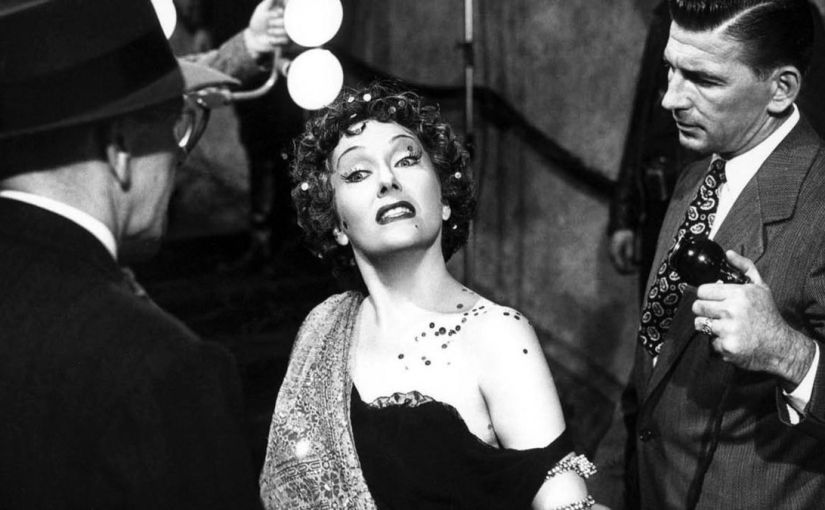
One of Billy Wilder’s most famous films is Sunset Blvd. A film that’s always escaped me despite seeing two productions of the stage musical, most recently on Broadway with Glenn Close as Norma Desmond. No matter how it is interpreted, it is a haunting story narrated from the grave of young screenwriter, Joe Gillis. In the 1950 film, Joe is played by William Holden. Norma is played by Gloria Swanson, with Erich von Stroheim as her butler Max.

Joe is a down on his luck screenwriter trying to avoid his car being repossessed. Events lead him toward hiding the car in the garage of a mysterious mansion belonging to one time silent film star, Norma Desmond, now obsolete during the age of talkies. She was big at one time. Though Norma insists she is big. “…it’s the pictures that got small.”

Joe is caught in Norma’s web, feeling obligated to write her story while she provides him with all the money and clothes that she can, to keep him close with no opportunity to escape. Even a sneak away to a New Years Eve party leaves Joe feeling compelled to return to Norma where Max has set up living quarters for him.

Holden’s voiceover narration is wry and descriptive like a novelist’s words being emoted vocally. Feelings are shared allegorically. It lightens the mood of Wilder’s film which is a quite dark and strangely sad depiction of a one time film star who has aged amid her isolation and is all but forgotten among the Hollywood elite. Even Cecil B DeMille (playing himself) doesn’t carry much interest in Norma anymore. It’s especially quite telling later in the film when she unexpectedly shows up on the Paramount lot. She had been called upon, but not necessarily for a new role, rather something else entirely.

Swanson is unforgettable as Norma; one of the greatest and most memorable film characters to ever grace the screen and the part is drawn out so well within the Oscar winning script from Wilder and his long time collaborator Charles Brackett. Swanson gives honesty to Norma’s madness; look at the famous final stair descending scene. It doesn’t get much better or more impactful than that. Don’t believe me? Go watch Carol Burnett spoof that moment. It’s one of the greatest cinematic moments ever placed on celluloid.

I digress.

Yet, I get Norma’s refusal to accept the changes to Hollywood films. She tells the modern screenwriter, Joe, that back then they had FACES, not dialogue. I get it Norma. I truly get it.

Joe is challenged to maintain his own present state of mind. He’s a writer with ideas like a baseball picture. Only he needs a producer to invest. Sure the money comes to him easy from Norma but it’s conditioned under her rules and unwavering possessiveness. It’s a shame when Joe only gets an opportunity at something following meeting Betty Schaefer (Nancy Olson), a pretty, up and coming writer herself, and engaged to his best friend. Joe is stuck. He has to be covert in sneaking away to write with Betty unbeknownst to Norma. Worse, he has to resist the urge to get intimate with Betty as well. Joe has multiple problems to contend with here all stemming from being stuck in someone else’s past that offers no stimulation sexually or creatively. Wilder and Brackett pen a perfect character conundrum. Joe has no escape.

It may sound silly but I couldn’t help but think of Paris Hilton while watching Sunset Blvd. I’ve never followed the heiress’ comings and goings. However, I recall a time in the early 2000s when Hilton would be all over reality TV. She was in every magazine and on every gossip headline. Not anymore. Reality TV, like network TV, is losing its flame quickly to the newest medium of streaming services. Hilton is now 15 years older. (Desmond is only 50 in the film, when she’s all but washed up.) Could Paris be wondering what’s become of her starlight? Is Paris waiting for the “Joe” who she’ll insist on being her boy toy? My mind actually drifted towards this subject!!!!

If anything, it tells me that Sunset Blvd still holds relevance. Mediums change and those that were once prominent sadly become obsolete. Either we change with the times, or we opt to be abandoned by an ever developing future.

Sunset Blvd should be seen simply as a reminder that our history never stays stagnant. However, a danger lies in refusing to move on or in Norma’s case losing the opportunities to move on. We might all be ready for our close up Mr. DeMille, but doesn’t that mean someone needs to be holding the camera?

WUTHERING HEIGHTS

By Marc S. Sanders

1939 is a pioneering year for film with timeless classics like Gone With The Wind, Stagecoach, and The Wizard Of Oz making their debuts on the silver screen. Arguably, it is one of best years ever for cinema. Finally, I was able to see another sampling from this period, William Wyler’s adaptation of Emily Brontë’s novel, Wuthering Heights.

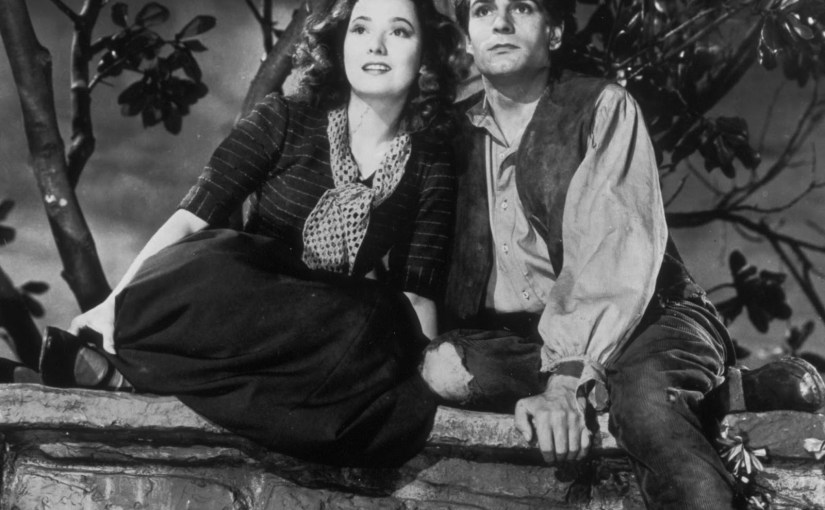
Laurence Olivier portrays Heathcliff, a wandering “gypsy boy” welcomed into the home where the story derives its title from. Over time, he develops animosity from Henry, the son of the landowner, while building a an affectionate relationship with the daughter, Cathy (Merle Oberon). Heathcliff and Cathy fantasize of royal, romanticized adventures along the neighboring rock side. Following a sneak away moment to observe a social gathering dance on a nearby estate, Cathy is tended to and welcomed by Edgar (David Niven), and eventually marrying him, much to Heathcliff’s dismay. From there, moments of melodrama, that likely served as a precursor for modern day soap operas, occurs.

Wuthering Heights caught my attention from the moment it began because I thought I was about to journey through a servant’s ghost story retelling of what became of the lovers never meant to end up together. A stranger wanders on to the property in the midst of a fierce snowstorm and swears he heard a woman’s voice outside and witnessed two shadows. Was this written by Brontë or Poe? Then the tale plays out.

Olivier is the most impressive of the cast, naturally. He’s very striking and handsome. While watching with friends, we all agreed that he might have made a good James Bond or Bond villain. Whether he’s the poor, oppressed Heathcliff or the later, wealthier property owner, Olivier offers a commanding presence that you can’t ignore.

The story doesn’t wow me as much as the the set design and camera work for 1939. Edgar’s grand ball room and foyer are a sight in wide measure with gorgeous, prominence ranging from large bookshelves and furnishings to a functioning fireplace. Was this a real home that Wyler’s camera moved through, or just a Hollywood set?

It was good to catch up with a classic. I’ll likely not watch on repeat, but Wuthering Heights is a treasured story in literature and film. I’m appreciative of the experience.

ETERNALS

By Marc S. Sanders

Was I dozing on and off during Marvel’s latest film, Eternals, or was I becoming interested and uninterested during a bloated running time of two and half hours?

As an avid comic book reader during the 70s and 80s, especially Marvel comics, I must admit I don’t know much about the team of gods known as The Eternals.  So, I went into this film kind of blind.  Reader, I don’t feel any more educated having seen the film.  These expressionless number of characters arrive on Earth 7000 years ago and apparently, they are assigned with protecting the planet’s course of events through history by fending off CGI monsters knowns as the Deviants, and that’s all they are supposed to do.  Allow the dinosaurs to perish.  Let Hitler do his thing.  Have Thanos snap his fingers.  Just take care of the Deviants. 

You know what the Deviants look like to me?  An early stage of computer graphics that we would see on a behind the scenes DVD documentary contained on the second disc of a Jurassic Park 25th anniversary edition.  The geeky visual effects wizard would show this deviant on his lap top as an early concept of a raptor or T-Rex.  I dunno.  Maybe it was the screening I saw at a Regal Cinema that soured me on the visuals in Eternals.  Everything seemed so dim and unlit at times.  When the Eternals are taking refuge in a woodsy campsite, that looks as simple as the Honey I Shrunk The Kids playground in Disney World, and a dino like Deviant roars and picks up a character with it’s tentacles only to toss the person into a wood shed, I felt like I was watching one of those 3D amusement park rides.  The computer animation blended with the human actors never flowed convincingly in this film.  This is maybe the worst looking special effects film in Marvel’s library of films. Nothing looks natural here. 

A small sect of the characters is interesting.  Most are quite boring actually.  Take Ikaris for example.  This guy, played by Richard Madden, flies and shoots powerful yellow laser blasts from his eyes.  Otherwise, there’s nothing I can say about his background.  He’s so unentertainingly morose and blah.  Sersi (Gemma Chan) is just the same, and yet she’s supposed to be more optimistic.  Almost twenty-four hours later and honestly, I forgot her powers or what she’s about.

Angelina Jolie is here too.  Moving on.  Salma Hayek is here as well, and yeah, moving on.

The most interesting character is the one causing controversy in the news over being the first Marvel super hero to have a gay kiss.  That’s only a fleeting moment and truly unworthy of causing any kind of uproar.  (Find something better to get pissed about people! Men fall in love with one another.  This is nothing new.) Brian Tyree Henry plays Phastos, who specializes in advancing technology over time that somehow becomes knowledge to the humans of Earth without him taking credit for it.  Phastos has a funny situation as he balances being a god on the planet for the last 7000 years, while also being a current day family man.  More so, he’s a tragically sad character.  The best moment (not scene, because regrettably it is not explored long enough) depicts Phastos gazing upon Hiroshima in 1945 following the dropping of the atomic bomb.  He can not help, as a god, to feel responsible for this outcome, while being consoled that this is not his responsibility to accept.  Remember Phastos, you’re just here to fend off dumb looking, unfinished monsters.

The other good character is Kingo (Kumail Nanjiani) – the god who eventually goes on to be a conceited and well-loved Bollywood actor/director.  Nanjiani is best used as the humor factor of the film with his tag along assistant cameraman (Harish Patel) who films all of the ongoing action for a possible documentary.  This is a good setup for a joke that doesn’t materialize well enough.

Marvel lent too much responsibility to its director Chloe Zhang, who to my knowledge does not have much experience with the big budget extravaganza films that’s expected of these installments.  Zhang was a large contributor to the script.  I’m going to take a guess and presume she’s not the comic book expert that say, Sam Raimi or Kevin Smith are.  She’s an Oscar winning director (Nomadland) who is a master photographer, but a film like Eternals tells me that if you take her out of the natural environments and put her in fantasy land computer graphics, you are not going to get the same thing.  This is like asking a guy who flips burgers at McDonald’s to prepare a $200 well aged Filet Mignon.  With Zhang directing this film, reader you are just not getting your money’s worth.

Everything seems very flat in Eternals.  The script is repetitive.  The narration of the story is that the team gradually reunites with one another following the unexpected death of one of their members.  When the characters do meet up with each other though, they explain the same news again and again and again.  This might be the way it is in real life when your 99-year-old grandfather kicks the bucket and you make one phone call after another.  However, in a film that luxury is not necessary to move the picture along.  Audiences are much more intelligent than this film gives credit.  They’ll make the safe assumption that when Phastos comes on the scene, he’ll have been caught up to date.  Yet, the picture ignores that opportunity of convenience, and just needlessly stretches the running time.

Eternals is not The Avengers.  These guys are boring.  They are written boring.  For the most part, they are acted boring.  There’s no sarcasm or biting insults among them.  There’s hardly any affection among them either, or even hate.  Think even beyond the Avengers for great team ups. Consider Daniel Radcliffe, Emma Watson and Rupert Grint in the first Harry Potter film, or Han, Luke and Leia in the original Star Wars trilogy.  There’s a chemistry to those characters that’s not in the Eternals; a love/hate relationship of jabs and hugs among the peers.  Even when they sit around a table for dinner, the most interesting thing the Eternals can talk about is who is going to take over the Avengers now that Iron Man and Steve Rogers are no longer around.  These folks have been separated from themselves for the last couple of thousand years or so.  Don’t they wanna catch up with one another, and maybe talk about themselves and what they’ve been up to?

The other issue with the film is the constant time jump from the times of B.C. to present day back to B.C. to early 20th century to present day and on and on.  This isn’t a Quentin Tarantino film where the fun is in piecing these moments together.  These time jumps have no impact.  I’d argue that it might have been more effective to just begin at the Eternals’ arrival on Earth and go through time chronologically.  Take me on a 7000-year journey.  Let me see what I can uncover.  For an observational director like Chloe Zhang, this is a missed opportunity here.  She could have demonstrated how the Eternal characters develop over time and get mixed up in side stories like becoming a private school teacher, or a loving dad or a film maker.  Then you have an arc to each of these misfits.  You’ll even have an arc to the planet Earth, and that could be very cool.  Don’t know what I mean?  Look at Zhang’s Nomadland from last year or Terrence Malick’s The Tree Of Life, or even Kubrick’s 2001: A Space Odyssey.  Eternals could have better demonstrated how history has an impact upon itself.

Within the Marvel lexicon, this is not a necessary film.  It quickly dismisses the biggest story that came down the pike with the Thanos character causing all kinds of trouble, and then settles into its own mire.  In other words, who asked for this picture?  I have to wonder if Marvel films are finally jumping the shark or crawling from under the dumpster (remember Glenn from The Walking Dead).  Have they used up all of the hot properties, that Disney owns at least, and are now settling for these minor characters?  Maybe or maybe not.  After all, the best parts of Eternals, for this comic book reader at least, were the post credit scenes.  Still, I didn’t pay $12.00 to wade through two and a half hours of sleep-inducing material just so I could catch a glimpse of two vague teaser moments either.

SHANG CHI AND THE LEGEND OF THE TEN RINGS

By Marc S. Sanders

Marvel’s installment of Shang Chi And The Legend Of The Ten Rings boasts a good cast and set up for an Asian superhero and his band of allies.  I only have one question, couldn’t some of this stuff have waited for the sequel?

Dave Callaham and Andrew Lanham wrote an adventurous screenplay for Destin Daniel Cretton (Just Mercy) to direct.  It’s fun and frolicking with magnificent action set pieces that take place on an out of control metro bus on the streets of San Francisco (where every out of control vehicle or car chase work best) and later on a high rise scaffolding in Macau.  While some sequences easily reveal the CGI work at play, the edited choreography of these martial arts scenes work beautifully. 

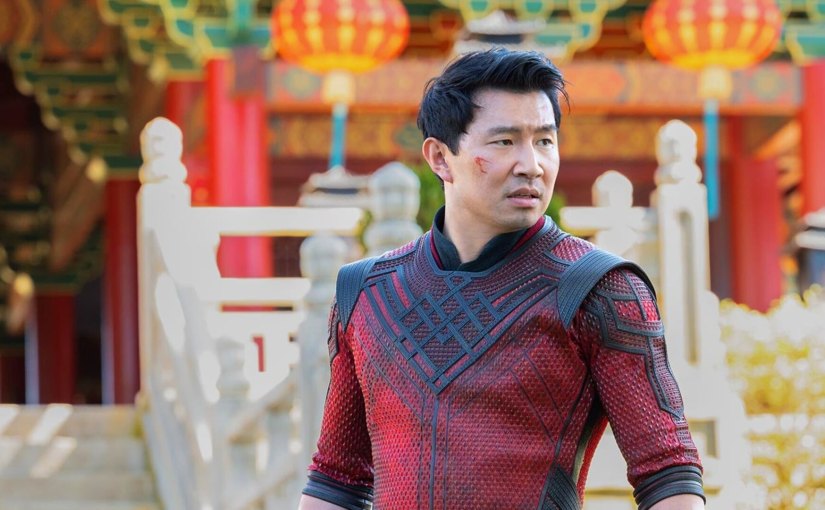
During the bus sequence, spread eagle jumps and high kicks and low punches by Shang Chi (Simu Liu) are done like a fine dance number as he fights off a gang of thugs who are mysteriously after the pendant he wears around his neck.  Comedienne Awkwafina plays Shang’s best friend Katy who rides the bus crazier than Sandra Bullock ever did.  Later the pursuit of the MaGuffin pendant leads into a meet up with Shang’s equally capable sister Xu Xialing (Meng’er Zhang) and the high-rise scaffolding fight occurs.  Marvelous work in both of these scenes.  The CGI is certainly forgivable.

After that, the film calms itself down to bridge some exposition that was revealed in the prologue of the film.  Shang and Xialing seem to have some parental issues.  Their father Xu Wenwu (Tony Leung) somehow acquired a set of ten magically powerful rings that he wears on both forearms.  Like other rings in fantasy/adventure films, these items take out armies and do nothing but conquer.   For once, could these powerful items just make a cup of hot tea or a decent wax job on my car?  When Wenwu uncovers a hidden majestic location to take over, he meets and becomes smitten with Ying Li (Fala Chen).  They fall in love and you’d think they’d live happily ever after, but if that were the case then there would be no movie.    

Beyond what’s described here, not much else mattered to me with this film.  The rings might as well have been Thor’s hammer or Captain America’s shield, or a Maltese Falcon.  A large, epic and very, very long climactic battle takes place so that one of Hollywood’s better known Asian actresses (Michelle Yeoh) can come into the picture and fight.  There’s also a return of a relatively unfavorite character from the Marvel Cinematic Universe, Trevor Slattery (Ben Kingsley), the fake out terrorist from Iron Man 3, that pissed off a collection of die hard Marvel geeks yearning for an appearance of the known villain called The Mandarin.  Shang Chi reminds us that this once reputably “threatening” villain is named after an orange.  Yup!  Get over it.  He’s as scary as an orange.  Moving on!  Beyond these appearances, are kaleidoscopes of colorful fantasy creatures like flying serpent dragons and furballs with wings and no face, as well as lion like four legged creatures.  Plenty of stuff for Disney/Marvel to merchandise.

I was seeing a story in Shang Chi, and then I wasn’t.  The long battle sequence goes on and on and on as a means to show off new toys and stuffed animals for the kids.  It all looks very good but it doesn’t lend credence to any storytelling like say in The Lord Of The Rings fare, where an Org could progress a story.  Here, it’s all overkill. 

The strength of Shang Chi And The Legend Of The Ten Rings lies in an enthusiastically fun cast and the outstanding martial arts moments that are presented.  The fantasy material is too much icing on the cake.  The graphics are good and all but couldn’t that fantasy stuff have been held for another film later on perhaps?  Go with one thing first and then another thing next, because after a while I forgot what kind of movie I was watching and why.

The cast is fine in their roles.  Just fine though.  Simu Liu has the athletic build for the title character.  He looks sharp in the costumes and fight sequences.  Though the fantasy material really takes away from the ranges that we could have appreciated from as an actor.  It’s clear this script is not giving him the same rightful opportunities for good super hero acting that was awarded to Robert Downey Jr or Brie Larson.  Equally same goes for Tony Leung and Meng’er Zhang.  They kind of plain jane.  Awakwfina is given the most to play with for the escapist humor as a fun loving karaoke singer and crazy valet driver.  Later, she quickly becomes an expert archer.  Good stuff there. 

Let’s face it the Asian community sect within Hollywood is not as well represented as it should be by now.  Box office numbers of the past have more than justified a need for Asian culture to be front and center in mainstream films.  There’s been some highlights in the past, most namely with the work of Bruce Lee and Jackie Chan, and films of merit like Crouching Tiger, Hidden Dragon and Crazy Rich Asians.  It’s pleasing to know that Marvel Comics created a character like Shang Chi back in the late 1970’s.  It just wasn’t capitalized back then as a marquee name like the Hulk or Spider-Man.  Still, Disney and Marvel could have tried a little bit harder here.  Just when I thought we were getting some dimension and checkered past subject matter for Shang Chi and his family to struggle with, Cretton’s film diverts into visual CGI fantasy Candy Land with no depth or substance. 

My recommendation on the next installment, is for Marvel and Disney to dig deeper.  I know there’s a wealth of storytelling here.  So, use a bigger shovel that’ll dig itself all the way to China.

ON THE BASIS OF SEX

By Marc S. Sanders

Director Mimi Leder provides a biopic on Supreme Court Justice Ruth Bader Ginsburg in On The Basis Of Sex. The movie is worth a view even if it is nothing very special.

Felicity Jones plays Ginsburg capably, even if her British accent keeps intruding into her performance. If Jones raises her voice in a debate with her daughter, all I’m hearing is Jyn Erso from Star Wars.

Leder’s film opens in 1956 as Ginsburg is depicted dressed in blue as a lone woman walking the campus of Harvard among a sea of male law students dressed in black. I’ve seen symbolism like that before. Nothing inventive here. From there, we learn she is entering the school as of one of nine women in the student body.

Ginsburg is married to fellow law student sophomore, Martin Ginsburg, played by Armie Hammer. I’m convinced if a film takes place at Harvard, Armie Hammer is going to be cast. He’s become a poster boy for the institution. When Martin is diagnosed with testicular cancer, Ruth accepts the challenge of not only attending her classes but Martin’s as well so he does not fall behind. Ruth then requests to finish her law degree at Columbia University to be with her husband. This is her first challenge as she is denied the request and its apparent because she is simply a woman. She perseveres and goes anyway. From there, Leder depicts a setting where even if you are at the top of your class at both Harvard and Columbia, if you are a woman, a mother and Jewish, then there is no job available to you as an attorney. Therefore, Ruth must settle for being a law professor.

The film jumps to 1970. Ruth’s daughter, Jane played by Cailee Spainee is a preteen ably ready to debate with her mother about the merits of Atticus Finch while Ruth continues to fall second to the male population mostly reliant on laws seem directed in preference to men over women. Don’t be too hard on our forefathers. Times have changed! Eventually, Martin introduces a case that would be perfect for Ruth to champion. An unwed man is denied a tax deduction for nursing expenses for his elderly mother. Had he been married or divorced or widowed or even if he’d been a woman, then the deduction would qualify. After all, single adult men should be out hobnobbing and earning a wage, or fighting in a war. So, if we can’t convince our lawmakers that a woman deserves the same equal rights as man, how would it appear if men were not entitled to certain rights equally? The case makes its way to the Supreme Court as Martin and Ruth team up for the cause.

All of this very inspiring and really should be seen by young students to open their minds to what they as people and American citizens are entitled to. However, I worry that if I were to show this film to my daughter, for example, she’d just get bored. Yes. You have to stick to the facts of the story and how it all played but the case that Ruth represents is kind of stale I’m afraid. If I, as a banker by day, find this case uninteresting, what should I expect of other adults and young viewers alike.

As well, Leder and screenwriter, Daniel Stiepleman (Ruth’s real life nephew), portray the opposition as tough minded, stubborn and bullish. Stiepleman might have been pushing this portrayal a little too far though. Were these great minds of debate and justice really this foolhardy and mean, or is this all for cinematic effect?

Ruth Bader Ginsburg is a hero because she’s an agent of change. Many of our current laws and those that continue to be updated must be credited to her efforts. The film primarily focuses on this one case which blazed the trail for her legacy to come. I would have rather have seen the legacy though. I bet that is much more exciting than listening to an exchange of tax law between Martin and Ruth. It just doesn’t make for good movie material and admittedly I got lost in some of the legal jargon speak. What happened exactly?!?! What now!?!?!

Jane and Ruth’s relationship kind of plays like an afterschool special. Jane did follow in her mother’s footsteps but it came off kind of hokey to me how Jane eventually participates in Ruth and Martin’s legal team. Still, this is a device that can attract young students to the material. I just think it’s kind of cheesy. There was better adult/kid chemistry and writing in Iron Man 3, for example.

Kathy Bates and Justin Theroux were kind of distracting to me as individuals who allied with Ruth. They are larger than life in this film and really they shouldn’t be. This film is about Ruth Bader Ginsburg, no one else.

On The Basis Of Sex won’t put you to sleep. I learned about Ginsburg’s beginnings a little bit. So I’m grateful for that, but as far as entertainment and insight, I’d turn to another source. Perhaps, I will seek out the 2018 Oscar nominated documentary RBG that is gaining massive positive response. I expect I’ll take away more from that film than just a dried up tax case that’s detailed over two hours.

PULP FICTION

By Marc S. Sanders

No one can deny that Quentin Tarantino’s classic film, 1994’s Pulp Fiction is one of the greatest screen accomplishments of the latter half of the 20th century. It’s strange, lurid, scary, unforgivingly funny and altogether different from practically anything that came before it. How did the Weinstein brothers with Miramax films prophesize the energy it would surge in mainstream audiences?

When I first saw the film I was apprehensively going with two college friends who insisted I see what they experienced from a prior viewing. Suddenly, I realized that alternate surf 70s rock, black suits, and a kinetic visit to the restaurant known as Jack Rabbit Slims could entertain and make me look further than just a facial close up.

Tarantino entertains the lens of his camera by making his audience the camera. A drug dealer scrambles to find a medical book to awaken a boss’ wife who is dying from a potent heroin overdose, and the camera stands in place only frantically swinging left and right. The camera doesn’t move while everyone in the scene remains in a panic, frightened of administering an adrenaline shot. The camera stands still to allow the audience to stand in the room as well. It’s very unusually funny, but unnerving and suddenly we are amid the clutter of crime and drugs frightened of a terrible fate.

Another scene follows two gangsters down the hall as they debate whether a foot massage equates to fellatio on a woman. They look serious as they earlier regretted bringing shotguns to their destination but here they are having a debate likely reserved for men’s locker room talk. Is a foot massage really worthy of dropping a guy out of a four story window into a glass enclosed garden below? I mean, apparently the poor guy developed a speech impediment.

Tarantino used Pulp Fiction as an excuse to show how criminals inadvertently lead their lives to the unexpected, beyond a cliché cop bust. Two guys might be settling a personal vendetta, but somehow get interrupted by a redneck gang rapist and his chained up “gimp.” Two other guys might be trying to deliver a briefcase and yet somebody’s brains splatter all over the inside of a car. Another guy might have left behind a family heirloom gold watch as he and his girlfriend run for their lives, or they might suddenly acknowledge a moment of clarity when death seemingly walks out of a bathroom door.

Some might not agree but I always consider Tarantino’s colorful film characters to be rather two dimensional. What you see is all you see. There are no hints at an underlying motivation or a background to anyone you meet in Pulp Fiction, or any of his other films. Normally, that’s a negative in my book but with Quentin Tarantino it is what’s expected. He’s a masterful script writer of the situation. A well known fan of kung fu and lurid crime movies of the B variety, gangsters like Vincent Vega, Jules Whitfield, Marsellius Wallace, Butch Coolidge and Winston Wolf (even the names are entertaining) get caught up in just a random moment in time. Beyond the incident nothing else matters, and just to make it fun Tarantino uses his favorite editor, Sally Menke, to scramble everything out of order. I like to think the script was assembled this way to demonstrate that what happens in one instance doesn’t reflect what happens in another. Every brief moment is bookended. Again, two dimensional characters who don’t reach an intended karma. It doesn’t matter what’s been done before or what will be done next. It only matters in the moment.

The cast is great. Likely, you know who all the players are by now. The best compliment is that they obviously listened closely to the director’s vision. They spoke his language which had yet to be very mainstream before this film’s release. They are a pioneering cast of great talent and many owe quite a bit to Tarantino for jump starting and reviving their careers.

Pulp Fiction is a rousing expedition in sin and surf music symphony with endless quotable and un-PC dialogue that revolutionized filmmaking and brought about risk taking movie makers. It’s just exciting and fun and wild and it especially became a favorite upon seeing one of my favorite kinds of scenes-a dance sequence. If you incorporate dancing into a non musical film, you’ll likely win me over.

Spoiler alert: Vincent & Mia win the dance contest, and right they should. Chuck Berry’s “You Never Can Tell” became that other popular film song once Pulp Fiction hit the scene.

Thank you Quentin Tarantino.

INGLOURIOUS BASTERDS

By Marc S. Sanders

If you are going to rewrite history then go crazy.  Go big and bloody.  Go for broke.  Don’t hold back.  Quentin Tarantino didn’t hold back when he penned and directed Inglourious Basterds, my personal favorite of his films.

To date of when this review is published, Tarantino has directed nine films and if ever the maturity of a director is so evident, it really shows with Basterds where three quarters of the picture is performed in either French or German.  English is secondary here, and Italian is limited to only a couple of “Bonjournos!”  and “Gorlamis!”

Tarantino presents early 1940s France when Germany occupied most of the country and practically rounded up all of the Jews.  In 1941, a cunning detective of a Nazi Colonel, Hans Landa (Christoph Waltz performing as one of the greatest villains of all time) visits a French dairy farmer to ensure there are no unaccounted-for Jews scurrying around; scurrying around like their beastly equivalent, the rat.  Landa is the hawk that will most assuredly find them.  This scene is the best written moment within Tarantino’s catalog of various scripts and dialogue exchanges.  The Landa character offers justification as to why a Jew needs to be exterminated to the point that he nearly had me (a conservative practicing Jewish man) believing in his hateful philosophy.  The lines crackle here with Waltz doing most of the talking while the sad dairy farmer can do no more than respond with certifying Landa’s interesting points.  Tarantino closes the peaceful discussion with horrifying violence though.  Hans Landa may be complimentary of a farmer’s milk and his three beautiful daughters.  He may be eloquent in his dialogue albeit French, German or English, but he is a ruthless enforcer of law …of Nazi law at least.  I also would like to note Tarantino’s tactful way of using props like the pipes the characters smoke, the glass of milk that is consumed by Landa and the ink pen and spreadsheet he uses for accounting of the Jews in the area.  There’s an uncomfortable intimidation in all of these items as they are handled by Waltz, the actor.  Later in the film, Waltz will send a chill down your spine as he happily enjoys a delicious strudel with whipped cream.  Inglourious Basterds is a great combination of directing, editing, cinematography and acting.

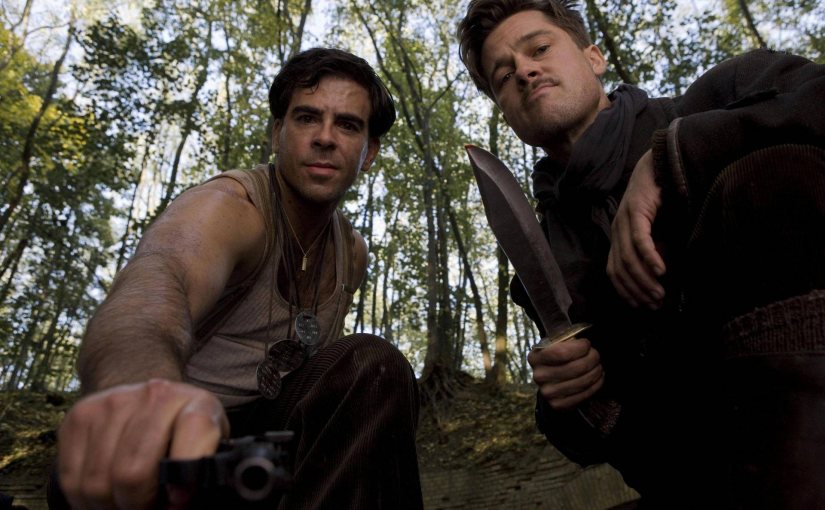
The film diverts into a few separate stories, namely the title characters led by Aldo “The Apache” Raines, played with Tennessee redneck glee by Brad Pitt.  The Basterds consist of mostly Jewish American soldiers tasked with going deep into enemy territory and literally killing and scalping one hundred Nazi soldiers, each.  However, keep at least one alive during each encounter with a carved souvenir on their forehead, to spread the word of the Basterds intent.  This is deliberate B movie Dirty Dozen material and it works because it doesn’t take itself seriously.  Tarantino maintains that pulpy fiction narrative.  A cut to an over-the-top crybaby Adolph Hitler asks, “What is a Hugo Stiglitz?” and then we get a quick pause with big black block letters across the screen spelling out HUGO STIGLITZ.  This guy is a bad ass; a German turncoat who only wants to kill fellow German Nazis.  He’ll shoot them up until they are dead three times over.  He’ll stab them in the face twenty times through a pillow.  He’s not a suave killer.  He likes it violent and bloody messy.  The Basterds are fans.

The heroine of the film is Shoshanna (Melanie Laurent), a Jewish girl who is living undercover as a cinema owner in France.  By implied force she is tasked with presenting Himmler’s proud film of Nazi Germany’s finest war hero, Fredrick Zoller (Daniel Bruhl), recreating his bird’s nest three day sniper battle against an army of three hundred men.  This is where Tarantino does best at writing what he knows, and what he knows best is anything about cinematic film.  He literally uses his knowledge of film and film reels to bridge his story while setting Shoshanna on a mission to actually end World War II in one swift motion.   

In addition, he captures the adoration of film lovers and celebrity status.  Zoller is as heroic a celebrity as John Wayne or Zorro.  When he is recognized in the coffee houses or on the street, he humbly stops his ongoing flirtation with an uninterested Shoshanna, to give an autograph or pose for a picture.

Furthermore, Tarantino applies the scientific knowledge of how 35mm film is more flammable than paper as well as how to edit a film reel to an unexpected moment for Shoshanna’s Nazi audience.  He knows the architecture of a European cinema with its lobby and balconies and seating capacities.  He allows his characters to speak on an intellectual level by discussing great film artists of the time – filmmakers not as well-known as Chaplin here in the United States, but just as great or even artistically better. The art direction of the cinema both inside and out is adorned with washed out, distressed classic noir films.  Shoshanna changes out the lettering of the curved marquee top of the theater as well.  It might sound mundane, but to me it’s all atmospheric.

Beyond the subject of cinematic art, a bad guy will weed out a spy disguised in Nazi garb by recognizing how he signals for three drinks with his hand.  There’s a right way and a wrong way to place an order with a bartender.  Inglourious Basterds may be a fictional historical piece, but it also will give you an education. All of this reminds me that Quentin Tarantino has graduated from the simplicity of Reservoir Dogs to something bigger and grander and glossier.  Production money with a large budget will lend to that status of course, but Tarantino still had to learn to truly know what he was doing.

I will not spoil the ending here.  It’s a bloody blast for sure.  Moreover, it’s shocking.  If anything, Inglourious Basterds introduces an exclusive universe that resides in the mind of Quentin Tarantino where the textbook is thrown away, burned, riddled with bullets and blown up; it is where something else altogether happened, and you know what? I really wish it did actually happen this way.

MICHAEL CLAYTON

By Marc S. Sanders

The corporate world can be murder sometimes.  Just ask a well known “fixer” like Michael Clayton. 

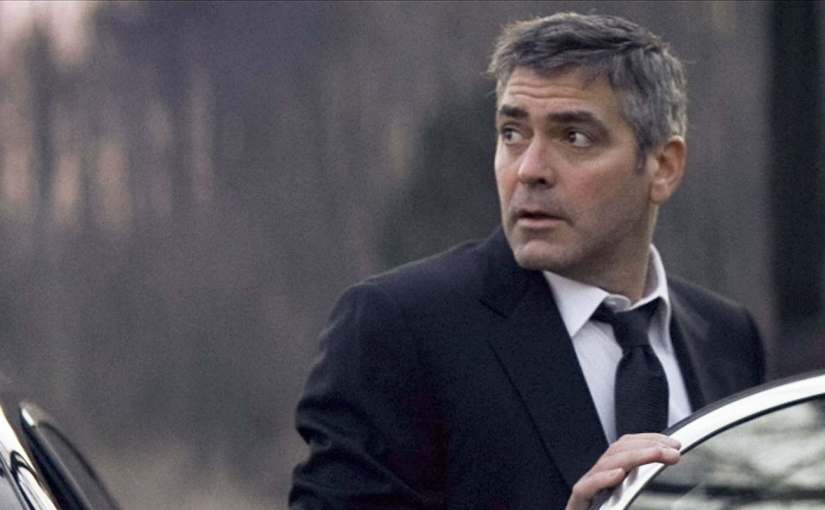
George Clooney plays the title role that’ll leave your head spinning while watching the film, and thereafter keep you thinking about how frighteningly true much of what you’ve seen, in this fictional account from master writer Tony Gilroy, could potentially be all too real.

Michael Clayton is a lawyer who does not practice law but rather “fixes” sticky situations for his law firm.  When the attorneys of the firm don’t have enough imagination to swindle their client from bearing responsibility or surrendering to guilt, they turn to Michael.  Michael will know what to do.  Ironically, Gilroy’s script (which is also his directorial debut) will have you believe that Clayton is at a career midlife crisis moment where he understands that nothing really can be fixed or simply swept under the rug.  Not even money can buy any of us out of a guilty situation when there’s nothing to work with but the black and white facts of actual guilt.  Early on in the film, Michael explains to an aggravated high-priced client that there’s no getting out of the fact that a late-night hit and run is nothing else but a late-night hit and run.  Can’t undent a car.  Can’t bring a bicyclist back to life.  Can’t fix what is permanently broken.

Moving on to the main storyline will demonstrate the same ideal.  If knowing admission of guilt and wrongdoing is documented on paper in plain English, then there’s no getting around this.  Moreover, there’s no getting around the fact that one of the best lawyers in Michael’s firm, played expertly by Tom Wilkinson, is consciously arrested in his own guilt of ethics violation.  To be considered one of the greatest lawyers in the country, would you factor in how to squeak out a win at no costs? Would it be when you can accept that your own client is guilty of wrongdoing and help them from that point?  I don’t know.  I’m not a lawyer.  The point is that Tony Gilroy implies that Wilkinson’s character, Arthur Eden, was once considered among his peers in high esteem in order to earn the reputation he has. Then another way when perhaps that reputation was based on actions not so honorable.  As Arthur struggles with this conundrum, maybe it’s only telling that his wealthy corporate client, an environmental weed killer manufacturer and his law firm colleagues easily think it’s nothing like that.  Arthur must be literally losing his mind.  It’s the only explanation.  He’d have to be crazy to literally strip his clothes off in the middle of a witness deposition, and later run after the witness in a freezing cold parking lot, while stark naked.

The pawn of the corporate client is represented by a shark named Karen Crowder (a brilliant Tilda Swinton, putting on the American Ivy League grad persona).  Karen is only insecure in how capable she’s actually considered when behind her closed doors.  She nervously practices what she will say at presentations for the corporation or interviews that hold her client in the highest regard.  She’s also desperate to maintain a calm and unpanicked appearance of this firm who clearly caused the death of many people that were exposed to their product.  Karen will make certain this knowledge never sees the light of day.  Karen talks to her mirror while stuttering over her lines.  By the way, if Karen was so confident in what her corporate client stands for, then would she even have a stutter to begin with?  This is where Tilda Swinton is great with Gilroy’s script.  What she knows would be the death of her career. Then again, this is her career we are talking about here. 

Tony Gilroy’s script is deliberately muddied in its first act.  Random scenes that carry no relevance to one another occur.  Michael sits at an underground poker table. Arthur spews off endless speeches that give a voice to madness. An army of lawyers led by a shrewd Sydney Pollack are up late at night sifting through piles and piles of documents.  Karen talks to herself while smoothing out the wrinkles of her suit while getting dressed in the morning.  Then a car explodes, and the movie sends us back in time to four days prior.  This might seem frustrating on a first viewing, but I urge anyone interested in seeing the film to be patient.  Gilroy demonstrates that if crime truly occurs within the offices of corporate high-rise buildings, then it’s not going to be anything but complex.  It’s only when it is gradually simplified like a math equation, do we see how justifiable the desperation of these crimes really are.  Murder and attempted murders and violations of law and ethics are committed in the film Michael Clayton, and yet no one is carrying a gun. 

This film boasts a brilliant cast ready for complicated characters.  Clooney is far from his charming other characters that evoke cuteness and handsome tuxedo clad appearances.  He’s a tired professional soul, exhausted on the heavy lifting he does for his firm and their apathetic clients.  He’s failed at his dream of running a New York City restaurant with his recovering alcoholic brother and he’s mounted in debt to loan sharks.  Wilkinson is old and past the age of winning at all costs.  He can’t sleep with the contributions he’s lent to criminals he’s legally served and rescued on paper.  Swinton is the younger one of the trio with a massively rich and successful future ahead of her, while holding on to the same mentality of what Clooney and Wilkinson’s characters once had.  The only issue is that maybe she’s taking a few too many steps way too far. 

Tony Gilroy has written brilliantly faulty characters who must function with strength, but are weakened by their lack in morale or inability to recover from never having morale, and the actors he’s directed in this film deliver the message sensationally.

Michael Clayton is a smart film, and Michael Clayton is a great, great film.

ROMA

By Marc S. Sanders

Alfonso Cuaron’s new film, Roma, is a masterpiece in cinematography, sound, and empathetic storytelling. Shot in beautiful, multi-dimensional black & white, it tells the story of a house servant named Cleo who tends to a family living in the city section known as Roma during the year 1970 in Mexico.

Cleo is portrayed beautifully with quiet reservation by Yalitza Aparicio. I imagine this actress is not well known to mainstream audiences. Perhaps she is not well known to Mexican or Hispanic audiences as well. However, it would be so refreshing if the positive response of this film opens up opportunities for her within more widely known fare, much like Precious did for Gabourey Sidibe.

Cleo seems content to cater to the family that contains four young children and their mother. The father appears stern in his mannerisms until one day he leaves for a conference taking place in Quebec. However, allusions to this conference indicate a different story when his absence lingers on longer than expected. During this year, Cleo gets pregnant by Fermin, the cousin of a friend. Fermin leaves Cleo to deal with the pregnancy on her own, and in the moments when he returns to the story, it is not promising that he will commit to fatherhood.

Cuaron writes and directs a relatively simple story amid turmoil in a very confused country that centers on riots among the young citizens and men who are not noble enough to dedicate themselves to the women that cross their lives. Family is not convenient either. When a conclusion dawns upon Cleo near the end of the film, you can’t help but understand her position. What she has seen is gut wrenching.

To further compliment this work is to appreciate the visual sense and sound of the film. This is not a sci fi special effects extravaganza like Cuaron has accomplished with his Oscar winning Gravity, or the dystopian action depicted in his under appreciated Children Of Men (masterful steady cam work in that film, especially). Cuaron takes advantage of a crowded bustling lower middle class city with an overpopulation of dogs, planes flying overhead, music, and crowded streets of different happenings. I watched this film with my new 7 point sound system and this film is perfect proof that I made a smart purchase. Cuaron hooks your senses to engage you in his setting. Therefore, the setting justifiably serves the title of the film.

The photography is sensational as well. Cuaron hardly does a close up on any of the characters. Rather, he opts to go deeper to show there’s more going on in any one given moment than just what is in front of you. The first example of this is during the opening credits that are displayed over the course of several minutes on a tile paved driveway. First you are just looking at tiles. Then you are looking at Cleo’s soapy mop water splash across the tiles. Now you have a reflection of the sky above and you get a sense of how high the sky goes as a passenger jet plane casually flies overhead. Dimension is gradually introduced and the theme of Cuaron’s filmmaking continues on during the course of the picture.

Later, at a pivotal point in the film, when Cleo delivers her child (I don’t think that’s a spoiler), Cuaron puts the silhouetted profile of Cleo close to his lens and then to the right deeper into the room you watch as the hospital staff tend to the newborn; seeing the baby, seeing the towels held by the staff, watching the staff tend to the baby. Cleo is separated from the activity but she remains in the room, exhausted and discombobulated from what she has just experienced. A moment like this, I would imagine, would be good material for film students to examine. Cuaron proves that what you show in a moment can be limitless in the scope of a lens. Nothing is impossible.

Because the film is in black & white, the activity of the hospital staff never appears to upstage or overshadow the experience that Cleo is enduring. Had this been in color, a viewer could have been distracted by the blood and the sweat and lighting in the hospital room. It’s all there. It’s just not as distracting as a colorized moment might have suggested. Cuaron’s choice of black and white permits you to focus on everything. So, a scene like this is so wisely conceived.

Roma will likely be selected as a nominee for Best Picture and Director. It deserves it, much more so than many other films I saw in what I consider 2018 to be a weak year for inventive filmmaking. I highly recommend this film. If you don’t have a good sound system or a high definition TV to watch it currently on Netflix, then find it at a local cinema. To immerse yourself in this film, requires the best in sound and visual quality.

I will admit that it takes some getting used to reading the subtitles translating both Spanish and Mexican, and Cuaron takes his time setting up his story. You have to be patient with the film. However, I watched the film on Saturday, December 28, 2018 and I still can’t stop thinking about it.

Please check out Alfonso Cuaron’s beautiful film, Roma. I think you’ll be glad you did.

VICE

By Marc S. Sanders

Christian Bale is one of the greatest method actors working today. He’ll put on muscle mass for Batman. He’ll shrink himself down to a skeletal 100 pounds for roles in The Mechanic and his Oscar winning turn in The Fighter. In Adam McKay’s new film, Vice, Bale puts the weight to present an uncanny resemblance to former Vice President Dick Cheney. Without Bale and co-star Amy Adams as wife Lynne Cheney, Vice would not succeed. Both will be nominated for Oscars this year. McKay can expect nominations for himself and Best Picture.

McKay approaches Vice similarly to his winning film The Big Short, where a historical debacle of great proportions is told from a comedic approach. However, the gags of Vice don’t necessarily measure up to the absurdity of the real estate investment collapse of The Big Short. Cheney’s accomplishments were just too sad, too tragic, too shocking to laugh at entirely.

Dick Cheney was a drunk who suffered multiple heart attacks. He got kicked out of Yale University. His daughter, Mary, is gay. His other daughter, Liz, went into politics herself and dismissed her sister’s sexual orientation. Dick has remained married to his very wise and very aggressive wife Lynne who more or less rescued him from a wasted life. Dick Cheney shot his close friend accidentally while hunting, and never apologized for it. He was fortunate to receive a heart transplant that continues to prolong his life, and Dick Cheney became Vice President of the United States for two terms. You don’t have to like the guy but you have to admit he’s got a colorful past.

It’s all in the movie. Immediately, McKay puts in a few words of a byline that this film is based on fact to best of their knowledge but they more or less tried their fucking best.

My impression of what could be considered a very divisive film was actually not divisive to me at all actually. Bale along with McKay’s screenplay show a Dick Cheney who truly sees no other way to carry on a political career than with a silent yet ruthless touch. Later, it required more aggressive tactics not labeled as torture and not appearing beyond his authority even if he is only the Vice President. Bale has the voice down, the walk and as noted before the appearance. This film will likely win Best Makeup.

Having recently seen three potential nominees for Best Actress in The Favorite, I have to say Amy Adams as Lynne Cheney beats them all. This is not an Amy Adams we’ve seen before. Lynne is depicted as smart, aware in a mindset of no nonsense bullshit. She gets the job done, and if she had her way she’d take the job herself but she’s aware of her limits as a woman. Adams easily shows her Lady Macbeth in a scene where daughter Mary reveals herself as gay. Dick promises to love Mary no matter what. Adams as Lynne does not. Adams offers an expression that kills. Right there in this scene is her Oscar moment. This is one of the best performances I’ve seen all year.

Back to Macbeth for a moment, McKay has a great imagination for gags including elevating the fantasy of Dick and Lynne reciting MacBeth to each other in bed while mulling the possibility of becoming George W Bush’s running mate. It’s more than that for Dick. Both know this is absolute power…finally. I’d accept if their decision to run came down to something like this. It takes an ego trip to obtain power after all. If you’ve already been denied power before, the power trip only becomes more powerful on another occasion.

The Shakespeare gag works. Some others fall a little flat. Some really win. Out of the blue, prior to running on Bush’s ticket, McKay wraps up the first portion of Cheney’s life and literally rolls end credits. Then a phone rings and Cheney’s biggest story begins. The end credits moment is a great psyche out.

Vice is not a perfect movie. A huge misfire occurs midway through the end credits that derails McKay’s best effort at a neutral point of view for the Republican. It’s a moment that screams of present day chaos of opinion. McKay said screw it and folded his hand to take advantage of showing how he really feels. Before this scene, McKay and his cast embraced the Cheneys despite their hard to swallow viewpoints and actions. If you are going to make a movie about Dick Cheney or Barack Obama or Mickey Mouse you, as the storyteller, have to develop an appreciation for the centerpiece. If all you are going to do is bash and mudsling, then perhaps you are not qualified to tell the tale. McKay failed at the finish line.

Still, the journey is always interesting. There are things to learn here, things to recollect and things to question how it all came to be a reality.

A good cast is offered including a surprising appearance by Tyler Perry as Colin Powell; make a movie about this guy and get Perry back. Steve Carrell plays a buffoonish Don Rumsfeld. Was Rumsfeld this stupid and this haphazard? I don’t know. McKay uses him to play the fool and the jester. I doubt Rumsfeld has a loyal fan base ready to wave pitch forks. So who cares, really? It’s in the past.

A casting misfire is Sam Rockwell. Moviegoers are too familiar with the real George W. Bush especially in 2018 following the loss of his parents and his deeply appreciated eulogies. Rockwell teeters on 12:45 am Saturday Night Live material, as he chomps down on chicken wings, with a good ol’ boy Texas dialect. I know people want to believe Bush 43 was this stupid. I’m just not ready to accept that. Ironically, a producer on this project is Will Farrell, widely known for his George W Bush on SNL. Farrell would have been a better George here.

Compliments also go to Jesse Plemons as a narrator with an unknown connection to Cheney. Plemons’ delivery plays well on an even keel.

Vice is a complicated film about a hard man to like with little to know redeeming qualities. Adam McKay is cornering the market on films about American absurdities of the past. He’s good at this kind of filmmaking. This isn’t his best film but it still works. Just get ready to leave the theatre as the real end credits roll. Again, it’s a moment that serves the film’s worst flaw as McKay leaves his imagination at the door. Everything before that was right on track. Adam McKay…next time, don’t think too hard.