LOVE, ACTUALLY

By Marc S. Sanders

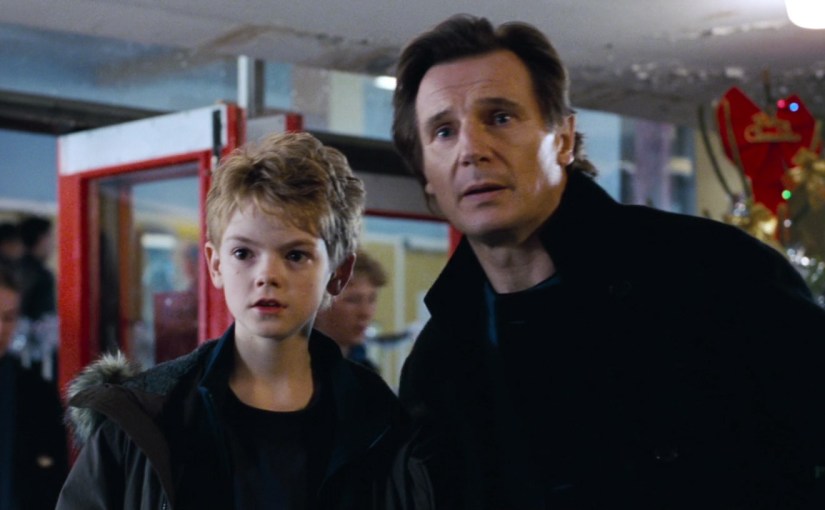
Love, Actually is like a warm favorite blanket to snuggle up in. Richard Curtis writes and directs a collection of the greatest British actors (along with American Laura Linney) in a kaleidoscope of love and relationships against the backdrop of beautiful London, England during the five weeks leading up to Christmas.

I won’t list my favorite characters or actors. In a film this treasured, this loved and this appreciated, that would be like picking your favorite child. It’s impossible when every single storyline is perfectly executed with thought and tenderness.

The stories of love uncovered, love that’s lost, love based in friendship, and love drowning in heartache beautifully jump from one to the next and then back again. Curtis is wise to not show all of the facets of each story early on. Some stories reveal more about themselves later that’ll leave you hurting for those that are not so merry and those that offer plenty of cheer.

I’m especially happy that Curtis did not compromise in the language or subject matter of his tales. Strong language at times makes for some memorable dialogue and nudity presents a normality to how we really are with those we have affections for.

It’s fair to say everyone in life experiences some variation of love. Yes! I mean everyone. Richard Curtis reminds you that love is a natural instinct, and so we can not focus on the easily recognized gloom of our world. To have these stories captured around Christmas time only enhances what we treasure, or what we wish we didn’t have to endure at times. Curtis’ blazing soundtrack helps along the way.

Love is hard. Love is challenging. Love will sweep you off your feet and love will destroy everything you thought you had. However, love will never leave you with complete regret. It’s never the love we have for someone that we regret. It’s only a wish to have it wholesome, healthy, happy and pure.

Love, Actually is all around.

ARGO

By Marc S. Sanders

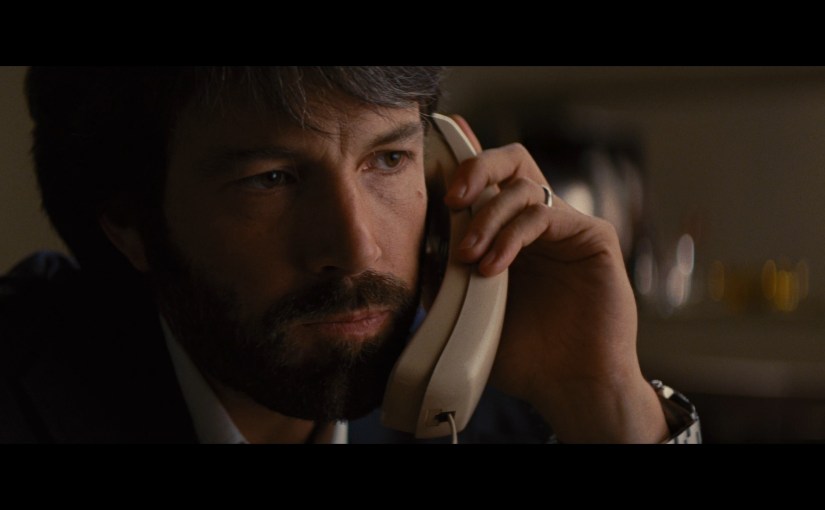
Ben Affleck’s third directorial effort Argo is his best. It makes me wonder why he followed this with playing Batman, a done to death cinematic character.

Argo showed promise of another great actor/director in the same vein as Orson Wells, Woody Allen, Robert Redford and Clint Eastwood. I’m sure Affleck will direct again but a Batman commitment certainly sidelines you. I hope he’ll direct again. I’m a big fan of his previous films, The Town and Gone Baby Gone.

The story tells of one aspect of the Iranian hostage crisis that spanned the end of 1979 through 1980. Six employees of the riot stormed American embassy in Iran manage to escape and hide in the Canadian ambassador’s home. Slowly but surely their hideaway will be revealed and they will inevitably be taken prisoner. Affleck plays CIA operative Tony Mendez who is tasked with getting them out. His plan, with assistance from John Goodman as legendary Hollywood makeup artist, John Chambers, and Alan Arkin as producer Lester Siegel, will make up a cockamamie story about producing a fake science fiction Star Wars rip off film called, you guessed it, Argo. They will do marketing write ups, poster advertising, and even a costumed table read at the Beverly Hills Hotel, all with the intent to just appear authentic as a film studio seeking out production locales in exotic Iran. The six hostages naturally are the film’s crew.

Affleck directs two acts here with two different narratives using both masks of theatre. Namely comedy and tragedy. The pleasure comes in watching Arkin and Goodman pair up to bring the Hollywood flavor that’s necessary. It’s great fun, especially when watching Arkin (in an Oscar nominated role) shyster his way with character actor Richard Kind to buy the Hollywood script-these two guys are like Oscar and Felix. Goodman is great as the been there done that Hollywood insider. He says “You can teach a Rhesus monkey to be a director.”

The drama comes with Affleck’s talent for delivering taut tension from his directing especially but also from his own performance as well as his cast of six hostages consisting of Tate Donovan, Scoot McNairy and Kerry Bishe. Bryan Cranston is also good as Mendez’ comunica from home. Cranston is just good in anything.

The tension builds with intimidating locals screaming of their loyalty to the Ayatollah as well as the eventual airport security. It’s all very nerve racking.

The critique for the the film lies in its own admission of historical inaccuracies. The escape was not as tense as the film suggests. More importantly, the caper was really primarily pulled off by the Canadian Ambassador, Ken Taylor (great actor Victor Garber). No. Canada is not given enough credit in the film. Still, here is a rare exception where I don’t mind. I guess because the suspense Affleck offers up is at its peak. You really shake your head at it all.

Forgive the cliche but Argo is a nail biting, edge of your seat thriller. At best, I can be grateful for learning about the true story following seeing the film. It’s a story that was kept hidden for 17 years. In these times of hardship and turmoil in America, it’s fortunate that a success can finally be celebrated.

Argo was undoubtedly worthy of its Best Picture Oscar win, and Ben Affleck should have at least been nominated for Best Director.

Fun Fact: Argo is produced by two former Batmans: George Clooney and Ben Affleck.

DIE HARD 2: DIE HARDER

By Marc S. Sanders

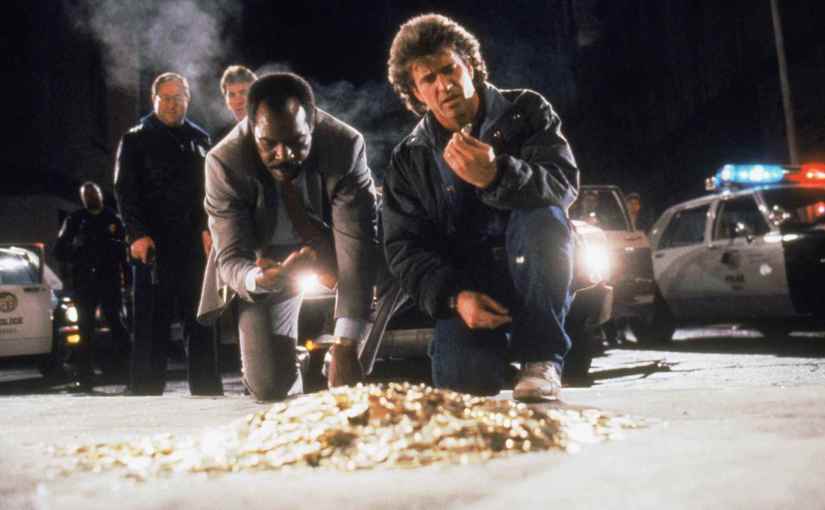
I think we’ve debated enough about whether Die Hard is considered a Christmas movie. So what about the next installment, Die Hard 2: Die Harder?

Truthfully, who cares?!?!?

Director Renny Harlin (Cliffhanger with Sylvester Stallone) takes over from John McTiernan and he does a capable job of depicting a frenetic Christmas Eve at Dulles Airport in Washington DC, sprinkled with the latest in early 90s technology like fax machines, pagers, tasers and even a reference to Radio Shack. But by golly, the film still remains modern as The Simpsons is shown on local TV.

The ingredients are pretty much the same as the first film and while Alan Rickman is sorely missed, William Sadler does alright as a cold hearted Colonel on a mission to aid an escape of a powerful drug overlord. Bruce Willis’ John McClane will not allow that to happen.

Willis is maverick and defiant again though this script doesn’t allow for better one liners that the first film offered. He’s doing his same one man army schtick though with an endless supply of bullets for his service weapon, and it’s nice to return to form.

Harlin is a good action director featuring snow mobiles, shootouts, shootouts on snow mobiles and exploding planes and satellites. Amazingly enough though, a crowded Christmas airport is unaware of all these massive fires and explosions going off all over the nation’s capital and all proceeds as normal until it’s broadcast on TV in the last act of the film. Meh!!! Everyone has Christmas on their mind.

Heck…well then I guess Die Hard 2 (with the inventive subtitle Die Harder) is in fact a Christmas movie. Glad that’s settled.

Happy Holidays. Let it Snow!

DIE HARD

By Marc S. Sanders

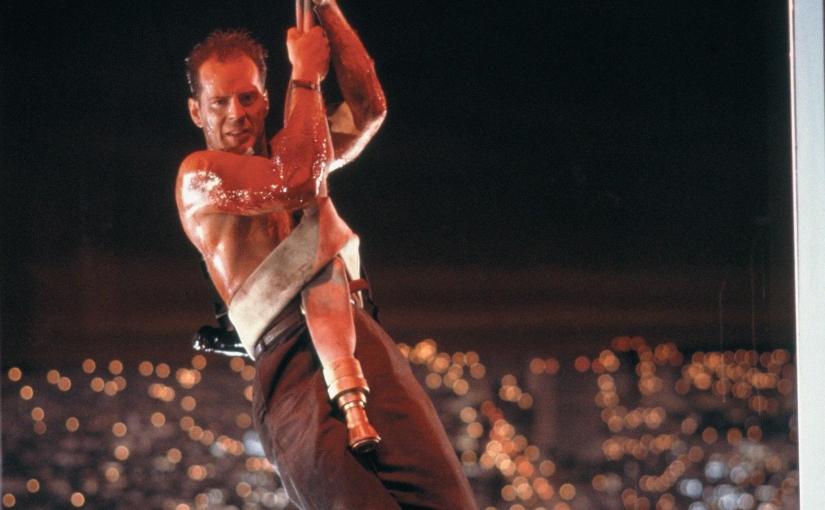
The long lasting appeal of Die Hard really stems from so many sources. Most importantly though is the performance of Bruce Willis.

Watching it this evening in a theatre commemorating its 30th anniversary, I found myself still laughing and relishing the fantastic set pieces of editing for great sound and visuals from Director John McTiernan. Yet, tonight Willis is what stood out for me. There’s not much dimension to New York cop John McClane but there is a great transition from being a reserved nervous flyer to an estranged husband with feelings of awkwardness at his wife’s Christmas party and finally to deliriously unhinged and reckless when faced with going up against a superbly brilliant villain from Alan Rickman, his very first film role. Willis goes wild against Rickman’s team of terrorists that hail from all different nationalities and races. (Hans Gruber was an equal opportunity employer.) The mouth on McClane doesn’t hold back for any kind of authority. It’s fun. It’s hilarious and you can’t help but pound your fist in the air with a “right on!”.

Rickman is great as well. His well tailored and groomed persona is a perfect counterbalance to Willis’ lack of class and style. Both are at the top of their game but using different devices to fight with. The playing field of a high rise tower is equal for them. Yet their tactics are different.

McTiernan offers up plenty in side humor from ego minded FBI guys both named Johnson (love that joke) to conniving reporters, to a coked up yuppie hostage and henchmen who all carry themselves differently. McTiernan bravely stops the approach to action to allow his audience to realize the setting on Christmas Eve with great note reminders from a film score by Michael Kamen and even a run through the roses only to have a kick ass swat officer get pricked. A terrorist takes a moment to snack on a Nestle Crunch before a firefight. Porno pictures on the walls of a construction area give Willis an opportunity to offer a glimpse. Great lines as well are so celebrated (“Yippee Kai Yeah Mother Fucker”).

But Willis is the real fun stuff as he gets into hand to hand combat with terrorist Alexander Godunov, he offers a promise to “kill ya, and cook ya” with his “had enough” delivery.

Roger Ebert always took issue with naivety of the law enforcement officials in the film especially actor Paul Gleason as an dumb antagonist. That’s okay and he’s not wrong. However, this is Die Hard where an 80s Los Angelos offers gas for .74 cents and ever relies on their characters getting caught up in a scenario they never fathomed. Had Die Hard been made in post 9/11 it wouldn’t carry that smirk inducing charm. It wouldn’t be fun.

We were fortunate to get one of my favorite Christmas movies when it did come before the age of cell phones and social media.

There were action films long before Die Hard. Yet the original 1988 film set the standard by what most films of action offered in subsequent years. More often than not, they were all fun films in their own right but whether you liked those films or not, they often remain comparisons against Die Hard. That’s the best compliment any film could receive.

FUN TRIVIA: Die Hard is the first of McTiernan’s teddy bear films. Can you name the other one that shows a giant teddy bear with its hero?

NATIONAL LAMPOON’S CHRISTMAS VACATION

By Marc S. Sanders

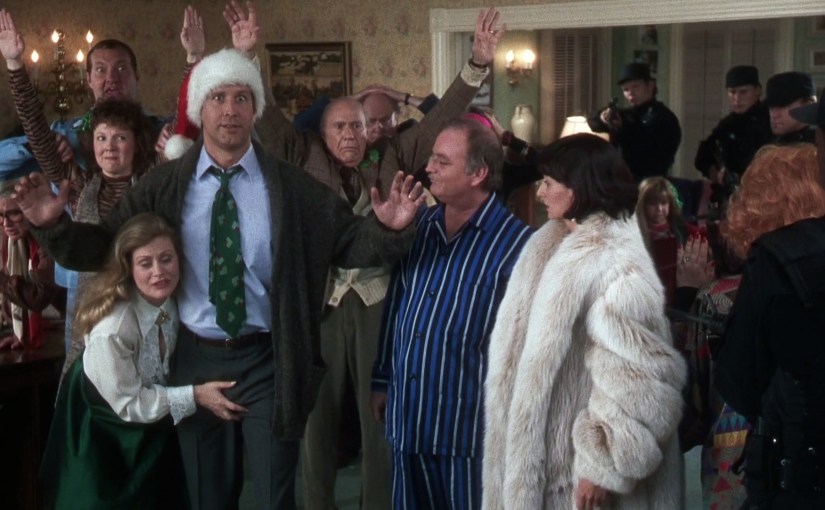
Not until December 25, 2021, had I seen National Lampoon’s Christmas Vacation.  Friends and colleagues couldn’t believe it, the same way they can’t believe I’ve never eaten a cheeseburger.  I’m not a big Chevy Chase fan.  I think the one film I like of his, because of him, is Neil Simon’s Seems Like Old Times.  The guy is just not a draw for me.  My fellow Cinephiles (Thomas Pahl, Miguel Rodriguez and Anthony Jason) introduced me to Fletch earlier this year.  Wow, did that movie start with a really interesting premise that just stumbled like 2,000-pound stone slowly sinking to the bottom of a very deep and empty sand trap.  The film didn’t work because of Chevy Chase.  Once it got past its exposition, Fletch relied too heavily on boring and unfunny schtick from a very unfunny Chevy Chase.  I was waiting for Christmas Vacation to fall into that same trap.  For a fraction of the film, thankfully, it didn’t.

By and large, what works with Christmas Vacation is because of its writer John Hughes, who writes with the consistency of humor that worked in Ferris Bueller’s Day Off and especially Planes, Trains and Automobiles.  The slapstick is most apparent here, then in other Hughes film released before.  (Home Alone would win that record title a year later, of course.)  As I said, Christmas Vacation relies entirely on the slapstick element.  There is no sensitive allowance for warm hugs or coming of age realizations and character arcs.  Clark Griswold gets in one predicament after another.  Like a mediocre Three Stooges short, some of those predicaments work.

Pun intended, the biggest highlight is when Clark decorates his Chicago suburb home with an infinite number of lights, eventually disrupting the next-door neighbors intimate candlelit dinner and blinding them into pratfalls.  The timing is pure John Hughes craftsmanship; John Hughes…not Chevy Chase

Stupid set ups include Clark getting trapped in the attic, unbeknownst to the rest of the family, as well as him hanging from the outside gutters and losing control of a tall ladder.  What works in these moments are what worked for the humor in Ferris Bueller with the school principal character, or Steve Martin’s character in Planes, Trains… .  Clark tries to come up with a way to get out and tip toe across the floor beams of the attic, trying to avoid a haphazard accident in the process.  The floors creak.  The items he finds in the attic squeak and grind.  When he’s hanging from the gutter, the rusty piece of metal is gradually giving way as he holds on for dear life.  I appreciated the prop humor.  The victim might be Chevy Chase, but that could’ve been anybody.  I guess sometimes, the pie is funnier than the one who gets it in the face.  So, there are moments that work.  I like the beginning as well where the dumb patriarch takes his family out to the forest to literally cut down a tree and then carries his optimism that he can actually fit it in the living room.  Moe, Larry and Curly had this kind of positivity when they convinced the Hoi Polloi that they could repair a plumbing problem in a mansion.

Much doesn’t work here either, though.  An overabundance of relatives show up to celebrate the holiday.  The set up is the same as in Hughes’ first film, Sixteen Candles.  However, in that film, each grandparent was given a moment to stand out among the masses.  Christmas Vacation doesn’t capitalize on that so much despite great talent that features Diane Ladd, Doris Roberts and EG Marshall.  No relative is a given a personality or unique and humorous annoyance.

The most remembered relative is Randy Quaid’s Cousin Eddie, but honestly, I found nothing funny about the guy and I thought he only served for irritated facial expressions to capture Chevy Chase in close up.  I know.  I know.  Before seeing this film, I was well aware of the “Shitter’s full” routine.  Okay.  Okay. Shit, poop, doodie, whatever you want to call it is funny.  Shit is God’s endless joke on the living beings he/she/they created.  A two word sentence of dialogue while draining a hose full of shit does not a movie make, though.  Otherwise, there is nothing marvelous about Randy Quaid in this film or the other relative extras that appear.  Clark’s (third time recast) kids could have also been funny but the script doesn’t let them.  There was just no material for these people on the page.  We know how pitch perfect actors like Juliette Lewis and Johnny Galecki have become over their careers.  I’d argue they are funnier and more talented actors than Chevy Chase ever was, but like the other supporting players the script didn’t consider the talent.  Beverly D’Angelo is back as Clark’s wife too.  Moving on…

I could have had regretted watching this film.  I finally, finally, FINALLY gave in per the insistence of practically everyone I know, on a whim, when I saw it available on HBO Max.  I don’t regret watching it.  Truly I don’t.  Yet, I don’t feel better having done so either.  Christmas Vacation is not an all-time great comedy or holiday film.  I don’t believe it did anything for anyone’s career.  Notice I didn’t mention the director’s name, because it doesn’t matter and I haven’t heard from that guy since this picture.

The film is just there, I guess, and as each passing December comes and goes, it is awarded new life…. unlike the electrocuted, exploding cat that perishes under a love seat.  Now that’s funny! Thankfully, this precious feline gave up his lives for a chuckle from me.  Had it been Chevy Chase though, then this review might have gone in another direction.

THE STING

By Marc S. Sanders

Find me a better combination of script, cast, direction, score, art direction and costume and I guarantee it’ll take you some time and effort.

The Sting, directed by George Roy Hill and written by David Ward, is the kind of movie where you uncover something new every time you watch it. It’s because the film is all in the minute details to assemble the beginning to the middle to the end. The film is wisely edited in step by step chapters; The Set Up, The Wire, The Shut Out and eventually on to the satisfying The Sting.

The audience is even set up but you’ll have to watch to see how. I dare not spoil it.

Cars, trains, drug stores, diners, a carousel, dames, gangsters, Bunko Cops, Grifters; all are elements needed for the best confidence men superbly played by Robert Redford and Paul Newman, along with a supporting cast like no other, Eileen Brennan, Harold Gould, Charles Durning, Ray Walston, Jack Kehoe and the best villain, or rather “mark,” Robert Shaw.

This is one of my favorite movies. When I first saw it, I was probably age 10 or 12. I understand next to nothing of what was going on. It was the music that drew me in first followed by the sharp suits designed by the legendary Edith Head. The movie’s script is its greatest asset but visually it is just as fun. The 1930s Chicago setting is a character in and of itself. Newman cheats beautifully at poker against a temperamental Shaw, and gets him!!! “You owe me 15 grand pal.” When I first saw it, I didn’t know what he was doing or how he did it. How did he switch hands? I was enamored with the hands that were dealt and the poker chips on the table, but I loved it when the better cheat won out.

The second iteration of the Hill/Newman/Redford trifecta (following “Butch…& Sundance…”) is just plain fun. It was the fun that earned it a Best Picture Oscar.

No other film has come close to duplicating it. Maybe the Clooney/Pitt/Damon version of “Ocean’s 11”? I don’t know. However, if you love that film, you owe it to yourself to watch “The Sting.”

The Sting is…”the quill!”

LIVE AND LET DIE

By Marc S. Sanders

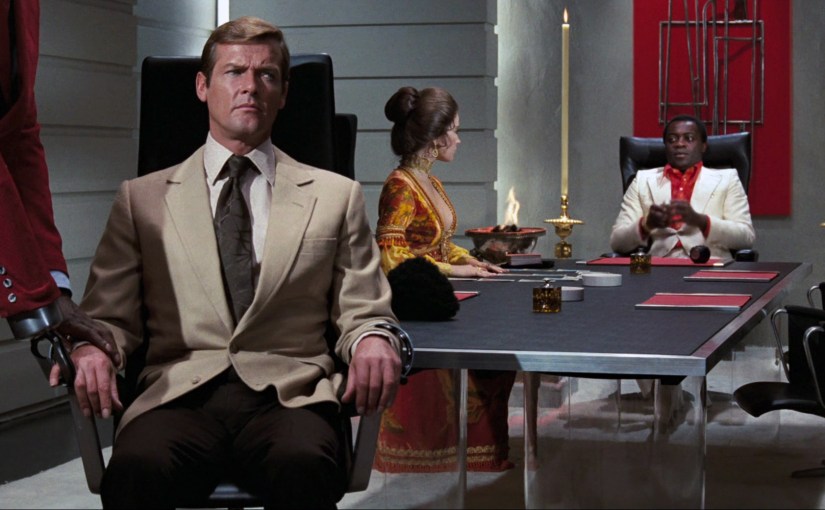
I dunno. For me, the suave sophistication with the tongue in cheek persona of James Bond doesn’t mix well with the ‘70s cinematic themes of Blaxploitation and island voodoo rituals with snake bite human sacrifice. Live And Let Die was never a favorite of mine in the series. Still, it has some merits; even pioneering moments that set the standard for the next 20-25 years of 007. The gadgets are getting cooler (like a handy Rolex watch with a super magnet and buzz saw) and better, more natural looking action.

Harry Saltzman & Albert Broccoli present a film where the action scenes are the most authentic yet. A car chase with a double decker bus doesn’t feature the background film scroll seen in the rear window of an automobile, like prior films.

There’s a particularly long sequence featuring a boat chase through the Louisiana bayou. Great stunts and well edited footage here, although it features one of the most annoying characters in the whole series, redneck Sheriff GW Pepper (Clifton James, who always played the same role like in Superman II and even The A Team). This scene is an absolute blast of fun as Bond commands a speed boat while trying to evade a handful of bad guys in pursuit. Cars are wrecked. Boats are wrecked, and a bride to be wails aloud as her wedding is ruined. It’s just fun.

Roger Moore slips comfortably into the role of the Britain’s most celebrated secret agent. He’s handsome, for one thing, and his humor is dry enough that even in the face of death a pun is well delivered.

Yaphet Kotto plays Kananga, a far cry from the Cold War villains of Blofeld and Goldfinger. Turns out this guy just uses a couple of bars as a front for his heroin dealing enterprise while he dons a neighborhood crime boss image of “Mr. Big,” looking more like a villain of Shaft. He’s nevertheless good. Though he starts out the role quite subdued, he gleefully comes alive in the second half of the film when Bond intrudes on his secret lair.

Tom Mankiwietz’ script is lacking though. The pre title sequence gets me curious why three agents are inventively killed, but then the story mires itself in Kananga relying on Tarot card reading from the first virginal Bond girl, the High Priestess known as Solitaire. (Jane Seymour’s first screen role.) This offers no suspense or substance. We wait for cards to literally be turned over. Not exactly nail biting. Seymour is beautiful, but the intelligence and sex appeal of the character is flat.

There are also scarecrows and Caribbean island voodoo that are hardly threatening and belong in a horror film, not a Cold War era Bond adventure.

All of this weird material was twisting the series a little too far off course.

Live And Let Die does add a great henchman to 007’s rogue gallery; that of the imposing Tee Hee with enormous height and his steel lobster claw arm. He’s a fun bad guy that happily deserts Bond in a hungry alligator swamp.

Director Guy Hamilton’s third Bond film is not a total bust. It’s well cast in villains and Roger Moore is a perfect successor. Location shots of New Orleans and Jamaica (subbing for Kananga’s Caribbean island) are cool to see. The Harlem, New York footage really doesn’t belong here, though. It also has one of the best, most often played songs in the whole series, compliments of Paul McCartney & Wings. Again, it suffers however from a short sighted script.

Bond will be better served in missions yet to come.

FRENZY

By Marc S. Sanders

London is being terrorized by the necktie strangler.

In 1972’s Frenzy, Alfred Hitchcock hearkened back to his killer classic themes remembered from Psycho. Only this time he is much more macabre with his material. Frenzy is Hitchcock’s only R rated film and his first movie to show outright nudity. Naturally, it’s all pretty eye opening, and considering that the film’s killer is regarded as a “sex maniac,” necessary as well.

Richard Blaney (John Finch) is not doing so well. He’s broke and he’s just lost his barkeep job. Subsequent from that he turns to his ex wife Brenda (Barbara Leigh-Hunt), a successful marriage and friendship counselor for comfort. It does not help that Brenda’s secretary overhears Richard violently losing his temper. Nor does it do any good when he has an outburst while dining with Brenda in a crowded restaurant. Why, this could only make him look suspicious of a crime, and the infamous, serial necktie strangler has yet to be caught.

When Brenda turns up dead by means of a necktie around her throat, all accounts point to Richard. Once again, Hitchcock’s protagonist is the Everyman caught up in an unwelcome conspiracy.

Frenzy is thankfully like many of Hitchcock’s best films. It gets straight to the point. Just as the film begins, the naked body of a dead girl floats up from The River Thames. Then it follows through with Richard and introduces likely suspects and or villains including Richard’s friend Robert Rusk (Barry Foster) and his bar waitress co-worker Baba Milligan (Anna Massey)

Hitch goes more horrifying than he might have had the liberty to do so a decade prior to this release. The necktie strangler’s rape and murder of the first victim is quite graphic and disturbing. This is a deranged individual and his victim is rendered helpless.

What keeps viewers interested in a good Hitchcock yarn is the suspense he manufactures for the one who is blamed, as well as for the killer. Hitchcock doesn’t dwell on mystery. Rather, he focuses on what his principal characters are going to do next, now that they are swept up in intrigue. The strangler continues his killing spree but overlooks one thing that could implicate him. The man who is blamed seems to get little help from anyone. Richard is in quite a pickle after all. As well, how will these two people encounter one another to wrap up the storyline?

Humor also comes through quite nicely with Chief Inspector Timothy Oxford (Alec McCowen) who is blessed with a loving wife who relishes analyzing the gruesome details of his investigation while preparing dinner time meals that look awfully worse than the corpses the Inspector encounters; quail with raisins for example. To look at her concoctions will certainly make you wince. It’s great side humor for the suspense at play.

A film like Frenzy hardly explores dimension in its characters. Many of Hitchcock’s films never get weighed down with too much material. The stories he directs are lean, only focusing on the central plot at play. The fun is in the disturbing angles he uses like a woman’s outstretched hand or frozen expression after succumbing to strangulation. Overhead shots of a man imprisoned in a small room can also be jarring. He keeps you engaged as tightly as the fingers of a dead body gripping a significant piece of evidence.

Films like Frenzy or Psycho cannot be made today. There are too many advances in technology and science to undo the developments of simple, yet grossly disturbing stories like this. DNA evidence and cell phones would wrap up any of these plot lines in five minutes. It’s fortunate that we can still transport ourselves to the period when these tales of suspense were originally developed. It doesn’t make it easy for the innocent man, the victims or the killer. I wonder how Hitch would approach today’s conveniences of modern science. If anything, he’d likely make his signature cameo on the wallpaper of someone’s iPhone. Nevertheless, I’m sure he’d find a way to continue to build his suspense. He had such an eye for his camera, his captions and his edits.

Frenzy is a demonstration of classic Hitchcockian thrills.

THE CANDIDATE

By Marc S. Sanders

A politician’s career isn’t being elected. A politician’s career is getting elected. Once it is all over, what does the politician do now?

I’m not sure I understand why Jeremy Larner’s script won the Oscar in 1972; only because I didn’t gather much from this Robert Redford star vehicle. What exactly was the point of what I was watching? Redford plays Bill McKay, an idealistic lawyer recruited to run for the California senate on a Democratic ticket.

He’s sure to lose and I guess he’s okay with that because it’s acknowledged that way early on, and yet he just follows through with the campaign. He’s a kid compared to his seasoned Republican incumbent opponent. So he’s got that to deal with, and he’s remorsefully living in the unwanted shadow of his father, a former good ol’ boy governor. He also occasionally brushes past a girl that follows his campaign. Bill is happily married. Sounds like a good set up, right? Maybe it is. Yet I’m not sure any of this is the set up of the film. There is rarely any conversations in The Candidate. Hardly any dramatic pauses occur either. Nary a scene with his wife. The televised debate midway through is generic cliche really. One good moment occurs when the Republican candidate steps on Bill’s toes during a threatening brush fire. Now here’s some conflict. Now we’re cooking. Except…we’re not. The film returns to its established theme from earlier. For some reason in the last half of the film, it throws two or three punchlines at you, and…well, I guess it’s a comedy now.

The Candidate fills a majority of its two hours with McKay doing a lot of handshaking, baby holding, celebrity meets (Hi Natalie Wood!) and autograph signing. When that’s not happening, we are treated to repetitive close ups of members of his campaign and voters. I felt like I should have known these people. Did I fall asleep during their big introduction in the film, or were those scenes deleted from the finished product? Bill doesn’t say much except to make generic statements that no voter would ever disagree with. That’s okay, I guess, yet really it’s just boring. None of this packs any punch.

Larner was a speechwriter for Eugene McCarthy in 1968, and Redford recruited him to write and tailor this script for him to produce and star, in response to his own dismay with the political climate at the time. Maybe The Candidate is supposed to be narrated in a documentarian sense but even if that’s the case, it fell short for me. Scenes here seem about as interesting as someone who unwraps a stick of gum and chews it.

Perhaps the Oscar was merited due to the political climate at the time. Redford’s character told audiences what they wanted to hear and magically Larner’s screenplay is now brilliant. If that’s the case, then I guess The Candidate is now dated. There’s no way this film outshines other political films like Wag The Dog, Primary Colors, Mr. Smith Goes To Washington, or from what I hear Bulworth (never saw it).

The Candidate carries no drama, no comedy, no shock value. I’d say no message either, but the unexpected ending (unexpected only because I didn’t know the end scene was actually the end scene) finally told me something that I laboriously waited a long two hours for. The wait wasn’t worth it.

CABARET

By Marc S. Sanders

Is it possible for a musical to be disturbing? Maybe Bob Fosse’s Cabaret favors that argument.

Liza Minnelli won the Academy Award for Best Actress in 1972 for her portrayal of Sally Bowles, a carefree, happy go lucky performer at the underground Kit Kat Club located in Berlin, 1931. She is the lead attraction among a company of dancers doing a different kind of stage vaudeville with its colorful emcee played amazingly by Joel Grey, also an Oscar winner.

The musical numbers are outlandish with caked on makeup and outfits that could make Victoria’s Secret seem like a children’s shop. I gathered from the film that Fosse, who choreographed the numbers as well, offered up the escape of life first, before showing the harsh reality of Berlin in its historical context.

Sally and the Emcee’s performances are first on hand, depicted as silly and showstopping. Thereafter, Sally encounters an English gentleman named Brian Roberts (Michael York) who is a professor of English study attempting to complete his doctorate. As Sally and Brian become closer as friends first, he must reluctantly admit to Sally that he’s a better bed companion with a man than with a woman. Sally doesn’t understand why he didn’t say that in the first place as she attempts to come on to him.

Herein lies the dilemma many faced as the Nazi party was gaining traction in Germany. How necessary is it to hide your true natures to preserve your life? Sally’s underground lifestyle at the club clouds her vision of what’s gradually happening in the world. Nevertheless, they eventually develop a relationship as Brian appears to be bisexual, more specifically.

A side story concerns Brian & Sally’s relationship with a baron named Maximillan (Helmut Griem), who will wine and dine them at his estate only to later abandon the respective relationships he sets up with them to more or less make them feel as cheap as prostitutes. I wasn’t sure what to gather from this extension, however. The irony is that unbeknownst to Sally and Brian they have both been sleeping with Max. Eventually, Sally reveals she’s pregnant but does not know who the father may be, Brian or Max, and an abortion is considered.

An additional side story concerns a wealthy Jewish German heiress named Natalia who falls in love with a German Jew named Fritz living under the guise of a Protestant.

Cabaret is a loose adaptation of The Berlin Stories by Christopher Isherwood (the Brian character) and his experience with stage performer Jean Ross (the Sally character). Isherwood’s stories gradually formed into different iterations of stage plays and short stories before making it to Broadway and Fosse’s celebrated film.

Though Fosse apparently took some questionable liberties and departures from Isherwood’s writings, I think it depicts the personal struggles of love and self identity while the world around them is quickly changing into a scary reality where your own self identity could get you killed.

Fosse gives terrifying glimpses of how the Nazi party seeps it’s way into a decadent Berlin of underground showmanship. Though apparently Berlin really wasn’t so decadent as the film has you believe. Ross and Isherwood have gone on record describing Berlin was a more destitute and poor environment, actually.

In Fosse’s film, a Nazi youth is seen early on being kicked out of the Kit Kat Club. A few minutes later, the night club manager is being beaten in an alley. Fosse juxtaposes scary moments like this against the silly debauchery depicted on stage. It’s as if the Gypsies, homosexuals and Jews in the area are unaware of the evil practice that is gradually taking over outside.

Soon, Fosse makes the swastika more apparent in the streets with propaganda handouts. Most telling is when a young boy is seen at an outdoor beer garden gathering singing a number selfishly entitled “Tomorrow Belongs to Me.” Fosse is frighteningly effective at showing this boy from the neck up. Eventually, he moves the camera down to reveal the boy’s swastika wrapped around his sleeve. The song which seemed to champion beauty and nature now evolves into a march of grandstanding fascism. It completely shocked me. Just as people like Brian and Fritz are reluctant to reveal their backgrounds, both sexually and religiously, the Nazi party is proud to announce their mindset in a converse manner. By the end of the film, the audience at the Kit Kat Club more predominantly shows Nazis in the audience as opposed to just the one shown in the beginning of the film. Hatred has spread its disease.

While Minnelli shines in her role, her showstopping moment really comes at the end when she dangles her carefree attitude while belting out the title song with “Life Is A Cabaret.” Along with Joel Grey’s Emcee closing out the film with the “Finale,” this musical goes against the grain of most musicals’ cheerful close outs or romantic theatrics. Fosse’s mirror image of the Nazi party taking in Sally and Emcee’s performances are chilling. We sense the characters’ time is at an end and wisely the film runs its closing credits among frightening silence with the cold, blurred images of Nazi soldiers staring right at us.

I had never seen the film of Cabaret until now, but I had attended two different stage productions; neither of which I liked. Bob Fosse’s film seems more clear with its content than I ever got from a stage performance. Perhaps it is because the Oscar winning art direction is more apparent than a stage set. We can see the bustling of Berlin change amid a political climate that at first is not taken so seriously. As hurtful and harrowing the relationships of love between Brian with Sally and then with Max, as well as Fritz and Natasha are, none of this will eventually compare to the upcoming demise for Berlin.

As Miguel noted in our recent podcast that focused on musicals, Cabaret won the most Oscars without winning Best Picture (losing to The Godfather). It’s clear how deserving it was of its accolades. The musical numbers are very engaging but the fear of fascism is well developed too. So there is a roller coaster of emotions to absorb from Fosse’s film. I believe in that podcast I noted that Francis Ford Coppola won Best Director. I now realize I was wrong. It was in fact Bob Fosse who took home that prize, and it’s truly evident how deserving that honor was for him.

Again, while I’ve yet to find a stage production I’ve liked, I was terribly moved by the film. Cabaret, the film from 1972, is a sensational and frightening production.