THE LAST EMPOROR

By Marc S. Sanders

Finally, I invested myself in watching Bernardo Bertolucci’s Oscar winning Best Picture The Last Emperor. Honestly, as breathtaking as the undertaking to make this sweeping epic is, it was the first and likely last time I will ever watch the film.

This three hour plus biographical picture focuses on a young child named Puyi, plucked from nowhere to become the next Emperor of China. He is destined to reside in Peking, The Forbidden City amid rich tapestries and deep Chinese culture at the start of the twentieth century. Oddly enough, the would be Emperor is a prisoner of his own surroundings for nearly his entire life. He is forbidden to go beyond the walls of Peking. Later in his adult life, he is a political prisoner and war criminal in the now regarded People’s Republic of China. Puyi was never granted an opportunity to think for himself or act upon his devices. He is forced to become an adaptable symbol to ongoing representations of the country that harbors him.

I watched this film with my wife. The next day we discussed it with my colleague Miguel who regards the picture as one of the best films he’s ever seen. I can not dismiss his viewpoint, but personally the depth of Betolucci’s efforts for maximum authenticity pushed my interest away from the film.

I embrace character arcs in films. It’s what keeps each passing moment of a movie refreshingly interesting. I do not deny the change in the Emperor’s story arc. Puyi changes as his country changes on both a political or militaristic platform. Yet, the film has vague segues in its changes as well.

Characters appear and disappear. Moments in history occur with no build up or explanation. It was challenging to follow who is who, and what has just happened.

Early on, we see how Puyi as a child interacts with his younger brother, Pujie. Much later in the film, Pujie reappears when they are adults. I am not going to pretend I’m a sophisticated enough moviegoer to realize this is the brother we saw as child over an hour earlier in the film. It took some time to realize who this guy was.

I’m also not going to pretend I know enough about Chinese history and culture to comprehend the traditional customs and ceremonies that occur, or China’s relationship that developed with Japan, or China’s significance during World War II.

That’s my problem with the film. Was I supposed to take a college course on Chinese history before watching The Last Emperor? The film is expository for sure, but it presumes the viewer will recollect at what point in history this moment or that moment occurs.

The film flashes forward and back to when Puyi was a prisoner of war in 1952. In prison, he eventually becomes reformed, but it became frustratingly complicated to understand exactly why he was even sentenced.

Following the film, I referenced Wikipedia to grasp the sequence of events. The historical change of this one man certainly merits a film to be made, much like Malcolm X or Born On The Fourth Of July. However, those films had a more comprehensive narration for me and the ongoing changes that the central figures experience are more well defined as the years pass and the people around them change.

The Last Emperor felt unclear to me in its storytelling while still immersing me in a land I’d imagine is unfamiliar to most viewers. For centuries “The Forbidden City” was not open for a public to encounter. If that’s the case, I believe Bertolucci needed to define what he captured much more clearly. Who’s to know what we are looking at, or what significance this setting has if most of the world population has yet to see what is here?

The Last Emperor requires a high threshold of patience and focus to grasp what it presents. It should be seen for the locales that are filmed, which were completely unseen by me personally. You’ll also get some tidbits of Chinese history, for sure.

All I can recommend is not to be so hard on yourself, when you find yourself lost at times in the film.
FLASH GORDON

By Marc S. Sanders

How can anyone not like Mike Hodges’ camp celebration of a savior hero vs a destructive villain?

Flash Gordon was penned by Lorenzo Semple Jr, writer on the 1960s Batman TV show. His first draft is the one and only draft which producer Dino DeLaurentis approved for shooting. A glossy, flashy and fetishistic approach was adopted for the film, and it became timelessly memorable.

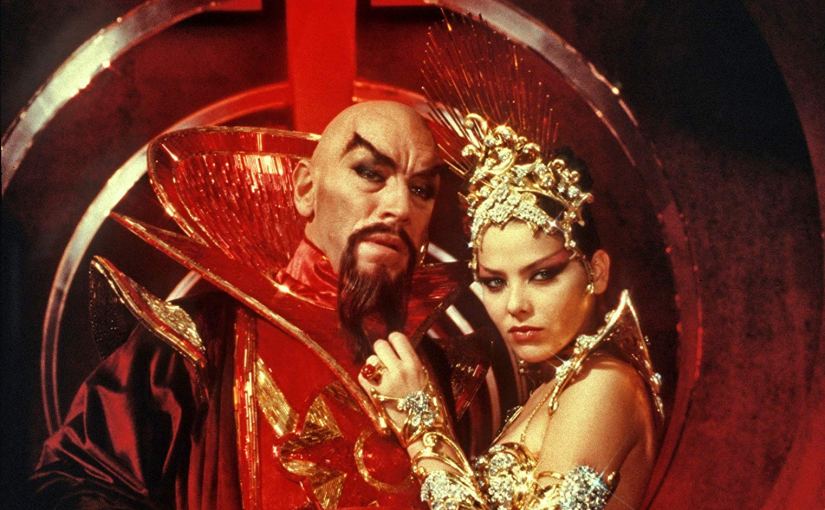
What thrills me about the film is its appreciation for the original, pioneering comic strips on which the film is based. Max Von Sydow’s Ming The Merciless is pulled right from the newspapers in his gloss pinks, reds, golds and blacks costume wear. The inflection of his voice is otherworldly from the start (“Klytus, I’m booooored. What do you have for me to play with today?”)

Sam Jones is a level down in the relatable hero of Christopher Reeve, but he’s enjoying every minute of his hero character schtick. He’s perfect for Semple’s playful writing and he looks like a champion.

Timothy Dalton and Brian Blessed are great side characters on opposite ends; one distinguished, the other gluttonous and proud.

The best flavor of the film is its soundtrack. Thank you Queen!!! Their musical touch is an early inspiration to some modern Marvel films like Guardians of the Galaxy, and Thor: Ragnarök, clearly showing direct influence from Flash Gordon. Freddy Mercury, Brian May and company relish in heavy pounding drums and special effect sounding guitars to deliver a cheerleading rock anthem. “Flash…aaaah!!! He’s a miracle!”

Dino DeLaurentis saw opportunity following the success of science fiction with Star Wars. He produced Flash Gordon with his own style, not as a copycat. The film became a fantasy with characters bleeding rainbow colors, pet midgets, cat fighting concubines, great hall football fighting with aluminum watermelons, weird lizard creatures, hawkmen, half egg-shaped planets, and even a thrilling fight to the death on a tilting platform with protruding spikes, the best scene amid all the camp craziness.

It’s all great. Flash Gordon is the savior of the universe. “He’s a miracle!!!!”

DEATH ON THE NILE (2022)

By Marc S. Sanders

It’s time for the murder mystery to maintain an ongoing trend in modern films.  They’re just fun to watch and play with and deduce.  Why do you think the board game Clue has lasted so long in so many households?  Films like Rian Johnson’s Knives Out and a recent retelling of Murder On The Orient Express have already whetted our appetites for the “who done it?” tales.  Endless variations of Sherlock Holmes continue to appear.  Even Steve Martin and Martin Short have gotten in on the mystery circuit.  Adam Sandler with Jennifer Aniston, too.  Kenneth Branagh’s second time as Hercule Poirot (following …Orient Express), in an adaptation of Agatha Christie’s Death On The Nile, is proof positive that the sleuth is the next super hero that movie goers should follow.

Branagh returns to direct his detective character in Egypt, aboard a privately rented boat occupied by the newly engaged couple, Lynette Ridgeway and Simon Doyle (Gal Gadot and Armie Hammer).  As the luxurious yacht makes its way down the majestic river Nile, the couple suspects that someone, particularly Simon’s recent ex-fiancée, Jacqueline (Emma Mackey), is determined to cause harm or even murder towards them.  They ask for the sleuth’s services in uncovering who is scheming against them.  Poirot is on vacation, however, and tells them his services cannot be made available as no crime has been committed.  Yet, he accepts their invitation to board the boat and attempt to relax and recline. 

Naturally, a murder will eventually occur.

Hercule Poirot was not even a character in Agatha Christie’s original novel.  Yet, Branagh seamlessly weaves the detective into an elegant page turner on screen, with a script from Michael Green.  Branagh is a skillful actor/director. 

As this is a murder mystery, there are a wealth of characters with possible motives and red herrings to keep the journey down the Nile tense and engaging.  There’s the doctor (Russell Brand), an aunt (Annette Benning), a nephew (Tom Bateman, returning from Orient Express), Lynette’s housemaid (Jennifer Saunders), a speakeasy blues singer and her niece (Sophie Okonedo, Letitia Wright), as well as Lynette, Simon and Jacqueline, and on and on.  Branagh wisely moves his camera repeatedly at times across the boat panning over the faces of the cast, as if to the remind the viewer of who are the suspects.  There’s a wealth of information to take in, but this is not going to feel like you are cramming for a final exam the next morning. 

Because everyone could have a motive and/or a background with the murder victim, each actor within the colorful cast has various moments to shine.  There are some great acting scenes going on here that the players share with Branagh, and they don’t come off with similar formulas from one moment to the next.  Each character actor is thankfully unique in both appearance and personality.  It’s not hard to keep up, and while I may have known the ending before seeing the film (having read the book and seen stage adaptations over the years), I don’t believe it’s easy to deduce and solve as a viewer.  Different characters and moments that never occurred in the source material turn up.  There might even be few unexpected deaths along the way.  Branagh also keeps the picture alive with outstanding blues numbers that begin in an underground speakeasy bar in Paris and then play over transitional moments throughout the film.  This picture has a great period soundtrack.

Beyond the well diversified mystery, Branagh treats the viewers to gorgeous scenery aboard the boat, but even beneath the surface of the river and within the pyramids and sphinxes of Egypt.  There are spectacular starry night skies and breathtaking sunrises and sunsets to take in with palm trees and wildlife in the desert frames.  Sure, I imagine most of it is CGI, but it’s well done and nothing looks artificial.  Costume work is also magnificent as they lend to the distinctiveness of the suspects.  Whether it is evening wear, or casual garb for post-World War I, each character looks so intriguingly lively and different.

Michael Green’s script even delves further into the Poirot character.  There’s a background to that infamous mustache and tiny goatee.  I recall how people responded to the outrageously grotesque facial hair that Branagh donned in his first film as Poirot.  I appreciated it, however.  His appearance was as unforgettable as the red and yellow “S” on Superman’s chest.  Yet, why go to such great lengths, even if this is the early 1900’s amid an exaggeratingly glamourous murder mystery, to grow a mustache like that? Thankfully, there’s reason given here that draws out a dimension to Hercule Poirot both within a ten-minute prologue, and then implied periodically during the course of the film and wrapping up in a bluesy epilogue before the credits roll.  All I’ll say is that absurd mustache delivers a humanity to the film’s protagonist.

Death On The Nile has already suffered from negative publicity involving controversy with some of its cast members.  Its release was also postponed a number of times due to the pandemic.  Finally, it has arrived in theatres and what a refreshing experience it is to see on a big screen.  It opened to a modest box office response in its first weekend, though it finished at number one.  Normally, I don’t care about rankings at the box office.  How much money a film makes does not lend to the merits or faults of a piece.  However, for this film, I think I do care a little.  I hope it becomes a profitable success only to allow more films of the mystery genre to appear on screen in the future.  I’d certainly welcome another gripping yarn from Agatha, out of service from Kenneth Branagh.  Could And Then There Were None… be next?  That’s the real mystery.

NIGHTMARE ALLEY (2021)

By Marc S. Sanders

Guillermo del Toro’s Nightmare Alley is a visual feast of the macabre set in a Depression era western America.  Every caption caught on film is unbelievable to look at, and while I know del Toro released his picture in black and white to enhance its film noir theme, I was truly delighted with the color version of the film.  With del Toro’s direction and photography designed by Dan Lausten, every dimension and sparkle of color from a sunset to a dreary cloud in the sky to the lights on a Ferris wheel spinning in an open field from the distance is absolutely jaw dropping.  Nightmare Alley is a modern technical masterpiece.  It makes me want to go back and watch the original 1947 version, as well as explore other productions in the film noir category.

Bradley Cooper portrays Stanton Carlisle, a murderous drifter who ends up accompanying a traveling carnival of garish figures who entertain their quirky qualities for townsfolk to be marveled and amazed.  There’s the flexible snakeman, the world’s strongest man (del Toro regular, Ron Perlman), the smallest man alive, the electrical woman, the psychic and the terrorizing, caged “geek” who will eat the head off a live chicken in front of your very eyes.  At first Stanton serves as a heavy meant to carry loads and set up and strike the tents and stages as the show moves from town to town.  He connects though with the psychic (Toni Collette) and the architect behind her façade (David Strathairn).  Soon, Stanton is adopting their techniques of using code words and hand gestures to “read the minds” of the various audience participants. 

He goes even further by redesigning the electrical woman’s presentation. Before she was using teslas to demonstrate her will to generate electrical currents.  Now she can be zapped in an electric chair.  The woman is Molly (Rooney Mara), and a relationship begins that sends her and Stanton on a successful tour away from the carnival where they entertain more sophisticated and wealthier nightclub guests with his psychic abilities.  One attendee, however, is on to Stanton’s devices, a beautifully alluring psychiatrist named Lilith (Cate Blanchett).  She maneuvers Stanton into using his manipulative talents into conning her clients.  She has recorded her sessions and will share confidential information with Stanton. Then, he will use that towards his ongoing psychic advantage as a means to swindle them of their fortunes.  Lilith and Stanton will split the rewards.  The play seems convincing enough for the likes of a wealthy industrialist named Ezra, played by Richard Jenkins yearning to reconnect with his deceased wife at a cost of thousands of dollars for Stanton’s services.

The narrative of Nightmare Alley is so absorbing.  Everything is beautifully staged.  A fun house hall of mirrors has a décor of disturbing imagery.  Stanton enters this place symbolically at the beginning of the film in search of the runaway “geek.”  The surroundings display the seven deadly sins around a large skull and other haunted house imagery.  del Toro demonstrates what Stanton is about to enter, which occupies the remainder of the film.  Stanton performs on the motivations of greed and lust and vanity.  Maybe, pride as well.  At least those are the first couple of sins that come to my mind.  How will his actions reflect back on him later on, though?

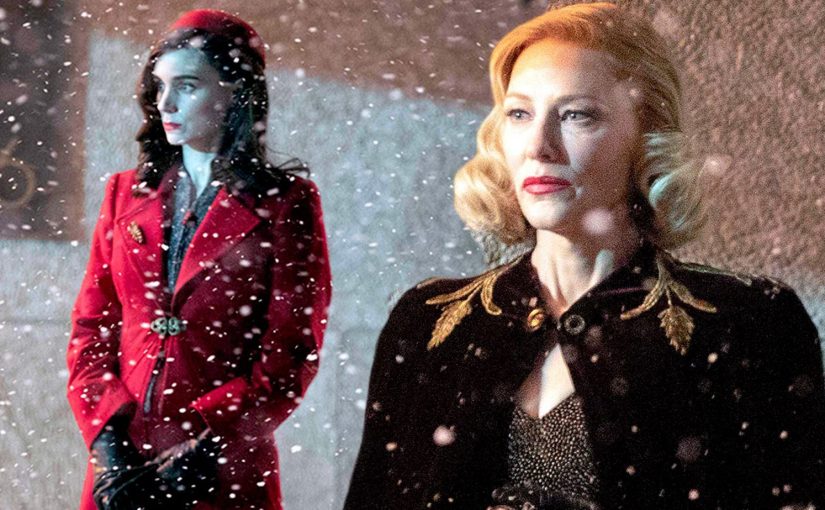
The film is also performed by a magnificent cast.  Cooper is doing some of his best work here.  While I feel like I’ve seen Blanchett’s deceitful character before, I don’t mind.  I can’t think of anyone else to play the role.  Curiously, del Toro has Mara, with her snow-white complexion, dressed in red quite often amid a cast of characters and extras wearing blacks and dark greys.  She’s meant to stand out as the innocent.  Molly questions Stanton’s decisions while also trying to convince him to end his charades.  Yet, she only serves as a disturbing pawn in the shyster’s tricks.  Will Stanton corrupt Molly though?  It’s one thing to put on a magic show for a couple of hours each night.  It’s another when you are swindling the massive fortunes of others and toying with their despair. 

Other surprise performers that appear include Willem Dafoe as the showman for the “geek,” and a late appearance by Tim Blake Nelson to close out the film and deliver what’s to come of Stanton. 

Nightmare Alley deliberately moves at a slow pace, but that only allows you to take in its various environments.  From the carnival tents to the nightclubs to the alleyways, to Ezra’s snow covered never-ending garden, and even Lillith’s gold embossed office of cabinetry and furniture are so hypnotic and dark in its intended film noir way.  Again, while I’m sure there’s some striking qualities to the black and white interpretation of the film, I really fell in love with the colors provided by Lausten’s photography.

I won’t call this a favorite film of mine, but I loved the journey of it all.  I appreciated the script by del Toro and Kim Morgan, adapted from the novel by Lindsay Gresham, that depicts a sinful man like Stanton devolve into more sin, until he’s only undone by a smarter sinner than he; a sinner masked within beauty and wealth with a noble and educated profession.  Bradley Cooper and Cate Blanchett perform beautifully with one another.  They make a terrific pair.  I only hope they’ll do another film together.

MARVEL’S THE AVENGERS

By Marc S. Sanders

Phase One of the Marvel Cinematic Universe concludes with Marvel’s The Avengers. This is a real treat and a feast for the eyes. It’s not my favorite of all the Marvel films because it gets a little too Saturday morning cartoon like at times, but it’s enjoyable to watch for good escapist popcorn fun.

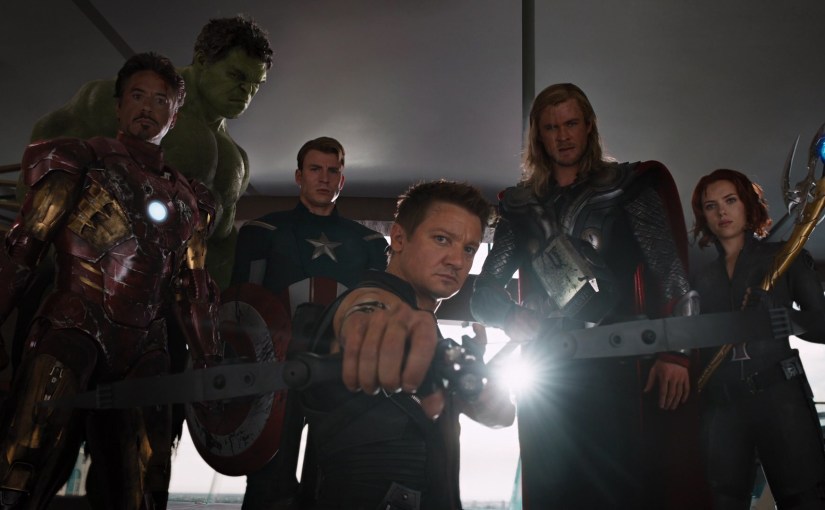
Movie goers were salivating for the year 2012 to arrive which would finally assemble Thor, Iron Man, Captain America and the Hulk on screen. Thanks to writer/director Joss Whedon that wish had finally come true and Whedon does not try to reinvent the wheel. When you assemble a team of heroes, you pit them against a large army and watch every variation imaginable of how the Hulk can smash, or what Iron Man’s armored suit can launch.

By now, you all know how I feel about the actors portraying their respective roles. Best to just say the chemistry works among them. They find reasons to squabble and Whedon provides moments for them to use their given talents against one another. So you get to see what happens when Thor smashes his hammer against Cap’s shield.

The actor who finally gets his moment in the sun is Samuel L. Jackson as Nick Fury, the orchestrator behind this team up. Jackson is more subdued than his other well known characters from the Tarentino films or Snakes On A (Mother effing) Plane. He does get to say “stupid ass idea” at one point and there’s the Samuel L. Jackson we all know and love! In comics, the Nick Fury character was reinvented before any of the films to harbor the appearance of Jackson. This film proves why the writers went that route. He’s great. He’s fun to watch. He makes for a great leader of the secret agency SHIELD. In tow with him is Clark Gregg as Agent Phil Coulson, a welcome cameo guy before this film, Gregg gets in a few scenes that show his endearment, and offer some dramatic weight as well. The guy could be waiting on hold while Black Widow takes out a couple of thugs, and you are cracking up at Gregg as Coulson, not necessarily Black Widow. He’s so likable that well…heck…he should get his own Marvel TV show….wait….nevermind….I digress.

Again, however, the women of the MCU are not drawn well for the screen. Scarlett Johansson makes her second appearance as Black Widow. She’s got a great, funny early fight scene while tied to a chair in a sleek black dress, but that’s all for show. She hints at a checkered past but this film does not offer much to expound on that. I understand. There’s a lot going on here. So there’s not much here for her to do. It’s time she got a film of her own, however. I’ll sign the petition. Wait! Nevermind! Colbie Smolders is a waste as Agent Maria Hill. She is nowhere convincing as a bad ass agent. Her line delivery seems forced. Her role seems unnecessary. Her scenes should have been on the deleted floor. It would have allowed more time for Johannson to play up her character. How is Maria Hill different from Black Widow in this film, anyway? She’s not. Therefore, cut out Maria Hill.

Jeremy Renner is given nothing to do but shoot arrows as Hawkeye, and work against the Avengers while under a spell from Loki.

Speaking of Loki, the great Tom Hiddleston is back. Hiddleston just elevates the Marvel films to more than just a comic book movie. His glee as the God of Mischief is different than say any version of the Joker’s. Pay attention Syndrome (from The Incredibles)!!! When Hiddleston monologues, you want to listen, unless you are the Hulk.

Whedon does an awesome job with the action scenes as he gradually destroys an aircraft carrier when chaos takes hold among the various heroes, and then later he destroys New York City in a fun amusement park like battle through the streets, subways and skyscrapers. It’s a little reminiscent of Richard Donner’s (or Richard Lester’s) Superman II, and Ivan Reitman’s Ghostbusters. It’s fun to watch the Hulk run through a building only to come out the other side and leap upon the head of a gigantic, flying centipede to bring it down on to the top of a building. Who cares how this all gets cleaned up? The greatest city in the world always figures out a way.

Whedon sealed the pop culture significance of superheroes in the early 21st Century. He’s done what guys like Michael Bay beg to do with other toy/comic book franchises. Marvel’s The Avengers stands out as an important impact in cinematic filmmaking. It’s not best picture worthy, but it is nonetheless important to how blockbuster films are conceived and created. Sadly, some people still don’t get it right, all these years later.

SPECTRE

By Marc S. Sanders

It’s fortunate that the success of Mike Myers’ Austin Powers franchise did not wash out the best features of the James Bond series. Had it done so, we wouldn’t have been treated to the outstanding production of Daniel Craig’s film, Spectre, with an opportunity to face off against a reinvented Ernst Stavro Blofeld played perfectly by Christoph Waltz. One of my few complaints however, is that we didn’t get enough material for the two-time Oscar winner.

Director Sam Mendes returns following Skyfall to reinvigorate the original traditions and blueprints that attracted audiences to 007 in 1962 with Dr. No. Blofeld lays in wait in his secret fortress of a lair housed within a desert crater (an upgrade from the volcano in You Only Live Twice), ready to offer exquisite hospitality to Bond and his love interest before providing an unrequested guided tour of his technology and hideous plots. No, he never had to show Bond anything. Yet Blofeld was never bashful, with or without his cat. Waltz is the right choice for this 21st century iteration of the staple villain. Gone is most of the camp presented in the character during the later Connery films. Most of the camp actually. He does still have the white cat after all.

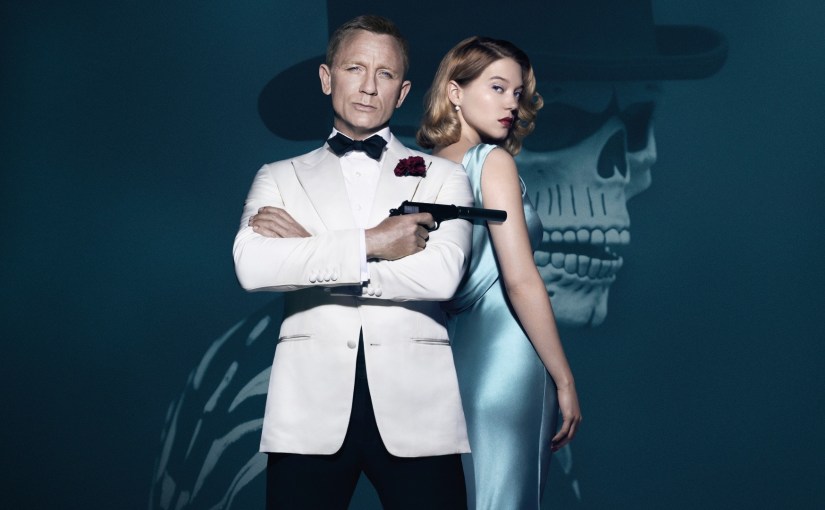
Craig remains a great 007. The role is not a mimic of past Bonds. Craig is everything of the “blunt instrument” that author Ian Fleming described. Thanks to his physique and some great fight choreography, a marvelous fisticuffs scene occurs between him and brutish Dave Bautista aboard a moving train. Craig always looking great in the white dinner jacket tux, even while he’s getting pushed around.

Lea Seydoux is serviceable as the Bond girl, Madeline Swann, daughter of an old enemy of Bond with information necessary in the pursuit. Seydoux is not the best Bond girl. Others have offered more intellect beyond the beauty. Still, that might only be due to the limits of the script. She’s a good actor nonetheless.

Ben Whishaw and Naomie Harris are great as Q and Moneypenny. The roles have stepped up in frankness and skills that stretch out more than a traditional one scene cameo. Whishaw as Q is more of a know it all and Harris as Moneypenny reminds the audience that she has a life outside the office.

Ralph Fiennes is good too as M. Though I do wish his storyline was better here where he is dealing with an over abundant policy in complete government surveillance. The antagonist against Fiennes is nothing special and as quick as this storyline started, you knew how it was going to end. Still, I like watching Fiennes in the role.

Spectre has great scenes, most especially the signature opening taking place on the Day of the Dead in Mexico City that culminates in the destruction of a city block before Bond disables two bad guys aboard a spiraling helicopter. Steady cam and very clear edits make this a knockout.

I also appreciate the gag that not all things work accordingly for Bond. He orders his signature Vodka Martini, shaken not stirred, and is denied as he is at a bar located in an isolated strict health retreat. As well, his Aston Martin is not as reliable thanks to empty hidden machine guns hidden behind the logo in the trunk. Not everything comes as easy for Craig’s Bond, and that allows for some tongue in cheek humor.

I liked Spectre more on a repeat viewing. Mendes shot a gorgeous looking globetrotting picture of Mexico City, Rome, Austria, Tangiers and clear evening London.

Considering the next installment is likely to be Craig’s last film is disheartening. With Spectre, a summation of all the prior Craig films is assembled leading to what has been a great miniseries within the storied franchise. I’ve liked following this James Bond. There are revelations about the character including his orphan history, his faults and his coldness that only serves to protect the Queen’s country. The Daniel Craig Bond is the best following the very different albeit wry interpretation of Sean Connery.

Still, I’ll take what I can get, and once again happily look down the target scope aimed right for 007 before the blood comes pouring down.

THE DEVIL’S ADVOCATE

By Marc S. Sanders

The Devil’s Advocate does not get the accolades it truly deserves, and I’ve never understood why. It is more than just a supernatural thriller or a legal drama. It’s both actually, and most films cannot lay that claim.

Director Taylor Hackford has assembled a brilliant cast that boasts a debut from Charlize Theron in the incredibly complex role of Marienne, wife to Keanu Reeves’ hot shot southern drawled, Gainesville attorney. Theron hits every pulse perfectly beginning with loose, beautiful and cocky to insecure, haunted and victimized. When I first saw the film in theatres, I left believing she’ll get an Oscar nomination. Alas, the powers that be never gave her consideration and they were wrong. Beyond a relishing Al Pacino as the lord’s most infamous fallen angel, Theron’s performance sends the script home into absolute believability. The power of Satan is executed on Marienne, and the visual and audible evidence lies in Theron’s delirious performance. She’s astonishing.

Next up, Reeves is entitled to lots of credit. The role of Kevin Lomax is his best role (Ahem…Sorry, Neo. Sorry John Wick. Sorry Johnny Utah.). He carries a disillusioned swagger that he is as good as his record of trial wins implies. Yet, is he as good as the best of the best New York City attorneys? When you are the son of Satan, maybe so. What works best though are the ongoing tests of will for Reeves’ character. His inescapable hillbilly dialect blends perfectly with a script that questions temptation against instinct, against opting for what is right. At the time of release, Keanu Reeves might have been perceived as his surfer dude Bill & Ted character not be taken seriously enough here. I never let that be an interference for me, however. Reeves doesn’t compromise and he avoids the wholesome, God-fearing kid that Kevin Lomax is meant to be. Instead, his Christian teachings seem like a nuisance for him; an obstacle to a more satisfying life regardless of sin. Reeves balances the dimensions beautifully.

Then there’s the machine behind all this. Al Pacino is John Milton, hardly disguising his true identity. He’s too proud of who he is to do that. Sure Pacino is chewing the scenery. Yet, shouldn’t he? This is Mephistopheles he’s playing here; an entity ready to undo the will of the Lord. He carries no honor for God. However, he maintains a rule book and before he accepts a disciple, he’ll make certain that it is by the follower’s choice alone. He administers the test, but he doesn’t take it. Pacino gets the best lines and the best monologues. He’s treated with an opportunity to two step along to Frank Sinatra. He’s given free reign to operate based on his legendary career. He’s my favorite devil of any and all films.

Taylor Hackford is meticulous in his direction. There’s a great moment near the beginning where Kevin is saying goodbye to his God loving and very Christian mother. He goes to her church. This is the first of many smart choices for Hackford. He does not allow Kevin to step inside the church. Rather, he paces just outside the door. Kevin does not have a relationship with God, thus opening an opportunity for Satan. Other moments are there too, such as Milton always insisting on traveling by subway…underground. Heck, there’s even a moment where a man with a box that says “Halo Industry” walks by Kevin and John; nice subtle nod. New York City is treated like a character boasting its numerous, sky-high cathedrals and angelic artwork. Pacino is the ultimate NYC resident; a creature of the concrete jungle. Hackford also recruits the notorious to boost the lair surrounding Reeves and Theron with appearances from the likes of Don King and Alphonse D’Amato. (Satan’s disciples, perhaps?)

This is one of my favorite films. It carries not one single flaw. It is richly assembled in dialogue, story, cast, set design and direction.

The Devil’s Advocate is one of those films that you want to watch over and over and delight in Pacino’s thought provoking one liners, debate with your conscience vs Satan’s own argument (he makes some good points here) and question the power of free will. It’s a fun, thinking picture.

SKYFALL

By Marc S. Sanders

Skyfall is a great James Bond film. One of the best. However, …it has one major shortcoming that always gnaws at me. Regrettably, it has a contrived middle section that steals some of the magic away from the film. Yes, for a moment, my suspension of disbelief is robbed from me.

Daniel Craig’s third outing as 007 has become a favorite among fans and movie goers. Craig is magnificent in a primarily dramatic turn in the part. Following a fantastic action packed opening where Bond pursues an assassin through the streets of Istanbul, Turkey (widely known as a favorite locale of Ian Fleming), the chase involves cars, motorcycles, rooftops, fruit stands and trains for well edited shootouts and fist fights. Alas, the assassin gets away and Bond is left for dead.

Following an attempt on the life of M (Judi Dench in her absolute best portrayal in the role), Bond returns for active duty. However, he’s not what he used to be. His aim is off and his body is worn. The question remains if Bond is ready to be back in the field.

The plot centers on a bitter former MI6 agent named Silva (Javier Bardem in a potentially Oscar worthy performance) out to seek revenge on M for the sins he believes she’s committed.

It’s funny. The Austin Powers films, and even film critic Roger Ebert, would always draw attention to the fact the villain would just longingly speechify when they have all the time in the world to just shoot Bond dead and move on with their devious plot. Silva is a response to that issue. He has a mutual respect for Bond, and you can see he’d rather keep him alive for the time being to allow the game to keep running. It’s not said outright, mind you. Yet that’s what I took away from the character. A superbly written monologue to introduce Silva at the midway point of the film compares him and Bond to the last of two rats surviving a trap. Which rat will win out?

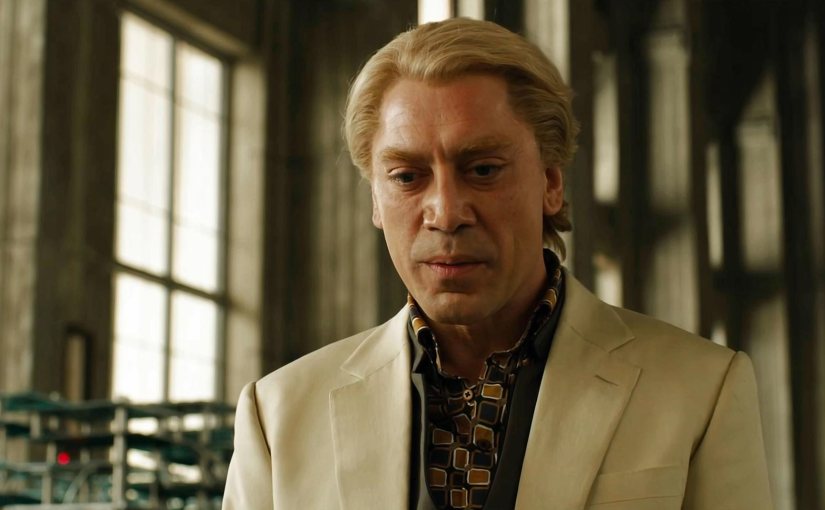
It’s also quite special that Bardem shapes his villainous role with a homosexual tendency. Silva is fashionable and proudly dons a bleach blonde hairstyle. He gleefully rubs Bond’s legs and opens his shirt to examine his scarred chest, pronouncing that Bond must ponder his “training” at the moment. Silva is beyond the typical femme fatale. It’s different and it’s time the Bond franchise acknowledges the differences in people. A welcome trait for a major character.

The plot set up of Skyfall‘s devices are ingenious in simplicity with a basic revenge tale but also with broadening the legacy and responsibilities of the M character. What Casino Royale did for a story arc for James Bond, Skyfall does for M, and with Dench in the role it works beautifully. She must answer to superiors, like a very welcome Ralph Fiennes, for the death of several agents and a bombing of MI6 headquarters. She must resist the pressure of early retirement. This is the most that M has ever had to contend with personally, and it’s here at last.

My one reservation with the film occurs just after the midway point. Silva somehow arranged to get apprehended and then managed to escape, don a police uniform, travel through London’s tube, and time an explosion on a runaway train ready to crash into James Bond who is on his trail. Thereafter, he’s able to locate the interrogation session where M is making a public statement in her defense and try to kill her. There are way too many factors at play that work too conveniently to Silva’s advantage. It’s a tension filled sequence. It looks great. It has great action and effects, but it’s overly contrived. I wish the script from Neal Purvis, Robert Wade and John Logan made this middle section a little more believable.

Sam Mendes (American Beauty) directs a terrific, action-packed film filled with more drama and minimal tongue in cheek that the series is primarily known for. I was grateful for the more serious Bond. Like the other Craig installments as well as the Dalton films, Skyfall offers a different and fresher approach.

Granted the ending plays more like an Arnold Schwarzenegger action piece from the 1980/90s, but it’s highly entertaining, well edited and well shot, nonetheless.

I highly recommend Skyfall for its outstanding cast that also includes Ben Whishaw as a nerdy variation of Q, the gadget man, and Naomie Harris in a secret role that has a satisfying payoff. As well, the standard revenge story works quite well here when you have Bardem, Fiennes, Craig and most especially Dench doing some really top notch acting with terrific dialogue. Mendes is a stage director first, and it shows quite admirably here.

Again, Skyfall is not the best Bond film but it’s at least one of the best.

DOG DAY AFTERNOON

By Marc S. Sanders

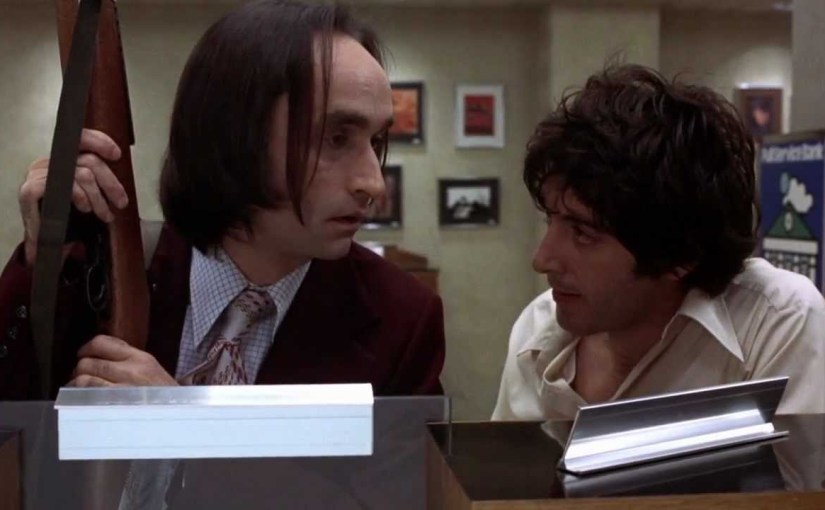
Sidney Lumet uses his best strengths in this ridiculous Brooklyn bank robbery that is actually based on fact.

Here, Al Pacino and his cohort, John Cazale, play inadvertent stupidity without compromise. If two of the three stooges went on to do drama, this would be the material they’d use.

A simple bank robbery with little to no planning spirals out of control and into sheer pandemonium. Nothing goes right even when Pacino’s dimwit character, Sonny, is deluded enough to believe all is going in his favor. He immediately earns the support of the encroaching Brooklyn community only to lose them when he shows his true homosexual nature. Then he’s blindsided as to what happened. Layered in drenching sweat, Lumet wisely takes advantage of Pacino’s best up close facial expressions. Utter delirium!!!!!

Once again, Lumet’s camera moves while his best actors remain naturally in place. Al Pacino does his thing and trusts his director will find his shots. As the cop initially in charge, Charles Durning does as well. Pacino and Durning especially have great scenes together in the middle of a heavily populated New York Street as the robber shines off the cop, and the cop does his best to obtain some measure of control. It’s a scream fest for the ages. “Attica! Attica!” Pacino and Durning’s best career performances were always the ones where it looked like neither of them were ever acting. Dog Day Afternoon is one those better examples.

Frank Pierson’s jagged script of wild turns makes every person whose an extra like the pizza delivery man, for instance, caught up in the hysteria. The pizza kid shouts out to the crowd “I’m a star!!!” It’s great reason to applaud Sidney Lumet’s control over a crew and the entire company of extras he’s employed. This film is a rare example where all of the extras (seemingly the entire Brooklyn population) are as integral as the leads. The setting is the main antagonist from the media all the way to the observers who can’t look away and can only cheer, yet mock as well. Brooklyn, New York is a great character here.

Most fascinating about Dog Day Afternoon is that it is all based on fact from the media circus to dumb bank robbers with a need to steal in order to fund a lover’s sex change operation. It’s ridiculous. It’s funny. It’s frighteningly stressful and it’s all true.

This was released following the first two Godfather films and confirms the enormous range Al Pacino possesses with his performance talents. Hyperactive and dumb here as gay bank robber, Sonny; quietly contained, evil as Michael Corleone. His range was through the roof in the 70s before absorbing his loud, crackling, smokers voice. It was when the script outshined Pacino and before the current age of writing being catered to its bankable star.

Lumet also allows great moments for the hostages who become undone to the point of regretfully using foul language, to actually befriending their captors. He’s a director who efficiently leaves no stone untouched.

Chris Sarandon as Leon, Sonny’s male gay spouse is great here too. He’s full of melodrama, panic, worry, and a New York maternal despair. Another great scene is a phone exchange between Pacino and Sarandon. It might appear funny at first, especially in the 70s when homosexuality was lampooned often with the other F-word, but anyone who appreciates the filmmaking of Lumet will quickly contain their snickering when they realize a gay man is equal flesh, bone and feelings like anyone else.

Dog Day Afternoon is very telling of an out of the closet social media future. The story will always get grabbed regardless of danger or sensitivity. People will get swept up in the hoopla (a teller hostage quickly boasts her brief fame on television “Girls, I was on TV!”), police will overextend their privilege, helicopters will swarm, the criminals will demand their moment in the spotlight, and the public will serve as jury per the majority.

It’s a vicious cycle but considering it is a 1975 masterpiece, it’s all disturbingly valid and sensationally true.

FERRIS BUELLER’S DAY OFF

By Marc S. Sanders

I’ve said before how John Hughes had an instinct for making interesting stories out of the mundane. Sure he might broadly exaggerate, but the storylines stem from relatable anecdotes like cross country traveling, forgotten birthdays or school detention. Thankfully he also explored a day in the life of faking illness and skipping school with Ferris Bueller’s Day Off.

Matthew Broderick memorably plays the title character with an answer for everything and the means to outsmart his naive parents, his pesky sister Jeannie (Jennifer Grey), as well as the dim witted victim of staged slapstick, school principal Ed Rooney (Jeffrey Jones). Hughes teams Ferris up with his beautiful girlfriend Sloane (Mia Sara) and his troubled best friend Cameron (Alan Ruck) for a romp through downtown Chicago.

Ferris Bueller… is simply a party to watch. The tempo of its comedy thankfully gets very familiar, very quickly. There’s gag after gag to celebrate the inventiveness of Ferris. With Cameron, he manages to get Sloane out of school, alter his absent days in the school system, arrange for a high-end fancy lunch thanks to the “Sausage King of Chicago” and actually pilot Cameron’s father’s prized, rare Ferrari convertible. There’s nothing Ferris can’t do, nor won’t do. There’s nothing Ferris can’t get away with. The guy can even hop on a downtown parade float to get the entire city engaged in a rousing rendition of “Twist & Shout,” arguably one of the most fun scenes to ever be filmed. Hundreds of extras crowd the streets to remind any one of us how fun life can be. What a joyous pleasure life is.

As expected with most of Hughes’ films though, this picture has a heart. Life should always be celebrated, but that does not mean we don’t have episodes where we suffer. Alan Ruck as Cameron is not well with his home life. Parental discourse and the lack of a loving home weighs upon him. The storyline is embraced very sensitively. A touching moment occurs as Cameron tours the Art Institute of Chicago and maintains an engrossed stare with the painting called A Sunday Afternoon on the Island of La Grande Jatte. Cameron is a product of loneliness lacking the ability to cry for help unlike the child in the painting. It’s another one of those treasured moments in film where dialogue is not needed to describe a character’s pain.

Jeffrey Jones makes for a good foil in a Three Stooges style storyline as he attempts over and over again to catch Ferris in the act. It never works well for him and leads to hilarious moments with the house dog and every other unfortunate circumstance imaginable such as getting his car towed and his foot stuck in the mud. Hughes pieces these cheap gags together to make them really feel much more valuable than they should be.

Lastly, John Hughes creates good inside gags within his setting. The city of Chicago works as a character concerned with Ferris’ supposed illness, including well wishes from his classmates, to the faculty, and even the police department much to the chagrin of his sister.

Let’s just say it’s imperative we all do our part to Save Ferris!