KISS THE GIRLS

By Marc S. Sanders

When you’re watching a movie and one character says “Now wait here. Let me handle this!” what do ya think is gonna happen? When you’re watching a movie and one character says “Kate, we’ve covered every inch of those woods. There’s no building there!” whatcha think? You think there actually is a building there?

Let me ask you this, what do you think happens in the film Kiss The Girls?

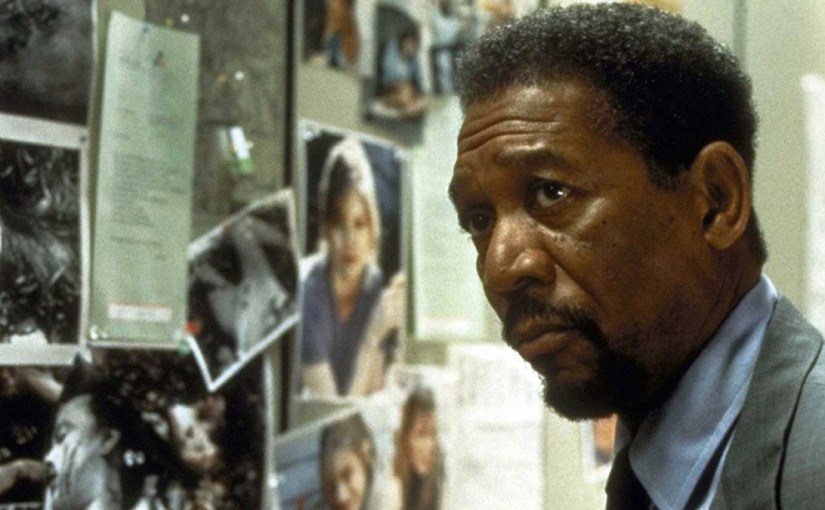
Yup! A whole lot of this nonsense and more that I could cover endlessly. Adapted from James Patterson’s best selling novel featuring his forensics detective hero Alex Cross, Kiss The Girls begins as an effective thriller focusing on the backgrounds of its two leads: dependable Morgan Freeman as Cross, and Ashley Judd as Dr. Kate McTiernan, a skilled surgeon with a specialty in kick boxing (that may come in handy later). At first, we see these characters handling snippets of storylines related to their careers. Cross defuses a suspenseful suicide situation. McTiernan has to console a family whose little girl was in a motorcycle crash. There’s good acting and emotion going on here and I was hoping the film would live up to the promise of these scenes; the characters’ expertise now being applied to Patterson’s main story. It doesn’t.

Instead, the movie just mires itself in plot holes and filler where one character insists on working alone while the other insists on not sitting idly by. This is not character development. This is ping pong volleying. Kate is kidnapped by a serial “collector” of smart, young, beautiful and highly intelligent women by someone regarded as “Casanova.” When Alex’ niece is one of the women taken, he travels from Washington DC to Raleigh, NC to join the investigation.

Soon after Kate has been taken, she manages to be the only one to escape from some hidden dungeon located in the woods. She joins Alex at every turn to find Cassanova and rescue the other captives. Okay. So that’s not a bad set up.

Where it falls apart is in the development. Kate managed to escape by jumping into a river where she’s retrieved by two kids. So wouldn’t law enforcement just sweep that entire area? I mean be really thorough, top to bottom! Surely, you’ll pick up footprints or scents from the dogs. Well, Alex says they did. Fortunately, his niece’s boyfriend finds the map. You know…the map that’s hidden in the library that no one else is aware of and shows this dungeon or whatever it is that’s there. Only one guy, ONE GUY, knows about this map????

When an hour and forty minutes has surpassed, you bet that map is gonna turn up. Remember, also when someone says wait in the car, the one thing you do is not wait. You know, this is a movie. So, Mr. Freeman, please spare me the act of surprise when Ms Judd walks into the bar you’re scoping out. This is all unnecessary, and boring and tired and old.

Kiss The Girls is another film with THAT TWIST! Was it really needed though? Just when the film apprehends the bad guy, and the ladies are recovered safely, there’s a gotcha moment in Kate’s kitchen with lots of knives and pots and pans to play with. Gary Fleder directed this 1997 disturbing thriller in a post age of The Silence Of The Lambs and Seven, which are far superior films. It’s not a film dependent on gore or torture porn, but it’s got the dark stone lined halls for haunted house creepiness. I’m good with that. It’s a thriller after all.

The film’s best assets, however, are Freeman and Judd. These are two top class actors who invest themselves in performance. If only they were working with a much more believable story.

It’s the implausibility in the script that make my eyes roll.

THUNDERBOLT AND LIGHTFOOT

By Marc S. Sanders

There are good Clint Eastwood films and there are bad Clint Eastwood films. You’d probably guess where I rank 1974’s Thunderbolt and Lightfoot (T & L).

I’m amazed. Director Michael Cimino, at the time, was really only known for polishing Eastwood’s Dirty Harry flick Magnum Force into a great crime drama of cop vigilantism. Then he does this picture, and how did anyone at Warner Bros trust him with The Deer Hunter a few years later? Sure, that film won Best Picture, but should anyone really have been surprised when the box office nuclear bomb, known as Heaven’s Gate came along, and bankrupted Orion Pictures? You think the producers of that turd said, “Fellas, we never considered Thunderbolt and Lightfoot. Hindsight 20/20. We shoulda known better.”

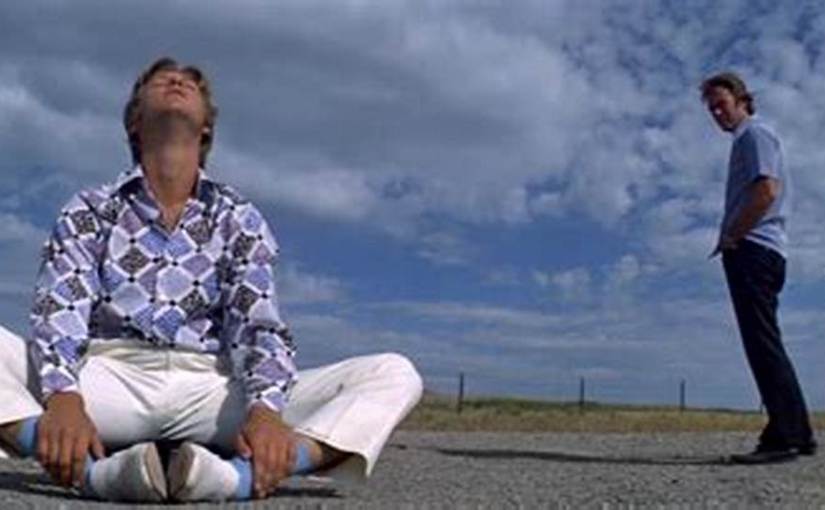
Back to the subject at hand. T & L is mindless of any coherence. Two criminals just happen to find each other randomly on some out of nowhere highway while running from the law (for Lightfoot) and a couple of bumbling henchmen (for Thunderbolt). Their respective crimes are unconnected. Eastwood’s quiet, familiar, tough guy demeanor (Thunderbolt) meets up with wild boy Jeff Bridges (Lightfoot) and then they eventually get to a plot of devising some kind of money heist with early adversaries George Kennedy and Geoffrey Lewis, former crime pals of Thunderbolt. However, they need to arrange to acquire a cannon, get on a job digging water lines for housing properties, work as ice cream delivery guys, hitch a ride in a redneck’s Dodge Challenger, and have Lightfoot dress in drag. There’s also a schoolhouse, no longer located where it once was, with a secret stash hidden behind a blackboard.

Doesn’t this seem like much too much effort for an ordinary bank heist in 1974? Security personnel and systems were probably not as sophisticated back then, no? Eastwood made an easier time of escaping from Alcatraz then all the work put in here.

The movie is sweaty, dirty, stupid, and it just doesn’t make sense really. Bridges actually got an Oscar nomination in the supporting actor category, up against nearly the entire cast of The Godfather Part II, for this film, and I’m…well…perplexed. How was that possible? Best guess, Cimino, who also wrote this dreck, decides to have Lightfoot die at the end. (There!!!!! I ruined it for you!!!!) Problem is I don’t know why or how. He’s not shot or wounded. There’s never an indication that he is ill. The script is too dumb to consider any kind of foreshadowing of his demise. The guys are just driving along with the money in backseat, and Lightfoot appears weak all of the sudden. Thunderbolt pulls over to the side and his partner just quietly dies in the passenger seat. Cimino cues up the Paul Williams music and the end credits appear. Bridges had a death scene. So, Bridges has to get a shot at Oscar glory. The math ain’t pretty but it’s the best logic that I can come up with.

THE GIFT

By Marc S. Sanders

Blumhouse Pictures had a monster year in 2017 with the release of Jordan Peele’s smash hit thriller Get Out.  It was by no means some slasher film for cheap scares.  It built on those typical shocks to deliver a message over a well-crafted three act storyline that commented on present day race relations while the action of it all knocked the hell out of you.  Get Out was one of my favorite films of that year.  

Having just watched Joel Edgerton’s The Gift from 2015, I see a pattern from Blumhouse.  This is a company intent on making high grade material on very small budgets.  This company knows how to spend its money wisely, while showing you something that looks familiar but is altogether new.

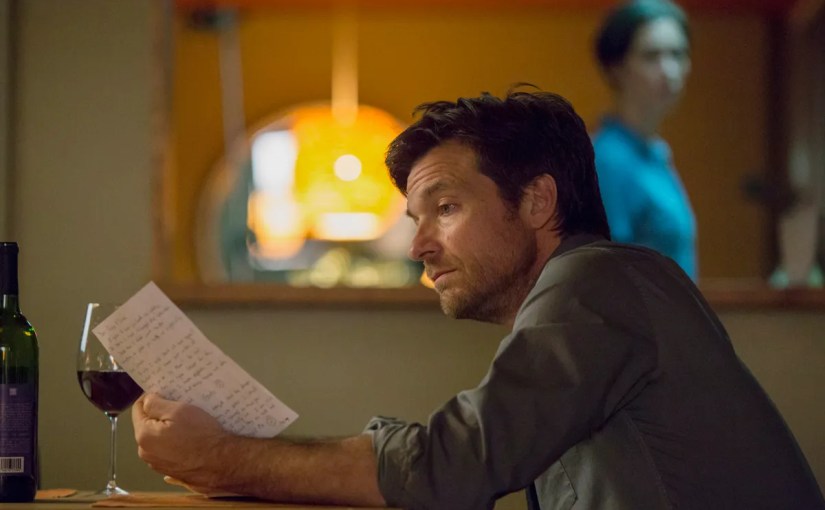
Edgerton wrote and costars in The Gift as a stranger who intrudes on the life of a happy couple with a promising future, played with great chemistry by Jason Bateman and Rebecca Hall.  

Casting Bateman and Hall was a smart move.  In other respective efforts from both actors, they are at their best by giving the less is more approach to their resume of performances.  In this film, they come off as nothing special really when the film begins; happy and minding their own business.  It’s important because it enhances the disruption of Edgerton’s character, Gordo “the weirdo.” All that Gordo is doing is being friendly by leaving gifts on the couple’s doorstep. Harmless, really, but I found my own instincts on alert. The question is, however, was I ever right to question my instincts in the first place.

The Gift is a top notch psychological thriller.  Do Edgerton and Blumhouse follow the same trite cliches of suspense films like this though? That’s what is eye catching about the film.  You really don’t know how developments are going to end up until the movie is completely over.  For the most part, this film is wildly unpredictable.

I really liked it.  It was a new kind of disturbed piece written with foreshadowed detail by Edgerton.  He writes with common, nervously laughable awkwardness for his couple to struggle with.  This new guy is only signing his cards with happy faces and leaving gifts.  What’s so wrong about that?  

Edgerton’s direction is just as fine with wide shots during the daytime suburban scenes to offer comfort for Hall’s housewife character, and a narrow lens to unsettle you as you peer down a dark endless hallway.  For cripes sakes, it’s only your house.  Is your new house really that scary?

The ending is satisfying for me even if I did predict an early scene would return to make its point later.  Narratively speaking though, I credit the screenplay for inventing something beyond a final fight that would probably include kitchen knives and crashes through windows followed by someone falling to his gruesome death from a great height, or drowning a villain in a bathtub before shooting him when he miraculously comes back to life. 

See, that’s what the other movies are doing. Films like The Gift and Get Out are completely doing something else entirely.

BACK TO THE DRIVE-IN

By Marc S. Sanders

I have a confession to make.  As much of a movie lover that I am, I have never seen a movie at a drive-in theater.  I should know better.  Fortunately, I had the honor of learning about this well-established culture of Americana while getting a private screening of a new documentary film called Back To The Drive-in, written and directed by April Wright.

Back To The Drive-in covers the resiliency of eleven different drive-in theaters spanning from Massachusetts, down to Texas, across to the state of Nebraska, and California beyond.  All of these institutions have likely been around longer than three times the age of most of their teenage and twentysomething employees.  They may be located in different areas of the greater United States, but many of these outdoor movie palaces have no choice but to contend with the same ailments that accompany a new age of living during the time of the Covid pandemic.  That’s the common theme April Wright covers as she turns on her cameras allowing the owners, their families and staff to discuss experiences, frustrations, worries and uncompromised passion for the drive-in.

The craft of Wright’s film is beautiful.  There are vast overhead shots of each drive-in that transition perfectly into the intimacy of a lived-in office or a concession stand down below.  As her film moves from one drive-in to the next, the chapters open like picture perfect post cards of an American institution that has survived for over 60 years.  My only familiarity with drive-in movies likely stem from episodes of the sitcom Happy Days, where Richie and Potsie would make out with their girlfriends in the front seat during the monster movie.  This insightful documentary, however, showcases how drive-ins operate in an age of new technology or lack thereof.  It also presents problems that have been ongoing since long before Covid arrived. 

The unpredictability of weather abounds for many of these owners. The most interesting story for me comes from the Wellfleet drive-in located near Cape Cod, Ma.  The owner, John Vincent, is a friendly enough gentleman, who tells of his history working for the drive-in first in the ticket booth while he was a teenager back in 1987, all the way up to now being a proud and concerned owner.  Warts and all, he loves the drive-in.  The offensive f-word for him, though, is fog.  With his business located near the ocean, it is hard to tell if the large outdoor screen will offer up a good enough picture for the Saturday night film.  Each time April Wright’s documentary returns to footage from Wellfleet, I was in suspense.  Mr. Vincent talks about how on a good night he’d have 300 cars parked ahead of the feature presentation.  On this night, with imminent fog, it’s lucky he has 117 cars.  Every time Wellfleet appeared in the film, the fog only looked thicker and thicker.  Fog has become an all too real fear.

A common problem for all of the drive-ins is the weather.  Another location is concerned about lightning in the area.  It goes with the territory that the managers and operators regularly monitor the weather apps.  I want to know what they did in the ‘60s to prepare for this uncertainty. 

Supply shortages, inflation, worker shortages.  All of these drive-ins face the same threats.  Wellfleet also contends with out-of-date technology where the speakers are burned out and the underground wiring needs repair.  Yet, that means digging up concrete at a huge expense.

As the time period focuses on the drive-in attractions in response to Covid, it seems to present a small favor for these businesses.  At the start of the pandemic, when new Hollywood pictures were being released in limited supply, there was at least the escapism of the drive-in for consumers who were exhausted over quarantining.  People could at least catch a classic flick like Back To The Future, and maintain social distancing within their own cars.  Still, Brian Smith who owns Coyote out of Fort Worth, Texas has to protect his teenage staff from angry, foul-mouthed patrons unwilling to cooperate with mask mandates while visiting the concession stand.  He talks about how he looks out for the kids who work for him, but even depression and the challenge to keep up with school is overwhelming. 

Now that vaccinations have provided relief from isolation, the struggle is all the more real for these business owners.  Ben and Nora Harroun who operate Galaxy Drive-in Ennis, Texas mention competing with streaming services for new film releases.

Other drive-ins attempt to reinvent what they have.  Field Of Dreams located in Ohio is offering up live concert entertainment.  Quasar in Nebraska was an I-70 drive-in refurbished by Rod and Donna Saunders with the latest technology and architectural designs.  Their friends said they were crazy to invest in this, but for the Saunders it is crazy to let an institution fade away.  Their retirement was meant to sustain the atmosphere accompanied with a drive-in movie.

There’s a culture to this industry.  These owners talk with one another and share their love for this uncertain and struggling industry.  Drive-ins seem outdated in an age of comfortable multiplexes and the convenience and safety of at home streaming.  They share each other’s pain while also appreciating the value a film like F9 (Fast & Furious) can draw on a Saturday night.  They take pride in the specialty food crafts they sell at the counter from funnel cakes to a delectable pulled pork sandwich for seven dollars.   To many of us, selling a box of Nerds candy or not selling chocolate products to avoid the risk of melting, might seem like a mundane awareness, easily taken for granted.  To these folks, it means the difference of the outcome of their current season in the age of Covid.  April Wright captures a young girl describing how she burned a scar into her finger on a popcorn machine.  These are proud war wounds, accepted within the ongoing challenge of keeping a business afloat and a decades long tradition alive.

April Wright’s documentary is breathtaking.  As her camera soars above the wide-open spaces of worn-out grass and cratered concrete with large movie screens at the edge, you absorb the history of places within the United States urging us to rediscover again.  Our eyes only opened a little during a desperate time in 2020, but these preservationists wonder if they will be able to hold on.  I won’t spoil the outcomes some of these businesses face during a footnote of coverage featured in the end credits, but perhaps a follow up piece is on the horizon from Ms. Wright.  These drive-in locales live with unstable fluidity.  Doubt, accompanied with hope, is what I walked away with following my viewing of the picture.  What will the American drive-in theater look like in a year from now?

LIGHTYEAR

By Marc S. Sanders

It’s kind of neat to see the evolution of a classic film character when you are a fully aware adult.  In 1995, I had no idea what the term Pixar meant, or knew the impact it would have with the Disney brand as a whole or on the cinematic landscape.  Pixar is now as pioneering as Skywalker Sound or Industrial Light and Magic.  There’s Pixar, and then there’s everything else.  Back in ’95, I was age 23, and my intuition never perked up that I was watching a touchstone character like Buzz Lightyear who would become as grand today as Batman and Elvis turned out to be in an ever-changing pop culture lexicon. Buzz Lightyear is by far one of the company’s most inventive creations.

Jump to nearly thirty years later, with four Toy Story adventures, and endless amounts of merchandising the Space Ranger has been primed for a more personal adventure beyond the imagination of a young child possessing an action figure in his playroom.  Lightyear tells of the adventure that leant to merchandising of the toy depicted in the Toy Story fictional world.  (Try not to think too hardly on that description.)

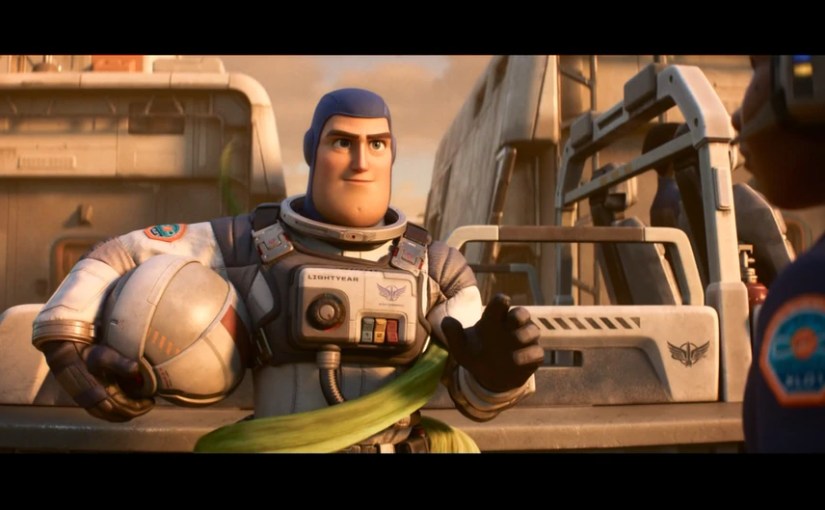
Buzz Lightyear (Chris Evans) is the eminent Space Ranger of Star Command, out to explore strange new worlds and seek out new life and– STOP! That’s another franchise.  When Captain Lightyear comes upon an unchartered planet, complications in unexpected science fiction adventure ensue.  Buzz and the small colony living on his global spaceship are marooned on this planet with no immediate solution for getting off and returning to Earth, 4.2 billion light years away.  Buzz makes it his mission to uncover a new kind of resource fuel that will eventually help the colony make its eventual return home.  Yet, with each experimental try, the minutes he spends in his super speed orbits around the planet equate to years for the colony who have set up habitation below.  His comrades on the ground below continue to age while Buzz does not.

I needed help with this picture.  My wife had to explain the staple lesson that usually comes with each Pixar film that I just didn’t catch while watching Lightyear.  I don’t think I’m spoiling anything, but the film reminds us to accept the hand dealt to us and appreciate what has come even if we never expected or planned on the circumstances in the first place.  It’s a good lesson.  I guess I just wish Lightyear made it a little clearer.  There’s a lot of mud on the windshield that I needed to wipe away before I realized what the message was about.

Maybe I was not fair with this film.  Tim Allen was not invited back to lend his recognizable voiceover to the character.  I guess Pixar is insistent that he’s reserved only for the toy version of the character.  Chris Evans is fine, mind you, and he doesn’t overdo it.  Yet, I could not help but think Tim Allen would have been just as capable and even more entitled to voice the role yet again.

Perhaps I was thinking that if Pixar wanted to go in another animated direction with the character, it just seemed completely fruitless.  How different could Lightyear be from the Toy Story films if the animated design is pretty similar in every frame?  Honestly, it doesn’t look like a new kind of device.  So that was a problem for me, as well.  It wasn’t inventive enough.  Maybe it’s time for a live action version of the space traveler.  Imagine Chris Evans wearing a live action and tactile version of the famous astronaut costume with the colorful buttons.  I still say that could work, and it’s what Disney/Pixar should have considered.

Maybe I’m getting bored with the time travel motif.  Isn’t everyone doing that these days?  Doesn’t it also seem like all our heroes are meeting their future selves and struggling to understand their current predicament?  Lightyear hinges on these story developments, and when the moments arrive my eyes rolled in the back of my head.  Time travel stories are very tricky for me to appreciate.  Often, the narrative paints itself into a corner, unable to explain itself back correctly.  Only two films that come to mind have worked their way out of it almost seamlessly – Back To The Future and 12 Monkeys.

So, while I love the lesson that Lightyear offers, the standard carbon copy plot outline left me unfocused at times.

The voiceover cast is well done with Keke Palmer, Taika Waititi and James Brolin.  The animation is gorgeous, most especially when Buzz is piloting his super jet around the planet’s sun. The atmosphere of the planet is fun when it becomes a nuisance with giant flying insects and vines that come alive to entangle the characters at any given moment.

Science Fiction can go to infinity and beyond with the directions it can take.  There is absolutely no limit.  With today’s technology in filmmaking and the endless resources that Disney provides, why didn’t the filmmakers try a little harder with Lightyear? Again, a live action interpretation would have allowed it to stand apart from the character’s prior Toy adventures, and some different avenues in space exploration would have opened a leaner and more entertaining story.  If Star Trek can do it, Lightyear can do it too.

I think Pixar tried to go the route of Christopher Nolan, by way of Interstellar.  However, Lightyear is designed for people of all ages where the brain of the show is in reminding us how to carry ourselves through life, and not to uncover the twists that a brilliant filmmaker like Nolan has become recognized for.  I didn’t want to resolve a puzzle in fictional science.  Lightyear is trying too hard to be to be brainy and thus we get distracted from its “The More You Know” lesson in self-effacement.

NATIONAL LAMPOON’S ANIMAL HOUSE

By Marc S. Sanders

When a film opens with two students walking across a college campus as the classical horn music of proud alumni accompany them, and then one of the students stops to pull up his fly, you know you are probably in for a contrast of ideals.

Animal House set a new standard in comedy featuring a John Belushi whose expressions and improvisations appeared too fast for the camera to catch everything he’s doing. The script never gave him much dialogue because his routines of smashing beer bottles, smashing guitars, smashing beer cans and just getting smashed merited no dialogue. He might have looked like a dirty slob, but he was a craftsman of facial expressions.

Every scene of Animal House plays like an episode of an ongoing sitcom; a raunchy one at that. A dead horse, a pledge ceremony, a toga party, a sabotaged parade, and a food fight. Each topic is the title of a sitcom’s various episodes.

John Landis directed the snobs vs slobs script co-written by Harold Ramis, and 40 years later the material still holds up. Then again, 40 years later, I wonder if this film would even get made. I’d rather not dwell on that.

What I do know is that this movie is still funny. Outrageously funny.


CODE OF SILENCE

By Marc S. Sanders

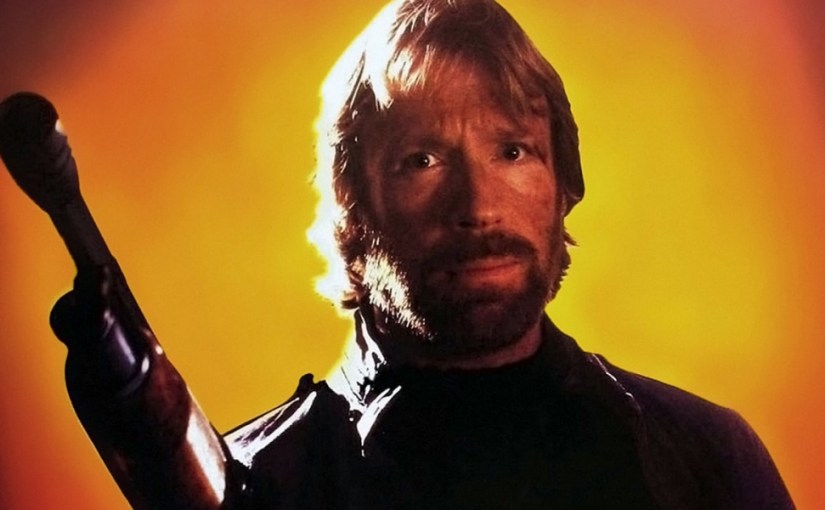
I must admit I have not watched many Chuck Norris movies. Just a handful here or there like The Delta Force, but on my radar to catch was always the cop thriller from 1985, Code Of Silence. I always intended to watch it someday as the film is highly endorsed by Siskel & Ebert. As well, it’s directed by Andrew Davis, the skilled filmmaker who would go on to direct The Fugitive and Under Siege.

Code Of Silence works in two ways; two stories that live up to the title. Norris is a Chicago cop named Eddie Cusack who heads a squad of under covers within the city. The film opens with what is supposed to be a well-planned drug bust that goes wrong when the one mob faction is overrun by another mob. Cusack’s informant as well as others turn up dead just before his band were to move in with arrests. Nearby, two of Cusack’s men come upon a young, unarmed man. The rookie officer witnesses the elder officer accidentally shoot the kid, and afterwards he plants a pistol in his hand to make it look like self-defense.

Now Cusack has to contend with a mob war in the streets where a boss’ daughter (Molly Kagan) is the only survivor of an attack and he must protect her. While at the same time he has to deal with his squad turning on him because he knows what the elder cop really did. The code of silence motif is expected to be honored in both camps. Personal vendettas and violations of police policy need to remain quieted.

The film belongs to Norris exclusively. Andrew Davis allows some of the action star’s kickboxing skills to work their way into the movie, and it all becomes a sidestep dance routine really. It always amuses me in these action pictures where the star will take on twenty guys at once yet he fights one or only two of them at a time. The other eighteen or nineteen thugs wait their turn. Why not just have all of them tackle Norris all together? No. Then we wouldn’t get his outstretched 360-degree roundhouse kicks in the air.

There’s also an unnecessary cop robot contraption that Norris pilots for the climactic action packed ending. This thing looks a rejected auditioner for the role of Johnny 5 in Short Circuit. The robot must have been too tall for the part and rather clunky. It has no relevance to either storyline and was obviously inserted for fun, campy violence of fireballs and explosions in the necessary old, abandoned warehouse where all of these actioners have to take place.

Fortunately, Code Of Silence has good story material to work with, and some thrilling stunt work including Chuck Norris pursuing a bad guy on top of a moving elevated train that makes its way with an eventual leap into the river. From what I could tell, that was really Mr. Norris himself in that whole scene. Good footage here.

Andrew Davis relies on what would become regular side characters that appear in many of his other films including Ron Dean and Joseph Kosala. They always make for good cop antagonists within the Chicago settings of his films. Norris is also good in a quiet Clint Eastwood kind of manner as he holds his own beliefs against the rest of his department who support the elder cop.

I like the conflicts that happen on both sides of the law in Code Of Silence. Sure, it’s got some silliness to it with the kickboxing and the gigantic, cop robot that shamelessly waddles along, but the two stories hold up by keeping me engaged of their outcomes.

Code Of Silence is a pretty effective thriller.

CLERKS

By Marc S. Sanders

Did Kevin Smith know he’d create a lasting cultural phenomenon when he recruited his neighborhood friends to depict the mundane life of a convenience store clerk (Dante) and video store clerk (Randall)? How could he? He made this very shoestring budgeted movie by maxing out his credit cards. He’s on a short list of entrepreneurs who went all in. Bravo!

Clerks is a film that doesn’t seem to say much, but actually says a lot by the time it’s finished. Smith wrote a script where Dante mulls over how hard it is to move on, to change and accept the fact that even his ex-girlfriend moved on to get married, while he’s nothing but number 37 on his current girlfriend’s oral conquests. It’s a challenge as he and Randall debate over the accomplishments of Star Wars films. Then there are the eccentric customers like Smith’s friend Walt Flanigan (of Comic Book Men) as a guy looking for the perfect dozen eggs, or another one offended by the harsh language of a couple of bored clerks.

On paper, this all looks ordinary and boring. Yet, that’s the point. It’s fair to say we have all experienced the boredom of work with no definitive vision of a future. So, we complain about how we are not supposed to be there on our day off, or that the most important, immediate need is participating in a Saturday afternoon hockey game. Since we gotta work, we’ll compromise. If we can’t leave work, we will move the game to the roof of the store.

Two legendary cinematic characters also debuted, Jay & Silent Bob (Jason Mewes & Smith). They just lean against a wall, smoke and do not much else. Still, they offer atmosphere. There’s always loiterers mulling around a 7-11 or Circle K. They have stories as well, but we will likely never know. They just cross our paths as we pick up a soda. Smith wrote these guys as anybody we’d recognize and who we’re familiar with.

Kudos to Kevin Smith for following through with Clerks. This doesn’t look like much of anything, but it’s everything.

MISS SLOANE

By Marc S. Sanders

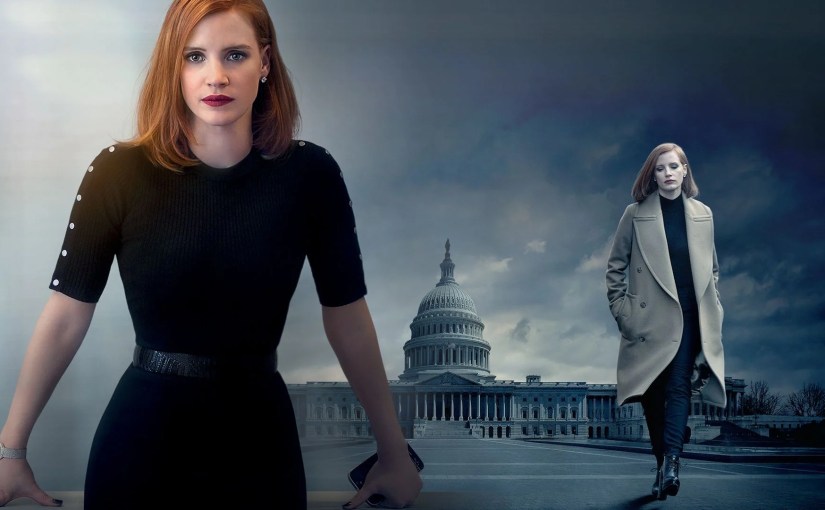
Jessica Chastain is an aggressive actress. The talent is on par with Meryl Streep or Katherine Hepburn for sure, and the Oscar trophy she won earlier this year is evident of that. Actually, she’s worthy of more than just one. My question, though, is if she is too aggressive. Films like Zero Dark Thirty, Molly’s Game, and Miss Sloane, put her in characters that never stop to react and smell the roses. That wears me out. Could you just slow down Jessica, so I can take this all in, please? You’re talking faster than I can think.

In Miss Sloane, Chastain portrays an impenetrable lobbyist. Nothing gets past this woman and despite her shortcomings, nothing will harm her either. Elizabeth Sloane will always be one step ahead of the game. This is a fierce chess player in the political arena. She’s omnipotent and admits to hardly ever sleeping. Maybe the pill popping helps with that. Like the Faye Dunaway character from Network, she also has no time for personal relationships or sensitive sex. So, she’s a high paying client for a male escort who will wait for her to come home to satisfy her fix.

Elizabeth is first employed with a wealthy private law firm who wants her to head up a bill in favor of the gun lobby. She declines, walks out the door with one long speech, a way over the top laugh (this is where there’s too much Jessica in my morning coffee) and over half her staff. She goes to the other side of the aisle to lobby aggressively against the gun bill.

From there it’s one aggressive maneuver after another and Elizabeth more than proves that she’s got the balls for this game. Only thing is, as Elizabeth proceeds to countermeasure and attack from her side, is she losing sight of the subject at play? Will her soul swim to the surface showing any sense of morality?

The film begins where Elizabeth is being questioned at a hearing headed by a state Senator (John Lithgow, always a pleasure to see). Then it moves on to show us how Elizabeth finds herself at that hearing.

Miss Sloane has no limits to what she’ll do to protect the integrity of a client’s argument for the bill even if it means embarrassing a traitorous teammate, putting another teammate in an unwelcome limelight of political journalism or maybe even employing a cockroach of the sort to use as a listening device. Miss Sloane won’t hesitate to take risks for the lobby she’s been hired to pursue, even if it risks someone’s life or their reputation.

A twist presents itself at the end and yeah, it could work assuming you believe Elizabeth Sloane, the brilliant lobbyist, can telegraph about fifty different actions that could take place amounting to that one moment. The math adds up, but were the numbers fudged to allow the arithmetic to work? That’s why a film like Miss Sloane is hard for me to swallow.

Does this woman have ESP? The final card she plays would require not only her own personal endurance, but that of a colleague as well. A lot of factors all have to be in sync to make this story work out the way it does. So my suspension of disbelief was really tested with this film.

I go back to Jessica Chastain. Zero Dark Thirty remains my favorite of hers. She was a great underdog against a male oriented governing body in the pursuit of Bin Laden. After that, Miss Sloane released a few years later and Chastain got bit by the Aaron Sorkin bug, I think. Endless talking works as an intellect that’s hard to challenge. Problem is, I’m the viewer and I’m wondering for the first thirty minutes what in the hell you’re talking about. Miss Sloane isn’t an Aaron Sorkin film, but Jessica Chastain will have you convinced she wants it to be.

Fortunately, writer Jonathan Perera with director John Madden ease up on the brakes allowing much more realistic and human characters to invade the film including Lithgow, Alison Pill and an especially riveting performance from Gugu Mbatha-Raw (recently seen by me with a subpar script called The Whole Truth) who becomes Elizabeth’s trusted sidekick both behind and in front of the cameras for political jockeying. This is an actress ready for some lead roles.

I described Miss Sloane as omnipotent earlier and that’s a problem for the first act of the film. This character never shuts up early on. There’s next to no impact on anyone around her. She just talks and talks and talks and she convinces me that she’s the smartest one in the room, but she also makes me want to turn the movie off. The film saves itself with the able supporting cast eventually.

To watch Miss Sloane is not to take any position on gun lobbying especially seriously. I’m not sure the filmmakers have a stance to play. I’m not sure the filmmakers know whether to even regard the titled character as a hero or villain. Actually, I just think the purpose of the film is to show corner cutting and how aggressive a made-up lobbyist can actually be, devoid of any determining factors. We are privileged to see how far a woman with stiletto heels, a cinched up red head ponytail and a tight business suit will go to win at any cost. It’s intriguing, but I guess I just felt unfulfilled by the end. It was all there. It just seemed to work itself all out too conveniently by the end. 

THE BIRDS

By Marc S. Sanders

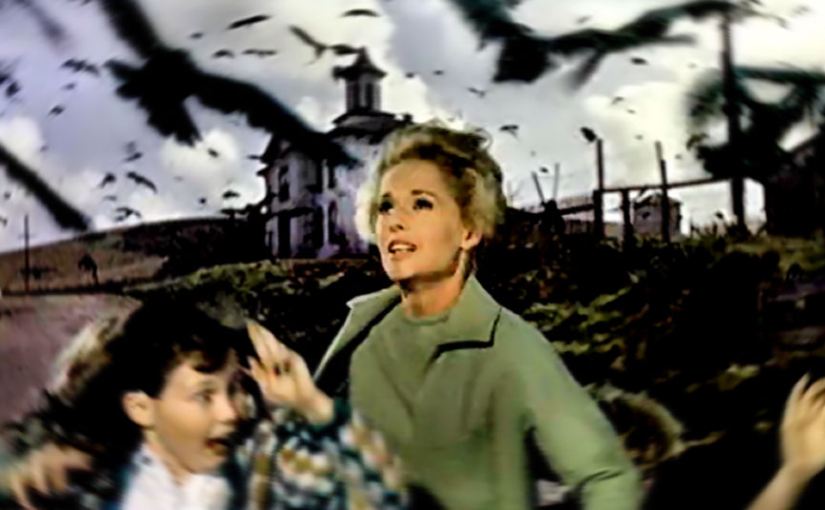
Alfred Hitchcock’s monster movie is The Birds from 1963.  There’s really not much to the piece as far as a story goes.  Characters are just given a purpose to be with one another so that they can be tormented together.  In this case, the film offers up a near hour introduction of newspaper heiress Tippi Hedren playing meet-cute with attorney Rod Taylor.  How ironic that they begin a flirtation in a bird shop of all places only to reconnect at Taylor’s harbor island home in Bodega Bay, located on the outskirts of San Francisco.  Still, as only Hitchcock can demonstrate there’s an ominous feeling sprinkled throughout before the real terror takes flight in the movie’s second half.

While I don’t rush for repeat viewings of The Birds, there’s no doubt as to its influence.  Each time there’s a shot of a bird soaring in the sky, your eyes open wider.  Something will eventually take effect.  At the beginning of the film, Hedren looks out into the San Francisco sky to see large flocks of birds soaring overhead.  Later, while taking a boat in Bodega Bay towards Taylor’s home that he shares with his mother and sister (Jessica Tandy, Veronica Cartwright), she’s attacked by a random gull.  It’ll raise the hair on your arms for sure. 

I’ve noted before how Alfred Hitchcock builds suspense.  The audience knows there’s a bomb under the table.  The characters in the film don’t. So, the audience is nervous as to when the bomb is going to go off or if the characters are even going to discover the explosive.  An outstanding sequence in The Birds includes Tippi Hedren sitting on a park bench near the jungle gym, outside of a school house.  The children are singing along inside.  One crow lands upon the jungle gym.  Then Hitch returns to a shot of Hedren calmly lighting a cigarette.  Then back to the jungle gym and there are four more birds perched just behind her.  Then back to Hedren, unaware.  Then back to the jungle gym for Hedren to turn around and there are suddenly hundreds of crows congregated together.  Effectively, other than the innocent harmonies of the children nearby, Hitchcock opts not to use any music to shock his audience as the scene develops.  The visuals lend to the fear.  The danger that threatens Hedren and the children heard off screen is at the forefront of the viewer’s mind.  No more is needed.  It’s scary, and you want to be as quiet and unalarming as Hedren so as not to instigate the monsters right next to you.

A later scene has Hedren ascend a dark staircase to open a bedroom door.  The roof has been torn open and suddenly the blackness comes alive with flapping wings from every direction.  That’ll make you shift in your seat.

Hitchcock offers plenty of set pieces for bird attacks, but another effective device is to show dissention among the ranks.  From a character perspective, the picture takes a sideways route to imply an oedipal complex between Rod Taylor and Jessica Tandy, who plays his mother.    Therefore, the script suggests Hedren as a threat to their relationship.  Before the film is over, they are likely going to have to develop a united front or it could be their undoing.  (Maybe it’s a nod to Hitchcock’s popularity with Psycho. A cute wink and nod.)

There’s also Suzanne Pleshette as the school teacher that we learn had a tryst with Rod Taylor’s character at one point.  That doesn’t spell out too well for Hedren, either.  As this bizarre epidemic becomes clearer, a scene in the town diner goes so far as to suggest that these random bird attacks didn’t start until Hedren arrived the day before.  Yes!!!!  It’s all her fault!!!! 

None of this will eventually matter though.

Other disaster films and monster movies later relied on exchanges like these, from Jaws to The Towering Inferno.  Hitchcock was wise enough to build tension.  Not a single bird in the scene, but still the fear and doubt among each other bares the strain.  There’s even an advocate for the birds with a strange elderly woman proudly debating her ornithological expertise, while a drunkard at the end of the bar declares the world is coming to an end.  All of these characters could have come from different movies, only to be pasted on to this canvas thereby lending to the frenzy.  Chaos must ensue among the masses.

Often, I get frustrated when there’s no explanation for a film’s central story.  I gave up on the TV show The Walking Dead many years ago because there never was a cause revealed for the zombie epidemic.  It became a smut of soap opera cliché accompanied with ridiculous gore.   Forgive the SPOILER ALERT, but I commend Hitchcock’s film for not providing a wrap up to The Birds.  The film ends with an uneasy final caption.  Nearly every inch of space on the screen is occupied with birds as the cast makes their way to the car to slowly drive out of town, careful not to disrupt the now dominant species of this universe.  Hitchcock provides a picture where the laws of nature declared a winner.  As intelligent as humans are considered to be, they have not won out.  They have had to surrender.  Why the birds attacked, we’ll never know.  Odd phenomena can happen.

There’s nothing thought provoking about The Birds.  It’s simply a film based on heightening your discomfort.  Often, I find the material and dialogue laughable.  The townsfolk notice a man lighting a cigarette right over a stream of gasoline and urge him to put out the flame.  Wouldn’t the dumb guy smell the diesel?????  However, then we wouldn’t get a fantastic fire ball to observe up close as well as from Hitchcock’s “God shot” in the sky with the birds looming into frame over the town below. 

The visual effects look outdated of course, but they still hold because of how Hitchcock demands they are used.  I noticed that his reliable composer Bernard Hermann is credited, but as a “sound consultant” this time.  The shrieking of the birds is what sends the chills down your spine.  Also, there’s the fact that Hitchcock offers up birds flying right at the screen or the windows.  A great sequence includes the front door of a house being gradually shredded apart by the bird masses.  The wood proceeds to splinter.  You don’t see the monsters but you know they’re right there on the other side.  Once that door breaks open or those windows shatter, then it’s likely all over for our heroes.  George A Romero exercised bits like this in Night Of The Living Dead.  Very, very effective.

The Birds is just okay for me, honestly.  The fright material is what keeps its legacy.  Yet, there’s a lot of soapy material among the cast of characters that’s not all that interesting.  Again, a purpose has to be served for these people to occupy the story.  Just offering a movie where birds hover and peck at people wouldn’t be enough.  So, we have to follow Rod Taylor and Tippi Hedren’s trajectory.  It’s fun to see screaming kids run from these animals turned menace, though.  I found it hilarious to watch a birthday party run amok.  I also yelp when I see a flock storm into Jessica Tandy’s house from the chimney turning the living room into a contained disaster area.  An especially gruesome discovery by Tandy later in the film is absolutely eye opening (pardon the pun, if you know what I mean), and clearly an inspiration to a well-remembered scream out loud moment in Jaws.

The Birds is fun, but it’s not the artistic merit you’ll find in other Hitchcock classics like Rear Window, Vertigo, Suspicion, or even Psycho. What I can promise is that once you get through the plodding character connection build up, you’re allowed to forget about any of their value to the picture and simply relish in the mayhem.