A MAN CALLED OTTO

By Marc S. Sanders

There’s A Man Called Otto who seems to be liked by everyone except himself. People in his neighborhood happily say hello to him every morning as he shovels the snow off his walkway.  They will try to chat with him on their morning jog.  He won’t even allow his work, where he was forced to retire, to send him on his way with a celebratory going away party. 

On the other hand, Otto prefers to occupy himself with insisting that the UPS truck driver not drive down their block, sniffing out whose dog left behind a present on his yard and scaring off the real estate agent in the fancy BMW who attempts to convince elderly residents to sell their townhomes and move into assisted living.  A new family moves in across the street and they appreciate Otto’s grumpy insistence of properly parking their car with a U-Haul trailer attached.  What Otto doesn’t appreciate is how one more attempt at a planned-out suicide is foiled by their disruption.

I’m told this late 2022 release is an adaptation of book called A Man Called Ove, which was also turned into a European film that is supposedly better than this picture.  I can’t offer an opinionated comparison as I have neither seen that other film nor read the book.

Tom Hanks is the title character in this film from Marc Forster.  He’s very good and right for the role.  I’m one of the few who find Hanks to be miscast on occasion.  Not here though.  His performance had me thinking back on a more subdued Jack Nicholson in About Schmidt.  Hanks has transitioned finally to the older generation of characters that are not as wide eyed with discovery, innocence and gusto that were depicted in films like Philadelphia, Big or Forrest Gump.

Marc Forster is striving to tug at the heartstrings.  Flashbacks of Otto when he meets his eventual wife, Sonya (Rachel Keller) hint at what led to his current state of nonstop crankiness.  Otto’s a widower but why is he so bitter with himself or any kind person who comes his way?  The younger Otto is portrayed by Truman Hanks, one of Tom’s sons in real life.  It’s inspired casting, because there is a consistency towards the mannerisms and personality within the two separate performances.  Truman Hanks and Rachel Keller pair up nicely as young adults from different backgrounds who convincingly fall in love.

The standout though is the pregnant wife/mother of the new family who’s moved in. Mariana Treviño is Marisol, and she is superb in her comedy as the Hispanic neighbor who is always getting in Otto’s way with prepared home made food to bring over while she relies on the grouch to babysit her children or give her a ride because she doesn’t have a license.  Eventually, a terrific scene arrives where Otto is teaching her to drive, and the two characters open up to one another despite their different backgrounds.  Treviño carries so much range with her part.  She’s ditzy but intelligent, sensitive, and very warm, lovable, and funny.  Every time she appears on Otto’s doorstep, Marisol is a new surprise.  You might think at first that she’s scatterbrained.  When you see her next, she’s intuitive.  Otto may think she knows this person from just one or two encounters, but Mariana Treviño’s performance is so well done and beautifully written that even the viewer really doesn’t know her until the climax of the film.  If A Man Called Otto had gotten a little more publicity traction upon its release, she could have been an Oscar nominated contender.  I think she was definitely worthy of more praise than I could uncover.

The script sets up a lot of questions that carry the film and keep it interesting.  Otto’s internal crisis is one thing, but there’s also a neighbor’s mute husband who apparently shares history with the title character.  There is also a scheme being plotted out behind this pesky real estate agent who blasts his hip hop music from his luxury car. (TRIVIA: Another son of Tom Hanks, Chet, is the rapper heard on the radio.)

I was never really convinced that A Man Called Otto could be a real-life story, however.  Call me a cynic, but the number of sweet natured people all living in one small space seems far-fetched.  These happy go lucky folks, including a transgender teen (Mack Bayda, wonderfully likable in his first film role) who was kicked out of his father’s house, find so much positivity out of life.  I’m not sure real life lays it on this thick!  Sometimes, the side characters appear like walking Hallmark cards.

I also felt uneasy about the suicide theme that is most prevalent throughout the picture.  I think I counted four different ways that Otto attempts to end his life (hanging, shotgun to the mouth, jumping in front of a train, carbon monoxide poisoning).  Each attempt is interrupted somehow and how it’s done is nothing so inappropriate or spoofed, but it is done with an intent of irony and humor. It started to feel comparable to another foiled attempt by the Coyote trying to capture the Road Runner.  Looney Tunes serve a purpose escapist slapstick.  Suicide, even when cheerfully disrupted, often doesn’t put a smile on my face. 

Otto does go through a character arc that I appreciate though where demonstrations of heroism and soul saving are captured.  The ending, while sad, is also quite rewarding.  With Marc Forster’s film, I’ve gotten to know a beautiful collection of well-intentioned and thoughtful people who do not give up on trying to rescue one of their own from a life currently mired in misery. 

A Man Called Otto is a good film worth watching.  The cast is absolutely wonderful and through the performances, everyone seems positively proud of what they accomplished with the final product.  I’d be up for seeing this exact same cast perform this script live on stage.  Still, I offer a warning of caution.  While it is trying to deliver sugary optimism at every turn, it is also coming off a little bit like artificial sweetener. 
THE HUNGER GAMES

By Marc S. Sanders

Some of the worst atrocities in history have often spawned some of the greatest stories.  I’d expect it would at least leave us feeling melancholy, but I hope it shapes a future that learns from humanity’s worst offenses.  That’s what came to mind as I watched the film adaptation of Suzanne Collins’ dystopian best-selling novel The Hunger Games.

In what was once a supposed North America, the continent is now called Panem and it is divided into twelve districts, with each specializing in some means of living.  Districts 1 and 2 are the upper-class wealthy.  Districts 11 and 12 are the starving destitute.  To maintain a semblance of order, President Snow (a chillingly older Donald Sutherland) oversees the nation’s Annual Hunger Games where a boy and a girl from each district is selected to compete in a dangerous competition of being the last one to outlive their competitors.  May The Odds Be Ever In Your Favor!  In the 74th edition, expert hunting archer Katniss Everdeen (Jennifer Lawrence in her most celebrated role) volunteers herself from District 12 to spare her younger sister from danger and selection.  She is paired up with the District 12 boy, Peeta Malark (Josh Hutcherson). 

Like any sporting competition, Collins’ story takes time to hype up the event.  The youths are fashioned up in the most glamourous adornments and interviewed for television by Caesar Flickerman portrayed by a delicious, yet unsung Stanley Tucci in bright blue hair and sparkly suits, doing his best Griffin, Carson, Letterman, Leno, and O’Brien.  With every white molar revealed in Tucci’s broad smile, he appears even more sinister in the purpose he serves for the Games, Panem, and President Snow.

Jennifer Lawrence gives a faithful portrayal to the Katniss character found in the pages of Collins’ series of young adult novels.  A new hero has been conceived – the rebel who stands along other well knowns like Luke Skywalker, Robin Hood and Harry Potter.  Katniss is not looking to be a savior but with influence from a prior Hunger Games champion (Woody Harrelson, doing his drunken best) and a calm, but humble fashion designer (Lenny Kravitz) she finds herself elevated towards a promising future.  Katniss Everdeen inherits the moniker known as “The Girl On Fire” with a three finger salute and a somber three note battle cry harmony.

I’ve likened the setting of The Hunger Games to the Holocaust and the early twentieth century European Nazi occupation.  (It seems more apparent in the next film, Catching Fire.)  If I had to compare the real-life period to this fictional one, then they are not anywhere close.  Yet, Suzanne Collins and director Gary Ross’ film depict hardship and oppression from a ruling upper class gleefully using their young for savage sport entertainment, while being forced to dwell in concentration camps with no permission to escape or run free, lest they suffer terrible punishments for themselves or those they care most about.

The Hunger Games values the themes of sacrifice while some characters inadvertently become heroes for a people against a domineering force.  It’s fantasy.  It’s adventurous.  It’s sprinkled with romanticism for Katniss and the triangle she’s pitted within for her care of Peeta but also her loving affections for another District 12 resident named Gale (Liam Hemsworth).   Frankly, the romance angle is a little weak in the films and books.  Ultimately though, it is harsh for the young characters in the story, which is why my wife refuses to invest her time.  I empathize with her position.  However, I find the story inspiring.  It’s also a hell of a thriller.

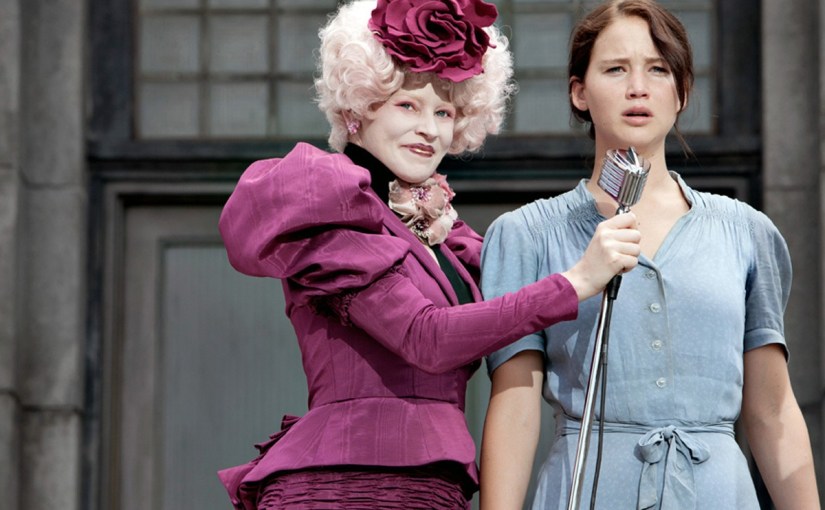
As a film, Gary Ross assembled a strong and alive production of gaudy, bright colors within the capital against morose grays found in District 12.  The clash of the two settings is no more apparent than when squeaky Effie Trinkett in her garishly loud facial makeup and wardrobes arrives in District 12 to host the Reaping, also known as the selection of the child contestants.  So many actors in this cast are memorable.  An unrecognizable Elizabeth Banks is no exception.  As Effie, her personality that publicly represents a hesitant Katniss and Peeta is deliberately inappropriate and further demonstrates how demonically twisted the mentality of The Hunger Games truly is. 

When it is time to finally arrive at the manufactured arena where the contestants will do battle to the death, Gary Ross effectively incorporates the inventive surprises offered by Collins’ source material.  Some competitors are brutal in their combative skills, but environmentally speaking the forest like jungle is dangerous as well.  Especially notable is a hive of stinging tracker jackers that’ll leave the viewers shaken. 

Suzanne Collins’ first installment of her series persists in leaving its ending completely questionable.  Will all these children, some of them who are noble and good, actually die?  Could a good soul like Katniss follow through with what the Games demand of her like killing Peeta for example?  I appreciate the imagination that went into the ending, leaving a subsequent tale to be told beyond this film.  

My one complaint is common in action films.  Gary Ross does really well with the edits and filming of his movie.  However, one of the last scenes develops into a hand-to-hand combat moment taking place in darkness with very shaky camera work and uneven grunts, punches, and kicks.  I abhor when filmmakers go this route.  It’s lazy work.  I can’t tell who is hitting who or where.  I’m just supposed to accept the final struggle that the hero is having with the bad guy and feel a sense of urgency and suspense as they supposedly cast a harsh blow to their enemy and fall over. I might as well close my eyes during moments like this because it’s all just blurry streaks in midnight blackness with sound editing filtered into the sequence.  This tiring approach happens so often in movies, and it becomes a let down for me time and again.   I love a well-made, thought-provoking thriller but the filmmaker hacks it all up near the end and it looks like he’s got to meet a deadline for the final print to get out to the theaters.

There’s much to discuss and think about in The Hunger Games.  Suzanne Collins’ idea stemmed from how television viewers soaked up the drama found in reality tv shows like Survivor and Big Brother.  It’s not so much the fate of the contestants that we care about, but how do they serve the producer’s crafted storylines.  Even American Idol steers the drama of the kids who get their shot at Hollywood fame.  The Super Bowl will position a star player like Tom Brady as a focus with questions of whether this is his final season, and how the championship games affect his marriage and family.  Does he get along with his coach?  None of this has anything to do with the points on the board.  Is all of this about the games, or is it about those tasked with playing the games, and for whose benefit of control, wealth, and power?  In this fantasy film, do the people of Panem cry at the drama spurned from the horrifying death of a child they got to know from Caesar’s colorful interviews, or are they in despair at the loss of another young life?  Whether it is real or fictional, is the drama of these gladiator games and competitions focused in the right direction?

The cast and production team under Gary Ross have put together an effective dystopian and bleak future reliant upon what the world focuses on more than anything beyond who they truly love or what they stand for.  The Hunger Games might seem inconceivable, but it is frighteningly relatable. 

CLIFFHANGER

By Marc S. Sanders

It’s an action picture.  What’s common?  Sylvester Stallone, the MacGuffin is money, and the villain has a European accent.  What’s uncommon?  The setting is a Colorado snow covered mountain. 

The movie is Cliffhanger directed by Renny Harlin.

This film deserves much praise for the photography it offers of Stallone and his sidekicks (Michael Rooker, Janine Turner) scaling steep rock formations while trying to evade brutal, but moronic, thieves who have foolishly lost their booty in midair. Now the bad guys must recover the stolen Federal Reserve bills which are scattered in three different locations within the mountain range.  When their plane crashes they force the heroes into leading them on an expedition to locate the money before they will surely kill them.  John Lithgow leads the villains.  Thanks to his slithery English dialect, he’s not bad in the part.

For a pinch of character depth, Gabe (Stallone) is haunted by the opening scene of the film where he failed to rescue the girlfriend of his buddy, Hal (Rooker).  Gabe and Hal will be awarded the opportunity to make amends thanks to this unexpected adventure.  Cliffhanger is not just a thriller.  It’s also a chick flick for guys. 

On a modern flat screen TV, it is quite discernable to recognize the CGI and handcrafted sets that make up much of the scenes.  However, the thrill of it all still holds up and as noted before, the overhead shots really look spectacular.  Stallone really is hanging from these bottomless heights with just one hand; at least that’s what it looks like.  If there is an illusion at play, then there are moments where I can’t tell if I’m being deceived.

The opening scene is the highlight of the picture as Gabe must zip line himself upside down over a wide crevice while attempting to save a hapless climber whose harness has given out.  It’s impossible not to sit still during a well edited and directed moment like this.  This is a masterful scene of terror and suspense.  Renny Harlin is certainly an undervalued director in the action genre.  (I wonder what he’s been up to these days.)

The bad guys are quite hapless though, as they freely bicker among themselves and give away how they’ll happily kill the heroes quickly, allowing one to warn the others.  They are dumb right from the start by killing the pilot of the plane they’re on before fully completing their mission and idiotically losing the money at play.  Then again, as my Unpaid Critic colleague would say, “Then there’d be no movie.”  True Mig!  Very true.

Still, the atmosphere of Cliffhanger is what works.  Blustery snow and wind come off convincingly as Gabe is forced to freeze and shiver with no layers to keep him warm while executing some daring escapes.  Rescue helicopter stunts and collisions are sensational.  There are obligatory shootouts and bloody slashes of skin from climbing tools.  There’s even a bat cave, with no superhero in sight, but it will give you the willies.

I’m hot and cold on many of Sylvester Stallone’s films.  Don’t get me started on Assassins with Antonio Banderas or The Specialist with Sharon Stone.  Those movies required some nuanced acting that the action star just wasn’t offering.  However, here the adventure makes the piece thanks to the director, and Stallone fits right into this environment where the role demands strength, stamina, and outdoor intuition.  Renny Harlin is the top hero here, allowing the marquee actor to look really good on screen.

AIR

By Marc S. Sanders

Pop culture for me began in the early 1980s.  Burger King had Star Wars glasses to collect. Everyone was running to the theatres to see Beverly Hills Cop.  Ray Parker Jr asked us who we were gonna call, and a little old lady wanted to know “Where’s The Beef?” 

Apparently, basketball was big too.  I wouldn’t know.  I only followed sports once in a blue moon.  However, I wanted the high-top sneakers that all the guys were wearing, the Nike Air Jordans.  Couldn’t make a free throw shot to save myself, but I explained to my mom that I just had to wear the shoes.  I owned two pair – one was charcoal and white and the other were black and blue.  Beautiful accessories to go with my Levi jeans, Ralph Lauren Polo shirts and my Member’s Only jacket.

All of these memories flooded back to me as I watched Ben Affleck’s latest directorial production called Air.  The film recaps how Nike, a distant leading third place sneaker brand in the USA, signed the eventual greatest basketball player to ever perform on an NBA court, Michael Jordan of the Chicago Bulls, as the celebrity face for its flagship shoe that still reigns supreme today, over forty years later.  Air is not so much a sports movie, as it is that rare breed of film hardly touched upon.  Air is an inspirational, stand up and cheer success story of capitalism and materialism. 

The year is 1984.  Nike’s headquarters reside in the sleepy state of Oregon.  Affleck’s longtime friend Matt Damon portrays Sonny Vacarro, an out of shape Vice President of Marketing for Nike who is tagged with finding the next flash in the pan basketball star to sponsor their shoes.  Sonny can recite statistics and facts about any past or present player in the league verbatim.  He also has a knack for recognizing the potential of up-and-coming stars fresh out of high school and college.  Nothing seems interesting, however.  Sonny religiously watches videotapes of game footage and one night it occurs to him that a rookie kid named Michael Jordan is the answer to Nike’s stagnant profit and loss statements. 

Sonny’s got challenges to overcome though, like convincing his fellow executives played by Jason Bateman and Chris Tucker to jump on his campaign.  He also needs to get Phil Knight (Nike’s CEO, played by a bearded and often barefoot Affleck) to invest their entire $250,000 budget in the faith of one player with no proven track record, as opposed to spending the money on multiple players.  It’s like playing roulette with everything on Red 23.  Perhaps the hardest obstacle will be swaying Mr. Jordan’s tough and intuitive mother, Deloris Jordan (Viola Davis, a clear front runner for Best Supporting Actress), to go with this company, as opposed to Adidas and Converse who seemingly can provide for any of her son’s requests, including a shiny red Mercedes coupe on top of any dollar figure imaginable.

Ben Affleck’s direction, with Alex Convery’s script, works so well because it operates on industry.  Vaccaro not only travels unexpectedly to the Jordans’ home in North Carolina, but he’s constantly working the phone on Michael Jordan’s ball busting, slick and foul-mouthed sports agent (Chris Messina giving a hilarious performance worthy of a nomination as well.).  The negotiations these guys communicate with hinges on how descriptively ugly they can be with their dialogue and tete a tete cursing.  Every conversation has to end with that much more of a dramatic hang-up.  Sonny also must take the elevator down to the design center basement, and delegate a quirky kind of guy (Peter Moore, played by Matthew Maher) with designing a shoe that stands above anything ever seen before. 

There’s a process to how to some of the most well recognized manufactured goods in the North American continent came to be and continue to circulate for decades on end.  It could be Coca Cola, or Ray Ban sunglasses or Ford Mustangs or Nike Air Jordans.  Matt Damon is the energetic thread that is connected to every ingredient and participant responsible for this finished product. 

Outside of the operation is the quiet Deloris Jordan protecting the best interests and image of her talented son.  She will ensure he is not taken for granted and most importantly he will be the one credited for every consumer who puts a pair of Air Jordan shoes on their feet. 

In less than two hours, Ben Affleck uses Convery’s script with perfect efficiency and time devoted to a passion for Sonny Vaccaro and a careful process of examination by Deloris Jordan.  Matt Damon and Viola Davis are so much in tune with their respective roles. In fact, the whole picture is perfectly cast.

This is a story that takes place in boring offices and cubicles.  Yet, the film comes alive with a culturally relevant soundtrack of pop culture music of its specific year, 1984, when life for middle class families seemed easier following an exhausting Vietnam War and an assurance of politics from a US President who held office for most of the decade.  People went to the movies in the summertime. They watched Dallas and Miami Vice on Friday nights.  Teens wore the one glitter glove on their hand as a salute to Michael Jackson.  Kids collected Care Bears, He-Man toys, and Garbage Pail Kids cards, and they saved up their money to emulate a basketball superstar by wearing his brand name shoes.

Too often films reflect back on business and industry that has betrayed the buyers and investors.  Films like The Big Short and a few interpretations of Bernie Madoff’s pyramid scheme come to mind.  I’m waiting for the movie that will focus on one of the greatest foul ups in business history, New Coke.  Air reminds me that we don’t have to always embrace the tragedies of business operations by focusing on where it has failed us time and again. 

Nike Air Jordans are an expensive epitome of materialistic need.  Yet, business is also about giving consumers what they want, and if that is done, then its success spreads to prosperity and financial security for many parties throughout the nation and the world.  Air is a film that should be shown to business majors in universities.  It teaches the art of risk, passion and confidence when taking on an investment and holding on to who can be each generation’s next hero. 

Air is a standout film, and I’ll accept the risk of declaring it one of the best films of 2023.

LAWRENCE OF ARABIA

By Marc S. Sanders

The moment finally arrived where I was able to see David Lean’s epic, also regarded as my colleague Miguel’s favorite film, Lawrence Of Arabia.  It truly is an eye-opening spectacle, and one of the most beautiful pictures I have ever seen, especially enhanced by an up-to-date Blu Ray restoration.  With a near four hour running time there is hardly an element or sliver of film that does not appear out of place.  Far ahead of the conveniences of dazzling special effects and CGI to arrive later in the twentieth century and beyond, Lawrence Of Arabia must be one of the greatest cinematic achievements ever created. 

When you factor in what David Lean made with an earlier picture, The Bridge On The River Kwai, it is fair to say that he was the James Cameron of his time – a bold, daring film director who did not surrender until every shred of a masterpiece was included in a final cut.  What puts a man like Lean ahead of Cameron perhaps, is that he depended on the resources of thousands of human extras and animals, broad desert landscape locations, painstaking architecture to set designs and buildings, along with authentic explosions and battlegrounds while delivering the story of British Lieutenant T.E. Lawrence and his efforts to aid an Arab nation into battle against the Turks during World War I. David Lean was persistent in bringing as much natural quality to his finished product as possible.  In fact, Miguel informed me that Lean was seeking out any possible way to point his cameras at the desert sun to heighten the feeling of the sweltering, unimaginable heat endured by his cast of characters.  It likely pained Mr. Lean that he had to settle for an optical illusion.  Nevertheless, when I was watching the movie, it did not occur to me once.  I was still appreciating his strive for absolute authenticity.

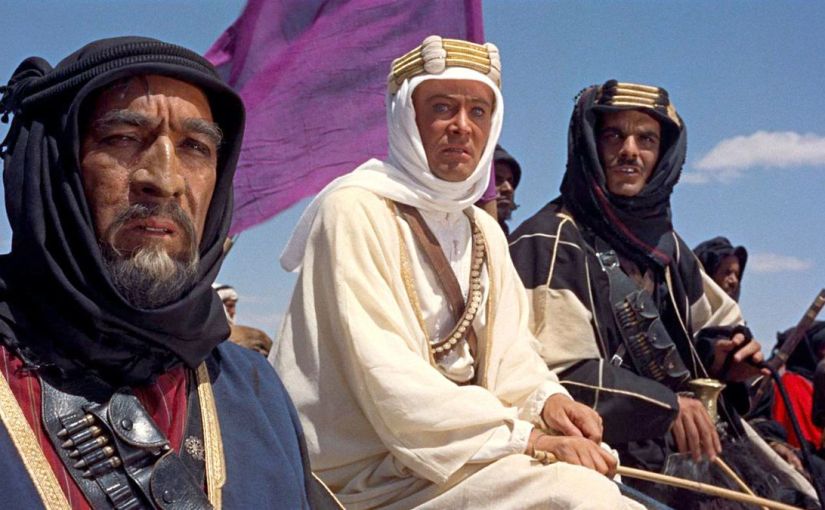
Peter O’Toole is the title character in his unforgettable film debut.  A daring, handsome, charming blond leading actor poised for adventure.  Lawrence is assigned to ally with the Arabs during the war to hold on to the necessary access of the Suez Canal which is a through way for oil, supplies and territory.  His determination for crossing wide, endless desert plains under a sun drenched open blue sky turn him into a leader, and a hero to the Arab soldiers, particularly represented by Sherif Ali (Omar Sharif).  They are a small band of fifty men, but Lawrence proceeds with the intent of gaining fifty more as he begins a long trek from one side of the desert to the other with persistent walking or by riding camel.  Lawrence won’t even leave a single man behind.  His resolve is courageous but could be costly later.

The technical construction of Lawrence of Arabia is likely what many notice and remember first, but the film comes with a well-set character arc for its protagonist.  Peter O’Toole was a perfect casting selection for this role.  Lawrence changes over the course of the film and it’s not a celebratory transformation.  Oft times, it seemed ironic to consider him the villain; perhaps a hero who falls from grace.  His derring-do is impressive, but likely also his undoing.  Lawrence allows strength and confidence to awaken a weak Arab nation who only survived for themselves with what little they held onto before their encounter with him.  Yet, the monster Lawrence creates within his own psyche may have also spawned a challenging threat from the Arabians for many years to come, long after this war is over and further generations come into play.  Bless a people with power but be aware of how that gift is used thereafter.

Lawrence accomplishes what has been regarded as seemingly impossible and now the Arabs adorn him in heroic white cloths (which must be one of the memorable costumes in film history).  He is who they look up to as the giver of their strength and confidence.  However, like most heroes that we find in the best of stories, T.E. Lawrence is weighed by fault, particularly his own hubris.  After his conceit gets him captured and tortured, it is not so easy to return to his home country who insist he continue to carry out his leadership.  Madness is invading his mindset and the hero we have borne witness to for well over two hours of film is now significantly diminished.  Parallel to that is the overconfidence and newfound freedom a political leader like Prince Faisal (Alec Guinness) absorbs for his Arabian people.  The end of David Lean’s film seems to imply what came of T.E. Lawrence’s contributions to the Arabs.  Was the world better or worse for what he achieved with his pioneering, yet dedicated military efforts?  What about Lawrence?  How did he fare, personally?

Forgive my incessant urge to compare David Lean to James Cameron.  I look at a film like Avatar and I see the monies and efforts invested to make that piece.  Yet, I feel like I walk away with little substance.  The films of Cameron not only fall short of story, but often lack texture as well.  I could never reach out and shake the hand of a “Pandoran.”  When I see Lawrence Of Arabia, though, I can feel the sweat and heat that O’Toole and Sharif experience.  Both are big films, not made on the fly. Rather, time and stress and a means to improve and show what’s never been seen or done before are offered.  David Lean might have been given all the monies in the world or the keys to kingdom to make his masterpiece.  However, it’s how he used these resources to painstaking perfection that lend to longevity in reputation for his career and Lawrence Of Arabia.

A train explosion near the start of third act is very impressive.  Lawrence and his men detonate a planted bomb on the tracks, and we see the locomotive derail onto its side, plowing into the hot desert sand.  We feel the immense weight of that steam engine.  We can detect the sand cloud that forms from the crash.  The collision of the cars being ripped apart and burned black thus create a new setting as Lawrence’s Arab followers rush to loot the train.

Grand battle scenes on horse and camel backs are meant to be seen at least ten times over in order to capture every piece of activity from the numerous extras and animals occupying a thousand different corners of the screen.  The bigger the screen, the better enhanced is the viewing experience. 

Long walks and camel rides in the desert may seem tedious for some, but not for me.  I was accompanying T.E. Lawrence and Sherif Ali on this journey.  This is another film where its running time affects what Lean set out to accomplish.  A trek through the desert is impossible to rush and this film is a testament to that notion.  I can’t say I’ve hiked through a desert plain that bears no end in near sight, but now I can lay claim that I’ve watched Lawrence Of Arabia.

Having only seen David Lean’s picture once thus far, I know that on repeat viewings I’d likely see something new each time hereafter.  This film is so alive of its period setting and backdrop and the unforgettable original score from Maurice Jarre give definition to the sweeping adventure that awaits with T.E. Lawrence’s travels.  The cast is marvelous as well.  Peter O’Toole is positively engaging.  Omar Sharif and Anthony Quinn are scene stealing character actors, much like Robert Shaw would become known for a decade later with Jaws.  Alec Guinness may be doing a brown face appearance as an Arab leader, but I’ll just salute the performance.  A charming actor of grand, yet subtle, skill.  I’m glad I’ve discovered him all over again from beyond …River Kwai and Star Wars.

Movies like Lawrence Of Arabia must remain at the top of the broad lexicon of films to watch.  It’s length and scope may be challenging, but its edits, its score, its immense visuals, and the performances therein, are unmatched by most anything else available to watch. 

MIDNIGHT COWBOY

By Marc S. Sanders

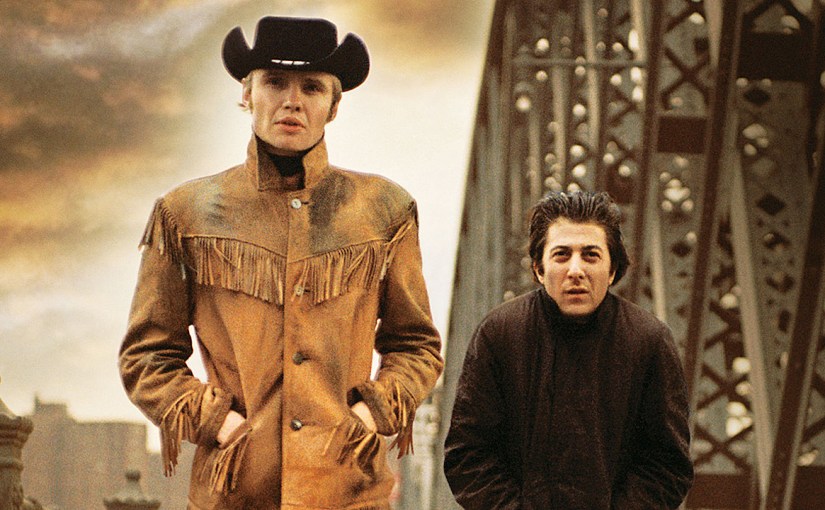
There’s an irony to John Schlesinger’s Midnight Cowboy.  At first, the film centers on a Texas bumpkin eager to relocate to New York City and succeed as a hustler.  Upon his arrival though, he could not appear any more virginal.  The cowboy’s name is Joe Buck, portrayed by Jon Voight in his Oscar nominated breakthrough role.

The first act of the film follows Joe on his long cross country bus ride.  He’s dressed in his finest country western shirt, stitched with floral patterns.  He’s got his black leather cowboy boots and of course the cowboy hat.  His origin bred Texas twang completes his image.  He meets a variety of comers and goers on the bus and then finally he reaches his destination. 

Schlesinger’s camera follows Voight as he treks through the city.  A man is passed out (heck, maybe he’s dead) on the street in broad daylight.  My Cinemaniac pals that I watched the film with noted how it’s funny that the streetwalkers don’t take one look at the poor fellow.  Rather they’re looking at Joe’s get up as he clearly stands out among the masses. Joe is the only one looking at the guy on the street.

Interspersed within Joe’s travels and entry into the city are quick flashbacks to where he stemmed from.  It does not look like a favorable upbringing spent with his grandmother.  There are flashes of Joe being victimized by possible sodomy.  There also appears to be a gang rape that he might have participated in.  None of it is made completely clear.  Though, it is evident that Joe has been trying to escape that environment for good. 

Eventually Joe encounters a sleazy, squat fellow who calls himself Rico Rizzo (Dustin Hoffman), addressed by others as Ratso.  Joe is so naïve that he’ll trust Ratso to get him some action where he can earn some money.  In exchange, Joe is completely willing to surrender the cash in his wallet.  He’ll learn from that mistake once he’s drained of everything but a few coins, locked out of his hotel room he can’t pay for and denied of his cow skinned suitcase that contains his possessions.  Eventually, he has no choice but to live in a condemned tenement building with Ratso. Joe Buck is about to lose a second virginity as he experiences how hard it is to live within the city.  He’ll also realize the value of friendship as he sees no choice but to take care of Ratso who is very sick.  Hoffman’s appearance shockingly changes as Ratso’s health submits to a harsh, unknown illness.  The sweat all over his face is palpable.  The chilling, sickly feeling he exudes is clearly felt.

Waldo Salt’s award-winning script, based upon a novel by James Leo Herlihy, explores the good nature found within two different walks of life despite the dodgy pasts that follow them. Ratso and Joe are one of the oddest couples in cinematic history.  There’s no way these two would want to be together unless one was trying to take advantage of the other or one was left with his guard down, open to being taken for and deceived.   Jon Voight has a tall youthful stature, a handsome man.  Dustin Hoffman is scrawny and significantly shorter with greasy hair, an uneasy limp and a weird squawk to his voice.  The often-times method actor seems to make himself increasingly hideous. 

Perhaps I needed to see Midnight Cowboy at the time of its release.  It surprises me the film merited the prestigious accolades it collected, including Oscars for Best Picture, Director, and Screenplay.  The two actors also received Oscar nominations.  It remains an honest film of its time in the year 1969.  Yet, it is disturbing and ugly too as it captures the seedy side of New York with experimental drug use and Joe’s victimization for sex.  He gets ripped off by who he thought was a kind woman (Sylvia Miles) looking for an intimate evening with his hustler capabilities.  Later, he’ll surrender himself to a man looking for oral pleasure in a movie theatre.  It’s not the typical glamourous epic of a Hollywood yesteryear.  In fact, for a time it was the only film to be recognized for winning Best Picture with an X rating.

The celebration of Midnight Cowboy’s achievements falls upon the relationship between Joe and Ratso.  Had Joe not been so naïve to how lowlifes operate and had Ratso not become so ill, yet welcoming to Joe when he needed a place to stay, then a friendship would not have gradually developed. 

The ending to Schlesinger’s film is touching, though sad.  As the story began, it also ends on a bus heading towards a new destination – another new way of life, different from what Joe experienced in small town Texas or New York City.  The two characters sit together in the back seat and the other passengers eventually observe them like they had on Joe’s first journey.  Either individually or together Ratso and Joe are simply strange to any sort of environment.  Yet, they’ll learn from each other and that’s where Midnight Cowboy triumphs.

THE BREAKFAST CLUB

By Marc S. Sanders

The outcry of teen angst in the 1980s comes through predominantly in the dramatic talking piece called The Breakfast Club.  I look at the film as a mature interpretation of Charles Schultz’ Peanuts Gang actually, and maybe an extension of some of the themes found in Steven Spielberg’s E.T. The Extra-Terrestrial.  The children are heard.  The adults are present but are mostly muffled and out of consideration.  Writer/Director John Hughes wanted the five teenagers destined to occupy a Saturday in the school library for detention to completely undo their armor.  With adults in the way, kids can never truly be themselves.  Lies, exaggerations and attempts at acceptable image come first but as his script progresses, the teens are reduced to expressing how they value themselves and each other. 

Having grown up watching The Breakfast Club by myself on many Friday nights after some challenging weeks of school, I was always looking to sit on the floor with this pack and share my own demons and fears.  Sometimes it worked.  Sometimes I felt as if the brain (Anthony Michael Hall, as Brian), the athlete (Emilio Estevez as Andrew), the basket case (Ally Sheedy as Allison), the princess (Molly Ringwald as Claire) and the criminal (Judd Nelson as John) spoke back to me and told me when I was wrong or when I was justified for having felt like I did. 

Nearly forty years later, some of the thought processes the five endure of themselves seems outdated and inappropriate, however.  For example, in Hughes’ film the female characters are sexually harassed, harshly criticized and/or they succumb to stepping outside their comfort zone and changing their appearance to please a male character.  Had this film been released in a post Me Too era, I think both sides of the political aisle would protest its content.  The Breakfast Club is certainly a movie of its day where it’s treated as comedic escapism to have Nelson’s character commit a fellatio act upon Ringwald’s panty covered crotch.  Do not mistake me.  I am not crying foul and demanding censorship or calling for torches and pitchforks.  The contents of The Breakfast Club should certainly remain preserved and viewed upon as what was a mindset of films in the 1980s, and perhaps how the opposite sexes treated one another then.  Sadly, it is still happening all too often.

The success of the film relies upon the differences in the characters.  None of them have the same interests.  Yet, if you allow them to live among themselves without any outside influences, they will open up to one another.  Hughes’ film begins where the characters hardly speak.  John gets the ball rolling as the troublemaker looking for shock value as he attempts to urinate on the floor in front of the others and then succeeds in unifying the students when he causes the library door to remain shut keeping Mr. Vernon (Paul Gleason), the teacher/antagonist, out of reach of them.  Why should the five work together against Mr. Vernon?  They don’t know or have respect for each other.  Why?  Because one generation will stand arm and arm against another generation, specifically a domineering entity. 

Now that they are isolated, Hughes writes in set ups allowing the five to shed their skin.  In one scene, the ladies empty the contents of their purses while the men’s wallets are exposed.  John sleeps around.  Allison may be mentally ill.  Claire lives off the vanity that comes with makeup and perfumes.  Brian’s middle name is revealed.  (“Ralph, as in puke.”)  The kids lie about their sexual conquests only to be cornered into telling how little experience some of them actually have.  Maybe the most common plane they share are their home lives.  Each uncovers how they relate to their parents and none of them have an ideal upbringing.  Rather, they are disregarded or abused or forced into an appearance they really are not passionate about.  Before the film ends, the five will have their battle cry of dancing individually first, and then lined up together, unified, to a song titled, We Are Not Alone

Hughes even allows enough time and subtlety to demonstrate how Mr. Vernon seems to suffer.  There’s a quick moment, where Vernon commits John to two months of detention.  As Vernon storms out of the room, John screams out “Fuck You!” and Hughes keeps a closeup on Vernon letting out a weary sigh.  His exhaustion of being the authoritative adult is wearing on him.  Yet, after twenty-two years of teaching it is also the only pedestal he has left to stand on; to rule over five misfits on a boring isolated Saturday.  Later, he’ll only feel his most powerful when he has John imprisoned away from the others and he can antagonize and threaten him with the intent of elevating his stature over a punk kid.  (Ironically, this moment also reveals how weak John is and not the intimidating bully he holds himself to be in front of the others.)  Later, Vernon tells the janitor how he’ll have to worry about these kids growing up to look after him when he is elderly.  He’s been so occupied with being sadistically cruel, he has not allowed time to carve out a balanced future.

The Breakfast Club is an important piece to watch for uncovering teenage mentality and the subconsciousness.  How do teenagers function by themselves, with outsiders, with their peers, and with their parents?  What’s best celebrated in many of John Hughes’ films are when he allows his characters not to hinder how they truly regard one another.  While I won’t spoil how these five consider each other by the end of this particular Saturday, as an adult and one who analyzes story more carefully than I did at age fourteen, I am disappointed with how Hughes concludes his film.  At least for four of the characters, it doesn’t seem right.  While I’m let down though, that doesn’t mean the movie is wrong. 

Teenagers will not always act upon what is right or more precisely what they know to be right or just.  Our teenage years are an opportunity to commit and then learn from our mistakes.  In our adolescent years, we explore what is forbidden with misbehavior and risk whether it be rebelling against authority, daring to drink and do drugs, acting upon sexual impulse or exacting bullying and peer pressure.  Even sneaking through the hallways around school is a game of cat and mouse where the goal is not to get caught by the teacher.

I’m inclined to recommend that parents watch The Breakfast Club with their kids when they are mature enough for the material.  Yet, I really don’t want to.  The whole point of the film is to cut off these kids from the outside world of parents and teachers and peers who expect something different of them than how they truly see themselves.  If my daughter were to watch this movie with mom and dad sitting right next to her, then she might not unequivocally respond to what Andrew, Claire, Allison, Brian and John really have to say.  To get in their minds, my daughter would have to watch without any outside influence where the conversation she has with the film is private between The Breakfast Club and her.  Perhaps, then she’ll see another teenager’s honest point of view.

LEGAL EAGLES

By Marc S. Sanders

In Legal Eagles, Robert Redford plays a promising district attorney named Tom Logan, who becomes ensnared by Debra Winger, playing a private defense lawyer named Laura Kelly.  Laura is representing Chelsea Deardon (Daryl Hannah), a mysterious, but alluring twenty-something accused of stealing a priceless piece of art.  Murder eventually comes into play.  Romance does as well.  Unfortunately, none of it works in what should have been a charming comedy from director Ivan Reitman (Ghostbusters, Stripes, Meatballs).  The casting is solid.  The script is not.

When this film was released in 1986, Robert Redford looked like the best option for the standard romantic comedy, to lead the fraternity of male actors eventually to come by way of Billy Crystal and Tom Hanks.  Debra Winger was well known with a collection of Oscar nominations for more serious subject matter.  However, she has always possessed that smart yuppie look; aggressive, professional, and ready for love.  Redford and Winger make a perfect pair.  The flirtations between the actors’ characters in Legal Eagles work quite successfully.  The regret is that a flat, boring mystery for them to tackle is always getting in the way. 

During Chelsea’s eighth birthday she is presented with a painting by her renowned artist father at a lavish party.  Later that night, a fire ravishes through their apartment.  Her father perishes in the flames and the painting along with other priceless pieces of art were thought to go up in flames.  Jump eighteen years to present day 1986, and Chelsea insists to both Laura and Tom that some of those paintings, including her father’s gift to her were stolen before the fire occurred.  Suspects are interviewed.  Danger gets in the way and so on.

The problem with this initial set up is that this conundrum is pretty stale.  It doesn’t offer enough to keep me interested.  What do I care about a stolen painting?  Moreover, I could care less about the fate of Daryl Hannah’s character.  She’s designed to be the standard Olan Mills Photography glamour model of the 1980s, and she is most certainly beautiful, but she is written with as much dimension of what a thumb tack does when you push it into a wall.  She just sticks there. 

There are some usual suspects for the lawyers to pursue like Terence Stamp, an interesting character actor by reputation.  Regrettably, his art dealer portrayal is not written with much logic.  The two lawyers follow him to a warehouse and find themselves in danger when Stamp traps them inside with a ticking time bomb that will not only kill them but destroy his immense collection of assets and records.  Why go through all this trouble?  You’ve got some of the most valuable, sought after pieces of art tucked away in here. 

Brian Dennehy is a cop who welcomes himself into the story and the “intuitive lawyers” happily accept his trust when he offers his file on the fire investigation from eighteen years prior.  He just turns up at random, odd moments.  Do Tom and Laura even think to wonder why this guy is so interested in assisting them all of the sudden?

What really sends Legal Eagles off the rails though is a step away from the narrative so that Robert Redford and Daryl Hannah can be caught in bed together.  This serves no purpose.  It’s a scene that screams of a producer demanding this happen to sell movie tickets and it betrays the intelligence any of us would expect of a sharp-witted New York City District Attorney.  Even more absurd is when Redford and Hannah are awakened the next morning, she is arrested for murder.  So the lawyer sleeps with the client, but no concern regarding ethics is ever questioned.  As well, Winger’s character just delivers an eyeroll response to Redford’s error in judgment, but the two continue to work in flirtatious harmony.  That doesn’t offer much respect for the aptitude of Winger’s character.  She should be repulsed by this transgression.

Legal Eagles contains more charming and mature humor than Ivan Reitman was recognized for by this point in his career.  It’s a yuppie ‘80s film.  I only wished for a more insightful pursuit and storyline for Redford and Winger to be focused on while they fall for one another amid the scenic backdrop of a bustling New York City. 

Daryl Hannah looks like she’s in another movie altogether.  Yes, she sleeps with Redford’s character, but I don’t think Hannah has more than five lines of dialogue exchanged with either Winger or Redford.  She’s expendable here.  You practically forget that she’s the accused client the lawyers are working to exonerate.

The value of the missing painting is hardly stressed upon.  The motive for murder really isn’t either.  There are not one or two fires in the film, but rather THREE!!!! Did the craft of invention just stop after page one of the screenplay? 

From a marketing standpoint, based on casting alone, this film had such potential.  The movie features some of the best working talent going for it.  Sadly, it gave all the players nothing to do, and what little was done lacked any kind of foresight or wit.

On the subject of Legal Eagles, my motion stands.  This movie is inadmissible in court!

12 MONKEYS

By Marc S. Sanders

Bruce Willis is a time traveler from an ugly dystopian future in 12 Monkeys.  His name is James Cole and his mission is to uncover why all but one percent of the world’s human population perished from a mysterious virus in the year 1996. 

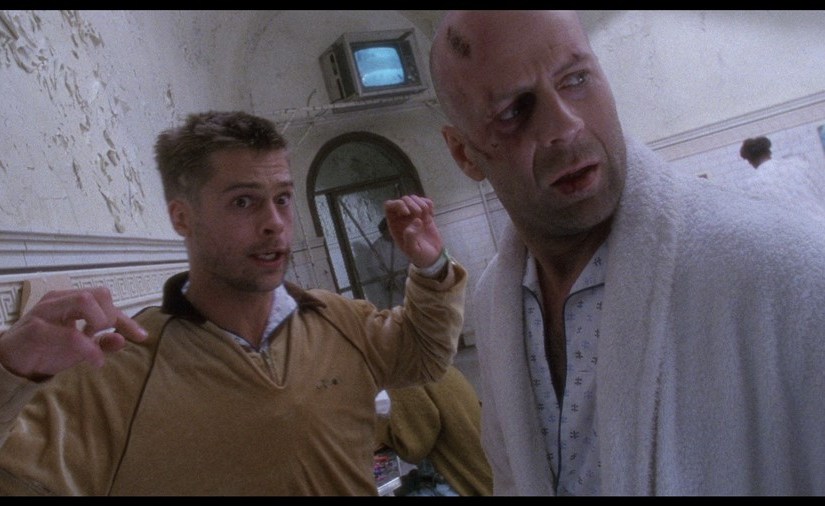
Director Terry Gilliam specializes in disorienting his films.  No shot or closeup is well defined.  He’ll position his camera on a slant or he’ll turn it on an uneven axis so that nothing appears completely clear.  In 12 Monkeys, the viewer is as confused as the protagonist, James Cole, along with a psychiatrist he periodically encounters named Kathryn Railly (Madeleine Stowe).  Beyond the camera trickery, the script of the film offers up oddball characters in both Cole’s present time period (the “future”) and in his past.  Jeffrey Goines (Brad Pitt, in his first Oscar nominated role) is one particular weirdo, residing in a mental institution that Cole is entered into when he time traveled back to Baltimore, Maryland in the year 1990.  During his stay in the loony bin, Cole is talking gibberish to Dr. Railly and her team.  Jeffrey has his own language of nonsense.

Cole’s dreams of himself as a child are intermittently weaved into the final edit of the film.  There’s a woman running after a man, a rapid beep, beep, beep and a gunshot.  Later returns to this dream will provide more clues fleshing out its significance.

It would be easy to have a five-minute conversation and spell out what occurs in 12 Monkeys, but that would be defeating the cleverness of the film.  The achievement of its story relies on the sum of its parts.  Terry Gilliam strategically lays out breadcrumbs with fractional pieces of dialogue, words and pictures that quickly flash in front of you.  It may even hinge on a news story or memorable pieces of music playing on a radio. Still, he also unnerves the characters and the viewer with uncomfortable and sometimes grotesque imagery. 

The first time you watch the film your attention may turn to the long stream of bloody drool hanging from Bruce Willis’ mouth when he shares his first scene with Madeleine Stowe.  Repeat viewings, which I believe only enhance the picture, will have you focus on the nonsensical dialogue that James Cole is continuously uttering.  Other characters are seemingly disruptive to your concentration, particularly the herky jerky behavior of Brad Pitt’s character, but their purpose is essential to a mystery that has left the world of the future in a tailspin where the last of the human race lives underground while animal wildlife roam the cities above.  Furthermore, who or what can explain the enigma behind a team of people perhaps known as The Army Of The 12 Monkeys?

12 Monkeys is a very weird and very unusual kind of science fiction film and that is its crowning achievement.  I have spoken before of how sometimes a movie can not be determined as a success until it reaches its climax, say the last five minutes of its running time.  Terry Gilliam’s picture is one such example.  Gilliam has a keen sense of foreshadowing with tactical layering of complexity.  He is wise with how everything neatly unravels at just the right moment. The answers to the mysteries that James Cole pursues eventually rise to the surface, reminding us that everything was right under our nose the whole time. 

I recall the elation I had the first time I saw the film in theaters.  On repeat viewings, I grin at how the movie is assembled.  Quick references that seem like blink and you miss it moments add up to a satisfying conclusion in Terry Gilliam’s film.  My colleague, Miguel, and I both agree on the time travel motif in 12 Monkeys.  It is one of those rare occasions where the science built within the story’s fiction seems to make sense.  Too often time travel movies paint themselves into a corner and can’t escape the gaping plot holes they leave behind.  Yet the different time settings of 12 Monkeys cooperate with themselves.  Because the film doesn’t color outside of its lines, its worth applauding how ingenious the picture truly is from beginning to end.

12 Monkeys may require your patience the first time you watch it.  It’s not a comfortable journey.  However, you’ll be glad you stayed with it as the story answers its own questions.

ELVIS (2022)

By Marc S. Sanders

Baz Luhrmann’s take on the legacy of Elvis Presley will certainly grab your attention, even if the director refuses to carry an attention span of his own lasting longer seven seconds.  Having watched the celebrated film from 2022 for a second time, eight months after my first viewing, I see more faults with the picture than achievements.  Elvis is strongest when the carnival ride stops moving, allowing its cast of colorful characters to have conversations with one another. 

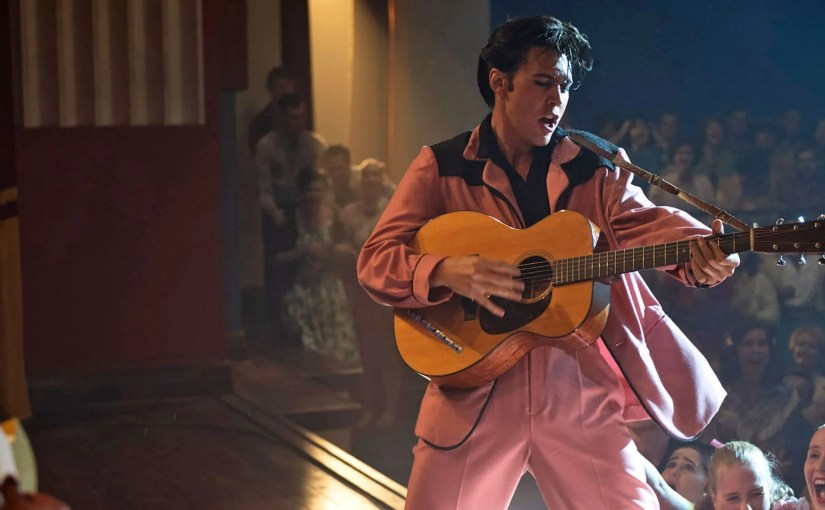
Austin Butler is now a known name for his portrayal of the King Of Rock N Roll, whose career was squandered by a slimy business manager known as Colonel Tom Parker (Tom Hanks).  Butler personifies what pop culture has recognized first and foremost about Elvis Presley, everything from the wild stage presence of dancing to the deep rockabilly singing or speaking (you decide) vocals.  He really bears an uncanny resemblance to The King as well.  Butler could have been better though had he been graced with a more economical and thoughtful script.  I don’t think Austin Butler was given enough to do.

The Elvis character hardly shares any conversations with any of the supporting characters.  That’s the film’s major shortcoming.  There are a scant few scenes of dialogue exchanged between Elvis and his mother and father, between Elvis and the Colonel, and between Elvis and his wife Priscilla Presley.  Baz Lurhmann wrote the script with Sam Bromell and Craig Pearce, and I guess it incorporates some major moments within the singer’s illustrious career but nothing seems to hold much weight.  Elvis gets threatened with being arrested for his pelvis swiveling gyrations while he performs.  We get a close up of the state Governor who leads this censoring campaign, but we don’t get an idea of his warped logic.  Elvis gets drafted into the army and the Colonel thinks to sell it as a comeback when his tour of duty will finish in two years.  Two years go by in a matter of sixty seconds however and the King is back to touring and donning the outrageous costumes, but we don’t see the marketing machinations led by the Colonel.  Where’s the deviousness and conniving?  Where’s the brainwashing of the public and our hero?  Elvis is also bedhopping from one woman to another and popping pills, but these incidents which arguably led to his life being cut short are glossed over with a sway of Luhrmann’s camera work.  When the third act of the film arrived, I didn’t even know Elvis was sleeping around until Priscilla (Olivia DeJonge) announces she is leaving him.  On her way out the door, the two characters share about five or six lines of dialogue before the film races to another transition or scenario.  In this film, the love of Elvis’ life, Priscilla, holds about as much presence as an extra in the film.  Their relationship isn’t explored like Johnny and June Carter Cash in Walk The Line, for example.

Lurhmann edits his scenes with title cards of what year it is or what place it is as Elvis tours the country.  Yet, I never got the feeling that I was inside these time periods.  A minute to a minute and a half go by and suddenly it is “One Year Later.”  What difference does that make?  Where’s the transition in Elvis’ character?  When exactly did he become a sensation?  Suddenly I see that Elvis is moving into a mansion (I think is what will eventually be Graceland) with his parents and I presume he’s…well…he’s a success?!?!?!

An opportunity presents itself for Elvis to have a mentor into the world of celebrity stardom by means of B.B. King (Kelvin Harrison Jr.), but as soon as he introduces himself, the man disappears and is not heard from again.  Elvis only offers a piece of dialogue later suggesting that “B.B. King once said…”  There’s no significance to the influences or naysayers who enter Elvis’ life.  The same goes for Elvis’ mother, Gladys (Helen Thomson).  The Colonel will assure Elvis’ parents that he has their son’s best interests in mind as he blossoms his career, but we don’t get enough of a solid foundation for his mother’s apprehension or her religious doctrine or the alcohol addiction that kills her.  

I know, reader.  You can argue that I’m offering descriptive text for these people.  However, the text that I give in this column is all that you see.  Baz Lurhmann is a flashy director.  I don’t doubt his skill for color with sparkles and glamour. No subject is glitzier than Elvis Presley.  Yet, if a biography is going to be recounted on film, it needs to be more than just a near three-hour music video.  Luhrmann seems prouder of the letter fonts and graphics that introduce another year like 1956 or another state like Tennessee as it zooms towards you from the depths of the screen.  The gloss of the photography in the movie is overly animated, lacking feeling or character arcs.

The script for Elvis seems to also adopt the approach that Milos Forman’s Amadeus took, where the puppet master/antagonist recalls the celebrity’s story.  Colonel Parker provides voiceover with a thick, German/Austrian (maybe ???), dialect for Tom Hanks to deliver.  Unlike popular opinion, I was surprisingly taken with Hanks’ portrayal.  He’s quite the villain in a disproportioned fat suit and bulbous sweat-soaked head.  The relationship between Elvis and the Colonel is nothing surprising.  We’ve seen plenty of bios where the manager swindles the fortunes of the outstanding talent.  Considering that is how it happened, I don’t mind seeing it again in Elvis.  However, much like everything else in the film, it is glossed over.  Only very late in the film do we learn that Colonel Parker is deeply indebted to the Las Vegas casinos, and he signs away a long-term Elvis obligation in lieu of repayment.  Before all of that comes into play however, while we know we can’t trust the Colonel, we also don’t know what his endgame is.  Only near the end, Luhrmann and his script writers throw in a last-minute Hail Mary to shock the viewers and uncover how the Colonel destroyed Elvis’ financial assets and betrayed his trust.  Unfortunately, we haven’t seen much of a relationship between the two rivals after over two hours of film.  A build up is missing.  The best way for a villain to attack a hero is to whet his appetite with trust and then use that reliability as a control device.  The script for Elvis never sets up those early moments of exposition that get the viewer, and more importantly Elvis, to trust the Colonel. 

Michelle Williams once played Marilyn Monroe in a film called My Week With Marilyn.  It’s an astonishing performance in a very shallow film.  In my review of that picture, I wrote that I wish I could see Williams play the role again in a story more worthy of what she puts on screen.  She was above that movie.  I feel the same way for Austin Butler and Tom Hanks here.  These are great actors who were not given adequate material to shine.  If only another Elvis picture could be made with them in the principal roles.

What I find ironic about Elvis is that when I first saw the film upon initial release in theatres, I felt thoroughly impressed.  While I am always more cold than hot on Baz Luhrmann’s movies, I thought maybe this was the exception.  Watching it a second time however, eight months later, I realize that much of the film I could not remember and that is because that movie doesn’t invest in memorable scenes.  It focuses much too much on flashy edit, cut aways.  What I lost from that narrative is an intimate connection to Elvis or any of the other characters. 

Even the music is not as electrifying as it is known for.  There is not enough time devoted to individual set pieces of Elvis performing numbers like Heartbreak Hotel or Jailhouse Rock, and because of the quick cuts, I’m not convinced that Austin Butler is truly crooning away in an Elvis impersonation like Jamie Foxx as Ray Charles or Joaquin Phoenix as Johnny Cash or Val Kilmer as Jim Morrison.  Austin Butler is just not offered ample opportunity to do his best Elvis performing.

As colorful as Elvis’ life was and his legacy continues to be, Baz Lurhmann is certainly a viable candidate to direct this biography.  The problem is maybe that Lurhmann needed an editor and producer who would put their foot down and tell him to try again.  Lurhmann was more concerned with showing his own kind of magic in filmmaking and reserving the story and plot devices for the closing act.  Exposition within the last thirty minutes of a movie usually never works.