THE MULE

By Marc S. Sanders

Earl Stone (Clint Eastwood) was once considered one of the best horticulturalists in the country.  In fact, he devoted more of his time to raising the most unique flowers and plants that anyone could find than he ever did to his wife, Mary (Dianne Weist) or his daughter, Iris (Alison Eastwood).  He even missed Iris’ wedding, to attend an award reception in his honor.  At age 90, though, Earl is quickly forgotten by his ardent fans thanks to the ease of ordering horticultural specimens off the internet.  There’s no longer value in meeting the maker.  Just as Earl never took account for his family like he did with his beloved occupation.

Clint Eastwood portrays Earl Stone in The Mule, which he also produced and directed.  Written by the Nick Schenk, this film is one of Eastwood’s best directing efforts.  It is inspired by a real life story where the forced to retire horticulturalist finds himself working as a drug mule for the Mexican cartel.  Earl is corralled into making easy money by driving a duffel bag across country.   At the destination, he leaves his truck and returns shortly thereafter to find large amounts of cash in his glove compartment for his trek.  

Earl is so naive to all this activity though that he doesn’t even know how to use the various cell phones the dealers give him for each new journey.  It’s only on the third drive that he opens the bag to find kilos of cocaine.  

Earl is a perfect front for the cartel.  The Don (Andy Garcia) sees the value of this camouflage.  Who’d ever suspect a frail ninety year old Korean War veteran, who’s never gotten a traffic ticket, of doing their bidding? Certainly, the sharp witted FBI agents (Bradley Cooper, Michael Peña) could only get as close as determining this mule is driving a black pickup truck.  Beyond that they are at a loss, despite the leeway and patience awarded to them by their superior (Laurence Fishburn).

This film boasts an outstanding cast from all four corners of its various stories.

The Mule works so well because of Eastwood, the filmmaker.  He offers thrilling overhead highway shots (with no car chases) of Earl’s pickup truck running parallel to a helicopter as well as how the cartel escorts follow behind.  There’s humor in how impatient they get with the old codger by how slow he drives and the old time music he listens and sings along to.  Wait until you see two tough armed Mexican cartel members relent to singing along to Dean Martin.  Eastwood cuts and stages these hilarious moments that are most welcome, even if they had no business being in a story like this.

Clint Eastwood’s performance is really shining through.  You recognize his signature scowl and his heightened walk despite his frail physicality.  The Earl Stone character is so well drawn and Eastwood, as director and especially actor, answers every demand of the script sharing celebrated scenes with Andy Garcia who treasures his prize mule and gifts him a couple of women to make him feel comfortable.  Other moments allow wonderful exchanges between him and Dianne Weist as Mary, Earl’s estranged and very ill ex-wife.

The Mule is a crime picture, sometimes lighthearted and on occasion heavily serious.  Yet, it’s also a well-drawn out family drama.  Earl is grateful for the rewards that come with being a drug mule.  He’s generous to his friends.  He modestly treats himself.  He lends attention to his adult and loving granddaughter (Taissa Farmiga).  He accepts Iris’ disregard for him.  Yet, none of these gestures buy back or exchange any time he’s lost with the family he never got to know.

The film plays like two different movies until finally a sacrifice must be made to appease one part of Earl’s life versus the other.  I almost wished for everything new that came upon Earl in his late life to remain on that trajectory.  Yet, like the best stories, interference will eventually get in the way.  It’s that much more crushing when Earl’s new pattern is upended.  Still, that’s what makes for good drama.

I highly recommend seeking out Clint Eastwood’s The Mule. It surprised me in the best ways possible.  I did not expect to be so impressed.  Eastwood continues to be an inspiration with the persistent longevity of his talents as an actor, a screen legend, and a gifted filmmaker.  The Mule shows he’s as sharp as he ever was before in some of the best films of his decades long career. 

SIXTEEN CANDLES

By Marc S. Sanders

John Hughes became a pop culture pioneer of the 1980s when he directed his first film, Sixteen Candles. The movie adopted a slapstick approach to teen anxiety related to love, cliques and high school popularity. Had Hughes waited much longer, it’s fair to say the picture may not have ever gotten produced. In a current age of political correctness and “Me Too” movements, Sixteen Candles is more shocking than originally intended.

There is no way this film would be made with a character like Long Duk Dung as a run-on gag Chinese foreign exchange student with a stereotypical Asian accent of mispronunciations, presumptions of mental retardation, and an accompanying “GONG” each time the film circles back to him. It is fair to say this is equivalent to when Buckwheat would wipe the sweat off his brow against a nearby wall and it would appear as ink stains in a random Our Gang/Little Rascals film. Actor Gedde Wantanabe who plays Dong has gone on record saying he was vilified for the role since the release of the film. Likely he was also quite embarrassed. I wouldn’t blame him.

Date rape is also a common element of the film. Dong is implied to be a victim by a butch high school girl. In another storyline the hot guy Jake Ryan (Michael Schoeffling), who drives a cherry red Porche, implies to the geek, Farmer Ted (Anthony Michael Hall), an offer to have his way with Jake’s intoxicated girlfriend. Freshman nerd Ted takes as much advantage of the opportunity as he can by taking photographs with the girl and then even forgetting what exactly occurred the next morning but making hopeful assumptions nevertheless, simply to bolster his reputation.

I don’t draw attention to these tropes to celebrate and guffaw though. The film continues to have a staying power with Hughes’ name labeled on the picture as well its recognition for making Molly Ringwald an ongoing cover photo for Teen Beat and Rolling Stone magazines during the MTV Generation.

Perhaps John Hughes had no idea at the time that his material would carry a shock element beyond plain silliness. I’m almost convinced of that. It’s fair to say Sixteen Candles is a byproduct of the raunchiness delivered by Animal House. I’m content with that because it is very, very funny in spite of the offending and inappropriate material.

Molly Ringwald is Samantha who is beside herself when everyone has forgotten her sixteenth birthday while gorgeous Jake seemingly doesn’t even know she exists. The family’s focus is drawn to her older sister’s upcoming nuptials the next day. It’s a lot to deal with for a high school sophomore. Ringwald embraces the frustration nicely as she doesn’t try for the comedy but often becomes the embarrassing victim of Hughes’ set ups: invasively touchy grandparents, Long Duk Dong, Farmer Ted’s obsession with her, and even giving up her underpants as a special favor. Samantha is the straight character among all the clowns in the cast, including her jerky younger brother played by Oscar nominee Justin Henry (Kramer vs Kramer). Paul Dooley, known for a career as a notable schlub, offers a nice scene or two with Ringwald as her father. John Hughes allowed himself to demonstrate how much he respects the characters he’s invented even if he spent the first two thirds of the picture humiliating them.

The transitional arc of the script almost parallels Hughes’ method of writing in his career. The comedy is sketched primarily in broad strokes. I said earlier it is rife with prejudiced humor, raunch and slapstick. That is until the end arrives with a mature, candle lit first kiss over a birthday cake accompanied by the sweet, soft melodies of the Thompson Twins. It’s adoring, sensitive, and Hughes closes the book on Sixteen Candles with the love and care he awarded most of his characters during his filmography. In one film, John Hughes approaches a level of maturity by the time the story’s end arrives.

The tenderness Hughes shows in the concluding scene of Sixteen Candles would become more evidently special in his later films like Ferris Bueller’s Day Off, Pretty In Pink, (not directed, only written by him), The Breakfast Club, and Planes, Trains & Automobiles.

John Hughes’ legacy is unmatched. Sixteen Candles is proof of that, and though some today would be dismissive of its ingredients, it remains a defining film of what the 1980s provided, culturally. If you grew up during the decade of excess or likely the grunge of the ‘90s, chances are you attended a sleepover with friends watching Molly Ringwald as the lovestruck, but crushed Samantha. She had to survive the most awful night of high school, coincidentally occurring on the day of her sweet sixteen, while making wonderful memories of laughter, tears, love and bonding.

NOTE: I waited to post this review for over two years until the eve of my daughter Julia’s 16th birthday. Happy Birthday Jules. I didn’t fucking forget your birthday!

ELEMENTAL

By Marc S. Sanders

Ember and Wade are perfect for one another.  They truly belong together.  Yet, science dictates that they have zero chemistry.

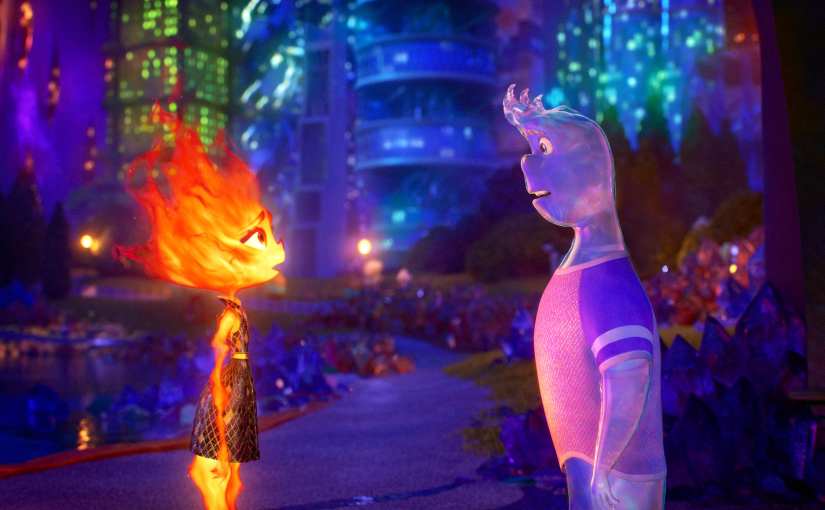
Ember is a figure of fire.  Wade is a bubbling, joyful standing puddle of water.  They reside in Element City along with people of earth and air, respectively.  Pixar with Disney Studios, has transitioned from emoting human feelings in lovably figurative toys, monsters, cars and colorful emotions to the primary elements of our planet.  Hence the title Elemental.  It’s a blessing that the storylines and messages of this digitally animated feature are a winning combination.

Ember (Leah Lewis) is the daughter of her fire immigrant parents, Bernie and Cinder (Ronnie Del Carmen, Shila Omni).  She loves to work with her dad in his mercantile shop that he built from nothing, known as The Fireplace.  She’s hardworking and dedicated, but she can suffer from a short temper that turns her firebrand orange disposition into a raging purple. Suddenly, she’s charred the shop interior and maybe some of the customers.  

Wade (Mamoudo Athie) is a water made building inspector who by unexpected circumstance comes upon the aftermath of a temper tantrum from Ember.  He works as a building inspector for the city and simply by doing his job he cites enough offenses with The Fireplace that could shut down the shop for good.  Now Ember must work with Wade to avoid that from happening, including haphazard water leaks that are stemming from a mysterious source within the city.

Elemental works because while it bursts with magnificent color, it has a story to tell in a brilliantly inventive and functional environment, much like the Monster World in Monsters, Inc. Pixar does not just stop at the marvelous animation. Their products continue working even beyond their well planned stories and conflicted characters.

With this film, the immigrant crisis that is a prevalent problem in the real world is addressed, but simplified for all ages to comprehend.  Fire based citizens, inspired by Asian/Eastern cultures, are typically restricted to only fraternizing within their area of the city, among only their demographic.  They are regarded as harmful and unsafe from the other three elements.

On the other hand, people of water, air and earth live in harmony.  Director Peter Sohn, with a highly informative script from John Hoberg, Kat Likkel and Brenda Hsueh, is consistent with this reflection.  Water, air and earth make up the first three iterations of Element City.  Fire gets no recognition.  Fire was not invented by a higher power.  It had to be discovered.  Therefore, they are sadly treated as a minority.  The film doesn’t go so extreme as segregating the fire community to literal internment camps, but the feeling of isolation seems quite authentic.  

Yet, fire serves an important purpose. Bernie might envision his daughter taking over the business as he is getting older and slower.  Still, with Wade’s help Ember is realizing that she has talents that will make her happier and more fulfilled.  She’s a natural at honing glass sculptures with merits in practicality and art.

At the same time Wade and Ember are becoming friends and maybe there is something more going on in their newfound relationship.  Problem is they dare not make contact with one another.  What would actually happen if fire and water mixed?  Bernie and Cinder would never approve of this relationship either.  As well, poor Wade and Ember may be frowned upon with prejudice if seen in public together.  

My colleague Miguel reminded me that Elemental gets 98% of its science accurate.   I definitely appreciate that.  However, I’m also grateful for the remaining 2% left for my suspension of disbelief that is quelled by insightful imagination.  Ember and Wade are such wonderful characters that they deserve the happiness they long for.  As I watched, I longed for their destinies to outlast the seemingly impossible.

This is a special film from the Pixar factory.  Elemental demonstrates that nothing should limit what any us of yearn for.  No shortsighted policy of any kind should bar us from our pleasures.  There’s a way for anything to work together.  It only takes some thought.  So you know what I say as I root for Ember and Wade?  SCIENCE/SCHMIENCE!!!!

A HAUNTING IN VENICE

By Marc S. Sanders

There’s A Haunting In Venice and Hercule Poirot is on the case.  

Kenneth Branagh returns for a third time as Agatha Christie’s famed literary detective.  He also serves in the director’s chair again, and this is his best installment in the updated franchise.

The man with the exaggerated mustache is living in Venice, Italy, with the assurance of a bodyguard (Fernando Piloni) to fend off any pestering folk needing their own personal conundrums resolved.  Poirot is not interested to assist.  

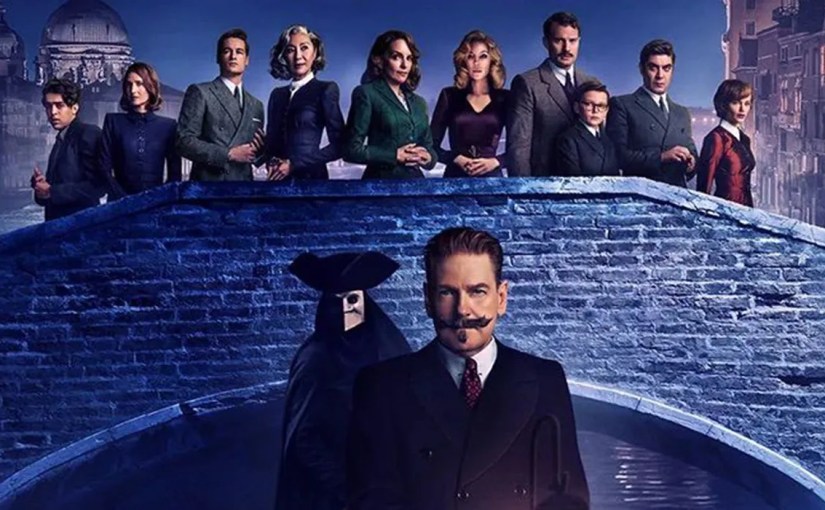
On All Hallow’s Eve, he is invited to be a tag along with his American mystery novelist friend Ariadne Oliver (Tina Fey) at Rowena Drake’s home. A celebrity Medium known as Mrs. Reynolds is to appear and perform a seance. My first impression of Fey’s character is a loose interpretation of Dame Agatha come to life to partner up with Hercule.  She’s sort of a wink and nod to the author’s fan base.  What if Agatha and Hercule actually worked together?  This is as close as you’ll get.  Branagh and Fey work so well together.

Poirot reluctantly agrees to accept Ariadne’s invitation.  Upon arrival at the affair, the best feature of the film is introduced.  Rowena’s home is a foreboding dwelling alongside the Venetian River, and this Hallowe’en evening is turning into a dark and stormy night.  A children’s costume party is wrapping up complete with creepy puppetry, ghost story telling and apple bobbing.  Then it is time to welcome the arrival of a figure dressed in black wearing a pearl white Kabuki mask.  The children have left, and the eventual suspects of a murder mystery are all that remain in the house when the seance begins.  Mrs. Reynolds will use her talent to communicate with Rowena’s daughter who passed away a year earlier following a fall off the rooftop and into the murky river below.  

Poirot is the most skeptical of the guests as he staunchly believes only in logic, not the supernatural.  Ariadne insists that he will be amazed at the unexplainable talent at play. A well timed falling chandelier and a typewriter that seems to answer the Medium’s questions are not convincing enough for him.  

Eventually, a gruesome and shocking murder occurs.  Like most formula mysteries, everyone appears to have an alibi.  Yet, Poirot refuses to believe this crime took place by means of a supernatural element.  Even if there are unexplained noises within the home and the appearance of Rowena’s daughter turn up, there must be a more logical resolution.  

A Haunting In Venice works especially well thanks to the atmosphere of its setting.  The multi-floored and darkened home lend to the eeriness necessary for a spooky story focusing on death.  The faucet of a sink doesn’t work.  The innocence of apples takes on a nervous feeling.  Lanterns allow shadows to float within the darkness while the lightning flashes and the thunder pounds outside with choppy waters in the river. This haunted place where a young girl recently died is not somewhere I want to stay overnight.  

One suspect that especially stands out is Leopold (Jude Hill), a preteen boy with a fondness for the macabre works of Edgar Allen Poe.  Poirot suggests he turn towards Dickens.  Leopold seems much wiser than his years, as he tends to and speaks on behalf of his unwell father, Dr. Leslie Ferrier (Jamie Dornan).  

Michelle Yeoh turns in another memorable performance permitting the strangeness of her Medium character, Mrs. Reynolds, to elevate suspense.  Poirot can choose to be doubtful.  Nevertheless, I’m convinced Mrs. Reynolds can speak to the actual dead.  

A Haunting In Venice has murder on its mind and the sudden death of one of the characters is horrifying.  I dare not spoil how it transpires.  Thankfully, this tale returns to an approach that so many classic films adopted.  You don’t need pools of blood and guts to get the hairs on the back of your neck to stand up.  It’s clear that with the approval from Agatha Christie’s estate, Branagh is well researched in what the author wanted to accomplish.  

The screenplay from Michael Green lends wonderful color to the characters, as Poirot interviews each person.  All of the performers are engaging.  This collection of actors especially works because unlike the other two Branagh films, this installment does not rely so much on stunt casting with recognizable marquee names.  For me, the who done it resolution was more challenging to solve because the actors portraying the assortment of suspects were deliberately vague, airing a sense of distrust in any one of them.  

This is a fireplace story to curl up with under a blanket and a cup of hot cider on a brisk Autumn night. The best compliment I can give A Haunting In Venice is that it’s a never-ending page turner.

PLATOON

By Marc S. Sanders

Oliver Stone’s Oscar winning Platoon takes place in the late 1960s, somewhere on the Cambodian border during the Vietnam War.  Many of the chaotic happenings the film presents are based on Stone’s own experiences after he voluntarily enlisted to fight.  However, while there is an unwinnable war occurring for the American troops, there is just as horrifying a battle going on within the ranks of the platoon the film focuses on.

Charlie Sheen echoes a lot of his father’s, Martin Sheen, voiceover narration, and performance in Francis Ford Coppola’s Apocalypse Now.  He portrays Chris Taylor, a college dropout who voluntarily enlisted for a one-year tour of duty to serve.  After only one week within the harsh, humid, and wet jungles, he’s writing his grandmother a letter asking what the hell was he thinking.  Chris is quite virginal to the harshness of war and that won’t work to his advantage when needing mentoring and support from his fellow soldiers.  The newest enlistees are the ones at the front point.  They haven’t devoted enough time to sit in the back and because of their lack of experience with war, they are not as valuable for the ongoing campaign in battle.  Platoon is not the heroics depicted in John Wayne movies.  This was one reason that Oliver Stone wanted to make this picture.  Platoon is a bitter retort to Wayne’s celebrated movie, The Green Berets.

There is an angel and devil flanking Chris in the form of Elias (Willem Dafoe) and Barnes (Tom Berenger).  Berenger is the cruel side of the conflict with his battle-scarred face.  He gives his underlings the impression that because he’s seen so much fighting and endured being shot seven times, that he must be invincible.  Elias is a fighting soldier, but he adheres to the rules of war and when it is time for rest, he joins his fellow troops in a unified vigil of drug-induced relaxation.  Chris warms up to Elias easily despite his initial fears of being a soldier with no experience or knowledge of how to survive, much less fight alongside his fellow men.

What drives the conflict between Barnes and Elias occurs following the first act of the movie.  The infantrymen come upon a Vietnamese village.  Some men, including Chris, get wildly abusive with the unarmed people, burning and pillaging their huts.  Only after Chris gets control of himself does he realize the wrongs he’s capable of by serving in this war.  He prevents a group of men from gang raping a child.  Furthermore, he witnesses Barnes commit the illegal murder of a defenseless village woman, shot at point blank range.  Elias has his bearings though and will file the proper reports when the opportunity permits.  Nothing in Platoon is easy though.  This war rages on and the possibility of an investigation and court martial is held off while the fighting continues. 

An interesting take on Oliver Stone’s direction is that he never really shows any close ups or lends any dialogue to the Viet Cong.  I believe Stone is confident that people know who our battalions were supposed to engage with.  However, as another favorite picture of mine stated (Crimson Tide), the true enemy of war is war itself.  The enemies of Elias, Chris, and Barnes as well as the rest of the platoon permeate within and among themselves and it lends to the chaos of the brutal combat scenes depicted in the film. Stone doesn’t offer much opportunity to see who any of the soldiers are shooting at or who is shooting at them.   There is much screaming and hollering but who are any of the characters shouting at and can they even be heard or understand what is being said amid the gunfire?  Platoon demonstrates that a Vietnam war picture is not one of heroics with grandstanding trumpets and a towering John Wayne who takes a hill.  War is disorganized, messy, and terribly bloody. 

This may be Charlie Sheen’s best film of his career.  As he represents the fictional account of Oliver Stone’s personal experiences, we see the trajectory of his change.  He is supposed to be there for 365 days, and he, along with his buddies, count down to when their tour will be complete.  However, this one short year will be the longest he ever encounters, and it will change him permanently, assuming he survives.  Chris is always tested of his tolerance.  He’s always subject to respond to how Barnes commands or how Elias mentors and leads. 

Oliver Stone is so convincing in his often-documentary approach to Platoon that it is at least understandable to see how the men in this picture behave and carry themselves.  Why do they refer to the Vietnamese as “gooks.”  Why do they bully with intent to commit rape.  Why do they quickly pounce to kill when for even a moment there is no threat.  Moreover, why they are willing to turn on each other.

They were never the decision makers for this conflict.  These soldiers are depleted of sleep and rest.  They are the pawns of a higher power, and they have been left to their own devices in a dense environment infested with bugs, snakes, unbearable humidity, and bodies that infest the waters and land while armed men appear out of nowhere ready to ambush.  Some ensnarements might occur within their own regimen.  None of these men are justified in their actions.  Yet, it is not hard to understand where their motivations stem from.  They are not programmed for heroics.  Keith David portrays a likable soldier who tells Chris that his mission is just to survive until he’s summoned home.  Survive among those you march and sleep with.  Outlast this hellish environment and overcome those that are trying to mow you down in machine gun fire.  Everything else around here is “just gravy.”  When you are an infantryman, you are not making a statement any longer.  You are not fighting for a cause anymore.  You are only trying to stay alive.

Platoon is such a shocking film of unconventional madness and turmoil.  Oliver Stone is relentless in the set ups he stages.  This picture came out in 1986, long before the strategic methods of the modern “shaky camera” approach.  It’s beneficial to watch the film as Stone must be positioning his camera on a track as the platoon hikes through the forest, parallel to his moving lens.  We are walking alongside them.   Early morning overhead shots depict the carnage of battles that occurred in the dark of night. Flares and sparks come from nowhere.  I think you could watch this movie ten times and still not know when to expect gunfire to intersect with the story or when the bombs to go off.  It’s hectic hysteria like I can only imagine these young men experienced before they spilled their blood on the battleground and either died right there or returned home physically and mentally crippled for life.

Platoon is one of the best and most frightening war pictures ever made.

AUGUST: OSAGE COUNTY

By Marc S. Sanders

Once the dead are buried, the secrets come out.  Some mourn the loss.  Others mourn the reality of what existed.  Tracy Letts’ Pulitzer Prize winning play August: Osage County was adapted into a very well-cast film in 2013.  Letts’ screenplay is just as biting as his original source. Perhaps that is because of the performances of not just Meryl Streep and Julia Roberts, but also the entire collection of actors.

Dysfunctional is not a strong enough word for the Weston family of the sleepy, lifeless area of Osage County, Oklahoma.  The patriarch, Beverly (Sam Shepard) hires Johnna (Misty Upham) a Native American housekeeper/helper, for his pill popping, cigarette smoking wife Violet (Streep) who is also stricken with cancer of the mouth.  Shortly after, Beverly disappears.  The family comes home to the dusty shelves of books and old black and white family photographs and learns that Beverly has committed suicide.  The opportunities flood in for Violet (or Vi) to unleash every ugly, harsh truth that her three daughters Barbara, Ivy and Karen (Roberts, Julianne Nicholson and Juliette Lewis) have encountered along with their partners.  There’s also Vi’s sister Fannie Mae (Margo Martindale), her husband Charlie (Chris Cooper) and their son Little Charlie (Benedict Cumberbatch) to revisit the revelations of the Weston family.  Barbara’s estranged husband Bill (Ewan MacGregor) and her daughter Jean (Abigail Breslin) have their own drama to contend with as well.

It’s best not to spoil too much of what is revealed in the movie directed by John Wells.  The centerpiece of the picture is the afternoon family meal following the funeral service.  This must be one of the most intense and captivating dinner scenes caught on film in recent years.  Wells positions his cameras perfectly, so you know where every family member is seated at the table and the trading of barbs that go back and forth between the different combinations of arguments.  I would say the scene lasts at least twenty minutes and Wells manages to seat the viewer next to or right in front of every person at the table.  At one end of the table is Charlie.  Chris Cooper is a reluctant fill in to the void left by Beverly, the original patriarch.  The instigator is Vi. Meryl Streep is placed at the other head of the table where her drug addled eye contact can be had with anyone seated in her presence.  I’d love to have seen Meryl Streep while shooting this scene because even when the camera is not on her for a close up, I can still see that she is there in the dining room.  I’d argue she never turned off this persona during the making of this film. 

The most agonizing relationship is clearly between Vi and oldest daughter Barbara.  The first pairing on screen for Meryl Streep and Julia Roberts.  Why didn’t it happen sooner?  Moreover, why hasn’t it happened again since this film?  Perhaps because it is rare to find material of this dramatic weight to justify what can come from these two incredible actors.

The dinner scene is left discomforting to say the least, but the timing and delivery of Tracy Letts’ dialogue is functioning with high energy.  At age fourteen, Jean is the youngest member at the table, and she is questioned as to why she doesn’t eat meat.  According to her, you are consuming an “animal’s fear.”  The Westons are only adoring when they are cruel to one another.  One of the rare times that the rest of the family will unite with the antagonizing Vi is when they can mock and chortle at young Jean’s philosophy for “claiming” to be vegan, which is also undone by her parents when they reveal what she eats back home in Colorado. 

A hip middle aged Florida man named Steve (Dermot Mulroney) in a Ferrari has accompanied Karen to Osage.  Karen is the flighty one with her head in the clouds.  Steve has been married three times and takes a liking to teenage Jean’s curiosity to try pot.  Vi expresses disdain for the jerk with another welcome facial expression from Streep, but Tracy Letts does not have his character lash out or protest Karen’s choice to marry the guy.  For Violet Weston, it is better that Karen does marry this letch.  It gives Vi more purpose to criticize and belabor upon one more poor decision made by another daughter.  Violet thrives on bellowing out the shortcomings of her children, her dead poet/author husband, her sister, and anyone else within her presence.  It’s how she lives and overcomes her cancer while an unkempt wig conceals her chemo remaining grey hairs.

On the side, a relationship is brewing between first cousins Little Charlie and Vi’s middle daughter Ivy.  They know it’s wrong, but they can’t help hiding their affections much longer.  Cumberbatch goes against type here as a nervous, insecure young man who has not matured from his boyhood nature.  Julianne Nicholson appears to be the most held together of the three daughters as she has never ventured out of Osage while living with her parents.  She is now ready to give up that lifestyle, and she’s leaving it in Barbara’s lap to figure what’s to come of Vi. 

Barbara is the most unhinged.  She is married to sweet natured but boring Bill and it’s likely that the past demons she clung to from her upbringing left Osage with her when she relocated to Colorado with her husband and daughter.  Bill might be having a tryst with one of his college students but is he the worst one in the marriage?  Barbara Weston might be Julia Roberts’ best role since her early career film introduction in Steel Magnolias and her Oscar winning turn in Erin Brockovich.  In films like these, Julia Roberts doesn’t look like the starlet she once was in the 1990s.  In August: Osage County she has downed her appearance with no makeup, unwashed hair, and wrinkled clothes while carrying an emotionally exhausted physique.  However, she’s perfect to play the eldest daughter who somehow must be the one responsible for picking up the shattered pieces of dishware that hit the floor on numerous occasions and fractured connections left behind in the family dynamic.  This is a commanding performance by Julia Roberts; one that needs to be seen.  Incidentally, she never does clean up the broken plates.  I only assume it would be her who must do so.  However, the quiet Johnna is around somewhere. She will make everything disappear.

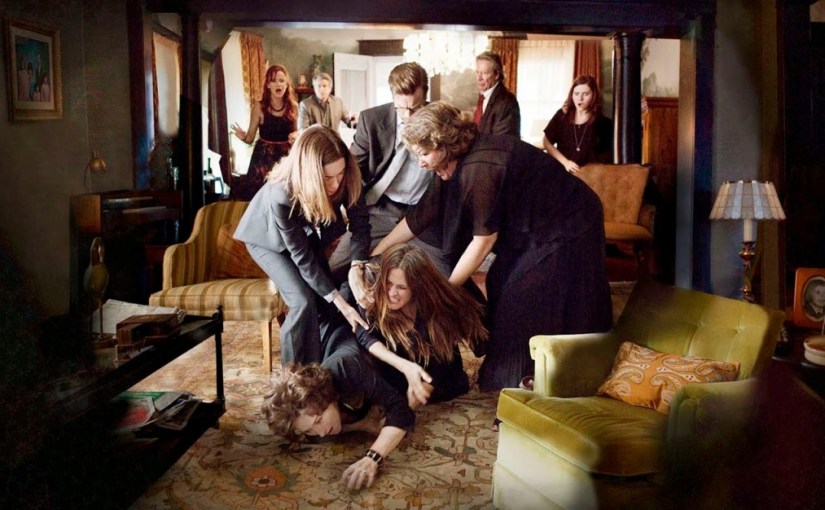
Memorably, a physical altercation ends the dinner.  The day passes into the next mid afternoon and more secrets are uncovered.  Some are quite horrifying, considering the circumstances that some members of the family have themselves in.  Just when you think that this script is ending with a debate of which daughter will look after mother now that daddy is gone, there’s more troubling truth to grapple with as well.

August: Osage County is a movie hinged on the acting chops of its cast with a smart, unforgiving script for the damaged characters depicted.  It falls in the same category as David Mamet’s Glengarry Glen Ross or Sam Shepard’s True West.  We may be witnessing the abnormalities and sins of these people, but it would be more unusual had these folks possessed genuine happiness and solid affection for one another.  The quietly muted Native American Johnna enters the household of people who replaced her own people, who occupied this land long before the early generations of Westons ever arrived.  It’s telling that Tracy Letts demonstrates the original occupants still survive in peace while the ones that took over can’t find a way to live happily among themselves.  Watch the film or see the play.  Then come back and tell me if the white folks of the Weston family truly belong in the once occupied Native American Osage County, Oklahoma.

GARDEN STATE

By Marc S. Sanders

The irony of Zach Braff’s Garden State is that the protagonist he portrays is heavily medicated to subdue any variation of depression or anger induced mood swings.  Yet, it seems like everyone else in the picture should be off the drugs, and those that aren’t taking any, should revert to some appropriate pharmaceuticals.  STAT!

Braff wrote and directed this quirky comedy-drama loosely inspired by his upbringing in northern New Jersey.  He plays Andrew “Large” Largeman.  He’s an actor living in Los Angeles when his father calls him to let him know that his quadriplegic mother has drowned in the bathtub.  Andrew seems like what Cameron from Ferris Bueller’s Day Off might have become a few years after he kicked his dad’s prized Ferrari out the glass garage.  This guy is sullen, sedate and when speaks or responds to a question, you might think he’s catatonic as well.  He’s just so numb from the medicinal products he takes.  They were prescribed by his psychiatrist, who also happens to be his father, Gideon, played with quiet tension by Ian Holm.

At the graveside funeral, Andrew comes upon some childhood friends who never left Jersey behind.  Peter Sarsgaard is Mark who vaguely remembers Andrew and invites him to a party later that night which is likely just like last weekend’s party and the weekend before that.  Mushrooms, weed, coke, alcohol.  It’s all there.

The next day Andrew meets a precocious young lady named Sam (Natalie Portman) who recommends he fend off a humping seeing eye dog by kicking him in the balls.  This unexpected introduction is what will meaningfully break Andrew of his stupor. The bond between Sam and Andrew will carve out the rest of Garden State following a meanderingly weird exposition.  I’m grateful for that because just when you think this film is going nowhere fast, even if it is told at a slow pace, the story absorbs a sweet narrative shared between two very likable characters.

There’s a lot of eccentricities in Zach Braff’s film which he admirably wrote and directed as well.  Living in New Jersey for fourteen years of my childhood, I don’t recall anything within my nearby Jewish suburban neighborhoods being this oddball.  Then again, Braff is maybe a little too ambitious to have one strange character turn up after another.  A woman at the funeral makes him a shirt that matches the wallpaper of the hallway.  A dim-witted cop asks how he did when he procedurally pulls Andrew over.  Another guy shoots flaming arrows into the air in the backyard of his mansion for Sam and Andrew to haphazardly dodge their descent. 

Mark is not only a grave digger in the cemetery, but a robber as well, stealing the jewelry from the remains in the coffins.  Sam lives with her mom and adopted Nigerian brother amid Dobermans and a hamster jungle gym that stretches the entire course of the house and serves as a hazard for one poor rodent after another.  Sam has a well populated little pet cemetery out back.

Amid all these strange visuals and discoveries, there is a background to Andrew’s need to be drugged by his father.  He was the cause of his mother’s disability when he was age nine and pushed her down, causing permanent paralysis. 

There are colorful backgrounds to Andrew and Sam and a curiosity to learn more about them.  Still, the film seems to stretch its running time with too much unusual, oddball material.  I responded to most of it with a smirk or chuckle, but I ask myself why.  Why is so much of this here?  It builds up a setting, perhaps.  I’m just not sure.  There’s an overt weirdness to every single character seen in this film.  Nevertheless, I don’t believe Braff’s intentions were to duplicate a Wes Anderson formula.

Fortunately, Zach Braff offers a wonderful character arc where Andrew becomes more and more awakened as the film moves on, while clinging to Sam’s company and abandoning his father’s prescriptions.  Natalie Portman seems to mature over the course of the picture. Sam’s quirk is that she tells tall tale lies in rapid succession.  That façade nicely breaks down to show the genuine person Sam truly is later.  When her mother boasts a video recording of an ice-skating routine that Sam did while dressed as an alligator, the embarrassment on Natalie Portman’s face is so naturally telling.

Ian Holm should also be recognized as he portrays the opposite of whatever dialogue Braff wrote for the father character.  That’s a great challenge.  A scene in the kitchen has Gideon dressed in a bland, beige sweater and tie and he seems to hide within the pale walls of the room.  There’s no life to the guy.  Nothing stimulating, despite how educated the man may appear.  So, it seems unjustified for Gideon to tell his son later that he wants them to be happy like they used to be.  Braff’s character wisely responds by being unable to recall any time when they were ever happy.  Moments like these are the strength and intelligence immersed in Garden State.  The assortment of side quirks does not have this kind of staying power, though.

I like Garden State but there’s no way I could love it or embrace it.  There’s just too much moroseness within the strange residents amid their sleepy conversations to make me want to stay with any of these characters.  The benefit of watching the film is to see what Zach Braff, Natalie Portman and Ian Holm lend to the picture – three wonderful performances.

ALIEN: COVENANT

By Marc S. Sanders

I imagine it would take a defiant personality to become a God and bearer of life.  That individual would most likely have to be beyond human to follow through on such an endeavor.  In cinematic fiction, to occupy such a role would require an exceptional actor with a calm yet powerful command.  It is fortunate that in Ridley Scott’s follow up to his Alien prequel, Prometheus, that he was able to recruit Michael Fassbender in the role of David – the android invested in discovering new amalgamations of life from unknown sources within a very deep universe.

I understand Alien: Covenant left many fans and critics divided and that it was not the box office success many were hoping for.  In addition, a follow up chapter to this film seemed more unlikely following Disney buying out 20th Century Fox.  Nevertheless, none of these occurrences dismiss one of best dual role performances I have ever seen, compliments of Michael Fassbender. 

The actor first appears in a prologue as David discussing challenging questions with his maker, the wealthy industrialist Peter Weyland (Guy Pearce), a younger looking iteration than from the prior film.  David has met his maker.  However, he questions who created his own maker.  No satisfying answer comes from the conversation and thus it ends with Weyland commanding his “child servant” to a menial task of serving him tea.  David, we learn, will resent humans who opt to subject his incredible capabilities to menial tasks.  He is destined for greater achievements than servitude.  David is meant to be a God.

The film diverts to a period eleven years after the events of Prometheus.  A massive ship known as The Covenant is embarking on a journey to a paradise where the cryo-sleeping colonists and the hundreds of human embryos in storage will set up a new civilization for themselves.  They have just over seven years left of their journey.  The crew of fifteen who command this expedition are also sleeping while an android named Walter (Fassbender in another role) oversees operations.  Following a collision with a storm-like phenomena in space, the crew is violently awakened and the captain (James Franco) does not survive. A reluctantly nervous replacement named Oram (Billy Crudup) now must lead, and it appears fortunate that Covenant has come upon another nearby planet sending a signal source in the form of a John Denver song.  Why John Denver????? I guess the Beatles and Rolling Stones were too expensive. This locale might suit the colonists’ needs and save them another seven years of travel and unexpected risk.

Oram and the former captain’s wife, Daniels (Katherine Waterston), lead a team down to the planet.  A wheat field is surprisingly found.  There’s beautiful blue sky and mountain ranges.  Water is found.  Still, there’s a disturbing realization. Not a single animal or life form is anywhere.  No insects, no birds, no wildlife, nothing.  Like prior installments in the franchise, it is not long before some crew members get ill, very, very rapidly.  Then the first of several terrifying episodes begins.  All of that is visual and not necessary to recap here.

David makes an “Obi Wan Kenobi” like appearance amid the mayhem and calms everything down.  The highlight of Covenant is when Fassbender as Walter (a down to earth American interpretation of an android) encounters Fassbender as David (a refined English example). Upon entering David’s habitat, it is clear he has been busy over the last decade since he and Dr. Elizabeth Shaw (Noomi Rapace, from Prometheus) arrived on this uncharted planet that was once populated by The Engineers, also from the first film.

At the risk of mild spoilers, I offer the following observations, because the thought provoking aspects of Ridley Scott’s third monster movie, are worthy of insightful conversation. 

Walter and David are undoubtedly the most interesting characters of Alien: Covenant.  They possess two totally opposite mindsets.  Almost like they are the angel and devil figures found on a person’s shoulders.  They regard the value of people differently.  Walter holds humanity in high esteem, ready to assist while they continue explorations of great beyonds.  David is prepared to dismiss them, though they serve a valuable purpose in his own selfish discovery to harbor a new breed of creature – one considered to be a perfect organism.  Experimentation has been David’s sole focus.  Now he may have finally uncovered precisely what he needs for his masterpiece of creation.

There are staple moments and happenings that are no longer surprising in Alien: Covenant because there’s a formula that traditionally worked in the long gestating franchise before.  Nevertheless, the film is far from stale.  The story offers up a well-conceived history to the origins of the alien breed, known as Xenomorphs from other films.  Why and how they came to exist are provided.  Hey, I’ll happily say this is more definitive than the Old Testament.

To witness one actor on both sides of a debate discussing the purpose of human preservation and what value people serve from this point is really a thrill.  Both Walter and David are artificial intelligence.  They are so advanced that they have usurped humans as the greatest thinkers in the universe.  It’s not farfetched in this age of smart phones and an over reliance on technological innovations to incorporate this into a monster movie.  It only enhances and improves upon a tired old Godzilla cliche.  Movies are sometimes quite prophetic.  So, it’s not even ridiculous to categorize a film like Network with a bloody sci-fi horror film like Alien: Covenant or even a couple of Tom Clancy political thrillers.

Alien: Covenant boasts a good cast particularly with Katherine Waterston, Billy Crudup, and an unusually serious Danny McBride as a good ol’ boy pilot named Tennessee.  McBride does well with the drama and horror to come.  He’s not a novelty act.  While these actors may be playing well developed characterizations, I know they are only here for the body count and to keep David and the aliens busy.

Again though, the film especially belongs to Michael Fassbender.  A brilliantly inspired casting choice for the first film in this more recent resurgence of the franchise.  It’s only a huge blessing that he returned, and this next film pounced on his capabilities to balance the two roles on opposite ends of the spectrum.  Regardless of whether he’s playing Walter or David, Alien: Covenant only gets more interesting when Fassbender occupies a scene. 

An especially telling moment is so wisely written with a kind of seductiveness between the androids while one teaches the other to play the flute.  Humans no longer need to program computers.  The computers can work it out themselves, and even develop an intimate attraction for one another.  What’s most delightful is again, I remind you, that Michael Fassbender is the only one working in scenes like this.  How often has an actor gone in for a kiss in another role that he is playing in the same scene?  He hides so well in Walter and David, that you lose sight of the fact that you’re watching only one performer doing all the work.

The final scene of the picture caters beautifully to what Fassbender offers in his two roles.  The story’s conclusion will leave you thinking and wondering what comes next.  Intentional or not, I regard the ending of Ridley Scott’s picture as an homage to other great films like The Silence Of The Lambs and The Usual Suspects.  You may feel shockingly haunted as the end credits roll.

Overall, Alien: Covenant is a chilling, mind-bending masterpiece of science fiction horror and what-if prophecy.

PROMETHEUS

By Marc S. Sanders

In 2012, Ridley Scott was well established as an elite film director that I’d argue could pick and choose what projects he would want to work on.  So, the question is was it worth the opportunity to return to the Alien franchise that had been established back in 1979?  Following its just as magnificent sequel, Aliens helmed by James Cameron, none of the other subsequent installments (including the Predator mish mash stuff) lived up to the first two films. Not even close.  So, was it worth another go at exploring the world of Alien under Ridley Scott’s leadership?  Yes.  I believe it was worth every effort exhausted into making the prequel/side story picture known as Prometheus.

The movie begins with an odd prologue where an unusual looking strong man consumes a black liquid while standing at the precipice of a wild waterfall, while an unidentifiable shadow looms above, darkening a blue sky.  Shortly after his drink, the man seems to violently implode, and a graphic of his DNA strand explodes apart while what is left of him descends into the bottom of the falls.  The natural waters are now contaminated.

Afterwards, in the year 2089, an exploration crew of scientists uncover a hieroglyphic on the wall of a cave in Scotland, and then the film follows Prometheus, a large technologically advanced spaceship (a very cool looking spaceship I might add), on a trajectory into deep space four years later.  An elderly man named Weyland (Guy Pearce) is uploaded on a video and describes the mission to the ship’s crew.  He explains that he is now dead and that the lead scientists, Shaw and Holloway (Noomi Rapace, Logan Marshall-Green), have discovered a link between what they found in Scotland to similar hieroglyphics uncovered in other parts of Earth.  Coordinates lead to this particular planet where Prometheus will make its landing.  Their goal is to research what made them–the human race in other words.

Prometheus works like a sci-fi/monster fest of course, like the other Alien films.  However, I admire the intelligent questions it asks even if it is all based on fiction.  For example, I look at the film as continuously testing whether technology can overcome man, or religion, or even the theory of Darwinism.  A significant character in the piece is an android known as David (Michael Fassbender, doing an uncompromisingly sterile performance).  As the ship embarks on its four-year journey, with the crew resting in cryo-sleep, David continues to collect data including studying the film Lawrence Of Arabia and looking over visuals of Dr. Shaw’s dreams.  Both sources seem to offer a tolerance to live (“The trick…is not minding that it hurts.”) and die.  The latter option depicts a pre-adolescent Shaw inquiring of her father about the death of her mother.  David is a mechanical creation that never stops pursuing advancement even beyond what the science of humanity allows.

Upon arrival on the mysterious planet, the crew enthusiastically approaches a structure to explore.  Finally, they will receive answers to life’s greatest mysteries.  It’s not hard to realize that things will not go as planned, however.  It’s also not worth detailing everything that happens within the confines of this column.  I’ll let you absorb the imaginative visual feast of horrors and effects for yourself.  Most interestingly is that Dr. Shaw shares with her lover/scientist partner that the strong men, which they identify as “Engineers,” possess the same DNA as humans.  That’s an interesting observation.  Is it disappointing though?  Should it be grander for this long hike into outer space?

In many films like Prometheus or Alien, not everything cooperates as the characters expect.  None of that is surprising but it is welcome for the entertainment of suspense and thrills.  However, what I took away from the picture is where technology duals against religion and biology.  A pertinent blink and miss moment occurs following a traumatic event for Shaw.  David the android removes the cross around her neck.  Is there sound reason any longer to believe in God or the biblical teachings she was raised on if Shaw found the origin of herself and fellow humans?  Is her faith now a moot point?

On a scientific level, we learn Shaw is incapable of bearing children.  Yet, through a set of circumstances David informs her that she is suddenly three months pregnant.  The high-tech invention of David may have had a hand in this development by the way, and this is not some normal kind of pregnancy either.  Technology lends to a horrifyingly memorable scene where Shaw “delivers” her offspring. 

I’m sure we all question our beginnings.  Did it begin in six days by God, with Adam and Eve, as initial products?  Was there a big bang that just started it all?  I’d argue these questions will likely never be answered in our lifetimes.  Thus, the debates rage on because we have nothing better to do with our lives.  Cynical, right?  Well movies like Prometheus try to offer suppositions on possibilities.  In fact, there’s one pessimistic crew member on the ship who questions Shaw and Holloway’s goals of undoing a century of Darwinism on some distant planet, billions of miles away from Earth.

As the film reaches its climax, I found it even more interesting that Shaw puts on her cross necklace again, and David asks her if its even necessary at this point. 

The visuals of Ridley Scott’s film are impressive, though the planet surface and space travel doesn’t look any more creative than other science fiction films.  Frankly, it doesn’t need to reinvent the wheel.  The cast is quite diverse in personalities from a space pilot captain portrayed by Idris Elba, to a nothing but business professional played by Charlize Theron.  Other cast members are there for the casualty line up.

How Prometheus relates to the universe of Alien is fun, but the film still stands on its own. This movie does not require knowledge of the other films to follow this storyline.  Yet, if you’ve seen the other pictures, it is fun to uncover a few wink and nods here and there.

Jon Spaihts and Damon Lindelof (writer of the TV series Lost) deserve more credit for the construction of Prometheus because of the subtle debates ingrained in the monster movie themes of the picture.  Would an emergency C-section be considered a natural way of giving birth?  Would a belief in an “Engineer” supersede someone’s faith in a higher God-like power?  Should technological advancement overcome what’s destined for humanity?

As I close this article, you know what?  I’m going to say yes to all those questions.  Whatever put people on the planet Earth to live and occupy, granted us the capabilities to find alternatives to biological functionality.  Alternatives of religion preach a variety of different content that all humans choose to believe (yes even atheism, because if it’s got a name then it is some form of belief).  The science and engineering capability of technology did not arrive and develop without tests and experimentation, and it will forever proceed that way.  Dr. Frankenstein toyed with invention that did not go as expected.  Ridley Scott’s film suggests that the characters of Prometheus had a similar experience.  The point is we never advance unless we try and unless we fail before we hopefully succeed.

THE SENTINEL

By Marc S. Sanders

You know those movies where in the first twenty minutes you learn that there is a mole in the department?  The department could be the police or the FBI or the Starship Enterprise.  In the Presidential assassination thriller, The Sentinel, the mole is someone within the Secret Service.  Having read several John Grisham and Brad Meltzer novels in my day, I have a weakness for assassination plotlines within the hallowed halls of the White House or on-board Air Force One.  However, if the object is to uncover who is framing the hero, in this case that’s Michael Douglas, and more importantly to reveal the mole, then at least give me more than one possibility. 

Director Clark Johnson works adequately with the sunglasses, dark suits and ties adorned by Douglas and his antagonist former colleague and friend played by Kiefer Sutherland.  Douglas portrays Pete Garrison, an elder agent who has commendations for heading off the Reagan assassination.  Amazing that President Reagen was even shot because on top of Michael Douglas, I believe Clint Eastwood and Kevin Costner were also there on that fateful day.  Sutherland is Dave Breckinridge. He wasn’t there because he was just a teenager in 1981.

There’s troubling bubbling up in this Presidential cabinet, particularly because black and white photographs have mysteriously landed on Garrison’s desk depicting his clandestine tryst with the First Lady, played by Kim Basinger.  An agent partner of Garrison’s is shot dead on his front porch.  Then Marine One is taken out by a missile.  Obviously, someone has the President (David Rasche) in their sights.  Therefore, it must be a mole.  Who’s the likely traitor?  Pete Garrison is suspect numero uno, and so Michael Douglas is in the spotlight doing a subpar Jason Bourne treatment of resourcefulness to prove his innocence and uncover who framed him.

The Sentinel is not a terrible movie by any means.  It’s just this flavor of film has been done countless times before it came out in 2006, and thereafter.  Eva Longoria plays a former student of Garrison and now partner to Breckinridge and together with Sutherland they do the staple run with guns drawn down the streets of D.C. and the black sedan daytime drives while trying to stay hot on Garrison’s trail.  For some extra spice, Pete and Dave had a falling out some time ago and when we discover what that’s about it’s not very savory.

What keeps Johnson’s film from entering the lexicon of other grade A thrillers is that the true bad guy is completely apparent long before the plot unravels itself.  You know who’s spiking the voodoo doll within the first five minutes of the picture.  Why did Clark Johnson have to give this character the most oblivious close up?  That’s a failure on the director’s part, I’m afraid.  The Sentinel is short of plausible red herrings.  Someone told me recently that the best part of a magic trick is when you forget you are watching a magic trick.  Well in this movie, you know how the rabbit pops out of the hat.

There are obligatory shootouts. There’s also the big speech the President gives at the end when the bad guy is about to make a deadly move at the podium. As well, naturally there’s another typical Michael Douglas affair in a long line of on-screen Michael Douglas affairs.  Kim Basinger, I’d like to introduce you to Sharon Stone, Demi Moore, and Glenn Close.

Michael Douglas and Kiefer Sutherland (more or less doing his Jack Bauer schtick) have a magnetism on screen that’s upheld their long careers.  However, The Sentinel is not evidence of their worthiness.  Watch this film after you’ve exhausted all the other movies belonging in this category, and you just need to see who Michael Douglas is sleeping with this time, while the President gets saved one more time.