THE JERK

By Marc S. Sanders

As I close out this year, 2023, it’s funny that one of the last films I watched was The Jerk, directed by Carl Reiner with Steve Martin as dumb, lovable, idiotic, adorable, and moronic Navin – who was raised as “a poor black child.”  I find it funny because I have just come off the heels of directing a play I co-wrote with a best friend I just lost from ALS.  That friend was a part of my life for thirty years, and his name was Joe Pauly.  The play was a smack in the face, a head slammed against a door with an enormous amount of pratfalls to Charles Dickens’ holiday classic.  Joe and I called it A Christmas Carol Gets Decked

The play was an enormous box office hit for our theater, but the reaction to the show was mixed.  There were big laughs each night, but we also had some walkouts at intermission, and I wasn’t surprised.  Slapstick is not for everyone.  The cast was always brilliant though.

As I watched The Jerk, first I was sad that I never, ever talked about this movie with my pal Joe.  I bet he loved it.  Second, I found it fitting that my heroes Roger Ebert and Gene Siskel didn’t care for it.  Their review from 1979 can be found on YouTube.  Ebert simply said he didn’t like Steve Martin’s form of comedy.  He’s just not a fan.  Fair enough.  Siskel said the star’s brand of humor was Steve Martin doing Steve Martin, and it would have worked better as Steve Martin doing comedy as the character, Navin.  I do not think Gene Siskel is wrong.  I look at The Jerk, and I think Joe and I accomplished what Steve Martin was doing.  There is a collection of gags that I do not think are funny, but then there are at least an equal amount of jokes that are utterly hilarious and thankfully shocking.  Joe and I took a risk with comedy, just like Steve Martin; like anyone who is brave enough to enter through that dark valley alone where the act is always a test, night after night, performance after performance.

I love the plot of The Jerk, which is straight out of a Three Stooges short. Navin stands out from his family as the one with white skin and no rhythm amongst his large southern, black family.  I was so pleased to see Mabel King from What’s Happening!!! portraying Navin’s mother.  Following his birthday, Navin embarks on a journey to St. Louis to discover a life for himself.  He gets a job working for Jackie Mason at a gas station and falls into a fortune when he shares his invention for eyeglasses with a random customer (Bill Macy).  Along the way, he falls in love with Marie, a sweet Bernadette Peters, who looks like Alfalfa’s crush from The Little Rascals.  They get a mansion and live filthy rich, blah, blah, blah. SPOILER ALERT!!!!! The film’s famed director, Carl Reiner, reveals that Navin’s invention is defective and following a one, two, three class action lawsuit, Navin and Marie are flat broke.  I love the body of this plot.  Rags to riches to rags opens an invitation for one gag after another.

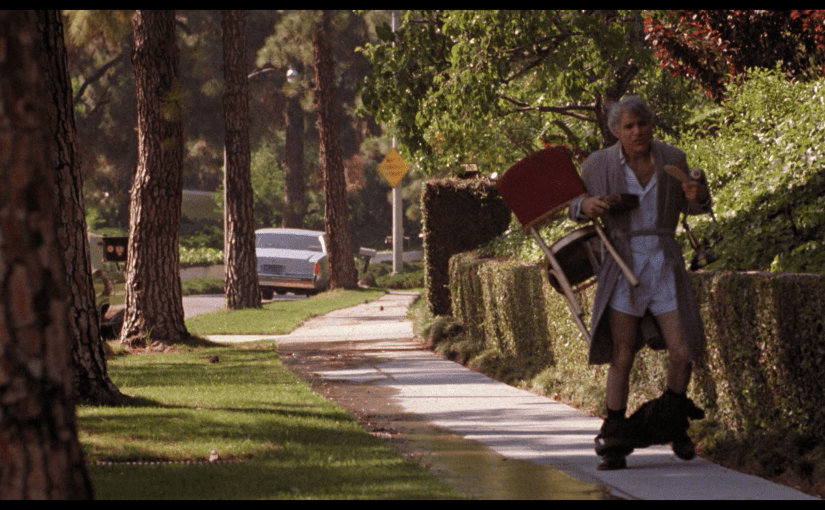
There’s his trusty dog named Shit Head.  Navin insists on no longer drinking the old wine.  Bring him the new stuff.  A crazed sniper (M Emmet Walsh) tries to kill Navin, misses and Navin reasonably concludes that it must be the oil cans that the killer has a grudge against, when the bullet holes spring leaks. Makes sense to me!  If you accidentally run outside naked to chase after the one you love, who is leaving you, then of course you will reach for the dogs nearby to cover up your bare behind and “your special purpose.”  Hilarious stuff.

There’s material that doesn’t work as well, but that’s just me.  Like the audiences that saw the play Joe and I wrote this year, what one person thinks is funny, another will not.  It’s a balancing act.  I’m not here to mandate what works and does not work for you.  I just want to celebrate Steve Martin’s inspired Three Stooges spawn that welcomed him to the big screen, long before the antics of Jim Carrey – who I rarely think is funny and simply comes off as an annoying child who won’t sit still.  That being said, I still prefer Martin’s  later work where he played the straight man victim to someone else’s annoyance such as in Planes, Trains and Automobiles (a favorite film of Joe and I, collectively) and Parenthood, not to mention the brilliant Only Murders In The Building, and his routines on Johnny Carson (a hilarious magician was my favorite) and Saturday Night Live.  The guy is an enormous talent far beyond The Jerk or The Man With Two Brains.

The Jerk had always eluded me, until now.  I think my parents wouldn’t let me watch it.  Dad thought the material was “filthy.”  He probably saw the one gag where the kid is running around with a t-shirt having the phrase “Bull Shit,” and thus opportunity passed me by.  Yet, he didn’t mind if I watched Dirty Harry or any of Bill Murray’s comedies.  Go figure.  That’s what the varying degrees of humor lend to you.  There are no straight answers in comedy.

Still, I’m glad I watched the movie.  2023 was melancholy for me.  There were some enormous ups, but losing my pal Joe, the Del Griffith to my Neal Page, was an expected but very hard moment to accept when he passed on December 4.  I’m still struggling with the loss.  In his last six months, he couldn’t speak with me on the phone, but at least I could text with him, and once the movie ended with Steve Martin happily dancing to banjo rhythms with his black family, I picked up my phone ready to write to him.  It couldn’t happen anymore.  At least not that way, from now on.  So, here I am on holiday break surfing Netflix, and there’s The Jerk with a warning that it was leaving the streaming service soon.  Joe must have been urging me to finally catch up with Navin, the poor black child.  Thanks Joe.

Chin up everyone.  We were all a name in a phone book. Happy New Year!!!!

THE HATEFUL EIGHT

By Marc S. Sanders

Quentin Tarantino’s eighth film, The Hateful Eight, has the signature director’s fingerprints all over, but it still stands apart from the rest thanks to a lurid, foreboding soundtrack from Ennio Morricone with an Agatha Christie narrative approach.

During a post-Civil War period, near the mountaintops of Wisconsin, an image of a crucifixion post is blanketed in snow as a stagecoach races past.  The cold symbol spells doom.  The coach is stopped by a curious, well-dressed man in the middle of the road.  This is Major Marquis Warren (Samuel L Jackson), a legendary black Union veteran, now bounty hunter.  With a fierce blizzard on its way, the Major convinces another bounty hunter, who has paid for the coach, to hitch a ride.  That man is John Ruth (Kurt Russell) and he’s escorting his ten-thousand-dollar bounty, a black-eyed unsavory Daisy Domergue (Jennifer Jason Leigh), to her hanging in the nearby town of Red Rock.  A would-be sheriff of that town eventually hitches a ride as well, Chris Mannix (Walton Goggins). The coach has to take shelter from an oncoming blizzard at Minnie’s Haberdashery, where four other men are already holed up.  They are Confederate General Sandy Smithers (Bruce Dern), the charming British hangman Oswaldo Mobray (Tim Roth), Cowboy Joe Gage (Michael Madsen) and the giant like Mexican Bob (Demian Bichir).  Tarantino has invented another collection of seedy two-dimensional characters whose unique appearances and vocal inflections set them apart from the rest of the gang respectively. Still, they are interesting enough.

The first celebrated performer of the piece is Morricone’s Oscar winning soundtrack which is totally eerie, sinister and immersive.  I go back to that carved out wooden image of Christ hanging from the cross and covered in snow.  Morricone’s music replays the same notes but with more intensity each time it starts up again.  It’s as if the Devil is luring us into his hellish lair.  If the famed Conductor’s chords could speak it would start with “Once upon a time, on a dark and stormy night…”

Twists of fate await all of these men and the one woman.  Like a mystery from Dame Agatha, the characters are set up for introduction to each other, with a little bit of back story.  The ones that especially stand out belong to Major Warren who possesses a personalized letter from President Abraham Lincoln himself.  The curious question of what could possibly merit a ten-thousand-dollar bounty for a small woman like Daisy is the other mystery I initially take notice of.  Once everyone is gathered at Minnie’s Haberdashery, how will these people intersect with one another?

The Hateful Eight plays like a short story you might find in a Reader’s Digest.  Taratino might correct me and insist that more specifically it would be found in a magazine of lurid subject matter – pulp fiction.  Go figure.  It is a theme he sticks to and continues to reinvent himself with each passing film.  The creativity comes in the new situations he constructs for his players.  He’s placed his figures in another kind of western by this point already.  He’s applied them to an alternate kind of Nazi occupied Europe during the second world war.  He’s updated swordplay in a zippy Dojo.  Now, he inserts his personalities into primarily a single setting, like Christie did time and again. 

Clues are uncovered as the film moves on to indicate that something may have happened here, before the stagecoach arrived.  There’s a broken door that needs to be nailed shut each time it is crashed opened.  A jellybean?  A chess board sits in front of the General and appears to be in the middle of a game.  And where is Minnie and Sweet Dave, the caretakers? The Major positions himself as the detective and within the small confines of this log cabin suspicions will reveal more about how the men and Daisy are connected and why they are here, now, while a harsh, unforgiving blizzard rages on outside.

The dialogue of The Hateful Eight is not as memorable as other Tarantino scripts.  Yet, the characters are just as colorful, and there are a couple of zips in time to keep you alert when a new development surfaces.  Tarantino is not shy about the bloodshed either.  The violence plays like most of his other films with a kind of slapstick twist.  A character gets violently ill and vomits blood all over Daisy.  That’s after a couple of wallops to the nose and jaw, plus a face full of stew that she’s had to endure as John Ruth’s handcuffed prisoner.  Later, someone’s brains splatter all over her. 

None of the guys are standard cowboys of the Old West either.  Goggins plays a good-natured dimwit.  Jackson is impervious to the racial name calling.  Russell is a cranky old grunt.  Your grandfathers did not take your fathers to Saturday matinee “ride ‘em into the sunset” westerns like these.  This is the most garish of material, and as in your face as it is, it’s also quite entertaining.

Tarantino has definitely graduated from the simplicity of his first films, Reservoir Dogs and Pulp Fiction.  The production value of The Hateful Eight is phenomenal.  Originally, I saw this movie in theaters with a couple of my Cinemaniac buddies.  Tarantino was proud to present it on 70mm Panavision film, complete with some intrusive lines and occasional burn spots.  Don’t tell me if this was not shot on location.  I don’t want to know.  I treasure the illusion. The deep snow-covered Wisconsin mountains are glorious to look at.  I feel completely absorbed in the setting with the harsh whispers of chilly winds happening outside as the dark blue of the snowstorm can be seen through the cabin windows.  This may be Quentin Tarantino’s most atmospheric film to date. 

This movie has a running time of three hours, but I strongly recommend to watch it without stopping.  The blu ray was a Hanukkah gift from my wife, and I tried watching the night before, but I kept having to pause it to struggle with a cold I’m currently fighting.  I only made it to “Chapter Four: Domergue’s Got A Secret.”  The next day, I told myself to start it from the beginning while everyone was out of the house and the experience was very fulfilling as Tarantino’s wintery day moves into night and then finally reaches its bloody conclusion. 

The Hateful Eight works like a graphic novel come to life.  It’s a great late-night rainy-day kind of picture.  If you haven’t seen it or it’s been a while since the last time, like it was for me, then I recommend checking it out during this winter season.  Trust me.  It just wouldn’t play as well on a hot summer night in July.  Quentin Tarantino and his cast work better when they are at their most cold blooded.

MAESTRO

By Marc S. Sanders

Bradley Cooper’s second directorial film suffers from the same ailments as his first film.  Like his interpretation of A Star Is Born, Maestro is not as good as the sum of its parts.

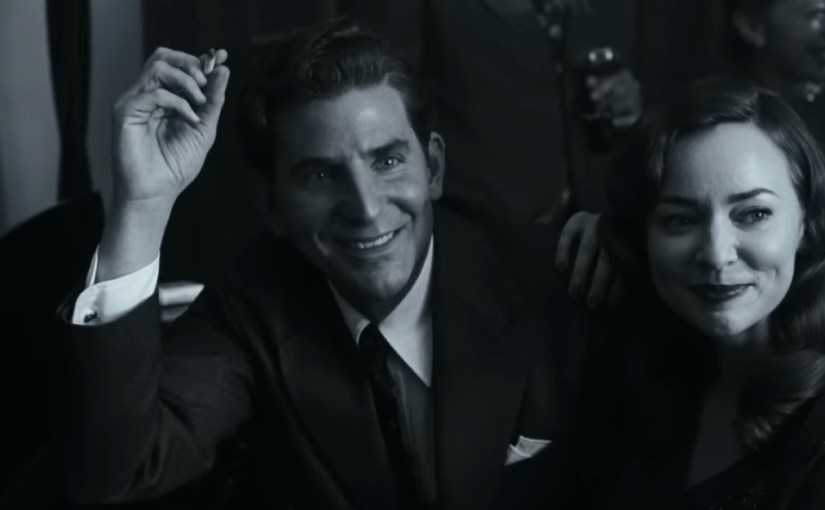
Constructively speaking Maestro is a gorgeous looking picture with a first half in a comfortable, historic black and white followed by its second half in vibrant colors.  The acting from Cooper, as Maestro Leonard Bernstein is well performed.  Carey Mulligan is sensational at no matter what age she is portraying actress Felicia Montealegre, the conductor’s wife.  Within the scenes they share together there is a beautiful rhythmic exchange of dialogue, written by Bradley Cooper and Josh Singer.  Cooper also looks powerful as he reenacts the conductor in front of his choruses and orchestras.  There are also inspiring shots that start out vague and unclear only to come into a full blossom as Cooper’s camera maintains an unbroken focus on an image. 

All that being said, none of it matters because the script from Cooper and Singer is muddied.  While Mulligan and the actor/director are in the midst of marital argument on Thanksgiving day, much is hard to understand as they naturally speak over one another, and what can be made out seems to mean nothing as they fight over people and issues that I do not believe are ever touched upon in the picture.  A scene like this looks like an actor’s dream piece, but it is hollow of substance. 

Like A Star Is Born, there are characters that enter Maestro for long winded scenes and then are never heard from again.  Either Bradley Cooper does not feel the weight of their importance, or he mistakenly presumes the audience will catch on.  An outdoor brunch with Felicia, Leonard, another couple and I believe a mentor or agent of Leonard’s seems well written, but I have no idea who those people are or what kind of influence they carry.  I was hoping to realize later, but those three amount to nothing.  Was the other couple supposed to be Leonard’s parents, and perhaps they were meeting Felicia for the first time?  I’m just not sure.

Bradley Cooper is a master with his camera.  An important moment in Bernstein’s life is when he gets the call to perform at Carnegie Hall when the other conductor calls in sick.  With its black and white imagery, a young and enthusiastic Leonard answers a phone call while a black square, with light from behind, occupies three quarters of the screen.  I was wondering if that was a stage curtain that needs to be lifted.  I was half right.  It’s a window curtain to the apartment Leonard shares with his gay lover.  The film moves into high energy as the would-be composer slaps his lover’s bottom and leaps down the stairs with a quick edit into the theater.  Mike Nichols would be proud. 

Another moment that struck me was Cooper pointing his camera up into the tall reaches of his apartment building staircase.  It’s quite dark.  You may have trouble realizing what you are looking at but then his son drops a paper airplane “good luck” note down to his father on the bottom floor.  These images blossom into something as alive as I would imagine the director/co-writer/actor regards Bernstein.

So, there is much to praise in Maestro.  Unfortunately, the assembly of these shiny, inventive, and magnificent pieces of film do not mesh very well together.  Bernstein led a homosexual lifestyle, even going so far as to welcome a lover into the home he shared with Felicia.  Carey Mulligan is excellent with expressions of resentment towards this other life that her husband follows.  However, the storyline never feels fully fleshed out.  We never get an opportunity to see the value or the menace of the other relationships that Leonard holds on to.  A so-so moment is accompanied by Bernstein’s saxophone opening to West Side Story.  The piece is used as a subtle tool of deceit and ignorant cruelty by Leonard while escorting his apprentice/lover in the home he shares with an angered Felicia in the foreground.  We presume the threat that Felicia likely feels, but it never comes to the surface. 

Bernstein’s career is glossed over as well.  Who pushed him to move on to bigger moments and acquire greater crescendos in his life?  I’d like to think it was Felicia, but I’m not certain.  Felicia has conversations with Leonard’s sister (Sarah Silverman) and other acquaintances, but what is she really alluding to or really talking about?

The most impressive moment in the film is when the Maestro conducts the London Symphony Orchestra at Ely Cathedral.  (I’ll own up and say I looked up what this scene was on IMDb.)  Bradley Cooper does a masterful reenactment of Berstein, dripping in shaggy grey hair sweat, dressed in a three-piece tuxedo with baton in hand.  This is a major multi talent working in films today.  Cooper studied film footage of the scene over a six-year period to get this six-and-a-half-minute unbroken moment caught on film.  It’s positively mesmerizing and I could watch this over and over again.  I’m waiting for the side-by-side comparison to appear on You Tube soon. It is reminiscent of what Rami Malek did as Freddy Mercury at the Live Aid concert at Wembley Stadium in the film Bohemian Rhapsody

Still, this scene much like a lot of the footage in Maestro seems to just be wedged in there.  There’s a balletic flow to some moments in Cooper’s film and then there are times that come out of nowhere and I’m left to wonder how exactly we arrived and what was truly going on in Bernstein’s life when he conducted at this historic moment time.  I’m watching a blazingly fine impersonation of Bradley Cooper doing Leonard Bernstein but I’m lacking the sub conscious dimension a biographical film should have at this point in a historical figure’s life.

Carey Mulligan is laying everything out to portray Felicia and her best moments come in the last third of the picture when the poor woman is struck with breast cancer that has spread to most of her body. We witness how she lives with the illness along with her separated husband by her side.  I’ve seen ill women before in films.  I know I sound crude by saying it’s nothing new.  I’m still allowed to be impressed though.  It’s a huge feat to bring a performance to this kind of level.

The makeup work is marvelous too.  Raw footage of the real Leonard Bernstein is shown before the end credits, and I’m impressed with how much Cooper looks in comparison.  The aging of him and Mulligan over the decades since the late 1930’s all the way through the mid 1980’s is perfectly captured.  At one moment, Carey Mulligan looks just like my mother.  I choked up a little bit when Felicia gazes upon Leonard at the Ely Cathedral.  Same hairstyle.  Same eyes.  Same expression.  Mom would have even worn a soft blue evening gown like that in the mid-1970s.

I wanted to like Maestro more than I did.  I almost feel guilty for not liking it as much.  There is magnificent camera work, sensational acting, wonderous music and perfect impressions on display, but the puzzle just did not have all of its pieces assembled together properly.  Sadly, Maestro lacks the focus it needs, either for the famed conductor’s amazing career or for his relationship with Felicia with his not so concealed homosexual lifestyle on the side.  Bradley Cooper put together a million magnificent moments, but it caused him to overlook the enduring structure of his subject.

POOR THINGS

By Marc S. Sanders

A sexually explicit rendering of Mary Shelley’s Frankenstein is brought to life by Yorgos Lanthimos’ film, Poor Things.  The strongest element of the picture is certainly Emma Stone’s uncompromising performance as Bella Baxter.  It’ll at least get an Oscar nomination.  The film will likely collect an abundance of nominations as well for it’s fantastical imagination in art direction, garish costuming and makeup and directing.  Maybe there will be some accolades for Willem Dafoe and Mark Ruffalo as well.  The adapted screenplay of Alasdair Gray’s novel, written by Tony McNamara, is a contender too.  It’s already being hailed by many outlets as a top 10 picture for 2023.  Yet, I grew tired of the novelty, and bored with the excessive sexual exploits of Bella.

Bella was once a pregnant woman who deliberately plunged herself off a London bridge to escape her misery.  Godwin Baxter (Willem Dafoe), who Bella appropriately recognizes as simply God, discovers her lifeless body in time to conduct an experimental procedure.  Replace Bella’s brain with that of the unborn child she carries and raise her from there.  God is scarred and altogether bizarre, and recruits a medical student named Max (Ramy Youssef) to observe the reborn girl’s progression and behavior; a grown woman with that of an infant who is learning to speak, walk, eat, and behave for herself.  After a while it is decided by God that Max will become engaged to Bella.  However, another man enters the picture, Duncan Wedderburn (Mark Ruffalo), who convinces Bella to accompany him on a sojourn.  God permits the idea as an opportunity for Bella to learn what is out there and not restrict her.  It is at this point, that Lanthimos’ film transitions from a blue tinge monochrome photography to vibrant color as Bella and Duncan travel to destinations such as Lisbon, Alexandria, and Paris, where Bella abandons a destitute Duncan to join a Parisian brothel.  Bella sees opportunity.  She can earn money for allowing men to put their things inside her.

I could not help but think of films like Forrest Gump, The Curious Case Of Benjamin Button and even Pinocchio while watching Poor Things.  An unwise subject discovers an independence to witness how a world around her functions.  As she learns, she matures, and she realizes she does not need to be held down by any party.  Shelley’s monster also broke free of its master’s clutches, tried to acclimate itself, but was revolted against for its grotesqueness on the outside and simply for being misunderstood.  Bella does not encounter such a fate.  Instead, she discovers acceptance but only at what she’s worth monetarily speaking with a simple attraction limited to individual thought.

Poor Things is constructed in the narrative themes of Yorgos Lanthimos’ preferred way of filmmaking.  Just like The Favorite, it’s deliberately weird and proud of it.  Nothing appears conventional.  You could substitute the settings for Paris, London and even the cruise ship that Bella and Duncan travel on for set pieces in Wonka.  It’s all fantasy with an adoption of real-world locales.  I surmise Lanthimos excuses these outlooks as a perception of Bella.  The settings look like they were spawned from a pop-up children’s book.  It’s all so different but I found it to be tiring. If someone were to argue that it is inventive as opposed to another stale backdrop of London Bridge or the Eiffel Tower, I wouldn’t debate them. Yet, I was growing tired of the piece. 

Moreover, the second act of the film concentrates abundantly on Bella’s adventures within the brothel.  Bella discovers the comfort of self-pleasure.  Later, the sensation is enhanced by the possibilities of getting satisfied by the company of a man.  The audience chuckled.  So did I, but I also squirmed quite a bit.  Bella insists to God that she wants to “go adventure,” and God allows her his blessing.  Yet, I found these series of sexual encounters to be overly exploitive.  Nothing is held back on what Emma Stone performs for the camera as a concubine for one needy, stinky, and ugly gentleman caller after another.  She takes it the traditional way, the oral way, the way from behind and much more.  She is captured with S & M straps across her nude body and the Oscar winning actress goes all the way to sending the scenes home.  It’s as if Yorgos Lanthimos needs to deliver his point, but it’s not enough to try it once, twice, or even three times.  I get it already.  Bella is used for whatever fetishistic imagination the male mind can fathom and more importantly she thrives off of the stimulation. She happily recounts how a pineapple can be used in the bedroom.  It’s even better that she can get paid for this lifestyle.  It sounds amusing while I type this all out, but I was not entirely comfortable watching it either.  I’ve seen enough porn in my day to not be shocked, and I wasn’t shocked.  Yes, I was amused at times.  Look, I don’t have ice water running through my veins.  Eventually, though, I was just bored.

Godwin Baxter is an interesting character as played by an always reliable Willem Dafoe.  Early on, we see how in addition to his experiment with Bella, God has toyed with the ideas of blending different breeds of animals together.  Roaming his estate are the likes of a dog crossed with a chicken and a pig crossed with…you know what I can’t even remember after seeing the film only once.  There was also a duck crossed with something.  Kind of sophomoric material and I think Lanthimos would accept that observation as a compliment.  Oh yeah, there was a goat crossed with something too; was that the pig?  What I think lacks from Poor Things, however, is to probe if these kinds of experiments should even be conducted and I cannot recall a conversation that goes in that direction.  Max seems taken aback by what he witnesses but he never investigates further.  This is all most unusual (a serious understatement) and it’s hardly ever questioned. Even Jeff Goldblum tossed a contrary opinion at the idea of Jurassic Park.

I suppose I wanted more from Poor Things.  Beyond sexual pleasure and what can be gained from it, isn’t there anything else that naïve Bella has to learn about?  I guess in conjunction, she also learns how to earn a wage and a gumption to stand up for herself.  What about love and the fear of death?  What about what else occurs within the world around her?  What about loss, or betrayal?  As well, Godwin’s occupations never go further than what we see he is capable and daring enough to do.  How do others consider his experiments?  What residual effects stem from his accomplishments?

I’m glad I saw Poor Things.  I think I’d like to see it again actually because I may gain a greater understanding from the attempts the script strives for in accordance with Lanthimos’ vision.  I know this film is not for everyone, though.  It’s proudly peculiar, but its plodding in its glee to step very far over a line that most filmmakers wouldn’t dare go.  It has my salute for what it has set out to do.  Nonetheless, I’m not sure I’m a fan of the material it served, though.

THE DEER HUNTER

By Marc S. Sanders

After watching the 1978 Best Picture winner, The Deer Hunter, I followed up by reading some of the trivia about the film on IMDb.  Please do not think I’m a terrible person, but the racial overtones within the portrayals of the Viet Cong never occurred to me.  I guess I can only surmise that war is hell, and I suppose that when any one of us are being held in captivity our prejudices go out the window, and the hatred we feel towards another human is directed at the ones who are exercising their sadistic torment upon us.  It does not matter where they come from or what they look like or even if they are related to me.  Being held prisoner and forced to participate in games of Russian Roulette must allow my seething abhorrence. 

Another important factor that was questioned in Michael Cimino’s film is whether games of Russian Roulette were in fact forced upon POWs during the Vietnam War.  Many veterans insist it wasn’t, therefore holding a strong grudge against the filmmaker.  Cimino argued that he had testimony and photographic evidence to its validity.  I will not even give you an opinion.  I do not know enough about that terrible conflict, and I will not disrespect the service that so many men and women devoted during its time.  I can only focus on the context of the three-hour film. 

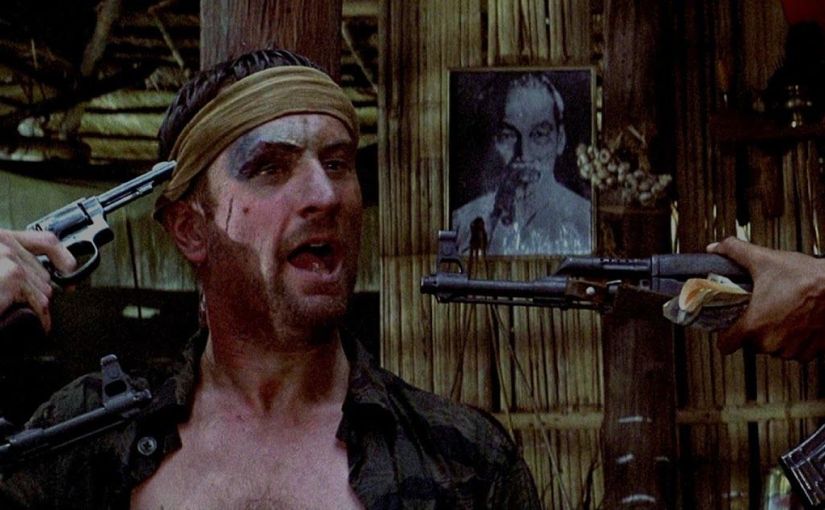
In this movie, I see a perspective of three buddies from a small Pennsylvania steel mill town who voluntarily enlist in the army in the late sixties to serve in the Vietnam War.  Thereafter, they are held as prisoners of war, confined in submerged bamboo cages infested with rats and mosquitoes.  They are only let out to compete against one another in face to face Russian Roulette by a forceful unforgiving Viet Cong.  Upon escape, the three men are separated with different measures of terrible destinies to live with afterwards.

Mike, played by Robert DeNiro, is the Green Beret Army Ranger who returns home to a lifestyle he can no longer lead.  Steve (John Savage) has been permanently traumatized both mentally and physically as he has lost both legs.  Nicky’s (Christopher Walken) whereabouts are unknown.

Before any of this occurs, there is a lengthy first act to The Deer Hunter.  The three men are celebrating their send off to serve, but more specifically Steve is getting married.  Michael Cimino takes much of his time focusing on the ceremony, which contains orthodox Russian traditions, and the party with an enormous amount of wedding guest extras (probably the whole town) to carry out endless, drunken celebrations. 

The first time I saw this film I grew bored with the wedding footage.  It seemed to be overly long and tiring.  Pointless, even.  On this most recent view, however, I found it completely absorbing.  There’s an unbeknownst future to all of these people, not just the three eventual servicemen.  None of the people in this Pennsylvania town live extravagantly.  It’s special for the ladies to wear their formal pink bridesmaid dresses but they run through the wet streets of the town on their way to church.  The men throw on their tuxedos that they likely wore only one time before during their prom.  Once the reception begins for Steve and his wife, Angela, everyone is sweaty and out of breath, happily drunk and wobbly.  They lean on one another in a sloppy way for a group photo. They never stop drinking.  More importantly, they never think about how scary or horrifying the Vietnam War could be for them.  They are celebrating a happily wedded future for their buddy Steve and their soon to come legacies as American war heroes.  Nicky even takes a boozy moment to propose to Linda (Meryl Streep).  Already an abused woman, she immediately accepts.  Mike can only gaze with inebriated amazement at a uniformed serviceman who is disturbingly quiet as he sidles up to the bar.  Mike insists on buying him a drink. 

Late into the night and onto the next morning, the guys are doing their traditional favorite activity with a ride into the mountains for some deer hunting.  They change out of their tuxes and into their hunting gear as they tease one another and gorge themselves on Twinkies with mustard.  None of these boys have a care or worry in the world, except for nerdy Stan (John Cazale) who has once again left his hunting boots behind.

There’s a relaxation and calmness to these people; to the men who are staying behind, to the ones getting ready to leave and to the women who share in their lives.

Regardless of the questions of racism or authenticity, Michael Cimino, with a joint screenplay written with Deric Washburn and Louis Garfinkle, show how the war not only directly changes those that served but also the ones who welcome them home.  Steve’s wife is not only separated from him but also appears mute and inactive.  Linda attempts to move on with her life but is absent of comfort from Nicky, the man who proposed to her on a whim.  Mike is not capable of being the drunken party leader or precise deer hunter he used to be.  The deep scars of the three also draw scars for everyone else back home.

The Deer Hunter is a very difficult film to watch.  The picture ends leaving you feeling traumatized because it stretches from innocent celebration and debauchery over to some of the worst images that could ever be fathomed.   Wars end in a truce, a victory or a defeat, but the conflict does not cease for many of those who participated as pawns for a governing power. 

Nicky never comes back to Pennsylvania.  He tries calling home, but he can never follow through.  He has been changed permanently by his time as a killing soldier and captive who was being forced to use his life for stakes.  Mike returns dressed in his uniform with his medals signifying his achievements but as soon as he sees the “Welcome Home Mike” banners he insists the cabbie drives on by and he does not enter Linda’s trailer home until he sees all the guests leave the next morning. 

There’s a haunt that Cimino’s film ends with as the remaining members of the group assemble following a funeral and segue into singing “God Bless America” together.  I don’t ask this question as a means to minimize anyone who has served or lives as an honored citizen of our country; should these folks who must endure loss from now on be chanting about blessing America, or should they be pleading for a blessing upon themselves? The characters of The Deer Hunter struggle internally and are desperate for a salvation and peace. 

War may be a chaotic, unforgiving hell, but living thereafter is another kind of hell that you cannot escape from.

TRADING PLACES

By Marc S. Sanders

Dan Aykroyd and Eddie Murphy are the unaware invitees of a Prince And The Pauper R-rated, yet whimsical, scenario in John Landis’ Trading Places.  They are one of the best on screen pairings in film, and this is one of the best comedies to come out of the 1980s.

Randolph and Mortimer Duke (Ralph Bellamy, Don Ameche – another brilliant on-screen duo) are the filthy rich misers who live to make more and more money and use their wealth to cheat and make even more monies or to perhaps use those that are at their behest to test certain social experiments.  Namely, Randoph believes that regardless of a man’s environmental upbringing, anyone can become a success based on their merits.  Mortimer believes otherwise.  It’s in the blood, he claims.  Who you spawn from is how you are destined to become.  To settle this debate, they make a modest bet of switching out their protégé investment representative, Louis Winthorpe (Aykroyd), with homeless bum/con artist Billy Ray Valentine (Murphy).  Deplete Louis of all his possessions and wealth along with his sparkling reputation, his lovely fiancée, his friends and even his faithful butler, Coleman (Denholm Elliot).  At the same time, establish Billy Ray as an up and comer in the WASP Hoi Polloi and award him all of Louis’ assets, along with assistance from Coleman.  Then they will see what shakes out and who wins the bet.  A plot like this was staged in a few Three Stooges shorts during a post Great Depression phase.

The premise for Trading Places allows for a lot of gags that consistently serve the story set mostly in Philadelphia around Christmas and New Year’s.  The holidays lend an atmosphere to the picture.  The brutal cold seems to only make it downright worse for poor Louis, the suddenly accused drug dealer and petty thief.  It only looks worse for him when he’s dressed in a dirty Santa Claus suit and getting peed on by a dog just before the cold rain arrives.  For Billy Ray, the warm comforts of Louis’ home seem like a welcome respite from the chilly, damp streets he likely has slept upon night after night.  If not on the street, then in a jail cell. 

The characterizations are perfect.  I get a kick of Dan Aykroyd’s performance of Louis, the contemptible snob with not one hair out of place and the arrogant tone of his line delivery.  Eddie Murphy is basically doing his routine from all of his early work like Saturday Night Live and 48 Hrs or Beverly Hills Cop.  Yet, I have no complaints.  He’s just funny as hell and the dialogue lends to his basic schtick.  This is the Eddie Murphy I miss from most of his modern film releases.  Denholm Elliott is great at often breaking his regal character to refer to someone as a scumbag.  Bellamy and Ameche are equivalent to wicked stepsisters from a fantasy story.  They are scheming and dreadful with glee.  Paul Gleeson is that “seen that guy somewhere before” henchman working in line with the Dukes.  He’s a great jerk who gets Louis and Billy Ray into their unexpected predicament.  Jamie Lee Curtis is unforgettable as a hooker with a heart of gold, convinced to help out a poor down on his luck Louis when there’s nothing else available to his assist.  She portrays Ophelia whose got the street smarts and sometimes the Judy Holliday squeak in her voice to lend to the spoof comedy this film relies upon.  It’s hard to believe this is the same actor who was a scream queen in a couple of slasher flicks a few years before this film’s release. Never a glamourous actor, but Jamie Lee Curtis has such an amazing range that still surprises in newer films of today (see her Oscar winning performance in Everything, Everywhere, All At Once).

The imagination into this film’s story has to be admired.  When Louis and Billy Ray become aware of the ruse pulled against them, it’s suggested not to kill the villains in cold blood. Rather do unto them what they already committed. Thus, a wonderfully energetic third act is welcomed on the floor of the New York Commodities Exchange that hinges on insider trading and realistic mass hysteria for a silly, yet highly valuable commodity such as Frozen Concentrated Orange Juice.

John Landis incorporates so many side gags into Trading Places.  Imagine Billy Ray intruding upon the wealthy’s exclusive club of snobs and you get a memorable caption of ten police officers pointing their guns in his face.  Poor Louis being subjected to a strip search conducted by nerdy Frank Oz.  Randoph and Mortimer explaining how commodities trading functions to Billy Ray thereby inviting Eddie Murphy to break the fourth wall for a moment.  Even one of my favorite actors of today, Giancarlo Esposito, makes a blink and miss it appearance as Billy Ray tells a tall tale of how he got arrested after using the “Quart of Blood Technique” on ten cops at one time while two hilarious jail cell thugs listen in to his BS.  A train ride to set the victims’ plot of revenge in motion is great involving silly disguises, a New Year’s Eve costume party attended by James Belushi, and a live gorilla.  Even Bo Diddley gets a scene with Louis trying to sell his expensive wristwatch while wearing the ugliest sports jacket and tie combination.

I yearn for another comedy that reunites Aykroyd and Murphy.  We were treated to a little sampling of Bellamy and Ameche in Murphy’s later film, Coming To America.  Oh, how I wish those guys could have capitalized on that small scene.  They pair just as well as Jack Lemmon and Walter Matthau did. 

Trading Places is always a perfect holiday movie to watch in December.  It’s funny, charming, and very smart.  It remains one of the best comedies ever offered by any of the cast members listed in this film.

Looking good Billy Ray!

Feeling good Louis!

LEAVE THE WORLD BEHIND

By Marc S. Sanders

Anxiety and the unknown are the themes of Sam Esmail’s apocalyptic Leave the World Behind.  Actually, I can’t even be sure it’s apocalyptic or not until the end arrives.  Even then I wasn’t so sure.  

A family (Julia Roberts, Ethan Hawke as the parents, Farrah Mackenzie, Charlie Evans as the kids) make an impromptu getaway from New York City and rent a luxurious upstate air B & B for the next five days.  Upon arrival they are quickly relaxed amid all the amenities and beautiful outdoor pool.  A visit to the beach is refreshing until an oil tanker arrives from the deep ocean waters and drifts upon the shore with no warning.  Strange, but okay.  No need for that to ruin the vacation.

Then other unexpected occurrences happen.  A charming gentleman dressed handsomely in a tuxedo and his formally dressed daughter appear on the doorstep of the home in the middle of the night.  They are played very well by Mahershala Ali and Myha’la.  The man claims that he’s the owner of the house and while attending a concert in the city, they needed to make a quick exit and the best place to hold up was at this house.  Conveniently, he does not have any ID to prove his identity along with no specific personal items in this home he claims to own, not even the title ownership papers.  No photos of family tucked away anywhere.  He does have a key to the liquor cabinet, however.

Quickly, the scene is set where the internet goes down.  Federal blue screen warnings appear on every television channel.  Cell phones don’t work.  Deer, lots and lots of deer, appear in the backyard and then disappear.  Pink flamingos wade in the pool.  Elon Musk’s white Tesla cars have a stand out scene.  Roberts then recalls seeing a grizzled Kevin Bacon collecting an abundance of supplies when she made an earlier shopping trip in the local town.  

The paranoia starts to set in beginning with Julia Roberts’ character Amanda.  Amanda declares early on that she fucking hates people.  Hawke’s husband character, Clay, is not ready to hit any panic button and is happy to accommodate the strangers on the doorstep and just wait for the internet to be restored with a logical explanation.  Ali’s character, known as G.H., lends a welcome smile but it’s clear he’s not sharing all that he’s thinking or maybe what he knows.  

Sam Esmail’s film wants to provide a demonstration of how people respond when they don’t know all that’s going on, particularly when modern technology fails us.  A more relatable inconvenience is suggested as Mackenzie’s character Rose is frustrated that her streaming channel shut down just as she was starting to watch the final episode of the sitcom, Friends.  I felt her anguish immediately as my daughter consumes the trials and tribulations of Ross and Rachel on a repetitive cycle.  Ironically, streaming goes down and now the girl can’t watch Friends.  Netflix is the distributor of this film.  Yet, I think they just gave a ringing endorsement for a dying medium.  If only this girl collected the DVDs.  

My problem with Leave the World Behind is the slow pace of it all.  This is one of those movies where its triumphs hinge upon the final five minutes or so.  Either you applaud what sums up the last two and a half hours you invested, or you roll your eyes at where the picture drops you off with the urge to throw your popcorn at the screen.  

Watching Leave the World Behind brought back experiences of shows like Lost or The Walking Dead.  The set ups are brilliantly intriguing from one development to another.  The follow through on each new happening amounts to nothing or at least not anything where I can suspend my disbelief.  Questions are answered with questions.  It’s like calling an insurance company for information following a car accident.  You just want to slam the phone down.

When Ali’s character chooses to check on a neighbor, he sees a watch embedded in the sand nearby.  He picks it up only to get a fright that makes us jump.  The viewer sees nothing else and we are led to believe that Ali sees nothing else, until Esmail goes to a wide overhead shot showing the massive wreckage of a commercial airplane crash, complete with black smoke and flames and endless amounts of luggage and debris.  It’s hard for me to buy a scene like this.  G.H. doesn’t smell any burning fire nearby?  He doesn’t hear anything? He doesn’t see any other debris left mere inches away from the wristwatch only until Esmail’s direction goes from closeup to wide?  I cannot accept the character’s tunnel vision.  My eyes would go towards the crashed plane before I’d ever discover a wristwatch.  It’s just eerily quiet.  The director’s manipulation is a set up shock for me, the viewer, to grab my attention.  Yet, it backfires because it’s completely implausible.  There are many moments like this in the film.

Other than Marhershala Ali (who I still insist should be considered a viable candidate for the next James Bond or a 007 adversary), the rest of the cast is not dynamic enough.  Julia Roberts is working a little too hard.  Ethan Hawke is not working hard enough.  The dialogue is often boring arriving at no conclusions.  Thankfully, most scenes are enhanced by unusual camera angles from Esmail’s artistic freedoms with his lens.  It’s reminiscent of the deliberately weird structure that Stanley Kubrick often did with The Shining.  Nevertheless, it’s exhausting after a while.

Sam Esmail’s work is no doubt shown through long ponderous imagination.  I certainly felt Julia Roberts’ frustration on display, but still, I got the point.  I see no reason to repeat the same lines at higher volume.  I got the point of a lack of trust between the two parties being brought together.  However, I just got tired of the act.  The racial elephant in the room is even suggested.  Though I wish it wasn’t. People quickly forget that George Romero’s Night Of The Living Dead steered clear of any racial factor, and just look at the legacy of that film from the era of the Civil Rights Movement.

The ending that arrives seems inevitable.  Without revealing anything literal, it is doom and gloom.  However, I might have had more appreciation if suddenly the TV and internet got restored and these odd occurrences all just happened to be one big nothing.  At the very least, then I’d understand that this whole freaking planet would just go nuts without their You Tube, Instagram and Netflix.  

You might have had a conversation at one point in the last decade or so that began as “How did we ever manage to survive before the internet?”  The truth is we did just fine.  The adults in Leave the World Behind never stop to remember that though. 

MAY DECEMBER

By Marc S. Sanders

A blaring piece of pounding piano music from Marcelo Zarvos hearkens awake the silent opening few seconds of Todd Haynes’ May December against that of a caterpillar/butterfly terrarium.  I don’t like the music and I’m immediately reaching for the volume control on my remote.  It’s only as the film progresses, however, that I develop a grateful appreciation for the often-disruptive soundtrack.

Julianne Moore and Charles Melton are Gracie and Joe Yoo, the relationship referenced in the film’s title.  Twenty years prior, Gracie, at age 36 who already had children and a husband of her own, had an affair with Joseph, a 13-year-old seventh grader at the time, in the storage area of a Savannah GA pet shop where they worked together.  Gracie went to prison for the crime of statutory rape and delivered their baby while serving her sentence.  Once her term was finished, the two continued their relationship and got married, bearing a set of twins, a boy and girl.

As the twins are approaching graduation, a television actress named Elizabeth (Natalie Portman) has arrived in town to do observational research and interviews to prepare for her portrayal of Gracie in a made for TV account of what occurred.  On the surface, all seems calm with the past put behind everyone.  Townsfolk will say that Gracie and Joe are so appreciated and loved in the community, and they love each other.  However, the script from Samy Burch will reveal otherwise as Elizabeth develops different kinds of connections with Gracie and Joe, respectively, as well as others she speaks with in town, including Gracie’s attorney, her ex-husband, the pet shop owner, and Gracie’s now adult son from her first marriage.  His name is Georgie (Cory Michael Smith) who was close friends with Joe until the affair was revealed, and now let’s everything hang out avoiding any kind of subtlety.  He’s even candid about what he believes occurred in Gracie’s childhood that could have dictated why she committed her act.

Todd Haynes’ picture is a complete character study of a story that many would regard as sordid or seedy trash material to talk about over dinner with friends.  People like Gracie and Joe may seem real to any of us who live in another part of the country.  We will never have any kind of relationship with them.  They are meant for cover stories in People magazine and The Inquirer.  It’s soap opera junk or trashy romance novels brought to reality.  It’s easy to judge the kind of person Gracie in particular is because what she has done is wrong and disturbing.  All these years later and they are still receiving packages on their doorstep that contain feces.  Gracie committed a terrible crime, but what does an act like this say about someone who would go to that length, so many years later? 

The performances in this film are astounding.  Charles Melton especially.  Samy Burch writes a disturbing and well-drawn character with Joe.  He’s thirty-six years old now, in 2015 when this story takes place, and as his children are graduating and are about to make their home an empty nest, he seems so much more immature than them.  A telling scene occurs when his son takes out a joint and practically instructs Joe on how to use it.  Joe coughs uncontrollably.  He gets ill, and it is his son who is calming him down.  Gracie also appears to treat Joe like the child she bedded all those years ago, instructing him to straighten up the house and put away his butterfly garden, or not to get into bed because he reeks of the BBQ he used earlier in the day.  Joe lives in an adult body, but he skipped his progressive years to go straight into marriage and fatherhood, and therefore he has not had an opportunity to grow up.

Julianne Moore plays delusional all too convincingly.  She might have confessed guilt to her crime.  She served her time, but as her attorney and Georgie will imply, none of that means anything if she still believes she did nothing so terrible.  She’s now married to Joe, who is now well past legal age and has had a twenty-year relationship with him, as well as the children they share.  Gracie happily accepts her new role as a baker in the community.  Yet, it doesn’t even occur to her that some acquaintances merely place orders just to keep her occupied.  Either Gracie chooses to wear blinders or she’s truly unaware of how she’s considered; still remaining a pariah within her social circle.  It’s devastating when someone cancels a cake order, tells her to keep the money that was paid for the work, but is also told that the cake no longer needs to be baked.  Especially now, as her children from her second marriage are leaving the home for college, she is realizing that she has no worth or value to anyone anymore.  No one even wants to sample her cake any longer.  Part of me wants to say it serves her right, but with Julianne Moore’s performance, it’s also terribly heartbreaking.  There are acts we commit in our lives that we will never, ever recover from.

Natalie Portman adds another accomplished performance to an outstanding resume.  Todd Haynes assists with demonstrating how manipulative and subtle Elizabeth, the starlet actress, is supposed to be.  When she first arrives at the couple’s home for a summer barbecue, Haynes captures Elizabeth with no jewelry on and wearing a hat and sunglasses that she never takes off.  Gracie, Joe and the others come to greet her and offer her a hot dog, but Elizabeth doesn’t reveal herself.  She keeps herself hidden.  She’s begun a camouflage as she initiates her observations.  As the story moves on, we get to see how perhaps a Julliard trained method actor prepares.  She begins to apply her makeup just like Gracie would.  Elizabeth dresses like Gracie.  She wears her hair like Gracie.  Elizabeth duplicates Gracie’s hand gestures captured in news articles.  Most significantly, she develops a bond with Joe, just like Gracie did.  A crumpled-up letter from Gracie that Joe has held on to since they began their affair twenty years ago, is reintroduced later in the film that Elizabeth pounces on.  Todd Haynes captures an unbroken take of Portman reciting the letter in a mirror and it’s an eye-opening moment for the character.  Suddenly, I don’t see Elizabeth anymore.  I see Gracie, and Natalie Portman is playing the predatory sex deviant.

By 2015, this story is a been there/done that.  The general public has stopped caring.  Only a few still carry an anger with those packages that are left on the doorstep.  Otherwise, there’s nothing left to share or care about.  Yet, May December does a fine job of showing the residual detritus of what’s come from such an illicit affair.  Gracie’s husband before the affair will say he’s over the betrayal and humiliation, but clearly he’s not.  Gracie now has two families.  The first family from a standard marriage with adult and teen children she greets as if they are neighborhood kids.  She’s on the outside of what she used to have as a mother. Then there is the second family consisting of the college age daughter she delivered while in prison and the twins that came thereafter.  An awkward moment occurs in a restaurant when the two families run into one another.  No one is well recovered from Gracie’s transgressions, even if she served her time.

Reflecting back on the music, I wondered why it made such a presence in this intimate, quiet drama.  It literally pounds at you every time it is reintroduced.  I believe it first serves as an abundance of the cheesy melodrama that naturally spawns from an unwell story like this.  Elizabeth is set to appear in a television movie adaptation of this ripped from the headlines account, much like a Lifetime movie of the week which shamelessly thrives on this kind of gossip trash.  The music seems to tell me to “LOOK AT WHAT SHE DID!!!!!!”  Later though, Marcelo Zarvos’ composition seems to remind me that this is not just “another story” as Elizabeth freely dismisses it when talking to Joe during a personal crisis of insecurity.  Joe immediately snaps back at her that this is not just some story.  “This is (his) life!!!!!” 

Before Todd Haynes’ film begins, terrible acts have occurred.  During the course of the movie, we see that terrible results remain.  The narrative of May December is kept interesting because we don’t learn everything at once.  There is exposition to uncover as soon as the film begins all the way to the very end where Gracie undoes all of Elizabeth’s prep work with a curveball truth.  Then, we witness Elizabeth do one take after another on a soundstage with a pet shop prop snake twisting around her arms as the seduction of a young, teenage boy is reenacted.  I don’t think Elizabeth got a convincing grasp on what makes Gracie and Joe tick, and now she questions what she invested in and what she sacrificed of herself in order to learn about the character she committed to portraying.

It’s disturbing what Gracie did.  Perhaps it’s at least as ominous that it is now being duplicated for the sake of entertainment in front of a worldwide audience.

SEA OF LOVE

By Marc S. Sanders

Al Pacino is a twenty-year veteran New York City cop, working out of Manhattan, on the trail of a serial killer in Sea Of Love.  The profession is nothing new to Pacino’s repertoire of roles, but the portrayal is unique thanks to a smart and suspenseful script from Richard Price and intense directing from Harold Becker.

The killer leaves a calling card.  A 45 LP record of Phil Phillips ’50s classic crooner, “Sea Of Love,” spinning on the turntable.  The victims are naked men lying face down in bed with a bullet to the head.  Turns out that a cop from another precinct played by John Goodman has uncovered a similar crime scene in Queens.  So, the two team up.  They believe the murderer is a woman.

All the victims have posted a Lonely-Hearts Club blurb in a magazine. The invitation for a date stands out because the text rhymes.  The detectives decide to post their own ad in the same kind of format, meet the women who respond and hope to nab the killer.  It gets complicated when Pacino encounters a breathtaking and sultry woman played by Ellen Barkin. 

Pacino’s cop is a smart guy.  He’s got instincts.  Yet, perhaps due to his constant drinking, insomnia, and the bitterness he carries now that his partner (Richard Jenkins) has hooked up with his ex-wife, he’s also quite vulnerable.

The mystery is strong, and the tension builds as Sea Of Love moves on.  Barkin has Pacino and the audience convinced that she’s the prime suspect.  Still, he lets his defenses down because he’s easily getting seduced by her advances.

Whether you’re watching Al Pacino share scenes with John Goodman or Ellen Barkin, the execution is fantastic.  Great performances from the three.  Pacino and Goodman have a natural exchange with one another. Often humorous, but the guys always talk like cops.  When Pacino admits to tossing away a fingerprinted glass from Barkin, Goodman suggests lifting the prints from something- ahem – more personal of his.  A cute wink and nod exchange.

More important to the film is the erotic chemistry between Barkin and Pacino.  Harold Becker uses a late-night supermarket visit in the vegetable aisle to evoke the risky and irresistible nature the two characters develop for one another.  Other scenes build well on the relationship between these two lonely strangers who’ve only recently met. 

Moments of isolation and drunken stupors also work towards fleshing out Pacino’s burned out cop.  He’s got a schleppy posture to him and an exhausted expression with his sullen eyes and shaggy black hair.  At the same time, his character’s twenty years of experience seem to uphold his alertness.  This cop knows he’s letting his guard down. Without any dialogue, you see the internal struggle Pacino has with what should be done against what he is deliberately neglecting.

This film was Ellen Barkin’s breakthrough role.  She received rave reviews as someone who takes care to uphold a New York City trendy appearance by day as a shoe salesperson in contrast to a woman looking for some carefree lust in the evening.  For Pacino, Sea Of Love reinvigorated a career slump following a series of poorly reviewed films.  Together, they make for a sexy yet untrusting pair.

Circumventing this relationship is the mystery.  Is Barkin the culprit? She seems to have a dark way about her that may not surprise you.  Price, Barkin and Becker designed the character quite well for her to at least have the potential to be a killer of men.  Is she setting Pacino up to be the next victim?

New York City from the late 1980s looks great, even though interiors were shot in Toronto.  Trevor Jones offers a nail-biting soundtrack to keep the suspense heightened at just the right beats of the picture with Becker’s camera pointing down dark hallways or when new clues are discovered.

I’ve seen Sea Of Love a few times and even with knowing the surprise ending, the film still holds up thanks to the performances from its three stars, along with its taut editing, well-paced writing, and smart direction. 

This is a good erotic murder mystery.

THE MARVELS

By Marc S. Sanders

If you just want to join your family to have fun at the movies then go see The Marvels

The thirty third installment in the Marvel Cinematic Universe (33???????? Wow!!!) follows a trio of women donning the superhero costumes and getting caught up in an exchange of bouncing around their respective presences with one another.  One second Ms. Marvel (Iman Vellani) is in her Jersey City home with her family and then suddenly she’s in an astronaut uniform, floating through space, previously occupied by Monica Rambeau (Teyona Parris).  Another minute, Monica is in that uniform and then suddenly she is occupying the space once held by Captain Marvel (Brie Larson).  This happens a lot within the first twenty minutes and its edited so well for laughs and hijinks as the three main characters of the film are constantly having to switch adventures on a dime.

I have not watched the Ms. Marvel Disney Plus TV series yet.  I won’t lie.  This guy who grew up on Marvel comics, cartoons, and toys is getting MCU exhausted and I just have needed a break.   I’m told there are some elements of that show that lead to some things going on in The Marvels.  Didn’t bother me though.  While I like wink and nod subtleties, it is not why I go to the movies.  I’m not watching War And Peace.  I’m watching superheroes who wear spandex and capes and fly.  I trusted myself to pick up on who was who and what was what.

The Marvels works for the most part as a stand-alone story from the rest of the MCU stuff.  Ms. Marvel, aka teenager Kamala Khan, is a diehard fan of Captain Marvel aka Carol Danvers.  Her room is adorned with her idolized hero in various poses and flights.  Kamala finally gets to meet Carol when they share an adventure together.  Her parents and brother are the strangers in a strange world who give poor Nick Fury (Samuel L Jackson, who I think holds the record for most MCU appearances) a hard time for the sake of comedy.  Monica is the niece by friendship connection to Carol Danvers.  Monica was a child the last time she saw Aunt Carol.  Since that time, her mother has passed away from cancer while she disappeared during Thanos’ blip.

A new Kree villain is mounting an offence.  Dar-Benn (Zawe Ashton) has recovered a wristlet of power (meh…it’s a MacGuffin).  Kamala has the other wristlet (meh…another MacGuffin).  Dar-Benn is going to fight the trio and then another MCU film will have been completed.

The Marvels is not a perfect movie.  At times the characters are speaking in their own science fiction scientific speak to tell me what is happening next and honestly I have no idea what in the hell they are talking about.  Meh!  I didn’t care.  Just get to where you need to go.

What serves the film is the set ups of scenes.  Kree bad guys wreck Kamala’s house while the family looks on as one dining room chair or another dish gets bashed.  Holes get smashed through the ceiling as well.  Three Stooges kind of stuff.

There’s also a planet The Marvels travel to for help where the citizens are dressed in pastel colors and ribbons and only communicate in song and harmony.  This could have been a season 3 episode of the original Star Trek series.

The most inspiring and memorable scene is especially catered for lovers of cats and Barbra Streisand.  This sequence that comes late in the film gives new meaning to the phrase “We are herding cats now.”  As silly as this moment is, it should remind you that producer Kevin Feige and his squad of MCU writers have not run out of inventive ideas yet.  This is on the level of the best Saturday Night Live skits you can find. 

Everything is still good in the MCU.  I still enjoy most of what has come down the pike.  The products are just oversaturating themselves by releasing so soon after each other. The MCU is not so enjoyable when it feels like homework to know who and what everything is and where it all left off.

With this installment, the cast is having fun.  The writers are having fun.  The visual effects are having fun.  The story and the bad guy really don’t matter.  The Marvels is simply a kaleidoscope of rainbow color sci-fi silliness and that’s enough to satisfy me.

What would have been a nice touch though is if Babs herself made a cameo appearance.  Then again, the reference joke made in the film during that cat scene left the teenage guys sitting next to me dumbfounded as to why I was laughing so hard at the inclusion of a Streisand number in the film.  Guys, have you not heard of Broadway?????????