TWISTER

By Marc S. Sanders

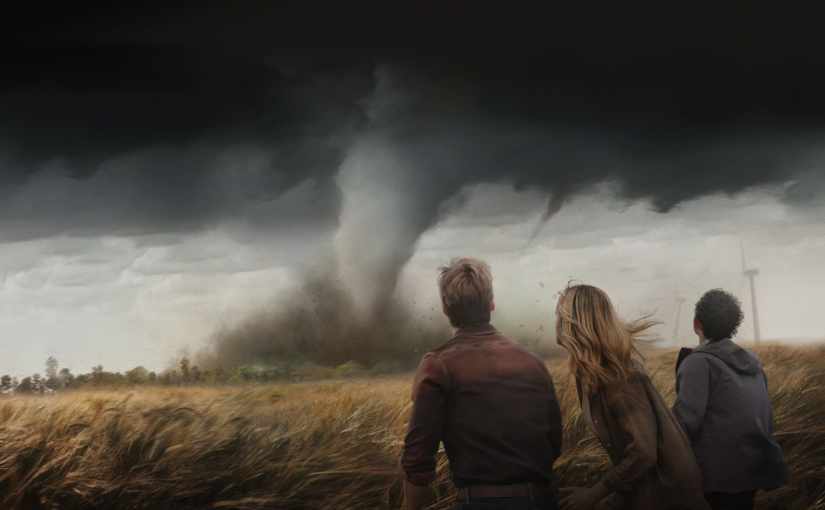
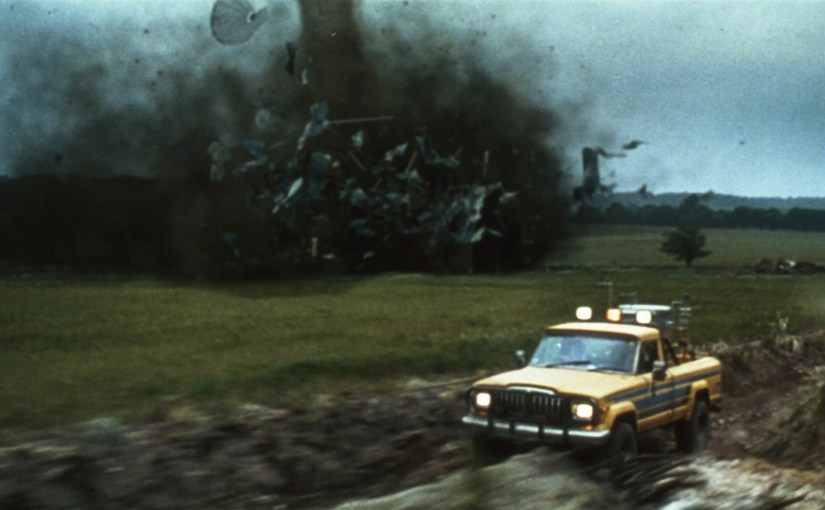
About twenty minutes into Twister, Helen Hunt and Bill Paxton crash their pickup truck while trying to outrun the title character.  Amid the high wind, mud and rain, they take cover under a narrow bridge.  Then Hunt’s character, Jo Harding, becomes enamored, almost hypnotized, with what she sees of the powerful storm and steps out saying she wants to see more while reaching with her hand.  Paxton’s character, Bill Harding, pulls her back down.  Reader, why did Bill have to pull Jo back down?  I don’t care about Jo.  I don’t care about Bill.  They’re not characters.  They’re talking objects.  The only character given any kind of care and treatment is the twister.  The next most important character is the next twister and then after that it is the next twister.

Jan De Bont’s Twister is devoid of a brain with a big head full of wind.

A thin story is inserted to connect these talking props.  Bill needs to convince Jo to sign divorce papers.  Jo is focused on getting a tin can thing named Dorothy into the center of a tornado so it can release sensors and thus their team will be able to study the characteristics of a tornado’s behavior like wind velocity for example.  With each new tornado, their attempts fail and somehow the team has another tin can ready to go.  Where are they hauling these things?  As well, how can such a clunky thing that looks less sturdy than a beer keg offer up so much information?  Dorothy looks like it can easily get its ass kicked by R2-D2.

I guess for escapist humor, Bill brings along his fiancé Melissa (Jami Gertz).  Melissa is here for a couple of lame reasons.  One, to wear a white suit with a fashionable hairdo that you know is bound to get messed up (but actually really doesn’t).  Two, to be used as the device for the rest of the cast to explain where they are going next and what they are seeing.  After whatever explanations have been exhausted, the script literally has her exit the picture in a quick announcement. 

I have not seen the new follow up film, Twisters, but I want to and I’m embarrassed to admit that.  It’s the special effects my dear reader.  The visual effects are all that is to be cared about in these movies.  Visually and audibly these effects are unbelievably impressive and I can only expect some enhancements in the new film.  Unfortunately, once I see one twister, I’ve seen them all.  I’m risking cavities for the five minutes of flavor I get in a Starburst.

What’s regrettable about Twister is that with a good collection of actors that also include Philip Seymour Hoffman, Cary Elwes, Alan Ruck and Jeremy Davies, the acclaimed author Michael Chrichton and Anne-Marie Martin hardly attempt to insert any intelligence into the science of weather phenomena or the trauma that goes with it.  I know just as little about tornadoes as I did before I saw this film. 

A prologue scene has Helen Hunt’s character witness her father being violently taken away in a sudden storm.  However, it is never referenced again.  I started to think about that monologue from Jaws performed by Robert Shaw about his experience aboard the sunken vessel the USS Indianapolis.  The scene is an actor’s dream, but it also makes the nature of the world we live in much more personal for that character.  Shaw’s character has a personal vendetta against sharks based on experience.  That’s what is missing from Twister.  None of it looks personal. Helen Hunt is an Oscar and Emmy winning actor.  She could have had a brilliant monologue that demonstrated her need to follow tornados and learn more about their unforgiving nature.  Chrichton even lent more passion to John Hammond (Richard Attenborough) in the film adaptation of Jurassic Park.  The entrepreneur talked of aspirations for a dinosaur zoo.  Jo Harding possess neither passion nor animosity for her purpose in life.  Twister could have operated better as an observational documentary than a special effects action picture.

Since a tornado cannot have an evil laugh or a handlebar mustache, there must be another source for villainy and that falls on Elwes and his crew.  Jo, Bill and the rest of the gang do not like Bill because he leads a convoy of black (black like Darth Vader) SUVs with the most up to date technology around to study weather patterns.  Yet, what is so wrong with any of that?  We have to hate these guys because they drive shiny SUVs.  Is that all it takes?  At best, the competition heats up as the two convoys nearly sideswipe each other or cut each other off on multiple occasions.  None of this is exciting.

A beloved elderly aunt is conveniently nearby so the gang can chow down and disgust Melissa with their eating habits.  Later, the aunt’s house happens to be in the path of a storm and then a sequence is devoted to rescuing her amid the crashing debris.  We get to see the beautiful mid-west house crash upon itself because to see another twister would just be more of the same.  I hardly got to know the aunt.  So, I don’t care if she lives or dies or becomes catatonic or turns into a superhero named Storm.  This is extra cream filling in an over expired Twinkie. 

The mouth pieces of Twister just don’t matter and while I’m dazzled by seeing a tractor, a cow, another cow (or was it the same cow?), and a house fly around and topple all over the roads amid the wind and the rain, I’m just not taken with any kind of suspense or care. 

Special effects only work if they are ingredients to a story, and not just the story. 

THE COLOR OF MONEY

By Marc S. Sanders

The Color Of Money is the first and only time that director Martin Scorsese tackled a sequel of sorts.  Paul Newman returned to the screen as Fast Eddie Felson, the hustling pool shark from thirty years prior in The Hustler.  That movie established his career on a bigger scale going forward.

Fast Eddie is older now, and wiser.  He’s much more humbled as a bar owner with a conservative amount of cash on the table to stake younger pool players for small time wagers.  A young John Turturro is who he relies on and quickly loses faith in when a brash, cocky kid named Vincent Lauria (a perfectly cast Tom Cruise) easily undoes his opponent. 

Eddie sees the talent in the kid.  He’s got a helluva break and clears a game of nine ball with as much speed as he has conceit.  What he lacks for in brains and instinct is made up in Vincent’s cool and mature girlfriend Carmen (Mary Elizabeth Mastrantonio in an Oscar nominated role).  It does not take long for Eddie to coach her into realizing that together they can make a lot of money off of what Vincent can do in pool halls across the country.  If only he’d listen to them and do what they tell him to do. Vincent can’t comprehend how sometimes you win a whole lot more, when you lose first.

Scorsese works his camera like a swinging Steadicam.  When he gets close ups of this trio of actors, it’s never just a close up.  He’ll position his lens in a northward direction and then swing around east.  Newman, Cruise and Mastrantonio trust the eye of the camera to follow their performances.  There’s an energy to this kind of shooting.  It makes for a great style.  Scorsese was doing this novel kind of filmmaking, going all the way back to 1971 with Alice Doesn’t Live Here Anymore.  The director is so favored because as typical as a script might seem by its title or its prose, he’s going to find an exhilaration to its narrative.

Along with the director’s resident editor Thelma Schoonmaker, there’s a crackle and quickness to the many variations of pool play – much more playing than I believe was featured in The Hustler.  Schoonmaker makes sure to cut in the cracks of the pool balls as they collide with one another.  The blue cue chalk snows off the tip of the cue sticks.  Reflections of the players appear in the shine of the balls.  Close up profiles of Cruise and Newman lower down into frame just before they take their shots.  Before the kinetic energy found in later films like Goodfellas and The Departed, Scorsese and Schoonmaker were already putting their tag team best at play in The Color Of Money.

Yet, all of this is style with not so much substance.  What kind of story does this next installment in the legacy of Fast Eddie Felson have to say?  Not much really.  While the three actors are doing top notch work, the conversations run very repetitive and do not build toward higher stakes or developments.  Time and again they argue over Vincent’s refusal or naivety to understand the hustling strategies that Eddie has in mind.  Carmen gets it but she goes her own way more often than cooperating with Eddie.  Simply, this is a story of the protégé not grasping what the mentor is trying to teach, and it never evolves from that problem.  It gets stagnant.

What changes within the second half of the film is the introduction of a championship pool tournament in Atlantic City.  Therefore, it’s easy to expect a showdown between Vincent and Eddie.  It happens and there is a twist of a dagger included, but then when the real competition is about to begin, Scorsese concludes his film.  Does it matter who is the better player?  I don’t know, but as the film is wrapping itself up, one character gets short changed.  When that’s discovered, the film opts to also shortchange the audience.  I didn’t think that was very fair.

I think about the notorious ending to the HBO series The Sopranos.  Sure, it’s an ending no one will ever forget but for all the wrong reasons, and I defiantly believe it is because the storyteller ran out of imagination or lost his confidence in upholding an ending that he really wanted.  I feel the same way with The Color Of Money.  The film establishes the skills, intelligence and capabilities of these characters.  Yet, when you take the tool kits away from them, the building never gets completed; only left abandoned.

I’m drawn to watch The Color Of Money.  Michael Ballhaus’ photography is smokey and colorful. I can’t get enough of Paul Newman’s gravelly vocal inflections or even how he unfolds hundred dollar bills from the roll in his pocket.  Tom Cruise humbles himself to look like an idiotic jerk and it works well against the maturity of his scene partners.  Mary Elizabeth Mastrantonio oozes sexual appeal with a lot of brains to uphold the cons.  She has sensational scenes with Paul Newman.  There’s a coolness to the picture because of the cast, the settings, the sounds, the visuals, the editing and the direction. 

This film arrived in 1986 with rock music from the likes of Eric Clapton and Phil Collins.  Beyond Miami Vice and an assortment of John Hughes teen flicks, these artists were making for effective needle drops of atmosphere in films from the 1980s.  Scorsese’s use of the camera keeps me engaged, but when I look at what the characters are anchored to only do, and never rise above, the film does not hold the weight of other character studies that several of Newman’s and Scorsese’s pictures were so astute at achieving.

One scene transcends the arc of Newman’s character and it works beautifully within or out of the context of the picture.  A relatively unknown Forest Whittaker portrays an unlikely kid who goes up against Fast Eddie. As the long scene evolves over their pool competition, the writing hearkens back to the weaknesses and torment that defined Eddie Felson’s character in The Hustler.  If you watch the first film and then jump over to this scene, you recognize a connection for the protagonist of both pictures.  Beyond that The Hustler and The Color Of Money stand a long distance apart from each other.  This scene though is always a favorite of mine for the eventual Oscar winner, Forest Whittaker.  Watch how Whitaker holds his cue stick when he exits the scene.  Think about how he picks the cash up from the table after Newman drops it.  Consider, what his character Amos really means when he asks Eddie: “Do you think I need to lose some weight?”

Had The Color Of Money used more of Whitaker’s character in the film along with the other three, there might have been something more solid to say and introduce within the world of pool hustling with a 1980s barroom vibe.  Same could be said if John Turturro’s character was utilized more.

Paul Newman received the Oscar for this picture.  The actor was nominated seven times before, having never won and the irony is by the time this nomination arrived, Newman opted not to attend the ceremony.  Roles in films like The Verdict (for which he should have won the award) and Cool Hand Luke were much more memorable and fleshed out.  I’d argue Newman likely knew this was not his best performance because it was not the best written of his long-established career, and so he genuinely did not expect to win.  Because he won, it became a celebration of his legendary status as an actor who should have been taken much more seriously, much sooner.   (Two more nominations would follow in Newman’s career.)

JACOB’S LADDER

By Marc S. Sanders

When a movie works beyond formulaic conventions, it takes risks.  A storyteller will either really impress their audience, or they will leave them feeling shortchanged.  You’ll either get a “Whoa!  Now that’s cool.” (The Usual Suspects, The Sixth Sense, but I did call that ending when I saw it in theatres.  Ask my wife if you don’t believe me.) On the contrary, you’ll arrive at “That’s it?” (The Happening, Signs or any other M Night Shyamalan reach for the rafters but come up foul kind of flick.)

A movie like Adrian Lyne’s Jacob’s Ladder is anything but standard and it asks you to trust in its ambiguity in order to arrive at its big payoff.  For most of the picture it is unclear what you’re watching.  What keeps you engaged is Lyne’s approach to atmospheric indicators, like dark tunnels, dim bulbs, distant echoes and a disturbingly scared and depressed Tim Robbins.  The creepier the film looks and the more ominous it feels, then perhaps it will lead to a conclusion that will leave you satisfied.  Jacob’s Ladder functions like an M Night Shyamalan film where you just want to arrive at the twist.  When it finally reached its destination though, I was ready to turn the car around and go home.

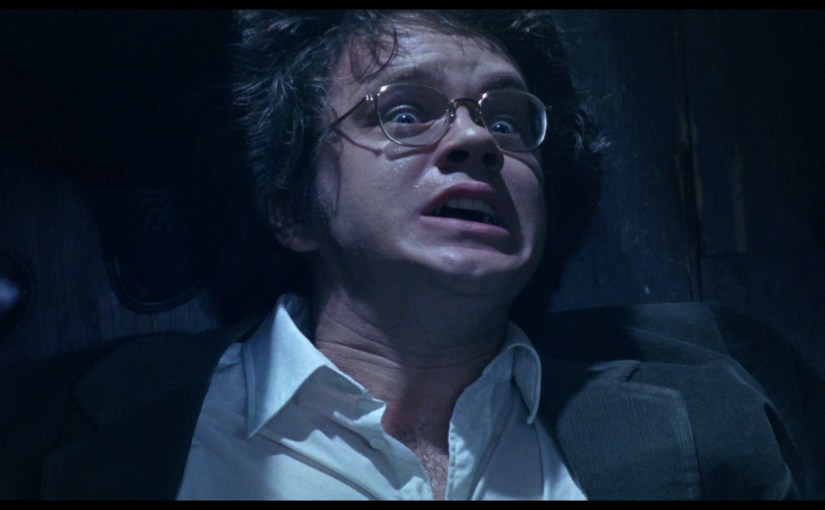
Tim Robbins is Jacob Singer, a Vietnam veteran.  The picture opens up with Jacob returning from the dense jungles to reunite with his squad after what was his like hundredth bowel movement, it seems.  The squad jokes about with men’s locker room talk and then a disturbing occurrence takes place.  The next scene, thereafter, has Jacob dressed in a mailman uniform awakening from a nightmare aboard a New York subway train.  He gets off at his stop, but then he cannot find his way out of the subway station and then he encounters unsettling images like perhaps a demon or two on board a train that just misses running him down.

Much of Adrian Lyne’s film sets up sequences like this where the unexplainable cannot be explained.  Jacob now lives with a girlfriend, Jezzie (Elizabeth Peña), who is growing frustrated with Jacob’s unusual behavior.  It seems he suffers from PTSD following his time in the war, but also he mourns the death of one of his three sons (Macaulay Culkin) from his first marriage.

Robbins is especially good at not going for big moments in his role.  He’s a quiet, cheerless individual working with very little dialogue.  That’s impressive but it’s also a little boring, especially considering that for most of the film it’s near impossible to decipher what is going on, nor what is the exact story to uncover in Jacob’s Ladder.  My patience was trying, up until a stand at attention moment that came from nowhere.  Still, not much arrives thereafter. 

Jacob receives a call out the blue from one of his old army buddies.  When they meet up, it dawns on Jacob that his friend is encountering similar kinds of feelings.  When he reunites with the rest of the squad it occurs to them to sue the United States government for experimental drug treatments that were administered to them while serving in the war.  They turn to an attorney played by Jason Alexander in a role far off from his Seinfeld sitcom days to later come in his career.  This lawsuit may uncover a link for Jacob.  Unfortunately, I think it diverts away from Adrian Lyne’s intended lack of clarity for another kind of movie altogether.  The movie goes in this detour with Alexander’s attorney role and then finds its way back on the main road for the third act.  Hardly any new mileage was to be gained from this rerouting though.

This new development may give a more literal understanding into Jacob’s psyche and condition. However, I think the film fails to pounce on a new opportunity to attack a topical storyline that had become suspect during the actual timeline of the war.  As the film arrives at its conclusion, the script seems to rush to the surprise ending it wanted to garner.

Frankly, an early conversation with a Jacob’s chiropractor (Danny Aiello) easily spelled out the twist for me.  Alas, perhaps that took me out of the film early on. 

There are good ideas and good performances to be had in Jacob’s Ladder.  Yet, I don’t think the film entirely works because of Adrian Lyne’s attempt to push it’s vagueness.  Demons that come out of nowhere during Jacob’s hallucinations should be scary and have a fright shock to them, but instead these moments come off like abstract art that only frustrated me. 

I always thought I knew the ending, and I was right for the most part, but why does a runaway car have to chase Jacob down an alleyway to deliver the point?  Arguably, a boogeyman like Freddy Krueger might have done a better job at disturbing a threat of death than what was ever going on in Jacob’s Ladder.

THE RUSSIANS ARE COMING. THE RUSSIANS ARE COMING.

By Marc S. Sanders

Farce works best when the serious explodes into the outrageously absurd.  When Jonathan Winters is a lawman who insists to Brian Keith “We gotta do something! I mean we really gotta do something!” you should know that whatever needs to be done has got to be out of unreasonable paranoia.   Yet, the desperation and nonsensical fear is something you can empathize with because if I were told the states were being invaded, I’d surely think twice as I reach for the tennis racket in the back of my closet to use as a weapon.

Norman Jewison set aside his penchant for intense drama, socially reflected in films like In The Heat Of The Night, to direct a madcap satire imagined from the very real threats of The Cold War of the 1960s.  At a time when submarines were being used for silent spying and espionage, a Russian sub gets stuck on a sand dune within the shallow ocean waters just beyond the New England town of Gloucester.

Alan Arkin as Rozanov leads a squad expedition off the vessel and intrudes upon the vacation home of Walt and Elspeth Whitaker (Carl Reiner, Eva Marie Saint).  With a pistol pointing at the family of four, all that is really needed is a boat to nudge the helpless submarine back into the water.  Yet, as word spreads of who has arrived, that’s not what the townsfolk will have you believe.

Before the age of the internet, hysteria still managed to catch fire with word of mouth.  Reader, perhaps you heard of what happened when Orson Welles aired his radio show of H.G. Wells’ The War Of The Worlds.  Yes!  Apparently, an alien invasion was really happening.  What amuses me about Jewison’s film is that only a very few people even get an opportunity to see the Russians in person.  Still, the fear overcomes everyone in town.  The battle crazed old codger named Fendall (Paul Ford) dons his sword, and because he carries said sword, he seems most fitting to lead the charged brigade.  

The Russians Are Coming. The Russians Are Coming. works like a pre-cursor picture to what the team of ZAZ would later do with Airplane! and The Naked Gun.  The town switch board gets overrun.  The men take hold of their rifles, but stop at the bar for a belt first. Two of the wives board a motorcycle with a side cab waving a poster that says “Alert” in front of their faces so they can’t see where they’re going.  What’s anyone supposed to gather from saying “Alert,” anyway?  It’s ridiculous, but the palpable tension of these fine folks is convincing when they come alive on this sleepy Sunday morning off the northeast coastline.

As comedic as Jonathan Winters always was, he takes it seriously as a deputy who does his best to lead while wearing his badge.  Brian Keith is great at just being Brian Keith, the grump who tries to keep things in perspective but can’t because everyone else is ready to take up arms.  Carl Reiner doesn’t have to do anything but occupy the screen and he’s funny.  He’s the antsy father to an eleven-year-old boy who he chooses not to believe.  In all seriousness, are we ever to take Carl Reiner seriously when he tries to offer a sound explanation for the Ruskies’ arrival?

Alan Arkin is just lovably speaking fluent Russian at times while trying to navigate his team around the island with no idea of what to do or what to say.  He might be the most sound character of the whole picture. He’s lovable and hilarious.

The film takes place in one day and it’ll leave you curious with how it all gets resolved among the two misunderstood factions.  Just when Norman Jewison ably reaches the highest summit of intensity, the oddest occurrence happens to shift the tide of the film’s characters and comedy.

Like other satire, particularly Sidney Lumet’s Network, The Russians Are Coming.  The Russians Are Coming. stands prophetically.  It was released in 1966, at the height of The Cold War with very fearful circumstances occurring in the news such as The Bay Of Pigs invasion.  Earlier this year, a sense of nervousness arrived when it was announced that Russian submarines have docked themselves outside of Cuba, seemingly lined up with Florida.  Anything could suddenly turn into a sad reality.  Still, how we respond to scary possibilities is how we live through these moments.  

You can laugh at The Bay Of Pigs crisis now.    Could you do it back when it was actually happening?  I wouldn’t know.  Yet, that doesn’t mean we shouldn’t make light of the situation.  Hogan’s Heroes, The Three Stooges, Mel Brooks, Charlie Chaplin and even the Looney Tunes ably served the purpose of needing to self deprecate our innate fears that would get all of us into nonsensical tizzies.  The Russians Are Coming.  The Russians Are Coming. was one of the best films to accomplish that feat.  

We gotta do something! I mean we really gotta do something!

DEADPOOL & WOLVERINE

By Marc S. Sanders

Hollywood back stories have created a quandary for the studios’ celebrated film franchises, especially the Marvel Cinematic Universe.  Disney has purchased the properties and copyrights belonging to 20th Century Fox and now, at last the X-Men can properly meet Captain America and the Hulk and Spider-Man…well only if Sony will let the wall crawler come out and play.  So, how should all these guys meet one another, especially now that some of these actors who play these superheroes have received their AARP cards?  Furthermore, some of these characters are dead…at least for now.  Marvel producer Kevin Feige has the answer.  Only Deadpool (Ryan Reynolds), the Merc With The Mouth who breaks the fourth wall at any given moment, can bring this all together.

Deadpool & Wolverine is the best of the smart aleck hero’s three movies.  Yet, it’s more of just a gimmicky flick than anything else.  This proudly excessive two-hour tentpole picture operates like a solid collection of Saturday Night Live skits, with buckets of blood to splatter instead of The Three Stooges’ cream pies.

Allow me to break down this very thin storyline.  Matthew MacFadyen is Mr. Paradox in a three-piece suit.  He informs Mr. Deadpool that his timeline is about to fizzle out of existence.  Somehow, our hero has to locate help from a Wolverine variant of another universe (Hugh Jackman, of course) to make things right again.  

There’s your open door into the silliness that normally comes with Deadpool.  Our title characters are tossed into a Mad Max kind of wasteland called the Void and an abundance of cameos commence from here on out.  The suprise appearances are a lot of fun and I dare not spoil a single one of them.  The rest of the internet did that the night before the film actually opened. I shan’t lend to that egregious violation. (I’m looking at you Variety, Yahoo and Entertainment Weekly. Was it truly necessary to go in that direction?)

I could never relate to the other Deadpool movies.  Sure, they had some hilarious wink and nod gags, at the expense of Reynolds’ career experiences with past superhero franchises.  Yet, those other films were also trying to work too hard with storylines weaved in as well.  They became tiresome and Ryan Reynolds is not the Bill Murray of yesteryear or even Robert Downey Jr. His schtick in this element was overdone.

With this third installment, the approach works with an Airplane! or Naked Gun finish.  That being said, it takes a lot of knowledge from prior Marvel films within the 20th Century Fox warehouse to get every gag.  It helps to know what other super hero movies missed out on getting green lit, which ones tanked at the box office and who are some of these very obscure characters that were churned out of the meat grinder.  If you know these guys, then you’ll applaud the purpose they serve to of any jokes or story references that allow this new picture to operate.

I found it fun.  I think most lovers of Marvel movies will too.  Yet would someone like my sixteen-year-old daughter catch every reference or cameo that walks into frame? Some characters have not appeared on screen in over twenty years.  Reynolds and company also toss out one-liners that reference dated Hollywood gossip.  There was a lot of explanation that I had to fill in for my wife on the drive home.

Beyond all this, Deadpool and Wolverine, played by Ryan Reynolds and Hugh Jackman, work really well together like a good buddy cop picture.  Get these guys back together again in a Lethal Weapon or 48 Hrs kind of movie and I’m there.  Honda might not be too fond of these guys, but their pairing is an overdue welcome to the big screen.  Why Honda? See the movie and you’ll know what I mean, but I am eternally grateful for the automaker’s contribution to this picture.

As expected, the violence is excessive.  I think I’ve had my fill of knives and claws being thrust into men’s crotches.  Seems to happen literally every five minutes.  Beheadings abound too.  Slow mo flips and bullets and bullet casings flying and dropping out of guns is never enough for these filmmakers either.  

Some will try to convince me of how tender hearted the picture is too.  Bah!!!! I know what you’re talking about, but go watch Terms Of Endearment or even Avengers: Endgame to get your tear ducts exercising.  The Hallmark moments here never carried much weight for me.

Deadpool & Wolverine is a grand time at the movies, worth seeing with an enthusiastic crowd over settling for a lonely night at home with Disney Plus.  The movie is a little too long, though.  None of the material belongs on the cutting room floor, but a good chunk of it could have been preserved for the next Deadpool blood spattered, slapsticky flick. I just didn’t need to consume all of the eggs in the basket.

My Personal Edit for the MCU: While I toss out my bravo on Marvel’s willingness for self-depreciation on a celebrity roast level with Reynolds and Jackman at the helm, it’s time to get serious again.  

Please get off this multi verse kick.  Director James Mangold (Logan, …Dial Of Destiny, 3:10 To Yuma) said it best that multi verse approaches produce lazy writing.  There’s no stakes anymore.  Hard to believe a character is dead when we watch him/her/they die.  They’ll just come back in the multi verse!!! Enough already.  

Bring back the villains who work based on sound logic like Thanos, Eric Killmonger and Obadiah Stane.  When these guys commit their worst misdeeds, know they did it for a greater purpose than just a mustache twirl and an evil laugh.  I could get behind their arguments.

More importantly, when the job is done, let it stay done.  Treat the audience fairly.  

As Annie Wilkes passionately declared: “Are you blind? They just cheated us.  HE DIDN’T GET OUT OF THE COCKADOODIE CAR!!!!”  I know exactly what you’re talking about Annie. Where’s that sledgehammer?

NO HARD FEELINGS

By Marc S. Sanders

Jennifer Lawrence goes the route of Farrelly Brothers comedy with No Hard Feelings.  She’s a thirty something gal named Maddie Barker who gets by sleeping around with the men of Montauk, New York while being an Uber driver and a bartender on the side.  It’s easy enough to do because her mother left her with a completely paid for house.  What she didn’t account for was taxes, and now that her car has been towed away (and shortly after totaled – just watch) and the past due bills start arriving, she’s got to find some means to uphold her Uber career so she doesn’t lose her house.  Problem is the best Uber drivers drive cars.

A seasonal annoyance of Montauk occurs when the ultra-wealthy WASPS come to reside in their summer homes.  A lot of these folks are helicopter parents for their spoiled kids who have futures awaiting them at Ivy League universities.  One such couple is portrayed by Laura Benanti and an especially flaky Matthew Broderick.  (Yes!  Ferris Bueller!)  Maddie answers the ad to literally get their dweeby son primed and ready for Princeton college life by sleeping with him and breaking him out of his shell of just video games and volunteer work at the homeless pet shelter.  In return, they will transfer the title over to a run-down Buick sedan that Maddie can own outright and catch up on her bills.  If life were only this easy.

The kid is Percy Becker played by newcomer Andrew Barth Feldman.  He’s quite good in this role and I imagine when he started on the first few days of filming he felt as awkward as he appears next to the confidence and experience emulating from Oscar winning Jennifer Lawrence.  You could never imagine pairing these two up in a film.  I mean, like they wouldn’t even work as a brother and sister.  Still, the comedic premise is so absurd like a Farrelly Brothers movie, that you just have to go with what this picture offers. Thankfully, the situations are hysterical.

It’s not easy for Maddie to break Percy of his introverted personality.  Poor kid doesn’t know how to drink or how to dress at an island bar.  He has no friends. He definitely doesn’t know how to talk to girls and even a naked Maddie accompanying him on an empty beach in the middle of the night for skinny dipping has disastrous results. 

Like a lot of romantic comedies, Maddie believes she just has to quickly lay this kid, collect the prize car and no feelings of love or like will ever get in the way.  Not so fast.  Soon, we get to see the attributes Percy possesses, and he’s hard to get off Maddie’s mind.  I read that Feldman played the title character in Dear Evan Hanson on a stage tour for a year. I can completely envision that after witnessing Percy perform a sultry rendition of Hall & Oates “Maneater” on the piano.  Close ups go over to Lawrence watching from across the room and I don’t believe she was acting.  This kid is a talented performer.  Suddenly, Lawrence and Feldman are great scene partners doing some very fine work together.

I hope to see Andrew Barth Feldman in more films.  He can do both drama, and of course comedy.  Moreover, Jennifer Lawrence has officially widened her range.  Her resume is certainly eclectic and this film only enhances her record.

The premise of No Hard Feelings is near impossible to swallow.  Fortunately, the gags that follow and especially the chemistry between the two leads allow for a sweet story with broad, raunchy,  slapstick R-rated material.  Many of the more successful comedic films followed this formula like Coming To America and There’s Something About MaryNo Hard Feelings has just enough substance to be grouped within that fraternity. 

THE QUICK AND THE DEAD

By Marc S. Sanders

The Quick And The Dead is a gritty, stylish western that boasts a who’s who of great actors.  Some of which went on to magnificent careers.  I wish the story was a strong as the cast list though.  It’s watchable.  It’s intriguing. It’s also too repetitious.

Sharon Stone is Elle.  Otherwise known in these parts as The Lady.  Two minutes into the picture and my suspension of disbelief is withering away.  Not because this gunslinger cowboy is a cowgirl, but because Stone does not look like she fits in the Old West.  Her blond locks are shampooed and conditioned.  Her complexion perfectly made up without a hint of grime or dirt or sunburn.  Stone looks like she took one step off the Oscars red carpet and onto this set. Her costume with a scarf, leather pants, black rimmed hat, and spurred boots looks like its attempting its own kind of Clint Eastwood stranger.  Frankly, it appears to have leaped off the pages of an Old Navy catalogue.

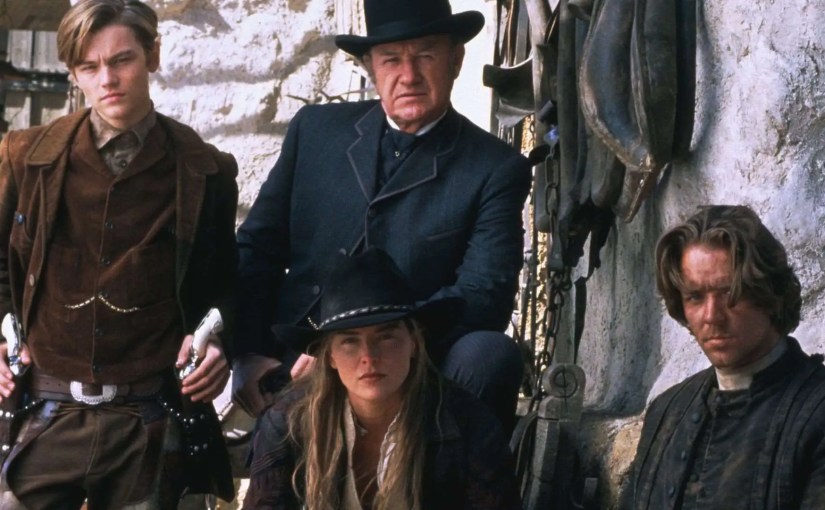
Below Stone on the credit lineup is a much more redeemable list of characters.  Gene Hackman is Mayor Herod who has amped up his level of sinister from his Oscar winning performance in Unforgiven.  There’s also Ace Hanlon played by Lance Henrickson with a rare on-screen giddy grin, whose personal deck of cards consists of aces of spades for every man he’s killed. Sgt Cantrell is the flamboyant personality with the handlebar mustache, deep voice and toothy grin that actor Keith David proudly bears.  A kid named Leonardo DiCaprio plays up the youthful cockiness of an outlaw named The Kid.  All these folks are gunslingers participating in the sport of gunslinging.  Last one left standing is the winner.  Midway through though, Herod will up the ante and deem that the last one left alive is the winner.  Each one challenges another until a final winner is recognized.  One reluctant participant is played by a very youthful looking Russell Crowe.  Cort is a former fast draw, who is now a remorseful preacher for all of the killings he’s committed.  Herod is not entirely convinced and will antagonize Cort to throw his hand in the game.

Sam Raimi directs and Sharon Stone produces this slick small town modern day High Noon.  The problem though is that Raimi and screenwriter Simon Moore choose to only send up the climax of that classic Gary Cooper western over and over.  Time and again, two opponents line up at opposite ends of the street.  The townsfolk observe with close up tension shots.  The hands twitch their fingers next to the holsters and when the clock strikes twelve, the guns go off.  Raimi often gives you the impression that the one expected to live is the one who is going to topple over dead and then an edit shows the match went exactly like you thought it would. 

This whole supporting cast has enough presence and charisma to keep my attention, but the set ups are the same over the course of the film.  Cut in between are discussions within the saloon or the hotel rooms where Herod or the Lady rest.  Cort remains chained in the town square.  When the movie breaks away it goes to flashbacks of Stone’s character as a child when she once crossed paths with the devilish Herod. 

I like the polish that Sam Raimi brought to The Quick And The Dead.  Before Quentin Tarantino was glamourizing his pulp fiction to his own two dimensional westerns and war movies, Raimi was daring enough to let us look through literal bullet holes from the front to the back of his victims.  Holes through the hand, the chest and the head.  It’s fun.  There are also countless closeups of haunting music from Alan Silvestri as a new stranger enters a saloon to click his spurs on the wooden floor.  Quick draw action is how these pistols perform too.  Hangings are a part of any day as well.  All of this is familiar and standard to the B movies brought to us by Sergio Leone’s spaghetti westerns during the mid twentieth century, but now we have a modern day cast and some glossy cinematography.

I was ready for a worthy salute.  It just comes up short due to a lack of any depth in story.  Gunslinging quick draws are not as dynamic as a gunfight at the OK corral.  How much different is one dual draw going to be from the last one we watched five minutes ago?  Raimi’s camera points from behind each challenger.  The music builds louder and louder.  Zoom in shots of townsfolk cut in.  The minute hand on the clock tower moves closer and closer to the roman numeral twelve, and then…BANG BANG!!! (I’ve said this before, haven’t I?  Well, so does the movie.)

The Quick And The Dead is worth seeing especially for another scenery chewing villain from the great Gene Hackman.  I’ll never tire of watching him.  To see the beginnings of Russell Crowe and Leonardo DiCaprio’s potential is a real treat as well.  They all certainly have some acting moments that I loved digging up from this time capsule.  Character actors Keith David and Lance Henrickson break from the standard personas you’ll find on the rest of their resumes.  I just needed more of a variety to this town setting they got play in.  The déjà vu is too overdone.

Sharon Stone usually looks like she’s giving a so so community theatre audition.  It’s hard to take her seriously, the same way I would had Uma Thurman, Susan Sarandon or Geena Davis been cast as The Lady.  Those actresses work for their appearance to be appropriate for the setting of their films.  Look at Sharon Stone here in the dusty Old West.  Then look back to what Sarandon and Davis did in Thelma & Louise.  You’ll see right away, practically anyone else would have been more suitable for the lead of The Quick And The Dead.

AIR FORCE ONE

By Marc S. Sanders

On the day I write this article, July 12, 2024, the new trailer for Captain America: New World Order premiered and Harrison Ford (whose birthday is tomorrow; Happy Tiding Dr. Kimble, Dr. Jones, Captain Solo, Mr. President, Dr. Ryan) is back in the Oval Office playing the President of the United States.  Don’t know what kind of Commander In Chief he’ll be this time around.  He might be as heroic as James Marshall from Air Force One. Then again he could be a challenge of hulk like proportions.  However, let’s at least fantasize that we have Mr. Marshall running for the top job this year against both the criminal buffoonery and geriatric disqualifications we are left to choose from.  Just look at James Marshall’s qualifications. 

Following an American Special Ops capture of a Russian radical, Marshall is bestowed an honor from the Soviet government. His acceptance speech insists his administration will never negotiate with terrorists.  Now that the line has been drawn, away he goes with his staff, his wife (Wendy Crewson) and pre-teen daughter aboard the most protected and safest plane in the world, Air Force One.  Yet, an element of careful process does not go according to plan and Gary Oldman’s team of Russian radicals hijack the plane with demands to free their leader from captivity.  Oldman’s screaming hysterical character, Ivan Korshunov, won’t have it so easy though because his team of men failed to capture the President.  As well, it requires the Vice President (Glenn Close) and Secretary of Defense (Dean Stockwell) who are on the ground to coordinate with Russia to free the prisoner.  Oldman’s response is to kill a hostage every half hour and if that does not work, then just blow up the plane.

This is not good.  BUT WAIT!!!!!  Is that…?  Could it be???  Is the President alive, sneaking around the bowels of the plane while taking out one terrorist at a time?  Raise your fist for Harrison Ford!!!!

‘Murica!!!!!!

There are two narratives going on with Air Force One.  One is the standard Die Hard formula action onboard the plane.  Then there is the endless debates of authority between the Vice President, the Secretary of Defense and the military leaders about if the President is in a proper state of mind to lead and act upon his aggression with a high level of threat to the country at stake, and more personally his wife and daughter in harm’s way?   None of this is nothing new.  It’s all familiar from the likes of many late 80’s and 90’s action pictures.  The politics are much more simplified than what you’d find in a Tom Clancy novel.  There’s even time for a which color wire to cut scene.  Yet, the movie is entertaining.

Director Wolfgang Peterson is best at showing the real star of the picture and that is Air Force One itself.  He’s got long shots down endless corridors and aisles. Within the underbelly, as well as the hollowed-out cockpit, there’s more for us to explore amidst the gunfire.  We see where the weapons are stored as well as the luggage and food supply.  We get to watch the football game in the President’s office too.  Heck, before the terrorists reveal themselves they are given a tour of the massive plane as their guide boasts that it is even impervious to a nuclear blast.  Color me impressed in Patriotic Red, White and Blue.

I think some of the acting is a little overdone at times. Not by Ford, but by almost everyone else.  Watching the debates within the government conference room, I’m seeing a little too much melodrama around the table.  A little too much hand clasping, pacing around the room, whispering,  and deep sighing.  On the plane, Oldman goes over the top but he’s one of our best character actors and its expected from him.  He’s the evil villain after all.  On the ground though, Dean Stockwell has done better work elsewhere, with much more complicated material. 

I like the idea of including political debates and a response to an unfathomable crisis like this, but a lot of the dialogue from guys like Stockwell, Phillip Baker Hall and Bill Smitrovitch comes off as textbook boring.  Same goes for Close, but she fits the role perfectly.  Let her be Ford’s running mate and they got my vote.  The only thing that upholds these scenes are due to Peterson’s hyper Steadicam.  So, when one more person in a suit makes a mad dash into the room, the director sweeps his camera right over there to get the latest news. 

Harrison Ford is doing his standard everyman/tough guy routine, always knowing how to stay one step ahead of the bad guys. President Marshall is much more capable than his entire trained Secret Service Squad and it’s fortunate that he gets the convenient shard of broken glass to cut the tape that binds his hands.  How often do we see that in movies?  The film definitely belongs to Ford, but it’s also nice to see some familiar faces participating like Xander Berkley, William H Macy and Paul Guilfoyle. 

The most unforgiving moment of the film occurs in the final minutes.  I don’t spoil everything by saying the plane nosedives into the sea, but this crash has to land at the top of some of the worst CGI ever assembled.  Yes, I know this was back in 1997, two years before what George Lucas accomplished with, at the time, pioneering effects on his return to Star Wars.  However, the final climax to Air Force One looks so obscurely animated and unfinished, it begs for the screenplay to find another way to wrap up its simplistic story.  It is downright terrible.  I recall it looking terrible on the big screen.  It looks just as bad on a 65” flat screen.  A toy plane crashing into a bathtub would look more convincing.

Air Force One is solid action.  Nothing more.  It’s not a thinking picture or one needing deep concentration and analysis. It does make you yearn for Harrison Ford to at least consider a run for the Oval Office, though.  He’d still be better than what will be on the ballot this year.

WISH

By Marc S. Sanders

Disney’s Wish seems to stand out from many other films within the studio’s vault because the lack of filmmaking confidence appears so obvious.  What does it tell you when a newly original story is continuously guided by winks and nods from past successes?  We see this thing can’t stand on its own two feet.  So, let’s dress a character up like Peter Pan and literally name a random deer Bambi.

A sorcerer trained in the arts of magic oversees his newfound Mediterranean island kingdom known as Rosas.  He is King Magnifico (Chris Pine) and he has attracted people from all over the world to reside under his rule on the condition that he collects their wishes to be held by him in glittering, floating blue bubbles.  The people of Rosas lose all memory of their respective wishes and now live month to month with anticipation that Magnifico will award them the wishes he holds as a kind of equity or collateral.   

Asha (Ariana DeBose) is a seventeen-year-old who is eager to finally witness her grandfather Sabino’s (Victor Garber) wish come true as his 100th birthday finally approaches.  She also aspires to meet the great sorcerer and hopefully become his apprentice.  As soon as she meets the King though, Asha realizes Magnifico is a greedy, selfish individual who thrives off the admiration of the people of Rosas while savoring the wealth of everyone’s longings.  In other words, Magnifico is a cult leader.

Chris Pine does good voice work here.  He’s gleeful and manipulative and uncaring and evil all at the same time.  Disney’s colorful animation lends to his vocal performance of course with Maleficent inspired glows of green spells which the character conducts.  Yet, my adult mindset could not get past the fact that I’m looking at an animated inspiration of David Miscavage, long time head of the Church Of Scientology.  Magnifico’s wife Amaya (Angelique Cabral) is the quietly naïve representation of David’s wife, Shelly (who has not been accounted for in years).  The poor people of Rosas are the brainwashed disciples believing in this false prophet.  I guess it’s not a terrible concept to apply to a fantasy, but once I see the allegorical connection, Wish makes me feel uneasy.  My fault I guess for watching too many HBO documentaries and listening to former Scientologist Leah Remini too much.

Asha is the hero of this story who makes a wish upon a star.  Actually, a literal character named Star enters the picture.  Star squeaks like a precious darling, ready to be your children’s next plush toy acquisition.  He shoots sparkling trails of gold out of his pointed appendages.  With Star’s help, Asha will reach the standard showdown with the villain by the film’s end and the awakening of the people below.  It’s all trite material that’s been done before.

Wish relies on the vast history of fantastical stories, believing you can fly and be heroic or simply a sidekick tagging along with the protagonist.  Asha has seven friends.  One is referred to as grumpy.  Huh!  How do you like that? Must it be so apparent so often though?  Thanks to Star, forest animals talk and one even makes an inside gag to Zootopia.  You’re practically asked “Get it?  See what I did there?” Magnifico bears a striking resemblance to Jafar and even resides in a similar castle to the Aladdin villain with stone spiral staircases to explore.

The colors and animation are just as engaging as nearly any other Disney film.  A few songs work, but there’s nothing on the level on what was accomplished during the days of Rice and Menken, or even more updated fare like Frozen.  I can’t recall the title of a single number from Wish.  Magnifico sings.  Asha sings multiple times.  The two duet together and it’s not terrible. Ariana DeBose could sing the phone book and I’ll feel swooned.  The supporting people of Rosa sing in choral support as well.

Still, what tainted my experience was turning a very real epidemic of cultish culture into a fantasy catered for all ages to enjoy.  The wishes the people offer up are the endless “donations” that a cult mentality always requests.  While I appreciate being accepted into a fraternity of Disney loving storytelling, I did not need to be banged over the head with so much saluting either.  The end credits contain one classic Disney character after another appearing next to the ongoing scroll.  Hi Dumbo.  Hi Genie.  Hi Peter.  Hi Belle. 

Disney always reminds us to believe our wishes will come true and yet with Wish the studio chose to go with what is blatantly familiar.  It’s time for some fresh ideas again that especially do not source themselves from the reality of harmful sects spreading false doctrines. 

NOTE: I still have a fresh idea from a very popular legendary story that Disney, nor Universal or Warner Bros has yet to touch.  Maybe it’s time I get it down on paper.  Hmm.

BEVERLY HILLS COP: AXEL F

By Marc S. Sanders

It took thirty years for Eddie Murphy’s best on screen character, Detroit Detective Axel Foley, to make a return.  He should have waited another thirty years. 

Reader, I got what I expected from Beverly Hills Cop: Axel F.  Yes, it was better than the third film in the franchise, but then again so was Morgan Stewart Is Coming Home (a Jon Cryer flick, directed by Alan Smithee).  There are moments in this latest flick, offered up by Netflix, that work, but it’s not enough to save the picture.

With Murphy producing, the smartest tactic the film takes is to gather up most of the surviving members of the other films, Judge Reinhold, John Ashton, Paul Reiser and Bronson Pinchot.  The problem is they are hardly used.  Axel F opts to go in the direction of feelings for the wisecracking cop from Detroit who always wreaks havoc in 90210.  Axel has a daughter named Jane Saunders (Taylour Paige).  I certainly know her last name because in the few moments that Murphy is shooting off his mouth, he takes time to repeat her last name and actually spell it out.  S-A-U-N-D-E-R-S.  Yes.  That’s a whole scene.  This is supposed to be comedy?  Saunders is not ranked up there with Focker.  That’s for sure.

Axel’s buddy Billy (Reinhold) is a private detective now and he’s come upon some kind of conspiracy.  He recruits Jane (a Beverly Hills criminal attorney) to represent a kid who is being framed.  When Axel gets word that Jane is being threatened, out to California he goes, but then Billy turns up missing and I mean missing throughout the whole movie.  Now Axel has to uncover the bad guys while trying to reconnect with Jane.  Of course they are estranged.  Axel also partners up with Jane’s ex, a cop named Bobby, an unfunny Joseph Gordon-Levitt.  Every so often Axel also marches into Taggert’s office (John Ashton) to just remind us that Taggert is back. 

Beverly Hills Cop never functioned on complex mysteries or storylines.  The films hinged on Eddie Murphy’s schtick, which used to be very, very funny and addicting.  As well, the smart route was always taken when the comedy of the first two pictures didn’t just rely on Murphy.  There was also material for Ashton and Reinhold, and on the side was Reiser and Pinchot as well. 

The glaring error in Axel F is that Murphy hardly does anything with these guys.  Instead, there are repetitive conversations with Paige’s character and how Axel put his career ahead of being a father.  Twice within the script, they remind one another that he’s been a father as long as she’s been a daughter.  How much thought was put into this dialogue?

The Cinemaniacs gathered together to watch Axel F, and we all agreed the film would be a half hour shorter had the storyline with Jane been completely stricken from the script.  Who says Axel Foley had to have a daughter?  The guy already has enough members within his world to work with.  Ashton, Reinhold and Murphy do not share a single moment together until an epilogue scene before the closing credits.  This is as egregious as when the new Star Wars pictures opted never to have Han, Luke and Leia reunite.  You got everyone back for Axel F and you opt not to use them or use them together.  Why?  This kind of success couldn’t have been served up better and yet it’s squandered.

Part of the fun in Axel Foley is his ability to con his way into a place.  At one point he returns to the Beverly Hills hotel from the first picture.  He approaches the counter and as he’s about to start a routine, but then he says fuck it, never mind and just chooses to pay for a room.  The script and Murphy could not have made their laziness in making this movie more apparent. 

Another staple was always the outrageous chases that would happen with unconventional vehicles.  The best moment in Axel F is when Murphy and Levitt pilot a police helicopter.  Levitt gets terrified and I think a little sick.  Murphy shoots his mouth off and here is a reason to watch Axel’s return.  Other moments do not work as well including a snowplow truck careening through Detroit and a big rig crashing through the glass front doors of a mansion.  There’s also a three-wheel motor scooter that does some tricks.  I recognize the attempts at recapturing the big moments from the first two films, but the editing does not work as well with a beginner director named Mark Molloy.  Martin Brest and Tony Scott were the MVPs who cemented the success of those other pictures.

I could not help but also take issue with some minor details.  Harold Faltermeyer was the symphonic composer of the other films.  You’ll certainly recognize his tunes this time around but they are annoyingly mixed with unnecessary overlays.  At times, the needle drop of music is so distracting to what you are watching that you might think there is something wrong with your sound system. 

In addition, and I can’t believe I’m saying this about a Beverly Hills Cop film, but the costumer had to be someone who was just fired from Old Navy.  Murphy dons a Detroit Lions jacket and a pair of jeans that look two sizes too big on him.  His clothes look so baggy on his frame.  As well, for some reason, he’s given a bright orange t-shirt to wear against the black and blue Lions coat and it could not be a worse eyesore.  Any color you want and you choose orange?

Miguel’s input was that it was better than three, but what kind of endorsement is that really?  Over the last decade, the franchises that were so beloved in the 1980s are making returns with the near geriatric stars of those films.  Some work (Top Gun: Maverick, and yes Indiana Jones).  Some definitely do not (that last Die Hard movie, Rambo and Terminator).  Axel F slides into the latter category.  It has some moments to laugh at along with send ups of some of the franchises best songs.  Yet, while I’m happy to hear the picture open to Glenn Frey’s “The Heat Is On,” it’s also indicative of little thought applied to making this movie. 

Ultimately, though, why did this picture have to get so watered down with an uninteresting father/daughter soap opera while neglecting the other favorites of this franchise?  What will these filmmakers do next?  Reinvent the Three Stooges, only the trio will be split up, and you’ll only follow Larry around for two hours?