STILL ALICE

By Marc S. Sanders

Still Alice is the observation of a woman whose mind gradually deteriorates from the symptoms of early onset Alzheimer’s disease.  Julianne Moore won an overdue slew of awards, particularly the Oscar, for the portrayal of the title character.  It’s a magnificently sensitive performance that will have you in tears following the first twenty minutes of the film.

Alice Howland is a revered Columbia professor of linguistics.  She has three grown children (Kristen Stewart, Kate Bosworth, Hunter Parrish) and John, her loving husband (Alec Baldwin).  The sad irony of Still Alice, adapted from Lisa Genova’s novel, is the fact that Alice specializes in teaching word origins and their formations, but she is stricken by the disease that will wipe her memory of the simplest vocabulary.  A highlighter becomes a “yellow thing.” 

The beginning of the film shows Alice functioning at her highest capacity following her fiftieth birthday.  She teaches her classes, does her daily jogs across campus, plays word games on her phone, travels across country delivering seminars and also tries to convince her youngest daughter, Lydia (Stewart) to abandon her dreams of becoming an actor and acquire a college degree.  Mixed in, however, are losses of train of thought, forgetting recipes, misplacing basic objects, forgetting appointments and getting lost during her jogs.  A quick glance over some visits with a neurologist (Stephen Kunken) set the wheels in motion of what we will witness Alice struggle with over the course of the film.  These doctor visits also teach the audience how one is examined for symptoms with simple memory tests and spelling questions. 

The film was directed by Richard Glatzer and Wash Westmoreland.  After I watched the movie, I learned that Glatzer could not speak while he was directing.  Due to his gradual deterioration from ALS, he had to resort to a computer monitor that would express his instructions to the cast and crew.  So now I’m that much more impressed.  To home in on the sensitivity of Still Alice, it only seems fitting that someone with Glatzer’s condition could co-direct this story. 

This is not a glamourous film.  Sometimes we may laugh at ourselves because we cannot think of a word or we forget a year or a name or we put our car keys in the refrigerator as soon as we come home and reach for a cold beverage.  However, when we see Alice discover that she puts a bottle of liquid soap in the fridge it says so much more.  Illnesses like Alzheimer’s and ALS strip people of the basics in living.  Having recently witnessed a friend slowly suffer and perish from ALS, I know that one disease brings you to this point with complete mental capacity while the other seems to tease you with how your mind gradually deteriorates.  Yet, like Richard Glatzer, my friend Joe did not stop functioning and co-wrote a play with me in his final year of life.  He couldn’t speak.  He couldn’t walk, but the man could write.

I have to credit the supporting cast behind Moore’s performance.  The film begins with the ease of conversations between the family members.  Before you know it, the exchange of dialogue shifts and becomes more one sided.  Julianne Moore most often shares scenes with Alec Baldwin and Kristen Stewart respectively.  She hides so well in her character’s mental incapacity that eventually, it looks like Alice Howland is not even applying the intelligence she’s collected and earned over her lifetime.  A scene in a yogurt shop towards the end of the film seems like Baldwin is the only one working.  He’s consuming his yogurt and reminding his wife of where she used to work while she sits beside him in an absolute haze of emptiness.  He simply says she is the smartest woman he’s ever known and by this point, I know exactly what he is talking about.  Moore is so heartbreaking in moments like this that I have to give credit to Alec Baldwin for maintaining his own performance against a scene partner who cannot offer much in return.

Alzheimer’s first affects the victim but also the family.  Still Alice allows time to explore the inconvenience of the illness.  There is the expected residual squabbling among the siblings.  Alice needs to be overlooked more and more as she gets sicker.  Who can be with her?  John still has to earn a living and has an opportunity for career advancement that he cannot afford to pass up.  A relocation is questioned because will it be okay for his wife.  Lydia is on the other side of the country trying to build her acting career.  Anna (Bosworth) is a pregnant, busy attorney, while Tom (Parrish) is in medical school. 

It’s also much more serious when the family learns that the gene Alice possesses has a one hundred percent chance of being passed down to the children.  This angle is touched upon for a brief moment, but then is hardly reflected as the film moves along.

Still Alice is a difficult film to stay with because it feels genuine in its account of living with Alzheimer’s.  Simple mistakes are just as heartbreaking as the big developments.  Leaving a potato in a purse is as hard to watch as seeing a mother speak to her daughter backstage, following a live acting performance. The daughter is now a stranger to the mother. 

Yes.  At times, the film feels like schmaltz you may find on the Lifetime channel, but then again you are seeing authentic, relatable performances from a cast who make up this family, especially the Oscar winner, Julianne Moore.  Alzheimer’s is an unfair and cruel disease that strips away everything a person builds for themselves in a lifetime.  Pardon the pun, but Still Alice makes sure you never forget that.

COP LAND

By Marc S. Sanders

You need look no further than the HBO series The Sopranos to see that the state of New Jersey is often regarded as a red headed stepchild in comparison to the empires of crime found in New York.  In fact, two years before that series debuted, many of the varied cast members (Edie Falco, Frank Vincent, Robert Patrick, Annabella Sciorra, and Arthur J Nascarella) appeared in writer/director James Mangold’s second film Cop Land, which carried the same kind of regards for the two thirds of the known Tri State area.  Tony Soprano always had to surrender to Johnny Sack and his crew if you know what I mean.  There’s Jersey…but then there is New York!

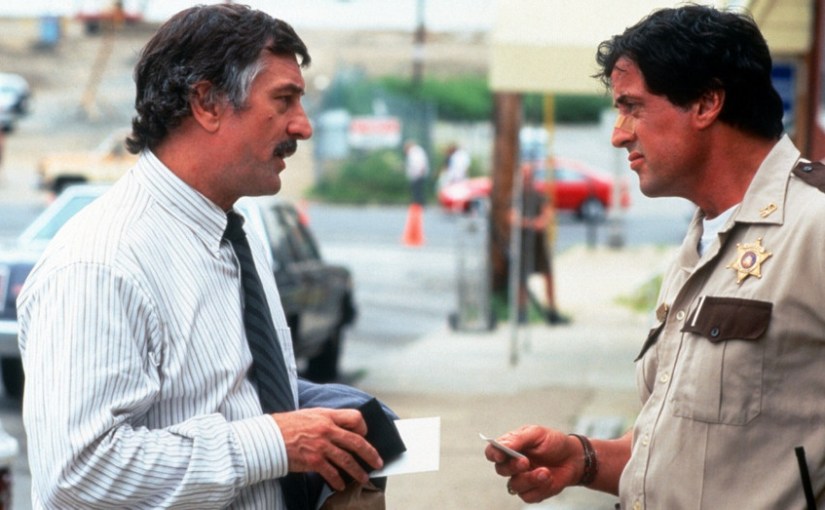
A whose who of staple actors for New York crime and corruption films take center stage including Harvey Keitel, Ray Liotta, and Robert DeNiro.  Yet, the spotlight belongs to Sylvester Stallone in what is arguably the most unsung and best role, next to Rocky Balboa, of his entire career. 

Stallone portrays the pot-bellied schlub Freddy Heflin.  He is the Sherrif of small-town Garrison, NJ where the cops who work within the city, across the bridge, reside comfortably here.  Freddy aspired to be one of those celebrated officers dressed in pressed blue uniforms, but he could not get past the physical due to a loss of hearing in his right ear.  He got that when he was kid and rescued someone from a sinking car that crashed in the river.  Perhaps Freddy wished that never happened.  Maybe his life would have been much more colorful like these New Yorkers.  I can understand the poor guy’s self-reflection.    

An internal affairs investigator named Moe Tilden (another of many convincing New York variations for Robert DeNiro) brings reasonable suspicions of corruption to Freddy’s attention.  How do these guys live so well based on the salary they earn on the police force?  Too often they have been connected with reputed mobsters, and incidents are quickly swept under the rug and kept quiet.  It stands to reason that the cover ups they commit happen in the home state of Jersey, outside of Moe’s jurisdiction.  Moe needs Freddy to quickly offer up anything he knows or witnesses. 

In particular, the leader of these guys, Ray Donlan (Harvey Keitel), might have something to do with the disappearance of his nephew Murray (Michael Rapaport) who was regarded as a young hero cop but is now at the center of a shooting incident gone wrong while driving across the bridge.  Donlan and gang fake a suicide for the kid, but with no body turning up in the river, it’s not so far-fetched to believe that perhaps he’s still alive and hiding out somewhere.

Cop Land works like an Us vs Them observation.  Freddy is the pawn for these guys to keep up appearances while this friendly town operates on other levels.  He’s the guy they can rely on to look the other way and mind his own business.  What I like about Mangold’s script is the dilemma with Stallone’s character.  Who could ever intimidate Sylvester Stallone after Rocky II?  He’s one of the biggest muscle men in film history. Yet here he is the weakling.  Most importantly, he’s utterly believable in this role that’s nowhere in the same league as Rambo or Rocky. 

The cast is as magnificent as you would expect.  Harvey Keitel looks like the family man but he’s got other nefarious ideas bubbling under his exterior.  Robert Patrick fills a role as Keitel’s heavy in a frazzled departure from his anal-retentive evilness that premiered in Terminator 2.  Ray Liotta is the second star of this picture sharing some good scenes with Stallone.  You’d think Liotta was the more seasoned actor even though Stallone came on the scene a few decades before.  Liotta is playing a guy who maybe once lived with a good soul but is now checkered and weary.  How I wish Ray Liotta had more significant screen time during his film career.

The setting works like an intimidating character here. The other supporting players flesh out the environment of Stallone’s sheep herding through a bed of wolves.  Those actors consist of Cathy Moriarty, Annabella Schiorra, Peter Berg, John Spencer and of course Frank Vincent who is a regular in these kinds of pictures.

Cop Land teeters on what Martin Scorsese or Sidney Lumet might have done with this picture.  It only falls short due to a wrap up ending with an unsurprising shootout.  What works so well as a pressure cooker crime drama devolves into blood and bullets and that is a letdown because it’s an easy way out.  In Lumet’s hands for example, the film would have taken advantage of at least an additional half hour to drive the piece into the arena of the public court system (a welcome opportunity for another all-star cameo from the likes of Al Pacino or Sean Penn.   I think the film would have been even smarter for doing so.  The avenue that James Mangold takes with his film is not terrible.  It just feels a little unrewarding or worthy of everything that was wisely executed before.

Cop Land should be seen for the dilemmas it hinges on and then for the various acting scenes among this terrific all-star cast.  Usually, actors will boast that they got to share screen time with Robert DeNiro.  I’m sure guys like Robert Patrick and Michael Rapaport place those experiences high on their mantles.  However, I bet all of these guys said what an honor it was to share the screen with Sylvester Stallone in a performance uncharacteristic of his usual criteria. 

James Mangold’s Cop Land is a terrific crime drama.

BREAKFAST AT TIFFANY’S

By Marc S. Sanders

Holly Golightly.  

Name sounds almost whimsical with a noun, a verb and an adverb.  Holly go lightly!  Puts a smile on my face.

Actually, the creation of this character from Truman Capote might follow the advice that her own name implies, and Audrey Hepburn portrayed the young self-inventive socialite – well let’s be honest as it is no longer 1961 and say “call girl” – with an enthusiasm for living better than anyone expected or could have imagined.  Hepburn was self-conscious of her portrayal.  Capote insisted on casting Marilyn Monroe.  None of it matters as Audrey was endearingly perfect.

Blake Edwards adapted Truman Capote’s novel Breakfast At Tiffany’s, and while I never read the source material I can recognize the director overstepping for sight gags, slapstick and exaggeration before he gains focus with a need to conclude his film on a turned character arc. 

I’ve had mixed feelings on Edwards career.  Days Of Wine And Roses was a rare drama for the filmmaker and yet I believe Jack Lemmon soars way over the top in his alcoholic performance.  The Great Race? Let’s just say there always needed to be “More pies!  More pies.”  I have tried multiple times to get through Victor/VictoriaThe Pink Panther was where Blake Edwards was most suitable.  However, with Breakfast At Tiffany’s he initially shoots for the silliness of Holly Golightly’s carefree life. She lives off of other people’s money while they obtain an increase in social stature for just being in the same room as her.  Holly was one of the pioneers of social media influencers.  Before a single Kardashian was ever born, there was Holly Golightly.  In an updated time, Holly would be on every reality show with countless podcasts, and a talk show hosted out of her own apartment where she’d lift her Tiffany blue sleep mask and wake up just as you turned to your Instagram account or Facebook string.

Paul Varjak (George Peppard) is Holly’s new neighbor who is on the brink of being a successful novelist with a little help from a middle age wealthy man’s wife who pays him for favors in return.  For Paul, Holly appears so foreign to him, and yet he’s living by the means he earns from what others leave on his night table.  Holly and Paul’s trajectories are quite paralell.

Capote’s film adaptation is appealing because of how air headed the picture seems at first.  Later though, it makes way for a sincere account of a young woman lost with no direction and full of lonely despair within the very large city of New York.  It makes sense that Holly Golightly finds simple solace from her need to tread in social gatherings and in the arms of wealthy men by visiting the window displays of the Tiffany jewelry store on 5th Avenue. 

We don’t yet know why but as the film begins with Henry Mancini’s Oscar winning Moon River (one of cinema’s greatest songs), Holly exits a cab in front of Tiffany, just as the sun is rising to consume a pastry with her cup of coffee.  The honest girl hides behind her thick sunglasses, a done-up hair do and a little black dress.  It’s an iconic scene in film, maybe the greatest that Blake Edwards ever shot, but what does this introduction truly mean?  Even Holly Golightly yearns for isolation from a crowded metropolitan city of eight million people, and the window display at Tiffany is her hiding spot. It is only for her to occupy all by herself on a brisk morning after sunrise.

A far cry from this opening scene soon occurs.  Holly crams at least fifty people into her apartment shortly after Paul arrives.  He witnesses the silly swinging attributes of the people who are welcomed to this social gathering of drinking and joyfulness.  He is puzzled that no one takes notice of Holly’s cigarette setting a woman’s hair on fire (typical Blake Edwards silliness) only to be put out by Holly when she is unaware she spilled her drink and doused the flame.

Later, an honest past comes back to haunt her, and Paul begins to see through the charade of her proud debauchery.  Further on, tragedy strikes and the gleefulness of life is no longer realized.  Misfortune will come upon all of us no matter how Holly Golightly we could ever be. 

Breakfast At Tiffany’s seems like a film meant to be light as a feather.  Yet, it’s not so easy to grasp the story’s purpose right away.  Capote, however, wrote an insightful observation of a young twenty something character occupying a world and a past that is much larger than she could ever handle at her young age. Turns out she is on her own with no financial means or purpose in life to show for her identity.  Holly will host a crowd in her tiny apartment, but she dresses in her bed sheet.  Fashionably dressed of course, but why a bed sheet?  She takes in a cat, but the cat has no name.  It’s just called cat.  Holly Golightly is devoid of depth or basic means, but she’ll still celebrate herself among the masses while trying to live off the wealth of others.

I appreciate what’s gained from watching Breakfast At Tiffany’s all the way to its ending. Holly appears to be crumbling beneath the weight of life that she’s ill-prepared to accept.  Just ahead of the epilogue, new and unexpected problems arise. There’s little option for escape.  Her one true blessing is Paul, the man who also evolves to grow up before Holly is ready to do so. Part of his maturity, progressed very well by the actor George Peppard, entails guiding his darling friend Holly along the way.

Holly Golightly is a tragically lost character.  Yet she’s a lot of fun thanks to Blake Edwards and Truman Capote, and most especially to the enormously engaging talents of Audrey Hepburn.

NOTE: Sadly, a terrible stain exists on Breakfast At Tiffany’s final cut, due to arguably the worst casting decision and worst written character in film history.  Mickey Rooney as Holly’s frustrated Japanese upstairs neighbor Mr. Yunioshi.  This is where Blake Edwards once again oversteps in his need for unnecessary slapstick.  It’s not enough that the character serves no purpose to any of the storylines.  He repeatedly bookends scene changes with unwelcome goofiness as Yunioshi endlessly bumps his head, startles himself or pratfalls in his bathtub, complete with overexaggerated buck teeth sticking out from beneath his upper lip.  These are unfunny Three Stooges gags. 

What’s way worse is that a Caucasian well loved character actor of legendary status was cast to invent buffoonery that apparently exists within Japanese culture.   A truly insulting and unfair representation of an entire people.  Poor Mickey Rooney. The existence of this character along with who occupies the role is the most egregious of film appearances ever put on screen.  Politically speaking, we are much more attuned and sensitive to all races and nationalities today.  Yes, many still have a lot to learn, but even in 1961 this was a horrible slap in the face taking pop culture back to the ill-conceived material that might have been found in Amos N Andy routines or even a Little Rascals Buckwheat personalization. 

I guess Blake Edwards and screenwriter George Axelrod must have thought the Japanese were due for a stooge.  Boy, were they ever wrong!

POINT BREAK (1991)

By Marc S. Sanders

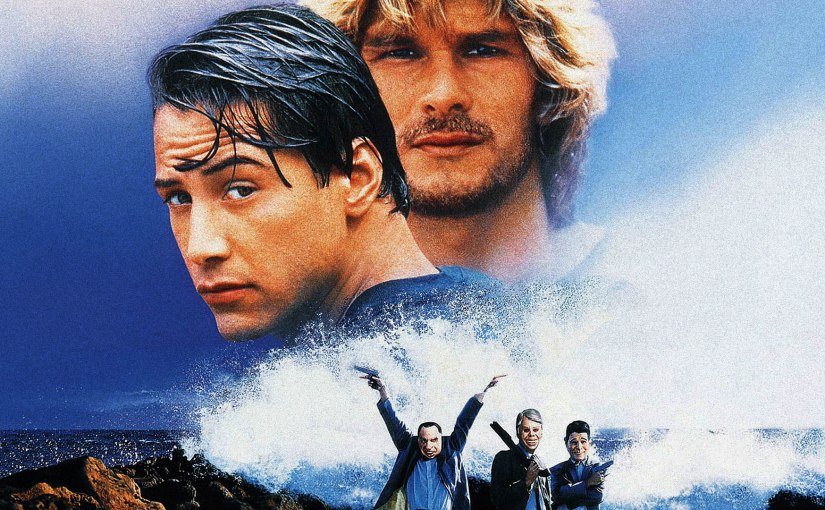
Stop me if you heard this one before.  Richard Nixon, Gerald Ford, Jimmy Carter and Ronald Reagan walk into a bank…

Yeah.  That’s right.  I’m talking about Kathryn Bigelow’s Point Break.  There’s a line in the movie where the rookie FBI hero, Johnny Utah (Keanu Reeves), is described by his new supervisor as being young, dumb and full of cumb.  Pretty fair assessment.

Much of this crime caper works despite the silly summary.  Agent Utah’s seasoned partner Pappas, played by Gary Busey, believes that a series of coastal California bank robberies are being committed by surfers who roll into town each year when the waves are at their most tubular.  They don silly looking rubber masks in the appearance of the Ex-Presidents of the United States to commit their ninety second smash and grab.  Fortunately, Johnny Utah looks and talks like Keanu Reeves who was raised in Hawaii and has experience playing a gomer like this in two other movies that were headlined by some dudes named Bill & Ted.  As well, don’t forget what he hilariously did in Ron Howard’s Parenthood.  Yes, Johnny Utah should fit right in with the California surf.

Point Break does not take itself seriously in its first half.  Johnny has to learn how to look the part of a surfer with a neon pink board amid the colony of saltwater dwellers.  Standard stuff pops up like the angry supervisor (John C McGinley) who screams about no progress being made.  Unfortunately, a romantic love interest named Tyler has to enter the fold played by an actor I’ve never been fond of, Lori Petty.  I’m supposed to believe that she is going to teach Johnny how to ride the waves and chastise him when he’s doing it wrong, and then he’s going to fall hard for her when she delivers one arbitrary piece of dialogue after another.  “What’s this pig board piece of shit?”  “Too much testosterone around here. Later!” Also, for those intimate scenes in the dark calm waters with the moon and stars gleaming in her eyes, Tyler has to ask Johnny something along the lines of “What’s that strange look you got?”  and “There it is again.”  Maybe it’s not all Petty’s fault.  The script doesn’t give her much to work with honestly.  Nothing Tyler says is relevant.  How it is delivered by Petty is not the least bit intriguing and honestly with only few nip/tucks, this character storyline could have been saved for special edition DVD featured deleted scenes that you’ll only watch once and never share on You Tube. 

On to the good stuff. 

You can see how amazingly talented a director like Kathryn Bigelow really is and it is no surprise that a couple of decades of experience led her to a well-deserved Oscar for directing The Hurt Locker.  Going all the way back to films like Blue Steel and Point Break demonstrated that Kathryn Bigelow made a name for herself based on stellar filmmaking skills.  Just look at the sky diving footage alone.  You see all the tricks as the camera follows the daredevils out of the plane and into the sunny blue sky with genuine close ups and acrobatic flips to relish in.  Sensational work.  Gorgeous photography and smooth, unshaking camera operations. Nothing artificial in these sequences.

Moreover, there is the surfing of course.  The checkered bag guy of this action picture is another variation of a dashingly handsome Patrick Swayze with shaggy dirty blond hair, dirty blond facial whiskers and his distinctive voice that if it could be described as dirty blond it would be dirty blond. Plus, a chiseled chest to show off during a karate fight scene.  He plays a guy named Bodhi.  I guess Walter, Melvin, Murray and Jack would not be cool enough.  (My dad, uncle, and grandfathers by the way.)  While Johnny maintains his undercover investigation with Pappas watching from the outside, he becomes enamored with Bodhi and his crew.  They like him in return.  Yet are these those Ex-Presidents who are robbing the banks?

Point Break is a smarter thriller than I think the filmmakers even realized because other than Lori Petty it is cast very well with Reeves and Swayze in the lead roles and a fun cooky Gary Busey on the side.  These actors are game for the quick moving adventures that Bigelow strives for.  There’s a fantastic foot chase through the back streets of Santa Monica following one such bank robbery.  This scene alone is eligible for a Best Editing Oscar with handheld Steadicams following the running players in and out of houses, around flaming gas stations and backyards with barking dogs and dense red light running traffic getting in the way.  Amazing film work.

The surfing would have to be stellar if the antagonists are in fact surfers. The photography is magnificent with narrow waves curving over the cameras directly pointing at Swayze, Reeves and cast coming right towards the screen while balanced on their boards with golden suns hovering overhead.

While Point Break does not seem to know when to end because the credits could have rolled up on three or four different occasions, at least the film insists on having fun with itself. 

I recall in The Predator Olivia Munn’s character went to MIT with a science major that somehow also included military trained special ops in its elite curriculum. I’m expected to believe that nonsense.  On the other hand, when I see Bill’s friend Ted has graduated in the top two percent of his FBI class at Quantico, Viginia, I can buy it.  I don’t have to dwell on it. Now I can enjoy the ride from a sky diving standpoint or a choppy mariner’s perspective.  My suspension of disbelief is bought, sold and paid for. 

Point Break is a smart thriller with a dangerously fun, zippy edge to it.

THE OUTSIDERS

By Marc S. Sanders

As we are about to embark on a trip to New York City to celebrate my wife’s half century milestone (wish her a Happy Birthday, please), we decided to watch the film adaptation of S.E. Hinton’s celebrated novel The Outsiders, read by many high school juniors and seniors, and now a beloved Broadway musical.  The play has to be better than the movie.  It truly would not take much.

Francis Ford Coppola is the director of this very amateur piece that is best known for introducing a who’s who of the brightest actors that would go on to occupy some of the biggest films of the 1980s and 90s.  One of these guys, someone named Tom Cruise, is still a money maker elite. Ironically, he’s got one of the smallest roles in this film.

I can see the potential talent of C Thomas Howell, Ralph Macchio, Patrick Swayze (age 29 here), Emilio Estevez, Rob Lowe and Matt Dillon.  Diane Lane is likely giving the best performance in a next to nothing role as a could’ve been puppy love interest.  However, I said potential.  Had they been directed with just a little bit of passion, it’d be nothing but apparent. Coppola didn’t put enough work into getting this cast into shape.

Hinton’s story focuses on two factions of kids from small town Oklahoma, the greasers dressed in jeans with slicked back hair and tough guy attitudes all portrayed by the gang listed above and the Socs (pronounced Sosh), who are the spoiled rich kids dressed in school letterman jackets and khakis.  Their leader is Leif Garrett, the only known celebrity name at the time of this film’s release.  The antagonism between the groups is as evident as the Jets and Sharks.  The greasers flash their switchblades, curse and strut, particularly Matt Dillon as the fearless tough guy leader Dallas. Yet, within this screenplay, and among the performances by the whole cast, Coppola often relies on hokey, cornball drama that is on par with an after school special.  This is a lousy, rejected Hallmark card come to life. I’ve cried more at “Deep Thoughts With Jack Handy.”

The edits of the picture hide much of the bloodshed until a climactic rumble in the pouring rain presents itself with many endless, overdramatized punches and kicks that clearly don’t make contact.  Yes.  I heard Tom Cruise broke his teeth from a slug to his jaw. Otherwise, the ballet boxing of West Side Story has much more threatening smacks and cracks. 

C Thomas Howell is Pony Boy and Ralph Macchio is Johnny – the sixteen-year-olds who are overtaken by the Socs in the middle of the night. One of the prep kids turns up dead as the two young greasers defend themselves.  They hop a freight train and hide out of town, only to be brought into the spotlight when they rescue a group of little kids from a burning church. Pictures are smack dab on the front page.

The Outsiders is a very brief ninety-minute film that does not do enough to establish relationships among these kids.  Howell has the most fleshed out role.  With his two older brothers (Swayze and Lowe), Pony Boy dresses the part but his appreciation for literature and poetry by Margaret Mitchell and Robert Frost says that his life as a greaser is not for him.  His current situation does not allow for any other opportunities, though. Howell is just mediocre in his performance.  I cannot say I related to his supposed anguish and conflict.  He’s a body saying the lines and standing on his mark for the camera.

Just as in The Karate Kid, Ralph Macchio is an annoying over actor.  His character has an abusive relationship with his parents. However, we never see the parents. Frustratingly speaking, I’d question if this kid Johnny is simply a storyteller looking for attention. Why would Coppola leave out this dimension of one the main character’s home life that is frequently mentioned? Macchio looks more concerned with making sure the collar on his jean jacket is popped up with his bangs hanging down just right for a cover photo on Seventeen Magazine.  The profile that has the cute scar imbedded in his tan complexion is front and center. He always looks like he’s posing for a still shot in front of Coppola’s movie camera.  Macchio delivers the final monologue of the piece, and it’s near impossible to believe the actor truly embraced any of the dialogue of the script.  His performance appears mechanically memorized. 

Matt Dillon looks like he was genuinely trying to turn in a tough guy performance, but his moments on film, especially his final scene, look terribly edited and off kilter.  The cutaways that Coppola uses are awful, like a TV movie that is interrupted by commercials.  Only someone axed the ads from the final print and did not tape the film reel properly together.  

The Outsiders is a coming-of-age story hinged on tragedy and the yearning for a better life, particularly for Pony Boy.  Hinton’s book remains essential reading for young adults needing to relate to characters their own age.  It also serves as an effective homework assignment.  Francis Ford Coppola’s film though offers little focus on what makes any character tick or why there’s a conflict between the rival groups.  Where’s the history and backstory?  Most of the actors, especially Estevez and Cruise, come off as if they are high on sugar with incomplete sentences for lines. What are you guys doing here if not to look anything but hyperactive?

West Side Story and Stand By Me quickly found their footing for adolescent boys with insecurities and uncertain futures.   The respective settings of those films knew these misfit kids, and they in turn interacted within the environments. Coppola went the wrong route because there is hardly any bond between the kids and the other folks who reside in this picture.

From a technical standpoint, The Outsiders is a muddled mess of poorly timed original scores, from Carmine Coppola, wedged into scenes that do not call for anything to enhance the emotional heft.  The director often puts one actor’s close up at a zoom in, while a buddy will be in the foreground. This technique looks like an Olan Mills family photograph you get in the mall.  It’s cringey.  It’s hard to take seriously as well.  

The Outsiders simply does not work to acquire an emotional punch of despair and loss.  These pretty boy tough guys have no effective humor even with Tom Cruise behaving like an ugly, incomprehensible wild man and Emilio Estevez donning a Mickey Mouse t-shirt with his signature cackle.  There’s just too little to relate to anything in this picture that S. E. Hinton magnetically achieved within her pages.  Her book was published when she was age seventeen by the way. What an amazing accomplishment!

Regrettably, the filmmaker who upped the scales of the war picture (Apocalypse Now) with terror and disillusionment, and successfully delivered two of the greatest, most operatic films of all time (The Godfather movies), not to mention his smaller but shocking films like The Conversation offered little attention to what S.E. Hinton captured and impressed upon young readers.  If anything, Coppola was more concerned with shooting picturesque, midwestern sunset landscapes that honestly have an artificial texture to the eye.  Nothing from the music to the photography to the editing to the overt contrivances or the acting seems natural here.

The Outsiders is equally regarded as assembling one of the most impressive groupings of eventual male box office stars, as it is for Francis Ford Coppola’s lazy and uninspired film work.

ALIEN: ROMULUS

By Marc S. Sanders

To make an effective horror film requires the necessary scares to startle an audience, but it doesn’t stop there.  The story has to work. Still, it doesn’t stop there.  You also have to care about the characters of the piece.

I guess one out of three is not bad for a new installment in a nearly fifty-year-old science fiction/monster movie, horror franchise.  However, with Fede Alvarez’ Alien: Romulus, I left wanting more.

I have no doubt I was the loudest, perhaps most frequent screamer in the Dolby theater last night.  Knowing what I know about Alien, I still get terribly nervous when watching a picture of these grotesque-like creatures, originally designed by H. R. Gigar.  The assortment of Xenomorphs in this film is a faithful treatment to what the monsters should look like.  Teeth, slime, black skeletal frames with scaly limbs and tails.  What these monsters do is another story. It is primarily the same old routine of the creatures from the other films.  Their quiet behavior ahead of their ritual attacks leaves me very nervous and anxious.  I’ve gotta scream at the screen to help me overcome what scare tactics Alvarez and his crew have in store for us.  

Alien: Romulus follows a Michael Myers/Friday The 13th blueprint.  In basic terms, a handful of twentysomethings board a deserted space station as a means to getting off a mining colony overseen by the franchise corporate antagonist Weyland/Yutani.  An audience familiar with the franchise knows this is not going to go well, and soon will expect the clawlike facehuggers, phallic shaped chestbursters and fully developed aliens, aka Xenomorphs, to run around trying to slash, eat, cocoon and build up their population.

Upon attending a screening with my Cinemaniac pals, the guys will testify to my shock and horror at what popped out on screen.  I was terrified for what was coming out of Fede Alvarez’ dark and disturbingly silent settings.  I was nervous when the cast crawled through narrow crevices or stepped into various labs, only to get stuck behind a jammed door or commit a clumsy trip into knee high, unclear water.  Cocooned bodies representing an aftermath of violent carnage sent a doomed message too.  The atmospheric sets alone work well at being terrifying.

Yet, for all of these technical achievements in luridly dark scenic design, jump scare editing, gross looking attacks along with alien “deliveries” and terrifying pursuits and chases, my friend Anthony said it best.  He didn’t care about one single character.  Same for me.  I can’t deny how accurate he is. Like a slasher movie, I could care less if any of the players lived or died.  Even with a periodic countdown during the course of the film, I also didn’t care if they got away from the deserted ship.  So, the suspense never sustained. I was only anxious for when the next monster was going to make an appearance. In the third act, many of the jump scares were nil and upstaged by machine gun shooting and acid (for blood) splashes.

I also didn’t care for the expository scenes either because the information presented was nothing new.  Anything that this gang learns they are suddenly up against has been told to me in all of the other films.  There’s some wink and nod material to salute the other pictures with famous line send ups and even one broad character salute.  It’s fun for a moment but what about this movie and this story

I was also quite bothered by the convenient “just made it out alive” encounters that the main character played by Cailee Spaeny survives over and over.  Anytime danger was knocking at her door her means of survival were not consistent with the long-established fiction of the Alien science of it all.  When I wasn’t screaming, I was asking myself, how is she getting away.  That’s the script not respecting the story elements, the universe or what is presented to an audience, and what they clearly know after almost a dozen pictures.

None of the characters have a personality.  One is Asian with a buzzcut, two are English, and one is pregnant.  The only interesting portrayal is an android named Andy (David Jonnson) who is a sidekick “brother” to Spaeny’s character, and behaves like an autistic savant, until a change comes over him, causing him later to operate like HAL 9000.  Jonnson is really good in this role, and it is unfair that his cast mates were not as fleshed out like most of the other franchise films depicted in portrayals by such actors Ian Holm, Yaphet Kotto, Paul Reiser, Bill Paxton, Lance Henrickson, Charlize Theron, Noomi Rapace, and of course Sigourney Weaver. The characters in this new picture are entirely forgettable and carry no value.

Jump scares with things that come out of dark corners or when crusty hive like walls come alive only go so far.  To effectively win over horror, I need to also care when the next victim is taken down, or about to go through a near death experience on an even playing field.  Romulus comes up short in that department.

Alien: Romulus is decent, but not great as it opts to only think with one side of its brain primarily focused on sneaking up to shiver you in hopes that you’ll pee a little.

NOTE: I knew what not to expect out of this film.  My wish was to see a book end to the last two films that Ridley Scott helmed (Prometheus and Alien: Covenant).  Questions were presented within those films that seemed to promise answers with a later film installment that has yet to come to fruition.  So, the production company seems to have abandoned what they started in response to lackluster box office revenue and a divisive audience response.  Therefore, reinvention came into play once more.  I was always on the enthusiastic side of the divide with those two films. I carry great appreciation for what was done with them, and I was eager for how a prequel trilogy (now remaining incomplete) would wrap up. Alas…

As well, at close to fifty years, if you’re going to keep this up, I believe it’s time to reveal more about the villainous puppet masters, namely “The Company” or to be more specific, Weyland/Yutani.  It has always been supposed how people who work for them may be expendable. Researching and controlling weaponized biological organisms is the company’s main priority.  Yet, how, who and why are these ideas being set in motion?  Does anyone at the top question the company’s practices and look at the moral and ethics of their functions?  Even the Marvel Cinematic Universe has approached these kinds of angles already.  Star Wars as well.  Regrettably after several decades though, the Alien franchise segues away from those perspectives.  This is my take only of course. Yet, I think it’s time to show who else is performing within this house of horrors universe.  Prometheus and Covenant were moving in that direction but sadly they seemed to run out of road. 

WINGS

By Marc S. Sanders

The first film to ever win the Oscar for Best Picture actually didn’t win Best Picture.  The category was called Best Production in 1927.  A year later the title was changed.  Wings was the film in question, directed by actual World War I flying ace William A Wellman, only ten years after the worldwide conflict had ended.

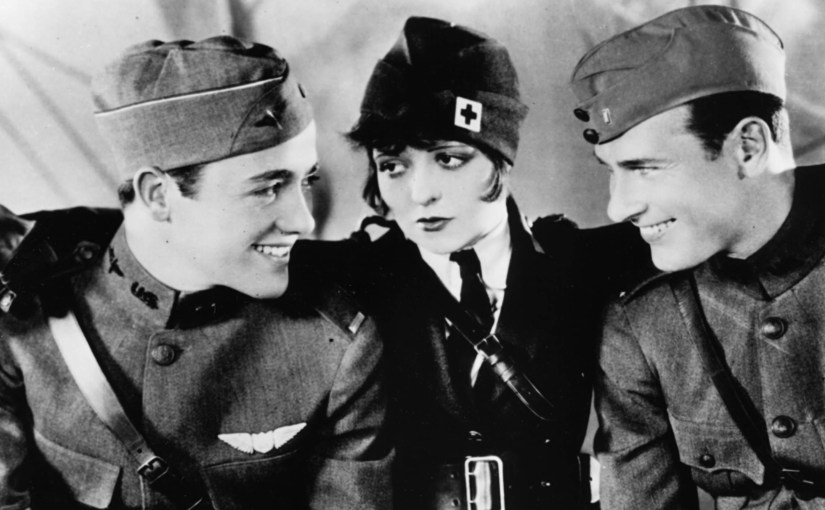
To watch this two-and-a-half-hour silent movie is an exhilarating experience.  The story focuses on two young men, Jack Powell and David Armstrong (Charles “Buddy” Rogers, William Arlen), who both pine for the affections of a local girl named Sylvia (Jobyna Rolston).  Their competition is put on hold as they enlist to train and serve as fighter pilots in biplanes against the German opposition.  A side relationship focuses on Mary (the adoring Clara Bow), and her affections for Jack who has no interest in her. 

Wellman’s film takes you through the regimen of enlistment with the calisthenics the men practice, through mentorship and then on to piloting the planes.  Jack and David set aside their differences to unite against the common enemy where they routinely say just before take-off “All set?” followed by “Okay!”  Reader, in a silent film with only a few frequent dialogue cards, this relationship was as effective as witnessing Maverick & Goose or Han & Luke.  (“I feel the need, the need for speed.” “Okay Chewie, punch it!”)

William Wellman captures outstanding dog fight footage and enormously vast battle scenes that look even more detailed than what I found in the graphically convincing 1917 from just a few years ago.  

Paramount Pictures invested in a 2012 restoration following the discovery of this film in a basement in France. I believe the restoration incorporated orange flames and sparks into the planes that get shot down, as well as from the cannons that fire from the pilots’ cockpits.  Yet, unlike CGI or quick edits, Wellman holds his camera in the skies above, often following the spiral trajectories of the downed planes with numerous ground crashes.  His camera is also teetered on the hull to capture engaging closeups of the pilots who are actually flying in air during the shooting of this picture.

Both Allied and German pilots get shot with blood pouring from wounds.  There are direct head shots as well as to the torso and appendages. Before Hitchcock, chocolate syrup was already being used as an effective substitute. Wings is action packed and one of the best war films I’ve ever seen.  These are not just random fight scenes captured on film.  A story comes from the developing dog fights. Suspense stems from what becomes of David while Jack wonders if his friend is even alive.

Wellmen’s film does not just resort to the battlefield and the skies above.  There’s a personal story going on for Mary, Jack and David.  Mary is enlisted as a traveling nurse for the troops and the director captures emotive moments from the silent film star Clara Bow as her character reunites with an intoxicated Jack on leave in Paris.  For a silent picture that must rely more on visuals, bubbles are incorporated to float away from the beverages as well as out of the actor’s mouths.  It looks silly like what Chaplin or Laurel & Hardy might include.  However, as Mary witnesses a drunken Jack, exhausted from the perils of war, there’s a sadness to seeing her literal despair for the one she loves. She’s even forgiving enough to accept Jack’s desperate need for immediate affections from a swinger girl.

Escapist comedy also comes into play. A character called Herman Schimpf (El Brendle) is the klutz of the regimen. He’s clumsy with the exercises and Brendle’s physical performance lives up to silliness of his character name. The drill sargeant can not even fathom a pilot named Herman Schimpf accomplishing the heroics expected of a world war flying ace. My extensive experience with late twentieth century films lent references to Goldie Hawn, John Candy and Bill Murray in an army lampoon like Private Benjamin or Stripes. Before these guys, there was Herman Schimpf.

I recommend you watch Wings like I did.  As with most silent films, there is a running loop of rag time piano music.  It’s terribly distracting and does not ever appropriately compliment the images on screen.  I turned my sound system off and watched in silence.  Oddly enough, there are so many explosive visuals to this piece with an enormous amount of artillery vehicles, planes and ammunition being fired, that I could subconsciously hear a sound system in my head as the film moved along with massive explosions, horrific crashes, rattling machine gun fire, and the screams of despair from the 5,000 American troops who were loaned by the United States military to complete the construction of the film. The U.S. hoped that Wings would serve as a recruitment piece for new enlistments.

I have no doubt Wings still serves as a seed for the future of filmmaking.  I easily found elements of hit modern films from Top Gun of course, to the romantic angles found in The Dark Knight, It’s A Wonderful Life, Titanic and It Happened One Night, and furthermore on to the regrets of serving in a destructive war as covered in Born On The Fourth Of July and 1917.

Standards in practice were also not enforced at this time. Wellman had the freedom to shoot graphic violence and even nudity that includes nude shots of Clara Bow and enlisted men going through their routine of living on an army base. Wellman had no hesitancy for offering the authentic.

It is a step back in time, when this film was produced just ten years after the first war ended. William Wellman provided convincing direct oversight from his experiences as an actual fighter pilot, practically reenacting what he went through.    He went so far as to relocate where he was shooting the aerial footage because the Texas skies had no clouds to offer clear composition of the acrobatically flying biplanes.  The clear blue skies could not highlight the planes well enough. He believed they looked like blobs on film. So, artistically, the director refused to settle.

Wellman also went so far as the shoot the actors up in the sky, actually flying the planes.  This allowed for a first-rate perspective as the hair blows in the breeze high above.  Forgive me as I do this again but it’s reminiscent of when I saw Christopher Nolan’s Dunkirk. Much of this kind of footage is identically found in Nolan’s film save for the black and white photography and the absence of sound.

I also have to credit Wellman as a pioneering filmmaker with how novel his camera work is during a speakeasy sequence in Paris.  Though it was not a steady cam, a camera is attached below a harness to allow a one-shot zoom over a half dozen bar tables at once with a crowd of extras occupying the spaces.  Before Scorsese, Wellman had already thought of this eye-opening approach. It is a one shot moment that belongs on any highlight reel.

Simply, there is so much to appreciate technically and theatrically in Wings. There’s a lot of groundbreaking material to uncover. The aerial footage is stunning.  This cast is superb.  The writing is compelling.  Wings has to be one of the most pleasantly surprising films I can recall in a very long time.  The feats that were accomplished here are magnificent.  

Wings is easily a must-see film for any film buff, and anyone who loves movies in general.

GHOST

By Marc S. Sanders

For a perfect blend of the supernatural, suspense, mystery, drama, romance and comedy, the first film that will always come to mind is the surprise hit film Ghost from 1990.  One of the zany Zucker brothers, Jerry to be more precise, who introduced the world to slapstick spoof (Airplane!, The Naked Gun) directed this film turning Demi Moore into a ten-million-dollar actress, placing Patrick Swayze ahead of his Dirty Dancing looks and earning Whoopi Goldberg a very well-deserved Academy Award.  Ghost was a film for all kinds of movie goers.

Sam Wheat (Swayze) is an up-and-coming New York City business executive who loves his new live-in girlfriend, Molly (Moore) even if he can only say “Ditto!” when she tells him she loves him.  Shortly after the picture begins Sam is gunned down following an evening at the theatre.  Unbeknownst to Molly and anyone else living on earth, Sam’s spirit lives on though, and he realizes that he was not the victim of some random mugging/murder.  Now, Sam must find out who arranged to have him killed and why, while also protecting Molly from becoming a victim.

Along the way, Sam crosses paths with a phony con artist, working as a medium, named Oda Mae Brown (Goldberg) who turns out to be the real thing when she can actually hear Sam’s voice and communicate with him.  Sam must recruit Oda Mae to be a go between for him with Molly and everyone else necessary to follow up on in order to resolve the mystery of his sudden death.

Ghost succeeded in every category of filmmaking.  Rewatching the film decades later, I believe Demi Moore should have gotten an Oscar nomination.  Her close ups on camera with beautiful, muted colors from Adam Greenberg’s cinematography are masterful.  Greenberg should have been nominated too.  He’s got perfect tints of pearl whites both on the cobble stone streets of New York with the outer architecture of the apartment buildings, as well as within the studio apartment where the couple lives.  He strives for an ethereal look with his lens. Gold often occupies Molly’s close ups with dim lighting.  Blues and blacks and steel glinting shines follow Sam’s trajectory. 

Look at the lonely scenes that Moore occupies in the couple’s apartment.  There’s a haunting image of isolation with no dialogue capturing the young actress at the top of a staircase when she eventually rolls a glass jar off the top and it shatters below.  It’s one of the moments that defines a sorrowful character, and not many cry on screen better than Demi Moore.  Later, Sam is engaging in a pursuit through the subway system and races down a steep blue escalator in the dead of night.  Zucker places Greenberg’s camera at the bottom of the escalator to show the depth of hell that Sam may be risking continuing his chase.  The images and transitions of this whole movie from scene to scene are stunning.

I mistakenly recall Whoopi Goldberg as just a comedienne doing her stand up schtick in this film.  Not so.  Goldberg looks radiant on film and while she starts out comically as the script calls for, she eventually resorts to sensitive fear of what her paranormal partner demonstrates as real within this fantasy.  There are so many dimensions to this character.  She’s silly.  She’s exact in her nature for what’s at stake and the dialogue handed to her from Bruce Joel Rubin’s Oscar winning script compliments the actress so well. Goldberg never looks like she’s working for the awards accolades. Yet, she earned every bit of recognition that followed her.

Patrick Swayze makes more out of the straight man role than what could have been left as simple vanilla.  His spirit character uncovers more and more about his afterlife and what happened to him as the film moves along. With each discovery, you’re convinced of Sam’s surprises and what he becomes capable of as a ghost.  Long before superhero films became the novelty, Sam Wheat operates like one who has to learn of his origin and then acquire his new talents and powers to fend off the bad guys.

Jerry Zucker, working with Rubin’s script, Greenberg’s photography and Oscar nominated editing from Walter Murch, along with haunting yet sweet scoring from Maurice Jarre, builds a near perfect film.  The narrative of Ghost shifts so often from comedy to crime to drama to romance and the various natures of the piece hinge so well off each other.  That’s due to storytelling and the editing necessary to smooth out any wrinkles.  You become absorbed in Jerry Zucker’s direction, especially with the movie’s most famous scene where Demi Moore and Patrick Swayze are sensually doing pottery together accompanied by Bill Medley’s rendition of “Unchained Melody.”  Watch that scene with someone you love or take it in on a late Saturday night by yourself with no one to distract you with cackles and eye rolls.  You’ll see how effective Zucker’s work is along with Swayze and Moore upholding the scene in a dark, empty apartment.  Take it as seriously as the scene was originally constructed.  (Then go watch Zucker’s Naked Gun 2 ½ for a chuckle.)

The mystery of Ghost works well with surprises if you are watching it for the first time.  You build trust with a character only to realize it is a ruse for something else.  I do not want to give too much away.  For viewers who have never seen the film, maybe you’ll see an early twist as soon as the film begins.  Maybe not.  Either way, Ghost performs very naturally, unlike a forced kind of twist that M Night Shyamalan too often relies upon.  I do advise that you not watch the trailer that was used for Ghost as I believe it deals out too many of the film’s secrets.

There are movies that I watch over and over again because I love to relive the special moments they offer.  Ghost has those kinds of gifts and yet I have not seen it in ages.  I’m glad.  To experience the picture again was such a treat.  While I recalled all of its secrets, this time I was able to take in the various technical achievements and the assembly of the piece, along with outstanding performances. 

I have no problem saying that Ghost possesses the best performances within the vast careers of Demi Moore, Patrick Swayze and Whoopi Goldberg.  Ghost still holds up. It deserves a rewatch and an introduction to new generations.

TWISTERS

By Marc S. Sanders

Reader, often The Two Unpaid Critics will debate the merits or lack thereof in a film.  Usually, one likes the piece while the other does not.  It’s rare though when we both find fault with a movie but for entirely different reasons…and we argue about it.

Fair warning, a poorly constructed declaration is coming your way:

Twisters is better than Twister.  

However, this is like saying cat shit is tastier than dog shit.  

Understand, I had a grand ol’ time watching Twisters with Miguel by my side as the experience quickly gravitated to a Riff Trax viewing.  This apparent sequel to the stupidity that was released thirty years ago teaches us more about the nature of tornadoes.  Though when I insist that observation to Miguel, my comrade put me to the test and my giggles took hold of me because I couldn’t utter a single scientific fact.  Okay.  So it’s not that much brainier. Yet, it is brainier!!!

Twisters offers a background and a traumatic dimension to Kate (Daisy Edgar-Jones) who loses all but one of her entire collection of friendly storm chasers in the film’s prologue, and then weepily monologues about it later.  That’s what I wanted from Helen Hunt in the first movie.  Miguel rightfully questioned why she even needed to speak.  We were firsthand witnesses to this early tragedy.  

CURSES!!!! You foiled me again, Mig.

Okay, so with my arguments shredded to pieces within our debate, I heed to the fact that I am no Jack Kennedy.  Yet, at least I could laugh at how utterly ridiculous Twisters is.

Kate is requested back to her home state of Oklahoma to locate powerful tornadoes that now can be studied with new triangular sensors, each respectively called Scarecrow, Tin Man and Lion.  That garbage can called Dorothy has been put out to pasture.  There’s also a Wizard van. Cute wink and nod names.  No Glinda. No Witch. No Munchkin. No Flying Monkey. How lazy can a tornado movie get?

This corporation with the high-tech gear is competing against a convoy of redneck grunge daredevils led by Tyler, The Tornado Wrangler (Glen Powell).  He fits the persona with the cowboy hat that Brad Pitt wore in Thelma & Louise, along with the flannel shirts and a big ass belt buckle below his ripped chest.  

Tyler’s off road pickup is tricked out with anchors to drill in the ground holding his vehicle in place while he drives right into the middle of a storm.  He’ll also launch fireworks straight up into a funnel.  Whatever it takes to impress his You Tube followers.  

Get this!  Tyler is one of the most educated people in the world on meteorology.  Has to be true!!!! Absolutely has to be, because Glen Powell would never agree to portray a daredevil redneck without a brain to complement his chestnut hair and five o’clock shadow.

Twisters fails at suspense, but unintentionally wins at outrageous comedy when the movie opts to have its terrible tornadoes attack Americana.  As soon as they show small town USA with the little league softball game, I broke out laughing.  I was waiting for the homemaker to put out a pie on her windowsill.  Where’s Bob Seger singing “Like A Rock” from those Chevy commercials?  Tyler, Kate and the gang race to save everyone in town single-handedly without ever calling emergency services.  Only ONE COP appears in the whole movie. Fortunately, once the storm moves on from its devastation, there’s a complete clear road with absolutely no debris for the Tyler’s gang to drive on through. I mean does this movie think for itself or what?

We are treated to people flying away and a water tower toppling over.  A movie house rips apart while Frankenstein shows on the screen.  There’s the inevitable moment when a character gets a leg stuck under wreckage while the others try to get him free but can’t lift him out as the storm bears down.  But wait!!!! At just the last second– I saw this in episodes of The Incredible Hulk and CHiPs and…um…well…Twister!

Earlier in the film, Tyler and Kate have an opportunity to settle their differences while taking in a rodeo.  Of course, Tyler the redneck meteorologist and Tornado Wrangler used to be a rodeo clown as well.  

Then!!!!

What’s this?  

“We gotta get these people to safety??”  

“Is there a basement around here?”

Apparently, Oklahoma is running low on basements.  Not a single basement anywhere in the state where the wind comes sweeping down the plains!!!!!  

Twisters fails because it is paint by numbers, and it shouldn’t be.  It should never be this transparent. The most unpredictable of weather phenomena is so laughably unsurprising when it should be dazzling and frightening and nail biting.  None of it is new.  Everything you expect to happen, happens.

This picture even fails at lending a nasty bad guy to its screenplay.  The rich old guy with the bolo tie, a true indicator of villainy, tours around the devastation. He’s offering to buy the properties of people who have lost their homes so that further profitability can be made with ongoing research into tornado activity.  Yeah.  This guy is a regular Darth Vader or Hannibal Lechter, alright.  Hang him in the town square and then stone his rotting carcass.  Seriously, what’s so wrong with this guy’s intentions?  Kate is disgusted for some reason, but if I just lost my house and my farm and my crops and my flat screen and all my blu rays, heck yeah, I’ll take this fat cat’s money.  

Miguel refused to write a review for Twisters.  However, I’m taking free liberty to share his compounded thoughts. As the end credits rolled over home movie footage of the happy cast, he declared this film is devoid of any kind of suspense, whatsoever.  He’s not wrong, and neither am I.  

Twisters is better than Twister but for all the wrong reasons.

SOAPDISH

By Marc S. Sanders

To get inside the head of a character on a soap opera would best be portrayed by someone who’s literally living a soap opera off the set.  That’s the paramount theme of every member of the cast and crew of the daytime drama The Sun Also Sets.  Everyone is living through their own checkered background from the lead actress to the returning actor to the homeless deaf/mute extra on down to the trampy nurse and the buxom doctor on the show. By default, the program’s head writer and the producer fall into this category as well. 

The hilarity found in Soapdish gave me remembrances of classic films like All About Eve and Sunset Blvd. Ego and stardom are treasured commodities above all else and an actress’s greatest fear is being aged out of fandom and replaced by the new girl in town. 

Celeste Talbert (Sally Field) is a star actress with dozens of career awards but an insecurity with becoming past her prime. A diva concern is that the stories written for her are not worthy of her importance to the show.  David (Robert Downey Jr) is the young producer feeling the pressure to come up with something to boost the ratings before his boss, the always naturally funny Garry Marshall, replaces the program with game shows.  On David’s side for her own ulterior motives is Montana Moorehead (Cathy Moriarty) who plays the resident nurse and is ready to take the reins from Celeste and make the show her own.  She’ll seductively manipulate David into getting things to work out her way. 

In the meantime, Lori Craven (Elisabeth Shue) sneaks onto the set seeking an opportunity by way of Aunt Celeste.  Best she can get is to portray a deaf/mute homeless woman extra.  Head writer Rose (Whoopi Goldberg) has devised a new plot where Celeste’s character will be tried for murdering Lori’s homeless mute character.  Lastly, at least through the first thirty minutes of the film, Jeffrey Anderson’s (Kevin Kline) character who died on the show twenty years prior by an unfortunate beheading is recruited out of dinner theater by David to return to the program.  Both Lori and Jeffrey’s unexpected arrivals do not sit well with Celeste.

Following along okay, so far? Well…

SECRETS ABOUND on Soapdish!

This film was developed by the powers who delivered Steel Magnolias to the big screen a few years prior.  The original playwright and screenwriter, Robert Harling, teamed up with Andrew Bergman, to satirize the weepy material that daytime drama promises and which he embraced seriously with his beloved play.  The director of Magnolias, Herbert Ross, also serves as an executive producer on this film.  To add some extra authentic spice, Aaron Spelling is producer.  That’s right.  The guy who produced Dynasty, 90210 and Melrose Place.  Michael Hoffman directs. 

The look of this film is so odd and has a garish blood coated red appearance to the television studio where the show within the movie is set, as well as to the offices that hover above.  The set designer for the film, Eugenio Zanetti was inspired by Dante’s Inferno.  Makes sense really because no one is ever satisfied with how The Sun Also Sets develops from one atrociously delicious storyline to the next, and how it makes them look in the public eye.  Zanetti is quoted as saying the offices of the producers and writers hover above the set for the soap opera.  So, it looks as if the powers that be are staring down into the depths of hell that the cast and crew must work and reside in.  While it looks odd, after having seen the film, I can’t help but believe Zanetti makes sense.

There are moments here that are outright hilarious.  As a community theater actor and director, I can totally relate to Kline’s character being stuck in a retirement community steak/playhouse performing as Willie Loman in Death Of A Salesman while elderly patrons call for their waiters.  Poor Jeffrey also has to project that much louder for the old folks to hear him.  This scene stands as gold on its own. A whole farcical film could be developed on this side story alone. 

Soapdish does lose some of its comedic appeal before it reaches the middle of the picture when secrets are uncovered related to Celeste, Jeffrey, Lori and so on.  Sally Field goes for great physical comedy that lands perfectly with the skeletons that Celeste pulls out of the closet.  Kevin Kline makes for a hysterical arguing scene partner, and the craziness just gets bigger from there. 

Whoopi Goldberg is also very funny as the one with common sense and brains behind her character.  For once, she’s not going for the female Eddie Murphy equivalent.  I’m with Rose when she vents to David about how she’s supposed to write a believable return from the dead of a character who was killed when he lost his head.  Maybe a brain transplant?

Cathy Moriarty does a fine job of being the conniving seductress.  She’s a full-bodied intimidator of teased, frizzy blond hair and a buxom nurse’s uniform costume against Robert Downey, Jr.’s nervous preppy producer.

There’s satisfying moments for cameos from Carrie Fisher as a casting director as well as Teri Hatcher and Costas Mandylor as bubbleheaded supporting characters.  However, the best scene stealer is Garry Marshall. I don’t think a single line he’s given would be as funny if he was not providing them.  He’s just got that Neil Simon kind of delivery as the studio boss.  “The nurse is in the restaurant?  Was there a meeting I missed?”

Other than a few F bombs, I think Soapdish works as movie the whole family could watch the next time they are snowed in or hunkering down from a blizzard or hurricane.  Soap operas are designed for escape and the outrageous comedy of Michael Hoffman’s film reaches into outrageous areas that work with surprise and big laughs. 

This nonpaid critic, who endures his loving wife’s adoration for General Hospital each night before bed, is at least a fan of The Sun Also Sets and Death Of A Salesman dinner theater.