THE DEER HUNTER (1978)

by Miguel E. Rodriguez

THE DEER HUNTER (1978)
Director: Michael Cimino
Cast: Robert De Niro, John Cazale, John Savage, Christopher Walken, Meryl Streep
My Rating: 10/10
Rotten Tomatometer: 86% Certified Fresh

PLOT: An in-depth examination of the ways in which the Vietnam War impacts and disrupts the lives of several friends in a small steel mill town in Pennsylvania

[Author’s note: This will be the first in an ongoing series of reviews inspired by a book given to me as a birthday present by my long-suffering girlfriend.  Entitled Everyone’s a Critic, it challenges readers to watch a movie a week within a given category, then answer questions like, “Why did you choose this particular film” or “Do you feel this film deserved the award? Why or why not?”  Clearly designed to inspire discussion.  This category was “A Film That Has Won Best Picture.” This format is a work in progress, so I hope you’ll bear with me on future installments.

I am going to assume, for the most part, that most readers will have seen the movies being reviewed in this series.  Therefore, some spoilers may or will follow.  You have been warned.]


Once about every couple of years, I like to pick up and read Stephen King’s The Stand in its original uncut version.  My paperback copy runs to 1,141 pages, not including King’s foreword and a brief prologue.  Even Tolstoy would look at that thing and go, “Dude…edit yourself.”  But having read it numerous times now, I cannot imagine what could possibly have been excised from the edited version of King’s novel.  Every detail of that apocalyptic saga feels necessary.  Reading it is like falling into a fully realized alternate universe.

That’s what watching The Deer Hunter is like.  I can still remember the first time I watched it.  I knew its reputation as one of the greatest Vietnam War movies ever made, had heard of its harrowing Russian Roulette scene, and was intensely curious.  I popped it into the VCR, hit play…and for the first 70 minutes I got a slice-of-life drama about steel workers in a tiny Pittsburgh town (Clairton, for the detail-oriented) where, mere days before three friends ship off to Vietnam, one of them is getting married.  And the centerpiece is the wedding reception.  Ever watch a video of a wedding reception?  How high do you think a young teenager would rate its entertainment value on a scale of 1 to 10? 

I could not appreciate, as I do now, how vital this scene is.  Relationships are stated, expanded upon, and brought to a kind of cliffhanger.  Take the mostly non-verbal interplay between Linda (a luminous young Meryl Streep) and Michael (Robert De Niro).  Linda is clearly in a relationship with Nick (Christopher Walken), but it is painfully obvious that Michael and Linda have eyes for each other.  Mike watches intently from the bar as Linda dances at the reception, and whenever their eyes meet you can almost hear their hearts stop beating.  The oblivious Nick even pairs them on the dance floor while he visits the bar himself.  The awkwardness as Michael forces small talk and Linda shyly reciprocates is palpable.  And…is that Nick giving the two of them the eye at one point…?

As a kid, I wondered why this soap opera nonsense was necessary in a Vietnam film.  Of course, I didn’t know what was coming.  That’s the beauty and wonder of The Deer Hunter.  It challenges you to follow along with this miniature melodrama to give meaning to what comes next.

There is a key moment during the reception when an Army soldier wearing a green beret stops by the reception.  Mike, Nick, and Steven (John Savage), who are gung-ho about serving their country, yell their support and let him know how much they’re looking forward to killing the enemy.  The steely-eyed soldier raises his glass, looks away, and says, “Fuck it.”  It’s not terribly subtle, but the ominous nature of this moment always fills me with a sense of foreboding, even having seen the film many times by now.

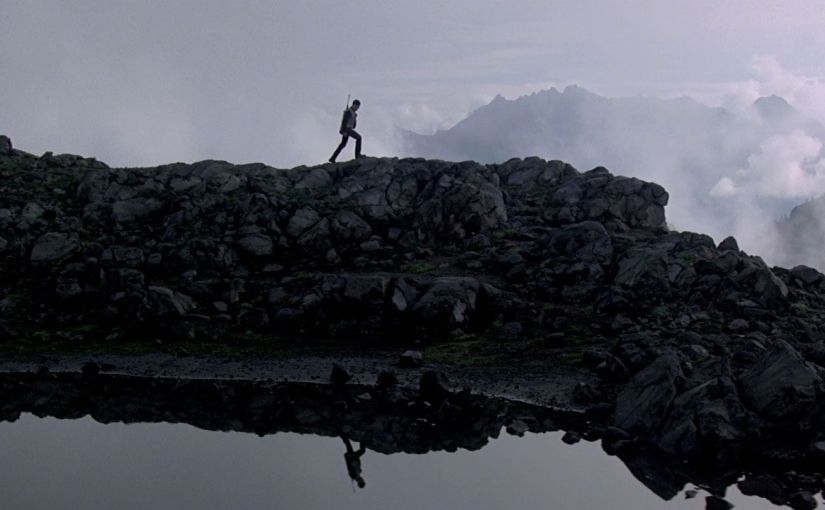
But even after the reception is over, there is one more small-town pit stop to make before the movie gets to Vietnam.  (In fact, The Deer Hunter spends surprisingly little time in Vietnam.)  Michael and a group of friends including Nicky and Stan (John Cazale) go hunting for deer in the mountains as a kind of ritual before Nick, Mike, and Steven are deployed.  It is in this sequence that Oscar-winning cinematographer Vilmos Zsigmond’s talents are put to stunning use.  We are shown vistas of the Allegheny Mountains that are simply breathtaking, with Mike and his friends seen as mere dots in the mountainsides.  Choral music with a men’s choir singing in Russian is heard on the soundtrack, giving the sequence a majestic aura that must be seen and heard to be believed.

Then the hunt is over, and the boys all have one last drunken night at the bar owned by another friend, John (George Dzundza in an under-appreciated, realistic performance).  Here they all sing along to Frankie Valli and listen somberly as John plays a sad classical tune on his piano.  And then, in one of the film’s masterstrokes of editing, we slam-cut immediately to the jungles of Vietnam – no boot camp, no footage of them being trained or flown over there, just suddenly they’re there and the contrast between the carnage we experience in the first few minutes of Vietnam versus the rhythms of their lives in Clairton could not be more extreme.

In a horrific but mercifully brief sequence, we watch as a Viet Cong soldier calmly walks into a burned-out village, discovers a hidden pit holding terrified villagers, and remorselessly tosses a grenade inside.  We then watch as Mike, now a battle-hardened soldier, emerges from a hiding place with a flamethrower and burns the VC soldier alive.

The effect of this scene cannot be understated.  To witness Michael torching a soldier, even after that soldier committed a brutal act himself, is jarring.  And why is it so jarring?  Because we have seen Mike as a civilian, as a friend, as a would-be lover, during that lengthy sequence at the wedding reception and while hunting with his friends.  Admittedly, you got the sense that he could or would get violent if necessary.  (He’s clearly the alpha male of his “clique.”)  But this…I mean, damn.

Then, in one of those Hollywood conveniences that never get old, Mike is unexpectedly reunited with Nick and Steve who just happened to arrive at that very same village with another platoon of US soldiers.  And then, immediately after being reunited, they are captured by enemy forces, imprisoned with several enemy combatants in a riverside compound, and forced by their sadistic keepers to play Russian roulette with each other as the guards bet on the outcome.  Michael comes up with a horrifyingly logical escape plan: convince the guards to put THREE bullets in the chamber instead of one.

Much has been made regarding the historical inaccuracy of this scene.  To those arguments, I say: who cares?  As someone once said, riffing from Mark Twain, “Never let facts get in the way of truth.”  The truth of the matter is, the Vietnam experience was a modern-day horror show, leaving physical and psychic scars on its participants and on our country.  In my opinion, the Russian roulette scene can be interpreted as a symbol of how those soldiers, or ANY soldiers, must have felt every single day.  Going on a routine patrol in the jungle could have potentially lethal circumstances.  They rolled the dice every time they called in an airstrike, betting they didn’t get firebombed themselves.  Booby traps were everywhere.  How is life in a war zone that much different from being given a one-in-six chance at living or dying?

I’ve already gone into far more spoilers than I am accustomed to, so let’s just say this happens and that happens, Michael winds up making it back home, Steven is grievously wounded in the escape attempt, and Nick goes AWOL when, after making it back to a military hospital in Saigon, he wanders the streets at night and discovers an underground ring of lunatics who run a high-stakes game of Russian roulette.  And we’re still just at the mid-point of the film.

When we see Michael back home, the earlier sequences establishing the rhythms of small-town life and his feelings towards Linda, for example, all come into focus.  We need that reception and the hunting scenes so we can see how much Michael has changed.  For example, when Michael is arriving back home by taxi, still in full military dress, he spots a huge banner: “WELCOME HOME MICHAEL”.  He tells the driver to keep going.  In a hotel room later that night, he sits on the edge of his bed and rocks back and forth, winding up crouching against the wall.  He is completely unable to process how to deal with people anymore.  Or, at least, he doesn’t trust what he will or won’t say.  I watch that scene, and I feel such intense sympathy and empathy.  What he’s feeling, what he’s been through, what he’s seen, is so huge that he knows he’ll never be able to explain it to anyone who hasn’t been there.  He knows he’ll get questions like, “What was it like?  Did you kill anyone?  How are you feeling?  Where’s Nicky?”  I’ll never know what it’s like to fight in a war, but if I had gone through what he’d gone through, I wouldn’t have stopped either.

There is a heartbreaking scene where Linda, who is more than a little distraught that Nicky is AWOL, hesitantly suggests to Michael that they go to bed.  “Can’t we just comfort each other?”  Mike rebuffs her, but in a way that makes it clear he’d like to, regardless.  De Niro’s performance here is staggering.  As he walks out, he makes a statement, showcasing how much he is feeling but also how unable he is to articulate it: “I feel a lot of distance, and I feel far away.”  I knew exactly what he was talking about.

The very end of The Deer Hunter is one of the most emotionally shattering finales of any movie I’ve ever seen.  It ends with a simple song, first sung as a solo, then joined by everyone else at the table.  I will not reveal what happens to get us there.  Is it shameless manipulation?  Yes.  Does it work?  Yes, so I can forgive the “shameless” part.

One of the criticisms I’ve read more than once about The Deer Hunter is how “one-sided” it is.  To which I say, “Well, duh.”  The Deer Hunter is not presented as a history lesson or a lecture on the internal politics in the country of Vietnam during the war.  The Deer Hunter is intended to make us feel something.  It wants to show us what happens to a person who is exposed to the very worst side of human behavior and lives to talk about it.  It wants to remind us that a country can wave a flag and stand for what’s right and be willing to sacrifice its best and brightest souls for a righteous cause…but it must also be prepared for the aftermath.  The Deer Hunter is a somber prayer that our country remembers the cost it demands, and that it will take care of its own when the dust settles.

EMPIRE OF THE SUN

By Marc S. Sanders

Empire Of The Sun is a marvelous film.  Finally, I got to see it, and now I consider it to be Steven Spielberg’s transition film within his storied career. It’s also one of his best cinematic achievements.

Other than The Color Purple, the majority of his directorial work up to this point in 1987, consisted of adventure and escapism found in cliffhangers and children with the innocent curiosities to uncover what is underneath.  Empire Of The Sun contains all of these elements, but as the film progresses, it matures and grows up right before your eyes. 

Christian Bale makes his introductory role a performance to remember as young Jamey Graham.  He is a British child of unlimited privilege living in Shanghai with his parents, naïve and sheltered from the gradual Japanese occupation taking place in 1941 when China and Japan were in conflict with each other.  Jamey happily plays and gets into adventures with his model airplanes and his imagination of heroics.  One day, while at a costume party, he discovers a crashed war plane and then envisions his fantastical heroism.  Shortly thereafter, the fantasy becomes real when he comes upon a Japanese battalion, just yards away.  With his parents, they make a desperate escape from the city they and their ancestors have called home.  However, Jamey becomes separated from them amid the chaos within the surmounting crowds.  Now, this young child with no sense of self reliance has no choice but to become resourceful if he is to survive and reunite with his mom and dad.

Eventually, Jamey meets up with two Americans named Basie (an outstanding John Malkovich) and his sidekick Frank (Joe Pantoliano).  The three are sent to a Japanese Internment Camp forced to live and survive on bare necessities as the second World War rages on with the Americans joining the fight.

Spielberg treats his protagonist the same as he did with the Elliot character in E.T. The Extra-Terrestrial.  Jamey happily lives in his own imagination until it is disrupted by an intrusion.  For films like Close Encounters Of The Third Kind and E.T., an alien of fantasy interrupts the protagonist’s lifestyle.  For Jamey, however, the reality of war harshly takes over.  It fascinated me how Empire Of The Sun, with a screenplay adaptation by Tom Stoppard of J.G. Ballard’s biographical account, seems to follow a familiar formula to Spielberg’s other pictures, and yet it reinvents itself with reality as opposed to fantasy.

Furthermore, Steven Spielberg does not abandon one of my favorite tropes of his as he makes the unseen the antagonist of the film.  When the veil is lifted, you can’t help but gasp.  Everyone knows he followed this approach in Jaws.  I also like to think he did this effectively with the German tank in Saving Private Ryan.  Here, he caught me completely off guard.  Young Jamey is dressed like Sinbad for Christmas jubilation at a costume party.  He’s happily tossing around one of his model planes and then when it flies out of sight over a grassy ridge, he runs over to the edge and finds something shocking beyond his treasured toy.  It’s a moment that happens early in the film and immediately tells me that this story will be bigger and more frighteningly real than meeting a cute, strange friend from another planet willing to eat my Halloween candy.

Spielberg’s production value is eye opening with thousands of extras within the scenes of mass exodus from Shanghai or within the internment camp.  Especially impressive is how he directs his extras to seem so overwhelming against young Christian Bale.  The child actor really followed direction, but more importantly it’s easy to see how method Bale might have been even at this young age.  He gets pushed and pulled and tugged on like I can only imagine an unforgiving circumstance of war would present itself.  Cinematics often praise Whoopi Goldberg’s debut in The Color Purple as one of the greatest introductions ever.  I have to put Bale’s performance up there as well.  The character arc that young Jamey experiences is well drawn out within Stoppard’s script, but Bale really performs the gradual change of a spoiled brat forced to become resourceful for not only himself but his comrades within the camp.  A director can tell a child actor where to walk or to sit or to stand.  A director can discuss the motivations of a particular scene.  With Christian Bale though, his performance throughout the film seems to remember where his character left off earlier in the story, where it has currently arrived and where it hopes to end up.  This young actor is so in tune with his character’s story. 

You may say John Malkovich serves as the staple mentor that every child protagonist has in so many other stories.  Basie is not that simple though.  A child will be quick to trust anyone he comes in contact with.  Spielberg and Stoppard know it’s not that easy though.  Malkovich is that dynamic actor who never seems forthright with his portrayals.  There’s something he always seems to hide from the audience.  Is he a snake ready to strike?  Is he a gentle pup ready for an embrace?  I never trusted how Basie would end up with Jamey by the film’s conclusion.  Malkovich delivers unpredictability so well.

Miranda Richardson is credited as a once wealthy friend to Jamey’s parents.  She’s not given much dialogue or scene work, but with the times she appears on screen Spielberg gradually breaks her down.  At first, she is well dressed in her finest linens insisting that her husband explain who they are to the Japanese forces.  Later and later in the film, the strength of her proud stature slowly crumbles.  It’s nice work and it’s crushing to watch.

Notable “tough guy” Joe Pantoliano goes through a similar transition.  A capture of him with Spielberg’s camera eventually focuses on a weeping and weak man.  Like much of the film, it is so unexpected.

There are epic overhead shots of panic and riots within the streets of Shanghai.  There are amazing moments where aerial attacks coming from nowhere with Jamey depicted running in a parallel line along the trajectory of a bi-plane.  It’s such a sweeping, personal story but the visual effects and camera work are so impressive as well.  The photography is striking in bright sunlight amid fireball missile strikes.  It is dazzling to watch.

As I noted earlier, Empire Of The Sun is Steven Spielberg’s transitional film.  Once again, he focuses on the innocent, young and unaware hero who is forced to become wise and most especially sensitive to a change in setting and circumstance.  With Empire Of The Sun, Steven Spielberg demonstrated that he could mature himself away from fantasy and embrace reality. 

I think Empire Of The Sun is an absolute masterpiece.

HACKSAW RIDGE

By Marc S. Sanders

“Please Lord. Help me get one more.”

Desmond Dawes rescued 75 American soldiers during the assault on Hacksaw Ridge in Okinawa, Japan following the United States’ entry into World War II, and he did it without ever lifting a weapon.

War pictures have become somewhat boring to me lately. The battle scenes all blend together. The main characters seem to be the same each time. They all have a different heritage (Polish, Jewish, Italian). There’s the soldier who is the bully. The one who’s brother died in battle so he enlisted. The platoon leader has to bark orders to such a degree that audience must hate him, only to love him later on when he makes the ultimate sacrifice. It’s become all the same.

Mel Gibson’s Hacksaw Ridge overcomes those tropes for most of the picture but at times it still suffers from that curse of sameness. It’s only when he returns to focus on his lead actor, Andrew Garfield, who plays Dawes, that we see something special. Dawes’ reasons for not lifting a weapon are vastly explored and they are convincingly justifiable when his domestic life is depicted under the tyranny of an abusive, alcoholic father suffering from his own demons of war. Hugo Weaving is Desmond’s father. Why isn’t he getting any accolades for his performance? He’s fantastic.

Garfield is very good in the role even if he really doesn’t have to shape a character arc for himself. His performance is all about maintaining his character’s convictions. He doesn’t change. Rather, the men he serves with do.

Teresa Palmer plays his wife, Dorothy, and she’s good as well. She’s not wasted in the script (like I found Michelle Williams in Manchester By The Sea or Rooney Mara to be in Lion.). I only wish Gibson showed one last scene between the characters before the film closed out.

Vince Vaughn was an issue for me, miscast as the platoon’s drill sergeant. He’s been pigeonholed in too many comedic roles I guess that he failed to convince me of his authority here. Maybe that’s my problem. I dunno.

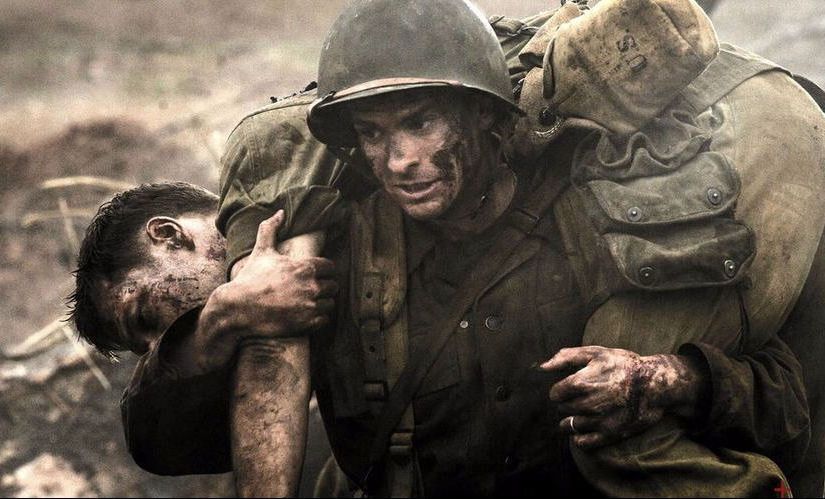
Hacksaw Ridge is another very good picture from 2016, but it is weighted down by graphic battle scenes, all well played out, mind you, but all done before. It’s not until late in the film that Garfield steps up to show why Dawes was so special to this particular moment in history. That’s when the emotion of the film kicks in and the interest heightens itself.

1917 (2019)

by Miguel E. Rodriguez

Director: Sam Mendes
Cast: Dean-Charles Chapman, George MacKay, Colin Firth, Mark Strong, Benedict Cumberbatch
My Rating: 10/10
Rotten Tomatometer: 89% Certified Fresh

PLOT: Two British soldiers during the First World War are given an impossible mission: deliver a message deep into enemy territory that will stop 1,600 men, including one of the two soldiers’ brothers, from walking straight into a deadly trap.


Bear with me for a second…I promise I’ll actually get to the movie in a second.

I’m not a professional movie critic.  I write reviews simply because it amuses me to do so, and because one of my friends made it possible for him and I to post our reviews in an online forum.  For about two months, though, I haven’t written a single review.  I pondered this with Marc a little while ago, and the only reason I could come up with was that I didn’t feel INSPIRED to write something.

Not that I haven’t seen good movies in those two months. Waves, Uncut Gems, Star Wars: The Rise of Skywalker, Jumanji: The Next Level, Frozen 2, Little Women, Bombshell, maybe one or two others – they were all good, even great.  (In the case of Uncut Gems and Waves, I’d even call them “must-see” events.)  But I never felt compelled to run home and put pen to paper, or fingers to keyboard.  I simply felt that I had nothing to contribute where those movies were concerned.

Well, tonight I saw 1917, and now I have to say, this is a different case altogether.

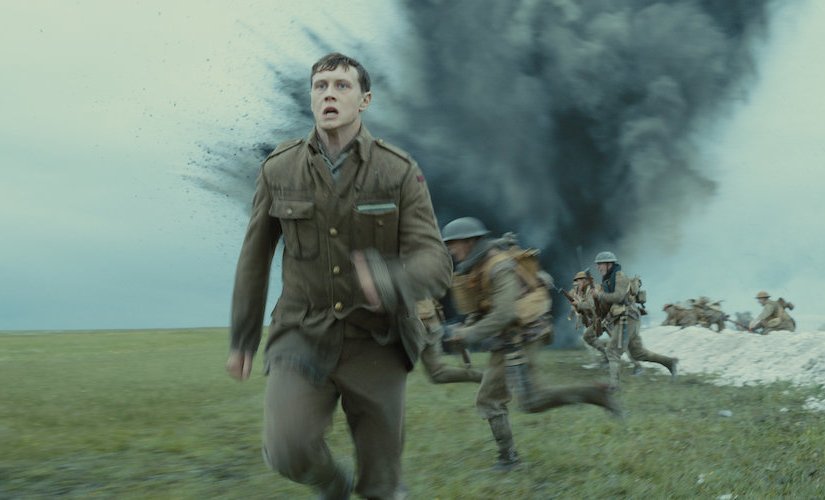
For anyone who’s not quite aware of why this movie is so special, aside from it just being really good, 1917 was hyped as being told in one single shot with a camera that follows two soldiers through battlefields and countrysides as they attempt to deliver an important message to a distant company of English soldiers.  No cuts to different angles, no cuts at all, in fact.  (Actually, there IS a single cut, but more on that later.)

While I originally felt it was a bit of a stunt to get it noticed at Oscar time (remember Birdman [2014]?), after seeing the movie it was abundantly clear that this was no mere trick to dazzle an audience with.  This specific story is particularly suited to this specific method of filming.  It forces the audience to empathize with these two soldiers immediately, and only them.  I was reminded for some reason of Saving Private Ryan, and a line spoken by Tom Sizemore: “This time the mission is a man.”  Well, this time, the men are the mission, and the mission is paramount.  The single-take strategy has the uncanny ability to put us in the shoes of these soldiers more so than many other war films.  You feel like you’re right there in the mud with the empty artillery shells and the corpses and the rats.

And that’s the supreme achievement of the movie: its ability to put us there and KEEP us there for two hours without ever calling attention to the fact that, “Hey, we haven’t cut yet and it’s been over a half hour!”  A lot of that has to do with camera placement and movement and, of course, the actors’ ability to keep us engaged.

But one thing that I kept noticing throughout the movie was the small details.  I’m not going to remember them all, but they included:

  • At one point, the British soldiers walk through an abandoned German bunker.  In a throwaway detail, the name “KLARA” is seen scrawled on one of the walls.  The camera doesn’t focus on it, but it just passes by.
  • We encounter a group of British soldiers, and of them is a Sikh.  The other soldiers are doing bad impressions of their superior officers, but the Indian’s impression is clearly better than the other Englishmen, with proper diction, upper-class accent, everything.
  • In the British trenches, various sections have unique names.  The one I remember most clearly is “Paradise Alley.”
  • As they walk, one of our two heroes notices cherry trees, and he quickly rattles off several different varieties of cherries.  He knows them because his family has an orchard back home.
  • An intense scene where someone has to literally wade through dozens of corpses.
  • In one remarkable scene, the movie pauses to listen to a song. Fighting is imminent, death may arrive at any moment, but for a brief moment, everything stops. It’s a brilliant moment…almost holy.

Little things like that.  The reason I bring them up is because some of them seemed unnecessary to the story, but they colored the story so that it felt more real than most.  And the closing credits reveal that this movie is based on stories told to director Sam Mendes by his grandfather, who served in World War One.  So many, if not all, of those little details were probably one hundred percent REAL details, the kind of details that could only be remembered by someone who was there.

Another reason the movie is so suspenseful is because we’ve become subtly programmed to believe that, in a war movie, the ending can’t be too Hollywood; otherwise, it’s not real enough.  The soldiers must deliver a message.  Will they even survive long enough to deliver the message?  Assuming they do, will the officers receiving the message even follow the order?  A civilian appears at one point…will they live?  They engage in combat…who will live and who will die?  I was on edge the whole movie because I never really felt “safe”, which was EXACTLY the kind of feeling you want when you’re watching a war movie.  In my opinion.

Now, about that whole single-shot thing.  There actually IS one cut, a SINGLE cut, during the whole movie.  You’ll know it when it happens.  But when you’ve seen as many movies as I have, you’ll also notice “invisible wipes”, where the camera passes by something in the foreground – a pillar, or a rock, or a tree – that comes in between the camera and the person/object being filmed.  Using clever editing and lighting, you can cut two shots together using that pillar/rock/tree as the splicing point.  And there is a LOT of that going on in this movie.

I’m not taking anything away from the achievement of the film, it’s spectacular.  It’s just something I noticed that I could not UN-notice for the duration of the film.  A minor quibble, nothing more.

1917 is definitely a top contender for Best Picture of 2019.  I have only seen a handful of World War I movies, but this is certainly one of the very best.  I’d rank it up there with Kubrick’s Paths of Glory any day.

QUICK TAKE: Jarhead (2005)

By Miguel E. Rodriguez

Director: Sam Mendes
Cast: Jake Gyllenhaal, Peter Sarsgaard, Jamie Foxx, Chris Cooper
My Rating: 10/10
Rotten Tomatometer: 61%

PLOT: A newly minted Marine sniper is sent to Iraq as part of Operation Desert Shield, only to find himself slowly losing his mind as he waits for a chance to make his first kill.


If Three Kings was the Gulf War version of Kelly’s Heroes, then Jarhead is the Gulf War Full Metal Jacket.  It’s a glorious paradox: a war film where it looks like the hero may never get to fire his weapon.

Jake Gyllenhaal is phenomenal in the lead role of Swofford, but Jamie Foxx steals every scene he’s in, as Staff Sergeant Sykes.

There’s beautiful imagery in the film, from the oil fires in the desert, to an arresting dream sequence where sand makes an appearance from a very surprising place.

I don’t know why, but I empathized a LOT with the Swofford role.  He learns how to use his sniper rifle with deadly force, he finally gets shipped out to where the fighting is…and air power nearly makes him obsolete.  What are they even doing there if airplanes can end the battle in minutes instead of hours?

There’s a great line when someone hears a helicopter flying overhead, blaring The Doors from loudspeakers.  A soldier looks up with exasperation: “That’s Vietnam music…can’t we get our own music?”  These guys wanted to fight, to carve their place into the history books with honor, and blood.  They wanted to distinguish themselves from their fathers or grandfathers who fought in other faraway countries.  The soldiers in the Gulf War of this movie wanted to “do it right.”

Jarhead offers searing insight disguised by a simple story.  It puts me into the head of a soldier who wants to do the right thing, the honorable thing – hell, ANYTHING – and who finds himself frustrated.  It struck me, and still does strike me, on a level I never expected.  I don’t know if I’ve clearly elaborated that with this review.  But there it is.