RAMBO: FIRST BLOOD PART II

By Marc S. Sanders

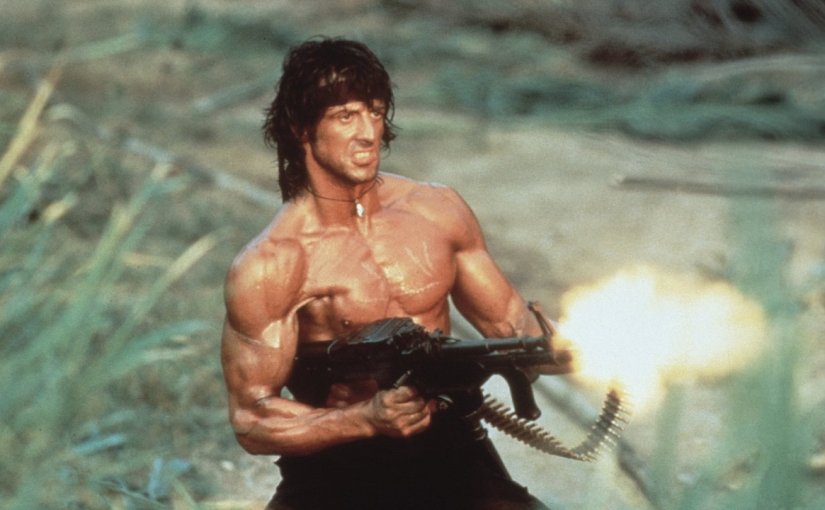
David Morrell’s literary character Rambo (no first name in the book, First Blood) cinematically survived his first post Vietnam adventure to spill buckets of bloodshed for many more follow ups.  Sylvester Stallone hit box office gold when he signed up for Rambo: First Blood Part II.  The Vietnam War was long over leaving an endless supply of storyline threads for Hollywood.  Who better to go back there with a ripped upper torso, a bow and arrow, a bayonet knife that won’t carve your steak but will hack up the cow, and a lot of firepower?

Green Beret John Rambo is specially recruited by his former C.O., Colonel Trautman (Richard Crenna) for a solo mission into a Viet Cong camp where American POWs might be held captive.  He’s got thirty-six hours to get in and out.  There’s a catch though.  A mercenary led operative named Murdock (Charles Napier), who hides behind a desk, a white collar and necktie specifically instructs Rambo to only survey the area and take photographs.  Under no circumstances is he to engage the enemy or escort any prisoners back to his rendezvous point.  Thing is that Rambo is not much of a photographer.  

James Cameron is credited as one of the screenwriters and apparently Stallone modified the script from there.  This bloody sequel is entertaining but I always found it a little mundane despite all the action.  

Just as the movie is about to grow a brain and intelligently debate with itself about how so many American soldiers were disregarded following the war, it stops talking and only resorts to one action set up after another.  Crenna and Napier potentially engage in a worthy debate focusing on government mistrust and moral servitude before the moment is cut short.  Trautman is the easily assumed ally of Rambo.  Murdock is the antagonist, but truly I have to ask why.  What is the motivation not to side with Rambo’s efforts to literally rescue half a dozen abandoned soldiers?  First Blood Part II cuts the argument short and never returns to settle the discord. 

There is perhaps only 5 or 6 lines in the last forty-five minutes of the picture.  There’s a melodramatic closing monologue from Stallone’s morose character.  Otherwise, this movie would prefer not to think.  Sadly, there is a lot to consider here, but the explosives and machine-gunning filibuster, insisting on holding the floor.

The action is categorized in a series of episodes.  A five minute section offers a variety of ways Rambo covertly takes out Russian military soldiers who are maintaining a stronghold with the Viet Cong.  It’s clever how one guy is taken by surprise when a mud caked Rambo guts him with his knife.  For another stooge, he’s literally sucked away into the mouth of a cavern.  You don’t even see Rambo.  How does the hero get around with enough time to set up these sophisticated traps?  This is all cool to look at but I would have liked to have learned more about how the Russian General (Steven Berkoff) formed an alliance with the Vietnamese.

Later, Rambo uses his endless supply of arrows to blow away acres and acres of marsh and tall grass.  I buy one man army tropes in movies.  Yet, I still question how a guy on two feet can set ablaze the equivalent of five football fields worth of territory.  How does he always manage to get in range? 

A war copter hovers over a river.  The henchman riddles the surface with bullets, and Rambo LEAPS from the depths INTO the chopper.  I mean he flies up like Superman.  Another moment has him submerged and then he pops out of the water with perfect aim to mow down a mob of men.  How did he know where to shoot?

I guess all of this is entertaining.  I just don’t relish it like I’m expected to because I’m asking too many “how does he…” questions.  My suspension of disbelief doesn’t have a high level of tolerance for what Rambo is apparently capable of.  David Morrell’s character was somehow blessed with superpowers, practically!  

With Rambo serving our country, how in the hell did we ever lose the Vietnam War? Seems damn near impossible.

First Blood embraced a common problem with veterans who were disregarded by the institutions they swore to defend and serve.  It’s a terrible blemish on our country’s patriotism.  An awareness was offered in that film amid all of the believably capable action scenes.  Part II clearly shows a lack of concern.  POWs get rescued but they are not even given an opportunity to reflect and speak.  Their bearded and malnourished figures speak for them in close ups.  I didn’t think enough was delivered for any semblance of a message that was asking to be heard.  Instead, we get a Stallone showing off a bronze, ripped chest, red bandana and a slew sophisticated weaponry. Rambo looks sexy here, and that does not sit right with me.

I can rewatch Rambo: First Blood Part II.  I just can’t feel for any of it.  I think I was entitled though.  Moreover, those that served in this awful conflict are deserving of a product that would better honor their sacrifices.

ASHES AND DIAMONDS (Poland, 1958)

by Miguel E. Rodriguez

DIRECTOR: Andrzej Wajda
CAST: Zbigniew Cybulski, Ewa Krzyzewska, Waclaw Zastrzezynski
MY RATING: 7/10
ROTTEN TOMATOMETER: 96% Fresh

PLOT: Against a backdrop of internal political turmoil at the end of World War II, a Polish resistance fighter faces a crisis of conscience when ordered to assassinate a Soviet official.


The Polish film Ashes and Diamonds is reportedly Francis Ford Coppola’s favorite movie, and Martin Scorsese has stated in interviews that he used it as an answer for one of his finals at film school.  From a technical standpoint, I can see why.  Echoes of this film (and perhaps others from director Andrzej Wajda’s filmography) are overwhelmingly evident in the bodies of work of both directors, from the mobile camera to the shocking moments of violence to the psychological makeup of the characters themselves.  As an emotional experience, I confess I didn’t get “worked up” over it, but it was interesting to see where two of the greatest American film directors got a healthy dose of inspiration.

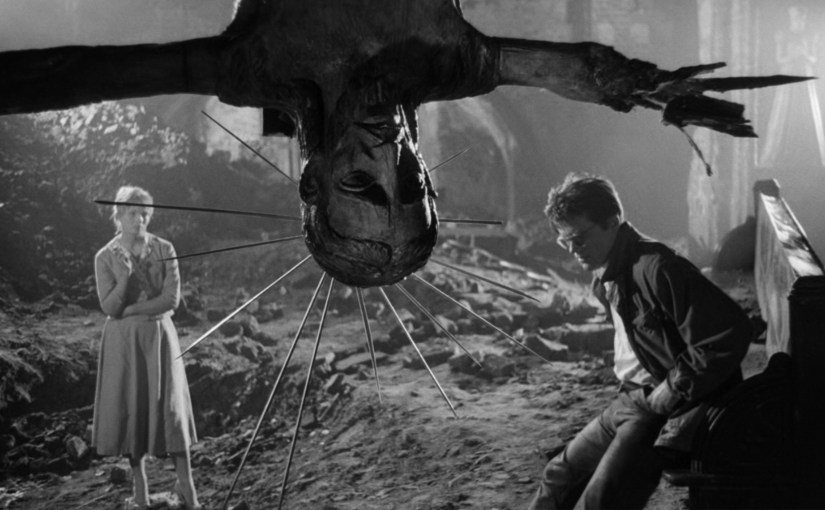
Ashes and Diamonds opens on May 8, 1945, with an idyllic scene outside a country church that quickly degenerates into a brutal double murder.  The killers are the calm, detached Andrzej and the flighty, charismatic Maciek, who spends most of the movie behind dark sunglasses.  We quickly learn their victims are not who they thought they would be.  Instead of killing two Soviet/Communist officials, they have killed two innocent factory workers.  War is hell.

Later, through circumstances that feel very Hitchcockian, Andrzej and Maciek hole up in a hotel bar, only to discover that one of their real targets, Szczuka, has booked a room in the very same hotel.  Maciek books a room directly below Szczuka’s, and the rest of the film plays out with that element of suspense hanging in the background, leaving us to wonder when and how Maciek will complete his assignment.

Complications arise when Maciek becomes infatuated with the hotel bartender, Krystyna, a blond beauty who rebuffs Maciek’s advances at first.  Later, they connect, but she doesn’t want to get involved with someone when it will eventually have to end: “I don’t want bad memories when memories are all I have left.”  Maciek falls for her so hard that he starts to doubt his resolve to kill his target.  “Will he or won’t he?” becomes the movie’s prime conflict.

Where to begin with the comparisons to Coppola and Scorsese?  The most obvious one is the unblinking attitude towards violence.  The two killings at the beginning of the film are done with very few cutaways as we see the multiple bullet hits on each victim, with one of them getting hit in the eye and another shot in the back at point blank range with such force his shirt catches fire.  (Malfunctioning squib?  Possibly, but it’s still effective.)  It’s interesting that this movie predates Bonnie and Clyde (1967) by almost a decade, but its depiction of onscreen violence feels very modern, even by today’s standards.

Then you’ve got the moral struggle of the main character, a man of action capable of casual murder who is suddenly given a reason to make something different with his life.  This reminded me of Scorsese’s The Departed (2006), with DiCaprio’s character undergoing the same internal conflict.  Maciek has multiple opportunities to kill Szczuka throughout the film, but something always pulls him back from the brink.  His partner, Andrzej, becomes impatient and reminds him what happens when soldiers let personal feelings interfere with their duties.  I had a vivid flashback of Michael Corleone’s credo: “It’s not personal, Sonny.  It’s just business.”

(I also felt that the dynamic between Maciek and his more level-headed partner Andrzej were evoked in Scorsese’s Mean Streets [1973], with De Niro’s Johnny Boy and his more level-headed partner Charlie, played by Harvey Keitel.)

But, cinematic comparisons aside, I didn’t find Ashes and Diamonds to be as gripping as other war or crime dramas of that era, such as Elevator to the Gallows, Touch of Evil (both 1958), or Rififi (1955), to name a few.  It’s a little weird to me, because all the pieces are there for a first-rate thriller.  I’m not asking that every drama pack the exact same kind of emotional gut punch every single time because I know that’s unrealistic.  But the fact remains: Ashes and Diamonds, while clearly very influential on future filmmakers, did not get me as involved as I would like to have been.  I was never bored, but neither was I over the moon.  It was…average.  Perhaps one day I’ll watch it again with a fresh eye to maybe see what I missed the first time around.

WINGS (1927)

by Miguel E. Rodriguez

DIRECTOR: William A. Wellman
CAST: Clara Bow, Charles ‘Buddy’ Rogers, Richard Arlen, Gary Cooper
MY RATING: 10/10
ROTTEN TOMATOMETER: 94% Certified Fresh

PLOT: Two young men, one rich, one middle class, who are in love with the same woman, become fighter pilots in World War I.


Not long ago, I purchased a copy of the 1927 classic Wings, based mostly on the favorable review by my friend and colleague, Marc Sanders.  I was more or less aware of its place in cinema history: the very first winner of the Best Picture Oscar, essentially the birthplace of Gary Cooper’s career (despite appearing in the film for just over 2 minutes), legendary aerial footage, and so on.  But I never felt compelled to seek it out.

Having finally watched it, I am very glad I did, and you should, too.  Wings is pure entertainment from start to finish.  Unexpectedly engrossing, captivating, thrilling, the whole enchilada.  High melodrama, comedy (borderline slapstick, what are you gonna do, it was 1927), romance, comic misunderstandings – and some not-so-comic – and eye-popping aerial footage, true to its reputation.  A neat camera move gliding over several cabaret tables even showcases director William A. Wellman’s desire to push the boundaries of what was possible with the massive cameras of his day.  I once wrote that Sunrise (1927) was my favorite silent film of all time.  If I ever make another 100-Favorite-Films list, Wings and Sunrise are going to have to duke it out…

Wings sets a surprisingly modern tone from the start.  In the very first sequences of the film, Jack Powell (Charles ‘Buddy’ Rogers) does not “ham it up” like some of the more typical Hollywood actors of that era.  Obviously, his mannerisms are exaggerated, but there is a restraint to his face and body that seems at odds (in a good way) with nearly everyone else in the film…except Gary Cooper, who, if he underplayed his role any further, would have become a still painting.  That restraint is also evident in Jack’s foil/nemesis, David Armstrong (Richard Arlen), the rich aristocrat to contrast Jack’s more humble background.  This moderation lends a very contemporary feel to a movie that’s nearly a century old – quite a feat.

In sharp contrast to the two male leads, the fabled Clara Bow plays her role, Mary Preston, with complete abandon.  She never truly overacts, exactly, but she throws herself into her supporting role with abandon.  Mary is hopelessly infatuated with Jack, who is actually in love with the debonair Sylvia Lewis (Jobyna Ralston), who is already involved with David, though they haven’t made anything official.  (If Facebook had been a thing back then, their relationship status would have been “It’s Complicated”.)  So, when Jack makes eyes at Sylvia, poor Mary is in the background as her hopeful smile deteriorates into sobs.  She may not be subtle, but Clara Bow makes sure you know EXACTLY what is on Mary’s mind at any given moment.

In the middle of this would-be soap opera, World War I intervenes.  Jack and David both enlist to become aviators.  A crucial scene shows Jack asking for Sylvia’s picture to keep as a good luck charm, a picture that has already been signed over to David.  Then, as he says his farewells to the lovelorn Mary, she offers him her picture.  How this scene plays out, and how it comes to bear much later, is one of the high points of the film’s ground-based drama.

But the real marquee attraction Wings comes during the aerial training and combat scenes.  Watching this movie, you understand why modern filmmakers today strive for realism as much as possible.  Ron Howard wanted to show weightless environments for Apollo 13, so sets were constructed inside a military jet tanker that flew parabolic arcs to simulate weightlessness…for real.  The makers of Top Gun: Maverick wanted to draw audiences into the film, so they had their actors train for weeks and months so they could be filmed inside the actual cockpits of F-18 fighters as they performed simulated combat maneuvers…for real.  Those filmmakers knew what had already been demonstrated decades earlier by Wings: nothing beats reality.

(Almost nothing…Ready Player One was pretty damn cool…BUT I DIGRESS…)

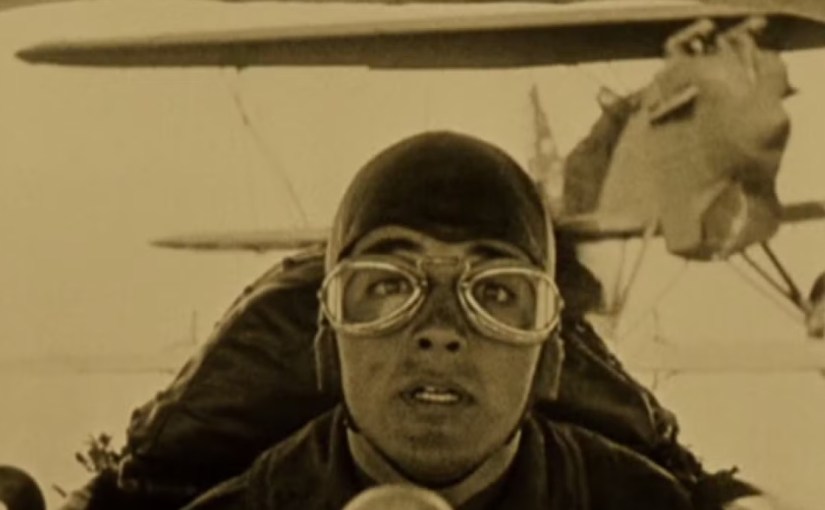
For Wings, director Wellman, a combat pilot himself during the war, knew that the best way to grab the audience by the lapels would be to get his actors up in the air for real.  To put it very briefly, he got his two lead actors to become certified pilots, got them into the air with small cameras strapped to the front of their planes, and had them act, fly their own planes, and be their own camera operators, all at the same time, while other stunt pilots flew around them, sometimes in VERY close quarters, simulating aerial combat.

The results are staggering.  There is a visceral mojo to these scenes that cannot be overstated.  Sure, it looks “old” because it’s black and white and grainy, but it is also undeniably real, and when you see long shots of a biplane going into a death spiral after being shot out of the sky, your intellect tells you there’s a real pilot flying a real plane hurtling at high speed towards the real ground, and you either sit back in awe or you lean forward with excitement.  There are a few scenes where real planes crash to the ground in various ways; one of them crashes into the side of a freaking HOUSE…for REAL.  IMDb mentions one staged crash where the plane didn’t do exactly what it was SUPPOSED to do, and the stunt pilot literally broke his neck…but survived and returned to his job six weeks later.  And it was all done in camera with no trickery or fake dummies in the cockpit.  It is literally mindboggling.

However, it should be noted that these accomplishments by themselves would mean very little if they weren’t hitched to a compelling story.  The love story among Jack, David, and Mary is a constant thread through the whole film.  Mary, having volunteered as an ambulance driver in the Army, miraculously finds herself stationed overseas…right next to Jack and David’s unit, wouldn’t you know it!  Contrivances aside, Wings expertly balances the exciting elements with the melodramatic flourishes.  The melodrama comes to a head when Mary finds herself alone in a hotel room with Jack, who is so drunk on champagne he doesn’t recognize her.  (She is dressed as a cabaret dancer, but that’s a long story…)  This movie truly contains the best of both worlds, genre-wise.

This might be crass of me to mention, but I’m going to anyway…Wings is also notable for some of the earliest on-screen nudity (in an AMERICAN film, anyway) that I can recall seeing.  There is a scene in a recruitment office where a line of bare male bums are lined up in the background, awaiting health inspection.  Then later, we see a woman’s bare breasts…just a brief glimpse, but it’s there.  Not only THAT, but during a fancy camera move in a French cabaret, we see a woman caressing another woman’s face…are they a couple?  Scandalous!  Who needs the Hays Code?  Not this guy!

(I could also mention the homo-erotic overtones during a pivotal scene towards the end of the film, but they pretty much speak for themselves [like the volleyball scene in Top Gun], so I’m just gonna move on…)

To sum up: Wings ranks as one of the greatest pure entertainments that Hollywood has ever served up.  Marc mentioned that it perhaps doesn’t get the love it deserves.  He’s probably right.  I’m sure it’s revered among cinephiles, but it is certainly not in the general public consciousness when it comes to silent films.  Regardless, it is exceptionally well-made and uncommonly effective.  If ever an old film deserved to be rediscovered by the general public, Wings is it.

UNCOMMON VALOR

By Marc S. Sanders

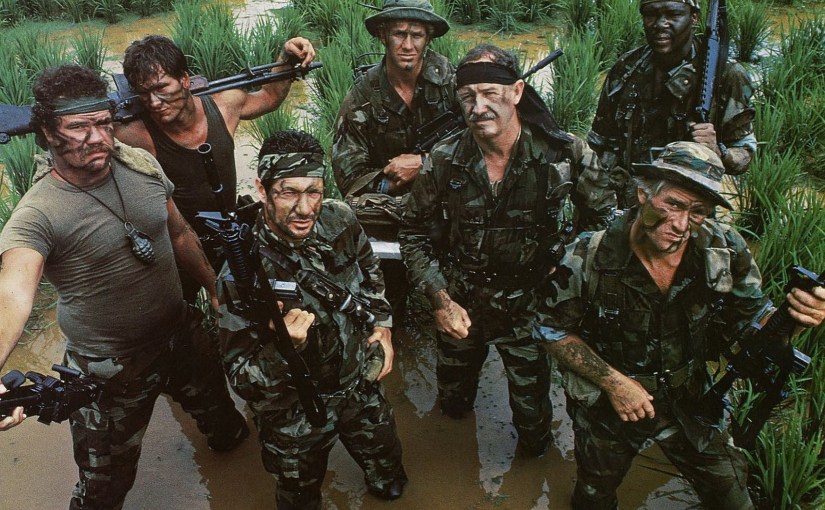
In the decade following the Vietnam War a common denial (or ignorance, maybe) went towards American soldiers who were missing in action.  Many men were theorized to be prisoners of war long after the armed forces left the country, ending a losing battle with record numbers of casualties.  A handful of films of the 1980s brought focus to this topic, as a means for adventurous entertainment.  Chuck Norris had a series of Missing In Action films.  Even light action fare TV shows like The A-Team and Magnum PI brought attention to this issue.  Most predominantly, the possibilities of POWs were ingrained within Sylvester Stallone’s box office bonanza of Rambo pictures.  In 1982, Ted Kotcheff directed the initial entry of that series, First Blood, and he zeroed in much more precisely the following year, with Uncommon Valor.  

Gene Hackman is retired Marine Colonel Jason Rhodes who begins a decade long campaign convincing the U.S. government to seek out those who were left behind and are likely being held as prisoners of war.  His motivation stems from his belief that his son Frank is likely being held captive in a camp located in northern Laos.  

By the time 1983 arrives no action of recovery or rescue is taken.  The Colonel is committed to bearing the responsibility.  He appreciatively accepts financing of his own mission from an oil tycoon (Robert Stack) whose son might be with Frank.  The Colonel also recruits members of Frank’s unit who made it home (Fred Ward, Reb Brown, Randall “Tex” Cobb, Harold Sylvester, and Tim Thomerson). Patrick Swayze is a young guy named Scott who never served in the conflict but is an expert combat and weapons specialist who will get these men retrained for the upcoming rescue.  He also has his own reasons for partaking of this mission. 

Uncommon Valor is sporadic on humor and focused on the adventure and resourcefulness.  The first half provides footage of how the squad gets reacquainted with each other and the jungle elements they left behind in Vietnam.  They practice routines outlined by the Colonel with ground patrols, detonators, hand to hand combat, artillery, sabotage, and chopper rescue.  The second half follows them back into the Asian country where they have to obtain weapons and supplies, while making connections with locals who will escort them through the dense jungle area towards the camp.  

This is a rare occasion where Gene Hackman is not applying much of his acting craft. He is primarily going through motions of Kotcheff’s film direction with a script rumored to be co-written by Wings Hauser (also a producer on the film).  The trauma of the war is primarily carried by Fred Ward who struggles with PTSD long before it became so widely attributed to service men and women after returning from combat.  In First Blood, Stallone offered a much more substantial and convincing demonstration.  Yet, Ward does a serviceable job with a script that never goes terribly deep.

Uncommon Valor is better described as a present-day adventure picture.  It’s never boring.  There are fireball explosions and machine gun shootouts. The action set pieces still hold up with good art designs staged off the Hawaiian Islands in place of a sweltering Vietnam.  The prisoners who are recovered, supposedly held for over a decade, are chilling to look at with obvious malnourishment and dead-blank expressions.

Randall “Tex” Cobb and Reb Brown (the TV movie Captain America) are mostly doing wacky A-Team material here.  Gene Hackman, Fred Ward and Harold Sylvester are the straight characters.  

It’s not as grand as a Rambo film, but Uncommon Valor never lampoons or minimizes what was a horrifying experience for those enlisted soldiers who never came home, while their next of kin never obtained closure.  

For the 1980s, which feels like it had just passed yesterday, it’s fair to say that all those missing in action during that terrible and bloody war are no longer alive over fifty years later.  The opportunity to search and negotiate for their freedom has long expired by now.  While movies like Missing In Action, Rambo and Uncommon Valor focused on fictional triumphs that were never factually replicated, at least these films can serve as reminders for the sacrifices these people served at the behest of their country.  I’m not writing to ease lifelong pains.  All I can do is recognize, remind and be forever grateful.  These movies still serve a purpose beyond the pulpy Saturday afternoon adventures. 

LETTERS FROM IWO JIMA

By Marc S. Sanders

The companion piece to Clint Eastwood’s World War II film, Flags Of Our Fathers, and shot back-to-back, is Letters From Iwo Jima.  It’s not so much a war film as it’s a perspective of a losing battle during the height of the war, shown through the eyes of Japanese soldiers bearing little ammunition, food, and supplies while being plagued with dysentery and starvation. 

Right from the start, what I found interesting is how similar the Japanese mentality is to that of American soldier characters I’m all too familiar within other cinematic retellings. Paul Haggis recruited Iris Yamashita to write the screenplay, entirely in English, and then translated into Japanese.  The subtitles seem to read with a familiar English vernacular that my limited knowledge of Japanese culture would never expect.  I also find it interesting that rankings are the same from General to Lieutenant for example, and the salute to officers is precisely identical.  All of these similarities, and still the world powers find reason to fight one another.

The running theme of the picture reminded me of the television show M*A*S*H.  An assortment of characters take the time to write home about their experiences and fears along with the hardships they are enduring with unpure water, sweltering heat, infectious bugs and exhaustion.  One soldier’s letters are told will get censored if they ever reach the mother land.  These men are bakers and scholars, forced to serve a power that controls them.  They are not spies or regular army men.  They had no choice but to be here digging and preparing to kill.

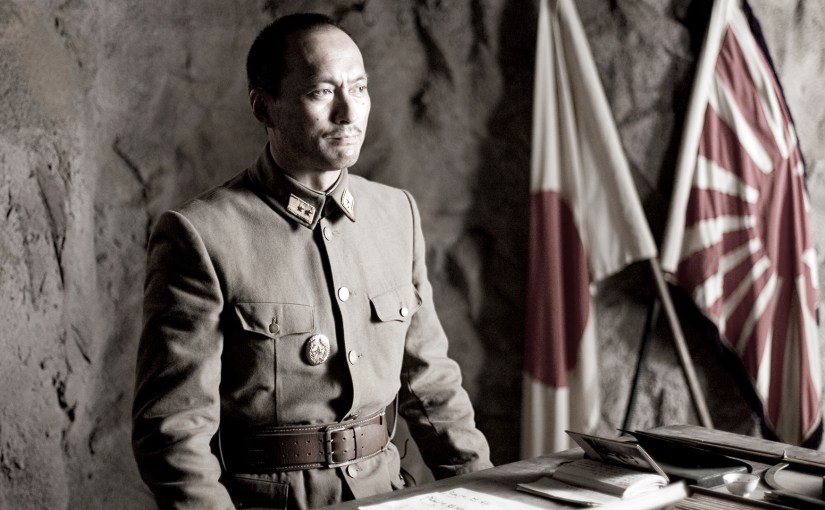
Ken Watanabe portrays General Kuribayashi.  In the beginning of the film, he is writing a letter to his wife as he is landing on the island days ahead of the battle to come.  One of his biggest concerns is that he did not finish installing the kitchen floor in his home before leaving. Kuribayashi is a celebrated strategist and hero, who actually studied and worked abroad in the United States.  He even broke bread with famed American military leaders and carries a valuable gift from them in his holster.  Yet, he is committed to his country’s Imperial Army and he knows he will not return home from this island.  He also knows that he will have to kill the very same men that he shared a meal with just a few years earlier. That kitchen floor is what is on his mind. 

A young infantryman named Saigô (Kazunari Ninomiya) was forced to enlist while his loving wife is carrying their child.  I’ve seen character situations like these before.  It’s much more revealing to see what cinematic history has described as the enemy to my John Wayne and Clint Eastwood heroes, though.  Recently, I listened to The Cine-Philes podcast recap of the film Crimson Tide, and they focus heavily on the midway dinner scene among the officers.  Denzel Washington’s character concludes that “…the true enemy of war is…war itself.”  Letters From Iwo Jima delivers on that argument.

Ahead of the well-known battle, there’s a quiet tranquility among the Japanese troops.  They debate about digging trenches and even fighting on the island which is devoid of any stronghold or power.  It’s also an unwinnable battle as the Japanese have realized that they are getting no air or naval support because much of their military cavalries have already been decimated.  The ultimate purpose for these men is to hold off the Americans, who are ten times more powerful, for as long as possible.  No man serving the Imperials is to surrender.  They will fight until they are as good as dead.  General Kuribayashi’s best idea to hold out is to dig caves within the mountainsides, thus making it challenging for the American soldiers to locate Japanese within the darkness of the caverns.  It worked longer than it should have as the engagement that was expected to only last five days went as long as thirty-six days instead.

Disturbing moments within the film do not compromise.  A small unit’s unified shout of “BANZAI!” will live with you forever when you see what they jointly commit within the cave they occupy.  Eastwood convincingly shows you the carnage.  Another character recollects how he was enlisted for five days in the military before he was forced to serve at this miserable place for disobeying a direct order. His humanity undid him.  Letters From Iwo Jima tells the stories before the occurrences that left gravesites (estimated to be ten thousand Japanese men lost) on its black sand beaches.

In a way it makes me proud that Clint Eastwood chose to direct Letters From Iwo Jima.  While his war pictures (Where Eagles Dare, Kelly’s Heroes), and even his Dirty Harry films which lean on prejudice for the truth found in humor, are endlessly memorable, he opts to take a sensitive position to the other side of the coin.  Eastwood does not lose sight of the fact that his heroes celebrated during the first half of his career were heroically killing and taking out fellow humans.  Letters From Iwo Jima recognizes the loss of humanity amidst the rocket fires and artillery of violence.  Six Japanese men will take to killing a captured American by beating and stabbing him into lifelessness.  Later, faceless Americans concealed by the director’s familiar shadows of photography will point blank kill a pair of unarmed Japanese men. 

Flags Of Our Fathers points a critical eye at the celebrations of victory.  Letters From Iwo Jima acknowledges victory is beyond reach but the enemy of all of us, war, is never done with any of us.

FLAGS OF OUR FATHERS

By Marc S. Sanders

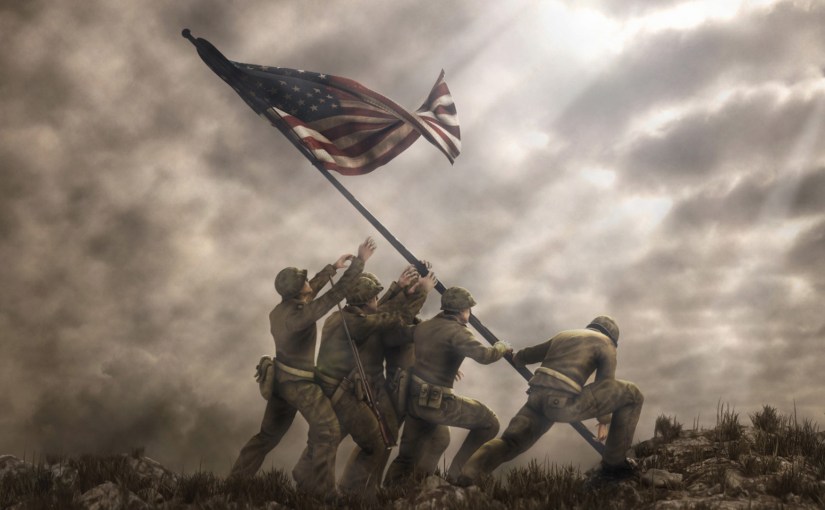
Arguably the most famous photograph in American history is that of the six soldiers raising the flag on the island of Iwo Jima while battling Japanese forces during World War II.  I remain fascinated by the image.  

I recall visiting the landmark statue in Washington DC when I was traveling by myself.  I took countless pictures of the piece.  I got close ups, wide lens shots, pictures of the flag and pictures of each sculpted soldier.  It’s heroic in any aspect.  It looks like something out of a Superman comic book.  As it turns out, the famed image was just a happy accident during a violently terrible time in twentieth century history.  Photographer Joe Rosenthal didn’t even realize what his camera captured until his film was later developed.  Turned out this was the second attempt at raising the flag.  Furthermore, this occurred on the fifth day of the conflict – with thirty-five days still to go before the Americans could claim victory over the bloody crisis.

So, while Rosenthal’s image seems to declare American patriotism at its finest, the real story is not as romantic.  In fact, one of the narrators of Clint Eastwood’s film, Flags Of Our Fathers, suggests that there are no heroes to celebrate.  Whoever the men in that picture were, they were not so much fighting for their country as they were trying to stay alive and look after the comrades ahead and behind them.

Flags Of Our Fathers has a very reminiscent feel to producer Steven Spielberg’s Saving Private Ryan with unforgiving battle scenes of blood, death, bombings and young soldiers storming a beach while screaming for their buddies.  Spielberg might have impressed me first, but Clint Eastwood masterfully shoots wide landscapes and up-close turmoil with his reliable strategies of shooting in shadows and silohouettes.  Eastwood’s film, scripted by Paul Haggis and William Broyles Jr veers into a unique direction though as Rosenthal’s picture takes on a life of its own back in the states.  It makes the front page of every paper.  Harry Truman stands proud of it along with all the decorated military leaders.

Now that America has entered the war, it is appropriate to ignite a propaganda campaign.  This picture of the Stars and Stripes getting elevated into the sobering, smoky war-torn skies will motivate citizens to buy war bonds to further fund the war effort.  The spokesmen will be the ones believed to be the remaining surviving three of the six in that image.  Ryan Phillipe is Navy enlisted John “Doc” Bradley.  Jesse Bradford is Rene Gagon, and Adam Beach plays Native American Ira Hayes, both of the Marine Corps.

I believe Flags Of Our Fathers embraces what every enlisted person did to serve the efforts of America during the war, and the picture mourns the countless sacrifices and losses that occurred.  However, it frowns upon the domestic response to what really went on overseas.  Those that returned carried terrible and unforgettable trauma based on their experiences.  Yet, the three thought to be part of the flag raising were pushed to celebrate their achievements summed up in a split-second image.  Bradley, Gagon and Hayes were skeptical if they were the ones in that picture.  Government Bureaucrats could care less.   There were others on that hill who cannot speak for themselves, but officials in suits and ties will insist otherwise to uphold a countrywide tour complete with recreations of the hill they ran up on that fateful day.  Even desserts are crafted like the famed image.

Ira Hayes is the one who is especially conflicted with his new responsibilities to the governing body that historically acquired his ancestors’ territory.  Adam Beach portrays a torn individual who is limited in celebration by the United States and certainly patronized.  Who he stems from does not matter.  He represents a false interpretation of the English acceptance of his Native heritage.  His obligation to this machine of propaganda only doubles the exaggeration that his other two peers are coerced to parade with marching bands and fireworks.  All that the ongoing extravagance does is keep him absorbed in the Japanese lives he brutally slaughtered and the bloodshed that surrounded him.  It’s a heartbreaking performance told with an absence of true appreciation for what Hayes gave up on that battlefield.

I learned much from Flags Of Our Fathers, but I had issues with comprehending everything.  While the immense war footage is chaotic with sharp editing and camerawork, it’s challenging to match names with faces in the picture.  There are two elderly men who are recounting what occurred and what happened to these men and their families long after the incident was over.  It was hard for me to line up which older man was who, on top of who they are talking about at times.  Paul Walker is one famous face in the crowd.  So is Barry Pepper but I could not identify the names of their characters until the film was arriving at its conclusion.  It was not until the epilogue of the movie arrives that it became a little clearer.  I also had to later reference what is listed on IMDB.  

The entire design of Eastwood’s movie is authentic from the battles staged for the Iwo Jima conflict to what mid-1940s domestic life looked like back home.  Truly absorbing while both storylines seem so different.  Clint Eastwood also wrote the soundtrack composition, and it is truly sobering.  His son Kyle performs with the orchestra.  

Flags Of Our Fathers partnered with Clint Eastwood’s follow up later in the year, Letters From Iwo Jima, which offered the Japanese perspective of the incident.  Bridge the films together and you get an incredible cinematic experience.  So many war pictures are one sided.  In all fairness, most movies do not have the time, luxury or finances to expand their palettes from one side to the other.  Because these two films are companion pieces, the viewer gets a fair account of how this battle, located on a tiny island, treated the men on the ground while their governing bodies celebrated their stands for patriotism, victory and monetary funding.

Eastwood demonstrates that the war destroyed practically everyone who was engaged in it regardless of the countries these soldiers served.  Many were slaughtered, but the innocence of those that physically survived died with everyone else during this period of time.  Clint Eastwood directed two films that explain this never-ending atrocity.  These men eventually laid down their weapons, but they never left the war.

THE BOYS IN COMPANY C (1978)

by Miguel E. Rodriguez

DIRECTOR: Sidney J. Furie
CAST: Stan Shaw, Andrew Stevens, James Canning, Michael Lembeck, Craig Wasson, Noble Willingham, R. Lee Ermey
MY RATING: 9/10
ROTTEN TOMATOMETER: [no score]

PLOT: In 1967, five young men undergo Marine boot camp training before being shipped out to Vietnam. Once they get there, the experience proves worse than they could have imagined.

[This review contains MILD SPOILERS concerning the film’s finale.]


I remember a short while ago, when I watched the original The Taking of Pelham One Two Three (1974) for the very first time.  I remember asking myself, “Why did it take me so long to finally watch this movie?  It’s fantastic!”

I’ve just had the same exact experience after watching Sidney J. Furie’s The Boys in Company C, which I think (someone correct me if I’m wrong) is the first attempt by Hollywood to provide a genuinely realistic portrayal of being a combat soldier during the Vietnam War.  There are some obvious parallels to Kubrick’s Full Metal Jacket (1987) and Fuller’s The Big Red One (1980), but this one was first out of the gate.  Company C is just as visceral, just as riveting, and just as entertaining to watch as those other films.  I have only seen a handful of Furie’s other films (including Iron Eagle [1986] and Superman IV: The Quest for Peace [1987]), so I can’t make a 100% informed opinion, but in my limited experience, this is far and away his masterpiece.  It goes on the list of my favorite war movies ever made, and I think it’s a real shame that it appears to have been nearly forgotten.

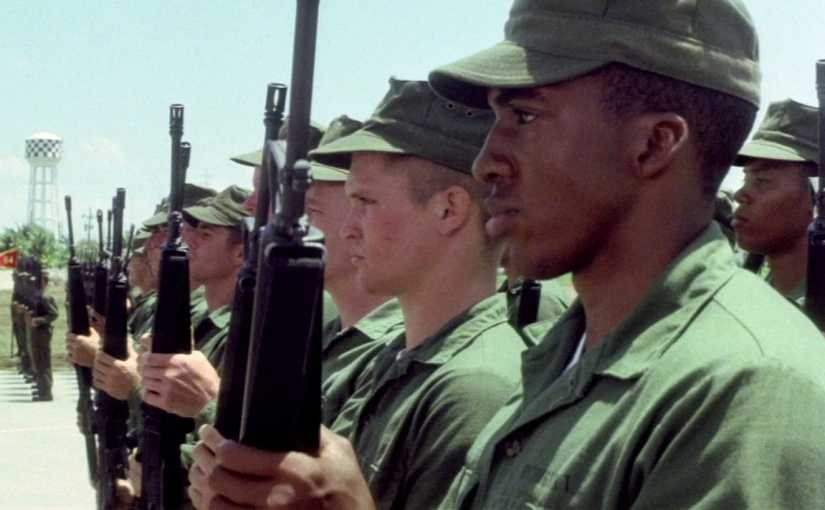
Like so many other war films that came after it, The Boys in Company C begins at boot camp.  More properly, it begins right outside the recruitment center (I think?) in late 1967, as several young men – boys, really – kiss their loved ones goodbye before getting on a bus.  In a weird way, this sequence reminded me of the opening scene in The Breakfast Club (1985) as each student is dropped off for detention by their parents (except for Bender, of course).  We are introduced to the boys who will become the key players: Washington, the angry black man (Stan Shaw); Pike, the country boy (Andrew Stevens); Foster, the aspiring writer (James Canning); Fazio, the Italian American from Brooklyn (Michael Lembeck); and Bisbee, the pacifist who is put on the bus in handcuffs (Craig Wasson).  Stereotypes?  Sure, I guess.  But the screenplay doesn’t limit them to JUST their stereotypes.  Washington, for example, starts out in camp as a guy who is looking out for himself, but after a surprisingly passionate speech from his drill instructor (R. Lee Ermey in his film debut!), he assumes the mantle of leadership and wears it exceedingly well.

We get the by-now standard scenes of the recruits getting their heads shaved, struggling through exhausting training runs, being called names that would’ve made George Carlin blush, and, eventually, graduation, where their reward for making it through boot camp is being assigned to combat duty in the ‘Nam.  Their problems begin even before they disembark from their troop carrier when the Vietnamese port comes under artillery fire.  It all sort of goes downhill from there.

The movie so far is nothing incredibly new, at least not to someone watching in the present day, but I had to keep reminding myself that this was probably the first time American audiences had seen a relatively honest representation of combat that wasn’t filtered through layers of self-censorship and jingoism.  M*A*S*H (1970) did show us the bloody reality of surgery in the field, but it didn’t concern itself too much with actual combat – plus it was set in Korea, not Vietnam.  A minor quibble.

There are a LOT of plot details I won’t relate here – the clueless captain, the “vital” convoy, Washington’s drug trafficking plans – because of the soccer subplot that reveals itself to be the film’s beating heart and real cry of protest.  Much like Kilgore and the California surfer in Apocalypse Now (1979), the squad captain learns that Pike, the country boy, is pretty good with a soccer ball.  There is a squad of elite Vietnamese military men who are also good at soccer.  The captain dreams up a plan: put together a soccer team of American soldiers who will play the Vietnamese men in an exhibition match.  If the American team wins, they will get a reprieve from combat and go on a “goodwill” tour of southeast Asia, including Tokyo and Bangkok.

Sounds good, right?  But complications arise when, at the match, the American general watching the match is approached by his opposite number in the Vietnamese army.  With the Americans leading at the half, the order is passed to the team: lose the match so the Vietnamese can save face in front of their own people.  If they throw the match, they will still get reprieved from combat to go play mare matches against Vietnamese teams…and lose every time.

The Americans can’t believe it.  Pike (and everyone else) wants to get back home, but he is afraid he can’t live with the shame of intentionally throwing a match, no matter what the big picture looks like.  But the orders contain no ambiguity.  Throw the match and go on tour, or win and go back to frontline combat the next day.

This is what the movie has been driving towards the whole time.  The squad has to collectively decide what is more important: winning or surviving.  I hope I don’t come off like an amateur historian here, but to me, that is the same question that could have been asked about the entire Vietnam conflict.  As a country, we had a chance to ask ourselves: is winning this war worth the price we’re paying?  How much more are we willing to spend, in money and lives?  In the film, the squad is asked to balance that equation themselves on a smaller, but no less important, scale.

Is this about honor?  Should they win the match to preserve their own personal integrity, even if it means going back to fighting in the jungle and maybe never making it back home?  Or should they throw the match, increasing their odds of making it home alive and boosting morale for their Vietnamese allies, but leaving them with a stain on their integrity?  Is this kind of thinking the reason the American government participated in possibly the most unpopular war in American history?  Because losing face was worse than losing lives?

These are questions I would not presume to think I could answer.  I know, of course, what I would have done in that situation, but I can only speculate because I have never been a soldier in a time of war.  The Boys in Company C put me right there and allowed me to understand the whys and wherefores of each major character in a way that we’ve seen in every notable war film ever since.  This is an incredibly important artifact in the history of war films, and it deserves to be seen by every movie fan.

[Trivia note: this movie was executive produced by none other than Raymond Chow, the man behind Enter the Dragon (1973) and nearly 200 other Hong Kong films, and virtually the entire movie, including the boot camp sequences, was filmed in the Philippines.]

M*A*S*H

By Marc S. Sanders

Forgive me.  I’m not sure my position on Robert Altman’s film will be fair.  All my life, I think I deliberately eluded seeing the motion picture of M*A*S*H as I have been so accustomed to the classic television show that ran for eleven seasons on CBS.  As I expected the two properties couldn’t be further apart from one another.

Altman’s movie still carries a zippy kind of perspective to the horrors of war.  With their hands and surgical scrubs in the thick of gory, blood red surgery, the characters are so much more apathetic to the turnaround of wounded that arrive at the 4077th American mobile army hospital, located three miles from the explosive front lines of the bloody Korean War.  The well-known characters were first given live action roles here following the published novel by Richard Hooker.  

Most surprising is near the end of the film when two doctors realize they are being sent home. One surgeon who is in the midst of operating on a head injury actually instructs a colleague to take over.  This guy has his hands covered in brains and blood and chooses not to finish saving his patient’s life.  Alan Alda of the television show, as a writer, director or while portraying Hawkeye Pierce, would never respond in such a manner. Yet, this is the approach that Robert Altman chose to follow, having infamously always despised the TV series that eclipsed his film in popularity.

Altman’s movie is a slap in the face to the famed oxymoron called “military intelligence.” In 1970, we say bravo for finally saying something frank and honest while a Vietnam War has carried on far too long for not necessarily any of the right reasons.  It’s not so simple to declare war is hell.  It’s much more complicated and horrifying than that.

The film’s opening bylines are quotes by celebrated military leaders of the time, like MacArthur and Eisenhower.  However, these championed commanders are lampooned as we watch shlubby Hawkeye Pierce (Donald Sutherland) arriving in Korea.  He heads directly towards a General’s jeep and steals it, plain as day.  From there on, M*A*S*H operates like a precursor to Animal House with a series of hijinks and a lack of care for military leadership or the U.S.’s purpose in this conflict.  

About the only time, there is any care or forthright anger from anyone is when the jerky Major Frank Burns (Robert Duvall) chastises an underling.  Trapper (Elliot Gould) and Hawkeye punch his lights out and the schmuck ends up in a straightjacket.  Nonetheless, these guys could care less about criticizing and exposing the truth about the institution they have been drafted to serve.  Their purpose is not to make an ironic statement like a Doonesbury comic strip.  They just punch the commanding officer in the face and drink.  The TV show was at its strongest when it relied on the wit and delivery.  Trapper and Hawkeye never use irony or intelligence to belittle a buffoon.  They punch, or they embarrass an authority who’s taking a shower. Regretfully, it’s the dialogue that’s lacking. Robert Altman encouraged much improv on the set and overlayered conversations within his scenes. He found nothing organized or neat and pretty about war, including daily functioning. Chaos did not only reign on a battlefield.

The pace of M*A*S*H moves episodically, and it is likely what led to the idea of a half hour TV show that dominated the airwaves for the better part of eleven years.  A character called Painless contemplates suicide and so a Last Supper reenactment before he sends himself off is inserted. It’s a funny caption from these halfwits, but a storyline focused on deliberately ending a life does not connect with me in a humorous way here. Burt Reynolds, the dark comedy Heathers, and even more recently Tom Hanks toed the line of humor to be found in death by suicide. I think it worked better in those examples. With the somber, well known theme song of “Suicide Is Painless” that is forever linked with M*A*S*H, I just could not muster the laughs for this bit.

There’s also time to build comedy against another regular army brat like Major “Hot Lips” Houlihan (Sally Kellerman, also the best and most memorable of the cast).  The iterations of shower hijinks has been duplicated so often since the release of this picture. Therefore, this gag is dried up. It does not hold its impact fifty years later after dozens Porky’s movies. As well, there’s golfing off the helicopter pad, heavy drinking and a long, drawn-out final act of an overstayed football competition which leads to one of the first times the F-word was used in a mainstream American film.  

In 1970, Robert Altman delivered a bold, risky and daring film to counteract against a losing Vietnam War and the heroism of John Wayne’s bravado in war pictures.  The chutzpah to lash out against American politics likely felt relatable to many who saw different and more realistic images when they understood their young sons and daughters were not coming home and were thus forever changed.  Richard Hooker’s properties and stories lent an understanding to the animosity of those who forced the war on America’s children and loved ones.  War has never been consistent with the short film propaganda asking you to buy war bonds. M*A*S*H negated the heroism of Hollywood sensationalism found in machine gun fare and overtaking a hill while draped in green fatigues with shiny bronze ammunition hanging off their shoulders. These soldiers of war deserve our country’s utmost respect, but they did so much more than what John Wayne demonstrated. They offered up parts of themselves they would never get back.

M*A*S*H deliberately left out the heroes.  However, seeing the film for the first time, over fifty years later, I wish that at least we could follow the escapades of doctors who also directed a bed side manner to the pawns who were dying while upholding their leaders’ cause.  The doctors of Robert Altman’s interpretation hardly emulate a reason to care. 

The film interpretation of M*A*S*H is outdated of its time of release and the period in which it takes place.  I like to think we live more humanely than not just how our military leaders functioned.  I wished these physicians used their scalpels with a much less obtuse absence of empathy.  Hate the puppet masters, yes. Yet would it kill these guys to still care about the puppets? 

MRS. MINIVER

By Marc S. Sanders

To watch a classic film, usually reserved for Turner Classic Movies, is to get a history lesson while realizing that people’s perceptions have hardly changed.    In the early 1940s as World War II was occurring, happiness in many corners of the world was still moving forward.  Presently, I believe that happens today.  For example, Israeli hostages are only now being released from Hamas.  Until the conflict is over though, a childhood friend of mine chooses to run every Sunday morning.  He declares that he runs because they can’t.  This friend is not a soldier bearing arms.  He is acknowledging a violent and frightening conflict that persists.  On the side, he’s a devoted New York Yankees fan.  In 1942, when William Wyler’s Oscar winning film Mrs. Miniver was released, the well to do characters were performing comparably as Europe was in the thick of staving off the Nazi militia.

Mrs. Miniver opens on a bustling metropolitan district in England.  The title character, Kay Miniver (Greer Garson), is in a mad rush for something.  She hops on and off the double decker bus and weaves her way through the crowd.  Finally, she arrives at the destination.  The glamorous hat she’s had her eye on is still available to purchase.  Her only dilemma now is what will her husband think when he learns of the extravagant purchase.

Upon her arrival home, Clem Miniver (Walter Pidgeon) hides from his wife in a brand new convertible.  When she goes in the house, he makes a decision.  It’s expensive, but he must have the car and so he buys it.

In this tranquil part of England, the most immediate concern among these well to do people is deciding whether or not to treat themselves to gifts that will bring them joy.  Talk of a German invasion seems like a possibility, but the Minivers, with their two young children and their twenty-year-old son at Oxford, insist on living comfortably and happily.

Lady Beldon (May Whitty) is the elderly and intimidating aristocrat who suffers a terrible dilemma.  It seems the bell ringer, Mr. Ballard (Henry Travers), has grown a beautiful rose that looks like no other.  He cherishes it so much that he names the flower “Mrs. Miniver.”  The real person is honored for the personal recognition.  Yet, Lady Beldon’s concern is her yellow rose will not win this year’s prize trophy cup at the village flower festival.  Her granddaughter Carol (Teresa Wright) gracefully asks Kay if she’ll convince Mr. Ballard to withdraw his entry so that her grandmother can win once again.  She’s elderly, she’s accustomed to winning each year, and it would mean the world to her.

This request will also lead to a romance for Carol with the Minivers’ son Vin (Richard Ney), who has just enlisted in the Royal Air Force so he’s ready to fight the Axis forces of World War II.

All of this seems frivolous during the first half of Mrs. Miniver.  These people live comfortably but gradually grow a little more unsettled as they soon hear planes flying overhead their homes while the sounds of battle play off in the distance.   The possibilities of war coming to their front door seems to be an unlikely scenario.  The battles and bloodshed are out of sight, but only partially out of mind. 

I appreciate the editing of this film.  Clem is woken in the middle of the night to join the other neighboring husbands at the local saloon.  They are being requested to join the historic small boat rescue at the battle of Dunkirk.  The men down a drink and sail off without hesitation.  No one gives protest or stands behind their wealth or stature.

Midway through the picture, Kay is reading a bedtime story to her children in a dimly lit room.  We never see the entirety of this cramped space.  The scene simply begins with no transition.  The walls appear to be made of aluminum and then I realize the Minivers have taken shelter in an underground bunker.  Soon, they will be living through one unimaginable night of shelling and bomb dropping. Director William Wyler never turns off the camera through the extended sequence.  The bunker shakes and rattles.  The children cry in fear.  Dirt rains down them.  Books and belongings fall among the family. The pounding explosions carry on outside.  It seems to never end and the concern over a lady’s fashion hat or a beautiful new automobile are distant memories.

When Vin and Carol arrive home from a honeymoon, the Minivers home is wrecked.  So is Clem’s boat following the Dunkirk incident.  However, they happily remain living there with the youngest child playing a welcoming number on the piano.  

Amid all of these episodes, the people of this small English town uphold their positivity, but they never lose sight of what is nearby.  It’s just a house.  The Minivers are surviving and remain together.  Their biggest concern is that one day Vin won’t return from battle. Yet, time and again he does with hugs and kisses for everyone.

I’ve provided a lot of what occurs in Mrs. Miniver because I was not entirely sure of the purpose of all of these happenings until the final act is served and surprising outcomes arrive.  For much of the film, William Wyler delivers an impression of life away from the front lines.  These people live with a devotion to help their country and abandon comfort when necessary. Flower festivals, gleeful children, young romance and materialistic tranquility will carry on regardless of terrible interruptions of war.

Amid turmoil in our present state with political divides, unjust prejudice, natural disasters, and a resurgence of Cold War threats, I can’t help but wonder if many of us live like this family.  I believe we do, and I see nothing wrong with that.  We have to escape and live happily no matter what terrible future might befall us because otherwise what is the purpose of living?  Still, we choose to remain alert and especially empathetic and ready to aid our fellow neighbors when the need arises.

Visually, a shocking set design for the final scene of Mrs. Miniver sends a message that is only enhanced by a sermon delivered by the town minister.  I learned later that this speech was written at the last second by William Wyler and the actor portraying the minister (Henry Wilcoxon).  It perfectly demonstrates the overall purpose of the entire film.  Mrs. Miniver is the story of a fight for ongoing freedom; an independence to live and to treat oneself happily and lovingly.  People perish during the course of the picture.  The minister explains with convincing validity why they had to die so undeservedly and unexpectedly.  It’s an ending that really touched me, and upon the movie’s conclusion a message appears urging Americans to buy war bonds.  

This speech had such an impact at the time that it circulated in propaganda films and on radio airwaves as a means to deliver a shared triumph among the Allied masses.  It reminded people that simply because you live at home, does not mean you are exonerated of the fight for continued freedom.  The fight is not exclusive to hoisting a rifle or dropping bombs from planes.  A unified front of country must be upheld.  

Mrs. Miniver begins as a romanticized film of people living glamorously and happily but it effectively segues to a reality of uncertain times.  I went from questioning what is its purpose to an understanding of a reason to live and to strive.  

GONE WITH THE WIND

By Marc S. Sanders

Gone With The Wind is probably the first of the sweeping epic.  It spans a transitional period in history from the American Civil War and through the aftermath known as Reconstruction.  Contained within these historical contexts are the prominent Georgian Southern Plantation residents. They court and romance one another ahead of the war. They celebrate with welcome glee, ready to fend off the horrible Yankees of the North who desire to put an end to black slavery.  Nearly ninety years later Victor Fleming’s film, based on Margaret Mitchell’s bestseller, is an impressive piece of movie making with set designs and shots that remain superior to many modern films of today. 

At the top of the character pyramid is young Scarlett O’Hara (Vivien Leigh), the spoiled Southern Belle of a wealthy Irish plantation owner.  Her spoiled livelihood pines only for the noble and dashing Ashley Wilkes (Leslie Howard).  Yet, he has committed himself to his cousin and Scarlett’s best friend Melanie (Olivia de Havilland).  Enter Rhett Bulter (Clark Gable), a self-made wealthy prospector who is taken with Scarlett. She gives him the coldest of shoulders as she waits for Ashley to leave Melanie and have him all to herself. 

Before the soap operas of radio and television arrived, there was Rhett and Scarlett in a competition of romantic swordplay. As you watch Gone With The Wind, you see how the relationships change with marriages and children, along with death as a cost of war.  If it wasn’t for how well this collection of actors perform, all of this storytelling would feel quite hammy by today’s expectations.  Yet, Clark Gable is undeniably handsome and confident as Rhett.  His stature is so impressively consistent with that pencil thin perfect mustache to enhance his proud grin.  He doesn’t wear the costumes of 1860 regality.  The costumes wear Clark Gable.  If the film were ever to be remade, no one could match what Gable delivered.  Vivien Leigh is also unforgettable.  Scarlett is hard to like, though amusing in how she holds to her convictions of rejecting Rhett’s advances while still obsessing over Ashley.  Sometimes you want to shake this spoiled brat down to reality.  Yet, as the film demonstrates, reality shellshocks the young lady as the war overcomes and she must learn to fend for herself and those closest to her.  Viviene Leigh is radiant, and she epitomizes this character amid the vibrant colors of her dresswear and her piercing eyes that focus on what is important to her.  Whether it is schoolgirl flirtations or determined survival, Viviene Leigh is always focused on Scarlett’s stubborn strengths, which at times are also her weaknesses.

The construction of Gone With The Wind is what stays with me most.  Knowing what we know of our country’s bloody history, it’s surprising to see how excited the men of the South are to enlist in the Confederate Army, defending their ways of Southern gentility and slave ownership.  Yet, even for a film, Victor Fleming does not shy away from the atrocities of war.  Before Oliver Stone demonstrated the false heroism that a man like Ron Kovic expected to find in Vietnam (Born On The Fourth Of July) or even what could be found in the first acts of All Quiet On The Western Front, Gone With The Wind was there to flip the coin first.  The same men who bucked their horses and fired their pistols in celebration of going off to fight either never returned or they came back to a thinly spread, elderly doctor ready to sever their limbs. 

The most unforgettable shot of this film occurs when naïve Scarlett traipses across a long block of wounded men to find the doctor and insist he tend to Melanie who is about to deliver a child.  The number of extras and the amount of detail and design in this one scene is astounding.  It’s truly a walk back in time and it never glamourizes an unforgiving history.  You cannot help but be marveled at this wide shot; one of the best I’ve ever encountered.

Following this moment, Scarlett is forced to grow up as Sherman’s forces advance through Atlanta and Savannah burning everything in sight, including what’s most precious, her plantation home known as Tara.  The art design of Tara should be studied in film school.  Victor Fleming’s crew show a beautiful expanse of land and prominence to open the film, just ahead of the Civil War, then it is followed by a pillaged and burn stained remnant of invasion that could not be fended away.  Fleming also captures stunning silhouettes of Scarlett and others with the foreground bathed in a burnt orange sunset or a grey and gloomy sky.  An unleafed oak tree is off to the side lending to the foreground and implying a current barrenness of what was once a luxurious South.  Just ahead of the film’s intermission, Victor Fleming completes his canvas on film showing a defiant Scarlett with a raised fist delivering her self-sworn testimony to reviving Tara for a new day.  It’s just another unforgettable moment in all of film history.

The length of Gone With The Wind feels overwhelming clocking in at just under four hours.  Still, the picture moves and progresses through historical landscapes and the developments of young Scarlett as she moves from her unquestioned reliance from Mammy, her house servant (Hattie McDaniel, the first African American to win an Oscar) and on to her courtships and marriages.  During her transitions, she must contend with lack of food, money and resources for herself and the slaves she’s grown up with at Tara, as well as the other plantation widows and wives.  Scarlett also must grow up quickly to find ways to fend off tax demands of Union Carpetbaggers.  All of these character developments hold my interest much more than the battle of the sexes engaged between her and Rhett.  These characters are wonderful.  Pure cuts of cinema grandeur.  However, I was caught up more in their recoveries following an undeniable defeat at the hands of war and what little was left behind.

When the film returns to the soap opera chapters, it is not so much that I am admiring Vivien Leigh, Clark Gable, Olivia de Havilland or Leslie Howard.  I am much more engaged in the backgrounds they occupy.  The rubble of carnage followed by the grand reconstructions that remedied their new situations.  Rhett and Scarlett fight for common ground in their eventual marriage, have a child and then emotionally toy with one another.  It’s nothing boring.  However, it is a lot of same old, same old and Margaret Mitchell’s sweeping epic finds sad resolutions to their dilemma of uncommon grounds with each other.  Arguably, these resolves in the storylines are a little too convenient as the story works to draw your tears while keeping you engaged in the drama.  Gone With The Wind is so legendary though, and still one of the biggest revenue earning films of all time. It is likely had I seen this film at the end of the 1930s when technicolor films were rare treats, that anything put on the screen would take me away in the splendor and heartache.  I reflect on the film after watching it for a second time and I still do not like Scarlett.  However, I admire what she endures and how she persists.

In 1939, Victor Fleming directed both The Wizard Of Oz and Gone With The Wind, two films with only the commonality of technicolor achievements.  They remain two of the greatest cinematic triumphs of all time and will always carry that honor.  I’d argue that Fleming was a Francis Ford Coppola, or a James Cameron or George Lucas of his time.  A pioneering and aggressive filmmaker looking to invent a new way to absorb moving images on a screen, accompanied by grand instrumental soundtracks and actors who complimented zoom ins and outs with his camera.  Victor Fleming is a director who truly remains unmatched.  When you watch these two films, you are carried off into unfamiliar times and places. You are forced to observe beyond what appears closest to you.  The immediate stories do not stop with Dorothy or Scarlett.  Look at Munchkinland or war-torn Savannah as far as your eye can take it. Fleming has something all the way back there, that far out, for you to see and collect in your consciousness.

Today, Gone With The Wind is accepted as a piece with an asterisk next to its title.  The treatment of African Americans in the film along with their dialects and appearances is held into question.  Should these people be depicted in this manner?  Ahead of the film, streaming on MAX currently, there is a warning label of what some may consider inappropriate content even though the film remains preserved in its original final edits.  It should be.  How blacks were cast in films and how blacks were treated in history can not be changed and if we are to improve on our future of filmmaking and the histories that have yet to come, then the worst thing we could ever do is disregard the errors of our ways and whitewash over how any people were regarded and what our perspectives looked like.  Hattie McDaniel’s character may be the most beloved and memorable character in Gone With The Wind.  She’s a scene stealer whenever Gable or Leigh share a moment with her.  It speaks volumes that she could win the Oscar during a time when overt prejudice was never subtle. She was not even permitted in the theatre to accept her trophy. Clark Gable almost didn’t attend the ceremony in protest of her restriction.  McDaniel held that he go in honor of the film.  Still, Ms. McDaniel insisted that she’d rather play a maid on screen a hundred times over than live the life of a real maid fulfilling the servitude of someone else’s demands. 

Ahead of the challenging progress that came over twenty years later with the civil rights movement, McDaniel demonstrated a need for people of color to connect and relate to any kind of movie watcher.  Gone With The Wind would not have the reputation it has always held without Hattie McDaniel or Butterfly McQueen (as Prissy, another house servant).  To wit, these actors upheld what was being fought for within the Civil War and how those of the deep south lived and treated one another.  While we should be sensitive to how blacks were treated at this time, I am also grateful for their contributions into a historical depiction of a violent and unfair period.

Gone With The Wind takes commitment to watch.  Yet, it is such an important masterpiece in filmmaking.  It carries an immense significance that I believe it is one of a select number of films that must be watched in everyone’s lifetime.  I expect to still be breathing when the film reaches its one hundredth anniversary, and while some critics and skeptics poke at its shortcoming in sensitivity, I also hope that those who wish not to censor or erase an often-cruel history will give the picture its ongoing salutes and applause.  I’ll be at that Fathom event in the movie theater for that one hundredth anniversary.  This film was made to last a full century after its debut and then to last another hundred years thereafter.

It’s a masterful, epic and unforgettable piece of movie making.