THE MEAN SEASON

By Marc S. Sanders

I get caught up in movies focused on serial killers.  As an actor, I imagine it must be fun to portray a deranged psychopath like Norman Bates or Hannibal Lector, or maybe even John Doe from Seven.  On the other hand, maybe not because an effective screenplay needs to be nearby.

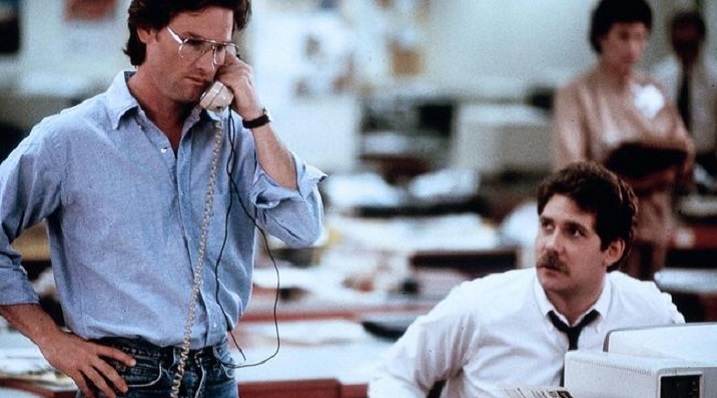
The Mean Season from 1985 has an effective premise but that’s where the positives of the picture stop.  Kurt Russell portrays Malcolm Anderson, a burnt-out reporter for the The Miami Journal.  He is the paper’s most reputable writer but just as he is ready to resign and move to Colorado with his loving girlfriend, Christine (Mariel Hemingway), he’s tasked with writing an article about the murder of a teenage girl on the beach.  Soon after, he’s getting phone calls from the killer himself, played by Richard Jordan whose face is concealed through most of the film by his hand holding a telephone.  The killer insists on only maintaining communication with Malcolm and no one else, especially not the cops.  He relays that the city of Miami can expect four more murders.

The title of the film stems from south Florida’s well known weather variations that occur at the start of hurricane season, primarily in July.  That does nothing for me, but the title alone sounds marketable enough for a thriller.  Almost sounds like a Stephen King novel.  The Mean Season!!!!!  Unfortunately, that’s all that this movie has to rely on, even if Kurt Russell is doing his best like he always does in better suspense movies like Unlawful Entry and Breakdown.

The fault with The Mean Season resides with the director’s amateurish approaches.  Fifteen minutes into the film, with the story hardly in motion, a nude Christine is taking a shower.  The haunting music begins and suddenly the shower curtain is pulled for Malcolm to deliberately startle his girlfriend.  So, we have the Psycho salute.  Check!  Later, following an argument between the two lovers, Malcolm gets in his car and is startled by Christine coming up from behind in the backseat. Ha!!!! Okay and there’s the Halloween nod.  Another check!  I bet these cheap tactics were not even written in the script.  Director Phillip Borsos (never heard of this guy before; doesn’t surprise me) must be so insecure in his skills behind a camera that he just goes for duplicative tripe.

Threats to the couple elevate as the film moves on and when Malcolm gets wind of Christine being in danger, he’s in his Mustang racing to her.  The cops (Andy Garcia, Richard Bradford) are right behind him, and no one thinks of summoning a squad car to where Christine is expected to be?  Of course not.  If they did, then we wouldn’t be treated to a clumsy sequence where an elevated bridge gets in Kurt Russell’s way forcing him to make a leap across the gap and come down on the steep other side and continue his foot race.  Kurt Russell really looks stupid in this moment, and I’m sure he was thinking I can not believe I agreed to this.

As with any of these movies, there is a just when you think the bad guy is dead, there he is again.  No wonder we didn’t get a long enough closeup on the corpse found in the dense Everglades.  However, we get treated to seeing a long, meaningless sequence of Kurt Russell being a passenger on a swamp buggy.  Big deal.  Does this enhance any kind of suspense?  Does it move the story along?  The director got access to a couple of swamp buggies and a day of shooting in the Everglades and said we gotta get this in here.

The final fight is as moronic as the rest of the picture.  Richard Jordan and Kurt Russell are going at it in the living room while a hurricane rages outside.  Mariel Hemingway just sits on the sofa and watches.  She just watches.  She doesn’t reach for a kitchen knife or a vase to smash on the bad guy’s head and help her poor boyfriend.  We just get a sad excuse of a damsel who is not in distress. 

Thankfully, Kurt Russell’s career survived this junk of standard jump scares and shortness on intellect. 

As I’ve said before in other columns, there was a better movie here.  There could have been a movie that explored the endless hours that an investigative reporter must endure.  His editor and photographer (Richard Masur, Joe Pantoliano) could have shared the heightened fear and suspense.  The cops on the case could have applied more pressure and/or assistance to the reporter.  They don’t even tap his phone to trace where the calls are coming from.  In 1985, I think they already had the technology to do that.  A tape recorder was used though, and the audience not only gets to listen to the conversations once as they are happening but then again as the characters listen to the tape.  Why?  Is there something I missed the first time I heard Kurt Russell say hello?  This is filler crap. 

A better movie would have pursued what motivates this killer we hardly get to know.  We should have learned more about this guy because he’s the one making the phone calls.  So, it is obvious he wants to be heard.  However, the guy has nothing to say of any significance.  Even a psychologist who’s recruited for one scene doesn’t make any observation that gives me, or the characters in the film, pause. 

The Mean Season is an “I got it!” film.  It’s where the director gets his big break and declares “I’ve got it!!!!  We’ll do Psycho and then we’ll do Halloween.  Gotta make sure we see Marial Hemingway topless.  That’s definitely at the top of the list. Oh yeah, and then we’ll get swamp buggies and can we get some wind and rain machines for a really, really, really mean—I mean very mean—season!”

PROMETHEUS

By Marc S. Sanders

In 2012, Ridley Scott was well established as an elite film director that I’d argue could pick and choose what projects he would want to work on.  So, the question is was it worth the opportunity to return to the Alien franchise that had been established back in 1979?  Following its just as magnificent sequel, Aliens helmed by James Cameron, none of the other subsequent installments (including the Predator mish mash stuff) lived up to the first two films. Not even close.  So, was it worth another go at exploring the world of Alien under Ridley Scott’s leadership?  Yes.  I believe it was worth every effort exhausted into making the prequel/side story picture known as Prometheus.

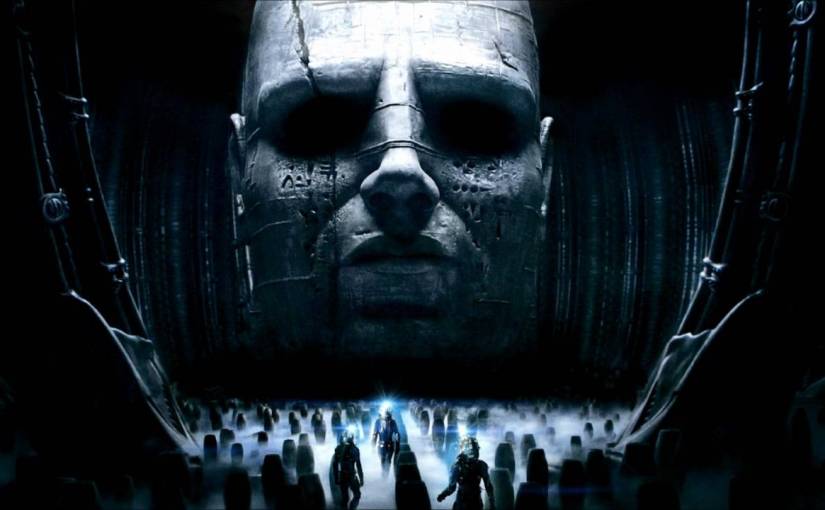
The movie begins with an odd prologue where an unusual looking strong man consumes a black liquid while standing at the precipice of a wild waterfall, while an unidentifiable shadow looms above, darkening a blue sky.  Shortly after his drink, the man seems to violently implode, and a graphic of his DNA strand explodes apart while what is left of him descends into the bottom of the falls.  The natural waters are now contaminated.

Afterwards, in the year 2089, an exploration crew of scientists uncover a hieroglyphic on the wall of a cave in Scotland, and then the film follows Prometheus, a large technologically advanced spaceship (a very cool looking spaceship I might add), on a trajectory into deep space four years later.  An elderly man named Weyland (Guy Pearce) is uploaded on a video and describes the mission to the ship’s crew.  He explains that he is now dead and that the lead scientists, Shaw and Holloway (Noomi Rapace, Logan Marshall-Green), have discovered a link between what they found in Scotland to similar hieroglyphics uncovered in other parts of Earth.  Coordinates lead to this particular planet where Prometheus will make its landing.  Their goal is to research what made them–the human race in other words.

Prometheus works like a sci-fi/monster fest of course, like the other Alien films.  However, I admire the intelligent questions it asks even if it is all based on fiction.  For example, I look at the film as continuously testing whether technology can overcome man, or religion, or even the theory of Darwinism.  A significant character in the piece is an android known as David (Michael Fassbender, doing an uncompromisingly sterile performance).  As the ship embarks on its four-year journey, with the crew resting in cryo-sleep, David continues to collect data including studying the film Lawrence Of Arabia and looking over visuals of Dr. Shaw’s dreams.  Both sources seem to offer a tolerance to live (“The trick…is not minding that it hurts.”) and die.  The latter option depicts a pre-adolescent Shaw inquiring of her father about the death of her mother.  David is a mechanical creation that never stops pursuing advancement even beyond what the science of humanity allows.

Upon arrival on the mysterious planet, the crew enthusiastically approaches a structure to explore.  Finally, they will receive answers to life’s greatest mysteries.  It’s not hard to realize that things will not go as planned, however.  It’s also not worth detailing everything that happens within the confines of this column.  I’ll let you absorb the imaginative visual feast of horrors and effects for yourself.  Most interestingly is that Dr. Shaw shares with her lover/scientist partner that the strong men, which they identify as “Engineers,” possess the same DNA as humans.  That’s an interesting observation.  Is it disappointing though?  Should it be grander for this long hike into outer space?

In many films like Prometheus or Alien, not everything cooperates as the characters expect.  None of that is surprising but it is welcome for the entertainment of suspense and thrills.  However, what I took away from the picture is where technology duals against religion and biology.  A pertinent blink and miss moment occurs following a traumatic event for Shaw.  David the android removes the cross around her neck.  Is there sound reason any longer to believe in God or the biblical teachings she was raised on if Shaw found the origin of herself and fellow humans?  Is her faith now a moot point?

On a scientific level, we learn Shaw is incapable of bearing children.  Yet, through a set of circumstances David informs her that she is suddenly three months pregnant.  The high-tech invention of David may have had a hand in this development by the way, and this is not some normal kind of pregnancy either.  Technology lends to a horrifyingly memorable scene where Shaw “delivers” her offspring. 

I’m sure we all question our beginnings.  Did it begin in six days by God, with Adam and Eve, as initial products?  Was there a big bang that just started it all?  I’d argue these questions will likely never be answered in our lifetimes.  Thus, the debates rage on because we have nothing better to do with our lives.  Cynical, right?  Well movies like Prometheus try to offer suppositions on possibilities.  In fact, there’s one pessimistic crew member on the ship who questions Shaw and Holloway’s goals of undoing a century of Darwinism on some distant planet, billions of miles away from Earth.

As the film reaches its climax, I found it even more interesting that Shaw puts on her cross necklace again, and David asks her if its even necessary at this point. 

The visuals of Ridley Scott’s film are impressive, though the planet surface and space travel doesn’t look any more creative than other science fiction films.  Frankly, it doesn’t need to reinvent the wheel.  The cast is quite diverse in personalities from a space pilot captain portrayed by Idris Elba, to a nothing but business professional played by Charlize Theron.  Other cast members are there for the casualty line up.

How Prometheus relates to the universe of Alien is fun, but the film still stands on its own. This movie does not require knowledge of the other films to follow this storyline.  Yet, if you’ve seen the other pictures, it is fun to uncover a few wink and nods here and there.

Jon Spaihts and Damon Lindelof (writer of the TV series Lost) deserve more credit for the construction of Prometheus because of the subtle debates ingrained in the monster movie themes of the picture.  Would an emergency C-section be considered a natural way of giving birth?  Would a belief in an “Engineer” supersede someone’s faith in a higher God-like power?  Should technological advancement overcome what’s destined for humanity?

As I close this article, you know what?  I’m going to say yes to all those questions.  Whatever put people on the planet Earth to live and occupy, granted us the capabilities to find alternatives to biological functionality.  Alternatives of religion preach a variety of different content that all humans choose to believe (yes even atheism, because if it’s got a name then it is some form of belief).  The science and engineering capability of technology did not arrive and develop without tests and experimentation, and it will forever proceed that way.  Dr. Frankenstein toyed with invention that did not go as expected.  Ridley Scott’s film suggests that the characters of Prometheus had a similar experience.  The point is we never advance unless we try and unless we fail before we hopefully succeed.

THE SENTINEL

By Marc S. Sanders

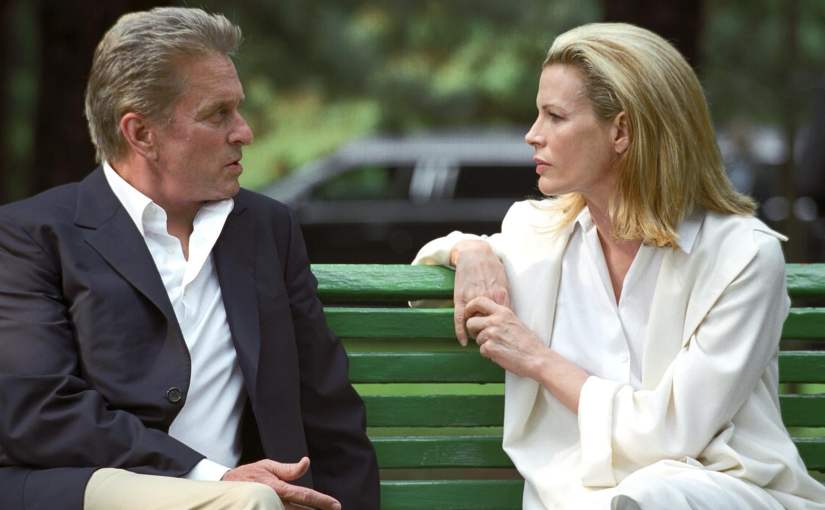
You know those movies where in the first twenty minutes you learn that there is a mole in the department?  The department could be the police or the FBI or the Starship Enterprise.  In the Presidential assassination thriller, The Sentinel, the mole is someone within the Secret Service.  Having read several John Grisham and Brad Meltzer novels in my day, I have a weakness for assassination plotlines within the hallowed halls of the White House or on-board Air Force One.  However, if the object is to uncover who is framing the hero, in this case that’s Michael Douglas, and more importantly to reveal the mole, then at least give me more than one possibility. 

Director Clark Johnson works adequately with the sunglasses, dark suits and ties adorned by Douglas and his antagonist former colleague and friend played by Kiefer Sutherland.  Douglas portrays Pete Garrison, an elder agent who has commendations for heading off the Reagan assassination.  Amazing that President Reagen was even shot because on top of Michael Douglas, I believe Clint Eastwood and Kevin Costner were also there on that fateful day.  Sutherland is Dave Breckinridge. He wasn’t there because he was just a teenager in 1981.

There’s troubling bubbling up in this Presidential cabinet, particularly because black and white photographs have mysteriously landed on Garrison’s desk depicting his clandestine tryst with the First Lady, played by Kim Basinger.  An agent partner of Garrison’s is shot dead on his front porch.  Then Marine One is taken out by a missile.  Obviously, someone has the President (David Rasche) in their sights.  Therefore, it must be a mole.  Who’s the likely traitor?  Pete Garrison is suspect numero uno, and so Michael Douglas is in the spotlight doing a subpar Jason Bourne treatment of resourcefulness to prove his innocence and uncover who framed him.

The Sentinel is not a terrible movie by any means.  It’s just this flavor of film has been done countless times before it came out in 2006, and thereafter.  Eva Longoria plays a former student of Garrison and now partner to Breckinridge and together with Sutherland they do the staple run with guns drawn down the streets of D.C. and the black sedan daytime drives while trying to stay hot on Garrison’s trail.  For some extra spice, Pete and Dave had a falling out some time ago and when we discover what that’s about it’s not very savory.

What keeps Johnson’s film from entering the lexicon of other grade A thrillers is that the true bad guy is completely apparent long before the plot unravels itself.  You know who’s spiking the voodoo doll within the first five minutes of the picture.  Why did Clark Johnson have to give this character the most oblivious close up?  That’s a failure on the director’s part, I’m afraid.  The Sentinel is short of plausible red herrings.  Someone told me recently that the best part of a magic trick is when you forget you are watching a magic trick.  Well in this movie, you know how the rabbit pops out of the hat.

There are obligatory shootouts. There’s also the big speech the President gives at the end when the bad guy is about to make a deadly move at the podium. As well, naturally there’s another typical Michael Douglas affair in a long line of on-screen Michael Douglas affairs.  Kim Basinger, I’d like to introduce you to Sharon Stone, Demi Moore, and Glenn Close.

Michael Douglas and Kiefer Sutherland (more or less doing his Jack Bauer schtick) have a magnetism on screen that’s upheld their long careers.  However, The Sentinel is not evidence of their worthiness.  Watch this film after you’ve exhausted all the other movies belonging in this category, and you just need to see who Michael Douglas is sleeping with this time, while the President gets saved one more time.   

THE BIG CLOCK (1948)

by Miguel E. Rodriguez

DIRECTOR: John Farrow
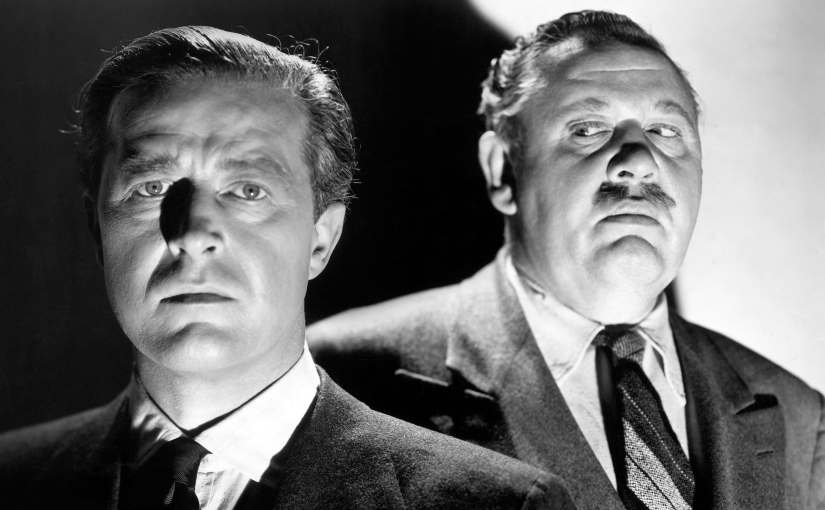
CAST: Ray Milland, Charles Laughton, Maureen O’Sullivan, George Macready, Elsa Lanchester, Harry Morgan
MY RATING: 10/10
ROTTEN TOMATOMETER: 100%

PLOT: A harried magazine editor finds himself in the unique position of trying to track down the person who murdered his boss’s mistress…when all the clues lead back to him.


I have been a fan of 1987’s No Way Out since first seeing it on cable umpteen years ago.  The marvelous twists and turns in the script – yes, including that improbable ending – kept me guessing from the moment of the murder to the final pull-away shot.  Having seen it multiple times, I always noted the fact that it was based on a book with an odd title: The Big Clock.  Since No Way Out takes place mostly at the Pentagon, I always wondered what the story has to do with a clock, but I wasn’t motivated enough to track down the book, so I just let it go.

Imagine my surprise when years later, I discovered that No Way Out is not just based on a BOOK called The Big Clock, it’s also a reboot of an earlier film-noir from 1948, also called The Big Clock.  For years I had never been able to track down an affordable copy of the movie until recently.  I just finished watching it a couple of days ago, and wow.  It has all the snappy pacing of a Howard Hawks screwball comedy, the witty dialogue of a Thin Man film, and the coiling suspense of Hitchcock at the height of his powers.  The Big Clock is a forgotten film that deserves to be rediscovered by the public.

The story opens in typical noir fashion with our hero, George Stroud (the dour-but-likable Ray Milland) avoiding security guards before hiding inside a giant mechanical clock located in the lobby of the office building where he works.  His voice-over narration wonders how he got into this mess and tries to figure out where it all began…and we’re on our way.  So far, pretty stereotypical, not very promising.  But once the prologue ends, the surprises start rolling in.

George’s boss is Earl Janoth (Charles Laughton), a clock-watching, penny-pinching tyrant who doesn’t hesitate to fire an employee who leaves a light on in a broom closet, for example.  George is the editor of a magazine called Crimeways, one of many magazines in Janoth’s publishing empire.  Crimeways specializes in investigative reporting like tracking down murder suspects, allegedly to assist law enforcement, but mostly so they can publish attention-grabbing headlines about captured criminals to boost circulation.

Through a series of events too circuitous to list here, George winds up missing a very important train (he was supposed to finally give his wife a long-delayed honeymoon) and spends a drunken night carousing with Pauline York (Rita Johnson), a blonde bombshell who also happens to be Janoth’s mistress.  He winds up passing out on her couch at her apartment (having NOT slept with her, mind you), but is forced to skedaddle when Janoth unexpectedly shows up.  Janoth catches a glimpse of George in the hallway but cannot see his face.  When Janoth confronts Pauline, things get heated, and Pauline winds up dead.  Instead of going to the police, Janoth confides in his second-in-command, Steve Hagen (George Macready, whom you may or may not remember as the slimy general in Paths of Glory [1957] who charges three men with treason for not following a suicidal order).  Hagen returns to the scene of the crime, “amends” the crime scene, and comes up with a brilliant plan: use the magazine’s considerable resources to track down the mystery man Janoth saw outside Pauline’s apartment.

And who better to lead the investigation than George himself, whose investigative skills are second to none?

There is a delightful thrill of suspense when George receives his assignment and realizes that he cannot reveal the truth of his whereabouts without implicating himself, but he is compelled to lead the investigation as thoroughly as possible.  There is an amusing but highly-charged moment when an investigator reaches a witness on the phone and starts dictating the suspect’s vital features…and they match George almost to a T.

The beauty of the film is the head-fake.  We are shown the details of the drunken night George spend with the dead woman, but we are never tipped off that what we’re watching will eventually come back to haunt him.  Green mint martinis.  The hunt for a green clock.  A sundial.  An antique painting.  An eccentric painter.  A radio actor.  All disparate elements that are almost thrown away while they’re happening, but all of which come back to neatly bite George in the ass at just the wrong moments.

I cannot stress enough how ingeniously the screenplay is constructed.  One of the greatest joys of watching The Big Clock is admiring how airtight it is, how George is forced to fly by the seat of his pants from one moment to the next, putting on a show of doing his job while simultaneously trying to find a way to sabotage the investigation without showing his hand in any way.  I won’t give away how he manages this high-wire act, but it’s brilliant screenwriting.

Eventually, the building gets locked down with George still inside and two or more witnesses who can identify him prowling the hallways, including one who is drawing a sketch of his face.  At this point, even though I’ve seen No Way Out many times, I was 100% sucked into the story: “How can this guy possibly get out of this?”  The answers will be just as unexpected to you as they were to me.

(I should mention a small role played by an impossibly young Harry Morgan.  It’s one of the most sinister performances by a mute character that I’ve ever seen.  One shot in particular feels out of time, like it was shot in a movie from the ‘60s or ‘70s.  Creepy stuff.)

The Big Clock deserves a place among the great noirs like The Maltese Falcon, Out of the Past, and The Big Sleep.  It’s filled with great performances, the visuals are suitably moody and shadowy when necessary, and the plotting is impeccable.  What more can you ask from a great film noir?

THE IMPOSSIBLE (Spain, 2012)

by Miguel E. Rodriguez

DIRECTOR: J.A. Bayona
CAST: Naomi Watts, Ewan McGregor, Tom Holland, Geraldine Chaplin
MY RATING: 9/10
ROTTEN TOMATOMETER: 81% Certified Fresh

PLOT: The story of a tourist family in Thailand caught in the destruction and chaotic aftermath of the 2004 Indian Ocean tsunami.


The Impossible, directed by J.A. Bayona (The Orphanage, Jurassic World: Fallen Kingdom), is one of the best true-to-life survivor stories I’ve seen since Touching the Void.  No doubt some liberties were taken here and there at the screenplay level, as always happens with movie adaptations, but while the film played out, the story was as gripping as any book by John Krakauer.

It’s 2004, and the Bennett family is on Christmas vacation in Thailand, at a beautiful beachside resort that has only been open for a week.  (In a nice little detail, we see that the protective plastic film has not yet been removed from their light switch panels.)  Henry (McGregor) and Maria (Watts) enjoy Christmas Eve and Christmas day with their three sons, Thomas, Simon, and Lucas (Tom Holland in his cinematic debut, already doing cartwheels and backflips on the beach).  On the morning of December 26th, an unthinkable catastrophe occurs when a tsunami, triggered by a massive seaquake offshore, slams into the beach.  The visual effects during this sequence are as convincing and terrifying as anything I’ve ever seen.  As the wave sweeps over everything in its path, the Bennett family is separated.  Maria and her son Lucas manage to find each other in the immediate aftermath, but there is no sign of Henry and her other two sons.

What follows is a story that gives new meaning to the words “hopeless” and “hope.”  While the outcome is somewhat predictable – SOMEONE survived to tell this story, after all – the filmmakers have managed to put together a film that generates suspense and cheers despite what we may or may not know about this family.  There are scenes of people missing each other in hospital hallways by seconds.  In a lesser film, it might have been comic.  In THIS movie, those scenes generated groans of empathetic frustration from the audience (that is, me).  By that time, we had followed various Bennett family members through many highs and lows, and I desperately wanted the right people to be found at the right time.  It was unexpectedly effective.

That sentiment applies to the movie as a whole, not just that one scene.  I have seen so many disaster movies that I was primed to expect certain cliches and tropes, even though this movie was highly rated and recommended when it came out.  To be fair, this movie does indulge in those tropes.  I mean, by nature, it HAS to.  The difference with The Impossible is that these stereotypical events and scenes all felt way more real than expected.  Credit to the screenwriter and director for molding these cliches into something more compelling than yet another reworking of The Day After Tomorrow.  When the finale of The Impossible arrives, it feels uplifting and inspirational instead of hackneyed and obvious.  It’s a neat little magic trick that I wish I could explain better.

An interesting self-reflective thought occurred to me during this movie.  There is a scene where Henry, the father, is huddled with a group of English-speaking survivors in a bus station.  Someone offers Henry his cellphone, even though he is trying to save his battery in case his own family tries to reach him.  Henry reaches someone in England, but because he still cannot find his wife, he breaks down and hands the phone back to the stranger.  The stranger looks at Henry, looks at his phone, and hands it back to Henry: “You can’t leave it like that.  Call him back.”

My entire life, my favorite sub-genre of science fiction has been anything dealing with an apocalypse or set in a post-apocalyptic future, like The Matrix or World War Z or the superlative HBO series The Last of Us.  One of the things many of the movies in that genre have in common is the inherent tendency for humans to turn on each other or behave selfishly when the chips are down.  You know what I’m talking about, right?  Somebody finds water in the desert, and instead of helping mankind, they sell it to the highest bidder.  Or someone discovers that the invading aliens will give them preferential treatment if they help round up more humans themselves.  That kind of thing.

Well, here is The Impossible, based on a true story, and here is a man who desperately needs to save the battery power on his cellphone, but whose compassion will not allow him to let Henry’s short conversation go unfinished.  “You can’t leave it like that.”

I have no way of knowing if this moment really happened or if it was manufactured.  All I can report is that scene, in a movie full of hard-hitting emotional beats, is probably my favorite scene.  Here is an apocalyptic situation in the truest sense of the word.  Here is a person who could have been justifiably selfish, but his empathy won’t allow him to turn his back on someone who is suffering.  It even got me wondering: would I do the same?

If this scene was taken from real life, then maybe all those post-apocalyptic movies got it wrong.  Maybe, when the chips are down, people are inherently good.  Is it possible?  I’d like to think so.  I’d like to think I’d do the same.

Long story short: The Impossible takes you on an unforgettable ride made even more remarkable due to it being based on a true story.  It’s full of great performances and astonishing visuals, but you may never want to stay at a beach resort again…

P.S.  According to the real-life woman played by Naomi Watts, the biggest “lie” in the movie was the color of the ball her children were playing with just before the tsunami struck…it was yellow, not red.  Do with that information what you will.

MARTHA MARCY MAY MARLENE (2011)

by Miguel E. Rodriguez

DIRECTOR: Sean Durkin
CAST: Elizabeth Olsen, Hugh Dancy, John Hawkes, Sarah Paulson
MY RATING: 10/10
ROTTEN TOMATOMETER: 90% Certified Fresh

PLOT: Haunted by painful memories and increasing paranoia, a damaged woman struggles to re-assimilate with her family after fleeing an abusive cult.


My feelings about Martha Marcy May Marlene are all over the map right now.  It angered me, shocked me, mesmerized me, saddened me, and thrilled me, all at once.  A despicable cult lies at the center of it, and having recently watched the second season of HBO’s The Vow, I noticed it shared many similarities with NXIVM, an even MORE despicable cult, which just angered me even more.  The movie’s saving grace is Elizabeth Olsen’s character, Martha, who escapes the cult after the opening credits and tries her best to adapt into real life after being brainwashed for two years.  But even with Martha as the star (and it’s a terrific performance from Olsen, by the way), Martha Marcy May Marlene dances recklessly on the verge of being a movie featuring people so abhorrent that I wanted to turn it off.

I’m glad I stuck with it, though, don’t get me wrong.  It’s a powerful, provocative film that asks lots of questions, and had me wondering about myself.  If my sister disappeared for two years, then wandered back into my life with no money and no home, then behaved erratically and sometimes dangerously around my friends and loved ones…how much of that could I take before I started making inquiries about psychiatric institutions?

Martha’s sister, Lucy (Sarah Paulson), does her dead level best to make Martha comfortable and keep the peace between Martha and her husband, Ted (Hugh Dancy), who does his best, but resents her for “invading” his 2-week vacation.  Lucy knows Martha is hiding something, but she senses it’s unwise to try to drag it out of her.  But every time the opportunity arises for Martha to give some insight, she either backs away or turns it into a verbal attack.

This was one of the things that infuriated me during the film.  I even paused the movie and asked Penni about why it made me so mad, thinking I needed a woman’s point of view.  Why, oh, WHY does this young woman, who has clearly been traumatized in some way, not implicate the people who mistreated her for so long?  Clearly, I’m not a psychiatrist.  I’m sure someone would be able to provide me with a concise answer that makes Martha’s behavior understandable.  The movie, however, does not provide such an answer.  Ultimately, that’s one of its strengths.  If it had ended with a Psycho-style expository monologue that gave clear-cut reasons for everything Martha does, it would have felt anti-climactic.

Patrick (John Hawkes), the cult’s leader, is not movie-star handsome by any stretch of the imagination, but he possesses that innate, infuriating ability to say exactly the right things at the right time.  One trick is to give all the women new names; he re-names Martha “Marcy May” the first time he meets her.  As a result, every woman in the compound is devoted to Patrick.  How devoted?  Whenever a new female member is introduced to their “family”, one of the first things the older members do is feed her a shake with a sleeping pill blended into it.  Then, when the new girl falls asleep, Patrick can come in and rape her while she sleeps.  The word “disgusting” doesn’t begin to approach this tactic.  But the fact that the women will talk with the new member after that first encounter, and convince the newbie that it’s all good, it’s all fine, we wouldn’t be here if it was bad, you’re sooo lucky…I mean, if I had popcorn, I would have thrown it at the screen, I was so mad.

Martha Marcy May Marlene is not just about the rage it instilled in me, though.  It asks us to empathize with Martha, and it succeeds, even when she behaves unpredictably.  One night, Martha crawls into Lucy’s bed…while Lucy’s having sex with Ted.  Lucy and Ted are understandably freaked out, but Martha seems dazed by their anger.  “Why would you do that, Martha?!”  Her reply: “I couldn’t sleep.”  At that point, I could clearly see both sides of the situation.  Lucy and Ted had every right to be angry, but Martha simply didn’t know any better.

The flashbacks to Martha’s days with the cult start out fairly normal, but as the movie progresses, we finally start to see some of the other incidents that finally drove her to run away.  One particularly ominous scene shows Martha and another girl having target practice with one of the other young men in the cult.  Patrick shows up with a live cat in a sack and abruptly tells Martha to shoot the cat.  When she refuses, he tells her to shoot the young man.  The man starts to walk away, and Patrick, in a voice raised ever so slightly, tells him, “Don’t you walk away from me.”  And he stops.

The cult members practice periodic home invasions to gather needed supplies, since the farm they’re working on isn’t fully functional yet, and you can only get so much money by selling blankets in town.  They do their utmost to avoid contact with the residents, but sometimes, things just…don’t work out the way you want them to, you know?

Martha Marcy May Marlene qualifies as a great film because it simply presents the facts of the story and doesn’t editorialize, doesn’t preach.  I can report that it’s a stunning character study/thriller, and I can tell you that the performance from Elizabeth Olsen is superb (her movie debut, by the way).  I can say that the filmmaking strategy is on point – kudos to director Sean Durkin.  And I congratulate it on eliciting the kind of emotional response from me that I’ve only felt once in my entire life.  It may not be the same for you.  But there you have it.

KALIFORNIA (1993)

by Miguel E. Rodriguez

DIRECTOR: Dominic Sena
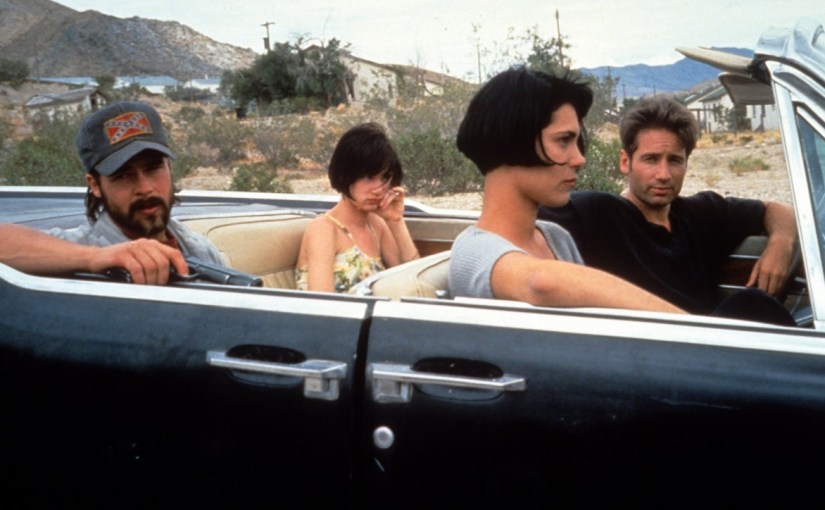
CAST: Brad Pitt, Juliette Lewis, David Duchovny, Michelle Forbes
MY RATING: 9/10
ROTTEN TOMATOMETER: 58%

PLOT: A journalist duo go on a tour of serial killer murder sites with two companions, unaware that one of them is a serial killer himself.


Ask any movie fan for names of actors who played memorable serial killers in film, and you’ll get a lot of obvious ones (Anthony Hopkins, Charlize Theron, Anthony Perkins) and you might get a few not-so-obvious ones (Michael Rooker, Andrew Robinson, Peter Lorre).  But I’m willing to bet no more than one person in 20 will name Brad Pitt, whose performance as the skeevy Early Grayce dominates Kalifornia, the 1993 directorial debut film of music video director Dominic Sena (Gone in 60 Seconds, Swordfish).  Pitt is so convincing and deliberately off-putting that I came close to switching the movie off and returning it to the thrift store where I found it.  Why would I want to keep watching a film where I’m repulsed by one of the main characters nearly every second he’s on screen?

Kalifornia may be predictable to some, but I was blown away by the story development.  Brian (David Duchovny) and his longtime girlfriend, Carrie (Michelle Forbes) are embarking on a cross-country road trip from Pittsburgh to California.  He’s an author writing a book on serial killers.  During their trip, he will visit infamous murder sites to gather material, and Carrie, a professional photographer, will take pictures for the book.

(The first time we see Brian, he’s mixing drinks at a party and holding forth about how the government should rehabilitate killers instead of executing them.  They are products of their environment, their upbringing, they’re not ultimately responsible for their own actions because they simply don’t know any better, and so on.  Over the course of the movie, his beliefs will be put to the test.)

Brian is short on cash until he finishes his book, so he places an ad on a university message board looking for people willing to split gas and food costs on a cross-country road trip to California.   One of the most incisive moments in the movie comes when Brian and Carrie drive to a meet-up point and spot their new travel companions: Early and his girlfriend, Adele (Juliette Lewis), a young woman whose mental development seems to have been arrested at about a 13-year-old level.  Carrie whispers to Brian, “Look at them, they look like Okies.”  Meanwhile, Adele whispers to Early, “Oh, Jesus, Early, they look kinda weird.”  The movie seems to be setting us up for an awkward odd-couple road-trip movie where, uh oh, one of them is a serial killer!  But you ain’t seen nothing yet.

During their road-trip, and in between visits to famous murder sites, Early and Brian start to bond a little, much to Carrie’s dismay.  Brian has a theory about why the Black Dahlia killer was never found, but Early has another: that he’s alive and well in a trailer park somewhere, “thinkin’ about what he’s done, goin’ over it and over it in his head, every night, thinkin’ how smart he is for gettin’ away with it.”  Ohhh-kay…

One night when Brian and Early are at a bar, Carrie and Adele get to talking, and Adele reveals that she doesn’t smoke because “he broke me of that.”  Carrie asks her if Early hits her, and her reply is as heartbreaking as it is terrifying: “Oh, only when I deserve it.”

This and several other red flags get to be too much for Carrie, and she gives Brian an ultimatum: “Either they get out at the next gas station or I do, your choice.”  What happens at that next gas station I would not dream of revealing, but it ignites the slow burn of the previous hour and turns Kalifornia into a tense, bloody thriller that rivals anything by David Fincher.

I’ve given so many establishing plot details above (I left some juicy bits out, trust me) because I’m trying to convey how this film, which starts out like a slightly amped-up basic-cable movie-of-the-week, shifts into another gear in the second hour.  Unsuspecting viewers like me, who have only heard of the movie but never even seen the trailer, will watch the first hour wondering where the good movie is.  But have patience, it’s coming.  The payoff is worth the wait.

[Author’s note: by the way, don’t watch the trailer for this movie.  It gives away WAY too many plot points that I haven’t mentioned, both before and after the gas station incident mentioned above.  Just the worst.]

Visually, I didn’t see a lot of the music-video camera pyrotechnics that director Sena would later employ in Gone in 60 Seconds, etcetera.  The movie is content to let the dread sort of speak for itself.  The various murder sites they all visit seem even creepier and uglier than they need to be.  Slick editing brings little details into focus that heightens the tension.

Ah, I can’t think of any way to explain how great this movie is without giving away more plot details, and this movie is best seen in a vacuum, knowing as little as possible.  So trust me.  If you’re a fan at all of serial killer movies or documentaries, this movie will not only entertain, it will give you a lot to chew over.  Kalifornia belongs in the serial killer movie pantheon with The Silence of the Lambs, Psycho, and Henry: Portrait of a Serial Killer.  Especially that last one.

TIME AFTER TIME (1979)

by Miguel E. Rodriguez

DIRECTOR: Nicholas Meyer
CAST: Malcolm McDowell, David Warner, Mary Steenburgen
MY RATING: 6/10
ROTTEN TOMATOMETER: 87%

PLOT: Before he wrote any of his famous novels, H.G. Wells pursues Jack the Ripper to the 20th Century when the serial murderer uses the future writer’s time machine to escape his time period.


There are two scenes in Time After Time that are genuinely shocking from a story perspective.  One involves a newspaper headline.  The other involves a bloody crime scene.  The first I should have seen coming, but the second I never would have guessed in a million years, and I literally yelled at the TV when it happened.  That’s good plotting.

Those two scenes are the only things that prevent me from giving Time After Time a lower score.  That, and the fantastical, thought-provoking nature of the story itself.  Too bad both those scenes and the plot are buried under layers and layers of hackneyed dialogue and the kind of forced situational comedy that would be more at home in Three’s Company than in a sci-fi adventure.

First, the good stuff.  After a credits sequence that looks inspired by countless grade-Z movies before it, the story starts back in London, 1893, two years before H.G. Wells would write his first novel, The Time Machine.  A prostitute is murdered in a dark alley, victim of the infamous Jack the Ripper.  Later that night, Wells hosts a dinner party at his house for some friends and shows them something he’s been building in his basement: a fully functional time machine.  It doesn’t quite resemble the famous machine from the 1960 classic The Time Machine – it looks more like a ride vehicle from an amusement park than a chair with attachments – but the Victorian details are all there.  There’s some talk about a vital key needed to return to their present and a VERY important device that is discussed without being precisely explained, at least not to my satisfaction.  When it makes a reappearance late in the film, I was still mystified as to its actual purpose other than a convenient deus ex machina.

Suddenly, Scotland Yard appears.  Turns out they tracked Jack the Ripper to Wells’ doorstep.  Tricky Jack awaits his chance and uses the time machine to escape…though, without that handy key mentioned earlier, the machine returns to its point of origin on its own, leaving Jack stranded in a world 86 years in the future.  Wells feels duty-bound to bring Jack to justice, so he follows Jack, setting up the meat of the next few reels: a man from 1893 London struggling to adjust to daily life in 1979 San Francisco.

(It must be noted that the bulk of this film’s budget was clearly NOT devoted to the visual effects department.  The effects on display as Wells travels through time are cheesy at best.  I’d try to describe them here, but my words cannot possibly do them justice.  I couldn’t even find a decent still shot to embed here that would accurately convey just how low-rent they are.  I recently watched 1974’s execrable Zardoz, and I’m here to tell you, from a VFX perspective, Time After Time makes Zardoz look like Interstellar.)

H.G. Wells chasing Jack the Ripper through time?  This is a great plot from a sci-fi perspective, a thrilling “what-if” tale.  I had heard about this film for years but was never able to find a copy until recently.  The scores on IMDb and Rotten Tomatoes are decent.  Not stellar, but decent enough that I was pretty sure I would enjoy it.  The movie was directed and co-written by Nicholas Meyer, the mind behind The Day After, Star Trek II: The Wrath of Khan, and Star Trek VI: The Undiscovered Country.  That’s not a bad track record.

But, man oh man…for most of the film’s middle section after Wells arrives in 1979, the movie’s brain goes on sabbatical.  Example: he walks into a McDonald’s, takes careful note of how the customer in front of him orders a meal, then does his best to literally impersonate the customer.  He doesn’t just order what he orders…he gives an impersonation of the customer’s voice and accent.  Why?  He doesn’t do that at a pawn shop or a bank.  No, it’s just there because someone thought it would be a laugh to see Malcolm McDowell do a broad American accent.

I can’t deny that the potential is there for real humor.  I couldn’t find it.  I thought these scenes were completely at odds with the tone of the first third of the film.  Wells meets a bank teller, Amy, (a very young Mary Steenburgen) who inexplicably falls in love with him at first sight.  She’s so taken with him she impulsively asks him to lunch, an act that, in 1979, was directly at odds with 99.99% of all other screen romances, so kudos to that, I guess.  But why?  I’m not saying Malcolm McDowell is an affront to the concept of human beauty, but…really?  As Wells, he’s the 19th-century version of a science nerd.  Amy is not a character so much as a cardboard placeholder to be moved and manipulated according to the whims of the plot.

The dialogue is clunky, to say the least.  There is a foot-chase between Wells and Jack that is devoid of suspense.  The score by Hollywood legend Miklós Rózsa feels utterly out of place, as if someone simply lifted Rózsa’s score from some other film and plugged it in where necessary.  There is simply no romantic chemistry between McDowell and Steenburgen, as evidenced in a painfully unfunny scene when they sit on a couch and she declares: “Herbert, if you don’t take me into your arms, I’m going to scream.”

Another actual line of dialogue: “My mother was rather an atrocious woman in her own way, but her many failings did not include raising mentally deficient sons.”  That’s not a real person talking, that’s a writer trying to imitate George Bernard Shaw.

No doubt someone out there will tell me I missed the boat with this movie somehow.  Perhaps Rózsa’s score is intentionally “retro” to make the whole movie feel as temporally displaced as its characters.  Perhaps the intention was the same with the hopelessly amateurish visual effects.  Who knows.  It’s possible.  Maybe there’s a better movie here somewhere and I’m not equipped to find it.  I doubt it, but it’s a possibility.  In the meantime, I’m going to keep this movie in my collection as an example of how a great story can be derailed by poor execution.

And maybe I’ll bring it out if my fellow Cinemaniacs are in the mood for a “So-Bad-It’s-Good” movie day.

[P.S. Keep your eyes open for the screen debut of an 8-year-old Corey Feldman.]

PLAY MISTY FOR ME

By Marc S. Sanders

Before Fatal Attraction and countless other stalker/possessive lover thrillers that continue to monopolize all kinds of entertainment mediums, there was Clint Eastwood’s directorial debut, Play Misty For Me.  Watching it for the first time in modern day, I can say that it pushes all the standard buttons of this kind of thriller formula.  The over enthusiasm of the mentally disturbed stalker, the uninvited appearances at inopportune times, the late night phone calls, and of course the knife wielding.  Nevertheless, I remain impressed with Eastwood’s interpretation.

Eastwood also headlines the cast as a late-night disc jockey named David.  Each night he gets a call from a devoted fan named Evelyn (Jessica Walter) requesting he play the jazzy tune, Misty by Erroll Garner.  Included in Dave’s regular programming are stanzas from poetry that he reads to his listeners and endorsements of favorite hang outs and bars that he frequents within the breezy coastal town of Carmel-By-The-Sea, California.  (Years later, Clint Eastwood would be elected Mayor of this community.)  Naturally, Evelyn shows up at one such regular hangout and the two have a one night stand under the presumption of no strings attached.  Of course, there would not be much of a film if Evelyn adhered to that policy.  Thus, the pattern begins.

Evelyn follows Dave around town.  She shows up uninvited at his house ready to prepare a steak dinner.  She’s knocking on his door in the middle of the night, naked under an overcoat.  There are phone calls along with disturbing, unexpected outbursts as well.  Complicating matters for Evelyn is that Dave is on his way to rekindling a romance with a former flame named Tobie (Donna Mills).  Then, it really gets frightening.

For a first time director, Clint Eastwood really shows some expert skill in Play Misty For Me.  The film opens with an overhead shot above the cliffs adjacent to the coastline, and then the camera circles around through the sky and finally zooms in on Eastwood standing on a veranda looking out to the sea.  It’s a glorious scenic shot and the director carries this theme throughout the course of the film.  A locale that impresses me is The Sardine Factory.  It is where Dave and Evelyn first meet, and Eastwood’s friend, mentor and often director, Don Siegel makes an appearance as a bartender.  The Sardine Factory is still there to this very day. 

Eastwood seems to offer a tourist guide and a photographic devotion for this quiet little town, and it contrasts well with the disturbing storyline.  Carmel-By-The-Sea seems like a comfortable and trusting area to live.  Therefore, it is all the more easy for an intruder to lay claim within the unguarded setting.  This film might be from 1971, over fifty years ago, but it makes me want to go visit.  We are treated to live footage at the Monterey Jazz Festival, and it does not overstay its welcome.  Eastwood’s film work is gorgeous throughout the whole picture. Particularly during a midway music sequence featuring Roberta Flack’s The First Time Ever I Saw Your Face, playing over footage of Dave and Tobie spending time and making love together. 

Jessica Walter is especially good in her role as the menace to this man’s livelihood.  She’s alluring and relaxing with her first encounter with Dave.  Then, she’s upended by the disruption and unwelcome halt of her romantic tryst and outbursts come from out of nowhere.  Eastwood lives up to the thriller characteristics of the film by the way he shoots Walter in close ups that appear with no build up.  He includes shots of her face and brunette hair in nothing but darkness with an agonizing scream.  It’ll shiver you.  It just makes Evelyn’s appearances even more shocking. 

The film that comes to mind when I watch Play Misty For Me, is Adrian Lyne’s Fatal Attraction from 1987.  I think that would be the go-to response for most viewers today.  However, it would be unfair for me to say I know what happens next.  Yes, I did know where everything was leading to.  However, Eastwood’s film is the pioneering installment, released years ahead of the other film.  I’ve always had mixed feelings about Fatal Attraction honestly.  I can’t take my eyes off it, especially because of the performances from Michael Douglas, Glenn Close and Anne Archer, but I frown heavily on the slasher ending that was pasted on to film.  Glenn Close did too.   Now that I’ve seen Eastwood’s movie, it astounds me how much Lyne’s picture lifts from the 1971 thriller.  Both films incorporate references to Madame Butterfly.  There’s a suicide attempt for attention.  There are phone calls and knocks on the door in the middle of the night.  There’s another lover who may be in harm’s way.  There’s an abundance of similarities in both films.

I have to wonder.  Should I now go back and revise my review of Adrian Lyne’s film? 

NOPE (2022)

by Miguel E. Rodriguez

DIRECTOR: Jordan Peele
CAST: Daniel Kaluuya, Keke Palmer, Brandon Perea, Michael Wincott, Steven Yeun, Keith David
MY RATING: 7/10
ROTTEN TOMATOMETER: 83% Certified Fresh

PLOT: Residents of a lonely gulch in inland California bear witness to an uncanny and chilling discovery.


After watching Nope, the third feature from Jordan Peele (Get Out, Us), I found myself curiously unable, or unwilling, to sit down and write a review for it.  What more can I add, I thought, to the volumes that have already been written about it?  What insights can I share that aren’t revealed in the making-of documentary on the Blu-ray?  How can I analyze a movie that can literally be boiled down to, “What if Close Encounters turned into Jaws?”  What good would it do to figuratively take this movie apart and critique its individual components?  It’s a roller-coaster, pure and simple, much like Jurassic Park III [2001].  How do you review a roller-coaster ride and try to compare it to other roller-coaster rides in terms of a review?

“I found the first hill of Rip-Ride Rocket much more intense than the slingshot approach of Hulk or Rock-N-Rollercoaster, but each has something to offer in terms of inversions, smoothness, and on and on and on…”

It just feels pointless, for reasons that are proving themselves difficult to pin down.  So, instead of a “normal” review, here are random thoughts, in no particular order:

  • The “true” nature of the UFO – oops, sorry, UAP, I had to look that up – stretched my disbelief suspension to the limit, but I will admit, it’s certainly original.  I can’t think offhand of any other movie or book I’ve watched or read that even considered that explanation for all those unexplained sightings in the books.  Once that was established, every successive appearance of the “spacecraft” became even more ominous and/or menacing.
  • I loved how the movie is littered with clues or easter eggs that either give a hint to the film or sort of comment on what we’ve seen before.  There is an early scene when OJ (Kaluuya) and Em (Palmer) are walking outside with a magnificent setting sun behind them behind the clouds, and hand to God, I remember noticing one particular cloud that looked…off.  Also, there’s another scene when a horse runs off and OJ watches it through the gaps of a wooden shed, and the visual impression is that of a zoetrope, the machine that made the opening images of the running horse possible.  Or even look at the screenshot at the top of this article…quick! What does that lampshade look like to you?
  • There was something about the design of the UAP that bugged me throughout the movie, not necessarily in a bad way, but it just seemed weird.  Why would something that is [SPOILER REDACTED] need what looks like fabric when seen up close?  Is it a sail?  That seems most likely.  In the latter stages of the movie, the “anomaly” doesn’t seem quite as mobile or speedy as it did when its “sail” was intact.  It’s an interesting design concept.
  • One of the scariest moments for me had nothing to do with the UAP itself.  It’s the scene in the exhibition area where the lights seem to be turning on by themselves.  The payoff for the scene seems predictable in hindsight, but as the scene progressed, I was BESIDE myself.  You can ask my best friend, Marc, who watched it with me.  When that shapeless mass by the light switch suddenly started to “unfold”, I echoed OJ: “Nope!  Gotta go, goodbye!”  It is a brilliantly executed scene.
  • I’ll need to watch the movie again to fully understand how that little parachute managed to scare off the UAP.  I assume it has to do with actual horse training, and with some research I could find the answer myself, but the movie does very little to explain it to the viewer.  Or maybe it does.  Like I said, I need to watch it again.
  • I loved how the flashback with the chimpanzee seems utterly incongruous at first.  And I loved how creepy and horrifying it is.  It’s a brilliant framing device (if I’m using that term right) that kept me guessing as to its real purpose right up to the end, or CLOSE to the end.  And did I mention how horrifying it is?  That moment when it’s resting…and then looks RIGHT AT THE CAMERA…chilling.
  • Someone somewhere had said that Keke Palmer was robbed of an Oscar nomination.  With all due respect to Ms. Palmer…she did an admirable job, but I didn’t see anything in the film that would have had me reaching for my Oscar ballot.  But I will give her props for her opening speech to that film crew.  The special features on the Blu-ray reveal that she delivered MANY different variations (fourteen, according to IMDb), much like you see so many other actors do in broad comedies, just to find the exact right version or take.
  • Much like Us, Nope feels like it bit off a little more than it could chew when it comes to the resolution of the film.  Everything leading up to the last 10 minutes or so is gangbusters, honestly, even the silver-helmet guy.  But as everything started to wrap up, I began to feel as if I’d seen all this before, just in different ways, in many different films.  Perhaps I’m being unfair.  Perhaps I’m criticizing the movie for what it isn’t instead of reviewing what it is.  I don’t know.  As it is, also like Us, Nope is one helluva roller-coaster ride that ends, not with a bang, but with a “pop.”
  • Allow me to shamelessly quote Roger Ebert, again: “If you have to ask what something symbolizes, it doesn’t.”