THE CHINA SYNDROME

By Marc S. Sanders

The China Syndrome explores the inherent risk that comes with a reliance on nuclear energy.  It also touches upon the moral choices within the field of journalism.  Most importantly though, it’s a hell of a thriller.

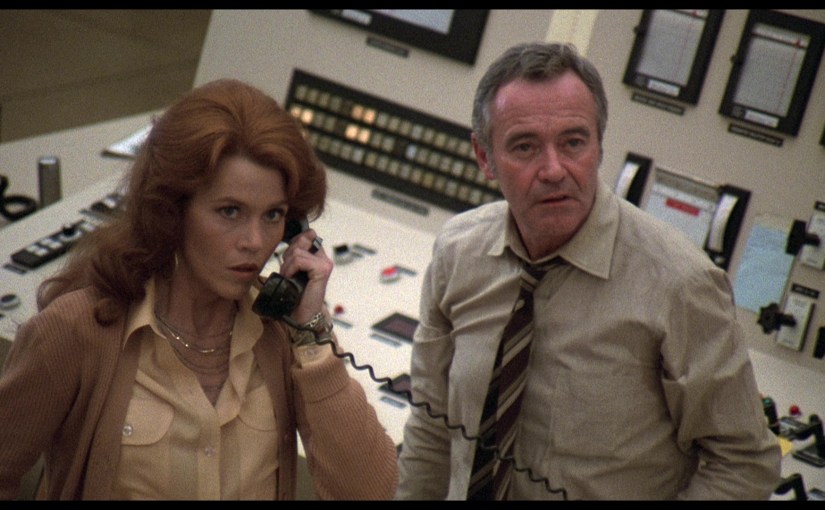
Kimberly Wells (Jane Fonda) is an on the scene reporter doing light fare topics for the evening news, like the novelty of singing telegrams for example.  With her subcontractor cameraman, Richard Adams (Michael Douglas, also one of the film’s producers), they cover a story on how a nuclear power plant operates.  During their tour, a very frightening accident stops short at only being a threat.  While the top brass at the company downplays the incident, Richard manages to record the panic-stricken activity happening among the operators in their soundproof control room.  As Kimberly and Richard gather information about what really happened, they are told they only were so close to what can be described as a China Syndrome – the underground nuclear rods could have overheated, imploded and the blast would have ruptured through the core of the earth where even China could feel it on the other side of the world.  

The corporate elites (led by Richard Herd) are the villains of this picture.  The could be hero is Jack Godell (Jack Lemmon), a could be whistleblower.  Jack oversees the whole operation and following that frightening scene begins to do his own kind of investigation.  What happened only makes sense because due diligence was not upheld, and inconsistencies are being neglected. Problems are only expected to get worse because they are not contained. There would be an enormous monetary expense that will put the company at a loss.  Initially, Jack wants to remain quiet, but the idea of what he’s certain will eventually happen is conflicting him.  As well, Kimberly and Richard’s pursuit of what truths he holds is gnawing at him.  

Jack Lemmon is a frazzled, yet sensible, marvel in this film.  I love the unspoken subtleties of this guy.  Best I could see is that Jack Godell is unmarried and has no children, nor friends beyond the faint connections he shares with his work colleagues, particularly one played by Wilford Brimley.  This only enhances Godell’s isolation in a them-against-him matchup.  Lemmon is great at emoting a sorrow and regret to his character.  He tells the journalists that he loves that plant.  It’s all he has in life and now it spells a certain, eventful doom if the faults in operation are not exposed.  Like Michael Mann’s The Insider, which was released over two decades later, the unlimited resources of this company will do everything in their power to silence this liable peon who works for them.  

The other side of The China Syndrome focuses on Fonda’s character.  When this film was released in 1979, it was the norm to not take a woman reporter seriously.  They were best used as attractive figureheads with beautiful hairstyles and well applied makeup to shift the seriousness of the news over to stories about dogs who can do tricks or hot air balloon happenings.  This film could have made more of a campaign to embrace the female journalists with heavier topics.  Instead, Jane Fonda’s character is not a fighter so much for deserved recognition in a male dominated world.  She’s actually just trying to circumvent around the unspoken chauvinism of her industry and get to the heart of this story that she witnesses firsthand.  The news station would rather her efforts be focused elsewhere.

Richard, the cameraman, is not embraced by Kimberly’s news station and therein lies the debate of airing what appears to be a story of urgency for the benefit of the public.  Yet, the station does not want to face a lawsuit.  What do the principles of journalism mandate even when there’s a monetary and reputational risk to their institution?  

Plenty of films with these kinds of dilemmas have come out following The China Syndrome.  What’s remarkable is the authentic feel of this fictionalized account.  Ahead of the release, the real-life companies that were developing a need for nuclear power were lambasting this film, insisting there was no validity to this story.  They were adamant that the production and maintenance of nuclear power was completely safe and well monitored. Twelve days after this film hit theaters in March 1979, the Three Mile Island accident occurred in Harrisburg, Pennsylvania when a partial nuclear meltdown of a reactor occurred. Traces of harmful gases and iodine were released into the atmosphere, and the incident was rated a Level 5, an “Accident with Wider Consequences.”  I do not believe Michael Douglas and his co-producers/filmmakers necessarily set out to make a statement. Though there are protesting movements peppered throughout the film. It’s a frightening irony, however, when life imitated fiction. 

 Jane Fonda and Jack Lemmon put the suspense of The China Syndrome into play. There’s an awareness to what could happen with technological advances in nuclear energy especially if they are not carefully observed and addressed.  

Over forty years later, do we really know what’s going on and even if we did, what could any of us do about it?

HERETIC

By Marc S. Sanders

Heretic operates like you’re playing Dungeons & Dragons but adapted into an Escape Room experience.  The stakes at play are bigger than just your life.  You have no choice but to truly test your faith.  Can you adhere to the religious beliefs you always vowed to uphold when a lunatic is holding you captive?

Sister Barnes and Sister Paxton (Sophie Thatcher, Chloe East) are two impressionable young ladies who are proud to spread the gospel of The Church of Jesus Christ of Latter Day Saints from door to door.  With bicycles and pamphlets in hand, proudly wearing their name tags, they visit the homes of those who have recently expressed interest in the church.

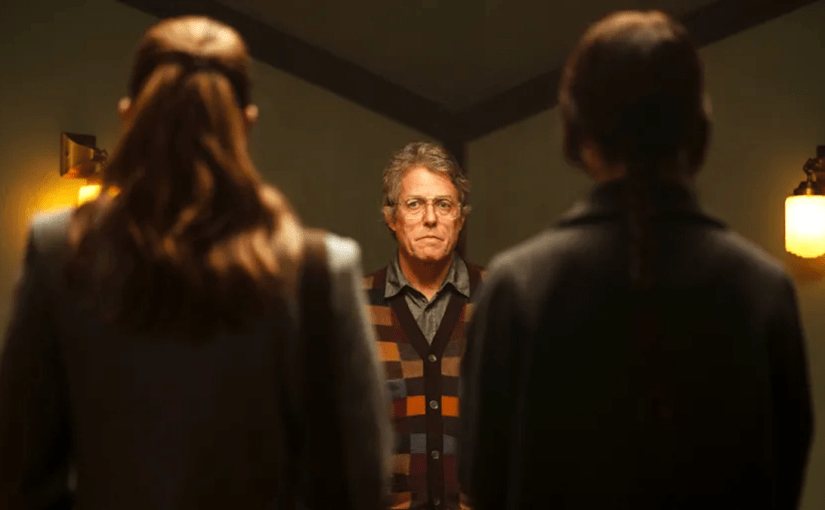
As a dark and stormy night approaches, they knock on the door of an eerie house that belongs to the charming Mr. Reed (Hugh Grant in an utterly surprising role).  Once the ladies are assured that the gentleman’s wife is at home, ready to offer some blueberry pie, they happily enter and are quickly engaged in an unsettling test that will carry on through the evening.

I went into Heretic not knowing a single thing about the film and that made my encounter with the piece that much more interesting.  It’s a disturbing thriller that always kept me curious.  Mr. Reed seems to go on tangents that eventually get to a point where the Sisters are confused, but eventually coherent of the strange man’s demonstrations.  The film is not shy about challenging practically every religious denomination known to man from Christianity to Judaism to Islam and Mormonism.  According to Mr. Reed the ten thousand other doctrines spread across the planet need also be questioned.

Higher powers and miracles – do they really exist?

There’s no doubt that Heretic is a suspenseful thriller teetering on horror but unlike most effective efforts in this genre I was never uneasy with the picture.  It doesn’t rely on jump scares and only gore introduces itself when it must serve the storytelling.  However, it’s an intelligent character study where the heroines are challenged over and over again while remaining in captivity.  So, I was always enthralled with how Sister Barnes and Sister Paxton will entertain their destiny from one step to another.  Stay for pie or don’t.  Lie or tell the truth.  Choose the purple door or the green door.  Belief or Disbelief.

As someone who is primarily educated in Judaism only, it was still not hard to follow the wordy, rambling dissertations of Mr. Reed.  He easily compares his own take on religion to the different interpretations found in music from bands like The Hollies and Radiohead, as well as the various editions of the board game Monopoly which suddenly take on new meanings.  He even brings up Jar Jar Binks to deliver a point.  It’s odd.

Hugh Grant is an unlikely selection for a role like the charming, yet sinister Mr. Reed.  As weird as he is in this darkened house with endless hallways, I wanted to trust him through most of the first half of the picture.  I didn’t care if there was a haunting corridor or staircase to walk down.  This is Hugh Grant of Notting Hill fame.  Grant’s resume of roles lends to the surprising effectiveness of his part here.  He’s always been that adoring charmer on screen.  Ian McKellan or Anthony Hopkins?  I’d never trust them.  Hugh Grant?  Well, why wouldn’t I?

I was hoping-praying actually-that Heretic would not dissolve into a sick rape and slasher movie typical of when young girls are welcomed into a creepy, inescapable house.  That’s cheap, exploitative thrills.  Fortunately, this movie never goes that route.  

The roles of the two Sisters are brilliantly written.  To open the piece, before you know anything about Sister Barnes and Sister Paxton the two women are sitting on a park bench that bears a seedy condom advertisement while staring into a heavenly Utah sky. The topic of their conversation is of a pornographic nature.  Sinful and mischievous, despite the value they hold in their religion and the proud purpose they serve with the church.  These are complex characters that are compelled by their antagonist to make some fair hypotheses about if they genuinely embrace what they claim to value and share with a community.

Heretic is most definitely a psychological thriller with some grotesque imagery.  It gets its audience caught in a trapped claustrophobia thanks to a lot of spooky atmospheric labyrinths.  Furthermore, its strengths lie in the writing, directing and most importantly three of the best performances to come out this year from Hugh Grant, Sophie Thatcher and Chloe East.  

This is a thinking thriller for anyone who has ever uttered a single prayer at least once in their lifetime.  If that’s you, then Mr. Reed may have some questions for you.  Get out of the rain and step inside.  

TRAP

By Marc S. Sanders

The devil is in the details and when you are watching an M Night Shyamalan film it’s transparent enough to know the writer/ director has a penchant for disregard.  He’ll put the two by fours together but he doesn’t hammer the nails into place treating his structure with less sturdiness than a house of cards.

His latest thriller Trap gains from a respectable, though nothing great, performance by Josh Hartnett as a psychotic serial killer named Cooper, also known as The Butcher.  However, Shyamalan takes away the actor’s credibility by allowing his portrayal to make unbelievable escapes while also being granted an ability to eavesdrop on people while attending a loud pop/rock concert with his pre-teen daughter, Riley (Ariel Donoghue). 

Cooper and Riley have a great father/daughter relationship.  She’s beyond thrilled to see her favorite singer, Lady Raven (Saleyka Shyamalan, the director’s real-life daughter), live on stage.  He’s thrilled to accompany her while munching on stadium snacks and granting the dutiful empathy she needs from middle school drama. Cooper only gets alarmed though when he sees an overwhelming amount of police officers and FBI agents roaming all over the stadium.  He asks some questions and learns that this event is being used as a means to capture the infamous killer on the loose known as The Butcher.  Now Cooper must play a game of cat and mouse by evading the authorities while not alarming Riley.

Once again, Shyamalan has an enticing set up, but then he doesn’t deliver.  First it’s hard to swallow Hartnett’s character listening in on conversations happening yards away down hallowed hallways, or even backstage where Lady Raven’s voice is blaring through stadium speakers while she’s dancing and singing in front of thirty thousand fan girls.   Reader, I saw Sting in concert performing one of the quietest songs imaginable, “Fields Of Gold,” and I still could not hear my wife ask me to get her a Coke when she was standing right next to me.

Midway through the film it only gets more ridiculous and even corny as Lady Raven ends up at the family home where Cooper’s wife (Alison Pill) and children become enamored with the celebrity playing piano in their living room.  Then there is an overly long scene meant to offer terrifying suspense when a character locks herself in the bathroom.  Then it’s back to Raven’s limo and then onto a new house and then back to the first house.

The structure of Shyamalan’s script seems to always paint itself into a corner.  So what does the writer do? If he’s trapped with no idea, well he just deepens the corner further and further.  He defies his blueprint, and pushes those two by fours further and further out.  

All of it is hard to digest.  Cooper needs to escape a limousine surrounded by swarms of both fans and police officers. Cut to the next shot and Josh Hartnett’s character is walking away from the commotion unbeknownst to everyone else who stayed glued to the doors and windows of the limo.  Excuse me but none of the car doors ever opened.  I didn’t even see the sunroof open.  Yet, the film insists the guy escaped from the vehicle.  So just go with it.  OKAY??? 

The irony of a film called Trap is that the filmmakers could not even figure out the traps they devised.  Therefore, they’ll just disregard offering up the sleight of hand and move along.

No good magician insists his audience trust him when he says that his assistant who stepped in the box has disappeared.  A good magician, or even a bad magician, is at least smart enough to know that we need to see it for ourselves.  

THE SHADE

By Marc S. Sanders

A ghost story works best when a mystery can be upheld.  Something so shocking or fascinating must draw you in and stay with you so that you want to look around every nook and cranny you see on screen and uncover clues that will eventually give you solid answers to the questions you have.  Writer/director Tyler Chipman, partnered on a script with David Purdy, to deliver The Shade.  His prowess with a camera had me darting my eyes from one corner of the screen to the next.

Newcomer Chris Galust portrays Ryan, a pot smoking student, who looks after his younger brother James (Sam Duncan) while his mother Renee (Laura Benanti) works the late shifts at the hospital.  When he is not delivering pizzas or working on his talents for tattoo artistry, Ryan is attending sessions with a mental health counselor (Michael Boatman) to discuss his attacks of anxiety.  Except that is an understatement.  Ryan awakens from night terrors where he encounters a ghoulish woman in skeletal white skin.  Charlotte Stickles portrays this phantom, known as The Harpy, and she puts on a terrifying performance to complement her grotesque makeup design.

These haunting episodes seem to amplify once Ryan’s disturbed brother Jason (Dylan McTee) returns home from school.  Jason is usually stand offish.  He’s disrupting the house in the middle of the night with loud death metal music blaring from his room.  He looks exhausted with a pale complexion and droopy eyes, and the two older brothers seem to get into bouts with one another very easily.

Chipman and Purdy plant a lot of intriguing seeds for a good campfire thriller.  I was curious through the whole course of the film.  The cast is especially top notch with an engaging performance from Chris Galust.  It’s easy to buy into all of his fear and panic. 

Tyler Chipman is also a promising filmmaker.  He’s got magnificent shots that made me blink twice because I am not a jump scare kind of guy.  So, when Ryan opens a medicine cabinet or the creaking door of Jason’s bedroom, for example, and there’s a change in angle, I got nervous for what would appear on the other side.  Camera shots loom on a darkened closet where something appears to be crawling inside of it.  All of this is very effective work in shot, editing and performance combined. 

The prologue to the film is positively eye catching.  Tyler Chipman depicts a late-night ride out to a cemetery and the whole sequence is cut beautifully, with a nervous, young boy staying back by the headlights of the truck, to the inebriated father who slovenly walks towards a tombstone and draws a gun from his pocket to a flame that goes out of control, and then on to the figures cloaked in black who emerge from the darkened woods.  The film had my attention from the start.

Yet, despite a solid cast, I wish the script for The Shade was stronger.  There’s too much written for the Ryan character from his job at the pizza place, to working on his tattoo art, and then providing scenes with friends at a campfire and sharing time with a girlfriend.  All the side characters in these various locations, do not serve much purpose.  Most of these people are unnecessary, including Ryan’s girlfriend Alex (Mariel Morino), who is never put in danger and never lends to the mystery at hand.  Morino is doing the job that the script demands of her but her character does not hold enough weight to belong in the final cut of the film.  Simply being a worrier for Ryan is not enough.

As well, Michael Boatman’s character works more like a collector of information than someone who can lend some clues or new intel to the mystery of The Shade.  During one of a handful of scenes with Boatman, Galust’s character only seems to relay an experience that the audience has already seen.  Once Ryan finishes his description, the moment ends and nothing new is established.  This is just repetitive.

Benanti’s character could have served more purpose, as the mother to these characters.  Not enough exposition is provided for the ghostly encounters that Ryan experiences, and I was hoping Benanti’s character would offer some Act 3 surprising insight and development. Renee always looked like she had a twist in the story to share.

Tyler Chipman needs to continue on with his filmmaking career.  He knows how to handle a camera that will lead to impactful edits with effective imagery, and he cast his film very, very well.  Yet, the writing of the script is too crowded with unnecessary characters that serve no purpose and weigh down the storyline.  Instead of arguing over who should be buttering a pizza crust or having a drawn-out drunken fight during a campfire outing, more attention could have been put towards the set up provided in the first few scenes of The Shade

As I understand through IMDb, Chipman first made this tale into a film short.  I’d be up for seeing a director’s cut of The Shade now that it is a full movie.  I want to learn more about The Harpy and her direct connection to Ryan and his family.  I imagine mom and Jason have more to share.  I simply wish they offered more of their knowledge in the finished product.

JACOB’S LADDER

By Marc S. Sanders

When a movie works beyond formulaic conventions, it takes risks.  A storyteller will either really impress their audience, or they will leave them feeling shortchanged.  You’ll either get a “Whoa!  Now that’s cool.” (The Usual Suspects, The Sixth Sense, but I did call that ending when I saw it in theatres.  Ask my wife if you don’t believe me.) On the contrary, you’ll arrive at “That’s it?” (The Happening, Signs or any other M Night Shyamalan reach for the rafters but come up foul kind of flick.)

A movie like Adrian Lyne’s Jacob’s Ladder is anything but standard and it asks you to trust in its ambiguity in order to arrive at its big payoff.  For most of the picture it is unclear what you’re watching.  What keeps you engaged is Lyne’s approach to atmospheric indicators, like dark tunnels, dim bulbs, distant echoes and a disturbingly scared and depressed Tim Robbins.  The creepier the film looks and the more ominous it feels, then perhaps it will lead to a conclusion that will leave you satisfied.  Jacob’s Ladder functions like an M Night Shyamalan film where you just want to arrive at the twist.  When it finally reached its destination though, I was ready to turn the car around and go home.

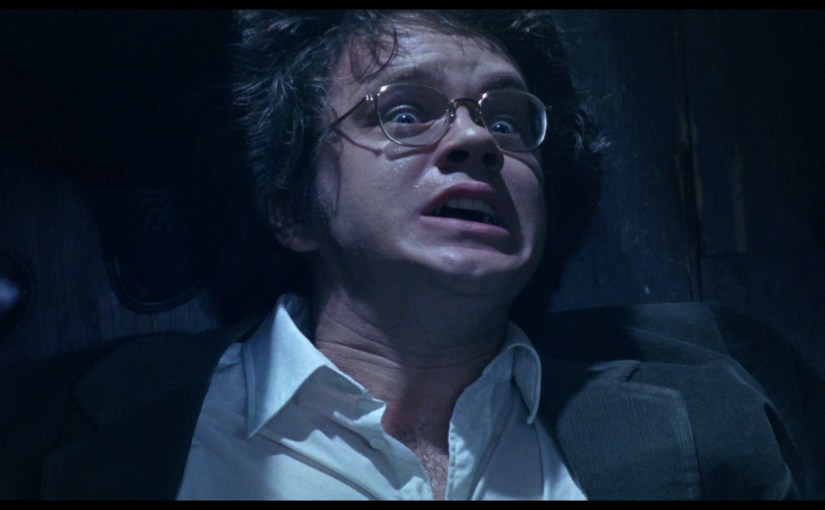
Tim Robbins is Jacob Singer, a Vietnam veteran.  The picture opens up with Jacob returning from the dense jungles to reunite with his squad after what was his like hundredth bowel movement, it seems.  The squad jokes about with men’s locker room talk and then a disturbing occurrence takes place.  The next scene, thereafter, has Jacob dressed in a mailman uniform awakening from a nightmare aboard a New York subway train.  He gets off at his stop, but then he cannot find his way out of the subway station and then he encounters unsettling images like perhaps a demon or two on board a train that just misses running him down.

Much of Adrian Lyne’s film sets up sequences like this where the unexplainable cannot be explained.  Jacob now lives with a girlfriend, Jezzie (Elizabeth Peña), who is growing frustrated with Jacob’s unusual behavior.  It seems he suffers from PTSD following his time in the war, but also he mourns the death of one of his three sons (Macaulay Culkin) from his first marriage.

Robbins is especially good at not going for big moments in his role.  He’s a quiet, cheerless individual working with very little dialogue.  That’s impressive but it’s also a little boring, especially considering that for most of the film it’s near impossible to decipher what is going on, nor what is the exact story to uncover in Jacob’s Ladder.  My patience was trying, up until a stand at attention moment that came from nowhere.  Still, not much arrives thereafter. 

Jacob receives a call out the blue from one of his old army buddies.  When they meet up, it dawns on Jacob that his friend is encountering similar kinds of feelings.  When he reunites with the rest of the squad it occurs to them to sue the United States government for experimental drug treatments that were administered to them while serving in the war.  They turn to an attorney played by Jason Alexander in a role far off from his Seinfeld sitcom days to later come in his career.  This lawsuit may uncover a link for Jacob.  Unfortunately, I think it diverts away from Adrian Lyne’s intended lack of clarity for another kind of movie altogether.  The movie goes in this detour with Alexander’s attorney role and then finds its way back on the main road for the third act.  Hardly any new mileage was to be gained from this rerouting though.

This new development may give a more literal understanding into Jacob’s psyche and condition. However, I think the film fails to pounce on a new opportunity to attack a topical storyline that had become suspect during the actual timeline of the war.  As the film arrives at its conclusion, the script seems to rush to the surprise ending it wanted to garner.

Frankly, an early conversation with a Jacob’s chiropractor (Danny Aiello) easily spelled out the twist for me.  Alas, perhaps that took me out of the film early on. 

There are good ideas and good performances to be had in Jacob’s Ladder.  Yet, I don’t think the film entirely works because of Adrian Lyne’s attempt to push it’s vagueness.  Demons that come out of nowhere during Jacob’s hallucinations should be scary and have a fright shock to them, but instead these moments come off like abstract art that only frustrated me. 

I always thought I knew the ending, and I was right for the most part, but why does a runaway car have to chase Jacob down an alleyway to deliver the point?  Arguably, a boogeyman like Freddy Krueger might have done a better job at disturbing a threat of death than what was ever going on in Jacob’s Ladder.

THE TAKING OF PELHAM ONE TWO THREE (1974)

by Miguel E. Rodriguez

DIRECTOR: Joseph Sargent
CAST: Walter Matthau, Robert Shaw, Martin Balsam, Hector Elizondo
MY RATING: 9/10
ROTTEN TOMATOMETER: 98% Certified Fresh

PLOT: An NYC transit chief must outmaneuver a gang of armed professionals who have hijacked a New York subway train and threatened to kill one hostage per minute unless their demands are met.


How?  How is it possible that it’s taken me this long, until fifty years after its release, to finally watch the original The Taking of Pelham One Two Three?  Until now, my knowledge of the film included only its title, its basic plot, and the fact it was remade with John Travolta and Denzel Washington.  Now that I’ve seen the original, my desire to watch the remake has dwindled from microscopic to zilch.  This is one of the most thrilling heist films I’ve ever seen, and its influences are clearly felt in the best thrillers in the decades since its release, from Die Hard to Speed to Reservoir Dogs.

In the first half of the 1970s, widely regarded as one of New York City’s worst decades (at least by me, anyway), four armed men methodically hijack a subway train, decouple the engine from the rest of the train, and bring it to a stop between stations.  Their leader, known only as Mister Blue (Robert Shaw), radios the transit system authorities with his ultimatum: deliver one million dollars to the train in one hour and leave quietly or he and his companions will kill one hostage for every minute the money is late.

The chaos that ensues is sprinkled with the kind of humor I did not expect from any cop thriller made before Die Hard.  The transit chief, Lt. Garber (Walter Matthau as an unlikely but strangely convincing action hero), must interrupt a tour he is giving to a visiting cadre of Japanese subway officials.  Colorful dialogue is provided to the transit system engineers and administrators as their carefully maintained schedule is destroyed by the hijackers.  One of Garber’s associates shows where his priorities lie when, in the middle of a hostage crisis, he complains, “Jesus…you realize the goddamn rush hour starts in an hour?!”  This and many other moments provide welcome comic relief, but they are also firmly grounded in the reality of career officials under a great deal of stress.  There is never a moment that doesn’t feel exactly right.

When it becomes clear the hijackers mean business and will have no compunction about following through on their threats, important logistical questions arise.  Where will they get the million dollars from?  The bedridden city mayor (who bears an uncanny resemblance to Ed Koch, four years before the real Koch was elected) doesn’t know.  The hijackers want it in specific numbers of bundles of fifties and hundreds.  How long will it take to assemble the money correctly, assuming they even GET the money?  Lt. Garber raises an interesting question: where will the hijackers go once they get their money?  They can’t simply get off at the next station, and they can’t leave the controls of the train while it’s in motion, thanks to the “dead man’s switch” that prevents such a thing.  What’s their end game?  Another transit official, played by Jerry Stiller, has the answer: “They’re gonna fly the train to Cuba.”

These and many other questions (including why the train is called Pelham One Two Three) are answered during the film’s running time, although one of them is answered without getting too specific because either it really is impossible to do so, or the filmmakers had no desire to lay out a step-by-step procedural for budding criminals.

One of the most important factors in the film’s success is its slam-bang pacing.  I’m not saying it’s cut together like Run Lola Run or an MTV video, not at all.  But the flow of the film is meticulously managed to keep the suspense going even when not much is happening on the train for their one-hour waiting period.  This is accomplished by having a local beat cop happen upon the train and provide close-cover reconnaissance to the transit authorities.  There’s also suspense among the passengers, obviously, as they plead with their captors.  (They provide more comic relief when one of them asks how much their captors are asking for their release.  “One million dollars,” one of them answers.  The hostage takes a perfectly timed beat, then says, “That’s not so terrific.”  Welcome to New York, ladies and gentlemen.)

Everything comes together so efficiently, so elegantly, that it’s a bit depressing that the film’s director, Joseph Sargent, would return to his roots and make a string of TV movies with only one other high-profile film to his name 1987’s Jaws: The Revenge.  That these two movies were made by the same director is mind-boggling.

I do have one quibble, though, and I will do my best to spoil as little as possible.  It involves a showdown where one man has a gun and the other doesn’t, and the infamous “third rail” in New York’s subway system.  If someone can successfully explain to me why one of those two men makes the choice he does, I will be happy to mail them a shiny new penny.  As it stands, that man’s decision made zero sense to me.  It almost felt like the screenwriter had written himself into a corner.  It was the one questionable moment in the entire film for me, but it did not ruin the movie, for what it’s worth.  It’s still an amazing ride.

The Taking of Pelham One Two Three deserves to be mentioned on any list of great ‘70s thrillers like The French Connection and Dog Day Afternoon, especially the latter with its tricky mix of humor and suspense.  It grips you with its realism and credibility right from the opening scenes and barrels along with barely a minute to breath right up to the literal final image.  This is superior filmmaking, and any fan of film, at any level, needs to add this to their must-watch list.

THE SCORE

By Marc S. Sanders

Nothing like a good heist thriller.  Am I right? 

It is hard to believe that Marlon Brando’s final performance was with Robert DeNiro and yet the two were never part of the same cast before.  Finally, though, the Oscar winning actors, who were both recognized for portraying Vito Corleone, teamed up for a little film that contained some daring thrills while also welcoming some crackling good acting scenes together.  Edward Norton joined them, and it worked sensationally.  The Score, directed by Frank Oz, is a forgotten gem, or in this case as priceless as the gold and jeweled scepter the three set their sights upon stealing.

Filmed on location in Montreal, DeNiro portrays Nick, a professional thief who is very disciplined in his work and would never dare commit a heist in his own town where he publicly operates as a jazz nightclub owner.  As the opening scene suggests, he only practices outside of his city and usually outside of Canada.  Yet, a brash cocky kid named Jack (Norton) enters his private life with a proposition too good to pass up.  DeNiro’s handler/investor, Max (Brando), urges Nick to overcome his reluctance and team up with Jack for one last score that’ll rake in thirty million dollars. Once the job is done, six million is earmarked for Nick.  Finally, Nick can get out of this business and move on with his nightclub mortgage paid off.  He can also get more serious with his stewardess girlfriend Diane (Angela Bassett). 

The MacGuffin?  A scepter from the 1600s that was crafted for French royalty.  It is currently locked in a state of the art safe located within the basement of the Montreal Customs Building.  This fortress is equipped with cameras, security guards, sensors, you name it.  Jack is working on the inside, posing as a mentally challenged maintenance man.  He supplies all the intel to Nick with ways to get inside showing him who is doing what, where and how.  Nick then prepares the strategy around what information is collected.

The shakedown of The Score is nothing unfamiliar.  The enjoyment comes from the acting scenes between the actors, especially when it is DeNiro and Brando.  It is as thankful to see these two legends perform on screen as it was to see DeNiro team up with Al Pacino in Michael Mann’s Heat.  This older interpretation of Brando is so entertaining.  He has a lot of fun with Max’ sarcasm and when he curses it just comes so naturally.  Just a huge departure from what the actor did in classics like Streetcar and On The Waterfront.  DeNiro is great at chastising Brando’s character with the risks he’s taking at getting them in trouble.  Their dialogue works beautifully with their performances.

Same goes for DeNiro and Norton.  It’s not so much a mentor/student relationship.  Right from the start, there is friction. Nick is overly cautious while Jack is anything but.  Yet, the film primarily focuses on the thieves’ preparation for the big job and the characters speak as if there is a trust or honor among them, but the skepticism remains.  Often Jack is defiant of Nick’s specific instructions.  Norton is great going at odds with DeNiro.

Once the wheels are set in motion, the pattern of the script is to introduce one unexpected obstacle after another.  At one point the men realize they need a particular access code.  So, an exchange in a public park has to take place. Against Nick’s wishes, Jack plays a potentially dangerous game.  Later, it is learned that the scepter might be moving on from Montreal.  So, the job has to be completed much sooner than planned.  Max seems to be hiding some details as well that leave Nick uneasy.  By the time all these bridges are crossed you have a solid foundation for the first two acts of the film before the heist gets going.  It’s all good stuff.  The epilogue to the picture is very satisfying as well with a couple of unexpected twists thrown in.  When a bag gets unzipped, you’ll likely be nodding your head and applauding.

Edward Norton is a fantastic character actor (when he’s not being a straight lead in other films).  Just like in films such as The Incredible Hulk, Fight Club and especially his debut Oscar nominated performance, Primal Fear, he dons a dual personality for this role.  Norton easily contorts his physicality to portray “Brian” the guy who’s working on the inside of the Customs Building.  When the persona is shed though, Jack is a guy that most need to be careful to trust or go up against.  Edward Norton demonstrates such ease with the transitions from one personality to the other. 

Angela Bassett is terrific actor, but her character belongs in another movie.  The one shortcoming is that Bassett feels more like a prop for DeNiro’s motivation rather than a fully-fledged love interest.  Out of context, the scenes they share are really impressive, but within the framework of the picture, Bassett comes off as an inconvenient detour.  It’s not her fault.  The relationship between Nick and Diane just does not seem to belong here.  I never had any urge for their happily ever after wrap up.  I was only concerned with Nick, Jack and Max pulling off the score.

Another minor shortcoming is Howard Shore’s soundtrack for the film.  It plays with loud horns that scream official action.  Yet, when the scenes are absent of music or only accompanied by soft jazz performances from Mose Allison and Cassandra Wilson does The Score feel like it is in its quiet mood comfort zone.  Howard Shore’s louder pitch just feels a little too intrusive here because these guys operate in whispers and clandestine actions.  I especially get a kick out of how Nick and Jack use their special tools that quietly click and turn and thump with no other sound in the area.  Their hardware work like musical instruments. 

Overall, this is a delicious, sophisticated thriller with an outstanding cast and Frank Oz’ direction thankfully does not get too inventive because he knows he’s assembled an A plus collection of actors.  Oz also has the art design and scenic details within Montreal working to his advantage. The locales are peppered in with a welcome French culture along the cobblestone streets.  DeNiro and Brando seem very comfortable and absorbed in this city that’s rarely used as a backdrop in film. Lastly, the procedure of the actual theft at play is a lot of fun to watch as it all seems plausible but still impressively crafty.

It’s worth your risk to check out The Score on a Friday or Saturday night when you need to get away from the chaos of everyday life.  It’s a quiet, relaxed suspense yarn that’s so very pleasing.

NOTE: If you have not seen the film yet, I encourage you to stay away from the trailer which can be found online.  I believe too many of the twists and surprises contained within the movie are revealed simply to bait an audience.  The less you know about what happens, the more satisfying the picture is.

THE GRIFTERS (1990)

by Miguel E. Rodriguez

DIRECTOR: Stephen Frears
CAST: Anjelica Huston, John Cusack, Annette Bening, Pat Hingle, Charles Napier, J.T. Walsh
MY RATING: 9/10
ROTTEN TOMATOMETER: 91% Certified Fresh

PLOT: A small-time con man has torn loyalties between his new girlfriend and his estranged mother, a high stakes grifter working for the mob.


Imagine your favorite film noir from the 1940s and ‘50s.  The Big Heat, say, or Double Indemnity.  Now imagine someone remade it, set it in the modern world, retained most, if not all, of the hard-boiled dialogue and characters, threw in some gratuitous nudity, and added some Freudian subtext that would have made Oedipus blush.  Oh, and imagine David Mamet directed it.  Voila…you’ve got 1990’s The Grifters, directed by Stephen Frears and co-produced by none other than Martin Scorsese.  It tends to move just a tad slow at times, but all that simmering pays off in the movie’s phenomenal final reel.  I am going to have to tread carefully indeed to avoid spoiling some of the movie’s best surprises.  Here goes:

As the movie opens, we are introduced to three very different characters, at least on the surface.  Lilly (Anjelica Huston) works for the mob by visiting horse racing tracks across the country and laying pricey bets on long shots to bring the odds down just in case they pay off.  She also skims just enough off the top to stay under the radar.  Roy (John Cusack) is a young man pulling small-time cons of his own, like the one where he flashes a $20 bill at a bartender, then pays with a $10 bill instead, getting $20 worth of change at half the price.  And Myra Langtry (Annette Bening in her breakout role) is first glimpsed attempting a lame con at a jewelry shop that ends with her offering her body to the jeweler instead.  (I like the fact that nearly everyone calls her “Mrs. Langtry” even though no one seems to have laid eyes on her husband.)

Myra is Roy’s vivacious new girlfriend.  Lilly is Roy’s estranged mother; she had him when she was fourteen years old (yikes) and he left home at 17, as he puts it, “with nothing but stuff I bought and paid for myself.”  Roy values his independence above all else, maybe even more than the money he’s “earned” and stashed away behind the ugly clown paintings in his living room.  So, when Lilly unexpectedly drops by his apartment in Los Angeles (which she always pronounces “Los Ann-guh-leez”) on her way to the track at La Jolla, he lies about his livelihood.  The last thing he wants is a concerned grifter mother trying to partner up with him.  He learned that from a mentor years ago, seen in a flashback: “You take a partner, you put an apple on your head and hand the other guy a shotgun.”

Due to an injury sustained from a bartender who caught him in a grift, Roy winds up in the hospital, where Lilly meets Myra for the first time.  They are not impressed with each other; their introductory conversation is brief, but it plays like Bette Davis clashing with Joan Crawford.  We get a little more information about Myra’s situation when we see her go home to her apartment where she is met by her landlord, Joe, who demands payment on her outstanding bill.  Her response is to bat her eyes and launch into a patter of what sounds like a radio or TV commercial.  “You, too, could learn to dance!  All you need is a magic step!”  After some more back and forth, she lies down naked on her bed and offers Joe a choice: “Only one choice to a customer, the lady or the loot.  What’s it gonna be?”

What makes a scene like that sparkle, along with virtually every scene in the film, is the fierce individuality displayed by the characters.  They are each wholly original, not simply placeholders for foregone dialogue or plot developments.  In classic film noir, the lead character is usually a smart guy (or gal) who thinks he’s smarter than everyone else but gets caught off guard by his own desires.  In The Grifters, all the main characters are smart…and they stay that way the whole movie.  There is not one single plot development that evolves because anyone makes a dumb decision.  You can see that they all have a clear view of all the angles, and no one is going to make a stupid choice for the sake of the script.  I can’t tell you how rare that is.  The plot and the story unwind and are wound up like a precision watch.  By the time the credits roll, you can see exactly why each character made the decisions they did, leading them to the shocking finale in the last reel.

I really can’t say more about the plot without simply retelling scenes or giving away spoilers.  Throughout the film, Huston, Cusack, and Bening deliver performances that would be right at home in a Mamet film.  They’re allowed to show more emotion than can usually be found in Mamet (I’m thinking particularly of House of Games), but their pared-down, hard-boiled dialogue cuts to the heart of the matter without being flowery.  There’s a scene involving Lilly’s boss, Bobo, played by Pat Hingle with a flat-eyed menace that would make Sonny Corleone run for cover.  His deadpan dialogue with Lilly about oranges is one of the tensest gangland conversations I’ve ever seen, and he does it without ever raising his voice.  Brilliantly written.

If this review has been vague, it’s because I am trying to preserve the unexpected twists and turns about who’s who, and who’s hiding what, and why.  If you find yourself wondering why things are moving kind of slow in the first 30-45 minutes, just be patient and let your ears bask in the hum of the crisp dialogue; observe how each character behaves according to their character, not according to a script; and marvel how a movie set in modern day can still have dizzy dames and classy broads and world-weary heroes and not feel like a relic from the 1940s, but instead feels as fresh as a movie that was released yesterday.  The Grifters is nearly-buried treasure that deserves to be rediscovered.

THE GUNS OF NAVARONE (United Kingdom, 1961)

by Miguel E. Rodriguez

DIRECTOR: J. Lee Thompson
CAST: Gregory Peck, David Niven, Anthony Quinn, Anthony Quayle, Irene Papas, Richard Harris
MY RATING: 8/10
ROTTEN TOMATOMETER: 92% Fresh

PLOT: A team of Allied saboteurs is assigned an impossible mission: infiltrate an impregnable Nazi-held Greek island and destroy two enormous long-range field guns preventing the rescue of 2,000 trapped British soldiers.


The Guns of Navarone is a “message” picture cleverly disguised as a World War II action-adventure/thriller.  No surprise there since the screenwriter was Carl Foreman, who also co-wrote 1957’s The Bridge on the River Kwai, another stirring wartime adventure with a strong anti-war message buried inside.  I found it interesting that, in the multiple behind-the-scenes documentaries on the Blu-ray, not one of them mentioned the one movie which I feel most resembles The Guns of Navarone: 1967’s The Dirty Dozen.  In both films, teams of men mount insurmountable odds to accomplish an insanely difficult mission, incurring casualties while ultimately succeeding.  In both films, there is a buried, or not-so-buried, subtext about the futility of the mission and/or war in general, while still gluing audiences to their seats.  However, given the timeframe of the release of The Guns of Navarone in the early 1960s, I find it to be the more surprising of the two, despite the foregone conclusion of the movie.

The movie’s narrated prologue tells us everything we need to know.  (Forget for a moment that there is not, and never was, a Greek island called Navarone.)  In 1943, two thousand British soldiers marooned on the island of Kheros must be evacuated before Germany convinces Turkey to join the Axis.  But the only sea lane to Kheros is defended by two massive German guns built into the sheer cliffs of the island of Navarone.  The guns must be knocked out of commission by a team of Allied saboteurs before any rescue attempts can be made.  This team will be led by Captain Mallory (Gregory Peck), Corporal Miller (David Niven), Colonel Stavros (Anthony Quinn), and Major Franklin (Anthony Quayle).  Along with the rest of the team, they must sneak on to Navarone, scale a steep cliff at night, and sneak across the island to the guns, hooking up with Greek resistance fighters along the way.  These details are laid out with admirable brevity, during which we are given just enough information about each of the three primary characters to understand their actions once the mission is underway.

The Guns of Navarone may be constructed almost entirely out of war movie cliches regarding desperate men behind enemy lines on a secret mission, staying undercover, close calls, and unexpected setbacks.  However, I enjoyed how much Navarone sort of “leans into” the material.  It’s almost as if the filmmakers said, “Okay, so this is a cliché, right?  We might as well embrace it and do it up right.”  For example, we find out that one of the squad commanders has a nickname: “Lucky.”  In the history of movies, any character in a war picture named “Lucky” has been anything but.  You know this, I know this.  Even so, as events transpired, I found myself thinking less and less about the most cliched material and just admiring how it was executed.  It’s a tribute to the director, J. Lee Thompson, that he found a way to present everything in such an uncomplicated fashion that its very directness pushes aside our suspension of disbelief.

That’s not to say there aren’t a couple of surprises.  Capt. Mallory devises an ingenious method of dealing with a man so injured he may have to be left behind.  A clandestine trip to a local doctor turns into something quite different, offering Anthony Quinn the opportunity to perform some amazing off-the-cuff histrionics that would make Nicolas Cage envious.  The Greek resistance fighters turn out to be two women who offer much more to the story than mere eye candy or comforting shoulders.  (One of them, played by the great Irene Papas, may even be the strongest member of the squad…discuss.)  David Niven’s character, Corporal Miller, is given two remarkable speeches that would have stopped a lesser film in its tracks, considering their anti-war and possibly even anarchic sentiments, including this exchange:

Mallory: And if Turkey comes into the war on the wrong side?
Miller: So what!  Let the whole bloody world come in and blow itself to pieces.  That’s what it deserves.
Mallory: And what about the 2,000 men on Kheros!
Miller: I don’t know the men on Kheros, but I do know the men on Navarone!

Was that kind of dialogue or sentiment even possible in a war movie made in the ‘50s?  (Aside from The Bridge on the River Kwai, of course.)  A war movie made in 1961, just fifteen years after The Greatest Generation rallied to defeat the worst dictator in history, and one of the main characters seems to be advocating desertion in order to survive the night?  Wow.

In my eagerness to describe how, I guess, subversive The Guns of Navarone is, I have yet to mention the action.  It’s top-notch.  Find it in your heart to forget how some of the effects are clearly matte paintings and models and miniatures and remember that this was top-of-the-line production values in 1961.  In fact, Navarone won the Oscar for Best Visual Effects that year.  There’s an impressive shipwreck sequence, attacks from dive-bombing airplanes, massive formations of tanks and troops (provided by the Greek monarchy), and the titular guns themselves, full-size props that dwarfed the actors and belched real fire when activated.  No expense was spared to provide audiences with true spectacle.

Is The Guns of Navarone perfect?  I mean, I personally could have done without the sequence where one of the soldiers sings along at a local wedding.  The story itself is ageless, but the film doesn’t quite feel timeless, despite its anachronistic tendency towards liberalism in the middle of a war zone.  There are one or two story decisions that I found questionable.  (One character’s death looked as if he was basically committing suicide, and I found no reason for it story-wise.)  But there’s no denying it’s a thumping good yarn.  And come on, who doesn’t enjoy watching Gregory Peck and Anthony Quinn tear up the screen for two-and-a-half hours?

THE INCREDIBLE SHRINKING MAN (1957)

by Miguel E. Rodriguez

DIRECTOR: Jack Arnold
CAST: Grant Williams, Randy Stuart, April Kent, William Schallert
MY RATING: 8/10
ROTTEN TOMATOMETER: 83% Certified Fresh

PLOT: After being exposed to an ominous mist, Scott Carey starts to shrink in size, baffling medical science and subjecting him to unanticipated dangers.


I appreciate the seemingly endless string of 1950s sci-fi/monster movies in the same way I appreciate the short films of Georges Méliès: I acknowledge their place in movie history and their influence on the films of today, but I have no overwhelming desire to hunt them down and watch them.  If that makes me a dilettante, so be it.  I remember watching some of those ‘50s films as a boy on Saturday afternoons, although the titles elude me.  (One of them was in 3-D, requiring a trip to the local 7-11 to get a pair of those funky cardboard glasses.)  As young as I was, I could already see that these were not exactly Hollywood’s best films.  The plots were creaky and repetitive, the special effects were barely passable, the scripts were hammy and the acting even more so.  The ideas behind the stories were more compelling than the movies themselves.

Imagine my surprise, then, when I sat down to watch 1957’s The Incredible Shrinking Man, directed by Jack Arnold, the man behind a few of the most famous entries in the sci-fi/horror craze at that time: It Came from Outer Space, Creature from the Black Lagoon, This Island Earth, and Tarantula.  Even though Shrinking Man appears on the National Film Registry as well as the invaluable list of 1,001 Movies You Must See Before You Die, I was prepared to be mildly bored with cheesy effects and overwrought acting.  Instead, I was genuinely thrilled by the adventures of Scott Carey, an everyman whose body inexplicably starts to shrink and shrink, until one day a housecat poses a mortal threat and a household spider – well, a tarantula – becomes as symbolic as anything from Hemingway.

A plot summary seems mildly superfluous: while boating one day with his wife, Scott Carey unwisely remains topside as a mysterious cloud of mist passes over their boat, leaving his body coated with somehow ominous glitter.  Six months later, he starts to notice his clothes aren’t fitting as they should.  His wife, Louise, barely has to stand on her tiptoes anymore to kiss him.  Doctors are baffled, but promise to do whatever they can, spouting pseudo-scientific nonsense about phospholipids and a “deadly chemical reversal of the growth process.”  There is some unintentionally (?) suggestive dialogue as Scott expresses his concerns to Louise: “I’m getting smaller, Lou.  Every day.”  And: “You love Scott Carey.  He has a size and a shape and a way of thinking.  All that’s changing now.”  Not exactly Michael Crichton, but I rolled with it.

One of the things that sells the movie and the story is the ingenious production design that kicks in when Scott reaches about 36 inches in height.  As he walks around his living room, everything has become larger than life.  When he sits in an easy chair, his head doesn’t even reach the top of the back.  A pencil is larger than a baseball bat.  He despondently visits a diner, where a cup of coffee is as big around as a beer barrel.  This aspect of the film seemed reminiscent of, say, a Disney movie.  It seems obvious at first, but it’s done so well that I was drawn into the illusion completely.  Some clever trick photography manages to put the shrunken Scott in the same frame as the full-size Louise many times.  Even my experienced eyes couldn’t see the “splice” without a lot of searching.

Scott eventually shrinks to just a few inches tall and must resort to living inside a literal dollhouse, another triumph of production design.  This sets up the first major set piece of the movie as their housecat sees the tiny Scott as a tiny morsel and attacks the dollhouse.  Scott winds up in the cellar, Louise comes home and assumes the cat has eaten her beloved husband, and Scott, unable to climb the now-inaccessible staircase, must navigate the menacing wasteland of a dimly lit cellar in search of food and water.

This central portion of the film is what sets it apart from most other similar films of its era.  The screenplay was written by Richard Matheson, based on his book.  Matheson also wrote I Am Legend, and in both stories, there are long passages where a solitary character is alone with his thoughts and must solve life-or-death problems with no one to talk to.  The silence of Shrinking Man during Scott’s adventure in the cellar is striking.  The film started with narration, and I expected it to last throughout the cellar sequences, but the filmmakers wisely decided to keep it minimal and focus instead on Scott’s actions, allowing the audience to think along with him instead of telegraphing what he was thinking.  I was reminded of Cast Away (2000), although poor Scott never gets a Wilson.  Instead, he’s stuck with the resident tarantula that becomes his nemesis.

I should mention the subtext of the story, even though it’s not something that occurred to me while watching.  I’m told in various documentaries that Matheson wrote his novel The Shrinking Man in 1956 during a bout of depression and insecurity as a new father.  Scott’s shrinking reflected Matheson’s own sense of insignificance under the responsibilities of a father and husband in an age of accelerating technology and the fears of the Cold War.  This is something that might have been far more obvious to audiences of the time than it is to a member of Generation X, but in hindsight, it’s an intriguing added level to a story that is compelling enough on its own.  If I wanted to, I could connect this story with Michael Crichton’s Jurassic Park with its ravenous dinosaurs paired with a warning to the scientific community about the dangers of unchecked progress.  Pretty neat.

As fascinating and, at times, terrifying as the cellar sequences are, what really sets Shrinking Man apart from its contemporaries is the ending.  In virtually every other ‘50s monster film, the story ends on some kind of positive resolution where the threat is removed due to some new scientific discovery or an unexpected ally (the germs in The War of the Worlds come to mind) or, like Godzilla, it just disappears into the sunset.  This movie sidesteps that cliché by presenting the audience with an existential statement about the vastness of the universe on both a cosmic and an infinitesimal scale.  I know that sounds dry as hell, and the final monologue flirts with hokeyness, but listen to it carefully, and the ideas in it are grand and mystifying.  It mentions “God” here and there, but if you think of God, not as THE God, but as the unknowable engine of fate and/or the cosmos, the sentiments expressed have thought-provoking implications.  Scott’s last words in the film may sound simplistic, but they’re loaded with meaning, and can be applied to his own situation or to anyone struggling with the meaning of their own existence.  Pretty heady stuff for a sci-fi/special effects genre movie.

Where other films of its kind attempt and fail to ascribe grand themes to their kitschy stories and rubber-suited big-bads, The Incredible Shrinking Man actually made me think.  That’s an accomplishment.