CHRISTY

By Marc S. Sanders

Boxing movies are nothing new.  The best ones depict the fighter surviving personal battles outside of the ring.  That was likely true with the fictional Rocky Balboa.  It might have also been what kept Jake LaMotta alive well beyond his demons.  It’s definitely a fair argument for Christy Martin, the first boxing champion to bring the sport into the mainstream for females.

Her story comes to the big screen with an astonishing Oscar caliber performance from Sydney Sweeney.  I saw Christy a week ago and I cannot stop thinking about it.  The material within this biography from writer/director David Michôd is entirely familiar.  Still, the character of Christy and what she endures is worthy of a movie.

Beginning in 1989, eighteen-year-old Christy Salters haphazardly begins her climb up the ranks with small time underground fights in her Virginia hometown.  She’s not educated and she’s not embarrassed about being in a relationship with her girlfriend.  Her bible loving mother Joyce (Merritt Weaver in an authentic, all too real and villainous role) says otherwise. She’d take her daughter to the local minister to draw the gay out of her if the girl wouldn’t rebel with a temper inflamed by F-bombs.

Christy is summoned for higher stakes fights in Texas.  She wins that one and then is connected with Jim Martin (Ben Foster) who witnesses one hard swing from the girl in a sparring match. He commits his entire life to being her coach.  Ask Jim and he’ll say he made Christy what she becomes, a near undefeated champion adorned in signature pink and on the cover of Sports Illustrated – a first for a female boxer.  The film reminds the audience that Jim’s perspective is hardly true.  This jerk nearly screws up Christy’s chances of getting a lucrative contract with Don King (Chad L Coleman) which included pre-fights ahead of Mike Tyson’s Vegas appearances in the ring.  If only Jim’s laziness and procrastination were his worst qualities, though.

Christy becomes an emotional challenge to watch as it progresses. David Michôd’s film burrows into the dark underbelly of athletic success. Once Jim and Christy are married, a limited lifestyle cages the young phenomenon with the husband/coach’s monstrous tendencies.  The torment that victimizes this woman is beyond compare as she must succumb to demonizing sex slavery for his twisted, intoxicating yearnings, as well as for anyone he collects money from who ready to engage in brawls with her, in dirty hotel rooms.  Working in her corner at the fights, Jim does not protect Christy against opponents that she is clearly no match for.

Christy is physically abused and mentally tortured by Jim, and maybe by other intimidating powers like Don King.  Chad L Coleman delivers a brilliant and familiar persona to King.  The boxer is also financially getting ripped off, despite opening a Florida gym in her name with Jim listed before her on the front door.  

It’s astonishing to see how much peace Christy can find in a boxing ring alone against an opponent.  At home, she can only acquiesce to what’s demanded or forced upon her.  There’s no fight at home.  Only surrender.

I had recently seen Sydney Sweeney host Saturday Night Live.  It was one of many terrible episodes in the show’s history because the writers only catered to Sweeney’s youthful glamour and looks.  There was a skit taking place in a Hooter’s restaurant where her character was collecting the biggest tips based upon how she filled out the signature uniform.  It was lousy, unaware and insensitive writing.  Actors like Anne Hathaway or Natalie Portman were never treated this way on the program. None of the skits gave Sweeney something unique and worthy of what she’s capable of.

In Christy, with a white trash twang, and a puffed up brunette curly hair style (later it becomes blond corn rows), Sydney Sweeney is doing what Meryl Streep would have committed to in a physically taxing role like this.  Sweeney demonstrates a focused young girl going after what she wants even if it means she has to make up for her husband’s shortcomings as a negotiator.  He’ll beat the shit out of her, but Christy Martin matures as Michôd’s film progresses with intense training moments and riveting fight scenes that have Sweeney in action.  

Ben Foster is that committed actor who never looks the same in two different roles.  I didn’t even recognize the former Disney kid until I saw his name in the end credits.  Outdated polyester clothing and track suits from the 1990s do not hide that paunch, ugly belly.  Christy’s winning purses of prize money cannot conceal his bleach blond combover or his trashy southern accent.  Yet, he is nothing but noticeable when he is on screen.  Foster is the worst kind of cad with a terrifying grip on his wife and her career.  A terrible eyesore within the presence of the film.  Jim Martin is none too bright, but he knows how to hold a wrenching grasp and he’s entirely frightening.

Merritt Weaver is the quiet antagonist.  Unlike Foster’s character, the mind games that Joyce plays on her daughter are not so intentional as they are natural.  This mother refuses to see beyond the expected dominance of a man to uphold a catholic home, devoid of sinful lesbian practices.  It’s awful when a mother will side with a daughter’s abusive husband. Weaver’s portrayal of Christy’s bible committed mother demands to be hated.  

Ahead of seeing this film, I knew nothing about Christy Martin.  So, when a shocking moment occurs in the third act, my jaw dropped at the direction of the scene.  An action occurs and Michôd’s camera seems frozen in position as a character paces in and out of the room.  Then the character returns and commits a much uglier act.  Then the back-and-forth pace continues with a harrowing stare down before exiting to take a shower.  I know Christy is just a movie.  Yet, I cannot recall the last time I felt so helpless as a witness to what I was observing. I wanted step into the screen and lend aid. I only hope that when the film comes out in digital format, some insight is provided into how Sydney Sweeney and Ben Foster circumvented around their clashes of characters.  All of it feels too real.

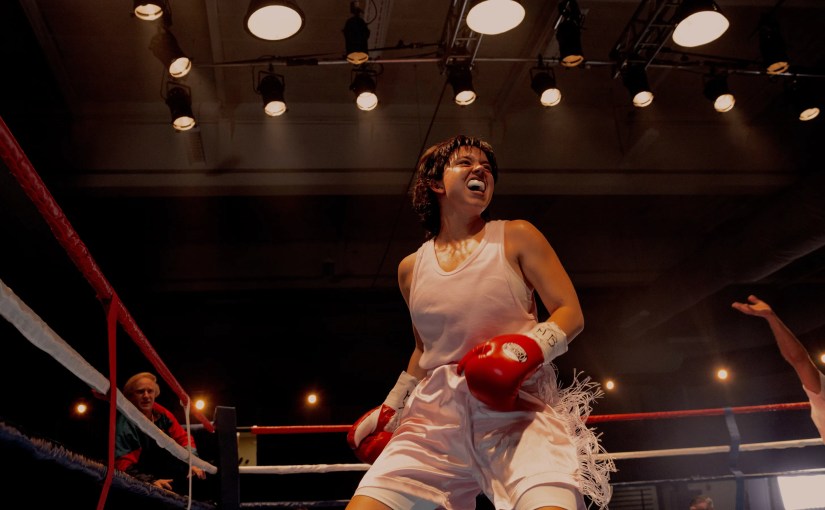
Sydney Sweeney is also convincing as the battering boxer.  Like most films that cover sports, there are typical training and fighting montages here.  Sweeney is not afraid to behave ugly for the showmanship needed to be in an elite ring.  There’s one expression she delivers in a blink/miss wide shot lens after she knocks out an opponent.  It feels so organic as a bloodied Sydney Sweeney outstretched with her gloved fists, prances around the ring, gives a shoulder shrug and sticks her tongue out.  This actress knew exactly how to play this character, soaked in sweat with blood streaking out of her mouth and nose absent of any kind of humility that would show weakness in a champion fighter.

I am afraid though.  Christy is currently not the box office titan it deserves to be and come awards time, I’m certain Sweeney, Foster, Coleman and Weaver will be wrongfully overlooked.  Sydney Sweeney, a producer on the film, was asked what her reaction is to the sluggish financial returns.  Best she could, she replied by saying not all films are made for the money.  Some need to be made for the art.  I’ll go a step further and declare that Christy serves as an advocate for awareness of domestic violence and prevention.  Amazingly though, this film executes astounding triumphs for those underdogs who have next to nothing.

Christy is one of the best films of the year.  
ROCKY III

By Marc S. Sanders

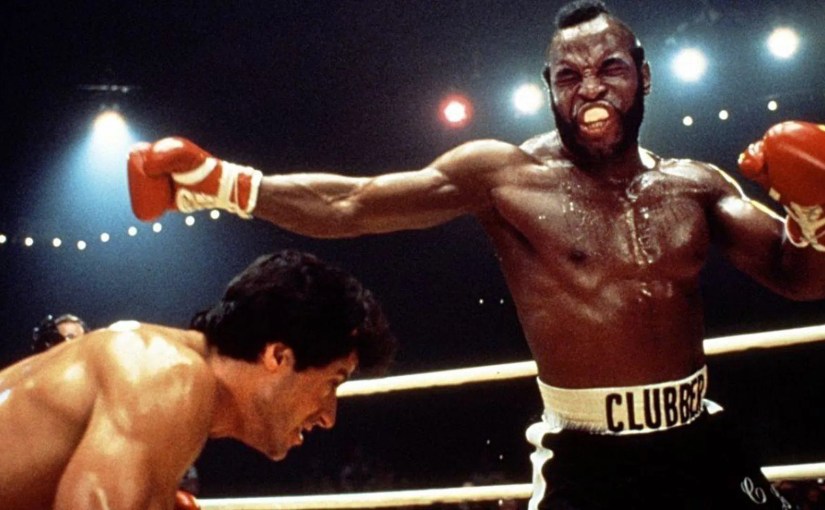
By the time a series of franchise films reaches its third installment there better be something interesting for the characters to encounter.  Otherwise, it is the same old show.  Not many talk about it, but Rocky III actually does have something new to offer even if the story still feels like the same kind of tread.  What’s new?  Mr. T!

In the lexicon of greatest villains of all time Mr. T’s introductory role of Clubber Lang, the fierce boxer who lacks pity for a fool, should be included within these tabulations.  Reader, I challenge you to find him listed anywhere.  I don’t think you’ll be successful.  Not even as a runner up. That is a terrible oversight.

As Rocky III opens with a quick flashback of Rocky Balboa (Sylvester Stallone who also writes and directs) winning the championship away from Apollo Creed (Carl Weathers), quick cuts of the hero show him knocking out one fighter after another with debonair ease.  When he’s not boxing, he’s posing for commercials and magazine covers, or he’s riding his custom-designed Italian Stallion Harley with his wife, a glamorous Adrian (Talia Shire) on the back.  Juxtaposed within this montage, played against one of the greatest songs in film history (Eye Of The Tiger by Survivor), is Clubber Lang executing bloodletting beatings on his own opponents.  He’s angry and he threatens to kill Balboa in the ring. Rocky’s mainstay coach Mickey (Burgess Meredith) attends these fights and grows fearful of this new menace.  Clubber will not give up on this campaign until he has his shot in the ring with Rocky.

Rocky III has a glossy finish the first two installments deliberately withheld.  The photography is sharper. Stallone is quite handsome, rich and fit.  Adrian has abandoned the meek bashfulness and nerdy, wing shaped eyeglasses.  Their furnished house sits on a gorgeous estate complete with servants, a golf cart, and a little boy all their own.  The filth-ridden areas of Philly are behind these protagonists.  Welcome to the materialistic and decadent 1980s.  Frankly, I like how nice and put together everything feels in Rocky III.  It truly is a window into what much of the 1980s looked like.  Stallone and Shire’s characters have evolved amidst their wealth, and I continue to like them. 

The one ingredient that carries over is the alcoholic slob, Paulie (Burt Young), whose grumpiness hasn’t changed.  He is a given a substory in the first ten minutes of the film where he shows his resentment for Rock.  Then, the slugger bails him out of the drunk tank, gives him a job, and he only remains through the film for a few laugh bits.

(SPOILER ALERT) Following accepting the challenge to fight Clubber Lang, Rocky loses in terrible defeat just as Mickey suffers what will be a fatal heart attack.  Not only does he lose, but he cannot overcome his sorrow, and fear has intruded upon his psyche.  Apollo volunteers to train Rocky and encourages him to do one last fight against this new opponent, now champion.  Only now, Rocky has to get that “eye of the tiger” back and he needs to move light on his feet like Apollo originally learned.

Everyone in Rocky III has an energy about them.  These actors are used to one another even if Stallone and Weathers were on opposite sides for the last two films.  Stallone’s script experiments with testing his boxing character to lose what he earned organically in his earlier films.  He also sketches the guy with conceited fault ahead of the film’s first fight when he showboats his training and does not take this new fighter seriously enough.  This is good material for a third follow up piece.  It’s certainly more exciting than what Rocky II offered.

However, the film belongs to Mr. T who became a pop culture icon of the 1980s with gold jewelry, the mohawk, a TV action series, cartoons, toys and guest appearances on telethons, Johnny Carson, Diff’rent Strokes and Silver Spoons.  Forty years later, he deserves some recognition for the impact he had on the American psyche.  This guy was a big influencer.  No one has ever replicated what Mr. T delivered.  If you watch Rocky III again, you can’t help but get caught up in how hostile his Clubber Lang is.  I doubt this guy was written this broad or aggressive in Stallone’s script pages.  Clubber Lang is a villain that owns this picture anytime he appears on screen.  Mr. T is not a diverse actor by any stretch but the personality that was introduced here is unforgettable.  During both training and boxing montages, his muscular physicality is an astonishment, and he’s a terrifying new kind of monster with every threat he screams at this cast of likable heroes.  This guy would burn the whole happy village down if given the chance.

I’m also impressed with Talia Shire.  She’s not given much to do here.  For the most part she is sitting in the audience, cheering on Rocky, or watching from the sidelines while he trains.  However, there is one special scene that Stallone wrote for them that turns the tide of this ninety-minute film ahead of the inevitable, pulse racing training montage.  Her scene of truth-hurting candor with Stallone’s character on California shoreline where all of the pain and anguish surfaces is carried by her against Sylvester Stallone, the superstar.  It’s a reminder why the Rocky films were never anything without Adrian.  The love of Rocky’s life has to always be there to rescue the lug from his despair and lack of confidence.  I love this scene.

I would never argue with anyone who said this franchise became a sad joke upon itself by the time Rocky III rolled around.  The formula is very recognizable.  It’s not a tremendous sequel like The Empire Strikes Back, The Godfather Part II, or even Superman II demonstrated ahead of its release.  Yet, there is a vigor to Rocky III, and the highs and lows are told efficiently at a very comfortable pace. 

I saw Rocky III before I saw the prior two films and at age ten, this had my attention from beginning to end. It’s likely when I left the theatre, I wanted to be a boxer and pound someone’s flesh into a bloody pulp amid a cheering crowd.  I recall the whole audience in the theater applauding as soon as Rocky triumphed again.  I also recall the tears and sniffles I heard at the midway point when poor Mickey’s life suddenly ends.  These are beloved characters that we only want to remain happy and healthy.

Rocky III is not accurate to how it really is for professional boxers.  I do not think the well edited cuts of the fights are genuine either.  A lot of the footage looks like an action movie more than a sports picture.  When Clubber Lang swings with a jab, there’s a whooshing sound.  However, Stallone as a writer/director knew how to touch on the melodrama effectively with laughs, sadness, fears and cheers. 

With that amazing Bill Conti soundtrack, Survivor’s rattlesnake opening chords of their Oscar nominated song, Mr. T and, oh yeah, a giant named Hulk Hogan as a beast of a wrestler named Thunderlips, Rocky III is outstanding, pure escapist entertainment.

HOOSIERS

By Marc S. Sanders

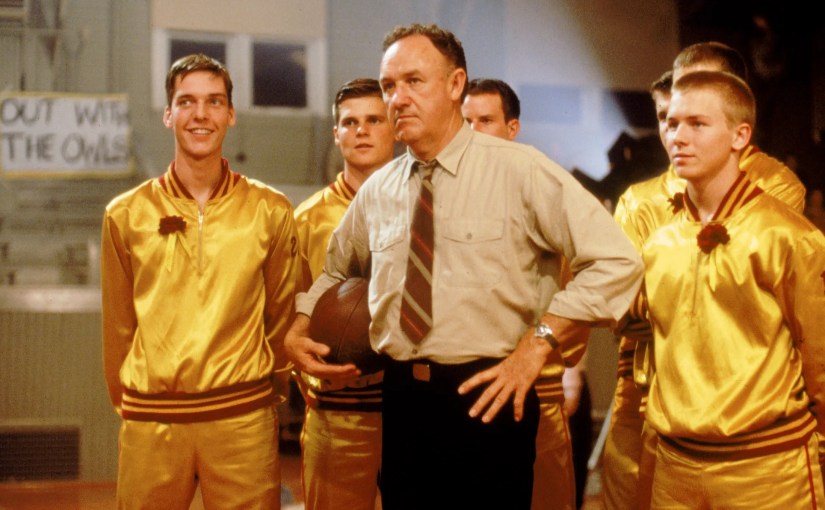
Hoosiers is a sports film offering nothing truly new or inventive.  What sets it apart though is that this high school basketball picture has Gene Hackman as the coach, Norman Dale.

Like so many films, this one occupies its opening credits with the cross country drive of the outsider arriving in small town USA with Jerry Goldsmith’s orchestral horns conducting the journey.  Welcome to the sweeping farmlands of Hickory, Indiana, 1951.  

Coach Dale has been hired by the local high school to lead the team of seven boys for the upcoming season.  Everything typical happens from there.  The potential love interest gives the guy the cold shoulder.  The town, who take such pride in the boys basketball team, find the coach unfit and work the first half of the story trying to vote him out. There’s the one kid who makes every shot and is stand offish, but just won’t play.    There’s a player who has strife with his father, the town drunk called Shooter (Dennis Hopper).  Coach gets kicked out of the games too.  Even Hackman’s recognizable short fits are here to stir it up with the referees.

Yet, is this team gonna get in shape and take it all the way to the championship?  I’ll let you decide if that’s rhetorical question.  

I dunno.  Maybe it’s because I’ve never been wild about basketball that Hoosiers just didn’t do much for me.  A film like Hoop Dreams or even the actor/players shown here impress me with their abilities to make one jump shot after another, while their capabilities to dribble appear like artistic forms of dancing.  The game however has never done much for me.  A team scores and then they go to other side the court where the other team scores.  For me, only the last few seconds of a basketball game seem important.  Otherwise, it’s a back-and-forth scrimmage to me.  Hoop Dreams lends more of a story within its tragic documentary footage than Hoosiers provides.

When I observe the team making plays on the court, there’s not much to open my eyes wider.  David Anspaugh was a new director when this movie was released. Much of the cuts within his footage are the players jumping and passing and Hackman’s sideline expressions where he slaps his play sheet before another cut to the cheering or booing crowd.  This is nothing but action takes. Where are the shortcomings and triumphs that come with cinematic athleticism?

Even the final game does not work like a story.  It’s all just a collection of basketball players making shots.  It never worked for me because I hardly know any of the kids.  The star player, Jimmy, literally has three lines in the film.  I could never pick out which young man was Hopper’s son because most of the team members are given such little attention.  It’s only when a scene or two finally presents itself for the father and son that I connect the dots, but that’s resigned for a quick last act.  The one I could always pick out was the short guy who is not very good and mostly sits on the bench.  The kid who prays too long?  Good gag, but when he’s not on one knee I don’t recall who he is among the crowd.  The players are not given distinct personalities. They are scarcely shown in close up and so I don’t know one from the other.  

Watch Teen Wolf with Michael J Fox.  Beyond the lead who is a werewolf, there are two or three others on the team that triumph, as well as faithful members of the school student body. Thus, that movie ending game becomes something entirely special and touching.

Gene Hackman is always an attraction even if some of the traits he lends to his characters are the same.  I love his grin and his quiet, sometimes sarcastic, cackle. When he throws a temper it’s not one that can be duplicated.  I’ve never seen someone who can do an exact impersonation of Gene Hackman.  He’s simply one of a kind. He’ll always be favorite actor of mine, no matter the material.

Dennis Hopper is very good as well.  He’s not just a drunk, but Shooter is a likable guy who looks worthy of a second chance.  Hopper’s body language defines all of that.  It’s not just the booze or the drying out moments that lend to the performance.  The celebrated actor is given scenes where the character is lost and helpless while trying to contribute moments of value to the basketball team.  Even the unpressed, oversized suit and greasy combover he wears tell a story.

Barbara Hershey seems underutilized.  For most of the film she proceeds with a scowl on her face, and I was never certain of her disdain for the Coach or the school where she teaches.  I could never confound exactly what her problem was anyway. At best, she’s here for an eventual on-screen kiss with the lead, but then the relationship doesn’t progress.  I read that much material went on the cutting room floor, and I can’t deny there’s an absence to her storyline.

Hoosiers is serviceable, but nothing it offers moved me and grabbed my attention.  This is a step by step sports film with every standard cliche included.  I didn’t stand up and cheer when that final shot swished through the basket in slow motion because I did that at the end of Rocky and The Karate Kid, and Teen Wolf too.  When The Bad News Bears ended I did a hard clap because those tykes had balls.  At the close of Slapshot, I couldn’t contain my laughter.  I couldn’t stop thinking about Hoop Dreams for good, long week. Other pictures focusing on athletics always possessed a way of making their stories special.  Hoosiers looks like it stole its play by play from those wunderkinds. 

TRIVIA: Look for Sheb Wooley, who portrays Hackman’s first assistant coach. He is the origin of the famous Wilhelm Scream uttered by Indiana Jones, several Stormtroopers and during the demise of various superhero villains.

UNSTOPPABLE (2024)

By Marc S. Sanders

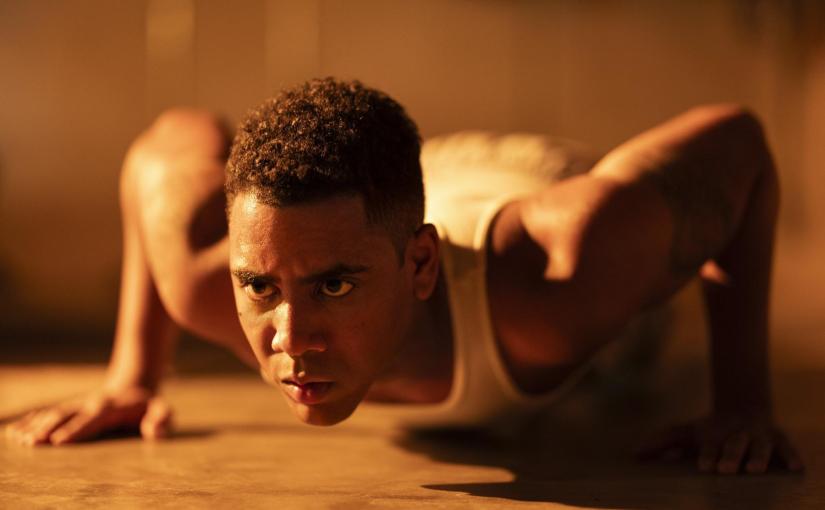
The Oscar winning film editor of Argo, William Goldenberg, finally directs his first film and it’s a winner.  The true story of Anthony Robles, the one-legged NCAA world champion wrestler is brought to the screen in Unstoppable.  While the story is paint by numbers for a typical sports movie, because it is adapted from his real-life experiences during his time at Arizona State University, it cannot help but be embraced.  The cast is sensational as well, with not one weak link.

Anthony Robles (Jharrel Jerome, the Emmy winner of the HBO miniseries When They See Us) is a good kid.  Anthony is loved by his brothers and sisters, and his mother.  They cheer him on to persist and win.  He’s a hero to his younger siblings.  Anthony also gets much encouragement from his high school wrestling coach, Michael Peña, and his co-worker that he cleans airplanes with, played by Mykelti Williamson.  Still, he has a troubled domestic life.  His stepfather is an intimidating tyrant.  Bobby Cannavale plays one of the harshest villains in recent memory.  A towering monster with a voice that’ll make you wince.  He’s verbally abusive and eventually we learn physically as well to Anthony’s mother Judy (Jennifer Lopez). 

As the film begins, following a winning match, Anthony receives an all expenses paid ride to a Pennsylvania college.  However, that school does not contend in the NCAA and despite everyone telling him to take the free ride, he has his eyes set on Arizona State.  Even ASU’s Coach Shawn Charles (Don Cheadle, and dang is he ever good) is not confident in Anthony making the final cut for the team.  Yet, Anthony defies what everyone else thinks and scrounges up the monies with his family’s support to attend the local university.  Now the challenge is to make the team against all odds with his crutches to support him through rocky terrain hikes and laps around the track while carrying heavy weights.  How does a man with one leg stand upright and manage to climb mountainous terrains in the desert heat while staying in pace with the rest of the candidates?  How does he even hold a thirty-pound weight while running the track on crutches?  Anthony Robles will show you.

Unstoppable does not offer anything new or inventive.  Anthony even reflects on the fictional character Rocky Balboa a few times.  There are challenges to overcome, not just for Anthony, but for Judy as well.  The bank wants to foreclose on their home and her husband is monster of a jerk.  Plus, there’s Anthony’s handicap which can never serve as an excuse for falling behind with the rest of his squad. 

Some matches are lost.  There are scary episodes at home.  There’s the imposing undefeated champion that Anthony will eventually have to face.  There are the loving moments between mother and son.  It’s all textbook, and the ending is predicted as soon as the film begins.  Still, had I known Anthony Robles personally while growing up, I’d be saying this story is prime for a movie or a book and that is what became of it. 

At the 2024 AFI Film Festival, there was a Q&A following the film’s presentation.  Jennifer Lopez, Jharell Jerome, William Goldenberg, and Judy and Anthony Robles were in attendance.  To watch the film and then hear of these people’s real-life experiences afterwards is astonishing.  Both mother and son came from rock bottom scenarios mired in debt and abuse.  Now, long after Anthony has finished his career as a champion wrestler, we see that the two continue their crusades.  I won’t spoil what they went on to next.  The film provides a footnote ahead of the end credits, but it is nothing short of inspiring.  The Robles demonstrate that anything is possible and nothing works as an excuse.

Jennifer Lopez and Jharrel Jerome share a lot of beautiful scenes together.  Lopez might be easy fodder for gossip columns, but she is truly a wonderful actress.  Jerome reminds me of when I first saw Cuba Gooding Jr in Boyz In The Hood, which was an astonishing debut of a promising career.  This guy needs to be cast in a lot of beefy roles going forward.  He’s a sensation. 

William Goldenberg has made an under the radar film, but it has box office success written all over it like The Karate Kid or Rocky.  His vast experience in editing allows for a well-paced two hours so that even if you know what is coming next, you remain enthralled and wanting to cheer on the protagonists. 

The film will be streaming on Amazon Prime soon, and that is perhaps it’s only disappointment.  Again, as I have written in other recent columns, a movie like Unstoppable belongs in the theatres first and seen with well attended audiences who will clap and cheer at both Judy and Anthony’s triumphs.  Some of my fondest memories are watching the heroes I grew up with played by Ralph Macchio and Sylvester Stallone finally achieving that hard-to-reach gold crown, and suddenly there’s an overwhelming cheer from the audience within the darkness of the theatre.  Remember when Rocky sprinted up the 72 steps of the Philadelphia Museum Of Art?  A cued response almost seems edited into the context of the film.  That kind of experience is absent from the private confines of a living room.

Unstoppable has joined the lexicon of amazing sports stories.  You can’t help but cry while you are cheering.

WHITE MEN CAN’T JUMP (1992)

By Marc S. Sanders

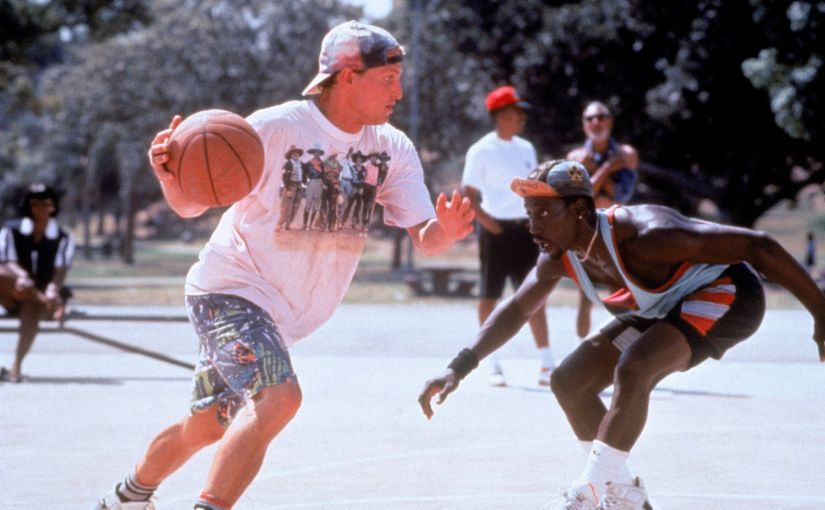
I’m not enamored so much by sports unless they are dramatized effectively in the movies.  If I can see Woody Harrelson and Wesley Snipes making magnificent trick shots with a basketball in White Men Can’t Jump, my attention will be had.  There’s lot of street corner basketball depicted in Ron Shelton’s film and for the most part it is sensational and quite funny when partnered with the on court ribbing that guys toss at one another.  This film arrived with the oncoming trend of “Your momma is so…” insults, which still bring out the sophomoric glee in me.

Fortunately, White Men Can’t Jump doesn’t just rely on the basketball antics. There’s a good set up here and some well-drawn characters.  It’s one flaw may be that I think the film overstays its welcome.  Just when you think the picture is over and every loose end is tied, a new development occurs.  That’s because every sports movie demands a final championship game.  Who made up that stupid rule?

Billy Hoyle (Harrelson) makes quick cash on the court by being the fish out of water on Venice Beach.  He’s the pasty white kid with the dorky rainbow-colored cap that any urban black athlete will happily challenge for a game of one on one or two on two.  That’s the trick to his con because he’s a magnificent player actually, and regular player and loudmouth Sidney Deane (Snipes) sees an opportunity for them to partner up and clean up.  Like most competitive sports, you gotta taunt your opponent and when they have gone overboard, you lay on your conceit and declare that you can beat them any day with any guy they choose to partner them up with, such as the blond, white guy sitting on the bench doing morning stretches. 

They each have their own motivations.  Billy is up to his neck in debt to some bookies who he wouldn’t throw a game for. They are ready to collect or shoot him in the head, or both.  His girlfriend Gloria (Rosie Perez in a standout performance) aspires to land a spot on Jeopardy!. Sidney lives with his wife Rhonda (Tyra Ferrell) and baby in the criminal area of Watts.  She’s pressuring him to get them out of the slums and buy a house in a nice neighborhood. 

At first, the cons work for the pair, but the question is can Billy and Sidney trust one another.  Will they scam each other while trying to work together?

Ron Shelton’s script works because it turns in various directions when you do not expect it.  These are unusual characters. Lovable, but not all that they seem either and they are built with flaws that will undo them while they try to make a further leap ahead.  Billy is a smart kid on the court but he’s not smart with money like Gloria.  Sidney is smart at putting up the façade of a dumb loudmouth on the court but that’s his M.O. for being a responsible family man.  Gloria seems like a zany dingbat on the surface but she may be the smartest character of them all.  It’s definately not because she has memorized every kind of food that begins with the letter Q for the game show.  She has true instincts and knows to see through the B.S. of people that her boyfriend Billy can’t. 

White Men Can’t Jump is a both a con movie and a sports movie, but it’s not the greatest of each of those categories.  Still, it’s very, very entertaining thanks to Harrelson, Snipes and Perez working in top form. Wesley Snipes is doing the fast-talking wise ass routine that Eddie Murphy built his career on.  You don’t see this kind of guy in every Wesley Snipes movie though, like you do in Murphy’s films.  That’s what impresses me with Wesley Snipes.  He’s not known to be an Eddie Murphy or a Chris Rock.  He’s an actor, not a comedian, and yet he’d convince me otherwise if this was the only performance I ever saw.  

Other than his obvious role in Cheers, Harrelson normally portrays smarter guys.  Billy is smart, but he lacks instinct and not just with money but with how he considers Gloria.  The best thing Ron Shelton could have done after perfectly casting this trio was to give these characters heart followed by the flaws that weigh them down.  All that maintains what could have been a one note and flat story.

However, the film runs a little longer than I cared for.  While basketball is at the forefront of the script, I believed the film was concluding when I saw the two guys had finally grown up and learned.  Only then, a new development occurs for Sidney and his family. Suddenly, it’s up to the two guys to get back together for one more game.  I didn’t need that one more game.  I had my fill and that final tournament is shot in slow motion – literally every shot the guys make, and I’m starting to lose my patience.  Don’t get me wrong.  I’m impressed.  Harrelson and Snipes are not stunt doubled.  That’s them doing the doing the shots and accomplishing enormous efforts of agility to wow the audience.  They’re great, but by this point, I had seen enough basketball to deliver the message and I found the tacked-on twenty-minute epilogue mostly unnecessary. 

Granted some may argue that something occurs in that last game to justify the literal title of the movie.  I know what you’re talking about.  Yet, that could have been covered a lot more efficiently, I believe.  Less would have been more in this situation.

White Men Can’t Jump is great comedic entertainment, full of improvised dialogue and characters that are easy to like while keeping up a skeptical guard on them.  That’s good.  It states that Shelton’s characters are complex and that holds my interest.  Even the extras are ones to appreciate in their sweaty t-shirts while delivering urban vernacular to harass one another.  It’s a great culture to get a peek into.  I love the one guy who is a sore loser and whips out his knife, but then just as his girl calms him down, he says forget the knife.  He’s gonna get his gun. I challenge anyone not to laugh as all the other guys on the playground make a mad dash escape in a hundred different directions.  It would likely go down this way.  We hear of violent stabbings and shootings all the time. In this movie however, Ron Shelton and his cast find the natural humor of this opposing conflict.

I guess that’s the best compliment I can give the writer/director.  He didn’t sensationalize his characters.  Ron Shelton has a way of just letting his creatures of the court play.  Into—the—basket it goes. 

SWISH!!!!  It works.

SLAP SHOT

By Marc S. Sanders

Slap Shot is to hockey what Caddyshack is to golf.  It is rude, crude and unapologetically harsh in its language, its temperament and with the memorable fraternal trio known as the Hanson brothers unforgiving with punches, slugs, checks and body slams.  The wardrobe looks dated (some of the ugliest plaids you have ever seen) and it was produced during a time when hockey players could opt not to wear helmets but it is still outrageously funny.  Best of all, Paul Newman, the guy from more upscale, sophisticated fare like Cat On A Hot Tin Roof, The Hustler, and Hud, leads the cast.  Some of the best actors are also the best comedians.  (Look at Robert DeNiro, Donald Sutherland and Clint Eastwood as well.)

The Charlestown Chiefs are the worst hockey team in the Federal League.  When the local Pennsylvania mill has announced that it is closing, it does not look good for the team as attendance will drop lower than what it already is.  The coach and oldest teammate, Reggie Dunlop (Newman), reaches for a few last-ditch efforts to elevate a demand and an appreciation for the Chiefs. 

First, he turns to reporter pal Dickie Dunn (M Emmet Walsh) and drops a made-up rumor that a Florida retirement community is interested in buying and relocating the team down south.  Then, it dawns upon him to antagonize opposing players which will lead into a series of goon fights.  His three newest recruits, the four eyed Hanson Brothers work best at bloodshed.  The enhanced violence lead to wins and suddenly the Chiefs have a new fan base that follows them on the road and sells out their home games.  Only one player, Ned Braden (Michael Ontkean) is against this new approach.  He’s college educated with a love for the game and refuses to stoop to Reggie’s level. A side story has Ned struggling with his marriage falling apart with his alcoholic wife (Lindsay Crouse).

In the meantime, as the rumor of the buyout stays alive, Reggie does his best to find who exactly owns the team.  He wants to convince that party to keep the organization running. 

Paul Newman owns this film despite a collection of fantastic characters that embody the team.  There’s the French-Canadian goalie who is not sharp at delivering proper English.  Killer Carlson (Jerry Houser) quickly develops a knack for being more of goon than a hockey guard. The team’s manager played by Strother Martin (a regular mainstay co-star in a series of Newman films) has to get the team to catwalk model the latest in fashionwear furs, and there’s Francine (Jennifer Warren).  She’s Reggie’s ex-wife, who still shares a thing with him but will not recommit while he continues to play hockey.

George Roy Hill (The Sting, Butch Cassidy And The Sundance Kid) is the unlikeliest of directors for a foul-mouthed film like this and just knowing that seems to make Slap Shot all the more rebellious and appealing for repeat views.  It’s as if Newman and Hill decided to lift their veil of innocence and join the ranks of the worst obscene.  These guys just said “Aw fuck it.  Let’s make the movie.”  I smile each time a sharp guy like Paul Newman delivers an F bomb.  It’s shocking, but it also works so perfectly.  Hockey is anything but delicate fare.

There are dozens of fight scenes in Slap Shot and normally I might claim exhaustion with its repetitiveness.  Thanks to Hill’s direction, every check or punch or wallop is caught differently.  No one is safe; the fans, the radio announcer, the referees, the organ player, the players.  All of them are in the line of fire of a puck or a punch.  While it should, none of what you see ever looks the same.  So, every contact in this contact sport brings one more laugh after another.  Absolutely hilarious!

The Hanson trio (played by real life hockey players – Jeff and Steve Carlson, David Hanson) became a pop culture sensation in cinema with the release of this film.  The image of these three goons, who look like nerds playing with racing car toys, is as uniquely identifiable as Arnold Schwarzenegger in his Terminator get up.  You can never forget the Hanson Brothers.

Screenwriter Nancy Dowd came up with the idea for Slap Shot after listening to her brother’s experiences of being on a minor league team.  Most of the characters she developed were based on actual players that Ned Dowd played with or against. 

I always like when a movie can teach me how an industry works.  With Slap Shot, as slapstick and raggedy as the material proudly is, there’s a mentality to witness and realize.  These guys are literally this brazen, crude and unrepentant, but like Newman’s character Reggie, they’re not stupid or unlikeable either. 

The conclusion of the picture is the championship game. It works because it performs against the grain of what the characters did to get to this point in the story.  The first period break in the locker room is hilarious with Strother Martin going off the rails while Paul Newman is muttering hilariously in the background.   What eventually sends this final game into the stratosphere is unexpected and hilarious. 

Slap Shot triumphs because it was never careful in its comedy.  It’s obscene, prejudiced by today’s standards and yet I do not believe most audience demographics would be offended because there’s an understanding in what it means to be a goon on a hockey team. 

Slap Shot may be a movie of its time from nearly fifty years ago, but it still holds up with big laughs and hilarious set ups. If I need to be more formal in my praise, it’s one hysterical fucking movie with a great fucking script.

Now cue the National Anthem because I’M LISTENING TO THE FUCKING SONG!!!!!

ARTHUR THE KING

By Marc S. Sanders

I cannot stand to watch dogs in peril.  It guts me right in the feels and stays with me long after.  I only saw the movie Single White Female once, when it was in theaters, and I still remember that puppy’s horrifying demise.  Terrible. Just awful.

On the other hand, when a dog is the companion or the factor of good fortune needed for the cast of human characters, I’m going to be won over.  Arthur The King has a shaggy mutt that you absolutely fall in love with, but I don’t think its all schmaltz, because the dog who portrays the title character is not the only storyline to follow.

Mark Wahlberg is Michael, who leads a team of four endurance adventurer racers.  He has the odds stacked against him.  He’s a well-known racer within the circuit but not for the right reasons.  The teams he’s led usually place in the top ten at the finish line, but Michael has never made it to first place.  Not once.  On social media, he’s mocked as the guy who comes up short.  His father (Paul Guilfoyle) is not very encouraging either.  As well, the window of opportunity to show himself as a champion is dwindling as he’s getting up in years.  Still, Michael is confident he has one more race left in him, but he’s granted very little sponsorship money and given a lot less time to train and prepare than he and his team are accustomed to.

Joining Michael in the competition is Olivia (Nathalie Emmanuel) who is an expert climber on any terrain.  She is reluctantly joining the team at the urging of her terminally ill father.  There’s also Chik (Ali Suliman) who serves as the navigator during the race looking for alternative routes and detours off the path that will put the team ahead of others.  Lastly, there is Leo (Simu Liu).  He is the vain Instagram celebrity with thousands of followers and a huge chip on his shoulder that tests Michael’s instincts because Leo has usually been right in the past.  Michael always made the foolhardy option to ignore Leo’s concerns and thus got stuck in the mud, missing another first-place opportunity.

The homeless, neglected dog in the picture initially follows a parallel story within the streets of the Dominican Republic.  Living off scraps with damp, dirty fur, he roams from place to place, being chased and bullied by other alley dogs.

Director Simon Cellan Jones goes for a documentary approach to the endurance racing.  Bylines and GPS maps cut into the picture showing the team’s progress and where they stand in the rankings.  Sometimes there are voiceover commentaries.  It’s efficient information that allows the audience to keep up with the team’s progress as the flow of the film moves at a brisk pace.

We see the team of four run, bike, kayak, climb, stop for breaks, and debate their next options.  Challenges arrive where a large rock must be climbed.  Heavy rain weighs upon their progress.  Snakes are encountered.  Swamp conditions must be overcome.  A thrilling zip line sequence will have you sitting up in your chair.  The footage in this scene is amazing to look at from the enormous height over a bottomless jungle chasm.  It’s certainly dramatic.  Because the film does not rely on the standard suspense music you might find in other sports films, it performs like a documentary with the director’s well positioned camera work and the unexpected reactions of the cast.

At a rest stop the dog captures Michael’s attention.  Some scritches and scratches along with a few meatball treats and then the team must move on.  However, the dog seemingly turns up within the dense jungle terrain having followed their trajectory.  Michael can’t help but be fascinated by the stamina of this animal, and thus a connection is made.  Shortly thereafter, Olivia, Chik and even Leo warms up to the fifth team member.

The race goes on.  Michael’s wife and daughter follow the team’s progress from home.  Dehydration sets in.  A twisted knee interferes.  It’s all standard.  Yet, it’s hard not to get caught up in this film.

If you have never been a pet owner, it might be hard to truly relate how an animal can change a person.  It might sound cliché but there’s really no way to describe how unconditional a dog’s love can be, and Arthur The King certainly demonstrates that kind of affection. If that is still not enough for you to swallow, then consider that this film is based on a true story. 

There was a dog named Arthur The King who defied the odds to keep up with an endurance racer named Mikael Lindnord, thereby inspiring the team to push forward and strive to win.  The inspiration of the real-life Arthur established The Arthur Foundation whose ongoing mission is to raise funds to provide resources to help dogs around the world receive better care.

Arthur The King might have mapped out its story as soon as the movie began, but that does not mean it is devoid of genuine emotion.  This film possesses a yearning for adventure and a need to defy doubt and reach for victory while never losing sight of what could be more valuable than a championship.  The main character starts out as a confident endurance racer.  Yet, he’s a new kind of racer with an eye-opening perspective when he meets Arthur The King.

MILLION DOLLAR BABY

By Marc S. Sanders

Clint Eastwood has one of the most remarkable careers in Hollywood history.  As his appearance has aged, so have the roles he’s occupied. He’s got these long lines that run down his cheekbones and across his forehead that compliment his signature scowl and white hair.  These facial features lend to a background in many of the characters he’s portrayed over the last thirty years ranging from a “Frank” in In The Line Of Fire to a “Frank” in Million Dollar Baby, his second film to be a recipient Oscars for Best Picture, Best Director, and Best Supporting Actor.  A Best Actress Oscar was also garnered for Hilary Swank. 

Swank won her second Oscar as Maggie Fitzgerald, a backwoods product of a hillbilly upbringing, who only lives for one dream and that is to be a championship boxer.  When she’s not waitressing to collect coins and singles for tips, she is spending every waking moment at Frank’s boxing gym, The Hit Pit.  Maggie keeps to herself by punching a bag, but she is persistent at convincing a closed off Frank to become her trainer.  Frank has no interest in training a girl, but maybe there’s more to why he’s reluctant to take her on.  The lines on Eastwood’s face seem to metaphorically hint at a challenging past.

Frank’s best friend is Eddie, or otherwise known as “Scrap Iron,” played by Morgan Freeman in a very long overdue Oscar winning role.  Some may argue that Freeman was bestowed with an award for such an illustrious career.  That’s fine.  I still believe that this performance is just as worthy as his other celebrated works (Driving Miss Daisy, The Shawshank Redemption).  Eddie lives in a small room in the gym and manages the place by day.  Frank is a crank towards Eddie, but they’re the best of pals. Frank carries the responsibility for Eddie losing an eye in the ring while under his coaching. 

Frank also suffers from the loss of a relationship with a daughter.  He writes her but the letters come back “return to sender.”

Million Dollar Baby is a boxing movie but the film, written by Paul Haggis, serves a much deeper and intimate purpose.  Eastwood, as director, gives beautiful and sensitive focus towards a relationship between Maggie and Frank.  Maggie has an ungrateful family with a mother (Margo Martindale) who spits the gift of a purchased home back in Maggie’s face.  Hilary Swank offers silent, yet agonizing hurt at the rejection and Haggis writes a simple line for her to share with her coach by asserting “You’re all I have, Boss.”  In turn, without his daughter, Maggie is all Frank has.  Their commonality is “Scrap Iron” who is there to offer insight into what Maggie needs from Frank, and what Frank needs from Maggie.  As well, Scrap even suggests that Maggie seeks out another manager to salvage both of their souls.

Haggis and Eastwood go even further with the setting of The Hit Pit.  A mentally disabled kid who proudly identifies himself as Danger (Jay Baruchel) relies on the gym for his own personal glorification.  Danger is a kid with no experience and no business being a boxer, but he glorifies himself as the next all-time great champion while the other boxers (Anthony Mackie, Michael Pena) tease and jeer him.  Frank hems and haws at Scrap Iron to get rid of him.  Danger doesn’t belong here.  Scrap Iron just lets the kid come and go.  The two old guys are both protecting Danger.  One doesn’t want to see another kid get permanently injured, but the other is well aware this kid has nowhere to go.

Million Dollar Baby is a film of acceptance when every other direction leads to rejection for its characters.  Every main character is destined to serve a purpose for another character.  The surprisingly heartbreaking third act is an ultimate test for a dare-to-dream fighter and her coach, however. 

A grizzled old trainer like Frank will laugh in the face of one of God’s ministers with his daily visits to Mass to hide the guilt he feels responsible for, while a girl boxer who wasn’t even much of a fighter until Frank reluctantly accepted her is forced to question how useful she is for herself or Frank or Scrap Iron after she’s been trained to be an elite.

There is so much to appreciate of the sins and curses that weigh on Frank, Scrap Iron and Maggie.  Accompanied with their anguish is a quiet, tearful piano soundtrack composed by Clint Eastwood, himself.  To complete the picture is the dark shadowed cinematography from Tom Stern.  So often, Eastwood with Stern shoots the cast in silhouette. A narrow beam of white light points down on Maggie punching the bag with earnest, but no rhythm.  It could also be Scrap Iron looking from a window upon his friends who accept the pain they live with.  The characters show only a small portion of profile while they are involved in their character.  You’ll catch a glimpse of Frank’s chiseled lines, or Maggie’s black eye and broken nose, or the rough texture of Scrap Iron’s dark complexion.  Other moments, Eastwood follows himself walking through the front door of Frank’s home to find another letter on the floor coming back to him, unopened, returned to sender.  The pain never gets numb.  The darkness of Stern’s photography is haunting, and yet it’s blanketed as comfort for these lonely souls.

Morgan Freeman as Scrap Iron narrates this bedtime story, and we eventually learn who he’s actually speaking to.  It’s the last element of the picture needed to complete Million Dollar Baby.  Freeman is the best candidate for any kind of voiceover.  He only draws attention to these people, in this beat-up old boxing gym, who never acquired acceptance from who they once thought should matter most in their lives. 

This film takes place in and out of a boxing ring.  However, it’s not so much about the sport as it is about surviving through personal battles that’ll never be won. 

Million Dollar Baby is one of the best films Clint Eastwood directed as well as performed in, and it belongs at the top of Freeman and Swank’s career best as well.  It’s just a beautiful piece.

THE IRON CLAW

By Marc S. Sanders

A compelling sports movie requires that uphill battle that must be overcome.  Rocky achieved that standard.  Raging Bull might not have reached a plateau for its protagonist to defy his faults, but Jake LaMotta’s demons were effectively on display. Reminiscent of that film, is The Iron Claw – the wrestling film that reenacts that supposed cursed theme linked with the famed all star Von Erich family. 

Writer/Director Sean Durkin opens his film with the patriarch of the family, Fritz Von Erich (Holt McCallany), in the ring and putting his signature move, THE IRON CLAW, on an opponent.  The title of the picture occupies the screen in big letters, and we jump to the late 1970s where the four sons of Fritz are having breakfast.  Fritz tells the youngest, Michael (Stanley Simons), that he needs to start working out, building his physique to catch up to his impressively built brothers if he wants to compete like them.  Fritz makes it clear he loves Mike the least but the rankings can change if he works at it.  Durkin’s breakfast scene sets off the pattern of the film where the four boys will have to live under the mantra of their father’s iron claw of unwavering expectations. 

The stand out role belongs to Zac Efron as Kevin Von Erich.  If he does not earn at least an Oscar nomination, then people have not been paying attention.  Kevin is establishing a name for himself in the nearby Texas wrestling federation, and Fritz sees opportunity for him to carry the torch of the family into national and worldwide championships.  What Fritz could not accomplish in his youth, he will ensure his sons complete.  If it is not Kevin, it’ll be one of the other boys.  Kevin is protective of his brothers, as best he can against their father.  The mother, Doris (Maura Tierney, another under the radar performance), makes it her mission to stay out of her husband’s controlling design of mentoring in a household where almighty God will lead the way, and handguns represent the American freedom to bear.

The other brothers consist of Kerry (Jeremy Allen White) and David (Harris Dickinson).  Kerry was on his way to Olympic gold in shot put until the United States opted to withdraw from the games.  Thereafter, Fritz directs his boy’s focus on wrestling as well. Kerry eventually finds himself in the center ring spotlight too. Durkin’s film shapes out each boy’s destiny as cause and effect based on the outcomes of the other boys.

I do not want to share much more.  While I had heard of the Von Erich family, I was not familiar with what they encountered during the boys’ young adult upbringing and within the spotlight.  Sean Durkin writes well drawn characters based on the real-life figures.  Fritz was a villain, a harsh antagonist, who was not so much a father as he was a chess player using his sons as pawns to win and win again.  If a setback occurred, then he turned to another athletic boy in his regiment to step up and fill a void.  If one of the boys were progressing, then he became the father’s primary focus, while another was pushed down a notch.  Holt McCallany is astonishing in this role. Fritz was a coach and hardly a father.  Any scene he occupies defines the obedience his character expects of his family.  Along with many others involved in the film, he is worthy of Oscar recognition as well.

Zac Efron has gone full method with a chiseled body and a mop top haircut that is a full departure from his pretty boy athletic physique.  As Kevin, what he’s done with his body should garner applause, but Efron’s character is tormented with never accomplishing enough, while accepting his father’s oversight when opportunity presents itself with one of his other brothers.  Kevin and his siblings are absolutely forbidden to cry at loss or setback.  This only allows the pain to remain unhidden on Efron’s face.  With no dialogue, the lead actor puts his insecurities and suffering on display whether he’s in the ring, working out or crouched in bed.  This is a stellar performance, in line with Robert DeNiro’s unforgettable portrayal of Jake LaMotta – a tortured, yet talented soul and athletic fighter imprisoned within inescapable circumstances.

Efron has terrific chemistry with Lily James as Pam, Kevin’s wife.  She is an impressive actress worthy of more attention to her career.  Lily James is not the headliner of this picture, but her response to scenes with Efron and a particular one with Maura Tierny make her acting partners all the more effective.

As the mother to these powerful men, Maura Tierny mostly hides in the background.  Should there be a chance she earns an Oscar nomination, the scene where she simply stares despondently at a black dress offers enough evidence.  This one standout moment deserves a lot of attention.

Sean Durkin is worthy of enormous accolades.  He has an ability to depict multiple stories occurring in one caption.  There’s a dizzying moment where Kevin, Kerry and David are working through their own respective progress.  Durkin blends the three athletes together, where you eventually see one hulking, flexing chest.  Above, are the blurred, sweaty faces of the three men meshed together and over one another, while working through their regimental exercises.  Their faces are layered upon each other.  

A later scene will show Kevin and Kerry practicing in an outdoor ring, with Kerry fighting a hard physical challenge.  In the foreground of this nighttime exercise, is a flashlight moving through the fields.  A subsequent moment will explain that significance.  Sean Durkin beautifully balances several biographies within this famed family.  You are viewing multiple stories at once, and nothing is ever distracting. This amounts to outstanding writing and directing that demands multiple layers.  

I became aware later that there is another son who remains unaccounted for in this picture.  Apparently, that story was cut for pacing issues.  I’m not sure I’d say it’s unfair to disregard that person within the confines of this picture.  Most biographical films take certain liberties to assemble an engaging structure, and frankly the destiny of that son is similar to what occurs with others in the movie.  Durkin opted to avoid appearing repetitive in his storytelling.  So, I stand by this decision.  

The Iron Claw is certainly the most surprising film of the year for me.  Based upon what happened within the Von Erich family, it seems so apparent that a movie would eventually be generated.  Yet, falling into melodramatic schmaltz with a drama like this is an easy trap.  Sean Durkin dodged that obstacle with a sensational cast.  There is not one weak performance in this picture.  You could make a separate film out of each perspective offered.  It’s fortunate that Durkin found a way to balance everything beautifully.

The Iron Claw is one of the best pictures of the year.

NEXT GOAL WINS (United Kingdom, 2023)

by Miguel E. Rodriguez

DIRECTOR: Taika Waititi
CAST: Michael Fassbender, Oscar Kightley, Kaimana, David Fane
MY RATING: 9/10
ROTTEN TOMATOMETER: 41%

PLOT: In 2011, the literal world’s-worst soccer team from American Samoa gets a new coach one month before the next World Cup qualifiers.


In all the best ways imaginable, Next Goal Wins is a throwback to those countless formulaic sports movies of yore, from The Bad News Bears to Little Giants to Cool Runnings to The Mighty Ducks and beyond, right down to some of the songs used on the soundtrack. The underdog formula is nearly as old as film itself, and there have been many, many bad attempts at using it.  Where Next Goal Wins succeeds is in making the audience really care about the players and the coach before the big match.

Apparently, that’s not easy to do.  The list of films that get this basic concept wrong is long and undistinguished, from badly-thought-out sequels (Rocky V, Major League: Back to the Minors) to original concepts that crashed and burned (The Air Up There, The Babe).  In fact, there have been so many BAD sports films that I initially didn’t want to see Next Goal Wins.  But it’s from a director I admire, New Zealander Taika Waititi (Jojo Rabbit, Thor: Ragnarok), and the trailers made it look mildly interesting with its exotic setting in American Samoa.

After watching it, I am once again compelled to repeat Roger Ebert’s axiom: “It’s not what a movie is about, it’s how it is about it.”  The formula may be old, but Next Goal Wins executes it beautifully, like a textbook sliding tackle.

The story begins with a flashback to when the American Samoan national football team – that’s “soccer” to us Yanks – legendarily lost 31-0 to Australia in the first round of the 2001 World Cup qualifiers.  (The device for this flashback is a charming narration from Taika Waititi himself, playing a Samoan priest…or preacher…it’s not quite clear, but it’s pretty funny.)  Flash forward to 2011 when a down-on-his-luck soccer coach Thomas Rongen (Michael Fassbender) is given a take-it-or-leave-it offer to coach the American Samoan team…a team which, by the way, had never scored a single goal since its inception.  The existing coaching staff, along with the team’s devoted fans, are so beaten down by disappointment and defeat that they don’t even necessarily want a win.  They’ll take just a single goal in official competition.

(I should mention here that before you think this is going to be another “white savior” movie, I assure you, it’s not. In fact, one of the characters brings up that very question, and the team ultimately rises and falls based on how they incorporate their own attitudes and customs rather than in utilizing new methods from their new Caucasian coach. This is key.)

What happens next is predictable to anyone who has ever seen Major League.  We meet the team members, a squad of misfits that includes an oversized goalie, a guy who looks like a reject from the old Geico caveman commercials, and a transgender player who spends most of her time on the practice field standing alone and playing with her hair.  Tradition says that the goalie must redeem himself, the caveman guy will reveal hitherto-unknown skills, and the transgender player will rise to the occasion when it counts.

Does all of this happen?  Well, yes and no.  I don’t want to reveal too much, because a lot of the pleasure in this film is watching how it toys with cliches, turning some of them slightly sideways while fully embracing others.  …okay, I’ll reveal one example.  Remember the overweight goalie?  You’ve probably seen him in the trailer, where the coach tells him to go around instead of jumping over him during a drill.  In another, less-inspired film, he would somehow save the day during the climactic match.  Nope.  He’s replaced about halfway through the movie with the ORIGINAL goalie from ten years earlier, the one who allowed 31 goals against Australia.  (But, as another team member points out, he did make 60 saves in that same game.)  Now this guy has something to prove.

Predictably, everything leads up to the first qualifier against Tonga.  We’re never given much info about this team other than they are the opponents and are therefore two-dimensional douchebags.  They insult the Samoan team unnecessarily and taunt the transgender player at a pre-game mixer.  Formulaic, yes, but it fits neatly into the mold of this movie, and I’m willing to let it slide.  There’s even a revelatory discovery halfway through the match that blindsided me and imparted even more emotional weight to the entire movie.  Don’t let anyone spoil it for you.

After looking at the critical comments regarding Next Goal Wins, it seems like this is just going to be one of those movies that either works for you, or it doesn’t.  One critic calls it “deeply irritating” because it follows the underdog sports movie formula in lockstep.  Well, yes, but it does it so well and with enough variations on that theme that I forgive its predictability.  Another critic says the film “doesn’t seem nearly as challenging or risky as most of what Waititi has given us before.”  Well, geez, what were you expecting, Slap Shot crossed with Jojo Rabbit?  Other critics make that same complaint, that the film suffers relative to Waititi’s previous films.  Well, wouldn’t it be fairer to judge the movie itself instead of comparing it to his earlier work?  Or is that just me?

Next Goal Wins was just a great time at the movies.  It may not unlock the secrets of the universe, but I had more fun than I expected.  I can’t ask for much more than that.

(P.S. For those of you keeping score, my girlfriend cried twice.  Do with that information what you will.)