STAR WARS EPISODE II: ATTACK OF THE CLONES

By Marc S. Sanders

Star Wars Episode II: Attack Of The Clones is a vast improvement on the prior installment of George Lucas’ prequel trilogy from a galaxy far, far away. Lucas made an attempt to bring his characters out of their shell a little bit. I mean at least they laugh among each another. You need that if you are to believe that Jedi In Training Anakin Skywalker and Padme Amidala (Hayden Christensen and Natalie Portman) are to fall madly in love. So at least have them romp around in a Naboo meadow.

There’s some curious political intrigue in Clones; delving deeper than what Episode I only began to imply. As stilted as some of the dialogue may be, there are ingredients here that allow to me correlate with real life government powers and to date current events. That’s a compliment, but it’s also a shortcoming.

Ian McDiarmid remains the MVP of this trilogy as Chancellor Palpatine, the puppet master with a faux innocent exterior. Anytime he’s on screen you sit up in your chair with a little more focus. He’s brilliant as the manipulator who keeps a short distance on Anakin, the supposed chosen one, while also pushing Padme away from government interference, and yet still managing to prevent the Jedi Order from detecting his true nature. It takes a heck of an actor to pull this off.

At the same time though, the politics take up a large amount of the entire trilogy. While it holds my interest, I still question if this is what a Star Wars film should be comprised of. Where’s the force, and where’s a more defined explanation of what “the chosen one” is to offer, or what the “balance of the force” really means? Some heavy vocabulary in this terminology, maybe, but is there any dimension to any of this? Regrettably, the answer is no.

New characters and planets are introduced. Jango Fett (Temura Morrison), an armored bounty hunter, is the initial antagonist who is part of an assassination attempt on Padme, followed by a revelation that he is the source of a new discovered clone army on a secret water planet known as Kamino. (As a diehard franchise fan, I have a lot of issues with Jango and his pre-teen son Boba, but that is for another discussion.)

Eventually, the antagonism shifts to Christopher Lee as the former Jedi Count Dooku, found to be keeping conference on another secret planet known as Geonosis, where life size dragonflies reside. Lee was legendary by the time this film was released in 2002, but he’s not exactly aggressive enough for me. He was an old man with little convincing agility to be engaged in a lightsaber fight with a very bouncy Master Yoda. In Lord Of The Rings, he commanded from the perch of his tower. Here, Lee is in the mix of the action and he’s a far cry from Ray Park’s appearance as Darth Maul.

Yoda is another issue. Now friends will be quick to remind and tease me over how excited I got when I saw Yoda engage in a climactic lightsaber dual for the first time. My tune has changed though. As The Empire Strikes Back showed way back in 1980, Yoda was convincingly powerful without ever having to prove how powerful he ever was. Here, it comes off gimmicky to me as an excuse to draw a crowd or make a new kind of toy to sell. Just Yoda’s appearance alone should be enough. Now, he’s just like the rest of them. Yoda’s greatest feature was his philosophy, never his combat skills.

I don’t take much issue with the romantic dialogue between Anakin and Padmé. An actor like Leonardo DiCaprio or Billy Zane would sell the “sand monologue” into the stratosphere. Remember, those guys performed James Cameron’s hammy Titanic script. Hayden Christensen could not do that though. His temper, which Anakin is regarded for at this age, is never convincing. It’s terribly overacted. He screeches his dialogue. Darth Vader never had to yell or scream or screech. So why is Anakin? This is also partly Lucas’ fault. Where’s the misuse of the force with Anakin? At one moment, Anakin is upset and throws an object? Why throw an object? Why not “force throw” an object? Anakin demands answers from a captive bounty hunter by screaming at her? Why only scream? Why not “force choke her” or mentally torment her? Don’t you think these ideas, these familiarities we’ve seen with Vader would have held much more dramatic weight and depth?

Lucas stretched himself further than he did on The Phantom Menace. Still, he just didn’t take his second episode far enough. It’s as if he opted not to apply too much effort. There are no twists to Attack Of The Clones. No surprises. We easily have a general idea of where all of this is going long before the opening crawl even begins. So, like its predecessor, Episode II lacks a wow factor that placed the original three films into the greatness they still hold.

There still needed to be more in these films. I’m not gonna even talk about CGI. I’m talking about story, and what makes a saga a Saga. So… WHERE’S THE SAGA?????
STAR WARS EPISODE I: THE PHANTOM MENACE

By Marc S. Sanders

22 years after the first Star Wars film made a ginormous cultural impact on the world, George Lucas finally returned to the franchise to make the first film of a new prequel trilogy with Star Wars Episode I: The Phantom Menace. It was hyped beyond measure, and it sold gazillions in ticket sales but was nevertheless a letdown for diehard fans and pretty much everyone else. I don’t think it’s a terrible movie. I just don’t understand how necessary the film is.

There’s a lot of irrelevant moments here. Early on two Jedi step off a ship, and a droid introduces herself to them and says “this way please,” and the three figures literally walk out of frame. This takes up time that I don’t understand. Why couldn’t the three just end up in the room they were supposed to be in? There are a lot of “so what?” moments in The Phantom Menace, and it all weighs the film down, hindering a story.

Listening to an audio commentary a number of years ago, one of the visual effects makers pats himself on the back of a shot midway through the film that consists primarily of CGI characters and sets. That was when I realized the conception of The Phantom Menace was completed with a short-sighted intent. Sure the scene might have been a technical breakthrough in 1999, but where’s the story? Fact is, there is no story and little regard for the celebrated franchise in Episode I. Lucas and his team were more concerned with shooting new CGI discoveries blended with human interaction. They offered next to no regard for intelligent plot and storytelling. The film suffers because of Lucasfilm’s hubris.

Consider the pod race. There’s a moment where young Anakin’s (Jake Lloyd) racer falls apart at high speed and he’s gotta get it back together. He uses a magnetic tool to get a cable plugged back in. If this child is “the chosen one” and potentially “dangerous,” why not show the child potentially use the force to bring the cable back in place? Why not show moments where unexplainable power emits from Anakin, to what would imply the inevitablity we are aware will eventually happen?

Lucas is also all over the place in his storytelling and characters. From the Shakespearean manipulator, Senator Palpatine, to the immature cartoon like Jar Jar Binks. I think they all serve a purpose to entertain. Yet while adults and die hard fans will relish the return of Ian McDiarmid (a terrific actor) they’ll be bored to death with actor Ahmed Best in the Jar Jar role. This I expect happens in vice versa with 8 year olds seeing their toy figures come to life. There is a silly charm to Jar Jar, but what 8 year old wants to pay attention or even comprehend debates among galactic senators over taxation and trade? It’s as if Bugs Bunny entered the halls of Congress, or Othello walked in on a pie throwing melee among the Three Stooges. At almost every point in The Phantom Menace something doesn’t belong or seems out of place.

The film moves far away from the tradition of the original trilogy. For the first time the human characters are enormously flat. Liam Neeson, Natalie Portman, Ewan McGregor…all flat, all bland. There’s no snarkiness to them. No sarcasm. Before The Phantom Menace when was it ever said that the Jedi order was so formal in their ways? It doesn’t feel very fun to be a Jedi, like it did for Alec Guinness and Mark Hamill before.

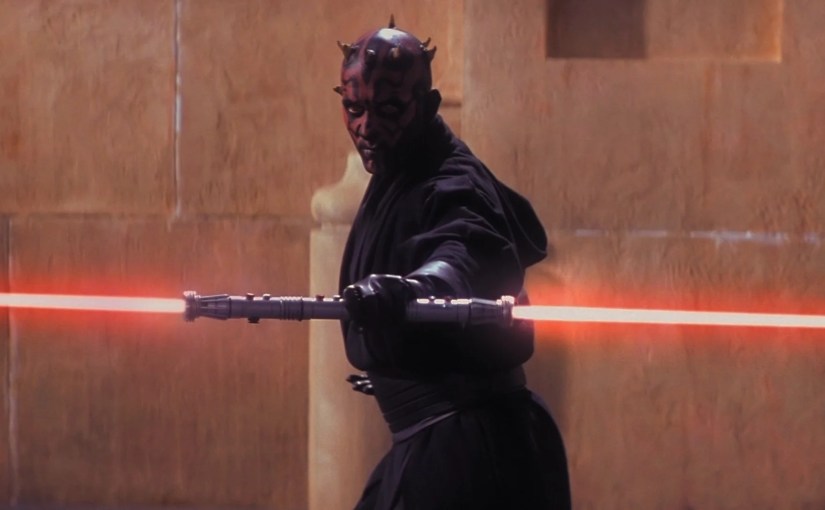
The two redeeming qualities of this film belong to the pod race which is thrillingly edited in sound and visuals. There’s some fun shots of each racer, the pit droids, the crowds in the stands and even Jabba The Hutt. The film really comes alive here much like the memorable cantina scene from the original Star Wars. The other best feature is the villain, the apprentice to the phantom menace, the red and black tattooed Darth Maul played by the agile martial artist Ray Park.

Lucas didn’t use Park enough in the film. With his double bladed lightsaber, the two on one dual Park has with the Jedi characters towards the end is one of the greatest sword fights in film. I would’ve welcomed an additional five minutes of this scene. Shamefully, this would be Ray Park’s only appearance in the film franchise, as well as Darth Maul. This was a great blend of actor and character. Lucas abandoned a good thing too soon.

Yes! I have much to complain about The Phantom Menace. Yet it is not all bad as a whole. I love the political trickery that McDiarmid displays and the senate meeting among the delegates is a nice foreshadowing for what we know will come of it. Visually, it’s a treat as well. (Again, though, what kids are going to be entertained by all of that?) The pod race and lightsaber dueling are masterful as well. There’s some good material here. There just could’ve been a whole lot more….and a whole lot less overall.

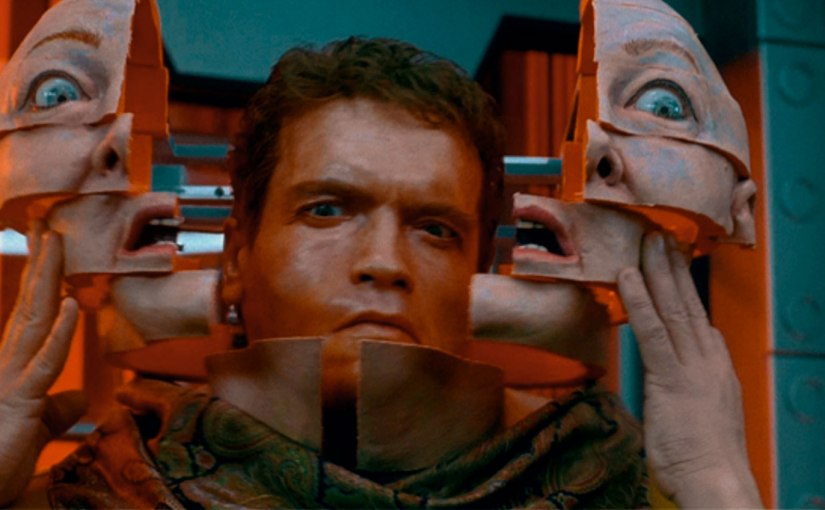
TOTAL RECALL

By Marc S. Sanders

Paul Verhoeven is an in-your-face director. His material regarding sex and violence goes at least a ginormous step further than other directors. For an action film like Total Recall, if someone gets shot, they don’t get shot once but hundreds of times. That way we can see more blood splurt all over the place. I especially feel ashamed how much I laugh when a tourist extra gets caught in good guy/bad guy crossfire. Once this guy is dead, Verhoeven makes sure his central nervous system is nonfunctional and none of his vital organs will qualify for donation. If Verhoeven sets a scene in a Martian adult night club, then you’ll have ample opportunity to take in an upfront view of a three breasted woman, or a little person in stiletto heels and hooker garb with the boa included.

Total Recall is a well-regarded Arnold Schwarzenegger action flick with a psychological twist to keep your attention. As soon as the film begins, you are questioning if you are watching a real-life experience for Douglas Quaid (Schwarzenegger) or is this a dream or is this all a purchased memory. A purchased memory is the new novelty of this science fiction future. If you can’t travel to a destination like the planet Mars, you can certainly buy an implant that’ll convince you were there and even living the life of a secret agent while romancing a beautiful buxom brunette.

The exposition for Total Recall really arrives in the second half of the film. The first hour deliberately leaves the viewer as confused as Quaid while he tries to uncover why he’s being pursued and shot at.

The film is full of surprising twists including another character reveal that Schwarzenegger portrays. It’s hard to trust anyone Quaid comes in contact with or who is real or even what is real.

The settings are very well constructed. When you enter a security zone before hopping on a subway, your entire skeleton appears in blue on a screen you pass by. Mars is brutally red while it tries to comfort the civilization with familiar products like a Hilton Hotel or Pepsi. All of this sensory overload is present while a brutal overseer named Cohagen (an over-the-top Ronny Cox just like Paul Verhoeven likes it) seems to disregard the alien inhabitants by hoarding their breathable air.

It all feels familiar but the product placement is a little much as well. When I first saw the film in its theatrical release, I was enthralled with this picture. The action seemed to come as fast as the various twists. However, now it’s hard not to notice the blatant commercialization of the film. Its like watching a football game and every few minutes a commercial comes on. I’m aware of you, Pepsi. I don’t think I need a reminder during a loud, violent gun fight. Look! Instead of “USA Today” there’s “Mars Today.” Ha!!!! Even if you have the means to travel to Mars, you might want to visit the local Sharper Image for the latest high tech toy.

Total Recall relies on a story from sci fi writer Phillip K Dick who also inspired Minority Report and Blade Runner. Fortunately, that’s a good strength to hinge upon. I think the weirdness of it all makes Schwarzenegger a better actor; a muscle guy who can only appear more like an Everyman in a film like this. He’s good with emoting confusion. He’s as good as always with delivering a pun, and his fight scenes are consistent with his other actioners like Predator and Commando.

Total Recall is a good picture but it’s a lot to absorb in story. It’s over inflated in its unsubtle appearance of product placement, violence and nudity. If you’ve got the stomach for it, then you’ll have a good time. It’s not Star Wars lite. It’s definitely Star Wars heavy. Prepare to be bloated.

PREDATOR

By Marc S. Sanders

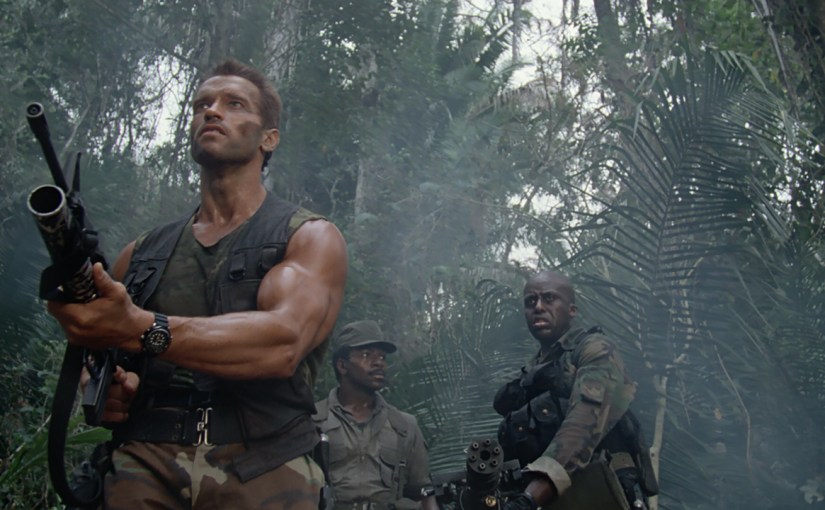
Predator is not only my favorite Arnold Schwarzenegger film, but it also remains as one of the best action films of all time.

The main reason for my praise stems from its cast consisting of the Austrian headliner followed by Carl Weathers, Jesse Ventura, Bill Duke and Sonny Landham. The cast is sensational because they take the science fiction material seriously by evoking their machismo gradually evolving into fear. Director John McTiernan displays all of this very well through quiet and covert close ups as each character sums up the possibility that they are being hunted for sport by an entity they are not familiar with.

McTiernan makes use of his setting to the point that the real-life dense jungle of trees amid thick humidity, within South America, is its own character. I don’t know how he did it but, in this film, McTiernan and his cinematographer capture flawless tracking shots of running over uneven grounds and roots, leaves and low hanging foliage. It’s really spectacular how it all moves fast without any chopped up quick cuts like a Michael Bay movie for example. In this movie, the chases are actual chases.

An outrageous Oscar crime is that this film lost its Visual Effects prize to Innerspace. That gnaws at me when you consider the vagueness of the Predator’s chameleon like invisibility shape. It leaves the viewer intentionally as confused as these expert Gung Ho military men are. They can’t quite make out what this thing is because McTiernan wisely follows Spielberg’s Jaws technique by not showing you the creature until all the cards are dealt. The viewer is left curious and aware but still in suspense. There’s a kaleidoscope of transparency in the figure that scopes these men but what is it, really? The best horror films present the horror by literally not showing you the horror.

I like how this rescue team is continuously displayed with their talents for covert sabotage, hand signals, caution and focus. The actors are actually setting up the booby traps and climbing and ground crawling.

It’s honestly a very well-acted piece most especially from, yes Schwarzenegger, as well as Bill Duke and his psychological trauma during the 2nd half of the film, and Sonny Landham as the Tracker Billy who can relay what transpired with a keen Native American sense of environment. It’s a great collection of characters all together.

Sadly, the majority of the follow up films in the franchise do not live up to what originated here. In the first installment, the story is condensed in an efficient 90 minutes that leaves enough time for one story of adventure and rescue before it gets to all its sci fi suspenseful showpieces. The follow up films never took advantage of the strengths used here from over 30 years ago.

Predator is a brilliantly edited, well shot, taut and a gripping yarn of imagination and fear.

From 1987, it hasn’t aged a bit.

STAR TREK IV: THE VOYAGE HOME

By Marc S. Sanders

We owe a lot to H.G. Wells, author of The Time Machine.  Without Wells, Marty McFly would not become familiarized with a souped-up DeLorean, and Earth as we know it would be decimated by the year 2286 because a probe, in the shape of a Ring Ding pastry, from the far reaches of space could not find its humpback whale friends to say hello to.  If Star Trek IV: The Voyage Home is not the best of the film series, it is certainly the most fun and delightful.  (For the record, my personal favorite is Star Trek II: The Wrath Of Khan but sometimes I switch to Star Trek VI: The Undiscovered Country.)

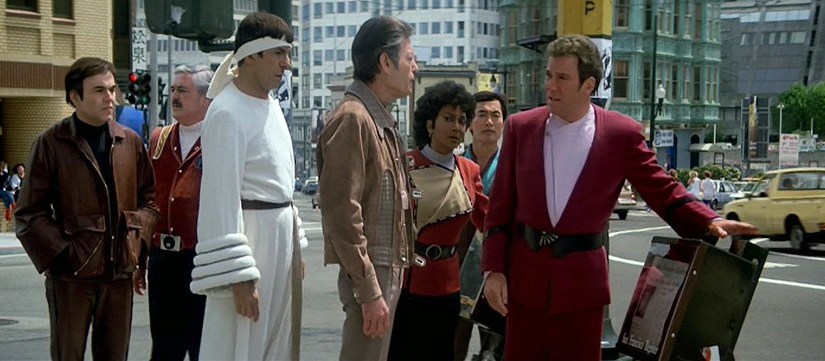
Kirk, McCoy (William Shatner, DeForest Kelley) and company have managed to resurrect their comrade Spock (Leonard Nimoy, also returning to the directing chair). Now, they are enroute from the planet Vulcan to Earth awaiting trial for the crimes and violations they committed in the prior film.  However, they must follow a detour back in time to the year 1986 and pick up a pair of humpback whales.  The sea mammals are the only creatures that can speak with an alien probe and salvage the Earth from becoming destroyed.  The probe isn’t an enemy.  Its arrival is simply unsettling the planet’s oceans and core because it can’t communicate with whale life, that is now extinct by the time 2286 has arrived.

So, in a Klingon Bird of Prey that they took command of and dubbed the HMS Bounty, our favorite Federation crew, arrive in late 20th century San Francisco.  Problems lay ahead though.  Their dilithium crystals (fuel) are depleted, they are unfamiliar with the daily activities of life during this period, and just how are they to find a pair of mammoth whales by walking around the city?  As well, Spock is not exactly himself since his rebirth.  His knowledge is there, but his common sense that stems from his human half is lacking.  This leads to some funny engagements with the city folk as he develops a habit for some colorful language not commonly used in the 23rd century.  A scene on a city bus with a punk rocker is a terrific highlight. 

Well, within the film’s two-hour time frame a pair of whales is located at The Cetacean Institute and they are overseen by a spunky and emotionally caring guide named Gillian portrayed by Catherine Hicks.  Now the gang has just gotta get home to their time before it’s too late.

The script for The Voyage Home is really quite brilliant and such a pleasant surprise.  All of the characters have their own moments for humor to occur.  The best being that Chekhov and Uhura (Walter Koenig, Nichelle Nichols) have to find a nuclear power source to make up for the lack of dilithium crystals.  Imagine, during the time of Reagan/Gorbachev Cold War politics, a man with a heavy Russian accent politely asking a motorcycle cop where he may find the “nuclear wessels…NUCLEAR… WESSELS.” It’s also inspiring to place a cynically cranky Dr. McCoy in a city hospital only to question how medical practices were ever tolerated at this time. “Is this the dark ages?”

William Shatner and Leonard Nimoy make such a sincere pair of friends as Kirk and Spock.  Shatner is especially good in the Star Trek films because he performs with a way of sarcasm and whimsy.  He works like Errol Flynn, unreserved while he swings into the danger.  Yet, he’s also so sincere.  There’s a flirtatiousness to him that’s impossible not to like.  He’s just so personable.  You also feel for his Kirk when he wishes his old friend, Spock, would just return to the way he once was and simply address him as “Jim,” not Admiral.  I couldn’t help but relate to it as someone who may wish that with a relative suffering from dementia.  The loved one is still there, and yet he/she is not there.  That’s how Shatner touchingly approaches this relationship.  The chemistry between Shatner and Nimoy is unparallel.  The recasting of the roles in later years has not matched up.  The original actors just read each other’s timing perfectly like Laurel & Hardy or Felix & Oscar.  There’s Newman & Redford.  There’s Lemmon & Mathau.  There’s Shatner & Nimoy.

I always had my facts mixed up.  I was always under the impression that this film was nominated for a Best Screenplay Oscar.  It in fact wasn’t.  Yet, it really should have been.   The Voyage Home has a message on the importance of preservation of life and an urge to hold on to the integrity of our environment.  Thankfully, it’s not preachy.  There’s a combination of science fiction, adventure and humor at play here that I don’t think has ever worked better in what I’ve seen of the Star Trek universe of films and TV series. This is just a very, very smart film with good, insightful direction from Leonard Nimoy. 

Nearly forty years later and this picture still holds up.  So many of our planet’s species remain endangered.  Many are suspected to be extinct by the hands of man.  The Voyage Home touches upon these facts.  It still feels so up to date that you even get a lump in your throat at the top of the film when a dedication is made to the memory of the Space Shuttle Challenger crew.  The makers of this Star Trek installment really presented a timeless film with the help of time travel, and you don’t have to be a Trek fan to appreciate its merits.

THE PEOPLE VS GEORGE LUCAS

By Marc S. Sanders

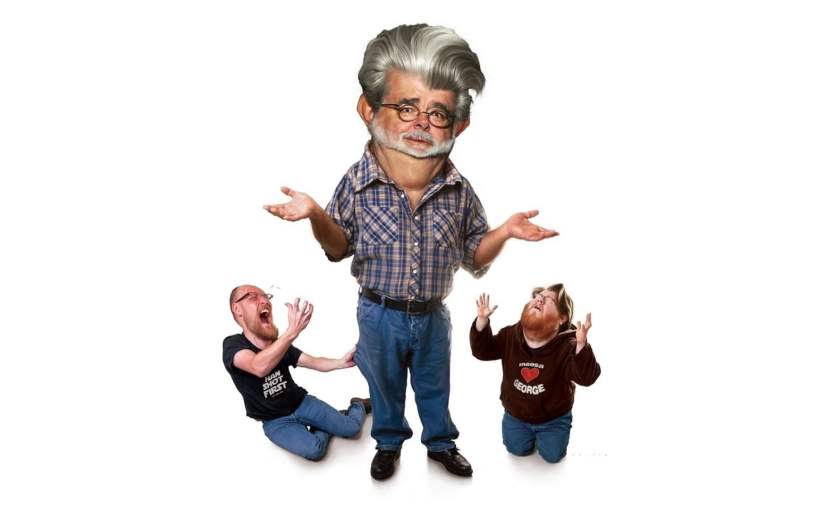
Star Wars has evolved from a beloved franchise celebrated in detailed play sets, figures, bed sheets, costumes, plush toys, and t-shirts to a franchise still wrapped in all those materials, only now there is an animosity and regret among its populace of fans. Vitriol and love mix like oil and water towards its creator, George Lucas.

In the documentary The People vs George Lucas a lot of complaining and poking transpires in the medium of endless home movie fan films (the best one being a spoof of Misery where a fan holds an injured Lucas captive) to measure the stress and betrayal followers of the franchise feel for a creator.

As a lifelong fan of the galaxy far far away, I did not watch this documentary with a constant nod in accord and “preach/fight the power” mentality. I could only think some people really need to value something more than this. Go outside. Taste an apple. Ride a bike. Feel a breeze in the air. Talk to a girl or a boy your own age.

The documentary only works to a certain level of degree and that’s because it doesn’t live up to the promise the title suggests. It’s primarily a one sided 90 minute argument of various worldwide fans venting frustrations with little to offer from Lucas. It’s fair to say Lucas would never give these documentarians the time of day anyhow. Why should he have to, really? So stock footage interviews are used instead to a minimal degree. The “vs” never really shows and the ball only ever stays on one side of the court.

Complaints abound of who shot first, the special edition edits of the original films, Jar Jar Binks (the best sequence of the film) and Lucas’ refusal to release the original cuts of the Episodes IV-VI (that’s always been my biggest issue).

A ridiculous segment focuses on the reiteration of merchandise like thousands of different Darth Vader figures or endless new releases of the films in new boxed sets thus tempting fans to continue to buy. This is frustrating. Yet, somehow, some way this need to collect is all Lucas’ fault? That’s where the film loses me. When a person uses a scapegoat because of a weakness of free will, there’s not much I can empathize.

There’s moments to laugh at. The frustrations are not wrong but who cares to listen to someone who claims their childhood was literally “raped by George Lucas?”

I did appreciate how the film examines that sadly, in an ironic sense, Lucas became the monster he tried to avoid. When making the 1977 original he broke many standards of filmmaking in Hollywood refusing to answer to corporate cogs. He wanted independence of money grubbing and grasps. He achieved that mean to an end by simply becoming the biggest corporate cog of them all. Stock footage interviews show him admitting that. Ultimately, he never directed again until 1999 when he declared he would direct a trilogy of prequels. He did not answer to anyone, and no one questioned his methods. Thus, the world was treated to Jar Jar Binks. That’s what corporate America does. That’s what George Lucas did.

STAR TREK III: THE SEARCH FOR SPOCK

By Marc S. Sanders

Leonard Nimoy accepted the director’s chair for Star Trek III: The Search For Spock.  Though background stories dictate that he was done with the famous character especially following the end of the previous film in the franchise, one hanging thread was left untouched to permit another chapter.  It’s fortunate that Nimoy worked with so much good, solid and well written material for him to oversee on this follow up picture.

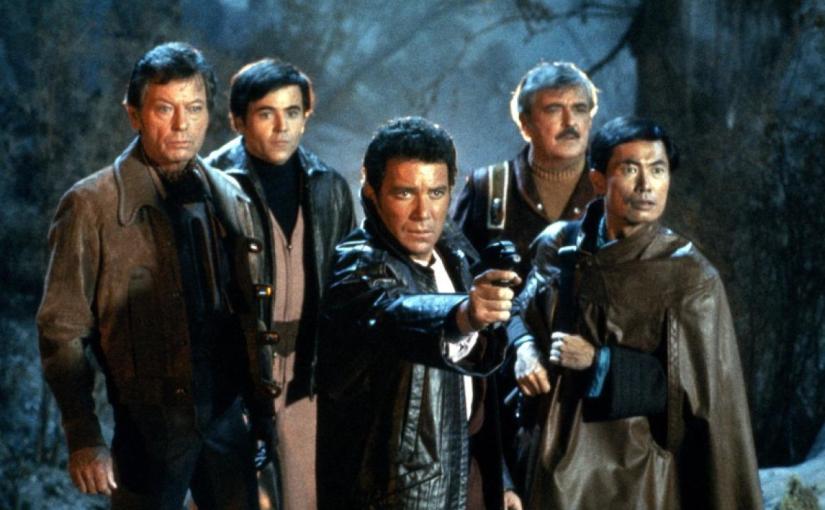
The Enterprise is returning to Earth following its entanglements with Khan.  Admiral James T. Kirk (William Shatner) is morose following the loss of a close colleague. In addition, Dr. McCoy (DeForest Kelley) is mysteriously unwell.  Meanwhile, the newest invention, Project Genesis, is being thoroughly studied by Kirk’s son David and Lt. Saavik, now that it has formed a planet of its own.  Genesis has become a clandestine and highly politicized issue among the Federation Of Planets and it is not to be discussed in public arenas. 

Shortly after Kirk arrives home, he is approached by Spock’s father, Sarek (Mark Lenard).  They both realize that before Spock’s unexpected self-sacrifice, he left his “spirit” within the mind of McCoy.  Now McCoy is unstable in the current life and Spock’s afterlife is not settled as well.  Kirk and crew must find a way to escort McCoy to the planet Vulcan, along with Spock’s corpse that is resting on the Genesis planet.  So, without authorization, they hijack the Enterprise and off they go into the far reaches of space all over again.  It won’t be easy as Christopher Lloyd has been cast as a vicious Klingon who commands a Bird Of Prey ship that can cloak itself just before an attack. 

Due to the enormous popularity of The Wrath Of Khan and The Voyage Home (even numbered installments in the movie series), The Search For Spock doesn’t get the recognition it truly deserves.  People love to point out how the odd numbered installments are the weaker films.  Star Trek III negates that observation for me, though.  Maybe whatever dismissal it carries is also in part because it’s a short film and doesn’t feature the main attraction for many Trek fans, Spock.  Yet, Nimoy with a script written by producer Harve Bennett tackles some shocking developments in the continuing adventures of Kirk, Bones, Scotty, Sulu, Uhura and Chekov.  All these years later and two eye opening moments occur in the film’s third act where I tell myself, “Wow, I can’t believe they actually went there.”

The film has a very gratifying ending.  Yet, it ends with a couple of big cliffhangers.  Look, when Darth Vader revealed his big secret, moviegoers had to wait three long years to find out the backstory and what was really the truth.  With this third Star Trek film, there’s much to account for as to what will become of our first favorite science fiction crew.  Leonard Nimoy hit all the right notes leaving audiences wanting more.

Nimoy has directed a well-versed picture.  The film doesn’t just belong to Shatner this time. Though he’s just as marvelous as the last film.  He just has such a likable charm to him, and his dramatic moments can be heart wrenching.  DeForest Kelley is given good material here.  At times, his mental dilemma is a struggle for the character.  In other areas, his curmudgeonhood comes out for humor as he curses Spock for what he’s left him with.  It’s a humorous kind of sci fi prejudice (sort of like Archie Bunker) that made Spock and McCoy a good pair to traditionally watch spar with each other.  George Takei, Walter Koenig, Nichelle Nichols and James Doohan are blessed with moments as well that feature some funny one liners (“Up yer shaft!” and “Don’t call me Tiny!”).

It’s easy to regard the third film of a “geek culture” as just another film.  However, in its brisk ninety-minute running time, The Search For Spock explores facets of religion, albeit fictional, and debates with science and discovery.  If that’s not good enough for you, at least it’s also a helluva great adventure.

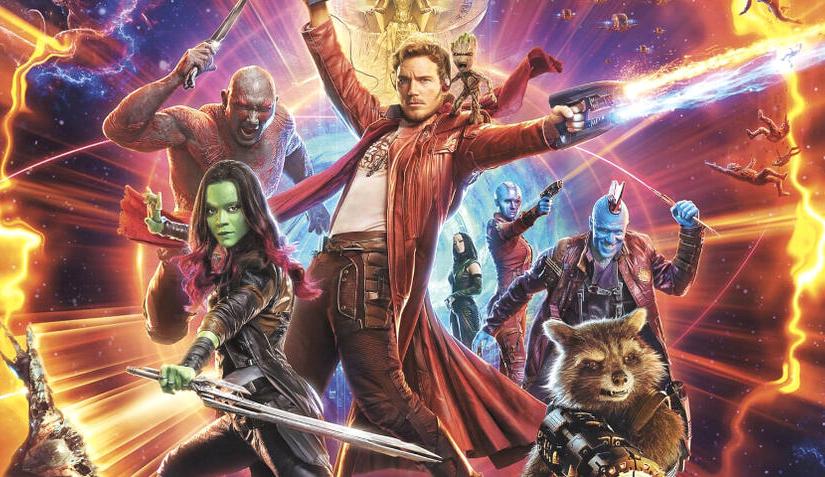
GUARDIANS OF THE GALAXY VOL. 2

By Marc S. Sanders

James Gunn continues his Looney Tunes odyssey helming Guardians Of The Galaxy Vol. 2. The silliness is grander, the story is weirder and the characters are now comfortably fleshed out.

Vol 2 is probably not better than the first installment. However, it is more inventive as Gunn takes his film along the hanging thread left over from before. Peter “Star Lord” Quill (Chris Pratt) meets his father at last in the persona of Kurt Russell who goes by the moniker Ego. This is all enthralling to Quill, though his love interest, Gamora (Zoe Saldana) sees beyond the facade.

Ego has invited them to his planet that he created. It pops with colors, serenity and cheer. This plays for a good story; maybe as a better and more developed Star Trek episode.

What differentiates this film from other Marvel films comes out in the third act. This does not consist of just space battles, laser swords and shootouts. The end is something else, something new, entirely. Thus, you are given the film’s greatest strength. I found it to be very imaginative.

Gunn however falls a little bit into his own trap along the way. There are too many relationships and characters that work as filler for side stories. Gamora vs her bitter sister Nebula. Drax (Dave Bautista) with a new, weird antenna on the head character named Mantis and Rocket Racoon and his big mouth with Yondu (Michael Rooker, in a bigger more significant role this time). Oh yeah! There’s also Yondu vs Sylvester Stallone (huh? why? how?) and Yondu vs his mutinous army, The Ravagers. It’s all a little too much for an already busy looking film.

I found it funny that The Ravagers reminded me of the motorcycle gang, The Black Widows, from Clint Eastwood’s Every Which Way… bare knuckle comedies. Those guys were much funnier than these Ravagers. Gunn overstays their welcome as they randomly cackle and heckle poor Baby Groot, the toddler tree thing. That gets old quickly.

Gunn approaches a special kind of humor here. Repeatedly, because these are outer space characters, it’s apparently funny to lend them explaining the punchline of a gag. So if Drax realizes that Peter has the hots for Gamora, he’ll belly laugh and explain literally how Peter feels and do it bigger and louder. Variations of that gag occur quite often among most of the characters. Sometimes it works. Sometimes it gets old.

GOTG Vol 2 is a fun watch. I don’t foresee this installment carrying the legendary status the first one did or even standing out among the best of the Marvel series, but I will give props to the outcome of what Ego truly is and what his intent depends on. (I won’t spoil that here, of course.)

The cast is great. Saldana is one of the stronger female characters in the MCU. She captures a background to Gamora that is blatantly absent from other Marvel ladies. Bautista has become a great character actor as well. He’s a smart guy with good timing. With his extensive child and adult film resume Kurt Russell is perfectly cast as Pratt’s father. Their personalities lend to some good chemistry.

James Gunn owns the Guardians films. No one else can capture his blend of humor and pop culture salutes. Yet, he overreaches a little trying to incorporate so much story and so many gags into one film. His vision is well defined, though.

Plus, Gunn stages another dance scene for Pratt and Saldana, and it’s great. As I noted in my Vol 1 review, that’s how you get to a viewer’s heart. Everyone loves to dance.

As well, Gunn accompanied his sequences with some tunes both fresh and familiar from Fleetwood Mac, Electric Light Orchestra and George Harrison to name a few.

James Gunn was always going to make sure never to take his films seriously. So, when you see a baby tree groove along while trying to detonate a bomb, I defy you to be so serious as well.

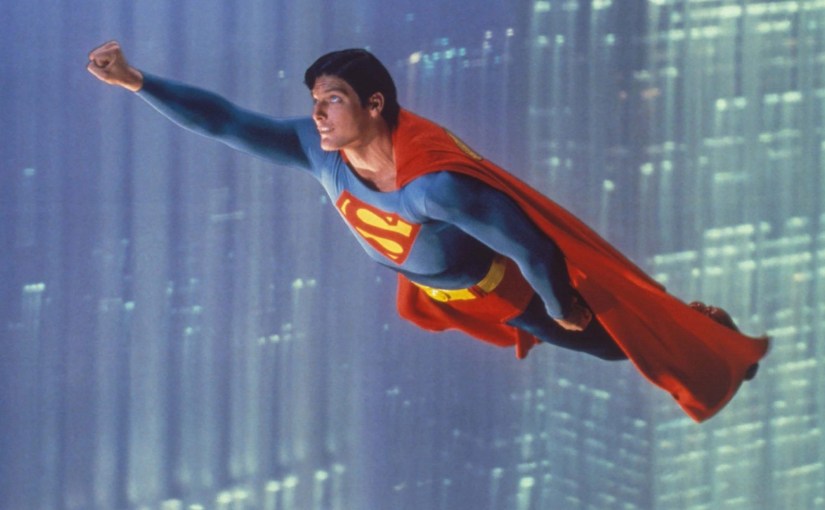
SUPERMAN: THE MOVIE

By Marc S. Sanders

Richard Donner’s Superman: The Movie is one of the best biographical films of a fictional character ever made.  Yes.  It absolutely is a biography.  How can you call it anything but?  The visitor from the planet Krypton is embedded so deeply within the lexicon of worldwide pop culture and historical significance that he rests within all of our subconsciousness.   When we think of ongoing problems in the world from natural disasters to destructive wars or famines and disease, or to even kittens stuck in trees, for a split second we all consider how simple we could go on with our lives if only Superman were here to rescue us. 

By 1978, forty years after Joel Siegel and Joe Shuster created the character, visual effects were at a more than adequate level to convince us that a man could fly. Thus, the man with the red cape was ready to appear on the big screen.  With creative input from writer Mario Puzo, Donner’s film goes through various stages of life from when the extra terrestrial is a new born baby, to a toddler, then a teenager and on to a thirty something adult.  While living on the planet Earth, his powers may make him virtually invincible, but he’s far from godlike.  He cannot prevent the unforgiving nature of death.  He can’t be everywhere all at once.  He can’t even perform on the same level as his colleagues or friends, who are skillfully beneath him.  It would be unfair to have Clark Kent on your football team.

To watch Superman is to see a mini-series over a span of nearly two and a half hours.  We begin on the white crystal planet of Krypton featuring one of the greatest actors of the twentieth century, Marlon Brando, cast as the father of the superhero to be.  Brando is Jor-El.  He serves the planet as a prosecutor and a political leader with an expertise in science.  He’s championed for his knowledge, but he’s also challenged by his peers when he is certain of his planet’s demise. Thus, he must release his newborn son, known as Kal-El, into the far reaches of space to survive.  The script here takes an almost Shakespearian approach in debates of facing inevitability.  Brando’s authoritative screen presence is perfect here. 

Kal-El moves on to Earth, particularly Smallville, Kansas, and the nature of the film changes personality.  1950s Americana becomes our main character’s environment with endless plains of crop fields and farm land as Kal-El becomes identified as Clark Kent, the teenager who develops a crush on the high school cheerleader and gets bullied in the process while he must deliberately withhold all that he’s capable of by influence from his adoptive parents (Glenn Ford and Phyllis Thaxter).  Life for any of us is never complete until we experience the death of a loved one and Donner showcases that here to demonstrate that Kal-El/Clark can not prevent what’s meant to happen when biologically our bodies shut down.  Not even a super man can save us. 

Clark reaches age 18, usually perceived by most as a turning point into adulthood and through a means of Krytonian process he’s educated until his thirtieth birthday upon the rules and boundaries he must function within while on Earth.  He learns of his ancestry and then Donner changes the setting of his film once again into the furthest extreme from quaint Smallville. 

We have transitioned to sprawling Metropolis where Clark works as a mild-mannered reporter at The Daily Planet.  Christopher Reeve plays Clark/Superman and there was no one who could have filled the role better.  Physically, Reeve is the example by which all super human character portrayals still look towards.  Yet, the Julliard trained actor performs the dual personality so well.  When he dons Clark’s glasses you feel as if you are looking at another actor from when he’s dressed in the blue and red costume of Superman.  His posture and voice inflections are so distant from each character he’s playing.  Christopher Reeve was a stellar actor of versatility. 

In Metropolis, we are also introduced to an impure villain, Lex Luthor (Gene Hackman, who never got enough praise for this role) focused on greed and individual power for him to consume at the expense of everyone else on Earth. 

As well, just as life must bring us towards the experience of loss, it also must introduce us to love in the form of Lois Lane. Margot Kidder does a magnificent job of the hustle and bustle career woman with a sense of romance and need for ongoing adventure.  A reporter’s life will only give you that some of the time.  Superman will let you live that every day.  In life, we all start with valuing one person in our lives beyond our immediate family, and Lois serves that purpose to Clark’s perspective. 

Donner takes advantage of comedy and slapstick when Metropolis comes into play.  It’s not as polished as Krypton.  Nor is it as calm and reserved as Smallville.  Again, the personality changes.  Reeve plays Clark as a persona of the inept and gullible newcomer nerd to hide his powerful alter ego.  Hackman’s Lex is accompanied by Ned Beatty as a bumbling sidekick to play off of. (This same actor was a frighteningly powerful and intimidating corporate CEO in Network just a few years prior!) Valerie Perrine holds her own against Hackman as Lex’ alluring dame to have a tete a tete of sarcasm with. Kidder is the leader of Metropolis’ populace always on the go so much that she’s not even aware of her insensitivity to poor Clark.  A great gag is that as a good as a reporter as she is, Lois has terrible skills in spelling.  (There’s only one p in ‘rapist’.)

Maybe you’ve never seen Superman from 1978, or maybe it’s been too long since you last took it in.  It remains a watch that’s worthwhile.  Donner’s film covers so much of this one individual’s life that also includes two separate ancestries.  I get hot and cold on biographical films, sometimes.  It’s a tough scale to measure.  Sometimes filmmakers don’t show you enough.  I thought the film Ray, ended too suddenly on its depiction of Ray Charles.  Sometimes, it’s an overabundance of material.  The Last Emperor and Chariots Of Fire seemed to never end, and became mired in long, drawn-out, sleep-inducing pieces of dialogue.  Superman allows just the right amount of time to live within these different parts of Kal-El/Clark Kent/Superman’s life that you get familiar with who the main character encounters and how he responds to those around him. You also witness how these environments respond back to him.  You get a sense of what he stands for and where he feels insufficient and where feels strong and secure, as well as valued by others. 

It might be crazy to believe, but biographical writers and filmmakers should turn towards Richard Donner’s film for an outline that perfectly establishes every scene and moment that’s cut into its mold.  Superman: The Movie?  When I want to tell the life story of Golda Meir, or Barack Obama or Joseph Stalin or Jesus Christ?  Yes, Superman.  If we are crazy enough to follow the exploits of a man who wears a cape and flies through the sky, then why can’t we believe he can provide the answers to the great mysteries of life better than any of us?

THE BLACK HOLE

By Marc S. Sanders

In 1979, Walt Disney Studios must have felt compelled to respond to the resurgence of science fiction, following 2001: A Space Odyssey, Star Wars, Close Encounters…, and even Moonraker, with The Black Hole. Their contribution to the genre falls flat however with shiny looking, helmeted, stiff robots that hardly use their joints and even more stiff performances from the human cast. If these actors didn’t have dialogue to speak, I would have thought they were dead.

Maximillian Schell is the deranged James Bond villain reject Dr. Reinhart, resigned to helm the mad plot of this film. His long-lost space craft is found at the border of the mysterious black hole. His intent, now that he has converted his entire human crew into mind-controlled humanoids, is to enter the unknown void that’s ahead and discover its secrets.

The small crew of another ship that discovers him consists of Robert Forster, Anthony Perkins, Joseph Bottoms and a poor imitation friendly robot named V.I.NC.E.N.T. who resembles R2D2 in shape and talks in cliche with C3PO’s voice. Their lack of personalities boards the ship simply to listen to Dr. Reinhart’s insane plan to fly into the black hole. Then in the final 30 minutes, the band of heroes run away across the pointlessly long platforms of the lost vessel as it crumbles apart during its slow-very slow-descent into the hole.

This is a film that lives up to its title. There’s no one to really rescue here. No romance or swashbuckling. No one for the villain to threaten. No reason to stop this nut job from committing his own mad suicide; Reinhart could care less if this band is with him or not. Even John Barry’s (“James Bond”) music lacks harmony, as the film contains at most two of his compositions to play over and over again.

When none of the mainstay ingredients for adventure carry any weight, then what’s the point really?

The Black Hole was Disney’s way of pushing action figures with the menacing razor blade bearing red robot Maximillan and the hardly lovable V.I.N.C.E.N.T. I recall when I was a kid the merchandising hardly made a dent in pushing the agenda for this film. A film catered towards kids, but barely entertaining for kids. There’s a lot, a whole lot, of speechifying going on here, mom and dad. What kid would be interested in listening to old farts like Ernest Borgnine or Maximillan Schell just yak away?

The Black Hole is as nothing as its title suggests. A void of a film. A franchise or cultural impact never came to be from this movie, and rightly so.

Though I do recall my mom buying me the pop-up book adaptation of the film. I wonder if that’s a valuable collector’s item these days.