ANT-MAN AND THE WASP: QUANTUMANIA

By Marc S. Sanders

Ant-Man And The Wasp: Quantumania is a fun frolic through the Quantum Realm, another dimension that was uncovered in previous chapters within the Ant-Man series of films.  I’m not watching a potential Best Picture nominee for 2023.  I’m watching a glorious kaleidoscope of colors and visual effects with likable characters, and the setup of a new big bad villain for upcoming installments for the Marvel Cinematic Universe.  It’s not a perfect movie.  It’s corny and hokey at times, but I was with the picture the whole way.

I do believe these sci fi superhero franchise films are getting way too diluted.  I think there are more Marvel films now, all working within a shared universe, then there are episodes of single seasons of television shows.  A lot of these films do not stand apart any longer and hinge on events or hanging threads that occur in prior installments.  It makes for a lot of homework and time spent on the consumer to keep track of everything, and where everyone was last left off.  With Disney + adding in multiple Marvel streaming series to watch as well, I’m sorry but my days feel like they need to be extended beyond the standard 24 hours.  The economic term known as “The Law Of Diminishing Marginal Utility” hearkens back to me at this point, all these years later after we first met Robert Downey Jr. as Iron Man in 2008.  Are viewers getting tired of the superhero phenomenon?  Superhero movies rule the box office these days.  Westerns did it four or five generations ago.  How many new westerns do you now see each year?

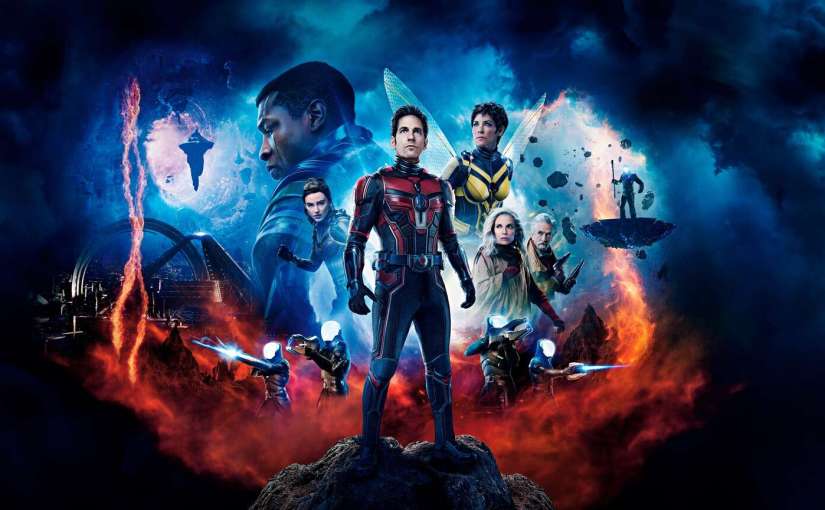
The blessing of Quantumania is that it does not rely abundantly on other material in the Marvel Cinematic Universe.  Scott Lang (Paul Rudd) reintroduces himself in a very adoring Paul Rudd-like way with a voiceover and thereafter, he is unexpectedly sucked into the Quantum Realm, along with his daughter Cassie (Kathryn Newton), his current partner Hope Van Dyne (Evangeline Lilly), aka The Wasp, and his mentors Hank Pym and Janet Van Dyne (Michael Douglas, Michelle Pfeiffer).  The gang must primarily depend on Janet to navigate them through this world of inconsistency and oddball inhabitants where no two characters seem to look alike.  Janet was marooned in the Quantum Realm for thirty years before finally being rescued.  What concerns her the most is one who is first referred to as “The Conqueror,” and later identified as the frightening superman known as Kang (Jonathan Majors), who was mysteriously exiled to this place.  As Janet describes, Kang has made the prison of the Quantum Realm his empire and now he wants to use the technology that our heroes possess to break free of this dimension and cause all kinds of chaos in the real world and other parallel universes.

The best assets to the film are the scenes between Jonathan Majors and Michelle Pfeiffer.  Granted, their dialogue could apply to any other kind of movie.  A lot of ping pong arguments between the villain and hero, which if I remember correctly go something like “You don’t understand.” and “I’ll never let that happen.”  This verbiage could also be suitable in a Meryl Streep tearjerker or a courtroom drama.  It’s pretty standard.  We’ve seen discussions like this a million times before.  Fortunately, my state of mind was not demanding of thought-provoking conversation.  The magnetism of their acting in front of the expansive CGI environment kept me hooked.   Jonathan Majors simply looks like a very frightening threat.  He’s calm at one point and later raging like a lunatic.  The man has levels.  If he were reciting the ingredients of chocolate chip cookies, I’d be on pins and needles. 

I do not think Quantumania is going to wow most audiences.  In fact, it’ll be a divisive film.  It’ll go half and half.  Though I really do not like to rank films any longer because it feels so pointless, I got into a debate with my wife and daughter about which one was better.  Quantumania or Wakanda Forever.  Both films have their merits, but I left the latest Black Panther film feeling a little depressed and exhausted.  That was a long time to feel morose for a superhero film.  The ladies, however, appreciated the story of that film over this one.  (I wanted to see the Black Panther suit a lot sooner.  I wanted a handful of people to be cut from the film, and I thought the Namor character was very boring.  Look for my review on this site.)

With Quantumania, audiences are either going to like the weirdness that is splashed all over the screen.  Splashed is not a strong enough word.  Try SPLATTERED!!!! Everywhere you look there is something abnormal to see from one corner to the next.  On the other hand, viewers will think the Quantum Realm and its inhabitants are just too bizarre, and the Marvel filmmakers are scraping the bottom of the barrel in imagination.  Sorry, but I got a kick out of the tall stilt guy with a spot light lamp for a head.  I thought the pink goo guy was cute.  I also giggled at the fat head henchman, with scrawny arms and legs, known as M.O.D.O.K. (with Corey Stall, making an MCU return).  The functionality of this character is deliberately lacking and comes off like Looney Tunes cutting room material, but that’s also why he is here.  If there was anything looking remotely normal in the Quantum Realm, well then it isn’t the Quantum Realm, I guess.  Bill Murray even shows up, but if you need a bathroom break, this is when you should go.  All of this looks way too stupid, yes!  Then again, stupid can be entertaining and stupid is often taken with subjectivity. So, I’m just one guy’s opinion. 

Quantumania is maybe the most unsophisticated of all the Marvel films.  More so than the Guardians movies, or the most recent Thor installment.  With a happy go lucky Paul Rudd, an army of ants and some of the most bizarre CGI extras found anywhere it proudly stands tall on that pedestal of ultra, ultra, ULTRA weird.  I think director Peyton Reed accomplished what he set out to do with this film.  The question is will the film win majority of approval within the nerd land of keyboard warriors like myself, who share their perspectives on the internet.  Well, the movie gets my vote at least.
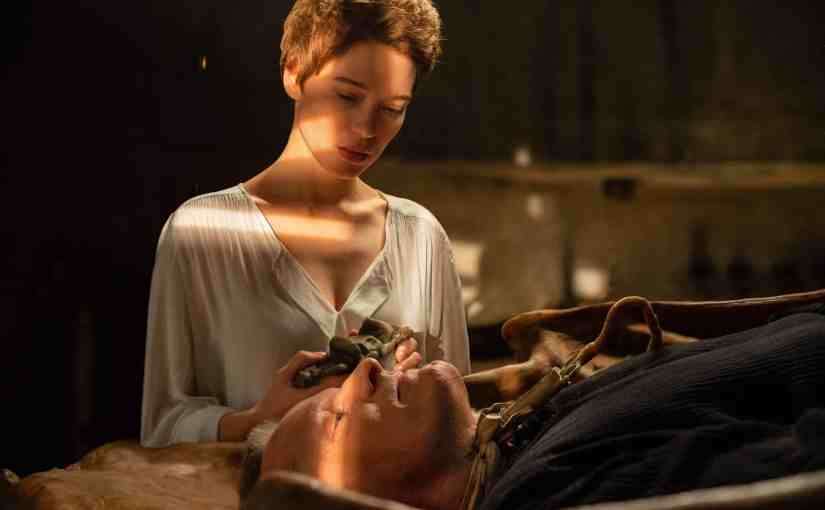
CRIMES OF THE FUTURE (Canada, 2022)

by Miguel E. Rodriguez

DIRECTOR: David Cronenberg
CAST: Viggo Mortensen, Léa Seydoux, Scott Speedman, Kristen Stewart
MY RATING: 5/10
ROTTEN TOMATOMETER: 80% Certified Fresh

PLOT: In a dystopian near-future, the human pain threshold has suddenly disappeared, giving rise to bizarre performance artists who publicly showcase bodily mutations and self-mutilations.


Somewhere at the core of David Cronenberg’s Crimes of the Future is a crackling good thriller waiting to happen.  I was still waiting for it when the end credits rolled.  I couldn’t predict what was going to happen next, which is normally a big plus for me, but the problem was, I didn’t care what was going to happen next.  Just when the movie seemed about to kick into a new gear story-wise, boom, credits.  Shame.

In the near future, human bodies worldwide have started undergoing bizarre mutations involving the development of new internal organs and the disappearance of a pain threshold.  This leads to the proliferation of underground performance artists who are either publicly mutilated or mutilated themselves.  Why?  Because Cronenberg.  We get close ups of the lead character, Saul Tenser (Mortensen), lying in a special chamber while knife-wielding robotic arms controlled by his partner, Caprice (Seydoux), slice, probe, and excavate his thorax in search of unwanted new organs.  Another performer lies in a chair while a surgeon literally cuts grooves into her face.  Yet another performer has grown dozens of additional ears all over his body, and has his eyes and ears sewn shut while he dances to modern music as a voice intones, “NOW is the TIME to LISTEN.”


This is all typical stuff from Cronenberg, who was and is a virtuoso of so-called “body horror,” going all the way back to Scanners, Videodrome, and the remake of The Fly.  It’s so typical, in fact, that the sight of various bodily injuries and mutilations didn’t really faze me as much as I thought it would.  Or should.  Maybe this says more about me than about Cronenberg, but the most off-putting sight was that one dancer with the extra ears.  Everything else, while graphic, didn’t feel “real.”  It all felt like effects.  Instead of recoiling, I found myself thinking, “Wow, how’d they do that?”  (By contrast, the dancer with the ears may yet give me nightmares.)

The storyline of the movie remains maddeningly vague for the first half.  In a weird prologue, we watch as a mother performs an unthinkable act after seeing her son eat a plastic trash can as if it were made of gingerbread.  Saul Tenser seems to encourage the growth of these new organs in his own body, even though they could become harmful over time.  His assistant, Caprice, gets turned on by seeing him getting carved up in his chamber; he seems to enjoy it as well.  They call it “the new sex.”  There is a subplot about a new police division, New Vice (not terribly original), trying to crack down on people who perform these public acts of mutilation.  We watch as an unknown gentleman stalks Saul and Caprice while he eats what looks like a purple chocolate bar.  At a bar, another stranger inexplicably grabs the purple bar and takes a bite out of it himself, and immediately experiences something that makes him wish he hadn’t.

This is all interesting, cerebral stuff, I must admit.  The makings of a dystopian thriller a la Blade Runner or Gattaca (with more blood) are all there.  But the mood and lethargic pacing of the movie literally put me to sleep.  I had to rewind it several times during the first half to catch what I missed.

But then the second half kicks in.  Saul is contacted and asked to perform a public autopsy on a child who may have inherited a surgical self-mutilation from his father, a medical first which might be the signal of a true next step in human evolution, but one which was engineered by man and not by nature.  New Vice reaches out to a deep-cover agent (whose identity I wouldn’t dream of revealing) who is assisting the search for cells of bio-terrorists who are trying to alter the course of human evolution.  Meanwhile, Saul, who has been battling some kind of respiratory affliction for the entire film, is tempted with one of those purple bars.  Caprice undergoes a self-transformation of her own…

And then, when a crucial discovery is made that might change the course of the entire movie…it’s over.

How to describe my disappointment?  I was a huge fan of Cronenberg’s two entries in the genuine, “traditional” crime thriller genre, A History of Violence and Eastern Promises, both starring Mortensen.  Both films are much more conventional than Crimes of the Future, but both are light years ahead in terms of holding my attention.  I naively thought this film (with the word “crimes” right in the title!) would be along the same lines.  Am I critiquing the film I wanted it to be instead of critiquing the film it is?  Maybe I am, because the first half of the movie was so bland and stultifying that I can’t think of anything else to say about it except to compare it to something that I wish it had been.

Crimes of the Future, Cronenberg’s first feature film after an 8-year hiatus, sees him returning to a horror sub-genre that he virtually created, or at least perfected, nearly 40 years ago, and he does have something meaningful to say about what mankind is doing to itself and the planet without regard to future generations.  I just wish he had found a way to say it without boring me for the first fifty-four minutes, then leaving me hanging at the end.

NOPE (2022)

by Miguel E. Rodriguez

DIRECTOR: Jordan Peele
CAST: Daniel Kaluuya, Keke Palmer, Brandon Perea, Michael Wincott, Steven Yeun, Keith David
MY RATING: 7/10
ROTTEN TOMATOMETER: 83% Certified Fresh

PLOT: Residents of a lonely gulch in inland California bear witness to an uncanny and chilling discovery.


After watching Nope, the third feature from Jordan Peele (Get Out, Us), I found myself curiously unable, or unwilling, to sit down and write a review for it.  What more can I add, I thought, to the volumes that have already been written about it?  What insights can I share that aren’t revealed in the making-of documentary on the Blu-ray?  How can I analyze a movie that can literally be boiled down to, “What if Close Encounters turned into Jaws?”  What good would it do to figuratively take this movie apart and critique its individual components?  It’s a roller-coaster, pure and simple, much like Jurassic Park III [2001].  How do you review a roller-coaster ride and try to compare it to other roller-coaster rides in terms of a review?

“I found the first hill of Rip-Ride Rocket much more intense than the slingshot approach of Hulk or Rock-N-Rollercoaster, but each has something to offer in terms of inversions, smoothness, and on and on and on…”

It just feels pointless, for reasons that are proving themselves difficult to pin down.  So, instead of a “normal” review, here are random thoughts, in no particular order:

  • The “true” nature of the UFO – oops, sorry, UAP, I had to look that up – stretched my disbelief suspension to the limit, but I will admit, it’s certainly original.  I can’t think offhand of any other movie or book I’ve watched or read that even considered that explanation for all those unexplained sightings in the books.  Once that was established, every successive appearance of the “spacecraft” became even more ominous and/or menacing.
  • I loved how the movie is littered with clues or easter eggs that either give a hint to the film or sort of comment on what we’ve seen before.  There is an early scene when OJ (Kaluuya) and Em (Palmer) are walking outside with a magnificent setting sun behind them behind the clouds, and hand to God, I remember noticing one particular cloud that looked…off.  Also, there’s another scene when a horse runs off and OJ watches it through the gaps of a wooden shed, and the visual impression is that of a zoetrope, the machine that made the opening images of the running horse possible.  Or even look at the screenshot at the top of this article…quick! What does that lampshade look like to you?
  • There was something about the design of the UAP that bugged me throughout the movie, not necessarily in a bad way, but it just seemed weird.  Why would something that is [SPOILER REDACTED] need what looks like fabric when seen up close?  Is it a sail?  That seems most likely.  In the latter stages of the movie, the “anomaly” doesn’t seem quite as mobile or speedy as it did when its “sail” was intact.  It’s an interesting design concept.
  • One of the scariest moments for me had nothing to do with the UAP itself.  It’s the scene in the exhibition area where the lights seem to be turning on by themselves.  The payoff for the scene seems predictable in hindsight, but as the scene progressed, I was BESIDE myself.  You can ask my best friend, Marc, who watched it with me.  When that shapeless mass by the light switch suddenly started to “unfold”, I echoed OJ: “Nope!  Gotta go, goodbye!”  It is a brilliantly executed scene.
  • I’ll need to watch the movie again to fully understand how that little parachute managed to scare off the UAP.  I assume it has to do with actual horse training, and with some research I could find the answer myself, but the movie does very little to explain it to the viewer.  Or maybe it does.  Like I said, I need to watch it again.
  • I loved how the flashback with the chimpanzee seems utterly incongruous at first.  And I loved how creepy and horrifying it is.  It’s a brilliant framing device (if I’m using that term right) that kept me guessing as to its real purpose right up to the end, or CLOSE to the end.  And did I mention how horrifying it is?  That moment when it’s resting…and then looks RIGHT AT THE CAMERA…chilling.
  • Someone somewhere had said that Keke Palmer was robbed of an Oscar nomination.  With all due respect to Ms. Palmer…she did an admirable job, but I didn’t see anything in the film that would have had me reaching for my Oscar ballot.  But I will give her props for her opening speech to that film crew.  The special features on the Blu-ray reveal that she delivered MANY different variations (fourteen, according to IMDb), much like you see so many other actors do in broad comedies, just to find the exact right version or take.
  • Much like Us, Nope feels like it bit off a little more than it could chew when it comes to the resolution of the film.  Everything leading up to the last 10 minutes or so is gangbusters, honestly, even the silver-helmet guy.  But as everything started to wrap up, I began to feel as if I’d seen all this before, just in different ways, in many different films.  Perhaps I’m being unfair.  Perhaps I’m criticizing the movie for what it isn’t instead of reviewing what it is.  I don’t know.  As it is, also like Us, Nope is one helluva roller-coaster ride that ends, not with a bang, but with a “pop.”
  • Allow me to shamelessly quote Roger Ebert, again: “If you have to ask what something symbolizes, it doesn’t.”

EXPLORERS (1985)

by Miguel E. Rodriguez

DIRECTOR: Joe Dante
CAST: Ethan Hawke, River Phoenix, Jason Presson, Robert Picardo, Dick Miller
MY RATING: 7/10
ROTTEN TOMATOMETER: 72% Fresh
Everyone’s a Critic Category: “Watch a Family-Friendly Film”

PLOT: Three friends try to unravel the mystery of these strange dreams they’ve all been having, at the same time.


I’m probably biased, but one of the best times to be a teenaged movie fan had to be the 1980s.  In the wake of his stupendous earlier successes, Steven Spielberg began to produce movies, letting other directors do the heavy lifting while he contributed behind the scenes.  This led to Gremlins, The Goonies, Young Sherlock Holmes, and of course, Back to the Future.  All in a two-year period.  Awesome.

In an attempt to replicate the success of these box-office favorites, director Joe Dante (The Howling, Gremlins) presented a film unabashedly aimed at its target audience, starring a cast of unknown, but immensely likable, teenagers, including two young men making their Hollywood debut: Ethan Hawke and a nerded-up River Phoenix.  While Explorers lacks the polish and sophistication of its predecessors, it is undeniably charming and, for a while at least, even a little spooky, even if the ending flies spectacularly off the rails.

Ben Crandall (Hawke) is a teenage kid obsessed with 1950s sci-fi movies.  He’s been having these strange dreams filled with what look like electrical schematics.  He draws these pictures as best he can and shows them to his best friend, Wolfgang (Phoenix), a science prodigy.  Ben also makes friends with Darren (Jason Presson), the stereotypical kid-from-the-wrong-side-of-the-tracks, and brings him along when Wolfgang decides to turn on the machine he built using Ben’s drawings.

What this machine eventually enables them to do is fly around inside a converted Tilt-a-Whirl car using an Apple II computer to steer.  (Did I mention this was made in 1985?)  One night, though, a phantom signal takes control of their little craft and starts sending it up, up, up…into space?  I wouldn’t dream of saying.

As a fourteen-year-old kid watching this movie, I strongly identified with the idea of receiving a message from space, not to mention being able to fly in a makeshift spaceship.  To say I envied those kids on screen is a monumental understatement.  Their dialogue may not have been as refined as it could have been, and the sub-plot about Ben’s crush on the “gorgeous blonde” in his class is a little ham-handed (not to mention that plot point never really goes anywhere), but I didn’t care.  SPACE, man!  Just imagine being able to go to SPACE!  What a bunch of lucky kids!

Well, naturally, after a couple of false starts, the three of them actually make it to space, where they have a close encounter of the…goofy kind.  If you’ve seen the movie, you know what I’m talking about.  You see, the aliens who were sending these schematics have been listening to and watching decades worth of TV signals.  So that’s how they communicate with our heroes.  Close Encounters it ain’t.  And the way these aliens look…any sense of wonder at being in space and communicating with an alien species gets torpedoed by the fact these guys look like a kid’s version of an alien.  Even Ben realizes something’s amiss when he says, “They don’t make any sense.”

So, yeah, Explorers is no Contact.  But let’s be fair, it was never meant to be.  Sure, it does kind of lead you down that garden path, but the final reels leave you in no doubt that this is sci-fi comedy, not drama.  It has not aged as well as its Spielberg-produced contemporaries.  But I watch it today, and I still get that little thrill of discovery when they turn that machine on for the first time.  And flying around in a spaceship that you built?  Who wouldn’t find that idea exciting?  Am I right?


QUESTIONS FROM EVERYONE’S A CRITIC

Which character were you most able to identify with or connect with?  In what way?
Shoot, are you kidding?  Ben, played by Ethan Hawke.  He was my age at the time.  Loved movies.  Loved sci-fi.  Wanted to be an astronaut.  Had a crush.  (Christine Day.  Went to my church.  Red hair.)  And also thought those aliens at the end made no sense.  Man, that was ME.

What elements do you feel are necessary to create an entertaining family-oriented film?  Do you feel this movie had those things?
Explorers has everything necessary to create an entertaining family-oriented film…in the first half.  The second half goes for easy laughs and cheapens what could have been something wondrous.  Alas.

ALIENS: THE DIRECTOR’S CUT

By Marc S. Sanders

James Cameron’s Aliens is deliberately morose in its storytelling and cinematic look.  It’s ugly and nightmarish.  It’s nerve-wracking at times.  It’s dark and somber too.  It’s also one of the best action films ever made.  For me, this is Cameron’s best film and it’s not only because I’m a sci-fi blockbuster nerd of sorts. 

Serving as a sequel to Ridley Scott’s monster movie, Alien from 1979, Aliens works on its own independence while still adhering to the storyline qualities of the original.  Sigourney Weaver returns as Ripley.  The story begins 57 years later where Ripley’s lifeboat ship from the end of the first film is found in deep space.  She reports back to the conglomerate company of the terrifying happenings she experienced with her crew mates who didn’t survive when an unrecognizable creature terrorized them aboard their vessel.  The company is less than apt to believe her account though. 

One of the company men, Burke (Paul Reiser), requests that Ripley accompany him and a squad of tough Marines on a mission to the planet, LV-426, where her crew discovered an immense crop of eggs and took back an alien aboard their ship.  In Ripley’s absence, a colony of over a hundred families was set up on the planet to establish habitable real estate.  However, the colony has lost contact, and the company is sending in the military to assess the situation to see what’s going on. Ripley is supposed to only serve as an advisor.

James Cameron’s script and direction takes its time to build up suspense and explore what’s unknown to these soldiers.  Upon arrival on the planet, much of what they find is left in wreckage and no one is to be found anywhere.  At best, Ripley can only see what was likely the remains of alien attacks with acid burns within the steel structures.  Yet to Ripley and viewers familiar with the first film, it is still a mystery as to what truly occurred.  Naturally, more will eventually be uncovered and then this arriving crew will have their hands full.

James Cameron has an imagination that bursts with colorful and amazing ideas.  The Terminator films were astonishing in its own apocalyptic future that haunts a present time period.  Titanic was a film mired in much expense and technical setbacks. Though, no one ever expected just how accomplished the award-winning blockbuster turned out to be.  Avatar is wonderous on a planetary level.  However, James Cameron is not necessarily a celebrated script writer.  Often his dialogue is very cheesy and unnatural.  Aliens is the exception though.

The script acknowledges that these gung-ho marines are “grunts.”  Thankfully, they talk like grunts.  I know that many fans adore Bill Paxton as the cut-up member of the troupe known as Hudson, who has brilliant one liners.  It’s actually a well fleshed out character.  Before Hudson knows what he’s up against, this new mission is just a lame “bug hunt” and he happily screams out as their spacecraft makes the quick drop into the planet’s atmosphere.  When he eventually comes to face to face with the monsters, terrifying, cry baby like fear overtakes him.  He’s giving his one liners like “Game over, Man,” and “We’re  fucked!”  Yet, the dread and anxiety are completely relatable.  There’s something out there waiting to tear me apart and eat me, and there’s hardly anyone left to help and rescue me.  I’m in the middle of nowhere.  Cameron wrote a good under the radar kind of character, and we feel for this guy’s dilemma as if it’s our own.  Paxton’s performance made it better and awarded it with adrenalized highs…and these aliens, with teeth and tails and acid for blood, are most definitely scary as hell.

I no longer watch the original theatrical cut of Aliens.  I turn to the Director’s Cut that Cameron always envisioned.  Particularly, it triumphs because the Ripley character is much more fleshed out with necessary dimension for the film.  Early on, a cut scene, now restored, tells us that Ripley’s daughter died from cancer while she was lost in deep space.  The daughter lived to the age of 66, even though Ripley didn’t age a bit.  Awakening from her cryo sleep, only introduces heartache for Ripley.  What I like about this information is that it serves a relationship later found in Aliens.  A little girl named Newt (Carrie Henn) is found by the marines and appears to be the sole survivor of the alien attacks.  Ripley steps in as a surrogate mother towards Newt as all of the characters work tirelessly to survive and somehow get off the planet.  The Director’s Cut gives some value to Ripley and purpose beyond just violently slaughtering aliens as a means of revenge or fulfillment.  It allows Aliens to work on an effective emotional level and Sigourney Weaver earned her Oscar nomination because of it.

Cameron introduces traitors as well into the story, which are likely not so surprising but make the film all the more challenging for the heroes of the picture.  Michael Biehn is the sex symbol, a cool and quiet tough guy.  Jenette Goldstein is a Hispanic marine who gives off good imagery as one of the few female squad members who enters the areas first with the largest gun in the troupe.  Lance Henrikson is memorable as an android that Ripley is apprehensive to trust – perhaps he’s the “Mr. Spock” of this sci-fi entry.

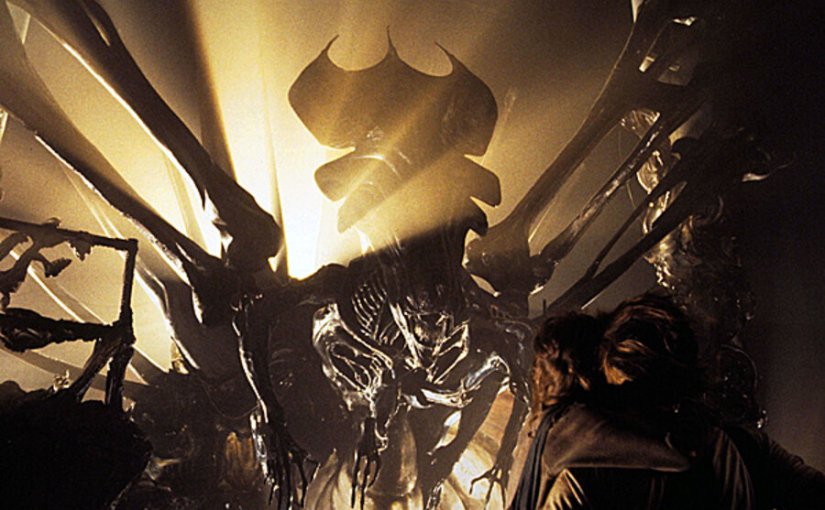
Technically speaking, Aliens is so unbelievably atmospheric in its bleak, futuristic setting.  Barring a few moments where the spaceships clearly look like miniatures, the interiors look organically formed.  I can’t compliment the set pieces enough in that respect.  When the Marines enter a large cavern, it is enormously shell like that it looks like an animal’s nest.  Cameron hides his various monsters perfectly.  So that when they slowly unravel their tales and skeletal forms, it looks as if the darkness within the frames begin to move.  The stillness of what surrounds our main characters awaken with life that maybe we don’t want to see. 

Aliens works independent of Ridley Scott’s prior picture because it’s a war movie; one that is set on an outer space planet.  We witness how the surviving squad troops strategize with what little they have left.  Thereafter, we see how they face enemies who may have the upper hand in battles to come.  I love how Cameron builds suspense with a sensor device the troops use.  It begins to ring as a life form closes in on their proximity.  The monitor fills with glowing blurs as more life forms nearby build up.  A nervous and great moment occurs when they can not understand how the aliens could be so close and yet none of them can see what is so nearby.  The surprise is unexpected and worthy of a scream. 

Cameron’s script doesn’t give his heroes a break.  Aliens thrives on the characters simply playing keep away, while one member of the party is working against what little they have left.  I like that.  While Aliens may be intentionally dreary the fact that there’s no easy out for these folks is what keeps the pulse of the film racing with nonstop suspense and action.

Aliens is an absolutely solid picture promising a future for this franchise. Sadly, it really never excelled above what was accomplished in these first two films from Ridley Scott, and now James Cameron.  Years later, Scott returned to the franchise with some interesting prequel films that colored in some of the elements that were only talked about before, like the company that puts all these people within the peril of the aliens.  Yet to date, that all still remains unfinished.  James Cameron just set the bar so high with his movie that the few that followed never amounted to what he created.

You may not feel all warm and fuzzy after watching Aliens, but at least you’ll feel incredibly excited with its construction from a director in the early years of his profession.  James Cameron brought about a solid script and unbelievable effects that say so much on a visual level.  If Aliens makes you nervous, fearful and especially terrified, then James Cameron has done his job.

THE WAR OF THE WORLDS (1953)

by Miguel E. Rodriguez

Director: Byron Haskin
Cast: Gene Barry, Ann Robinson, Les Tremayne
My Rating: 7/10
Rotten Tomatometer: 89%
Everybody’s a Critic Assignment: Watch a Movie “Classic”

PLOT: A small town in California is attacked by Martians, touching off a worldwide invasion.


I admire the 1953 version of The War of the Worlds most when I try to imagine myself back in that era as someone seeing it for the very first time.  For me, 69 years is still an almost unimaginable gulf of time.  In 1953, TVs were not quite a luxury item anymore, but a color TV definitely was.  Little kids still wore coonskin caps and watched The Howdy Doody Show for fun.  The very concept of UFOs was only six years old.  And the Cold War was a direct threat to our national security and our general peace of mind.

Into this culture came a film that, while thoroughly cheesy by today’s standards, nevertheless captured the paranoia of a nation.  Unstoppable creatures from another planet!  Wreaking havoc wherever they go!  Not even the mighty A-bomb can defeat them!  And who could resist those terrifying movie posters?  “A mighty panorama of earth-shaking fury!”  I would have been BEGGING my parents to give me ticket money.

Is a plot summary even necessary for this classic story?  A fiery meteor plunges to Earth near a small California town, but instead of making a crater, it carves a gully as it slides to a stop.  A scientist hypothesizes it might be hollow inside.  Presently, an alien spacecraft emerges from the meteor, bearing a fearsome weapon that looks like a cobra’s head and rains destruction and death on anything in range.  Forsaking Wells’ original vision of Martian tripods, this version presents sleek, manta-ray-shaped spacecraft supported by nearly-invisible electromagnetic currents.  Or something like that. Reports start coming from around the globe of other meteors and other spacecraft, and it quickly becomes apparent they’re not interested in friendly negotiations.  To paraphrase the stentorian commentary that bridges some scenes, this is the beginning of the end of civilization as we know it.

The heroes of this film are Dr. Clayton Forrester (Gene Barry) and Sylvia van Buren (Ann Robinson).  To put it kindly, their acting skills are…adequate.  To be fair, they weren’t working with a stellar screenplay, but the filmmakers wisely decided the real star of the movie should be the Martians and the Oscar-winning special effects.  As a result, Clayton is reduced to either giving scientific explanations of the Martians, while Sylvia’s main purpose is to look scared, scream loudly, and fry some eggs for Clayton in the middle of a war zone.  (I’m not making that last part up.  It’s not exactly Aliens.)

Regarding those special effects, sure they’re dated, but consider that, at the time, Hollywood studios regarded effects-heavy films as financial losers.  At least, that’s what they thought before The War of the Worlds.  It did so well that one of the head honchos at Paramount – one Cecil B. DeMille – presented the extraordinarily effects-heavy The Ten Commandments (1956) just three years later…and it broke box-office records.  The current trend is to blame Jaws (1975) and Star Wars (1977) for singlehandedly creating our insatiable appetite for special-effects extravaganzas, but look back far enough and there’s plenty of blame to go around, in my opinion.

Full disclosure: I still prefer Spielberg’s whiz-bang 2005 remake of War of the Worlds with its actual tripods and its CGI explosions and its callbacks to the 1953 original, including a cameo by Barry and Robinson, to satisfy cinephiles.  But this version, while dated, still has enough charm to remain effective.  Mostly.  (My favorite part is when the “hatch” on the meteor starts unscrewing; right about then is when I would’ve bought a ticket to Australia.)


QUESTIONS FROM EVERYONE’S A CRITIC

  1. Best line or memorable quote?
    When Dr. Forrester speculates how the Martians’ death ray works: “It neutralizes meson somehow. They’re the atomic glue holding matter together. Cut across their lines of magnetic force and any object will simply cease to exist! Take my word for it, General, this type of defense is useless against that kind of power! You’d better let Washington know, fast!”  It’s formulaic nonsense that’s only once or twice removed from calling an alien mineral “unobtainium”, but it’s delivered with the kind of conviction that only exists in the movies.
  2. What elements of this film do you feel have helped it become a movie classic?
    On a surface level, I’d say the quaintness of its visual effects.  Comparing them to the films of today is like comparing a paper airplane to the space shuttle.  But its also how the film captures the pop culture of the day.  The War of the Worlds fed on the fears and paranoia of a nation and stuck in the minds of millions of moviegoers and continues to do so today.  The 1953 film was influenced by the Cold War.  Spielberg’s remake was at least partially fueled by a nation’s fear of global terrorism.  Perhaps in another 20 or 30 years, some other enterprising filmmaker will once again send Martians to Earth to lay waste to its cities as a commentary on some future phobia or event.  …perhaps a global pandemic…?  Nah, too on the nose…

ROGUE ONE: A STAR WARS STORY

By Marc S. Sanders

On my 4th viewing of this film, I second guessed myself over and over. I know I’m a Star Wars junkie, but can I truly give an objective opinion about Rogue One? I think I can.

Rogue One: A Star Wars Story is of one of the best films of the last ten years. Now there are conditions that accompany that observation. It’s difficult to follow its trajectory if you haven’t seen A New Hope (the intended follow up story; the original Star Wars film). Frankly, reader if you are watching this film without ever watching A New Hope, I’d imagine you’ve been on a deserted island with a volleyball for a friend, unaware of this pop culture geek-oriented phenomenon from a galaxy far, far away, and upon your return to civilization you were just randomly flipping the channels. So, let’s just go ahead and dismiss that parameter right now.

Disney is the only studio with enough resources and scrutiny to ensure a good product is developed in the franchise. Rogue One proves that theory. From the Rebel uniforms to the Stormtroopers, to the Yavin 4 set recreation, and even a harkening back to Darth Vader’s original 1977 appearance (red eyes in the helmet), director Gareth Edwards, Lucasfilm and Disney ensure consistency in its side chapter apart from the 9-part saga. You relish the familiarity of it all, and what’s new you welcome with appreciated enthusiasm. It all works within the long-established universe.

The cast is superb with major highlights from Felicity Jones as Jyn Erso (great name) as a brash no nonsense rogue in and of herself. Jones comes off with tough bravado reminiscent of Susan Sarandon and Geena Davis, as well as Jodie Foster. Nothing will intimidate her, though she will show her heart and soul for her father, the reluctant architect of the Empire’s Death Star played by Mads Mikkelson, an important character to the story but not much material for him to capitalize on.

Alan Tudyk is a marvelous voice actor here as the tall droid K2SO, with a personality combination of Chewbacca & C3PO. He’s honest, maybe a little to honest, but he’s also physically strong and a smart aleck. His tone is Anthony Daniels, but his delivery is snide and arrogant. He’s just so entertaining.

Ben Mendohlson plays Imperial Director Krennic as a frightening antagonist who embraces the terror of this super weapon he oversees. “Oh it’s beautiful,” he sighs and really believes he sees beauty as a planet gradually combusts under the laser blast emanating from the Death Star. He expects greatness from his accomplishments and Mendohlson is also good at surrendering to what he’s not permitted to celebrate thanks to a strong Darth Vader and welcome return of Grand Moff Tarkin, a beautifully recreated CGI of deceased actor Peter Cushing. Tarkin is important to the Krennic storyline and his insertion in the film is flawless.

The cast also boasts Donnie Yen. He’s a real crowd pleasing blind martial artist. Not a Jedi, yet arguably even more fun.

The planets are crowded and different. Scarif where the final battle takes place is draped in palm trees and ocean blue. Great because it’s daylight setting allows all the action to be seen. Nothing is blurred.

The story structure is phenomenal as it centers on a race to make contact with an Imperial pilot who has just defected and then on to Jyn’s father in order to prevent this new Death Star from going into operation. I especially salute its honest, uncompromising, but still necessary ending. You’ll get a lump in your throat, followed by an adrenaline shot of excitement in the last five minutes. The end is pure genius. One of the great cinematic endings. Absolutely absorbing.

I really appreciate the various demographics in the film as well. For a story about an unending and lived in galaxy everyone should look and sound different. So, we are treated to Caucasian, African American, Hispanic, Asian, and English, and then you have the droids and fictional alien species.

If anything is shortchanged, it might stem from some of the actors’ dialects. Forrest Whitaker, Diego Luna and Riz Amed play primarily roles that at times are hard to comprehend, even in a fourth viewing. This is forgivable though. The story lends value to all of the players on screen.

So yes. Rogue One: A Star Wars Story is sensational; the best of the 4 Disney produced films thus far. There’s weight to its story, and its characters on both sides. It moves at a fast pace of action, dialogue and runaway suspense. It will go down as one of the best installments in the vast franchise that’s thrived for over 40 years so far.

SOLO: A STAR WARS STORY

By Marc S. Sanders

To those who naysayed this standalone installment in the galaxy far, far away, all I say is you are trying too hard to be pleased.  Shut up and have some fun, will ya?

Solo: A Star Wars Story presents a film that stands on its own, relying on mysterious legendary side stories only talked briefly about for the last fortysomething years like the Kessel Run, Sabaac card games, dice and the origin of how Chewbacca met everyone’s favorite space smuggler, Han Solo, plus the Millennium Falcon and the scoundrel Lando Calrissian.  

My brother and even a few friends of mine (Joe Pauly) grew up loving John Wayne’s films. No one else epitomized a Hollywood western better than The Duke.  He was their childhood hero.  For me, it is the generation after that which introduced the space cowboy Han Solo played by Harrison Ford.  He is not anywhere near a multi-dimensional character; pretty one note if you ask me (which ironically is opposite of what I demand in any kind of storytelling these days).  

Captain Solo was the guy who would make it up as he goes; never planning ahead or considering others beyond his trusted furry partner and his beloved spaceship.  He’d poorly talk his way out of trapped situations and when that didn’t work, he was a fast draw with his blaster.  

The screenwriters for Solo, legendary Lawrence Kasdan with his son Jonathan, were all aware of Han’s placement in this space opera, while constructing this film.  Only this time they intended on showing how that devil may care came about. It reminded me of a similar approach writer Paul Haggis took with the reinvention of James Bond in Casino Royale.    A lone hero trusts very little beyond his own arrogance and self-assurance.  The Kasdsans used that technique as the spine for this story and it works.

Director Ron Howard is the right guy to fill in following a notorious director incident beforehand.  Howard keeps the film moving fast with casualties you might not expect to perish, revealing masks (an under looked theme of the original films), traitors, fast ships, fast cars, and their pursuits and chases.  A favorite scene, saluting the Western, is a thrilling train robbery across a snowy mountain that seamlessly changes its angle and vector at times.  It’s as awesome a scene as it promised in the trailers.  

Howard is best at keeping the film grounded in actors rather than tired CGI cartoons.  He definitely makes Han, Lando and the rest look convincing trying to steer a ship or carry a blaster and play cards.

The cast is great.  Alden Ehrenreich is fine in the role; young, cocky, brash, handsome.  I wasn’t looking for him to do a Harrison Ford impersonation.  That would only look like a 12:45 am Saturday Night Live skit. The guy had to do his own thing, not someone else’s much like the Batman and Bond films have done before.  Donald Glover is perfect as Lando, even adopting Billy Dee Williams own way of pronunciation (“Han” vs Ha-an”).  Still, he makes the part his own.  He’s fun to watch.  Beyond some mild makeup scarring, Paul Bettany makes for a really uncomfortable crime lord, like a suave Miami Vice drug kingpin, and Woody Harrelson is just right in the inspirational pirate role; gruff and tough and educating.  Emilia Clarke is finally directed properly in a film.  (I still haven’t forgotten her awful Terminator: Genisys Sarah Conner portrayal.). She is dangerously sexy, but smarmy and cocky like Carrie Fisher was.  She’s a great femme fatale of the 1940s beautifully incorporated into some very thick sci fi.  

This was such a fun time at the movies.  Go ahead.  Accuse me of my bias, but as well shouldn’t I be expected to be a tough demanding critic of all new Star Wars material?  I’d probably be wanting it to match the magic of the original trilogy.  Well no.  I don’t want it that way.  I want new and fresh ideas, while still recognizing George Lucas’ used universe settings.  Disney and Lucasfilm continue to move along, stretching their imagination in monies well spent while also following the rules of smart aleck characters, film western motifs, Eastern cultures and death-defying cliffhangers.  Had the Star Wars franchise remained with Fox, audiences would not be getting the treats we’ve been blessed with for these last 10 years.

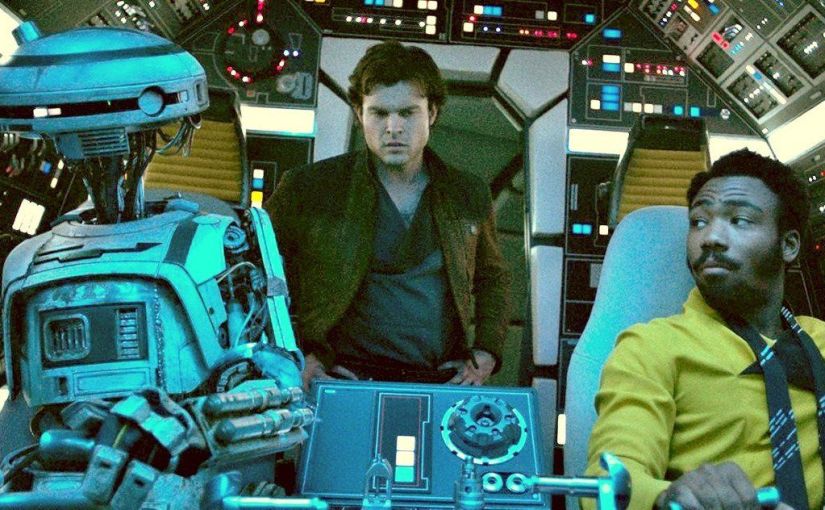
Solo really only has two minor misfires.  The droid L3, Lando’s Co-pilot, does not live up to Anthony Daniels nor Alan Tudyk and their high brow robot attitudes.  Why? Because it’s hard to understand what L3 is truly saying.  The lines are garbled at times; drowned out by the robot dialect I guess, and maybe also by a mostly origninal score.

As well, there is one ending moment that’s eye opening, but puzzling with little demand for it.  It was one surprise that did not seem to be well thought out and considering this is a stand alone film, it left me unsure of what Lucasfilm hoped to gain from it.  The moment was too distracting for me.  Yet it’s in there and it’s not the worst offense.  Just very very unnecessary and perplexing.

Solo: A Star Wars Story is none other than great fun with something to think about.   I was laughing out loud.  The audience we were with was clapping and cheering.  That’s why Star Wars films continue to thrive.  Their audiences get caught up in the ride, especially when the films are relatable while not taking themselves too seriously.

TRON

By Marc S. Sanders

I was not raised on video games.  My father refused to allow us to have them in the house. While I was envious of every kid that owned an Atari 2600, dad didn’t want us to get addicted to them.  I wouldn’t know until later on how thankful I was for that rule he stood by.  I like arcade games for a once and a while escape, but once I reach the banana board (which isn’t often) on Ms. Pac Man, I’ve had my fill.

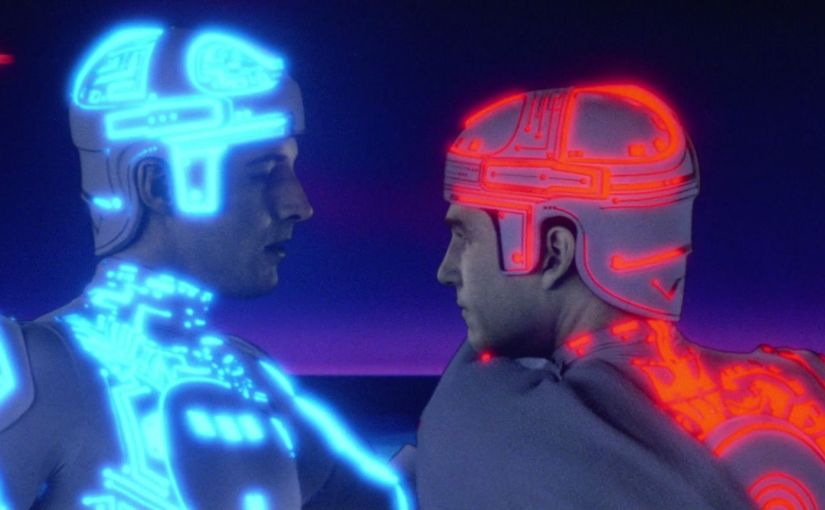
I recall seeing at least a few scenes of Walt Disney Studios’ Tron back when it was released on VHS.  Way back then, just like now, I just was never so impressed by it.  I can forgive the thin characterizations of really the only 5-7 actors with speaking roles.  Yet, the visuals and sound really do nothing for me.  What am I looking at?  Grids!  Just grids or endless squares.  A blank chess board looks more exciting to me.  The players in the film are dressed in what are presumed to be digitized armor that have carved out glowing blue and red lights.  Their human faces are grainy grays.  It all seems so flat to me, like that awful Pac Man adaptation Atari developed for their game consoles. 

Jeff Bridges plays Flynn, a game software developer done dirty by a corporate conglomerate led by a man named Dillinger (David Warner, the bad guy with the British accent).  Dillinger, along with a super computer intelligence known as the Master Control Program, have stolen Flynn’s intellectual property for dynamic new video games.  Since that time, Flynn has been making efforts to hack into the computer system and steal back what was originally his to begin with.  Master Control Program always fends him off, though.

A side story involves Bruce Boxleitner as Flynn’s colleague, Alan, working for the corporation. Alan has just developed a new security system known as TRON.  Dillinger puts a stop on the TRON program however.  Flynn, Alan and a third colleague named Lora (Cindy Morgan) break into the corporate computer lab one night, and before you know it, while attempting to hack in, Flynn is zapped right into the computer system, where he finds himself ensconced in a series of gladiator like games that were part of his original program write ups.

Master Control Program has the capability to erase Flynn from existence but insists on having him compete in the games that involve frisbees that deflect lasers and drive colorful racing cycles.  All of these games occur on this boring grid.

The actors mentioned above are utilized in the film much like The Wizard Of Oz.  They are introduced in the real world for the brief exposition portion of the film, and then later used to represent the TRON program (Boxleitner), as well as other elements that serve or perform under the eye of Master Control Program in the digital computer world.  The only real entity is known as a “user,” and that is Flynn.

I got sleepy watching Tron.  I think it is because like many video games it does not challenge me to figure things out or solve the dilemma. How can I envision Flynn escaping this world before he’s zapped out of existence?  I have no idea, because I’ve not been shown anything that demonstrates how this computer world functions.  Basic video games, at least from the early 1980s, were primarily about timing your button pushes and jerking the joystick accurately and timely.  Like the film Tron, they were never about application of the mind. 

No.  Movies are not meant for me to solve their riddles all the time.  Often, if I’m not trying to figure out how to resolve a story’s conflict, then I’m at least absorbed in the writing and performances of the cast.  The music might heighten the adventure or suspense.  The set designs will dazzle me.  Don’t get me wrong.  This Star Wars fanatic loves visual effects, but without any kind of story or suspense for the players and their outcome, what’s left to watch?  Tron is as dimensional as a blank index card for me. All these grids and lines are no more exciting than office stationery.

Tron from 1982 may seem very outdated, forty years later, but as a ten-year-old, I recall not being impressed either.  The sound design is annoying as when the digital players walk with clunk, clunk footsteps.  The objects on film are just sketched out, geometric glowing, colored lines on a black background. There is no depth, at all, to Flynn, Lora, Alan, Dillinger, or their computer counterparts.  In 1982, this might have been groundbreaking. For the Atari lovers this may have been the answer to many of their prayers.  I dunno.  Maybe I couldn’t relate or understand back then because my tyrant for a father denied me of an Atari game console.  I certainly don’t understand the fascination now. 

I have a 100-sheet pad of graph paper, here in my desk.  I’ll stand my Darth Vader action figure on a page and just stare at it for five minutes.  There!  Now, I can say I’ve watched Tron for a third time.

WAR OF THE WORLDS (2005)

By Marc S. Sanders

There’s a harsh reality to science fiction in the 21st century.  When the aliens arrive on Earth, a little girl will ask her dad “What is it?  Is it terrorists?”  Steven Spielberg’s interpretation of H.G. Wells’ War Of The Worlds covered that territory when it was released four brisk years after 9/11.  All these years later and there’s still some legitimacy to that sadly reasonable question.  I find it interesting that one of the most pioneering novels in sci fi was published just ahead of the twentieth century paving the way for endless approaches to alien arrivals and attacks on Earth.  When Spielberg approaches it on his third try, the trope may have been done to death, but now the reality of the response is updated and all too real, and brutally disturbing.

Tom Cruise is the lead in this adaptation, and he is arguably in the most vulnerable role of his career.  He plays a storage bin dock loader, only regarded as a half caring deadbeat and divorced dad to his teenage son (Justin Chatwin) and 10-year-old daughter (Dakota Fanning). After his ex-wife (Miranda Otto) drops the kids off for the weekend, there’s an uncomfortable game of catch in the backyard followed by the beginning of the mayhem.  What appears like a lightning storm evolves into dead batteries and no electricity along with odd wind currents and hammering echoes.  When the people all around the main characters in their New York neighborhood get vaporized, then naturally their first instinct is to think it’s terrorists.  In today’s science fiction, terrorists are real and aliens are not.

Later, once the extra terrestrials (not the friendly kind who consume Reece’s pieces) have viciously introduced themselves, Spielberg’s film resorts to demonstrating mass exodus of the people of Earth.  Military units advise folks to “keep movin’.”  When the attacks happen, people scatter in different directions.  When a ferry is leaving the mainland, helpless folks rush for the dock, desperately climbing over the gates and leaving loved ones behind.  Spielberg hasn’t forgotten about the unlawful occupations from world history.  He simply applies it to a Tom Cruise action piece.

Tim Robbins shows up as a crazed man hiding in a farmhouse basement with a shotgun ready to begin a one-man revolution.  Cruise tries to contain the hysteria.  A scene like this could have had Nazis or aliens circumventing on the floor above, as the central characters remain as quiet as the Jews used to do in the basement below.  The parallels are eerily the same. 

Still, I respect the reality of the piece.  For one thing, much of the film, scripted by Josh Friedman and David Koepp is pulled right from H.G. Wells’ pages, including the nice and tidy ending that eventually arrives.  Don’t knock it.  That’ how Wells wrote the story to begin with.  Spielberg and crew don’t invent their own new image of the invaders.  They are still the tall three-legged tripods towering over the people of Earth and blasting them with their “heat rays.”  My favorite touch of this film is using Morgan Freeman’s vocals as the bookended narrator reciting Wells’ novel text, nearly word for word.  It’s a welcome salute to the memorable radio show that Orson Welles lent to the story decades before. 

I consider this adaptation of War Of The Worlds to be an observational picture or a reactionary film.  Cruise is not super skilled with fighting techniques and weapons handling.  All he can do is watch and react.  He’s an everyman here, which is actually quite unusual for him when you gloss over his resume.  This is not Maverick or Ethan Hunt: Superspy.  His purpose is to watch and return his kids to their mother in Boston, assuming she is still alive.  The success of the mission here only depends on getting the kids back to mom. 

Dakota Fanning and Justin Chatwin go against the grain of so many other Spielberg kid characters.  They are not intuitive or inventive.  Especially for Fanning’s character, she is just a scared little girl.  Not a Goonie and not like Gertie, who is scared for the sake of humor with precocious one liners.  If aliens were attacking the Earth, this is how my kid would react. 

Once it is established that this movie is a Spielberg running man film, then you may be grateful for the realistic mentality of the story’s community.  You’ll also appreciate the amazing set pieces accompanied by John Williams’ original score that plays like a drive-in monster movie or a Twilight Zone episode.  The aftermath of a plane crash on a Jersey suburban neighborhood is very convincing.  A runaway train set ablaze intrudes upon the cast with great surprise.  A cracked piece of concrete that gets swallowed up below only to immediately vomit a tripod in the air for instant attack is eye popping. 

War Of The Worlds is a well-crafted film, and the thought was definitely invested in its approach ahead of making it.  Yet, I won’t say it’s fun escapism.  It’s a reminder of the unrelenting realities we live in now.  Sadly, it’s not reaching to say that maybe we live in a time where it is in fact every person for themselves.  Even Cruise’s son insists on going off on his own, abandoning both him and his sister with nary a care at all.  Unlike Close Encounters or E.T., there’s not much to laugh or grin at in this Spielberg alien film.

The 2005 adaptation of War Of The Worlds is certainly loyal to H.G. Wells.  It may be realistic in the human nature of its science fiction, but in the end, it is also a very bleak film.  There’s much to marvel at, but once the movie is over, as my colleague Miguel and I often recommend to one another, it’ll likely be best that you get outside and bathe in the warm sun under a blue sky, roll around in the grass with your dog, and taste an apple for the first time all over again.  It’s about all we have left to embrace what little is left of our sanity.