IRON MAN 2

By Marc S. Sanders

Iron Man 2 is a Frankenstein’s Monster of a film. Director Jon Favreau returns, but not with the same insight he invested into the first Iron Man. This loud, headache inducing sequel is an assemblage of cutting room floor scenes taped together to mask itself as a cohesive narrative brought to life. The movie exists. Yet it has no brain.

Six months have passed since the events of the first film, and Tony Stark (Robert Downey Jr) is ready to open his peace parade Expo in New York. The problems begin here. Stark, who redeemed himself as a born-again, eyes open martyr at the end of the first film, reverts to an obnoxious jerk full of brash, rude cockiness. Downey goes so over the top with his improvisational one liners that you can hardly stand Tony Stark, and this is all before he gets drunk and pees in the Iron Man suit.

Stark is experiencing rapid blood toxicity from the suit and he is unable to find a solution. I might have been concerned at first but after the film is over, the convenient remedy just made me feel cheated. Poor writing offers a convenient get of jail free card.

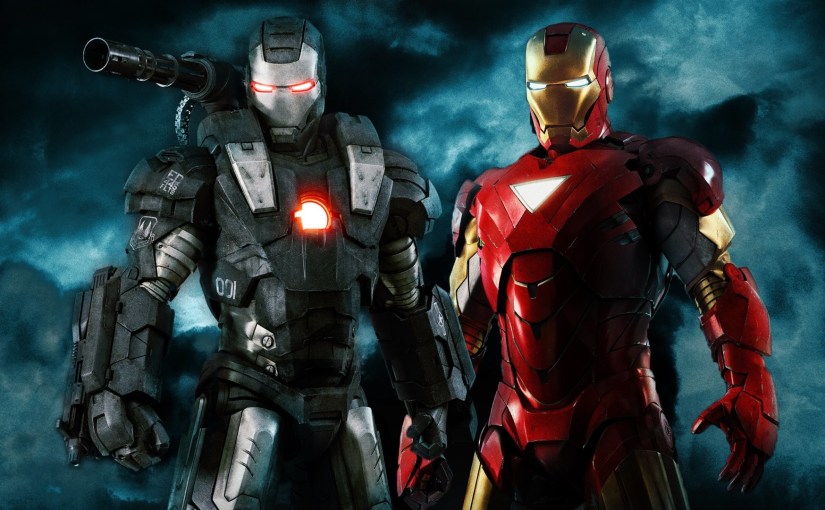
Then there is Stark’s relationship with his friend Rhodey (Don Cheadle). Cheadle shows potential in the part he resumed from Terrance Howard, but he really only serves two sole purposes, to have an armor throw down with Tony throughout the mansion (a stupid fight by the way), and to wear the new War Machine armor. That, I’ll say is pretty cool in charcoal black with red eyes and a shoulder resting machine gun.

Gwenyth Paltrow is back as Pepper Potts, and she just kvetches a lot. Paltrow and Downey’s chemistry are all but gone. Not really the actors’ fault though. More so, it’s the dumb screenplay by Justin Theroux who I guess found it adorable for the two players to squabble amid the action scenes. It’s rather annoying actually.

Theroux makes a lot of misfires here. The great Mickey Rourke appears to have fleshed out a great villain known as Whiplash. A Russian physicist with a grudge against Stark. Rourke offers a scary appearance of long hair, gold teeth and a tattooed muscular body. Oh, and he has a cockatoo as well. Mustn’t forget that. Too much of this film is devoted to this bird that does nothing. Whiplash is insufficiently written. He has a mid-film battle with Stark at the Grand Prix in Monaco, then following a prison escape, he’s harbored by Stark competitor, Justin Hammer, in a factory where he does nothing but build robots. None of this is interesting.

Sam Rockwell plays Hammer as a whiny kid in nerdy glasses and even nerdier three piece suits. He’s not a villain you ever love. He’s a Frank Burns, but his stupidity against Stark and Rourke’s character offers no humor from the stooge that he is.

Side stories focus on anticipation towards the first Avengers film with Samuel Jackson as Nick Fury and Scarlett Johansson’s Black Widow, yet not much is offered. They have nothing to do with anything else going on in this hodgepodge. Johansson finally gets a good fight scene during the climax, but it remains brief.

So there’s really nothing in Iron Man 2. It’s just a mix of things smashed together. The Iron Man suit only has three scenes, one to open the Expo (no fight there), one to have drunk Tony Stark fight with Rhodey while wrecking his house (Belushi did it better in Animal House, as well as the cast of Sixteen Candles), and then finally in a climactic ending against Hammer’s military robots and Rourke’s Whiplash who hardly participates in the moment.

Iron Man 2 is likely my least favorite of all the MCU films. (Actually, Eternals took that top honor, recently.) It offers one redeeming quality and that’s its end credit scene, maybe my favorite of that particular category.

Otherwise, Iron Man 2 is pointless, dumb, ignorant of its product, and flat out obnoxious.

Stan Lee Cameo: Was that Larry King? Really?

A FEW GOOD MEN

By Marc S. Sanders

A Few Good Men really does hold up.

Anyone with even minimal movie going experience can predict how it is going to end almost as soon as it starts, but that doesn’t take away from Aaron Sorkin’s first screenplay based on his original stage play.

It is well cast. For the film, no one else could ever play the intimidating and terrifying Colonel Nathan R Jessup other than Jack Nicholson. It’s not that it is just him in the role. It’s really Nicholson’s whole career legacy against the arguably still ripening careers of Demi Moore, Kiefer Sutherland, Kevin Bacon, Kevin Pollack and Tom Cruise. Nicholson’s timed grandstanding is necessary for the role to work.

Cruise on the other hand left me feeling a little too overplayed. The role calls for cockiness, yes, but is Cruise too cocky? Some of the gags he does work. Some don’t, like impersonating Nicholson momentarily (leave that for the guys on SNL, Tom), or when he’s poking fun at Moore’s character to his own delight. It’s a little too much. Still, his courtroom scenes are like watching the best in live theatre. Those scenes play like great sport, notably thanks to Tom Cruise.

Major props go to JT Walsh as a conflicted witness. When I say conflicted, I mean he authenticates a seriously valid and personal dilemma beautifully. Had it not been for Jack Nicholson, Walsh might have had an Oscar nomination. A shame he didn’t come close to such recognition while he was alive. He was such a great character actor.

Recognition also goes out to Kevin Bacon as a well versed prosecutor/Marine. His timing exudes the experience his character has, despite his youthful appearance.

Demi Moore might be caught trying too hard, I think. Kevin Pollack is the wise mentor sitting quietly waiting for his great moments. Kiefer Sutherland is great in almost anything he does. He doesn’t ever steal the spotlight like Cruise, Nicholson or Moore but he makes a great presence; conniving and bold.

The direction is nothing special really. Rob Reiner does fine but honestly Sorkin’s script sells itself.

Yeah, yeah. “You can’t handle the truth.” Great line, but I got news for you. I’d argue there’s even better lines in this 1992 film. It’s worth revisiting.

STAND BY ME

By Marc S. Sanders

I’m not embarrassed to say it.  I’ve experienced a mid-life crisis.  Last night, I watched Rob Reiner’s Stand By Me, and I absolutely broke down in tears when it finished.  As I approach age 50 later this year, the most recent viewing of this film alerted me that my childhood memories are further away than I ever realized before. 

Reiner lifts this coming-of-age story from Stephen King’s novella entitled The Body. Four boys spend the long and hot dog days of summer in Castle Rock, Oregon (it was Maine in King’s story) in their tree house smoking cigarettes and discussing important topics like Annette Funnicello’s breast size on The Mickey Mouse Club and the recent disappearance of a twelve-year-old kid.  Yackety Yak and Lollipop play on their transistor radio in the background.  The wimpiest one of the pack, Vern (Jerry O’Connell), overhears the location of the kid’s body is off the side of the railroad tracks, about twenty miles away.  Teddy (Corey Feldman), along with best friends Chris (River Phoenix) and Gordon (Wil Wheaton) decide to embark on the search for the body and get their picture in the paper, labeled as heroes.  It’ll take them the Labor Day weekend to carry out their quest.

During their long journey across the railroad tracks into the woods, the four boys will discover what concerns them, like figuring out if Goofy is a dog and who could win in a fight; Superman or Mighty Mouse.  As well, they’ll uncover what gives them anxiety ahead of their entry into adulthood.  Gordon lives with being unloved by his parents both before and following the accidental death of his older brother (John Cusack).  Chris lives with being unfairly labeled as a young hoodlum.  Teddy endures the aftermath of an abusive military father currently living in the looney bin.  Vern suffers from a hesitancy to live for adventure and risk due to ongoing fear. These boys had a future that awaited, but for some it seemed like there was no escaping the destiny the locals of their small town had already mapped out for them. 

In the last few years, I reconnected with a childhood friend by means of social media.  Visiting New York City annually over a three-year period, I got to see Scott in person and recollect on our times together.  It had been over thirty years since we had seen or spoken with one another.  We reminisced about tormenting the substitute teachers, and our first crushes.  We reflected on favorite movie scenes that we acted out in between classes.  We are different now, though.  Nowhere near the same as we were at age 12.  We have families and careers and responsibilities.  Yet, our memories of trading comic books, talking dirty, going to movies, and acting out cops and robbers shoot outs in the backyard all remain. 

When Stand By Me opens, a present day adult (Richard Dreyfuss) is shown reflecting in the distance following reading an article about a lawyer who was killed in a restaurant.  This narrator then flashes us back to the year 1959 when this adventure between him and his three friends occurred.  One of those friends was the lawyer who was killed.  A piece of his history has ceased to live and continue on.  That terrifies me personally.  Friends, and family, and people I’ve encountered over my half century will leave my presence, never to be seen or spoken to again.  I’ll never get the opportunity to reflect with them again, much less make new memories.  I’m now living in an age where Facebook comments seem to weekly consist of saying “very sorry for your loss.”  Friends are losing their parents.  Some are passing away themselves.

Stand By Me might not be altogether realistic.  The boys are getting overpowered by a sinister Kiefer Sutherland, who’s not afraid to use a switch blade and cut one of the kids’ throats.  King’s story also feels like an elevated Hardy Boys or Tom Sawyer kind of adventure.  I don’t know of anyone who went looking for a mutilated corpse during my summer days living in Wyckoff, New Jersey.  The adventure conceived by Stephen King serves as a thrill that you imagine as you read it off of the page.  My upbringing consisted of play dates and sleepovers with Scott, Star Wars toys and Saturday morning cartoons.  Yet, the connections that thread the main story together are what’s to treasure in Rob Reiner’s film.  The friends we make in grade school before becoming interested in high school, alcohol, sex, and career planning, are the most important people we know and first encounter in our lifetimes.  It’s impossible to forget them or the impact they had on our lives.  Scott certainly had an impact on my life.  I credit my sense of humor to him, and his carefree attitude to the ugliness of this world.  Sometimes that’s all we have to survive.

King and Reiner use the body that is being sought as a device to drive the characters.  What’s going to bring these boys together with no outside influence?  How can young Gordon deliver his revered sense of imagination as the writer he’s to become?  The best way is to put the boys around a camp fire.  Gordon can then entertain his pals with the story of an incredibly fat kid who got his revenge on the locals during a pie eating contest that results in a massive “Barforama.”  It’s silly and sophomoric and childish fun, but for 12-year-olds, it’s the best thing imaginable.  Teddy dreams of being an army hero storming the beaches of Normandy like his father was rumored to have done.  His sleeping bag is his machine gun mowing down an oncoming train.  Vern’s favorite food?  Watch the movie to find out.  Chris might be regarded as the outlaw, but he’s also the most mature, and perhaps the mentor to Gordon who suffers from the loss of the brother he loved, as much as he suffers from the neglect of his mother and father.  At age 12, in 1959, Chris was all that Gordon had.  I may have had more than Gordon at that age, but whenever I was with Scott, he’s all that I had.

Ultimately, Stand By Me is not an adventure or a silly comedy about boys being boys.  It’s a character study of kids just outside of their formative years.  It’s a film that captures a single moment before friendships inevitably expire.  It’s a reminder to embrace those you’ve treasured over your lifetime, because we cannot be twelve years old forever.

ALICE DOESN’T LIVE HERE ANYMORE

By Marc S. Sanders

Martin Scorsese was destined to be a great director. No doubt about it. Look at 1974’s Alice Doesn’t Live Here Anymore. Not only does it offer an Oscar winning performance from Ellen Burstyn as Alice, but this early career film contains skilled tracking shots.

Scorsese uses his camera like a musical instrument. He times it to move on a certain cue. Near the end when Alice needs to pick up her 12 year old son Tommy (Alfred Lutter, well played here) from a police station, Scorsese is clearly on foot positioned behind the police counter. When the time is right, he walks it behind the cop and extras in a crescent step by step over to behind Alice. We are in the scene. It didn’t take much imagination, but Scorsese is economical for an engaging payoff. The camera continues to follow a young Jodie Foster as Tommy’s rebellious pal, Audrey and then after she’s quickly escorted out by her mother, it peers into the room where Tommy is waiting. It’s an unbroken steady cam moment that predates his classic tracking shot of the Copacabana in Goodfellas, or the bloody overhead outcome from Taxi Driver.

The story is decent, though nothing big. Alice is forced to flee following one set back after another with the men she encounters in her life. First she’s unexpectedly widowed from her unappreciative and cruel husband, next she encounters a charmingly young Harvey Keitel who sheds his first impression quickly. Then she comes across Kris Kristofferson but is he right for her?

The second half of the film inspired the basis for the classic TV show Alice, featuring Linda Lavin and Vic Tayback who plays Mel the cook in the film as well. Scorsese uses the diner sequences for some good laughs of confusion and slapstick with side characters Flo (scene stealer Diane Ladd) and Vera (Valerie Curtain, another scene stealer).

These are good characters here. You want Burstyn’s Alice to be happy and succeed as a mother to Tommy and become the singer she dreams about. She’s adoring. She tries, and she always works hard. Burstyn has some great moments of various range whether she’s feeling like a pestered mom driving the long highways, having anguish and fear with the men who cross her path, or when she’s singing Gershwin’s “I’ve Got A Crush On You” at the piano of a seedy bar. I loved her in the role.

This is not really a special movie. Yet, it’s an important one in cinematic history. See this film to see the master director when he was merely a pupil, exceeding what was likely minimally ever expected of him to accomplish.

Martin Scorsese is just a great director.

CAPE FEAR (1991)

By Marc S. Sanders

Would you ever think that Martin Scorsese could be a master of horror? I do. I thought so ever since I saw his remake of Cape Fear, back in 1991, featuring Robert DeNiro, Nick Nolte, Jessica Lange and Juliette Lewis. This cast of four is an astonishing assemblage of talent, complimented with players from the original film, Robert Mitchum and Gregory Peck, as well as Joe Don Baker, Fred Thompson and Illeana Douglas.

Wesley Strick is credited with this updated screenplay that questions the measure of sin; pot vs heroine, battery vs rape, flirting vs infidelity, as well as the ethics and justifications that we reason with every day.

DeNiro provides one of his greatest roles. He lost the Oscar in 1991 to Anthony Hopkins. Reader, DeNiro should have won for a much more complex, fleshed out part. He plays Max Cady, a man released from prison after a fourteen year stretch. His focus during his time was to learn how to read, build up his body, tattoo his flesh with the principals he inherited from the Almighty Bible and other literary sources, and most importantly reconnect with his defense attorney Sam Bowden (Nick Nolte in one of his best roles, as well). Cady needs to remind Bowden of how he was misrepresented during his trial.

Strick’s screenplay is so smart. Smart because the antagonist never, ever makes an error, not until the end of the story. Cady’s intelligence is always one step above anyone else’s intuition and with the literal mechanics of the law beside him, Cady’s tactics come off very believably. Cady might come off as hokey, hillbilly white trash with ugly polyester clothing, a slicked back mullet and a fat, offensive cigar but he is a smart hunter who will weaken his victims before initiating his attack.

Bowden is a smart lawyer but he’s at a loss, and he does not have the support he needs from his family to protect himself and them, Jessica Lange as his wife and Oscar nominee Juliette Lewis as his daughter. Lange is very good as a wife who has survived marital turmoil of infidelity from her husband. She’s a marketing career woman who does not succumb to Sam as being head of the household. Sam asks that the dog not be put on the table and Lange as Leigh Bowden scoffs at his concern.

Fifteen years old at the time, Lewis is astonishing as a young girl discovering her sexuality but unsure of what is appropriate; almost like a kid finding a loaded weapon in a closet. One of the greatest acting sequences in the last thirty years, occurs between DeNiro and Lewis alone on a stage set against a sinister lighted Hansel & Gretel set. Lewis twitches and stutters like any girl would, as DeNiro assuredly comforts her and seduces her into a touch that leads to a kiss. Scorsese uses this midpoint scene to quiet down an aggressively frighteningly film, meticulously edited by the legendary Thelma Schoonmaker. Before this moment, telephone rings, shutters, racket balls, car engines, aggressive close-up zooms, and Elmer Bernstein’s horn and string sections of his orchestra startle you and scare you when almost nothing terribly vicious has really happened. When we arrive at Lewis and DeNiro’s scene, Scorsese quiets it all down. He needs no devices for this exchange of disturbing, yet researched dialogue by Strick, blended with the performance talents he has at his disposal.

Another stand out performance belongs to Illeana Douglas in a small, early role. She plays a court clerk to Bowden’s lawyer and they are flirtatious. Cady uses this as an opportunity to remind Bowden that he must take his sins seriously. Douglas is supreme in an inebriated scene with DeNiro as she flirts with him and then goes to bed with him. We can sense the danger she’s in. Douglas’ drunken portrayal cannot. Never does she look like she’s foreseeing her immediate future.

It’s ironic, really. I can’t help but compare Cape Fear to any one of the various slasher films featuring Jason, Freddy, Michael, etc. Those guys stalk the house or are seen from the distance at the end of the street. Those are horror films as well where an entity stalks a prey. Scorsese really has that here with Strick’s screenplay. However, Scorsese finds other ways than to just have the menace be…well the menace. He offers up an overabundance of fireworks behind Cady as he sits in Bowden’s backyard. He’s got Bernstein’s blaring horns and squealing strings for soundtrack, of course. He colors the palette of the sky above Bowden’s doomed house in bruised purples and blood reds. He even changes the perception of the Bowden family by showing what they are looking at in a sort of X-ray/black light like state. Are they seeing what they think they are seeing? Sure, Cady is stalking them, but in a given moment, are they just being paranoid by the disturbances Cady has cemented in their consciousness?

I’d imagine these are filmmaking inventions of Scorsese not specifically featured in Strick’s script. That’s what makes Martin Scorsese a director above so many others. He doesn’t just settle for the page. He won’t necessarily manipulate the script, but he won’t settle to just leave it at only what he reads. Cape Fear is a demonstration in unsettling, visual terror, and it’s worth revisiting for a look.

TAXI DRIVER

By Marc S. Sanders

A number of years back I was watching Robert DeNiro interviewed by James Lipton on Inside The Actor’s Studio.  DeNiro recalled considering doing a modern day follow up on one of his most memorable characters, Travis Bickle, with director Martin Scorsese.  Lipton thought it would be a marvelous idea.  So do I.  However, I don’t think it’d be a comfortable film to watch.  Taxi Driver certainly isn’t a comfortable film to watch.  It might seem a little dated now, but its themes of loneliness, isolation, depression and violent obsession remain entirely unsettling.

Travis claims to be an honorably discharged Marine in his mid-20s, when he applies to be a New York City cab driver during the present period of the film, 1976.  He recounts every thought that runs through his head, and when you are alone, behind the wheel of a taxi cab, traveling through the arteries and veins of an ugly, crime ridden, seedy part of town, a lot of ideas run through your sub conscious.  Travis recognizes so much wrong with what he sees through his windshield that he prophesizes one day when a good, solid rain will wash away all of this scum and filth.  Maybe Travis will be the bearer of that inevitable storm.

Travis lives alone in a one room apartment with junk food, an old television set, and his unending thoughts that he writes in his journal.  When he’s motivated, he occupies himself with chin ups and pushups.  He also becomes enamored with perhaps the only pure and innocent occupant of this ugly city-a young, Presidential campaign worker named Becky (Cybil Shepherd).  Travis approaches her innocently enough under the guise of wanting to volunteer for the campaign and invite Becky out on a date.  He’s cordial enough, albeit awkward too.  Yet, he can not understand how twisted it is to escort Becky to a dirty, X rated film.  She’s sickened by the film and Travis is at a loss of what he did wrong.  Travis has become infected by the city he circumvents each day, and he’s blinded of gentlemanly courtesy he could be providing for a woman he’s interested in.

The well-known script for Taxi Driver was written by Paul Schrader.  He quickly conceived its disturbing ideas during an isolation binge he found himself trapped in. Schrader couldn’t make sense of his mindset at times.  One week he was gorging on sleeplessness, junk food, and endless television watching.  The next week, he was motivated to get in shape with exercise and healthy eating.  There was a lack of consistency in his behaviors.  Travis goes through the same experiences, but he also finds motive to respond to the offenses that he sees. 

Scorsese captures scenes of some of the passengers that enter Travis’ cab.  One scene includes the director himself in the back seat as a character obsessing over a woman in an apartment above.  It’s a cameo of an unhinged man that Travis never had any interest in knowing, yet this person insists on sharing his frustrated anguish.  Later, Travis happens upon the Presidential candidate in his back seat.  The candidate seems noble enough inquiring on what issues are most important to Travis as an American citizen.  What I gathered from the scene is that the candidate has his own ways of fighting for a better future dressed in a suit on a campaign trail, while Travis has a more disturbing outlook on what should be done. 

Midway through the film, Travis is purchasing guns from an underground seller and practicing how to quickly unleash his arsenal for when the fight crosses paths with him.  He builds a quick draw sling to hide a gun under a sleeve.  He practices how to whip out the switchblade he keeps strapped to his boot.  One of the most famous scenes in film history occurs when Travis is talking to his mirror image asking repeatedly, “You talkin’ to me?”.  Supposedly, this moment never existed in Schrader’s script, and Scorsese was fortunate to capture DeNiro getting into character.  Whatever the origin of the scene, it sends a chilling summation of where Travis prioritizes his mental focus.  It’s not on love or affection for a fellow human being.  Once he blew it with Becky, other ideas remained with Travis.  Now, he’s solely obsessed with the war that he’ll fight for, all by himself.

Schrader and Scorsese go even a step further with the character as he comes upon a twelve-year-old hooker, named Iris, (Jodie Foster) and her street pimp, named Sport (Harvey Keitel).  He takes Iris for breakfast encouraging her to go home to her family and get away from this life.  Iris cannot see the need for that.  This encounter almost seems to justify Travis’ will for violence.  He now has a cause to rescue this child from the danger she’s immersed in.  I won’t spoil the outcome of this relationship.  Yet, Schrader and Scorsese keep the ending unexpected.  Have we been watching a dangerous villain for the last two hours, or were we watching a hero? Does the bloody and excessive violence that wraps up the picture lean towards heroics or vigilante crime?  These are good questions to ask but they are also consistent with the contradictions of Travis’ mindset.  When all you have to occupy yourself with are the endless, mounting thoughts running through your head, you are doing nothing but debating with your subconscious, and it’s likely you’ll have no other person to assure you that whatever actions and choices you make are the right ones.  One day you wonder if it’s all worth it.  The next day, you feel chosen for a crusade.

So as DeNiro and Scorsese considered a follow up to Travis Bickle in a modern time of the internet, where the world has only gotten smaller and more intimate with itself, I’d be nervous to see what becomes of him.  Travis would likely still be alone, driving his cab twelve hours a day, and listening to the thoughts running through his head.  Only this time, he’d likely be getting responses to journal inputs, that he’d put on blogs and in chat rooms, from unknown keyboard warriors justifying his will for violent cleansings.  Travis would no longer be limited to just his own inner thoughts.  Now, he’d have the influence of others willing to share their own internal ideas of how to clean up the streets.  They might feel helpful and recognize themselves as saviors, but would they be able to decipher what needs saving, what needs improving, and what is the best, healthiest and most ideal way of following through with those missions?  Violence might be their answer. 

You know what.  Perhaps, I’m not being fair.  Maybe I should be more optimistic.  Some of these keyboard warriors who hide behind their computer monitors may attempt to convince Travis that the world is fine as it is and does not need the cleansings that he had always considered.  I don’t know. Sometimes, like Paul Schrader or Travis Bickle, even I go back and forth on what’s right, what’s wrong and what’s the best thing to do.

THE 355 (2022)

by Miguel E. Rodriguez

Director: Simon Kinberg
Cast: Diane Kruger, Penélope Cruz, Jessica Chastain, Lupita Nyong’o, Bingbing Fan
My rating: 5/10
Rotten Tomatometer: 25% (…oof…)

PLOT: When a highly advanced technological googah falls into mercenary hands, a wild card CIA agent joins forces with three international agents on a mission to retrieve it.


I can’t speak for my colleague, Marc, but sometimes it’s harder for me to write about mediocre films than about films that are either outstanding or truly terrible. It’s harder to muster up the motivation to break down a movie that’s not bad or great, but merely so-so.

That’s the situation in which I find myself, sitting down here to write about The 355, a female-led action-thriller from director Simon Kinberg, whose previous writing credits are like a roll call of woulda-shoulda-coulda superhero movies: xXx: State of the Union, X-Men: The Last Stand, Jumper, X-Men: Apocalypse, the ill-fated 2015 reboot of Fantastic Four, and so on. (Full disclosure: he did write the 2005 comedy thriller Mr. & Mrs. Smith, which I believe is highly underrated, but that might be due more to the onscreen chemistry of Angelina Jolie and Brad Pitt than the script.)

The 355 (the title is explained only in the film’s final five minutes, so be patient) is standard Bond/Bourne stuff: an advanced technological doodad has surfaced and every bad guy on Earth wants it. It’s a fancy-looking USB drive that, once connected to any laptop in the world and properly decrypted, can access literally any network and/or mainframe in existence. As proof, the device’s inventor uses it to first crash a military transport jet flying overhead and then, as an encore, cuts the cable to his house. Personally, I would have reversed that lineup, but that’s just me.

(If this plot device sounds familiar, well, that’s because it is, as anyone who remembers the movie Sneakers will attest…but whatever.)

The device is stolen, and the good guys need to get it back before the bad guys do. Enter the main characters of the film: Mason Browne (Jessica Chastain) for the CIA, Marie Schmidt (Diane Kruger) for German intelligence, Khadijah Adiyeme (Lupita Nyong’o) for MI6, and poor Graciela Rivera (Penélope Cruz), a therapist who is in the wrong place at the wrong time. There’s some nonsense about them fighting each other at first, then banding together when they belatedly realize they’re on the same side.

The first major action scene is really well done, I have to say. There’s a foot chase through Parisian streets and subways that is as well done as any similar chase in the Bourne trilogy or any given Bond film. For that matter, ALL of the action scenes are competently executed…but that’s about it. There’s no flash or style, no real sense of originality.

There’s one sequence in particular that takes place in and around a fish-packing warehouse that, after a few minutes, became extremely muddled, and I lost track of who was chasing whom, and why, and how. The camera just seemed to be recording the action without getting me invested. It was curiously bland and detached.

The story itself was vaguely disappointing and unsatisfying, as well. It serves as the very definition of “by-the-numbers.” Virtually every cliche from better spy films are evident. The partner (Sebastian Stan) who’s dead…or is he? The trustworthy boss…or is he? The villain (Bingbing Fan) who lurks in the background…or is she a villain?

Now, there are uncountable films that have used these cliches to better effect, but it’s especially disappointing in The 355 because, throughout the movie, the story felt as if it was on the verge of talking about some truly interesting topics, specifically as it relates to women. There are subplots about how Mason, the CIA agent, has no personal attachments, while Khadijah, the MI6 agent, has a lover, and Graciela, the therapist, has a whole family waiting at home for her. Marie, the German spy, has some REAL problems that I won’t get into here. The story dances around the social perception of what women should or shouldn’t do with their lives. You want to be a secret agent full time? Okay, but you’ll get judged for not wanting to start a family. You want to start a family? Okay, but you’ll get judged for not being as professional or as dedicated as others in your line of work. You want to try to do both? Fine, but just when you think it can work, it doesn’t, so you should have come down on one side or the other. It’s a no-win scenario, and it happens all the time.

The movie dances with exploring this concept further, and then dances away in favor of more cliches and unnecessary plot twists. There’s even a whole sequence that feels as if it was lifted directly from one of the Ocean’s movies. Any one of them, take your pick.

There is also a moment when, out of NOWHERE, the stakes are raised in dramatic and horrifying fashion, so much so that it felt completely out of place. I was reminded, oddly, of a scene in the 2006 remake of The Hills Have Eyes where one of the mutant baddies slowly waves a gun over an infant in a crib. To me, it felt like overkill, and that’s the feeling I got with this off-putting twist. Was it necessary? It was shocking, true, and effective, but was it necessary? I don’t believe it was. I would have believed these women were motivated enough without bringing in outside pressure. And, to be honest, it felt like it was punishing those women who dared to have a life outside of their profession and rewarding those women who didn’t. No doubt there are other interpretations, but that’s how I saw it.

All in all, The 355 wasn’t downright unpleasant or super thrilling. It wasn’t exactly a waste of time, but it didn’t exactly blow my hair back, either. I don’t think it’s quite as bad as that Tomatometer would suggest, but…

Yeah…wait for streaming.

RETURN OF THE JEDI

By Marc S. Sanders

There’s a moment in Return Of The Jedi where Luke Skywalker (Mark Hamill) is about to be forced into Jabba The Hutt’s monstrous Sarlaac pit. R2D2 launches the Jedi Knight’s lightsaber in the air. Luke catches the hilt of the saber and just before he ignites it, the hero gives a smile. The Star Wars saga is not just fun for audiences. The players in the film are enjoying themselves just as much.

Following the mind-blowing cliffhangers of The Empire Strikes Back from 1980, the third film in the original trilogy picks up to tie off all those loose ends. The result is nothing but giddy, refreshingly inventive, swashbuckling adventure. I always admired the sets of the original trilogy. No two locations looked the same. Prior films have introduced desert, snow, swamp and cloudy locales. Jedi takes us to a forest moon known as Endor. It’s no surprise that a forest moon will not offer much technology even in science fiction/fantasy. So, we are treated to a welcoming and ironic final battle to overthrow Darth Vader’s evil Empire. Ewoks, cuddly looking teddy bears, known for the means of survival with primitive devices like rocks, sticks and logs will face up against armored Stormtroopers and gigantic, zippy little speeder bikes, and steel chicken walkers armed with powerful blasters. The battle scenes are fun, and they work. Just before the heroes break into an Empire bunker, Han Solo outstretches his arms and gives a smirk at the Imperial troops. Even Harrison Ford is having a good time. There’s much opportunity for the audience to clap along.

The main story involves Luke making an effort to defeat Darth Vader once and for all after he’s urged by Yoda and Ben Kenobi (Frank Oz and Alec Guinness) to confront the dark lord as a means to complete his training to be a Jedi. It will not be easy as it also means that Luke must resist the evil Emperor Palpatine’s seductive nature to join the dark side.

Ian McDiarmid is the Emperor and I always say this guy never got enough recognition. He’s as masterful with the role as Margaret Hamilton was with The Wicked Witch of the West. He chews the scenery and like the good guy actors, he’s also having fun in the part.

Jabba The Hutt is also a terrific surprise that’s finally revealed (if you had been following the more preferred original cuts of the trilogy). This large, slug like puppet character is an amalgamation of Marlon Brando in The Godfather and a very bulky Orson Welles. The infamously controlling gangster on Luke’s home planet of Tatooine gleefully displays a captive Han Solo still frozen in carbonite. The sets within his palace are magnificently detailed in creature extras and sleazy decor, much like a seedy strip club.

I think the appeal of Star Wars comes partly from the nature of human beings and the planet Earth where we reside. All looks familiar in a way the first time we see something and it’s easy to make presumptions of this galaxy’s inhabitants and what they are respectfully capable of. We can recognize that Ewoks might be as constructive as the Swiss Family Robinson with their tree like village. At the same time, a giant slug with a green skinned, dancing concubine chained to him commands over a peasantry. Elders in black robes carry an instinct to almost gaslight a weaker opponent for personal gain.

George Lucas sourced from prior films of all different categories used before. He only made it his own original work with some modifications. So you get sword fights, only in this world the swords are beams of light. You get a strip club bar, but it’s science fiction polish allows it to be a little more PG rated.

Return Of The Jedi serves as a great time to watch a movie. It’s swashbuckling and even well-acted, especially with Mark Hamill in the lead. His character changes from one film to the next. He’s no longer a child here. He’s now an absolute leader walking into the depths of hell aboard a new and more powerful Death Star, ready to sacrifice himself to fulfill a likely prophecy, as well as to save the Rebellion he commands.

It may not be the best film of the original trilogy, but Return Of The Jedi was one of the most satisfying movie going experiences from the decade of the 1980s.

THE EMPIRE STRIKES BACK

By Marc S. Sanders

My absolute favorite film of all time is the Star Wars sequel The Empire Strikes Back.

It is a film that brilliantly reinvents the outstanding product that George Lucas introduced to the world three years prior. The dialogue is sharper for every single character from Han Solo (Harrison Ford giving a breakneck, adventurous performance) to C3PO (Anthony Daniels, masterfully giving the perfect and necessary inflections to a golden droid with a sole expression of worry, but still quite intelligent) to the man in black, Darth Vader (with David Prowse’s hulking physicality playing much more aggressively, and James Earl Jones’ voice giving a more sophisticated nuance to the character’s coldness). Lawrence Kasdan, the screenwriter, uncovered new ways to apply story to these characters above the incredible special effects of miniature models and matte paintings, as well as set design. Just look at the underground tunnels of the Hoth rebel base for convincing set pieces. Director Irvin Kershner knew how to apply the beats. A director and screenwriter make a perfect duet of cinematic filmmaking.

For one thing, settings were unlimited. While the first film showed a great contrast of sandy, sun-drenched desert and lack of development against the industrialized steel of a massive space station, Empire opts to introduce new, previously unseen environments for the characters to play in. A planet made of snow? Yup! There’s that. A planet mired in mud and swamps? Yup there’s that as well. A planet with a city in the clouds? Yup, got that too!

As the film opens, the Rebellion, heroically led by Jedi in Training Luke Skywalker (a terrifically believable Mark Hamill) is in hiding from the evil Empire on the desolate snow planet Hoth (filmed in Norway, accompanied by realistic matte paints in post production). The first battle sequence moves with a kinetic pace as the band of heroes are defeated and forced to retreat when the Empire’s giant four legged walkers (inspired by the monster films of King Kong and Godzilla) locates them.

From there, the film really lives up to its title as the heroes never win the advantage over the domineering bad guys. Han Solo with Chewbacca desperately escorts Princess Leia (a fiercely sarcastic Carrie Fisher to play against Harrison Ford) out of danger, only to find worse encounters to come as Vader remains hot on their trail. There’s a spectacular sequence that includes John Williams beloved score involving the Millennium Falcon in a crowded asteroid field. Meanwhile, at the request of Obi Wan Kenobi (Alec Guinness, in spirit), Luke visits the swampy planet of Dagobah to be trained by a mysterious Jedi Master named Yoda.

Assuming you can avoid focusing on all that you may already know of the film, including events that lead to discoveries in Empire, you have a film that never stops surprising you. Sure, by now we all know who Yoda is and what he looks like. What I remain curious about is Luke’s own image of what Yoda could be before it’s revealed midway through the film. Isn’t it a brilliant surprise and sleight of hand that Lucas, Kasdan and puppet master Jim Henson, with the voice of Frank Oz, to offer up the most unlikely person to be this great warrior or Jedi Master? It’s refreshing and it remains that way to me, no matter how many times I’ve seen the film. No matter how small or odd looking any of us could be in the eyes of someone else, our true strength and wisdom and bravery will show itself in unexpected ways. Yoda must be the most unlikely hero ever to grace a film. It’s smart storytelling when two entire scenes in Luke’s story arc come before the curtain is lifted on who Yoda actually is. Later, we are treated to a demonstration of the small creature’s strength and skills. It’s done beautifully with the absence of a lightsaber or any kind of attention-grabbing fight scene. The moment Yoda lifts Luke’s ship out of a swamp still raises the hair on the back of my neck. This scene shows that the mysterious “force” is more than simply sword fighting. There’s something more intrinsic in the willingness to believe in this element of fantasy. For us, I think it reminds us to believe in unlimited possibilities. I’m comfortable with that philosophy.

Masks are a theme I’ve always embraced in the Star Wars films. It’s not discussed enough actually. It’s ironic to me. Characters like C3PO or Darth Vader or Chewbacca and Boba Fett have these blank facial images to them. However, with the economics of Kasdan’s dialogue they say so much with brief statements of anger, despair (including a howl from Chewbacca) or worry. The expression physically never changes on C3PO’s face and yet I see different moods in the character thanks to the miming techniques of Anthony Daniels, the actor. A nod of the head will say something. With the practically silent Boba Fett agreeing to a contract with Vader, you see how methodical this bounty hunter dressed in dented armor really is. The character hardly gets any action scenes, yet you know how threatening he is. Every dent and scratch of his green armor tells a story. An aggressive walk shows a fear inducing Vader, one who is intolerant of any shortcomings. Sometimes Vader is simply matter of fact. If a minion fails in their assignment, he’ll force choke them and just walk away. As he duels with Luke, he simply puts his saber down when Luke is struggling with a massive wind current. We know that Darth Vader is cunning. So he hardly ever pushes himself further than necessary. We understand all of these characters’ emotions and motivations, and yet they are covered by masks.

The big surprise at the end of the film is the main crux that’s sustained the success of this sequel. It’s an absolute surprise out of nowhere but it seems to belong, as it is consistent with my belief in the mask motif throughout the whole film. There’s a veil draped over many developments of the film.

Allow me to digress. I’ve already discussed Yoda. Also consider other elements of the film though. Han decides to hide his ship from the Empire in the deep cavern of a large asteroid. Later, we learn it’s no cave. We also meet a charming new character named Lando Calrissean (Billy Dee Williams, who’s also great). He might not be what he seems as well. Since the first film came out, we’ve never had a full grasp of what or who Darth Vader is. He murdered Luke’s father and he’s someone or something in black. So, he must be the villain. That’s all we know, however. Yet, we eventually discover there’s something more. Because this is fantasy and science fiction with no roots in Earth based science, Lucas and Kasdan are well aware that they can color outside the lines and make up their own rules to this unfamiliar galaxy we are immersed in. Why not, actually? There are simply no boundaries.

A favorite scene of mine is when the Millennium Falcon makes a daring escape from that cave. It turns out to be the stomach of a giant slug…living in a rock…that floats in space! That’s the beauty of the original trilogy of Star Wars films, nearly anything could be put on the table, and it would be easy to accept and believe. In The Empire Strikes Back, almost every scene is layered and then further layered in imagination. Other storytellers would stop at just making this setting a cave and nothing else. It just might be shocking though. Put it this way, I’ll never forget taking my dad to see the special edition of this film in 1997. When the space slug revealed itself, dad burst out laughing. He didn’t see it coming. Kasdan hooks his audience with the furthest thing from your mind. When we got to the surprise ending, dad turned to me and actually asked me if he heard what he actually heard. When I showed the film to my daughter at age 6, her jaw dropped. How could a being dressed in complete black have any more depth to himself when I can’t even see what he looks like? The storyline of this film in particular is not aimed at any one demographic. Anyone could absorb the merits of surprise stuffed into this piece.

Empire is also admired for its firm stance to wrap up the film with an unhappy ending and cliffhanger. No other film has ever accomplished that so well. Much uncertainty is left to our imaginations. Will a character turn out to be dead? Is Vader’s revelation true, and if so then how does that explain the exposition delivered from Obi Wan? What does this “Jabba The Hutt” I keep hearing about actually look like? Was I looking at Vader’s brain or a human head underneath his helmet? What is Luke’s destiny? He didn’t do so well here. Could that lead to a worse fate? That scene for Luke in the Dagobah cave seemed quite foreboding, after all. Yoda implies “there is another.” Who could he be talking about, and what does that even mean? What about the conflict between the Rebellion and the Empire?

In the year 1980, the internet was not available as a means to spoil certain surprises and dismiss our own theories. We simply had the storytelling to work with. We had to wait three long years, speculating and discussing among our friends and family. It’s what maintained the strength of George Lucas’ space saga. The idea that we could play in the sandbox over a six-year period made these films more than just movies. They were events and they symbolized turning points in our lives. Personally, I discovered the magic of imagination. When I’m the writer the only rules I need to abide by are my own. That is most especially true with The Empire Strikes Back.

STAR WARS

By Marc S. Sanders

Of all the infinite times I have watched Star Wars (now also known as Episode IV: A New Hope), what remains appealing to me is the depth of its outer space setting. It would have to, right? Otherwise, what was the point of making action figures beyond the main characters, Darth Vader & Luke Skywalker? It’s a film where it’s just as important to get to know the extras seen in the film like a “Walrus Man” or a “Hammerhead,” or green skinned “Greedo.” Unquestionably, Star Wars is a film with a very, very rich and very deep setting.

What kept moviegoers coming back to the film time and again in the late ‘70s through the ‘80s and on into the next century, is that there is just so much to get accustomed to. One moment, you are adjusting to a summary scroll that opens the film with John Williams triumphant music, and then you are trying to familiarize yourself with an unusual ship that is being pursued by a much grander one within the depths of space while circumventing an orange planet. Laser shootouts occur with robots caught up in some kind peril, and then we meet a towering figure in black with an asthmatic, incessant breathing mask.

Later, we have to get used to small scavengers, and then scarier scavengers tormenting a boy on the cusp of adulthood who only dreams of adventure. The boy meets a mentor and then we are in a saloon with the oddest collection of patrons we could ever encounter. The film carries forward to daring rescues and escapes and a sword fight that may lack sophisticated choreography, but makes up for it with lightsabers and a surprising death that leaves an air of mystery. Before that’s all over, we still have to become enamored with the daring dog fights within space among battalions of one man piloted space ships.

That’s what has always kept Star Wars alive with much to celebrate. There is always something new and different just minutes away from the current scene you are engaged in. No two characters or bands of people look the same. No two settings look the same either.

Lucas always sought out to build a “used universe.” The ships and settings beyond the villains’ (known as the Empire) powerful Death Star space station were beat up and bruised and rusted and dented. This galaxy is lived in, and mired in a history.

Considering the film released in 1977 is somewhat telling of that decade. Films like The French Connection and Dirty Harry showed the ugliness of their respective cities and citizens with broken down cars and trash in the streets, and hoods with unkempt beards and worn-out clothing. Lucas must have carried these visions over to his PG universe to give viewers the idea that a guy like Greedo is a dangerous bounty hunter unconcerned with drawing his pistol in public, and a gangster like Jabba The Hutt rules a territory with a threatening criminal fist. (Incidentally, I strongly oppose Jabba’s appearance in the reissue of the film; better to imagine how vile this guy is in my own mind when watching the picture for the first time).

Lucas also famously takes inspiration from Akira Kurosawa’s Japanese films (especially The Hidden Fortress) of samurai culture, and blends it perfectly with a sci fi interpretation of the Old West gunslinger as seen in Sergio Leone’s spaghetti westerns.

Star Wars pleases so many different demographics of audiences because it jump starts its multiple stories and settings with what made going to the movies so appealing to begin with. Present within the film are humor, childlike appeal, fantasy, western motifs, suspense and romance.

It’s a visual classic that remains unmatched. At least with the original trilogy, Lucas never allowed any two settings to look alike. With this film in particular, we are treated to the contrast of a desolate desert planet vs the cold industrial operations of a ruling regime proud to carry out their actions with menace and terror. (More pleasing contrasts occur in the next two films.)

Star Wars is well known for the simplicity of its story. It’s main hero, Luke (Mark Hamill), is recognized for his basic innocence simply with his white tunic and mop top head of hair. Same can be said for the damsel in distress, Princess Leia (Carrie Fisher) and the fearful but sweet droids she sets out to embark on a mission. She evokes a royal and dedicated government in her white robe with elegant hairstyle; the droids have an expression of worry for the tall one, and spunky nerve for the shorter fat one, like a Laurel & Hardy pair. Villainy is epitomized with Darth Vader (voiced with commanding authority from James Earl Jones), who dons all black with a terrifying mask/helmet. You don’t know what Darth Vader really is beneath that dark costume. It’s not important for the exposition of this film. All that matters is that Lucas shows you who is good and who is bad. The visual references are enough for the explanations. What we need to know about these characters are summed up with the wise but elderly prophet in quick summation by Ben Kenobi (Alec Guinness, in an Oscar nominated role). Kenobi serves as the historian of this universe.

Over time, even almost immediately upon its release, the commercialization of Star Wars hogged the spotlight of the original product. It’s reflected today based on a measure of expectations both financially and within the fraternity of diehard fandom. Ironically, in 1977 everyone was satisfied with the surprise that George Lucas shared on the big screen. There were no objections to be found. Today, though, it’s become an act of trying to satisfy the masses by what they believe the next developments should be. I’m guilty. I admit to sometimes being an accomplice to that notion. It’s impossible to please everyone. So new film products in the Star Wars franchise will never succeed as well as the original film managed to do.

I don’t let any of that bother me. I remain pleased that I can still feel the sensation of pumping my fist in the air when Luke & Leia swing across the chasm thereby evading Stormtroopers, or getting a thrill when their pirate escort, Han Solo (Harrison Ford), finally lets loose of his quiet, cool demeanor to run down a hallway while trying to take out an army of baddies. I get a lump in my throat when Kenobi gives a slight grin before surrendering to Vader in front of Luke’s eyes.

So much is to be seen in Star Wars, but not all of it is explained. George Lucas completed his film with routes left to wonder and think about; he gave an opportunity to continue our imagination long after we finished watching the film for the first time. On the multiple occasions we watched thereafter, we pondered where we could get a table in the Cantina/saloon, or just how many droids the Jawa scavengers kept in their sand crawler.

As well, what did the blue milky substance taste like. More importantly why exactly did Luke’s uncle give a concerned glance across the dinner table to his aunt during a slight mention of his father?

That’s the magic of Star Wars. Like the land of Oz or Willy Wonka’s chocolate factory, there’s just so much to explore and think about and imagine beyond its surface. Long after we are all gone and our grandchildren’s children are beginning to stimulate their imaginations, they may well turn to the cartoons and other films and toys in the vast galaxy from long ago and far, far away. One thing is certain, though. They should ALWAYS begin with the original Star Wars.