KILLERS OF THE FLOWER MOON

By Marc S. Sanders

Killers Of The Flower Moon reflects on a period in Oklahoma history that I imagine has hardly been told.  In the early 1920s, the Native American residents, consisting of four tribes, came into a blessing of wealth when oil was discovered on the land they occupied in Osage County.  Almost immediately, white folk from all over the country migrated to this area and built up an infrastructure of capitalism that included private practices, pool halls, movie houses, law enforcement, pharmaceuticals, and even cab drivers.  However, they didn’t want to just stop at developing the area.  They wanted to seize it and they proceeded to do so by wiping out the Native American residents.  Family lineages were all but erased as the whites married into the race and gradually found ways to kill and bring about surprising deaths that would ultimately allow them to legally inherit what was rightfully owned by the Indian people.

Director Martin Scorsese has introduced a new kind of historical education with a film that I believe will be my favorite picture of the year.  I was mesmerized by every photographic shot, closeup, edit, and musical accompaniment contained in this movie.  Everything works so well. 

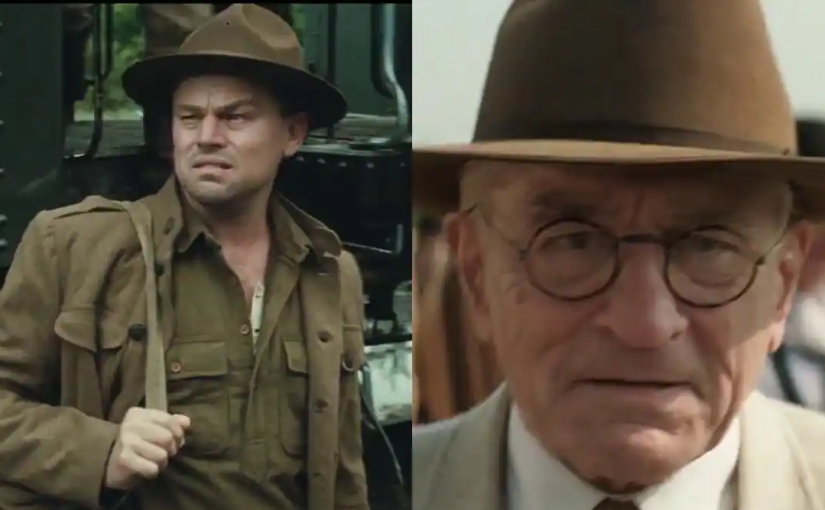
Robert De Niro reunites with the director for the tenth time; an amazing legacy of a partnership spanning fifty years.  He portrays William “King” Hale.  King is a kindly old fellow on the surface, but his intelligence shows as he strategizes how to take over more and more of this area.  He oversees a control of the white gentlemen folk, leading them into quick marriages with the young women of the tribes.  From there, they have children and over time will gradually purify the bloodline.  It’s a ruthless and scheming tactic and it successfully works thanks to how taciturn Mr. Hale is.  De Niro might win his third Oscar for this role.  This character joins that exclusive fraternity of the best villains in cinematic history, ranking up there with The Wicked Witch, Harry Lime, Norman Bates, Darth Vader, Joker, Daniel Plainview and Hannibal Lecter.

Early on in the epic film, The King’s nephew, Ernest Burkart (Leonardo DiCaprio) has returned from the war to work under his uncle.  Ernest starts as a cab driver and meets Molly (Lily Gladstone), the Native American woman he will take as a bride and establish residence together.  DiCaprio does some of his best work following a very boastful career of roles.  He’s also sure to get at least an Oscar nomination.  This is already his sixth film with Scorsese.  Ernest is not very bright, but with The King’s guidance and instruction he’ll also come to own much of this territory.

Mysterious deaths of unexpected natures occur within the tribes of Osage County, particularly in Molly’s family.  Over the course of the film, one relative after another perishes until what’s left of her bloodline is practically only herself.  The children she bears are a mix of Molly and Ernest.  Molly knows something is amiss.  She is starting not to feel well, and her suspicions speak to her.  Others in the community are also suffering peculiar deaths following doctor’s visits or evenings of drunken binging.  An investigation is warranted before it becomes too late.

Lily Gladstone will become a surprise hit at Oscar time as well.  A breakthrough role where her feared silence and bravery matches well against the deceit emanating from the King and even the poorly hidden conniving of her husband Ernest.

Scorsese builds his film with suspense and shock.  A quiet beat of instrumental music haunts certain scenes.  Who will be the next target of the King’s bidding?  The King hides behind his empathy for loss by attending funeral services and allowing the survivors to cry into his shoulder.  On another side, he instructs Ernest to carry out an assignment to some flunky to make a murder appear like a suicide.  A shot in the back of the head will not send a convincing cause and effect though, and the King and Ernest must make up for that. 

The King is everyone’s friend in Osage County, but he’s also a puppet master Grim Reaper.  With the circular rim glasses that DeNiro wears along with his peaceful beige suits, it’s a wonder that this man is an executioner using the hands of others to carry out his bidding.  He dances in the middle of town during festive gatherings.  It even amuses the Sheriff’s office when he voluntarily offers himself up following a warrant for his arrest.  At the risk of getting politically sided, DeNiro was recently interviewed during a press junket for the film.  His animosity towards President Trump is no secret.  I was in the audience at Radio City Music Hall when he led a unified roar of “Fuck Trump” during the Tony Awards.  Still, the skilled actor said he used the enmity he harbors to his advantage for this role.  In the latter half of the film, William “The King” Hale preaches in a similar approach to Trump.  There are figures in our history who just know what buttons to push and absorb massive amounts of influence while earning respect through fear. 

Killers Of The Flower Moon covers a wide berth of its period in history.  Scorsese takes an inspired approach by cutting away on occasion with black and white footage and photographs of the Native Americans coming along with their good fortune and then on to how the white “immigrants” of this area enter this land and assume a daily life within the community, whether they were welcomed or not.  All is depicted from how Osage County quickly changed following the discovery of “black gold,” to how Ernest becomes wise to the advantages of power. 

Leonardo DiCaprio has a great undertaking.  Ernest is not very bright.  He can hardly read.  He’s not subtle with his approach like his uncle.  Yet, the actor maintains an expression of no choice to abide by but what he’s been told is right.  DiCaprio does this incredible expression with long frowned lips and a fat chin that stands out from beneath his nose.  It almost seems like a barrier to finding the humanity he may have once had when he was an infantryman fighting with the allies in Europe.  It is just a haunting performance.

The third act picks up with J Edgar Hoover’s newly established Bureau of Investigation entering the story to investigate the odd happenings in Osage.  Jesse Plemons again plays that guy that you have seen somewhere before.  Often, he occupies similar kinds of roles, and still, I like what he contributes to this picture as Investigator Tom White.  Screenwriter Eric Roth lends the character simple, plainly worded questions for Plemmons to work with and it seems to come off as nothing intimidating.  Rather, the presence of Tom White on Ernest’s doorstep, with Molly mysteriously sick in the bedroom, is enough to rattle Ernest, the King, and the whole county.

It’s no secret that Killers Of The Flower Moon has a long running time at nearly three and a half hours.  However, it is necessary.  This widespread crime is not done in just minutes.  How it is gradually orchestrated needs to be seen, followed by those that uncovered how sinister it became.  Then attention needs to be given to how biased the trials of Ernest and The King had become.  Men who conspired with the King and Ernest serve on the jury.  A lot of unfair wrongs occurred during this time spanning what I believe was at least a decade and a half. 

Roth and Scorsese bring the conclusion of the film with a welcome invention.  In a time where Netflix, Dateline, 20/20 and ABC News thrive off true life crime documentaries that become so addicting, the filmmakers resort to a radio show to sum up what happened to the main players of this devastating episode in twentieth century American history with the director making a cameo to offer his final words for the main victim of the piece, Molly Burkhart.  This bookend to the film has stayed with me since I finished watching the movie, and I applaud Scorsese and Roth for their execution.  Newsmakers of today go for the most sensationalized crimes that have occurred; the ones that leave the most shock and awe and even audaciousness.  What happened in Osage County is unforgivable.  Likely a genocide of bloodlines that were unjustly ceased so that what was rightfully theirs to own could be seized.

Killers Of The Flower Moon is a drama that had to be told because the motivations that led to the series of crimes happens not only to Native Americans, but to practically any other demographic across the globe.  This is a captivating story and one of the best films Martin Scorsese has ever made.

Again, this will likely be my favorite film of the year and Oscars are deserved for DeNiro, DiCaprio, Gladstone, Roth, Scorsese and for Best Picture of the Year. 

NOTE: As I watched this movie, I could not help but think of the film August: Osage County, the motion picture adapted from Tracy Letts’ Pulitzer Prize winning play.  There is one Native American character in the film who is hired to serve the white family living on a wide expanse of land in present day 2013 (2007 for the play).  The first time I watched the movie, I could not recognize the purpose of the character.  On a second viewing, following a conversation among the dysfunctional family of characters about Native Americans, it was much clearer.  Having now watched Scorsese’s film, this picture serves as a great companion piece to watch afterwards.  I’ll be directing a stage production of this soon and much of what I learned from both films will be incorporated into my interpretation.  Even the architectural designs of the homes in both films, interior and exterior, are uniquely similar. 

Look for my review of August: Osage County (featuring Julia Roberts and Meryl Streep) on this site as well.

CLOSER

By Marc S. Sanders

Mike Nichols is a director for those actors who really grind their teeth into the craft of performing with crackling dialogue.  Often, he goes for what makes a person drive awkwardness into a moment.   Equally he focuses on those folk who sustain the discomfort so apparent in a room.  Prime examples are his classic films Who’s Afraid Of Virginia Woolf? and The Graduate.  There’s even some of instances in his slap happy comedy, The Birdcage. Towards the end of his career, Nichols adapted Patrick Marber’s biting play, Closer, into a film.  

Closer carries a four-pronged approach in the shapes of Jude Law, Natalie Portman, Julia Roberts and Clive Owen.  Law plays Dan who catches the eye of Alice (Portman), an alluring stripper who gets hit by a car on the streets of London.  Beginning with playful flirtation in the hospital waiting room, they develop a relationship mostly based on sex for the following year.  Later, Dan gets distracted by a beautiful, much more mature photographer named Anna (Roberts).  She rejects Dan’s horny advances and by some manipulation with online anonymous sex talk, he sways a sex starved doctor named Larry into meeting Anna at an aquarium.  Then, to Dan’s surprise, Anna and Larry get married. There’d be nothing more to discuss if these four lived happily going forward.  What follows, however, is a manipulative chess match of lies and deceit among the four.  

One after the other disarms somebody who they valued and thought they could live with at any given time.  Alice leaves Dan after he reveals an affair with Anna.  Larry has a regretful one-night stand with a woman in New York. Anna doesn’t mind because she’s been having an illicit affair with Dan.  Larry is miserable but begs Alice the stripper to justify his torment, assuming she’s also anguishing over being betrayed by Dan. Not likely the case as she erotically teases him in a private stripping room. This scene with Natalie Portman in control establishes as the best actor in the film.

The four players on the game board all start in their respective corners, only to go around the perimeter or advance diagonally across and pounce on what they don’t have. At any given moment someone is drawing the top card or rolling the dice, and it’ll have a direct effect on one of the other three or all of them at once.

Patrick Marber’s script gets more layered as the partners change hands, but it’s his dialogue that keeps you engaged.  Alice believes “Lying is the most fun a girl can have without taking her clothes off – but it is better if you do.”  An angry Larry confronts Anna by asking about Dan.  “What does it taste like?”  Anna’s reply: “Like you, only sweeter.” Ooooo!!!! Lines like these sting, and I’ve never met someone in real life who can think that quick on their feet with such savviness.

Just as in other scripts like Steel Magnolias and Glengarry Glen Ross, I think the characters in Closer (initially a stage play) speak a little too instinctively.  They’re just so quick with their hurtful insults, comebacks and seething expressions.  Therefore, should I like plays that perform on a higher, smarter plane; plays that work quicker than most minds can register with what to say next?  Well, I appease myself with a constant reminder that a piece like Closer is more performance art than truly authentic. These four characters are so quick with a verbal jab, while engaging in some foolhardy actions that promises to make their circumstance appear worse. How can they be so smart with a comeback while acting so stupid at the same time?

The cast of four are so sharp, alert and precise.  Most of the scenes in Nichols’ film are performed in different combinations of pairs.  Every one of them is expertly rehearsed and Roberts, Law, Owen and Portman are of course the strongest assets in the production.  However, Nichols wisely uses his lens in zoom close ups, practically justifying the quirky title of Patrick Marber’s work.  I never trusted a single character was entirely genuine in Closer.  How should anyone? They’re always stabbing one another in the back. However, when an actor leans in and Nichols meets their expression halfway, I’m being ordered to look that person straight in the eye.  Still, I won’t know what to believe, but that’s the point.  

Dan, Alice, Anna and Larry move the scenes along with question after question because every answer is so dubious.  You’ll likely never get a more skeptical response when a common inquiry such as “Do you love him?” is asked.  It can be frustrating, but thanks to the cat and mouse play of Mike Nichols’ stage direction, on film, I wanted to dig deeper into the bottomless rabbit hole.

You might conclude there is a surprising twist at the end of the film.  I don’t know if it holds much weight to what I learned during the course of the story.  Nevertheless, it reinforces the theme of Closer.  Being bad can be fun, offering an immediate high, and part of being bad is lying and betraying, and maybe the ending reveals who actually won this board game with four players at the table.

Look Closer and tell me what you think.

COLLATERAL

By Marc S. Sanders

A salt and pepper haired gentleman in a knitted suit with sunglasses arrives at LAX before the sun sets.  He exchanges bags with a man he runs into, played by Jason Statham. Elsewhere, a driver does a polish and check on his taxi cab before beginning his evening shift.  He picks up an attractive, overworked attorney named Annie (Jada Pinkett Smith) and before she hands him her business card, the driver has at least convinced the woman to re-examine her life’s purpose and consider simple ways to escape reality.  The man in the suit is Vincent played by Tom Cruise.  The cab driver is Max played by Jamie Foxx.  They are about to collide with one another on this night and put Michael Mann’s film, Collateral, into play.

Following being a massive fan of the TV show Miami Vice, and the films Thief, Heat and The Insider, I remember my anticipation sky rocketing when I saw the trailers and write ups for Collateral.  Mann, Cruise, Foxx, and crime in a cool looking L.A. with a symphonic soundtrack? I’m there!  It seemed like a perfect formula.  When I finally saw the movie, I think I was let down because it was too formulaic following a step-by-step recipe.  The editing for Collateral is abundantly cookie cutter, never taking any risks with its story.

Vincent chats with Max as soon as he gets in the cab.  He offers eleven hundred dollars to occupy Max’ evening, transporting him from one location to the next. Max has dreams of running his own limo company one day and this easy money is too good to resist.  It’s only when Vincent tosses someone out a fourth-floor window to land on the roof of the cab that Max realizes there’s a hitch to this arrangement.  

Vincent is a hitman out to check off a list of targets before sunrise, and he needs Max as a cab escort.  Threats to Max’ ill mother in the hospital will keep the driver in check, and if inconveniences like a shattered windshield draw the cops’ attention then Max will have to abide by Vincent’s demand for no interference with his plans.  

The two hour running time of Collateral is structured on one stop after another.  Mann abides by side scenes from Stuart Beattie’s script to look at the undercover night detective (Mark Ruffalo) who is one step behind the pair’s frequent stops within the city.   I guess it’s fortunate for this guy that ballistics and coroner’s reports are quickly and readily available within minutes and hours to connect some dots.  

In between the kills, Vincent and Max chat in the cab.  Standard stuff really where Tom Cruise is at one time charming and other times sociopathic.  Jamie Foxx is the bright but frightened guy with dialogue that doesn’t amount to much in convincing this unwanted passenger to either let him go free or to give up on his mission.

Ironically, the many scenes shared between Tom Cruise and Jamie Foxx are the least interesting parts of the film.  When the sound editing isn’t failing by making their dialogue sound like incoherent mumbling, neither guy is ever convincing the other to look in a new direction or consider another idea.  Therefore, the conversations never go anywhere.  Look at films like The Silence Of The Lambs, Cape Fear, Seven, and especially Mann’s best picture to date, Heat by comparison.  Those films work when either the antagonist or protagonist allow themselves to consider the arguments, even if it’s just for a second, against the ones they are debating.

There is action and violence in Collateral, but it’s really a talking piece.  Still, the best exchange of dialogue occurs with Foxx and other cast mates besides Cruise.  A great scene occurs when Vincent insists that Max act under the guise that he is Vincent when he has to report to the drug kingpin employer who originally hired him (a surprise welcome from an at the time unknown Javier Bardem); great acting and writing happening here.  The early scene between Jada Pinkett Smith and Jamie Foxx also works at a thought provoking and interesting level.  These scenes are short one act plays that belong elsewhere.  Jamie Foxx is doing some great work in these moments.

Unfortunately, when Foxx and Pinkett Smith reconnect later in the film, they are not written with the same kind of intelligence during a run and hide third act climax.  The suspense is absent here because the setup is ridiculous.  While standing on the top level of a parking garage, Max can easily see Annie in a fourteenth-floor office window, blocks away across the city, and specifically direct her where to run from the dangerous killer who is a few floors below, all while using a dying cell phone.  

More to the point, why is Annie still wearing a suit and heels, with her hair and makeup done up, at four o’clock in the morning? I know an aggressive lawyer never stops working, but don’t they go home, pour a glass of white wine, get into sweats and pop open the laptop while Miles Davis plays softly on the stereo?  How would these guys even know this is where Annie would be at four in the morning? Reader, you might tell me to dismiss what’s merely circumstantial here, and normally I would.  Yet, if I’m an expert hitman like Vincent is supposed to be, my first instinct is to go to Annie’s home first before the office in the middle of the night.  It’s the circumstances that negate the believability of the main character.  

As expected, Los Angeles looks moody and cool like in any other Michael Mann picture.  He’s got blazing overhead shots that emit a white glow in the thick of night.  The wolf is holding a fang and claw to the neck of the sheep as they careen through this endless city maze.  In that respect, the environment of this film works like a great character game master. What turn or straight avenue or bridge is going to work in either saving Max or getting him killed?

The technique of this filmmaker, who I usually favor, is here.  It’s been seen many times before for the other sharp, well-dressed killers in Michael Mann’s worlds. I welcome it back, but it’s not new or inventive in Collateral.  I guess that’s why the film is ordinary.  It lacks the depth that other productions from Mann rely upon.  The setups are quite amateurish and most of the talking is wholly uninteresting.

In spite of a phenomenal and reputable cast and crew, it’s a shame this Michael Mann installment is only ho hum in its finished product.  Collateral needed another script rewrite, followed by some additional reshoots.  There was a better movie to made here. 

PUMP UP THE VOLUME

By Marc S. Sanders

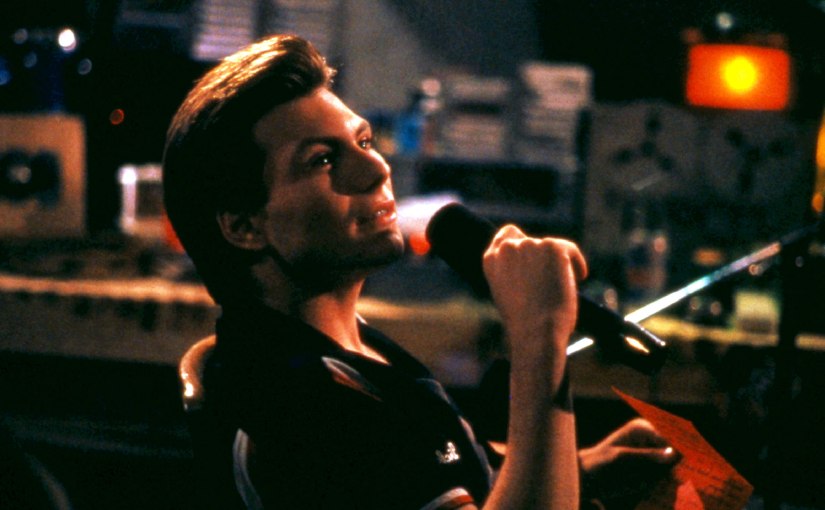
Travis Bickle, the character portrayed by Robert DeNiro in Taxi Driver, is arguably one of the most famous lonely men in film.  There have been other iterations of the sad, angry and depressed individual that just can’t speak to anyone and vents his frustrations only to his consciousness that an audience is meant to hear while watching a movie.  An isolated guy that stands out to me is a radio DJ known as Happy Harry Hard-On played Christian Slater in Pump Up The Volume, a sleeper hit on early 90s videotape.

Harry is a lonely, quiet high school student by day who goes by his real name of Mark Hunter.  No one takes notice of him because he doesn’t socialize, and he hardly speaks.  He just keeps to himself.  Only an English teacher impressed with his writing and another student named Nora Diniro (perhaps a salute to Robert?) played by Samantha Mathis catch his eye.  Mark’s parents really don’t even take much notice of him, other than to believe that Mark has problems adjusting.  It’s much deeper than that, as the poor kid adopts his alter ego on a pirate radio station which reaches the neighboring homes around the school. 

Pretty soon most of the student body is listening and relating to Mark’s diatribes of loneliness, depression, and the school administration’s efforts to doctor passing grades and average GPAs to enhance its image within the state of Arizona.  The school proudly boasts of a program to help troubled kids too, but Mark as well as the other kids fail to see any legitimacy in that approach.  All of it is a sham. 

The efforts behind this ongoing fraud are being committed by the tyrannical Principal Cresswood (Annie Ross).  However, Mark has access to confidential records thanks to his father who now works for the school.   Drawing no attention to himself, he can uncover some students who were expelled just for having poor grades despite having no violations.  One student was dismissed under dubious circumstances when it was discovered that she was pregnant. 

Hard Harry’s radio show airs each night at 10pm where such secrets are revealed along with some of the most perverted and filthy material imaginable interspersed with the grunge/punk music of the time (Concrete Blonde, Ice-T, Pixies, Sonic Youth).  Before podcasts and the internet, there was pirate radio in a kid’s basement. Hard Harry vents his frustrations about not speaking with anyone all day or how difficult it is for him to approach a girl.  The student body empathizes even though they can’t identify this mysterious voice of airwaves.

Pump Up The Volume never made a huge impact at the box office, but my high school pals and I caught it anyway in movie theatres.  It spoke to us.  It was much more relatable than Taxi Driver because it was modern, and it was set in an environment that we were similarly living through.  Everything that Mark/Hard Harry had to say I could understand.  I felt his anguish.  Writer/Director Allan Moyle goes for an early surprise when one listener sends in a letter saying he wants to kill himself.  Wisely, Moyle doesn’t go for the standard call where the DJ talks the kid out of it.  Mark isn’t mature or intuitive enough yet to be an effective “fast-food therapist.”  Instead, Hard Harry makes the initial mistake of not taking the letter writer seriously.  The aftermath amplifies the pirate DJ’s presence, and then the debate of his servitude comes into question.  Mark can no longer toss this personality aside.  He’s making a difference, whether some believe it is good or bad and now, with Nora’s encouragement, he must continue his crusade, even if he’s not sure what that is.

Pump Up The Volume was released in 1990 before the Columbine shootings and waves of other school violence that’s occurred since.  It was around before social media.  Though it is hardly spoken of anymore, perhaps because it lives only in the time of its original release, the context of the film speaks more openly than most of John Hughes’ films.  A variety of different students reveal the pain they are suffering, from the genius student who only appears to have it all together in the brains and beauty department to the punk kid who was unfairly expelled to even the silly kids who just want to prank Harry while he’s on the air, and the kid who was cruelly tricked into coming out.  The stress and suffering of what students endure still exists and it is perhaps more visible now due to how much further some students publicly act on their frustrations.  In that respect, Allan Moyle’s film is not outdated.  It might not be pirate radio anymore, but similar content that Harry incorporates in his nightly show continues to be seen in podcasts, Instagram and Tik Tok posts. Public actions are now performed on campuses – such as protest marches, rallies, voicing sexual interests or regrettably school violence, and suicide.

Christian Slater is perfect in this role, maybe one of his best, next to the misfit he would later play in True Romance.  Slater has a Jack Nicholson personality. He’s great with the on-air smarmy comments and adoption of his own routines such as “pleasuring himself on the air with a cock ring.”    He’s not literally doing any of this, but he keeps his listeners’ attention, the same as shock jocks like Howard Stern.  Turns out Mark doesn’t even know what a cock ring is, but everyone is curious, nonetheless.  He makes Hard Harry confrontational, as well as regrettable, when Mark feels things are going out of control.  Another angle is the quiet student that Slater is by day wearing large glass frames and keeping his head down while subtly checking out the writings of Lenny Bruce from the school library.  Slater does well with the multi-faceted character, and I couldn’t envision other actors of his brat pack age in the role.

Samantha Mathis is also sensational, a real surprise.  This was her debut screen performance.  She has the appearance of a 1990’s Winona Ryder, but she exudes complete confidence as Nora, the girl who seems to know everyone at school and what they are involved in.  Moyle writes smart, and sometimes poetic, dialogue for her character. She delivers with a personality of being seduced or moreover being the seductress.  Mathis has great chemistry with Slater. She works very well at breaking down Mark’s outer shell while encouraging him to carry on with what he has started.

Pump Up The Volume enters a third act that becomes a chase scene of sorts when the FCC is called in to find Hard Harry.  The film ends abruptly because I think Hard Harry may have run out of things to talk about.  However, I walk away from the film having seen a hero in a pirate DJ, who brought the wrongs of an administrative body to light. More importantly, he allowed attention to focus on the trials that high school youth encounter.

You’ll feel good after watching Pump Up The Volume, and you’ll understand when Harry tells you to “Talk Hard!”

THE COST

By Ronnie Clements from Screen Gems – A Guest Review

Screen Gems checks out The Cost (2023) …

Introductory note …

I approach an assessment of The Cost (2023) with a significant amount of “baggage” (so to speak). Firstly, director and co-writer, Matthew Holmes and co-writer, Gregory Moss are very good FaceBook friends of mine. Secondly, I’m not overly into Australian films. My Cinema Studies concentrated on American films and most of my all time favourites are American ones. Thirdly and most significantly, as a true crime buff, I do often watch revenge thrillers and by default root for those exacting the revenge no matter what. However, I take writing reviews very seriously so I will off-load my “baggage” and appraise The Cost with a completely “cold eye”.

Review …

The revenge thriller is alive and well! We should be thankful and rejoice!

The sub-genre of the revenge thriller is an interesting one. It is very commonly tackled by American filmmakers but not so often by Australian ones. Of course the many American ones I have seen (1974’s Death Wish, 1982’s Class of 84, etc.) tend to be very “manipulative” and “framed” in such a way that we are consistently on the side of those in the business of getting even. This is where The Cost makes the sub-genre entirely its own!

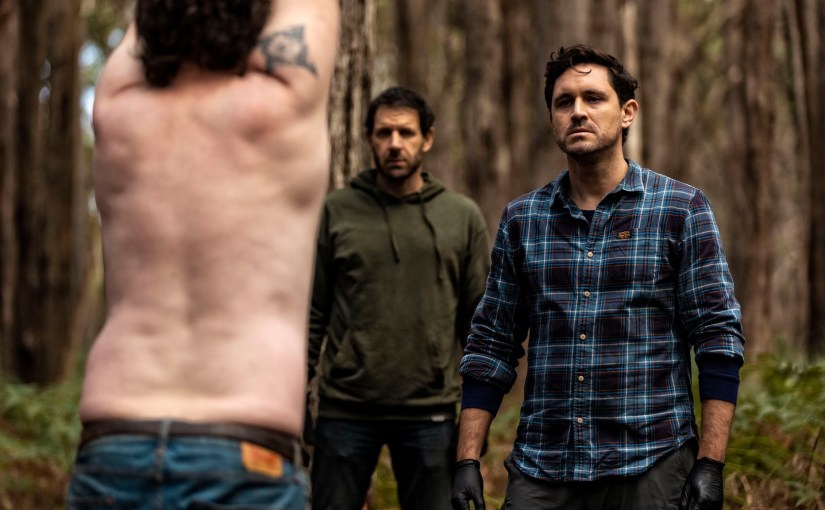
Two regular guys abduct a crim who was given early release from jail for a rape and murder many years before. The husband and brother of the victim are intent on dispensing their own brutal form of justice. However, director Matthew Holmes (by way of the script which he co-wrote with Gregory Moss) does not make it easy for us to firmly and consistently root for any one character. We are constantly shifting our allegiances between the perpetrator of the sickening crime and the revenge seekers. This not only makes The Cost different. It makes it riveting! It makes it unforgettable! It makes it superb!

The setup for the film is quickly and clearly established at the very beginning with obligatory flashbacks and slick editing. We are introduced to the three principal characters who will carry us through a very emotional journey as two of them dole out their own payback: the husband, David (Jordan Fraser-Trumble), the brother, Aaron (Damon Hunter), the perpetrator, Troy (Kevin Dee). Then there is “the intruder”, Brian (Clayton Watson) who comes into the story later and enriches the narrative as it goes in different and unexpected directions.

Of course a film with a small number of main characters lives or dies on the strength of the acting performances and in The Cost the performances are stellar. Fraser-Trumble, Hunter, Dee and Watson are equally engaging in their disparate roles and adequately capture the “development” of their characters as the tale unfolds. It needs to be mentioned that all the supporting cast are great too, not one bum performance in the piece.

Overall The Cost is a breath of fresh air in the revenge thriller sub-genre because we are often shifting our allegiances from one character to the other and sometimes even feeling for the crim. We are never being “manipulated”, we are in control. And interestingly enough, The Cost’s violence is relatively restrained too. There is not the over-the-top blood letting as there is in so many American, European and Asian revenge films. There is a particular scene where the violence could have been horrific, but the clever script does not allow that: what we don’t see happen is as effective as what we could have seen happen!

Beautifully lit and shot with a script that is crisp to the core (not one line of dialogue is wasted), The Cost is an important Australian film that is highly recommended. It will definitely have you thinking long after the credits have rolled.

On balance if I had one “issue” with the film, it would be the ending. It is perhaps not quite as “dramatic” as I would have preferred but, to be fair, it still works. We are certainly left with questions and the ending, as it is, makes way for a sequel. I’d certainly love to see that!

So … I will finish as I began: The revenge thriller is alive and well! We should be thankful and rejoice!

I am and I do!

Trailer …

May be an image of 13 people and text that says 'O DELIVER THE COST'

All reactions:

2828

ELEMENTAL

By Marc S. Sanders

Ember and Wade are perfect for one another.  They truly belong together.  Yet, science dictates that they have zero chemistry.

Ember is a figure of fire.  Wade is a bubbling, joyful standing puddle of water.  They reside in Element City along with people of earth and air, respectively.  Pixar with Disney Studios, has transitioned from emoting human feelings in lovably figurative toys, monsters, cars and colorful emotions to the primary elements of our planet.  Hence the title Elemental.  It’s a blessing that the storylines and messages of this digitally animated feature are a winning combination.

Ember (Leah Lewis) is the daughter of her fire immigrant parents, Bernie and Cinder (Ronnie Del Carmen, Shila Omni).  She loves to work with her dad in his mercantile shop that he built from nothing, known as The Fireplace.  She’s hardworking and dedicated, but she can suffer from a short temper that turns her firebrand orange disposition into a raging purple. Suddenly, she’s charred the shop interior and maybe some of the customers.  

Wade (Mamoudo Athie) is a water made building inspector who by unexpected circumstance comes upon the aftermath of a temper tantrum from Ember.  He works as a building inspector for the city and simply by doing his job he cites enough offenses with The Fireplace that could shut down the shop for good.  Now Ember must work with Wade to avoid that from happening, including haphazard water leaks that are stemming from a mysterious source within the city.

Elemental works because while it bursts with magnificent color, it has a story to tell in a brilliantly inventive and functional environment, much like the Monster World in Monsters, Inc. Pixar does not just stop at the marvelous animation. Their products continue working even beyond their well planned stories and conflicted characters.

With this film, the immigrant crisis that is a prevalent problem in the real world is addressed, but simplified for all ages to comprehend.  Fire based citizens, inspired by Asian/Eastern cultures, are typically restricted to only fraternizing within their area of the city, among only their demographic.  They are regarded as harmful and unsafe from the other three elements.

On the other hand, people of water, air and earth live in harmony.  Director Peter Sohn, with a highly informative script from John Hoberg, Kat Likkel and Brenda Hsueh, is consistent with this reflection.  Water, air and earth make up the first three iterations of Element City.  Fire gets no recognition.  Fire was not invented by a higher power.  It had to be discovered.  Therefore, they are sadly treated as a minority.  The film doesn’t go so extreme as segregating the fire community to literal internment camps, but the feeling of isolation seems quite authentic.  

Yet, fire serves an important purpose. Bernie might envision his daughter taking over the business as he is getting older and slower.  Still, with Wade’s help Ember is realizing that she has talents that will make her happier and more fulfilled.  She’s a natural at honing glass sculptures with merits in practicality and art.

At the same time Wade and Ember are becoming friends and maybe there is something more going on in their newfound relationship.  Problem is they dare not make contact with one another.  What would actually happen if fire and water mixed?  Bernie and Cinder would never approve of this relationship either.  As well, poor Wade and Ember may be frowned upon with prejudice if seen in public together.  

My colleague Miguel reminded me that Elemental gets 98% of its science accurate.   I definitely appreciate that.  However, I’m also grateful for the remaining 2% left for my suspension of disbelief that is quelled by insightful imagination.  Ember and Wade are such wonderful characters that they deserve the happiness they long for.  As I watched, I longed for their destinies to outlast the seemingly impossible.

This is a special film from the Pixar factory.  Elemental demonstrates that nothing should limit what any us of yearn for.  No shortsighted policy of any kind should bar us from our pleasures.  There’s a way for anything to work together.  It only takes some thought.  So you know what I say as I root for Ember and Wade?  SCIENCE/SCHMIENCE!!!!

PLATOON

By Marc S. Sanders

Oliver Stone’s Oscar winning Platoon takes place in the late 1960s, somewhere on the Cambodian border during the Vietnam War.  Many of the chaotic happenings the film presents are based on Stone’s own experiences after he voluntarily enlisted to fight.  However, while there is an unwinnable war occurring for the American troops, there is just as horrifying a battle going on within the ranks of the platoon the film focuses on.

Charlie Sheen echoes a lot of his father’s, Martin Sheen, voiceover narration, and performance in Francis Ford Coppola’s Apocalypse Now.  He portrays Chris Taylor, a college dropout who voluntarily enlisted for a one-year tour of duty to serve.  After only one week within the harsh, humid, and wet jungles, he’s writing his grandmother a letter asking what the hell was he thinking.  Chris is quite virginal to the harshness of war and that won’t work to his advantage when needing mentoring and support from his fellow soldiers.  The newest enlistees are the ones at the front point.  They haven’t devoted enough time to sit in the back and because of their lack of experience with war, they are not as valuable for the ongoing campaign in battle.  Platoon is not the heroics depicted in John Wayne movies.  This was one reason that Oliver Stone wanted to make this picture.  Platoon is a bitter retort to Wayne’s celebrated movie, The Green Berets.

There is an angel and devil flanking Chris in the form of Elias (Willem Dafoe) and Barnes (Tom Berenger).  Berenger is the cruel side of the conflict with his battle-scarred face.  He gives his underlings the impression that because he’s seen so much fighting and endured being shot seven times, that he must be invincible.  Elias is a fighting soldier, but he adheres to the rules of war and when it is time for rest, he joins his fellow troops in a unified vigil of drug-induced relaxation.  Chris warms up to Elias easily despite his initial fears of being a soldier with no experience or knowledge of how to survive, much less fight alongside his fellow men.

What drives the conflict between Barnes and Elias occurs following the first act of the movie.  The infantrymen come upon a Vietnamese village.  Some men, including Chris, get wildly abusive with the unarmed people, burning and pillaging their huts.  Only after Chris gets control of himself does he realize the wrongs he’s capable of by serving in this war.  He prevents a group of men from gang raping a child.  Furthermore, he witnesses Barnes commit the illegal murder of a defenseless village woman, shot at point blank range.  Elias has his bearings though and will file the proper reports when the opportunity permits.  Nothing in Platoon is easy though.  This war rages on and the possibility of an investigation and court martial is held off while the fighting continues. 

An interesting take on Oliver Stone’s direction is that he never really shows any close ups or lends any dialogue to the Viet Cong.  I believe Stone is confident that people know who our battalions were supposed to engage with.  However, as another favorite picture of mine stated (Crimson Tide), the true enemy of war is war itself.  The enemies of Elias, Chris, and Barnes as well as the rest of the platoon permeate within and among themselves and it lends to the chaos of the brutal combat scenes depicted in the film. Stone doesn’t offer much opportunity to see who any of the soldiers are shooting at or who is shooting at them.   There is much screaming and hollering but who are any of the characters shouting at and can they even be heard or understand what is being said amid the gunfire?  Platoon demonstrates that a Vietnam war picture is not one of heroics with grandstanding trumpets and a towering John Wayne who takes a hill.  War is disorganized, messy, and terribly bloody. 

This may be Charlie Sheen’s best film of his career.  As he represents the fictional account of Oliver Stone’s personal experiences, we see the trajectory of his change.  He is supposed to be there for 365 days, and he, along with his buddies, count down to when their tour will be complete.  However, this one short year will be the longest he ever encounters, and it will change him permanently, assuming he survives.  Chris is always tested of his tolerance.  He’s always subject to respond to how Barnes commands or how Elias mentors and leads. 

Oliver Stone is so convincing in his often-documentary approach to Platoon that it is at least understandable to see how the men in this picture behave and carry themselves.  Why do they refer to the Vietnamese as “gooks.”  Why do they bully with intent to commit rape.  Why do they quickly pounce to kill when for even a moment there is no threat.  Moreover, why they are willing to turn on each other.

They were never the decision makers for this conflict.  These soldiers are depleted of sleep and rest.  They are the pawns of a higher power, and they have been left to their own devices in a dense environment infested with bugs, snakes, unbearable humidity, and bodies that infest the waters and land while armed men appear out of nowhere ready to ambush.  Some ensnarements might occur within their own regimen.  None of these men are justified in their actions.  Yet, it is not hard to understand where their motivations stem from.  They are not programmed for heroics.  Keith David portrays a likable soldier who tells Chris that his mission is just to survive until he’s summoned home.  Survive among those you march and sleep with.  Outlast this hellish environment and overcome those that are trying to mow you down in machine gun fire.  Everything else around here is “just gravy.”  When you are an infantryman, you are not making a statement any longer.  You are not fighting for a cause anymore.  You are only trying to stay alive.

Platoon is such a shocking film of unconventional madness and turmoil.  Oliver Stone is relentless in the set ups he stages.  This picture came out in 1986, long before the strategic methods of the modern “shaky camera” approach.  It’s beneficial to watch the film as Stone must be positioning his camera on a track as the platoon hikes through the forest, parallel to his moving lens.  We are walking alongside them.   Early morning overhead shots depict the carnage of battles that occurred in the dark of night. Flares and sparks come from nowhere.  I think you could watch this movie ten times and still not know when to expect gunfire to intersect with the story or when the bombs to go off.  It’s hectic hysteria like I can only imagine these young men experienced before they spilled their blood on the battleground and either died right there or returned home physically and mentally crippled for life.

Platoon is one of the best and most frightening war pictures ever made.

AUGUST: OSAGE COUNTY

By Marc S. Sanders

Once the dead are buried, the secrets come out.  Some mourn the loss.  Others mourn the reality of what existed.  Tracy Letts’ Pulitzer Prize winning play August: Osage County was adapted into a very well-cast film in 2013.  Letts’ screenplay is just as biting as his original source. Perhaps that is because of the performances of not just Meryl Streep and Julia Roberts, but also the entire collection of actors.

Dysfunctional is not a strong enough word for the Weston family of the sleepy, lifeless area of Osage County, Oklahoma.  The patriarch, Beverly (Sam Shepard) hires Johnna (Misty Upham) a Native American housekeeper/helper, for his pill popping, cigarette smoking wife Violet (Streep) who is also stricken with cancer of the mouth.  Shortly after, Beverly disappears.  The family comes home to the dusty shelves of books and old black and white family photographs and learns that Beverly has committed suicide.  The opportunities flood in for Violet (or Vi) to unleash every ugly, harsh truth that her three daughters Barbara, Ivy and Karen (Roberts, Julianne Nicholson and Juliette Lewis) have encountered along with their partners.  There’s also Vi’s sister Fannie Mae (Margo Martindale), her husband Charlie (Chris Cooper) and their son Little Charlie (Benedict Cumberbatch) to revisit the revelations of the Weston family.  Barbara’s estranged husband Bill (Ewan MacGregor) and her daughter Jean (Abigail Breslin) have their own drama to contend with as well.

It’s best not to spoil too much of what is revealed in the movie directed by John Wells.  The centerpiece of the picture is the afternoon family meal following the funeral service.  This must be one of the most intense and captivating dinner scenes caught on film in recent years.  Wells positions his cameras perfectly, so you know where every family member is seated at the table and the trading of barbs that go back and forth between the different combinations of arguments.  I would say the scene lasts at least twenty minutes and Wells manages to seat the viewer next to or right in front of every person at the table.  At one end of the table is Charlie.  Chris Cooper is a reluctant fill in to the void left by Beverly, the original patriarch.  The instigator is Vi. Meryl Streep is placed at the other head of the table where her drug addled eye contact can be had with anyone seated in her presence.  I’d love to have seen Meryl Streep while shooting this scene because even when the camera is not on her for a close up, I can still see that she is there in the dining room.  I’d argue she never turned off this persona during the making of this film. 

The most agonizing relationship is clearly between Vi and oldest daughter Barbara.  The first pairing on screen for Meryl Streep and Julia Roberts.  Why didn’t it happen sooner?  Moreover, why hasn’t it happened again since this film?  Perhaps because it is rare to find material of this dramatic weight to justify what can come from these two incredible actors.

The dinner scene is left discomforting to say the least, but the timing and delivery of Tracy Letts’ dialogue is functioning with high energy.  At age fourteen, Jean is the youngest member at the table, and she is questioned as to why she doesn’t eat meat.  According to her, you are consuming an “animal’s fear.”  The Westons are only adoring when they are cruel to one another.  One of the rare times that the rest of the family will unite with the antagonizing Vi is when they can mock and chortle at young Jean’s philosophy for “claiming” to be vegan, which is also undone by her parents when they reveal what she eats back home in Colorado. 

A hip middle aged Florida man named Steve (Dermot Mulroney) in a Ferrari has accompanied Karen to Osage.  Karen is the flighty one with her head in the clouds.  Steve has been married three times and takes a liking to teenage Jean’s curiosity to try pot.  Vi expresses disdain for the jerk with another welcome facial expression from Streep, but Tracy Letts does not have his character lash out or protest Karen’s choice to marry the guy.  For Violet Weston, it is better that Karen does marry this letch.  It gives Vi more purpose to criticize and belabor upon one more poor decision made by another daughter.  Violet thrives on bellowing out the shortcomings of her children, her dead poet/author husband, her sister, and anyone else within her presence.  It’s how she lives and overcomes her cancer while an unkempt wig conceals her chemo remaining grey hairs.

On the side, a relationship is brewing between first cousins Little Charlie and Vi’s middle daughter Ivy.  They know it’s wrong, but they can’t help hiding their affections much longer.  Cumberbatch goes against type here as a nervous, insecure young man who has not matured from his boyhood nature.  Julianne Nicholson appears to be the most held together of the three daughters as she has never ventured out of Osage while living with her parents.  She is now ready to give up that lifestyle, and she’s leaving it in Barbara’s lap to figure what’s to come of Vi. 

Barbara is the most unhinged.  She is married to sweet natured but boring Bill and it’s likely that the past demons she clung to from her upbringing left Osage with her when she relocated to Colorado with her husband and daughter.  Bill might be having a tryst with one of his college students but is he the worst one in the marriage?  Barbara Weston might be Julia Roberts’ best role since her early career film introduction in Steel Magnolias and her Oscar winning turn in Erin Brockovich.  In films like these, Julia Roberts doesn’t look like the starlet she once was in the 1990s.  In August: Osage County she has downed her appearance with no makeup, unwashed hair, and wrinkled clothes while carrying an emotionally exhausted physique.  However, she’s perfect to play the eldest daughter who somehow must be the one responsible for picking up the shattered pieces of dishware that hit the floor on numerous occasions and fractured connections left behind in the family dynamic.  This is a commanding performance by Julia Roberts; one that needs to be seen.  Incidentally, she never does clean up the broken plates.  I only assume it would be her who must do so.  However, the quiet Johnna is around somewhere. She will make everything disappear.

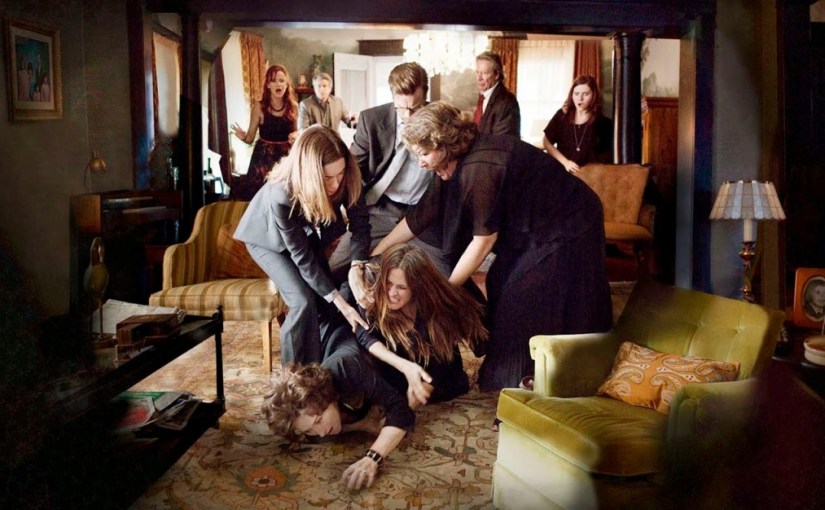
Memorably, a physical altercation ends the dinner.  The day passes into the next mid afternoon and more secrets are uncovered.  Some are quite horrifying, considering the circumstances that some members of the family have themselves in.  Just when you think that this script is ending with a debate of which daughter will look after mother now that daddy is gone, there’s more troubling truth to grapple with as well.

August: Osage County is a movie hinged on the acting chops of its cast with a smart, unforgiving script for the damaged characters depicted.  It falls in the same category as David Mamet’s Glengarry Glen Ross or Sam Shepard’s True West.  We may be witnessing the abnormalities and sins of these people, but it would be more unusual had these folks possessed genuine happiness and solid affection for one another.  The quietly muted Native American Johnna enters the household of people who replaced her own people, who occupied this land long before the early generations of Westons ever arrived.  It’s telling that Tracy Letts demonstrates the original occupants still survive in peace while the ones that took over can’t find a way to live happily among themselves.  Watch the film or see the play.  Then come back and tell me if the white folks of the Weston family truly belong in the once occupied Native American Osage County, Oklahoma.

GARDEN STATE

By Marc S. Sanders

The irony of Zach Braff’s Garden State is that the protagonist he portrays is heavily medicated to subdue any variation of depression or anger induced mood swings.  Yet, it seems like everyone else in the picture should be off the drugs, and those that aren’t taking any, should revert to some appropriate pharmaceuticals.  STAT!

Braff wrote and directed this quirky comedy-drama loosely inspired by his upbringing in northern New Jersey.  He plays Andrew “Large” Largeman.  He’s an actor living in Los Angeles when his father calls him to let him know that his quadriplegic mother has drowned in the bathtub.  Andrew seems like what Cameron from Ferris Bueller’s Day Off might have become a few years after he kicked his dad’s prized Ferrari out the glass garage.  This guy is sullen, sedate and when speaks or responds to a question, you might think he’s catatonic as well.  He’s just so numb from the medicinal products he takes.  They were prescribed by his psychiatrist, who also happens to be his father, Gideon, played with quiet tension by Ian Holm.

At the graveside funeral, Andrew comes upon some childhood friends who never left Jersey behind.  Peter Sarsgaard is Mark who vaguely remembers Andrew and invites him to a party later that night which is likely just like last weekend’s party and the weekend before that.  Mushrooms, weed, coke, alcohol.  It’s all there.

The next day Andrew meets a precocious young lady named Sam (Natalie Portman) who recommends he fend off a humping seeing eye dog by kicking him in the balls.  This unexpected introduction is what will meaningfully break Andrew of his stupor. The bond between Sam and Andrew will carve out the rest of Garden State following a meanderingly weird exposition.  I’m grateful for that because just when you think this film is going nowhere fast, even if it is told at a slow pace, the story absorbs a sweet narrative shared between two very likable characters.

There’s a lot of eccentricities in Zach Braff’s film which he admirably wrote and directed as well.  Living in New Jersey for fourteen years of my childhood, I don’t recall anything within my nearby Jewish suburban neighborhoods being this oddball.  Then again, Braff is maybe a little too ambitious to have one strange character turn up after another.  A woman at the funeral makes him a shirt that matches the wallpaper of the hallway.  A dim-witted cop asks how he did when he procedurally pulls Andrew over.  Another guy shoots flaming arrows into the air in the backyard of his mansion for Sam and Andrew to haphazardly dodge their descent. 

Mark is not only a grave digger in the cemetery, but a robber as well, stealing the jewelry from the remains in the coffins.  Sam lives with her mom and adopted Nigerian brother amid Dobermans and a hamster jungle gym that stretches the entire course of the house and serves as a hazard for one poor rodent after another.  Sam has a well populated little pet cemetery out back.

Amid all these strange visuals and discoveries, there is a background to Andrew’s need to be drugged by his father.  He was the cause of his mother’s disability when he was age nine and pushed her down, causing permanent paralysis. 

There are colorful backgrounds to Andrew and Sam and a curiosity to learn more about them.  Still, the film seems to stretch its running time with too much unusual, oddball material.  I responded to most of it with a smirk or chuckle, but I ask myself why.  Why is so much of this here?  It builds up a setting, perhaps.  I’m just not sure.  There’s an overt weirdness to every single character seen in this film.  Nevertheless, I don’t believe Braff’s intentions were to duplicate a Wes Anderson formula.

Fortunately, Zach Braff offers a wonderful character arc where Andrew becomes more and more awakened as the film moves on, while clinging to Sam’s company and abandoning his father’s prescriptions.  Natalie Portman seems to mature over the course of the picture. Sam’s quirk is that she tells tall tale lies in rapid succession.  That façade nicely breaks down to show the genuine person Sam truly is later.  When her mother boasts a video recording of an ice-skating routine that Sam did while dressed as an alligator, the embarrassment on Natalie Portman’s face is so naturally telling.

Ian Holm should also be recognized as he portrays the opposite of whatever dialogue Braff wrote for the father character.  That’s a great challenge.  A scene in the kitchen has Gideon dressed in a bland, beige sweater and tie and he seems to hide within the pale walls of the room.  There’s no life to the guy.  Nothing stimulating, despite how educated the man may appear.  So, it seems unjustified for Gideon to tell his son later that he wants them to be happy like they used to be.  Braff’s character wisely responds by being unable to recall any time when they were ever happy.  Moments like these are the strength and intelligence immersed in Garden State.  The assortment of side quirks does not have this kind of staying power, though.

I like Garden State but there’s no way I could love it or embrace it.  There’s just too much moroseness within the strange residents amid their sleepy conversations to make me want to stay with any of these characters.  The benefit of watching the film is to see what Zach Braff, Natalie Portman and Ian Holm lend to the picture – three wonderful performances.

ALIEN: COVENANT

By Marc S. Sanders

I imagine it would take a defiant personality to become a God and bearer of life.  That individual would most likely have to be beyond human to follow through on such an endeavor.  In cinematic fiction, to occupy such a role would require an exceptional actor with a calm yet powerful command.  It is fortunate that in Ridley Scott’s follow up to his Alien prequel, Prometheus, that he was able to recruit Michael Fassbender in the role of David – the android invested in discovering new amalgamations of life from unknown sources within a very deep universe.

I understand Alien: Covenant left many fans and critics divided and that it was not the box office success many were hoping for.  In addition, a follow up chapter to this film seemed more unlikely following Disney buying out 20th Century Fox.  Nevertheless, none of these occurrences dismiss one of best dual role performances I have ever seen, compliments of Michael Fassbender. 

The actor first appears in a prologue as David discussing challenging questions with his maker, the wealthy industrialist Peter Weyland (Guy Pearce), a younger looking iteration than from the prior film.  David has met his maker.  However, he questions who created his own maker.  No satisfying answer comes from the conversation and thus it ends with Weyland commanding his “child servant” to a menial task of serving him tea.  David, we learn, will resent humans who opt to subject his incredible capabilities to menial tasks.  He is destined for greater achievements than servitude.  David is meant to be a God.

The film diverts to a period eleven years after the events of Prometheus.  A massive ship known as The Covenant is embarking on a journey to a paradise where the cryo-sleeping colonists and the hundreds of human embryos in storage will set up a new civilization for themselves.  They have just over seven years left of their journey.  The crew of fifteen who command this expedition are also sleeping while an android named Walter (Fassbender in another role) oversees operations.  Following a collision with a storm-like phenomena in space, the crew is violently awakened and the captain (James Franco) does not survive. A reluctantly nervous replacement named Oram (Billy Crudup) now must lead, and it appears fortunate that Covenant has come upon another nearby planet sending a signal source in the form of a John Denver song.  Why John Denver????? I guess the Beatles and Rolling Stones were too expensive. This locale might suit the colonists’ needs and save them another seven years of travel and unexpected risk.

Oram and the former captain’s wife, Daniels (Katherine Waterston), lead a team down to the planet.  A wheat field is surprisingly found.  There’s beautiful blue sky and mountain ranges.  Water is found.  Still, there’s a disturbing realization. Not a single animal or life form is anywhere.  No insects, no birds, no wildlife, nothing.  Like prior installments in the franchise, it is not long before some crew members get ill, very, very rapidly.  Then the first of several terrifying episodes begins.  All of that is visual and not necessary to recap here.

David makes an “Obi Wan Kenobi” like appearance amid the mayhem and calms everything down.  The highlight of Covenant is when Fassbender as Walter (a down to earth American interpretation of an android) encounters Fassbender as David (a refined English example). Upon entering David’s habitat, it is clear he has been busy over the last decade since he and Dr. Elizabeth Shaw (Noomi Rapace, from Prometheus) arrived on this uncharted planet that was once populated by The Engineers, also from the first film.

At the risk of mild spoilers, I offer the following observations, because the thought provoking aspects of Ridley Scott’s third monster movie, are worthy of insightful conversation. 

Walter and David are undoubtedly the most interesting characters of Alien: Covenant.  They possess two totally opposite mindsets.  Almost like they are the angel and devil figures found on a person’s shoulders.  They regard the value of people differently.  Walter holds humanity in high esteem, ready to assist while they continue explorations of great beyonds.  David is prepared to dismiss them, though they serve a valuable purpose in his own selfish discovery to harbor a new breed of creature – one considered to be a perfect organism.  Experimentation has been David’s sole focus.  Now he may have finally uncovered precisely what he needs for his masterpiece of creation.

There are staple moments and happenings that are no longer surprising in Alien: Covenant because there’s a formula that traditionally worked in the long gestating franchise before.  Nevertheless, the film is far from stale.  The story offers up a well-conceived history to the origins of the alien breed, known as Xenomorphs from other films.  Why and how they came to exist are provided.  Hey, I’ll happily say this is more definitive than the Old Testament.

To witness one actor on both sides of a debate discussing the purpose of human preservation and what value people serve from this point is really a thrill.  Both Walter and David are artificial intelligence.  They are so advanced that they have usurped humans as the greatest thinkers in the universe.  It’s not farfetched in this age of smart phones and an over reliance on technological innovations to incorporate this into a monster movie.  It only enhances and improves upon a tired old Godzilla cliche.  Movies are sometimes quite prophetic.  So, it’s not even ridiculous to categorize a film like Network with a bloody sci-fi horror film like Alien: Covenant or even a couple of Tom Clancy political thrillers.

Alien: Covenant boasts a good cast particularly with Katherine Waterston, Billy Crudup, and an unusually serious Danny McBride as a good ol’ boy pilot named Tennessee.  McBride does well with the drama and horror to come.  He’s not a novelty act.  While these actors may be playing well developed characterizations, I know they are only here for the body count and to keep David and the aliens busy.

Again though, the film especially belongs to Michael Fassbender.  A brilliantly inspired casting choice for the first film in this more recent resurgence of the franchise.  It’s only a huge blessing that he returned, and this next film pounced on his capabilities to balance the two roles on opposite ends of the spectrum.  Regardless of whether he’s playing Walter or David, Alien: Covenant only gets more interesting when Fassbender occupies a scene. 

An especially telling moment is so wisely written with a kind of seductiveness between the androids while one teaches the other to play the flute.  Humans no longer need to program computers.  The computers can work it out themselves, and even develop an intimate attraction for one another.  What’s most delightful is again, I remind you, that Michael Fassbender is the only one working in scenes like this.  How often has an actor gone in for a kiss in another role that he is playing in the same scene?  He hides so well in Walter and David, that you lose sight of the fact that you’re watching only one performer doing all the work.

The final scene of the picture caters beautifully to what Fassbender offers in his two roles.  The story’s conclusion will leave you thinking and wondering what comes next.  Intentional or not, I regard the ending of Ridley Scott’s picture as an homage to other great films like The Silence Of The Lambs and The Usual Suspects.  You may feel shockingly haunted as the end credits roll.

Overall, Alien: Covenant is a chilling, mind-bending masterpiece of science fiction horror and what-if prophecy.