BEVERLY HILLS COP II

By Marc S. Sanders

I know. I know. I SHOULDN’T like this movie, but I do.

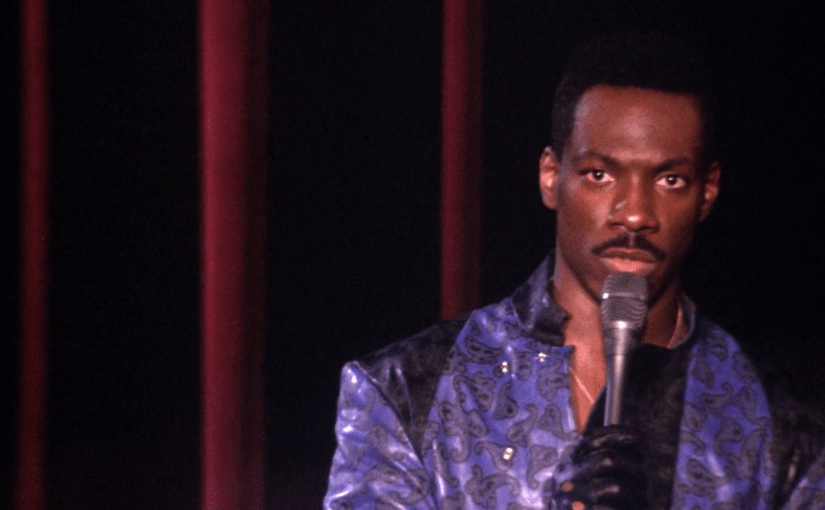
Beverly Hills Cop II is a sequel that is really an opportunity to see a wide variety of close ups of an Eddie Murphy who was well in his ‘80s prime, releasing one #1 movie after another. Here the viewer is treated to Murphy’s Axel Foley blowing a kiss to himself in the mirror, laughing to himself, tucking his crotch in his tailor made suit, flipping sunglasses on and off, driving a Ferrari, and shamelessly plugging the Detroit Lions all while trying to stop an “Alphabet Bandit” criminal in Beverly Hills, CA.

So there’s really not much here when all the vanity is on Murphy. Well, then what’s to like?

Considering I’m a fan of director Tony Scott, who uses great cinematography in all of his films with quick, tension filled editing, it’s hard to resist.  Most especially here Scott’s film is accompanied with an exceedingly cool and dangerous soundtrack from Harold Faltermeyer. Just the opening scene alone (without Murphy in it) belongs in a better movie. A robbery at a City Deposit bank and then later at a horse track are so well edited that you might tuck your knees into your chest and chew on your thumbnail. Great stuff from Tony Scott that would eventually carry over in films like Crimson Tide, Enemy Of The State, and one of my very favorites True Romance.

There are other good moments in Beverly Hills Cop II, especially a great scene with Gilbert Gottfried, and a few with Paul Reiser as well as a smirk inducing scene with Hugh Hefner.

I shouldn’t like this movie but sue me. It’s a guilty pleasure for me. However, watch the far superior first installment over this one any day of the week.

BEVERLY HILLS COP

By Marc S. Sanders

Who actually wrote the Oscar nominated script to Beverly Hills Cop? Daniel Petrie Jr and Danio Bach, or Eddie Murphy?

Murphy’s lines are delivered so fast and so naturally that it seems impossible they could ever rest on a page. Eddie Murphy is an enormous talent of word play and delivery. I miss this Eddie Murphy. I’m reluctant to welcome the Eddie Murphy of PG related fare of recent years. He just doesn’t look comfortable in that garb.

One of the first R rated films I ever saw in theatres (not THE first, as that honor belongs to the Clint Eastwood classic, Sudden Impact) still holds with its hilarity, and the credit does not belong to just Murphy but the whole cast including John Ashton, Judge Reinhold, Ronnie Cox and even early in career appearances from Jonathan Banks, Bronson Pinchot, and Damon Wayans.

I still haven’t forgotten this theatre experience when I joined my older brother, Brian and his friend Nick at the movie theatre in Ridgewood NJ. Never had I heard an entire packed room of people in the dark on a Saturday night laugh so hard together. It’s likely a moment that impressed my love for movies going forward. Movies could bring all sorts of joy and happiness and escape. Beverly Hills Cop was altogether another thing entirely.

Yes!!!! A foul mouthed cop from Detroit who becomes a stranger in a strange land while visiting Beverly Hills to solve his friend’s murder. That’s a film that’s had a great impact on me. As a writer, director Martin Brest’s film (later to do Midnight Run and Scent Of A Woman) offers a very simple blue print to allow Murphy to run wild. It cuts out a lot of complicated red herrings to just stay on a straight resolution. As Murphy’s Detective Axel Foley (great character name) comes across another development, in walks another great set up.

I compare the frame of Beverly Hills Cop and Eddie Murphy to the first Mission: Impossible film with Tom Cruise. The Cruise film makes a huge oversight. Early on it introduces a huge array of characters for an M:I team and then eliminates them all to hardly be used. It was wall to wall Tom Cruise. He was a producer on that film with much creative control and it felt to me as if he insisted on owning every scene, every line, every moment. It turned me off a little.

Murphy on the other hand plays along with his ensemble. Ashton and Reinhold have great moments all to themselves. I still die laughing out loud as Reinhold tries to subdue a situation by ordering an army of machine gun toting bad guys to lay down their weapons only to be silenced with another round of gunfire. The banana in the tailpipe! Ashton working with Murphy to stop a random robbery at strip joint, and then helping to save him later on from arrest. What about Ashton trying to climb a wall during a shootout?

Then there’s Murphy and Pinchot discussing a weird art piece (“Get the fuck outta here!”). Couldn’t you envision Pinchot and Murphy in another film together?  A shame it hasn’t happened.  (No, I won’t count the dreadful reunion in Beverly Hills Cop III.)

Brest provides great showpieces accompanied by one of the best film soundtracks ever. I will never not listen to “Neutron Dance” by the Pointer Sisters on Sirius XM’s 80s on 8 while recalling this film’s opening scene double rig truck chase. Brest directs a symphonic high energy blend of sight and sound. Plays like an awesome music video. Same goes for Glenn Frey’s “The Heat Is On.” If I ever get an opportunity to visit Detroit, that’s what will be playing in my head.

Orchestrator Harold Faltermeyer’s electronic keyboard deserves much credit as well. His covert, sneaky 5 note tune shaped the Axel Foley character. Faltermeyer only made Murphy even cooler during the heyday of “Miami Vice MTV Cops.”

Beverly Hills Cop remains one of the best films with the longest staying power of the 1980s. It’s a comedy. It’s an action picture. It’s music filled fun with great characters. It’ll always be Eddie Murphy’s best film. I can watch it again and again. I’ll never tire of it.

PALE RIDER

By Marc S. Sanders

Clint Eastwood’s Pale Rider is more or less a simple western film with a storyline you’ve seen countless times before.  It’s an old west tale that has the The Magnificent Seven (or Seven Samurai) feel, but this might as well be called The Magnificent One, perhaps.

Pale Rider is nothing special in its assemblage to be another Hollywood western.  However, it’s delivery from Producer/Director Clint Eastwood is what kept me engaged.  Seeing it for the first time, nearly forty years following its theatrical release, I took great pleasure in recognizing the tough and intimidating persona that Eastwood became famous for in his spaghetti westerns and tough cop films.  The scowl and squint across his chiseled face are here along with his imposing height, with his black hat resting perfectly atop his head.  Eastwood knows how to capture himself on camera better than most any other actor/directors.  He capitalizes on his foreboding and intimidating presence.  He does it very well in Pale Rider when he points his camera at a distance down the dirt road where he’s saddled perfectly still upon his steed.  He does a shot like this as well in his Dirty Harry film, Sudden Impact, where he positions his silhouette against bright carnival lights in the background with his loaded gun held at his side.  This guy makes himself scarier than Freddy Krueger in moments like these, and in film history, the images are iconic.

Again, Pale Rider has all the trappings of what audiences used to love in Hollywood Westerns.  It has reminders of Shane and High Noon.  Yet, it’s a bit more brutal, because 1980’s cinema allowed that, and this film falls in the tradition of Eastwood’s continuous violent work at the time.  Still, that’s not why you watch an updated picture like this.  You take in Pale Rider as a Clint Eastwood vehicle.  The familiarity of Eastwood’s unnamed dangerous man that bad guys should’ve walked away from was treasured long before he thankfully segued into his anti-violent themes of films yet to come (Unforgiven, A Perfect World).  The point is that I recommend the film because…well…I’ll never tire of that scowl and squint.

ESCAPE FROM ALCATRAZ

By Marc S. Sanders


Okay.  I’m gonna give this a shot.  Granted Escape from Alcatraz came out over a decade prior to that other famous prison movie with Morgan Freeman, but how do you not avoid a comparison?

Clint Eastwood is Alcatraz inmate Frank Morris who believes he’s uncovered a way to break out of the most inescapable prison located on an island that’s at least a mile away by San Francisco Bay sea water from civilization.  The film is directed by Don Siegel (“Dirty Harry”) who depicts the true life inspired events that occur in the early 1960s.

Even before Morris begins to plot his steps to freedom with three other inmates, Siegel shows the brutal life of living in the Federal Government’s most notoriously secure prison.  The Warden assures Frank that escape is impossible.  Others who have tried were either shot or drowned in the ice cold waters of the bay.  Still, Frank Morris, who has accomplished prison escapes in the past, is certain that he’s found a way.

“Escape from Alcatraz” isn’t just about digging through walls with a makeshift tool combo of a nail file and spoon.  Siegel shows what occurs in a day in the life in the cafeteria, out in the yard and in the work shop.  Prison guards patrol with rifles.  The black prisoners have their spot on the bleachers.  An old guy paints portraits to occupy himself.  There’s even a library.  Look!!! There’s Danny Glover accepting a book from Clint. 

Actually, it comes off pretty tame all these years later when compared to many other prison films.  Frank is bullied by one bruiser, but also remember this is Clint Eastwood.  So this big guy doesn’t have a chance in a bare knuckle brawl.

The prison escape is calculated and you see step by step of how the guys climb through piping and vents and over fences and down walls.  Frankly, it looks a little too easy.  As Frank digs, all he has to do is turn off his light in his cell and the guards never catch a glimpse of what he’s up to in the dark.  Same could be said with the papier mâché dummy heads he and his cohorts make up to lie in bed.  The guards just don’t catch on.

“Escape from Alcatraz” doesn’t give me all the feels like “The Shawshank Redemption” or “The Green Mile.”  It’s simply another easy go-to watch of many of Eastwood’s 1970s tough guy flicks.  I did find it interesting, however, that this is based on a true story and when the conclusion arrives, I’m informed how in real life the result of the escape remained open and uncertain of what happened after the events of the film.  So I appreciate that the story kept me curious.  That’s saying something, and therefore I’m glad I watched the film.

A GHOST STORY (2017)

By Miguel E. Rodriguez

Director: David Lowery
Cast: Casey Affleck, Rooney Mara, Will Oldham
My Rating: 9/10
PLOT: A white-sheeted ghost…on second thought, I’d better not say.

———————————————————————————————————————————-

SPOILER ALERT…

There is no way to discuss or review this movie without giving away certain key plot points that are more effective when you don’t know they’re coming, so please, if you have any intentions of seeking this movie out, ignore this or ANY other review until after you’ve seen the movie.

All good?  Okay, let’s begin.

A Ghost Story is more like a meditation on its subject than any movie I’ve seen since 2001: A Space Odyssey.  Like Kubrick’s sci-fi epic, A Ghost Story contains long, VERY long stretches of film that involve little or no dialogue.  Sometimes there are stationary shots that simply sit and regard a scene and just…wait for something to happen.  One shot especially struck me, where a character just sits on the kitchen floor and eats some pie.  No dialogue, just eating.  For four minutes.  That’s a LOT of screen time for a film that clocks in at 92 minutes, WITH credits.

So what’s going on here?  On the surface, I’ve just described the most boring film ever made.  But in this case, director David Lowery’s method of storytelling is vital to what the movie’s really about.

[Here’s where the spoilers really start, last chance to bail.]

Rooney Mara and Casey Affleck play a young couple who live in a small house in what appears to be Texas or some other Midwestern state.  Tragedy strikes early on when Casey Affleck’s character (listed in the credits only as “C”) is killed in a car crash.  After Rooney Mara’s character (“M”) identifies his body at the morgue, we’re treated to the first of several long takes as the camera watches her leave but stays with C’s body covered in white cloth.  The seconds tick…tick…tick by, and by this time we’re wondering why we’re still here.  Rather than boring me, this had the effect of moving me to the edge of my seat.  I was pretty sure I knew what was about to happen, but as more and more time elapsed, my certainty ebbed away and I became galvanized.  What IS going to happen?

Well, whatever it is happens, and C is now a ghost covered in a white sheet with two eye holes, looking for all the world like someone wearing a Charlie Brown Halloween costume.  (“I got a rock.”)  After apparently declining the opportunity to “move on”, he returns to his house, and here’s where the movie got to me.  C’s ghost is now a mute witness to his wife’s grieving.  We’re not quite sure what his purpose is, at least not right away.  There’s no mystery to solve, no unfinished business to deal with.  He just watches her.  (She obviously can’t see him.)

During this segment of the movie, I was mesmerized.  It’s hard for me to describe or even understand what gripped me so much in scenes where very little is happening.  I found myself empathizing, not with the wife, but with the ghost.  It’s one of those “what-if” questions that you pose to your friends.  If you COULD come back, would you?  “C” made his decision, and here he is, but his presence is bittersweet.  He can see her, but she can’t see him.  I felt the longing that is only apparent onscreen.  Maybe this part of the movie is a Rorschach test.  We see what we want to see, which makes us feel what we expect to feel.  I don’t know.  But I can’t deny the effect these scenes had on me personally.

As the movie progresses, we are also treated to sudden jumps forward in time.  Rather than the usual fades or segues, months or years suddenly go by in a single hard cut.  Time behaves differently for the ghost.  He’s got nothing BUT time.  Like many literary and movie ghosts, he’s rooted to one physical location, unable to leave, while the living get on with living, year after year, decade after decade.  This made me empathize with him even more.  How sad it must be for a spirit to bear witness to decades, even centuries passing by him, with no way to interact with the living.  Oh sure, he can make light bulbs flicker and he’ll have the occasional tantrum with broken plates and floating cups.  But nobody can talk to him.

Well, that’s not quite true.  He has one companion.  One day, through the window, he spots another ghost in the house next door.  This ghost is also covered in a bedsheet with holes cut out for the eyes.  They seem to communicate by, I guess, telepathy, because we don’t hear their voices, but subtitles tell us they are indeed having a conversation.  In one of the saddest moments of the film, the other ghost tells C that he or she is waiting for someone…but he/she can no longer remember who it is.

If there was ever a case to be made for someone to “head toward the light” rather than remaining on Earth, that’s it.  Far better, in my opinion, to complete the journey to “the other side”, whatever it may be, rather than endure an eternity of waiting for…what?

Look at me.  Philosophy.  That’s the effect this movie had on me.  It got me to really THINKING about the kinds of topics that I normally avoid thinking about.  The inevitability of death.  The efforts we make to keep our memories alive after we’ve gone.  Remembering those who are no longer with us.  Heavy, man.

After some time, “C” eventually does find a reason to stay, beyond attachment to his wife.  I won’t reveal what it is, but it’s organic, and it’s something I would certainly be invested in if I were in the ghost’s place.  His attempts to fulfill his goal are poignant, and constantly being frustrated.

The final reel is where the movie may potentially lose a lot of viewers.  It even lost me a little bit while I was watching it, but upon reflection, I can see where it’s going.  After all, any movie made about the afterlife is pure speculation anyway, so who am I to say their concept makes no sense?  There is a certain sad logic to it, after all.

There’s that word again, “sad.”  This is definitely not a popcorn movie, that’s for sure.  This is a thought-provoking film designed to inspire introspection and reflection.  AND it’s entertaining, make no mistake.  But, yes, sadness is a big part of the film.  I didn’t tear up or anything, but it is filled with overwhelming heartbreak.

And yet, with that final shot, there’s a kind of triumph to the whole thing.  Not the kind of triumph like at the end of Rocky or your average Spielberg movie, but a sense of completion, of sudden realization.  It won’t please everyone, but it works.

A Ghost Story will mean many things to many different people.  If there’s a better definition of effective “art”, I don’t know what it is.

GOLDFINGER

By Marc S. Sanders

If From Russia With Love offered a promising future for James Bond, Guy Hamilton’s direction of Goldfinger solidified it. This is Sean Connery’s best representation of 007, and yet the only triumphant thing the character does is win a golf match against the title character, Goldfinger, played by Gert Frobe.

As good as the film is, ironically Bond does not succeed in any effort to thwart the diabolical plans of Auric Goldfinger, who intends to invade the gold depository located at Fort Knox. Bond doesn’t deactivate the bomb. He doesn’t successfully get his CIA allies on the right track. He doesn’t even do away with Mr. Goldfinger. Everything happens to occur circumstantially. James Bond just got lucky this time.

So then why is the third entry considered by many to be the best in the series?

Well, the movie is immense in its charm, and it pioneers the flavor of nearly ever Bond film released from here on out, at least until the coming of the blunt, brooding instrument of Daniel Craig.

The vile henchman, Oddjob, with his razor bowler hat introduced a staple needed for a winning film. Every bad guy had to have an unusual trait. Pussy Galore (Honor Blackman) set a more defined precedent for the Bond Girl. Even Shirley Bassey’s dangerously pounding title song carried a threat of the most sadistic villains to come.

Plus the gadgets are exceedingly fun. How do I know? Because time and again Bond returns toward using his classic Astin Martin DB5 with tricked out machine guns, oil slick and (I wouldn’t joke about this) ejector seat. 007’s moment with Q became a necessary ingredient in every Bond film following “Goldfinger.” Actually, I think Q is only missing from 2 or 3 films following this entry.

The tongue in cheek theme couldn’t be more apparent in this film thanks to Sean Connery. “Manners Oddjob. I thought you always took your hat off to a lady.” 007’s casual response to any threat, or what follows after subduing a bad guy, is such fun. What else would you say after you’ve electrocuted a guy in a bathtub?

“Shocking. Positively shocking.”