RED ONE

By Marc S. Sanders

Santa Claus has been kidnapped.  It’s up to Dwayne Johnson and Chris Evans to rescue him before Lucy Liu has to explain to all the Presidents and Prime Ministers across the world that there might not be a Christmas.  It’s one thing to read this as pertinent information.  It’s another to say it out loud with a straight face.  I’m now convinced that Lucy Liu is the most amazing actress of all time.  Not a curve, not a wrinkle, not a twitch in her stoic expression. Still, I believe Christmas is going to happen.

Yes, ol’ St. Nick (J.K. Simmons) has been captured.  His bodyguard is Cal (Dwayne Johnson), also head of security at the North Pole.  He is determined to get the bearded man in red back before Christmas Eve, and he partners up with a petty computer hacker mastermind, lacking any Christmas spirit, named Jack (Chris Evans).  The guys will argue with each other before they connect as buddies. You know how this works.  They’ll follow the leads to find out who and why “Red One” was taken. 

Red One works as a fun action picture with pretty cool and imaginative visuals like I’d count on from director/writer Jake Kasdan, son of Lawrence.  As a Christmas movie though? It needs a lot more tinsel.  

J.K. Simmons is not a conventional fat man Santa with a jolly “Ho Ho Ho.”  This dude is a weightlifter and, well, he talks like the guy from Whiplash and those Spider-Man movies.  Pair him up with the bruising Dwayne Johnson and this Santa is the morose police captain who would sit behind a desk, handing out the next Lethal Weapon assignment.  

The director of security is played by Lucy Liu, dressed in a black starched pantsuit, stressing the urgency of the problem.  Like the rest of the cast, save Evans, she takes Christmas way serious and that’s where the problem lies with Red One.  It’s not gleeful or celebratory of the holiday.  When she warns us that Christmas may not come, how am I supposed to respond to such a dire consequence?  Should I be scared? Am I supposed to laugh or cry?  When Doc Brown told Marty McFly he may be erased from existence, well you know that was pretty heavy (and not as trivial as something wrong with the gravitational pull of the earth).  When Lucy Liu and The Rock talk about NO CHRISTMAS of all things, I gotta wonder if I’ll get my annual Chinese dinner with my Jewish family.  Red One feels like a cliffhanger episode of NCIS.  Even Die Hard was more in line with the Christmas spirit than this flick.  John McClane declared his “Ho Ho Ho!” when he got a machine gun.  No one in this movie seems to have a sense of humor.  Chris Evans cracks some one-liners as if he’s shying away from the hokey script that everyone else embraces like a Tom Clancy novel.  

What works in Red One is the visual imagery of a wicked Christmas witch and assorted trolls and monster mayhem, particularly from Krampus (Santa’s gholish beast of a brother played by Kristofer Hivju) who gives a hilarious beatdown on The Rock.  There’s also a cute way to disarm some beastly polar bears who can encase our heroes in ice. The designs of the North Pole look cool as an industrial military base specializing in toy manufacturing.  However, we could have seen some cool gadgetry with this factory.  Instead, there’s a lot of underground mazes to circumvent that we barely get a look at amid the fast pace of the action scenes.

Cal is gifted with a power wristlet that packs a punch, shrinks him down for fighting advantages and has the ability to turn Hot Wheels cars into life size Chevrolet products for quick travel.  Naturally, Cal also knows that storage closets found in any toy store will transport you to another part of the world.  Nifty!  Not holiday spirited though.

The chases and fights work.  Johnson and Evans make for an okay buddy cop kind of pair.  The designs of the movie hold.  Yet, what’s missing is a spirit of Christmas magic.  Again, the holiday of Santa with his magical reindeer and cookies and stockings all feel hollow here.  Something is definitely missing because it’s hard for me to pinpoint who this film is catered for.  Families?  Red One comes off too nihilistic for that crowd ready to enjoy everyone’s comfort during winter break.  It’s too hokey just for the adults or the action movie lover.  A threat of Santa Claus missing with Christmas at risk also seems too overwhelming for the under 8 crowd.  

I got a kick at everything I saw on screen but there’s no one to connect with or empathize, and even for this Jewish guy, there’s an absence of Christmas tidings to behold from music to decor to the common recognizable tropes. Even when Santa poses as a shopping mall iteration, Simmons’ tough guy exterior doesn’t lend to any sort of joy or whimsy that comes with the holiday.

The sad irony is that Cal wants to retire because he sees more pessimism and materialistic selfishness in the adults these days.  Santa tries to convince Cal to reconsider as the spirit of the holiday will return.  If that’s true, then St Nick with a J. Jonah Jameson disposition does not offer much promise.  

These guys are rescuing Santa Claus like they are rescuing the President Of The United States, and frankly who the hell has liked any of the Presidents Of The United States of late?

RED ONE (2024)

by Miguel E. Rodriguez

DIRECTOR: Jake Kasdan
CAST: Dwayne Johnson, Chris Evans, Lucy Liu, J.K. Simmons
MY RATING: 8/10
ROTTEN TOMATOMETER: 30%

PLOT: After Santa Claus is kidnapped, the North Pole’s Head of Security must team up with a notorious hacker in a globe-trotting mission to (all together now) save Christmas.


Jake Kasdan’s Red One is by no means perfect, but it is not nearly as bad as the plethora of negative reviews would have you believe.  The Rotten Tomatoes website lists such jabs as:

  • “…forgettable as a first dusting of snow.”
  • “…offers big-budget visuals but lacks soul…”
  • And my favorite: “An ugly, under-lit, joyless slog, devoid of any holiday charm or sense of fun.”

Let me first address that “under-lit” comment.  I first attempted to watch this movie at our local AMC cineplex, and I noticed that the ads and previews were so dim that parts of the screen looked almost black.  I petitioned the manager to adjust the projector settings twice, but to no avail.  (“That projector has been giving us problems for two weeks.”)  When the movie started and it was just as dark as the previews, I gave it up as a lost cause, left and got a refund, and streamed it on Prime instead, and on our big-screen HD TV, presto, no more under-lit areas.  Everything was perfectly visible, clear, and bright.  So, it’s entirely possible that that reviewer’s issue with the screen being “under-lit” could have been a projector issue, and NOT a problem with the film itself.  Just wanted to throw that in there.

As far as those other negative comments go, well, I don’t know what kind of mindset those folks were in as they watched Red One, but it’s difficult for me to comprehend how anyone could call it “joyless.”  I found it charming and funny myself.  But then, when it comes to holiday movies, I have always been partial to the ones that attempt to provide logical solutions to the massive logistical problems involved in getting one man to travel the entire globe in a single night, delivering presents to every household that’s waiting for them.

For example, in The Polar Express, we are treated to a semi-industrial North Pole that runs like clockwork and (thanks to convenient time dilation) can get everything into Santa’s sleigh so he can dash away just before midnight. Red One ups that ante right from the get-go.

After he has taken a brief holiday in the city – masquerading as, of course, a mall Santa – the real Santa Claus, call sign “Red One” (J.K. Simmons), is driven to the nearest military airbase in an armored limo with a motorcade escort.  Accompanying him is his Chief of Security, Callum Drift (Dwayne Johnson)…because of course the real Santa would have a bodyguard.  It just makes sense.  Then, at the airbase, under blacked-out radar coverage, Santa’s state-of-the-art sleigh, powered by eight gigantic reindeer and carefully monitored by NORAD, takes off for the North Pole with a fighter jet escort.

I dunno, man, I just ate this stuff up with a spoon.  The imagination and attention to detail that went into creating this version of the Santa mythology brought a smile to my face for pretty much the entire movie.  Another example: I mentioned to my girlfriend that this version of Santa Claus is not very fat, which is usually a given.  But then there’s a scene where Santa lifts weights in a gym as Drift spots him, and I thought, okay, I can buy that.  Santa needed to drop a few pounds. It sounds absurd writing it out like that, but I’m telling you, for me it all made sense.

So, like I said, right away I was on board with the logistics of the story.  Then the real plot kicks in when Santa is kidnapped under everyone’s noses by a gang of bad guys who manage to infiltrate the North Pole’s highly sophisticated defensive measures.  The only way Drift and his colleagues will have a chance of retrieving Santa before Christmas Eve is with the help of Jack O’Malley (Chris Evans), a talented but amoral tech genius who claims he can track down anyone, anywhere, anytime.

There’s the usual backstory of Jack’s son who lives with his mother and her husband, and Jack was never father material to begin with, but the son is going to play in a concert on Christmas Eve, and so on.  I’m not saying this material is irrelevant, but for me it was secondary to my enjoyment of how the filmmakers were treating all the mythological/fantasy/sci-fi material.  We get talking polar bears [not the Golden Compass kind, the Zootopia kind], murderous snowmen who are seemingly invincible, tech gadgets that turn Matchbox cars into full-size vehicles [I want one!], a whole new use for Rock ‘Em Sock ‘Em Robots, and we even get to meet Santa’s brother.  Yep…his brother.

I mention all these details because they are what I responded to mostly during the film.  The plot?  The plot is, let’s face it, standard thriller fare, with a reasonably interesting big-bad and hidden connections and a few surprises, but because the filmmakers went to such great lengths to provide a fascinating backstory for all the mythological characters and how the North Pole is organized logistically, I didn’t particularly care if the story was perhaps shallow and mildly predictable to anyone who has seen more than 10 movies in their lives.  I’m not ashamed to admit it.

But because of how the filmmakers were telling the story this time around, I just ate it up.  Dwayne Johnson and Chris Evans are a decent screen pairing.  Bonnie Hunt as Mrs. Claus was a treat.  Lucy Liu was perhaps the most wasted of the entire cast, although she does get one very brief kicking-ass scene.  The motive behind Santa’s kidnapping was credible.  There was nothing in the movie that broke its own set of rules, which is more than I can say of quite a few would-be thrillers out there.

Heck, I’m just gonna say it: Red One is the Galaxy Quest of Christmas movies.  You either buy into the preposterous, but logically sound, premise and laugh for a while, or you don’t.  As for me, I’ll be watching this one again next Christmas.  Or maybe sooner.

SCROOGED

By Marc S. Sanders

Bill Murray with director Richard Donner delivered their contribution to the Charles Dickens assortment of A Christmas Carol iterations with a modern update called Scrooged.  Until now, this movie eluded me.  Yet I can’t deny it has all the ingredients for a sure-fire green light to make the movie.  Bill Murray? Doing Ebenezer Scrooge?  Stop everything people!  Get this ready for December.  STAT!

Unfortunately, it misses the mark.  

Now, I’m supposed to like this miser by the end of the story, right?  So then why is Murray’s personification so annoying and unappealing by the end? If I was his nephew, I’d rescind my invitation to come over for Christmas dinner.

The best and most hilarious part of Scrooged occurs in the beginning following the easily recognizable Danny Elfman instrumentals.  Santa and his elves are happily making toys when suddenly terrorists attack the North Pole and Lee Majors jumps out of nowhere ready to bear arms with ol’ St. Nick and his crew.  I was sad to realize this was only a TV commercial for the station programming that Murray’s character oversees.  If there is a God, he’ll reveal the location of the lost film for The Night The Reindeer Died.  Earlier this year I saw Lee Majors needlessly squandered away in the terrible Fall Guy adaptation.  It crushes me that he got this same kind of treatment over thirty years prior.

Bill Murray is the uncaring and thoughtless Frank Cross.  When we meet him on Christmas Eve day, he’s firing an executive (Bobcat Goldthwaite) for simply disagreeing with him.  Also, in typical overplayed Bill Murray fashion, Frank insists that his assistant Grace (Alfre Woodard) ignore the needs of her family during the holiday and get work done with him.  Grace of course filling in for the Bob Cratchit role.  

Following a few other gags to parade the comedian’s antics around, Frank is encountered with the Jacob Marley stand in, played by John Forsythe.  At this point I’m still with the picture even if the breadcrumbs are easy to follow.  Forsythe, in his grotesque makeup, works well against the clown who leads this movie.  (Not a bad scene together between Charlie and Bosley. “Hello Angels!”).

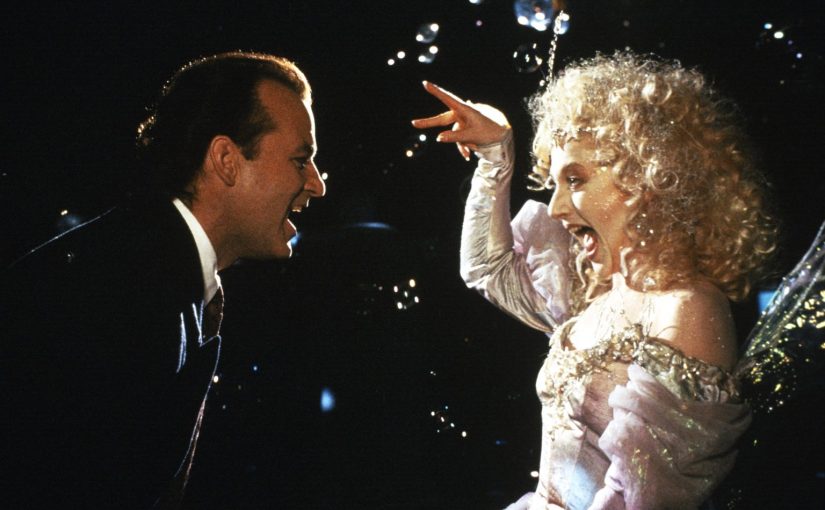
It’s when the follow up ghosts make appearances that my mind ponders what I’ll be writing about in this review.  Ghosts of Christmas Past (David Johansen) and Present (Carol Kane) enter on cue and right away I grew bored and uninterested.  

Johansen is a cabbie, or just another screeching screamer like Murray.  He’s laughing at Frank’s demise and past missed opportunities, but I’m not seeing what’s funny or even heartbreaking.  Neither theatrical mask of comedy or tragedy is functioning.  Carol Kane does her typical schtick with the high-pitched baby talk voice, dressed in a fairy get up.  Beyond that familiar routine, she commits every kind of Three Stooges smack and painful tug on Frank’s face that you can imagine.  Why of all things does she rely on a toaster to upper cut the jerk in his face?  I mean why a toaster???? If the comedy works, then I should not be wondering why a toaster or a pie or two by four or an anvil.

There’s nothing wisely written here.  The screaming and the smacking get old very fast and it gets in the way of a potential love story passed by that the script was promising for the Frank Cross character and his crush Claire (Karen Allen, whose smile always lights up a room).  I never felt like Bill Murray was ever listening to Karen Allen in the scenes they share.  Did they even rehearse this stuff?  Too often, Bill Murray seems to just be winging it, and it wouldn’t make a difference if Karen Allen even memorized her lines.

Scrooged starts out with fresh, quality made National Lampoon material but then waddles into the same typical chapters of Dickens’ holiday story.  However, while it hammers the familiar story beat by beat and you tell yourself there’s the Fred character and there’s the mute kid covering for a crippled Tiny Tim and there’s Yet To Come, you got Bill Murray who was granted too much artistic license to improvise, and has thus squeezed out all of the sensitivity and spirit that we expect from A Christmas Carol.

I’m sorry but I think I liked this Frank Cross a whole lot more before he was visited by the ghosts.  This is one Scrooge who should’ve been allowed to sleep through Christmas.

PS: If anyone can find a DVD print of The Night The Reindeer Died, I’m ready to review it.

CARRY-ON

By Marc S. Sanders

Action movies have been done to death, haven’t they?  Yet, don’t we still get a kick out of them?

Sure, I need my TCM classics like It Happened One Night or my updated biographies like Angelina Jolie’s Maria, but action movies are like the best junk food without any of the calories.  Still, an action picture has to have that special attraction if it is to stand apart from the others.  I got bloated by the time I got to the fourth Lethal Weapon.  The first is a perfect wham bang shoot ‘em up set during Christmas time. Now Netflix grants us a long-lasting candy cane with its airport run around chaser flick known as Carry-On.

What makes this mad bomber fest a smash is that the hero, TSA agent Ethan Kopek (Taron Egerton), actually cries out of fear and pain as the bad guy beats up on him and frightens him into direct obedience.  He begs with tears coming down his cheeks for the bad guy to just stop with his mission.  He screams “WHY ME?”  The Rock, Stallone, Schwarzenegger, Willis, Ford, Gibson – those guys don’t cry.  Yet, little Ethan Kopek does, and once he gets his wits about him does he truly become a super hero.  I recall the moment happens in the last twenty minutes of the picture.  Ethan throws off his pansy TSA uniform shirt and makes a go at saving the day in his black undershirt.  Now he’s earned John McClane’s respect.

On the busiest travel day of the year, December 24th, Ethan is assigned to scan the carry on luggage ensuring travelers have not packed contraband items.  He and his colleagues have to put up with all the typical TSA complaints that come with the job.  My hat’s off to screenwriter T.J. Fixman for allowing some time to show the challenges of this occupation.  It adds some truth, comedy and depth to a thankless job that’s hardly celebrated or acknowledged like cops, doctors, athletes, and attorneys.  

Ethan is handed an earpiece and a mysterious voice, provided by Jason Bateman, gives him direct instructions to allow one black suitcase with a red ribbon to pass through inspection.  If Ethan deviates in any way at all, the voice promises that Nora (Sophia Carson) will be killed.  She is Ethan’s pregnant girlfriend and also runs airport security at LAX.  

Movies like this function like a game or sport.  The villain sets up boundaries.  How is Ethan going to save the day or get around the unexpected while trying to avoid harm to Nora or the airport as a whole?  As far as he knows, he is always being watched by the guy talking in his ear.  There’s rules and obstacles he must observe.  Granted, Carry-On allows a lot of unlikely and hard to buy conveniences to let our hero obtain the advantage, but he’s also not Superman, and at times when you believe Ethan is coming out ahead, Bateman’s antagonist changes up the game.  

Heck! A bomb is activated not at the end of the movie, but dead center right in the middle of the story.  Normally, the end all be all explosive serves as the final exclamation point with the expected digital clock countdown.  However, in Carry-On if it can get deactivated, there will still be more story to go.  Bateman’s villain really has everything thought out and Egerton’s character has no choice but to man up to the plate once again.

A side story with Danielle Deadwyler as an investigative cop named Elena will eventually intersect with the main narrative.  It’s nothing special until a car ride on the way to the airport plays Wham’s Last Christmas on the radio and the scene explodes into a mind-blowing thrill reminiscent of what I saw in Children Of Men twenty years ago.  The construction of this scene alone is absolute fun.  

Deadwyler’s character is written with a lot of carte blanche to allow Ethan to save the day.  No, none of this is ever likely to be how things go.  Yet, I recall Arnold Schwarzenegger being thrown out of an airplane and surviving a crash landing in a garbage heap thirty thousand feet below (Eraser).

If you watch Carry-On, I will not be surprised if you protest its merits based on a collection of plot holes.  The most glaring one to me is that LAX does not look nearly as crowded as the script insists, nor what I’d expect on Christmas Eve day.  Also, traffic is really easy to get around on the way to the airport.  (New Orleans fills in for Los Angeles.). However, just because Dreamworks and Netflix cut corners on spending for more extras and scenic inconveniences, it does not mean my enjoyment with the film is suspended. 

To make up for where the film’s budget might have come in the way, there are storyline surprises that enter from nowhere. Logic is applied to what’s inserted at these opportune times.  Ethan and Elena experience a set back and now new forms of game play must take hold.  You accept what’s thrown at you because of the cast and set ups.

Taron Egerton is a deliberately wimpy, but also an attractive, unlikely hero.  Jason Bateman ranks with other impressive Die Hard type movie villains like Alan Rickman, Tommy Lee Jones and Dennis Hopper.

Carry-On’s director, Jaume Collet-Serra, is well aware of the near miss escapes that allow his movie to…well…carry on.  He really doesn’t try to hide or distract from the plot holes or questions that audiences may argue.  Yet, I say who cares? This cast of mostly unknowns step up to embrace the dialogue and circumstances of the script while trying to win the game.  

Look, anything you see in Carry-On can theoretically happen.  

Would it happen?  

Let’s just change the subject please.  You have a plane to catch.

THE HOLDOVERS

By Marc S. Sanders

Alexander Payne’s The Holdovers plays like a modern-day Christmas Carol.  Paul Giamatti is the Scrooge of the story set during mid-late December in 1970.  He’s an arrogant, unforgiving and unlikable teacher at Barton Academy, an all-boys Massachusetts boarding school.  Two other Scrooges round out the headlining cast.  Da’vine Joy Randolph is a cafeteria cook at the school.  Dominic Sessa is senior student – very bright, but also a troublemaker.  With uninvited circumstances facing the trio, they are the holdovers at the snow-covered school campus during the Christmas break, and they’ll have no choice but to get along or at least tolerate one another.

Alexander Payne often specializes in bringing attention to sad sack lonely souls like in Sideways, The Descendents, and About Schmidt.  His films begin with the characters seeming to accept their fates which lack a desire to smile and be cheerful.  Death or abandonment are common sources for their conditions.  Yet, with each of his wonderful films, it’s always fresh and new.  After an endless series of superheroes, I’m glad I get an occasional reminder of the humanity that can be found and treasured within entertaining films like The Holdovers.

Giamati is Paul Hunham.  Paul is disliked by everyone including his colleagues, the dean of the school (who was a former student of his), and especially the students.  Sessa is Angus who has a discipline problem but normally gets good grades. It’s most impressive that his B+ in Mr. Hunham’s class is leagues ahead of his classmates.  Randolph is Mary who recently lost her son, a recent graduate of Barton, after his entry in the Vietnam War.  These very different individuals have to share their lonesome disregard for one another.  Eventually though, their shields will whittle away and perhaps a couple of viewings of The Newlywed Game will open themselves up to each other.

I would be doing a great disservice to spoil the character backgrounds of these three who stem from different worlds and have nothing in common.  However, a theme found especially in Angus, and surprisingly in Paul, is a tactic of lying and exaggerating.  Within the context of the script written by David Hemingson, the untruths his characters tell work because it opens up further revelations that color in Paul, Angus and Mary’s current states.  The goal of The Holdovers is to scrape away the dirt on the surface in order to uncover the likable or sad nature hidden within. During a trip to Boston, Paul and Angus visit a museum and the irascible teacher finds an opportunity to remind his student that we do not study the past to only see what once was.  Paul tells Angus “…history is not simply the study of the past. It is an explanation of the present.” If The Holdovers were to have a mission statement, this is what the film stands upon.  Angus, Paul and Mary may all be a variation of a Scrooge, but this story explores what precisely added up to their respective states of misery.

The performances in The Holdovers are perfection.  Dominic Sessa offers one of the best film introductions in history.  This actor looks as if you have seen him before and it’s surprising that his only experience ahead of this picture were school plays, he’s done at his own Massachusetts prep school where he was discovered by the filmmakers who were scouting locations for this film.  He ranks up there with the debut performances of Whoopi Goldberg in The Color Purple and Lukas Haas in Witness.  Da’Vine Joy Randolph is heartbreaking, yet lovable as a grieving, chain smoking widow and mother.  Having also watched her bring out her acerbic funny side in Only Murders In The Building, she’s now one of my favorite eclectic character actors working today.  She is wonderful with either natural comedy and drama or just broad, satiric humor.  Arguably, Paul Giamatti occupies the best role ever written for him.  He finds the right beats during different plot points in the movie.  He’s positively unlikable but there’s an understanding to be found amidst the carnage of his past and present.  The sensitivity of Mr. Hunham eventually shines through, but Giamatti keeps it blended with the angry grouch he’s introduced as in the first few scenes of the film.  It’s a dynamic portrayal.

Alexander Payne reminds me once again that everyone we encounter in life is going through some form of turmoil and suffering.  Some of us can hide it well.  Others have given up concealing what’s not attractive or pleasing to our peers.  If we only take the time to look beyond what’s in front of us then maybe a person’s past will justify their present heartache, and we can either grieve, lend support or simply listen.  Payne will have you convinced to do anything except give up on a person.

As I write this last particular paragraph, I recall when Da’Vine Joy Randolph’s character prepares to attend a Christmas Eve party.  She lays out a nice dress.  She does her hair up attractively.  She puts on makeup.  She brings fresh baked brownies and gives them to the hostess with a welcome smile.  A few minutes later though, poor Mary is breaking down in the kitchen and Paul and Angus are seeing a colleague at her weakest when she was doing her best to uphold a semblance of strength.  Mary’s past defines her present to both Angus and Paul.

Alexander Payne is a genius storyteller of the human heart.  He’s already been quoted as saying The Holdovers is not a Christmas movie and he despises the reference.  Mr. Payne will simply have to forgive me though.  His Oscar nominated piece is a wonderful film to watch ritually during the year-end holidays.  Christmas and New Year’s may be a time to celebrate with our loved ones and the fact that we’ve lived through another year gone by.  However, it is also the loneliest for many of us who can no longer celebrate with a family or friends.  It’s important to acknowledge the pain that comes with living under that circumstance.  Fortunately, Payne, with David Hemingson’s screenplay, finds the humor needed for these souls to shed their agony and proudly reveal the faults they carry and the suffering they had no choice but to endure.

The Holdovers is funny, touching, insightful and it’ll leave you embracing a new collection of characters that will not soon be forgotten within the enormous lexicon of memorable movie roles.  

This film will likely win Oscars for screenplay, supporting actress and actor.  A shame that Dominic Sessa was not nominated as well.  There could never be too many accolades for this picture.  It’s marvelous.

The Holdovers is another wonderful film.  Another best of 2023.

TRADING PLACES

By Marc S. Sanders

Dan Aykroyd and Eddie Murphy are the unaware invitees of a Prince And The Pauper R-rated, yet whimsical, scenario in John Landis’ Trading Places.  They are one of the best on screen pairings in film, and this is one of the best comedies to come out of the 1980s.

Randolph and Mortimer Duke (Ralph Bellamy, Don Ameche – another brilliant on-screen duo) are the filthy rich misers who live to make more and more money and use their wealth to cheat and make even more monies or to perhaps use those that are at their behest to test certain social experiments.  Namely, Randoph believes that regardless of a man’s environmental upbringing, anyone can become a success based on their merits.  Mortimer believes otherwise.  It’s in the blood, he claims.  Who you spawn from is how you are destined to become.  To settle this debate, they make a modest bet of switching out their protégé investment representative, Louis Winthorpe (Aykroyd), with homeless bum/con artist Billy Ray Valentine (Murphy).  Deplete Louis of all his possessions and wealth along with his sparkling reputation, his lovely fiancée, his friends and even his faithful butler, Coleman (Denholm Elliot).  At the same time, establish Billy Ray as an up and comer in the WASP Hoi Polloi and award him all of Louis’ assets, along with assistance from Coleman.  Then they will see what shakes out and who wins the bet.  A plot like this was staged in a few Three Stooges shorts during a post Great Depression phase.

The premise for Trading Places allows for a lot of gags that consistently serve the story set mostly in Philadelphia around Christmas and New Year’s.  The holidays lend an atmosphere to the picture.  The brutal cold seems to only make it downright worse for poor Louis, the suddenly accused drug dealer and petty thief.  It only looks worse for him when he’s dressed in a dirty Santa Claus suit and getting peed on by a dog just before the cold rain arrives.  For Billy Ray, the warm comforts of Louis’ home seem like a welcome respite from the chilly, damp streets he likely has slept upon night after night.  If not on the street, then in a jail cell. 

The characterizations are perfect.  I get a kick of Dan Aykroyd’s performance of Louis, the contemptible snob with not one hair out of place and the arrogant tone of his line delivery.  Eddie Murphy is basically doing his routine from all of his early work like Saturday Night Live and 48 Hrs or Beverly Hills Cop.  Yet, I have no complaints.  He’s just funny as hell and the dialogue lends to his basic schtick.  This is the Eddie Murphy I miss from most of his modern film releases.  Denholm Elliott is great at often breaking his regal character to refer to someone as a scumbag.  Bellamy and Ameche are equivalent to wicked stepsisters from a fantasy story.  They are scheming and dreadful with glee.  Paul Gleeson is that “seen that guy somewhere before” henchman working in line with the Dukes.  He’s a great jerk who gets Louis and Billy Ray into their unexpected predicament.  Jamie Lee Curtis is unforgettable as a hooker with a heart of gold, convinced to help out a poor down on his luck Louis when there’s nothing else available to his assist.  She portrays Ophelia whose got the street smarts and sometimes the Judy Holliday squeak in her voice to lend to the spoof comedy this film relies upon.  It’s hard to believe this is the same actor who was a scream queen in a couple of slasher flicks a few years before this film’s release. Never a glamourous actor, but Jamie Lee Curtis has such an amazing range that still surprises in newer films of today (see her Oscar winning performance in Everything, Everywhere, All At Once).

The imagination into this film’s story has to be admired.  When Louis and Billy Ray become aware of the ruse pulled against them, it’s suggested not to kill the villains in cold blood. Rather do unto them what they already committed. Thus, a wonderfully energetic third act is welcomed on the floor of the New York Commodities Exchange that hinges on insider trading and realistic mass hysteria for a silly, yet highly valuable commodity such as Frozen Concentrated Orange Juice.

John Landis incorporates so many side gags into Trading Places.  Imagine Billy Ray intruding upon the wealthy’s exclusive club of snobs and you get a memorable caption of ten police officers pointing their guns in his face.  Poor Louis being subjected to a strip search conducted by nerdy Frank Oz.  Randoph and Mortimer explaining how commodities trading functions to Billy Ray thereby inviting Eddie Murphy to break the fourth wall for a moment.  Even one of my favorite actors of today, Giancarlo Esposito, makes a blink and miss it appearance as Billy Ray tells a tall tale of how he got arrested after using the “Quart of Blood Technique” on ten cops at one time while two hilarious jail cell thugs listen in to his BS.  A train ride to set the victims’ plot of revenge in motion is great involving silly disguises, a New Year’s Eve costume party attended by James Belushi, and a live gorilla.  Even Bo Diddley gets a scene with Louis trying to sell his expensive wristwatch while wearing the ugliest sports jacket and tie combination.

I yearn for another comedy that reunites Aykroyd and Murphy.  We were treated to a little sampling of Bellamy and Ameche in Murphy’s later film, Coming To America.  Oh, how I wish those guys could have capitalized on that small scene.  They pair just as well as Jack Lemmon and Walter Matthau did. 

Trading Places is always a perfect holiday movie to watch in December.  It’s funny, charming, and very smart.  It remains one of the best comedies ever offered by any of the cast members listed in this film.

Looking good Billy Ray!

Feeling good Louis!

BAD SANTA: Director’s Cut (2003)

by Miguel E. Rodriguez

DIRECTOR: Terry Zwigoff
CAST: Billy Bob Thornton, Tony Cox, Brett Kelly, Lauren Graham, Bernie Mac, John Ritter
MY RATING: 9/10
ROTTEN TOMATOMETER: 78% Certified Fresh

PLOT: The world’s worst department-store Santa experiences an existential crisis in between drunken benders and burgling department stores.

[Author’s note: This review is of the Terry Zwigoff-approved Director’s Cut, NOT the studio-released Unrated “Badder Santa” version created without Zwigoff’s input. The Director’s Cut improves on the original theatrical release, in my opinion, by removing a lot of extraneous scenes (the Advent Calendar shots, Willie teaching the Kid how to fight, etc.) while keeping some bits from the Unrated version, resulting in a leaner, darker, yet even funnier movie.]


I recently re-watched this movie with my girlfriend, first time for her, first time in a long time for me.  I had forgotten how relentlessly funny it is, specifically because of how vulgar, offensive, and, let us not mince words, dirty it gets.  I don’t know if it’s because this was the Director’s Cut as opposed to the original version, but I was also reminded of the earlier films of Kevin Smith.  It has all the coarseness and low-budget production values of Mallrats, but with a better story and a funnier script (all due respect to Mr. Smith).

The film opens with our “hero”, Willie T. Soke (Billy Bob Thornton) getting drunk and puking in an alley while dressed as Santa Claus.  This is the high point of the movie in terms of his character.  It’s all downhill from here.  Almost.  Sort of.  Anyway, we learn that he is involved in a somewhat-feasible scam with Marcus, a felonious dwarf (Tony Cox), and his rather materialistic wife, Lois (Lauren Tom, aka “Julie” from Friends…I was today years old when I learned that, thanks to Penni).  After Soke does the Santa thing, muttering profanities under his breath the whole time, Marcus stays behind after hours, deactivates the store’s security system, and lets Soke in the back so he can crack the store’s safe.  Meanwhile, Marcus steals whatever is on the list his wife gives him.  (I liked that little touch; he’s not a random thief, he’s a very SPECIFIC thief.)

One day, a literally snot-nosed kid (Brett Kelly) perches on Santa/Soke’s knee and solemnly tells him, “You’re not Santa”…then peppers him with questions about the reindeer, Mrs. Santa, the elves, ad infinitum, while Willie does his best to keep up through his alcoholic haze.  To say this is the start of a beautiful relationship is straining the definition of “beautiful” and “relationship”, but there is a point to all of it.  Trust me.

There’s more, much more, that’s been crammed into this barely ninety-minute-long movie.  The bartender (Lauren Graham) whose non-traditional sexual kink makes Willie implausibly irresistible.  The department store detective (Bernie Mac) who senses Willie and Marcus are trouble but has plans of his own.  The store manager (John Ritter) who claims he’s no prude but who can barely pronounce the words he heard coming from the dressing-room stall in the plus-size section where Willie was…well, modesty forbids.  Not to mention the Kid’s grandmother with the apparent obsession with making sandwiches.  And the profanity.  The virtually non-stop stream of profanity pouring from Willie’s mouth.  In a comic strip, his dialogue would be almost entirely composed of symbols and punctuation marks.

The executives at the now-defunct Dimension Films must have had cojones of solid rock to give this movie the green light.  Who is this movie for?  I’ve seen so-called “polarizing” movies before, but this achieves some kind of high bar.  Some of the lines must be heard to be believed.  Bernie Mac and Tony Cox have an exchange late in the film that belongs in some kind of cuss-word Hall of Fame.  I can imagine Kevin Smith watching that scene and nodding his head in a kind of salute.

As I’ve said many times before, I have always had a hard time watching movies or TV shows with loathsome characters as the leads, no matter how funny they are.  I have never been able to stomach Seinfeld for this reason, but I do acknowledge the ingenuity of the show’s writing and the comic skills of the actors.  I just find it a shame it’s all been attached to characters whom I would cross the street to avoid.  But here is Bad Santa, with a lead character who is not only alcoholic, but who is also suicidal, who haunts mall arcades to hit on teenage girls (“She said she was eighteen”, he says at one point), has no compunction about swearing around children, and beats the crap out of some local bullies who are picking on his new friend…then has the chutzpah to look at the beating as a turning point in his life.  “You need many, many, many f***in’ years of therapy”, Marcus tells him.

And yet I don’t just like this movie, I LOVE this movie, because it makes me laugh.  I’ve been sitting here trying to self-analyze my affection (if that’s the right word) for this film, but I am failing.  I can only report that it has some of the raunchiest dialogue I’ve ever heard, that it is definitely NOT appropriate for kids, that it is certainly NOT one of Penni’s favorite movies (kudos to her for making it all the way through), and that hand-carved wooden pickles stained with blood are not the best Christmas presents ever.

And I laugh like a loon whenever I watch it.  Sue me.

IT’S A WONDERFUL LIFE

By Marc S. Sanders

I have finally righted a serious wrong and watched Frank Capra’s It’s A Wonderful Life, and what a pleasurable experience it has been.  Reader, if this movie lover who gets hopped up on science fiction gobbley gook with laser swords and spaceships can watch an old black and white movie feeling sorrow for its main characters, and elation when the film finishes, then it’s easy to understand how timeless and impressionable Capra’s classic film truly is.

I recall when I had finally seen It Happened One Night, originally released in 1934 and arguably the pioneer of the romantic comedy genre.  I could not help but connect certain moments and pieces of dialogue to the films released while I was growing up, like When Harry Met Sally… and Bull Durham.  Those films took inspiration from Capra’s comedy with Clark Gable and Claudette Colbert.  Capra pioneered storytelling once again with It’s A Wonderful Life.  As my wife and I watched the movie late last night until nearly two in the morning, I said to her this is like Back To The Future.  My wife said A Christmas Carol.  Both true statements.  So perhaps while Capra was revolutionary with his own storytelling, he might have been adopting some inspiration from what came before as well.  Regardless, I applaud his approach.  Frank Capra is a tremendous gift to the cinematic medium.  If there was a Mount Rushmore for filmmakers, Capra would most certainly be sculpted alongside the likes of Hitchcock, Chaplin and Disney.

George Bailey (James Stewart) has big dreams of leaving his sleepy little town of Bedford Falls and building grand designs of skyscrapers while also exploring the world, beginning with Europe and Alaska and whatever else needs discovering.  Like any of us, our yearning for adventure and the destinies we wish for get interrupted. Before you know it, we ask ourselves if life has passed us by.  It takes a guardian angel named Clarence (Henry Travers) to remind George that life has been with him all along; maybe not the life he envisaged, but certainly a life of purpose and significance beyond just himself.

George watches as his high school chums go on to grand accomplishments that pay off in enormous amounts of wealth.  His younger brother Harry (Todd Karns) goes to college, gets married and becomes a celebrated war hero.  However, George remains in Bedford Falls offering loans to his fellow townsfolk that he can’t afford to honor with a business he inherited from his father.  To lend and support comes involuntary to George.  He’s just a good man. 

On the other end of the spectrum is the mean, wealthy miser Mr. Potter (Lionel Barrymore).  Barrymore plays Potter like one of the worst villains in the history of cinema.  An unforgiving, jealous wretch of a man.  His cruelty is long and unmatched, even if he is relegated to a wheelchair.  He knows how destitute George is, despite his unending generosity, but Potter won’t tolerate the admiration George receives.  To squash George’s stature, he’ll buy out his business.  He’ll make every effort to silence George Bailey’s influence.  Potter will even try to take George under his wing where he can maintain complete authority as a big fish in the small pond of Bedford Falls.  Yet, Potter’s never-ending wealth cannot crush the love for George’s humbleness and giving nature.

A favorite device of mine in movies is when the filmmaker can turn the story’s setting into a character all its own.  Examples of this are shown in pieces like Spielberg’s Schindler’s List where the use of thousands of extras and piles of rubble bring testimony to the atrocities of the Holocaust.  In James Cameron’s Avatar (which I just watched as a refresher for the just released sequel), an imaginary neon glowing planet awakens our senses, and we learn that its inhabitants form a symbiont circle with the plant life and animals that dwell there.  In many films, the time and place speak to the viewer.  Bedford Falls is a main character to the story.  Capra makes wonderful use of the Main Street where each business building quickly becomes very familiar as if we have walked into these small town structures a hundred times.  It hearkened me back to my time in Fair Lawn, New Jersey where I would accompany my grandmother on her daily errands to the bank, the kosher deli and the Woolworth’s.  Wherever she went, everyone knew Helen.  In Bedford Falls, the pharmacy with the soda jerk doesn’t look new to me.  It appears like I’d seen it a hundred times before.  Martini’s, the bar, felt like I knew every hob knobber in the joint.  I could smell the ink and feel the creak of the wooden floors in Bailey Building and Loan. 

The townsfolk are also assembled wisely by Capra.  An old man sitting on his porch at night takes in the flirtations that George and soon to be wife Mary (Donna Reed) exchange with one another.  This man represents Bedford Falls taking stock in what’s to come next for our protagonist.  The people in this town have a rhythm to their gatherings.  Capra offers a magnificent shot where the camera is overhead behind George, wearing his overcoat and hat, and the townspeople are facing him at the other end of the sidewalk.  They expect of George, but does George have anything left to give?  I can only see the back of Jimmy Stewart, but I know all too well the expression he’s sending to the people opposite him.  Look at the scene where they march over to George Bailey’s business demanding their monies back.  How one delivers a line followed by another is perfectly timed to James Stewart’s despair.  The ending is beautifully cut as these same folks come into George’s home to offer their sense of giving during a desperate hour of need for George. 

I always knew the story of It’s A Wonderful Life.   Years ago, I saw a stage production where Miguel portrayed George opposite his girlfriend in the role of Mary.  Yet, I was not familiar enough with the surprises that Capra’s film offers.  I just didn’t realize how much fantasy is embedded in the movie as Clarence is meant to be a naïve angel who has yet to earn his wings.  Seems a little too childlike for me on the surface.  I’ll admit I didn’t take to the angels represented as blinking stars early in the picture.  That’s hokey!  However, when Clarence is personified in the latter half of the film, Henry Travers brings a sense of clarity to the purpose of life when he forces George and maybe anyone watching the movie to imagine what things would be like had they never been born.  Reader, I think I’ve seen story adaptations like this on episodes of Family Ties and The Golden Girls.  In this movie, it becomes frightening as we realize the actions we take carry impacts with them.  Had George not rescued his brother Harry from a skating accident, what would have happened to a squadron of soldiers during the war?  Had George not had the nerve to dance with Mary at his high school dance, what would have happened to her?  Had George not existed, then he wouldn’t be available to lend monies to people and what would have happened to a beautiful collection of new homes that would never be erected?  These questions are incorporated into roughly a thirty-minute last act that remind you to appreciate all that you saw earlier in the film.  I want to say its cheesy, but Travers and Stewart really don’t make it that way.  The sequence comes through with forthright honesty from Travers, never going big or outlandish, and genuine anguish from Stewart who convincingly appears like he’s lost everything when earlier he felt like he had nothing. 

I read that Jimmy Stewart did this film shortly after returning from serving in World War II.  He was suffering from PTSD and much of the torment and agony that George exhibits was coming through naturally on film.  This has to be one of the all-time greatest performances on screen.  Jimmy Stewart’s timing in practically every scene of the picture is perfection.  He’s a wide eyed optimist with big enthusiasm to get his life going.  Then he transcends into a teasing flirt with the girl he was not expected to hook up with.  When George tells Mary he wants to throw a lasso around the moon and give it to her, I really believe he could do it.  We have Jimmy Stewart to thank for that.  Later, he’s unexpectedly frightening as he is on the verge of being charged with fraud and penniless.  Stewart is uncompromising in front of Donna Reed and the young actors playing his children.  When he kicks over the table with the train set and gifts, on Christmas Eve, it’s terribly shocking.  Sadly, it’s relatable.  A film from 1946 presents personal problems and struggles that exist today.  That is why It’s A Wonderful Life is such an important piece.  We struggle to live with our struggles.

Frank Capra’s film is necessary to remind each of us to never give up, no matter how hard it gets.  We have value.  We have importance to ourselves and to others.  We are loved.  Yes, it’s only a movie and it conveniently solves itself in its made-up fantasy.  However, those that enrich and occupy space in our daily lives are real and they are folks who depend on us for their fulfillment and happiness.  We are necessary to making their lives better and sustainable.  Reciprocally speaking, they are just as important to mine and your satisfactions.  It might be drippy to claim that Frank Capra’s film is a “feel good movie,” but I prefer to believe that the writer/director, along with Stewart, Reed, Travers and the rest of the company served a higher purpose. They demonstrate that we have all been blessed with an enormous gift filled with the riches of love and friendship that life absorbs and treasures. 

Happy Holidays!!

FOUR CHRISTMASES

By Marc S. Sanders

I love Christmas cookies.  Those Santa, snowman and tree shaped sugar cookies with the frosting and sprinkles.  They are my weakness come every December.  Cookie cutter, however, is not necessarily a compliment when talking about a movie.  Four Christmases is as cookie cutter as they come.

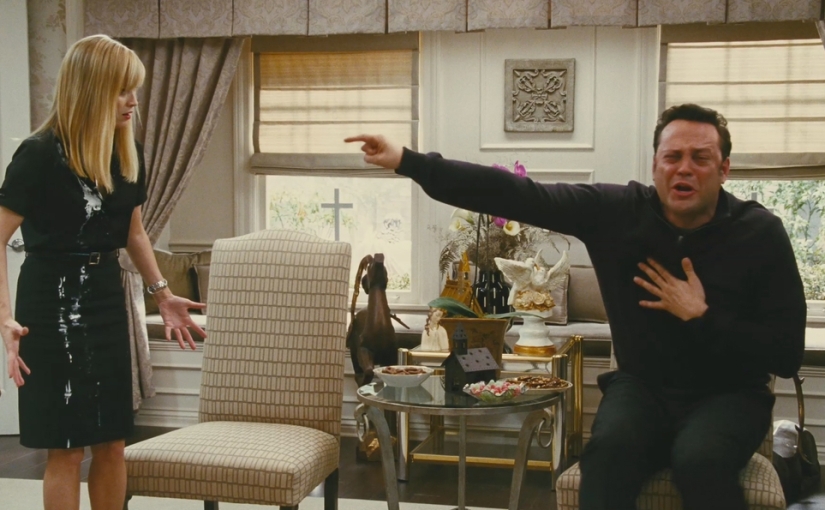
Reese Witherspoon and Vince Vaughn are Kate and Brad, an unmarried couple happily going on three years and ready to celebrate the holidays alone in Fiji while lying to their divorced parents, on both sides, about doing charitable service within poorly developed countries.  However, when they arrive at the airport and learn that their flight is cancelled, wouldn’t you know it?!?!  A news reporter is there to capture them on live television revealing their ruse.  Now Brad and Kate have no choice but to visit each parent’s home on Christmas.  With less than an hour and a half running time, let’s chop this up evenly, shall we?  Figure there will be about 15-20 minutes devoted to each parent.  Hence the title… (say it with me now) …Four Christmases.

Let’s go see Brad’s dad first, Robert Duvall, who lives with Brad’s aspiring MMA fighting brothers played by Jon Favreau and Tim McGraw.  They live a simple life with a Zenith television set and Christmas presents that are purchased with a ten dollar or less limit. A gift of a satellite dish is not gonna go over well, and will likely mean a fall off the roof.  Side note: doesn’t falling off a roof seem to happen a lot in Christmas movies?  Also, if the bros are into MMA fighting, well you know that Brad is going to have to endure body slams galore while Kate simply gasps in shock at her boyfriend’s demise.

Transition time in this film happens in the car while going to the next Christmas celebration.  Brad and Kate take these opportunities to question the purpose of their relationship.  They think they have relationship troubles licked by NOT getting married and not devoting themselves to time with family, but are they kidding themselves? 

Next stop is at Mary Steenburgen’s house, Kate’s mom.  Kate’s older sister played by Kristin Chenoweth is here too.  Kate’s agonizing childhood is brought up for laughs like attending a fat camp and reminiscing about her being the one with the cooties and fearful of bounce houses.  Oh, look what’s in the backyard!  A bounce house!  How ironic!  Know where this is going?  A visit to the church of an overzealous evangelist (Dwight Yoakum), where Kate and Brad are quickly recruited to participate in the Nativity play, happens. 

This is about midway through the film and I gotta say I can’t blame Brad and Kate for always lying about going somewhere else for the holidays.  Who wants to live with this kind of torment?  There’s some truth to the adage “You can pick your friends but you can’t pick your family.”  The movie wants me to recognize the oversight of Brad and Kate and their disregard for family time, but I don’t see it.  These are cruel people that they are confronted with.

Next up, let’s go see Sissy Spacek, Brad’s mom, who is sharing coitus with Brad’s high school best friend.  Enough said there. 

There’s more transitional driving to happen where the question of if Brad wants to get more serious about their relationship is discussed following Kate’s reveal that she took a pregnancy test.  Often in films, it’s the baby factor that tests the relationships.  I wish Hollywood would think outside that box a little.  Having children is not the end all be all, all the time, in building a loving relationship.  Components involving work, religion, and money also come into play.  Mustn’t forget about love too.  Just once, I’d like to see something else.  So many couples live happily without children.  We are even reminded how it’s rude and intrusive to ask “when are you going to have a baby?”  In fact, it is rude to ask that question because it’s too standard and presumptuous.  Hollywood should account for that.  I digress though.

The fourth and final Christmas visit occurs at Jon Voight’s house, Kate’s dad.  Not much wrong here, as we are in the final act of the movie where it’s more about a will they or won’t they conundrum for Brad and Kate.  So, cue the insightful commentary from Voight dressed in a comfy blue sweater.

Look, I can’t deny it.  I laughed at several moments in Four Christmases.  Favreau is hilarious in his tattooed, buzz cut, intimidating presence.  The Nativity play with Brad dressed as Joseph and getting caught up in the hallelujah enthusiasm is funny too.  Duvall is doing his old man redneck routine like he does in Days Of Thunder, and well…c’mon it’s ROBERT DUVALL!!!!

I just wish I didn’t know what was coming from one scene to the next.  In a film this structured, you don’t even have to try to predict what will happen.  You have an involuntary instinct to just know. 

As well, I don’t get a kick out of seeing how uncomfortable characters are made out to be when they are doing nothing but paying a visit.  Poor Brad gets outnumbered by his fighting brothers and suffers the Home Alone slapstick body blows.  Later, a baby spits up all over Kate’s dress, and Brad starts to dry heave at the sight of the mess. That’s not funny.  That’s a shame.  In life that happens.  Babies spit up, but we should feel awful for the victim.  How uncomfortable that must be.  Kate is not Joe Pesci trying to rob a house and getting a deserving paint can to the face.  Kate isn’t laughing at her misfortune.  She’s in shock.  Steenburgen and Chenoworth cackle hysterically, though.  I can’t bring myself to do that.    I feel bad for these two, and all I’m thinking is that it really sucks that they couldn’t make it to Fiji.  I wish they made it to Fiji.  What a shame they never got to Fiji.

Like Home Alone or Planes, Trains and Automobiles, Four Christmases wants to deliver the message that there is nothing better than to spend the holidays with the family, or get married and start a family of your own.  Yet the campaign seems to defeat itself in its demonstration.  I love my family and I love being married, but if I saw this film ahead of what I have now in life, twenty years going strong, I might have thought otherwise. 

Quick reminder: THEIR FAMILIES ARE FRACTURED IN DIVORCE ALREADY!!!!  So, all that Four Christmases tells me is TO HELL WITH FAMILY.  I JUST WANNA GO TO FIJI!!!!!

PLANES, TRAINS AND AUTOMOBILES

By Marc S. Sanders

The Tuesday Before Thanksgiving Tradition blazes on for another year as Steve Martin and John Candy travel from New York City to Wichita, Kansas and then who knows where all while trying to reach their final destination of Chicago, Illinois in time for Thanksgiving dinner.

Despite the fact that Planes, Trains & Automobiles was made in 1987 before the age of cell phones, personal navigation systems, Priceline .com and Ubers, it remains a timeless classic of inadvertent comedy. Travel is still as frustrating, maybe more so now, and family kinship is still treasured.

Martin plays Marketing Executive Neil Page, forced to succumb to the unwanted company of Shower Curtain Ring Salesman Del Griffeth (Candy). One inconvenience after another delays Neil from getting home to his family for the holiday. Del wants to be helpful, yet he is anything but.

The roles are perfectly cast. One of the best on screen couples of all time. I imagine had John Candy not passed away so young, he would have been paired up with Steve Martin at least one more time.

Writer/Director John Hughes is a master at taking simple circumstances (detention on a Saturday, skipping school, traveling) and blossoming it into episodes of relatability amplified in both comedy and drama. His knack for dialogue is a huge factor in his scenes. Consider the best scene in the film between Martin and favorite character actor Edie McClurg where 19 F- bombs are tossed over the mix up of a rental car. It happens all the time to any one of us, and Hughes took advantage of the frustration and built comedy that comes from it. Its not funny when you are in the moment. It’s funny when you recall the moment later on. It’s a brilliant scene.

Nut grabbing, taxi races, ride hitching in 1 degree weather, bed sharing with what you think are pillows, burning cars, wrong way driving, encounters with death and the devil, “The Canadian Mounted,” and a perfect excuse to use Ray Charles’ rockin’ “Mess Around” all point to a reason for a climax that arguably (on the first time any of us saw the film) we never expected or considered. If you don’t choke up, you have no soul.

Hughes was all too familiar with the meaning of Thanksgiving when he wrote Planes, Trains & Automobiles. I like to think those that see the film are even better for having watched it.

It’s a very funny movie, but it’s very special movie as well. Give thanks, offer what you can, when you can, and Happy Thanksgiving.