BLANCANIEVES (2012, Spain)

by Miguel E. Rodriguez

Director: Pablo Berger
Cast: Daniel Giménez Cacho, Maribel Verdú, Macarena García
My Rating: 9/10
Rotten Tomatometer: 95% Certified Fresh

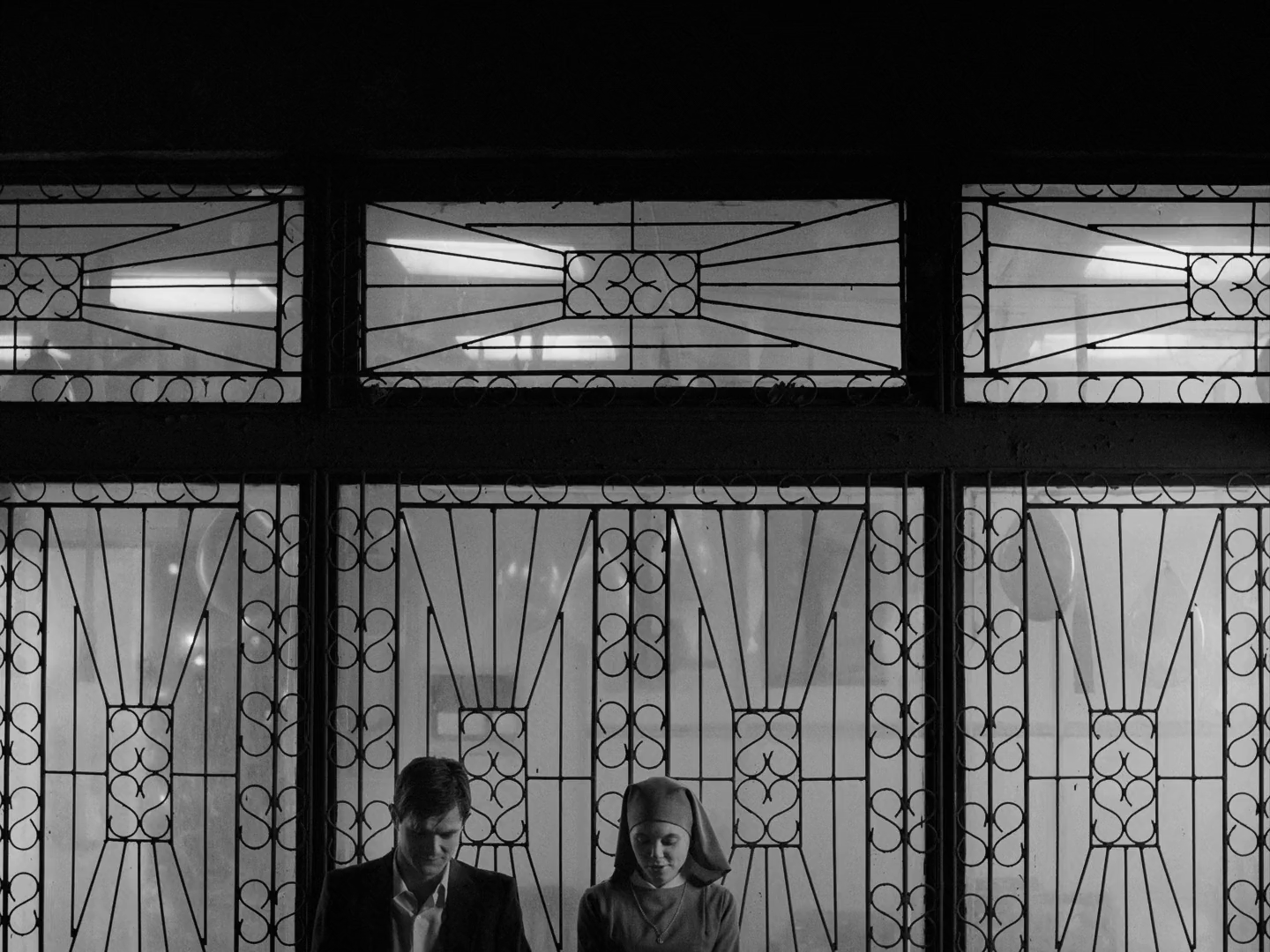
PLOT: A re-telling of the classic Snow White, Blancanieves is a beautiful homage to the black-and-white Golden Age of European silent cinema, set in a romanticized 1920s Seville.


If you are one of the 3 or 4 people in the world who have ever wondered what would happen if Terry Gilliam and Guillermo del Toro collaborated on a black-and-white silent film, your prayers have been answered.  Blancanieves is a beautiful anachronism, a black-and-white silent film created as a tribute to the silent films of nearly 100 years ago that gave birth to the motion picture industry as we know it.  The filmmakers have remixed the classic Snow White fairy tale by the Brothers Grimm into a movie that puts all the recent Disney remakes to shame.  THIS is how you pay tribute to your predecessors.

The updated story takes place in Seville during the 1910s through the 1920s.  Antonio, a famous bullfighter, is gored in the ring and paralyzed.  Traumatized by her husband’s injuries, his pregnant wife goes into premature labor and dies after giving birth to a daughter, Carmencita.  Antonio remarries to a scheming nurse, Encarna (Maribel Verdú, whom you may recognize from Y tu mama tambien or Pan’s Labyrinth).  Encarna, who gives gold diggers a bad name, manages to keep Antonio from ever seeing his daughter, who is raised by her grandmother.  But true to Brothers Grimm fashion, Carmencita (and her pet rooster, Pepe) eventually must come to live with her father and her evil stepmother, whose idea of caring for her paralyzed husband is to leave his chair in a sunny spot of the house while she indulges in a little S&M with the chauffeur.  Why didn’t we see THAT in the Disney version?!

If you know the story of Snow White, you know what happens next.  The insane jealousy, the trip into the forest, the attempted murder, her discovery by a group of little men (only six this time, and they’re bullfighter/clowns).  But everything is turned on its head slightly.  For example, she loses her memory, even forgetting her own name.  She remembers the steps to bullfighting, but she doesn’t know why.

We even get a scene with the infamous apple and the “Sleeping Death,” although the resolution to Blancanieves’s predicament is not quite what I was expecting.  It will take you by surprise, too.  I guarantee it.

This was such a charming movie to watch.  It was full of the kind of shots and edits that are typical of silent films of the ‘20s.  I won’t catalog them all here, but their usage really put me into the “vibe” of that bygone era.  I especially liked the liberal use of double-exposure shots to reinforce a state of mind, or to remind the audience of a piece of “dialogue.”  Or, most effectively, when Antonio reminisces about his dead wife.

And the actress who plays the adult Carmencita, aka Blancanieves, is one of the most beautiful actresses I’ve seen in a while.  For the record.  Films are heavily reliant on faces, silent films even more so.  They found the perfect face for this character.  A true beauty.

There were some nice quirks, too, that reminded me of Terry Gilliam more than anything or anyone else.  Among the six dwarves is one named Josefa.  Josefa is either a really ugly woman or a really bad drag queen.  In miniature.  Her name is mentioned, and that’s it.  No explanation given for her appearance.  We move on.

A word of warning: you know those stories you hear about how the Grimm fairy tales have been “cleaned up” or edited over the years either to remove the more gruesome elements or to tack on happy endings for kids?  Yeah.  Keep that in mind.  That’s all I’ll say.

I used to tell people that, if they’ve never seen a silent film before, The Artist (2011) is the place to start.  Having seen Blancanieves, I think I have to update my statement.  The Artist is a great deconstruction of the art of silent films, but it would be even better to start with a great example of the medium itself.  Sure, there’s always Chaplin and Lloyd and Keaton, but for someone who has historically shunned silent films, Blancanieves is an even better entry point.  It’s a little harder to find, but it’s worth the effort.

AMOUR (2012, Austria)

by Miguel E. Rodriguez

Director: Michael Haneke
Cast: Jean-Louis Trintignant, Emmanuelle Riva, Isabelle Huppert
My Rating: 9/10
Rotten Tomatometer: 93% Certified Fresh

PLOT: Georges and Anne have known a lifetime of love within their intimate marriage. Though their bond has survived the test of time, it’s about to meet its greatest challenge.


I’ve only seen three films by famed German director Michael Haneke.  The first was Caché (2005), which some may consider maddening, but which I think is a masterpiece of open-ended storytelling designed specifically to provoke arguments at the nearest Starbucks after the movie is over.  The second was The White Ribbon (2009), a pre-World War I fable about what happens when children give in to their tribal appetites.  I thought it was well made but a little too sedate, but it also won an unheard-of FOUR awards at Cannes that year, so what do I know.  (One day I’ll watch Funny Games [1997], but today is not that day.  Tomorrow is not looking good, either.)

Last night, I finished watching Amour, Haneke’s 2012 film that won Best Foreign Film at the Oscars that year, and the Golden Palm at Cannes.  After seeing three of his films, the one thing I can say about Haneke as a director is that he is apparently a perfectionist, who edits and composes shots as well as Kubrick, and that his subject matter is all over the place…also like Kubrick.  He also does not shy away from shocking the audience by lulling them into a kind of complacency before presenting them with a moment of violence or revelation.  Like Hitchcock, he plays the audience like a grand piano.

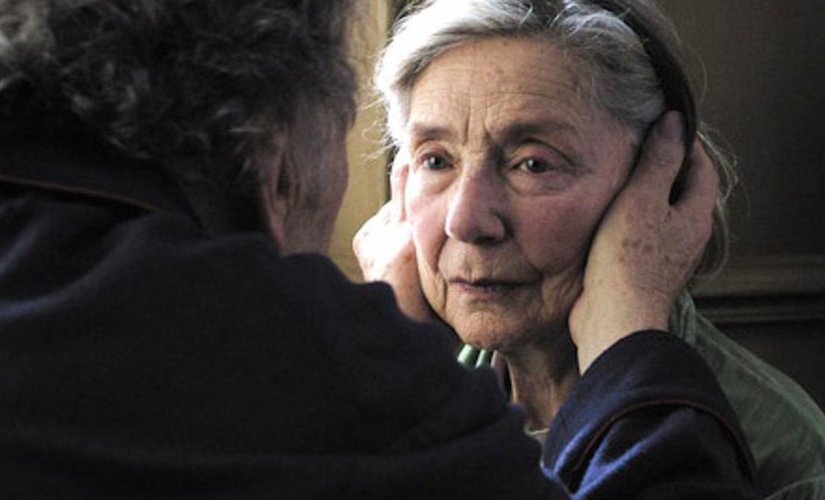
Amour tells the story of an octogenarian couple, Georges and Anne, still very much in love with each other.  They are retired music teachers living a quiet life of piano concerts, meals at the kitchen table, and reading the newspaper.  Georges might be a little more straightforward or curt than Anne, but they clearly know each other’s rhythms.  The style of the film clearly indicates their routines with a brilliant economy of editing and camerawork, not to mention the subtle performances from the two main actors.

One day, something happens at the breakfast table.  Anne and Georges are having a conversation over a boiled egg when Anne simply stops and stares into space.  Unable to get a response, even after dabbing a wet towel on her face, Georges prepares to fetch the doctor.  Suddenly Anne snaps out of her trance and wonders where Georges is going.  When he tries to explain what’s happened, she gets confused and angry with him for torturing her.  But when she tries to pour herself a cup of coffee, the coffee goes everywhere except in the cup, and suddenly her right hand seems to be trembling…

At this point, in years past, I would have probably turned this movie off, or returned it to Blockbuster without finishing it.  I can hear my inner monologue now: “Why do I need to watch an ultra-depressing movie about someone who’s dying?  I mean, I can hope that it has a life-affirming message at the end like Philadelphia or Angels in America, but this is a foreign film that won awards at the Oscars AND at Cannes, so chances are it’s going to end on a down note.  Who needs it, am I right?”

Well, Amour may not have the kind of crowd-pleasing finale one might hope for, but it is nevertheless engrossing, quietly devastating, and even a little terrifying.

…you can’t see it, but I’m very frustrated right now.  I’m trying to figure out how to write the rest of this column and it’s eluding me.

With a movie like this, an analysis of its technical prowess seems irrelevant.  I learn from the extras on the Blu ray that the couple’s apartment was constructed entirely on a set with a big green-screen backdrop.  Haneke wrote the script with his parents’ apartment in mind, so it seemed appropriate to just recreate it on a soundstage.  How does this contribute to the story?  I honestly don’t know.  I would imagine it enabled the filmmakers to control every aspect of lighting so that anything involving scenery through the windows felt as if it was real.  So I guess there’s that.

My problem is that this movie is intended very specifically to make you empathize with the characters.  It does this job very well.  It was a pleasure to watch a great film with great characters in the hands of a great director.  But if I’m going to talk about how the movie made me feel…I guess I must be honest and say it didn’t exactly make me feel good.  It didn’t make me feel bad, exactly, just really, really sad.

There is a kind of sadness I can feel at certain kinds of films (The Remains of the Day and Requiem for a Dream come to mind) where the endings are so mind-blowingly sad, and so unexpected, there is a kind of emotional exhilaration that accompanies the sadness.  I am so wrapped up in the story I have left real life behind, but after the movie is over, I am back in the real world, and I am stoked to tell someone about how great the movie is, despite its dark material.

With Amour, though, when the end of the film arrives, and I’m back in the real world…I still felt like I was in the movie.  Because, in a way, the movie is about me.  About all of us.  One day, I will (finally) grow old and eventually die.  Watching the scenes where Georges stares into Anne’s eyes as her body functions waste away and he reluctantly hires a nurse who is stronger than he is because Anne has lost the use of her right side and must be carried out of the wheelchair to be bathed?  Listening to the conversation when Anne says point blank that she sees no point in going on living if she’s going to be such a burden?  Watching Anne’s face when the nurse turns her in her bed to demonstrate to Georges how to put on her diaper?

Watching these scenes, I wondered how I would feel myself if I were to succumb to something similar.  I tell myself I would want to live.  There’s a line in Full Metal Jacket: “The dead know only one thing.  It is better to be alive.”  But what if I got as sick as Anne does?  What if I lost the power of speech?  What if I lost the ability to type with both hands, as I’m doing right now?

I’m not even sure that is the point of the movie, to make me reflect on my own mortality.  It’s said that Haneke made this movie to honor his aunt who suffered a degenerative disease as Anne does.  The title of the movie is Amour, so maybe I should be writing about the great love between Georges and Anne.  But whenever I think about that aspect of the film, I fall back into thinking about myself again.  It’s a vicious cycle, and I’m not sure how to break it.

I’m making this movie sound depressing to the nth degree.  I suppose it is, by default, but it is still definitely worth your while to watch.  It is so well made and so thought-provoking.  It deserves to be seen and discussed, ideally with someone you love.  I don’t agree with every decision made by the characters in this film.  But I understand why they were made, so I do not judge them.  One day, I will get old, and I will think back to this movie and say to myself, “Now I really know how they feel.”


P.S.  The only reason I don’t rate this movie 10/10 is because there’s a brief prologue involving an empty apartment and a bedroom with a single occupant that, to me, telegraphed a key moment that I saw coming a mile away as the scene unfolded.  But that’s just me.

A SEPARATION (2011, Iran)

by Miguel E. Rodriguez

Director: Asghar Farhadi
Cast: Payman Maadi, Leila Hatami, Sareh Bayat, Shahab Hosseini
My Rating: 10/10
Rotten Tomatometer: 99% Certified Fresh

PLOT: A married couple in Tehran are faced with a difficult decision – to improve their daughter’s life by moving to another country or to stay in Iran and look after a deteriorating parent who has Alzheimer’s disease.


The above plot description, paraphrased from IMDb, is rather brilliant because it is misleading in all the right ways.  When I read it, I assumed I would be in for a depressing domestic drama, a la Marriage Story or Kramer vs. Kramer.  It won Best Foreign Film at the Oscars that year, so that only strengthened my belief that it would be a fine film, but also a bit of a slog.

Boy, was I wrong.  That plot description covers just the opening four or five minutes of the movie, an incredibly nuanced, brilliantly acted, uncut take of the two spouses, Nader (husband) and Simin (wife) arguing in front of a judge.  Simin wants to move out of the country so their daughter, Termeh, can have a better quality of life.  Nader has no problem with them leaving, per se, but he cannot go because he must stay and take care of his elderly father who suffers from Alzheimer’s.  If Simin wants to go so bad, let her go, he says, but he won’t give permission for Termeh to go with her.  And Simin won’t leave without Termeh.  It’s a pickle.  (For her part, Termeh wishes to stay with her father, but Simin says that’s only because she doesn’t know any better…how depressingly typical of parents going through a separation.)

After this brilliant scene, I was ready for the movie to settle into a series of one scene after another showing Nader and Simin arguing over custody of Termeh.  Instead, the script ingeniously takes a bit of a left turn and focuses on the woman Nader has hired, Razieh, to be caretaker for his sick father, because Simin, in a move unexpected by me, packs up and moves out.  Razieh wears a traditional chador, and so Nader is unable to tell she is pregnant, which might have affected his decision to hire her.

Razieh does her best with Nader’s father, but the long commute and the difficult work takes its toll.  One day, Nader comes home from work and discovers his father has fallen out of bed, with one hand tied to the bedpost with a piece of cloth, and Razieh is nowhere to be found.  He also discovers some money is missing.  When Razieh returns, she is cagey about why she left, but she insists she stole no money.  Nader is furious and tries to throw her out of his house.  When she insists she be paid for the day’s work and continues to maintain her innocence of the theft of the missing money, Nader loses a little control and pushes her out the front door of their third-floor apartment and onto a staircase.  She walks away, but later winds up in the hospital – she has suffered a miscarriage.

What follows is one of the most engrossing social dramas I’ve ever seen in my life.  I suspect part of my insane interest in the story was the fact that it takes place in a country thousands of miles away, in a culture that is utterly alien to me, and yet the people there are just like any parents and children and husbands and wives we meet every day here in the States.  Razieh’s husband, Hodjat, even has a line: “Why do you think we beat our wives and children like animals?  I swear on this Qur’an, we’re humans just like you!”  He’s talking to his accuser, but he was also talking to me.

The film is shot with mostly handheld cameras, a technique that works extremely well by making everything feel like a documentary.  It makes things feel more real in a story that only works the more you empathize with the characters.  I empathized a great deal, not because I am a husband or a father, but because I recognized their situation, faced with an impossible decision where each person is right and wrong simultaneously.  In the ensuing plot developments, which I will not disclose here, I was so wrapped up in the lives of these people that I found myself reacting the way old school sit-com housewives might respond to watching their favorite soap operas while folding laundry.  “No WAY did he just say that!  …oh my god, lady, you’re just making things WORSE!  …jeez, this guy is CRAZY…!”

This was an unexpected reaction for me.  In years past, I have tended to shy away from foreign dramas after watching one called 4 Months, 3 Weeks, and 2 Days about women in ‘80s-era Romania forced to seek illegal abortions due to their country’s ban on the practice.  I’m not denying that film’s power, but it was so insanely depressing that I swore off foreign films for a while.  It’s only in the last couple of years that I’ve started to come back around to giving films like A Separation a chance.  It hasn’t always paid off, but I’m happy to say it did this time, in spades.

I should note that the story is also extremely revealing in terms of the legal system in Iran.  I can’t vouch for its accuracy, of course, but it all feels very authentic.  In a governmental system so intertwined with religion, it’s easy to see how decisions that are made based on religious statutes may be technically correct without being just.  Just another dimension to the film that makes it even more compelling to watch.

But there is another aspect of A Separation that I believe is even more profound than the engrossing domestic drama.  I’m not even sure if it was intended by the filmmaker.  I’ve read snippets of reviews from other top critics, and none of them seem to have touched on my theory.

[SPOILERS FOLLOW]

In my opinion, A Separation could be interpreted as an allegory of the impossible choices faced by anyone living in such a country or circumstances who yearn for a better (or at least different) life elsewhere, but whose ties to their roots and traditions make such a decision extremely difficult.

Look at the husband in the story, Nader.  He states repeatedly that he has no problem with his wife leaving.  If his father weren’t sick, he would be more than happy to go with her.  But his father needs constant care, and so his familial connection dictates his decision.  There is a telling moment when Nader is bathing his father by hand, while the father sits in a wheelchair, virtually oblivious to his surroundings.  Nader dutifully rinses his father’s body and leans him forward to so he can reach the bottom of his back…and he abruptly stops and starts to weep.  Is he weeping for his father?  Or himself?  It’s one of the film’s many “fill-in-the-blank” moments that we must interpret for ourselves.  For me, I believe it was over the fact that his decision to stay, motivated by love and duty, has resulted in years of caretaking.  He’s committed to it.  But it’s also profoundly sad.

Now look at the wife, Simin.  She believes her daughter, Termeh, will be better off in another country where she doesn’t have to worry that some man might take out his anger on Termeh while at school or walking home from school.  But Termeh insists on staying with her father.  Simin’s choices are to stay and be unhappy, or leave…and be unhappy without her daughter.  She adopts a middle ground by simply moving to her mother’s apartment while she works on convincing Termeh to come with her.  In the grand scheme of things, as a function of the allegory I have in mind, she represents the person who wants to leave and is held back, not by duty, but by the fact she won’t leave her daughter behind.  There’s a piece of her in this place, and she’s free to leave it if she wants, but she’ll never be the same.

How many people in other countries and other circumstances are faced with similar choices?  How many people in our own circles are stuck in marriages or family situations where leaving appears to be the best option on one hand but an impossibility on the other?  I could say that I’ve had similar situations in my own past with such a decision, but it was certainly nothing on the level of leaving my roots behind and moving to another country.  I can’t imagine the struggle and conflict for anyone facing that kind of choice.

A Separation takes that struggle and wraps it up in a movie that, even if it weren’t so perfectly symbolic, could stand on its own with any other film from any other country.  At the end of the film, the daughter is asked, point blank, which parent she would rather live with.  In what would ordinarily be a frustrating moment, we are not shown what she chooses.  It is left to us to imagine her choice.  Or maybe not.  Maybe we are meant to see what it’s like to be faced with an impossible choice, when neither option is better than the other and someone will get hurt either way.

The question isn’t, “What will she choose?”  The question is, “What would you do?”

NOSTALGIA FOR THE LIGHT (2010, Chile)

by Miguel E. Rodriguez

Director: Patricio Guzmán
My Rating: 10/10
Rotten Tomatometer: 100% Certified Fresh

PLOT: This award-winning documentary juxtaposes the search for answers about the history of the cosmos with Chilean women searching the Atacama Desert for the remains of loved ones killed by a despotic regime decades earlier.


I am going to look at the stars.  They are so far away, and their light takes so long to reach us…all we ever see of stars are their old photographs. – Dr. Manhattan, Watchmen


If Nostalgia for the Light has one flaw, I might point to its rather abrupt ending.  It comes so quickly it almost cuts off the sentence being spoken by the film’s narrator.  Perhaps it’s metaphorical.  The film is over, but there is no resolution.  The riddles of the cosmos remain unanswered, and the bodies of cherished loved ones remain undiscovered.  If they don’t get a resolution, why should we?

The Atacama Desert in Chile is one of the driest places on earth, with an average annual rainfall of 0.5 inches.  With its virtually zero percent humidity, the skies remain remarkably clear at night, making it one of the prime spots on the planet for astronomical observatories.  From these perches, astronomers use massive visible light and radio telescopes to probe the outer reaches of the cosmos, searching for clues to the origins of life, the universe, and everything.  (Sorry, couldn’t resist.)

One astronomer points out that many times, when science finally answers a question, two more pop up to replace it.  He says some people even consider it an exercise in futility.  If every answer only reveals more questions, why bother?  You might as well ask NASA why we sent men to the moon.  Because it’s in man’s nature to know, to try to find out what’s over the next hill or what is beyond the farthest galaxy.

Another scientist explains that the calcium in our very bones literally comes from the stars.  Everything on earth today is descended in one form or another from the Big Bang.  Radio telescopes can measure the calcium levels in distant stars.  (Calcium in stars?  You learn something new every day.)  That calcium came from the Big Bang, and so did Earth’s.  As Carl Sagan said, “We are star stuff.”  We may die, and we will.  The stuff in our bodies remains, and will eventually help a tree to grow, or a vegetable, and so on and so on.  The circle of life, as it were.

All this information in the film is presented in a very straightforward without flash or fanfare, at least in terms of the narration.  Visually, the filmmakers use great editing with the interiors of huge observatory domes and the immense telescopes within, cut together with stunning vistas of starfields, including shots of our own Milky Way.  Indeed, the film’s narration informs us that, night after night, “slowly, impassively, the center of the galaxy passes over Santiago.”

But this is not simply an overblown episode of “Nova.”  Nostalgia for the Light is divided almost schizophrenically into two parts bumping into each other for the duration of the film.  It’s this second part that gives Nostalgia its heart and soul.  I’ve been thinking about it ever since I finished watching it this afternoon.

In 1974, Augusto Pinochet rose to power in Chile.  His dictatorship lasted for 17 years.  During that time, he imprisoned as many as 80,000 people in concentration camps in the Atacama Desert, killing anywhere from 3,000 to 4,000 dissidents.  To cover his tracks, he ordered his military to truck the bodies into the desert and dump them in unmarked mass graves.  It was rumored that he also had many of them thrown into the ocean.  Families were torn apart.  One young woman in the film tells how, when she was 12 months old, her grandparents were forced to reveal the whereabouts of her mother and father, using her as leverage.

For decades since then, women have come to the desert with spades and pickaxes, searching the dry ground for clues to the whereabouts of their loved ones.  The desert is enormous, and there are very few of these women.  In the film, they talk about the people who try to convince them of the futility of their actions.  Not just their friends or family, but public figures, politicians.  They are embarrassing.  They are dredging up a painful past others would prefer to forget.

One of these women wishes the giant telescopes on the distant hilltops could be designed to see through the ground instead of into space, so they wouldn’t have to dig.  They could find the secrets of their past much more quickly.  But of course, that’s exactly what the telescopes are designed to do.  They’re just pointing in a different direction, reaching to a far more distant past.

When I was younger, I was of the belief that a good documentary had to be completely impartial.  It simply documented what was happening without commentary from the filmmakers.  You could use editing to make a point, but it was against the “rules” to editorialize your subject.  And never use a narrator.  Let the audience make up its own mind, right?  The fancy word for this kind of strictly observational filmmaking is “cinéma verité.”

Nowadays, with most modern documentaries I’ve seen, the strictures of “cinéma verité” have gone by the wayside.  Instead of being a passive observer, the director is free to edit together disparate footage and interviews to make their point of view heard loud and clear.  This director, Patricio Guzmán, is using this documentary as a tool for social activism, or at least awareness.  I wouldn’t normally care for this kind of in-your-face, this-is-my-point documentaries.  I have never been a fan of Michael Moore’s films (at least not anything after Roger and Me), and I think Morgan Spurlock’s films are nothing but glorified Jackass stunts.

But Nostalgia for the Light affected me in a way I did not expect.  There is a sequence where an astronomer explains how “the present” isn’t technically real.  Light from the sun takes eight minutes to reach earth.  The light we see from the distant stars are years, decades, centuries old.  What we see in the sky is not the stars’ true position.  It’s where they were years and years ago.  It’s almost as if we’re looking at the memory of light.  This concept, which I’ve heard before, simply boggled my mind this time around.  I don’t know how to explain it.  And then when the film draws parallels between the astronomers searching for answers in the cosmos to the sad, determined women searching for closure in the desert, and the perceived futility of both ventures in the minds of so many…it’s very difficulty to put into words.  I felt that I was watching, or perceiving, something that transcended my poor abilities to describe it.

The astronomers search for answers to better our world and themselves.  The women in the desert search to bring closure to their lives and to the lives of the ones they lost.  They cannot forget, as so many in their country have willingly forgotten.

Director Guzmán also narrates the film, and I believe the crux of the entire film can be explained in one of his lines: “…those who have a memory are able to live in the fragile present moments.  Those who have none don’t live anywhere.”

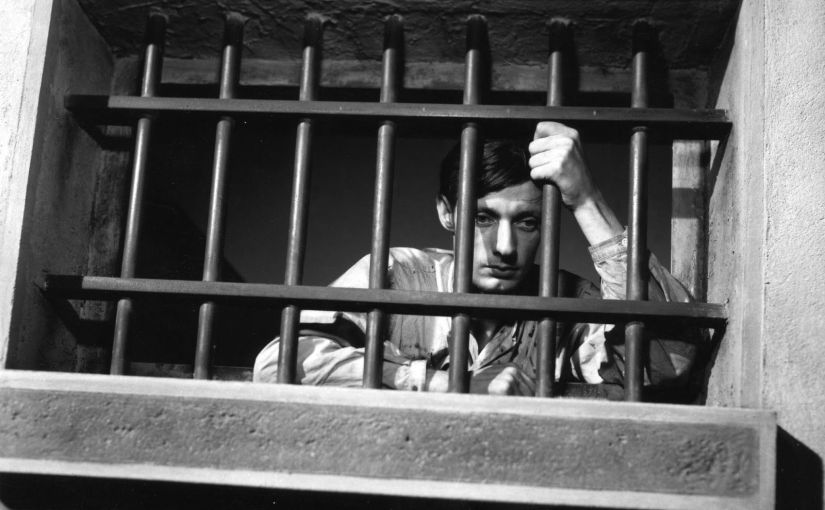
ELEVATOR TO THE GALLOWS (1958, France)

by Miguel E. Rodriguez

Director: Louis Malle
Cast: Jeanne Moreau, Maurice Ronet, Georges Poujouly
My Rating: 10/10
Rotten Tomatometer: 93% Certified Fresh

PLOT: A married woman and her lover hatch an apparently foolproof plan to kill her husband (his boss), but a split-second decision at a crucial moment sends everything into a tailspin.


We plan, God laughs. – old Yiddish proverb

Let me get this out of the way right at the top: Elevator to the Gallows is one of the best crime drama/thrillers I’ve ever seen.  It holds its own against anything by Hitchcock or Clouzot.  With admirable focus and restraint, first-time director Louis Malle (My Dinner with Andre, Vanya on 42nd Street) crafts a gripping illustration of how the best laid plans can fall apart because of one minor miscue.

The film cuts right to the chase at the opening scene, showing a phone conversation between Florence Carala (Jeanne Moreau) and her lover, Julien Tavernier.  They discuss their plans for Julien to kill her husband in his office on a Saturday evening, after which he’ll pick her up at a café where she’ll be waiting, and that will be that.  Everyone will assume her husband is in Geneva on business, and no one will discover the murder, which Julien will arrange to look like a suicide, until Monday morning, giving Florence and Julien plenty of time to make their escape.

(I liked how we never got any flashbacks of the relationship between Florence and Julien.  All we need to know is, they’re lovers, they’re desperate enough to commit murder, and that’s it.  Very concise.  I love it.)

Julien’s plan involves using a grappling hook to avoid using the office elevator to get to his boss’s office one floor above his.  He proceeds with the plan, nearly getting caught in the process, but he’s able to commit the crime and leave the building with several witnesses as an alibi, witnesses who will say they never saw him enter his boss’s office before he left.  So far so good.

Julien gets to the street, takes the top down from his convertible, takes one last look back at the building…and realizes he left a vital clue in full view of any pedestrian or street cop.  Leaving his car running, he decides to run back into the office building and retrieve the evidence before the night guard shuts off the power for the night.

Unnoticed by Julien, a florist and her bad-boy boyfriend have been having an argument at the shop next to his car.  The boyfriend sees this rich man leave his convertible on the street…with the engine running…

Thus begins a Hitchcockian odyssey that leaves Julien stranded in an elevator, his car and his identity stolen, and his mistress stranded on the streets wondering where the hell her lover is.  At one point, Florence sees Julien’s car drive by the café where she’s waiting…she can’t quite make out the driver, but who is that girl in the car with him?!  Has she been betrayed at the last minute?

The film follows the younger couple, Louis and Véronique, as they tool around in Julien’s car, eventually winding up at a roadside motel, and unwittingly making friends with two German tourists.  They even share drinks with the Germans and take some candid photos using a little spy camera in Julien’s raincoat.  (We learn that Julien was in the Foreign Legion and was well-trained as a soldier – maybe even in spycraft.)  I found myself wondering why we were wasting time with this larcenous couple…until they decide to check into the motel as Mr. and Mrs. Tavernier to cover their own tracks.

The screenplay ingeniously heaps one hasty decision on top of another so that, just when it seems Julien might be in the clear, something else happens that makes it seem impossible he won’t be discovered or at the very least blamed for something he didn’t do.  Meanwhile, Julien is desperately trying to escape the elevator, using a penknife as a screwdriver, getting excruciatingly close to tripping a vital switch that’s just out of his reach.  He eventually tries to get out using the old climbing-the-cable trick…which is of course exactly when a night watchman is making his rounds.

This story is so good, I can’t believe there hasn’t been an American remake.  And it’s not like there aren’t other great films out there that cut right to the chase and never look back for flashbacks or additional material.  I’m not sure what makes Elevator to the Gallows so good, to be honest.  Maybe I was rooting for Florence and Julien when they are clearly not the good guys.  Maybe it’s the economy of the storytelling, or the screw-turning twists that lead the police to believe Julien has committed more than one murder.  At one point, Louis and Véronique make a startling decision that had me yelling at the screen.

Words fail me on this one.  I can’t describe it any better than by saying this is one of the best films I’ve ever seen, certainly one of the best film-noirs I’ve ever seen, and a movie that I’ll bet Hitchcock watched while thinking to himself, “Damnation…I wish I’d thought of that.”

ALL ABOUT MY MOTHER (1999, Spain)

by Miguel E. Rodriguez

Director: Pedro Almodóvar
Cast: Cecilia Roth, Marisa Paredes, Penelope Cruz, Antonia San Juan
My Rating: 8/10
Rotten Tomatometer: 98% Certified Fresh

PLOT: A single mom fulfills her son’s last wish by going on a search for her estranged husband, whom she has not seen since before her son was born.


Whatever you might think personally of director Pedro Almodóvar’s films, you can’t say he doesn’t have range and/or versatility.  In one of his previous films, Women on the Verge of a Nervous Breakdown [1988], he takes potentially dark material (a suicidal woman’s quest to find out why her lover abruptly left her) and turns it into farce (police officers accidentally eat drug-laced gazpacho intended for another suicide attempt).  In All About My Mother, winner of 1999’s Oscar for Best Foreign Film, Almodóvar takes potentially farcical material (a mother searches for her estranged husband, who happens to be a transvestite named Lola, and makes friends with a pregnant nun) and turns it into solid, albeit soapy, melodrama that is rather unique in its matter-of-fact treatment of its transvestite characters and situations.

Manuela (Cecilia Roth), a single mother and part-time actor, takes her teenaged son, Esteban, to see a local production of A Streetcar Named Desire in Spanish.  (The night before, they watched All About Eve together, so she’s clearly teaching him right.)  Esteban is so taken with the performance of Huma Rojo (Marisa Paredes), the lead actress playing Blanche, that he waits outside the stage door to get her autograph.  Huma absently gets in a cab and drives away, Esteban runs after her, and is struck dead by a car in traffic.  In a scene of poignant irony, Manuela must sign some official forms to release her son’s body as an organ donor, just days after portraying a grieving mother in a hospital video about…becoming an organ donor.

Manuela discovers her son’s journal in which he is literally writing all about his mother, and he mentions his sadness because he never knew his father, and his mother has told him nothing about his father his entire life.  So begins her quest to locate the long-lost father, whom she refers to as either Esteban or Lola, depending on the context.

After she travels across Spain to Barcelona, her first encounter is with an old friend, a transvestite hooker named Agrado, which roughly translates to “liking” or “agreeable.”  Agrado helps Manuela find a job through the social services of a nunnery, where they meet Rosa (Penelope Cruz), a nun dedicated to assisting hookers of all sorts escape their scandalous lives and find wholesome work elsewhere.  Rosa talks about leaving soon to go to El Salvador to assist in similar work there…but alas, she soon finds out she is pregnant herself.

Meanwhile, Manuela also connects with Huma, the actress whose autograph her son was seeking.  Soon she is hired as an assistant and even, through circumstantially suspicious events, manages to appear onstage as an emergency substitute for Nina, the actress portraying Stella, who is also having an on-again/off-again fling with Huma…

And so on and so on.  At times, All About My Mother feels a little too much like a telenovela, those famous Spanish-language soap operas whose plotlines pack more melodrama into one episode than Dynasty did in an entire season.  But as wacky as the situations got, the movie never gets out of hand, so to speak.  It never wallows in the trashy elements, like a John Waters or Russ Meyer movie, for example.  It simply presents the situations, and the characters face it, deal with it, and move on with their lives.  If I find the situations trashy or overly sensational, that’s my problem, at least in Almodóvar’s world.

That’s one of the charms of this film.  There is a running gag where Agrado, the transvestite hooker – pre-op, by the way – gets hit on by both men and women, and neither gender seems to care about her seemingly incompatible sets of equipment, if you get my drift.  (The guy even offers to do to her what she would normally do to him.  I don’t remember the exact line, but at one point the guy says something like, “Hey, if you think it will relax me, I’ll try anything.”)  In virtually any other movie, that scene would be milked for laughs, or it might be the defining scene for the Agrado character.  But instead, it showcases the…I’m not sure what word I’m looking for here…the “non-issue” attitude that everyone in the movie has to transvestites, gays, lesbians, or any other sexual orientation that might otherwise be a distraction in most American films.  Manuela’s husband is himself a transvestite hooker.  Okay, she accepts it, everyone accepts it, even Rosa the pregnant nun accepts it, and let’s get on with the story.

There is a remarkable scene where Agrado has gotten a job as an assistant to Huma, the actress, and for various reasons a performance has to be cancelled.  Agrado goes in front of the curtain, informs the audience, and offers to tell her life story as compensation for anyone who wants to stay.  She proceeds to itemize every bit of cosmetic surgery she has had done to herself in the past few years in order to become…herself.  Eyes, nose, breasts, jaw reduction…all so she can be more authentic.  “And one can’t be stingy with these things, because you are more authentic the more you resemble what you’ve dreamed of being.”

And then the movie moves on.  It’s a bravura moment that might have been the centerpiece of another film, but in this one, it’s just a dash of character color that deepens everything around it.

I should also mention the lighting style throughout nearly the entire film.  On a few occasions, we are treated to scenes from that stage production of Streetcar, and we clearly see the theatrical lighting.  But in many, if not ALL interior scenes throughout the rest of the movie, the lighting is roughly similar to that of a stage production, or maybe a TV production.  Nothing is lit like I have come to subconsciously expect.  Instead, it all has a kind of heightened reality to it, or maybe “un-reality”, which paradoxically makes it more engaging to watch instead of being distracting.  I think I’m being a little contradictory, but it’s the best description I can provide.

Pedro Almodóvar has been directing shorts and feature films since 1974 and shows no signs of slowing down.  I can’t promise I’ll eventually watch everything he’s ever done, but of the two films of his I’ve seen, this one is my favorite so far.  There’s an abundant love of theater, theatricality, and especially for his characters in his work.  You or I may not like all of them, but he doesn’t seem to care.  Almodóvar seems to be arguing there is humanity in everyone, not exactly a groundbreaking message, but certainly one that was still not widely accepted, even as recently as 1999, and even less so today, unfortunately.  He’s saying, “Look at someone, and don’t see their differences.  See them.  And get on with your life.”

ROSETTA (1999, Belgium)

by Miguel E. Rodriguez

Directors: Jean-Pierre Dardenne, Luc Dardenne
Cast: Émilie Dequenne, Fabrizio Rongione, Olivier Gourmet
My Rating: 9/10
Rotten Tomatometer: 90%

PLOT: A poor young woman, teetering on the edge of desperation, struggles to support herself and her alcoholic mother.


The word “neo-realist” is used several times in other reviews or movie blogs where this little Belgian film is discussed. I’m not a film scholar, so I can’t claim to know precisely what that term describes. Without searching for the dictionary definition, I think it refers to a film in which the predominant theme or tone is that of real life, happening to real people. A favorite method of creating this tone is to use non-professional actors in all the key roles, so one never gets a sense of acting from a performance, only reality.

If I got that right, then Rosetta is definitely a neo-realist film, and I typically do not like neo-realist films. I have seen Bicycle Thieves (1948) a couple of times, and while I acknowledge its place in cinema history and its craftsmanship, the appeal of the film (commonly called a masterpiece of Italian neo-realism) eludes me. It’s not my favorite genre and/or time period.

But Rosetta undercut my preconceived notions of the genre and had me riveted from its opening moments to its severely unconventional ending, ninety short minutes later.

The determining factor is the camerawork, at least at first. We immediately follow this young girl, Rosetta (a gutsy, award-winning performance by Émilie Dequenne), maybe 16 or 17 years old, who is walking briskly through a factory floor, though we’re not sure why at first. As she walks, the camera follows her, hand-held, unsteady, very queasy-cam, but it lends a sense of immediacy to the shot. The camera is almost running just to keep up with Rosetta, and I was instantly curious. Where is she going? Why is she walking so fast? Is she about to punch someone out?

But no, she’s about to be fired for being late, and when her boss intercepts her, she refuses to go quietly, to a point where security has to be called and chases her through the entire building. Why so desperate? Aren’t there other jobs to be had for someone her age out there?

Apparently not. This will be a theme throughout the film: her constant hustle to get a paying job. At one point, someone offers to hire her and pay her under the table, but she refuses: “I want a real job.”

Wherever she goes, the handheld camera follows right behind her, like a paparazzo who won’t give up. We only get a handful of long shots, like when she crosses a busy street after getting off a bus. Virtually every other shot is right behind her or right next to her. The effect creates the idea that Rosetta’s life is composed mostly of sleep and hustling to make that next dollar, or franc. In between, she maintains her trailer home with her alcoholic mother, a woman who is so pitifully down the road of addiction that she demeans herself with the landlord of their trailer park to pay for their water, just so she can keep the money to pay for more liquor. Rosetta ruthlessly tries to keep her mother in check, constantly berating her for her behavior, their familial positions clearly reversed.

Rosetta is not a happy film. How can it be? It simply follows this girl’s life from one crisis to another. But I was totally engrossed in a way that reminded me, for some reason, of another movie, Noah Baumbach’s The Squid and the Whale, which was also shot and filmed in such a way that the actors (most of them recognizable and famous) didn’t feel like actors, and as such felt more real than many other films.

So…what is the takeaway from this movie? Is Rosetta a good person? She has noble intentions, I believe, but she is forced to be strong and calculating as a way of keeping her and her mother afloat. At one point, she meets a young man, might even like him, but at one point, on the shore of a small lake, he falls in and appears to be drowning…and Rosetta takes an awfully long time to decide whether to help him or not. After all, if he dies…she might be able to take his place at work.

I just watched a video essay on Netflix about how it’s not always necessary for you to like a character in a movie in order for it to be enjoyable. Overall, I’d agree with that assessment, especially with Rosetta (though What About Bob? is the CLEAR exception). This film was both dazzling and simple, a neat trick, involving a character I didn’t always agree with, but who I believed made the only choices she could make in her situation. I found myself asking what I would do in her place. Left to fend for myself with no steady job and an alcoholic parent, how would I fare in this world? How would you? Rosetta answers that question in a way that makes sense for the lead character. Her answers may differ from yours. Discuss.

LOOK WHO’S BACK (2015, Germany)

by Miguel E. Rodriguez

Director: David Wnendt
Cast: Oliver Masucci, Fabian Busch, Christoph Maria Herbst
My Rating: 10/10
Rotten Tomatometer: No score [never released in the U.S.]

PLOT: Without a single word of explanation, Adolf Hitler materializes in modern-day Berlin and, thanks to an unscrupulous TV station, begins to once again take the world by storm.


In the comedy documentary The Aristocrats, scores of comedians tell different versions of the same hilariously dirty joke.  In one scene, the staff of the parody website The Onion gets together in a room and tries to construct the perfect Aristocrats joke by combining every known shocking and taboo subject into their version.  Nothing is off the table: religion, politics, graphic sexual acts, nothing.  We never hear their version of the joke, but their discussion is hilarious by itself.  Look Who’s Talking, a shocking comedy from Germany, feels like someone took all the notes from that meeting, pulled out all the Hitler material, and put it all in this one movie.

…this has happened to me before.  I started a review of this movie earlier this week and abandoned it after I realized I had written over 1,500 words of mostly summaries of the action and plot.

I think the reason is because the plot and the comedy in Look Who’s Back are so outrageous and shocking that I felt I HAD to give context to my reactions.  And the only way to do that was to summarize this scene and that scene and the next.

I simply am unable to put my feelings about this movie into words, at least none that would do justice to this stunning, effective, supremely disturbing satire.

The story: For reasons that are never explained, Adolf Hitler materializes in modern-day Berlin…well, Berlin in October, 2014.  After some initial confusion, he marches to the Brandenburg Gate and tries to get some answers from the crowds of people regarding his situation.  No one will answer his questions…but a bunch of people take a second for a quick selfie with this crackpot in a Hitler costume.

At first, Hitler concerns himself with short-term goals.  After befriending a newsstand vendor, he is informed that he smells.  He needs to get his uniform laundered.  And if you don’t think the sight of Adolf Hitler trying to communicate with a laundromat clerk, who doesn’t speak German very well, about when he can pick up his dry cleaning is hysterical, this movie may not be for you.

The story expands.  A TV producer on the skids at work discovers Hitler at the newsstand and convinces his bosses to allow him to take Hitler on a road trip across Germany.  (They’re convinced because a short video of him railing against German politics has gotten a TON of views on social media.)  Then he lands a spot on a live TV show, and things REALLY start to snowball.  He writes a book.  The book is optioned for a movie.  And so on.

I assure you, this is just the bare bones of the story.  I haven’t even gotten into the innumerable scenes that made me laugh like a hyena on acid.  But I can’t describe those scenes in detail, because I don’t want to get banned from the internet.

Here is a list of the scenes that struck me as the funniest or the most disturbing.  Usually both at the same time.

  • The dog.
  • The discussion about rap music.
  • The “hand puppet.”
  • Hitler drawing sketches (badly) in a public square to earn some money.
  • The TV host in blackface.
  • The scene at the soccer stadium.
  • When Hitler visits a pro-Nazi demonstration.
  • When Hitler compares the TV network manager to Leni Reifenstahl

…and on and on and on.

The true horror/comedy of the movie comes when you realize that, for the VAST majority of scenes where Hitler interacts with people on the street, those are real people having real reactions, not actors. The things that come out of the mouths of some of these people is beyond belief. One guy tells Hitler point blank that he had the right idea about concentration camps. A shop vendor says he had the right ideas about how to run the country economically, and she’d support him if he ran for office. All on camera.

There are other genuine laughs, to be sure. The sequence where Hitler discovers the internet for the first time is worth the rental/streaming fee. But by the time the movie is over, I was left with a distinct feeling of unease. The movie depicted the sinister way in which someone with extreme views can manipulate popular opinion and catapult themselves into a position of power. And it’s not so hard to imagine what it must have been like in the 1930s when Hitler did it all the first time.

The film closes with Hitler being driven down a public street in a convertible, saluting random people as they go by. Most people are shocked. A lot of them flip Hitler the bird. But there are some who give the Nazi salute as he drives by. Are they joking?

This is one of the most effective, provocative satires ever made, and it was never released in the U.S. due to the controversial nature of some of its funniest scenes. If you can stream this somewhere, you won’t regret it. Then ask yourself: could it happen this easily today? This movie provides its own answer. Compare and discuss.

THE ARTIST (2011, France)

by Miguel E. Rodriguez

Director: Michel Hazanavicius
Cast: Jean Dujardin, Bérénice Bejo, John Goodman, James Cromwell, Penelope Ann Miller, Missi Pyle, Malcolm McDowell
My Rating: 10/10
Rotten Tomatometer: 95% Certified Fresh

PLOT: A hugely popular silent film idol must adjust to culture shock when “talkies” suddenly invade the movie business.


Is there a movie more in love with the First Golden Age of Hollywood than The Artist?  I can’t think of one.  Sunset Blvd. comes close, but that was a caustic commentary on the heartless tendencies of studio executives to reject the Old and embrace the New.  The Artist covers the same ground, but in a much more comic fashion.

Not to say The Artist pulls its punches.  Not at all.  It tells the story of a silent film idol, George Valentin (Jean Dujardin), who has a meet-cute with a fan, Peppy (the stunning Bérénice Bejo), outside of a movie theatre.  Long story short, she becomes a bit player in numerous silent films and eventually becomes a superstar when the talkies take over Hollywood.  And George?  He struggles, as so many other silent actors did, to acclimate himself to a brave new world where faces and title cards aren’t enough anymore for an audience who is always looking for something new.

And, oh, yeah, did I mention The Artist is itself a silent film?  Shot in black and white?  Filmed in the old 1:33 aspect ratio?  Yeah.  It’s actually pretty cool.  It takes a little while to get used to seeing modern actors moving their mouths and not hearing their voices, but after a while, my brain acclimated itself to this “new” way of watching a movie.

As I was saying, The Artist doesn’t pull its punches in exposing Hollywood’s appetite for the New (in ways I don’t want to give away here), but it is still far more whimsical and audience-friendly than Sunset Blvd.  I’d compare it more to Singin’ in the Rain, if I had to compare it to anything at all.  But The Artist is a singular achievement, and well worth the Best Picture Academy Award for 2011.

There are two scenes in particular that elevate The Artist. In one, Peppy, who has always adored George from afar, finds herself alone in his dressing room.  She spots one of his jackets hanging on a coat rack and embraces it, imagining his arms inside it.  She then slips one of her own arms into the jacket, and voila!  She has a brief love scene where it really feels like she’s interacting with another person’s arm.  It’s a little hard to describe, but the effect is magical.

The second scene is one of my favorite scenes of all time.  George has just gone to see one of Peppy’s new films, a talkie.  The audience loves it, but he is still resistant to the idea.  He retreats to his dressing room, but something bizarre happens.  Remember, up until now, the movie has been completely silent (except for a musical score).  But this time, when he puts a glass down on a table…it clinks.  He stares.  What the heck was that???  He does it again.  Clink!  What’s going on???  He picks up a comb and drops it.  Thunk!  What the hey?!!  He opens his mouth to yell…but nothing comes out!

It’s a wonderfully comic moment, and a perfect way to demonstrate George’s anxiety at what this new technology will mean for him.

The more I think about The Artist, the more I’m realizing that the only way to properly discuss it is to go almost scene by scene, and I certainly don’t want to go down that road, especially for anyone who may not have seen it.  I mean, there’s the dog, George’s butler, the release date for one of his movies (October 24th, 1929, oh dear), the auction, the fire, and the deliriously happy ending, the kind of ending that tends to only exist in movies.

That’s really all The Artist is.  It’s an efficient engine designed to pull at our heartstrings and deliver a feel-good ending after teasing us with darker possibilities here and there.  The fact that it’s black-and-white and silent is a bonus, especially for film buffs.  It may not be realistic, but when it comes to Hollywood’s Golden Age…I mean, who really cared about realism back then?  (Back then, they didn’t need words, they had faces.)

INCENDIES (2010, Canada)

by Miguel E. Rodriguez

Director: Denis Villeneuve
Cast: Mélissa Désormeaux-Poulin, Lubna Azabal, Maxim Gaudette
My Rating: 10/10
Rotten Tomatometer: 93% Certified Fresh

PLOT: Twins living in French Canada journey to the Middle East to fulfill their mother’s last wishes by discovering their family history.


A few years before French-Canadian director Denis Villeneuve made a big splash in American cinema with Sicario, Arrival, and Blade Runner 2049, he directed Incendies [French for “flames” or “fires”…I had to look it up].   This is one of the best films I’ve ever seen.  It’s a mystery, a melodrama, and an urgent plea for peace, all at once.  It’s heartbreaking, engaging, absorbing, and beautiful to look at.  There are two directors currently working who I believe have successfully picked up the mantle left behind by Stanley Kubrick.  Denis Villeneuve is one of them.

(The other is Alejandro G. Iñárritu [Babel, The Revenant], but let’s not get sidetracked…)

A mother dies.  At the reading of her will, her twin son and daughter receive a mission: go to the Middle East and track down their previously unknown father and brother, and give them letters in sealed envelopes.  Only then will the mother allow a headstone to be erected on her gravesite.

The brother, Simon, is skeptical, owing to the mother’s strange behavior in her later years, but the daughter, Jeanne, dutifully follows her mother’s wishes and travels to an unnamed country in the Middle East and begins the laborious process of tracking down anyone who knew her mother and father.

We also get flashbacks of the mother, Nawal, in her younger years, paralleling the daughter’s search.  We learn that Nawal, a Christian, fell in love with a Muslim, Wahab, which is a BIG no-no, to say the least.  Soon, Wahab is out of the picture, and Nawal gives birth to a son who is immediately taken from her arms and delivered to an orphanage.

So far, this is standard soap opera material, but it’s depicted with gorgeous cinematography and spot-on direction.  Director Villeneuve uses a lot of wide shots that have a stark beauty; they reminded me of some of the memorable vistas from Bonnie and Clyde and The Deer Hunter.

When Nawal gets a little older, she decides to track down her son.  This is made difficult owing to the state of war that now exists between Muslims and Christian Nationalists.  Attacks and reprisals make it nearly impossible to find accurate records.  She travels alone from one burned-out orphanage to another looking for clues.  At a key moment, she flags down a bus, but is very careful to first hide her crucifix necklace and put on a head-covering.  Can’t be too careful.

At this point, regrettably, I have to abandon summarizing the story, because the less you know about what happens after Nawal gets on that bus, the more effective those events will be.  Suffice to say it’s a life-changing event, one that sends her on a wildly careening path from activist to assassin to political prisoner.

All of this, naturally, comes as a shock to her children, Jeanne and Simon, who are starting to think this search for missing family members may be a mistake.  At one point, someone makes an important statement: “Sometimes, it’s better not to know some things.”

So…what is this movie really about?  It’s not just about the mystery of the missing family members, which is enough of an engine to make a compelling movie on its own, especially when it’s intertwined with the mother’s past.  But there is a deeper, much more profound level to Incendies that is not apparent until the movie’s final sections, when the threads of Nawal’s past converge in a moment of shattering revelations.  The movie beautifully hides its real motives along the way so you get blindsided by its true message, its true heart.

I dunno, maybe I’m getting too mushy.  But that’s the effect this movie had on me.  I’ve only experienced this kind of emotional catharsis after a precious few films.  It’s impossible to fully describe it without giving away the secrets lying at the heart of Incendies.