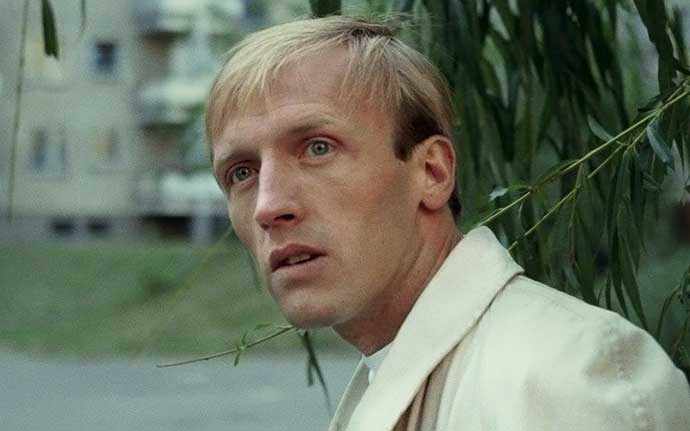
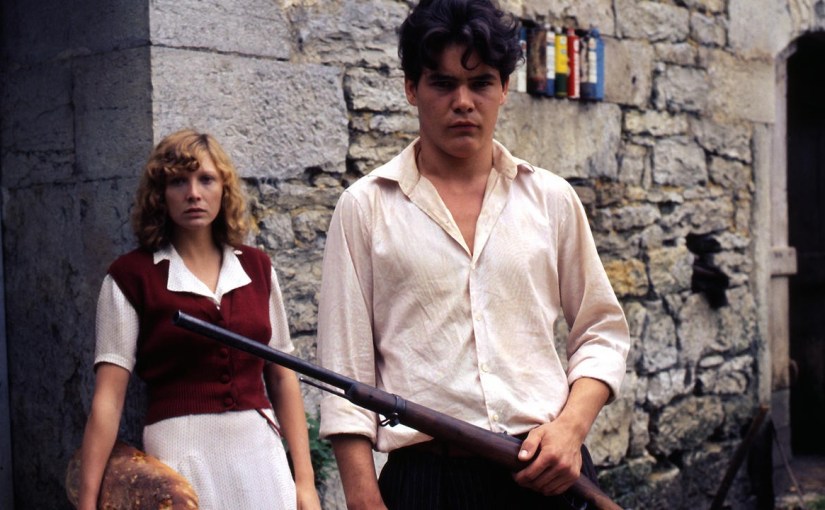
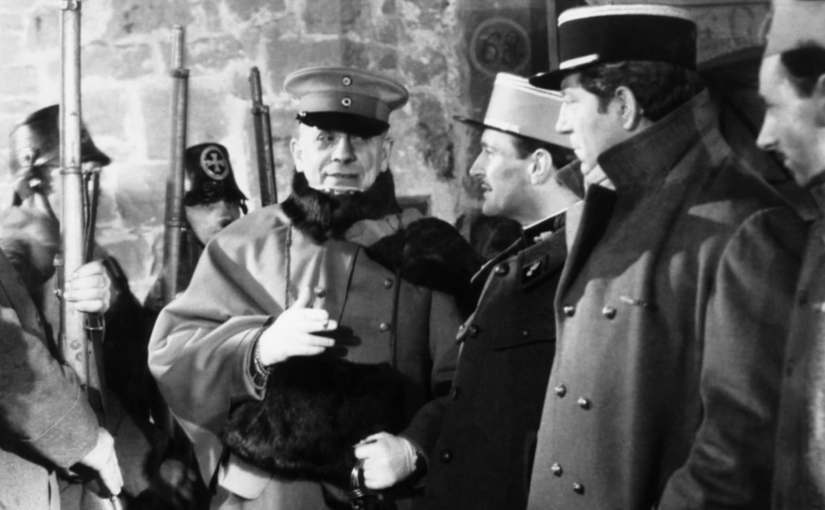
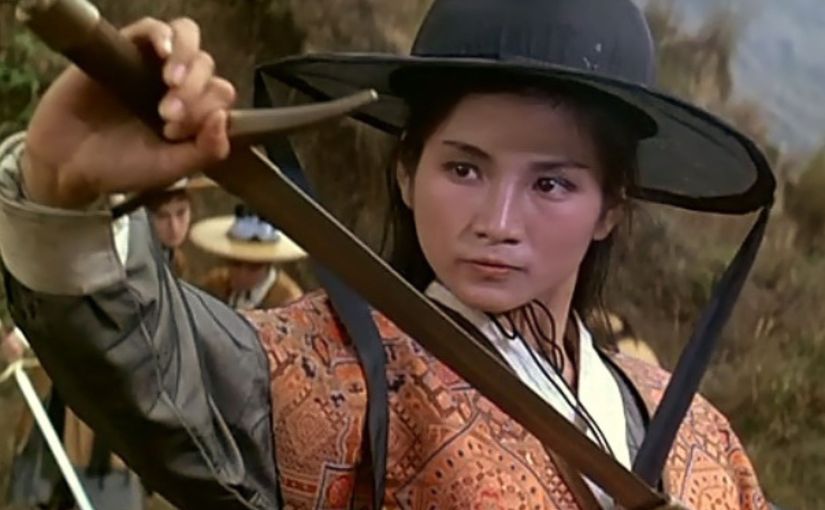
THE VANISHING (Netherlands, 1988)

by Miguel E. Rodriguez

DIRECTOR: George Sluizer
CAST: Bernard-Pierre Donnadieu, Gene Bervoets, Johanna ter Steege
MY RATING: 9/10
ROTTEN TOMATOMETER: 96% Fresh

PLOT: A young couple, Rex and Saskia, stop at a service station during a road trip.  Saskia vanishes without a trace, prompting a years-long search by Rex…while an unassuming family man monitors his progress.


[WARNING: This review contains unavoidable spoilers.  If you have any plans to see this movie, trust me…stop reading now.]

I went into The Vanishing absolutely cold.  I knew nothing about it aside from the name of the director, the bare outlines of the plot (a young woman vanishes while on vacation), and the fact it was a critically acclaimed foreign film, remade in America with Jeff Bridges and Kiefer Sutherland, which I never saw because it was, quote, “laughable, stupid and crude” (Roger Ebert).

With absolutely no gore, no unnecessary side plots, and no clichéd final chase between the killer and the cops where the outcome is a foregone conclusion, director George Sluizer has crafted one of the most compelling, creepiest abduction films I’ve ever seen.  By not showing the actual abduction when it happens, by focusing on the boyfriend’s frantic attempts to track her down immediately afterwards, and by abruptly shifting gears twice in the first hour, the viewer is kept constantly off balance (in a good way).  If she was abducted, how did the kidnapper accomplish his task in broad daylight?  WAS it even an abduction?  We get a good look at the person who most likely committed the crime, but his process looks almost comic…how did he pull it off?

We first meet Rex and Saskia as they’re driving to France to do some cycling.  After Saskia relates a recurring nightmare to Rex (she dreams of being trapped inside a golden egg floating through space), there is an early crisis when their car runs out of gas in the middle of a long tunnel.  We get an early, incisive look at their relationship when Rex elects to walk back for gas, while Saskia stays behind frantically looking for a flashlight she insists they will need.  Later, at a crowded service station, they kiss and make up.

This scene at the service station looks entirely mundane at first, but it is interrupted by a sequence in which we are shown the man who pretty clearly is about to commit a kidnapping.  When we cut back to Rex and Saskia, their interactions become charged with tension.  They talk and tease and kiss, while we are suddenly hyper-aware of their surroundings.  Director Sluizer fills the background with extras, and we start scrutinizing them to see if any of them might be the kidnapper.  Or perhaps there will be a clue later, a Hitchcockian callback which relies on our recall of the crowd scenes.  Rex takes a random Polaroid as a blue semi rolls past the lens, obscuring the front of the store.  Sluizer’s camera lingers on the semi, and we immediately wonder if there is any significance.  (There both is and isn’t.)

The creepy effect of these scenes cannot be overstated.  I can easily imagine some people watching this movie and immediately changing their travel habits.  Never go into a crowded store alone.  Carry mace.  If you must separate, stay in touch with your cellphone until you meet up again.  Stanley Kubrick knew what he was talking about when he told Sluizer that The Vanishing was the most terrifying movie he’d ever seen.

After Saskia’s disappearance, there are the nominal scenes of Rex searching the store and grounds for her, asking if anyone has seen her, giving her description, and so on.  Interestingly, we never get a scene of Rex being interviewed by the police as the day drags on.  Looking back on it now, I get the feeling that Sluizer perhaps thought those scenes would be way too familiar for audiences who have sat through any number of police procedurals in the movies and on TV.  Better to stay with the matter at hand and keep the story moving.

It’s at this point that the movie makes its first abrupt shift in tone and focus.  With no warning, we suddenly spend a good 20-30 minutes, not with Rex’s search, but with the apparently happy family life of the man we got a good look at earlier in the film, the man who appeared to be prepping for a crime.  These scenes are even creepier than the earlier scenes at the service station because we are pretty sure this is the kidnapper, but his home life seems stable: a wife, two daughters, a well-paying job as a chemistry teacher, and the financial wherewithal to buy a large farmhouse in the country…where we discover, in an INTENSELY creepy moment, that no neighbors will hear any screaming.

The decision to focus on this man was jarring and disturbing to me, but in that good way achieved only by the best crime thrillers.  We get more details about his life and his “preparations” that I won’t spoil here.  The film almost seems to have forgotten all about Rex and Saskia; this man is now the primary character.  (In fact, this actor gets top billing in the credits).  He has the kind of forgettable face and unimposing persona that would fly under anyone’s radar.  By showing us the fact that he has two sides to his personality, we come to the uneasy realization that evil could easily lurk behind the cheerful facades of just about anyone we meet.  This concept is far more terrifying to me than a slasher wearing a mask.

But The Vanishing has two more tricks up its sleeve.  It takes yet another dramatic shift when we abruptly jump forward three years.  Saskia is still missing.  Rex has a new girlfriend, but he still posts flyers asking for any information on Saskia.  He makes appearances on local news programs, pleading for the perpetrator to step forward, promising not to press charges; he just has to know whether Saskia is alive or dead.  He craves closure more than anything else.  It has consumed him.  And…he has received several anonymous postcards from the kidnapper asking to meet in a public place, but whenever Rex arrives, the kidnapper has never shown himself.

This creeped me out even more than I had already been.  But the screws get tighter still.  At one point, the kidnapper offers Rex a choice: turn me in, in which case you’ll never find out what happened to Saskia, or I show you what happened to her…by going through the same ordeal she did.

This has all SORTS of psychological implications that I don’t feel fully qualified to sort out.  I have to wonder about those families and friends who have suffered through the disappearance of a loved one.  (I looked up the statistics on missing persons on a whim…they are horribly depressing.)  I can only imagine what those people would do to finally get closure on what happened.  Would they accept this kidnapper’s offer?  Even if it means they might possibly die?  What price would they be willing to pay to finally get an answer after years of searching?

I hope I never have to answer that question.  Rex goes back and forth in agony before finally making his choice.  His decision leads to an ending that was probably inevitable, but which still took me by surprise.

In an interview with the actress who played Saskia (Johanna ter Steege), she states that when the movie was finally released, she was deeply disturbed.  She went to George Sluizer and asked him, “What is the point of this movie?  What do you achieve by telling this kind of disturbing story?  What are you trying to tell the audience?”  If I had to answer that question, I would say that the first motive was to make an entertaining crime thriller, which it is.  But perhaps there’s also a deeper statement about the banality of evil.  One does not have to wear a black hat and twirl his mustache to be the bad guy.  Sometimes you just have to blend into the background.  The film opens and closes with shots that include a praying mantis, a creature that relies on stealth and speed to capture its prey.  The kidnapper in The Vanishing has learned that lesson in spades.

LA GRANDE ILLUSION (France, 1937)

by Miguel E. Rodriguez

DIRECTOR: Jean Renoir
CAST: Jean Gabin, Dita Parlo, Pierre Fresnay, Erich von Stroheim, Marcel Dalio
MY RATING: 9/10
ROTTEN TOMATOMETER: 97% Certified Fresh

PLOT: During WWI, two French soldiers are captured and imprisoned in a German P.O.W. camp. Several escape attempts follow until they are eventually sent to a seemingly inescapable fortress.


What a pleasure it is sometimes to be proven wrong.  Years ago, back when Netflix was still sending physical DVDs to subscribers, I watched Jean Renoir’s anti-war masterpiece La grande illusion.  Unfortunately, I either could not or would not appreciate it for what it was, and I returned it after giving it a mediocre rating.  Flash forward to today, and even in the midst of suffering through my second Covid infection (thank YOU so much, [establishment name redacted]), I rewatched La grande illusion and found it charming, delightful, poignant, and full of (for me) unexpected comedy and ominous foreshadowing, especially because it’s a World War I film made two years before Hitler invaded Poland and ignited World War II.  Turns out this is one of the best war films ever made, whose influences are clearly seen in later classics like Stalag 17, Casablanca, and The Great Escape.  Who knew?

The film centers around two French soldiers in particular, Lieutenant Maréchal (Jean Gabin) and Captain de Boeldieu (Pierre Fresnay).  They are captured after being shot down during a reconnaissance mission and are taken to a German prison camp…camp number 17, because of course it is.  There they meet the paradoxical camp commander, Captain von Rauffenstein, portrayed by Erich von Stroheim as a man who knows the rules of war, but is willing to bend them – slightly – when it comes to imprisoned officers.  He invites them to dine at his table and even offers de Boeldieu a private cell because, wouldn’t you know it, he knew de Boeldieu’s brother before the war.  It’s almost like he’s saying, yes, we’re enemies, but we’re not savages.

There’s another reason for von Rauffenstein’s behavior that has nothing to do with chivalry.  It’s very clear that de Boeldieu and von Rauffenstein are both aristocrats.  They demonstrate this class affiliation by occasionally holding brief conversations in English, which the other soldiers, being mostly of working class, would not have understood.  It’s fascinating to watch the German and the Frenchman interacting with each other, stubbornly maintaining an air of sophistication and bonhomie required of their class, when de Boeldieu knows he must attempt escape, von Rauffenstein knows it, and de Boeldieu knows he knows it.  This might be considered the first and most obvious level of meaning in the film’s title: the grand illusion that we can still be friends, despite the war, because we’re both members of aristocracy.

Ironically, de Boeldieu doesn’t share this same kind of camaraderie with his own countrymen.  Maréchal, the man he was imprisoned with, is clearly a working-class soldier, a bit less refined, and doesn’t know a lick of English or German.  He makes one escape attempt too many and is put in solitary.  Interestingly, de Boeldieu makes similar escape attempts (we learn later), but we never see him having to experience solitary confinement for his actions.  Double standards?

The fourth major player in this drama is another fellow prisoner, Lieutenant Rosenthal, a French Jew played by Marcel Dalio.  He and several other prisoners are in the process of digging an escape tunnel under the barracks, using gear and methods that are directly quoted in The Great Escape, especially the problem of soil disposal.  It was fascinating to see so many elements in this 1937 film featured so prominently in later films.  I never realized just how influential this movie was, and probably still is.  (There’s even a scene – I won’t spoil the setup – that features a small orchestra spontaneously breaking out into La Marseillaise at a key moment…tell me the Casablanca screenwriters didn’t have this movie in mind when writing their script.)

After some months (perhaps longer, it’s unclear), Maréchal, de Boeldieu, Rosenthal, and several other prisoners are unexpectedly transferred to another camp before they can finish their tunnel.  Their new digs are at an enormous gothic castle, also run by von Rauffenstein, who by now has sustained injuries from some kind of airplane crash which require him to wear a neck brace.  He is still exceedingly friendly to de Boeldieu but assures him escape is impossible from this new “camp.”

What happens from there, I’ll leave for you to discover.  What I will repeat is that this movie covers some heavy territory with a deceptively light touch.  There is a scene where a prisoner receives a parcel from home, a large box containing nothing but women’s clothing, so the men decide to hold a mock “revue” with the male prisoners doubling for the showgirls.  One of the soldiers tries on a dress and wig and walks out and asks, “Don’t I look foolish?”  Au contraire.  The men are struck dumb in a moment that is at first hilarious, then poignant, as they feast their eyes on the first thing even resembling a woman for the first time in forever.  Another parcel arrives for some Russian prisoners in another barracks, a large box which they are sure contains food, but instead it contains – well, I won’t spoil it, but to say they are disappointed would be an understatement.

La grande illusion is brilliant at balancing profound ideas of men at war with the occasional humor in the everyday rhythm of life in a prison camp.  It even gets into the ingrained prejudices of so many people against Jews, views that in 1937 were sweeping across Germany like a plague.  (Nazi Germany banned the film, of course.)  This dichotomy is a little hard for me to describe without just giving a play-by-play of the film in its entirety.  Watching it again today, it’s impossible for me to remember what I didn’t like about this movie the first time around.  It has everything: drama, suspense, comedy, daring escape attempts, a showdown between friendship and duty, men in drag…I mean, everything.  This is one time I’m happy to admit: yes, I was wrong.  La grande illusion is not mediocre.  It’s a masterpiece.

KAGEMUSHA (Japan, 1980)

by Miguel E. Rodriguez

DIRECTOR: Akira Kurosawa
CAST: Tatsuya Nakadai, Tsotumo Yamazaki, Ken’ichi Hagawara
MY RATING: 7/10
ROTTEN TOMATOMETER: 88%

PLOT: A petty thief with an utter resemblance to a samurai warlord is hired as the lord’s double. When the warlord later dies, the thief is forced to take up arms in his place.


Kagemusha is a double-edged sword for me, no pun intended.  On the one hand, its visual beauty is virtually peerless.  Only the films of Kubrick, Lean, and those shot by Vittorio Storaro are even in the same league as Kurosawa.  There are shots in Kagemusha that will remain in my mind long after the details of the story have been purged by old age.  In particular, there’s a shot with Japanese soldiers crossing a ridgeline in the background, more soldiers in the foreground, and the setting sun positioned perfectly, so the shadows of the soldiers in the background reach out towards the viewer and interact with the foreground soldiers.  It’s a masterpiece.

On the other hand, the pacing is so sedate that newcomers to Kurosawa or foreign films in general might wonder, my god, when is something going to happen?  At one point, a key figure is taken out by musket fire from an enemy soldier.  This happens so early that we haven’t been introduced to all the main characters just yet, so the conversations surrounding the gunshot were a mystery to me until later in the film.

On the other hand, Kurosawa proves himself over and over again to be a master of the visual aspects of cinema.  In addition to the shot I mentioned above, there is a trippy dream sequence that looks as if it were painted with an explosion at the paint factory (I mean that in the best possible sense), a wonderful camera move that reveals two characters who are conversing in a plain room are actually overlooking a stormy lake, and an eerie moment when the contents of a large vase are revealed after a lengthy burglary attempt.  There are way too many other examples, you simply have to see the film to appreciate what I’m talking about.  I suppose the way to get the most out of the Kagemusha experience is to surrender to the visuals, much like I do with Barry Lyndon or Doctor Zhivago.

I wouldn’t advise anyone to completely ignore the story, though.  There is immense food for thought here.  A condemned thief is conscripted to act as a warlord’s double.  We never learn the thief’s real name.  He is credited only as “Kagemusha”, aka “The Shadow Warrior.”  He must present an outward face to the other generals, friends and foe, in the event that the real warlord is injured or killed, which (SPOILER ALERT) inevitably happens.  There is portentous dialogue about how a shadow only exists if the man is alive.  Remove the man, and how can a shadow remain?

There are several close calls where Kagemusha’s secret is almost revealed.  His grandson – well, sort of his grandson, it’s a long story – immediately yells, “THAT’S not my grandfather!” when he sees him after a long absence.  The real warlord, Shingen, had a huge black horse that only he could ride.  The inner circle who knows Kagemusha’s secret agrees immediately that he should never try to ride it; you can fool some of the people some of the time, but you can never fool a horse.  Shingen’s mistresses present a real danger.  Kagemusha squirms for a few moments as they slowly start to question his identity during tea, but he brilliantly defuses the situation by telling them the one thing they would never believe: the truth.

There’s also a much larger issue at work in Kagemusha.  Shingen’s own generals (the ones outside of the inner circle), and the opposing warlords, all believe Shingen is still alive when they see him on the battlefield.  They have no reason to think he’s an impostor.  There are some skeptics, but their spies are helpless to discover the ruse.  For all intents and purposes, that is Shingen, and they behave accordingly.

There is one battle at night where this, I don’t know, philosophy becomes all too real for Kagemusha.  In the darkness, Shingen’s forces can hear enemy armies approaching, and then musket fire breaks out.  Instinctively, Shingen’s bodyguards leap to shield Shingen/Kagemusha from enemy bullets.  Some are killed.  The look of horror on Kagemusha’s face as the dead bodyguards are piled on top of other bodies is indescribable.  They gave their lives for him.  Or, more importantly, they gave their lives for the idea of Shingen, their belief that he was the most important person on the battlefield.  I was reminded of a bit of dialogue from American Sniper, of all things, when the lead character, an accomplished sniper, is asked to cover some soldiers on a raid.  He is told that the soldiers feel invincible with him up there.  He says they’re not, and the reply is eye-opening: “They are if they think they are.”  Just like the soldiers in American Sniper, the soldiers in Kagemusha are prepared to lay down their lives for a concept.  The man is nothing, a thief.  They don’t know that, though.

This took me down a little bit of a rabbit hole.  I thought of Secret Service agents whose literal job is to protect our President and take a bullet for him if necessary.  It doesn’t matter whether he (or she) agrees with the President’s policies.  That is secondary.  Their job boils down to one thing: I will die to protect this person if that’s what it takes.  The dedication on display by these men and women humbles me, and it makes me think.  Surely, they have opinions about world and national policies.  Doesn’t matter.  It’s not part of the job.

Watching those bodyguards fall in front of the imposter warlord made me think really hard about those kinds of jobs, about anyone in any branch of the armed forces.  Ready to kill and die for what they believe in.  In the case of Kagemusha, these people died for a fake.  It makes their deaths sad, but are they any less honorable?  Like I said, food for thought.

The film ends with a massive battle where, curiously, we are not shown any deaths, only the aftermath.  (The opposing general is especially cruel: “Shoot the horses first.”)  Then there is a dreamlike coda that recalls that philosophy of dying for the right cause.

To recap, though, the movie is slow going, at least as slow, if not slower, than Kubrick’s Barry Lyndon.  I can see that Kurosawa has a lot to say with this movie.  He employed thousands of extras and lavish costumes (financed thanks to the involvement of Francis Ford Coppola and George Lucas, which is this whole OTHER thing).  It’s not my favorite Kurosawa film.  That spot is reserved for Ran (1985), which I consider his career-capping masterpiece.  Kagemusha sort of lays the groundwork for that movie, in my opinion.  It was one of his first films in color (I think) and it shows a natural talent for the medium.  Like I said before, surrender to the visuals and contemplate the story, and the slow pacing will take care of itself.  (That doesn’t make much sense, but I’m sticking to it.)

COME DRINK WITH ME (Hong Kong, 1966)

by Miguel E. Rodriguez

DIRECTOR: King Hu
CAST: Pei-Pei Cheng, Hua Yueh, Chih-Ching Yang
MY RATING: 8/10
ROTTEN TOMATOMETER: 100%

PLOT: A highly skilled martial artist (Pei-Pei Cheng) is dispatched to rescue her own brother from kidnappers.


King Hu’s Come Drink with Me feels like a multiverse version of Ang Lee’s Crouching Tiger, Hidden Dragon, and no wonder: Lee, like so many of his countrymen, is a huge fan of the wuxia genre of films that have been around since the 1930s.  Come Drink with Me created the template that was faithfully followed by many other films in the succeeding years, and while I cannot claim to have seen them all, it is plainly visible that this film was their prototype, much like Halloween laid the groundwork for countless other slasher films.

Right from the opening scene, the focus is clearly on action above all else.  We watch a caravan taking prisoners to jail, in the traditionally accepted timeframe of what looks like medieval China.  The caravan is stopped by a lone figure who announces himself as the leader of the bandits known as The Five Tigers.  The gang’s name alone evokes scores of kung-fu films aired on Saturday afternoons on Channel 44. A furious battle ensues in which the prisoners are freed, and a government official is kidnapped by the bandits and ransomed in exchange for the release of another one of their comrades.  Rather than pay the ransom, the government sends a lone warrior, Golden Swallow (Pei-Pei Cheng), to rescue the captured man. (If Golden Swallow looks familiar, that’s because she played the villainous Jade Fox in Crouching Tiger, Hidden Dragon, further enhancing the idea that we’re in some kind of wuxia multiverse.)

That’s all in literally the movie’s first five-to-ten minutes.  Everything that happens afterwards is one action sequence after another, with only two breaks for a breather.  There is a bar brawl that looks curiously similar to the one featured in Crouching Tiger, Hidden Dragon, complete with some impossible acrobatics from the heroine as she leaps from a wall to the upturned legs of a table to the other side of the room.  Granted, it’s not as technically sophisticated as the newer film, but the influence is undeniable.

There is a chase across the rooftops at night, another element clearly appropriated by Crouching Tiger.  Golden Swallow fights off wave after wave of enemy thugs, most of them wielding swords, but some of them hurling wicked needles and darts, one of which finds its mark and lands Golden Swallow in the care of a man, Fan Ta-p’I, who she thought was a drunkard, but who turns out to be a skilled martial artist himself.  These two will eventually cooperate to accomplish their mission, along with a second mission that reveals itself organically.

I must say I wasn’t altogether thrilled with this secondary plot element because it takes the spotlight from Golden Swallow, who dominates three-quarters of the movie.  However, I immediately let it slide when it provided the opportunity to showcase one of Fan’s hidden skills: the ability to manipulate and focus the air so it flows from his hand and can part the cascading stream of a nearby waterfall.  That’s right out of comic books, man.  Or “Avatar: The Last Airbender.”  Take your pick.

To say Come Drink with Me is inferior because it is not as technically sophisticated as modern martial arts films is to overlook its relevance.  Yes, there are a lot of quick cuts used to hide some otherwise impossible-to-perform maneuvers.  Yes, a lot of the dialogue (what little of it there is) is either hammy or overly expository, or both.  Yes, the fight choreography, on close inspection, is not as polished as we’ve come to expect after seeing The Matrix or House of Flying Daggers.

But as an artifact of where today’s martial arts films began, Come Drink with Me is incredibly valuable and still entertaining, even in its relative crudeness.  I loved being able to draw straight lines from specific scenes in this movie to Crouching Tiger, or even all the way to the John Wick franchise.  The last John Wick film featured a scene where Wick fights off an almost literal army of henchmen on a long staircase.  I laughed at the audacity and absurdity of the situation…but I rolled with it, because that’s just what John Wick does: he fights, and he endures.  Why?  Because if he didn’t, he wouldn’t be named John Wick.  Same thing applies to Jason Bourne and James Bond.

And the same thing with Come Drink with Me.  The obviously overmatched Golden Swallow picks off the hordes of attackers one by one because they’re foolish enough to only attack her one or two at a time.  Why?  Because the story demands it.  It’s tradition, even when it looks goofy and unrealistic.  It took me some time to grasp that core concept, but when I did, my enjoyment of these older swordplay films deepened considerably.

ONIBABA (Japan, 1964)

by Miguel E. Rodriguez

DIRECTOR: Kaneto Shindô
CAST: Nobuko Otowa, Jitsuko Yoshimura, Kei Satô
MY RATING: 7/10
ROTTEN TOMATOMETER: 90%

PLOT: In feudal Japan, two women kill samurai and sell their belongings for a living. While one of them is having an affair with their neighbor, the other woman meets a mysterious samurai wearing a bizarre mask.


Squint your eyes, and long stretches of Onibaba look as if they were adapted from comic books.  I’m not talking about the eye-popping colors of Kirby, though.  More like the moody noir of Miller or McFarlane…especially Miller.  Extreme closeups, off-centered faces (to make room for word balloons, of course), sneering lips and bared teeth, gratuitous female nudity, shocking violence, the possibility of supernatural elements getting involved in the story – we’ve got all the makings of a new chapter for the Sin City saga.

But Onibaba misses its chance for true greatness by the disappointing nature of its ending, which I cannot, in good faith, describe in detail here.  The last time I felt this cheated by the ending of a film was when I watched the original Night of Living Dead for the first time.  When the credits for that movie rolled, I wanted to throw popcorn at the TV.  Since I didn’t have popcorn, I cursed out my friends instead.  C’est la vie.

The story of Onibaba begins as we see two women – one older, one younger – living in poverty in medieval Japan.  Some later exposition informs us of an ongoing war far away between two warlords.  Weary soldiers from both sides wander into the tall grassy fields where the women live, and the women promptly kill them, take their clothes and belongings, and sell them to local merchant for bags of millet.  (We never learn the women’s names, by the way.  They are identified only by how they relate to Kichi, a man we never see: one is Kichi’s mother, the other is Kichi’s wife.)  The bodies of the men they kill are disposed of in a large, ominous pit hidden by the tall grass.

I should mention yet another stylistic and visual flourish.  The two women live in a grass hut constructed in a vast field of tall grass at least six, possibly seven feet tall.  There is poetry in many shots when the wind rises and pushes the grass.  In one neat overhead shot, the only way we can see a man pushing his way through the grass is by tracking the hole he makes as he walks.  It’s an indescribably lyrical moment in an otherwise mundane scene.

ANYWAY.  A neighbor arrives, Hachi, with sad news for the two women: Kichi has been killed.  When he asks how the women got by during his absence, they are cagey.  It’s here where we get the first of many masterful sequences where faces and eyes are used to convey emotion more vividly than any prose could.  When Hachi propositions the young woman, now a freshly-minted widow, she sneers.  But as days go by, Hachi wears her down, and they begin an affair, much to the mother-in-law’s disapproval.

Night after night, the young widow wanders off to Hachi’s shack, while the mother-in-law sneaks off and follows her, disapproving but never interrupting their liaisons.  All she offers as a rebuke are stern words and resentful glares.  This cycle repeats itself several times, and despite the visually unique methods of showing us these middle passages, I found myself wondering where this was going.  No doubt people more knowledgeable than I can make conjectures about how this might be a representation of Japanese culture at the time: the old severely disapproving of the young, but powerless to stop the march of progress.  It’s not a far-fetched theory, but if so, it’s an obvious one.  So, what’s the point?

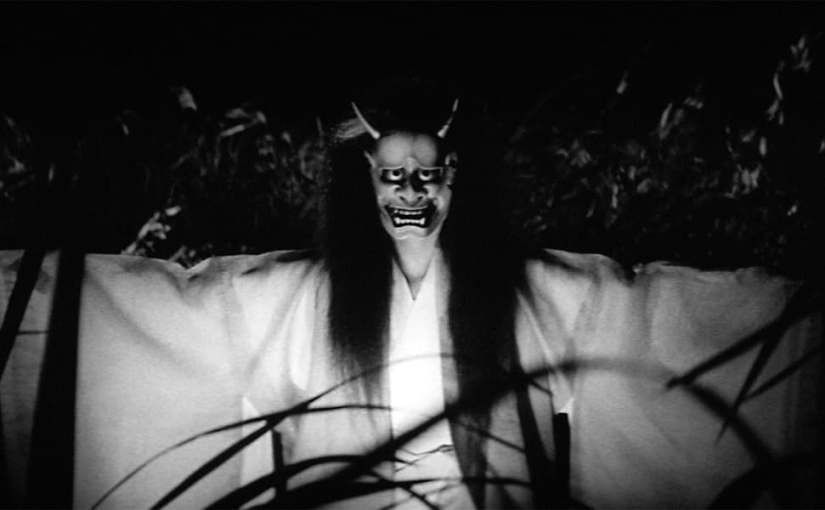
Hope arrives (story-wise) in the form of a tall samurai warrior the mother-in-law encounters in the tall grass one night.  He wears a fearsome demon mask and demands the old woman show him the way to the nearest town.  She asks him to remove the mask.  He refuses, but he assures her that he is very handsome underneath.  Right.

At this point, I was on the edge of my seat.  At last, here we go, some real horror-story stuff.  The mask looks awesomely horrifying, not like the kind of demons we tend to think of, but a weird, bug-eyed, fanged face that still looks vaguely human, which only makes it that much creepier.  When the old woman finally gets her hands on the mask (I won’t say how), she formulates a plan.  The next night, when the younger woman sneaks off to another rendezvous with Hachi, she is confronted by a tall figure with long black hair with the face of a demon…gliding through the grass is if it were floating over the ground.  Floating?  People can’t float.  …what exactly is going on here?

At this point, I was primed for a Twilight Zone kind of twist, revealing the true nature of the samurai warrior, the mask, and the old woman.  (Onibaba translates to “demon woman”, according to the main titles of the movie.)  But what?  I was pleasantly surprised by my eagerness to see what would happen next, even if it were mildly predictable.  The movie had shown great visual flair, so even if the ending was a cliché story-wise, it would look really cool.

But…alas.  The film’s ending teases us with several minutes of truly disturbing stuff psychologically, and then throws it away in a moment of ambiguity, the kind of open-endedness that may inspire discussions on the movie blogs, but which is terribly unsatisfying when it doesn’t work.  And here, unfortunately, it doesn’t work.  It leaves us with more questions than answers, and when “The End” appears, it almost feels like the director and/or screenwriter said, “That’s it, I’m out of story.”

The liner notes of the Criterion Blu Ray for Onibaba inform me that it’s based on an ancient samurai legend, so I guess I can’t totally blame the director/screenwriters.  But I just wish there had been something meatier waiting at the end of what had been a visual treat.  If it had provided a nudge into something deeper or more visceral, I’d have been ready to put Onibaba near the top of my favorite Japanese films.  Visually, it’s stunning with a surprisingly modern feel.  But, oy, that ending.

EYES WITHOUT A FACE (France, 1960)

by Miguel E. Rodriguez

DIRECTOR: Georges Franju
CAST: Pierre Brasseur, Alida Valli, Juliette Mayniel, Edith Scob
MY RATING: 9/10
ROTTEN TOMATOMETER: 97% Certified Fresh

PLOT: A surgeon goes to extreme lengths to give his daughter a new face, which was disfigured in an accident he caused.

[NOTE: This review contains mild spoilers.]


I have become a fan of many of the new breed of horror films released in the last ten years or so – Under the Skin, The Babadook, Get Out, Hereditary, Doctor Sleep, and Saint Maud, just to name a few.  Despite their cosmetic differences, these movies all accomplished the same thing: they got under my skin.  They were genuinely unsettling as their stories unfolded, and they can still creep me out to this day.

Imagine my surprise when I sat down to watch George Franju’s Eyes Without a Face, a French horror film released over sixty years ago, during a time when most mainstream American horror films (Hitchcock aside) were exercises in jump scares, cheesy special effects, and outrageous premises.  I was not prepared for how effectively this movie grabbed me from the outset and, except for a brief middle passage, did not let go.  When a movie from 1960 begins with a woman dumping a corpse into a river…a corpse with a clearly, hideously disfigured face…I don’t know about you, but I sat forward a little in my seat.  Where is THIS going?

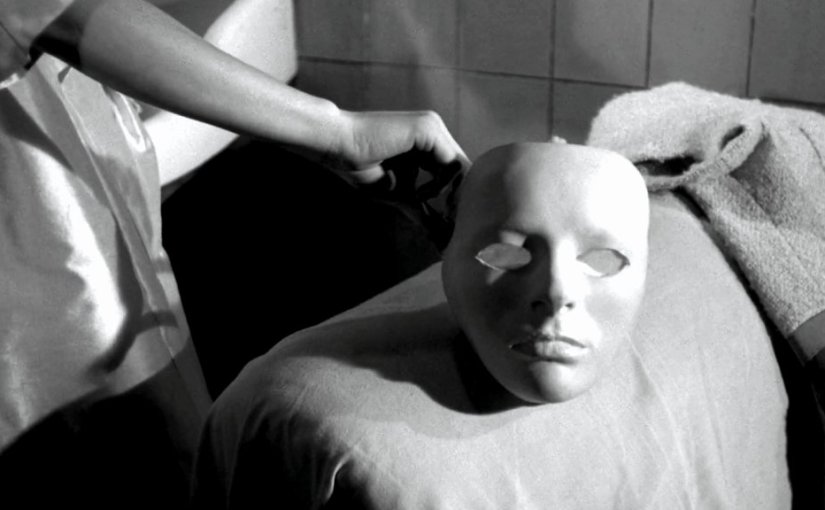
When the body is discovered, the esteemed Dr. Génessier (Pierre Brasseur) solemnly identifies it as his daughter, Christianne.  There is a funeral, Christianne’s fiancé is distraught, and the police are satisfied.  When the good doctor returns home to his large, gothic estate in the country, he goes upstairs to a room where we find his actual daughter, still alive and so disfigured the camera dares not show her face.  The doctor’s assistant, Louise (Alida Valli, still exotic-looking 11 years after The Third Man), brings in a simple but disturbing mask for Christianne to wear.  “Get into the habit of wearing it,” says the doctor.

Who was the girl in the opening scene?  What happened to Christianne’s face?  And why does Louise start searching the nearby city for young unattached women with blond hair and pretty faces?  Why, indeed?

Eyes Without a Face may not have a particularly inscrutable or complicated story, but that doesn’t matter.  The movie unfolds like a modern-day Grimm’s fairy tale, poetic, with princesses locked in tall towers, an evil father figure, and unspeakable violence hinted at but never quite seen.  Except this time, in an unforgettably shocking scene, we witness one of the doctor’s operations.

In most films of this era, shockingly violent acts were tactfully carried out offscreen.  I am thinking, for some reason, of Lawrence of Arabia, where Lawrence must execute a man in order to keep the peace between two Arabian tribes.  Lawrence pulls his gun, we see the bound man try to escape, and we cut to Lawrence as he fires his gun, once, twice, several times.  It’s a shocking scene, but we never see the carnage of those bullets.  It’s left to our imagination.

In Eyes Without a Face, we watch as the doctor gently draws a grease pencil outline around his anesthetized victim’s pretty face.  (“I must try removing it in one large section, not in pieces as before.”  Yikes.)  Then Louise hands him a scalpel, and the camera stays on Louise’s face, and I expected it to stay there for several seconds as the horror of what the doctor was doing was left to our imaginations.  But no.  We cut back to the scalpel piercing the skin as he gingerly follows his outline around her face.  Some excess blood drips down, and Louise dutifully sponges it away.

This is already pretty strong stuff for 1960, at least when I compare it to other films I’ve seen from that era (again, Hitchcock aside).  But I was doubly shocked when the movie didn’t stop there.  The face must still be removed, but to do that we need clamps, more incisions (taking care around the eyes, of course), and we watch this process in several long takes which must have had some audience members fainting in disbelief.

When the doctor is finished, another body must be disposed of, Christianne has a new face, and all seems to be well.  (The doctor reminds his daughter: “Smile.  Smile.  …not too much.”)  What makes this movie great is that there is still so much more to the story, but I’ll leave that for you to discover.

This is the kind of gothic stuff that screams for a remake today, maybe by del Toro or Ari Aster.  Although perhaps they are already fans and have made the decision that the film is too perfect as it is.  I can’t blame that viewpoint.  Eyes Without a Face has just about everything a modern horror fan could desire.  Franju plays many of the film’s creepiest scenes with no score, creating a deeply unnerving mood like in The Blair Witch Project.  It doesn’t shy away from disturbing gore.  Christianne is not just a shrinking violet, but prone to heartbreaking philosophy.  (“My face frightens me.  My mask frightens me even more.”)  To say the resolution of the story is satisfying is an understatement; it takes “poetic justice” to a whole new level.  There is Hitchcockian – or, perhaps more accurately, Clouzot-esque – suspense when Christianne’s fiancé begins to suspect there is something fishy about Dr. Génessier’s clinic and tries to set up a sting operation with the help of local police.

And so much more.  Eyes Without a Face is, for me, one of those buried treasure movies that I normally do not seek out, but when they turn out to be more than worth my time, I can’t help but share it with others.  It holds its own with modern horror films, and then some.  The fact it was made in 1960 still boggles my mind, and that just makes it even more fascinating.

[P.S… According to IMDb, John Carpenter once suggested that the selection of the mask worn by Michael Myers was influenced by Christianne’s mask from this film. I believe it.]

A PROPHET (France, 2009)

by Miguel E. Rodriguez

DIRECTOR: Jacques Audiard
CAST: Tahar Rahim, Niels Arestrup, Adel Bencherif
MY RATING: 9/10
ROTTEN TOMATOMETER: 96% Certified Fresh

PLOT: A new arrival in a French prison is recruited by the ruling Corsican gang to carry out hits and traffic drugs. Over time, he earns the gang leader’s confidence and rises in the prison ranks while secretly devising plans of his own.


The French film A Prophet, winner of the Grand Prix at the 2009 Cannes Film Festival, plays like the origin story of an alternate-universe version of Tony Montana.  A young, uneducated criminal, Malik (Tahar Rahim), arrives at a French prison and is almost immediately recruited by the ruling Corsican gang and their leader, César (Niels Arestrup), to kill another prisoner, an Arab, who could testify against César.  César’s method of guaranteeing Malik’s participation is ingenious: “Now that you know the plan, if you don’t kill him, we kill you.”

Malik will spend the rest of the film learning the ins and outs of criminal activity within the prison walls and occasionally outside as well, a process explained with great attention to detail.  For instance, for Malik’s first hit, he must seduce his male target into lowering his defenses while they’re alone.  However, since he knows he’ll be frisked first, he must hide the only lethal weapon he can find, a razor blade, in the only place it won’t be found AND be readily available: tucked inside his mouth between his teeth and cheek.  Ouch.

A Prophet doesn’t rush.  It takes its time with its plot development and character building.  It seems to me that the best films set in a prison adopt this strategy, or they should.  The deliberate pacing gives us time to settle into the world of the prison and the prisoner.  It creates the sensation that time is passing a little more slowly, which is exactly what any prisoner must feel every day.  The Shawshank Redemption comes to mind.

Malik’s slow conversion from timid newbie to trusted assistant in César’s gang to eventual dangerous adversary is never less than captivating, but in a weird way…like watching a hungry tiger stalk its prey.  The filmmakers are careful to give Malik human foibles.  At one moment, we watch Malik carrying out a task for César.  The next, he’s studying French in an adult literacy class because he never learned to read.  Or we see him alone in his cell where he occasionally has matter-of-fact conversations with the ghost of his first kill.  I particularly liked the scene where the ghost would predict random events in the courtyard outside of Malik’s prison window.

The idea is to make sure we never lose sight of the fact that, whatever Malik is becoming, he was and is a real person.  There are questions being asked in A Prophet about the efficacy of a prison system that, instead of rehabilitating criminals, seems to embed them deeper into a criminal lifestyle by the time they’re released.  Sure, Malik is a character in a movie, but how many other convicts just like him are chewed up and spit out of the prison system?  I was reminded of a scene in another prison film, Brute Force (1947), when a prisoner is working in the prison mechanic shop working on a car.  Someone asks him, “What have you learned?”  The prisoner says, “I’ve learned that, when I get out, I don’t wanna be a mechanic.”

As A Prophet works its way towards its Godfather-esque ending, Malik’s chilling evolution reaches the point where, with the help of his contacts with former inmates, he can orchestrate the kidnapping and beating of a rival drug dealer outside the prison walls who threatens his own plans for getting out.  Nothing Malik or César did seems outrageous or implausible in any way.  It’s scary how easily they can pull the strings of so many people inside and out.

I am rambling, but I’m simply at a loss to efficiently explain how effective this movie is in its portrayal of the rise and rise of an eventual crime boss.  In the final scene, as a caravan of black vehicles follows a key character as he walks out of the prison for the last time, a chill came over me as I realized the implications.  It’s a brilliant final curtain on a character every bit as chilling as Michael Corleone or Tony Montana.

BOY AND THE WORLD (Brazil, 2013)

by Miguel E. Rodriguez

DIRECTOR: Alê Abreu
CAST: Vinicius Garcia, Alê Abreu, Lu Horta
MY RATING: 10/10
ROTTEN TOMATOMETER: 93% Certified Fresh

PLOT: A little boy goes on an adventurous quest in search of his father.


Filmmaker Brad Bird, the mind behind The Iron Giant, Ratatouille, and The Incredibles, once said something that occurred to me multiple times while I was watching the Brazilian animated film, Boy and the World.

“…animation is not a genre.  And people keep saying, ‘The animation genre.’  It’s not a genre!  A Western is a genre!  Animation is an art form, and it can do any genre.  You know, it can do a detective film, a cowboy film, a horror film, an R-rated film, or a kids’ fairy tale.  But it doesn’t do one thing.”

Boy and the World proves Bird’s statement correct by delivering a succinct, poignant film, virtually without words, that defies classification.  Is it a kids’ film?  It’s colorful, vibrant, and contains no long words, but it was rated PG in America.  Is it a “grown-up” film?  There is absolutely some thematic material that might require some parental explanation, but the style of the film’s images is almost like a children’s book come to life.  Boy and the World is quite unique in animation, at least in the animated films I’ve seen.  The only film I might possibly compare it to is Walt Disney’s Fantasia…or more accurately, I’d say Boy and the World was inspired by Fantasia’s core concept.  It’s a fairy tale and a cautionary tale and a coming-of-age story and a visual tour-de-force all in one.


We first meet the titular Boy in this story as he seems to be hearing music coming from under a colorful rock in a field.  The Boy is never named.  Indeed, what little dialogue we ever hear in the movie is conveyed either by grunts and coughs and harrumphs, or by a peculiar, unrecognizable language.  I turned on the Blu-ray’s subtitles, and it only said “SPEAKING FOREIGN LANGUAGE.”  But the film’s story is so well-constructed, a literal understanding of their speech is never necessary.  (Trivia note: I learn from the disc’s special features that the language we hear is Portuguese…spoken backwards.)

The Boy lives with his mother and father in a humble dwelling in the Brazilian countryside during an unspecified time period, though his clothing indicates something close to present day.  One day, his father simply decides to leave, boards a train, and is gone.  We are not given a clear reason for his departure.  The Boy is distraught, so one night he packs a suitcase (its only contents: a photo of him with his mother and father) and sets off to find him…

From there, the movie becomes an absolute visual feast.  I do not wish to give further plot details – and there IS a surprisingly compelling plot – but I do want to give some idea of the startling originality on display during the film.

  • The Boy has a unique ability that no one else in this world seems to have: he can see music.  Whenever his mother hums a tune, or his father (in flashback) plays a song on a recorder, the Boy sees the music appear in the air as little balls of color, like cotton balls or tiny clouds.  Later, he watches a parade go down a street, and the music clouds rise and swirl together in the sky, forming a huge multicolored bird.  Later still, a military formation marches down another street.  The boy sees that music as blacks and greys, and the bird it forms in the sky is far more imposing and ominous.
  • Nothing in the film is a literal representation of what it’s depicting.  For example, when the Boy sees a big city for the first time, most of the vehicles appear to have faces.  The language on all the ads and billboards doesn’t make any sense.  The sports he sees on the TV sets in the shop windows are confusing and nonsensical.  It is more like an impression a child might have of a big city, and it feels more real because of its stylistic liberties.  When he sees large industrial machines in operation for the first time, they look more like elephants and dragons than tow trucks and construction cranes.  This is something animation can do better than any other medium.

  • There is a heartbreaking scene when the Boy sees a train pull in at a station and sees his father step out.  The Boy runs forward…and then his father steps out of another car.  And another, and another.  And soon the platform is crowded with scores of men, all identical to the Boy’s father, and the Boy falls to his knees in frustration.  I interpreted this as an eloquent analogy of how anyone in the Boy’s situation might see a recognizable figure in the distance, only to be disappointed again and again.  Instead of it happening 15 or 20 times in the movie, we got it all at once, and it was an unexpectedly powerful moment.
  • Listen closely, and you’ll hear that a lot of sound effects, from birds in the jungle to car horns honking to clattering machinery, are made by musical instruments or the human voice and/or body.  Yet another unique element to an already unique film.
  • The resolution of the boy’s search took me completely by surprise.  There were little visual clues that had me believing the movie was not going to have a happy ending.  But then it unfolded, and the effect was eye-opening.  I won’t say one way or the other if he found his father or not, but I will say the ending felt earned, authentic, and very satisfying.

All told, Boy and the World is a marvelous little discovery, one that I plan to re-watch soon to drink in its marvelous visual concoction once more.  My colleague, Marc, is a playwright who once wrote a short play as a pantomime.  He believed (and still does, I think) that the main purpose of the visual arts is to show us something new and exciting whenever possible.  Boy and the World would be right up his alley.

ALL QUIET ON THE WESTERN FRONT (GERMANY, 2022)

By Marc S. Sanders

Edward Berger’s Oscar nominated interpretation of All Quiet On The Western Front is a massive success in filmmaking, storytelling, character and construction.  This 2022 adaptation of the well-known novel by Erich Maria Remarque does not only depict the ugly horrors of a mud soaked, gory and bloody conflict within deep dug out trenches, and on endless plains of wasteland battlegrounds.  It also provides perspective for the difficult peace talks occurring near the tail end of the third year (1917) of the First World War.  Another aspect covers the celebrated commander who leads a charge from the comfort of a German high castle while feasting on grand meals, far away from the front, steadfast to never surrender, and emerge victorious no matter the cost.

The main character is a youth named Paul (Felix Kammerer) who is eager to join the German brigade against the French armies.  He happily takes up with school chums to forge their parents’ signatures and enlist amid the reverie that greets them with cheer from his school superiors raging with heroic propaganda.  Shortly after, he is gifted an honorary soldier’s uniform, pressed, and laundered, that once belonged to another soldier who violently perished in battle.  Paul and his friends are rushed to front line of the fighting, into a muddy German trench and pushed on to slaughter in the name of his country. It does not take long for Paul to realize any derring-do he envisioned is nonexistent as men die by gunfire, grenades, flame thrower attacks and tank armaments.  If the men around him aren’t dead, they are at least dismembered with shredded, bloody stumps in place of limbs.

Elsewhere, the German diplomats travel in class aboard a luxury passenger train to meet up with French leaders in an effort to come to a cease fire.  Germany is greatly failing this conflict with loss of life, territory, supplies and money.  It’s a reluctant meeting to partake as the French are uncompromising with their terms.  Either Germany agrees to the demands of the French, or the war continues.  The Germans only has 72 hours to concur.  Coinciding with all of this is General Friedrichs of Germany (Devid Striesow) who lays out commands while dining and taking his butler service for granted.  He also sheds no tears for the soldiers beneath him as they are giving up their lives to fight a war that can’t be won.  Assuming a complete understanding of what constitutes a soldier based upon the generations who fought before him, he asks “What is a soldier without war?”; a dangerous philosophy for all others but him.

Of the modern war pictures to arrive in the late twentieth century and on (The Thin Red Line, Born On The Fourth Of July, Letters From Iwo Jima, 1917), the battle footage consistently offered a convincing and horrifying reality of the bloodshed that occurred during these historical conflicts.  These are not the John Wayne pictures of yesteryear.  Watching Berger’s film, which he co-wrote, I didn’t necessarily see anything that I hadn’t seen before, like sudden gun shots to the head, rapid gunfire, caked on mud, faces being blown off, or bodies being blasted to bits. Tanks are destroyed with grenades tossed into the cockpits and within their tracks. At times Paul even loses his sensory hearing amid the deafening battles, just as Tom Hanks’ character did in Saving Private Ryan.  Much of the material is identical to these other esteemed films.  What grabbed me though was how three storylines in this new film compound on each other.

Peace talks arrive. However, any kind of reconciliation will not begin until the eleventh hour of the eleventh day of the eleventh month.  That’s quite convenient for country leaders to agree on while sitting around a dining table within a luxury train compartment, but the bloodshed continues until that scheduled moment arrives.  Talk of peace also does not force battalion leaders to stand down.  If Germany is to lose the conflict to France, they will go down with one final victorious conquest in battle.  War does not play like a sporting contest where the officials ensure that everyone stops what they are doing as a clock runs out.  War unleashes a rampage in the pawns used to obtain territory and conquest. The fighting gets personal.  One on one fights resort to drowning your enemy in a brutal mud puddle or clubbing an attacker with a rock to the head.  A very personal scene occurs when Paul resorts to stabbing a French soldier multiple times in the heart.  The poor man is giving his last breaths and Paul needs to shut him up to avoid drawing any attention to their location, so he starts to shove mounds of dirt in the man’s mouth.  Soon after, Paul is apologizing to this man and begging his victim to hold on for dear life.  It’s a powerful scene never intended to make any sense, because ultimately in the field of battle, nothing makes sense.  Only frenetic chaos exists.

I have every appreciation for men and women who serve their country with the courageous will to protect against enemy threats and uphold domestic freedom and democracy.  Yet, endless war for achievement of gain does not necessarily translate to protection or honor like General Friedrichs preaches to his battalions from his balcony.  It’s easy for him to heed this policy, dressed in an unstained, decorated uniform with the pride of his fighting generations before him who were all hailed as heroes.  For an insignificant solider like Paul, though, when does he earn the recognition he has sacrificed?  When will his dead comrades gain any appreciation?  Paul’s greatest accomplishment is that he does not get shot and blown away as he runs head on towards a more powerful enemy.  Is that a celebration of the Germany he thought he stood for, though?  Paul encounters an awakening he never expected while fighting at the front line. 

Edward Berger controls a very detailed and forceful piece.  Every ditch or shredded body of a solider tells the real story of this bloody war that cost nearly 17 million lives.  The art direction of the trenches for both the German side and the French, located at the front lines, are endless mazes dug deeper than the heights of the even the tallest soldiers.  Vokel Bertelmann provides the blaring, monstrously echoing soundtrack to the film and uses his horn like chords as an omnipotence to this hellish environment.  His orchestra is so pertinent to the setting of the film.  The craft of makeup and costumes for all the extras and main players in the battle scenes is grotesque with extra thick caked on mud and different shades of blood reds, browns, and blacks.  The sounds of the tanks and the rattling explosions will make you wince with fear and shock for these boys running to their ill-fated doom with just a thin rifle to fight with. 

All Quiet On The Western Front has all of the common tropes of other more modern war pictures.  It works on its own though because the battle scenes are spliced in with the puppet masters, comfortably located elsewhere, who can control the outcomes of these bloody conflicts.  The delay of peace and agreement prolongs the horrifying carnage.  The fate of Paul, his friends, and all the other soldiers rests on what does or does not come to settlement from the people whose commands they serve.

This is a fantastic movie.  One of the best films of 2022.

JEANNE DIELMAN, 23, quai du commerce, 1080 BRUXELLES

By Marc S. Sanders

You ever see a movie that feels like utter torture while watching it, and then when you have time to reflect on it later, you at least appreciate the message it delivered?  I guess this can apply to my experience with Sight & Sound’s recent selection of Jeanne Dielman, 23, quai du commerce, 1080 Bruxelles as the greatest film of all time; number one on their list of the best 100 films of all time.  This picture usurped other achievements like Citizen Kane (number one for close to five decades) and Vertigo (which held the top spot since 2012).

Chantal Ackerman directed this feminist film in 1975, produced in Belgium, about a widow named Jeanne Dielman (Delphine Seyrig) who lives a very mundane life.  The running time of 3 hours and 21 minutes positions a still camera depicting her everyday activity over three ordinary days.  We see Jeanne boil potatoes, prepare soup, and escort gentlemen callers behind her closed bedroom door.  One man per afternoon.  In the evening, her non talkative adult son Sylvain (Jan Decorte) arrives home and she serves him soup and dinner.  The viewer watches them eat their whole meal with Jeanne barely able to hold conversation with her son who remains mostly unresponsive.  After dinner, the sofa in the living room is unfolded into a cot for Sylvain to prepare for bed.  The following morning, Jeanne takes time to fold her son’s pajamas and shine his shoes.  Jeanne will then run errands like seeking out a particular color of yarn for sowing, or a button to replace on her coat.  She also waits for a colleague (maybe another woman in her line of work) to drop off her baby to be watched for a short period of time, before Jeanne’s next afternoon appointment with another gentleman.  After the appointment, she will fold up the little towel in the center of the bed for where her customer positioned himself.

This is a very tedious film to watch with little dialogue that is delivered in French with subtitles.  There is insight to be gained however, and as I reflect on the film, it mostly comes through in the deliberately long running time.  I believe Ackerman was attempting to make a viewer’s experience with the piece feel as lonely and mundane as the main character.  There are very few cuts in the film.  Often, for long periods of times, maybe as long as four or five minutes, we are watching Jeanne sit in a chair staring into space.  We will watch her walk down her hallway or across the street to the post office.  We will watch her button every button on her coat or house robe.  We observe her take a routine bath.  We see her peel potatoes.  We watch her enter the kitchen to find a utensil and then leave while turning off the light.  She’ll then return to the kitchen for something and turn the light back on.  Near the end of the film, she receives a package and has trouble with a knot while undoing it.  After nearly three hours of this routine kind of activity, I knew she would leave the room, walk down the hall, enter the kitchen, pull open a drawer and look for a pair of scissors. There is nothing special in any of this, but it remains in the final print to be witnessed.  Nothing you see in this film is enhanced with stimulating devices like dialogue, music cues, lighting effects, close ups or strategic editing.  Even the title of the film, Jeanne Dielman, 23, quai du commerce, 1080 Bruxelles, is very, very boring and ordinary.  We are simply watching how a lonely widow lives from day one to day two and on to day three.

I am one of four members of a movie watching group of friends who get together (hopefully once a month, if our schedules allow it) to watch three movies on a Saturday or Sunday.  One member selected this film out of curiosity with Sight & Sound’s notable recognition of late.  (We also watched Shane Black’s Kiss, Kiss, Bang Bang and Doug Liman’s Go.)  While we are watching these selected movies, we respond like any audience member should to a film.  We’ll laugh or scream.  We’ll comment in moments that seem appropriate and keep the mood lively.  Much commentary was tossed around among the four of us while watching Jeanne Dielman, 23, quai du commerce, 1080 Bruxelles.  At times we sounded like locker room boys.  On multiple occasions I told my good friend Anthony how much I hate him for selecting this slog of a picture to watch.  We even started to look for symbolism or inconsistencies in the film.  On several occasions, we see Jeanne enter the kitchen and there is only one chair positioned at the table.  She walks out of the room and when she returns there will be two chairs, only we never saw her or Sylvain bring in a second chair.  What could that mean?  Is this film suddenly going to reveal itself with a supernatural characteristic?  Could there be someone else in the house?  Will Sylvain and Jeanne have dinner at the kitchen table tonight, instead of in the dining room.  Is there something symbolic about this disappearing and reappearing kitchen chair?  I’ll save you the trouble, Reader.  It means nothing.  I could only draw that it is an error in editing or continuity.  Yet, that is where our minds would go to, as we absorbed these long moments of ordinary life.  Blame us for yearning for the quick fix that most movies offer.  We are simply weak, very weak, men.

Bear with me as I tell you that to watch Jeanne Dielman, 23, quai du commerce, 1080 Bruxelles is sheer torture.  To listen to a faucet drip into an empty tin pan or watch a strand of grass grow in real time is at least as entertaining.  Movies serve to make us laugh or cry or scream in fear and heighten our suspense.  Movies serve messages that we choose to agree or disagree with.  Movies teach us about a kind of person or industry we may never come across and movies allow us into the mind of an artist’s own imagination.  Movies can disgust us.  Movies can anger us, and movies are also there to frustrate us, like Jeanne Dielman, 23, quai du commerce, 1080 Bruxelles.

To think back on this film, I’m taken with Jeanne, the character, and what she ultimately does before the film concludes.  I’d never spoil the movie’s ending.  However, it stands as the most memorable moment in the picture.  It’s a scene I won’t forget and it certainly is the most eye opening.  Most importantly, it’s understandable having lived as a witness to Jeanne’s seemingly worthless and boring lifestyle. We’ve all endured boredom.  I’d argue at times we’ve all felt a lack of worth to ourselves and those around us.  I certainly have questioned my value on this earth more times than once.  Therefore, to really feel how hollow Jeanne is with whom she caters to each day, like an unresponsive son or gentlemen callers that lack loving affection while they pay for a quick tryst, a viewer must endure the long running time of the film.  It’s the most assured way to embrace the authenticity of Jeanne’s empty livelihood.  The most important element to Chantal Ackerman’s film is likely the running time.  How else to truly understand how mundane a lonely widow is than to live through a near full three days with her?  Therefore, Ackerman is successful in getting across what she wanted to with her film.

Credit should be recognized for the actress Delphine Seyrig.  To simply sit in a chair staring into space with a camera (likely positioned on a tripod) at the other end of the room and not break character for long periods of time requires extreme concentration and endurance.  To share a scene with another actor that does not respond to anything you are doing, is equally challenging.  Seyrig is a professional actress, whose career I’m not familiar with.  She has likely portrayed more stimulating characters with more hyperactivity in other pieces of work.  To bring a performance down to a level of this most extreme kind of monotony is certainly dexterous while requiring complete focus. 

I’ll likely never watch Jeanne Dielman, 23, quai du commerce, 1080 Bruxelles ever again.  I don’t need to.  I won’t gain anything new on a second or third viewing.  I won’t ever forget the film, however.  It stands apart from most other films I have watched because the construction of the piece is intentionally unexciting and the performances are deliberately ho hum.  There are people who live completely uninteresting lives, and it is certainly sad to acknowledge that.  Movies will tell me that a deranged man will kill people.  They will also tell me that heroes go searching for treasure or that employees have a desire to exact revenge on their boss.  Movies will demonstrate how families will love each other or how two people fall in or out of love.  Movies will also explain how sorrowful it is for a person to experience loss.  Movies will also tell me that people live within a mind that offers no self-worth while their heart beats and beats from one mundane and ordinary day to another.  The best example of that is Chantal Ackerman’s Jeanne Dielman, 23, quai du commerce, 1080 Bruxelles.  An admirable accomplishment for a film dependent on the study of a woman’s sheer emptiness.