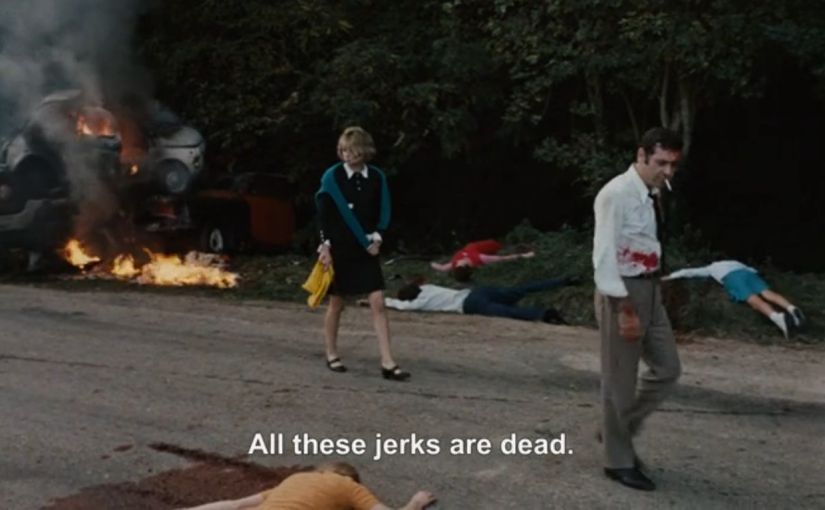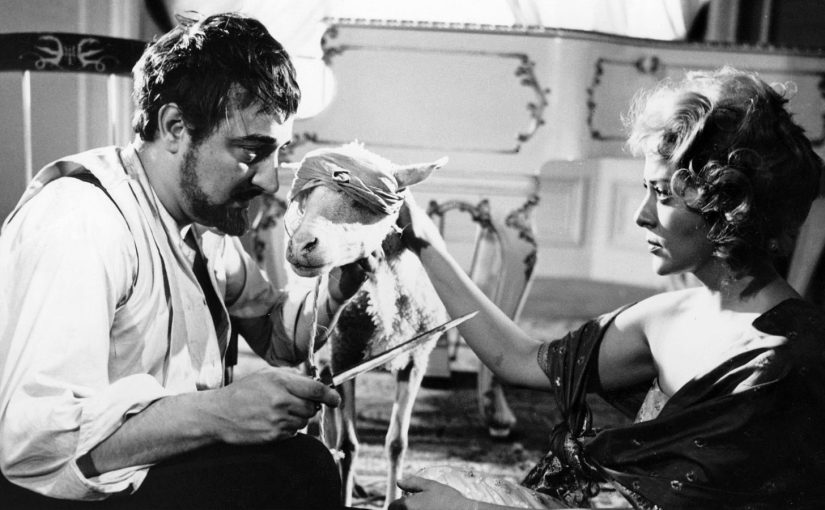
BLACK ORPHEUS (France, 1959)

by Miguel E. Rodriguez

DIRECTOR: Marcel Camus
CAST: Breno Mello, Marpessa Dawn, Lourdes de Oliveira
MY RATING: 8/10
ROTTEN TOMATOMETER: 88% Certified Fresh

PLOT: The Greek myth of Orpheus and Euridice is translated into a modern-day story (with an all-black cast) set in during Carnaval in Rio de Janeiro.


In the first two-thirds of Black Orpheus, there are scarcely more than 2 minutes strung together at a time without some kind of music or sound effects thumping away in the background.  This gives the film a subtle real-world backdrop, which is good, because Black Orpheus is a fantasy through and through.  Critics, now and at the time of its release, complained that French director Marcel Camus ignored the reality of the Brazilian favelas, or slums, in favor of depicting Rio as a non-stop party.  This is a valid point.  However, I believe that, in this movie, reality has no place.  This is a love story, a myth, a tragedy, and a travelogue all rolled into one.  Reality must take a back seat in movies like this.

(And, heck, somebody must have liked it because it won both the Palme d’Or at Cannes AND the Best Foreign Film Oscar that year, a rare feat.  True, there were extenuating circumstances [numerous French critics had problems with the emerging French New Wave], but let’s not turn this into a classroom, shall we?)

If you’re familiar with Greek mythology, then the plot of Black Orpheus is nothing new.  Orfeu (Breno Mello, a non-professional actor) is a streetcar conductor engaged to the sexy, vivacious Mira, but he is not exactly thrilled about it.  Meanwhile, Eurydice (Marpessa Dawn, who actually hailed from Pittsburgh, not Brazil) gets lost in the city on the way to visit her cousin, Serafina, who lives in a ramshackle favela neighborhood.  She asks Orfeu and his boss, Hermes, for directions, and for Orfeu it’s love at first sight.  The rest of the movie will involve Orfeu wooing Eurydice, who worries about a strange man who might be following her, while trying to ditch Mira, with Serafina’s help.  Also assisting Orfeu, while acting as a Greek chorus in miniature, are two street urchins, Benedito and Zeca, who envy Orfeu’s lovely guitar playing, which Orfeu claims is what makes the sun rise every morning.

Apart from the story itself, the things I noticed at the outset were the presence of riotous colors in the costumes and the Brazilian countryside, and the music.  Lots and LOTS of music, but not a great deal of songs.  Black Orpheus is billed as a musical, but I’d have to say it’s a quasi-musical.  In a standard musical, characters break out into song, and no one notices because otherwise we’d be watching a play.  In Black Orpheus, every song is diegetic…someone asks Orfeu to play a song on his guitar, for example, or the Carnaval participants sing a rousing song while on parade or at a huge dance.  And I want to mention again that, while Orfeu is singing a quiet song to Eurydice, the constant percussion of the Carnaval pulses behind it, completely at odds with his song.  You would think it would become a cacophony, but it doesn’t.  It makes his quiet song much quieter, which may sound counterintuitive, but it works.

The mythic tone of the story keeps the film from flying off into ridiculous territory amid all the revelry.  Without mythology, Black Orpheus would be a soap opera.  A pivotal scene occurs during a massive dance contest, as Eurydice has disguised herself as her cousin, Serafina, so Mira doesn’t recognize her.  But Mira sees through the disguise and threatens to kill Eurydice.  Mira chases her, and unseen by anyone else except Eurydice, a man dressed all in black wearing a skull mask follows them both.  This is Death.  Earlier he had nearly chased Eurydice off a cliff, but Orfeu had saved her.  “I am not in a hurry,” he said, “we shall meet soon.”  With that in mind, his presence during this second chase is tinged with suspense.  It’s a very Hitchcockian element, the threat of danger juxtaposed with a dance or a party.  Good stuff.

So, it’s fair to say I enjoyed this movie a little more than I expected to.  But the bonus features on the Blu-ray brought up an interesting point.  Detractors of the film pointed out that, despite taking place mostly in a slum, the actual reality of those slums (both then and now) is anything but festive, no matter how much bossa nova music you play or how many songs you sing.  It’s highly unlikely these people would have had the wherewithal to create such stylized, colorful costumes while having to deal with the reality of poverty, all while looking down the mountainside at the distant concrete high rises of the higher classes.

Does Black Orpheus ignore reality?  Well…yes, it does.  Myths, by definition, have little to do with reality in the first place.  Would it have been possible to tell this mythical story, retaining its coincidences and absurdities and supernatural elements [especially towards the end], while also keeping its feet firmly on the ground and making a socially conscious statement about the horrible living conditions in Brazil?

I don’t think so.  Or, if you did, it wouldn’t be held together very well.  Black Orpheus is simply re-telling a very, VERY old story and re-imagining it as if the Greek gods had lived atop Sugarloaf Mountain instead of Olympus.  When you start with that kind of premise, reality goes out the window.  You have to focus on the story’s emotional beats, the pleasant assault on the senses and, occasionally, logic.

This opens a whole separate argument: is it a film’s responsibility to BE authentic, or just to FEEL authentic?  For example, Titanic [1997] feels authentic to me, a layman, but I’m sure historians and other experts could point to any number of things that were simply not true in the film.  Fair enough, but that doesn’t affect my enjoyment of the film as it was presented to me.  It FELT authentic, and that’s enough for me.  The only way to make a movie like that 100% authentic would be to turn it into a documentary.

Black Orpheus FEELS emotionally authentic to me, a layman, who is not a social anthropologist.  I look at the colors and vibrancy on display, visually and in the story itself, and while a small part of me acknowledges, “This isn’t real life”, another part of me says, “Well, if I wanted real life, I wouldn’t be watching a movie, would I?”

DAS BOOT (GERMANY)

By Marc S. Sanders

Wolfgang Peterson demonstrated how much suspense he can squeeze out of the tightest of movies when he embarked on filming one of the most realistic and famous submarine movies of all time, Das Boot (translated as The Boat).

During World War II, a German U-Boat is assigned to carry out missions of war within the deep Atlantic.  The purpose is simply for attack and never to question motivations or reasons.  Because these Nazi sailors have no concept of the politics or the totalitarianism behind the Führer, it is not hard to empathize with their plights at sea.  Life on a submarine is no party.

The Captain of the vessel is played by Jürgen Prochnow, the only recognizable actor in the whole cast.  However, all of these men are working just to get by one more day within the very narrow confines of the sub.  In fact, the main character is the submarine.  Rarely has a setting been so evident.  I was told that Peterson used miniature cameras, rare for use in the late 1970s when the film was shot.  He would tightly hold the projector and pursue his cast of shipmates down one galley way after another.  He’d put the camera right up against their face and profiles.  The concentration of these actors to ignore the filming is astounding.  Wolfgang Peterson provides a very clear documentary style to the piece.  Herbert Grönemeyer portrays a war correspondent, easily used within the context of the story to accept Peterson’s approach of simply witnessing the activities and claustrophobia aboard a boat that is primarily under hundreds of feet of ocean water.

To my knowledge, Das Boot is a fictional story loosely based off of accounts from an actual military journalist who was aboard a similar cruiser during the war.  I suppose the film could have been told from an Allies perspective rather than the Axis German superpower.  However, the film works and as a viewer, as you become more engrossed in the picture, you become blinded to the fact that these men served Adolph Hitler.  There’s hardly a swastika in the film.  So, I’m seeing men like any other cadets and officers serving a military branch, working to survive while completing the assignments bestowed upon them.

The torment comes in all forms.  The controls are old and clunky.  It gets very dark at times.  The vessel does not move at a comfortably smooth pace.  They have no choice but to eat rotten food.  It is so bad that the bread turns blue or green.  The men are unbathed and you can practically smell the stench of their body odor and the raw sewage that remains behind.  Sleeping quarters are cramped and are never efficient.

There is such miniscule space available for these people to carry on. The top officers get their exclusive table, but they must get up and move out of the way during dinner, while seamen pass them by on their way to different stations.  Luxury is not afforded for anyone.  The beards of the men become longer.  Wolfgang Peterson shot the film in sequence to accurately show the progression of their beards.  It maintained proper continuity as their sojourn of the boat carried on. 

Most agonizing is when the submarine attacks back at the crew.  A long sequence of suspense occurs following a surprise attack from the air.  The boat has dive into the depths of the ocean, but their controls are malfunctioning and they just continue to sink and sink.  Nuts and bolts pop out of nowhere like ricocheting bullets as the water pressure gets heavier.  My car or my smart phone is more technologically developed and capable than this sub, and I question how this clunker can even withstand the compression.  To maintain balance and direction, the men have to race to the front or back of the ship applying their body weight to work like a scale. 

Imagine the boat coming to a rest on a rocky perch hundreds of feet deep underwater.  There is no propulsion or engine power.  No communications either and the crew has less than a few hours left to survive among the carbon monoxide flooding the ship.  It’s a helpless scenario and at multiple points during the movie, I was convinced this is how it will all end.  Often, I was prepared not to be surprised how this all wrapped up at any given period of time.  Das Boot is a long film. The special edition is over three and a half hours. So, you get a vibe of how stretched out this crew has been away, cramped in these quarters.  Because Peterson stages these challenging scenarios to be extensive, you easily relate to the stress of these men. 

War is hell, even for the Nazis.  The Captain agonizes over a successful attack he’s accomplished when he takes out an American naval destroyer.  He’s done his job well, but he’s angered as he witnesses the aftermath through his binoculars.  Crewmen are set ablaze as they fall off the ship and into water below, and he wonders where the rest of their convoy has gone.  Shouldn’t they be rescuing their men?  This Captain is not a Nazi.  He’s a pawn on a chess board, not assigned to think of the fallen, but rather to do what he is told, absent of questions or emotions.

I do not want to spoil the ending but I cannot recall feeling so much anguish for a collection of Nazi officers before.  Another submarine movie was bold enough to say that the only true enemy in war is war itself and having watched Das Boot, I can clearly see the meaning behind that perspective.  This is not a war picture where one side torments and personally tortures individuals before brutally killing them with gunshots to the head.  In a submarine, the crew is somewhat blind to what they must attack. They are only aware of the environment that troubles them. The men of Das Boot don’t curse the Americans or the British, or the Jews.  They show no prejudice.  That’s not their mentality.

When I see them overcome one daunting challenge after another, I’m relieved for these Germans.  They survived.  They made it. 

However, after watching for over three and a half hours, the final sequence and frame send me a cold, all to real reminder of what occurred during that terrible world war less than eighty years ago and it the film’s ending is the only way this picture could have ended.

Das Boot is a masterpiece of filmmaking.

UMBERTO D. (Italy, 1952)

by Miguel E. Rodriguez

DIRECTOR: Vittorio De Sica
CAST: Carlo Battisti, Maria Pia Casilio, Lina Gennari
MY RATING: 8/10
ROTTEN TOMATOMETER: 98% Certified Fresh

PLOT: An elderly man and his beloved pet dog struggle to survive on his government pension in Rome.


The greatness of Vittorio De Sica’s Umberto D. is something I was only able to appreciate after it was over.  As the film plays out, I was waiting for something more to happen, something to add to the paper-thin plot of an elderly man struggling to make ends meet in a city whose government has forsaken him and thousands or millions like him.  When the screen faded to black at the end, my first thought was, “That’s it???  Well, what happens next?”  The fact that the film prompted me, not only to ask the question, but to attempt to come up with an answer, is probably one of the reasons why this film is widely regarded as a classic.  Not many films can claim to keep the story running forward in your head after it’s over.

Umberto Domenico Ferrari is an elderly man living in post-war Rome.  The film opens with him joining a crowd protesting the city government’s policy of cutting their pensions.  Umberto is in dire straits.  He’s behind on his rent, low on cash, his landlady threatens eviction, and he must somehow still feed his beloved dog, Flike (rhymes with “like”).  The film will follow Umberto’s tribulations over the course of several days as he berates his landlady, tries to get some cash by selling some of his books and other possessions, dines at a soup kitchen while furtively feeding scraps to Flike, and befriends the young maid in his building who has problems of her own.

Umberto D. is as good an example as any, and better than most, of Italian post-war neo-realism, a cinematic movement in which Italian film directors aimed to paint the silver screen with portraits of everyday life in their country, which was wracked with poverty and unemployment at the time.  Rather than provide an escape from such hardships, these directors felt it was their civic duty to bring the everyman (or everywoman) into the spotlight, to remind the audience that movies could be more than escapist entertainment.  They felt obliged to say, “There are more stories of despair and hardship ten feet out your front door than can be imagined by any Hollywood screenwriter.”

There are pros and cons to this approach, at least in my opinion.  On one hand, the neo-realist movement created such immortal classics as La strada [1954], Bicycle Thieves [1948, also directed by De Sica], and a little later, Rocco and His Brothers [1960]; these are films that have stood the test of time and will continue to do so for decades to come.

On the other hand, a quote from Roger Ebert comes to mind: “A man goes to the movies; the critic must admit that he is this man.”  In other words, learn to say exactly what you think about a film as opposed to what you think you should think.  And when it comes to Italian neo-realism, I’ll say this: give me a choice between a De Sica retrospective and a Christopher Nolan marathon, and it’s the Nolan marathon seven days a week and twice on Sunday.  Yes, I am aware of the place that neo-realism films have in cinematic history, and I can appreciate their greatness on a cerebral level.  However, on a gut level, I can usually only watch them once or twice, with very few exceptions.  La strada, for example, is heart-wrenching, but in such a way that I want to revisit it just to relive those emotional gut-punches at the end.

Umberto D. didn’t quite deliver those gut-punches, at least not during its running time.  …okay, there IS a moment when Flike runs away, and the possibility arises that he may or may not have been put down by the local pound.  There is a cringe-inducing scene when we watch hardened men roll a cage full of stray dogs into a large box where the dogs will be gassed; we are spared the sight of the actual procedure, but we see enough of it to get the picture.  Umberto watches the box with fear in his eyes.  Another man wants to retrieve his captured pet, but he falters when he lacks the money to pay for his return.  The look on his face as he repeatedly asks, “So, if I don’t take him, you’ll kill him?”  THAT is a scene where my emotional juices where stirred up.

(Okay, there is ONE other scene that got me a little riled up emotionally, but it happens near the film’s climax, so I can’t describe it without spoiling something.)

Aside from those very rare moments of heightened emotion, the film is mostly pedestrian, giving us more details of Umberto’s daily life as he tries and tries to find a way to get enough cash to pay his rent.  In one pathetic scene, he debates whether he should resort to panhandling like so many other men he sees on the streets.  At first, he tries it himself, practicing holding out his hand on a street corner, but when someone actually turns to give him some money, Umberto pretends he was just stretching – he just can’t bring himself to accept handouts from a stranger.  He tries to enlist Flike instead, getting him to hold his hat while sitting on his hind legs, but that doesn’t work out either.  He reaches out to former friends, to no avail.

As I’ve said before, DURING the film, these scenes, and others like them, didn’t stir me up the way I felt the director was shooting for.  It was only afterwards that I found myself pondering those scenes and Umberto’s actions.  I used to own a dog, a very long time ago.  If my dog were my only remaining connection, with no family or friends to reach out to in times of need, how would I feel if I learned he might have been captured and put down?  If I suddenly had no means of income, no way to pay the rent/mortgage/whatever, and nowhere to go if I got kicked out of my apartment/house/whatever, how would I manage?  Would I manage?  Late in the film, Umberto makes a couple of hard choices.  Would I make the same choices in his position?

As FINE appears on the screen, Umberto D. invites us to wonder about Umberto’s fate.  The last scene is, on the surface, a happy one, but somber music plays over it, and the scene does not address or solve Umberto’s situation.  This is in the neo-realist tradition.  If De Sica were asked, “But what happened to him at the end?”, I can imagine him saying, “The same thing that happens to all such men.”  If he was told, “But I don’t know what happens to such men,” De Sica might say, “Well, now you have something to think about.”  Q.E.D.

[Trivia: The lead actor, Carlo Battisti, was not a professional actor, but a professor of linguistics. Umberto D. would be his only film, and not many people can claim that kind of legacy with just one film.]

TWO PEOPLE EXCHANGING SALIVA (FRANCE)

By Marc S. Sanders

For a short film with a running time of only thirty-five minutes, Two People Exchanging Saliva (aka DEUX PERSONNES ÉCHANGEANT DE LA SALIVE) offers a lot to tell within its absurdist universe thanks to writers/directors Natalie Musteata and Alexandre Singh.  Reflecting on the film, which I saw during the After Dark collection of shorts at the 2024 AFI Film Festival, my list of imagery grows longer and longer and I am grateful for it.  There’s much to remember, even nearly a full week after seeing the film.

Shot within a department store located off the Champs-Élysées within the heart of Paris, the film is a gorgeous black and white presentation with striking lighting to illuminate a wide collection of settings.  Shoe racks never looked so ethereal.  A staircase leading upward feels very curious.  Piles of cardboard boxes feels terrifying before I even know what they are to personify.  Yet, the oddities that Musteata and Singh introduce are what tempts you to learn more about the rules they have set up for this fictional cosmos.

Malaise (Luàna Bajrami) is a salesperson at this store and like the rest of the staff, she must exhale her breath directly into the nose of a security guard before starting her shift.  She is suppressed by a domineering supervisor, Pétulante (Aurélie Boquien).  It cannot be more apparent that Pétulante feels threatened by her best customer’s favorability for Malaise.  That customer is Angine (Zar Amir Ebrahimi).  Among these three ladies, this comes off like a common soap opera love triangle that has been seen many times before.  Yet, the writers/directors throw some spice at this centerpiece.

Within this world, kissing is outlawed, punishable by death.  Hence the necessary requirement for a breath smell.  Ingest some garlic or other reprehensible aromatic food to divert any temptation from breaking the law.  Furthermore, products are sold at a cost of slaps to the face.  Several players exhibit the scabs and bruises, as well as nosebleeds, that evidence their purchases.  Looking at Angine it’s easy to see she is certainly a high-priced shopper.

With these set ups in place, the story can take off and rely on bold imagery.  We witness Malaise’s fear of what can happen if she commits to her attraction for Angine when the apparent crime of kissing occurs within the store.  We fear that Pétulante will pounce on prohibitive kissing in order to win her prized client back while getting her underling, Malaise, permanently out of the picture.  We see the great lengths of tormented slapping Angine endures in order to have another shopping experience with the innocent Malaise. 

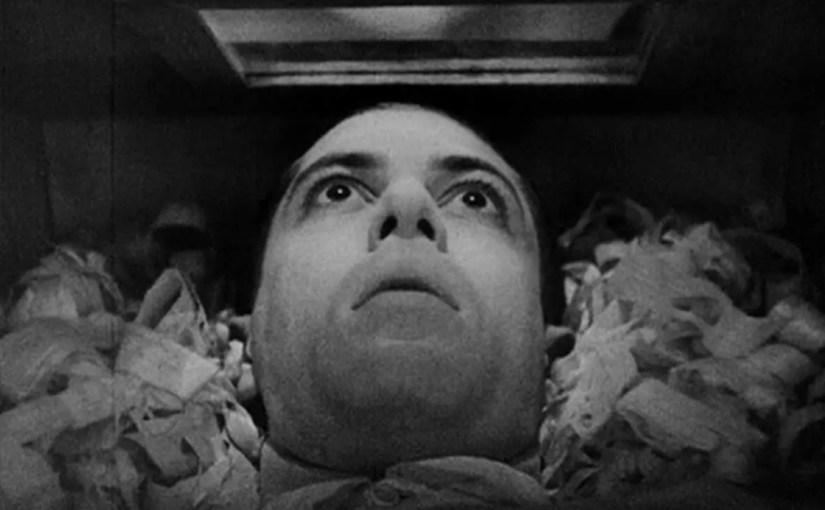
The film serves reminders of the nature of punishment if a kiss is committed between two people.  The criminals are literally boxed up and disposed in a junk heap of other boxes that encase people just like them.  Musteata and Singh’s most powerful shots are of this pile of boxes dumped into a landfill toppling one over the other.  It’s like something from George A Romero film, like Night Of The Living Dead.  No big effects here.  Nothing that looks like a large expense beyond collecting a enormous supply of cardboard boxes.  Yet, when piled together in an outdoor area under the shine of their black and white cinematography from Alexandra de Saint Blanquat, it’s terribly haunting.

My wife and I got to speak with Natalie Musteata and Alexandre Singh on a few occasions during the 2024 AFI Film Festival.  They explained how the idea of this dystopian universe came to them while quarantining in their New York home during Covid.  They went through the steps of obtaining financial backing and they discovered that it would be more cost effective to shoot the picture in France than in the United States.  As well, they had access to a department store in Paris after it had closed for the night.  They went through the process of setting their scenes, rehearsing their actors, coordinating lighting and camera positioning within the few hours available to them before sunrise when the store would reopen.  Listening to them, I could envision the tight scheduling pressures they must have experienced in making this film.

I also find it interesting that they assembled this film during Covid. Simply shaking hands with others was highly discouraged to avoid a spread of disease. Highly charged debates on reproductive rights are so prominent right now too.  In Two People Exchanging Saliva, it’s not hand shaking that is impermissible, it’s something much worse, but also more intimate – kissing.  As well, in order to live off of materialism, one must fall victim to an abuse of their bodies, and they have the marks to show for it just beneath their eyes and across their profiles.  In this world, people are limited and exposed to the will of a domineering enforcement.  I salute the allegories found in the short film.  It may sound silly on the surface.  Natalie and Alex even laughed while explaining the plot of their film before we had a chance to see it.  Still, it is not altogether farfetched.  When can we live truly independently without a threat of punishment, when all we want is a will to live and love with one another?

Two People Exchanging Saliva was the winner of the Grand Jury Prize at the 2024 AFI Film Festival, and I could not be happier for the filmmakers’ accolades.  It’s worthy of its merits.  If you can find this outstanding short film I highly encourage you to take a little over a half hour out of your day to experience something entirely unique, while beautifully presented. 

Seek out your local art houses for a film short festival coming soon.  Two People Exchanging Saliva should be included in any collection that’s being offered.  Now I’m hoping an Oscar nomination is on the horizon for Natalie and Alex.  Bon Chance!!!!

UNIVERSAL LANGUAGE (FRENCH/PERSIAN)

By Marc S. Sanders

Writer/Director Matthew Rankin’s Universal Language is the selected Canadian submission for the 2024 Academy Awards consideration in the category of Best Foreign Language Film.  Though the picture was shot on location in Quebec and Winnipeg, many of the characters are of Persian heritage in this absurdist piece that moves along three different trajectories before they all collide with one another.

I had the opportunity to see Universal Language at the 2024 AFI Film Festival. Rankin, who also leads one of the storylines, opens the film with brilliant comedy as an eighth-grade classroom of unruly children are quickly silenced by an angry teacher who blames his students for his own tardiness and then unleashes on a latecomer who is unable to read the blackboard because a turkey has supposedly run off with his eyeglasses.  The child sincerely stands by this excuse.  The humor of this introductory scene, which I only wish could have gone longer, relies on the outrageous over the top temper of the teacher and the melancholy response from the students.  None of them seem to fear this guy.  One of them is even daring enough to dress like his idol Groucho Marx complete with a prop cigar and the mannerisms, as he aspires to become a comedian.  The teacher wraps up his frustration by sentencing the whole classroom to stand in the tiny closet at the back of the classroom until the boy is able to obtain a new pair of eyeglasses or at least gives up on his silly turkey story.

One classmate, Negin, and her sister Nazgol take the long walk home through the snow-covered paths and come upon a five hundred dollar Rubie bill that is buried under the ice.  There is no way to get it out, but if they do, they can use the money to buy their classmate a new pair of glasses, and thus class can resume and they will be free of their closet detention.  They’ll need something sharp to crack the ice like an axe, and so a search begins.

Elsewhere, Matthew (Matthew Rankin) quits his job with the Quebec government in possibly one of the funniest “I quit” scenes since Albert Brooks angrily stormed out of his boss’ office in Lost In America.  Neither scene from each movie are remotely similar, but they are terribly hilarious.  Rankin is so hilariously smart when he cuts from his perspective to that of the supervisor and the joke delivers on what is mounted on the background walls that mirror the greenish drab room.  For an accompanying soundtrack, there is poor schlub hysterically crying within a cubicle.  It’s the second of a series of great scenes within this picture.  Anyway, Matthew opts to purchase a large bottle of sleeping pills, dispose of his wallet, passport and keys and board a bus to visit his mother who he has not seen for several years.  Unexpected circumstances take place as this scenario moves forward.

Lastly, there is Massoud who is a tourist leader escorting a group on the most mundane and sublime journey through the locales of Quebec, such as a small patch of grass in the middle of a highway exit fork in the road.  He encourages his group to stand for a thirty-minute moment of silence in front of a cemetery that is wedged within this area.  Traffic speeds on by though. 

Universal Language might have been a dystopian kind of setting in another filmmaker’s hands.  However, Matthew Rankin prefers to draw inspiration from his own upbringing within Quebec and Winnipeg where the buildings are drab earthtones of tan, gray and brown, outlined in white from the snowfall that doesn’t seem to melt or the cold that never rises to a warmer temperature.  I had a brief moment to speak with Mr. Rankin following the film, using my limited knowledge of French and then English. He told me that he has a deep appreciation for this kind of appearance that the Canadian towns offer.  When I was in Quebec earlier this year, I witnessed the exact opposite actually, a town full of vibrancy and color. 

Fortunately, Rankin found a story of absurdist, sometimes subtle, humor to emote the dullness of these people’s lives.  People don’t really live like this, do they?  Universal Language makes a convincing argument.  So, I can’t be sure. 

First Rankin and his cinematographer were wise to shoot the picture on what seems like 16mm film which adds a noticeably grainy layer to the picture.  Rainbows and bright sunlight are not what delivers cheer to these people, and this looks like a movie you would find on your grandmother’s Zenith TV set from the 1970s.  Then, there is an acceptance to how Massoud and the two sisters, Nagin and Nazgol, live within this realm where a Persian governance has taken over a Canadian province.  No one complains or revolts, but there is no chance for a life of luxury among these inhabitants, only acceptance. 

When the three stories finally intersect there is a realization to how they move on beyond the confinements of the film.  Turkeys abound, the money is recovered, only to take on a new destiny.  Something becomes of the missing eyeglasses and Matthew encounters a new development when he arrives at his childhood home. 

Universal Language sort of works like three bedtime stories rolled into one.  There are visual symbols and props to consider in addition to the principal players.  Most significant to me is the fact that I do not believe there is one solitary answer or point that Rankin’s film offers.  Much of the picture is left up to each individual viewer’s interpretation.  For example, while my wife and I strongly appreciate the movie, we still had very different perceptions of the film’s conclusions in relation to the building storylines.

A film that is titled Universal Language only welcomes open minded discussion. 

MEPHISTO (Hungary, 1981)

by Miguel E. Rodriguez

DIRECTOR: István Szabó
CAST: Klaus Maria Brandauer, Rolf Hoppe, György Cserhalmi, Karin Boyd
MY RATING: 9/10
ROTTEN TOMATOMETER: 80% Fresh

PLOT: In early-1930s Germany, a passionate, prominent stage actor must choose between an alliance with the emerging Nazi party or a life of obscurity in exile.

[Author’s note: this is another in a series of movies I’ve watched lately whose subject matters have intimidated me.  There are topics at play in Mephisto that are beyond my ability to analyze in coherent prose.  I must advise you, this is a BRILLIANT film, even if my review below does not convey that fact…]


Watching Mephisto reminded me of the early days of Covid-19.  As the infection spread and restaurants and other businesses voluntarily closed their doors, I was still naively hopeful that it would all just go away.  A friend asked me, “When will you take this seriously?”  I blithely said, “When all the McDonald’s restaurants close, that’s when I’ll know there’s a problem.”  Not long afterwards, that’s exactly what happened.  Then I was indefinitely “furloughed” from my job, and soon after that, the government shutdown occurred.  In hindsight, I was foolish.  The signs were all there.  Had I paid more attention, I might have been better prepared for the stressful days that followed.

This situation is echoed in director István Szabó’s Mephisto, the first Hungarian film to win the Academy Award for Best Foreign Film.  Mephisto tells the story of a popular actor in 1930s Germany, shortly before and after Hitler rose to power.  Hendrik Höfgen (Klaus Maria Brandauer) is a hot-headed, passionate stage actor who throws himself into his performances with abandon.  We watch him evolve from an actor/director to the leading force behind a “revolutionary” theater company that exhorts its audience to acknowledge the plight of the everyman in their society.  He marries (for money more than anything else), but keeps a mistress on the side, a black German woman named Juliette Martens (Karin Boyd) who doubles as his private dance instructor.  He rails at his wife for riding horses before breakfast – the ultimate in bourgeois behavior – but engages in frantic frolicking with his mistress between dance lessons.

Brandauer plays Hendrik as a man who only feels like himself when he’s pretending to be someone else.  Onstage or when directing his cast, he’s filled with boundless energy, dancing with the chorus line or leaping across the stage with abandon.  Offstage, he is quiet and self-effacing, unless he’s socializing with other cast members.  Mention is made several times of his “limp” handshake, a direct contradiction to the strong characters he portrays, especially his most famous role: Mephistopheles in Faust, a role that brings him even more fame and prominence within the theater community.  The imagery of Hendrik is striking: He covers his face in white makeup like a kabuki player with sharply angled black eyebrows and red lips, the ultimate in being able to disappear inside a character.

But something is happening in the background that Hendrik is reluctant to acknowledge.  A fellow cast member almost gets into a fistfight with him when he criticizes another actress because of her associations with a member of the Nazi party.  His wife warns him about the dangers presented by this man who was just elected Chancellor.  [Interestingly, the name of Adolf Hitler is never once mentioned onscreen.]  She tells Hendrik that many of his friends are leaving Germany, fearing for their livelihoods, if not their lives.  But Hendrik refuses to panic:

“There is still the opposition, no?  They’ll make sure he doesn’t get too big for his boots.  And even if the Nazis stay in power, why should it concern me? … On top of that, I’m an actor, no?  I go to the theater, play my parts, then go back home.  That’s all. … I’m an actor.  You can design sets anywhere or buy antiques.  But I need the German language!  I need the motherland, don’t you see?”

Hendrik is so wrapped up in his profession that he simply cannot accept the fact that his freedoms are about to come crashing down around him.  He would rather formulate a far-fetched scenario based on nothing but hope so he can just stay where he is and keep performing.

(I have to be honest: when we took our first steps out of the Covid lockdown, I felt the same way.  Local theaters announced auditions for shows again, and I assured myself and my girlfriend that I would take the utmost precautions and wear masks at rehearsals and disinfect and wash my hands and I wouldn’t get sick.  And, of course, I eventually got sick.  I recovered, but you can probably imagine my disbelief when I tested positive that first time.  “ME?  But I was so careful!”)

Hendrik stays in Germany.  His wife moves to Paris.  Fellow actors either disappear outright or are arrested by the Gestapo in full view.  Hendrik accepts an offer to direct the official state theater, despite his past affiliations with liberal/Bolshevik causes, because of his prestige in the theater world.  A character known only as the General (probably intended to be Hermann Göring) gives him his marching orders as theater director.  He witnesses several Nazis beating a man on the street and walks in the other direction…best not to get involved.

So, what we have here is an actor willing to trade away his soul and his conscience in exchange for the opportunity to remain in the limelight, performing as Mephisto or Hamlet.  The metaphor is not exactly subtle, but director Szabó manages to land the message in such a way that it never feels like preaching.  It’s a masterpiece of storytelling that lands somewhere between satire and Kafka.

An especially telling scene has Hendrik explaining to an attentive crowd of Nazi journalists that his production of Hamlet will portray the lead character as “a hard man…an energetic, resolute hero”, rather than as a neurotic, “pathetic” revolutionary.  Hendrik tells them exactly what they want to hear so he can stay in the limelight.  He’s made his own deal with the devil.  I will not reveal whether Hendrik’s bill comes due during the film, but I will say the finale evokes the landmark documentaries of Leni Riefenstahl.  I’ll leave it at that.

As I said, watching the film reminded me of the Covid lockdown…but it also made me think about all those many, many times in the past that actors and other celebrities have been criticized for voicing their political opinions in public.  “Shut up and play/act!” is the usual cry.  Many people would prefer their favorite actors to behave more like Hendrik: just keep your head down and let everything blow over, don’t make waves, it’s not your place, etcetera, etcetera.  Mephisto argues that keeping silent in the face of injustice or tyranny is not an option, especially not for people in the spotlight.  Those who do so risk suffering Faust’s fate.  Or Hendrik’s, whose last words in the film are brilliantly contradictory.

THE SORROW AND THE PITY (Switzerland, 1969)

by Miguel E. Rodriguez

DIRECTOR: Marcel Ophüls
MY RATING: 8/10
ROTTEN TOMATOMETER: 100% Fresh

PLOT: An in-depth exploration of the various reactions by the French people to the Vichy government’s acceptance of the German invasion.


When writing this review, I initially tried to provide a background to the film’s topic, attempting to summarize what Vichy France was, who General Petain was, and how bitterly French resistance fighters resented Petain and others who believed that acquiescence to the conquering German army was key to survival and avoiding further destruction.  That attempt at a “brief” summary ran to two full pages.  So, rather than teach a history lesson, I thought it better to just review the film and assume that readers will have an even better grasp of history than I do.  So here goes.

My enthusiasm for The Sorrow and the Pity, another sprawling film from documentarian Marcel Ophüls, is tempered slightly by my tenuous grasp of French history during World War II, and by the fact that, at least at FIRST, I did not feel I could pass judgement on the people involved.  One English interviewee says exactly that, in response to a question about whether he felt Petain’s life sentence after the French Liberation was unfair: “It is not my place to judge whether or not people’s anger was justified.  We haven’t been through it, so we cannot say.”

After watching the complete film, I have changed my tune a bit.  Under Petain’s leadership, Vichy France did indeed escape total destruction, but since they were essentially under German rule, they did end up deporting approximately 76,000 Jews to concentration camps during World War II.  Only a small percentage survived.  French Resistance fighters attacked when and where they could with immense dedication, believing it was better to fight and die than to live under the thumb of Nazi Germany.  Pro-Vichy Frenchmen denounced anyone they believed was a member of the Resistance.  In the documentary, the bitterness felt by surviving Resistance fighters towards surviving collaborators is palpable.

This documentary was (I believe) the first from a French filmmaker to openly discuss, on a world stage, the conflict between the Resistance and the collaborators.  Up to that time, it had been a virtually taboo subject, something swept under the rug or kept in the basement.  The attitude was one of, “Why bring up such a painful subject?  Why go over something so historically embarrassing?  Let’s just move on.”  This attitude reminds me of the thinking behind those who are in favor of redacting your kid’s history textbook or banning certain books from the school library.  The people interviewed in the film – people on both sides of the debate, mind you – demonstrate clearly that a national policy of polite silence on the matter is unacceptable.

In this way, The Sorrow and the Pity functions less as a film, an entertainment, and more like a historical record, the kind of thing you might see at a museum or on a college campus as part of a homework assignment.  I can’t promise watching this film will be as gripping as a typical Hollywood war film, but I can say I was never bored during the film’s running time.  I found myself intrigued by the fact this film was released in 1969, just 25 years after the end of the war in Europe, so the people appearing in the film were not just experts or college professors.  They literally lived through the events they were discussing.

A woman who sided with Petain was tortured by Resistance fighters after the Liberation; she still holds to her belief that Petain was a good man.  A Resistance member who was denounced and sent to prison returns and is told by a friend that he knows who denounced him and he will avenge him with a nod of the head.  The man refuses to allow that to happen, even though he knows who the denouncer was; in fact, he still lives around the corner from him.  “It’s something you can’t forget.  But what can you do?”

A former Nazi soldier is interviewed at his daughter’s wedding reception.  (I would LOVE to hear how Ophüls managed to wrangle this particular interview.)  Ophüls asks why he still wears his military medals when many Germans refuse to wear them because they were awarded by a Nazi state.  The former soldier says the only people made uncomfortable by them are men and women who never fought.

Another former soldier (now apparently a waiter in a pub) makes this startling statement: “We’re not stupider than anyone else, and yet we lost the war.  Nowadays we have to wonder if we’re not better off like this.  After all, if we had won, Hitler may have continued, and where would that leave us today?  Perhaps we’d be occupying some country in Africa…or America.”  It’s hard to tell whether his statement is remorseful, grateful, or wistful.

The Sorrow and the Pity is a remarkable record of a time when a nation had to choose between subservience or resistance.  That some chose resistance is not hard to fathom for Americans, whose existence is founded on resistance to tyranny.  That some chose to collaborate is perhaps unthinkable, but if I look inward, can I say with certainty I would have chosen differently?  I’d like to think so.  I hope so.

Just recently I was looking at a bookstore’s window display with a “banned books” shelf filled with novels that have recently been banned by school libraries in several states.  A woman walked by, noticed the display, and said as she walked away, “This store is degenerate.  I can’t believe they’re glamorizing this shit.”  I found myself wondering how many of those volumes she had read herself.  I wondered which side she would have taken in France when Nazi policies banned certain texts.  It never occurred to me to start an argument with her right there in the street.  Will there come a time in this country when it becomes our duty to openly oppose those who support totalitarian policies?  I don’t know, I’m not a political Nostradamus.  But The Sorrow and the Pity argues that, if that time does come, sitting on the fence should not be an option.  And the world will not soon forget those on the wrong side of history.

THE BLUE ANGEL (Germany, 1930)

by Miguel E. Rodriguez

DIRECTOR: Josef von Sternberg
CAST: Emil Jannings, Marlene Dietrich, Kurt Gerron, Rosa Valetti
MY RATING: 10/10
ROTTEN TOMATOMETER: 96% Certified Fresh

PLOT: An elderly professor’s ordered life spins dangerously out of control when he falls for a nightclub singer.


There are so many things I admire about The Blue Angel that I hardly know where to begin.  The cinematography, the story, the acting, the unbearably tragic arc, the dichotomy of the main character, the debut performance of Marlene Dietrich…just ridiculously top notch all around.  The final 20 minutes or so of the film are so searingly tragic and raw that there were times when I wanted to look away, not out of disgust, but out of social embarrassment.  I’m fully aware of Emil Jannings’s Nazi sympathies, but love him or hate him, this is one of the greatest performances I’ve seen from any film of this period.

[Fair warning, I’m about to really run off at the mouth about this one, so make yourselves comfortable.]

Jannings plays Professor Immanuel Rath, a fussy, stuffy little man who teaches at a local school in Germany somewhere around 1924.  Director von Sternberg directs Rath’s introductory scenes almost as if he were using sound only reluctantly.  With a bare minimum of dialogue, we watch Rath’s morning process as he prepares his clothes just so, eats his breakfast just so, carries his books just so, and arrives at his classroom like Gandalf: never late, never early, but precisely when he means to.  His upper-high school students, all male, respect him just enough to stand at attention upon his arrival, but are rebellious enough to write graffiti on his notebooks, turning his name from “Rath” to the German word for “trash.”

One day, he discovers that several of his male students are in possession of scandalous little postcards picturing a sensuous burlesque performer whose lower regions are covered by a little tuft of actual feathers pasted onto the card.  Blow on the card just right, and her little feather skirt rises to reveal – well, nothing terribly scandalous by today’s standards, but certainly not family friendly in 1924.  Rath is incensed.  How dare these students profane their minds with such affronts to decency?  (We get a brief glimpse of his hypocrisy as he experiments with the feather skirt himself when no one is watching.)

Rath discovers that some of his students have been frequenting a burlesque house called The Blue Angel to see the girl on the postcard.  Her name is Lola Lola, portrayed by Marlene Dietrich in the role that made her a star.  It’s all here: the skimpy outfits, those long legs, the pouty face, sitting backwards on a chair, and the singing voice that eventually led to concert hall appearances in later years when her acting career waned.

Enraged by the thought of his students attending something as inappropriate as a burlesque show, Rath storms to the Blue Angel that very night to try to catch them red-handed.  All his wrath evaporates, though, when he spies Lola in the flesh while she performs.  From that moment, he is doomed.  He winds up in Lola’s dressing room where Lola, seasoned performer that she is, treats him as if he were a rich patron, showering him with compliments and, daringly, gifting him with a pair of her underpants.  Talk about chutzpah.

Predictably, Rath’s students see him at the Blue Angel, and his authority in his classroom starts to wane.  He returns there to give Lola’s underwear back, winds up in a box seat, and watches as she trills the song (in German) “Falling in Love Again.”  She sings directly to him.  He is smitten.  He drunkenly stays the night in her boudoir (nothing happens) and is late to school the next day.  At this point his authority over his students utterly vanishes, he announces his plans to propose to Lola, and his superior essentially fires him from his post.

It’s here where we get one of the first real masterstrokes in von Sternberg’s direction.  Rath carefully empties his desk drawer, fussy as always, picks up a few books, stands, and then slowly looks over the empty classroom.  As he stands, the camera slowly dollies back away from him, increasing our awareness of how large the empty room is, and putting a visual exclamation point on just how momentous his decision is.  He’s throwing away his vocation, everything he’s ever known, and perhaps there’s a moment during this camera move when he is thinking to himself, “What the hell am I doing?”  I’m not doing it justice verbally, but it’s a sensational moment, reminding me of the famous moment in Taxi Driver when Scorsese’s camera tactfully dollies off Travis Bickle during an embarrassing phone call.

The second half of the film involves Rath’s rash proposal to Lola, her improbable acceptance, and his slow inevitable decline.  Up to now, von Sternberg’s direction has been impeccable, using dialogue only when necessary, relying on Emil Jannings’s imposing presence and impressive non-verbal acting, and on Marlene Dietrich’s inimitable beauty and sensuality to underscore their scenes together.  Now, in the tragic second half, von Sternberg REALLY impresses.

Without going into too much detail (you deserve to be as wowed by this movie as I was), let me just list some moments that stood out to me, moments that felt as fresh and moving as any other movie I can think of.

THE WEDDING RECEPTION: At Rath and Lola’s reception, a magician conjures eggs from under Rath’s nose.  The kittenish Lola playfully clucks like a hen.  Rath, besotted beyond reason, smiles and crows like a rooster.  The sight of him making such a ridiculous noise filled me with unease, a reaction I am still unable to completely unpack.  Did I feel sorry for Rath?  Maybe, but why?  He has brought this on himself.  Lola isn’t to blame for his unseemly behavior, though it is all too easy to see how she could be seen as the “villain” of the film.  That is wrongheaded, in my opinion.  If there is a villain in the movie, a person who brings about every bad thing that happens to Rath, it’s Rath himself.

THE EDITING: At one point, Rath discovers that Lola still carries large numbers of those feathery postcards to sell at her performances.  He is adamant: “While I have a penny to my name, you will never sell another one of these postcards!”  Lola’s response is simple, but both wise and somehow chilling: “Well, bring them with us anyway…you never know.”  The camera fades out, and in the very next scene, Rath is sitting at a table, watching Lola perform, and as her song ends, he carefully gathers up the postcards before him and goes table to table, hawking them.  With one single edit, von Sternberg captures not only how wrong Rath was, but also how quickly he has fallen from a place of petty pride to a lowly peddler.  The effect was startling and disheartening at the same time.

THE CALENDAR: Lola is preparing for another performance.  Rath is helping her with a primitive curling iron, but she complains that it’s too hot.  To cool it down, Rath turns to a small day-to-day calendar on the wall, pulls a sheet off, and touches it to the iron to, I guess, burn off some of the heat.  One isn’t enough, so he pulls another sheet off.  We watch as the calendar’s sheets disappear one by one, then in a montage of burning sheets and curling irons as March turns to April turns to November turns to December, and quick as a flash it’s suddenly 1930…four years later.  This astonishing sequence has as much impact as that moment in Cast Away when we fade out on Tom Hanks in the cave and fade back in with the title card FOUR YEARS LATER.

THE FINALE: Wow, I’m really going to have to tread carefully here, but the last 15-20 minutes seal the deal and make The Blue Angel one of the greatest classic films I’ve ever seen.  There is enough heartbreaking pathos and awkwardness and humiliation to satisfy any fan of melodrama.  It’s practically operatic, right down to the image of an anguished clown (long story, watch the movie and see what I mean).  Rath’s rooster crows make an encore appearance, but the circumstances under which he makes those noises are just…I’m having trouble finding the right words.  It’s genuinely hard to watch.  Lola’s portion of responsibility in this sequence is undeniable, but honestly, it’s like that fable about the scorpion and the frog that ends with, “What’d you expect me to do?  I’m a scorpion.”  She is no more evil or immoral than a shark or an earthquake.  In the end, Rath’s hypocrisy and intolerance are rewarded with a comeuppance that is richly deserved, but also pathetic and pitiful, in the most literal sense of those words.

The Blue Angel is one of the most uncompromising depictions of a tragic arc that I’ve ever seen, but it also manages to make the tragic figure inexplicably sympathetic, despite his hypocrisy.  It is achingly, wonderfully sad and melodramatic and heartbreaking, tempered by the occasional song from Marlene Dietrich as well as just being able to gaze upon her from time to time.  Watching it for the first time is an experience I will not soon forget.  I hope I haven’t spoiled too much of it for you if you’ve never seen it, either.  If you haven’t, I urge you to seek it out immediately.  (The German version whenever possible…I’ve seen clips of the English version, and it simply does not carry the same weight as the German version.)

MAN WITH A MOVIE CAMERA (Soviet Union, 1929)

by Miguel E. Rodriguez

DIRECTOR: Dziga Vertov
CAST: Mikhael Kaufman, Elizaveta Svilova
MY RATING: 9/10
ROTTEN TOMATOMETER: 98% Certified Fresh

PLOT: This highly influential quasi-documentary captures a day in the life of a Russian city, as well as the cameraman doing the filming.


Film scholars more highly educated than I may be able to dispute this, but I think Man with a Movie Camera qualifies as the most “meta” film ever made: a movie about the making of itself.  Filmmaker Dziga Vertov, who cut his teeth on Soviet newsreels, cobbled together three years of footage of everyday life in Moscow and condensed it into a 68-minute quasi-documentary/newsreel that acts as a virtual wormhole into the past, revealing people and activities and life that is not that far removed from our own experiences.  Spliced into this footage are shots of the film’s cinematographer carrying the camera around on a tripod, setting it up, and shooting the footage we’re seeing, sometimes putting himself in mortal danger for the sake of getting the perfect shot.

Vertov used every camera trick available at the time, including [bear with me while I consult IMDb]: double exposure, time lapse/fast motion, slow motion, freeze frames, jump cuts, split screens, Dutch angles, extreme close-ups, reversed footage, and even stop motion animation.  The resulting film is extremely reminiscent of two of my other favorite films, Koyaanisqatsi (1982) and Baraka (1992), though the reverse is clearly more accurate.  When those two movies were hailed as art house masterpieces, fans of Vertov’s film must have been thinking, “Yawn, been there, done that.”

I’m sure entire books and even college courses have been written and designed around Man with a Movie Camera with its metatextual layers and its impossible-to-overstate influence on filmmakers up to and including the present day.  (There was even a small scene that reminded me of those spinning-atom “flashbacks” in Oppenheimer [2023].)  As a wise man once said, “Better to be remain silent and be thought a fool than to speak and remove all doubt.”  I won’t attempt to approach this beautiful movie from an intellectual standpoint.  Rather, I want to convey the emotional effect Vertov’s techniques succeeded in creating in me as I watched.

Basically, the movie can be broken down into several chapters.  We first see a city asleep: Moscow, mostly, though some sequences were shot in Odessa, Kiev, and Kharkiv.  Early morning streets are deserted except for street sweepers and homeless folks on park benches.  Department store mannequins stare blankly onto empty sidewalks.  A young woman lies in bed asleep.  We see a car pull up to a building and pick up a passenger: a cameraman, who is “played” by the film’s cinematographer, Mikhail Kaufman.

The city awakes.  Store shutters are thrown open.  Electric streetcars and motorbuses pull out of their “stables” and head for the city.  The young woman from earlier gets out of bed and, as the quaint phrase goes, “performs her ablutions.”  In a couple of interesting sequences, homeless men on the street awake to discover a cameraman filming them.  Invasion of privacy?  Exploitation?  Perhaps.  But of the two men I recall seeing filmed this way, one of them simply made no reaction, while the other smiled and laughed, then rolled over to snooze for a few more minutes.  Hey, a cameo’s a cameo.

Then the city gets to work.  People arrive at their factory jobs.  Vast machinery is switched on.  Steel mills rumble to life, and smoke belches from towering smokestacks.  We see the cameraman climbing the crude ladder on the side of one such smokestack with no visible safety equipment.  My palms got a little sweaty just watching it.

The city streets become unbelievably congested with mobs of people, herds of streetcars, and only crude manually operated street signals to maintain order.  Trains pull in and out of train stations right on schedule – presumably.  In one absurdly dangerous shot, we watch as the cameraman places his camera directly on the track in front of an oncoming train and then remains behind the camera for as long as possible, checking focus or whatever, as the train gets closer and closer and CLOSER…then we cut to a shot of the train rolling over us as if the camera was right on the ground underneath the train.

(In the first of several such sequences, we then see a series of shots showing the cameraman has dug a hole in the middle of the tracks large enough to fit him and the camera so he can still crank the film while the train rolls over him.  First the magic, then the explanation.)

Here and there in the middle of all this, we also get shots of the film’s assistant editor, Elizaveta Svilova, laboriously poring through endless feet of film, searching for the perfect shot or the perfect splicing point, cutting and pasting, and sometimes storing small reels on shelves marked with categories like “Factory” or “Street” to be used later.  We’re really getting a look at how the sausage is made here.  But to what purpose?  Perhaps Vertov is going to great pains throughout the movie to demonstrate to the audience that the magic of montage and any emotional reactions they may experience while watching is the result of intensely hard work by manual laborers much like themselves.

Vertov even exhibits a wicked sense of timing and dark humor.  We see a short scene in which a man and woman visit a city office to sign a marriage certificate, all smiles and nerves.  This is followed shortly by another couple, who are NOT smiling, visiting the same office…this time to sign a divorce certificate.  At this point I started to wonder if these scenes were being staged.  But there is a third sequence set in the same office, where a woman hides her face from the camera with her purse.  This time they are signing a DEATH certificate.  We’re then treated to a mixed montage showing a wedding, a live birth, and a funeral: ashes to ashes, dust to dust.  Manipulative?  I guess you could make that case, but that does not diminish its power one little bit.

The raw power of the freeze frame is utilized to great effect in several shots of athletes, horses pulling carriages, and children watching a magician.  Time lapse footage shows clouds scudding past a statue, a technique that would not be widely appreciated until over fifty years later.  Workmen push heavy wheelbarrows and walk directly over the camera, followed immediately by a shot showing the cameraman lying on the ground filming the workmen as they walk over him.  This kind of juxtaposition does not ruin the film’s impact, however.  For me, it emphasized something I tend to forget: this movie – in fact, ALL movies – are created by someone with an idea and a movie camera and the chutzpah to do what it takes to make it happen.

Another idea that deserves mentioning is that Vertov created a compelling and enduring film out of vignettes of everyday life in the city.  No melodramatic scripts, no overacting, no impossible coincidences…just life.  Maybe Vertov was reminding the audiences of his day that their lives, their recreation, their struggles, were no less enthralling or exciting than anything that could be dreamed up by a Hollywood screenwriter.  “You want to see something interesting?” he seems to ask.  “Look no further than yourselves and your family and your neighbors.  You are more interesting and unique than you believe yourselves to be.  Watch…I’ll show you.”

To summarize: Man with a Movie Camera is nearly a century old, but it has lost none of its power over the years because of the director’s utilization of groundbreaking techniques that are still being used – and, in some cases, copied – in today’s film industry.  Even more so than any of the silent films by Chaplin or Keaton, it feels like a time machine, beaming images to us today from a bygone world with none of our modern luxuries but all the emotions and experiences that make us human.  There is a quick sequence showing a hospital nursery, giving us closeups of several newborns.  I found myself wondering…it’s been 95 years since the movie was made and released.  It’s conceivable that one or more of those babies might still be alive today.  I don’t really know what that would mean in the grand scheme of things, but wouldn’t that be something?

THE TWO OF US (France, 1967)

by Miguel E. Rodriguez

DIRECTOR: Claude Berri
CAST: Michel Simon, Roger Carel, Paul Préboist, Alain Cohen
MY RATING: 10/10
ROTTEN TOMATOMETER: 94% Fresh

PLOT: In German-occupied France during World War II, a Jewish child is sent away from his family and conceals his religious affiliation from the anti-Semitic elderly man that takes care of him.


What are we to make of Pépé Dupont, the grandfatherly old man at the center of Claude Berri’s film The Two of Us?  Here is the kind of craggy, crotchety, yet endearing old man we’d like to turn into when we get to be his age.  He loves his 15-year-old dog almost as much as he loves his wife, if not more.  He’s a vegetarian who doesn’t like it when his wife cooks rabbit for dinner.  “Cannibal!” he exclaims.  He makes friends easily with Claude, the little 9-year-old boy who comes to live with him and his wife in the French countryside in late 1943, sent away by his Jewish parents who feared for his safety during the German occupation of Paris.

But Dupont makes some comments at the dinner table about Jews that makes it very clear: he is anti-Semitic.  He quotes statistics about how the percentage of Jews in political office is vastly higher than the percentage of Jews in France.  The little boy, Claude, is instantly cautious and tentatively asks Dupont, how can you tell if someone is a Jew?  “Why, by their smell, and their large noses, and their flat feet that keeps them out of the army, but look how fast they run to make money!”

These scenes and others like them are intentionally jarring because they emerge from a man who is utterly unaware he’s talking to a Jewish child.  Dupont’s deep-seated bigotry is as much a part of him as his beloved dog, Kinou, but it is so blindingly wrongheaded that he completely overlooks the fact that Claude is Jewish himself.  It’s a situation that is both funny and heartbreaking at the same time: funny because we laugh at the ignorance of someone blinkered by his prejudices, and heartbreaking that such attitudes are harbored by a man who would otherwise be the perfect picture of a loving grandfather.  (Or surrogate grandfather in this case, but you get the idea.)

The Two of Us is based on the actual experiences of director Claude Berri, which makes the film even more poignant.  Over the course of the film, little Claude will cautiously befriend Dupont, but he is careful to never let Dupont’s wife wash him (it wouldn’t do for her to see he has been circumcised).  He memorizes the Lord’s prayer.  He assumes a new last name – Longuet instead of the more Jewish “Langmann.”  Over time, he even becomes bold enough to tweak Dupont’s ignorance.  When Dupont says all Jews have large noses and curly hair, Claude gleefully points out Dupont’s own bulbous nose and frazzled hair and runs away in mock terror: “You’re a Jew!”

Perhaps I’m making this film sound like a dreary exercise in pointing out the obvious – anti-Semitism is wrong, DUH – but it’s far more than that.  Berri’s film is very careful to never, ever include a scene in which Dupont is shown the error of his ways.  The closest we get is when Dupont’s son refuses to enter his house because Dupont supports the Vichy (pro-German) Prime Minister Pétain as opposed to Charles de Gaulle.  Aside from that, we are simply allowed to observe Dupont’s behavior and Claude’s reactions.  Berri is smart enough to realize that people (generally) know right from wrong on an instinctive level and do not need to be preached at.  So few films dare to assume their audiences have a brain that it’s a relief when one is discovered, waiting in some long-forgotten corner of cinema history.

The dichotomy between Dupont’s beliefs and his obvious affection for Claude define the word “provocative.”  It forces us to realize that not all bigots are loud-mouthed blowhards.  They can be just as charming and effusive and loving as your best friend’s favorite uncle or aunt.  Is Dupont evil in The Two of Us?  Some of his core beliefs are rotten, for sure, but I started to take pity on him a little bit.  Like so many other racists, his attitudes were probably taught to him by his own parents, and he simply accepts them as reality without realizing how deeply wrong he is.  The phrase “the banality of evil” has perhaps been overused of late (especially in the wake of Jonathan Glazer’s brilliant film The Zone of Interest), but it occurred to me time and again during scenes showing Dupont playing with Claude, doing chores with Claude, helping Claude with his first crush, and so on.  We get lulled into the idea of a wonderfully jolly fellow…and then he says something anti-Semitic, and it all comes crashing down again.

Not only that, but we get hints and omens of what is occurring on the wider world stage during the war.  At Claude’s new school, children’s heads are checked for lice.  When they are discovered on another boy’s head, the teacher immediately sits him down and shaves his head, right then and there, using a pair of uncomfortable-looking clippers, to the amusement of the other schoolchildren.  As the boy’s hair falls to his feet in clumps, and the other kids are laughing, Berri cuts to Claude, who observes the process without a trace of emotion.  What is he thinking?  Is he aware of the concentration camps?  Or were they still just rumors to everyone else in France in 1943?

The Two of Us feels like a Fellini film (poignant reminiscences of childhood) cross-bred with a Stanley Kramer message picture, minus the sermonizing.  It shifts between delight and solemnity with no warning, making each shift stand out that much more, and enhancing the storytelling by making us passive observers, letting us make our own judgements without guidance from an overanxious screenplay.  This movie was made to be discussed around the water cooler, or on a podcast, or in a movie chat room, just so we can try to wrap our heads around exactly what this film is trying to say by making the kindly old man at the center of the film the source of all of its moral and ethical conflict.