THE EXTERMINATING ANGEL (Mexico, 1962)

by Miguel E. Rodriguez

DIRECTOR: Luis Buñuel
CAST: Silvia Pinal, Jacqueline Andere, José Baviera
MY RATING: 9/10
ROTTEN TOMATOMETER: 94% Fresh

PLOT: The guests at an upper-class dinner party find themselves unable to leave the drawing room in Buñuel’s famous, none-too-subtle satire.


Buñuel’s The Exterminating Angel has many moods.  On the one hand, it’s a dark comedy of manners railing against the entitlements of the upper classes, much like the more recent Triangle of Sadness (2022), which owes much to this film.  On the other, it’s a Serling-esque horror story mining a common occasion for unexpected suspense, like The Ruins (2008) or Open Water (2003).  On a deeper level, perhaps it’s a Lynchian exploration of the human psyche, regardless of class, like Mulholland Drive (2001) or…well, with Lynch, you can probably just take your pick.

I experienced all of those moods while watching The Exterminating Angel.  I haven’t seen such an effective juxtaposition of tone since Everything Everywhere All at Once (2022).

The weirdness starts right away, in scenes that seem to be setting the stage for a Marx Brothers comedy.  Edmundo Nobile (“Nobile”, “noble”, get it, wink, wink?) has invited a large number of his posh friends to his mansion for dinner following an opera.  The moment they arrive, Nobile notes that his servants are not stationed at the door to take the visitors’ coats.  This is because most of the servants felt the sudden need to take the night off and left, being careful to avoid their employer.  He makes a statement about his servants, then everyone troops up the grand staircase to the dining room.

Moments later, this scene literally repeats itself, not by re-using the same footage, but in a separate take.  This kind of repetition occurs multiple times during the actual dinner scene, as well.  If there’s a deeper meaning to this device, I’ll have to leave it to film scholars to analyze.  For myself, it simply added a layer of oddness to the proceedings, but not in a bad way.

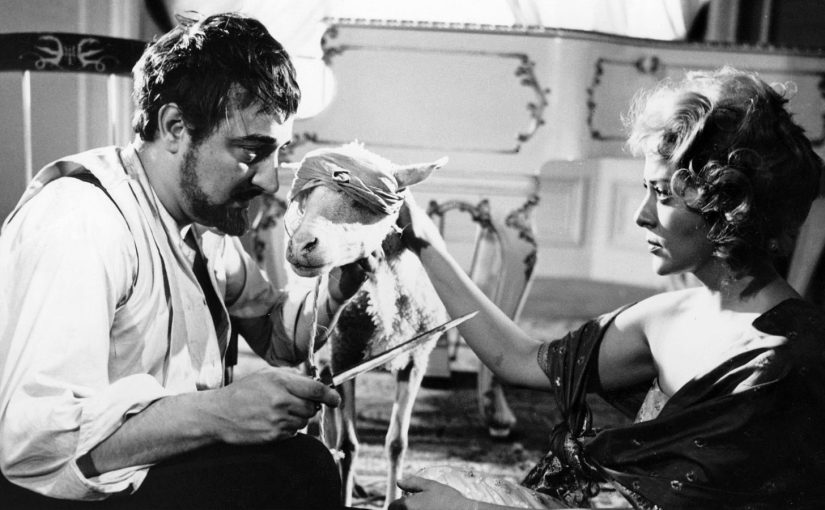
The dinner scene contains pratfalls, repeated conversations, and a visit to a side room containing three or four lambs and a bear on a leash.  What the WHAT…?  I remember thinking, okay, so this is going to a broad comedy turning upper-class manners into slapstick.  Seen it before, so I hope this movie executes it well.

The weirdness escalates when everyone retreats to a drawing room just off the dining room, where one of Nobile’s guests entertains everyone with a piano solo.  But when one of them tries to leave, he finds he can’t.  Not physically, like there’s suddenly an invisible wall, but one by one the guests discover they’re simply unable to leave the room.

They slowly realize the logistics of this bizarre situation.  The drawing room has no food.  Water runs low.  The one servant who remained outside manages to bring in a tray of water and coffee, but when he tries to leave to bring food…he can’t.  There’s no phone for them to call anyone about their predicament.

Outside the house, people find themselves unable to enter the grounds, so no one can tell what has happened to the people inside.  Curious crowds gather.  Inside, social structure starts to degenerate.  There are no restrooms, but one quick shot reveals a closet full of nothing but vases, and we see people entering and exiting these rooms repeatedly.  Ick.  Arguments are started with the drop of a hat.  One couple finds a unique, but undesirable, method of escaping their prison.

I responded to this material very unexpectedly, due mostly to its unpredictability.  I wasn’t cheering at the sight of upper-class twits being brought low when faced with bizarre circumstances, but I was more in tune with the horrific aspects of this story.  Buñuel has stated in interviews that he regretted not being able to take the story even further by including cannibalism, which is honestly where I thought things were headed.  It would have made a marvelous satirical statement, hearkening all the way back to Jonathan Swift.

(So, what DO they eat, you may be asking yourself?  Wouldn’t EWE like to know?)

I realize this review of the film hasn’t been much more than just a summary of its events, minus the surprising, “circular” ending.  A more detailed analysis might require listening to the commentary or reading Roger Ebert’s review or something.  But I hope I’ve conveyed how much I enjoyed The Exterminating Angel.  It was weird and surreal and absurd, and comic and horrific, and slapstick and satiric, and totally unpredictable all the way to the final frame.

P.S.  Now that I’ve seen this movie, the Woody Allen film Midnight in Paris (2011) has even deeper resonance when Gil meets Buñuel at a party and gives him the idea for The Exterminating Angel, and even Buñuel can’t understand it: “But I don’t get it. Why don’t they just walk out of the room?”  Funny stuff.

ASHES AND DIAMONDS (Poland, 1958)

by Miguel E. Rodriguez

DIRECTOR: Andrzej Wajda
CAST: Zbigniew Cybulski, Ewa Krzyzewska, Waclaw Zastrzezynski
MY RATING: 7/10
ROTTEN TOMATOMETER: 96% Fresh

PLOT: Against a backdrop of internal political turmoil at the end of World War II, a Polish resistance fighter faces a crisis of conscience when ordered to assassinate a Soviet official.


The Polish film Ashes and Diamonds is reportedly Francis Ford Coppola’s favorite movie, and Martin Scorsese has stated in interviews that he used it as an answer for one of his finals at film school.  From a technical standpoint, I can see why.  Echoes of this film (and perhaps others from director Andrzej Wajda’s filmography) are overwhelmingly evident in the bodies of work of both directors, from the mobile camera to the shocking moments of violence to the psychological makeup of the characters themselves.  As an emotional experience, I confess I didn’t get “worked up” over it, but it was interesting to see where two of the greatest American film directors got a healthy dose of inspiration.

Ashes and Diamonds opens on May 8, 1945, with an idyllic scene outside a country church that quickly degenerates into a brutal double murder.  The killers are the calm, detached Andrzej and the flighty, charismatic Maciek, who spends most of the movie behind dark sunglasses.  We quickly learn their victims are not who they thought they would be.  Instead of killing two Soviet/Communist officials, they have killed two innocent factory workers.  War is hell.

Later, through circumstances that feel very Hitchcockian, Andrzej and Maciek hole up in a hotel bar, only to discover that one of their real targets, Szczuka, has booked a room in the very same hotel.  Maciek books a room directly below Szczuka’s, and the rest of the film plays out with that element of suspense hanging in the background, leaving us to wonder when and how Maciek will complete his assignment.

Complications arise when Maciek becomes infatuated with the hotel bartender, Krystyna, a blond beauty who rebuffs Maciek’s advances at first.  Later, they connect, but she doesn’t want to get involved with someone when it will eventually have to end: “I don’t want bad memories when memories are all I have left.”  Maciek falls for her so hard that he starts to doubt his resolve to kill his target.  “Will he or won’t he?” becomes the movie’s prime conflict.

Where to begin with the comparisons to Coppola and Scorsese?  The most obvious one is the unblinking attitude towards violence.  The two killings at the beginning of the film are done with very few cutaways as we see the multiple bullet hits on each victim, with one of them getting hit in the eye and another shot in the back at point blank range with such force his shirt catches fire.  (Malfunctioning squib?  Possibly, but it’s still effective.)  It’s interesting that this movie predates Bonnie and Clyde (1967) by almost a decade, but its depiction of onscreen violence feels very modern, even by today’s standards.

Then you’ve got the moral struggle of the main character, a man of action capable of casual murder who is suddenly given a reason to make something different with his life.  This reminded me of Scorsese’s The Departed (2006), with DiCaprio’s character undergoing the same internal conflict.  Maciek has multiple opportunities to kill Szczuka throughout the film, but something always pulls him back from the brink.  His partner, Andrzej, becomes impatient and reminds him what happens when soldiers let personal feelings interfere with their duties.  I had a vivid flashback of Michael Corleone’s credo: “It’s not personal, Sonny.  It’s just business.”

(I also felt that the dynamic between Maciek and his more level-headed partner Andrzej were evoked in Scorsese’s Mean Streets [1973], with De Niro’s Johnny Boy and his more level-headed partner Charlie, played by Harvey Keitel.)

But, cinematic comparisons aside, I didn’t find Ashes and Diamonds to be as gripping as other war or crime dramas of that era, such as Elevator to the Gallows, Touch of Evil (both 1958), or Rififi (1955), to name a few.  It’s a little weird to me, because all the pieces are there for a first-rate thriller.  I’m not asking that every drama pack the exact same kind of emotional gut punch every single time because I know that’s unrealistic.  But the fact remains: Ashes and Diamonds, while clearly very influential on future filmmakers, did not get me as involved as I would like to have been.  I was never bored, but neither was I over the moon.  It was…average.  Perhaps one day I’ll watch it again with a fresh eye to maybe see what I missed the first time around.

À NOUS LA LIBERTÉ (1931)

by Miguel E. Rodriguez

DIRECTOR: René Clair
CAST: Henri Marchand, Raymond Cordy, Paul Ollivier, Germaine Aussey
MY RATING: 7/10
ROTTEN TOMATOMETER: 100% Fresh

PLOT: A convict escapes prison and becomes a wealthy industrialist, but his life of leisure is threatened when his former cellmate turns up unexpectedly.


À nous la liberté (rough translation: “freedom for all”) is a charming, if slight, romantic farce from celebrated French director René Clair, who would later make his mark in Hollywood films with I Married a Witch (1942) and And Then There Were None (1945) before returning to French cinema for the rest of his career.  It won’t go down as my favorite French film, or classic film, or anything like that, but as a snippet of cinema’s early years, along with some mildly scandalous history of its own, it’s worth a look for cineastes.

Louis and Émile are cellmates in a French prison.  Their daily routines are marked by hours and hours of assembling children’s toys on an assembly line that looks and feels a lot like the one from Chaplin’s Modern Times (1936) or even that one at a chocolate factory in a famous episode of I Love Lucy – but we’ll come back to that.  They sing, too, while toiling.  There’s a LOT of singing in À nous la liberté, not all of it clearly motivated, but serving as a kind of punctuation mark or accent piece to various scenes.

Émile and Louis attempt to escape their prison, but through no one’s fault, only Louis gets away, while Émile remains behind.  After some amusing episodes involving Louis trying to blend unobtrusively back into society, he lands a job hawking phonographs to pedestrians for a department store.  He gets so good at it that eventually he’s running the store…and eventually, improbably, he becomes the owner of the factory that BUILDS the phonographs, making him rich beyond his wildest dreams.

Trouble arrives in paradise when Louis’ cellmate, Émile, unexpectedly shows up, recently released from prison.  But he’s not looking for a job or to “touch” an old wealthy friend.  He’s in love with a girl who works at Louis’ factory, and getting a job there is the easiest way to stay close to her.  (I don’t THINK her name is ever said aloud, but she’s listed on IMDb as “Maud”, so that’s what I’ll call her.)  If Émile’s behavior sounds mildly stalker-y, well, it is, but what are you gonna do, love is love, and I’m sure I could dig up a modern rom-com or two that feature stalking as a romantic element.  Somehow.

Plus, there’s this whole ironic subtext that shows how the assembly lines at Louis’ phonograph factories are no different from the assembly lines at the prison.  The movie is not subtle about their similarities, but how could it be?  This fluffy material is corny as all hell, but the movie never gets too schmaltzy.  And if you think you know how the romantic subplot plays out in a romantic comedy from the 1930s, check your assumptions.

The centerpiece of the film is an assembly line sequence at the phonograph factory, a scene that has been imitated many times.  More modern movies and TV shows may have improved it, but having seen this movie, it’s clear where their inspiration came from.  In fact, the most interesting backstory of À nous la liberté is the fact that, after Charlie Chaplin released Modern Times in 1936, the producers of the French film sued Chaplin for plagiarism.  Both films feature bumbling but charming protagonists who wind up working on, and screwing up, assembly lines, and both films were making a point about the increased mechanization and dehumanization of the labor force.  After dragging on for ten years, Chaplin ultimately settled (without admitting guilt), but remained friends with René Clair for years afterward.

Having seen both films now, my opinion is that the similarities between the two films are purely incidental.  You might as well say that Star Wars plagiarized Star Trek because they both have “Star” in the title.  Modern Times is funnier and faster-paced, while the most farcical scenes in À nous la liberté are played, not for laughs, but smiles, if that makes sense.  It does to me, so I’m sticking with it.

It’s also interesting to observe how Clair used sound in this film from sound’s early years.  As I said before, there’s a lot of singing, but scenes with dialogue are few and far between.  Ambient sound is almost non-existent.  Where you might expect to hear lots of noises – scenes on the assembly line, for example – we only hear background score.  It’s almost startling when one scene plays street noises during an outdoor shot.  It’s almost as if Clair – like Chaplin – was reluctant to completely abandon silent storytelling in favor of this new sonic “trend.”  As a result, while it’s not a laugh riot, the film does have a quaint likability that is hard for me to describe.

À nous la liberté is an interesting peek backwards in time to when many of the film tropes we take for granted today were shiny and new.  It didn’t get me all “riled up” at an emotional level, but it wasn’t a waste of time.  And, like I said, there are one or two surprises story-wise.  That’s never a bad thing.

VAMPYR (Germany, 1932)

by Miguel E. Rodriguez

DIRECTOR: Carl Th. Dreyer
CAST: Julian West, Maurice Schutz, Rena Mandel, Sybille Schmitz
MY RATING: 8/10
ROTTEN TOMATOMETER: 98% Certified Fresh

PLOT: A drifter obsessed with the supernatural stumbles upon an inn where a severely ill adolescent girl is slowly becoming a vampire.


Carl Th. Dreyer’s Vampyr [pronounced “vom-PEER” in this German version] is not the scariest vampire film I’ve ever seen, but it is definitely one of the creepiest.  There’s a difference.  Dreyer’s film doesn’t move with the pacing seen in more standard horror fare.  Instead, it forsakes typical plot development for scenes that linger on the horrific or the unexplained.  In its own way, it is more directly related to the films of David Lynch than to any other contemporary monster movies of the time (Dracula or Frankenstein, for example, both 1931).

The story is fairly simple, but it belies the complex imagery that awaits the viewer.  A young drifter, Allan Grey, happens upon an inn from which he thinks he can hear animal sounds, or perhaps a young woman screaming.  The village doctor, who looks like a bespectacled long-lost relative of Doc Brown from Back to the Future, vehemently denies the presence any animals or young women on the property.  The innkeeper invites Allan to stay the night.  In the middle of the night, Allan’s sleep is interrupted by a mysterious visitor to his room who intones, “The girl must not die!”  The gentleman then leaves a package on Allan’s desk and writes a most portentous message: “TO BE OPENED ONLY UPON MY DEATH.”

What is this book?  What did Allan hear?  And how do you explain the shadows he saw on his way to the inn?  Shadows of people running along the lane – with no corresponding people attached to them?  Wouldn’t YOU like to know.

Vampyr is positively drowning in atmosphere.  Dreyer apparently shot many scenes with a piece of thin gauze over the lens, creating a misty layer that makes everything feel like a dream, even when Allan is awake.  Allan goes on frequent excursions around the inn and the surrounding property, and it’s here where most of the fantastical imagery is seen, especially when it comes to disembodied shadows.  In one mildly unsettling sequence, a shadow of a man with a peg leg descends a ladder and appears to sit on a bench…re-joining itself to a peg-legged man already sitting on the same bench.

There’s a lot more, but I don’t want to just write a list.  However, I am compelled to mention one sequence in particular that exudes as much creepiness as anything I’ve ever seen from this cinematic era.

It turns out there is, not one young woman at the inn, but two: Gisèle and Léone.  Léone is seen early on, confined to her bed with a mysterious illness, which we later learn has been brought on by her contact with a seldom-seen old woman who lurks somewhere on the property.  And there are some odd injuries on her neck…UH oh.

At one point, Léone awakes while Gisèle is alone with her.  I don’t remember what they discuss, but Léone goes into this weird sort of trance.  Without the use of any strange Chaney-esque makeup or camera tricks, Léone’s face becomes an object lesson in creepiness.  Her eyes open wide, her face breaks into a creepy grin, and she slowly moves her head from side to side, while Gisèle backs away in terror.  It might be the scariest sequence in the film, one which could easily compare to any subsequent monster or vampire movie.

Later, Dreyer throws more camera tricks at us in increasingly imaginative ways.  Allan dreams of a skeleton handing him a bottle of poison.  A dead man’s face appears in the sky during a sudden thunderstorm.  Dreyer includes camera moves that would fit right into any modern film.  And in a sequence that reminded me of Wes Craven’s The Serpent and the Rainbow (1988), Allan watches as his own body is sealed inside a coffin with a tiny square window for his apparently dead eyes to look out of.

If nothing else, Vampyr is an interesting artifact of cinema’s transitional era from silent to sound.  Even though there is a conventional soundtrack and we hear people’s voices as they speak, a lot of expository information is provided via title cards and long looks at passages from a book of vampire lore.  Given that the vampire mythology was then not as popular as it is today, I can forgive these beats that tend to bring the momentum to a halt.

While Nosferatu (1922) and the Bela Lugosi Dracula are much more famous, Vampyr is worth a look if you’re a horror fan.  While it doesn’t involve the kind of fear factor I tend to expect as a child of the 1970s and ‘80s, it is nevertheless creepy as hell. 

IPHIGENIA (Greece, 1977)

by Miguel E. Rodriguez

DIRECTOR: Michael Cacoyannis
CAST: Irene Papas, Kostas Kozakos, Tatiana Papamoschou
MY RATING: 9/10
ROTTEN TOMATOMETER: [Not scored]

PLOT: In ancient Greece, King Agamemnon, in order to appease the gods, is told he must sacrifice his favorite daughter, Iphigenia, before his troops can march to war.


To my mental library of favorite closing shots in cinema, I must now add the final image of the engrossing Greek film Iphigenia.  I won’t spoil it, but the hatred in the eyes, the set expression of the face, spell out exactly what will follow in the years to come without saying a word.  It’s cinematic, yes, but it’s also theatrical, expressing oceans of passion (good or bad) with a stare instead of a monologue.

Director Michael Cacoyannis’ filmed adaptation of an ancient Greek tragedy by Euripides (Iphigenia in Aulis) does not immediately seem like the kind of film I would cotton to.  I’ve never read any of the ancient Greek plays, nor have I ever read the Iliad or the Odyssey, though I am familiar with their plots…barely.  This is not the kind of literature I have traditionally sought out, and I am content in my decisions.  But a weird thing happened while watching Iphigenia.  After a somewhat rocky start, I became enthralled with the language these characters were using.  I don’t mean the Greek language itself, but the subtitles used in the English translation.  I cannot say with any certainty how closely the subtitles mirror what is actually being said, but if they’re even just fairly accurate, then I now understand, at least to a small degree, why these plays have endured for millennia.

The story itself is one that has undergone countless interpretations and revisions over the course of history.  King Agamemnon (Kostas Kozakos) and his vast army are ready to set sail for war against the kingdom of Troy, but their ships are stranded by a lack of wind.  The seer Calchas informs Agamemnon that the winds will not blow until he sacrifices his eldest and favorite daughter, Iphigenia, to the goddess Artemis, who is withholding the winds because his men have offended her by killing a sacred deer.  (And now I know where the title of The Killing of a Sacred Deer [2017] comes from…knowledge really IS power!)

Agamemnon agonizes over this decision, but his hand is forced by the eagerness of his troops to sack Troy; he’s afraid they’ll mutiny if he doesn’t go through with the sacrifice.  He invents a pending marriage of Iphigenia to the great warrior Achilles to get Iphigenia to the encampment, but Clytemnestra (Irene Papas), her mother and Agamemnon’s queen, tags along unexpectedly.  The rest of the movie churns with gloriously over-the-top melodrama, as Clytemnestra rages at Agamemnon, Iphigenia pleads for her life, and Achilles swears to defend Iphigenia at all costs.  Agamemnon also argues with his brother, Menelaus, in a terrific scene during which they both change each other’s minds just a little too late.  In the meantime, the winds never blow, the Greek troops grow restless, and the seer waits a little too eagerly for the chance to carry out the impending sacrifice.

It was during Agamemnon’s argument with Menelaus that I really started to perk up.  This is not an easy scene to write or act out.  Even with English subtitles, the sentence construction and syntax were occasionally overworked.  I remember thinking at one point, “Huh…this is almost Shakespearean.”  Except these scenes were written roughly two thousand years before Shakespeare was born.  When that concept smacked me in the face, I started paying attention a little more to the style and the passion of the words.  And I can’t explain it, but everything acquired a new dimension.  It started to feel more like a play than a film.  It became – at the risk of sounding a tad abstract – poetic.

That feeling permeated everything after that scene.  Throwaway scenes felt more immediate, and really important scenes felt monumental.  Sure, there is some overacting, particularly from the actor playing Achilles, but really, it’s called for in this scenario.  When Clytemnestra promises her husband that, if he goes through with the sacrifice, she will accept his will but hate him for the rest of her life…I really felt it.  And it’s not just the language, but the zealotry of the acting on display, especially from Irene Papas, who must have salivated at the chance to play this fiery woman, a proto-feminist who accepts her duty as a queen but never lets the king forget who truly rules the roost.

And then there’s Iphigenia herself, played by a waifish, almost elvish actress I’d never heard of before seeing this movie, Tatiana Papamoschou.  In her first scenes, she’s almost too innocent to be taken seriously.  It’s only when Iphigenia learns of her father’s plans to murder her for the sake of war that Papamoschou’s acting style allows her to really embody the character, and she delivers a speech late in the film that is, for lack of a better word, biblical.  She accepts her fate and shames the men around her with the same surgical precision that can be found in the Gospels when Jesus accepts His own fate while dismantling the Pharisees with His words.  There are monumental themes at play behind the scenes, and “normal” dialogue just would not feel adequate.

And then there’s that final shot.  I did a tiny bit of research on the original play, and when you learn what historically happened to the main characters after the play’s events, that last look carries even more weight, foretelling decades of death and tragedy without saying a word.  That a foreign film of a 2,200-year-old play was able to affect me this greatly was very pleasantly surprising to me.  I doubt any newer version with today’s technology or modernized dialogue would affect me the same way.  Iphigenia was a very pleasant, surprisingly effective discovery.

THE MAGIC FLUTE (Sweden, 1975)

by Miguel E. Rodriguez

DIRECTOR: Ingmar Bergman
CAST: Josef Köstlinger, Irma Urrila, Håkan Hagegård, Birgit Nordin
MY RATING: 8/10
ROTTEN TOMATOMETER: 91% Fresh

PLOT: Valiant prince Tamino and his zestful sidekick Papageno are recruited by the Queen of the Night to save her daughter from the clutches of evil.


Here lies the noble, magical illusion of the theater.  Nothing is; everything represents. – Ingmar Bergman

Ingmar Bergman’s whimsical staging of Mozart’s opera The Magic Flute is a movie made by a theater fan, for theater fans…and to a certain degree, it’s about theater fans.  I use the word “staging” instead of “film of” because, throughout the movie, Bergman never once lets us forget that we’re watching a staged production.  The opera’s overture plays over shots of the audience members, and at intermission we watch actors passing the time by playing chess or smoking where they shouldn’t be.  Once or twice, we see the hands of the stage crew as they move from one “cue card” to the next.  Fishing wire is clearly visible when objects “float.”  But the very artificiality of the production is what makes it so charming.  It celebrates artifice and scorns reality.  It wouldn’t surprise me if this were one of the favorite films of Tim Burton or Terry Gilliam.

Since my only previous knowledge of the story of The Magic Flute comes from a precious few scenes in the film Amadeus (1984), here’s a brief summary for anyone else who knows as much about opera as I do.  The brave, handsome prince Tamino and his enthusiastic sidekick Papageno are recruited by the Queen of the Night to rescue her beautiful daughter, Pamina, from the clutches of the evil Sarastro.  Before the opera is over, there will be revelations, separations, reunions, laughter, tears, semi-divine intervention, and even an operatic strip-tease.  There are monsters, woodland creatures, villains, three angelic young boys in a hot air balloon, and, of course, a magic flute.  And it’s all portrayed as it might be seen if we were watching it on a real stage in a real theater, with some obvious cinematic licenses taken with time and space.

I’m gonna be brutally honest: having never seen an opera, I had moderate-to-low expectations of how much I would enjoy it, even if the music is by my second-favorite classical composer of all time.  (Beethoven is the king, and that is that.)  But Bergman’s film sidestepped my expectations by not trying to present anything in a realistic way, or by simply staging a live production and just filming it from multiple cameras.  By keeping everything clearly artificial, clearly staged, and occasionally using clever movie tricks, The Magic Flute held my attention, making me curious about what other tricks Bergman might have up his sleeve.

For example, he’ll start a scene with a wide shot, showing the entire stage with the flats and fake backdrops, then cut to a medium shot, making us think we’re in the space we just were, then panning over to reveal a completely separate set that was invisible before.  But because it’s been established that we’re in the realm of theater, this kind of spatial paradox isn’t jarring, it’s almost expected.  You can get away with certain things in theater, especially opera, especially in a fantasy, that would never fly in a regular movie.  In The Magic Flute, a person’s face can be completely made over with a simple edit.  A picture in a locket can come to life.  A journey through a fantastic hellscape can be suggested by clever editing and careful camera placement.

But what if you simply don’t like opera?  Is The Magic Flute enough to convert you?  I mean…maybe?  If you’re a fan of the films of Terry Gilliam, particularly Brazil (1985) and The Adventures of Baron Munchausen (1988), then this movie is going to be right up your alley.  They share the same visual strategies and production design sensibilities.  Even if you believe you don’t like opera, The Magic Flute could still win you over for at least this one movie, simply because it’s such fun to look at.

Looking back over what I’ve written so far, I don’t believe I’ve accurately conveyed how the deliberate “fakeness” of the film enhances its effectiveness.  Live theater has the ability to get audiences to suspend their disbelief in a way that film cannot always achieve.  I’ve seen community theater productions where, for example, the walls of a café are supposed to “fly” off the stage revealing a night sky, and the effect was accomplished by simple lighting tricks.  A clubhouse foyer can be magically transformed into a golf course with a green carpet and some more selective lighting.  In live theater, the audience is constantly aware that it’s fake, but when they’re in the grip of a good story, their mind fills in the blanks.  That’s the effect Bergman is going for in The Magic Flute, and it works.

So, in the end, what you have here is a love letter to the stage, to opera, to Mozart, to fantasy.  Throughout the film, Bergman will cut to the face of young girl, an audience member, who watches with rapt attention and an almost Mona Lisa-esque smile.  Not only is he reminding us, the viewer, that this is a staged production, but maybe he’s also sending a reminder to filmmakers to never forget that, for a movie or play or opera to work, you have to remember who you’re making it for: the paying audience.  Speaking as an occasional audience member myself, I know that, when I buy a ticket, I want to be taken out of myself.  I want to believe that a man can fly, or that a wooden puppet can come to life, or that a valiant prince can overcome three tasks to win the heart of his beloved.  The Magic Flute is a tribute to the magic-makers and the storytellers, to the genius of Mozart, and to the people out there in the dark who make it all possible.

I’M STILL HERE (BRAZIL)

By Marc S. Sanders

Biographies of terrible truths are fascinating.  Haunting, yet fascinating that circumstances ever got as far as they did when unfairness, immorality and unspeakable tragedy occurs.  Walter Salles’ Brazilian film I’m Still Here recounts the abduction of Reubens Paiva in 1970 when Rio Di Janeiro was under the control of a militaristic dictatorship.  This is a moment in world history that I am completely unfamiliar with, and so I wished that Salles’ movie provided more backstory to paint a clearer picture.

Reubens Paiva (Selton Mello) is a father of four girls and a boy.  Despite a happy marriage to Eunice (Fernanda Torres) and a comfortable life across the street from the coast, the government stronghold of the island looms with planes flying overhead and check point searches at intersections.  Other than this dark overrule, life goes on for the Paiva family as they plan to build a new home, send their eldest off to London for college, and swim daily in the ocean blue.  Ice cream outings are also a treat.

Then Reubens is requested to go with a military escort.  He gets dressed in a jacket and tie and calmly leaves the home.  Eunice is also taken and placed in a dirty cell for days while being put towards intense questioning.  Their daughter, Verona (Valentina Herszage), is stopped at a checkpoint and searched while out with friends.  No explanations come their way for these encounters.  

Following a few weeks in captivity, Eunice is released back to her home.  Reubens is nowhere to be found and assumed to still be held prisoner.  The couple were friends with people much like them who apparently spoke out against the regime.  It is likely Reubens was taken due to his writings and vocal protests as a former Congressman.  It’s also concerning that foreign diplomats are rumored to be kidnapped as well.  There’s definitely an uneasy feeling happening. Now Eunice’s dilemma is to try keeping her children calm and sheltered from news of this arbitrary situation, including her worst fears about her missing husband.  

I’m Still Here is certainly an important story that needs to be told and was more than ready for the big screen.  I’m sorry to say though that Walter Salles’ picture is terribly boring.  Once the captivity sequence is over, Salles relies often on Eunice silently wondering what has become of her spouse.  Colleagues visit with rumblings of what they have heard and in between there is a lot of gazing at photographs and newspaper articles.  It’s challenging to embrace a character looking at documents and pictures over and over with no progress being introduced to the story.

There are moments of paranoia as Eunice observes people watching her and the family from across the street.  Tragedy befalls a loving pet as well.  Yet, I never felt the tension that I’m sure resided with this woman from one day to the next.  Eventually, the film takes two different leaps in time and an older Eunice is now played by Fernanda Montenegro (Fernanda Torres’ real life mother). 

I’m Still Here is very slow moving. I couldn’t help but feel lost with most of this story and it’s not until the second and final epilogue arrives that a televised newscast offers more clarity to what likely happened.  I was glad I walked away with a better understanding, but it does not make up for how lost I was during the first two thirds of the picture.  

I still do not understand how the military coup came into power. A prologue might have helped enhance the threat the family had to face.  I was never clear on what precisely Reubens stood for against this stronghold regime.  What was his platform?  What bothered him specifically?  Anyone could tell me it should be obvious, but again I know nothing about this story that arguably is not shared in schools and is hardly a current event.  Granted, Brazilians likely have a clearer idea.

Without enough knowledge, I’m Still Here is uninteresting.   Viewing characters staring at old photos is not stimulating enough on its own and I’m sure Eunice Paiva was at least a little more aggressive than Fernanda Torres’ performance implies.  I read that Eunice never cried in front of her children and that is demonstrated in Salles’ film.  So, I have to presume this real-life woman, who eventually earned a law degree she used to fight for human rights, would have been much more aggressive than what is on display in this movie.

I can only recommend watching I’m Still Here as another example of tragic unfairness towards human rights.  

Learn about the Paiva family.  However, instead of watching this film, it might be better to rely on the book it’s based on, written by Eunice and Reubens’ son Marcos Rubens Paiva.  I’d expect it to be much more insightful.

EMILIA PEREZ (FRANCE)

By Marc S. Sanders

I never watched a telenovela from start to finish.  At best, the only footage I’ve seen are on GIF scenes that tease at the over exasperated expressions (bulging eyes, big teeth, big hairstyles, lots of lipstick) of the actors and the characters they are portraying.  The Funny Or Die You Tube clips draw their comedy by having the straightest voiceover summarize a season of these miniseries. The stories were not meant for humor, but on the surface, I can’t help but think they are operating with a Naked Gun tongue firmly in an Airplane! cheek. 

Emilia Pérez looks like a telenovela compiled into a two-hour film, but as outrageous as the storyline and the sequence of events play out it’s anything but silly.  I held an appreciation for the circumstances that writer/director Jacques Audiard set up so that the insurmountable conflicts appeared convincing, and most especially overwhelming.  Emilia Pérez performs like an episode of Three’s Company – the one with the misunderstanding – but there are complications that border on bloody violence, life, and death.

Zoe Saldana portrays Rita, a defense attorney for Mexico’s worst criminals, and she despises the purpose she serves for the murderous scum she represents as she assists in getting one thug exonerated after another.  Early on in the picture, Saldana espouses her remorse through song and dance all within the middle of a courtroom, because as you quickly learn Audiard’s film is a movie musical. 

Shortly after the opening number Rita is summoned by Manitas, the most powerful head of the Mexican drug cartel.  He has unlimited resources and cash, and he hires Rita to do a worldwide search for the finest physicians to complete his sex change operation.  Once that is complete, the two will arrange the publicly known death of Manitas, send his wife Jessi (Selena Gomez) and their two children off to hiding in Switzerland, and the drug czar will be replaced by the woman Emilia Pérez.  Emilia and Manitas are portrayed by real life trans actress Karla Sofía Gascón.

Four years jump by, and Emilia catches up with Rita, who remains the only person to know of the ruse that took place.  Emilia wants Rita to deliver Jessi and the children back to her.  The former father will now pose as the wealthy aunt and they will live together in Mexico, going forward. 

Rita discovers a new kind of respect for Emilia as the bloody past of this individual have ceased since her sex change.  As such, Emilia recalls that her former self was responsible for countless murders and kidnappings, many of which took place under her command.  Now she seeks redemption by making herself public with a well-funded campaign that will focus on the recovery of missing people and set up proper burial arrangements so next of kin can have closure.  Emilia reveals a common burial site where hundreds of bodies were secretly laid to rest.  No one questions how she knows of this area.  Yet, she becomes a philanthropic woman who has earned the respect of millions within Mexico.  The irony is that she recruits other cartel lords to make sizable donations to this cause.  If anything, it makes them look more noble in a public eye.

Elsewhere, simplicity does not hold for her relationship with Jessi.  I won’t reveal what occurs because it lends to an ending you might expect.  All three leads embrace different perspectives of this storyline, and it only heightens the complexities of the film.

Jacques Audiard is of French descent, and after seeing the film I learned that many have taken issue with him overseeing this project.  He does not speak Spanish, has no Mexican heritage and according to many has not embraced a true account of Mexican culture or activity.  The movie was also submitted for Oscar contention as the French candidate in the Best Foreign Film category. I’m glad I did not learn of these objections until after seeing Audiard’s film, though.  It did not interfere with my take on the picture, and I believe it should not cloud your viewpoint if you intend to see it.  (It’s currently showing on Netflix.)  There were moments in the film that I predicted would occur such as where a boy on a bicycle is heading with a plastic shopping bag in tow.  By that moment, I knew what was to be revealed inside the bag. 

The film is soap opera like, especially with the musical numbers that are included.  I’d think the songs were composed by Lin Manuel Miranda if I didn’t know better because the lyrics work like dialogue much like you would see in Hamilton or In The Heights.  I was taken with the singing performances of Saldana, Gascón, and of course Gomez who works part time as a professional singer anyway.  It’s almost operatic how they and other cast members express their conflicting feelings in character.  Out of context of the film, I don’t think any of these songs work or would draw an attraction to leave the radio tuned in.  The songs are storytelling, but not memorable or catchy with chorus versus.

While I did not mind the song portions, I never missed them when scripted dialogue, primarily in Spanish with English subtitles, was being played.  I guess you could say the music makes the film different.  A different kind of telenovela, a different kind of crime drama, a different kind of soap opera, and certainly a different kind of musical.  Whether you take to the assembly of the film or not, you cannot deny that Emilia Pérez stands out within any one of these categories.

The film is up for the most Oscar nominations in the year 2024, thirteen in total.  One thing that is odd though is that Zoe Saldana is competing in the Best Supporting Actress race while Karla Sofía Gascón is up for Best Actress.  Even though Gascón plays the title character, I insist it should be the other way around. Saldana occupies most of the running time of the film and as complicated as the character Emilia Pérez is, I found Saldana to be more conflicted as Rita, the outsider looking in with all the secrets held tight in her subconscious.  The best way to share her struggles with the audience is to sing them aloud.  The long-time action movie star (Guardians Of The Galaxy, Avatar) sets the stage for the whole movie, as soon as the five hundred million studio logos get their street cred at the beginning of the film.  (I empathize with Peter Griffin on Family Guy.) Saldana is marvelous in this picture.  A stunning performance.

As Emilia Pérez, Karla Sofía Gascón pulls off an intricate stretch as she convincingly plays two very different roles.  Had the film not told me, her character could have easily been the second coming of The Crying Game. Unlike Saldana though, once Emilia is brought into the film I didn’t so much see a performance as I heard the problematic narrative that came from the script.  I don’t recall any special moments or scenes that wowed me to the point of an Oscar nomination.  It’s certainly one of the most unique roles to come along in films lately.  So I guess that’s where the justification for special recognition stems from.

Selena Gomez is a powerhouse in her role.  She was worthy of a nomination that regrettably did not come.  As I understand she cannot speak Spanish fluently and was challenged at times with the dialogue and the singing involved.  Beyond Saldana’s introductory number, Gomez has the standout song with her portion of El Trio.  Gomez has so many dimensions to this character, as the bubbly airheaded and spoiled wife of the drug czar, who then transitions to a sorrowful and cold caricature after time has passed since her husband has been killed, and later she is vengefully outraged.  This is such a standout performance from her lighter material found in Disney programming and Only Murders In The Building.  She’s quite fierce.

I liked Emilia Pérez.  Artistically speaking, I question the worthiness of some of the recognition though.  It’s up for Best Cinematography.  Often the picture is grainy, which I believe was deliberate, but intent does not imply the highest order of artistic measure.  Maybe it is earning praise due to the transitions during the musical numbers.  Nevertheless, this film does not look as sharp as Dune, Alien: Romulus or The Brutalist

As well, I did not find anything special for its nomination in Sound.  Perhaps the sound lends to the music embedded throughout the film.  I don’t know.  I can’t figure what was merited here, when there are arguably dozens of other films that likely deserved more recognition. 

The creative licenses are where the strengths lie in Emilia Pérez.  The editing and directing are good with expansive footage of Mexican locales, and transitioning film work during the song and dance portions.  It has a screenplay that grabbed me right away.  The compounded conflicts that arise feel fresh as one new development introduces itself after another. None of the material is so much for shock value like you would find in a telenovela.  The crises all seem to make sense. 

It’s not easy once a gender transition is complete, especially for a murderous drug lord.  Likewise, it’s not going to be easy for the immediate family or the one person who carries all the secrets that no one else does.  Regardless of his background, Jacques Audiard’s film lays enough groundwork and attention for each of these women’s perspectives.  He’s simply a storyteller who triumphs with impressionable tales to unfold. 

WEEKEND (France, 1967)

by Miguel E. Rodriguez

DIRECTOR: Jean Luc Godard
CAST: Mireille Darc, Jean Yanne
MY RATING: 8/10
ROTTEN TOMATOMETER: 93% Fresh

PLOT: A married couple go on the road trip from hell to visit the wife’s parents, intending to kill them for her inheritance.


You don’t risk the time it takes to do this…unless the act itself has meaning. – Detective Somerset, Se7en (1995)

In my personal opinion, there are few things more dangerous than a skilled director who genuinely has something to say.  Oliver Stone.  Stanley Kubrick.  Martin Scorsese.  Spike Lee.  Even Kevin Smith (Dogma, 1999), among many others you or I could name.  Give these guys a finished script and a camera and watch the fireworks from a safe distance.

In 1967, iconoclastic filmmaker Jean Luc Godard became disgusted or disillusioned or just plain pissed off about the class division in France and around the world, especially with how the middle class/bourgeoisie had forsaken human connection for the accumulation of material wealth.  So, he dashed off a screenplay, gathered up a crew and some actors (including a lead actress that he specifically did not like, because he needed her to play a CHARACTER he did not like), and made a film that defies classification or genre.  Is it a comedy?  A drama?  Satire?  I’m still not sure.  All of the above?  None of the above?  Weekend stands stubbornly apart from anything I’ve ever seen, thumbing its nose at the world with one hand while flipping the bird with the other.  It is many things, but timid it is not.

The movie begins with a simple enough scene, interrupted by title cards that say things like, “A FILM FOUND IN A DUMP”.  A husband and wife calmly discuss their plans to murder her parents so she can get her inheritance.  They might as well be talking about what movie to see tonight.  When the husband leaves the room, the wife takes a call from her lover.  In the driveway of their house, a fight breaks out among three people about…what?  Doesn’t matter, they’re never seen again, and the husband and wife observe the fight without commenting on it or making any attempt to stop it.

This is followed by an extraordinary scene, in a film full of extraordinary scenes, in which the wife, apparently speaking to her analyst, describes, in graphic detail, a sexual encounter she had with a strange man and his other mistress.  Meanwhile, Godard’s camera does a slooow zoom in to the woman’s face, then a slooow zoom out to reveal she’s in her bra and panties, then another slooow zoom in, and out, and in, and out, and you get the idea, right, wink, wink, nudge, nudge?

Is Godard being too obvious in this scene?  Clearly.  So, what is he trying to say here?  By being so blatantly obvious, is he parodying earlier French New Wave and Italian neo-realist films, some of which invested a lot of screen time in long conversations about nothing?  Sure, let’s go with that.  What’s with that in-and-out camera move that I read someone describe as “masturbatory” that occurs during the explicit discussion?  Is he also poking fun at other filmmakers who lack subtlety?  Yep, that works, too.  In a weird way, I was reminded of Tarantino’s Kill Bill cycle, movies that took every kung fu trope imaginable, turned the volume up to eleven, and then turned it up some more.  That’s what Godard is doing here.  Why?  As Robin Williams once said, “Because we’re French.”

That’s just the first two scenes.  Later, there is a justly famous tracking shot (really two or three that are spliced together) that lasts for nine minutes and covers 300 meters of ground.  It tracks past an endless traffic jam as our “heroes” try to get around them on their way to kill her parents.  The camera passes cars, convertibles, trailer trucks, a flatbed with two caged lions and a monkey on a leash, horns honking, people yelling at each other.  THIS part reminded me of some of the best “Family Guy” gags where something is spun out for a ridiculously long time, where the duration of the event becomes the gag, instead of the gag itself.  In the film, it actually did become kind of funny…until finally, nine minutes later, we see the cause of the traffic jam, and my jaw dropped.

Car accidents are a recurring motif throughout the film.  Perhaps they represent Godard’s assertion that his country was, at the time, more or less a trainwreck.  With other filmmakers, showing just one or two car wrecks would get the point across.  Not Godard.  They’re everywhere.  And you don’t get just twisted and burning metal; there’s also broken and bloody bodies adorning the wrecks and the roadside.  And through all of this (and more), our main characters walk or drive, apathetic to the chaos, asking everyone – even the dead bodies – how to get back to the main road, blind to the madness around them.

Godard adds intertitles at random intervals, some of which are laden with French cultural references that escaped me.  Some of them didn’t even get translations on my Blu Ray.  One of them says “THE EXTERMINATING ANGEL”, which is the title of a famous film by Luis Buñuel…sly wink to the cinemaniacs in the audience.  Go Godard, celebrating geek culture before it was cool.  Some of them are repeated while the film backtracks as if the projectionist is having a spasm.  At one point, the film jumps and skips forward as if there was a bad splice in the reel. At another, a scene occurs in a field full of abandoned cars. Then, JUMP CUT, and the cars are now a flock of sheep. Take THAT, audience expectations!

At every stage, Godard is constantly reminding the viewer that they’re watching a movie.  One of the characters even says, “What a rotten film, all we meet are crazy people.”  Later there are scenes that approximate some kind of revolution.  Battles are fought.  The gunplay looks curiously amateurish.  There’s a scene with a pig.  I don’t want to give too much away, but let’s just say that it was definitely harmed in the making of this movie.  Same with the chicken.

The chaotic nature of the movie was mesmerizing, like…a car accident that you can’t turn away from.  To fully analyze every historical, literary, and cinematic reference would be like trying to catalog every single pop culture reference in Ready Player One [2018], and that’s something for which I have neither the time, the inclination, the education, nor the space to do.  Weekend is not for everyone, he said, blatantly stating the obvious.  But I ultimately enjoyed it because it’s not that often I get to listen to the voice of a really angry filmmaker.  I may only understand the basics of what Godard is angry about, but that doesn’t diminish the power of his statement.

THE LEOPARD (Italy, 1963)

by Miguel E. Rodriguez

DIRECTOR: Luchino Visconti
CAST: Burt Lancaster, Claudia Cardinale, Alain Delon, Paolo Stoppa
MY RATING: 9/10
ROTTEN TOMATOMETER: 98% Certified Fresh

PLOT: The Prince of Salina, a noble aristocrat of impeccable integrity, tries to preserve his family and class amid the tumultuous social upheavals of 1860s Sicily.


Visconti’s intimate epic The Leopard evokes the spirit of so many other films, in all the best ways, that it’s hard to know where to begin.

It’s epic in scope and intimacy, like Doctor Zhivago.  The opulent costumes reminded me of Amadeus, and the lush scenery reminded of Barry Lyndon.  The final ballroom sequences must have influenced the wedding party in The Deer Hunter.  The literate screenplay refining tons of background exposition resurfaces in movies like JFK and Nixon.  The theme of a grizzled older man facing his own obsolescence is echoed in scores of Westerns from The Wild Bunch to Unforgiven to Butch Cassidy and the Sundance Kid.

In short, The Leopard takes bits and pieces of many of my favorite films and consolidates them into an absorbing movie that held my interest from beginning to end, despite its esoteric setting: Italy during the tumultuous years of the “Risorgimento,” when the aristocratic ruling classes were faced with extinction as the middle classes rose up, rebelled, and created a democratic Italy.

We first meet Prince Don Fabrizio Salina (Burt Lancaster) as he and his extended family are attending vespers in an upstairs room of their palatial mansion.  Their ritual is interrupted by sounds of commotion and argument coming from outside the room; turns out the dead body of a soldier has been found in the garden.  (In retrospect, this seemed to me an elegant metaphor for the entire rest of the film: a family’s stability and comfort in ceremony and formality being interrupted by outside forces intent on tearing down the old order in favor of the new.)

The dead body is forgotten very shortly amid the return home of a beloved nephew, Tancredi Falconeri (the dashing Alain Delon).  His return is short-lived as he intends to leave and join the middle-class army under General Garibaldi.  Meanwhile, Prince Salina comprehends the way the wind is blowing in his country and befriends a man, Don Calogero Sedara (Paolo Stoppa), who USED to be in a lower class, but who is now on the same social footing as the Prince himself.  As the newly instated supervisor of elections, Sedara wields considerable power in the imminent new society on the horizon, and the Prince knows what must be done, despite his misgivings.

From there, The Leopard evolves into a vivid tapestry of life in the rustic Italian countryside, set among some of the most beautiful Tuscan/Sicilian backdrops I’ve ever seen.  Some of the exteriors, showing seas of wheat or olive groves with peasant workers in the foreground, looked like museum-quality oil paintings.  Some soapy material is introduced, but it never panders, never descends into schmaltz.  For example, Tancredi falls in love with Don Sedara’s daughter, the luscious Angelica (Italian knockout Claudia Cardinale), at the expense of breaking the heart of Concetta, one of Prince Salina’s daughters.  We watch as the Prince boldly strides into a seedy quarter of town to visit the rundown apartment of his mistress.  When his priest rebukes him for this transgression against his wife, the Prince explodes: “What do you want from me?  I’m a vigorous man.  I can’t be content with a woman who crosses herself before hugging me!  …I had seven kids with her.  You know what?  I never saw her navel!”

While this dialogue is both funny and not, it highlights the way the Prince has always viewed himself: as a man of noble birth whose behavior is no one’s business but his own, regardless of morality or social niceties.  But this same man is intelligent enough to know which way the wind is blowing and how to modify his behavior accordingly.

Everything concludes with a magnificent ball held by a neighboring nobleman, attended by “anybody who’s anybody” including the Prince, his family, Tancredi and Angelica, and literally hundreds of others, decked out in some of the greatest costumes I’ve ever seen on film.  During this lavish party, some final decisions are made, and the Prince contemplates what will happen to him and his family, and his entire class, after his death.  The live orchestra plays several waltzes and dances by the one and only Nino Rota, the scorer for Coppola’s The Godfather and numerous Fellini films.  As a result, yet another great film is evoked: as the celebrants dance in a line and weave their way throughout the great house, I was reminded of the famous ending of Fellini’s [1963] and its conga line of circus performers.

Some time ago I read Donna Tartt’s Pulitzer-prize winning novel The Goldfinch.  While it didn’t deliver breathless thrills like a Crichton technothriller, it was nevertheless engrossing.  The language of Tartt’s prose transported me into the world of her hero and his morally complex journey like few other books had before or since.  That’s exactly what happened with The Leopard.  I expected it to be a “spinach” movie [good for you, but yucky taste], so my expectations were a bit low, despite its massive reputation in film circles.  But, like the other Visconti film that I’ve seen [Rocco and His Brothers, 1960], it breaks free of the mold I had created for it and becomes something grand and operatic.  I have a slight issue with the very final scene (I was hoping for something a little less open-ended), but if you have the patience for it – and if you don’t mind watching Burt Lancaster overdubbed into Italian – The Leopard is a treasure worth digging for.