LEAVE HER TO HEAVEN (1945)

DIRECTOR: John M. Stahl
CAST: Gene Tierney, Cornel Wilde, Jeanne Crain, Vincent Price
MY RATING: 9/10
ROTTEN TOMATOMETER: 85% Certified Fresh

PLOT: A writer falls in love with a young socialite, and they quickly marry, but her obsessive love for him threatens to be the undoing of them both as well as everyone around them.


Leave Her to Heaven is one of the earliest examples in my movie collection of what I call a “head-fake” movie.  There is a tiny bit of foreshadowing in its opening moments, but after that, it appears to fall into the traditional pattern of an old-fashioned, melodramatic potboiler, with a spurned fiancé, lovers in a whirlwind romance, and glorious three-strip Technicolor production design and cinematography that makes everything feel like a Douglas Sirk soap opera.  When it makes its left turn into unanticipated territory, I was on tenterhooks.

Author Richard Harland (Cornel Wilde) has a classic, almost clichéd meet-cute with the ravishing Ellen Berent (Gene Tierney, who has never looked more beautiful) during a train trip to New Mexico.  He’s visiting friends, she’s there for a funeral, and their circles of friends unexpectedly mesh.  He winds up staying with her family at their ranch house.  She and her family remark how much Richard resembles Ellen’s late father.  He notices her engagement ring, but a few days later he also notices its absence along with her declaration that she’s removed it “forever.”  (I’m REALLY condensing here to get to the point…)

Her fiancé, Russell Quinton (a very young Vincent Price), arrives upon hearing she’s broken off their engagement.  He leaves after a brief conversation, and a few minutes later she literally proposes to Richard.  They marry and enjoy a few scenes of wedded bliss (in separate beds, of course, this is the ‘40s), during which Ellen makes some red-flag-raising statements to the effect of, “I’ll never let you go” and “I want you all to myself.”

During all of this, the filmmakers exhibit terrific restraint.  In some high-tension scenes, there is a notable lack of background score, which is a bit unusual for these kinds of pictures.  You usually get ominous for tension, or pastoral for outdoor scenes, etc.  But Stahl seems determined not to cue the audience for what they’re supposed to feel at any given moment, with one or two exceptions.  This method contributes greatly to not giving away what’s coming.  Ellen’s own words do that all by themselves.

There are other plot developments I could mention: Richard’s brother, Danny, who is disabled and comes to live with them for a while…Ellen’s fixation on how much time Richard spends with her sister, Ruth…Ellen’s attempt to get Danny’s doctor to prescribe more bedrest…these and other signal markers start to twist this apparent soap opera into something else entirely.  It reminded me of the great head-fakery in Woody Allen’s ingenious Match Point [2005], which also started out in soap opera territory and wound up somewhere altogether more sinister.

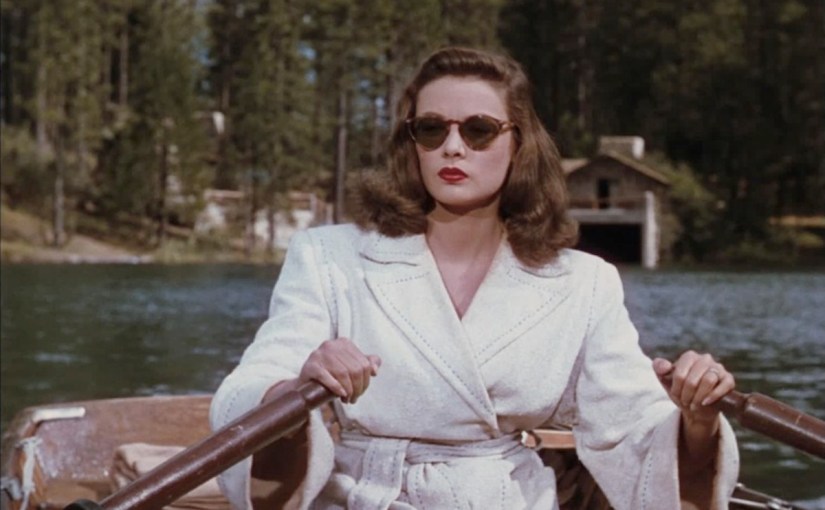
Much is made of the film’s Oscar-winning cinematography, and rightly so.  In an era when color films were an extravagance for a movie studio, they made the right choice here.  Cinematographer Leon Shamroy and production designer/art director Lyle R. Wheeler create picture-postcard images of a bygone era, lending an air of “vintageness” to the rooms, wardrobe, and makeup of the actors.  Look at Gene Tierney’s marvelous red lips, or the gaudy red of her swimsuit, worn at a time in the film when she probably shouldn’t have been so extravagant.

But I particularly love the music choices, or rather the choices to NOT use music during key sequences.  One in particular stands out.  If you’ve never seen Leave Her to Heaven, I won’t spoil it for you.  It’s the scene with a rowboat and one character’s attempt to swim across a lake.  In many other films of the time, there would almost certainly have been tense strings, low cellos and brass in the background.  For some reason, my mind goes to Miklós Rózsa’s magnificent score for Double Indemnity [1944].  That’s the kind of music normally heard in scenes like this.  But the filmmakers made the canny decision to let us merely listen to the actors and watch as Ellen makes a crucial decision.  That dread silence fairly SCREAMS as the scene progresses.

It’s tempting to look at this movie as a kind of Fatal Attraction [1987] prototype, but that’s not giving either movie its due.  Fatal Attraction is a straight up thriller, and it’s about an unfaithful husband getting what he deserves.  Leave Her to Heaven is also a cautionary tale, but not because the husband did anything wrong, aside from choosing to ignore a lot of red flags in Ellen’s behavior until it was far too late.  It might also be possible to interpret the film as a warning to men against women who think for themselves too much, who are too “take charge”, or would be considered such in the 1940s.  But I would disagree with that interpretation, too.

Look at Leave Her to Heaven as a whole, and I think it most closely resembles Lawrence Kasdan’s Body Heat [1981], or vice versa.  Both feature femme fatales who are not shy about doing what’s necessary to get their way.  The film’s ending even seems about to resemble Body Heat’s ending, but it veers away at the last second from the later film’s bleakness, providing an ending that seems just a little too pat.  I have a sneaking suspicion the filmmakers had a different ending in mind, but were forced to make changes to please the censors.  If there’s anyone out there who knows how the book on which the film is based ends, sing out.

Leave Her to Heaven is a singular experience.  I even knew about the famous boat scene, and I was still on the edge of my seat.  I simply couldn’t believe she was going to go through with it.  That’s the sign of a great film: you know what’s coming, it’s inevitable, but instead of feeling predestined, there is real suspense, a desire to know why this is happening, and what’s going to happen next.

FAREWELL, MY LOVELY (1975)

DIRECTOR: Dick Richards
CAST: Robert Mitchum, Charlotte Rampling, John Ireland, Sylvia Miles, Anthony Zerbe, Harry Dean Stanton, Jack O’Halloran, Joe Spinell, Sylvester Stallone
MY RATING: 9/10
ROTTEN TOMATOMETER: 71% Fresh

PLOT: When a giant ex-con fresh from prison asks Philip Marlowe to find his missing sweetheart, Marlowe winds up entangled in multiple murders, prostitutes, and a sultry trophy wife.


Because it was released only a year after Chinatown (1974), it is tempting to compare Farewell, My Lovely to that landmark film noir, but although they are in the same genre, the two films are apples and oranges…or at least apples and pears.  Both feature hard-nosed private eyes accepting cases that turn out to be more complicated and far-reaching than they appear, both feature multiple unexpected deaths, and both feature curvy, smoky-eyed dames with dangerous secrets and aging husbands.  All true to the genre.  But Chinatown breaks (successfully) with film noir in several key areas, while Farewell, My Lovely achieves its lofty heights while still remaining faithful to the bedrock tropes of vintage film noir, right down to the tired voice-over narration from the hero.  I have no idea how faithful it is to the Raymond Chandler novel by the same name, but if the book is half as entertaining as the movie, I may have to track it down and give it a read.

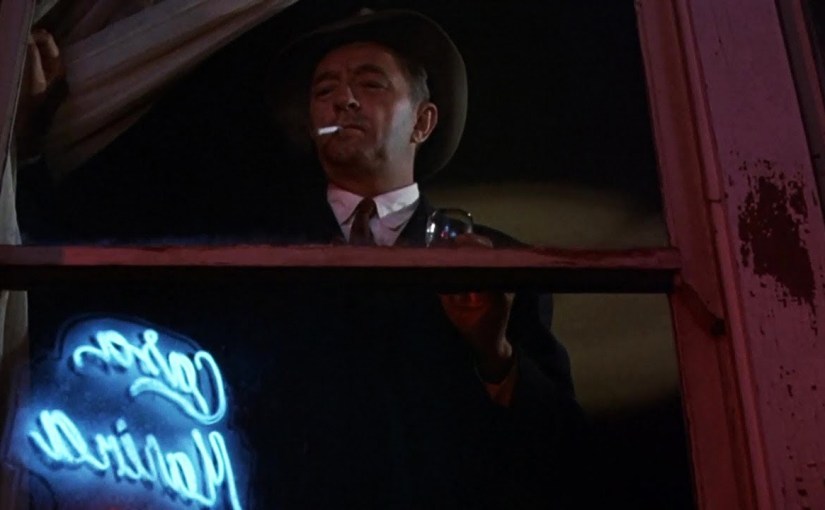
Robert Mitchum plays legendary gumshoe Philip Marlowe, the third version of the character I’ve ever seen after Humphrey Bogart (The Big Sleep, 1946) and Elliott Gould (The Long Goodbye, 1973).  Compared to the other two, Mitchum is by far the most shambling version, but I mean that in a good way.  We first see him staring out of a rundown hotel room in downtown Los Angeles, some time in 1941.  We know the timeframe because of a calendar here and there, and because Marlowe is obsessively following Joe DiMaggio’s progress, as he is on the verge of breaking the record for hits in consecutive games.  That’s a nice touch.  Marlowe’s world-weary narration plays over Mitchum’s sagging face and drooping cigarette, and the spell is complete: we are in the hands of one of the great genre pictures, from a story by one of the greatest mystery writers of his generation.

Marlowe’s story starts as a flashback, a story he’s relating to similarly-weary Lieutenant Nulty (John Ireland).  See, it all began when Marlowe was tracking down a rich family’s runaway daughter.  Soon thereafter, “this guy the size of the Statue of Liberty walks up to me.”  This is Moose Malloy, an ex-con fresh out of the slammer after serving seven years for armed robbery and making off with $80,000, which was never recovered.  Moose is played by Jack O’Halloran, whom cinephiles will recognize immediately as the overly large/tall man who played Non, the mute superpowered henchman in 1980’s Superman II.  To see this man actually string words together into sentences was a strange experience, but I eventually got used to it.

Moose wants Marlowe to find his sweetheart, Velma, who hasn’t written to him the last six years of his stretch.  Next thing you know, someone takes a potshot at Moose on the street, Moose winds up killing a guy in a bar, and Marlowe follows Velma’s trail to an insane asylum, and that’s still just the tip of the damn iceberg, because now there’s this guy who wants Marlowe to help deliver $15,000 in ransom to some other guys who stole a jade necklace…and we STILL haven’t seen the rich trophy wife yet.

And round and round it goes.  I have seen other films that attempted to combine this many plot threads and they wound up a jumbled mess.  Not this movie.  Farewell, My Lovely skillfully walked that tightrope and held my interest all the way through.  I was never lost, never confused…except for a couple of places where the soundtrack obscured a word or two, but I don’t know if that’s the soundtrack’s fault or the actors for mumbling too much.  Plus, this movie contains one of the single greatest interrogation sequences I’ve ever seen, starring Marlowe, two thugs, and the madame of a whorehouse.  It starts semi-normal, escalates with a shocker, then tops the first shocker with something I didn’t think even a hardcase like Philip Marlowe would do.  But the more I watched this movie, the more I got the sense (whether it’s true or not, I don’t know) that this Mitchum version of Marlowe is truer to the literary Marlowe than we ever got previously, in terms of Marlowe’s principles.

I should also mention the dialogue, which contains some of the best one-liners and comebacks I’ve ever had the pleasure of listening to.  For example:

  • Marlowe describing a large house he’s driving up to: “The house wasn’t much.  It was smaller than Buckingham Palace and probably had fewer windows than the Chrysler Building.”
  • Marlowe on his billing practices: “I don’t accept tips for finding kids.  Pets, yes…five dollars for dogs, ten dollars for elephants.”
  • Marlowe describing the obligatory femme fatale (Charlotte Rampling): “She had a full set of curves which nobody had been able to improve on.  She was giving me the kinda look I could feel in my hip pocket.”
  • Marlowe when the femme fatale asks him to sit next to her: “I’ve been thinking about that for some time.  Ever since you first crossed your legs, to be exact.”

Dialogue and lines like this are dangerous because they have been the targets of so many parodies for so long that modern audiences may have forgotten how to take them at face value.  But in Farewell, My Lovely, it comes off perfectly as a tribute to the classic noirs of the 1940s and ‘50s, a tip of the hat to the giants of the past.

Conversely, this movie also reminded me of many of the best eighties thrillers I remember watching, which is ironic considering it was released in 1975.  Movies like Body Heat and Jagged Edge and Silverado, whose purpose for existing seemed to be just to tell a freaking awesome story, unburdened with subtextual layering but laden with style and wit and intelligence, paying homage to their cinematic ancestors by emulating them without plagiarizing them.  There are no doubt film historians who could analyze this film scene by scene and explain exactly what the filmmakers were really trying to tell us underneath the ingenious dialogue and intricate plotting.  But even if I knew or understood all of that, I maintain the best reason for seeking out and watching Farewell, My Lovely will always because it’s just a damn good movie.

(…if for no other reason because of that interrogation scene…I had to rewind it a couple of times just to get my shocked laughter out of my system…)