THE WIZ

By Marc S. Sanders

It always surprised me that Sidney Lumet is the credited director of The Wiz, the black cultured musical interpretation of L Frank Baum’s celebrated fantasy The Wizard Of Oz.  Now that I’ve seen it with adult eyes and a tremendous appreciation for the director, it’s template makes sense knowing that I’m looking through the lens of Lumet.  Dorothy might arrive in the land of Oz, but Oz sure looks like a journey through the five boroughs of New York City, and of course Sidney Lumet is one of the all-time great storytellers of what happens within one of the greatest cities in the world.

With electrifying music penned by Quincy Jones and a screenplay by Joel Schumacher, The Wiz follows the step-by-step moments of the beloved tale.  However, everything looks like a new invention. 

Diana Ross was a sensation at the time this film was in the making and she campaigned so hard for the role of Dorothy that the script modified the age of the character to 24, thus allowing a thirty-something to convincingly play the role of an unsure kindergarten teacher with an opportunity to move on to high school academics.  On a snowy Thanksgiving night, our heroine is cast off in a twisting blizzard, landing in the Munchkinland of Oz.  Toto, a gray schnauzer, has accompanied her.  These munchkins are graffiti figures who come alive out of the concrete walls of a Harlem basketball court and neighborhood park.  It’s a brilliant invention of set design that deviates from the familiar.  The Wiz opts to maintain an urban theme.

Michael Jackson is the Scarecrow, though made of paper garbage, not straw.  A peanut butter cup wrapper enhances his nose.  He’s heckled by street guys garbed in crow likenesses when Dorothy comes upon him.  Lumet maintained a 70’s vibe to this film to fall in line with Jones’ music.  All of this design works, including the cartoon like cabs that ritually appear and abandon the characters as they embark on the Yellow Brick Road with the Chrysler Building rising in the distance.

The Tin Man is portrayed by Nipsey Russell.  He’s discovered in an amusement park junkyard where he’s crafted out of rickety old junk.  Terrific makeup here.  Ted Ross breaks out of the lion shelled statue famously erected outside of the New York Public Library.  Within the land of this Oz, a New York flavor answers for all of Baum’s familiar creations. 

Not everything works so well in The Wiz.  I’m impressed among these great talents of black entertainment that Lena Horne is cast as the Good Witch Of The South, but her one true moment at the end of the film is wasted with baby angels floating in the background of a very false looking starry backdrop.  Lena Horne is shown for the briefest of moments as Dorothy crash lands in Oz but then does not come back until the end of the film.  She sings a message to Dororthy about believing in herself.  It’s an awful moment and drains a lot of the energy from the film. Cheesy and awkward.

The course of the movie is invested so well by hundreds of costumed extras along with Diana Ross and Michael Jackson.  Nipsey Russell keeps up just fine. Ted Ross could have done more as he transferred from the live stage to this film.  His portrayal is not a standout from what Burt Lahr did with the role of the Cowardly Lion.  Diana Ross with Jackson are the leaders with nonstop energy, though.  Michael Jackson’s performance is clumsy but falls beautifully in line with all of the music.  His physical prowess in dance is part of what made him a star.  Diana Ross does not stop.  She never looks out of breath, and she puts such gusto into leading this company of musical performers.  It’s such a joy to watch both of them strut to Ease On Down The Road and Everybody Rejoice/Brand New Day.  These are two of the best and most memorable songs in the picture because of what Diana Ross does on screen with the numbers.  I especially love Brand New Day.  I’m hearing it now in my head as I write and fondly recall the wide shots that Lumet devotes to the enormous feats of choreography.  May be the best scene in the film.

Lest I forget Mabel King, as Evillene – this story’s Wicked Witch.  She is not introduced until after the great Wiz orders the four travelers to kill her.  When she does arrive, in her home based “Sweat Shop” it’s an amazing moment.  Mabel King is best known as Raj and Dee’s strict mother on the TV show What’s Happening!!!  Growing up, I’ve always been a fan and Mabel King is a sensational performer.  Her vocals give off such power and demand during her song Don’t Nobody Bring Me No Bad News.  Evillene marches down the stage in her puffed-up costume wear of glittered red with a large updo to command her little Winkees.  She certainly hijacks the picture from Diana Ross and Michael Jackson.  This is a performance that is Oscar worthy.  An absolute scene stealer.

As for The Wiz himself, it is Richard Pryor.  He’s cute in what was supposedly his first film where he donned his familiar mustache.  He’s silly but not so much fun.  Sometimes he’s just garbling like he forgot his lines and does his Richard Pryor schtick that he’d later rely on in The Toy and Superman III.  What impresses me is the costume choice for the character.  He’s eventually revealed to be the phony Wiz who operated the giant intimidating head, and he’s dressed like a literal homeless person from the streets of Harlem. 

Sidney Lumet worked with Jones and Schumacher to help us envision a modern New York as a world of urban, but colorful, fantasy.  The Yellow Brick Road goes down into the subway tunnels for some threatening moments of suspense as well as through an old amusement park, maybe located in Coney Island.  The Emerald City appears on the other side of the Verrazano Bridge, and it is Manhattan lit up in green.  The centre of the city is Lincoln Center where the inhabitants dance in red, yellow and green depending on the traffic light raised high above the famous circular fountains.  I believe the mysterious Wiz is located at the top of one of the Twin Towers.  Lumet used what he knew and applied a colorful brush of fantasy over the entire Metropolitan area.  I say it is brilliant.  Familiar like it should be, but still a fresh idea as Dorothy leaves her home of Harlem for the more extravagant of locales where she seeks out the famous Wiz hoping for a way home.

A Broadway and touring stage company of The Wiz is performing currently and I hope not too much of what is featured in this film has been washed over. 

The Wiz is dated to a disco era but most of the songbook still works with high energy and passion.  A strong appreciation remains, and maybe that’s because L Frank Baum’s original story is so timeless.  This cast along with Quincy Jones and Sidney Lumet, plus creative inventions in makeup from Stan Winston still hold up.  You’ll tap your foot if you turn this soundtrack on your radio or you opt to take in the visuals of this kaleidoscope of color and sound on your flat screen.
FLOW (Latvia, 2024)

by Miguel E. Rodriguez

DIRECTOR: Gints Zilbalodis
MY RATING: 10/10
ROTTEN TOMATOMETER: 97% Certified Fresh

PLOT: Somewhere deep in a forest wilderness, a solitary Cat barely survives a cataclysmic flood by clambering into a boat with an assortment of other animals; their survival will depend on their ability to help each other.


Nearly twenty-five years ago, Disney released an animated film called Dinosaur [2000] that was touted as being an industry game-changer.  The premise was revealed in a stunning, epic-length teaser trailer that fired my imagination.  Some of you may remember it.  Using state-of-the-art CG animation, and with no spoken dialogue, we watched as a dinosaur egg on prehistoric Earth was flipped out of its nest, carried away by scavengers, dropped into a river, swallowed and regurgitated by a fish, then plucked out of the water by a pterodactyl that soared over magnificent real-world vistas and plains before being dropped accidentally into a jungle canopy where the egg was discovered by a family of, I think, prehistoric lemurs.  A reminder: all with no spoken dialogue.

I remember thinking, wow, Disney is going to attempt the impossible: create a feature-length animated movie with no spoken words.  I was stoked.  What an experiment!  Hasn’t been done since Fantasia [1940]! And if anyone can pull it off, it’ll be Disney, right?  Imagine my disappointment when I went to see the movie, the opening scene plays out exactly as shown in the teaser, the lemurs peek through the foliage at the fallen egg, and one of the lemurs opens its mouth…and talks.  Not just human speech, but with a New York-Brooklyn-esque accent that almost sounded like Bugs Bunny.  Dreams shattered.

I mention that story because Flow, the recent winner of the Golden Globe for Best Animated Motion Picture, promised the same thing in its trailer: an animated film without words, starring only animals on a perilous journey.  I was skeptical.

Until I watched the movie today.  Not only does it deliver on its promise (making Dinosaur look shallow and childish by comparison), it sets some kind of crazy bar for mystical, awe-inspiring visuals that I would put on the same level as Avatar [2009] or Dune [2021].  Yes.  They’re that good.  And, according to IMDb, it was all created using only Blender, a free, open-source animation software tool.  Flow is a remarkable accomplishment.

The story opens with Cat wandering a forest.  None of the animals are named, of course, nor were they named by the animators.  They were all referred to simply by their species or breed: Cat, Whale, Bird, etc.  After being chased by some dogs, including a friendly Retriever, Cat curls up in the top floor of an abandoned, expensive-looking forest cabin with nary a human in sight.  Where are all the people?  No answer is given.

With ominous abruptness, a cataclysmic flood sweeps through the forest, leaving Cat and Retriever stranded at the cabin as the waters steadily rise.  Retriever hops into a passing rowboat occupied by the other dogs from an earlier scene, but Cat understandably passes on this opportunity and eventually finds itself sharing a second boat occupied by a grunting, monosyllabic Capybara.

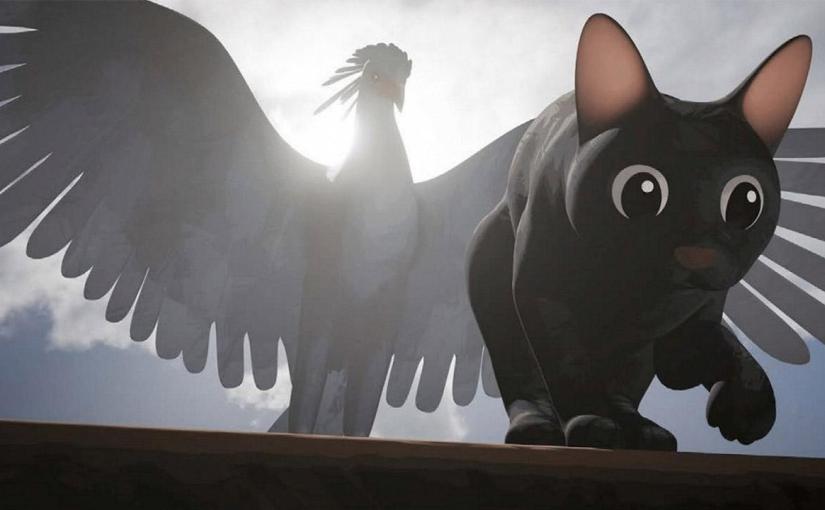
…but this simple plot summary doesn’t begin to do justice to the experience of simply watching this film.  I am super glad I saw it on the big screen first, 3rd row back, so the screen filled my field of view.  The whole movie reminded me of the best oceanic scenes in Finding Nemo [2003], crammed with detail, lavishly rendered, so that you sort of fall into the world.  There are hints to indicate that the forest and the lands beyond, now flooded, were once populated by humans, but they have all disappeared.  Statues of animals.  Top floors of houses still untouched by water, but not for long.  And, on a distant hilltop, a massive statue of a cat, on which Cat must find refuge at one point.

The look of the film is something I’m not going to be able to describe very well.  Partnered with the smooth CG animation itself, the main animal characters nevertheless have a hand-painted quality to their coats and fur.  The virtual camera moves as if being held by a real cameraman, reminiscent of the best scenes in the first Avatar.  There is a magical, spiritual sequence towards the end of the film (you’ll know the one I mean) that took my breath away and rivals anything from Pixar or Studio Ghibli.  I may not know precisely what it means, but to be honest, I didn’t care then, and I don’t care now.  I just know that it is a spectacular scene.  There are subtle hints that this world may not even be Earth as we know it, or when we know it.  Mystery abounds!  I love it.

I must give special mention to the animation of the lead character.  Cat has moments of cat behavior so specific and real that, even if you’re not a cat person or watched umpteen cat videos on YouTube, you will recognize it as being 100% authentic.  For that matter, the same could be said of all the animals in the film.  I must be honest and report that there are times when, viewed through a lens of “is-this-realistic”, the animals behave in a way that does not compute with reality.  I highly doubt a capybara would be able to figure out how to work the rudder of a sailboat…and yet, in this movie, it does, and it’s fine.

Which brings me to the one problem I can imagine some folks might have with the film: the ending.  I can’t tell if the right descriptor is “elliptical” or “open-ended” or “inconclusive.”  Perhaps it’s a plea from the filmmakers for cooperation and teamwork in an age where uncontrollable outside forces are doing their best to prevent it; like these animals, we’re all in the same boat.  Or maybe that’s not the message.  The beauty of Flow is that the ending is subject to interpretation, thanks to the lack of dialogue simply telling us what it means.

Frankly, I’m not too fussed about extracting the message from Flow.  I am too grateful that a film like this even exists to lose sleep over its Deeper Meaning.  It is a film constructed out of wondrous sights that harken back to the days of Pinocchio and Fantasia [both 1940], when animators and filmmakers gave equal weight to story and visuals, and it’s one of the best animated films I’ve ever seen.

WICKED PART ONE

By Marc S Sanders

The blessing of film is that it provides a channel to forms of entertainment that not everyone necessarily has access to.  I was never fascinated with the Tony Awards so much (even though I attended three live ceremonies) because the nominees were exclusive to what was performed in the last year on Broadway in New York City.  How can I or the rest of the country get enamored with the best of the best when we hardly have access to see any of the performances?  With movies, well you just go to the movies!

Wicked is one of the few musicals in the last twenty years that has taken on a worldwide fascination.  It was a very long novel before it became the touring stage production following a massive debut on Broadway. Perhaps because the story returns to a familiar setting, the fantastical land of Oz, the book and show carried a strong appeal.  Wicked arrived with an established brand.  Who doesn’t know The Wizard Of Oz?  Nevertheless, Wicked never needed magical ruby slippers (or rather silver as author L Frank Baum intended) to find its footing.  It’s always been worthy of its accolades apart from any other properties.  The new film, directed by John M Chu, will become a timeless classic all by itself.  Despite some technical issues, this cinematic adaptation is wondrous.

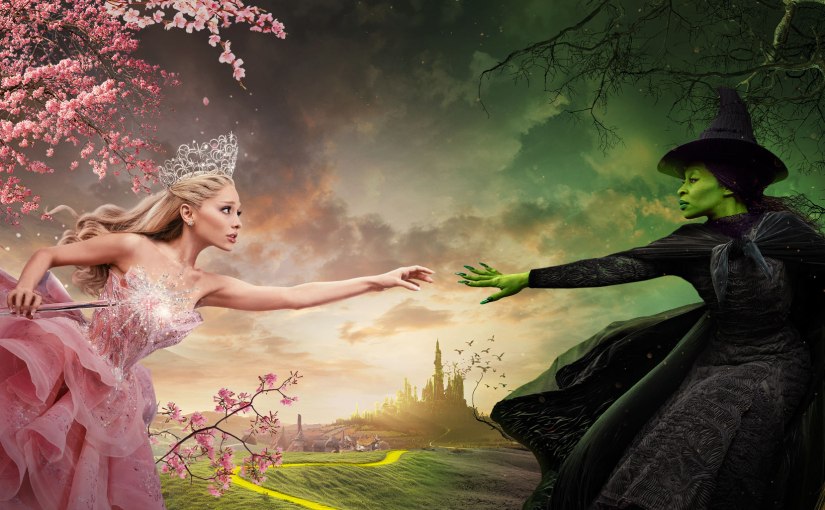
Elphaba (Cynthia Erivo) is the green skinned awkward teen, who was rejected by her father and only served a purpose to tend to her wheelchair bound sister Nessarose (Marissa Bode).  She accompanies them to drop her sister off at the esteemed magical school known as Shiz.  However, the headmistress of the institution, Madame Morrible (Michelle Yeoh), requests that Elphaba stay on as a student that she will personally teach as well.  Elphaba is roomed with the self-absorbed Galinda (Ariana Grande), where their relationship is frictional at first and later adoringly empathetic.  Eventually, we come to realize the destinies of these young ladies will develop into what is all too familiar in L Frank Baum’s eternal The Wizard Of Oz – Elphaba becomes The Wicked Witch Of The West while Galinda is recognized as Glinda, the pinkishly tender Good Witch Of The North. 

This Part One iteration of Wicked is very faithful to the stage production.  Every recognizable number is included from the operatic “No One Mourns The Wicked” to the giddily cheerful “Popular” to the climaxing, fist pumping, take charge “Defying Gravity” that closes out Act One.  The latter number is arguably one of the most well recognized and beloved theatrical songs of the twenty-first century thus far.  The edits and choreography of every number is magnificent, full of energy, and the harmonies work like natural dialogue as opposed to something like West Side Story where it’s not crazy to ask exactly why rival street gangs suddenly break out into song while trying to knife one another. 

John M Chu makes sure that his cast use every prop and set piece available.  You can’t help but grin while Ariana Grande does a circular swan flight from a chandelier while making a case for why it’s best to be popular.  “One Short Day” is a massive declaration within narrow school courtyards and corridors that berth out toward wide open endless fields into a vast blue sky for Elphaba to declare what she yearns for.  Cynthia Erivo has that knack to sing and perform personally to her character’s own subconscious when she’s in these intimate, private moments.  She then bursts out with confident volume to show that as repulsive as she might appear to everyone around her, the soul inside is what is beautiful.  In order to cast Elphaba, you really need one of the most beautiful singing voices in the world because the character is most stunning when she is expressing herself vocally. 

Ariana Grande is good. Though I still prefer the two iterations of the character that I saw on stage prior to this film.  Her performance is a different interpretation than what is traditionally in a live production.  I especially noticed that change when her character attempts to explain how to properly pronounce her name of Galinda.  The stage version of this memorable moment induced the laughs from me more.  As beautiful as Grande is in her characterization and singing, she’s not so humorous as the live stage performances.  So, the humor of Galinda, the self-entitled spoiled rich girl with everything, is not as strong.  As well, at the top of the film, I had an issue with understanding precisely what Ariana Grande was singing at first.  Was she harmonizing or was she singing dialogue?  Perhaps, that is not so much a fault of the actress as it is the recording.  Yet, the issue does not last long, and soon you are treated to Galinda laying it all out there.  She might not be as funny this time, but she’s incredibly charming and loved by her surrounding entourage of student followers, especially from Bowen Yang (Saturday Night Live) and Bronwyn James. 

The sets are spectacular and I learned afterwards that they are mostly physically constructed.  So, there is a texture to the schoolgrounds of Shiz with bridges and babbling brooks as well as regal castle-like architecture.  This is a Universal picture and many may presume that Disney would have produced something like this musical fantasy.  However, in Disney’s hands, much of this film would have been polished in a grandiose, yet artificial, CGI.  John M Chu and his crew went the smart route and diminished the cartoon sheen that comes with CGI.

My issue though is in the cinematography.  Regrettably, I could not see Wicked in a Dolby cinema.  So, we settled for a traditional theatre at AMC which was fine.  Yet, I was wondering at first if there was something wrong with the projector.  A lot of the scenes taking place in the daytime seemed washed out, especially with close ups on Ariana Grande and her complexion.  Then I concluded that John M Chu’s cinematographer relied on a lot of blaring sunlight for many of the scenes.  I imagine it was used to contrast the dark green complexion of Elphaba, emphasizing how much she doesn’t belong in this environment and amping up what an eyesore the character must feel like within the world of Shiz.  When Elphaba dominates a scene or a caption or when the film arrives at the Emerald City, the photography is just right.  Elsewhere at Shiz, it’s very oversaturated with a fuzzy kind of look to it.  Was I wearing the wrong spectacles?  Wait, I don’t wear glasses or contacts!  I could not get past this for much of the film. There was just too much white light, and it didn’t compliment the pinks and pales that accompany Galinda and some of the environments and extras.

My wife and I agreed we are going to see it in theatres at least one more time within a Dolby surround sound.  You should too.  We missed the surround sound of the winning music blaring through the entire theatre.  In a traditional theatre, the sound feels as if it is only coming from the front, or behind the screen.  Dolby or IMAX enhance the audible as if your mind is right at the center of an orb with the most gorgeous, pitch perfect sounds accompanying you.  Dolby and IMAX will also enrich the colors, and Wicked is most certainly vibrant.  Every scene looks like a completed coloring book, despite my one noted imperfection.  A year after Barbie, and pink is still in.  Greens and blacks are just as impactful.

Wicked is magnificent entertainment, worth seeing again.  The music is enchanting and easy to catch on to.  It’s fun and dramatic and every lyric works to shape the characters.  The story is magnificent as well with eye opening twists while allegorically adopting a message demonstrating the harm of prejudice.  There’s also opportunity to show where life can be a disappointment at times when you encounter false idols and learn truths about yourself and those you have grown close to.  I speak in vague terms on these accounts so as not to spoil what this powerful story delivers.

The film is smart in invention as well.  There are good, solid moments that were never staged in the live performances, but thanks to the art of filmmaking new ideas seem totally appropriate where the classic 1939 film, The Wizard Of Oz, are referenced.  Though, I have yet to see Part Two, I can confidently say Wicked works as a solid prequel.

I was one of the skeptics who believed breaking this film into two parts was a shameless studio cash grab.  It certainly seems that way and maybe it is, but considering how good this new musical film adaptation is, I am eager for another installment.  So, I will happily fork over more admission money a year from now and I am confident that I’ll wholeheartedly enjoy Wicked Part Two.  This is a brilliantly creative story with a strong cast, sensational music and eye-popping invention.  I may know what becomes of the characters and how this story ends, but I can’t wait to see it reenacted for its latter half, and I am eager to see what new creations present themselves in its next chapter. 

Wicked is one of the best films of the year.  A triumphing soar through the skies on a magical broomstick.

WISH

By Marc S. Sanders

Disney’s Wish seems to stand out from many other films within the studio’s vault because the lack of filmmaking confidence appears so obvious.  What does it tell you when a newly original story is continuously guided by winks and nods from past successes?  We see this thing can’t stand on its own two feet.  So, let’s dress a character up like Peter Pan and literally name a random deer Bambi.

A sorcerer trained in the arts of magic oversees his newfound Mediterranean island kingdom known as Rosas.  He is King Magnifico (Chris Pine) and he has attracted people from all over the world to reside under his rule on the condition that he collects their wishes to be held by him in glittering, floating blue bubbles.  The people of Rosas lose all memory of their respective wishes and now live month to month with anticipation that Magnifico will award them the wishes he holds as a kind of equity or collateral.   

Asha (Ariana DeBose) is a seventeen-year-old who is eager to finally witness her grandfather Sabino’s (Victor Garber) wish come true as his 100th birthday finally approaches.  She also aspires to meet the great sorcerer and hopefully become his apprentice.  As soon as she meets the King though, Asha realizes Magnifico is a greedy, selfish individual who thrives off the admiration of the people of Rosas while savoring the wealth of everyone’s longings.  In other words, Magnifico is a cult leader.

Chris Pine does good voice work here.  He’s gleeful and manipulative and uncaring and evil all at the same time.  Disney’s colorful animation lends to his vocal performance of course with Maleficent inspired glows of green spells which the character conducts.  Yet, my adult mindset could not get past the fact that I’m looking at an animated inspiration of David Miscavage, long time head of the Church Of Scientology.  Magnifico’s wife Amaya (Angelique Cabral) is the quietly naïve representation of David’s wife, Shelly (who has not been accounted for in years).  The poor people of Rosas are the brainwashed disciples believing in this false prophet.  I guess it’s not a terrible concept to apply to a fantasy, but once I see the allegorical connection, Wish makes me feel uneasy.  My fault I guess for watching too many HBO documentaries and listening to former Scientologist Leah Remini too much.

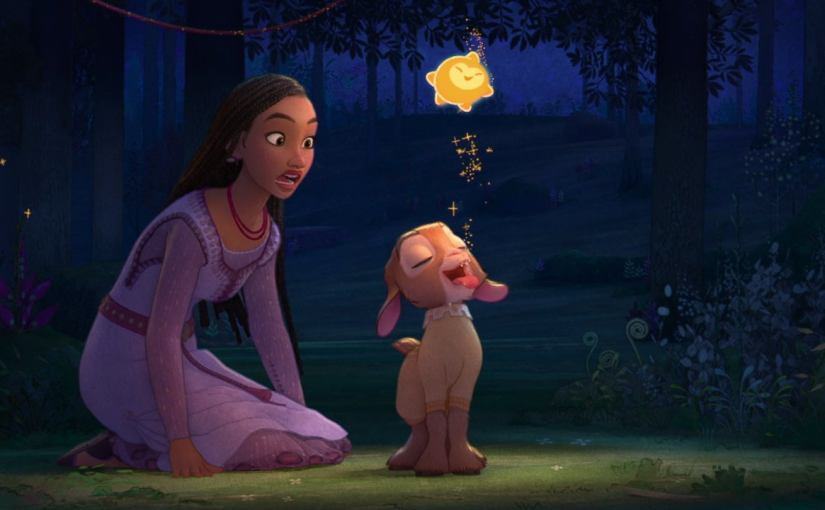
Asha is the hero of this story who makes a wish upon a star.  Actually, a literal character named Star enters the picture.  Star squeaks like a precious darling, ready to be your children’s next plush toy acquisition.  He shoots sparkling trails of gold out of his pointed appendages.  With Star’s help, Asha will reach the standard showdown with the villain by the film’s end and the awakening of the people below.  It’s all trite material that’s been done before.

Wish relies on the vast history of fantastical stories, believing you can fly and be heroic or simply a sidekick tagging along with the protagonist.  Asha has seven friends.  One is referred to as grumpy.  Huh!  How do you like that? Must it be so apparent so often though?  Thanks to Star, forest animals talk and one even makes an inside gag to Zootopia.  You’re practically asked “Get it?  See what I did there?” Magnifico bears a striking resemblance to Jafar and even resides in a similar castle to the Aladdin villain with stone spiral staircases to explore.

The colors and animation are just as engaging as nearly any other Disney film.  A few songs work, but there’s nothing on the level on what was accomplished during the days of Rice and Menken, or even more updated fare like Frozen.  I can’t recall the title of a single number from Wish.  Magnifico sings.  Asha sings multiple times.  The two duet together and it’s not terrible. Ariana DeBose could sing the phone book and I’ll feel swooned.  The supporting people of Rosa sing in choral support as well.

Still, what tainted my experience was turning a very real epidemic of cultish culture into a fantasy catered for all ages to enjoy.  The wishes the people offer up are the endless “donations” that a cult mentality always requests.  While I appreciate being accepted into a fraternity of Disney loving storytelling, I did not need to be banged over the head with so much saluting either.  The end credits contain one classic Disney character after another appearing next to the ongoing scroll.  Hi Dumbo.  Hi Genie.  Hi Peter.  Hi Belle. 

Disney always reminds us to believe our wishes will come true and yet with Wish the studio chose to go with what is blatantly familiar.  It’s time for some fresh ideas again that especially do not source themselves from the reality of harmful sects spreading false doctrines. 

NOTE: I still have a fresh idea from a very popular legendary story that Disney, nor Universal or Warner Bros has yet to touch.  Maybe it’s time I get it down on paper.  Hmm.

MAX DUGAN RETURNS

By Marc S. Sanders

Max Dugan Returns is one of those delightful films where the smile never leaves your face.  It’s a cozy, rainy Saturday afternoon with your favorite pillow and throw blanket.  The characters are whimsical, and they simply feel like good, good friends you would love to have in your life.

Nora McPhee (Marsha Mason) is an overworked, underpaid high school English teacher who is drowning in debt with a broken refrigerator and a car that is as ugly as it sounds on the road.  Her fifteen-year-old son Michael (Matthew Broderick, in a sensational on-screen debut performance) is a good kid, but she’s worried he’s getting too involved with the drug dealers that roam his school.

After her jalopy of a car gets stolen, the only positive that comes upon her is in the form of Donald Sutherland as a cop named Brian.  After he lends her his motorcycle to get around, there’s an immediate attraction, but it could not happen at a worse time.

Nora’s father, Max Dugan (Jason Robards), who abandoned her at age 9 arrives on her doorstep in the middle of a rainy night with a business proposition.  Now that his doctors have informed him he has six months to live, he would like to provide Nora and Michael with the six hundred thousand dollars he’s towed with him in an attaché case.  In exchange, he only wants to spend time with his grandson.  Beyond the animosity she’s held for Max, what alarms Nora is that her father stole this money from a Vegas casino.  He claims the mob stole the money from him first.  She doesn’t want the money; not with Brian the police officer in her life and she does not want to be affiliated with Max’ criminal past or associations.  Not to mention there would no way to explain this sudden windfall based on her minimal teacher’s salary.  Max won’t go away so easily, though.

Thus, the theme of Max Dugan Returns is one scene after another where a hoard of luxurious items arrive on the McPhee’s doorstep.  New appliances, new jewelry, new furnishings, fresh groceries, electronics for Michael, a Mercedes, and a thoroughbred dog named Pluto – I’m sorry.  Plato!

It’s impossible not to love this movie.  It is one of the few films that Neil Simon wrote directly for the screen.  It is so much fun though, that I think it would work marvelously as a stage play.  The story may not be grounded in reality, but Simon’s dialogue is so quick and sharp and a better cast could not be found to deliver Neil Simon’s wit.

Mason, Robards, Broderick and Sutherland have pitch perfect chemistry with one another.  These actors are so absorbed in their characters, and it makes sense.  Matthew Broderick was personally selected by Neil Simon to do his biographical play, Brighton Beach Memoirs.  Marsha Mason did five of Simon’s adapted films while she was married to him.  (They divorced shortly after the release of this picture in 1983.)  Jason Robards has an affectionate gravel to his voice – one of the best voices in film next to James Earl Jones. Robards is just so appealing as he playfully conflicts with Mason on screen while connecting with Broderick’s character under a different identity.  It’s important Max maintains a low profile.  Donald Sutherland is the straightest character in the picture.  He has a relaxed manner to him that’s found often in Neil Simon’s scripts (unless you’re a Nora McPhee or a Felix Unger).  In another actor’s hands, this would be just a walk on role, but with Sutherland on screen, you are satisfied to watch another winning performance from this actor with a relaxed stature and a genteel way about him, as his detective suits and ties hang loose on his shoulders.

Max Dugan Returns is an enchanting fantasy without the overt fantasy.  It never needed unicorns or lovable elves to deliver its magic and whimsy.  I did notice a collection of rainbows –  easter eggs hiding in plain sight, however.  Are pots of gold to be uncovered? The film asks what would happen if your long-lost father showed up on your doorstep with a suitcase full of money and a treasure trove of gifts to bestow upon you. 

Hey, it could only happen in the movies.

ARTHUR THE KING

By Marc S. Sanders

I cannot stand to watch dogs in peril.  It guts me right in the feels and stays with me long after.  I only saw the movie Single White Female once, when it was in theaters, and I still remember that puppy’s horrifying demise.  Terrible. Just awful.

On the other hand, when a dog is the companion or the factor of good fortune needed for the cast of human characters, I’m going to be won over.  Arthur The King has a shaggy mutt that you absolutely fall in love with, but I don’t think its all schmaltz, because the dog who portrays the title character is not the only storyline to follow.

Mark Wahlberg is Michael, who leads a team of four endurance adventurer racers.  He has the odds stacked against him.  He’s a well-known racer within the circuit but not for the right reasons.  The teams he’s led usually place in the top ten at the finish line, but Michael has never made it to first place.  Not once.  On social media, he’s mocked as the guy who comes up short.  His father (Paul Guilfoyle) is not very encouraging either.  As well, the window of opportunity to show himself as a champion is dwindling as he’s getting up in years.  Still, Michael is confident he has one more race left in him, but he’s granted very little sponsorship money and given a lot less time to train and prepare than he and his team are accustomed to.

Joining Michael in the competition is Olivia (Nathalie Emmanuel) who is an expert climber on any terrain.  She is reluctantly joining the team at the urging of her terminally ill father.  There’s also Chik (Ali Suliman) who serves as the navigator during the race looking for alternative routes and detours off the path that will put the team ahead of others.  Lastly, there is Leo (Simu Liu).  He is the vain Instagram celebrity with thousands of followers and a huge chip on his shoulder that tests Michael’s instincts because Leo has usually been right in the past.  Michael always made the foolhardy option to ignore Leo’s concerns and thus got stuck in the mud, missing another first-place opportunity.

The homeless, neglected dog in the picture initially follows a parallel story within the streets of the Dominican Republic.  Living off scraps with damp, dirty fur, he roams from place to place, being chased and bullied by other alley dogs.

Director Simon Cellan Jones goes for a documentary approach to the endurance racing.  Bylines and GPS maps cut into the picture showing the team’s progress and where they stand in the rankings.  Sometimes there are voiceover commentaries.  It’s efficient information that allows the audience to keep up with the team’s progress as the flow of the film moves at a brisk pace.

We see the team of four run, bike, kayak, climb, stop for breaks, and debate their next options.  Challenges arrive where a large rock must be climbed.  Heavy rain weighs upon their progress.  Snakes are encountered.  Swamp conditions must be overcome.  A thrilling zip line sequence will have you sitting up in your chair.  The footage in this scene is amazing to look at from the enormous height over a bottomless jungle chasm.  It’s certainly dramatic.  Because the film does not rely on the standard suspense music you might find in other sports films, it performs like a documentary with the director’s well positioned camera work and the unexpected reactions of the cast.

At a rest stop the dog captures Michael’s attention.  Some scritches and scratches along with a few meatball treats and then the team must move on.  However, the dog seemingly turns up within the dense jungle terrain having followed their trajectory.  Michael can’t help but be fascinated by the stamina of this animal, and thus a connection is made.  Shortly thereafter, Olivia, Chik and even Leo warms up to the fifth team member.

The race goes on.  Michael’s wife and daughter follow the team’s progress from home.  Dehydration sets in.  A twisted knee interferes.  It’s all standard.  Yet, it’s hard not to get caught up in this film.

If you have never been a pet owner, it might be hard to truly relate how an animal can change a person.  It might sound cliché but there’s really no way to describe how unconditional a dog’s love can be, and Arthur The King certainly demonstrates that kind of affection. If that is still not enough for you to swallow, then consider that this film is based on a true story. 

There was a dog named Arthur The King who defied the odds to keep up with an endurance racer named Mikael Lindnord, thereby inspiring the team to push forward and strive to win.  The inspiration of the real-life Arthur established The Arthur Foundation whose ongoing mission is to raise funds to provide resources to help dogs around the world receive better care.

Arthur The King might have mapped out its story as soon as the movie began, but that does not mean it is devoid of genuine emotion.  This film possesses a yearning for adventure and a need to defy doubt and reach for victory while never losing sight of what could be more valuable than a championship.  The main character starts out as a confident endurance racer.  Yet, he’s a new kind of racer with an eye-opening perspective when he meets Arthur The King.

HAUNTED MANSION (2023)

by Miguel E. Rodriguez

DIRECTOR: Justin Simien
CAST: LaKeith Stanfield, Rosario Dawson, Owen Wilson, Tiffany Haddish, Danny DeVito, Jamie Lee Curtis, Jared Leto
MY RATING: 6/10
ROTTEN TOMATOMETER: 40%

PLOT: A single mom in New Orleans hires a grieving tour guide, a dubious psychic, a shady priest, and an unhinged historian to help exorcise her newly bought mansion after discovering it is inhabited by ghosts.


Writing even a mildly negative review of Disney’s Haunted Mansion feels a little like hitting “dislike” on a picture of a 3-legged puppy.  The puppy is just being a puppy.  It doesn’t know or care that it’s missing a leg.  It just is what it is.

So it goes with this new attempt at a movie based on a popular Disney ride.  It’s chock-a-block full of inside jokes and references to the ride, some in plain sight, some tucked away in the corners of the screen.  As a fan of the ride at the Magic Kingdom in Orlando (I’ve never been to the Disney parks in Anaheim), I enjoyed these little Easter eggs.  Truthfully…I enjoyed them a lot.  I especially liked the chair shaped like a Doom Buggy, and the room that stretches, and the hitchhiking ghosts, and on and on.  This movie is basically Ready Player One revolving around just one IP instead of hundreds of them.  (That’s “Intellectual Property” for all you non-nerds out there.)

But aside from all the cool references, there’s not much else to recommend, especially not for those few poor souls who are not as thoroughly familiar with the Disney ride as I and many others are.  For those people, I would imagine Haunted Mansion plays a little bit like a de-fanged version of the original Jumanji [1995] or Jon Favreau’s criminally under-appreciated Zathura [2005].  There’s a heart-tugging sub-plot about the grieving tour guide, Ben, played by LaKeith Stanfield.  (Stanfield deserves recognition for playing the absurd material absolutely straight, even pulling out the emotional stops for a touching moment as he describes his late wife, in a scene that features an absolute scene-stealing button from Danny DeVito.)  Travis, son of single mom Gabbie (Rosario Dawson), has problems with bullies at school, even when he isn’t troubled by the ghosts who have latched onto him like lice.  Then there’s the issue of who all the resident ghosts are REALLY afraid of, a big-bad known only as the hatbox ghost (Jared Leto).

(I was reminded here of Peter Jackson’s The Frighteners [1996] in which a host of ghosts were terrified of a being that can actually kill a ghost.)

The movie has all the requisite creepy hallways and creaking doors and one or two jump-scares, but everything is done so tongue-and-cheek that it’s never truly horrifying…which was, I’m sure, the aim of the filmmakers.  Certainly you don’t want to make a film, based on a theme park ride, as scary as The Exorcist.  So, to that end, the filmmakers succeeded.  The movie is harmless, even a little fun at times, Owen Wilson gets to deliver some of his trademark dry observations, and DeVito gets to play some notes that I haven’t seen him play in a very long time.  If pressed, I would be forced to conclude that, for non-fans of the ride, this movie would most likely be a bit of a slog.

…but it is cute, despite missing that one leg.

BOY AND THE WORLD (Brazil, 2013)

by Miguel E. Rodriguez

DIRECTOR: Alê Abreu
CAST: Vinicius Garcia, Alê Abreu, Lu Horta
MY RATING: 10/10
ROTTEN TOMATOMETER: 93% Certified Fresh

PLOT: A little boy goes on an adventurous quest in search of his father.


Filmmaker Brad Bird, the mind behind The Iron Giant, Ratatouille, and The Incredibles, once said something that occurred to me multiple times while I was watching the Brazilian animated film, Boy and the World.

“…animation is not a genre.  And people keep saying, ‘The animation genre.’  It’s not a genre!  A Western is a genre!  Animation is an art form, and it can do any genre.  You know, it can do a detective film, a cowboy film, a horror film, an R-rated film, or a kids’ fairy tale.  But it doesn’t do one thing.”

Boy and the World proves Bird’s statement correct by delivering a succinct, poignant film, virtually without words, that defies classification.  Is it a kids’ film?  It’s colorful, vibrant, and contains no long words, but it was rated PG in America.  Is it a “grown-up” film?  There is absolutely some thematic material that might require some parental explanation, but the style of the film’s images is almost like a children’s book come to life.  Boy and the World is quite unique in animation, at least in the animated films I’ve seen.  The only film I might possibly compare it to is Walt Disney’s Fantasia…or more accurately, I’d say Boy and the World was inspired by Fantasia’s core concept.  It’s a fairy tale and a cautionary tale and a coming-of-age story and a visual tour-de-force all in one.


We first meet the titular Boy in this story as he seems to be hearing music coming from under a colorful rock in a field.  The Boy is never named.  Indeed, what little dialogue we ever hear in the movie is conveyed either by grunts and coughs and harrumphs, or by a peculiar, unrecognizable language.  I turned on the Blu-ray’s subtitles, and it only said “SPEAKING FOREIGN LANGUAGE.”  But the film’s story is so well-constructed, a literal understanding of their speech is never necessary.  (Trivia note: I learn from the disc’s special features that the language we hear is Portuguese…spoken backwards.)

The Boy lives with his mother and father in a humble dwelling in the Brazilian countryside during an unspecified time period, though his clothing indicates something close to present day.  One day, his father simply decides to leave, boards a train, and is gone.  We are not given a clear reason for his departure.  The Boy is distraught, so one night he packs a suitcase (its only contents: a photo of him with his mother and father) and sets off to find him…

From there, the movie becomes an absolute visual feast.  I do not wish to give further plot details – and there IS a surprisingly compelling plot – but I do want to give some idea of the startling originality on display during the film.

  • The Boy has a unique ability that no one else in this world seems to have: he can see music.  Whenever his mother hums a tune, or his father (in flashback) plays a song on a recorder, the Boy sees the music appear in the air as little balls of color, like cotton balls or tiny clouds.  Later, he watches a parade go down a street, and the music clouds rise and swirl together in the sky, forming a huge multicolored bird.  Later still, a military formation marches down another street.  The boy sees that music as blacks and greys, and the bird it forms in the sky is far more imposing and ominous.
  • Nothing in the film is a literal representation of what it’s depicting.  For example, when the Boy sees a big city for the first time, most of the vehicles appear to have faces.  The language on all the ads and billboards doesn’t make any sense.  The sports he sees on the TV sets in the shop windows are confusing and nonsensical.  It is more like an impression a child might have of a big city, and it feels more real because of its stylistic liberties.  When he sees large industrial machines in operation for the first time, they look more like elephants and dragons than tow trucks and construction cranes.  This is something animation can do better than any other medium.

  • There is a heartbreaking scene when the Boy sees a train pull in at a station and sees his father step out.  The Boy runs forward…and then his father steps out of another car.  And another, and another.  And soon the platform is crowded with scores of men, all identical to the Boy’s father, and the Boy falls to his knees in frustration.  I interpreted this as an eloquent analogy of how anyone in the Boy’s situation might see a recognizable figure in the distance, only to be disappointed again and again.  Instead of it happening 15 or 20 times in the movie, we got it all at once, and it was an unexpectedly powerful moment.
  • Listen closely, and you’ll hear that a lot of sound effects, from birds in the jungle to car horns honking to clattering machinery, are made by musical instruments or the human voice and/or body.  Yet another unique element to an already unique film.
  • The resolution of the boy’s search took me completely by surprise.  There were little visual clues that had me believing the movie was not going to have a happy ending.  But then it unfolded, and the effect was eye-opening.  I won’t say one way or the other if he found his father or not, but I will say the ending felt earned, authentic, and very satisfying.

All told, Boy and the World is a marvelous little discovery, one that I plan to re-watch soon to drink in its marvelous visual concoction once more.  My colleague, Marc, is a playwright who once wrote a short play as a pantomime.  He believed (and still does, I think) that the main purpose of the visual arts is to show us something new and exciting whenever possible.  Boy and the World would be right up his alley.

EXPLORERS (1985)

by Miguel E. Rodriguez

DIRECTOR: Joe Dante
CAST: Ethan Hawke, River Phoenix, Jason Presson, Robert Picardo, Dick Miller
MY RATING: 7/10
ROTTEN TOMATOMETER: 72% Fresh
Everyone’s a Critic Category: “Watch a Family-Friendly Film”

PLOT: Three friends try to unravel the mystery of these strange dreams they’ve all been having, at the same time.


I’m probably biased, but one of the best times to be a teenaged movie fan had to be the 1980s.  In the wake of his stupendous earlier successes, Steven Spielberg began to produce movies, letting other directors do the heavy lifting while he contributed behind the scenes.  This led to Gremlins, The Goonies, Young Sherlock Holmes, and of course, Back to the Future.  All in a two-year period.  Awesome.

In an attempt to replicate the success of these box-office favorites, director Joe Dante (The Howling, Gremlins) presented a film unabashedly aimed at its target audience, starring a cast of unknown, but immensely likable, teenagers, including two young men making their Hollywood debut: Ethan Hawke and a nerded-up River Phoenix.  While Explorers lacks the polish and sophistication of its predecessors, it is undeniably charming and, for a while at least, even a little spooky, even if the ending flies spectacularly off the rails.

Ben Crandall (Hawke) is a teenage kid obsessed with 1950s sci-fi movies.  He’s been having these strange dreams filled with what look like electrical schematics.  He draws these pictures as best he can and shows them to his best friend, Wolfgang (Phoenix), a science prodigy.  Ben also makes friends with Darren (Jason Presson), the stereotypical kid-from-the-wrong-side-of-the-tracks, and brings him along when Wolfgang decides to turn on the machine he built using Ben’s drawings.

What this machine eventually enables them to do is fly around inside a converted Tilt-a-Whirl car using an Apple II computer to steer.  (Did I mention this was made in 1985?)  One night, though, a phantom signal takes control of their little craft and starts sending it up, up, up…into space?  I wouldn’t dream of saying.

As a fourteen-year-old kid watching this movie, I strongly identified with the idea of receiving a message from space, not to mention being able to fly in a makeshift spaceship.  To say I envied those kids on screen is a monumental understatement.  Their dialogue may not have been as refined as it could have been, and the sub-plot about Ben’s crush on the “gorgeous blonde” in his class is a little ham-handed (not to mention that plot point never really goes anywhere), but I didn’t care.  SPACE, man!  Just imagine being able to go to SPACE!  What a bunch of lucky kids!

Well, naturally, after a couple of false starts, the three of them actually make it to space, where they have a close encounter of the…goofy kind.  If you’ve seen the movie, you know what I’m talking about.  You see, the aliens who were sending these schematics have been listening to and watching decades worth of TV signals.  So that’s how they communicate with our heroes.  Close Encounters it ain’t.  And the way these aliens look…any sense of wonder at being in space and communicating with an alien species gets torpedoed by the fact these guys look like a kid’s version of an alien.  Even Ben realizes something’s amiss when he says, “They don’t make any sense.”

So, yeah, Explorers is no Contact.  But let’s be fair, it was never meant to be.  Sure, it does kind of lead you down that garden path, but the final reels leave you in no doubt that this is sci-fi comedy, not drama.  It has not aged as well as its Spielberg-produced contemporaries.  But I watch it today, and I still get that little thrill of discovery when they turn that machine on for the first time.  And flying around in a spaceship that you built?  Who wouldn’t find that idea exciting?  Am I right?


QUESTIONS FROM EVERYONE’S A CRITIC

Which character were you most able to identify with or connect with?  In what way?
Shoot, are you kidding?  Ben, played by Ethan Hawke.  He was my age at the time.  Loved movies.  Loved sci-fi.  Wanted to be an astronaut.  Had a crush.  (Christine Day.  Went to my church.  Red hair.)  And also thought those aliens at the end made no sense.  Man, that was ME.

What elements do you feel are necessary to create an entertaining family-oriented film?  Do you feel this movie had those things?
Explorers has everything necessary to create an entertaining family-oriented film…in the first half.  The second half goes for easy laughs and cheapens what could have been something wondrous.  Alas.

GUESS WHO’S COMING TO DINNER

By Marc S. Sanders

Watching Stanley Kramer’s Guess Who’s Coming To Dinner had me reflect on a brief encounter I had many years ago.  I was a head teller in a bank and approached the drive thru window to collect a customer’s transaction.  The junior teller who was part of my team got there before me and as she reached for the checks and deposit slip she commented “That’s disgusting!”  I was so engrossed in a busy day that it didn’t register until later what she was referring to.  In fact, I’m proud it did not register.  The customers in the car were a mixed couple with two children in the back.  I guess I’m happy to be naturally color blind.  Sadly some others still live with such an ailment.  We’ve come a long way, but I think we have a lot further to go.

Guess Who’s Coming To Dinner is a classic American film that should be watched by anyone with a pulse.  If not for anything else, then to realize that somehow our human nature is held back by prejudices that we can not keep from considering.  So, let’s learn to overcome whatever foolhardy thinking stands in the way of happiness for ourselves and our loved ones.

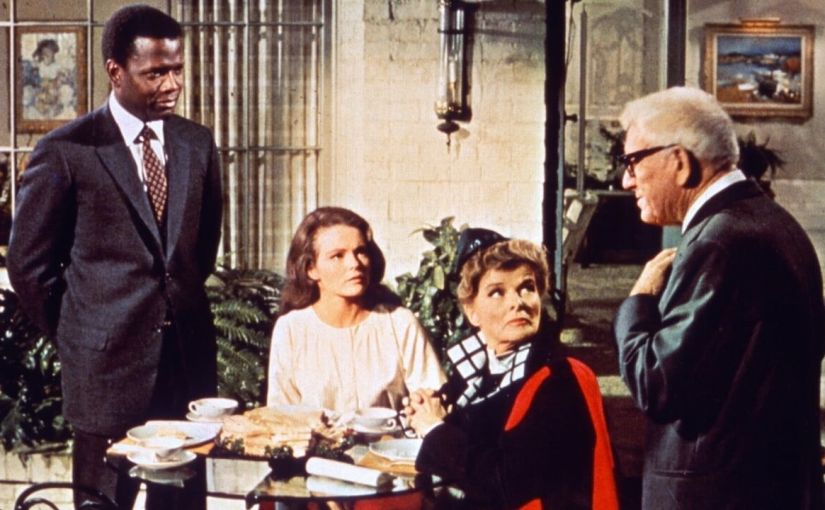
Sidney Poitier portrays Dr. John Prentice, a gentlemanly successful, polite, and brilliant physician with an educational background from Johns Hopkins, a professorship at Yale and internships with the World Health Organization in Africa and Asia.  He has just flown into San Francisco from a Hawaiian vacation with the young girl he has fallen madly in love with, Joanna Drayton (Katharine Houghton).  Joanna is the daughter of Matt and Christina Drayton (Spencer Tracy, Katharine Hepburn).  She is a highly energetic twentysomething with an optimistic view on life.  Everyone else has to take a second look at the fact that Joanna is paired up with a Negro or a colored man (as the movie indicates).  Even their cab driver has to offer an odd glance while the happy couple kiss in the back seat.  John is even aware that it can be a little startling at first.  Joanna doesn’t give it a second thought as she was raised by liberal parents who taught her that no race or creed is better than any other.  Everyone is equal.

The test for Matt and Christina however is whether a black man can be a husband to their white daughter?  It’s much different when you are on the outside looking in.  How do you respond when such a scenario occurs within your own household.  Even the black loyal housekeeper to the Draytons, Tillie (Isabel Sanford), takes a serious contempt towards the situation, more vocally than Joanna’s parents.  For Tillie, this is a hairbrained stunt by a wild-eyed young girl.  John’s parents fly up to meet Joanna and they have reservations as well.  It does not help that John doesn’t share with his mom and dad that Joanna is white ahead of meeting her in person.  Joanna also did not offer the same courtesy to Matt and Christina about John.  Curiously, for Joanna it should not even make a difference.  For John, he’s hesitant because he knows this will not play out well, initially. John is okay with his new, loving relationship.  He’s wise enough to know that his parents, particularly his father, will not be, however.

What caught my attention more than anything was the difference in age between John and Joanna.  He’s 37.  She’s 23. 

In Stanley Kramer’s film, there isn’t so much a prejudice towards whites or blacks.  It’s more so that there is a reservation toward a mixed race couple.  Should blacks only belong with blacks, and whites only belong with whites?  Of course not.  However, biting sarcasm is tossed into the script suggesting that what Joanna and John are doing would be considered illegal in 14 states.  It wasn’t at the time of the release of this film in 1967, but this was just ahead of when Dr. Martin Luther King Jr was assassinated amidst the civil rights movement spreading throughout the country.  Joanna even makes reference to the fact that she would not let go of John even if her mother was Governor of Alabama, who at the time was Governor Lurleen Burns Wallace, wife of notorious segregationist and former Governor George Wallace.  As well, let’s face it.  While it might be legal on the books, many in the United States were still intolerable of a living situation like this. Legally, a mixed marriage can happen.  Yet not everyone settles for just accepting what is law. 

Spencer Tracy as Joanna’s father Matt is the one who most prominently struggles with this situation.  He’s insisted upon to offer his blessing on John and Joanna’s upcoming nuptials.  However, he’s on a deadline to approve as they are flying out of town later that night and will get married in ten days while John is working in Geneva.  This is all contrived to contain the story within one day where a beginning is offered that must arrive at an end that provides closure.  It’s kind of sitcomy.  Christina warms up to the idea.  She likes John very much.  It’s Matt who has the problem.  It’s also John’s father (Roy Glenn) who takes issue as well.  His mother (Beah Richards) approves if the children are happy simply because she loves her son.

Spencer Tracy closes the film with his reasoning on the subject.  Arguably it is one of the most well thought out soliloquies in film history.  What I took away from it the most is that he stressed his concern for how hundreds of people across this country will look upon John and Joanna with unjustified derision.  Yet, the young couple will have to plow on and survive through those challenges. 

As a film, I could not help but account for a common theme in the picture which did not have so much to do with race as it did with a change in generations.  First, Kramer offers a quick escapist scene where a white delivery truck driver is bopping along to the latest rock music.  Tillie’s daughter joins in and hops in the truck for a ride with the fella.

Matt drives to a diner with Christina and orders an ice cream float.  Upon leaving, he accidentally backs his car into a young black man’s hot rod.  The older white man has to negotiate and accept fault with the younger, frustrated black man.  Once it is settled, Matt vents to his wife that he runs into one of them everywhere he looks.  Times have changed.  Matt has taught his daughter that no race is better than any other.  Does he realize that as well, though? 

Later in the film, Sidney Poitier as John has a stern conversation with his father.  John says in no uncertain terms that he owes nothing to his father.  He does not owe it to his father to not fall in love with a white woman.  His father owes everything to him for having him as a son, and he will commit that same mindset to his own children, if he should ever have any, regardless of the changes that come of that future generation.

There’s a reason Sidney Poitier is noted as a pioneer for black actors in cinema.  He was the first African American man to win an Academy Award for Lillies In The Field.  He also performed in Guess Who’s Coming To Dinner in the same year he made In The Heat Of The Night, which focused on a black Philadelphia cop headlining a murder investigation in the racist state of Mississippi at the time.  Both films were nominated for Best Picture. Heat won.  Poitier was well aware of the racist strife permeating throughout the country.  Per his insistence for his own safety, In The Heat Of The Night had to be shot primarily in the state of Illinois, away from the southern states that were not ready to accept a black man in an authoritative role.  I recall reading that Poitier refused to be cast in roles as the clown where the black man was treated as the punchline for white people’s entertainment.  He kept to a policy of adhering to roles demonstrating the intelligence of black men the same as other colleagues in his profession who were of the Caucasian race.  What an influence he was because of his doctrine.

Guess Who’s Coming To Dinner does not take daring risks with its story.  Every single character is likable, other than the racist colleague memorably dismissed early in the picture by Hepburn.  At times, the story does play like a sitcom ready to welcome a laugh track.  Nevertheless, it is an important film to see nearly sixty years later when racism and prejudice remain uninvitingly prominent.  The script, written by William Rose, is so sensible.  What is so wrong with a man, any man, in love with a woman, any woman?  Yes.  It feels unconventional when your household has consisted of one race for so many years or decades.  However, despite the difference in the pigments of two people’s skin, happiness is what is most important.  Matt testifies towards his unconditional love for Christina in his closing remarks and determines that is the one true factor in a relationship that must always be questioned whether it is the start of something new or something that has reached its twilight years.

As I come to my conclusion, again I reflect to that incident I had working in the bank with that teller.  What exactly was so “disgusting?”

NOTE: On this second viewing of the film, I specifically paid attention to Spencer Tracy’s closing monologue.  George Clooney recalled on Inside The Actor’s Studio with James Lipton, a story he heard.  Tracy was very ill during the making of this picture.  So ill, that Katharine Hepburn contributed financing to making this film to appease the insurance company that was concerned about the actor being unable to finish the project.  She drove him to and from the studio and often left early with him when she could see he could not go on much longer in the shooting days. During Spencer Tracy’s monologue, you can see him looking down frequently as he delivered his dialogue.  He was reading lines and blocking cues on the floor.  Clooney was just so impressed.  Typically, an actor would be directed to avoid looking down so much and focus on the camera in front of him or the other performers in the scene.  Spencer Tracy was just so impressive with his timing in this moment.  His glances down at the floor were embedded into the behavior of the character.  Sadly, Spencer Tracy passed away 17 days after filming was completed on Guess Who’s Coming To Dinner.  He received a posthumous Oscar nomination for Best Actor.  I like to think the challenge he endured lent itself to an adoring, beautiful and unforgettable performance.