ROMA

By Marc S. Sanders

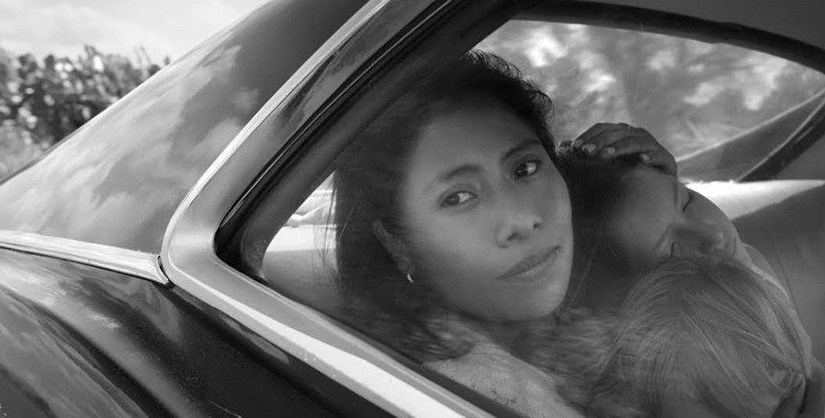
Alfonso Cuaron’s new film, Roma, is a masterpiece in cinematography, sound, and empathetic storytelling. Shot in beautiful, multi-dimensional black & white, it tells the story of a house servant named Cleo who tends to a family living in the city section known as Roma during the year 1970 in Mexico.

Cleo is portrayed beautifully with quiet reservation by Yalitza Aparicio. I imagine this actress is not well known to mainstream audiences. Perhaps she is not well known to Mexican or Hispanic audiences as well. However, it would be so refreshing if the positive response of this film opens up opportunities for her within more widely known fare, much like Precious did for Gabourey Sidibe.

Cleo seems content to cater to the family that contains four young children and their mother. The father appears stern in his mannerisms until one day he leaves for a conference taking place in Quebec. However, allusions to this conference indicate a different story when his absence lingers on longer than expected. During this year, Cleo gets pregnant by Fermin, the cousin of a friend. Fermin leaves Cleo to deal with the pregnancy on her own, and in the moments when he returns to the story, it is not promising that he will commit to fatherhood.

Cuaron writes and directs a relatively simple story amid turmoil in a very confused country that centers on riots among the young citizens and men who are not noble enough to dedicate themselves to the women that cross their lives. Family is not convenient either. When a conclusion dawns upon Cleo near the end of the film, you can’t help but understand her position. What she has seen is gut wrenching.

To further compliment this work is to appreciate the visual sense and sound of the film. This is not a sci fi special effects extravaganza like Cuaron has accomplished with his Oscar winning Gravity, or the dystopian action depicted in his under appreciated Children Of Men (masterful steady cam work in that film, especially). Cuaron takes advantage of a crowded bustling lower middle class city with an overpopulation of dogs, planes flying overhead, music, and crowded streets of different happenings. I watched this film with my new 7 point sound system and this film is perfect proof that I made a smart purchase. Cuaron hooks your senses to engage you in his setting. Therefore, the setting justifiably serves the title of the film.

The photography is sensational as well. Cuaron hardly does a close up on any of the characters. Rather, he opts to go deeper to show there’s more going on in any one given moment than just what is in front of you. The first example of this is during the opening credits that are displayed over the course of several minutes on a tile paved driveway. First you are just looking at tiles. Then you are looking at Cleo’s soapy mop water splash across the tiles. Now you have a reflection of the sky above and you get a sense of how high the sky goes as a passenger jet plane casually flies overhead. Dimension is gradually introduced and the theme of Cuaron’s filmmaking continues on during the course of the picture.

Later, at a pivotal point in the film, when Cleo delivers her child (I don’t think that’s a spoiler), Cuaron puts the silhouetted profile of Cleo close to his lens and then to the right deeper into the room you watch as the hospital staff tend to the newborn; seeing the baby, seeing the towels held by the staff, watching the staff tend to the baby. Cleo is separated from the activity but she remains in the room, exhausted and discombobulated from what she has just experienced. A moment like this, I would imagine, would be good material for film students to examine. Cuaron proves that what you show in a moment can be limitless in the scope of a lens. Nothing is impossible.

Because the film is in black & white, the activity of the hospital staff never appears to upstage or overshadow the experience that Cleo is enduring. Had this been in color, a viewer could have been distracted by the blood and the sweat and lighting in the hospital room. It’s all there. It’s just not as distracting as a colorized moment might have suggested. Cuaron’s choice of black and white permits you to focus on everything. So, a scene like this is so wisely conceived.

Roma will likely be selected as a nominee for Best Picture and Director. It deserves it, much more so than many other films I saw in what I consider 2018 to be a weak year for inventive filmmaking. I highly recommend this film. If you don’t have a good sound system or a high definition TV to watch it currently on Netflix, then find it at a local cinema. To immerse yourself in this film, requires the best in sound and visual quality.

I will admit that it takes some getting used to reading the subtitles translating both Spanish and Mexican, and Cuaron takes his time setting up his story. You have to be patient with the film. However, I watched the film on Saturday, December 28, 2018 and I still can’t stop thinking about it.

Please check out Alfonso Cuaron’s beautiful film, Roma. I think you’ll be glad you did.

NOMADLAND

By Marc S. Sanders

amazon ( n.) a large strong and aggressive woman; Synonyms: virago. amazon ( n.) mainly green tropical American parrots; 2. Amazon ( n.) (Greek mythology) one of a nation of women warriors of Scythia (who burned off the right breast in order to use a bow and arrow more effectively);

As I reflect on watching the 2020 Best Picture Oscar winning film, Nomadland, I considered the literal translation of the word “amazon.”  To many of us, I would think the word has an entirely different meaning.  Director, writer and editor Chloe Zhao probably considers both the literal definition of the first noun (noted above), as well as the brand name that seemingly runs the world these days.

Fern, played without compromise by Frances McDormand, is likely a strong and aggressive woman, though only subconsciously large.  I’d argue you would have to be in order to survive as a nomad within a pre-Trump era mid-western America with a beat up van as your mobile residence and a deep plastic bucket for a toilet that isn’t hard on your knees when used.  Fern is a former resident of Empire, Nevada.  Empire and its postal zip code no longer exist as of 2011 when the sheetrock factory that sustained the town closed up after 88 years, thus forcing all its residents to give up their homes and relocate elsewhere.  Now that Fern is widowed, she does not see any other way to live other than in the van she calls “Vanguard.”  She lives paycheck to paycheck with seasonal jobs that are hopefully available.  The first of these jobs includes a packing facility for Amazon.  Once the holidays are over, it’s up in the air as to what she’ll come across next.

Zhao is an observational director.  To depict a film about a lonely, uncertain post middle age nomadic widow will require shots of the country like frost on the ground, deep snow, endless roads, hot deserts and moonlit campfires with other nomads who come by Fern’s way.  These people (many of which are real life nomads in the film) might travel individually but they are a community as well.  They teach one another in ways of being resourceful with auto repair or what’s the best bucket for a toilet.  They provide people like Fern with temporary job opportunities.  They also counsel one another with how to deal with grief and share their own health challenges like the various forms of cancer and illnesses they endure and how they plan to live out the remainder of their limited time on earth.  One woman with an inoperable brain tumor is determined to make it back to Alaska.  What drives these people is not necessarily a will to survive.  More importantly, it’s the knowledge that they will cross paths with one another again.  An experienced nomad who lost a son to suicide never considers saying goodbye to anyone he encounters.  Rather, he is staunch in telling others that he’ll “see them down the road,” at another time and place.  He reminds Fern that to live this life is to never close the book or end a chapter, and memories of those we have lost can only stay alive if Fern and others stay alive.

I appreciate a film like Nomadland simply because I’ve never been the brave traveler.  One of my greatest fears is being lost and alone.  It has always terrified me.  I still don’t trust the navigation apps on my cell phone.  I have to see the destination in front of me.  Luckily, my wife keeps me in check.  Yet, Nomadland is a film that gives me an opportunity to explore places I might never arrive at, while I sit safely in front of my flat screen.  Chloe Zhao shoots with wide lenses to take in gorgeous landscapes.  How fortunate for Fern that she can encounter all of this beauty in person.  How fortunate, as a viewer, a film like this allows me to witness what’s out there.  How sad though as well that sometimes this way of life seems treacherous and nonsensical.  Whatever entity created the earth allowed no sympathy for a flat tire or a broken-down engine, when you have no means of paying for replacement parts.  As well, mother nature is not always going to be that companion that holds your hand during lonely times.  Corporate America certainly won’t do that either, but it is a necessary evil.  Thank you, Amazon!

Frances McDormand is perfect for this role as she carries no inhibitions about herself.  She will truly show herself sans makeup or coiffed hairstyles, floating nude in a stream, or go so far as to literally defecate on screen in that practical bucket to demonstrate how truly unglamourous and unforgiving the life of a nomad is. 

Nomadland is not a favorite film of mine, but I can’t help but appreciate its honesty thanks to Zhao, McDormand and the numerous real-life nomads that inhabit the picture.  It’s a sad story; not a triumphant one, but it is also a film that tries to emulate the comfort of being “houseless…not homeless” as Fern describes with absolute certainty.  It might not be the life for many of us, but it is definitely a life meant for Fern.

CREED II

By Marc S. Sanders

Creed II is fortunate to have a stellar cast that includes an exceptional Michael B Jordan as the title character, Sylvester Stallone (again as Rocky Balboa), Tessa Thompson, Phylicia Rashad and even Dolph Lundgren back as Russian boxer Ivan Drago. It’s a cast with great chemistry, especially between Jordan and Thompson, rekindling what made their relationship so authentic in the first “Creed” film. I appreciate how all the characters genuinely care for one another without getting too schmaltzy. Nevertheless, that’s about all that works for this installment.

The problem with Creed II is that it is blatantly formulaic, almost to the point that I was getting drowsy. If not for the gentleman sitting next to me who could not get into a comfortable position, I might have slept through the whole film. The first hour is really a slog. Maybe this next door viewer was getting bored like me, and couldn’t fight his restlessness.

In the 2nd hour, after Creed gets beaten to a pulp mentally and physically by Drago’s gigantor of a son (am I really spoiling anything here?) does it pick up, because we are about to enter BEAST MODE where the staple training montages (this time in a desert where i guess sunburn and dehydration lead to exceptional athleticism) are about to begin, and Creed is gonna kick the Russian guy’s ass once and for all.

Hey! I didn’t give away the ending here. You’ve seen this movie before in Rocky III, Rocky IV and Rocky 99 1/2. So quit your cryin’.

That’s the thing with Creed II. It’s an exact replica blueprint of the Rocky franchise films before it. Stallone pulled up his saved script on Word, and simply changed a couple of names and pop culture references. Example: scratch out music by Survivor and insert modern age hip hop.

There’s nothing new here, except for maybe giving a little dimension to Ivan Drago as a one time heroic celebrity of a country that no longer exists and a people who no longer celebrate him. Now, he lives through the stamina and strength of his son, Viktor. Not bad writing for Drago. Just not enough material for him. Otherwise, again there’s nothing special here that you haven’t seen before.

Wait…scratch that…I gotta say I couldn’t keep my eyes off Michael B Jordan. This guy is a good actor, but man is he ripped. I mean not an ounce of fat on this guy. He’s practically an eighth wonder of the world. It’s great to see, but even that is not enough to see Creed II in theatres. Wait for Netflix and save 12 bucks.

BOHEMIAN RHAPSODY

By Marc S. Sanders

The aftermath of Rami Malek’s electrifying performance of Freddie Mercury might just follow the same trajectory of Jessie Eisenberg’s portrayal of Mark Zuckerberg. People will never be able to see past the one accomplishment and every role hereafter will be measured against this moment. Bohemian Rhapsody will likely be Malek’s best film of his career.

Bryan Singer, and more importantly an uncredited director replacement, have assembled a by the numbers music biopic complete with defiance against naysayers, sexual discoveries, band discourse, drugs, booze, illness, a wildly eccentric lead and an altogether sensational soundtrack. This isn’t me complaining however. The film might be formulaic but what else should I expect really?

Though I’m dubious if the compositions really were spawned as depicted, I nevertheless loved every second of Bohemian Rhapsody. Yeah, I doubt “Another One Bites The Dust” finally sprung to life during an in studio scuffle but as soon as the bass began to play, I was in the moment. Movies should always touch you naturally. The emotional response should never feel forced. It should be be triggered. The music of Queen has that effect for me. Not every song. Some lyrics are downright silly. Yet if “We Are The Champions” is going to be re-enacted during a Live Aid concert at Wembley Stadium following a series of setbacks for Mercury, you are going to get caught up in the moment.

The song introductions are the highlights of the film. They carry an energy that leads to lip sync and toe tap. However, the movie doesn’t stop there. I appreciated the strife between Freddie and his disapproving father, his affection for his bandmates and the eventual conflict among them, his struggles with loving Mary, his wife, while coming to grips with his bisexuality, his betrayals among those that used him, and finally his AIDS diagnosis. Every aspect is given enough attention. Still , we are treated to a near full shot for shot re-enactment of Live Aid, one of Freddie’s final performances before his eventual surrender to death.

Called me biased. Yet I’m not a die hard Queen fan. I just found the period set up authentic. The music editing to be well orchestrated and the cast to be spot on. A Mike Myers appearance (look for him but you won’t see how apparent he really is) is inspired.

The film ultimately belongs to Malek. Awards season will be generous to him. He’s comfortable and assured in the attire, the skin, the gravitas and even the teeth of Freddie Mercury. This was a film circulating the press for many years. Everyone seemingly wanted a bio pic. Finally, it has arrived and no one else could have played Freddie Mercury so beautifully as Rami Malek. He’s a miracle!

CHAPPAQUIDDICK

By Marc S. Sanders

The morals of Senator Ted Kennedy were tested in July, 1969. While under the influence, he drove his car off a bridge that overturned into a pond. The Senator survived. Over 9 hours later, he reported that a passenger he was with drowned in the accident.

It’s terrible to think about the trust he retained following this incident. He was re-elected to office, and went on to become the 4th longest running Senator in American history. The parents of Mary Jo Kopeckni (Kate Mara) lost a daughter with a promising future.

Jason Clarke is excellent as the insecure son of an intimidating stroke stricken Joseph Kennedy Sr (Bruce Dern, effectively overpowering with paralyzed limitation), forced to walk in the shadows of his brothers John and Robert, both assassinated prior to this occurrence. Clarke is great as someone we are to be disapproving of, but for me personally I’m that much more disgusted by the Senator’s response.

Ed Helms is Ted’s cousin Joe who makes all efforts to make this right following the foolhardy actions that occur. Senator Kennedy tries to pride himself as a martyr for the state of Massachusetts, appearing as a victim with a false neck brace, claiming a concussion, hiding left over alcohol and sympathizing with the Kopeckni family. He identifies himself as a “moral compass.” Cousin Joe knows differently as the truly authentic moral character, yet he’s merely disregarded by the army of Kennedy spin doctoring.

Director John Curran will have you believe more of this story and it’s longevity in history did not amount to much considering this all occurred while Neil Armstrong was making his historic walk on the moon, ironically initiated by President John Kennedy. It’s a reason I believe the Senator sustained quite a successful career. Maybe not totally successful. I don’t recall another President Kennedy.

Curran maintains a picturesque image of Martha’s Vineyard and the slow gradual response of all the players, including a police chief who has no scuba gear and must resort to getting down to his skivies to search through the submerged car. The chief is also quite comfortable with accepting an eventual prepared statement followed by a release so the Senator need not concern himself.

None of this was pretty. None of this was Camelot. John Curran’s film reminds you of a young woman helplessly drowning, while the perpetrator did nothing but consider his chances at a Presidency from that point on.

Chappaquiddick is a must see film.

A STAR IS BORN (2018)

By Marc S. Sanders

Bradley Cooper produces, directs and co-writes himself with Lady Gaga in the fourth iteration of A Star Is Born. They will go down as the hottest screen couple of October, 2018, but not much beyond that.

The chemistry is maybe there between the two stars but I won’t say it’s very electrifying. Individually, I really liked what each of their performances offered. Together? Meh. At times when they are in a scene it almost looks like they are not paying attention to one another; as if they aren’t listening for their cues. Oddly enough, Sam Elliott and Cooper have terrific chemistry as brothers. They truly look and sound like they came from the same cloth. Same with Gaga and Andrew “Dice” Clay as her father (a welcome surprise; I wish he had more material). The scenes with Gaga and Cooper however don’t measure up.

Cooper directs outstanding musical performances of himself and especially Gaga, though I’d argue she relieved some of the pressure with her experienced talents. Her first concert introduction is show stopping; that note she hits stays with you. Her final performance is just as effective and reminiscent of the legendary status Whitney Houston made for herself in The Bodyguard.

Cooper’s directorial debut absolutely must be commended. The concert set pieces are especially authentic. However, the film is too long. For a simple and familiar story, two hours and fifteen minutes is a bit much. A small appearance by Dave Chappelle as Cooper’s friend is wasted and pointless. He shows up an hour into the film, does a quick scene and then he’s never mentioned again. Definitely a scene worthy of the cutting room floor.

Lady Gaga has wonderful moments especially at the very end and during the first half of the film. The 2nd act is by no means her fault but when her stardom blossoms, I didn’t care for the image of a what seemed like a 2nd rate Miley Cyrus act. I would have preferred something more sophisticated like Celine Dion, Adele, or heck even a Lady Gaga. The artificial orange/red hair is a major distraction. I couldn’t help but get fixated on this car accident of an hairdo and not on the performance. A poor choice.

It’s a good film. Not great. Some songs are memorable. Some are very forgettable. I think Bradley Cooper did a fine directing job more or less. I just hope he gets a little better.

THE DELTA FORCE

By Marc S. Sanders

In the 1980s, a small production company named Cannon Films was started by an Israeli named Menachem Golan.  It churned out at least a dozen Charles Bronsan cheapy crime dramas and gave longevity to his Death Wish series of films.  Cannon also provided another franchise called American Ninja with action star Michael Dudikoff.  Dudikoff, nor any of his films won an Oscar, much less a Golden Globe or even an MTV Movie Award.  The poor guy with twenty bottles of mousse in his hair didn’t even get turned into an action figure. 

While I did see Death Wish 3, ahem…five times in the movie theatres (I mean there’s an outstanding final thirty minutes of a wall to wall shootout action in that film, and it was all a 13 year old boy yearned for at the time), Golan’s best product that I have at least seen to date is The Delta Force, featuring Chuck Norris, Lee Marvin and a host of stars most recently having been featured in every disaster film to crank out of the 1970s; Shelly Winters from The Poseidon Adventure, Robert Vaughn from The Towering Inferno and George Kennedy from every Airport movie under the sun.

Golan directed this film that was inspired by the 1985 hijacking of a TWA flight heading for Athens, Greece and he pretty much directed two different kinds of films in one.  The first hour focuses on the Libyan hijackers, led by an unrecognizable and terrifying Robert Forester, and their hostages.  A plane carrying mostly Americans is taken captive in midair and is diverted to Beirut.  Like the real-life event, a German born American stewardess is forced to select the Jewish passengers (Winters, Lanie Kazan, Joey Bishop and Martin Balsam) and separate them for an unknown fate.  An American Navy serviceman is also brutally tormented and later, an airline pilot (Bo Svenson) is interviewed by the media from the open window of the grounded plane’s cockpit, complete with a gun to his head.  All of this happened during that harrowing event.  Golan does a very good job of capturing these moments with heartbreak, fear and genuine terror.  The Jewish selection process is a scene that I take very personally, and it is not overdramatized as it glaringly hearkens back to the atrocities of the Nazis who sent millions of Jews to certain death, torture and concentration camps.  Remember, this film was released only 40 years after those terrible events.  Golan’s filmmaking makes certain the Holocaust is never forgotten.

Sprinkled throughout these first hour scenes are bits and pieces of the American strike team known as The Delta Force, led with gruff command by Lee Marvin and silent but deadly Chuck Norris.  These guys gear up, dress in black uniforms, load their aircraft carrier with motorcycles and armed dune buggies, listen to Marvin’s instructions and wait and wait and wait.  There’s something to appreciate in the wait of these skilled snipers and specialists.  Golan doesn’t rush the action.  Material is depicted showing Marvin, Norris and company exploring the options they have for taking out the terrorists and rescuing the hostages.  This is not a typical Rambo movie of destroying the village just to save it.  However, once the action starts, it doesn’t stop and Golan lets Norris do all the things he’s known for while arguably inspiring how POWERFUL Chuck Norris is compared to…well…anything else.  Don’t forget!  Inside Chuck Norris’ chin is ANOTHER FIST!  Also, Superman wears Chuck Norris underoos!  Chuck Norris can unscramble an egg!  Chuck Norris made a snowman out of rain!  It’s hard not to deny these claims when the film boasts a strike team consisting of 20-30 members, but Norris seems to do all the work and heavy lifting. 

It’s hard not to get caught up in The Delta Force.  You wanna see these terrorists get blown up real good.  You also wanna see Chuck Norris ride an agile moped equipped with an endless supply of missiles and ammunition ready to overturn enemy vehicles and bloody up a bad guy until he screams and turns on one foot before dropping dead with his eyes opened.  You also may get a jolt of energy from Alan Silvestri’s rah rah theme music that quickly stays embedded in your subconscious.  I read that his music was used for a time when the Indy 500 would air on TV.  That does not surprise me at all.  Its symphonic themes are as memorable as the Monday Night Football tune.

Unlike, other Norris films this crowd pleaser doesn’t just rely on him and his roundhouse kicks.  There’s a little bit of that schtick for the fans, but I gotta say I was truly touched by the cast as whole.  Lee Marvin (in his final film) echoes George C Scott’s portrayal of Patton.  The collective hostage cast are not overdramatized here.  Golan managed to capture a history to them.  While I thought Shelley Winters was a such joke for fodder in Poseidon, here she is truly sorrowful as she is separated from her husband played by Balsam.  Kazan and Bishop are equally touching.  Reader, this Jewish guy originally from New Jersey, who attended ten years of Yeshiva education, recognizes these folks when they are spirited vacationers early on, and then later tormented prisoners who’ve faced horrors like this before.

I know that Cannon Films also produced another favorite called Runaway Train with an Oscar nominated performance from Jon Voight.  As I write this column, I’ve yet to see that film.  It’s on my radar.  That being said, I have to wonder if Golan and company had stayed on this trajectory of genuine drama like he mustered in portions of The Delta Force, what powerfully impactful films might he also had up his sleeve.  Unfortunately, we were left with too much excess like American Ninja, I’m afraid.

Still, after watching The Delta Force you’ll absolutely believe that Chuck Norris can see things that don’t exist and that he counted to infinity…twice!

WHITE BOY RICK

By Marc S. Sanders

Matthew McConaughey is probably my favorite actor that I somehow always forget about. He always has that god Ol’ boy dialect and yet he hides it so well no matter what role he plays, whether he’s a space traveler in a heavy sci fi drama like Interstellar, an AIDS victim drug dealer in Dallas Buyers Club (his Oscar winning performance), or an over the top unscrupulous stock trader in The Wolf of Wall Street. In White Boy Rick, he’s an unscrupulous black market Detroit gun dealer. Selling out of the trunk of his car, he justifies his trade by telling his son Rick it is a constitutional right to own a gun and sweetening his sales with silencers by metaphorically comparing them to up selling fries to go with a burger. His intensity as this sleazy guy is downright remarkable. A great moment for me was simply a close up of him walking down the hallway of a hospital. This guy knows how to perform in front of a camera. I’ll say it again. His intensity is remarkable. He’s seemingly worthy of an Oscar nomination. Yet, it’s likely come December this film just won’t be remembered.

The title character was first a junior gun runner per the inspiration of his father and was quickly recruited by the FBI to be an inside buyer and seller to the drug houses in the Detroit slums during the mid 80s. In a community of black criminals, with one major player married to the sister of the city’s mayor, Rick earns his moniker of White Boy Rick by speaking the lingo and dressing the part. Thick gold chains with large jeweled crosses are a status symbol. So naturally Rick shows his prominence by donning a Star of David. It makes no difference if he’s unaware of its Jewish symbolism. His bling builds his stature. From FBI insider, Rick gradually moves on towards dealing drugs on his own street smarts and a means to sustain himself along with Dad and his junkie sister as well as his grandparents. He’s a natural.

Newcomer Richie Merritt is very good in the part of Rick and holds his own against McConaughey. His attitude overcomes his father’s experience. He’s smarter than his father actually and he’s a better talker than his father. His one flaw was not realizing his inevitable future.

The director is Yann Demange, a filmmaker I’m not familiar but a skilled guy nonetheless. He captures a dirty snow covered Detroit in 1984-87 very well with dark crack houses, wet streets and a crowded skating arena. These locales are where these guys dwell. The photographery looks worn out and offers that uncozy winter feel. The only glamour of this atmosphere comes mink coats worn by the dealers and their gaudy Run DMC gold chains.

Here’s hoping I’m wrong and this small film gains some more traction and following. It’s a good true story that I never heard of. It’s got a solid cast that easily blends into this dangerous underground, and its performances are worthy of recognition during awards season.

JUST MERCY

By Marc S. Sanders

I’ve learned so much from movies. I really have, and I’m continuing to learn. An important lesson that I absorbed from Destin Daniel Cretton’s film Just Mercy is that we have a long way to go in this country. A racial divide is sadly still in existence. As I watched this film while the nationwide protest response to the killing of George Floyd is still prominent, it’s glaringly obvious that this story, taking place from 1987 to 1993, has likely only made a tiny dent in the reach for equal and fair justice between black and white Americans.

Just Mercy follows newly appointed Alabama civil rights attorney Bryan Stephenson’s (Michael B Jordan, who I still insist will win an Oscar one day) pursuit to overturn a murder conviction for Walter “Johnny D” McMillan (another magnificent performance from Jamie Foxx). Johnny D was easily ruled to have murdered an eighteen year old white woman. The trial hinged on the testimony of another convict (Tim Blake Nelson) pressured into making up an outrageous story that put Johnny D at the scene of a crime he had nothing to do with. All that mattered was that the all white jury believed this ridiculous testimony.

Bryan is newly graduated from Harvard University with nothing but righteousness and the intent of making a difference in this world. Against his family’s urging for fear of his life, he deliberately moves to Alabama with Federal Grant money to start the Equal Justice Initiative (EJI) with Eva Ansley (Brie Larson), a passionate white southern mother who is prepared to face the danger of a prejudiced community that’s hypocritically proud to boast that it is the hometown of writer Harper Lee (To Kill A Mockingbird). Bryan is informed that he can actually visit the Mockingbird museum and see where Atticus Finch actually stood. I question if the majority of Monroe, Alabama have even read Lee’s book.

Bryan’s intent is to research and represent those prisoners that likely never received a fair trial. One man is a Vietnam veteran who did in fact kill a woman with a home made bomb. Sadly though, his PTSD likely motivated this regrettable action. This man is more mentally ill than guilty and his country could care less.

Most of the film’s focus goes to the egregious acts that convicted Johnny D. While it’s plain to see how innocent he is, Bryan is faced with bigoted pushback from the local police force as well as the District Attorney (a very good and effective Rafe Spall). Bryan obtains a material witness but then that is compromised. Now he must rely on if the convict who originally testified against Johnny D will come clean with telling the truth.

There’s a lot you can become more aware of while watching Just Mercy. First, our legal system can be very tainted with extreme prejudice. Second, slavery may have been long abolished by the end of the twentieth century, but it’s racial underpinnings and need to dominate a black community still appears justified in many southern eyes. There’s a sad food chain that exists in the state of Alabama. It therefore becomes an impossible obstacle for Bryan and Johnny D when they take their case to the state Supreme Court. This doesn’t take a law degree to recognize such an apparent wrong. Yet, that means nothing if the judicial system won’t even read a simple and otherwise obvious explanation.

A third aspect that Just Mercy presents is police brutality against black men. It exists. A black man, such as a hard working tree cutter like Johnny D or a Harvard graduate in a suit, can get pulled over. The man can cooperate completely with hands shown and calm politeness when faced with an authority. Yet, with next to no action that black man will suddenly have a gun drawn on him and get slammed against a truck and put in handcuffs.

Moments like this continue to occur simply because of the color of their skin. It matters not where they were going or where they were coming from. If they just look guilty, then they must be guilty.

Just Mercy is a demonstration of a large menu of wrongs being committed against black America. Cretton’s script with Andrew Lanham, is a well edited and focused film that doesn’t drift into any side stories. Bryan Stephenson seemingly takes in a lot of cases all at once but for a two hour and twenty minute film, only so much can be presented.

Yes, Johnny D’s case is most prominent but time is also devoted to what could be his overall fate, a trip to the electric chair. Bryan Stephenson sees this first hand with another case. It is often a wrong and terrible outcome but it at least amplifies his motivation to represent these wrongly convicted men.

Bryan Stephenson is a tremendous hero portrayed by a humble yet passionate performance from Michael B Jordan. How many Harvard graduates would truly take their expensive Ivy League degree and put their lives on the line in an unwelcome community with no pay to save the lives of convicts who no one else has ever regarded?

Most especially during the current climate of our country, Just Mercy is an absolute must see film.

PARASITE

By Marc S. Sanders

I first discovered director Bong Joon-Ho when I watched his futuristic sci fi adventure Snowpiercer. I loved that film despite how absurd the set up was. Absurdity, though, is a credit to his craft. That’s why his latest film Parasite is a hugely successful interpretation of class warfare within South Korea. It might all appear drastically unlikely. Yet, it’s all absolutely possible when you reflect on the film after you’ve seen it.

Parasite begins almost like a farce and ends in deep, realistic horror that you’d never expect, even after you surpass the films midway surprise.

It’s best I leave much of the film’s details out. The less you know the better. I knew nothing at all about the film beyond the numerous accolades it has received. I was better off for it.

Joon-Ho’s film makes its point quickly that there is always someone better off than us and always someone worse off. (This was a theme carried over from Snowpiercer.). A poor family living off scrap money for folding pizza boxes while living in a cramped, bug ridden basement is still better off than the drunk who pisses on the street, outside their window. Just as an upper class family with all the best things in life are better off than them.

It’s only when this poor family find opportunity to dupe their way into this wealthy home through jobs they are hired for that we eventually see how lighthearted material, compliments of Joon-Ho and his writing collaborator, Jin Wan Han, can convincingly escalate into class warfare politics that even their characters ever hardly acknowledge, or are aware of. Is the wealthy matriarch really aware where her family chauffeur stems from or where he lives? The off putting scent of someone’s presence can quickly turn a tide or an impression.

I might sound vague, but I have no choice. It would be a betrayal to the imagination of the best film of 2019 if I spelled the film out for you.

Simply know that I truly appreciate the symbolic research Parasite presents as it makes note of a Korean child’s fascination with Native Americans, and how their plight parallels the story. Even that drunk taking a piss on someone else’s territory. Even the gift of a stone sculpture told me how one can be crushed or weighted down by his own country.

Parasite begins as one movie and ends as maybe five other different movies. It’s a farce. It’s wry and conveniently ironic; maybe silly at one point. It’s suspenseful and surprising. It’s also shockingly horrific.

I recently declared Clint Eastwood’s film Richard Jewell the best film of year. I stand corrected.

Parasite is the best film of the year.