MILLION DOLLAR BABY

By Marc S. Sanders

Clint Eastwood has one of the most remarkable careers in Hollywood history.  As his appearance has aged, so have the roles he’s occupied. He’s got these long lines that run down his cheekbones and across his forehead that compliment his signature scowl and white hair.  These facial features lend to a background in many of the characters he’s portrayed over the last thirty years ranging from a “Frank” in In The Line Of Fire to a “Frank” in Million Dollar Baby, his second film to be a recipient Oscars for Best Picture, Best Director, and Best Supporting Actor.  A Best Actress Oscar was also garnered for Hilary Swank. 

Swank won her second Oscar as Maggie Fitzgerald, a backwoods product of a hillbilly upbringing, who only lives for one dream and that is to be a championship boxer.  When she’s not waitressing to collect coins and singles for tips, she is spending every waking moment at Frank’s boxing gym, The Hit Pit.  Maggie keeps to herself by punching a bag, but she is persistent at convincing a closed off Frank to become her trainer.  Frank has no interest in training a girl, but maybe there’s more to why he’s reluctant to take her on.  The lines on Eastwood’s face seem to metaphorically hint at a challenging past.

Frank’s best friend is Eddie, or otherwise known as “Scrap Iron,” played by Morgan Freeman in a very long overdue Oscar winning role.  Some may argue that Freeman was bestowed with an award for such an illustrious career.  That’s fine.  I still believe that this performance is just as worthy as his other celebrated works (Driving Miss Daisy, The Shawshank Redemption).  Eddie lives in a small room in the gym and manages the place by day.  Frank is a crank towards Eddie, but they’re the best of pals. Frank carries the responsibility for Eddie losing an eye in the ring while under his coaching. 

Frank also suffers from the loss of a relationship with a daughter.  He writes her but the letters come back “return to sender.”

Million Dollar Baby is a boxing movie but the film, written by Paul Haggis, serves a much deeper and intimate purpose.  Eastwood, as director, gives beautiful and sensitive focus towards a relationship between Maggie and Frank.  Maggie has an ungrateful family with a mother (Margo Martindale) who spits the gift of a purchased home back in Maggie’s face.  Hilary Swank offers silent, yet agonizing hurt at the rejection and Haggis writes a simple line for her to share with her coach by asserting “You’re all I have, Boss.”  In turn, without his daughter, Maggie is all Frank has.  Their commonality is “Scrap Iron” who is there to offer insight into what Maggie needs from Frank, and what Frank needs from Maggie.  As well, Scrap even suggests that Maggie seeks out another manager to salvage both of their souls.

Haggis and Eastwood go even further with the setting of The Hit Pit.  A mentally disabled kid who proudly identifies himself as Danger (Jay Baruchel) relies on the gym for his own personal glorification.  Danger is a kid with no experience and no business being a boxer, but he glorifies himself as the next all-time great champion while the other boxers (Anthony Mackie, Michael Pena) tease and jeer him.  Frank hems and haws at Scrap Iron to get rid of him.  Danger doesn’t belong here.  Scrap Iron just lets the kid come and go.  The two old guys are both protecting Danger.  One doesn’t want to see another kid get permanently injured, but the other is well aware this kid has nowhere to go.

Million Dollar Baby is a film of acceptance when every other direction leads to rejection for its characters.  Every main character is destined to serve a purpose for another character.  The surprisingly heartbreaking third act is an ultimate test for a dare-to-dream fighter and her coach, however. 

A grizzled old trainer like Frank will laugh in the face of one of God’s ministers with his daily visits to Mass to hide the guilt he feels responsible for, while a girl boxer who wasn’t even much of a fighter until Frank reluctantly accepted her is forced to question how useful she is for herself or Frank or Scrap Iron after she’s been trained to be an elite.

There is so much to appreciate of the sins and curses that weigh on Frank, Scrap Iron and Maggie.  Accompanied with their anguish is a quiet, tearful piano soundtrack composed by Clint Eastwood, himself.  To complete the picture is the dark shadowed cinematography from Tom Stern.  So often, Eastwood with Stern shoots the cast in silhouette. A narrow beam of white light points down on Maggie punching the bag with earnest, but no rhythm.  It could also be Scrap Iron looking from a window upon his friends who accept the pain they live with.  The characters show only a small portion of profile while they are involved in their character.  You’ll catch a glimpse of Frank’s chiseled lines, or Maggie’s black eye and broken nose, or the rough texture of Scrap Iron’s dark complexion.  Other moments, Eastwood follows himself walking through the front door of Frank’s home to find another letter on the floor coming back to him, unopened, returned to sender.  The pain never gets numb.  The darkness of Stern’s photography is haunting, and yet it’s blanketed as comfort for these lonely souls.

Morgan Freeman as Scrap Iron narrates this bedtime story, and we eventually learn who he’s actually speaking to.  It’s the last element of the picture needed to complete Million Dollar Baby.  Freeman is the best candidate for any kind of voiceover.  He only draws attention to these people, in this beat-up old boxing gym, who never acquired acceptance from who they once thought should matter most in their lives. 

This film takes place in and out of a boxing ring.  However, it’s not so much about the sport as it is about surviving through personal battles that’ll never be won. 

Million Dollar Baby is one of the best films Clint Eastwood directed as well as performed in, and it belongs at the top of Freeman and Swank’s career best as well.  It’s just a beautiful piece.

NIMONA (2023)

by Miguel E. Rodriguez

DIRECTORS: Nick Bruno, Troy Quane
CAST: Chloë Grace Moretz, Riz Ahmed, Eugene Lee Yang, Frances Conroy
MY RATING: 9/10
ROTTEN TOMATOMETER: 94% Certified Fresh

PLOT: Framed for a crime he didn’t commit, a knight in a futuristic world reluctantly accepts the help of a shapeshifting teenager to prove his innocence.


Just when I thought the Spider-Verse animated films held the current monopoly on creating cool futuristic worlds, along comes Nimona with its delirious fusion of medieval pageantry with flying cars, cellphones, and annoying TV jingles.  Put aside what some will no doubt call its “woke” agenda/storyline and just drink in the amazing visuals, as knights in shining armor wield swords as they ride hoverbikes into battle.  (There is the occasional horse, naturally…some traditions apparently die hard in this version of the future.)

The pre-requisite prologue explains how a brave warrior queen, Gloreth, defeated a vile monster a thousand years ago.  To maintain vigilance against any future attacks, Gloreth’s subjects erected a wall around their magnificent city and created the Institute, a sort of school-for-knights, to train their protectors from generation to generation.

One thousand years later, the city prepares to matriculate its current class of knights, including, for the first time in their history, a commoner, Ballister (Riz Ahmed), championed by the current Queen Valerin as a symbol of progress.  What matters a knight’s lineage if his heart is brave, and his spirit is bold?  This choice has not gone over well unanimously in the queendom, unfortunately, but she is confident in her choice.  However, in a twist of fate, Ballister’s sword malfunctions during the knighthood ceremony, resulting in the Queen’s death, and Ballister, minus an arm, finds himself a fugitive.

He has exactly two allies.  One is his romantic partner and fellow knight candidate, Ambrosius Goldenloin, a direct descendant of Gloreth herself, who spearheads the search for Ballister in an attempt to keep someone else from killing him outright.  The other is a flighty, impetuous teenager who tracks Ballister down the following night and offers her services as sidekick to what she thinks is the newest villain in town, Ballister the Queen Slayer.  This is Nimona (Chloë Grace Moretz), a shapeshifter who can assume any form she desires, although her favorites appear to be a pink rhinoceros and a giant pink whale.  She likes pink.  And punk, as it turns out.

I imagine one could be cynical and say that what follows story-wise is nothing new: our heroes overcome initial adversities and suspicions of each other, they track down clues, deal with one or two serious crises, and eventually expose the truth of what really happened the day the Queen was killed.  But that’s like saying The Stand is about a bunch of people who survive the end of the world and eventually defeat the bad guy.  Well, duhNimona doesn’t offer anything outrageously subversive in the story department.  What it offers is a fresh new imagination and perspective in how it tells this story, especially when it comes to the character of Nimona herself, the very definition of the rebel outsider who literally doesn’t fit in anywhere.

What makes great kids films work – what makes MOST films work – is how it invites the juvenile audience to identify with the main character.  In Pinocchio, what little kid doesn’t know what it’s like when a lie grows out of control?  In The Wizard of Oz, what little kid has never felt homesick?  In Harry Potter and the Sorcerer’s Stone, what kid has never dreamed that they were special, not really meant for everyday life?

In Nimona, what kid has never felt alienated at some point in their life because of something that makes them different?  They’re not as old as the grown-ups.  They’re not as young as little babies anymore.  They’re in an in-between world where they’re only as strong as the friends they make, if they’re lucky enough to make friends.  What if there is something inherently different about them?  Nimona has tried shapeshifting before, tried to explain her gift, but people immediately think of her as a monster instead of someone who’s gifted.  There are echoes of the X-Men films here, too, but those mutants were lucky enough to find a home at Xavier’s mansion.  Nimona is not so lucky.  So, she decides to embrace the monstrous role society thrusts upon her.  I imagine there are lots of people out there who feel the same to one degree or another.  I’m not a sociologist, but it seems logical.

The real villain of the story (I won’t reveal their identity) does everything in their power to manipulate the narrative in the eyes of the public.  At one point, their scheme is all but exposed, but they discover yet another way to maintain power: turn society on itself.  They reveal the existence of the shapeshifter, explaining to the city that the real monster could be sitting next to you, or playing with your child, or living in your house.  The sinister nature of this ploy made me genuinely angry, mostly because of how effective it is, both in the film and in real life.  When you’re too busy fighting each other, the true villains win.

Enough philosophy.  Nimona stands among the best animated films yet produced by Netflix (Klaus, Guillermo del Toro’s Pinocchio).  There is plenty of humor to go around to leaven the moments when the film goes deep into territories unexplored even in the best Pixar movies.  (Correct me if I’m wrong, but I can’t recall a Pixar film where a character contemplates suicide as an alternative to grief.)  The end credits inform me that Nimona is based on a graphic novel.  Guess what I’m looking for on Amazon in a few minutes.

SMASH PALACE (New Zealand, 1981)

by Miguel E. Rodriguez

DIRECTOR: Roger Donaldson
CAST: Bruno Lawrence, Anna Maria Monticelli, Greer Robson-Kirk, Keith Aberdein, Desmond Kelly
MY RATING: 8/10
ROTTEN TOMATOMETER: 100%

PLOT: After the break-up of his marriage, a racing driver sets out to get back his daughter – at any cost.


Since last night, I’ve been trying to figure out what to compare Smash Palace to, and I finally came up with something: John Sayles.  Smash Palace resembles the best films of John Sayles, in that they are concerned with nothing more than character and plot.  The performances and camerawork do not strive for effect or bias, and the plot, while it proceeds with perfect logic, remained a mystery to me right up to the final scene.  I can’t quite vouch for its re-watch value, but any movie that can keep me guessing until the credits roll gets its due in my book.

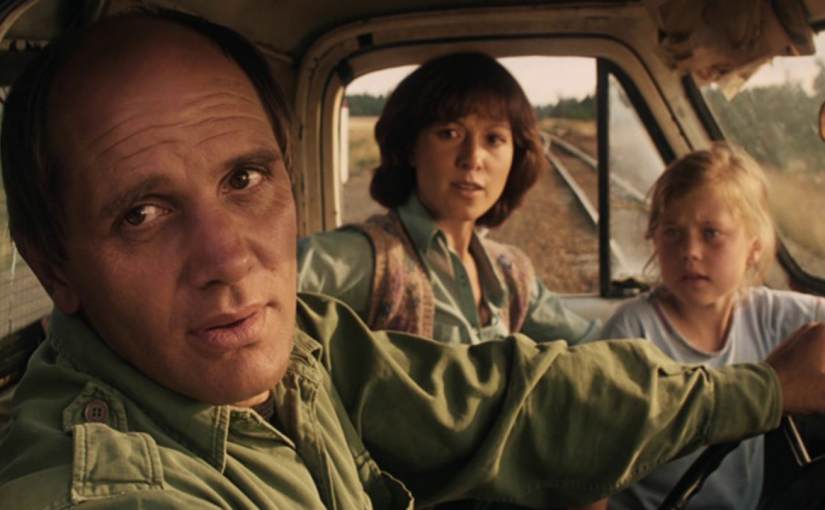
Alan (Bruno Lawrence) is a once-famous Grand Prix racer who has semi-retired to a sprawling auto junkyard, the titular Smash Palace, with his fragrant wife, Jacqui (Anna Maria Monticelli), and their 7-year-old daughter, Georgie (Greer Robson-Kirk).  The fact that these actors were all unknown to me created an atmosphere of reality that would have been more difficult to reproduce with established names and faces.  The movie opens with a spectacular single-car crash on a lonely road and establishes Alan’s job: to haul away totaled cars to his junkyard for scrap.  The size and scope of his automotive graveyard is shown in a shot that astonished me.  (I was even more astonished when I learned in the Blu Ray special features that this graveyard is an actual location that still operates today.)

We watch as Alan tinkers in his garage with a racing car he plans to drive in an upcoming race.  He’s also restoring an older car (from the ‘20s, maybe?  I’m not an expert) for his best mate, Ray (Keith Aberdein), a local policeman.  These opening scenes establish everyone’s relationship: Alan loves his wife and daughter, Jacqui loves their daughter but has become exasperated with Alan’s unwillingness to sell Smash Palace and move out of the sticks, and Georgie loves her mum and dad and enjoys helping Dad with his repair jobs.  When Jacqui wants to go to a party, Alan demurs, citing work.  Jacqui then says she won’t go at all, and Alan does what he thinks is the right thing: offers to drive her to the party, and Ray can drive her home.  Alan’s perfect logic completely ignores the crumbling state of his marriage, much to Jacqui’s dismay.  Even young Georgie questions his decision-making when Alan tucks her in that night.

Jacqui winds up driving herself to the party.  At the party, Ray, Alan’s cop friend, finds it necessary to drive Jacqui home when she is drunk and claims her car won’t start.  On the way home, a moment passes between Ray and Jacqui.  We are teased with the possibility that either something or nothing happened.  The next morning when Ray drives out to pick up the stranded car, he finds no trouble and the car starts with no problem.  Curious…

As the song says, one thing leads to another.  Alan and Jacqui get into a quasi-violent argument at home while Georgie retreats to her room, sucks her thumb, and turns a flashlight on and off, on and off, a precisely observed scene that brought back strong memories of when my own parents had their fair share of arguments leading up to their eventual divorce.  We get a deeper sense of Alan’s emotional depth, or lack thereof, when his idea of making everything all right is apologizing to his wife while she cries on the bed, then having rough makeup sex.  In the afterglow of their “lovemaking”, Jacqui calmly informs Alan she’s leaving him.  His nearly wordless response is worth the ticket price.

I don’t want to reveal too much of what happens next, because while it may seem like we’re heading into soap opera territory, and we kind of are, it’s important that I convey a peculiar emotional tug-of-war that occurred as I watched.  There are scenes of violent emotions getting the best of Alan.  I’m not talking about physical violence or beating his wife or anything like that; this movie is too smart to tip its hand in that direction so quickly and obviously.  But, for example, at one point, Alan points a shotgun at someone while he yells at his daughter to “get in the truck!”  Now, speaking as a rational person, there is obviously no situation, ever, in which pointing a shotgun and essentially kidnapping your own daughter would ever be justified.  I think we can all agree there.  But the subtle genius of Smash Palace is that, while the scene unfolded, I could so clearly see why Alan was doing what he did that, yes, in the moment, I sided with him.  It wasn’t until the scene was over that I found myself wondering, wait, that’s not cool what he did.

But then, was it “cool” for Jacqui to file the New Zealand equivalent of a restraining order against Alan when he had taken her hunting without informing her after they were separated?  Was it “cool” for her to almost immediately take up a relationship with Ray, Alan’s best mate, a move that would almost certainly enrage Ray even further?  Well, what difference does “cool” make?  Jacqui is doing what she feels is best for her and her daughter in the face of a loveless marriage to a man who would rather bury himself in the hood of a car than face up to his responsibilities as a husband.

That’s the beauty of Smash Palace.  We may not agree with what these people do, but we can clearly see the why at every turn.  The movie takes the trappings of a soap opera and turns it into a crystallized character study that explains why a man with limited emotional resources would point a shotgun at someone’s face because he believes that’s his last remaining option.  Alan’s shortcomings have trapped him, and while we audience members know he’s in the wrong, we sigh and commiserate with him: “That poor, dumb bastard.”  And the same applies to Jacqui.  We know she’s doing the right things by moving out and taking Georgie with her, but because we know how shortsighted Alan is, and we know SHE knows it, too, we feel the same kind of regret when her actions force Alan’s hand.  An old family friend, Tiny, even tries to warn her of the consequences of her actions, but she will not be deterred.  Poor, dumb bastard.

Smash Palace may infuriate some viewers who have been programmed by Hollywood convention to see clearly defined boundaries between heroes and villains, especially in domestic dramas involving custody of a child.  This movie denies them that.  Instead, it invites viewers to probe their own psyches and wonder about themselves: what would I do to get my daughter back?  What would I do to keep her safe?  How far am I prepared to go to be happy in this world?  The characters in Smash Palace supply their own answers to those questions in ways that had me rooting for both sides simultaneously.  Now that’s hard.

THE SNAKE PIT (1948)

by Miguel E. Rodriguez

DIRECTOR: Anatole Litvak
CAST: Olivia de Havilland, Leo Genn, Celeste Holm, Natalie Schafer [aka Mrs. Howell on Gilligan’s Island…how about that?]
MY RATING: 8/10
ROTTEN TOMATOMETER: 100%

PLOT: A young woman’s life is torn apart when she suffers a mental breakdown and is admitted to an institution.


For much of its running time, The Snake Pit remains firmly in the realm of reality without succumbing to melodrama, as was symptomatic of so many film dramas of the 1940s.  That’s what makes it mildly disappointing when, in the last reel, we get a nice little summation of the origins of our heroine’s dilemma, and she bravely makes a series of decisions that result in a happy ending.  Naturally, that was the case in real life, as well.  The film is based an autobiographical novel by Mary Jane Ward, who spent eight months in a mental institution after a nervous breakdown.  I don’t begrudge the happy ending, you understand.  I just wish it didn’t feel as rushed as it does.

But I’m quibbling.  This is a fine film.  The Snake Pit was another in a series of Daryl F. Zanuck productions intended as “message pictures”, movies that addressed real issues in contemporary society.  The Grapes of Wrath (1940) dealt with the Dust Bowl and harsh labor conditions.  Gentleman’s Agreement (1947) was one of the first films, if not THE first, to openly condemn casual anti-Semitism in “polite” society.  The Snake Pit is said to be the first mainstream film to realistically depict conditions in America’s mental institutions at the time.  If so, the filmmakers really went for the jugular in their first at-bat.  In its own way, this is as harsh and unforgiving a film as One Flew Over the Cuckoo’s Nest.  There’s even a sequence involving shock treatments that are as effective as anything else I’ve seen along those lines.

The story begins intriguingly, as we open on the lovely open face of Virginia (a deliberately un-made-up Olivia de Havilland) as she wonders mentally what she’s doing outside on this bench.  A man we don’t see asks her a series of questions, and she has little mental conversations with herself before she answers.  Then the camera pulls out, and there is no man, just another woman telling her it’s time to go back inside.  Inside where, she wonders?  Then she’s herded with a bunch of other women back into the main hall of the Juniper Hill State Hospital.  She starts to panic.  What is she doing here?  Is she crazy?  She doesn’t feel crazy.  The reasons for her stay provide the central mystery to the film.

(Incidentally, Stephen King apparently saw this film on TV as a youngster…which may account for the numerous appearances of the Juniper Hills psychiatric facility that appears in many of his novels and stories, including It, The Dark Half, and Needful Things.  When you win on “Jeopardy”, I’ll let you know where to mail my half of the winnings.)

De Havilland’s performance is extraordinary.  Her talent is undeniable, but it’s notable that one of the silver screen’s great beauties went without makeup, wore clothes two sizes to big, and even dropped some weight to make her look more fragile.  This was my first time watching the movie, and I was astonished at her appearance.  When she flies into rages, or pleads for mercy, or desperately tries to remember her past, you really believe it.

In a series of flashbacks, we discover that Virginia Stuart was a frustrated author who met her future husband in Chicago, in the offices of the company that had just rejected her manuscript.  There was a whirlwind romance that ended when she simply ran out on him and disappeared, only to show up six months later in New York, where he had moved…six months previously.  (I don’t know about you, but that’s red flag territory in my mind, but whatever.)  Their romance picked up where it left off, there was a ceremony at City Hall, and they enjoyed married life…for about a week.  At which point Virginia behaved erratically, declaring that she will never love any man, that no man can love her, and flatly denying that today is May 12th, no matter what it says on the newspaper.  Virginia’s husband admits her to Juniper Hill, and it’s here where her troubles REALLY begin.

The film’s depictions of life on the various wards of the asylum are tame by today’s standards, but they are no less disturbing.  There are the usual cast of off-kilter characters wandering the halls, mumbling to themselves or being unreasonable, but there is something indefinably…I don’t know, squirmy about seeing this kind of behavior in such an old movie.  At least for me.  When it’s played for real and not for laughs, in black and white, in 1948, something about that place and those people became much more real to me, at least as real as McMurphy’s fellow travelers, or maybe even more so.  I’m unable to put it into words.  When someone in Cuckoo’s Nest dances by themselves in a corner or wants his cigarettes, it’s kinda funny.  In The Snake Pit, when a woman dances by herself, or another covers her face with her hair and paces around muttering that it’s her right to cover her face…it was creepy.  Is it the black-and-white cinematography?  Is it the shortage of comic relief?  Is it because they’re women instead of men?  Discuss.

(There’s even a head nurse who seems like the prototype for Nurse Ratched: a no-nonsense, by-the-book authoritarian who makes no bones about disliking Virginia.  When Virginia is given a typewriter for therapeutic reasons, the nurse reminds her: “Don’t go thinking you’re better than the rest of us just because you’re a writer.”  Talk about terrible bedside manner, geez…)

Interestingly, I didn’t find Virginia’s behavior all that “crazy.”  She has problems with her memory, she tends to fly off the handle at trivial matters, and she once bit the finger of an arrogant doctor who was waving it in her face unnecessarily.  Frankly, that sounds like something I would do on a bad day.  Virginia’s conversations with her doctor, Doctor Kik (Leo Genn), are the only things that keep her tethered to reality.  These conversations are handled extremely well.  I found myself thinking of another famous movie about psychiatry in the ‘40s: Hitchcock’s Spellbound (1945), which was not so concerned with legitimate psychiatry as it was with making sure Bergman and Peck wound up together at the end.  In that film, the conversations between doctor and patient are full of double-speak and heavy-handed metaphors.  In The Snake Pit, I found it interesting that, whenever Dr. Kik makes a small breakthrough with Virginia, he never pushes the matter.  He simply calls it a day and picks it up tomorrow, armed with new information.  I’m no doctor, but that seems way more realistic to me.

I went into The Snake Pit expecting a semi-watered drown treatment of insanity and mental institutions.  Instead, I got a film that is remarkably effective and powerful, containing a performance from Olivia de Havilland that might seem like a lot of histrionics at first, but which is the very definition of someone completely at the mercy of mood swings beyond her comprehension.  They say that only the insane never wonder if they’re crazy.  If that’s the case, Virginia is as sane as they come, wondering over and over again why she does what she does, why she’s been thrown into this place.  She comes across as someone who desperately wants someone to listen to her.  Thankfully for her, someone does.  If everyone were as lucky as she is, maybe there’d be a lot more happy endings in the world.

THE GAMBLER (1974)

By Marc S. Sanders

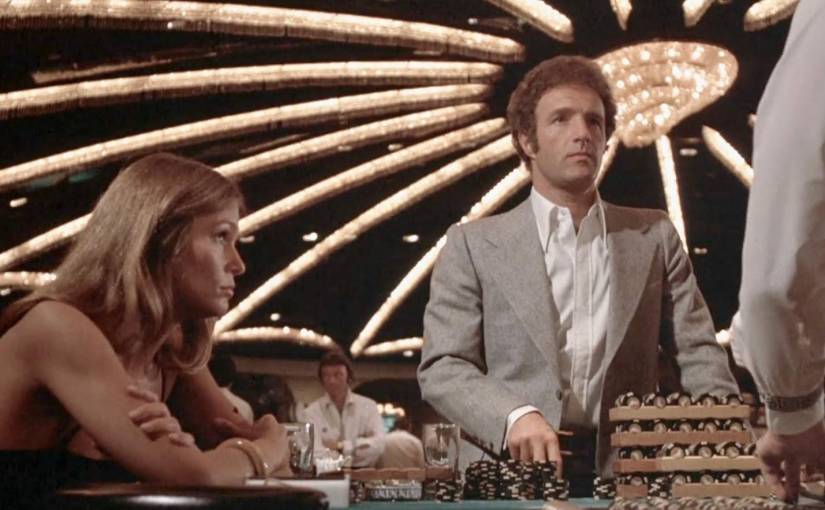
James Caan is Axel Freed, The Gambler, and when the film starts it shows the main character figuratively at the bottom of a very deep hole.  From this point on, he’s always looking at its great endless height above; a depth so low or a height so high, that there’s no crawling out of this trap.  No matter the opportunities that rescue Axel from a $44,000 debt to some bookies, he’ll never allow himself to be saved.

The autobiographical inspiration of James Toback’s first screenplay is hardly entertaining, but it held my attention all the way through.  Axel is a well-educated literature professor and an expert on Dostoyevsky but he’s entirely foolhardy.  A parallel inspiration comes from the author’s novella The Gambler.

I dunno.  Whether it’s 1974 or 2024, if I’m told I owe forty-four grand to someone who will otherwise break my legs and then who knows what else, I’d be terrified with fear.  Axel Freed seems to brush off his dilemma as he cruises through the city in his Mustang convertible.  To him, this is just the current setback of the week.  Nothing big.  He’s been in worse situations.  At least that’s what he tells himself. Axel swallows some pride and asks his mother (Jacqueline Brooks) for a loan, and she has to go through her own hoops to scrounge up the funds.  Look for an early appearance from James Woods as an unsympathetic banker.  Once mother’s monies are in hand though, Axel opts for a different route than to wipe his debt clean. Therein lies the anchoring burden of gambling addiction.

Toback’s script, directed by Karel Reisz, is not so much about a story as it is about living with overwhelming compulsion.  He writes good dialogue performed with apathy by Caan.  It’s not about winning.  It’s about the thrill of possibly losing the money he’s got in hand. 

Once Axel obtains money, he ventures off to Vegas feeling sure that he will double what he’s got and still manage to pay off this huge debt.  The brilliance of the film is that it had me tricked as Axel marathons through victory at every table while also feeling confident on three college basketball games that seem to be moving in his favor.  I was not sure if I was looking at a hero or a despairing loser during this sequence.  Reisz convinces me that it can go either way for Axel with his girlfriend, Billie (Lauren Hutton) in tow.

As many films, books, and programs that I’ve encountered focusing on gambling and the addiction it musters, I feel confident I know the outcome of the piece.  What sets The Gambler apart though is the realistic nature of what this kind of craving does to a person.  It depicts the victim as in denial, rejoicing when he dodges bullets, thinking he’s invincible.  The film demonstrates how those close to Axel Freed respond to his mounting dilemmas, but also how they are affected.  It’s inclusive not only of his Billie, his mother, his self-made millionaire grandfather, or even his main bookie (Paul Sorvino), but an admiring student of his as well. 

There are scenes that I could see how they are going to play out as soon as they begin.  I’m sorry but when I see tough guy character actors like Burt Young and Vic Tayback enter a story like this, I know something, or someone, is about to endure some damage and walk away feeling terribly threatened.  Still, I’d be complaining if Toback excised moments like this from his screenplay.

The ending left me feeling a little perplexed as to if it really belongs here.  It’s not a happy ending but seemed to come out of nowhere and I questioned its relevance against everything else that was seen before. 

The strength of The Gambler lies in the honesty of James Toback’s script and the performance of James Caan.  The film belongs exclusively to Caan and his character, with the others entering the frame when they are called upon for a cause and effect of Axel’s actions and decisions.  There’s nothing to celebrate in a hard drama like this, but I applaud the film’s will to uphold a genuine truth of how gambling addiction leaves behind a crippling life for those caught in continuing temptation.

LA GRANDE ILLUSION (France, 1937)

by Miguel E. Rodriguez

DIRECTOR: Jean Renoir
CAST: Jean Gabin, Dita Parlo, Pierre Fresnay, Erich von Stroheim, Marcel Dalio
MY RATING: 9/10
ROTTEN TOMATOMETER: 97% Certified Fresh

PLOT: During WWI, two French soldiers are captured and imprisoned in a German P.O.W. camp. Several escape attempts follow until they are eventually sent to a seemingly inescapable fortress.


What a pleasure it is sometimes to be proven wrong.  Years ago, back when Netflix was still sending physical DVDs to subscribers, I watched Jean Renoir’s anti-war masterpiece La grande illusion.  Unfortunately, I either could not or would not appreciate it for what it was, and I returned it after giving it a mediocre rating.  Flash forward to today, and even in the midst of suffering through my second Covid infection (thank YOU so much, [establishment name redacted]), I rewatched La grande illusion and found it charming, delightful, poignant, and full of (for me) unexpected comedy and ominous foreshadowing, especially because it’s a World War I film made two years before Hitler invaded Poland and ignited World War II.  Turns out this is one of the best war films ever made, whose influences are clearly seen in later classics like Stalag 17, Casablanca, and The Great Escape.  Who knew?

The film centers around two French soldiers in particular, Lieutenant Maréchal (Jean Gabin) and Captain de Boeldieu (Pierre Fresnay).  They are captured after being shot down during a reconnaissance mission and are taken to a German prison camp…camp number 17, because of course it is.  There they meet the paradoxical camp commander, Captain von Rauffenstein, portrayed by Erich von Stroheim as a man who knows the rules of war, but is willing to bend them – slightly – when it comes to imprisoned officers.  He invites them to dine at his table and even offers de Boeldieu a private cell because, wouldn’t you know it, he knew de Boeldieu’s brother before the war.  It’s almost like he’s saying, yes, we’re enemies, but we’re not savages.

There’s another reason for von Rauffenstein’s behavior that has nothing to do with chivalry.  It’s very clear that de Boeldieu and von Rauffenstein are both aristocrats.  They demonstrate this class affiliation by occasionally holding brief conversations in English, which the other soldiers, being mostly of working class, would not have understood.  It’s fascinating to watch the German and the Frenchman interacting with each other, stubbornly maintaining an air of sophistication and bonhomie required of their class, when de Boeldieu knows he must attempt escape, von Rauffenstein knows it, and de Boeldieu knows he knows it.  This might be considered the first and most obvious level of meaning in the film’s title: the grand illusion that we can still be friends, despite the war, because we’re both members of aristocracy.

Ironically, de Boeldieu doesn’t share this same kind of camaraderie with his own countrymen.  Maréchal, the man he was imprisoned with, is clearly a working-class soldier, a bit less refined, and doesn’t know a lick of English or German.  He makes one escape attempt too many and is put in solitary.  Interestingly, de Boeldieu makes similar escape attempts (we learn later), but we never see him having to experience solitary confinement for his actions.  Double standards?

The fourth major player in this drama is another fellow prisoner, Lieutenant Rosenthal, a French Jew played by Marcel Dalio.  He and several other prisoners are in the process of digging an escape tunnel under the barracks, using gear and methods that are directly quoted in The Great Escape, especially the problem of soil disposal.  It was fascinating to see so many elements in this 1937 film featured so prominently in later films.  I never realized just how influential this movie was, and probably still is.  (There’s even a scene – I won’t spoil the setup – that features a small orchestra spontaneously breaking out into La Marseillaise at a key moment…tell me the Casablanca screenwriters didn’t have this movie in mind when writing their script.)

After some months (perhaps longer, it’s unclear), Maréchal, de Boeldieu, Rosenthal, and several other prisoners are unexpectedly transferred to another camp before they can finish their tunnel.  Their new digs are at an enormous gothic castle, also run by von Rauffenstein, who by now has sustained injuries from some kind of airplane crash which require him to wear a neck brace.  He is still exceedingly friendly to de Boeldieu but assures him escape is impossible from this new “camp.”

What happens from there, I’ll leave for you to discover.  What I will repeat is that this movie covers some heavy territory with a deceptively light touch.  There is a scene where a prisoner receives a parcel from home, a large box containing nothing but women’s clothing, so the men decide to hold a mock “revue” with the male prisoners doubling for the showgirls.  One of the soldiers tries on a dress and wig and walks out and asks, “Don’t I look foolish?”  Au contraire.  The men are struck dumb in a moment that is at first hilarious, then poignant, as they feast their eyes on the first thing even resembling a woman for the first time in forever.  Another parcel arrives for some Russian prisoners in another barracks, a large box which they are sure contains food, but instead it contains – well, I won’t spoil it, but to say they are disappointed would be an understatement.

La grande illusion is brilliant at balancing profound ideas of men at war with the occasional humor in the everyday rhythm of life in a prison camp.  It even gets into the ingrained prejudices of so many people against Jews, views that in 1937 were sweeping across Germany like a plague.  (Nazi Germany banned the film, of course.)  This dichotomy is a little hard for me to describe without just giving a play-by-play of the film in its entirety.  Watching it again today, it’s impossible for me to remember what I didn’t like about this movie the first time around.  It has everything: drama, suspense, comedy, daring escape attempts, a showdown between friendship and duty, men in drag…I mean, everything.  This is one time I’m happy to admit: yes, I was wrong.  La grande illusion is not mediocre.  It’s a masterpiece.

KAGEMUSHA (Japan, 1980)

by Miguel E. Rodriguez

DIRECTOR: Akira Kurosawa
CAST: Tatsuya Nakadai, Tsotumo Yamazaki, Ken’ichi Hagawara
MY RATING: 7/10
ROTTEN TOMATOMETER: 88%

PLOT: A petty thief with an utter resemblance to a samurai warlord is hired as the lord’s double. When the warlord later dies, the thief is forced to take up arms in his place.


Kagemusha is a double-edged sword for me, no pun intended.  On the one hand, its visual beauty is virtually peerless.  Only the films of Kubrick, Lean, and those shot by Vittorio Storaro are even in the same league as Kurosawa.  There are shots in Kagemusha that will remain in my mind long after the details of the story have been purged by old age.  In particular, there’s a shot with Japanese soldiers crossing a ridgeline in the background, more soldiers in the foreground, and the setting sun positioned perfectly, so the shadows of the soldiers in the background reach out towards the viewer and interact with the foreground soldiers.  It’s a masterpiece.

On the other hand, the pacing is so sedate that newcomers to Kurosawa or foreign films in general might wonder, my god, when is something going to happen?  At one point, a key figure is taken out by musket fire from an enemy soldier.  This happens so early that we haven’t been introduced to all the main characters just yet, so the conversations surrounding the gunshot were a mystery to me until later in the film.

On the other hand, Kurosawa proves himself over and over again to be a master of the visual aspects of cinema.  In addition to the shot I mentioned above, there is a trippy dream sequence that looks as if it were painted with an explosion at the paint factory (I mean that in the best possible sense), a wonderful camera move that reveals two characters who are conversing in a plain room are actually overlooking a stormy lake, and an eerie moment when the contents of a large vase are revealed after a lengthy burglary attempt.  There are way too many other examples, you simply have to see the film to appreciate what I’m talking about.  I suppose the way to get the most out of the Kagemusha experience is to surrender to the visuals, much like I do with Barry Lyndon or Doctor Zhivago.

I wouldn’t advise anyone to completely ignore the story, though.  There is immense food for thought here.  A condemned thief is conscripted to act as a warlord’s double.  We never learn the thief’s real name.  He is credited only as “Kagemusha”, aka “The Shadow Warrior.”  He must present an outward face to the other generals, friends and foe, in the event that the real warlord is injured or killed, which (SPOILER ALERT) inevitably happens.  There is portentous dialogue about how a shadow only exists if the man is alive.  Remove the man, and how can a shadow remain?

There are several close calls where Kagemusha’s secret is almost revealed.  His grandson – well, sort of his grandson, it’s a long story – immediately yells, “THAT’S not my grandfather!” when he sees him after a long absence.  The real warlord, Shingen, had a huge black horse that only he could ride.  The inner circle who knows Kagemusha’s secret agrees immediately that he should never try to ride it; you can fool some of the people some of the time, but you can never fool a horse.  Shingen’s mistresses present a real danger.  Kagemusha squirms for a few moments as they slowly start to question his identity during tea, but he brilliantly defuses the situation by telling them the one thing they would never believe: the truth.

There’s also a much larger issue at work in Kagemusha.  Shingen’s own generals (the ones outside of the inner circle), and the opposing warlords, all believe Shingen is still alive when they see him on the battlefield.  They have no reason to think he’s an impostor.  There are some skeptics, but their spies are helpless to discover the ruse.  For all intents and purposes, that is Shingen, and they behave accordingly.

There is one battle at night where this, I don’t know, philosophy becomes all too real for Kagemusha.  In the darkness, Shingen’s forces can hear enemy armies approaching, and then musket fire breaks out.  Instinctively, Shingen’s bodyguards leap to shield Shingen/Kagemusha from enemy bullets.  Some are killed.  The look of horror on Kagemusha’s face as the dead bodyguards are piled on top of other bodies is indescribable.  They gave their lives for him.  Or, more importantly, they gave their lives for the idea of Shingen, their belief that he was the most important person on the battlefield.  I was reminded of a bit of dialogue from American Sniper, of all things, when the lead character, an accomplished sniper, is asked to cover some soldiers on a raid.  He is told that the soldiers feel invincible with him up there.  He says they’re not, and the reply is eye-opening: “They are if they think they are.”  Just like the soldiers in American Sniper, the soldiers in Kagemusha are prepared to lay down their lives for a concept.  The man is nothing, a thief.  They don’t know that, though.

This took me down a little bit of a rabbit hole.  I thought of Secret Service agents whose literal job is to protect our President and take a bullet for him if necessary.  It doesn’t matter whether he (or she) agrees with the President’s policies.  That is secondary.  Their job boils down to one thing: I will die to protect this person if that’s what it takes.  The dedication on display by these men and women humbles me, and it makes me think.  Surely, they have opinions about world and national policies.  Doesn’t matter.  It’s not part of the job.

Watching those bodyguards fall in front of the imposter warlord made me think really hard about those kinds of jobs, about anyone in any branch of the armed forces.  Ready to kill and die for what they believe in.  In the case of Kagemusha, these people died for a fake.  It makes their deaths sad, but are they any less honorable?  Like I said, food for thought.

The film ends with a massive battle where, curiously, we are not shown any deaths, only the aftermath.  (The opposing general is especially cruel: “Shoot the horses first.”)  Then there is a dreamlike coda that recalls that philosophy of dying for the right cause.

To recap, though, the movie is slow going, at least as slow, if not slower, than Kubrick’s Barry Lyndon.  I can see that Kurosawa has a lot to say with this movie.  He employed thousands of extras and lavish costumes (financed thanks to the involvement of Francis Ford Coppola and George Lucas, which is this whole OTHER thing).  It’s not my favorite Kurosawa film.  That spot is reserved for Ran (1985), which I consider his career-capping masterpiece.  Kagemusha sort of lays the groundwork for that movie, in my opinion.  It was one of his first films in color (I think) and it shows a natural talent for the medium.  Like I said before, surrender to the visuals and contemplate the story, and the slow pacing will take care of itself.  (That doesn’t make much sense, but I’m sticking to it.)

SALTBURN (2023)

by Miguel E. Rodriguez

DIRECTOR: Emerald Fennell
CAST: Barry Keoghan, Jacob Elordi, Rosamund Pike, Richard E. Grant
MY RATING: 9/10
ROTTEN TOMATOMETER: 71%

PLOT: A scholarship student at Oxford finds himself drawn into the world of a charming and aristocratic classmate, who invites him to his eccentric family’s sprawling estate for a summer never to be forgotten.


What is Saltburn?

I sit in front of my keyboard and try to figure out a way to write a review of Saltburn that doesn’t spoil its surprises in any way.  I ponder.  I rack my brain.  As of this writing (January 2024), the film has already been released theatrically and in the public eye for almost three weeks.  Any avid filmgoer who hasn’t seen it has heard rumblings about some kind of dark undertones and risqué material in writer-director Emerald Fennell’s follow-up to her astounding debut film Promising Young Woman.  The trailers reveal nothing except a plot that seems almost too similar to another film released over a month ago, The Holdovers.

Having just watched it last night, I can say that Saltburn is a pure thriller, masquerading as a dark comedy about class warfare, heavily influenced by The Talented Mr. Ripley and, say, Howards End, but that’s just plotting.  With this movie, it’s all about style and delivery, both verbally and visually.

First, a plot summary.  Young Oliver Quick (nice Dickensian name), played by Barry Keoghan, is a scholarship freshman at Oxford University in the long-ago year of 2006.  Virtually friendless except for an antisocial math whiz, he notices the strikingly handsome Felix Catton (Jacob Elordi, unknown to me), a very rich…what, junior?  Senior?  Probably a senior.  People of all genders are attracted to him like bees to honey.  Oliver is instantly attracted to him, but that doesn’t stop him from making out with one of Felix’s paramours given the opportunity.  He is nothing if not opportunistic.

After a meet-cute involving a flat bicycle tire, Felix gradually folds Oliver into his flock of hangers-on, much to the dismay of Felix’s cousin, Farleigh (who is brown-skinned…that will be important later), and to Oliver’s math friend, who cryptically tells Oliver, “He’ll get tired of you.”  One thing leads to another, and Felix winds up inviting Oliver to stay at his – there’s no other word for it – palatial manor house, Saltburn.  There, Oliver meets Felix’s aristocratic, idiosyncratic family: Felix’s mother, Elspeth (Rosamund Pike); his father, Sir James (Richard E. Grant); his sister, Venetia (newcomer Alison Oliver); a “friend of the family”, Pamela (Carey Mulligan); and the creepiest butler since that guy in the men’s room with Jack Nicholson in The Shining.

Here at Saltburn, and at Oxford, Fennell proves to be a master at creating a certain kind of mood.  There is an air of…something in the offing.  You know how some animals supposedly know when an earthquake or a tornado is coming?  That’s what the movie feels like during its first half.  I kept expecting a gruesome murder to occur, or for Oliver to discover a literal skeleton in a forgotten closet, or an explosion, I dunno, something.  I don’t know how much of that is due to my expectations after Promising Young Woman and how much to the carefully modulated camerawork and editing, but either way, the mood was there, permeating the screen with a sense of foreboding.

Oliver revels in his proximity to Felix, and I remembered with some chagrin my own formative years as a geeky teenager.  Trust me, I recognize hero worship when I see it.  At Saltburn, they sleep in separate rooms with a common bathroom, but there’s no shower, just an old-fashioned bathtub in the middle of the room.  At one point, Oliver hears…noises…coming from the bathroom and takes a peek inside, where he sees Felix lying back in the filled bathtub and – well, I’m given to understand that in Catholic schools, it was called “interfering with yourself.”

And it’s here I must stop with any kind of summarizing.  It’s here where Saltburn abandons its masquerade as a comedy of manners and becomes something else entirely.  It’s still comic, in my opinion, but it becomes less about manners and more about Machiavelli.  Oliver may present a meek façade, but he reveals the ability to do some very quick thinking indeed, especially in a moonlit scene involving Felix’s sister, Venetia, and during a karaoke party when Farleigh suggests a song for Oliver to sing that hits a little too close to home.

I admired how the movie turned my expectations on their head…twice.  There were a couple of times when, I must admit, my conspiratorial thinking led me to a couple of conclusions that turned out to be right in the end, which is something I don’t really like to do.  I don’t like to be that guy who goes to see The Sixth Sense and thinks, “You know, I don’t see how Bruce Willis could have survived that gunshot…”  I want to revel in the mystery, to live in the moment of the film and let its surprises work organically.  When a movie does its job well, I don’t even have to think about it.

What’s cool about THIS movie is that I managed to pick up on little “clues” about what was happening, or about to happen, but as the movie progressed, other things occurred (especially Felix’s little field trip with Oliver), and I found myself thinking, “Nah, never mind.”  And that is pretty ingenious, I think.  To lead the viewer down the garden path, make a left turn, get back to what looks like the main road so you think you know where it’s headed, then to pull a sudden U-turn into something else entirely?  That’s masterful misdirection.  I dunno, I fell for it hook, line, and sinker.  Call me crazy.

I haven’t even really touched on what will no doubt be the most famous elements of this movie.  That would be the scenes involving the bathtub, the cycle of the moon, a surprise midnight visit, a freshly dug grave, and Oliver’s, er, choreographic inclinations.  With the exception of that last one, which occurs too late to mean anything to the plot except as a wonderful ribbon to tie it up with, these scenes were, yes, shocking, but not in a hostile way.  Or even a Hostel way, if you take my meaning.  They were not intended to disgust or horrify the audience.  Or perhaps they ARE meant to horrify, but not in the kind of way that a serious horror movie disgusts people, like The Thing or Hellraiser.  It’s very tongue-in-cheek.  I’d like to believe there was a certain kind of glee in Emerald Fennell’s face when she watched her actors performing those scenes, knowing the material might completely turn some people off to the film without hesitation.  I found them to be yet another example of misdirection.  The off-putting nature of those scenes sort of lulled me into thinking one thing was happening and that the movie would then follow that thread into a more predictable conclusion.  But it didn’t.

I know, I’m being maddeningly vague.  The movie is new enough that I don’t want to risk spoiling anything.  There are supposedly some moths that, once touched by human hands, can never fly again.  Or is that butterflies?  Either way, I don’t want to deprive this movie of flying high in the eyes of a first-time viewer.  It’s refreshing to see a movie that seems to be following all the mile markers towards one thing, when it was really leading you somewhere else.  Saltburn is a treasure.

FUNNY GIRL (1968)

by Miguel E. Rodriguez

DIRECTOR: William Wyler
CAST: Barbra Streisand, Omar Sharif, Kay Medford, Walter Pidgeon
MY RATING: 7/10
ROTTEN TOMATOMETER: 94% Certified Fresh

PLOT: Barbra Streisand elevates this otherwise rote musical melodrama with her ultra-memorable star turn as real-life stage performer Fanny Brice.


There is nothing wrong with Funny Girl that couldn’t have been fixed by the film not taking itself so seriously.  With its widescreen compositions and scores of extras and lavish stage productions featuring flocks of Ziegfeld girls in the most extravagant costumes imaginable, this should have been a romp, even with the serious bits in between.  Instead, the movie sinks under the weight of its pretentiousness, short-changing the funniest bits and wallowing in pathos way more than is necessary.  Thank goodness Barbra Streisand is there, giving a debut performance for the ages that is part Groucho Marx, part Debbie Reynolds, but mostly just Barbra.  Come for the spectacle, stay for the songs.

The story begins with Fanny Brice (Streisand) walking backstage at a theater and delivering her immortal opening line to a mirror: “Hello, gorgeous.”  From there, the rest of the movie is a flashback to the rise and rise of Fanny Brice, a plain-ish vaudeville chorus girl who is discovered by a roguish playboy, Nick Arnstein, played by Omar Sharif, who looks like a man whose last name would be anything BUT Arnstein.  He cleverly gets her boss to raise her pay to $50 a week (about $800 in today’s dollars, so not bad), and in the process captures Fanny’s heart.  Shortly after that, she’s invited to join Florenz Ziegfeld’s legendary troupe of dancing girls, where she manages to tweak his authority in probably the funniest number in the movie, “His Love Makes Me Beautiful.”

It’s in this number where the first tonal tug-of-war takes place between Streisand’s playfulness and the movie’s urgency to look “important.”  There is an earlier number, “I’m the Greatest Star”, that really showcases Streisand, but the movie never gets that tone right for the rest of the movie.  In “His Love Makes Me Beautiful”, she has these wonderful glances and occasional throwaway lines, but most of them are lost in medium or long shots that emphasize the extravagant Ziegfeld costumes and the expensive-looking set dressing.  It’s like watching a play where the lights are shining everywhere except the stage.

Arnstein comes and goes, sometimes for weeks or months at a stretch, always making sure to see Fanny when he’s in town but repeatedly pointing out that he doesn’t want to be tied down by a relationship.  Their “courtship” lasts through “People”, a song most people know without knowing what it’s from, and a curious number where Arnstein invites her to dinner in a private room upholstered entirely in red velvet, and we know and Fanny knows what’s going to happen, and she has a funny argument between her lust and her manners in “You Are Woman, I Am Man.”  The song also contains a duet with Arnstein, and brother, if you haven’t seen Omar Sharif crooning, you haven’t lived.

Everything comes to a head at the finale of Act One when Fanny learns Arnstein is sailing to Europe and decides to join him instead of going to the Ziegfeld girls’ next port of call.  Here is where Streisand really pours it on, proving her virtuosity with the classic “Don’t Rain on My Parade”, belting out note after note and ending on the iconic shot of her standing on a tugboat as it passes the Statue of Liberty.  If anyone ever doubted she was the real thing before that moment and this movie, their doubts were certainly erased by intermission.

Alas, all good things come to an end, and Act Two falls into a predictable series of economic rises and falls as Arnstein’s volatile income stream finally goes south permanently, while Fanny’s career continues arcing upwards without looking back.  It’s here where the pretentious sensibilities of the filmmakers finally take over for good.  In a second number that could have been downright hilarious, “The Swan”, the movie once again keeps its distance from Streisand’s (appropriate) mugging, asides, and pratfalls…although, being a ballet, it is interesting to see her doing all the dancing herself.

I found myself committing a critical sin by comparing this movie to another widescreen, elaborate movie musical from around the same era, My Fair Lady.  Here’s a movie shot on a grand scale with huge sets, lavish costumes, and big musical numbers, but instead of feeling ponderous, there is a lightness to it.  It zings along, even during the long stretches between songs, thanks to its crackling pace, and gives us just enough pathos to appreciate why we need glee and glamour.

Everything that’s wrong with Funny Girl could have been fixed by just lightening the mood, man.  You’ve got a star-making performance by an experienced theatre actress (Streisand is actually reprising the role she played on Broadway), you’ve got one of the most legendary directors of the time at the helm, William Wyler (Ben-Hur, Roman Holiday), and you’ve got some above-average songs that people can still hum over fifty years later.  Why cloak everything in this gloomy overcoat of affectation and heavy-handed emotional beats that we can see coming a mile away?

When all is said and done, Funny Girl is by no means a bad film.  Streisand is too good at what she does to let this movie fall by the wayside without recognition.  But without her, it’s easy to imagine this movie sinking into near-obscurity, yet another maudlin melodrama that crams 100 minutes of story into a 2-hour-and-35-minute film.  So, rather than mourn what could have been, let’s instead give thanks for what we’ve got: one of the last of the old-fashioned Hollywood musicals with a 24-karat-gold star at its center and a handful of memorable songs.  I suppose it could have been worse.  [insert shrug emoji here]

THE IRON CLAW

By Marc S. Sanders

A compelling sports movie requires that uphill battle that must be overcome.  Rocky achieved that standard.  Raging Bull might not have reached a plateau for its protagonist to defy his faults, but Jake LaMotta’s demons were effectively on display. Reminiscent of that film, is The Iron Claw – the wrestling film that reenacts that supposed cursed theme linked with the famed all star Von Erich family. 

Writer/Director Sean Durkin opens his film with the patriarch of the family, Fritz Von Erich (Holt McCallany), in the ring and putting his signature move, THE IRON CLAW, on an opponent.  The title of the picture occupies the screen in big letters, and we jump to the late 1970s where the four sons of Fritz are having breakfast.  Fritz tells the youngest, Michael (Stanley Simons), that he needs to start working out, building his physique to catch up to his impressively built brothers if he wants to compete like them.  Fritz makes it clear he loves Mike the least but the rankings can change if he works at it.  Durkin’s breakfast scene sets off the pattern of the film where the four boys will have to live under the mantra of their father’s iron claw of unwavering expectations. 

The stand out role belongs to Zac Efron as Kevin Von Erich.  If he does not earn at least an Oscar nomination, then people have not been paying attention.  Kevin is establishing a name for himself in the nearby Texas wrestling federation, and Fritz sees opportunity for him to carry the torch of the family into national and worldwide championships.  What Fritz could not accomplish in his youth, he will ensure his sons complete.  If it is not Kevin, it’ll be one of the other boys.  Kevin is protective of his brothers, as best he can against their father.  The mother, Doris (Maura Tierney, another under the radar performance), makes it her mission to stay out of her husband’s controlling design of mentoring in a household where almighty God will lead the way, and handguns represent the American freedom to bear.

The other brothers consist of Kerry (Jeremy Allen White) and David (Harris Dickinson).  Kerry was on his way to Olympic gold in shot put until the United States opted to withdraw from the games.  Thereafter, Fritz directs his boy’s focus on wrestling as well. Kerry eventually finds himself in the center ring spotlight too. Durkin’s film shapes out each boy’s destiny as cause and effect based on the outcomes of the other boys.

I do not want to share much more.  While I had heard of the Von Erich family, I was not familiar with what they encountered during the boys’ young adult upbringing and within the spotlight.  Sean Durkin writes well drawn characters based on the real-life figures.  Fritz was a villain, a harsh antagonist, who was not so much a father as he was a chess player using his sons as pawns to win and win again.  If a setback occurred, then he turned to another athletic boy in his regiment to step up and fill a void.  If one of the boys were progressing, then he became the father’s primary focus, while another was pushed down a notch.  Holt McCallany is astonishing in this role. Fritz was a coach and hardly a father.  Any scene he occupies defines the obedience his character expects of his family.  Along with many others involved in the film, he is worthy of Oscar recognition as well.

Zac Efron has gone full method with a chiseled body and a mop top haircut that is a full departure from his pretty boy athletic physique.  As Kevin, what he’s done with his body should garner applause, but Efron’s character is tormented with never accomplishing enough, while accepting his father’s oversight when opportunity presents itself with one of his other brothers.  Kevin and his siblings are absolutely forbidden to cry at loss or setback.  This only allows the pain to remain unhidden on Efron’s face.  With no dialogue, the lead actor puts his insecurities and suffering on display whether he’s in the ring, working out or crouched in bed.  This is a stellar performance, in line with Robert DeNiro’s unforgettable portrayal of Jake LaMotta – a tortured, yet talented soul and athletic fighter imprisoned within inescapable circumstances.

Efron has terrific chemistry with Lily James as Pam, Kevin’s wife.  She is an impressive actress worthy of more attention to her career.  Lily James is not the headliner of this picture, but her response to scenes with Efron and a particular one with Maura Tierny make her acting partners all the more effective.

As the mother to these powerful men, Maura Tierny mostly hides in the background.  Should there be a chance she earns an Oscar nomination, the scene where she simply stares despondently at a black dress offers enough evidence.  This one standout moment deserves a lot of attention.

Sean Durkin is worthy of enormous accolades.  He has an ability to depict multiple stories occurring in one caption.  There’s a dizzying moment where Kevin, Kerry and David are working through their own respective progress.  Durkin blends the three athletes together, where you eventually see one hulking, flexing chest.  Above, are the blurred, sweaty faces of the three men meshed together and over one another, while working through their regimental exercises.  Their faces are layered upon each other.  

A later scene will show Kevin and Kerry practicing in an outdoor ring, with Kerry fighting a hard physical challenge.  In the foreground of this nighttime exercise, is a flashlight moving through the fields.  A subsequent moment will explain that significance.  Sean Durkin beautifully balances several biographies within this famed family.  You are viewing multiple stories at once, and nothing is ever distracting. This amounts to outstanding writing and directing that demands multiple layers.  

I became aware later that there is another son who remains unaccounted for in this picture.  Apparently, that story was cut for pacing issues.  I’m not sure I’d say it’s unfair to disregard that person within the confines of this picture.  Most biographical films take certain liberties to assemble an engaging structure, and frankly the destiny of that son is similar to what occurs with others in the movie.  Durkin opted to avoid appearing repetitive in his storytelling.  So, I stand by this decision.  

The Iron Claw is certainly the most surprising film of the year for me.  Based upon what happened within the Von Erich family, it seems so apparent that a movie would eventually be generated.  Yet, falling into melodramatic schmaltz with a drama like this is an easy trap.  Sean Durkin dodged that obstacle with a sensational cast.  There is not one weak performance in this picture.  You could make a separate film out of each perspective offered.  It’s fortunate that Durkin found a way to balance everything beautifully.

The Iron Claw is one of the best pictures of the year.