
TRUE CRIME

By Marc S. Sanders

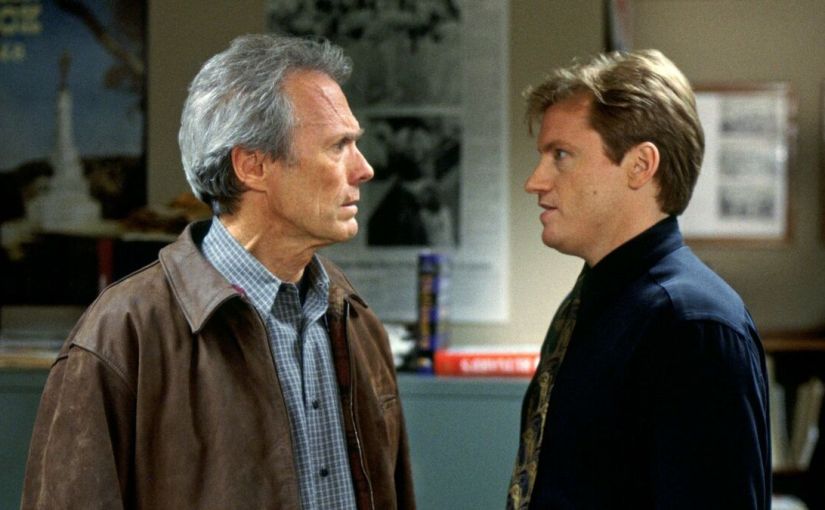
Clint Eastwood is having a pretty eventful day in the film True Crime, a picture he produces, directs and stars in. He plays Steve Everett, a womanizing journalist who is assigned at the last minute to interview Frank Beechum (Isaiah Washington) for a human interest story about the man’s last hours before he’s sentenced to death by lethal injection for shooting a young pregnant woman. Everett gets a hunch though that Beechum may be innocent and he’s quickly running out of time to prove his gut feeling. It does not help that his editor (Denis Leary) has discovered that Steve has been sleeping with his wife. It’s also inconvenient that Steve has to honor his promise to take his young daughter to the zoo.

For the simplicity in the storyline of Eastwood’s film, I still found moments that kept me engaged. Washington’s footage which begins at sunrise on his supposed last day at San Quentin penitentiary is very well detailed. I liked how the warden spells out to Beechum what to expect today ranging from requesting his last meal to ensuring direct phone lines to the governor are working properly. I got to witness how all activity of a death row inmate is strictly recorded. I found it interesting how the lethal cocktail is to be administered.

Washington has really good moments with his wife (Lisagay Hamilton) and young daughter wanting to color him one last picture of green pastures. The film doesn’t drown in sappiness or long monologues that you might expect. Like other Eastwood films he looks for the quiet moments in a person’s day; familial, but painful intimate moments of a loving family with all options exhausted.

The other storyline might be debatable for existing. Steve has to contend with his editor’s animosity towards him while also trying to balance what’s left of his family life with his current wife (Diane Venora). Opportunities are given for tough guy comebacks and insults between Eastwood and Leary along with their boss played by James Woods. There’s good timing in these lines but some might question why waste time with this material. I had no objection, however.

These are men who are not putting their lives or instincts on hold to focus just on an inmate sentenced for death. This is just routine work of the day. We don’t stop working just because we find out our spouse is a two timer. We also don’t put our personal interests in hold for a criminal we have regard except to fill a square in the news paper.

Same goes for Steve’s time sparingly spent with his daughter (Francesca Eastwood) at the zoo. Steve turns out not to be an attentive father as he also tries to stay on top of his story on Frank. My cinephile colleagues (including Miguel) took issue with most of the material that the journalist experiences. They thought it was meant for a different film other than the death row storyline. Not I, however. I found it courageous of Eastwood with a script from Larry Gross, Paul Brickman and Stephen Schiff to stay true to this portion of the film. All people have demons they live with and those setbacks don’t grant mercy in even the most desperate of times such as when a possibly innocent man has mere hours left to live. Life is never put on hold even if you’re a lousy father and husband.

True Crime stayed with me up until its last ten minutes. At that point, Eastwood takes the film in a beat the clock car chase direction. This moment is unlike anything else the film presented and I took issue with it here. I wasn’t watching an action picture before any of this. Before the end arrived, I was caught up with the different perspectives of those involved in the process of supposedly humane lethal injection. I saw the prison guards who’d make a joke out of what’s to come. I saw a self involved minister trying to egg on a confession for his own personal salvation, and I saw a warden (Bernard Hill) who actually possessed sensitivity to a prisoner’s fate; that’s something you don’t see too often in film.

Eastwood never allows the audience to empathize with his character’s personal problems. This guy made his own bed. His personal life is not wrapped up in a pretty pink bow by the film’s conclusion. Instead, True Crime told me that beyond a man’s own personal issues is the necessity to help rescue another man who is arguably in a much worse scenario. Dismiss the film’s ending, and you’ll nevertheless appreciate the structure of the rest of the picture.

THE TAKING OF PELHAM 1 2 3 (2009)

By Marc S. Sanders

While the remake of The Taking Of Pelham 123 is not the best of the Tony Scott directed/Denzel Washington headlining thrillers, it’s still a good time. I’m a sucker actually for most of their films, though as of this writing I’ve yet to see Man On Fire. Washington and Scott made several action pictures together. You depend on Scott to work in all the fast cuts to wake up your pulse and allow Washington to form a variety of characters. Denzel Washington didn’t have to appear like the macho tough guy with the ripped muscles. In Pelham, it could not be more evident.

Washington plays Walter Garber (first name salute to Walter Matthau of the original film), a dispatch operator for the New York City subway line with years of experience in all facets of operation and management. However, he’s been demoted due to an ongoing investigation that he has accepted bribes. Now let me say that I like this angle. He’s not a typical alcoholic or drug addict that we might have seen a Bruce Willis guy do one too many times. This is something different and unexpected. Washington also appears with a pot belly, glasses and no fashion sense. He’s not a decorated war veteran. This is not an action hero. Screenwriter Brian Helgeland got it just right, with this character at least.

John Travolta is your bad guy known as Ryder, and I’m afraid he’s cut from similar cloths of his other career bad guys. He screams in the same way. He has the psycho meltdown attempts at hilarity. So he’s more of the same really.

Ryder and his crew hijack one car off the subway line that comes out of Pelham Bay, NY. Garber answers the call from Ryder with his demands for money within the hour or a hostage will get killed minute by minute after the deadline.

Now Helgeland and Scott are very aware of the absurdity going on here. When the apathetic Mayor (a welcome James Gandolfini) agrees to pay the cash, it has to be transported all the way from the bank reserve in Brooklyn. This requires Scott’s signature moves of racing police cars and bikes through congested New York City to get it to Ryder before the deadline. Only midway through this long sequence which gobbles up tons of the film’s running time, does someone ask why they just didn’t use the helicopter. Cue my colleague Miguel E Rodriguez: “Then there wouldn’t be a movie!!!!”

As much as I like the action shots, because I’m a guilty pleasure sucker for that stuff, I have to insist that there still could’ve been a movie; a better movie. Helgeland’s script wasn’t imaginative enough, or the producers insisted on more car crashes and things blowing up real good. The original with Walter Matthau and Robert Shaw maintained tension for its two hour running time. This remake could have learned a little more from its ancestor. Two great actors are at your disposal, and you might have gotten some good dialogue like that of Clarice & Hannibal, perhaps.

Still, the conversations between Washington and Travolta are serviceable on at least one side with most credit going to Washington. Surprises into the Garber character keep the film interesting. Travolta? Well, I saw this guy in Face/Off and Broken Arrow and Swordfish and on and on.

The Taking Of Pelham 123 always had my attention. Yet, I wish it showed me even more new things than just its unlikely hero. Denzel Washington shouldn’t have to be the only one putting in overtime.

THE LINCOLN LAWYER

By Marc S. Sanders

Michael Connolly authored a series of best seller legal thrillers featuring his famed character Mickey Haller. His most favored book of that series was adapted into a 2011 film called The Lincoln Lawyer with Matthew McConaughey in the role and directed by Brad Furman. I only wish more of Connolly’s books were adapted thereafter, because this movie is at least as good as the novel.

McConaughey is well cast as Haller, a defense attorney who operates out of his Lincoln Town Car working to get low level criminals off on technicalities or by easy settlements with the prosecution. His clients range from prostitutes accused of possession to notorious motorcycle gang members. When these clients can’t pay, Mickey wisely becomes resourceful with favors they can provide later on. One of his former clients drives the car while Mickey works in the back seat making calls out of his mobile office.

Louis Roulet (Ryan Phillippe) has just been arrested for beating up a prostitute at knifepoint. Roulet is a spoiled, preppy thirty something who is protected by the vast wealth of his mother (Frances Fisher) and their successful real estate enterprise. So it’s surprising that Roulet turns to street lawyer Mickey to be his legal counsel. At the same time though, this is a big score in legal fees. So Mickey is enthusiastic to accept the case, and go to trial. Louis doesn’t want it any other way to prove and insist upon his innocence.

It wouldn’t be fair to reveal much more about The Lincoln Lawyer because it’s got a lot of welcome surprises and twists along the way. What I can reiterate is how good an actor Matthew McConaughey is as I’ve written before. He just performs with a relaxed and confident swagger about himself. Mickey Haller is written as a smart and very strategic attorney. He knows the ins and outs of the courtrooms. He not only uses his clients for additional help, but he also sidles up to the bailiffs so he gets his clients cut ahead of the line to quickly face a judge. McConaughey is really good at not glamorizing the intelligence of Mickey Haller, but rather the charming personality of the guy. The character doesn’t come off as having all the answers at his fingertips, even though he likely does. It makes the film that much more dynamic to see McConaughey’s personality ahead of a Sherlock Holmes or Perry Mason kind of lawyer who might telescope everything five steps ahead of what’s eventually going to happen.

The supporting cast of The Lincoln Lawyer is also magnificent with Marisa Tomei, Bryan Cranston, John Leguizamo, Bob Gunton, Michael Pena, Trace Adkins, Josh Lucas and William H Macy. These are just great character actors. Everyone serves a purpose, even if it is just for a few moments.

Again, Mickey Haller is a great, modern day crusader. Like other literary characters such as Alex Cross and Jack Ryan, based on this film, I always hoped McConaughey followed up with at least one or two more additional films. I’d sure as hell be there to watch. Heck, the eventual Oscar winner went on to be a spokesman for Lincoln automobiles. So why couldn’t he have continued to carry the torch on the big screen?