BEFORE THE DEVIL KNOWS YOU’RE DEAD

By Marc S. Sanders

When it comes to crime – New York crime – few directors come as close as Sidney Lumet to make an audience feel the authenticity of its trappings.  Maybe only Martin Scorsese can stand next to Lumet.  Either with crime on the streets (Dog Day Afternoon, Serpico) or within the courtrooms (Find Me Guilty, 12 Angry Men), or both (Night Falls On Manhattan), Sidney Lumet hones directly upon how the plans should operate and when everything should unfold or derail.  

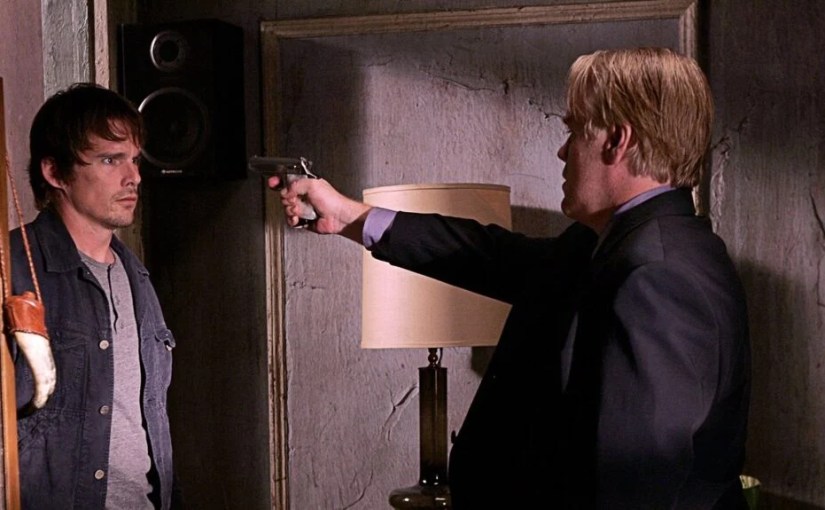
With the last picture before his death, Before The Devil Knows You’re Dead zeroes in on crime within an educated Irish family nucleus.  Andrew (Phillip Seymour Hoffman) has it laid out perfectly for his younger brother Hank (Ethan Hawke) to commit the perfect robbery. No one will get hurt and the insurance company will cover any loss.  The approximate take is around six hundred thousand. These guys carry their own desperate reasons for even considering such an idea, but Andy knows nothing can go wrong.  Hank has some trepidation though, because the target is mom and dad’s jewelry store.

Kelly Masterson’s script shows how quickly everything comes undone with bloodshed and unaccounted for details that could lead straight back to the two brothers.  It’s all told through three different perspectives – Andy, Hank and their father Charles played by Albert Finney.  Often, Lumet will return to the very same scene you saw moments earlier to show two sides of a phone call or in what direction one character goes versus that of another following a particular action that has occurred.  The timeline even jumps back in time a few days to show the direct perspective of any of these three particular characters ahead of showpiece scene – the robbery. Charles was retaking his driver’s license test. Elsewhere, Hank was struggling to pay spousal and child support with an angry ex-wife (Amy Ryan). Andrew was scheming and committing other clandestine acts both at work and in his free time.

However, Masterson’s script weaves all of these side details into how much more complicated this botched robbery becomes in the aftermath. All of what they commit following the robbery compounds into potentially making it worse for everyone involved.

Some of the breadcrumbs don’t carry enough water at times though. You might have to tolerate the characters being more intuitive than they likely should be.  Andrew leaves a business card with a side character.  When the film circles back to this item, it seems a little too easy for someone else to get wise about what has transpired.  I just chose to go with it.

Marisa Tomei is also part of the cast, caught in a love triangle as Andy’s wife and Hank’s mistress.  Tomei is really good, lending some authenticity with unscrupulous nudity in scenes with both Hoffman and Hawke.  This storyline serves as character exposition and only briefly scrapes against the crime drama at play.  It could have been excised from the film, but because the dialogue and scenario is written and performed so well, it effectively held my attention.

Albert Finney is magnificent as the patriarch owner of the store.  Simply his devastated, echoey breathing and the way he fumbles to put his eyeglasses on to learn more about what has occurred is absolutely genuine.  A late middle-aged man discovering horrible truths.  Finney plays it beautifully.  That being said, I wish the film offered more backstory to his character.  There are few hints suggesting how he regarded Andy as the first born who needed be thrown to the wolves and learn to fend for himself.  Contrarily, Hank is the younger and more disappointing son.  Yet, the script is short on material that further explores the relationship between the father and his sons.  I felt the film demanded more because Charles is quite significant to the conclusion of the story, which carries an unexpectedly abrupt ending.  

The acting and assembly of time and perspective are so finely tuned by the whole cast under Lumet’s direction.  Still, Before The Devil Knows You’re Dead needed another twenty to thirty minutes of storytelling.  One character runs out of frame with an unfinished storyline.  Another, seems too hasty in making a final decision with an easy convenience.

Don’t get me wrong.  I strongly recommend this last effort from Sidney Lumet.  It’s a unique crime yarn with an especially conniving Phillip Seymour Hoffman doing some of his best work.  The set up had me riveted and I couldn’t wait to see how all these terrible scenarios were going to fix themselves or make things horribly worse.

A SIMPLE PLAN

By Marc S. Sanders

“Three can keep a secret if two are dead.”  – Benjamin Franklin, pictured on the one-hundred-dollar bill

A murder of crows is made especially prominent at the beginning of this dark, wintry fable from director Sam Raimi and writer Scott B Smith, based off of his novel, A Simple Plan.  

On the afternoon of New Year’s Eve Day, Hank, his brother Jacob and Leon get swerved off a slippery Minnesota road while riding in a beat-up pickup truck. They come upon a crashed airplane buried under a blanket of snow in the woods.  Besides the pecking crows feasting on the corpse of a dead pilot, they uncover a duffle bag with over four million dollars; tons of bales of strapped hundred-dollar bills.  What should they do? Report the discovery to the police or secretly keep it to divide among themselves?

Hank (Bill Paxton) is the educated sensible member of the trio.  Jacob (Billy Bob Thornton) is his dim-witted brother.  Leon (Brent Briscoe) is Jacob’s loudmouth drinking buddy.  After much debate, the men agree that Hank will hold on to the money until springtime.  By then, if no one is looking for the loot, then it surely can be shared among them.  

Easier said than done.

This is one of Bill Paxton’s best roles, not only because he’s a fine actor, but his character is constructed beautifully with one internal conflict after another.  He carries an appearance of a doting husband to his pregnant wife Sarah (Bridget Fonda, who I wish never retired from acting) and he’s well-liked by the folks of this town.  He’s also a protective brother to Jacob.   However, money changes people and hypocrisy and plotting turn this good man corrupt.

Billy Bob Thornton is brilliant in an Oscar nominated role. It’s not easy to portray the sweet dumb guy when your career has demonstrated how insightful you are as a winning screenwriter and actor (Sling Blade).  Jacob looks “lived in” within this sleepy town with a pair of broken eyeglasses, an old parka and boots.  He’s the troublemaker and the sheriff knows this schlub can’t take care of himself.  As Hank changes one way over the course of the film, Jacob literally transitions in a completely opposite direction of character.  Both approach their tests of ethics and morality differently, and it’s fair to say that a gift of simple logic and sensibility can be more of a curse rather than a blessing.

Bridget Fonda operates like a conniving Lady MacBeth as Hank’s wife Sarah.  She’s adorable and sweet as the happy couple await the delivery of their first child any day now.  What good fortune to come upon this money to help with living a lifetime of comfort and joy.  Sarah knows this is all going to work out, but what’s important is that Hank covers his tracks while also being especially cautious of Leon and Jacob’s reputation for carelessness.  Sarah has an answer for everything and a proactive approach to handle this surprise windfall.

Yet, the luck of one man is the demise of another, and another and maybe even another.  

A Simple Plan is anything but.  Too many people know what is discovered.  Even the inconvenience of snow-covered plains work against any kind of airtight solution.  Snow leaves tracks.  What if someone lets a simple, but curious, word slip?  What if someone wants his share sooner than agreed upon?  What if someone is in the wrong place at the wrong time? 

Scott B Smith changes the tune of his script over and over.  First, it questions the morality of man.  Later, it traverses into crime and cover up.  After that, A Simple Plan hinges upon survival while questioning a series of costs.

Because most of the characters in this small Minnesota town are blue collar and not formally educated, you might believe they lack the intuition to properly guard themselves or the ones they hold dear.  On the surface, this is a friendly community, and everyone bears a facade of innocence with Happy New Year greetings. Actually, desperation only enhances the thinking abilities of these people to do the most twisted of acts to protect what they consider their rightful, personal entitlement.  

Each act of extreme behavior seems justified in the eyes of Hank, Jacob, Sarah and Leon. I mean this is four million dollars we are talking about here.  Try to see it their way, and you’ll know what I mean.

WAKE UP DEAD MAN

By Marc S. Sanders

Benoit Blanc is back with a new mystery to solve in Wake Up Dead Man.  With three films, all directed by Rian Johnson (Knives Out, Glass Onion), Daniel Craig’s eccentric detective now belongs in the ranks of Sherlock Holmes and Hercule Poirot.  He’s a pleasure to watch with a smirk on your face.  Ironically, he doesn’t make his entrance until at least a third of the picture is complete.

Josh O’Connor is Father Jud Duplenticy who first reveals a wide berth of exposition ahead of the murder mystery that awaits us.  He’s a catholic priest who works hard to contain his temper that might resort to raising his fists.  He’s been assigned as the assistant minister to a church in a small New England town where everyone knows one another, especially repulsive Monsignor Jefferson Wicks (Josh Brolin).

Whodunit mysteries should never be spoiled.  I certainly wouldn’t imply how this film wraps up.  I also do not want to reveal who the victim(s) is/are.  I urge you to see Wake Up The Dead Man because this puzzler of a story is as gleeful as the title itself.

Like the Agatha Christie film adaptations from the 1970s, Rian Johnson does his best to provide a lineup of suspects with celebrity familiarity including Brolin, O’Connor, Mila Kunis, Kerry Washington, Thomas Hayden Church, Cailee Spaeny, Jeremy Renner and a standout performance from Glenn Close who steals much of the film away from the rest of the cast.  After seven nominations spanning over forty years, give her the Oscar already.  She’s eerie and needling, spooky and fun.  As Detective Blanc continues his investigation, a character tells him this all seems like something straight out of Scooby Doo.  Glenn Close, donned in black with an elderly bleached facade certainly feels like she’d come in contact with the animated pup and those meddling kids.

Rian Johnson writes with that classic narrative that Agatha Christie or Arthur Conan Doyle adopted, only it’s modernized.  The director of The Last Jedi even throws in a Star Wars reference and the joke soars.  The writer/director crafted this script as an invitation for hair raising merriment with his design.  If you can’t be a part of a mystery dinner theater party, he ensures that you can participate in this one.

An old church, priests who curse, habitually pleasure themselves and confess to an abundance of sins, a gothic tomb, a dark basement with a repulsive bathtub, a bar with a photograph of clues, startling entrances, unconventional dialogue and a quizzical murder weapon function like page turning literature.  Even better is to understand how impossible the first murder can be under the limitations of a locked door mystery.  How can someone be killed right in front of our eyes when no one else is in room?  The answers await and thankfully the revelations are not far-fetched.

Wake Up Dead Man is a fun time at the movies.  It’s coming to Netflix on December 12, 2025.  Nevertheless, I encourage you to go your local cinema.  The crowd we saw it with was responding consistently with us, and that only enhances the experience.

GONE BABY GONE

By Marc S. Sanders

Ben Affleck’s directorial debut, Gone Baby Gone, is crime drama mystery thriller that never offers easy answers and concludes with great debate.  You’ll ask yourself if right decisions were made.  You will argue with your best friend or significant other about the endings.  What’s undeniable though is that the film, adapted from Dennis Lehane’s novel, is full of an array of characters, most operating with the best of intentions, and yet they wind up doing everything wrong or against their sworn principles.  In order to work the problem, these people will have to betray themselves. 

One of Affleck’s many best decisions was casting his brother Casey Affleck in the lead role of private detective Patrick Kenzie.  With his girlfriend, Angie Gennaro (Michelle Monaghan), they specialize in tracking down missing persons in and around the Southeastern Boston area.  The brothers’ pairing is especially effective as Boston, Massachusetts is where they were born and raised.  They know this setting intimately. Unpolished multi-floored tenement neighborhoods near seedy watering holes are where the crimes of Gone Baby Gone occur.  Casey can ensure that his character, Patrick, can speak the slang, use the thick dialect, and feel comfortable amid a crowded and overpopulated area. As director, Ben ensures the setting is captured in great detail from Red Sox caps to beat up cars and dirty unkept apartments and secret hang outs.

In the middle of the night a little girl has gone missing and her deadbeat, drug addicted, careless mother Helene (Amy Ryan) is unmotivated to offer the police much to go on. Helene’s brother and sister-in-law (Titus Weliver, Amy Madigan) take it upon themselves to hire Patrick and Angie to find their niece.  The only leads that Patrick, Angie and the police (Ed Harris, John Ashton and occasionally Morgan Freeman) have to go on are Helene’s contacts within the drug peddling underground.  Someone within that community might have taken the girl or know someone who did.

Gone Baby Gone may feel like a Law & Order episode where red herrings are offered early and then dismissed for the actual truth.  However, Lehane’s story twists much deeper beneath the surface.  Not one character is wasted in this film.  Each serves a purpose to how and why this crime ever occurred.  Mysteries get resolved but the answers are not simple because they are multi-layered with many different people spinning twice as many plates.

Ben Affleck seems nothing like an amateur director here.  He does not always rely on dialogue to describe a scenario because he films quite a bit of a disheveled room or kitchen, or an outdoor area.  A daylight scene will take place in a darkly lit bar where only people need to hide from their troubles on an ordinary workday, or maybe they are in there to suppress something uglier.

The cast is outstanding.  While the characters belonging to Freeman, Harris and Ashton seem familiar from much of their other career films, they look like they lived within this environment of three-story houses bordering the harbor, across town from Fenway.  You believe these guys know every alleyway, street corner or contact among the city’s small-time deadbeats. 

Amy Ryan was nominated, and perhaps should have won, for her trashy Bostonian performance as Helene, the missing girl’s mother.  This actress is buried so deep in this role, from her worn out facial features to her New England dialect that blends so well.  She is completely believable, which is why you would not be able to stand sharing the same space with her.

Titus Welliver dons a thick, wide Irish mustache.  I read he had to keep it because he was shooting his HBO series, Deadwood, at the same time.  Nonetheless, it builds his character into the blue-collar working man whose greatest achievement is getting out of the life of small-time crime in order to put food on the table, while his sister could not.  His wife played by the great Amy Madigan, an actress that does not get enough coverage, is perfect.  Just her facial expressions with a pale, freckled complexion, tight chin and pinched lips show her biting her tongue while in the same room as her loser sister-in-law.  It sickens her that a sweet little girl like her niece is missing.  Everything is read on her face.  I know Madigan best as Kevin Costner’s midwestern cheerful wife in Field Of Dreams.  She played this role almost two decades later and she absolutely hides herself.  You forget you are watching her.  An outstanding character actress.  (I’m glad she’s getting new recognition with 2025’s hit horror movie Weapons.)

Michelle Monaghan as the girlfriend Angie is the sidekick to Casey Affleck’s Patrick.  Yet, she makes the horror of this movie convincingly real.  Early on, Angie is reluctant to accept the case because she doesn’t “want to find a kid in a dumpster.”  Now this isn’t some Dirty Harry or Lethal Weapon cop showcase.  It’s not glamourized with Hannibal Lecter glee.  This has not become much further materialized.  I don’t want to see a horrifying outcome for a child either, but Ben Affleck’s direction does not make any promises.  There are some repulsive, scary people in this world, right outside the front doors where people listen to the game on the radio and kids play stickball in the street.  Monaghan seems like that young woman who came from another place in the country with a fine upbringing and fell in love with Affleck’s character. With her brains, instincts and empathy, Angie took up the cause as a fellow crusader.  None of this is spelled out in the film and I have not read Lehane’s books, but I can see it in Michelle Monaghan’s performance.

Casey Affleck is a perfect surprise.  He dons the appearance of a thin, shrimpy kind of kid (supposedly age 31), and yet no matter who he is coming face to face with he never shows any sort of apprehension.  I truly believe that Patrick is not afraid of his work or the people he has to confront while trying to solve his various mysteries.  If a large gun is introduced into a scene, Patrick’s reaction is an act of “whoa, what’s this?”  Another character in another film would tighten up and hold their breath, or they would knock the weapon out of the way for an action scene.  Patrick has put this kind of act on before to outlast a situation.  Angie has definitely seen it before. 

Casey Affleck is great at just listening.  Shortly after he accepts the case, Patrick and Angie are in one of these darkened bars trying to collect information.  Ben Affleck shoots his camera above Casey sitting in a booth with a beer.  The actor keeps his head tilted as if he is listening to nothing spewing from a possible lead sitting across the table.  When a gun is pulled though, Casey stands three feet taller than his posture implies and controls the scene.  That is Dennis Lehane’s character Patrick Kensie completely defined because Casey Affleck has a full understanding of this guy.  Someone like Patrick knew that if he was going to take this kind occupation on full time, he had better be aware he would not survive on brawn that he cannot show.  It’s a confidence that has to come through. 

Gone Baby Gone is a gripping and engaging thriller shown with varying degrees of light and perfect cinematography to offer genuine on-site locations of Boston and the surrounding areas.  Ben Affleck chose not to compromise any of his set pieces.  With handheld cameras, when a missing person’s search is happening, it feels like a documentary of procedure is being shown. 

The various directions and endings are entirely unexpected and yet very, very plausible.  This is a smart, sensational crime drama that deserves a resurgence of attention nearly twenty years after its release.

A CLOCKWORK ORANGE

By Marc S. Sanders

What is Stanley Kubrick attempting to demonstrate with A Clockwork Orange, arguably the most controversial and shocking film of his career?  The film is considered an almost precise adaptation of Anthony Burgess’ novel.  I never read the book, but the sources I found on Wikipedia and IMDb are consistent with their claims.  Kubick’s vision is never not odd or strange.  It’s almost always repulsive and I have to believe the director is proud of the finished accomplishments left in every caption and scene.  Yet even Kubrick was disgusted by some copycat attempts that spawned from what the story’s protagonist troublemaker executes within this context.  Regrettably, in 2025, it would be easier to ask what did you expect Mr. Kubrick?

In a dystopian future of England, young Alex (age 17, but 15 in the book) relishes on walking the streets each night, accompanied by his three droog companions, committing the worst atrocities imaginable.  They beat up a homeless beggar, engage in gang brawling, and brutalize and rape a wealthy couple in their own home to the celebrated tune of Singin’ In The Rain.  I’m curious how reminiscent A Clockwork Orange is to people who only wish to watch the cheerful and innocent fare of Gene Kelley.  Is their subconscious intruded by Malcolm McDowell as naughty boy Alex with the one eyelash, bowler hat, protective jock strap and erection mask?

Mayhem is the specialty of Alex and his degenerate friends.  However, Alex who is the leader of the pack is challenged to uphold his command on the gang of four, and once the others betray him, the poor boy is sentenced to a militaristic, concentrated prison where he must don an academy uniform while studying the gospel of the Bible.  

What happens though if the student sees himself more as the Roman with the harsh whip, and less as the savior willing to die for our sins?  Are people like Alex only inherently wicked, vile, and perverted?  Can nothing change their insatiable appetites for harm and evil doing?

I thought about One Flew Over The Cuckoo’s Nest while watching A Clockwork Orange.  McMurphy fakes an impression of insanity to be institutionalized. He operates under the presumption the circumstances will be more accommodating than a jail cell.  Alex campaigns to be a guinea pig for a new kind of therapy believed to eliminate all temptations of violence and cruel sexual escapades. This could be a means to free him from a forty-year prison sentence. I never believed he wanted to be liberated from his appetite of rape, torture and murder, though.

Following an abundance of sickening, visual exposition, Stanley Kubrick is ready to test some possible outcomes by forcefully prying open the subject’s eyes to witness footage of violence, extreme rape, harsh pornography, and Nazi propaganda.  Will this overexposure repulse Alex away from being the monster he used to be?

I’m not sure A Clockwork Orange provides any definitive answers but the weirdness of this off scale and ugly England is nothing but apparent.  Nothing is normal looking or relatable in this film.  Everything from the colors to the costume wear to the slang verbiage of the dialogue and even the furniture is completely twisted.  Kubrick would offer a similar approach in The Shining. No director is louder and more offensive with colors in a film. A green bedroom ceiling or a blue typewriter or even a glass of milk and stark white sexually posed mannequins used as furniture pieces in a hangout joint are so much more than discomforting.

Even the infamous rape scene is uncharacteristically done.  The Droogs happily sing while brutalizing this couple.  Before Alex commits his “push in, push out” he scissors the woman’s red jumpsuit around her individual breasts before cutting her out of the fabric to be entirely nude.  I’ve seen plenty of staged rape scenes but then there is what Kubrick envisions. Not to mention, how notoriously redundant he is with repetitively shooting his scenes over and over again. Kubrick is an auteur filmmaker but his desire for perfection in his shots are as twisted as many of his films.

A woman is brutally killed by being pummeled with a sculpture of a penis/taint/anus piece. (I don’t know what else you call this!) A typical baseball bat, stick or hammer is not the bludgeoning weapon of choice. Stanley Kubrick wants to ensure this perverted item of art owned by a wealthy woman is used to commit the crime. A mix of sinful natures ranging from sexual to violent.

Why go to all of these lengths to be so unusual?

A Clockwork Orange is deliberately shocking and thus everything on display is disorienting.  With all the movies and TV shows I’ve watched, on top of some of the most unusual fetishistic material I’ve witnessed, I imagine I’m like most viewers where I’ve grown accustomed to the violent and sexual debauchery on display.  I’ve seen so much I am practically desensitized to it all.  When I read about another school shooting in the news, regrettably and with sick sarcasm, I’ll think to myself, “Huh!  Must be a Tuesday.”  It feels so wrong but there is truth in this ongoing epidemic. Stanley Kubrick, back in the early 1970s, had to work that much harder to grab the attention of the viewer.  Nothing can prepare you for an initial viewing of A Clockwork Orange. Back in 1971, I’d argue no one was prepared for this film’s content. It’s a pioneering document of extreme violence and sexual perversion. Filmmakers, like Martin Scorsese, David Lynch, and Brian DePalma hereafter would push their own limits while bridging these activities with the natures of their challenged characters.

Is there a confidence to seeing if a heathen like Alex can be cured of his original nature? Can he be returned to a society where his once menacing threat is nonexistent?  Plus, can Alex live a peaceful and nurturing life?

Alex is not the only villain to this piece.  While we do not get to know his parents well enough, how sadistic are the individuals behind his therapy process? Alex’ “recovery” becomes politicized and treated like scientific doctrine at the expense of his own humiliation. He is used to prove a point by beating him up publicly and forcing him to lick the bottom of a man’s shoe and exposing him to a naked woman, as well. Those that he encounters again, like former victims and fellow Droogs, following his therapy are not perfectly complimented to this new Alex. Scenarios that re-introduce him to society imply that Alex’ conditioning process might have overlooked what was to come following his release. Were they truly “healing” their patient?

A Clockwork Orange is never a refreshing film.  It’s always alarming right down to its final frame.  The picture certainly does not endorse the merits of psychotherapy or psychological reform.  Maybe, that’s why I believe that anyone specializing in the field of mental health should watch the picture. See what works and what doesn’t. Kubrick is uncompromising with getting his cast to do what he wants, no matter how off putting the material is. If anything, I wonder if this movie is more relevant today. Can anyone who traps themselves in an impersonal and isolated environment of social media influence attain the capability to shed their destructive proclivities for a natural desire to live, care and cherish fellow human beings?

Like most of Kubrick’s films, A Clockwork Orange is not an easy watch.  I know a friend who describes the movie as a comedy.  I know what she’s talking about and why. Still, how can anyone allow themselves to guffaw at someone who is an agent of death, torture, destruction and chaos? 

I don’t know what else I can say about A Clockwork Orange.  I do not recall asking so many questions in one review as I demonstrate here. Watch the film on mute or with Alex’ voiceover against an assortment of classical music as Kubrick intends simply because Alex’ only friend, only ally, is “Ludwig.”  No matter how you observe the piece, it is likely your jaw will drop, and your eyes will wince.  You will cringe and you will unquestionably test your tolerance.  You may just turn the movie off.

Regardless of how you respond to the picture, be assured that Stanley Kubrick successfully completed what he set out to do.

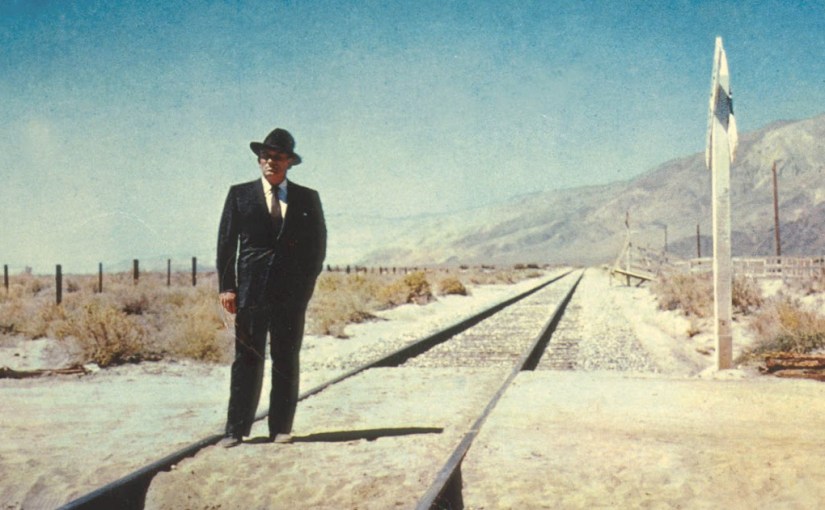
BLOW OUT

By Marc S. Sanders

Brian DePalma’s Blow Out is an inventive approach to the political conspiracy thriller.  In 1981, following a mask of innocence the United States lost with the assassination of President Kennedy, later his brother Bobby, plus the drunken, liable carelessness of their brother Ted, and then finally the Watergate scandal, DePalma capitalized on newsworthy incidents to make a paranoid thriller of present day while incorporating what he likely knows much about which is sound effects editing.  Despite the cheesy music soundtrack that is highly intrusive and poorly composed, Blow Out is a good blend of hysteria and suspense.

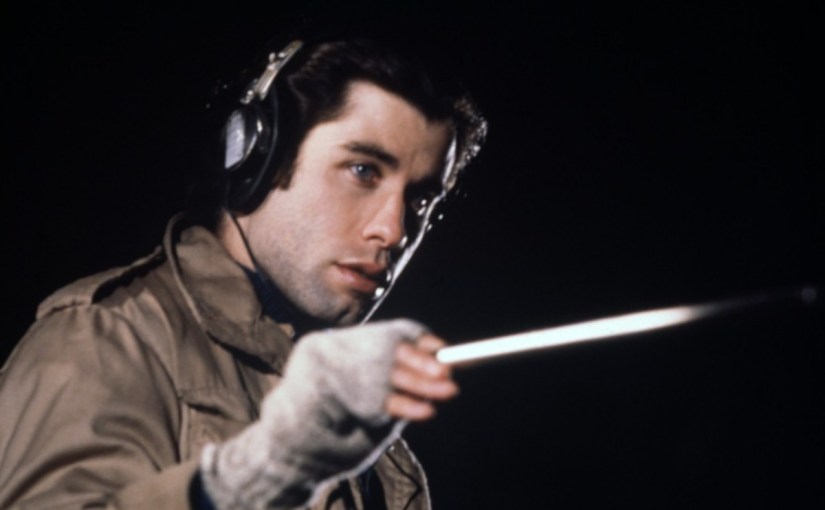
John Travolta plays Jack Terry, a Philadelphia sound effects recording artist for b-grade schlock horror movies.  One night, while out in a park trying to pick up sounds of outdoor nature, he witnesses a car suffer a blown-out tire and crash into a nearby river.  Jack is able to rescue a woman named Sally (Nancy Allen) but cannot save the Pennsylvania governor who was driving the car.

As he is about to leave the hospital, he is specifically instructed to never speak to Sally nor acknowledge to anyone about any of his own involvement in this incident.  However, Jack cannot help but recount the sequence of events in his head and as new details come to light, he knows that there is a cover up at play.

Blow Up operates like a how-to kind of picture.  The expertise of a sound effects recording artist is demonstrated as Jack replays every sound that his equipment picked up. Later he’s able to manufacture his own film by assembling a series of published photographs that also captured the crash.  Sync up the sounds with the sights and a new theory surfaces.  Other mysteries change the course of the riddle through dialogue.  This character has to work by himself using the skills he’s acquired to learn the truth.  He hardly has anyone to commiserate with.

John Travolta is convincing within this occupation that’s not as common as a cop or a private eye.  I like how I can pick up how he uses his recording equipment and even the minute details like labeling what he has preserved within his inventory.

It took a little bit of patience to get used to Nancy Allen’s damsel in distress who plays it up like Judy Holliday or Jean Hagen with the squeaky, dingbat voice.  When we first meet her, she is in an intoxicated stupor that goes on a little too long. Nevertheless, I came around because the tension of the film builds quite well.

John Lithgow is the sadistic adversary – a serial killer and assassin rolled into one.  He’s got the weird, unwelcome appearance like any bad guy in a Hitchcock film.

DePalma is known for his split screen cuts that he offered in Carrie and later in Mission: Impossible.  More well known is his reliance on bringing a character in zoom close up, while in the same frame, another object will be zoomed out at a distance.   During an outdoor evening in the park, an owl hoots and stares us down while John Travolta is far in the background standing on a bridge. Within this same moment, DePalma does it again with a toad ribbiting up close with the actor again positioned out. It’s a disorienting approach that works well at maintaining the perplexity of his story.

I think the final act of Blow Out falls apart a bit.  Travolta is on the heels of rescuing Sally by rampaging his jeep through a crowded parade.  The scene is shot so aggressively that it was hard for me to believe he would survive much less not run down a cop, spectator, or the entire marching band.  DePalma could have tightened this up a bit.

Blow Out ends on a bleak irony that’s quite surprising and definitely against formula.  There’s a running gag for Jack and a film director as they edit a silly problematic issue for a new slasher flick.  I guessed early on how this was going to resolve itself.  Though I was right, I didn’t expect how the conclusion arrived at my predication.  

As well, there are some notable questions left unanswered.  I had to roll back and see if I missed something.  I didn’t.  DePalma’s script neglects some key points with unfinished resolutions. So, I was not entirely satisfied. Still, the how-to procedures along with the pursuit of the truth, while also evading demise, are very engaging.

When I conduct workshops on playwriting, I always recommend keeping up with the news.  An unending wealth of ideas are there to be discovered.  As a sincere compliment to Brian DePalma, it could not be more apparent where his creativity took off with this film.  As a skilled and educated filmmaker, he also writes what he knows.  

Blow Out is very close to being a smart nail biter that echoes the sad truths of political rule breaking by means of savage crime. I wish modern films would be as risky today.  There are so few of these kinds of thrillers being made anymore.

NIGHT MOVES

By Marc S. Sanders

As soon as composer Michael Small’s easy listening disco themes kick in and you see Gene Hackman make a u-turn in his green Ford Mustang convertible, I had vibes that Night Moves was going to operate like an episode of The Rockford Files.  I was alert and energized.  I liked where this was going.  A new, undiscovered gritty 70s movie to sink my teeth in.

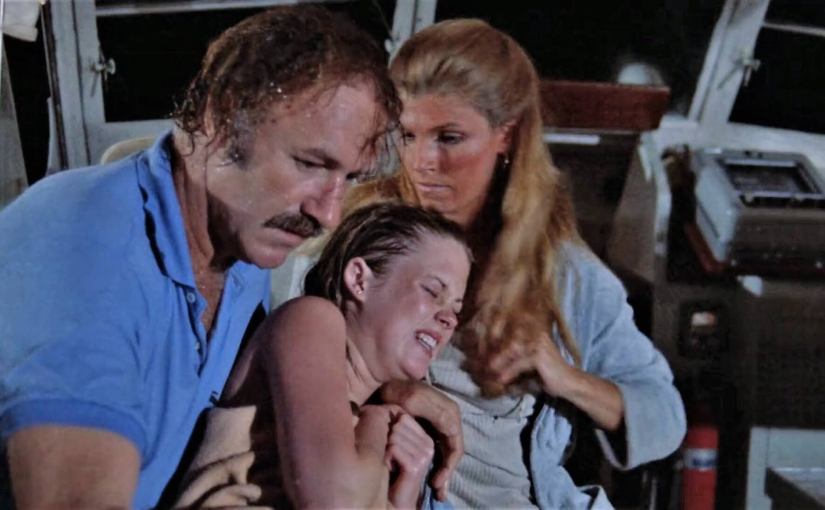
Gene Hackman is Harry Moseby, a perfect name for a private detective.  Arthur Penn is the director in his second of three collaborations with the actor.  The film starts off well for Harry.  He’s giddily promiscuous and happily married to Ellen (Susan Clark), and he’s ready to take on a new case. 

A Hollywood has been actress needs Harry to find and bring back her sixteen year old, runaway daughter named Delly (Melanie Griffith, in her debut role).  Through a lead in the form of a young, punk kid (James Woods, in an early role), Harry flies out to the Florida Keys where Delly might have taken up with her step father.  

Seems easy enough, but before he departs Harry does some personal investigating on the side and discovers that Ellen is having an affair with a guy named Marty (Harris Yulin).  Harry’s carefree exterior is shattered.  Quickly, he becomes bitter towards all he cared about, from his wife and his profession which serves a purpose of lifting the veil on sins and secrets.  

Night Moves performs with unpredictable directions and tempos.  When Harry finds Delly with her step father Tom (John Crawford) and his younger girlfriend Paula (Jennifer Warren), the rundown boat dock where they reside seems relaxing and tranquil.  Paula tends to a dolphin pen.  There’s a plane that Tom uses for shipment trips.  Drugs?  Harry is not all that concerned.  He’s only here to pick up Delly.  A boat is there for fishing and swimming off of too.  Delly feels welcome and independent here.  Though as a teen she’s resistant to Harry’s obligation to return her to her mother in Los Angeles.  

It’s only after he wraps up the case that unexpected twists occur and now he’s got to backtrack to find out what is really going among the ranks of these folks.  In parallel succession, Harry and Ellen have to wade through their own sordid conflicts.  

Watching the Criterion issue of Night Moves was really interesting.  After seeing the film, I watched two different interviews with director Arthur Penn.  There are lots of discoveries to find in the film all the way down the very last frame of the picture.  However, the revelations of the mysteries are not told but rather shown.  Dialogue hardly spells out this story.  It’s what Arthur Penn allows you to see.  He described it as explaining through a lens or view from a window, for example.  As Penn speaks, Criterion edits in quick moments where mirrors and windows that were woven into the final cut of the film provide new information and answers.  It’s a very clever strategy.

The sinister happenings of Night Moves are undetectable until Harry gets wise.  It made me think of what Jake Gittes experiences in Chinatown.  The new assignment seems so easy.  An open and shut case until the complexities surface from under water or even high above.  

What separates Night Moves from the Mickey Spillane gumshoe stories or Chinatown and The Maltese Falcon for example, is that Harry Moseby’s personal hell interferes with an occupation where he’s meant to serve from outside of all of the sordidness.  Harry won’t slack on his case, but he still has to grapple with a sudden broken marriage that he is so capable of uncovering from his wife and her bumbling lover.  He’s not a loner like Sam Spade, Jake Gittes or Mike Hammer.  He’s opted to open his own private practice and dig into others personal conflicts and misgivings.  On the side, he wants a happy home life.  Problem is he is just too damn good at what he does.  So, he’ll get hurt.  It’s the cost of his talents.

This is a great performance from Gene Hackman.  He seems like a put together Jim Rockford in the form of James Garner.  Yet, when the film steers into the tsunami of its conflicts, this character splinters apart.  Hackman has always been good at evoking strength and confidence in the romances and adventures his characters get into as well as with their various occupations.  He’s also a dynamo at showing how his characters crack and become undone (Crimson Tide, The Conversation, The French Connection).  

The supporting cast of lesser known but familiar character actors are collectively stellar as well.  Sharing scenes with Hackman only makes them look more engaging and natural in either their privileged Hollywood, California habitats or the earthy locales of Florida islands.  Arthur Penn assembles this whole cast in great footage and sequences.

Whether it’s a trip to Florida or back to California, a late night personal stake out and break-in at an ocean beach house, a visit to a film set, or a moonlit boating venture in the Keys, Alan Sharp’s script never foreshadows what’s too come.  Thus, Night Moves offers a verity of the sinister and complex.  Just when you think you don’t need to carry much thought with the picture, it suddenly begins to challenge you.

Night Moves will have you believe it gets its title from how Harry plays the strategies of two celebrated chess champions against one another.  He explains to Paula, that while it may seem that the players are three moves ahead of each other, they’re really not.  Instead, there’s play going on beyond a standard trap of check or checkmate.  When everything is laid out to the very last second, it all makes sense even if Harry never had the instinct to think of any likely scenario before.  

Was I a little vague with you just now?  

Good.  

That’s how Night Moves serves its audience best. A stunning, unpredictable thriller.

ARLINGTON ROAD

By Marc S. Sanders

Arlington Road is a disturbing and all too real glimpse into how domestic terrorism in the United States operates.  The film from director Mark Pellington becomes more intriguing with repetitive views. Evening news shows and commentators’ programs airing nightly on outlets like FOX, CNN and MSNBC will delve ad nauseam into the hows, whys, and whos of a startling attack upon a populated area within the country.  Theories are pronounced, explored, and fault is found with someone, somewhere.  The protagonist of the film suggests that a name and face must be declared to ensure the country is at peace once again and punishment is rightfully delivered.

What surprises me about Pellington’s film is that it was released in 1999, two years before 9/11.  The worst, modern tragedy at that time was the Oklahoma City bombing.  School shootings were not even as prominent; practically unheard of.  We were only on the brink of Columbine High School’s terrible massacre.  At this precursor moment in time, I have to believe it was especially complex and required meticulous strategizing to bomb a government building.  

When I watched Arlington Road for the first time in theaters, I went with a last resort option for a ritual Sunday movie outing with dad.  We had seen everything else that was playing.  Title is lousy.  (Really lousy – Arlington Road??? That’s the best name they could come up with???) The marquee actors are meh to my twenty-seven-year-old psyche.  (Where’s Harrison Ford or Tom Cruise or Schwarzenegger???). Who’s the director????  Well, for dad and I this film was a huge surprise because of its taut, compelling screenplay and magnificent performances from Jeff Bridges, Tim Robbins and Joan Cusack.  The acting is what stands out the most while you forgive all of the conveniences that intersect to keep the story on its tracks.  

However, when I watch the picture on repeat viewing every couple of years, I realize that other than a random encounter in a parking garage for two characters, everything had been well planned ahead by the villains.  Roger Ebert and even the other unpaid critic, Miguel, took issue with minor happenstances that occur at just the right time.  Well, sorry to disappoint them but Arlington Road has an explanation for nearly every detail that seems contrived when in fact it was all part of a villains’ orchestrated construction.  The bad guys are especially smart in this movie.

Jeff Bridges plays Michael Faraday, a college professor who teaches a history class about domestic terrorism in relation to bombings, shootings, and assassinations.  He lectures his students about the faults and responsibilities of the FBI and other law enforcement departments.  He also provides insight into the people responsible for these heinous acts and often questions if these nefarious figures were lone wolves capable of such madness or were they scapegoats or were there others involved to help carry out these acts.  

Michael is a widower and a father to a ten year old son named Grant (Spencer Treat Clark).  After his FBI wife is killed in the line of duty, Michael has not fully come to grips with the loss.  He is dating Brooke, a former graduate student (Hope Davis), but he is clearly obsessed with what went wrong on that fateful day when his wife perished.

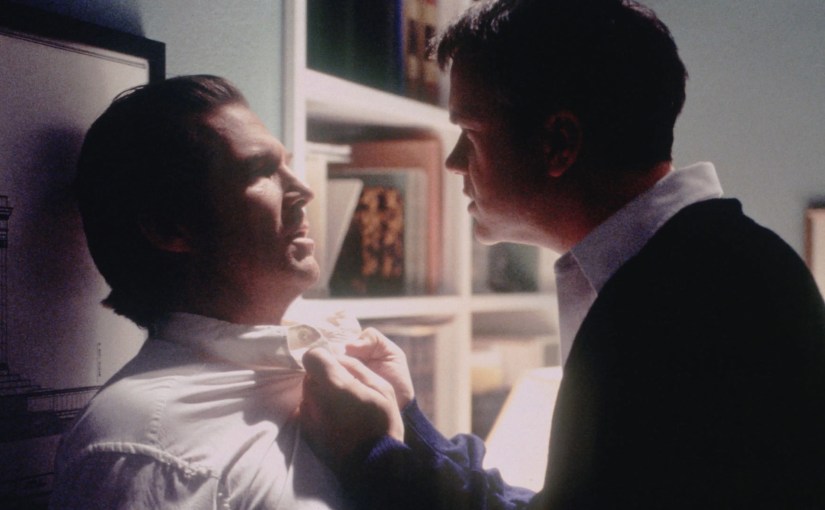
Oliver and Cheryl Lang (Tim Robbins, Joan Cusack) are the happy neighbors who recently moved in across the street.  Michael becomes acquainted with them when he saves their son’s life following a fireworks accident.  The Langs quickly become enmeshed within Michael’s space with child sleepovers, barbecues and evening dinners.  However, the friendlier the Langs seem the more suspicious Michael feels about them.  

Oliver’s backstory seems inconsistent with what Michael observes.  Soon, the professor’s hysteria becomes increasingly amplified.  As wholesome as Oliver and Cheryl are with big, toothy grins and neighborly charm, could they actually be plotting for an act of violence to occur?  As Michael becomes more skeptical around them, Grant, Brooke, plus his wife’s former FBI partner, seem all the more dismissive.  Whatever Michael is beginning to believe is nowhere near as apparent as his own expressive paranoia with big outbursts and unkempt appearances.  Jeff Bridges delivers a manic performance that leaves you breathless and uncomfortable.  He’s so focused on how unhinged this guy is even when he’s just trying to move on with a new normal as a surviving spouse and parent.

One of the many strengths of Arlington Road is reliant upon its ongoing build.  More is learned with each passing scene.  When you feel like you’ve grasped everything, new material presents itself and the actual truths may be more disturbing than what’s already been revealed.  

Joan Cusack is freaky frightening.  She performs to the camera with wool over the viewers’ eyes and she says so much by doing so little.  Before you die, the last thing you want to see is a Joan Cusack with a crooked, unwelcome grin. I salute the simple costuming of Tim Robbins character.  He dresses like Mr. Rogers with a lanky, thin build covered by earth tone sweaters and khakis.  He’s so plain and corny that its terribly awkward. These friendly neighbors hide in plain sight.  

On a first view, Arlington Road may feel like a paint by numbers formula with a few jump scares as the hero sneaks around for clues along with a high stakes chase through Washington DC.  However, I encourage anyone to watch Mark Pellington’s thriller more than once.  The first time you are focused on Bridges, Robbins and Cusack.  The second time you are likely to find what explains the conveniences of the characters and the story.  Then you realize that Pellington and screenwriter Ehren Krueger have done thorough research into what realistically upholds the actions of these characters and situations.

Arlington Road only suffers from a terrible and misleading title.  It’s simply unattractive.  However, the film is compelling and authentically conceived long before a dark trend of American terrorism and mass violence dominated social media and evening newscasts.  It’s a mixed compliment to suggest that the cast and filmmakers got so much right with a topical story that was not yet so commonplace.  

This is an absolutely engaging thriller that I only wish was more fictional and exaggerated than it actually is.

KLUTE

By Marc S. Sanders

Perhaps Klute, directed by Alan J Pakula, was one of the earliest erotic thrillers to hit the cinema.  In 1971, with Jane Fonda portraying a call girl who briefly goes topless on screen, the daringness of the picture likely garnered a lot of attention.  I bet it was perceived as controversial and elevated the common murder mystery to a grittier more forthright and sleazier height.  Even John Klute, the investigator, played by Donald Sutherland, did not possess the theatrical disposition of a Sam Spade like Bogart or even a Jake Gittes that was just a few years away.  The case at hand in Klute felt real and disturbing.  The actions of the characters were unmentionable and unfathomable.

A highly respected married man named Tom Grunerman turns up missing.  The most unusual clue into his disappearance are letters found in his desk that were written to a New York City prostitute named Bree Daniels (Jane Fonda).  According to his wife and the CEO of his company, the letters seem out of character for a man like Tom.  Six months go by and there is still no sign of the man.  So, John Klute voluntarily goes to New York to investigate for himself while becoming acquainted with Bree.  

Bree is a very high-priced call girl who estimates she does between five hundred and six hundred calls each year.  She’s trying her best to step away from this lifestyle and work as a professional actress and model.  Yet, to uphold her means of living and to make up for the various rejects at auditions, she can’t help but return to what she’s best at.  Occasional visits to a therapist help her justify why she maintains this seedy occupation.  Various recordings of Bree’s observations and conversations with her Johns are about her regard for the profession. She claims that she is capable of catering to any particular vice a man might have. Most impressive is that she does not get turned on by the trysts she shares with these men. She also does not cast much judgment on whatever niche her various clients are into.  She’s positively cold to the demands of her job. Tom does not sound familiar to her, but he might have been the guy who beat her up a year earlier.  

I like the slow burn wait of this story.  A picture like Sea Of Love with Al Pacino works this way.  That’s a better movie though.

Donald Sutherland has significantly less dialogue than Jane Fonda.  He’s got a disturbing expression with large eyes and closed lips, not to mention a tall stature, that allows him to seem alert as an observer and a listener, particularly to Fonda’s character who is protective of herself even if she has much to say.  So, while the two get to know one another with Bree offering some possible leads for Klute to follow, there is an eerie and deliberately meandering pace to the story.  I knew I had to keep up my patience with Klute because an unexpected payoff would eventually arrive.

What bothered me though is that the twist of the mystery is revealed midway through the movie.  You brought me my steak before I had time to finish my salad.  Now, for the rest of the story I’m smarter than the characters and I’m only watching everything unfold. That left me feeling unchallenged through the whole second half of the film. Klute became boring and less inviting.

In 1971, this was a bold kind of picture though, not a common 1990’s erotic thriller like Basic Instinct or Color of Night.  It was seedy, unheard of and therefore fascinating.  At the time, the intrigue for a picture like this must have been off the charts.  Pakula even shows off how novel a tiny tape recorder was in 1971. Imagine what this recorder is capable of!

Had Klute been released today, I’m certain many would take issue with its final edit of story development.  I would also argue that a young Jane Fonda would never be accepted in a role like this.  Frankly, twelve years after this film, Jamie Lee Curtis was more convincing to me as a call girl in Trading Places.  Fonda’s inflection and voice of maturity just did not work for me in this role.  I did not find her alluring in the part, and I think she was too organized and educated to be Bree the call girl.  I was surprised to read afterwards that Jane Fonda won the Oscar for Best Actress for this film because I considered her miscast. Fonda’s voice always sounded overly patronizing to me.  I read later that the actress’s moments with the therapist were primarily improvised by Fonda, shot after the bulk of the picture was completed. Pakula honored her wish to shoot the therapist scenes later because Fonda wanted to have more of a grasp on this call girl character. The therapist scenes definitely look unpolished, particularly for the woman portraying Bree’s counselor. I could detect the improv going on before I knew that it was so. I was watching Jane Fonda, the actress, making a case for the research she collected to prepare for this role.  I wasn’t convinced Jane Fonda was playing the role, though.

The film provides moments where Bree is catering to a couple of clients.  Pakula is honest with his staging.  One client breathes heavily with nervousness about the trouble he’s about to indulge in and then there is the awkward business agreement between Bree and the man followed by the necessary construction of turning the hotel sofa into a bed. It’s weird and unromantic. All this business interrupting this guy’s ultimate fantasy. Very good direction by Alan J Pakula.

Another client hires Bree to pose like a woman from a pre-World War I era where she simply narrates a scenic moment from his past. He does not touch her. He does not undress. This old man from the city’s fabric district simply takes it all in, allowing Bree to do the heavy lifting while he remains stoic in his chair surrounded by the darkness provided by famed cinematographer Gordon Willis (The Godfather).  Still, Fonda seems out of place in these episodes.  Even her fear of a possible killer on her trail left me unsatisfied.  This woman always looks like she has it altogether. She arrives on John Klute’s doorstep in the middle of the night because she’s apparently haunted by what he’s pursuing and also, she’s getting prank calls at odd hours. Nevertheless, I’m still not convinced that Jane Fonda as Bree the call girl is truly shaken by any of this. Jane Fonda is just too put together and hardly evokes any convincing weakness.  

It is ironic the film is named after Sutherland’s character, Klute.  The story begins with his perspective.  I liked his detective.  Almost like the guy could’ve branched off into other stories, like Sherlock Holmes or Sam Spade or Mike Hammer.  The fact that the picture is called Klute leaves me wondering if a series of mysteries would have been paved for this character.  To my knowledge, I do not believe that ever came to be.  I’m sorry the trajectory of the movie veers off into Fonda’s character primarily when she enters the story.  Little is revealed about John Klute.  I only know his experience as a detective is limited, and he’s actually never visited New York City before.  Some interesting challenges for this guy, but none of this hardly becomes obstacles or factors for the rest of the film.  Much is learned about Bree Daniels, but hardly anything is absorbed about the title character, John Klute.

Klute starts off with a lot of promise.  I was excited to tag along with a new kind of brooding investigator who is impervious to influence and looks like he could not get easily overwhelmed. The mystery to uncover why a man went missing but not murdered is very intriguing.  My curiosity was there from the start.  Unfortunately, my interest dwindled as the picture carried on.  Jane Fonda talks a lot with not much to say and when the real culprit is unmasked at the midway point, my attention span is no longer demanded by the film.

Klute was likely a risky, pioneering kind of picture at the time of its release.  A sexy thriller.  Nowadays, it’s like any Saturday night midnight kill thrill of the week where the tempos are foreseen several minutes before they come to life.  Klute just loses its lust–ahem–sorry luster.

THE SUGARLAND EXPRESS (1974)

by Miguel E. Rodriguez

DIRECTOR: Steven Spielberg
CAST: Goldie Hawn, Ben Johnson, Michael Sacks, William Atherton
MY RATING: 6/10
ROTTEN TOMATOMETER: 87% Certified Fresh

PLOT: A young wife breaks her husband out of prison in 1969 Texas so he can help reclaim their infant from a foster family.  The ensuing media circus takes everyone by surprise.


Watching Steven Spielberg’s The Sugarland Express is like looking at one of those historical medieval tapestries of fierce battles, created by artists who didn’t yet know how to depict perspective.  There is plenty of action on display, but everything looks and feels flat.  The film took an award at Cannes that year for Best Screenplay, probably (at least partly) in recognition of how it shies away from a traditional Hollywood resolution, but even its downbeat ending is reminiscent of earlier, more resonant films like Bonnie and Clyde [1967] or Butch Cassidy and the Sundance Kid [1969].  As a stepping stone in the career of an eventual legend, it’s worth a view.  As a stand-alone film, it never quite achieves liftoff.

Based on real events, The Sugarland Express tells the story of Lou Jean Poplin (Goldie Hawn at her irrepressible, bubbly best), the young wife of prison inmate Clovis Poplin (William Atherton).  During a conjugal visit, just four months before Clovis is to be released, Lou Jean boldly busts him out because she needs his help to reclaim their infant, Langston, from a foster home.  Lou Jean herself has just finished serving time at a women’s prison, and the state, probably very wisely, determined Langston was better off with a foster family.  But they need to hurry because “I bet those Methodists are gettin’ ready to move out of state.”  Lou Jean’s delivery of “Methodists” tells you all you need to know about her feelings on the matter.

After Lou Jean breaks him out, a comedy of errors ends up in a situation where she and Clovis have hijacked a police cruiser and are holding a police officer at gunpoint.  They demand to be left alone while they drive to Sugarland, Texas, and retrieve their son, at which point they’ll release their hostage.

Now, this has all the makings of a smart, character-driven “road” movie, instigated by desperate people with no real plans for their end-game.  But for reasons I can’t put a finger on, nothing ever happens in the film that got me on the edge of my seat, figuratively speaking.  I fully comprehended the situation intellectually, but the film never got to me at an emotional level.

Could it be because we never really learn a lot about Lou Jean and Clovis in order to make them more empathetic?  No, I don’t think so, because over the course of the film, we’ll hear all about their past histories and previous brushes with the law.  The very fact they’re executing this plan to essentially kidnap Langston is proof of how unfit they are as parents.

I think part of the problem with the movie is…

…I’ve been sitting here for the last fifteen minutes trying to finish that sentence.  I can report that the film didn’t get to me emotionally, but I am struggling to explain why.  Could it be as simple as I think they’re not such great people, but the film seems to be siding with them as the movie progresses?  I mean, the movie HAS to side with them at least partially in order to make their journey mean anything.  Look at Butch Cassidy and the Sundance Kid.  Bank robbers, lawbreakers, but clearly the good guys because, duh, Paul Newman and Robert Redford are playing them.

So, maybe it has to do with the casting?  The Sugarland Express had one of America’s sweethearts as a woman willing to resort to kidnapping just to commit another kidnapping in the name of maternal love.  So, we’ve gotta root for her, right?  But then we see her behaving in the most inane, brainless way for so much of the movie.  I found it difficult to side with her when I just wanted to, forgive the expression, slap some sense into her.

What about Clovis?  I could side with him.  He appears to have misgivings throughout the entire film, right up to the point of no return.  But the way he willingly goes along with the scheme because, dammit, it’s his wife…something about that also turned me off on him.  There are moments I felt sorry for him, for them both, because I could see where this movie was headed early on.  But that empathy wasn’t enough to make me feel a catharsis of tragic energy at the film’s finale.  There’s just something about Clovis and Lou Jean that wouldn’t allow me to get too worked up over their fate.

I guess I identified most with the kidnapped police officer, Slide (Michael Sacks).  Maybe too much.  From the beginning, Slide is begging them to drop their weapons and turn themselves over to the police.  At first, he looks like he’s just following his training.  But then the movie progresses, and doggone it, he starts to like these two loonies, even though Clovis handcuffs him and even shoots at him a couple of times in the heat of the moment.  He can see where this road ends, and he pleads with them not to do exactly what the Texas state troopers expect them to do, because he doesn’t want to see them dead.  Because Slide never stops imploring the Poplins to see sense and do the smart thing, I guess he’s who I sided with for the entire movie.  (Well, him and his superior, Captain Tanner [Ben Johnson], who also doesn’t want to see them die.)

But…isn’t that the wrong way to approach this movie?  I shouldn’t be siding with the cops, for cryin’ out loud, should I?  At least, not in this movie.  Discuss.

From a technical standpoint, it is pretty cool to see how Spielberg, in only his second film, was able to marshal vast resources to create some arresting imagery.  The sight of what looks like literally hundreds of cop cars following the Poplins is a deceptively difficult feat, logistically speaking.  There’s a tense shootout in a used car lot that would have been right at home in The French Connection.  And everywhere, there’s bits of humor that made me smile.  From the elderly couple abandoned on the road (long story) to the solution of how to get Lou Jean to a toilet while in the middle of an extended police chase, Spielberg constantly pokes us in the ribs.  If this had gotten to the hands of someone like John Landis, it’s easy to see how this could have been turned into an out-and-out comedy with thriller elements, instead of the other way around.

One other aspect I did like was the media circus that blew up around the Poplins’ plight.  I’m sure it is yet another link to previous anti-heroic films, but while I was watching it, I was reminded of only one film: Oliver Stone’s Natural Born Killers [1994].  The outpouring of affection from the general public for these two, let’s face it, outlaws was both funny and sobering at the same time.  It would have been interesting to see a scene or two at the end of the film as an epilogue, so we could get a reading on what the public thought about how the police should have handled the situation.

If comparing The Sugarland Express to most of Spielberg’s later films, it certainly comes up lacking, no question.  As a lifelong Spielberg fan, I am compelled to say it SHOULDN’T be compared to his later films because it was made before he’d had a chance to hone his skills and become the populist/mainstream film icon he is today.  Look carefully at the two-dimensional storytelling and you can see the outlines of what was coming around the bend for this modern-day master.