BEETLEJUICE

By Marc S. Sanders

On Friday night, we watched Beetlejuice the movie.  On Saturday afternoon, we watched Beetlejuice the musical, and as soon as the curtain was pulled on the stage and the performance began, I knew exactly what the movie did wrong and what the play did so right.

I saw Tim Burton’s much beloved spooky comedy for the first time just last year with my Cinemaniac pals, which includes the other Unpaid Movie Critic.  The guys were laughing and laughing until it hurt.  I was off to the side thinking how I remember seeing that scene while flipping channels on occasion.  Cute, but ultimately boring.  That’s how I feel about Burton’s second film, following a hilarious debut with Pee Wee’s Big Adventure and just ahead of his blockbuster accomplishments with the first two Batman films.  Beetlejuice is full of big ideas but devoid of content, and I mean that literally, because the title character brilliantly played by Michael Keaton is scarcely in the film.  When he is not on screen, the remaining cast are quite bland or unwelcomingly weird.

Adam and Barbara (Alec Baldwin, Geena Davis) happily reside in a three-story Connecticut home.  Adam indulges in making a scaled model of their picturesque hometown and Barbara…well I can’t recall what she does.  On an errand trip, they haphazardly die and suddenly return to the house.  Yet, they realize quickly that they have expired and what is even less convenient is that they cannot leave the house lest they end up in a kind of limbo threatened by a monstrous sand worm and other unusual experiences. 

Shortly after, Charles and Delia (Jeffrey Jones, Catherine O’Hara), appearing with the typical Tim Burton flavor, move into the house along with his suicidal daughter Lydia (Winona Ryder) and their quirky interior decorator Otho (Glenn Shadix).  They plan to refurbish the house in their own way with Delia’s ugly art sculptures and Charles looking for a reading room.  Adam and Barbara want them out so they can roam free and avoid being contained within the attic. 

Upon discovering that Lydia can speak with them and following an entrance to the Netherworld, they get an idea to scare the new owners away.  Only whatever efforts they set out to make fails miserably and they consider reciting the name of the “ghost with the most” three times to carry him over to their side to do their bidding.

Great storyline.  Sounds great on paper.  So why didn’t it work for me?  Well, Lydia is resigned to her mostly miserable suicidal self and that is neither funny nor empathetic to me.  More importantly, conflict works best when different worlds clash and what I find lacking in several Tim Burton films is that the characters on both sides of the coin are not different enough from one another.  The ghosts or souls or comforts of the Netherworld do not look far enough apart from how Charles, Delia, Lydia and especially Otho behave.  Everyone is weird.  Where is the normalcy to ruin or undo or disagree with? 

Beetlejuice himself is a character to behold though.  Keaton is doing Jim Carrey better than Jim Carrey does and long before that guy was ever discovered.  The actor is working in the area of Robin Williams material, particularly as the Genie from Alaadin.  The issue I have is that Michael Keaton is seldom in the film.  It is a long first act with Baldwin and Davis not doing much of anything before they finally encounter Beetlejuice to have a couple of funny exchanges.  Then they leave him to have mundane conversations with everyone else in the film, particularly Winona Ryder who has nothing to do except dress in her signature, depressing black.  When Keaton finally is summoned, he takes possession of a dinner party with the beloved Calypso tune “Dayo.”  However, we don’t see Keaton in this popular sequence.  Instead, we get Jones and O’Hara with David Niven doing odd contortions to the music with some butt shaking and grotesque facial and body expressions.  I would rather have seen Keaton doing his funny best in a lip sync routine.  What’s in the final cut is just not funny enough for me. Kooky, yes.  Funny, no.

Eventually, the black and white striped suited ghost with green hair is called back for the final act and we get to see him pull all the tricks out of his hat.  However, it’s not enough.  Just as the routine is getting started, it’s over, and then the movie is over. 

There are some inventive sight gags.  Not enough though.  I particularly loved the shrunken headed ghoul with the googly eyes and the pink skinned prostitute whose legs are separated from her torso.  I love when Beetlejuice’s head gets shrunk, and I like when Adam and Barbara’s faces are contorted into odd shapes of gigantic beaks or zany skulls beneath their facial skin.  These are the highlights of this film’s Netherworld and the distance I travel to see it all is smaller than Rhode Island.  In the original Star Wars, I experienced what felt like thousands of alien races.  In Ghostbusters, New York is haunted by one different kind of afterlife from another and another.  In any episode of The Muppet Show, I get to see one breed of silliness before another ridiculous set up is put into play.  The Netherworld setting of Beetlejuice is simply not vast enough.

The stage musical makes up for the shortcomings I have with the film.  The spine of the story is what the two pieces have in common.  After that, the stage play takes more risks.  The musical numbers are absolutely winning.  More significantly though, all the characters are granted more depth and dimension.  The root cause of Lydia’s anguish is explored.  We see the snobbery of Charles just like in the film, but he is also a loving father who recognizes Lydia’s suffering following the loss of his wife/her mother.  Delia also has a desire to connect with her stepdaughter Lydia.  All the elements are given enough attention amidst the craziness offered by Beetlejuice himself who occupies the story from beginning to end.  The character works like a great two-hour stand-up routine with his unlimited imagination of ghoulish trickery and fun.

Burton’s film was released in the late-1980s when updated stop motion effects of the puppet kind were new to the medium of film.  The imagination was there, though it does not hold up as it is very outdated.  Still, Tim Burton was showing his gift for macabre creativity that he has become known for ever since.  Nevertheless, he did not go far enough with the vision of his film, and he did not award any of his characters enough ingredients to let them be unique.  It is not enough that they all speak weird and look strange.  It is better if we can know why they are so uncompromisingly odd.  Beetlejuice the film lacks its variety. More specifically, it lacks its Beetlejuice.

HAUNTED MANSION (2023)

by Miguel E. Rodriguez

DIRECTOR: Justin Simien
CAST: LaKeith Stanfield, Rosario Dawson, Owen Wilson, Tiffany Haddish, Danny DeVito, Jamie Lee Curtis, Jared Leto
MY RATING: 6/10
ROTTEN TOMATOMETER: 40%

PLOT: A single mom in New Orleans hires a grieving tour guide, a dubious psychic, a shady priest, and an unhinged historian to help exorcise her newly bought mansion after discovering it is inhabited by ghosts.


Writing even a mildly negative review of Disney’s Haunted Mansion feels a little like hitting “dislike” on a picture of a 3-legged puppy.  The puppy is just being a puppy.  It doesn’t know or care that it’s missing a leg.  It just is what it is.

So it goes with this new attempt at a movie based on a popular Disney ride.  It’s chock-a-block full of inside jokes and references to the ride, some in plain sight, some tucked away in the corners of the screen.  As a fan of the ride at the Magic Kingdom in Orlando (I’ve never been to the Disney parks in Anaheim), I enjoyed these little Easter eggs.  Truthfully…I enjoyed them a lot.  I especially liked the chair shaped like a Doom Buggy, and the room that stretches, and the hitchhiking ghosts, and on and on.  This movie is basically Ready Player One revolving around just one IP instead of hundreds of them.  (That’s “Intellectual Property” for all you non-nerds out there.)

But aside from all the cool references, there’s not much else to recommend, especially not for those few poor souls who are not as thoroughly familiar with the Disney ride as I and many others are.  For those people, I would imagine Haunted Mansion plays a little bit like a de-fanged version of the original Jumanji [1995] or Jon Favreau’s criminally under-appreciated Zathura [2005].  There’s a heart-tugging sub-plot about the grieving tour guide, Ben, played by LaKeith Stanfield.  (Stanfield deserves recognition for playing the absurd material absolutely straight, even pulling out the emotional stops for a touching moment as he describes his late wife, in a scene that features an absolute scene-stealing button from Danny DeVito.)  Travis, son of single mom Gabbie (Rosario Dawson), has problems with bullies at school, even when he isn’t troubled by the ghosts who have latched onto him like lice.  Then there’s the issue of who all the resident ghosts are REALLY afraid of, a big-bad known only as the hatbox ghost (Jared Leto).

(I was reminded here of Peter Jackson’s The Frighteners [1996] in which a host of ghosts were terrified of a being that can actually kill a ghost.)

The movie has all the requisite creepy hallways and creaking doors and one or two jump-scares, but everything is done so tongue-and-cheek that it’s never truly horrifying…which was, I’m sure, the aim of the filmmakers.  Certainly you don’t want to make a film, based on a theme park ride, as scary as The Exorcist.  So, to that end, the filmmakers succeeded.  The movie is harmless, even a little fun at times, Owen Wilson gets to deliver some of his trademark dry observations, and DeVito gets to play some notes that I haven’t seen him play in a very long time.  If pressed, I would be forced to conclude that, for non-fans of the ride, this movie would most likely be a bit of a slog.

…but it is cute, despite missing that one leg.

BARBIE

By Marc S. Sanders

Having just returned from donning my pink t-shirt to watch Greta Gerwig’s box office smash Barbie, I am certainly relieved that I watched the film with my wife.  Just when I thought I understood everything I was watching in the movie, my better half explained to me that my perception was wrong.  Yet, I still believe Barbie was a magnificent experience that allowed me to reminisce about my pre-teen years occupied with my favorite toys (Kenner’s Star Wars figures and playsets).  I applaud this film for going even deeper than that though.  Barbie reflects on the patterns between men and women primarily in the fields of career, objectivity, and social stature.  As pink as the film is, and it is pinker than a truck load of Pepto Bismol, it is also observant and telling.

Someone commented on a Facebook post when I announced that I was seeing the film that Barbie is a “woke” movie.  I am so sick of that term, honestly, and it has nothing to do with which side of the political aisle I sit on, because I no longer sit on any side.  While watching Margot Robbie as the main “Barbie” of a whole community of “Barbies” in Barbie Land, I never recognized said “wokeness.”  Only afterwards did my wife have to explain where it likely exists within the film.  I still don’t think it’s a fair observation though.  Barbie and Ken dolls, Skipper and even the pregnant Midge doll and the lonely Allan doll and all their accessories are marketed by Mattel to a demographic for young girls.  Greta Gerwig’s script though questions what could threaten a Barbie Land.  Frankly, the only thing imaginable (besides opening the film on the same day as a biographical film about the man who invented the atomic bomb), is if the world of Barbie was no longer Barbie & Ken, but rather Ken & Barbie and a male dominated finish conquered Barbie Land following Ken (Ryan Gosling) reading up on some books about horses and machoism.  Very inventive, as well as comedically endearing to watch how Barbie and all the other Barbies undo what’s been done by Ken and all the other Ken variations.

A second storyline is really what rang true to me.  America Ferrara portrays Gloria, a mother in the Real World who has lost a bond with her daughter Sasha played by Arianna Greenblatt. Sasha has long outgrown spending time with Gloria and playing with Barbies together.  Sasha is a typical moody teenager.  This is crushing to Gloria and real-world thoughts enter the mother’s mind by the will of nature, including the uncertainty of death and even worse…cellulite.  Barbie (Margot Robbie) realizes the effect it has on her and with guidance from Weird Barbie (Kate McKinnon) embarks on a journey to the Real World to right what is wrong with the girl who plays with her.  Barbie is in for a surprise though. 

One day I will weave into one of my original plays about the time I showed my father my brand-new Star Wars TIE Fighter ship.  I demonstrated for him how the wings pop off.  His response was an artificial “Oh wow!” and then a return to his dinner with further discussion about his workday.  At six years old, I could even identify how uninterested he was.  This moment from so many years ago came back to me as I observed Ferrara’s emptiness.  The mother has lost her daughter, the same way my young self lost my father. 

Toys can draw out nurturing emotions of happiness, and perhaps disappointments, when we are young and imaginative.  As adults, a desire for a recapture of youth can blossom.  My generation yearns for the toys they played with and are even willing to pay enormous amounts of money for that tangible memory with what are now considered antiques.  Toys have always been a part of my life.  I was never an athlete.  I got much more pleasure out of playing with my action figures and my made-up car chases and shootouts in my bedroom. 

Gerwig’s script, co-written with Noah Baumbach, is quite intuitive.  Barbie and Ken (Robbie, along with wonderfully sweet and naïve Ryan Gosling) try to perfect what is imperfect about themselves and end up making things drastically worse for their respective existence within the Barbie World.  Barbie may fear bad breath and try to escape death, but how will that affect the pink, plastic world she stems from?  Ken tries to learn more from the Real World to enhance his noticeability with Barbie and deal with his insecurities against the other theatrical Kens he exists with. Does learning change Ken into a better version of himself, though?  Experience and exposure to foreign situations are necessary to enhance oneself but go a little too far and it might become a reminder to be careful what you wish for.

Mattel is even spoofed by means of Will Farrell and his posse of dark suit executives and the office’s grey cubicles representing white collar corporate America.  What Barbie and Ken have unleashed could have drastic consequences on the commodity of their bestselling dolls and playsets.  Honestly, I was waiting for an appearance by He-Man to enter the fold.  How would this carry over to the Masters Of The Universe??????

Barbie is more complex than the cheerful advertisements, the toy brand or even the bubbly appearances from Robbie, Gosling, McKinnon and the rest of the cast may appear to be. I’ve already heard it described as strange, and definitely not a movie for kids.  There’s a reason it is PG-13.  Mature themes are at play amid the sunniness of President Barbie, Astronaut Barbie, Supreme Court Justice Barbie, Mermaid Ken and Beach Ken.  Greta Gerwig didn’t want to settle for a just a happy go lucky fantasy.  The Barbie doll has existed for over fifty years and by now, nearly a quarter of the way into a new century, she better serve more purpose than a perfect smile, arched feet, and cheerful shades of pinks and yellows.  Gerwig sought to uncover the role Barbie has for girls and women at age 5, 8, 15, 30, 50 and on and on. 

I must recognize some of the attractions contained in the picture.  An inspired opening of the film had me rolling as Barbie answered the call of Stanley Kubrick’s classic 2001: A Space Odyssey.  (Makes me sad that I was the only one laughing in a full theater.)  Gerwig also took wise advantage of the multitalented Gosling with a collection of musical song and dance numbers.  I never really cared for the song “Push” by Matchbox Twenty, until Ryan Gosling and his Ken mates applied it as a substitute to Robbie’s Barbie and her Barbie gals’ adoration for “Closer To Fine” by the Indigo Girls.  Gosling puts such energy into his performance.  He’s certainly the go-to actor for musical films like Barbie and La La Land.  Those days on The Mickey Mouse Club truly paid off.

Barbie is a vibrant and very smart film.  I’m just not sure everyone will respond to it like I did.  It is no surprise that moviegoers resent that it is not catered for young children or that there’s an oddness to some of the stories.  You may not care for it.  Who knows?  Maybe you’ll find it to be “woke,” but I hope you’d look deeper than that.  I appreciate it on a personal level however, remembering back to my time as a kid with a toy or two that were more than just pieces of molded plastic.  Rather, my Boba Fett and Han Solo figures were often the best friends to spend time with and it’s only sad that dad may have missed out on what was truly special for his son. Still, even Barbie reminds me that none of us are perfect and that’s okay.

HAIL, CAESAR! (2016)

by Miguel E. Rodriguez

DIRECTORS: Ethan Coen & Joel Coen
CAST: Josh Brolin, George Clooney, Alden Ehrenreich, Ralph Fiennes, Scarlett Johansson, Tilda Swinton, Channing Tatum
MY RATING: 7/10
ROTTEN TOMATOMETER: 86% Certified Fresh

PLOT: A movie studio “fixer” in 1950s Hollywood faces his biggest challenge yet when the star of the studio’s most prestigious film in production is kidnapped by a shadowy organization calling itself, “The Future.”


The word “idiosyncratic” feels like it was invented for the Coen Brothers…or maybe vice versa.  Their 2016 film Hail, Caesar! is yet another case in point.  Packed with the kind of early Hollywood detail we wouldn’t see again until 2022’s Babylon, this film is a love letter to the 1950s studio system that produced such classics as All About Eve, Stalag 17, The Bridge on the River Kwai, and Ben-Hur.  However, the comic story surrounding this love letter is a bit rambling and disjointed.  About halfway through, I found myself wondering if maybe the movie wouldn’t have been better if the filmmakers had just ditched the comedy and made a straight-up drama.  But then we got to the climax, and I realized, no, comedy is better for serving up the kind of silliness we get at the end.  It’s no Raising Arizona, but it’ll serve.

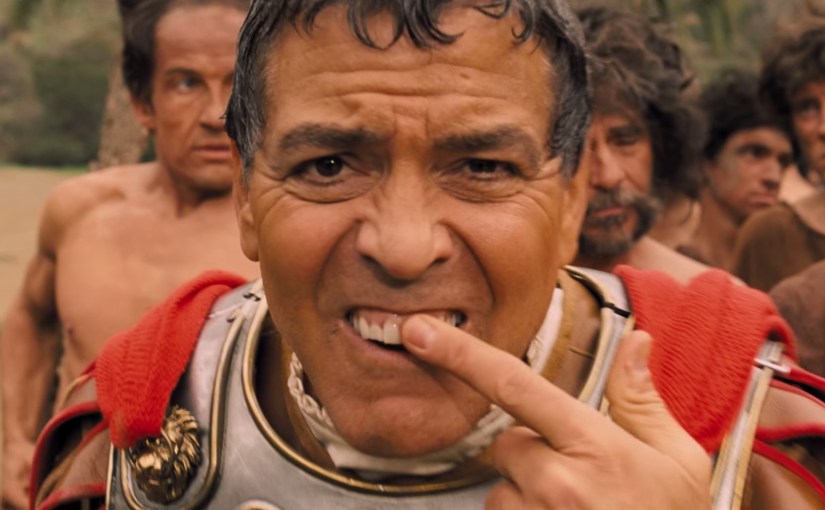
In classic film noir fashion, a narrator (Michael Gambon) informs us that Eddie Mannix (Josh Brolin) is head of production at the fictional Capitol Pictures, which is in the middle of shooting its most ambitious picture ever, an epic Biblical tale called Hail, Caesar!  (Think Ben-Hur with a lower budget and an outright plagiarized screenplay.)  However, their leading man, the improbably handsome and incredibly dumb Baird Whitlock (George Clooney), abruptly goes missing when he is kidnapped by a couple of lurking extras.  Mannix must deal with finding Whitlock while also figuring out what to do about:

  1. DeeAnna Moran’s (Scarlett Johansson) unexpected pregnancy.
  2. Hobie Doyle’s (Alden Ehrenreich) inability to deliver lines without a cowboy accent, which infuriates his director, Laurence Laurentz (Ralph Fiennes).
  3. Two persistent gossip columnists (both played by Tilda Swinton) who are running stories on Whitlock’s disappearance and/or salacious rumors about Whitlock’s past.
  4. A lucrative job offer from Lockheed.
  5. His promise to his wife (Allison Pill in a tiny role) to quit smoking.

Whew!  And I haven’t even mentioned the singer/dancer Burt Gurney (Channing Tatum) or the mysterious group of academics who have apparently kidnapped Whitlock, a group calling itself, “The Future.”  …spooky…

As in many other of the Coen Brothers’ films – not ALL of them, but many of them – the story itself is not really the point.  It just serves as an excuse for Ethan and Joel to present the viewer with scene after scene demonstrating their immense affection for a bygone era of filmmaking.  When Scarlett Johansson’s character, DeeAnna, is introduced, for example, we don’t just get a line or two about what she does (she’s an aquatic star modeled after Esther Williams).  We’re treated to an elaborately choreographed scene with dozens of bathing beauties, ScarJo diving from a great height wearing a mermaid tail, and a mechanical whale complete with a spouting blowhole.

At one point, Mannix visits the chief film editor for the studio, C.C. Calhoun (Frances McDormand), to see how Mr. Laurentz’s film is shaping up.  This scene in particular is lovingly presented, as we get a quick-cut sequence of Calhoun unspooling the film in the dim editing room, re-threading it, punching a button, flipping a switch, click-clack, click-clack, and Mannix watches the opening sequence of “Merrily We Dance” on the tiny Moviola as the projector whirs in the background.  I would bet real money that Martin Scorsese really, REALLY loved this scene.  (Plus there’s a nice little comic button at the end of the scene that is an excellent demonstration of Edna Mode’s immortal dictum in The Incredibles: “No capes!”)

The whole movie is like that.  It’s one of the most nostalgic homages to old Hollywood that I’ve ever seen.  But the movie can’t seem to make up its mind about what it’s about.  George Clooney puts on a clinic of how to play dumb as the clueless Baird Whitlock.  (In fact, this movie serves as the conclusion to the unofficial “Idiots” cycle of films from the Coen Brothers films, which also includes O Brother, Where Art Thou?, Intolerable Cruelty, and Burn After Reading, all of which star Clooney in a lead role…playing an idiot.)  Alden Ehrenreich is pretty convincing as a young star with a pretty boy face and limited acting ability, which I’m sure is far from the truth, but he pulls it off.  His scene where he tries to wrap his Texas accent around the simple line, “Would that it were so simple”, with his director patiently trying to coach him, is hilarious on its own.  But it runs on a little too long, as does the aforementioned scene in the editing room.  The subplot with the gossip columnists feels tacked on, almost as of the Coens were trying to pad the running time.  There’s a magnificently choreographed scene where we watch Channing Tatum’s character do some tap dancing dressed as a sailor for another movie being filmed, but even THAT runs a little too long.

Ultimately, Hail, Caesar! feels more like an intellectual exercise instead of an emotional one.  I hate to keep bringing this movie up by comparison, but Babylon, for example, managed to capture a nostalgia for Old Hollywood AND kept me emotionally involved for its entirety.  There was an energy that kept things moving.  Hail, Caesar! lacks that energy, but I can’t quite bring myself to call it a “bad” movie because I connected with its affection for the monolithic, flawed system that managed to create so many diamonds amid SO many lumps of coal.  (Just like today!)

HOBSON’S CHOICE (Great Britain, 1954)

by Miguel E. Rodriguez

Director: David Lean
Cast: Charles Laughton, John Mills, Brenda de Banzie
My Rating: 7/10
Rotten Tomatometer: 92% Fresh

PLOT: A widowed bootmaker in 1880s England with three unmarried daughters is thrown when his eldest daughter announces her intentions to marry his best cobbler and start her own business.


From Wikipedia: “A Hobson’s choice is a free choice in which only one thing is actually offered. … The most well-known Hobson’s choice is ‘I’ll give you a choice: take it or leave it’, wherein ‘leaving it’ is strongly undesirable.”

Ask ten cinephiles about their favorite David Lean films, and I’ll bet dollars to doughnuts not more than two of them will even know Hobson’s Choice exists.  It’s one of only two comedies Lean ever directed (the other being Blithe Spirit in 1945), and it’s one of the last smaller-scale movies he would direct before 1957’s The Bridge on the River Kwai made his name synonymous with big-budget cinematic spectacles.  Hobson’s Choice oozes charm from every frame, has many well-earned laughs, and features a brilliant performance from the great Charles Laughton.  I just wish it had a better ending.  I’ll try not to spoil it for you, but…dang.

Henry Hobson (Laughton) is a widowed bootmaker in late 19th-century England with three unmarried daughters.  The eldest daughter, Maggie (Brenda de Banzie), keeps house, manages the books, and essentially runs the business, leaving Henry free to drink himself silly at the local pub every night and come home drunk as a skunk.  Being of an undesirable age – 30 years old – Maggie is also considered unmarriable.  But she’s no dummy.  See, one of Henry’s employees is a cobbler named William (John Mills, a legendary, prolific British actor), and Maggie notices when a rich patron praises William’s boots as the best she’s ever owned.  So, Maggie hatches a plan that will accomplish three things: get herself married, steal her father’s prize employee, and start her own business with the best bootmaker in town.  Hobson, of course, will have none of it, for various reasons…one of which is that, as the father, he is expected to pay a handsome dowry to the bridegroom, and he’ll be damned if he’ll give hundreds of pounds to a lowly cobbler, nor will he allow his “uppity” daughter to get the best of him.  Comedy ensues.

There is a lot to like in Hobson’s Choice.  First, there is the clever skewering of the class system, both socio-economically and along gender lines.  Hobson is reluctant to pay anything to William other than his barely-livable wages.  When circumstances force him to treat William as if he were a member of the same middle class as he, Hobson, is, he becomes enraged because…he simply has no choice.  The idea of all men being created equal is alien to him.  This same principle applies to his treatment and perception of his daughters.  He may genuinely love them in his heart of hearts, but all we ever hear from Hobson is how bothersome and loud and “uppish” they are.  To him, their sole purpose is to keep things neat and tidy and have dinner ready when he demands it.  It never once occurs to him that Maggie, the eldest, would be capable of putting her plan together, let alone actually pulling it off.

I also enjoyed how a good chunk of the story parallels Shaw’s Pygmalion, at least in broad strokes.  Will, Hobson’s prize cobbler, is as low-class as you can get, and has been treated as such his entire life.  Part of Maggie’s plan is to get Will to behave and dress more genteelly, and her method is nothing short of brilliant.  Rather than follow Henry Higgins’s approach – bullying with a heavy hand – Maggie very gently points Will in the right direction, stepping in with a firm hand only when necessary, as when it becomes necessary to deal with Will’s landlady, one of the funniest bits in the movie.  At first, Will is taken aback by Maggie’s directness, but it’s fun watching how gradually he gets turned around.  He may not be the spitting image of a member of the royal family after all is said and done, but his transformation is unmistakable.

Another great factor is the blustery performance by Charles Laughton in a role that, in my opinion, deserves more attention from film fans.  He’s most commonly associated with Quasimodo or Captain Bligh or the barrister in Billy Wilder’s Witness for the Prosecution (1957), but in Hobson’s Choice, he convincingly plays a man who is painfully aware he’s being driven towards a specific decision he does not want to make.  He’s been lord of the “manor” his entire life, and the idea that he might be forced to bow to his daughter’s whims is unbearable.  He is the most fun person to watch in the film…although John Mills is a close second.  I love his borderline incomprehension as Maggie patiently explains her plans and orders him about.

As I said, there is a lot to like in Hobson’s Choice.  But, man, did that ending let me down.  I was reminded oddly of David Cronenberg’s most recent film, Crimes of the Future (2022), which rolls the closing credits at the EXACT moment it becomes the most interesting.  I have no theatrical knowledge of the play on which Hobson’s Choice is based (other than the fact it ran for over 130 performances), but if the play ends the way the movie does, and I had been a member of the audience at a performance of that play, I would have rolled up my program and chucked it at the curtain.  I don’t want to give too much away, but its abruptness is breathtaking.  In my mind, it leaves far too much unresolved, unless there’s something I missed in that final scene/conversation.  I kept waiting for Hobson to make his eponymous choice, and for a second it LOOKED like he did, but it also looked like he had a devious plan of his own, and then…credits.

Oh, well, no matter.  There is more charm in a single frame of Hobson’s Choice than there is in any two Will Ferrell rom-coms.  I found it thoroughly enjoyable, even if it did let me down at the end.  Since Lean directed my favorite movie of all time, I’m inclined to forgive it.  I’ve seen most of Lean’s other films, and none of them committed this same blunder, so…c’est la vieHobson’s Choice is still worth seeking out.

SEVEN PSYCHOPATHS (Great Britain, 2012)

by Miguel E. Rodriguez

DIRECTOR: Martin McDonagh
CAST: Colin Farrell, Sam Rockwell, Woody Harrelson, Christopher Walken, Tom Waits, Abbie Cornish, Olga Kurylenko
MY RATING: 7/10
ROTTEN TOMATOMETER: 83% Certified Fresh

PLOT: A struggling screenwriter inadvertently becomes entangled in the Los Angeles criminal underworld after his oddball friends kidnap a gangster’s beloved Shih Tzu.


I wanted to like Seven Psychopaths more than I ultimately did, but it is still a fun, mostly unpredictable ride.  My biggest hangup was that it felt too similar, in broad strokes, to other “meta” movies.  To other BETTER movies, unfortunately.  I always try to review the movie in front of me instead of comparing it to other films, but in this case that guideline proved impossible.  But I did try.

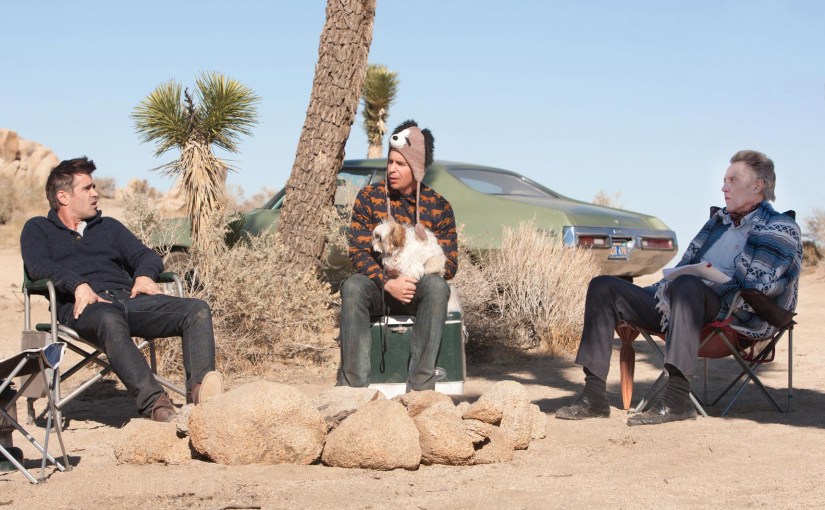
The story involves Martin (Colin Farrell), a struggling screenwriter in Los Angeles; Billy Bickle (Sam Rockwell), his best friend who also runs a dog-napping racket with HIS friend, Hans (Christopher Walken); and Charlie (Woody Harrelson), a dog-loving gangster whose favorite pet is a Shih Tzu named Bonny…whom, as it happens, the dog-nappers have stolen.  We get an idea of just how much Charlie loves his dog during a scene where he interrogates the dog-walker who lost her.  When a man is willing to shoot someone over a dog, I’d be the first in line to give it back, but Billy has other plans.

See, his friend Martin is trying to write a screenplay.  He’s under a deadline, but all he has so far is the title: Seven Psychopaths.  He doesn’t even know who all the psychopaths are yet.  So, Billy tells him a couple of stories about psychopaths that he’s heard about here and there, and the characters slowly start to take shape.  Meanwhile, Hans makes periodic visits to his cancer-stricken wife at the hospital.  Also, a serial killer is on the loose, but he only kills mafia and yakuza hitmen.  ALSO also, Billy puts an ad in the paper advertising for psychopaths to reach out to him and Martin so their stories can be used in Martin’s screenplay.  That’s how they wind up meeting Zachariah (Tom Waits), an odd little man who carries a rabbit wherever he goes and spins a tale of how he and HIS wife would hunt…but I’m getting ahead of myself.

As you see, there’s a lot of story going on.  And, as I mentioned before, most of it is unpredictable.  The concept of a killer who only targets hitmen is unique, at least in my mind.  But when the story focused on Martin’s screenplay and how it was being put together, that’s when I started having cinematic déjà vu.

Example: Martin isn’t sure how he wants it to end.  He’s a pacifist, so he doesn’t want it to end in a cliched shootout.  Billy spins a tale of how HE would end the film, with a bullet-ridden, blood-soaked shootout in a cemetery, featuring the return of Martin’s ex-girlfriend for no reason and a supporting cast of all seven of the psychopaths reuniting, also for no reason.  At that moment, I instinctively thought, “Well, clearly this movie is going to end in a shootout.” And it does. Sort of.

Martin hears Billy out and disagrees.  “They should all just go to the desert and talk their issues out instead of shooting each other.”  Again, I realized, “Okay, so they’re going to wind up in the desert.” And they do.

And so it went, over and over again.  A character would pitch an idea for Martin’s screenplay, and later in the film that idea would suddenly be manifested.  Martin gets criticized because his screenplay doesn’t feature enough women and doesn’t give them anything meaningful to do or say…in the middle of a movie where the women don’t do or say anything meaningful.

Don’t get me wrong, I like meta movies.  But despite the dark comedy and the typical awesomeness of Chris Walken and the other elements that weren’t so predictable (the reason behind Hans’ cravat, for example), I just couldn’t shake the feeling of “it’s all been done before, and better.”  I’m thinking specifically of Kiss Kiss Bang Bang (no screenwriter, but same vibe) and Adaptation, a movie where the lines between reality and the screenplay get so blurred as to be non-existent.  Seven Psychopaths feels like it’s trying to get to that level, but it never quite gets there.  On that level, it’s not quite a success.

However, I will say it’s worth a watch for any movie fans.  There are enough satirical elements that make it worthwhile.  (“But his rabbit gets away, though, because you can’t let animals die in a movie…just the women.”)  Walken’s performance is, as always, the stuff of legend, even in a smaller role like this one.  Late in the movie, he has a marvelous scene between himself and a button man with a shotgun.  If that vignette is not mentioned during the tribute video when he eventually passes away, I would be extremely disappointed.

THE MITCHELLS VS THE MACHINES (2021)

by Miguel E. Rodriguez

DIRECTORS: Michael Rianda, Jeff Rowe
CAST: Abbi Jacobson, Danny McBride, Maya Rudolph, Eric André, Olivia Colman
MY RATING: 9/10
ROTTEN TOMATOMETER: 97% Certified Fresh

PLOT: A quirky, dysfunctional family’s road trip is upended when they find themselves in the middle of the robot apocalypse and suddenly become humanity’s unlikeliest last hope.


Discovering The Mitchells vs the Machines feels like finding a discarded lottery ticket that someone threw away.  Intended for theatrical release in 2021, it was instead sold to Netflix when that became unfeasible due to Covid.  I have no way of knowing how many people may have streamed it, but it didn’t exactly take the world by storm.  I happened to find a discounted copy on sale at Target some time ago and have only just now gotten around to watching it.  Written and directed by the writers/creators of the acclaimed animated series Gravity Falls and produced by the minds behind the Jump Street reboots, the two Lego Movies, and Spider-Man: Into the Spider-Verse, this movie is a home run that feels like it has been all but forgotten by the general public.  If you’re a member of that section of the public, and you like great animated films, do yourself a favor and carve out some Netflix viewing time.  You won’t regret it.

The Mitchells are a mildly dysfunctional family with their hearts in the right places, but their quirkiness gets the best of them sometimes.  Aspiring filmmaker Katie Mitchell (voice of Abbi Jacobson) has been accepted into a film school in California, but instead of flying, her father, Rick (Danny McBride), decides to make one last effort at connecting with his daughter by taking the whole family on a road trip in a mid-90s station wagon whose model name is sensible.  As in, that’s the name of the model, the mid-90s Sensible.

The mom, Linda (Maya Rudolph) tries to act as a buffer between Katie and Rick, when she’s not trying to get her family to act more “normal” like their all-too-perfect next-door neighbors (voiced by John Legend and Chrissy Tiegen).  Katie’s younger brother, Aaron, is so obsessed with dinosaurs he calls random people from the phone book: “Hi, would you like to talk to me about dinosaurs?  No?  Okay, thank you.”  They have a pug dog named Monchi that apparently has the IQ of a carrot and looks like he was bred in a bakery.  (“Bred” in a bakery…get it?  Don’t worry, you will.)  Put them all in close quarters and you’d be lucky to get them to survive into the next county, let alone halfway across the country.  And don’t forget that robot apocalypse mistakenly engineered by a tech genius (Eric André) who took the concept of obsolescence one step too far.

What follows is a Pixar-esque journey into self-discovery, industry and pop culture in-jokes, and genuine emotional moments.  Any quibbles I have with the movie have to do with certain physical logistics.  I know I shouldn’t bring the concept of real-world physics into an animated film that includes killer microwave ovens and ominous toasters, but there were a couple of moments that defied logic when everything else was doing so well.  I won’t spoil them, but they’re there.

But that’s a minor, minor quibble.  TMvTM is so delightful and fun, it doesn’t matter.

I loved the visual style of this movie, recalling the eye-catching pyrotechnics in Spider-Man: Into the Spider-Verse.  To emphasize certain moments during the film, the filmmakers added little “flair” on the edges of the screen, or emitting from certain characters like in a comic book, but instead of feeling “comic-book-y”, it felt like a little glimpse into the mind of Katie, the main character, whose mind is constantly in “making-a-movie” mode.

I loved the “big-bad” in the movie because it’s based on the world’s ever-increasing reliance on portable electronic devices.  At one point, the villain shuts down the wi-fi on a global scale.  Humanity predictably loses its mind within seconds.  (My favorite example of this meltdown showed a woman pleading with someone to take a picture of her food.)  Do I advocate for a complete erasure of our devices?  Absolutely not.  But I am on the dad’s side when he insists on no devices at the dinner table.  Everything in moderation, folks.

Underneath the flashy style and effective villains, though, there is a real human story about the father’s desperate need to reconnect with his daughter before she leaves for college.  (Indeed, the film’s original title was Connected.)  The filmmakers took a lesson from Pixar’s playbook and made very sure to include some tender moments and heartfelt speeches that never once felt contrived or schmaltzy.  I don’t have kids, but if I did, I could easily imagine myself shedding a tear when the dad watched old home movies of himself and Katie when she was a toddler.  And I loved the story behind the wooden moose.  The story is diligent about giving everyone a solid, believable back story that fills in the blanks without resorting to lengthy flashbacks.  Not an easy task.

As hidden animated treasures go, this goes on the list with Boy and the World and A Town Called Panic.  It’s streaming on Netflix, so chances are you have access to it right now, so…what are you waiting for?

LEGAL EAGLES

By Marc S. Sanders

In Legal Eagles, Robert Redford plays a promising district attorney named Tom Logan, who becomes ensnared by Debra Winger, playing a private defense lawyer named Laura Kelly.  Laura is representing Chelsea Deardon (Daryl Hannah), a mysterious, but alluring twenty-something accused of stealing a priceless piece of art.  Murder eventually comes into play.  Romance does as well.  Unfortunately, none of it works in what should have been a charming comedy from director Ivan Reitman (Ghostbusters, Stripes, Meatballs).  The casting is solid.  The script is not.

When this film was released in 1986, Robert Redford looked like the best option for the standard romantic comedy, to lead the fraternity of male actors eventually to come by way of Billy Crystal and Tom Hanks.  Debra Winger was well known with a collection of Oscar nominations for more serious subject matter.  However, she has always possessed that smart yuppie look; aggressive, professional, and ready for love.  Redford and Winger make a perfect pair.  The flirtations between the actors’ characters in Legal Eagles work quite successfully.  The regret is that a flat, boring mystery for them to tackle is always getting in the way. 

During Chelsea’s eighth birthday she is presented with a painting by her renowned artist father at a lavish party.  Later that night, a fire ravishes through their apartment.  Her father perishes in the flames and the painting along with other priceless pieces of art were thought to go up in flames.  Jump eighteen years to present day 1986, and Chelsea insists to both Laura and Tom that some of those paintings, including her father’s gift to her were stolen before the fire occurred.  Suspects are interviewed.  Danger gets in the way and so on.

The problem with this initial set up is that this conundrum is pretty stale.  It doesn’t offer enough to keep me interested.  What do I care about a stolen painting?  Moreover, I could care less about the fate of Daryl Hannah’s character.  She’s designed to be the standard Olan Mills Photography glamour model of the 1980s, and she is most certainly beautiful, but she is written with as much dimension of what a thumb tack does when you push it into a wall.  She just sticks there. 

There are some usual suspects for the lawyers to pursue like Terence Stamp, an interesting character actor by reputation.  Regrettably, his art dealer portrayal is not written with much logic.  The two lawyers follow him to a warehouse and find themselves in danger when Stamp traps them inside with a ticking time bomb that will not only kill them but destroy his immense collection of assets and records.  Why go through all this trouble?  You’ve got some of the most valuable, sought after pieces of art tucked away in here. 

Brian Dennehy is a cop who welcomes himself into the story and the “intuitive lawyers” happily accept his trust when he offers his file on the fire investigation from eighteen years prior.  He just turns up at random, odd moments.  Do Tom and Laura even think to wonder why this guy is so interested in assisting them all of the sudden?

What really sends Legal Eagles off the rails though is a step away from the narrative so that Robert Redford and Daryl Hannah can be caught in bed together.  This serves no purpose.  It’s a scene that screams of a producer demanding this happen to sell movie tickets and it betrays the intelligence any of us would expect of a sharp-witted New York City District Attorney.  Even more absurd is when Redford and Hannah are awakened the next morning, she is arrested for murder.  So the lawyer sleeps with the client, but no concern regarding ethics is ever questioned.  As well, Winger’s character just delivers an eyeroll response to Redford’s error in judgment, but the two continue to work in flirtatious harmony.  That doesn’t offer much respect for the aptitude of Winger’s character.  She should be repulsed by this transgression.

Legal Eagles contains more charming and mature humor than Ivan Reitman was recognized for by this point in his career.  It’s a yuppie ‘80s film.  I only wished for a more insightful pursuit and storyline for Redford and Winger to be focused on while they fall for one another amid the scenic backdrop of a bustling New York City. 

Daryl Hannah looks like she’s in another movie altogether.  Yes, she sleeps with Redford’s character, but I don’t think Hannah has more than five lines of dialogue exchanged with either Winger or Redford.  She’s expendable here.  You practically forget that she’s the accused client the lawyers are working to exonerate.

The value of the missing painting is hardly stressed upon.  The motive for murder really isn’t either.  There are not one or two fires in the film, but rather THREE!!!! Did the craft of invention just stop after page one of the screenplay? 

From a marketing standpoint, based on casting alone, this film had such potential.  The movie features some of the best working talent going for it.  Sadly, it gave all the players nothing to do, and what little was done lacked any kind of foresight or wit.

On the subject of Legal Eagles, my motion stands.  This movie is inadmissible in court!

SOUTH PARK: BIGGER, LONGER & UNCUT (1999)

by Miguel E. Rodriguez

DIRECTOR: Trey Parker
CAST: Trey Parker, Matt Stone, Mary Kay Bergman, Isaac Hayes
MY RATING: 9/10
ROTTEN TOMATOMETER: 80% Certified Fresh
Everyone’s a Critic Category: “Watch a Movie Based on a TV Series”

PLOT: When the overprotective mothers of South Park convince America to go to war with Canada over a Canadian R-rated cartoon (wink, wink), they unwittingly set off a chain of events that could lead to global apocalypse.


I sat down and watched South Park: Bigger, Longer & Uncut for perhaps the fifteenth or twentieth time in my life.  My mind went back to the first time seeing it in movie theaters in 1999, one of the single greatest years of American cinema since 1939.  [Fight Club, The Insider, American Beauty, The Sixth Sense, The Iron Giant, Galaxy Quest, Three Kings, need I go on?]  I recall laughing and laughing and laughing, then forcing myself to be quiet so I could hear the next joke, and then laughing some more.  I recall being shocked, yes, SHOCKED to hear such salty language coming from the mouths of animated children.  I had seen the first season or so of the TV series, especially the pilot featuring the battle between Santa Claus and Jesus, and the aliens who force Cartman to sing, so I was not unfamiliar with the formula.

And yet, as transgressively funny as the TV show was, here comes the movie, which featured, among other things I’m sure I’m forgetting:

  • Several uses of the “F” word.  (Not THAT one, the OTHER one.)
  • A socially unacceptable use of the word “retard.”
  • A very brief glimpse of a white character in blackface.
  • A character who uses very naughty language to describe God.
  • Satan and Saddam Hussein having conjugal relations in Hell.
  • A song with a passage containing musical farts.

…the list goes on.  (One of my favorite exchanges: “Haven’t you heard of the Emancipation Proclamation?!”  “…I don’t listen to hip-hop.”)

These are the kinds of jokes you only repeat to your friends when you’re certain there are no eavesdroppers.  Heck, some of them I wouldn’t repeat to my best friend on a desert island.  But I must be honest: I laughed and laughed again.

Naturally, the satirical elements are bloody ingenious.  The story revolves around our lovable heroes – Stan, Kyle, Cartman, and Kenny – sneaking into a Canadian R-rated film based on one of their favorite television shows, “Terrance and Phillip.”  The aptly named Asses of Fire seems to contain three hours of nothing but two goofy-looking characters farting, making fart jokes, and singing songs about farting and having carnal relations with your mother’s brother.  Our heroes walk out of the movie thoroughly entertained and sporting a new profanity-laden vocabulary that would be right at home in The Aristocrats.  When their mothers hear where their precious children heard such foul language, they form a protest group against Canada and sing the Oscar-nominated song (true story!) “Blame Canada,” which contains this revealing line: “We’ve got to blame Canada, we’ve got to make a fuss / Before someone thinks of blaming us!”

To everyone’s great surprise, it turns out these events might bring about a Biblical apocalypse in which Satan will escape Hell and cleanse the Earth, with Saddam Hussein by his side.  Because, you know, why not?  How this crisis is averted, and how it involves a Clockwork Orange-esque “V-chip” implanted in Cartman’s brain, I would not dream of revealing.

The cleverness of this plot is breathtaking, skewering the concept of forced morality with wit and poop jokes, but something tells me they’re preaching to the choir.  The folks who most need to see this film are clearly the ones who will stay the farthest away from it.  (In one of Hollywood’s supreme ironies, since “Blame Canada” was Oscar-nominated, that meant it was to be performed at the Oscar ceremony, but the network censors would not allow the singer, Robin Williams [!], to sing the word “fart” on national television.  How they got around that absurd logic, I leave it to you and Google to discover.)

This is one of those “review-proof” films, like the Jackass or Scary Movie franchises.  You could line up established critics around the block, telling everyone how juvenile and crude and offensive this movie is, and it will not matter a tiny, tiny bit; they made money, and lots of it.  I might even agree with those critics to a certain degree.  But I cannot deny the fact that tears of laughter rolled down my face when Cartman sang “Kyle’s Mom Is a Big Fat Bitch.”  I cannot deny that watching Saddam Hussein’s idea of foreplay made me first recoil, then cackle with more laughter.  I cannot deny that my best friend and I still laugh today if one of us starts singing, “Shut your ******* face, uncle ****** / You’re a *****-biting bastard, uncle ******.”

It’s juvenile.  It’s rude.  It’s socially unacceptable.  But sweet baby Jeebus, it is funny.


QUESTIONS FROM EVERYONE’S A CRITIC

Best line or memorable quote?
[I already said what my favorite exchange was, but what the heck I’ll double-dip:]
“Remember what the MPAA says: Horrific, deplorable violence is okay, as long as people don’t say any naughty words! That’s what this war is all about!”

If you have seen the television series, do you prefer the movie or the TV version?  Why?
Another moment of full disclosure: I haven’t watched the South Park TV series since shortly after they introduced “Mr. Hanky, the Christmas Poo.”  Honestly, the show’s style of humor started wearing thin, at least for something that aired weekly.  I thoroughly enjoyed 80 minutes or so of the movie, but the show itself just got tiresome.  (You can’t see it, but I just shrugged.)  Even Parker and Stone’s next movie project, Team America: World Police, had its laugh-out-loud moments, but the pinpoint satirical accuracy was missing, and it just seemed mean-spirited compared to the South Park movie.  Apparently, my taste for fart jokes and pervasive profanity does have its limits.  Who knew?

YOU PEOPLE

By Marc S. Sanders

You People has me wondering how we could have stepped so mind bogglingly far back in social tolerance and understanding.  I give people far more credit than the foundations that Jonah Hill and Kenya Barris, who wrote the film together, describe in this movie.  (Barris directed, as well.) People cannot be this cruel and stupid, can they?  Someone give me hope! Give me assurances, please!!!!!

You People is a send up of the Meet The Parents formula, or more specifically Guess Who’s Coming To Dinner? In the latter example, an African-American doctor is brought to the home of his Caucasian fiancée to be introduced to her parents.  Later, the woman meets his parents.  There is an understandable sense of surprise for the characters in both scenarios.  Yet, none of the parties carry the instinct to embarrass each other or allow them an opportunity to lie just to impress and speak with moronic naivety.  The film was never catered for big laughs, but rather more towards awareness and understanding. 

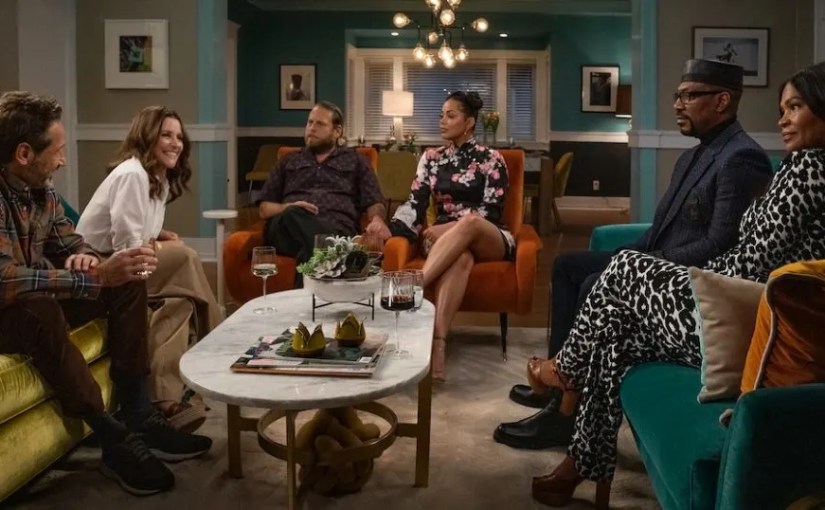
With a cast that includes Jonah Hill, along with Julia Louis-Dreyfus and Eddie Murphy, all well known for huge comedic achievements, You People is designed for the laugh out loud moments.  That’s great.  It sounds very promising, and it was a movie I was looking forward to watching.  However, did the comedy have to come at the expense of stereotyping Black Muslims as angry and intimidating and freely dropping the N-word, while White Jews are dumb, ill informed, clumsy lying cocaine users?

The pattern of Barris’ film is very structured.  For every scene of father-in-law to be Eddie Murphy paired with Jonah Hill, there is also a scene on the other side of mother-in-law to be Julia Louis-Dreyfus paired with Lauren London, portraying Hill’s fiancé.  Murphy does his comedic best in expression and stature with or without dark sunglasses on, while Hill sits very uncomfortably next to him, whether it is in the car or at his bachelor party getaway in Las Vegas where his buddies ask him to call his cocaine dealer.  Cuz, you know, all Jewish guys have a go-to cocaine dealer on speed dial. 

Julia Louis-Dreyfus does her comedic best trying to impress Lauren London by acting aware of what a black person has had to endure and over-complimenting her hairstyles and appearance.  She’s ready to go all “Karen” at the front desk of a luxury spa when she suspects racial discrimination towards London’s appearance.  Later, she will commit slapstick sin by accidentally pulling off the hair weave extensions of one of London’s friends.

I refer to comedic best because the two SNL alumni are so good on camera even if their script is nothing but insulting junk, devoid of validity.  Their expressions are reminiscent of Murphy’s best stand up routines and Louis-Dreyfus’ hilarious sitcom portrayals.  However, these collection of scenes are written with an obnoxiously overabundance of cringe and discomfort.  How these characters treat one another is utterly disgraceful.

Upon an initial meeting at the dinner table, a comparison of suffrage by means of black slavery vs the Holocaust is brought up.  You know what?  Neither incident within our world history is worse than the other.  They’re both horrendous and could never merit comparison.  Yet, here they are being presented as punchlines for outrageous comedy in terms of one upmanship.  Murphy’s character, along with Nia Long as his wife, will announce their admiration for Louis Farrakhan, while Julia Louis-Dreyfus will point out the speaker’s antisemitic doctrines.  In response, she will accidentally light fire to Murphy’s prized Muslim hat gifted by the minister.  If I were to translate this mathematically, Black Muslims celebrating antisemitic gospel equates to White Jews as insensitive klutzes. 

You People is nothing but one insulting moment after another.  In every scene, someone is the punchline at the expense of the writers’ unfair and incorrect blanket approach categorization for what these two demographics must be like. What a huge misfire. 

These are some of my favorite comedic actors.  Lauren London even looks like she can hold her own in scenes with her co-stars.  The potential for talent is hard to match here.  There could have been debates as to who should officiate the wedding and what themes the reception should have, or what the bride and groom should wear. Imagine an argument over the cake topper.  Actually, as I recall there are moments like this in the film.  Nevertheless, they dwindle into conclusions that demonstrate Black Muslims should be feared while White Jews are clueless morons. 

As a conservative Caucasian Jew myself, none of what is depicted in You People could be further from the truth.  I’ve known a few Muslim people and I never caught this kind of vibe from them or who they associate with, or what they practice.  I’ve also never felt uncomfortable in their presence.

The failure of this film lies within the insensitivity of its ignorant script.  This movie could have demonstrated a clash of cultures.  Instead, it relies on moments to squirm at uncomfortably with some of the worst people any of us could ever know.

The next time Jonah Hill and Kenya Barris want to make a movie, they need to read a book and speak with who they select for their subject matter.  Even better, just turn on the camera and let Eddie Murphy and Julia Louis-Dreyfus start talking…about anything!  They are far more intelligent and creative than anything on display here.