LOCAL HERO (United Kingdom, 1983)

by Miguel E. Rodriguez

DIRECTOR: Bill Forsyth
CAST: Burt Lancaster, Peter Riegert, Fulton Mackay, Denis Lawson, Peter Capaldi
MY RATING: 8/10
ROTTEN TOMATOMETER: 100% Certified Fresh

PLOT: An American oil company has plans for a new refinery and sends someone to Scotland to buy up an entire village, but things don’t go as expected.


Local Hero is not normally the kind of movie I gravitate to.  It’s not slow, but it’s deliberate.  It’s not hilarious, but it’s funny.  It’s not plotless, but it meanders and skips around.  It’s not flashy, it’s not glossy, and it’s not kinetic.  I can easily remember a version of myself that might have turned this movie off after the first thirty minutes.

But today, at this time in my life, for whatever reason, something made me look at this movie in a different way than I might have once upon a time.  The movie started to resemble a memory.  Not one of my memories, but like someone else’s memory, like I was listening to someone tell a story about this one time when he went to Scotland and something happened that didn’t exactly change his life, but it made him look at the world differently.  Fiction or not, Local Hero plays not as a movie, but as a recollection.  Its charm carried me through the entire film.

And I’m not talking about the kind of charm you might see in any 2 or 3 movies set in Scotland or Ireland.  Normally, in films set in and around the British Isles, the villages one might find there are laid back, yes, but filled with eccentric characters who know each other’s business, are friendly but cautious around outsiders, and who are loud and boisterous at the local pub.  In Local Hero, the most eccentric characters are the Americans, and the village pub might fill up, but you’ll never have to raise your voice to be heard.  It’s an interesting switch.

The story: A Texas oil company wants to buy the entire village of Ferness in Scotland so it can turn the surrounding area into a giant oil refinery.  The company’s CEO, Felix Happer (Burt Lancaster), sends a junior executive, Mac (Peter Riegert), to Scotland to facilitate the deal.  When Mac arrives, he gets his first taste of culture shock, not due to all the eccentricities he finds, but due to how quiet this town is.  He is checked into the local hotel by Gordon Urquhart (Denis Lawson, aka “Wedge Antilles” in the Star Wars films), who also turns out to be the town’s bartender, the town treasurer, and the head chef in the hotel’s kitchen.  Mac is accompanied by an eager Scottish assistant, Oldsen (an impossibly young Peter Capaldi), who develops a crush on a local scientist and runs from one assignment to another as if his arms were on fire.

Local Hero throws curveballs every chance it gets.  You’d expect the citizenry to get indignant at the idea of an American mega-corporation wanting to buy their town.  But when the locals get an idea of how much each person would get, they become instant supporters.  When they all convene at the local church, the Reverend is not an inexperienced youth or a crusty old soul, but an African gentleman who, according to the story he tells Mac, came to Scotland to learn the ministry and just…never left.  Happer, the CEO, insists on periodic updates from Mac, and since this is 1983, Mac has to call Texas from a red phone booth just outside the hotel.  But Happer seems less interested in the deal than in the potential discovery of a comet, somewhere in the constellation Virgo.

All of this is told in the laid-back manner of someone telling a story around a campfire.  There are little jumps forward that omit what might seem to be key information, but we pick up on it right away.  Little details emerge, like the motorcyclist who always seems to be roaring down the town boulevard just in time to nearly run Mac over.  There’s a moment when Mac encounters a group of men near the beach, has a pleasant conversation, then notices a baby in a stroller.  “Whose baby?”  His question is met with an uncomfortable silence as the men slowly look at each other, and Mac wonders what just happened.  And the beautiful thing is, that’s it.  That’s the end of the scene.  No one ever answers the question, and we never find out why not.

That kind of thing would normally infuriate me, but in this movie, it reinforced the idea of a fond memory.  I can easily imagine someone telling the story and saying, “And that was it!  No one ever said whose baby it was!  I still don’t know whose baby it was!”  It has the ring of real life, it’s not played up for laughs, and there’s no punchline at the end.  The punchline is that there IS no punchline.

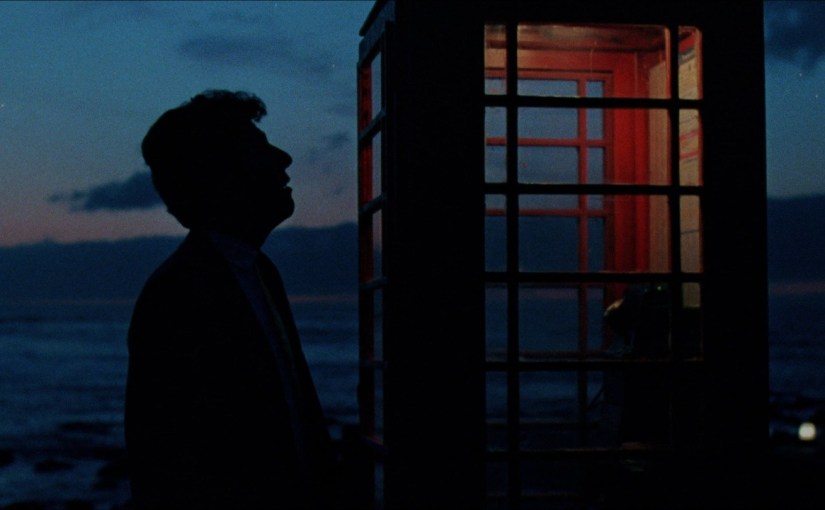
There is a nice moment when Mac has had one or two whiskeys too many one night, and he gets on the phone with Happer in that red phone booth.  Suddenly, the sky starts to glow and glisten – the aurora borealis.  Mac gets excited and tries to explain to Happer what’s going on, but he lacks the vocabulary.  “I wish I could describe it to you like I’m seeing it!”  I know how he feels.  It’s how I felt when I went to Alaska for the first time in decades and traveled on a cruise ship through a narrow fjord and saw towering cliffs covered in trees and intermittent waterfalls cascading over rocks so everything looked primeval, like something out of The Lord of the Rings.  Just describing it doesn’t convey how it felt.  It’s a short moment in the movie, but I felt the reality of it in my bones.

In an interview on the Criterion Blu-ray, the film’s producer, David Puttnam, talks about how, when this movie was made, the general public’s idea of comedy was Airplane! and Blazing Saddles.  If it wasn’t zany, it wasn’t considered a comedy.  He wanted to help make a film that tried to remind audiences that comedy doesn’t automatically mean pratfalls and fart jokes.  Comedy can be gentle.  Local Hero is as gentle as they come.  It’s marvelous closing shot speaks volumes, and it wouldn’t have had the same impact if the story had been told any other way.

NIMONA (2023)

by Miguel E. Rodriguez

DIRECTORS: Nick Bruno, Troy Quane
CAST: Chloë Grace Moretz, Riz Ahmed, Eugene Lee Yang, Frances Conroy
MY RATING: 9/10
ROTTEN TOMATOMETER: 94% Certified Fresh

PLOT: Framed for a crime he didn’t commit, a knight in a futuristic world reluctantly accepts the help of a shapeshifting teenager to prove his innocence.


Just when I thought the Spider-Verse animated films held the current monopoly on creating cool futuristic worlds, along comes Nimona with its delirious fusion of medieval pageantry with flying cars, cellphones, and annoying TV jingles.  Put aside what some will no doubt call its “woke” agenda/storyline and just drink in the amazing visuals, as knights in shining armor wield swords as they ride hoverbikes into battle.  (There is the occasional horse, naturally…some traditions apparently die hard in this version of the future.)

The pre-requisite prologue explains how a brave warrior queen, Gloreth, defeated a vile monster a thousand years ago.  To maintain vigilance against any future attacks, Gloreth’s subjects erected a wall around their magnificent city and created the Institute, a sort of school-for-knights, to train their protectors from generation to generation.

One thousand years later, the city prepares to matriculate its current class of knights, including, for the first time in their history, a commoner, Ballister (Riz Ahmed), championed by the current Queen Valerin as a symbol of progress.  What matters a knight’s lineage if his heart is brave, and his spirit is bold?  This choice has not gone over well unanimously in the queendom, unfortunately, but she is confident in her choice.  However, in a twist of fate, Ballister’s sword malfunctions during the knighthood ceremony, resulting in the Queen’s death, and Ballister, minus an arm, finds himself a fugitive.

He has exactly two allies.  One is his romantic partner and fellow knight candidate, Ambrosius Goldenloin, a direct descendant of Gloreth herself, who spearheads the search for Ballister in an attempt to keep someone else from killing him outright.  The other is a flighty, impetuous teenager who tracks Ballister down the following night and offers her services as sidekick to what she thinks is the newest villain in town, Ballister the Queen Slayer.  This is Nimona (Chloë Grace Moretz), a shapeshifter who can assume any form she desires, although her favorites appear to be a pink rhinoceros and a giant pink whale.  She likes pink.  And punk, as it turns out.

I imagine one could be cynical and say that what follows story-wise is nothing new: our heroes overcome initial adversities and suspicions of each other, they track down clues, deal with one or two serious crises, and eventually expose the truth of what really happened the day the Queen was killed.  But that’s like saying The Stand is about a bunch of people who survive the end of the world and eventually defeat the bad guy.  Well, duhNimona doesn’t offer anything outrageously subversive in the story department.  What it offers is a fresh new imagination and perspective in how it tells this story, especially when it comes to the character of Nimona herself, the very definition of the rebel outsider who literally doesn’t fit in anywhere.

What makes great kids films work – what makes MOST films work – is how it invites the juvenile audience to identify with the main character.  In Pinocchio, what little kid doesn’t know what it’s like when a lie grows out of control?  In The Wizard of Oz, what little kid has never felt homesick?  In Harry Potter and the Sorcerer’s Stone, what kid has never dreamed that they were special, not really meant for everyday life?

In Nimona, what kid has never felt alienated at some point in their life because of something that makes them different?  They’re not as old as the grown-ups.  They’re not as young as little babies anymore.  They’re in an in-between world where they’re only as strong as the friends they make, if they’re lucky enough to make friends.  What if there is something inherently different about them?  Nimona has tried shapeshifting before, tried to explain her gift, but people immediately think of her as a monster instead of someone who’s gifted.  There are echoes of the X-Men films here, too, but those mutants were lucky enough to find a home at Xavier’s mansion.  Nimona is not so lucky.  So, she decides to embrace the monstrous role society thrusts upon her.  I imagine there are lots of people out there who feel the same to one degree or another.  I’m not a sociologist, but it seems logical.

The real villain of the story (I won’t reveal their identity) does everything in their power to manipulate the narrative in the eyes of the public.  At one point, their scheme is all but exposed, but they discover yet another way to maintain power: turn society on itself.  They reveal the existence of the shapeshifter, explaining to the city that the real monster could be sitting next to you, or playing with your child, or living in your house.  The sinister nature of this ploy made me genuinely angry, mostly because of how effective it is, both in the film and in real life.  When you’re too busy fighting each other, the true villains win.

Enough philosophy.  Nimona stands among the best animated films yet produced by Netflix (Klaus, Guillermo del Toro’s Pinocchio).  There is plenty of humor to go around to leaven the moments when the film goes deep into territories unexplored even in the best Pixar movies.  (Correct me if I’m wrong, but I can’t recall a Pixar film where a character contemplates suicide as an alternative to grief.)  The end credits inform me that Nimona is based on a graphic novel.  Guess what I’m looking for on Amazon in a few minutes.

THE MAN IN THE WHITE SUIT (United Kingdom, 1951)

by Miguel E. Rodriguez

DIRECTOR: Alexander Mackendrick
CAST: Alec Guinness, Joan Greenwood, Cecil Parker, Michael Gough
MY RATING: 8/10
ROTTEN TOMATOMETER: 100%

PLOT: An altruistic chemist invents a fabric which resists wear and dirt as a boon to humanity, but both big business and labor realize it must be suppressed for economic reasons.


First, a brief history lesson:

“The Ealing comedies is an informal name for a series of comedy films produced by the London-based Ealing Studios during a ten-year period from 1947 to 1957. Often considered to reflect Britain’s post-war spirit, the most celebrated films in the sequence include Kind Hearts and Coronets (1949), Whisky Galore! (1949), The Lavender Hill Mob (1951), The Man in the White Suit (1951) and The Ladykillers (1955)… Many of the Ealing comedies are ranked among the greatest British films, and they also received international acclaim.” – from Wikipedia

There.  That summarizes it way better than I could.  Watch enough British films and the term “Ealing Studios” will invariably come up.  Their comedy films have a breezy, economical quality, sometimes combined with dark humor and almost always with something to say about the conditions in Britain at the time.

The Man in the White Suit is a prime example of the Ealing comedies (although Kind Hearts and Coronets is my personal favorite).  In this film, the versatile Alec Guinness portrays Sidney Stratton, an unemployed inventor with a head for chemistry and textiles.  He stumbles upon a formula that he believes will create the ultimate cloth: impervious to stains and virtually unbreakable.  After a series of pyrotechnic failures, he cracks the code and makes a white suit out of his miracle material.

The storytelling for this whole first half of the film is quick as lightning.  Director Mackendrick wisely realizes that lengthy exposition is the enemy of good pacing, so we get a lot of quick scenes that linger only long enough to make their point before we fade into the next one.  While watching it, I began to worry that this rapid rhythm would hinder my investment in the story, but in retrospect, it almost feels like we’re inside Sidney’s head.  On film, he’s almost always running, rarely strolling except when he’s trying to fool any casual observers.  When he makes his breakthrough, his speech becomes a rattling string of syllables that might require subtitles to decipher, his excitement nearly derailing his ability to talk.

Once he creates this magical cloth and fashions a suit out of it (resorting to blowtorches to cut the suit patterns), he beams.  What a boon to mankind!  You can’t damage it, you can’t get it dirty…it’s the only suit you’ll ever have to buy!  What a windfall!  Well, not so fast.  He immediately encounters resistance from both sides of the textile supply chain.  The laborers who work in the textile mills don’t like it because they envision making only one set of clothes per person and that’s it; it never needs replacing.  Competing companies (management) don’t like it because no one will buy anything else, and it will put them out of business.  Sidney becomes caught in this tug of war, and the whole second half of the film becomes a variation of chase scenes as Sidney struggles to publicize his invention while labor and management fight to suppress it.

There’s an interesting subplot when management tries to persuade Daphne, the daughter of the company’s owner, to seduce Sidney into signing away his rights to his invention.  In an era when most women’s roles were relegated to love interests, her reaction to this offer is unique: she calmly asks, in so many words, “How much is this worth to you?”  She negotiates her fee much the same way as a high-priced escort might.  The board members are scandalized when they realize exactly what they’re asking her to do, and what is being negotiated.  But instead of shying away from it, Daphne embraces it.  Neat.  (Her “seduction” of Sidney has a clever resolution that I did not see coming.)

Like other great films, The Man in the White Suit offers a lot to chew over after the credits roll.  Sure, the last half of the film offers lots of comedy and chase scenes and farcical situations to satisfy any film lover.  But the underlying concept is more interesting the more I think about it.  It’s not exactly a NEW idea, but interesting, nevertheless.  One of the workers at the textile mill tells Sidney: “The razor blade that never gets blunt.  And the car that runs on water with a pinch of something in it.  No.  They’ll never let your stuff on the market in a million years.”  We’ve all heard the urban myths of rubber tires that never wear out, or even the cars that run on water (just saw that one on the internet the other day).  Are they real?  Probably not.  But it’s fun to think so, to imagine the shadowy forces suppressing brilliant inventions for the purpose of commerce.

But there’s a flip side to the story.  During Sidney’s pursuit, he runs into an old washer woman and asks for a coat to cover his suit (the material’s properties make it practically luminous at night).  She happens to know about Sidney and his invention, and she tells him, “Why can’t you scientists leave things alone?  What about my bit of washing when there’s no washing to do?”  More than anything else, this gives Sidney pause, and I can almost hear him thinking, in the back of his head, the immortal words of Ian Malcolm: “Your scientists were so preoccupied with whether or not they could that they didn’t stop to think if they should.”

In this way, The Man in the White Suit offers more food for thought than I would have expected.  It’s making a statement about the inevitability of scientific progress, pleading with the responsible parties to be more, well, responsible with their actions.  This film was released only six short years after America ended World War II by dropping atomic bombs on Japan, so the question resonates more dramatically than you might expect from such a breezy comedy.

I can almost hear you asking, “Yeah, but is it funny?”  Yes, this delightful Ealing comedy is in the best traditions of the form.  It’s not too heavy, asking the big questions but wisely not answering them.  It has plenty of smiles and laughs.  And for those who have never seen Alec Guinness as a young man in the movies, it’s a treat to watch a very young Ben Kenobi cavorting on the screen with his eyes bugged out and a silly grin on his face.  And if it offers food for discussion afterwards, all the better.

P.S.Look for a very young Michael Gough in the cast, aka “Alfred” in Tim Burton’s Batman.

FUNNY GIRL (1968)

by Miguel E. Rodriguez

DIRECTOR: William Wyler
CAST: Barbra Streisand, Omar Sharif, Kay Medford, Walter Pidgeon
MY RATING: 7/10
ROTTEN TOMATOMETER: 94% Certified Fresh

PLOT: Barbra Streisand elevates this otherwise rote musical melodrama with her ultra-memorable star turn as real-life stage performer Fanny Brice.


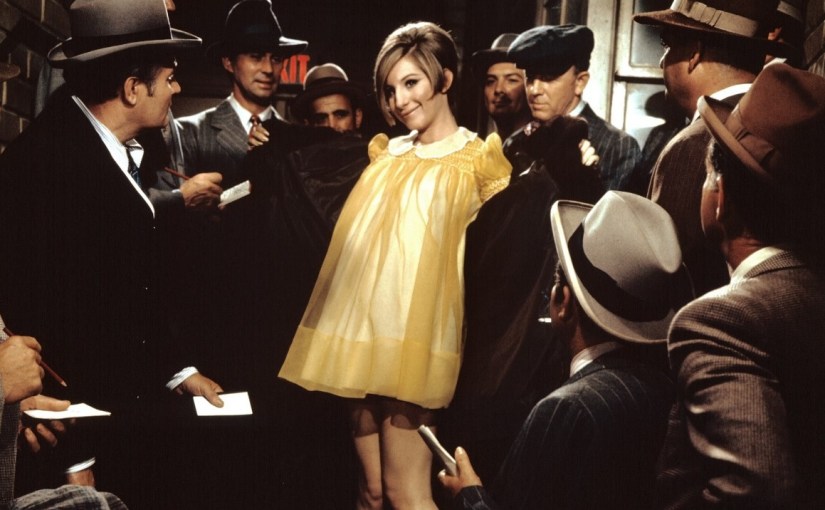
There is nothing wrong with Funny Girl that couldn’t have been fixed by the film not taking itself so seriously.  With its widescreen compositions and scores of extras and lavish stage productions featuring flocks of Ziegfeld girls in the most extravagant costumes imaginable, this should have been a romp, even with the serious bits in between.  Instead, the movie sinks under the weight of its pretentiousness, short-changing the funniest bits and wallowing in pathos way more than is necessary.  Thank goodness Barbra Streisand is there, giving a debut performance for the ages that is part Groucho Marx, part Debbie Reynolds, but mostly just Barbra.  Come for the spectacle, stay for the songs.

The story begins with Fanny Brice (Streisand) walking backstage at a theater and delivering her immortal opening line to a mirror: “Hello, gorgeous.”  From there, the rest of the movie is a flashback to the rise and rise of Fanny Brice, a plain-ish vaudeville chorus girl who is discovered by a roguish playboy, Nick Arnstein, played by Omar Sharif, who looks like a man whose last name would be anything BUT Arnstein.  He cleverly gets her boss to raise her pay to $50 a week (about $800 in today’s dollars, so not bad), and in the process captures Fanny’s heart.  Shortly after that, she’s invited to join Florenz Ziegfeld’s legendary troupe of dancing girls, where she manages to tweak his authority in probably the funniest number in the movie, “His Love Makes Me Beautiful.”

It’s in this number where the first tonal tug-of-war takes place between Streisand’s playfulness and the movie’s urgency to look “important.”  There is an earlier number, “I’m the Greatest Star”, that really showcases Streisand, but the movie never gets that tone right for the rest of the movie.  In “His Love Makes Me Beautiful”, she has these wonderful glances and occasional throwaway lines, but most of them are lost in medium or long shots that emphasize the extravagant Ziegfeld costumes and the expensive-looking set dressing.  It’s like watching a play where the lights are shining everywhere except the stage.

Arnstein comes and goes, sometimes for weeks or months at a stretch, always making sure to see Fanny when he’s in town but repeatedly pointing out that he doesn’t want to be tied down by a relationship.  Their “courtship” lasts through “People”, a song most people know without knowing what it’s from, and a curious number where Arnstein invites her to dinner in a private room upholstered entirely in red velvet, and we know and Fanny knows what’s going to happen, and she has a funny argument between her lust and her manners in “You Are Woman, I Am Man.”  The song also contains a duet with Arnstein, and brother, if you haven’t seen Omar Sharif crooning, you haven’t lived.

Everything comes to a head at the finale of Act One when Fanny learns Arnstein is sailing to Europe and decides to join him instead of going to the Ziegfeld girls’ next port of call.  Here is where Streisand really pours it on, proving her virtuosity with the classic “Don’t Rain on My Parade”, belting out note after note and ending on the iconic shot of her standing on a tugboat as it passes the Statue of Liberty.  If anyone ever doubted she was the real thing before that moment and this movie, their doubts were certainly erased by intermission.

Alas, all good things come to an end, and Act Two falls into a predictable series of economic rises and falls as Arnstein’s volatile income stream finally goes south permanently, while Fanny’s career continues arcing upwards without looking back.  It’s here where the pretentious sensibilities of the filmmakers finally take over for good.  In a second number that could have been downright hilarious, “The Swan”, the movie once again keeps its distance from Streisand’s (appropriate) mugging, asides, and pratfalls…although, being a ballet, it is interesting to see her doing all the dancing herself.

I found myself committing a critical sin by comparing this movie to another widescreen, elaborate movie musical from around the same era, My Fair Lady.  Here’s a movie shot on a grand scale with huge sets, lavish costumes, and big musical numbers, but instead of feeling ponderous, there is a lightness to it.  It zings along, even during the long stretches between songs, thanks to its crackling pace, and gives us just enough pathos to appreciate why we need glee and glamour.

Everything that’s wrong with Funny Girl could have been fixed by just lightening the mood, man.  You’ve got a star-making performance by an experienced theatre actress (Streisand is actually reprising the role she played on Broadway), you’ve got one of the most legendary directors of the time at the helm, William Wyler (Ben-Hur, Roman Holiday), and you’ve got some above-average songs that people can still hum over fifty years later.  Why cloak everything in this gloomy overcoat of affectation and heavy-handed emotional beats that we can see coming a mile away?

When all is said and done, Funny Girl is by no means a bad film.  Streisand is too good at what she does to let this movie fall by the wayside without recognition.  But without her, it’s easy to imagine this movie sinking into near-obscurity, yet another maudlin melodrama that crams 100 minutes of story into a 2-hour-and-35-minute film.  So, rather than mourn what could have been, let’s instead give thanks for what we’ve got: one of the last of the old-fashioned Hollywood musicals with a 24-karat-gold star at its center and a handful of memorable songs.  I suppose it could have been worse.  [insert shrug emoji here]

THE JERK

By Marc S. Sanders

As I close out this year, 2023, it’s funny that one of the last films I watched was The Jerk, directed by Carl Reiner with Steve Martin as dumb, lovable, idiotic, adorable, and moronic Navin – who was raised as “a poor black child.”  I find it funny because I have just come off the heels of directing a play I co-wrote with a best friend I just lost from ALS.  That friend was a part of my life for thirty years, and his name was Joe Pauly.  The play was a smack in the face, a head slammed against a door with an enormous amount of pratfalls to Charles Dickens’ holiday classic.  Joe and I called it A Christmas Carol Gets Decked

The play was an enormous box office hit for our theater, but the reaction to the show was mixed.  There were big laughs each night, but we also had some walkouts at intermission, and I wasn’t surprised.  Slapstick is not for everyone.  The cast was always brilliant though.

As I watched The Jerk, first I was sad that I never, ever talked about this movie with my pal Joe.  I bet he loved it.  Second, I found it fitting that my heroes Roger Ebert and Gene Siskel didn’t care for it.  Their review from 1979 can be found on YouTube.  Ebert simply said he didn’t like Steve Martin’s form of comedy.  He’s just not a fan.  Fair enough.  Siskel said the star’s brand of humor was Steve Martin doing Steve Martin, and it would have worked better as Steve Martin doing comedy as the character, Navin.  I do not think Gene Siskel is wrong.  I look at The Jerk, and I think Joe and I accomplished what Steve Martin was doing.  There is a collection of gags that I do not think are funny, but then there are at least an equal amount of jokes that are utterly hilarious and thankfully shocking.  Joe and I took a risk with comedy, just like Steve Martin; like anyone who is brave enough to enter through that dark valley alone where the act is always a test, night after night, performance after performance.

I love the plot of The Jerk, which is straight out of a Three Stooges short. Navin stands out from his family as the one with white skin and no rhythm amongst his large southern, black family.  I was so pleased to see Mabel King from What’s Happening!!! portraying Navin’s mother.  Following his birthday, Navin embarks on a journey to St. Louis to discover a life for himself.  He gets a job working for Jackie Mason at a gas station and falls into a fortune when he shares his invention for eyeglasses with a random customer (Bill Macy).  Along the way, he falls in love with Marie, a sweet Bernadette Peters, who looks like Alfalfa’s crush from The Little Rascals.  They get a mansion and live filthy rich, blah, blah, blah. SPOILER ALERT!!!!! The film’s famed director, Carl Reiner, reveals that Navin’s invention is defective and following a one, two, three class action lawsuit, Navin and Marie are flat broke.  I love the body of this plot.  Rags to riches to rags opens an invitation for one gag after another.

There’s his trusty dog named Shit Head.  Navin insists on no longer drinking the old wine.  Bring him the new stuff.  A crazed sniper (M Emmet Walsh) tries to kill Navin, misses and Navin reasonably concludes that it must be the oil cans that the killer has a grudge against, when the bullet holes spring leaks. Makes sense to me!  If you accidentally run outside naked to chase after the one you love, who is leaving you, then of course you will reach for the dogs nearby to cover up your bare behind and “your special purpose.”  Hilarious stuff.

There’s material that doesn’t work as well, but that’s just me.  Like the audiences that saw the play Joe and I wrote this year, what one person thinks is funny, another will not.  It’s a balancing act.  I’m not here to mandate what works and does not work for you.  I just want to celebrate Steve Martin’s inspired Three Stooges spawn that welcomed him to the big screen, long before the antics of Jim Carrey – who I rarely think is funny and simply comes off as an annoying child who won’t sit still.  That being said, I still prefer Martin’s  later work where he played the straight man victim to someone else’s annoyance such as in Planes, Trains and Automobiles (a favorite film of Joe and I, collectively) and Parenthood, not to mention the brilliant Only Murders In The Building, and his routines on Johnny Carson (a hilarious magician was my favorite) and Saturday Night Live.  The guy is an enormous talent far beyond The Jerk or The Man With Two Brains.

The Jerk had always eluded me, until now.  I think my parents wouldn’t let me watch it.  Dad thought the material was “filthy.”  He probably saw the one gag where the kid is running around with a t-shirt having the phrase “Bull Shit,” and thus opportunity passed me by.  Yet, he didn’t mind if I watched Dirty Harry or any of Bill Murray’s comedies.  Go figure.  That’s what the varying degrees of humor lend to you.  There are no straight answers in comedy.

Still, I’m glad I watched the movie.  2023 was melancholy for me.  There were some enormous ups, but losing my pal Joe, the Del Griffith to my Neal Page, was an expected but very hard moment to accept when he passed on December 4.  I’m still struggling with the loss.  In his last six months, he couldn’t speak with me on the phone, but at least I could text with him, and once the movie ended with Steve Martin happily dancing to banjo rhythms with his black family, I picked up my phone ready to write to him.  It couldn’t happen anymore.  At least not that way, from now on.  So, here I am on holiday break surfing Netflix, and there’s The Jerk with a warning that it was leaving the streaming service soon.  Joe must have been urging me to finally catch up with Navin, the poor black child.  Thanks Joe.

Chin up everyone.  We were all a name in a phone book. Happy New Year!!!!

POOR THINGS

By Marc S. Sanders

A sexually explicit rendering of Mary Shelley’s Frankenstein is brought to life by Yorgos Lanthimos’ film, Poor Things.  The strongest element of the picture is certainly Emma Stone’s uncompromising performance as Bella Baxter.  It’ll at least get an Oscar nomination.  The film will likely collect an abundance of nominations as well for it’s fantastical imagination in art direction, garish costuming and makeup and directing.  Maybe there will be some accolades for Willem Dafoe and Mark Ruffalo as well.  The adapted screenplay of Alasdair Gray’s novel, written by Tony McNamara, is a contender too.  It’s already being hailed by many outlets as a top 10 picture for 2023.  Yet, I grew tired of the novelty, and bored with the excessive sexual exploits of Bella.

Bella was once a pregnant woman who deliberately plunged herself off a London bridge to escape her misery.  Godwin Baxter (Willem Dafoe), who Bella appropriately recognizes as simply God, discovers her lifeless body in time to conduct an experimental procedure.  Replace Bella’s brain with that of the unborn child she carries and raise her from there.  God is scarred and altogether bizarre, and recruits a medical student named Max (Ramy Youssef) to observe the reborn girl’s progression and behavior; a grown woman with that of an infant who is learning to speak, walk, eat, and behave for herself.  After a while it is decided by God that Max will become engaged to Bella.  However, another man enters the picture, Duncan Wedderburn (Mark Ruffalo), who convinces Bella to accompany him on a sojourn.  God permits the idea as an opportunity for Bella to learn what is out there and not restrict her.  It is at this point, that Lanthimos’ film transitions from a blue tinge monochrome photography to vibrant color as Bella and Duncan travel to destinations such as Lisbon, Alexandria, and Paris, where Bella abandons a destitute Duncan to join a Parisian brothel.  Bella sees opportunity.  She can earn money for allowing men to put their things inside her.

I could not help but think of films like Forrest Gump, The Curious Case Of Benjamin Button and even Pinocchio while watching Poor Things.  An unwise subject discovers an independence to witness how a world around her functions.  As she learns, she matures, and she realizes she does not need to be held down by any party.  Shelley’s monster also broke free of its master’s clutches, tried to acclimate itself, but was revolted against for its grotesqueness on the outside and simply for being misunderstood.  Bella does not encounter such a fate.  Instead, she discovers acceptance but only at what she’s worth monetarily speaking with a simple attraction limited to individual thought.

Poor Things is constructed in the narrative themes of Yorgos Lanthimos’ preferred way of filmmaking.  Just like The Favorite, it’s deliberately weird and proud of it.  Nothing appears conventional.  You could substitute the settings for Paris, London and even the cruise ship that Bella and Duncan travel on for set pieces in Wonka.  It’s all fantasy with an adoption of real-world locales.  I surmise Lanthimos excuses these outlooks as a perception of Bella.  The settings look like they were spawned from a pop-up children’s book.  It’s all so different but I found it to be tiring. If someone were to argue that it is inventive as opposed to another stale backdrop of London Bridge or the Eiffel Tower, I wouldn’t debate them. Yet, I was growing tired of the piece. 

Moreover, the second act of the film concentrates abundantly on Bella’s adventures within the brothel.  Bella discovers the comfort of self-pleasure.  Later, the sensation is enhanced by the possibilities of getting satisfied by the company of a man.  The audience chuckled.  So did I, but I also squirmed quite a bit.  Bella insists to God that she wants to “go adventure,” and God allows her his blessing.  Yet, I found these series of sexual encounters to be overly exploitive.  Nothing is held back on what Emma Stone performs for the camera as a concubine for one needy, stinky, and ugly gentleman caller after another.  She takes it the traditional way, the oral way, the way from behind and much more.  She is captured with S & M straps across her nude body and the Oscar winning actress goes all the way to sending the scenes home.  It’s as if Yorgos Lanthimos needs to deliver his point, but it’s not enough to try it once, twice, or even three times.  I get it already.  Bella is used for whatever fetishistic imagination the male mind can fathom and more importantly she thrives off of the stimulation. She happily recounts how a pineapple can be used in the bedroom.  It’s even better that she can get paid for this lifestyle.  It sounds amusing while I type this all out, but I was not entirely comfortable watching it either.  I’ve seen enough porn in my day to not be shocked, and I wasn’t shocked.  Yes, I was amused at times.  Look, I don’t have ice water running through my veins.  Eventually, though, I was just bored.

Godwin Baxter is an interesting character as played by an always reliable Willem Dafoe.  Early on, we see how in addition to his experiment with Bella, God has toyed with the ideas of blending different breeds of animals together.  Roaming his estate are the likes of a dog crossed with a chicken and a pig crossed with…you know what I can’t even remember after seeing the film only once.  There was also a duck crossed with something.  Kind of sophomoric material and I think Lanthimos would accept that observation as a compliment.  Oh yeah, there was a goat crossed with something too; was that the pig?  What I think lacks from Poor Things, however, is to probe if these kinds of experiments should even be conducted and I cannot recall a conversation that goes in that direction.  Max seems taken aback by what he witnesses but he never investigates further.  This is all most unusual (a serious understatement) and it’s hardly ever questioned. Even Jeff Goldblum tossed a contrary opinion at the idea of Jurassic Park.

I suppose I wanted more from Poor Things.  Beyond sexual pleasure and what can be gained from it, isn’t there anything else that naïve Bella has to learn about?  I guess in conjunction, she also learns how to earn a wage and a gumption to stand up for herself.  What about love and the fear of death?  What about what else occurs within the world around her?  What about loss, or betrayal?  As well, Godwin’s occupations never go further than what we see he is capable and daring enough to do.  How do others consider his experiments?  What residual effects stem from his accomplishments?

I’m glad I saw Poor Things.  I think I’d like to see it again actually because I may gain a greater understanding from the attempts the script strives for in accordance with Lanthimos’ vision.  I know this film is not for everyone, though.  It’s proudly peculiar, but its plodding in its glee to step very far over a line that most filmmakers wouldn’t dare go.  It has my salute for what it has set out to do.  Nonetheless, I’m not sure I’m a fan of the material it served, though.

TRADING PLACES

By Marc S. Sanders

Dan Aykroyd and Eddie Murphy are the unaware invitees of a Prince And The Pauper R-rated, yet whimsical, scenario in John Landis’ Trading Places.  They are one of the best on screen pairings in film, and this is one of the best comedies to come out of the 1980s.

Randolph and Mortimer Duke (Ralph Bellamy, Don Ameche – another brilliant on-screen duo) are the filthy rich misers who live to make more and more money and use their wealth to cheat and make even more monies or to perhaps use those that are at their behest to test certain social experiments.  Namely, Randoph believes that regardless of a man’s environmental upbringing, anyone can become a success based on their merits.  Mortimer believes otherwise.  It’s in the blood, he claims.  Who you spawn from is how you are destined to become.  To settle this debate, they make a modest bet of switching out their protégé investment representative, Louis Winthorpe (Aykroyd), with homeless bum/con artist Billy Ray Valentine (Murphy).  Deplete Louis of all his possessions and wealth along with his sparkling reputation, his lovely fiancée, his friends and even his faithful butler, Coleman (Denholm Elliot).  At the same time, establish Billy Ray as an up and comer in the WASP Hoi Polloi and award him all of Louis’ assets, along with assistance from Coleman.  Then they will see what shakes out and who wins the bet.  A plot like this was staged in a few Three Stooges shorts during a post Great Depression phase.

The premise for Trading Places allows for a lot of gags that consistently serve the story set mostly in Philadelphia around Christmas and New Year’s.  The holidays lend an atmosphere to the picture.  The brutal cold seems to only make it downright worse for poor Louis, the suddenly accused drug dealer and petty thief.  It only looks worse for him when he’s dressed in a dirty Santa Claus suit and getting peed on by a dog just before the cold rain arrives.  For Billy Ray, the warm comforts of Louis’ home seem like a welcome respite from the chilly, damp streets he likely has slept upon night after night.  If not on the street, then in a jail cell. 

The characterizations are perfect.  I get a kick of Dan Aykroyd’s performance of Louis, the contemptible snob with not one hair out of place and the arrogant tone of his line delivery.  Eddie Murphy is basically doing his routine from all of his early work like Saturday Night Live and 48 Hrs or Beverly Hills Cop.  Yet, I have no complaints.  He’s just funny as hell and the dialogue lends to his basic schtick.  This is the Eddie Murphy I miss from most of his modern film releases.  Denholm Elliott is great at often breaking his regal character to refer to someone as a scumbag.  Bellamy and Ameche are equivalent to wicked stepsisters from a fantasy story.  They are scheming and dreadful with glee.  Paul Gleeson is that “seen that guy somewhere before” henchman working in line with the Dukes.  He’s a great jerk who gets Louis and Billy Ray into their unexpected predicament.  Jamie Lee Curtis is unforgettable as a hooker with a heart of gold, convinced to help out a poor down on his luck Louis when there’s nothing else available to his assist.  She portrays Ophelia whose got the street smarts and sometimes the Judy Holliday squeak in her voice to lend to the spoof comedy this film relies upon.  It’s hard to believe this is the same actor who was a scream queen in a couple of slasher flicks a few years before this film’s release. Never a glamourous actor, but Jamie Lee Curtis has such an amazing range that still surprises in newer films of today (see her Oscar winning performance in Everything, Everywhere, All At Once).

The imagination into this film’s story has to be admired.  When Louis and Billy Ray become aware of the ruse pulled against them, it’s suggested not to kill the villains in cold blood. Rather do unto them what they already committed. Thus, a wonderfully energetic third act is welcomed on the floor of the New York Commodities Exchange that hinges on insider trading and realistic mass hysteria for a silly, yet highly valuable commodity such as Frozen Concentrated Orange Juice.

John Landis incorporates so many side gags into Trading Places.  Imagine Billy Ray intruding upon the wealthy’s exclusive club of snobs and you get a memorable caption of ten police officers pointing their guns in his face.  Poor Louis being subjected to a strip search conducted by nerdy Frank Oz.  Randoph and Mortimer explaining how commodities trading functions to Billy Ray thereby inviting Eddie Murphy to break the fourth wall for a moment.  Even one of my favorite actors of today, Giancarlo Esposito, makes a blink and miss it appearance as Billy Ray tells a tall tale of how he got arrested after using the “Quart of Blood Technique” on ten cops at one time while two hilarious jail cell thugs listen in to his BS.  A train ride to set the victims’ plot of revenge in motion is great involving silly disguises, a New Year’s Eve costume party attended by James Belushi, and a live gorilla.  Even Bo Diddley gets a scene with Louis trying to sell his expensive wristwatch while wearing the ugliest sports jacket and tie combination.

I yearn for another comedy that reunites Aykroyd and Murphy.  We were treated to a little sampling of Bellamy and Ameche in Murphy’s later film, Coming To America.  Oh, how I wish those guys could have capitalized on that small scene.  They pair just as well as Jack Lemmon and Walter Matthau did. 

Trading Places is always a perfect holiday movie to watch in December.  It’s funny, charming, and very smart.  It remains one of the best comedies ever offered by any of the cast members listed in this film.

Looking good Billy Ray!

Feeling good Louis!

BAD SANTA: Director’s Cut (2003)

by Miguel E. Rodriguez

DIRECTOR: Terry Zwigoff
CAST: Billy Bob Thornton, Tony Cox, Brett Kelly, Lauren Graham, Bernie Mac, John Ritter
MY RATING: 9/10
ROTTEN TOMATOMETER: 78% Certified Fresh

PLOT: The world’s worst department-store Santa experiences an existential crisis in between drunken benders and burgling department stores.

[Author’s note: This review is of the Terry Zwigoff-approved Director’s Cut, NOT the studio-released Unrated “Badder Santa” version created without Zwigoff’s input. The Director’s Cut improves on the original theatrical release, in my opinion, by removing a lot of extraneous scenes (the Advent Calendar shots, Willie teaching the Kid how to fight, etc.) while keeping some bits from the Unrated version, resulting in a leaner, darker, yet even funnier movie.]


I recently re-watched this movie with my girlfriend, first time for her, first time in a long time for me.  I had forgotten how relentlessly funny it is, specifically because of how vulgar, offensive, and, let us not mince words, dirty it gets.  I don’t know if it’s because this was the Director’s Cut as opposed to the original version, but I was also reminded of the earlier films of Kevin Smith.  It has all the coarseness and low-budget production values of Mallrats, but with a better story and a funnier script (all due respect to Mr. Smith).

The film opens with our “hero”, Willie T. Soke (Billy Bob Thornton) getting drunk and puking in an alley while dressed as Santa Claus.  This is the high point of the movie in terms of his character.  It’s all downhill from here.  Almost.  Sort of.  Anyway, we learn that he is involved in a somewhat-feasible scam with Marcus, a felonious dwarf (Tony Cox), and his rather materialistic wife, Lois (Lauren Tom, aka “Julie” from Friends…I was today years old when I learned that, thanks to Penni).  After Soke does the Santa thing, muttering profanities under his breath the whole time, Marcus stays behind after hours, deactivates the store’s security system, and lets Soke in the back so he can crack the store’s safe.  Meanwhile, Marcus steals whatever is on the list his wife gives him.  (I liked that little touch; he’s not a random thief, he’s a very SPECIFIC thief.)

One day, a literally snot-nosed kid (Brett Kelly) perches on Santa/Soke’s knee and solemnly tells him, “You’re not Santa”…then peppers him with questions about the reindeer, Mrs. Santa, the elves, ad infinitum, while Willie does his best to keep up through his alcoholic haze.  To say this is the start of a beautiful relationship is straining the definition of “beautiful” and “relationship”, but there is a point to all of it.  Trust me.

There’s more, much more, that’s been crammed into this barely ninety-minute-long movie.  The bartender (Lauren Graham) whose non-traditional sexual kink makes Willie implausibly irresistible.  The department store detective (Bernie Mac) who senses Willie and Marcus are trouble but has plans of his own.  The store manager (John Ritter) who claims he’s no prude but who can barely pronounce the words he heard coming from the dressing-room stall in the plus-size section where Willie was…well, modesty forbids.  Not to mention the Kid’s grandmother with the apparent obsession with making sandwiches.  And the profanity.  The virtually non-stop stream of profanity pouring from Willie’s mouth.  In a comic strip, his dialogue would be almost entirely composed of symbols and punctuation marks.

The executives at the now-defunct Dimension Films must have had cojones of solid rock to give this movie the green light.  Who is this movie for?  I’ve seen so-called “polarizing” movies before, but this achieves some kind of high bar.  Some of the lines must be heard to be believed.  Bernie Mac and Tony Cox have an exchange late in the film that belongs in some kind of cuss-word Hall of Fame.  I can imagine Kevin Smith watching that scene and nodding his head in a kind of salute.

As I’ve said many times before, I have always had a hard time watching movies or TV shows with loathsome characters as the leads, no matter how funny they are.  I have never been able to stomach Seinfeld for this reason, but I do acknowledge the ingenuity of the show’s writing and the comic skills of the actors.  I just find it a shame it’s all been attached to characters whom I would cross the street to avoid.  But here is Bad Santa, with a lead character who is not only alcoholic, but who is also suicidal, who haunts mall arcades to hit on teenage girls (“She said she was eighteen”, he says at one point), has no compunction about swearing around children, and beats the crap out of some local bullies who are picking on his new friend…then has the chutzpah to look at the beating as a turning point in his life.  “You need many, many, many f***in’ years of therapy”, Marcus tells him.

And yet I don’t just like this movie, I LOVE this movie, because it makes me laugh.  I’ve been sitting here trying to self-analyze my affection (if that’s the right word) for this film, but I am failing.  I can only report that it has some of the raunchiest dialogue I’ve ever heard, that it is definitely NOT appropriate for kids, that it is certainly NOT one of Penni’s favorite movies (kudos to her for making it all the way through), and that hand-carved wooden pickles stained with blood are not the best Christmas presents ever.

And I laugh like a loon whenever I watch it.  Sue me.

NEXT GOAL WINS (United Kingdom, 2023)

by Miguel E. Rodriguez

DIRECTOR: Taika Waititi
CAST: Michael Fassbender, Oscar Kightley, Kaimana, David Fane
MY RATING: 9/10
ROTTEN TOMATOMETER: 41%

PLOT: In 2011, the literal world’s-worst soccer team from American Samoa gets a new coach one month before the next World Cup qualifiers.


In all the best ways imaginable, Next Goal Wins is a throwback to those countless formulaic sports movies of yore, from The Bad News Bears to Little Giants to Cool Runnings to The Mighty Ducks and beyond, right down to some of the songs used on the soundtrack. The underdog formula is nearly as old as film itself, and there have been many, many bad attempts at using it.  Where Next Goal Wins succeeds is in making the audience really care about the players and the coach before the big match.

Apparently, that’s not easy to do.  The list of films that get this basic concept wrong is long and undistinguished, from badly-thought-out sequels (Rocky V, Major League: Back to the Minors) to original concepts that crashed and burned (The Air Up There, The Babe).  In fact, there have been so many BAD sports films that I initially didn’t want to see Next Goal Wins.  But it’s from a director I admire, New Zealander Taika Waititi (Jojo Rabbit, Thor: Ragnarok), and the trailers made it look mildly interesting with its exotic setting in American Samoa.

After watching it, I am once again compelled to repeat Roger Ebert’s axiom: “It’s not what a movie is about, it’s how it is about it.”  The formula may be old, but Next Goal Wins executes it beautifully, like a textbook sliding tackle.

The story begins with a flashback to when the American Samoan national football team – that’s “soccer” to us Yanks – legendarily lost 31-0 to Australia in the first round of the 2001 World Cup qualifiers.  (The device for this flashback is a charming narration from Taika Waititi himself, playing a Samoan priest…or preacher…it’s not quite clear, but it’s pretty funny.)  Flash forward to 2011 when a down-on-his-luck soccer coach Thomas Rongen (Michael Fassbender) is given a take-it-or-leave-it offer to coach the American Samoan team…a team which, by the way, had never scored a single goal since its inception.  The existing coaching staff, along with the team’s devoted fans, are so beaten down by disappointment and defeat that they don’t even necessarily want a win.  They’ll take just a single goal in official competition.

(I should mention here that before you think this is going to be another “white savior” movie, I assure you, it’s not. In fact, one of the characters brings up that very question, and the team ultimately rises and falls based on how they incorporate their own attitudes and customs rather than in utilizing new methods from their new Caucasian coach. This is key.)

What happens next is predictable to anyone who has ever seen Major League.  We meet the team members, a squad of misfits that includes an oversized goalie, a guy who looks like a reject from the old Geico caveman commercials, and a transgender player who spends most of her time on the practice field standing alone and playing with her hair.  Tradition says that the goalie must redeem himself, the caveman guy will reveal hitherto-unknown skills, and the transgender player will rise to the occasion when it counts.

Does all of this happen?  Well, yes and no.  I don’t want to reveal too much, because a lot of the pleasure in this film is watching how it toys with cliches, turning some of them slightly sideways while fully embracing others.  …okay, I’ll reveal one example.  Remember the overweight goalie?  You’ve probably seen him in the trailer, where the coach tells him to go around instead of jumping over him during a drill.  In another, less-inspired film, he would somehow save the day during the climactic match.  Nope.  He’s replaced about halfway through the movie with the ORIGINAL goalie from ten years earlier, the one who allowed 31 goals against Australia.  (But, as another team member points out, he did make 60 saves in that same game.)  Now this guy has something to prove.

Predictably, everything leads up to the first qualifier against Tonga.  We’re never given much info about this team other than they are the opponents and are therefore two-dimensional douchebags.  They insult the Samoan team unnecessarily and taunt the transgender player at a pre-game mixer.  Formulaic, yes, but it fits neatly into the mold of this movie, and I’m willing to let it slide.  There’s even a revelatory discovery halfway through the match that blindsided me and imparted even more emotional weight to the entire movie.  Don’t let anyone spoil it for you.

After looking at the critical comments regarding Next Goal Wins, it seems like this is just going to be one of those movies that either works for you, or it doesn’t.  One critic calls it “deeply irritating” because it follows the underdog sports movie formula in lockstep.  Well, yes, but it does it so well and with enough variations on that theme that I forgive its predictability.  Another critic says the film “doesn’t seem nearly as challenging or risky as most of what Waititi has given us before.”  Well, geez, what were you expecting, Slap Shot crossed with Jojo Rabbit?  Other critics make that same complaint, that the film suffers relative to Waititi’s previous films.  Well, wouldn’t it be fairer to judge the movie itself instead of comparing it to his earlier work?  Or is that just me?

Next Goal Wins was just a great time at the movies.  It may not unlock the secrets of the universe, but I had more fun than I expected.  I can’t ask for much more than that.

(P.S. For those of you keeping score, my girlfriend cried twice.  Do with that information what you will.)

SPEEDY (1928)

by Miguel E. Rodriguez

DIRECTOR: Ted Wilde
CAST: Harold Lloyd, Ann Christy, Bert Woodruff, Babe Ruth (!)
MY RATING: 10/10
ROTTEN TOMATOMETER: 100% Fresh
Everyone’s a Critic Assignment: “Watch a Silent Film”

PLOT: An everyman helps his girlfriend’s grandfather keep his obsolete horse-drawn trolley business alive by finding odd jobs in New York City (when he’s not having fun at Coney Island with his gal).


Speedy is charming, delightful, inventive, funny, thrilling…I could go on.  For me, this movie, along with the other Harold Lloyd films I’ve seen (The Freshman, Safety Last!, The Kid Brother), cements my perception about Harold Lloyd when compared to the other giants of his day: Chaplin will always be The Tramp, and Keaton is the Great Stone Face, but Harold Lloyd, in his films, is us.

Lloyd plays Harold “Speedy” Swift (get it?), a young man who loves his girlfriend, Jane, almost as much as he loves Yankees baseball.  How much does he love it?  He interrupts his duties at a soda shop with frequent phone calls to a friend who gives him the up-to-the-minute score of the Yankees game.  (No radio stations or televisions yet…ancient history, folks.)  He then passes the score to the workers in the kitchen by using a pastry case as a scoreboard and doughnuts and crème horns as zeros and ones.  When he finds out the Yankees have scored three runs in an inning, I found myself actively wondering what pastry item he would use for a “3.”  The answer may or may not surprise you.

Jane’s grandfather, Pop, owns and runs the last horse-drawn trolley service in New York City.  Big-shot railroad owners want his track for themselves, but Pop won’t sell until they meet his price (craftily inflated by Speedy himself in one of the movie’s funnier scenes).  The rail tycoons learn that Pop must run the track’s route at least once in a 24-hour period, so they hire some goons to hijack the trolley the next day.  When Harold learns of their plan…

But this is just a synopsis.  There is a story here, but it is almost secondary to the delights to be had just from watching the film play out, not just because every scene is cleverly executed, but also because many of those scenes present the viewer with what amounts to a travelogue of New York City in 1927, from Times Square to Bowling Green to Washington Square Park to Coney Island.  (A documentary on the Criterion Blu-ray of Speedy reveals there were several skillfully concealed cuts to the streets of Los Angeles, but I was absolutely fooled, so I stand by my statement.)

The highlight of the film is the sequence when Harold takes Jane to spend his week’s pay at Coney Island.  These scenes left me flabbergasted.  I have seen many vintage photos of Coney Island in the 1920s, but never had I seen film footage of any kind.  Some of the rides there defy belief.  There’s a giant flat disk that spins on the floor and guests pay for their chance at a prize if they can stay on the revolving disk for three minutes.  There’s a flume ride where the ride vehicle shoots out into the bay instead of staying in a chute.  There’s something called the Steeplechase that looks like a death-defying ride on a gravity coaster, but instead of sitting in a car, you’re riding on top of a metal carousel horse…no lap bars!

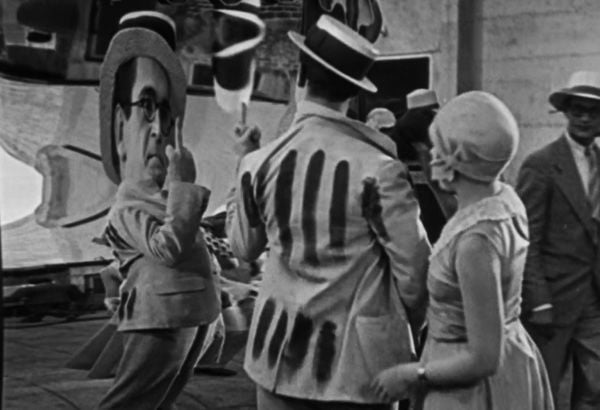
The Coney Island segment is home to some of Speedy’s funniest gags, like the live crab that improbably winds up in Speedy’s pocket and causes havoc on the midway by popping balloons, pinching passersby, and stealing a woman’s negligee…from her purse, of course.  And let’s not forget the scene when Speedy looks at his reflection in a funhouse mirror, doesn’t like what he sees…and flips himself off.  That’s right: in this pre-Hays-Code film, a character in a mainstream movie, certainly seen by children and adults alike, gives himself the finger.  Don’t believe me?  Take a look:

I must have rewound that scene five times to make sure I saw what I saw.

Anyway, the other highlight of Speedy is when Speedy gets a job as a cabdriver and gets to drive Babe Ruth to Yankee Stadium.  That’s right.  BABE.  RUTH.  Just like with Coney Island, I had only ever seen The Babe in grainy newsreel footage and still photos.  To see the Sultan of Swat in a fantastically restored film from nearly a century ago was…damn, I seriously cannot think of the right word for it.  I had a big grin plastered on my face during his entire scene, and it’s a long scene, with Speedy careening through traffic, barely avoiding accidents, while Ruth hangs on for dear life.

The experience of watching Speedy, with its real NYC locations and the inclusion of genuine sports royalty, felt less like watching a movie and more like watching a magic window into the past, like a wormhole through space and time.  The last film that made me feel transported like that was the fascinating documentary Dawson City: Frozen Time, about a trove of forgotten films and newsreels from the turn of the century and slightly beyond found buried under the permafrost in the Yukon.  To be sure, there are plenty of old films that I’ve seen before, but Speedy is the first one of those that presents, not a manufactured set or a western town that was already old in the 1920s, but a living snapshot of a real, tangible place where the locations in the film can still be seen today.

And I haven’t even started on the brilliant performance from Harold Lloyd himself.  Lloyd carries the movie on his shoulders from the get-go, establishing himself as an everyday Joe who just wants to earn that cash and help his girlfriend.  He doesn’t mug, like Chaplin, and he doesn’t stare, like Keaton.  He just IS.  He never comes off as overacting, playing every scene absolutely straight, expressing consternation and exasperation at the fates that, for example, gets him away from a dirty mutt on the street, only to back into a freshly painted fence.  Or watch his face on the midway when he wins a special prize: a baby’s crib.  Jane, his girlfriend, lights up.  Speedy does what any man not ready for commitment would do: tries to give the damn thing back.

After a frantic chase under the city’s elevated train tracks that results in a genuinely unplanned accident – SUCK it, French Connection, we were here first! – everything comes together in a massive rumble (between the rail tycoons, their thugs, and residents of Speedy’s and Pop’s neighborhood) that has to be seen to be believed.  At the end of the film, I still had that stupid smile plastered on my face from earlier.  What a treasure this movie is.  What a delight.  I don’t know if Speedy is available on any streaming service, but if it’s not, I would urge anyone who loves film to buy or borrow a copy whenever they can.  For film aficionados, it’s a gem.  For anyone new to silent films, this would be a great place to start.