THE HOT ROCK

By Marc S. Sanders

I’m a sucker for a good caper.  Capers play like strategy games.  An object (Hitchcock called them MacGuffins) needs to be acquired.  It doesn’t matter so much what the object is.  The importance falls within the pursuit. 

William Goldman wrote The Hot Rock, adapted from a novel by Donald E Westlake who penned a series of books focusing on the ex-convict John Dortmunder and his further adventures.  In the film, he’s played by Robert Redford. 

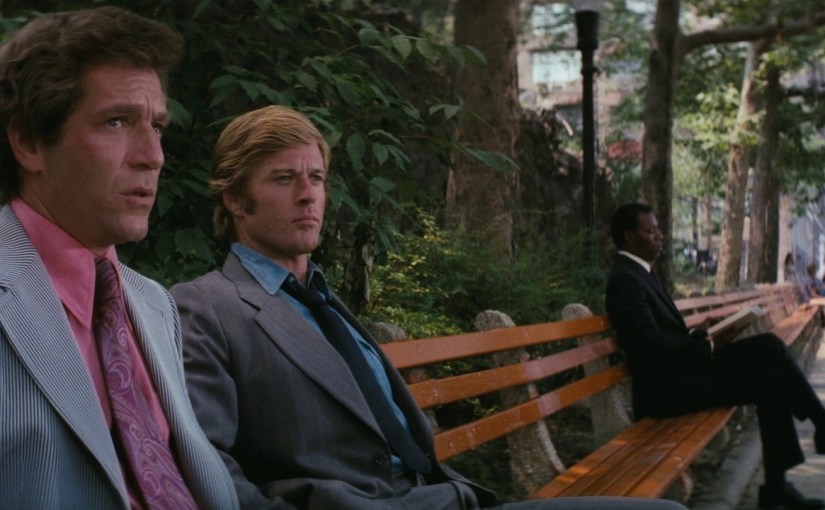
On the day that John is released from a New York state prison he’s picked up by his inept brother-in-law Kelp (George Seagel) who escorts him to Central Park.  Kelp wants John to be the fourth member of a team and steal a priceless diamond.  A man by the name of Dr. Amusa (Moses Gunn) sits about five feet away from them on a park bench.  Amusa breaks it down for the men, but they get interrupted by an elderly woman who sits between them to feed the pigeons.  This is what you can expect from The Hot Rock, a film structured under one pesky inconvenience after another.

This rock is currently on display at the Brooklyn Museum, on loan by an African country who has no business having possession of the valuable.  The stone belongs with Amusa’s country and he’s ready to pay Kelp and his crew $25,000 each to pull of the heist.  He’ll also, reluctantly, front some funding monies ahead of the theft for preparations. 

Like in all of these kinds of movies, John is ready to do one last job.  Then he’s out for good.  However, one last job turns into four last jobs.  Without spoiling too much, the rock gets relocated from one place to another.  So, a late-night heist at the museum turns into a break in a prison, and then it’s somewhere else and somewhere else after that.

As Hitchcock describes, you never care about the MacGuffin.  For movie purposes, you see it on display in its majestic glory, encased in a glass box right in the center of the museum, but so what.  The question is to uncover how the guys are going to get it out of there.  The Hot Rock doesn’t work nice and neatly like Ocean’s 11 or The Score.  In those movies, there are things that don’t go according to plan.  In The Hot Rock, nothing goes the way it should. Honestly though, it should be funnier than it really is. 

I recall there was a movie called Quick Change with Bill Murray doing his best to get out of New York City following a bank robbery.  It was comedic all the way through and maybe that’s because it was Bill Murray of Caddyshack and Ghostbusters fame, not to mention Saturday Night Live.  Robert Redford is the rugged actor of the time in 1972, though.  Not a comic and he plays Dortmunder like a serious kind of thief, even with his famous blond locks and toothy grin.  George Segal along with Ron Leibman and Paul Sand are bumbling chatter mouths, but are they funny?  Segal’s character steals a car to pick up John and we see him trying to figure out how to drive the dang thing, nearly running over Redford.  I never believed he did not know how to not drive the car. 

BY THE WAY: Ever notice in movies that they’ll show someone does not know how to drive a car by having them accidentally turn on the windshield wipers?  That’s all that is done.  That and having the car drive in S shape patterns as if the steering wheel suddenly took on a life of its own.  Then the scene comes to a halt with a startling slam on the brakes.  Never fails.  This happens over and over again in the movies.

Zero Mostel appears as the father/attorney for Paul Sand’s character.  It’s Zero Mostel, but Goldman’s script doesn’t give him much material to play with.  It’s not a silly caper flick because suddenly Zero Mostel of The Producers makes an appearance.  Look at Ocean’s 11, and see what Carl Reiner is doing.  There’s an organic affection for Reiner’s character that Mostel never achieves here. 

Peter Yates directed The Hot Rock a couple of years after the car chase thriller, Bullitt with Steve McQueen.  He impressed audiences with what two cars pursuing one another across the hilly streets of San Francisco could accomplish.  In this film from the early 1970s, Yates attempts to dazzle the audience with a few more speeding car stunts but they just don’t cut the corners.  Everything on screen looks like Yates and his crew are trying too hard.  There’s a helicopter sequence and much time is devoted to seeing how the chopper flies low over the Hudson River and then soars above the Twin Towers, still under construction at the time.  Look everyone!  Ron Leibman is flying a helicopter and Robert Redford and the rest look woozy about it all.  Thing is that James Bond movies were already doing this kind of schtick (with special effects) year after year by this time.  Peter Yates just doesn’t offer up anything that looks like a new sensation.

I’m actually surprised The Hot Rock has not been remade like Ocean’s 11 or The Italian Job.  In this film, the tools and skills are left to the guys and their cons. There’s no computer overrides or laser sensors to assist them.  Today, all of the techno stuff would be there with lots of closeups of fingers tapping away on a keyboard and then data entries appearing on a monitor.  In between, would be the comedy and would you believe of all people, I thought Will Farrell would be the guy to play the straight man and lead the charge.  The comedy of the situations would remain, but the thieves would be nerdy geniuses, each having their unique abilities and quirks. 

The set up is there for a remake.  Who you cast and what is done with it is up to the filmmakers. 
A HARD DAY’S NIGHT

By Marc S. Sanders

Before there were Swifties or Dead Heads or Parrotheads or Beliebers or Fanilows, there were Beatlemaniacs.  Everyone was screaming for and chasing after The Beatles – John Lennon, Paul McCartney, George Harrison and Ringo Starr.

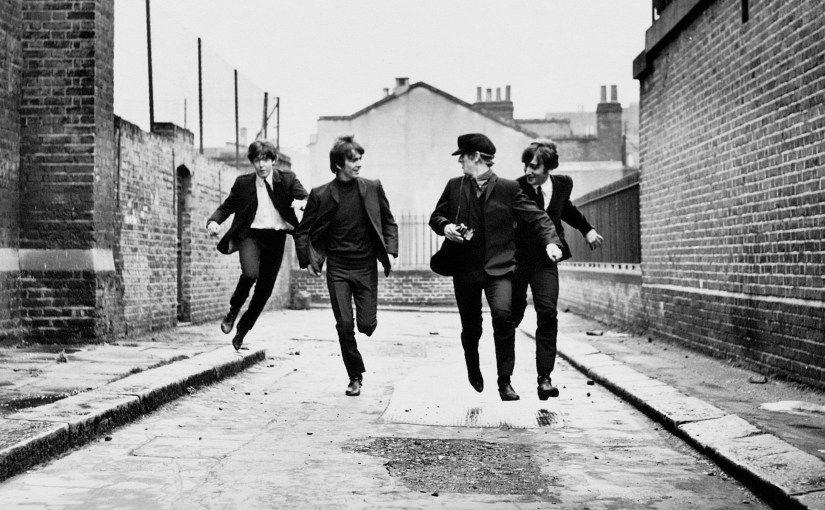
The musical mockumentary, A Hard Day’s Night, captures the famous foursome from Liverpool over a two-day period, during their time of matching suits and mop top haircuts when they were taking the world by storm with their harmonizing vocals of innocent love and fancy-free celebration.  Richard Lester (eventual fill in director of Superman II) directed with a loose documentary like camera while the young men carried themselves in lighthearted and silly situations that served as a visual vehicle for their hit songs like Can’t Buy Me Love, All My Loving, and I Love Her.  The title song was featured too of course.  Along with Billy Joel and Barry Manilow, I grew up on this music and it helped me appreciate the loose construction of Lester’s film. 

Silly scenarios are set up with McCartney’s supposed “grandfather” (Wilfred Brambel) getting into all kinds of mischief while the guys circumvent through media conferences with improvised dialogue like:

REPORTER: Are you a mod or a rocker?

RINGO: I’m a mocker.

I’m not sure I understand the humor or the existentialism of this exchange, but it had fans, including famed critic Roger Ebert, going ga ga over it.  It even made it on to Premier Magazine’s Top 100 movie quotes of all time.  Then again so did “Plastics!” from The Graduate.  These are the vernaculars of the time.  It’s gotta have something to do with devoted fandom.  Right?

I recall seeing the music documentary U2: Rattle And Hum in the theaters upon release, and there was a moment where The Edge was sitting quietly next to Bono in an interview and snapping his palm on his knee, and the die-hard fan I saw it with could not stop laughing with appreciative glee.  I’m just as guilty.  If someone says in simple conversation “I have a bad feeling about this,” my Star Wars man child wakes up like a dog seeing a squirrel.  It can be politicians, rock stars, movie stars, preachers, athletes or even our parents that center us on an obsession that we respond to.  There’s no denying the Beatles had this kind of magnetism.  With half the band gone, the appeal still upholds much like it does for Elvis Presley and Michael Jackson.

A Hard Day’s Night serves a visual extension of the band beyond just what we would receive audibly over the airwaves and on vinyl.  They had recently finished performing on The Ed Sullivan Show, during their first arrival in America. Their charm, good looks, witty intelligence and even their quiet sensitivity enhanced the worldwide significance of the band.

Richard Lester finds opportunities to show the Beatles being performers of themselves behind the scenes, though most of what is shown in A Hard Day’s Night seems staged.  After all, we famously get to see John acting silly in a bubble bath and when his frustrated manager drains the tub and the suds dissipate, John is nowhere to be found.  A cute gag, much like we would find in music videos on MTV, twenty years after this film’s release.

There is a blend of overhead and wide ground level shots of the four prancing and dancing in an open field while Can’t Buy Me Love echoes through a scene.  It’s silly.  It means nothing.  It’s simply sophomoric fun begging us to appreciate their harmless, mad cap shenanigans.

Each bandmate is given room to shine, but Ringo surprisingly stood out to me the most.  He seemed like the little brother to the other three who was never taken seriously.  Paul’s grandfather even tells Ringo to give up music. He should be “parading.” Suddenly, just before a practice warm up for a television program, Ringo is missing.  The fourth Beatle has seemingly run away.  If I could find character dimension anywhere in this Oscar nominated script by Alun Owen, it surprises me that it came from Ringo; the one who was occasionally considered the least celebrated of the Beatle craze.  At the time, he wasn’t a songwriter.  He sat in the back with his drums.

A Hard Day’s Night is enjoyable simply for the innocence shown of the four guys from Liverpool.  They’re happy with themselves and to be with each other.  It’s very natural and yet it’s a little sad too.  This film predates what was never expected to come of them over the next decade and a half with break ups, marriages, controversies, new career trajectories, and even a sudden death of one of their own, occurring on December 8, 1980.

I can only imagine that in the moment of Beatlemania, A Hard Day’s Night was a celebration of happiness and cheerfulness.  They had a rebelliousness to them, yes.  However, there was never anything like them.  Today, the film serves as a reflection of my earliest appreciations for infectious song lyrics and music.  As a middle-aged man, with two members of the band gone, the picture works like a home movie for me.  It’s like watching archived footage of family members who have long passed away.

When you watch A Hard Day’s Night and sing along to the songs as they enter the picture, the words and the melodies return. You’ll likely find yourself thinking back as if to ask yourself “Remember When…?”

THE SECRET OF MY SUCCESS

By Marc S. Sanders

Reader, it has been a hard week.  Hard because my flat screen has been on the fritz.  Finally, today at last, the Best Buy Geek Squad will be paying me a visit and working on a repair. In the meantime, I have had to relegate myself to one of the smaller flat screens within the household.  I feel dirty.  Cheap.  I can’t even look at myself.  Just look away!!!!  Considering the dire circumstances, I could never look at my next big film to review during the absence of my 9.0 sound system and 65 inches of viewing pleasure.  It would be a sin to watch a Christopher Nolan or Steven Spielberg piece anywhere else (unless it’s in the cinema).  Therefore, I settled, and I hit rock bottom.  I opted to for Netflix meh! 

All I have, all I can give you, all I can offer, all I can claim for you during this dark, sad time is Herbert Ross’ attempt at shaping a Michael J Fox thirty second MTV style 1980’s music video into a film.  The “film” is The Secret Of My Success

I recall seeing this movie at age 14 during a field trip to Washington DC with my eighth grade Yeshiva class.  Every time the dimply cute yuppie Canadian sensation from Family Ties and Back To The Future graced the screen, the girls in my class screamed with puppy love glee.  I liked Fox at that time.  I still do.  He was a bright guy and while not an actor like Brando or Olivier, he had a unique charm that defined the clean cut 1980s with knit ties and Benneton sweaters.  His unforgettable Alex P Keaton was the fictional cheerleader for the era of Ronald Reagan, and no one protested.

I recall the promise of The Secret Of My Success as being the vehicle that would elevate his tv persona to the big screen since he already had luck with Marty McFly and a healthy B-movie following with HBO airings of Teen Wolf (a much better movie than it ever deserves to be). Regrettably, this film never landed.  It’s most glaring failure is that it never even lives up to its title.

The assembly of Herbert Ross’ romantic, New York, yuppie comedy occupies itself so much with music montages.  It’s as guilty of its own indulgence as Rocky IV.  How many times must we see a grinning Michael J Fox hustle through the concrete jungle of the city and then through skyscraper cubicle hallways within a white collared business world?  Night Ranger is the ‘80s hair band who provides most of the movie soundtrack and they owe much to Michael J Fox as the face that accompanies their work with trinkling keyboards and electric guitars with the raspy roar of their lead singer.  If Michael J Fox is not walking down streets where apparently supermodels live to turn their heads (I saw you Cindy Crawford), he’s got a pen wedged between his teeth and he’s pulling huge three ring binders off of shelves while doing an all nighter.  This is oh so boring.  In 1987 however, it is all a couple of Teen Beat readers needed in their lives.  I can watch Meryl Streep or Gary Oldman read a three-ring binder.  Michael J Fox just doesn’t have a knack for this skill.

Fox plays Kansas farm boy Brantley Foster.  Now that he has earned a business degree, he has enormous aspirations to climb the top of the New York corporate ladder and make a success of himself with a “beautiful secretary.”  Because, you know, you can’t make it without a secretary, much less a beautiful secretary. 

Upon relocating into a roach infested apartment, Brantley’s plans fall through, and he has to beg his super rich Uncle Howard (Richard Jordan) into giving him a job in the mail room of his building.  Brantley encounters a beautiful blond executive named Christy (Helen Slater) amid a sea of uptight middle-aged men.  The depth of this attraction only goes so far as fantasizing about her walking towards him in a cheesy, glittery pink evening gown with a keyboard and saxophone chiming in.  On the side is Howard’s bored trophy wife Vera (Margaret Whitton) crowding young Brantley in an illicit Mrs. Robinson kind of affair.  Let me clarify.  Vera is married to Brantley’s Uncle Howard.  So, Brantley is being terrorized by Aunt Vera.

For the purposes of ridiculous farce, that might be funny for a moment.  However, The Secret Of My Success takes forever to arrive at the farce it could have hinged on.  Instead, Brantley has to discover a way into the white-collar world when he comes upon an empty office and bears the fictional name of Carlton Whitfield to justify his suits and his motivation to work in the heart of the corporate world.

I noted that the film does not live up to the title.  When Brantley is working the persona of Whitfield, we never get an idea of his brilliant ideas for business success and operations.  We never learn what turned Uncle Howard’s high-rise building into the towering reputation it apparently stands upon.  We never understand the threat of a shareholder’s takeover that Howard and his team fear is imminent.  Where’s the value in anything that Brantley is doing to be that corporate hero and what is he trying to improve or salvage?

Instead, we are left with a very poor chemistry pairing between Helen Slater and Michael J Fox.  Slater is flat out boring with no dynamic to her.  If you want to see how to deliver any variation of a line in a flat, monotone way, then observe what she has to offer.  Fox is on another level of energy that Slater cannot match and Herbert Ross and the script from Jim Cash and Jack Epps Jr (Top Gun, Legal Eagles) chooses to occupy itself more with this romance than the corporate world at play.

The following two years after this film’s release would do better for this hustle and bustle setting with Oliver Stone’s cynical Wall Street and Mike Nichols romantic comedy Working Girl.  The latter film follows a near exact blueprint of The Secret Of My Success.  Yet, it wins because we actually see the main character, portrayed by Melanie Griffith, actually demonstrate her prowess for the cutthroat world of business power and politics.  By comparison, Michael J Fox just wants to play hooky and make out in the back of a limousine.

A last-ditch effort is made though when the big wigs assemble for a weekend getaway. What seems like an attempt at bedroom farce barely gets started with the players climbing staircases and tip toing behind doors and hopping into bed together and blah blah blah.  It doesn’t serve, however, because the idiot plot intrudes where everyone has to act as if they have no idea of who is sleeping with who and who is Brantley and who is Whitfield amid the fast-talking dialogue edited within.  You want to scream at the screen and tell everyone to shut up because this can all be explained in sixty seconds.

Again, as Mike Nichols’ Oscar nominated film eventually proved, there was a better film to be made here for Michael J Fox.  It could have included all of the cynical realities that go with the natures of a corporate American beast.  Instead, The Secret Of My Success relies on music video montages with the teardrop keyboards and the yearning saxophone that seemed like a requisite for the adoring Michael J Fox of the 1980s. 

Enough already!!!!  I need to cleanse my palette.  GEEK SQUAD, WHERE ARE YOU????? 

IT’S A GIFT (1934)

by Miguel E. Rodriguez

DIRECTOR: Norman Z. McLeod
CAST: W.C. Fields, Kathleen Howard, Jean Rouverol, Tommy Bupp, Baby LeRoy
MY RATING: 9/10
ROTTEN TOMATOMETER: 94%

PLOT: A henpecked New Jersey grocer makes plans to move to California to grow oranges, despite the resistance of his overbearing wife.


I have pondered and pondered for almost a week now, and I still have no idea how the title of It’s a Gift relates to its plot, unless it refers to the comic abilities of the film’s star, W.C. Fields.  Perhaps it refers to the bequest of a dead uncle that sets the plot in motion.  Or maybe it’s a situation where the studio heads couldn’t think of a title and just picked one that was languishing on a stack of papers somewhere.

Not that it matters.  It’s a Gift is a tiny gem of a comedy with a plot as inconsequential as its title.  As fate would have it, this is the only W.C. Fields movie I’ve seen, but I’m prepared to bet that this is the best W.C. Fields I’m likely to see.  The only other one on my radar is The Bank Dick (1940), but it’s hard for me to imagine how it could top It’s a Gift for pure slapstick comedy.  Or not slapstick exactly…it’s a weird, wonderful combination of slapstick with theatrical farce, like The Three Stooges or the Marx Brothers but with a shortened leash.  In this movie, Fields is not a wacky character like Groucho or Curly…he’s us, and that makes it more effective.  (That was part of Buster Keaton’s genius, too, but that’s for another review…)

Fields plays Harold Bissonette (pronounced “Bee-so-NAY”), a cosmically patient man living in New Jersey with an overbearing wife, Amelia; a thoughtless teenage daughter, Mildred; and a rambunctious young son, Norman.  How rambunctious?  He wheels around their apartment on roller skates; when Harold tells him to stop, he obliges by removing only one skate.  If I had tried that with my parents, I wouldn’t be alive to talk about it.

Harold’s relationship with his family is defined by their total indifference to what he wants and his desire to avoid conflict at all costs.  Right at the outset, when he tries to shave in the bathroom, his daughter blithely steps between him and the mirror so she can do her hair and brush her teeth.  Rather than raise an objection (which he clearly wants to do), he improvises by hanging a travel mirror from the pull chain on the overhead light bulb.  The mirror spins slightly, leaving him no option but to shave in stages whenever the mirror faces him.  This scene beautifully defines both characters with barely a word spoken.  [Marc, if you’re reading this, this kind of thing is right up your alley.]

The plot involves a dead uncle who has left Harold a decent chunk of change.  Harold’s wife, Amelia, looks forward to moving to a nice house and buying some nice dresses, but Harold has something else in mind.  He wants to move the family to California and raise oranges on an orange grove he’s bought from his daughter’s boyfriend, or the boyfriend’s father, or something, it doesn’t really matter.  What matters is, the boyfriend discovers the orange grove is a wreck, but Harold refuses to listen and moves ahead with his plan.

Before they move to California, though, there are two hysterical sequences to get through.  One takes place at the general store Harold runs in town.  His day at the store plays out as one of the worst (and funniest, for us) days of his life.  It involves an angry customer demanding kumquats, which is funny all by itself because in real life, it’s impossible to demand kumquats and be angry.  Try it sometime.  There’s also a regular customer, Mr. Muckle, an elderly gentleman who is blind and hard of hearing; he carries an ear trumpet and a large cane which he swings indiscriminately in front of him, destroying anything breakable in his way.  There is something Matthau-esque in Harold’s desperate attempts to get those kumquats while also keeping the deaf Mr. Muckle away from his light bulb display.  And then there’s the clueless assistant and the meat locker and the child in the overhead basket and a barrel of molasses and so on and so on.  No WONDER Harold wants to get out of town.  Another day at that store and they’d have to carry his customers out in a hearse.

The second sequence, and by far the funniest in the whole film, involves Henry trying to get some sleep on the front porch because his wife won’t stop nagging him about using all their inheritance to buy an orange grove.  This marvelous set piece involves him trying to sleep on a rickety porch swing while his upstairs neighbor engages in conversation with people below, a baby drops grapes on his noggin through a hole in his ceiling/the baby’s floor, the swing threatens collapse at any moment, a random coconut manages to bounce down three flights of stairs, and he is “accosted” by an insurance salesman.  What makes this scene work so well is not the slapstick nature of the scene, which plays out like a Looney Tunes cartoon, but Harold’s dogged determination to get some damn SLEEP, despite the universe’s intention to make it utterly impossible.  Fields here proves himself a master of understated reactions.  Where the Stooges or perhaps even Groucho would resort to yelling or lobbing insults, Fields projects a world-weariness, as if this kind of thing is always happening to him, HAS always happened to him, and WILL happen to him in the future.  He loses his temper only once, and even then, he doesn’t resort to yelling: he just goes inside and gets his shotgun.

This and the grocery store scene are the highlights of the film.  After they pack everything into their car and hit the road, it becomes a series of episodes before they finally arrive at the orange grove he bought, which is, as promised by his daughter’s boyfriend, a wreck.  What happens next, I wouldn’t dream of revealing, except to say it’s as implausible as it is satisfying.

While It’s a Gift will never be mentioned in the same breath as anything by Capra or Wilder in the screenplay department, it works impeccably as a vehicle for W.C. Fields and his often-imitated/never-quite-duplicated brand of comedy.  (Walter Matthau came close.)  I haven’t seen enough of his films to be scholarly in my approach, but I can report that it made me laugh much more than I thought it would.  That’s all I can really ask for in a comedy, so I’m not going to try to break it down too much.  I’ll just roll with it, like Harold.

SOAPDISH

By Marc S. Sanders

To get inside the head of a character on a soap opera would best be portrayed by someone who’s literally living a soap opera off the set.  That’s the paramount theme of every member of the cast and crew of the daytime drama The Sun Also Sets.  Everyone is living through their own checkered background from the lead actress to the returning actor to the homeless deaf/mute extra on down to the trampy nurse and the buxom doctor on the show. By default, the program’s head writer and the producer fall into this category as well. 

The hilarity found in Soapdish gave me remembrances of classic films like All About Eve and Sunset Blvd. Ego and stardom are treasured commodities above all else and an actress’s greatest fear is being aged out of fandom and replaced by the new girl in town. 

Celeste Talbert (Sally Field) is a star actress with dozens of career awards but an insecurity with becoming past her prime. A diva concern is that the stories written for her are not worthy of her importance to the show.  David (Robert Downey Jr) is the young producer feeling the pressure to come up with something to boost the ratings before his boss, the always naturally funny Garry Marshall, replaces the program with game shows.  On David’s side for her own ulterior motives is Montana Moorehead (Cathy Moriarty) who plays the resident nurse and is ready to take the reins from Celeste and make the show her own.  She’ll seductively manipulate David into getting things to work out her way. 

In the meantime, Lori Craven (Elisabeth Shue) sneaks onto the set seeking an opportunity by way of Aunt Celeste.  Best she can get is to portray a deaf/mute homeless woman extra.  Head writer Rose (Whoopi Goldberg) has devised a new plot where Celeste’s character will be tried for murdering Lori’s homeless mute character.  Lastly, at least through the first thirty minutes of the film, Jeffrey Anderson’s (Kevin Kline) character who died on the show twenty years prior by an unfortunate beheading is recruited out of dinner theater by David to return to the program.  Both Lori and Jeffrey’s unexpected arrivals do not sit well with Celeste.

Following along okay, so far? Well…

SECRETS ABOUND on Soapdish!

This film was developed by the powers who delivered Steel Magnolias to the big screen a few years prior.  The original playwright and screenwriter, Robert Harling, teamed up with Andrew Bergman, to satirize the weepy material that daytime drama promises and which he embraced seriously with his beloved play.  The director of Magnolias, Herbert Ross, also serves as an executive producer on this film.  To add some extra authentic spice, Aaron Spelling is producer.  That’s right.  The guy who produced Dynasty, 90210 and Melrose Place.  Michael Hoffman directs. 

The look of this film is so odd and has a garish blood coated red appearance to the television studio where the show within the movie is set, as well as to the offices that hover above.  The set designer for the film, Eugenio Zanetti was inspired by Dante’s Inferno.  Makes sense really because no one is ever satisfied with how The Sun Also Sets develops from one atrociously delicious storyline to the next, and how it makes them look in the public eye.  Zanetti is quoted as saying the offices of the producers and writers hover above the set for the soap opera.  So, it looks as if the powers that be are staring down into the depths of hell that the cast and crew must work and reside in.  While it looks odd, after having seen the film, I can’t help but believe Zanetti makes sense.

There are moments here that are outright hilarious.  As a community theater actor and director, I can totally relate to Kline’s character being stuck in a retirement community steak/playhouse performing as Willie Loman in Death Of A Salesman while elderly patrons call for their waiters.  Poor Jeffrey also has to project that much louder for the old folks to hear him.  This scene stands as gold on its own. A whole farcical film could be developed on this side story alone. 

Soapdish does lose some of its comedic appeal before it reaches the middle of the picture when secrets are uncovered related to Celeste, Jeffrey, Lori and so on.  Sally Field goes for great physical comedy that lands perfectly with the skeletons that Celeste pulls out of the closet.  Kevin Kline makes for a hysterical arguing scene partner, and the craziness just gets bigger from there. 

Whoopi Goldberg is also very funny as the one with common sense and brains behind her character.  For once, she’s not going for the female Eddie Murphy equivalent.  I’m with Rose when she vents to David about how she’s supposed to write a believable return from the dead of a character who was killed when he lost his head.  Maybe a brain transplant?

Cathy Moriarty does a fine job of being the conniving seductress.  She’s a full-bodied intimidator of teased, frizzy blond hair and a buxom nurse’s uniform costume against Robert Downey, Jr.’s nervous preppy producer.

There’s satisfying moments for cameos from Carrie Fisher as a casting director as well as Teri Hatcher and Costas Mandylor as bubbleheaded supporting characters.  However, the best scene stealer is Garry Marshall. I don’t think a single line he’s given would be as funny if he was not providing them.  He’s just got that Neil Simon kind of delivery as the studio boss.  “The nurse is in the restaurant?  Was there a meeting I missed?”

Other than a few F bombs, I think Soapdish works as movie the whole family could watch the next time they are snowed in or hunkering down from a blizzard or hurricane.  Soap operas are designed for escape and the outrageous comedy of Michael Hoffman’s film reaches into outrageous areas that work with surprise and big laughs. 

This nonpaid critic, who endures his loving wife’s adoration for General Hospital each night before bed, is at least a fan of The Sun Also Sets and Death Of A Salesman dinner theater. 

THE RUSSIANS ARE COMING. THE RUSSIANS ARE COMING.

By Marc S. Sanders

Farce works best when the serious explodes into the outrageously absurd.  When Jonathan Winters is a lawman who insists to Brian Keith “We gotta do something! I mean we really gotta do something!” you should know that whatever needs to be done has got to be out of unreasonable paranoia.   Yet, the desperation and nonsensical fear is something you can empathize with because if I were told the states were being invaded, I’d surely think twice as I reach for the tennis racket in the back of my closet to use as a weapon.

Norman Jewison set aside his penchant for intense drama, socially reflected in films like In The Heat Of The Night, to direct a madcap satire imagined from the very real threats of The Cold War of the 1960s.  At a time when submarines were being used for silent spying and espionage, a Russian sub gets stuck on a sand dune within the shallow ocean waters just beyond the New England town of Gloucester.

Alan Arkin as Rozanov leads a squad expedition off the vessel and intrudes upon the vacation home of Walt and Elspeth Whitaker (Carl Reiner, Eva Marie Saint).  With a pistol pointing at the family of four, all that is really needed is a boat to nudge the helpless submarine back into the water.  Yet, as word spreads of who has arrived, that’s not what the townsfolk will have you believe.

Before the age of the internet, hysteria still managed to catch fire with word of mouth.  Reader, perhaps you heard of what happened when Orson Welles aired his radio show of H.G. Wells’ The War Of The Worlds.  Yes!  Apparently, an alien invasion was really happening.  What amuses me about Jewison’s film is that only a very few people even get an opportunity to see the Russians in person.  Still, the fear overcomes everyone in town.  The battle crazed old codger named Fendall (Paul Ford) dons his sword, and because he carries said sword, he seems most fitting to lead the charged brigade.  

The Russians Are Coming. The Russians Are Coming. works like a pre-cursor picture to what the team of ZAZ would later do with Airplane! and The Naked Gun.  The town switch board gets overrun.  The men take hold of their rifles, but stop at the bar for a belt first. Two of the wives board a motorcycle with a side cab waving a poster that says “Alert” in front of their faces so they can’t see where they’re going.  What’s anyone supposed to gather from saying “Alert,” anyway?  It’s ridiculous, but the palpable tension of these fine folks is convincing when they come alive on this sleepy Sunday morning off the northeast coastline.

As comedic as Jonathan Winters always was, he takes it seriously as a deputy who does his best to lead while wearing his badge.  Brian Keith is great at just being Brian Keith, the grump who tries to keep things in perspective but can’t because everyone else is ready to take up arms.  Carl Reiner doesn’t have to do anything but occupy the screen and he’s funny.  He’s the antsy father to an eleven-year-old boy who he chooses not to believe.  In all seriousness, are we ever to take Carl Reiner seriously when he tries to offer a sound explanation for the Ruskies’ arrival?

Alan Arkin is just lovably speaking fluent Russian at times while trying to navigate his team around the island with no idea of what to do or what to say.  He might be the most sound character of the whole picture. He’s lovable and hilarious.

The film takes place in one day and it’ll leave you curious with how it all gets resolved among the two misunderstood factions.  Just when Norman Jewison ably reaches the highest summit of intensity, the oddest occurrence happens to shift the tide of the film’s characters and comedy.

Like other satire, particularly Sidney Lumet’s Network, The Russians Are Coming.  The Russians Are Coming. stands prophetically.  It was released in 1966, at the height of The Cold War with very fearful circumstances occurring in the news such as The Bay Of Pigs invasion.  Earlier this year, a sense of nervousness arrived when it was announced that Russian submarines have docked themselves outside of Cuba, seemingly lined up with Florida.  Anything could suddenly turn into a sad reality.  Still, how we respond to scary possibilities is how we live through these moments.  

You can laugh at The Bay Of Pigs crisis now.    Could you do it back when it was actually happening?  I wouldn’t know.  Yet, that doesn’t mean we shouldn’t make light of the situation.  Hogan’s Heroes, The Three Stooges, Mel Brooks, Charlie Chaplin and even the Looney Tunes ably served the purpose of needing to self deprecate our innate fears that would get all of us into nonsensical tizzies.  The Russians Are Coming.  The Russians Are Coming. was one of the best films to accomplish that feat.  

We gotta do something! I mean we really gotta do something!

DEADPOOL & WOLVERINE

By Marc S. Sanders

Hollywood back stories have created a quandary for the studios’ celebrated film franchises, especially the Marvel Cinematic Universe.  Disney has purchased the properties and copyrights belonging to 20th Century Fox and now, at last the X-Men can properly meet Captain America and the Hulk and Spider-Man…well only if Sony will let the wall crawler come out and play.  So, how should all these guys meet one another, especially now that some of these actors who play these superheroes have received their AARP cards?  Furthermore, some of these characters are dead…at least for now.  Marvel producer Kevin Feige has the answer.  Only Deadpool (Ryan Reynolds), the Merc With The Mouth who breaks the fourth wall at any given moment, can bring this all together.

Deadpool & Wolverine is the best of the smart aleck hero’s three movies.  Yet, it’s more of just a gimmicky flick than anything else.  This proudly excessive two-hour tentpole picture operates like a solid collection of Saturday Night Live skits, with buckets of blood to splatter instead of The Three Stooges’ cream pies.

Allow me to break down this very thin storyline.  Matthew MacFadyen is Mr. Paradox in a three-piece suit.  He informs Mr. Deadpool that his timeline is about to fizzle out of existence.  Somehow, our hero has to locate help from a Wolverine variant of another universe (Hugh Jackman, of course) to make things right again.  

There’s your open door into the silliness that normally comes with Deadpool.  Our title characters are tossed into a Mad Max kind of wasteland called the Void and an abundance of cameos commence from here on out.  The suprise appearances are a lot of fun and I dare not spoil a single one of them.  The rest of the internet did that the night before the film actually opened. I shan’t lend to that egregious violation. (I’m looking at you Variety, Yahoo and Entertainment Weekly. Was it truly necessary to go in that direction?)

I could never relate to the other Deadpool movies.  Sure, they had some hilarious wink and nod gags, at the expense of Reynolds’ career experiences with past superhero franchises.  Yet, those other films were also trying to work too hard with storylines weaved in as well.  They became tiresome and Ryan Reynolds is not the Bill Murray of yesteryear or even Robert Downey Jr. His schtick in this element was overdone.

With this third installment, the approach works with an Airplane! or Naked Gun finish.  That being said, it takes a lot of knowledge from prior Marvel films within the 20th Century Fox warehouse to get every gag.  It helps to know what other super hero movies missed out on getting green lit, which ones tanked at the box office and who are some of these very obscure characters that were churned out of the meat grinder.  If you know these guys, then you’ll applaud the purpose they serve to of any jokes or story references that allow this new picture to operate.

I found it fun.  I think most lovers of Marvel movies will too.  Yet would someone like my sixteen-year-old daughter catch every reference or cameo that walks into frame? Some characters have not appeared on screen in over twenty years.  Reynolds and company also toss out one-liners that reference dated Hollywood gossip.  There was a lot of explanation that I had to fill in for my wife on the drive home.

Beyond all this, Deadpool and Wolverine, played by Ryan Reynolds and Hugh Jackman, work really well together like a good buddy cop picture.  Get these guys back together again in a Lethal Weapon or 48 Hrs kind of movie and I’m there.  Honda might not be too fond of these guys, but their pairing is an overdue welcome to the big screen.  Why Honda? See the movie and you’ll know what I mean, but I am eternally grateful for the automaker’s contribution to this picture.

As expected, the violence is excessive.  I think I’ve had my fill of knives and claws being thrust into men’s crotches.  Seems to happen literally every five minutes.  Beheadings abound too.  Slow mo flips and bullets and bullet casings flying and dropping out of guns is never enough for these filmmakers either.  

Some will try to convince me of how tender hearted the picture is too.  Bah!!!! I know what you’re talking about, but go watch Terms Of Endearment or even Avengers: Endgame to get your tear ducts exercising.  The Hallmark moments here never carried much weight for me.

Deadpool & Wolverine is a grand time at the movies, worth seeing with an enthusiastic crowd over settling for a lonely night at home with Disney Plus.  The movie is a little too long, though.  None of the material belongs on the cutting room floor, but a good chunk of it could have been preserved for the next Deadpool blood spattered, slapsticky flick. I just didn’t need to consume all of the eggs in the basket.

My Personal Edit for the MCU: While I toss out my bravo on Marvel’s willingness for self-depreciation on a celebrity roast level with Reynolds and Jackman at the helm, it’s time to get serious again.  

Please get off this multi verse kick.  Director James Mangold (Logan, …Dial Of Destiny, 3:10 To Yuma) said it best that multi verse approaches produce lazy writing.  There’s no stakes anymore.  Hard to believe a character is dead when we watch him/her/they die.  They’ll just come back in the multi verse!!! Enough already.  

Bring back the villains who work based on sound logic like Thanos, Eric Killmonger and Obadiah Stane.  When these guys commit their worst misdeeds, know they did it for a greater purpose than just a mustache twirl and an evil laugh.  I could get behind their arguments.

More importantly, when the job is done, let it stay done.  Treat the audience fairly.  

As Annie Wilkes passionately declared: “Are you blind? They just cheated us.  HE DIDN’T GET OUT OF THE COCKADOODIE CAR!!!!”  I know exactly what you’re talking about Annie. Where’s that sledgehammer?

NO HARD FEELINGS

By Marc S. Sanders

Jennifer Lawrence goes the route of Farrelly Brothers comedy with No Hard Feelings.  She’s a thirty something gal named Maddie Barker who gets by sleeping around with the men of Montauk, New York while being an Uber driver and a bartender on the side.  It’s easy enough to do because her mother left her with a completely paid for house.  What she didn’t account for was taxes, and now that her car has been towed away (and shortly after totaled – just watch) and the past due bills start arriving, she’s got to find some means to uphold her Uber career so she doesn’t lose her house.  Problem is the best Uber drivers drive cars.

A seasonal annoyance of Montauk occurs when the ultra-wealthy WASPS come to reside in their summer homes.  A lot of these folks are helicopter parents for their spoiled kids who have futures awaiting them at Ivy League universities.  One such couple is portrayed by Laura Benanti and an especially flaky Matthew Broderick.  (Yes!  Ferris Bueller!)  Maddie answers the ad to literally get their dweeby son primed and ready for Princeton college life by sleeping with him and breaking him out of his shell of just video games and volunteer work at the homeless pet shelter.  In return, they will transfer the title over to a run-down Buick sedan that Maddie can own outright and catch up on her bills.  If life were only this easy.

The kid is Percy Becker played by newcomer Andrew Barth Feldman.  He’s quite good in this role and I imagine when he started on the first few days of filming he felt as awkward as he appears next to the confidence and experience emulating from Oscar winning Jennifer Lawrence.  You could never imagine pairing these two up in a film.  I mean, like they wouldn’t even work as a brother and sister.  Still, the comedic premise is so absurd like a Farrelly Brothers movie, that you just have to go with what this picture offers. Thankfully, the situations are hysterical.

It’s not easy for Maddie to break Percy of his introverted personality.  Poor kid doesn’t know how to drink or how to dress at an island bar.  He has no friends. He definitely doesn’t know how to talk to girls and even a naked Maddie accompanying him on an empty beach in the middle of the night for skinny dipping has disastrous results. 

Like a lot of romantic comedies, Maddie believes she just has to quickly lay this kid, collect the prize car and no feelings of love or like will ever get in the way.  Not so fast.  Soon, we get to see the attributes Percy possesses, and he’s hard to get off Maddie’s mind.  I read that Feldman played the title character in Dear Evan Hanson on a stage tour for a year. I can completely envision that after witnessing Percy perform a sultry rendition of Hall & Oates “Maneater” on the piano.  Close ups go over to Lawrence watching from across the room and I don’t believe she was acting.  This kid is a talented performer.  Suddenly, Lawrence and Feldman are great scene partners doing some very fine work together.

I hope to see Andrew Barth Feldman in more films.  He can do both drama, and of course comedy.  Moreover, Jennifer Lawrence has officially widened her range.  Her resume is certainly eclectic and this film only enhances her record.

The premise of No Hard Feelings is near impossible to swallow.  Fortunately, the gags that follow and especially the chemistry between the two leads allow for a sweet story with broad, raunchy,  slapstick R-rated material.  Many of the more successful comedic films followed this formula like Coming To America and There’s Something About MaryNo Hard Feelings has just enough substance to be grouped within that fraternity. 

BEVERLY HILLS COP: AXEL F

By Marc S. Sanders

It took thirty years for Eddie Murphy’s best on screen character, Detroit Detective Axel Foley, to make a return.  He should have waited another thirty years. 

Reader, I got what I expected from Beverly Hills Cop: Axel F.  Yes, it was better than the third film in the franchise, but then again so was Morgan Stewart Is Coming Home (a Jon Cryer flick, directed by Alan Smithee).  There are moments in this latest flick, offered up by Netflix, that work, but it’s not enough to save the picture.

With Murphy producing, the smartest tactic the film takes is to gather up most of the surviving members of the other films, Judge Reinhold, John Ashton, Paul Reiser and Bronson Pinchot.  The problem is they are hardly used.  Axel F opts to go in the direction of feelings for the wisecracking cop from Detroit who always wreaks havoc in 90210.  Axel has a daughter named Jane Saunders (Taylour Paige).  I certainly know her last name because in the few moments that Murphy is shooting off his mouth, he takes time to repeat her last name and actually spell it out.  S-A-U-N-D-E-R-S.  Yes.  That’s a whole scene.  This is supposed to be comedy?  Saunders is not ranked up there with Focker.  That’s for sure.

Axel’s buddy Billy (Reinhold) is a private detective now and he’s come upon some kind of conspiracy.  He recruits Jane (a Beverly Hills criminal attorney) to represent a kid who is being framed.  When Axel gets word that Jane is being threatened, out to California he goes, but then Billy turns up missing and I mean missing throughout the whole movie.  Now Axel has to uncover the bad guys while trying to reconnect with Jane.  Of course they are estranged.  Axel also partners up with Jane’s ex, a cop named Bobby, an unfunny Joseph Gordon-Levitt.  Every so often Axel also marches into Taggert’s office (John Ashton) to just remind us that Taggert is back. 

Beverly Hills Cop never functioned on complex mysteries or storylines.  The films hinged on Eddie Murphy’s schtick, which used to be very, very funny and addicting.  As well, the smart route was always taken when the comedy of the first two pictures didn’t just rely on Murphy.  There was also material for Ashton and Reinhold, and on the side was Reiser and Pinchot as well. 

The glaring error in Axel F is that Murphy hardly does anything with these guys.  Instead, there are repetitive conversations with Paige’s character and how Axel put his career ahead of being a father.  Twice within the script, they remind one another that he’s been a father as long as she’s been a daughter.  How much thought was put into this dialogue?

The Cinemaniacs gathered together to watch Axel F, and we all agreed the film would be a half hour shorter had the storyline with Jane been completely stricken from the script.  Who says Axel Foley had to have a daughter?  The guy already has enough members within his world to work with.  Ashton, Reinhold and Murphy do not share a single moment together until an epilogue scene before the closing credits.  This is as egregious as when the new Star Wars pictures opted never to have Han, Luke and Leia reunite.  You got everyone back for Axel F and you opt not to use them or use them together.  Why?  This kind of success couldn’t have been served up better and yet it’s squandered.

Part of the fun in Axel Foley is his ability to con his way into a place.  At one point he returns to the Beverly Hills hotel from the first picture.  He approaches the counter and as he’s about to start a routine, but then he says fuck it, never mind and just chooses to pay for a room.  The script and Murphy could not have made their laziness in making this movie more apparent. 

Another staple was always the outrageous chases that would happen with unconventional vehicles.  The best moment in Axel F is when Murphy and Levitt pilot a police helicopter.  Levitt gets terrified and I think a little sick.  Murphy shoots his mouth off and here is a reason to watch Axel’s return.  Other moments do not work as well including a snowplow truck careening through Detroit and a big rig crashing through the glass front doors of a mansion.  There’s also a three-wheel motor scooter that does some tricks.  I recognize the attempts at recapturing the big moments from the first two films, but the editing does not work as well with a beginner director named Mark Molloy.  Martin Brest and Tony Scott were the MVPs who cemented the success of those other pictures.

I could not help but also take issue with some minor details.  Harold Faltermeyer was the symphonic composer of the other films.  You’ll certainly recognize his tunes this time around but they are annoyingly mixed with unnecessary overlays.  At times, the needle drop of music is so distracting to what you are watching that you might think there is something wrong with your sound system. 

In addition, and I can’t believe I’m saying this about a Beverly Hills Cop film, but the costumer had to be someone who was just fired from Old Navy.  Murphy dons a Detroit Lions jacket and a pair of jeans that look two sizes too big on him.  His clothes look so baggy on his frame.  As well, for some reason, he’s given a bright orange t-shirt to wear against the black and blue Lions coat and it could not be a worse eyesore.  Any color you want and you choose orange?

Miguel’s input was that it was better than three, but what kind of endorsement is that really?  Over the last decade, the franchises that were so beloved in the 1980s are making returns with the near geriatric stars of those films.  Some work (Top Gun: Maverick, and yes Indiana Jones).  Some definitely do not (that last Die Hard movie, Rambo and Terminator).  Axel F slides into the latter category.  It has some moments to laugh at along with send ups of some of the franchises best songs.  Yet, while I’m happy to hear the picture open to Glenn Frey’s “The Heat Is On,” it’s also indicative of little thought applied to making this movie. 

Ultimately, though, why did this picture have to get so watered down with an uninteresting father/daughter soap opera while neglecting the other favorites of this franchise?  What will these filmmakers do next?  Reinvent the Three Stooges, only the trio will be split up, and you’ll only follow Larry around for two hours?

KELLY’S HEROES

By Marc S. Sanders

There’s gold in them thar Nazi castle.  Hence the plot is set in motion for a World War II romp called Kelly’s Heroes.  It’s easy to get acclimated to the lightheartedness of this comedic war picture from director Brian G Hutton (Where Eagles Dare). 

The movie opens during a dark and rainy evening within a German occupied France. The on-screen credits pop up revealing an all-star cast of tough guy actors who are also quite funny.  Clint Eastwood is the title character who sits behind the wheel of a jeep. When the Nazis take notice, he hits the gas, makes a sharp left through the muddy road, and zooms away while avoiding shell fragments coming down on him. The film’s catchy theme song marches in – “Burning Bridges” performed by the Mike Curb Congregation.  The chorus of singers speak as a soldier who does not even care about authority or the rules of war.  The lyrics are rather simple to understand, and you want to just join in on the revolutionary merriment.  The song enters the film again and again over the next two and a half hours, reminding you to just enjoy the ride against this tragic capsule of time from the first half of twentieth century history.  Hawkeye Pierce couldn’t have said it better.

In his capture, Kelly has brought back a Nazi commandant and when he sees a fourteen-karat gold bar in the German’s possession, it’s easy to surmise that there must be more where this came from.  Turns out there is a stash worth roughly sixteen million dollars crated in a bank vault in the center of a stopover town, located across enemy lines in war torn France.  Kelly and his squad, led by Big Joe (Telly Savalas), are under heavy fire and forced to retreat for safety, but that isn’t going to stop him from making a snatch and grab.

Joe has been given orders to get the unit to safety and allow them a three-day reprieve of R & R.  However, he’s just as enticed as Kelly and gradually a small team of men assemble to pull off the heist.  First, they’ll need tanks to fight off the nearly indestructible Nazi Panzer machines they expect to encounter.  Fortunately, Crapgame (a scene stealing Don Rickles) and Kelly come across the hippie loving Oddball (another scene stealer – Donald Sutherland) who can supply the tanks they need and fend off what stands in the unit’s way.  What’s also important is Oddball find a bridge for the squad to cross before the allies destroy it.  That’s not so easy.  Sutherland is somewhat of a spaz; maybe an ancestor of Cosmo Kramer.

Meanwhile, a blood and guts two-star General Colt (Carroll O’Connor) is screaming for results from his subordinates.  When he intercepts the guys’ communications, he can’t help but be impressed with their progress and strategies of attack.  He’s ready to go into the field with a handful of medals for every American soldier that’s giving a damn. 

The looniness of Kelly’s Heroes is hilarious. Eastwood carries his signature quietness about him.  So, he’s the straight man leaving the loudmouth material for Savalas, Rickles, and a bevy of supporting actors.  Plus, there’s O’Connor in his own side story.  Sutherland is another kind of comedy – the free spirit who appears to have taken one too many shells to the noggin. 

It’s not a slapstick kind of movie.  It operates like the doctors from M*A*S*H.  These draftees have no loyalty to a cause.  They look out for each other.  They know how to survive the battles and they know that some will not make it.  Brian Hutton does not forget the frightening impact of war.  A memorable scene occurs when the unit realizes they are dead center in a mine field, offering up the life and death factor blended in both the comedy and drama that comes with a heroic war picture. 

There are some inconsistencies to Kelly’s Heroes.  Often, it feels like some scenes that would connect certain dots must have been edited out of the final print.  As the men come close to the to the bank where the gold is stashed, two of the soldiers are already in the overlooking bird’s nest tower giving a low down of the area to Kelly and Big Joe.  Yet, how did those guys ever get up there?  It’s not a terrible violation.  There are sequences like this that make the movie feel a little uneven. Clint Eastwood even went on record expressing his disappointment with the film as there were excised moments that drew more out of Rickles and Sutherland’s characters, and a few of the other supporting characters played by Gavin MacLeod (The Love Boat, The Mary Tyler Moore Show), Stuart Margolin (a very underrated character actor who had memorable episodes on the M*A*S*H tv series) and a young Harry Dean Stanton (here credited only as Dean Stanton). 

This film was shot in Yugoslavia simply because the country still had possession of many tanks and vehicles from the story’s time period.  The art design and battlegrounds are very impressive.  Before CGI, Brian G Hutton and his team were reenacting a lot of these loud, bombastic battle scenes complete with big fireballs of explosions along with the aftermath wreckage left behind of rubble and blasted out walls and craters.  Hutton positions his cameras either on top or right behind the cannons and guns mounted on the tanks.  So, you are actually getting a first person view of these massive war machines driving across the plains while shooting off their firepower.  The filmmakers did not hold back on making World War II look authentic in its battle wear.  I’ll be bold enough to say the settings are comparable to what Spielberg accomplished with Saving Private Ryan, and what Eastwood depicted in Letters From Iwo Jima.  The lens is just not as serious as those films.

The cast is a magnificent fraternity of brazenly funny tough guys, in the same vain as The Dirty Dozen, though much more lighthearted.  They’re a motley sort who all stand out among their similar appearances in green army fatigues and netted helmets. 

Kelly’s Heroes is a lighthearted comedic adventure where the heist is what you come to see against a historical backdrop when nothing was ever sensationalized fun.  History offers up a cruel world of pain and suffering, but who says we can’t enjoy ourselves through all the blood, guts and misery as our heroes ride off into a ravishing orange sunset?

Go for the gold and catch up with Kelly’s Heroes.