TAPAWINGO

By Marc S. Sanders

It’s amusing to say that Jon Heder (Napolean Dynamite) becomes a bodyguard in Tapawingo.  He plays a weirdo who headlines a cast of familiar faces, who also portray weirdos.  Yet, come what may, he is in fact a bodyguard named Nate Skoog (a weirdo with a weirdo’s name) who lives with his mom (Amanda Bearse) and her boyfriend (John Ratzenberger).  By day, he works in the mailroom for Amalgamated Insurance.  Nate has not hit the ranks of earning a shirt that bears the company name.  His boss gives him hope though as he assigns Nate the lofty responsibility of picking up his nerdy son, Oswalt (Sawyer Williams), from school.  Nate uses his dune buggy to handle the task.

The city of Tapawingo is notorious for its family of bullies known as the Tarwaters.  Nate is given a warning.  He’s to stop giving Oswalt rides to his tutoring sessions for their sister Gretchen (Kim Matula).  Let me be clear.  Young teen Oswalt tutors Gretchen, a twenty-something tough chick, dressed in black who moves with an attitude and a strut.  When Nate witnesses two Tarwater heavies beating up on Oswalt, he runs into action with his own technique of martial arts. Suddenly, he becomes protective of the kid.  It doesn’t help that Nate’s dune buggy runs over Gretchen’s Doberman.  Well, the Tarwaters move up the food chain and bring in their bruiser brother Stoney (Billy Zane) to make sure their policy stays in line.

Tapawingo is proudly oddball, strange, stupid, silly, slapsticky and really, really, out there.  Following the surprise response of the cult hit Napolean Dynamite Jon Heder moved into more mainstream fair and became a marquee name of sorts.  It’s fortunate he returns to his roots.  He’s on a very short list of comedians who could pull off this material.  Tapawingo is funny.  Very funny at times.  The blessing is that it does not overstay its welcome because of the stupidity of it all; how the actors portray the characters, how writer/director Dylan K Narang shoots his setups and close ups and how the absurdity of the script never stops to think.  Comedy like this only has so much fuel to drive a certain distance.  This gonzo kind of writing that lacks any kind of insight or symbolism operates like another kind of Abbott & Costello routine.  Eventually, you’ll want to move on.  In the moment, it’s a lot of fun though.

Jon Heder invents his own kind of character brand with a stoned kind of look on his face.  Nate Skoog doesn’t so much move.  Rather, the world around this nincompoop circulates around him.  With his buddy Will Luna (Jay Pichardo, playing a different flavor of weird with a Rambo wardrobe on his bearded scrawny physique) these dorks spend their time answering ads to serve as hired mercenaries.  They are marksmen at launching firework sparklers from a distance. Believe me when I say though that Nate and Will are the poster boys for gun prevention.  Maybe even butter knife prevention if there is such a thing.  Otherwise, they are playing bingo at the rec center or maybe wrestling by way of whatever they think wrestling should be.  A pair of overweight, goateed twins (George and Paul Psarras) demonstrate what the contact sport should look like in the foreground. 

Even Gina Gershon invests herself by hiding her signature glamour.  Caked in colorful makeup with a hairsprayed zig zag formation of dirty blond locks, I did not even recognize the actress who made big splashes in movies like Bound, Face/Off and Showgirls.  Her character’s name is Dot and I’d love to know if she took inspiration from Pee Wee Herman’s girlfriend, Dottie, in Pee Wee’s Big Adventure.  Dot resides in the background of Nate’s meandering life.  She’s seductive…I guess.  It’s another oddball within Nate’s world where stimuli is not so much a priority.  Nevertheless, Gershon is hysterical in a clownish, buffoon like role.

Billy Zane is the villain of this silly picture.  Bald, clean shaven, husky and dressed in black, I don’t think the guy has more than ten lines.  It’s his presence that says it all as he sits behind the wheel of an emerald, green Mustang.  I’m glad he’s here.  He headlined Waltzing With Brando (which I loved), while Heder played the supporting role.  Now the pair switch positions.  Newman and Redford, Lemmon and Matthau, Zane and Heder.  It works.  By appearance, method, and physique, these guys are so unlikely to work together, and yet that generates inventive comedy.

Tapawingo operates like one of those B-movie 1980s comedies (Better Off Dead, Real Genius) that you’d rent when The Goonies or Gremlins was checked out at the video store.  It carries no charm.  No sensitivity.  No romance.  The adventure is pratfallish and deliberately lethargic.  It’s strength comes from its characters that leap out of a comic book or a Saturday morning cartoon.  Jon Heder’s approach to live action animation is a winner.  He’ll make you bust a gut.  He doesn’t have to say a word.  Simply a close up of him staring into a void will generate the laughs. 

The brains lie in the bravery to do something as zany as Tapawingo.  Go into it with an open mind.  Better yet, take your thinking cap off and just observe.  It’s a lot of fun.

Oh yeah.  The soundtrack is killer with the help of Pat Benatar and Quiet Riot.

THE EXTERMINATING ANGEL (Mexico, 1962)

by Miguel E. Rodriguez

DIRECTOR: Luis Buñuel
CAST: Silvia Pinal, Jacqueline Andere, José Baviera
MY RATING: 9/10
ROTTEN TOMATOMETER: 94% Fresh

PLOT: The guests at an upper-class dinner party find themselves unable to leave the drawing room in Buñuel’s famous, none-too-subtle satire.


Buñuel’s The Exterminating Angel has many moods.  On the one hand, it’s a dark comedy of manners railing against the entitlements of the upper classes, much like the more recent Triangle of Sadness (2022), which owes much to this film.  On the other, it’s a Serling-esque horror story mining a common occasion for unexpected suspense, like The Ruins (2008) or Open Water (2003).  On a deeper level, perhaps it’s a Lynchian exploration of the human psyche, regardless of class, like Mulholland Drive (2001) or…well, with Lynch, you can probably just take your pick.

I experienced all of those moods while watching The Exterminating Angel.  I haven’t seen such an effective juxtaposition of tone since Everything Everywhere All at Once (2022).

The weirdness starts right away, in scenes that seem to be setting the stage for a Marx Brothers comedy.  Edmundo Nobile (“Nobile”, “noble”, get it, wink, wink?) has invited a large number of his posh friends to his mansion for dinner following an opera.  The moment they arrive, Nobile notes that his servants are not stationed at the door to take the visitors’ coats.  This is because most of the servants felt the sudden need to take the night off and left, being careful to avoid their employer.  He makes a statement about his servants, then everyone troops up the grand staircase to the dining room.

Moments later, this scene literally repeats itself, not by re-using the same footage, but in a separate take.  This kind of repetition occurs multiple times during the actual dinner scene, as well.  If there’s a deeper meaning to this device, I’ll have to leave it to film scholars to analyze.  For myself, it simply added a layer of oddness to the proceedings, but not in a bad way.

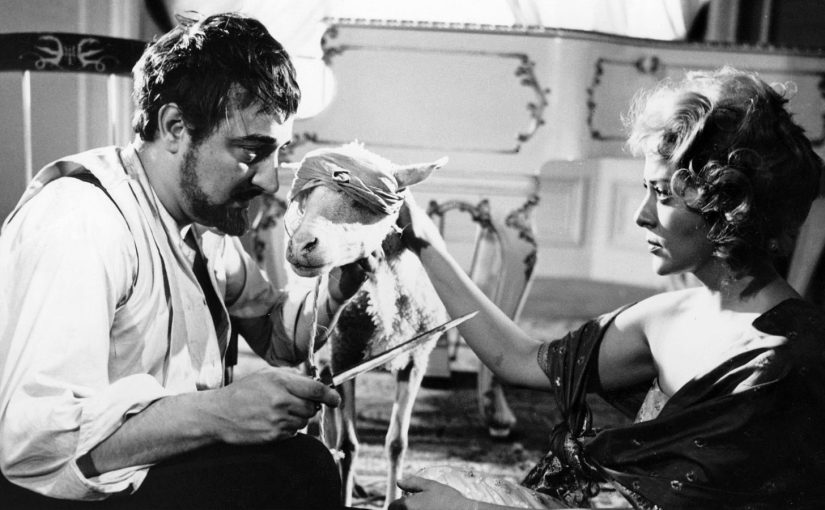
The dinner scene contains pratfalls, repeated conversations, and a visit to a side room containing three or four lambs and a bear on a leash.  What the WHAT…?  I remember thinking, okay, so this is going to a broad comedy turning upper-class manners into slapstick.  Seen it before, so I hope this movie executes it well.

The weirdness escalates when everyone retreats to a drawing room just off the dining room, where one of Nobile’s guests entertains everyone with a piano solo.  But when one of them tries to leave, he finds he can’t.  Not physically, like there’s suddenly an invisible wall, but one by one the guests discover they’re simply unable to leave the room.

They slowly realize the logistics of this bizarre situation.  The drawing room has no food.  Water runs low.  The one servant who remained outside manages to bring in a tray of water and coffee, but when he tries to leave to bring food…he can’t.  There’s no phone for them to call anyone about their predicament.

Outside the house, people find themselves unable to enter the grounds, so no one can tell what has happened to the people inside.  Curious crowds gather.  Inside, social structure starts to degenerate.  There are no restrooms, but one quick shot reveals a closet full of nothing but vases, and we see people entering and exiting these rooms repeatedly.  Ick.  Arguments are started with the drop of a hat.  One couple finds a unique, but undesirable, method of escaping their prison.

I responded to this material very unexpectedly, due mostly to its unpredictability.  I wasn’t cheering at the sight of upper-class twits being brought low when faced with bizarre circumstances, but I was more in tune with the horrific aspects of this story.  Buñuel has stated in interviews that he regretted not being able to take the story even further by including cannibalism, which is honestly where I thought things were headed.  It would have made a marvelous satirical statement, hearkening all the way back to Jonathan Swift.

(So, what DO they eat, you may be asking yourself?  Wouldn’t EWE like to know?)

I realize this review of the film hasn’t been much more than just a summary of its events, minus the surprising, “circular” ending.  A more detailed analysis might require listening to the commentary or reading Roger Ebert’s review or something.  But I hope I’ve conveyed how much I enjoyed The Exterminating Angel.  It was weird and surreal and absurd, and comic and horrific, and slapstick and satiric, and totally unpredictable all the way to the final frame.

P.S.  Now that I’ve seen this movie, the Woody Allen film Midnight in Paris (2011) has even deeper resonance when Gil meets Buñuel at a party and gives him the idea for The Exterminating Angel, and even Buñuel can’t understand it: “But I don’t get it. Why don’t they just walk out of the room?”  Funny stuff.

FLASH GORDON (1980)

by Miguel E. Rodriguez

DIRECTOR: Mike Hodges
CAST: Sam J. Jones, Melody Anderson, Max von Sydow, Topol, Timothy Dalton, Brian Blessed
MY RATING: 2/10
ROTTEN TOMATOMETER: 83% Certified Fresh

PLOT: A hotshot quarterback for the New York Jets, an aviophobic travel agent, and a borderline-mad scientist try to save the Earth from the evil cosmic emperor Ming the Merciless.


I could try to intellectualize myself into analytical knots to explain why Flash Gordon is not a good film, but that’s not really in question, even to its fans.  Aficionados readily affirm its badness, its cheesiness, its willingness to go so far over the top it’s on its way up the other side.  That’s WHY they like it.  “I enjoy it for what it is,” a fan told me recently.

Well, after watching it for a third time, mildly against my will, I can easily say that I know and understand what Flash Gordon is, but I still can’t find it in myself to enjoy it the way so many others do.  I remember being amazed by it when I was 10 or 11, but that was a very long time ago, and watching it now gives me no more enjoyment than what I might get from eating a stick of Fruit Stripe® chewing gum.  I get a burst of flavor when I hear the iconic Queen score and/or theme song, but the rest is like chewing on a wad of overdone steak. That this movie came from the same director as the gritty Get Carter (1971) is flabbergasting.

Do I really need to summarize the story?  No.  I’m sure anyone who’s taking the time to read this has already seen the movie, so I’ll just assume we all know how cheesy the plot is.  I was informed by a fellow Cinemaniac that what we see on film is all taken from the first, and only, draft of the screenplay.  Brother, I believe it.

The only thing worse than the so-called dialogue is the quality of the so-called visual effects.  Now, I’m prepared to forgive low-quality VFX from older films when there’s a story I can care about, but when Flash Gordon’s filmmakers ask the audience to suspend their disbelief when a supposedly distant city is being bombarded by what looks like Roman candles, or any number of equally absurd VFX shots…I can’t do it.  I laugh, and not in a “I’m-having-fun” kind of way.

Before you ask, yes, there ARE bad movies that are SO bad that I actually recommend them to people simply BECAUSE of their badness.  Birdemic: Shock and Terror (2010), for example, which features a scene where the heroes are being attacked by a huge number of Windows Clip-Art.  Or the uber-terrible Troll 2 (1990), which gives new meaning to the word I just made up, “corn-ography.”  However, some films either cross an invisible line or fall short of it, I don’t know which, and are so bad that I can’t enjoy or recommend them.  For example, the infamous The Room (2003), which was such an unpleasant viewing experience that I didn’t even enjoy the movie about its making, The Disaster Artist (2017).

That’s where Flash Gordon sits for me.  It’s terribly cheesy and campy, but it’s either not cheesy enough, or it’s TOO cheesy, for me to enjoy myself while watching it.  There may be a cerebral, intellectual way for me to try to parse the reaction I have to it, but if there is, I can’t think of it.

I will say that I thoroughly enjoyed watching one actor out of the entire cast, who seemed to be having way more fun than was needed or expected.  No, not Max von Sydow, whose sneering turn as Ming the Merciless is a master-class in remaining professional in the face of lunacy.  (Timothy Dalton deserves kudos for doing the same as the stoic Prince Barin.)  No, I’m referring to Brian Blessed as Prince Vultan, whose screeching battle cry will forever be stored in my memory banks: “Hawkmen…DIIIIIIIIVE!!!”  Examine his performance next time you watch the movie.  Look at his face, his eyes, the canyon of his mouth when he laughs.  There is a sparkle of delight that, to me, reveals someone who has realized the only way to stop himself from firing his agent is to go completely, full-blown, bull-moose gonzo.  Everyone else is playing it straight, or attempting to.  Brian Blessed is the only one who seems to be having any fun.  What a different movie this might have been if EVERYONE had taken his cue.  Alas.

To the fans of this film, I don’t apologize for my point of view, but I do admit to a tiny, VERY tiny, twinge of regret that I can’t see past its shortcomings enough to enjoy it the way its fan base does.  For me, it’s two hours of tedium enlivened only occasionally by a random chuckle or a smile when Queen’s music makes an appearance.  And by Brian Blessed’s manic smile.  DIIIIIIIIIVE!!!

[editor’s note: this review appears only by special request from the author’s best friend.  You’re welcome, Marc.]

À NOUS LA LIBERTÉ (1931)

by Miguel E. Rodriguez

DIRECTOR: René Clair
CAST: Henri Marchand, Raymond Cordy, Paul Ollivier, Germaine Aussey
MY RATING: 7/10
ROTTEN TOMATOMETER: 100% Fresh

PLOT: A convict escapes prison and becomes a wealthy industrialist, but his life of leisure is threatened when his former cellmate turns up unexpectedly.


À nous la liberté (rough translation: “freedom for all”) is a charming, if slight, romantic farce from celebrated French director René Clair, who would later make his mark in Hollywood films with I Married a Witch (1942) and And Then There Were None (1945) before returning to French cinema for the rest of his career.  It won’t go down as my favorite French film, or classic film, or anything like that, but as a snippet of cinema’s early years, along with some mildly scandalous history of its own, it’s worth a look for cineastes.

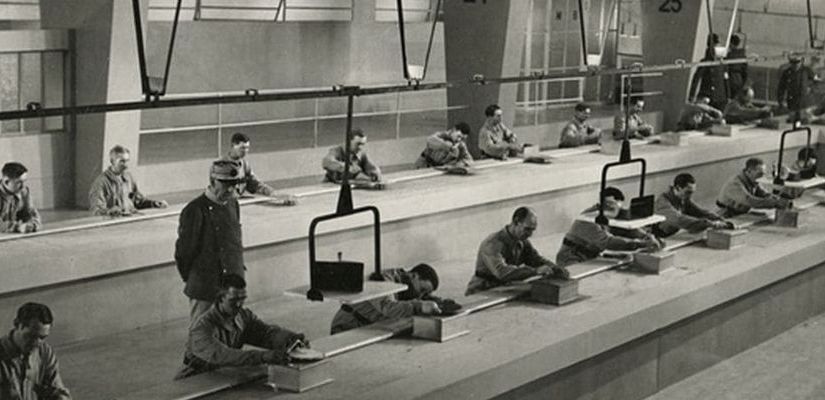
Louis and Émile are cellmates in a French prison.  Their daily routines are marked by hours and hours of assembling children’s toys on an assembly line that looks and feels a lot like the one from Chaplin’s Modern Times (1936) or even that one at a chocolate factory in a famous episode of I Love Lucy – but we’ll come back to that.  They sing, too, while toiling.  There’s a LOT of singing in À nous la liberté, not all of it clearly motivated, but serving as a kind of punctuation mark or accent piece to various scenes.

Émile and Louis attempt to escape their prison, but through no one’s fault, only Louis gets away, while Émile remains behind.  After some amusing episodes involving Louis trying to blend unobtrusively back into society, he lands a job hawking phonographs to pedestrians for a department store.  He gets so good at it that eventually he’s running the store…and eventually, improbably, he becomes the owner of the factory that BUILDS the phonographs, making him rich beyond his wildest dreams.

Trouble arrives in paradise when Louis’ cellmate, Émile, unexpectedly shows up, recently released from prison.  But he’s not looking for a job or to “touch” an old wealthy friend.  He’s in love with a girl who works at Louis’ factory, and getting a job there is the easiest way to stay close to her.  (I don’t THINK her name is ever said aloud, but she’s listed on IMDb as “Maud”, so that’s what I’ll call her.)  If Émile’s behavior sounds mildly stalker-y, well, it is, but what are you gonna do, love is love, and I’m sure I could dig up a modern rom-com or two that feature stalking as a romantic element.  Somehow.

Plus, there’s this whole ironic subtext that shows how the assembly lines at Louis’ phonograph factories are no different from the assembly lines at the prison.  The movie is not subtle about their similarities, but how could it be?  This fluffy material is corny as all hell, but the movie never gets too schmaltzy.  And if you think you know how the romantic subplot plays out in a romantic comedy from the 1930s, check your assumptions.

The centerpiece of the film is an assembly line sequence at the phonograph factory, a scene that has been imitated many times.  More modern movies and TV shows may have improved it, but having seen this movie, it’s clear where their inspiration came from.  In fact, the most interesting backstory of À nous la liberté is the fact that, after Charlie Chaplin released Modern Times in 1936, the producers of the French film sued Chaplin for plagiarism.  Both films feature bumbling but charming protagonists who wind up working on, and screwing up, assembly lines, and both films were making a point about the increased mechanization and dehumanization of the labor force.  After dragging on for ten years, Chaplin ultimately settled (without admitting guilt), but remained friends with René Clair for years afterward.

Having seen both films now, my opinion is that the similarities between the two films are purely incidental.  You might as well say that Star Wars plagiarized Star Trek because they both have “Star” in the title.  Modern Times is funnier and faster-paced, while the most farcical scenes in À nous la liberté are played, not for laughs, but smiles, if that makes sense.  It does to me, so I’m sticking with it.

It’s also interesting to observe how Clair used sound in this film from sound’s early years.  As I said before, there’s a lot of singing, but scenes with dialogue are few and far between.  Ambient sound is almost non-existent.  Where you might expect to hear lots of noises – scenes on the assembly line, for example – we only hear background score.  It’s almost startling when one scene plays street noises during an outdoor shot.  It’s almost as if Clair – like Chaplin – was reluctant to completely abandon silent storytelling in favor of this new sonic “trend.”  As a result, while it’s not a laugh riot, the film does have a quaint likability that is hard for me to describe.

À nous la liberté is an interesting peek backwards in time to when many of the film tropes we take for granted today were shiny and new.  It didn’t get me all “riled up” at an emotional level, but it wasn’t a waste of time.  And, like I said, there are one or two surprises story-wise.  That’s never a bad thing.

TRUE LIES

By Marc S. Sanders

James Cameron’s True Lies never had to be believable.  It only had to be fun, and it is fun for the first act and most of the third act.  Too bad the sitcom like, chauvinistic second act pretty much overthrows the whole picture.

When you watch an Arnold Schwarzenegger pic, you have to take it with a boulder of salt.  Throughout his career, he’s been pregnant (never saw Junior), he’s begged God to give him the strength to fight Satan (I’m being honest here. It happened in End Of Days), he’s been tossed out of a plane at thirty thousand feet with no parachute and lands safely in a dumpster (Eraser) and his twin brother has been Danny DeVito.  (Do I really need to share the title of that movie?) In True Lies, I have to accept the fact that the muscular body builder with an Austrian accent, and pretty good line delivery, convinces his wife and daughter, played by Jamie Lee Curtis and Eliza Dushku, that he’s simply a boring computer salesman.  It’s shocking, utterly shocking, to realize that he is actually a clandestine spy, and his family is completely unaware.  See if Bruce Willis or Harrison Ford or Mel Gibson were in this role, then I’d buy it.  Tom Arnold might have been a good pick, but James Cameron settled to make Roseanne’s ex-husband Schwarzenegger’s secondary partner with some comedy bits. He might be the best part of the movie.

A brilliant 007 inspired opening gets this adventure started off with a literal bang at a black-tie affair at a wintery German mansion. Harry Tasker (Schwarzenegger) infiltrates the party along with support from his partner Albert (Tom Arnold) who hides in a tech equipped van that’s close by.  Harry does the tango with Tia Carrere, which is charming and something new for the Terminator.  The outcome of this shoot ’em up episode puts these super spies on the trail of an Arab terrorist who has the capability of unleashing a nuclear arsenal on the United States.  When Harry is not chasing this guy on horseback and up high-rise elevators, with the equine in tow, he and Albert report to an eye patch played by Charlton Heston.  

Somehow, I sleepwalked into another movie, though.  Harry has not been the model family man and when he tries to make amends, he inadvertently hears his wife Helen (Jamie Lee Curtis) chatting with a sleezy car salesman (Bill Paxton).  Now all of the spy department’s resources change course to surveille Helen and this moron she’s been talking to because this is the episode with the misunderstanding.  James Cameron’s script makes very poor efforts to achieve sitcom level comedy.  A laugh track couldn’t even save this tripe.

Bill Paxton is a great actor, but he accepted a terrible, unfunny role as he ironically pretends to impress Helen by actual being a spy.  Ha!!!! Go figure!!!!

Jamie Lee Curtis is a great actor too, but she agreed to play one of the dumbest women to ever grace a screen.  She believes this moron’s lies as easily as she believes the one and only Arnold Schwarzenegger is just a computer nerd.

One of the most intolerable scenes I can ever think of occurs after Harry learns what is really going on. He gladly continues to play one over on his neglected and unhappy wife by believing he’ll give her a fun adventure he thinks she deserves.  Helen is convinced that she must abide by the wishes of a clandestine government group who apprehends her.  She arrives at a dark hotel room with Harry sitting in the shadows, mere feet away, and convinces his wife to do a striptease dance in front of a stranger.  This routine goes on for the longest five minutes.  It’s not funny.  It’s not sexy.  It’s eerie and perverted with sick narrow mindedness. 

At the risk of getting political and prudish, Jamie Lee Curtis has always been one of the most outspoken celebrities for equal treatment between men and women and has ostracized those in positions of power who work towards their own self advantage.  Yet here she allows herself to be objectified by James Cameron and Arnold Schwarzenegger to be a punchline for male chauvinistic pranks.  If this scene ended with Curtis breaking Schwarzenegger’s nose with a karate chop while holding him at gunpoint, then this becomes something else.  That’s a no, however.  Instead, she is a scantily clad victim of sexual deviants, and she never stands up for herself, or exudes any kind of pride.  I recall in 1994 not liking this sequence.  Over thirty years later, well after the tides of the Me-Too movement have passed, I still hate this material.  With all of the high-flying stunts and action thrown in to other parts of the movie, it is this scene that stays with me.

Once this stupid story detour is over with a cast of actors enhancing its inanity, do I sleepwalk my way back into the movie I was watching before.  Whattya know?  The Arab terrorist who has not been discussed for the last forty-five minutes, still exists. So, while being held captive, this becomes an opportune time for the unhappy couple to sort through their baggage.

True Lies starts out so fun and when the action is turned on, James Cameron and his team are offering some solid footage.  Helicopters, limos, and missiles fly over a bridge running from the Florida Keys.  Then it is ridiculous silliness with a fighter jet piloted by Schwarzenegger who uses the entire cache of weapons to wipe out the one bad guy while trying to rescue his daughter who his hanging from a crane high in the skies over Miami.  Some say the slapstick of The Three Stooges is a demonstration in violence.  I ask if those critics have seen True Lies because the mayhem is absolutely bonkers. 

I can’t endorse this movie because I think it is one of Arnold Schwarzenegger’s worst films.  It’s also one of James Cameron’s most awful efforts.  The action is marvelously over the top, but the characters are reprehensibly idiotic and the film gets hijacked by a whole other storyline that is neither funny nor worth caring about.  There are so many better options to select from this writer/director, and this entire cast. 

With an absence of untruth, I am being forthright by declaring that True Lies belongs back within the scummy cauldron from it was stirred up from.

TOOTSIE

By Marc S. Sanders

Tootsie is my favorite comedy of all time.  At age ten I saw it on Christmas Eve with my family and beyond the Star Wars and Rocky films, I had yet to see an audience respond, or more specifically laugh, so uncontrollably for two hours straight.  I might not have recognized all of the innuendo and I was not yet alert to the idea of women feeling belittled while knowing they should be entitled to equal respect, but the performances, especially from Dustin Hoffman were entirely genuine.  Tootsie still remains the only film where I can forget that a man, a not so attractive or sexy man, is convincingly disguising himself as a woman who possesses internal strength and gusto.

Whether directing or acting on screen, Sydney Pollack was not someone well known for overseeing comedy at the time.  Yet, that’s an attribute to the end product of this celebrated movie.  Other than a typical Bill Murray routine in an uncredited role, no one in this picture is waving their hands in the air to insist they’re funny.  The humor of Tootsie bears from true, raw emotion, fear and desperation.  No one is doing Saturday Night Live sketches and building up to the next punchline.  Despite the cross dressing, Tootsie is not even a farce.  A guy gets a job wearing the necessary garb and modifying his verbiage, but only to earn enough money to survive.  However, it also doesn’t help that he’s falling for his co-worker.  

Dustin Hoffman is an actor living in New York City named Michael Dorsey.  He’s a great, learned performer, especially on the stage, who lives with his playwright buddy Jeff (Murray) in a crummy apartment in the meat packing district.  They need to raise enough money to put on Jeff’s play in Syracuse.  

The problem is that Michael can no longer get cast in anything.  Not on stage or even in a commercial.  His agent (Pollack) says it point blank that nobody will hire him.  He’s just too difficult with short bursts of temper and no tolerance for others who work in the field.  

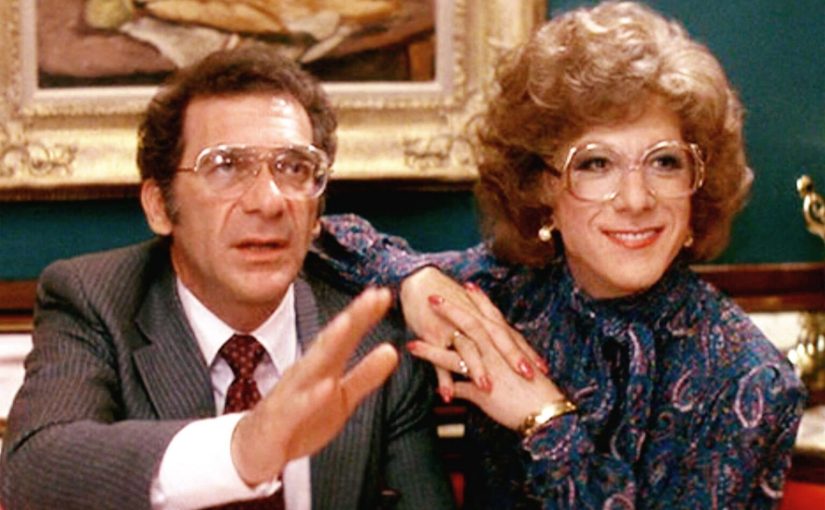
So, Michael surrenders to desperation and puts on the guise of a character actress named Dorothy Michaels.  As quick as she stands up for femininity against a chauvinistic TV director (Dabney Coleman) she is cast on the most watched daytime soap opera.  As long as Michael can perform off and on camera as Dorothy he should be able to earn more than enough money for Jeff’s play.

Complications arise though when he becomes protective of his co-star, Julie (Jessica Lange, in her Oscar winning role), against her unfaithful boyfriend, the TV director.  Julie’s widowed father, Les, is falling for Dorothy though, and then there is Michael’s friend Sandy (Teri Garr) who lost out on the part that he earned, and to keep things maintained has been seduced by Michael into a romantic relationship beyond just their friendship.

With me so far?  I hope so because there’s even more obstacles to overcome.  Tootsie is very economical in its story development, but it’s also a very crowded film.

Don McGuire and Larry Gelbart (TV’s M*A*S*H) wrote this Oscar nominated script with a brilliant collection of characters.  The blessing is while it sounds like farce, Tootsie is never delivered with a slapstick tongue.  In order for the film to work, Dustin Hoffman especially had to portray Michael Dorsey as a guy with natural ticks, motivations and fears.  He accomplishes that because Michael always ensures that Dorothy is as real as she can ever be.  When Dorothy hails a cab or shops for clothes the southern accent must hold while perusing through the city streets in heels.  Michael gets frustrated over what to wear for a dinner visit at Julie’s apartment.  Especially when Julie opens up her heart, Hoffman is precise to make sure Dorothy approaches with a low whispered approach to simply be a consoling girlfriend.  

The comedy arrives when Michael has no other choice but to break this strong powered female persona.  Dorothy will call for a cab but if it just won’t stop, then a deep voiced, bellowing New Yorker will come out of this woman’s mouth with an angry “TAXI!!!”  I like to believe that Sydney Pollack deliberately arranged for Dorothy to yank a Woody Allen lookalike out of a cab that was about to be taken from Dorothy too.  Dustin Hoffman knows Michael Dorsey is such a committed method actor that he has to convince all eight million people in New York he is strong willed Dorothy Michaels – a character actress capable of playing the new Hospital Administrator on Southwest General

There are so many fleshed out pairs of relationships in Tootsie – all going beyond the cross dressing of the film’s main character.  All of these people could get along forever if only for the fact that some characters have befriended a man while others truly believe they have made a connection with a woman.  How long can we have it both ways?  The facade has to undo itself, right?  True.  Thankfully it occurs at the end when every single character can have it explained to them all at once.  I’ve never forgotten the roars of laughter from my mom, dad and grandmother as the end of Tootsie arrived.  Well-placed close-up shots of every actor who had a speaking role in this movie is covered (well except for Sydney Pollack as Michael’s agent). On Christmas Eve in 1982, the packed movie house at the Forum Theater on Route 4 in Paramus NJ only amplified the shocking reactions.  Tootsie is a reason why you sit among a crowd at a movie theater.  

This is Dustin Hoffman’s all-time best performance.  He was nominated against fierce competition from Paul Newman in The Verdict, Jack Lemmon in Missing, and Ben Kingsley in Ghandi (who took home the trophy). Michael Dorsey/Dorothy Michaels is a much more challenging role than what Hoffman superbly accomplished in his two Oscar winning roles (Kramer Vs Kramer, Rain Man).  Robin Williams or Tom Hanks could have played Michael Dorsey who invents Dorothy Michaels.  Yet, what Hoffman emotes are the natural tics of a guy who is constantly broke while he charms an array of women at his birthday party, only with the intention of bedding them and hardly ever listening to what these ladies have to say.  When Hoffman puts Michael literally in a pair of woman’s shoes though, he begins to identify the lack of respect that women endure on a daily basis.  

Watch Dustin Hoffman’s body language.  He becomes angered with his agent upon learning that he lost out on a role which somehow leads to a debate about whether a tomato should walk or talk or sit or stand.  That back and forth is outrageously hilarious.  Having seen Tootsie hundreds of times though, I now appreciate how a schleppy looking Michael hustles across the streets of New York, avoiding traffic and then marches down the hallway to his agent’s office.  Hoffman twitches his head and shrugs his shoulders as if he’s prepping to give the agent a piece of his mind.  Hoffman is so absorbed in this guy he’s playing.  I am not recognizing any other kind of Dustin Hoffman that I’ve seen anywhere else.

Sydney Pollack is also attuned to the cutthroat atmosphere of desperate theater folk trying to survive in this concrete jungle.  Tootsie opens with a montage of quick episodes for Michael.  He is leading a workshop while being candidly ugly with his fellow thespian students about how challenging it is to get work.  In between, are auditions that he goes on where there is one reason after another why he can’t land a role.  Michael Dorsey is an incredibly skillful actor, but that means nothing for this role or that role.

On this most recent viewing I caught on to a detail that never occurred to me.  Bill Murray as Jeff, the broke playwright, is snacking on lemons and wincing while he talks to Michael.  Now I don’t know if this is in the script or if this was Pollack or Murray’s idea.  Nevertheless, it’s a brilliant detail.  These guys are so broke that they have resorted to smuggling lemon slices out of the restaurant they work at to live off of.  Another actor or filmmaker would have used an orange or cookies.  Who snacks on lemons?  Only those with nothing else to rely on.  

Makeup bottles with spirit gum, cannisters of fake blood, prosthetic teeth, props and sloppily hung costume wear are all given focus beyond the broad comedic storylines.  Sydney Pollack pans his camera over all of these items with no actors in frame because he wanted to ensure that being an actor or a playwright in New York is nothing glamorous.  It’s a world of unending torment. All of these nuances and details justify the extremes that Michael has to go through to achieve his goal.  

Jessica Lange never plays her role for laughs.  Her portrayal of Julie, the beautiful, blond celebrity of daytime television, is authentic and she inherits a new girlfriend to confide in. Finally, Julie can share what she values and holds dear.  You can’t not fall in love with someone who only treasures the best parts of her young life and yet only seeks a companion to chat with.  A humble celebrity is hard to find and that is one reason Michael falls hard for her.  Lange is outstanding while being so heartfelt.

Teri Garr’s comedy stems from the insecurities of actors.  Sandy is described as someone who wants to commit suicide at a birthday party.  Doing community theater for over thirty years I know precisely who this person is.  I’ve been this person, and I’ve encountered hundreds of these people.  It’s hard to be a big fish in the small pond of community theater.  Imagine trying to hold on to your sanity when you have to compete with all of New York.  Teri Garr was rightly Oscar nominated for what could have been a throwaway part. Like Hoffman she also has these little gestures that suggest her lack of confidence. After she sleeps with Michael and he’s getting ready to leave, Garr peaks at her naked chest hidden underneath the sheets.  It’s as if she’s wondering was I not attractive enough.  She’s hurting. No matter if she just had sex with one of her favorite people, she is still suffering.

Charles Durning is familiar for having the tough guy, intimidating persona because he’s usually so much larger than life.  However, he offers a sweetness to this guy who’s ready for companionship.  You don’t want Michael or Dorothy to let him down.  Les doesn’t deserve to get hurt.

Again, as I described any of these characterizations, none of it is funny.  They are wrapped in sensitivity. There’s a lonely sadness to people like Michael, Jeff, Julie, Sandy and Les.  Yet, when this variety of sorrow and anguish collide, while poor Michael is only trying to make some money, does it all combust in hilariously, unwinnable scenarios of tremendous proportions.

Tootsie is an amazing film.  It is one of the smartest, most insightful scripts ever written and it is blessed with a cast and director who mastered how to live in an unforgiving and unsympathetic industry.  This picture offers lessons in the human spirit while demonstrating the lengths and boundaries that must be broken in order to survive.  By practically not performing as a comedy, it only becomes that much more funnier and wiser.  

Tootsie is a perfect film!

SPECIAL GUEST REVIEW: THE ROCKY HORROR PICTURE SHOW (1975)

by Ronnie Clements with Screen Gems

Screen Gems reflects on The Rocky Horror Picture Show (1975)… Review by Ronnie (Dorian) Clements on his FB page Screen Gems http://www.facebook.com/screengemsbyronnie


On 14 August, 1975 (50 years ago), The Rocky Horror Picture Show opened at the Rialto Theatre in London. Rocky is still the longest running movie in theatrical history and the biggest cult movie of all time! I doubt if any other film will ever “usurp” it. 

[And whatever you do, forget the 2016 made-for-TV remake. It’s a pale imitation, woefully flat and best left in the vault or preferably down the pooper!]

Screen Gems 70’s Flashback …

The Rocky Horror Picture Show (1975).

A Look Back at the OG (totally re-written for the masterpiece’s 50th anniversary) …

Two of the most unforgettable Saturday afternoons of my life were spent watching live matinee performances of The Rocky Horror Show; years apart, yet equally electric. While the film adaptation, The Rocky Horror Picture Show, has rightly earned its cult status, nothing compares to the raw energy of the stage. Still, the movie captures the essence and outrageous brilliance of the original, preserving it for eternity.

As a screen adaptation of musical theatre, Rocky stands alone. There’s truly nothing else like it. The score is wildly eclectic, veering from tender ballads to glam rock anthems, and yet not a single dud among them. It’s a sonic rollercoaster that defies genre and expectation.

The plot? A delicious mash-up of horror and sci-fi tropes, with a heavy nod to Frankenstein. But what emerges is something wholly original: a campy, chaotic celebration of identity, desire and rebellion.

Written by Richard O’Brien, The Rocky Horror Show premiered at London’s Royal Court Theatre Upstairs on June 19, 1973. The original cast: Tim Curry (Frank-N-Furter), Richard O’Brien (Riff Raff), Patricia Quinn (Magenta), and Nell Campbell (Columbia), all reprise their roles in the film, bringing their eccentric brilliance to the screen.

The stage show holds the record as the longest-running theatrical production in history and it’s still performed around the world. The film, after flopping on its initial release, found new life through midnight screenings in the mid-70s. Word of mouth turned it into a phenomenon. 

Since 1975, it’s been shown continuously in cinemas — the longest theatrical run ever. Every Friday or Saturday night, somewhere in the world, fans gather in costume, props in hand, ready to shout, sing and surrender to the madness. I’ve never attended a midnight screening myself, but I’m told it’s a surreal, unforgettable experience.

The Story …

Brad (Barry Bostwick) and Janet (Susan Sarandon), two squeaky-clean newlyweds, find themselves stranded on a stormy night. Seeking help, they stumble into the gothic lair of Dr. Frank-N-Furter, a self-proclaimed “sweet transvestite from Transsexual, Transylvania”, and his bizarre entourage. What follows is a wild descent into seduction, science and spectacle as Frank unveils his latest creation: the perfect man, built for pleasure.

Does the plot make sense? Not really. But that’s beside the point. It’s pure fantasy, a glitter-drenched fever-dream, powered by a magnificent score and unapologetic theatricality.

Tim Curry was born to play Frank-N-Furter. His performance is iconic, seductive, menacing and utterly magnetic. The rest of the cast delivers with equal flair. The film’s comic book aesthetic (garish lighting, bold colors, exaggerated performances) only heightens its surreal charm.

Themes Beneath the Fishnets …

At its heart, Rocky Horror is a battle between conservatism and counterculture. And, as in life, the establishment unfortunately wins! Frank-N-Furter and Rocky are killed … but … Brad and Janet return to their “normal”, mundane lives. However, the film leaves us questioning what “normal” really means and whether conformity is truly a happy ending! 

THERE’S SOMETHING ABOUT MARY

By Marc S. Sanders

Love never dies.  Sometimes it just gets jammed in your zipper.

Ted (Ben Stiller) can’t put his finger on it.  Neither can Pat (Matt Dillon) or a couple of other obsessed, stalking paramours.  There’s Just Something About Mary.

In 1985, brace faced, insecure Ted gets the opportunity to go to prom with the prettiest girl in school, Mary (Cameron Diaz).  He’s a good guy, but disaster strikes in truly one of the most unimaginable ways and prom never works out for these kids.

Jump thirteen years later to 1998 and Ted gets the idea to hire Pat, a private investigator, to track down Mary in hopes of rekindling a new romance.  She’s in Miami, Florida now, working as a chiropractic surgeon and even more beautiful than ever.  Problem is that Pat has lied to Ted about what has come of Mary and wants to pounce on her all for himself.  Ted eventually gets up the gumption to trek from Rhode Island to Florida anyway.  Along the way complications ensue.  Let me change topics for one second and remind you to be mindful of rest stops when you are road tripping.

There’s Something About Mary is one of the all-time great comedies and my favorite of the Farrelly Brothers’ collection (Kingpin, Dumb & Dumber, Me, Myself & Irene).  I’ve described the spine of this film, but it’s the guts of endless sight gags within that uphold this picture.  Everything from a dog that gets drugged, electrified, drugged a lot more, and body casted to a handicapped friend of Mary’s who simply cannot pick up his keys without instigating terribly guilt-ridden chuckles. (I’m laughing as I write this.)  Special needs adults lend to the comedy as well.  The Farrellys are proudly nowhere near politically correct. Yet the material manages to not be horribly offensive either.  You need not worry, you will still get into heaven even if you laughed at There’s Something About Mary.  Still, that’s what comedy is.  Somebody always needs to be the victim of the stooges who lend to the mayhem.

This comedy is also perfectly cast from the three headliners all the way down to the extras.  A South Carolina jail cell setting draws big laughs at poor Ted’s demise. 

Cameron Diaz is such a sport though, always looking beautiful while willing to be the fool.  It was great to watch this with my seventeen-year-old daughter since she had no idea of that hair gel scene.  If you don’t know, don’t read about it.  Just watch and look at how well Diaz holds the moment together.  I remember SCREAMING in the movie theatre next to Miguel.

Stiller and Dillon are two dumbasses you likely never would have envisioned in a film together.  Nevertheless, they are perfect foils of stupidity against one another.  Matt Dillon is often recognized for his tough guy dramatic roles.  Yet, he puts it all on the line.  Stiller is primarily known for comedy, and this film is the first of a series where he becomes the unfortunate victim of circumstances (Along Came Polly, Meet The Parents).  I wouldn’t want anyone else in these scenarios though.  You laugh at what Ben Stiller ends up in but also feel sorry for the poor guy.  I would have no objection if Matt Dillon and Ben Stiller paired up again for another comedy, even all these years later.

Other cast members also lend their level of comedy from Chris Elliott to Lin Shaye to Sarah Silverman, Jeffrey Tambor, Markie Post and especially Keith David, who knows he belongs nowhere in this movie, but that’s exactly why he should be part of the cast.  He’s utterly hilarious.

A nice touch to the movie are the series of outtakes during the end credits while the cast lip sync to The Foundations celebratory number “Build Me Up Buttercup.”  This had to have been such a party to film and finally the audience is assured that they can laugh along in front or behind the camera as well. 

There’s Something About Mary is the movie so many of us need right now.  Turn off the news and turn on what went on between Ted and Pat and their pursuit of Mary. 

MEET THE PARENTS

By Marc S. Sanders

Am I the only one who used to get tired of feeling sorry for Ben Stiller?  The go to formulas of his earlier comedies made him the unfortunate stooge.  The best of that batch was The Farrelly Brothers’ hilarious There’s Something About Mary.  Every gag, every cast member, every storyline was straight up side splitting.  Late last year, during the hurricane chaos in Florida I got around to watching Along Came Polly.  Poor Ben had to play basketball defense against a bare chested wookie hairball of a guy and his close up of misfortune carried the advertising campaign for that movie. 

Back in the year 2000, Stiller suffered through a terrible weekend with an intimidating Robert DeNiro frowning on his every move in Meet The Parents, also known as the first of a “Fockers Trilogy.”  Yeah, Meet The Parents is funny.  You shake your head at the absurd comedy that befalls Stiller’s character, Greg Focker. Though that isn’t even his real name at birthright.  Still, I can’t recall feeling so guilty for one guy’s misfortune that he can hardly ever help to avoid.  This guy is destined to never win, to never overcome, to never live without self-consciousness.

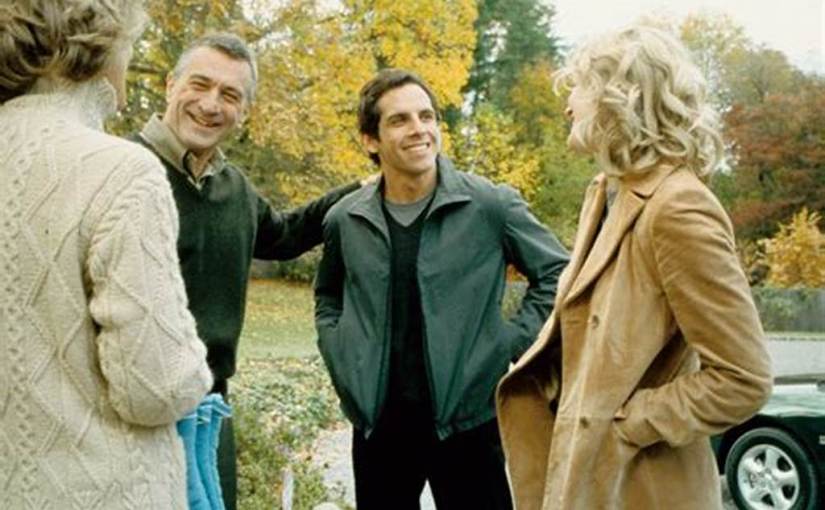
Greg Focker is ready to propose to his loving girlfriend Pam Burns (Teri Polo). First, he has to survive a weekend at her parents’ house where the other daughter is getting married.  Not so easy because first the airline loses his luggage and poor Greg has no clothes to wear, other than what Pam’s pot head brother can provide. Baggy jeans and baggy sweatshirt on a short and svelte Ben Stiller is one sight gag of many.  The guy also has to nonchalantly dismiss his uninviting surname and the fact that Pam’s father Jack (DeNiro) is unimpressed with his occupation.  Greg is not a nurse.  Greg is “a male nurse,” who opted not to go all the way for the MD, even after taking the exams. 

Jack and his wife Dina (Blythe Danner) are less than impressed with Greg’s housewarming gift.  Jack’s precious cat Mr. Jinx is a bit of a problem because Pam can’t keep her mouth shut that Greg is not fond of cats.  Doesn’t make him a bad guy, but does her cat loving father need to know this interesting tid bit, right away?  Pam’s ex-boyfriend Kevin (a hilarious Owen Wilson against Stiller’s pitiful expressions) can do absolutely no wrong – like nothing at all.  The biggest challenge for Greg though is Jack.  Whether it’s Taxi Driver or Meet The Parents or Rocky & Bullwinkle, Robert DeNiro is the embodiment of intimidation. 

Meet The Parents is funny, and it serves no purpose to surrender the many sight gags or one liners that are offered in the film.  I laugh.  I laugh hard when I watch this movie, but I hardly ever feel good about myself.  Poor Greg never catches a break.  He’s in a no-win situation and I’m just uneasy about the whole thing.  The guy chooses not to go swimming because he has no swimsuit. Then Kevin offers one and well…yeah…I’m on Greg’s side and it’s not funny for Greg.  If I was a guest in someone’s home only to wake up late when the whole family is dressed and finishing breakfast, and I’m wearing my girlfriend’s dad’s PJs, of course I’m going to feel insecure.  For the sake of the comedy in Meet The Parents, the set ups are simply awkward situations to laugh at that one guy in the room.  Poor Greg.  Poor, poor Greg. 

In fact, the real villain of Meet The Parents is not even DeNiro’s Jack Burns who has some secrets to hide.  Actually, the unsympathizing bad guy is Teri Polo’s character.  Pam never makes it easy for her boyfriend.  Greg rightfully asks why didn’t she wake him up or why didn’t she tell him her dad is not a florist, or why this and why that, and Pam is naïve to Greg’s justified concern, never empathizing with his position.  In fact, when he tries to explain his feelings, she’s nothing but insensitively dismissive. 

Yes.  It’s a comedy, but I was begging and begging and BEGGING Greg to just leave.  Leave this place.  LEAVE PAM FOR GOOD AND GET OUT OF THIS HOUSE.  You know, like we would tell the counselors in a Friday The 13th flick?  It’s not so much the father as it is his girlfriend who quickly nosedives Greg’s comfort into an inescapable hell.  You know how people love to say Jenny is the villain of Forrest Gump?  Well, I got one better.  Pam Burns is an unthoughtful, uncaring, spoiled brat of a daddy’s girl with nary a shred of consideration for others. 

I despise you Pam Burns – daughter of Jack and Dina Burns, rotten and heartless girlfriend to Greg Focker!!!!! 

MY COUSIN VINNY

By Marc S. Sanders

The American Bar Association’s publication, The ABA Journal, ranked My Cousin Vinny #3 on its list of the “25 Greatest Legal Movies.”  Surprised?  You really shouldn’t be.  

This “fish out of water” film follows a goodfella who did not pass the bar exam until his sixth try.  Now he’s defending his cousin and another UCLA college kid in an Alabama courtroom.  It’s Vinny’s first murder trial.  So he’s gotta learn the ropes of how to dress properly for court all the way up to discrediting material witnesses and demonstrating reasonable doubt to get his clients exonerated.  It’s a great courtroom picture because within the dense slapstick comedy there are authentic lessons to learn about being a member of the Bar and having confidence in yourself.

Bill and Stan (Ralph Macchio, Mitchell Whitfield) are roadtripping through southern America, en route to UCLA, when they get pulled over and framed for the murder of a convenience store clerk.  With no money or hope of retaining a reliable public defender, the young men turn to Bill’s cousin Vinny.  

Straight out of the five boroughs of New York wearing a black leather jacket, black boots and a slick pompadour, Vinny Mancini arrives in small town Alabama.  You know something?  If I didn’t know any better I’d say he looks and acts a lot like Joe Pesci.  With him is his long time fiancée, Mona Lisa Vito (Marisa Tomei, in her very well remembered Oscar winning role). Mona Lisa Vito!  I love when there’s some thought put into a character’s name.

The future looks grim for the accused as Vinny doesn’t know where to begin.  The iron horse Judge Chamberlain Haller (Fred Gwynne) habitually holds the guy in contempt because Vinny can’t shed his New York ways either in wardrobe or proper decorum. The prosecutor played by Lane Smith really doesn’t have to try hard at all.  Though he deliberately gets all Southern showy each time he faces the jury, made up of friendly locals.  In an unexpected and tender moment, the tough guy, Vinny, admits to Lisa that he’s “a-scared.”

I never cared for My Cousin Vinny since I had seen it in theaters.  However, there’s much I appreciated on only my second viewing of this film directed by Jonathan Lynn, an actual law scholar.  Lynn is always striving for an authenticity within the courtroom.  His protagonist might not know anything about being a litigator, but the director ensures that a genuine regiment of customary courtroom behavior, procedure, and theatrics will be upheld even if this is only a silly, little comedy flick.  

Outside the courtroom, there’s primarily an updated George and Gracie situational comedy at play.  Marisa Tomei is of cinema’s great scene stealers.  Mona Lisa Vito might look like an overly familiar character, but the actress’ performance is entirely unique.  She never plays Lisa as a dumb side character to her boyfriend who will not commit to marriage.  Lisa comes off generous, always offering to assist Vinny despite his rejections.  She’s also positively smart as a whip with her extensive knowledge of automotive repairs, and she’s a quick study of Alabama law.  When she gets put on the witness stand it hardly matters what she’s saying.  Marisa Tomei owns the expertise and defiance of Lisa.  Turn the scene on mute to watch her doing some of her best work would be equally effective.

Go look at Silver Linings Playbook when Jennifer Lawrence rhythmically dictates numeric football statistics at Robert DeNiro.  Both actresses won Oscars for these respective roles.  These performances stand apart from so many other second, third and fourth billed actresses because they are written with immense intelligence.  That’s what Tomei and Lawrence normally embrace first, ahead of costume and makeup.  The confidence from these actors is uncanny.  More women need to be cast in roles like these.  

Joe Pesci is doing his reliable, familiar schtick from Goodfellas, Raging Bull and Easy Money.  He’s in a what if scenario though.  What if there’s a movie with Jersey Boy Joe Pesci, but he’s put in Alabama country with roosters crowing and trains chugging into town at five in the morning? There can even be a communication gap between the Judge and Vinny for some padded laughs.  “What is a yoot?”

I was bored with this movie the first time I saw it.  I just didn’t think the humor was funny even if I recognized the attempts.  Over thirty years later, what I appreciate is the heart that feels much more apparent.  The hero feels weak and at a loss.  Only when he is given strength and support from a wisecracking, sexually frustrated girlfriend does he get the drive to behave like a lawyer he’s licensed to become.  I like Vinny.  I like Lisa.  Therefore, now I can laugh at their unfortunate dilemmas as they work towards an end goal – getting him to do his best at becoming a courtroom lawyer and hopefully reaching a not guilty verdict. 

I gotta give a shout out to the supporting cast.  Bruce McGill plays a familiar sheriff that we’ve seen before, but so what.  It’s the way he carries himself that I’m always welcome to see him in a movie.  Same goes for Lane Smith.  These guys are sophisticated Dukes Of Hazzard.  Fred Gwynne, most famously known as Herman Munster, was always a brilliant character actor.  He has the ability to be goofy and intimidating all in the same scene.  To place his towering stature against little Joe Pesci? Who needs dialogue? Watch Fred Gwynne’s moments in My Cousin Vinny.  He could’ve been Oscar nominated, and I would not have complained.  While Ralph Macchio is doing his typical routines (same things we saw in The Karate Kid, The Outsiders and so on), it’s Mitchell Whitfield playing his buddy who really stands out.  This is a nothing role but it’s as if this guy fell out of a Woody Allen or Neil Simon picture to claim his own territory among an outstanding cast.

My Cousin Vinny is one of those comfort films to put on when the stress is becoming too much in real life.  Everyone is so likable here.  There isn’t a villain to dual against.  Instead, it’s a conflict of cultures who must work together to uncover truths within a murder trial while also learning about what any one of us is actually capable of accomplishing. 

Vinny from da Bronx is a lawya???? 

FUGGETABOUTIT!!!!!