I, TONYA

By Marc S. Sanders

The will to commit wrongdoing must stem from somewhere; an outside influence or perhaps a genetic makeup, or both.  I think I, Tonya suggests it’s central character suffered under the former possibility. Outsiders put former Olympic figure skater Tonya Harding where she is today with a reputation forever scrutinized and forever tarnished.

Margot Robbie was unjustly denied of the 2017 Academy Award that went to a been there, done that Frances McDormand for the horrible Three Billboards Outside Ebbing, Missouri.

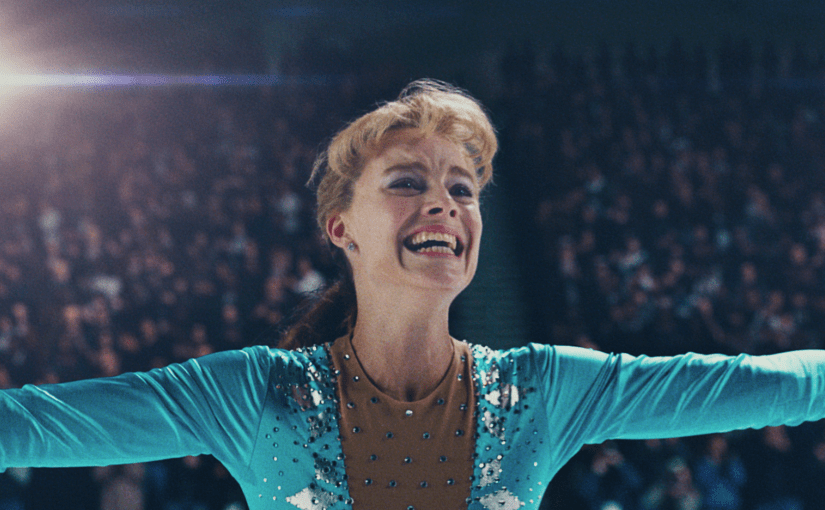
Margot Robbie is one of the most beautiful and talented actresses working today. This film puts her into the stratosphere.  Robbie is unrecognizable beneath the punishing white trash persona of the infamous Tonya Harding.  She is unrecognizable in caked on makeup,  awful periodic perm haircuts, chain smoking, excess drinking and terrible dietary habits that include a shameless plug for Dove chocolate bars.  

Harding is forever notoriously linked to the knee bash heard round the world victimizing her Olympic competition, Nancy Kerrigan.  Margot Robbie does not hold back in displaying Harding’s lack of class and elegance expected in the sport of women’s figure skating.  It’s what Tonya Harding lacks that blocks her from the fame and success expected to come with being a champion athlete. Robbie is fantastic about surrendering her character’s talents for short tempered flare ups, crass behavior and a filthy mouth.  Her facial expressions are shocking.  Stretched fake, Cheshire Cat grins with bulging eyes pull at the pressure Tonya suffered under a hateful mother’s thumb, and an equally abhorrent, stupid husband.  She is forever naïve to how the judges never put her above the competition in points.  I mean this is the only woman to ever successfully accomplish the triple axle!!! 

Equally astonishing is Allison Janey as Tonya’s mother LaVona Harding, an incredibly cruel woman hell bent on making sure Tonya skates for the sole opportunity to endlessly torment her only daughter physically and, even worse, mentally.  Janey joins the exclusive club of cinematic great villains.  This is an unsympathetic woman with no drive to be better at anything except increasing her abuse upon Tonya.  It’s a shocking performance.  Janey appears so comfortable in the cruel insults, offensive language, and non stop smoking all the while her pet parrot sits atop her shoulder.  LaVona is uncompromising in how she punches, throws plates or even tosses a steak knife at her hated daughter.  What a horrible person, and what an amazing performance. You’ll be hard pressed to find a better antagonist in a film these days.

Sebastian Stan chose wisely to accept the role of Jeff Galooley.  It’s a great departure from the Marvel superhero films.  Jeff is a dumb, needy, abusive husband to Tonya; the man who admitted to being the orchestrator of the knee bash (though the movie will tell you it’s not that simply explained).  Stan should have been nominated at least.  It’s not easy to play such a dumb, real life moron, and he excels in the role. What an asshole Jeff Galooley was; what a dumb asshole actually.   He, along with his conspirators, have great chemistry in idiotic planning.  Stan really shows his best moments when he’s being reckless with his rag doll wife, Tonya.   The physical domestic fights are so well edited amid rock ballads from Fleetwood Mac, Laura Brannigan, ZZ Top, and Supertramp. 

Director Craig Gillespie follows the breakneck formula of Martin Scorsese with character interviews, racing steady cams that convinced me that Robbie is as talented a skater herself as Harding was.  She has so many levels of erratic fear, insecurity and tempers.  The method of filmmaking here seems like a slight nod to Raging Bull.  Gillespie takes advantage of all that Robbie brings to the camera.  It’s a perfect marriage of director and actor; as perfect as DeNiro & Scorsese or DiCaprio & Scorsese.  I hope Robbie & Gillespie will be teaming up again soon.

Once again, I have to ask.  How in the hell does that piece of celluloid waste called Three Billboards Outside Ebbing, Missouri get a Best Picture nomination when as far as I’m concerned, I, Tonya clearly stands much higher above it in terms of craft, writing, performance and filmmaking?????  It astounds me.

I, Tonya is without a doubt one of the ten best films of 2017.  I can’t wait to see it again.  It’s unbelievably good.  

Footnote: Do I think any differently or sympathize with Tonya Harding now that I’ve seen this depiction? I don’t think so.  She is clearly a woman who was never given a fair chance at a happy life. She was destructive to herself as much as those that surrounded her.  Yet, she had to also accept responsibility for her actions and behavior.  Any of this could have gone differently.  If only these people were not so stupid or irresponsible.  These people, Tonya Harding included, all had choices to make.  They could have chosen a different option time and again.  Despite some of the positions Craig Gillispie’s film takes, I truly believe Tonya Harding could have opted for a different path while combating her inner and outer demons.  

PATTON

By Marc S. Sanders

You may find this hard to believe but as I was watching the epic Best Picture winner of 1970, Patton, I was actually thinking of a dreadful film I had seen the day before called Under The Cherry Moon, featuring and directed by Prince.  How in the hell could that be?  Well, both films are laced with the vanity of their films’ main characters to the umpteenth degree.  However, I’ll save Prince’s piece for another column, when maybe I’m out of excuses to avoid death or a root canal.  The point is both films never tire of the close ups of its featured player to enhance the pride, ego and conceit they do not hesitate to thrive off of.  The difference is that director Franklin J Schaffner knew that to really show what motivated General George S Patton you had to drill for the American warrior’s drive, and Patton’s motivation was truly his own self-worth.  (Prince just wanted one more close up on top of one more close up as a means of self service.  Sorry but that’s not enough of a reason for a character to live.)

Patton is portrayed by George C Scott in an Academy Award winning performance.  No one else could have played this role.  No one else should ever play this role again.  Scott and Patton are symbiont in a camera’s lens.  One can not be imagined without the other.  Schaffner’s film opens in front an American flag that fills the entire screen.  Patton steps up in front.   Somehow, his figure seems like a bigger, more prominent figure than the large backdrop of the stars and stripes.  He delivers a monologue that was aimed at the troops fighting in the second World War, but this is really an introduction to the audience of what to expect for close to the next three hours.  He reminds us that the blood and guts of the Nazis will be used to grease down the tread of our tanks and he will be proud to lead his men on any battlefield that calls for the bloodshed of Hitler’s regime.  In the film’s first five minutes, you know that this biographical character will never sway from what he stands for.

The theme of the film tests the egotism of General Patton.  We see him get dressed in his military uniform before heading in to battle.  His subordinates put his military jacket on.  Another one places his helmet upon the great battalion leader’s head, but it is done with great detail.  This helmet will never fall off.  I can promise you that.  Early in the film, the two star general takes it upon himself to decorate his shirt collar with three stars.  He’s reminded that President Eisenhower has not made his promotion official yet.  Patton proudly dismisses that detail.  None of this has to do with the strategist Patton became known for on the battleground.  George C Scott demonstrates that the General knew when to bestow himself with another honor in his proud military career.  No one else, not even the Commander in Chief, would determine when the General was worthy of another star.

In the heat of battle, Patton happily volunteers historical facts about the regions he is fighting on.  He even insists that he knows for sure what happened before.  He, General George S Patton, was there.  He’s not kidding.  He truly believes that.  History did not deliver General George S Patton.  Rather, General Patton delivered history. 

All throughout the film, Patton is seen in moments of great pride.  He’ll be standing as his jeep caravans his military forces through conflicts in Tunisia and war torn Europe.  General Patton loved to lead, but his leadership was specific to sending a battalion into one conflict after another and what was most important was earning the glory for himself.  The British couldn’t have the accolades.  Certainly, his fellow generals couldn’t either.  Patton is who the Nazis feared.  Patton is the towering six foot tall man who must be seen walking off the bow of a ship into battle when the US back home gets film updates. 

Scott’s character is tested however as Ike loses confidence in the great general.  Patton’s mentality on war does not mesh well with the propaganda of the United States with the other allied countries, particularly Russia.  Patton is not interested in making friends with Russia as he is more concerned with anticipating an eventual disagreement with them and thus, we must be prepared for war.

More significantly, Patton only cared for the bravery of his men.  Early on in the film, Patton arrives at the camp site of a US battalion to take over its leadership.  George C Scott’s presence is all that needs to be said as he visits the mess hall followed by an office and then an infirmary.  Men will no longer show up late for breakfast.  If other men are going to sleep, well then that’s fine as long as it is a means to end with an advantage towards military victory.  Doctors will don their helmets even if it means drilling holes in them to continue properly using stethoscopes, and any man who is being treated for self-inflicted gun shot wounds will not be entitled to a bed for healing.  Get those cowards out immediately.  Hospitals are for those soldiers who proudly shed their blood in the name of the United States of America. 

This last detail is further echoed at a pivotal point in the film.  Patton chastises a crying soldier who is simply terrified of the shelling of war.  No man who dons a military uniform should ever be crying in fear.  Following slapping the boy around, Patton orders that the soldier be sent to the front lines.  My question is how useful is this kid going to be on the front line if he is crippled by his own fears.  Patton would have then slapped me around, most likely.  The front line will certainly wake this kid up and load his weapon to spill some enemy blood. 

The other interesting dynamic to the film falls upon the role of General Omar Bradley played with contradictory delicateness by Karl Malden.  The script by Francis Ford Coppola and Edmund H North display Bradley as a man who came up through the ranks of General Patton.  Yet, because of Patton’s controversial nature as a proud war hero and not a politician representing the ideals of Ike’s administration, Bradley is eventually put in charge of the United States’ positions in the War.  By the time this arrives, the film is only approaching the beginning of its second hour and I could only imagine how Patton is going to take this. He’s advised by his friend Bradley to calm his nature and maybe even question his motivations for battle.  Yet, Patton can only see that his apprentice has taken over and he has been grounded or meant to serve as a decoy to Hitler’s armies.  This is a complete misuse of his skills and his pride as an American symbol.  Patton is relegated to delivering speeches to gracious European women.  This is beneath him.  Adding insult to injury, the dog he proudly walks by his side is a fraidy cat when confronted with a woman’s little yappy pup.  The great general’s ego has been terribly bruised.

General Patton might have been controversial but the film serves as a means to show his imperfections ahead of his historical conquests.  When Patton is questioned as to how he can overthrow Hitler’s positions in various parts of Europe within two days of heavy snowfall, Patton is proud to say that he alone has trained his men to overcome any ordeal they are faced with.  His men are killers; killers of Nazis.  The doubt of other military leaders is proven wrong thanks to the General’s insistence.  Sure, the old general might have been a pain in the ass for the United States, but how would the war have really ended for the Nazis if they hadn’t have had to deal with the great leader?  Periodically, during the course of the film we see how the Nazis try to gage what Patton will do next.  It makes no difference how the United States are censoring their general.  The Nazis stare at a proud photograph of him, knowing he is still out there.  Where is Patton leading his forces to, and how will they ever explain it to their Fuhrer? 

George C Scott is truly a great presence here. Schaffner’s work with the camera must also be recognized.  The film is epic because of its scale.  Years before the age of CGI and a great war film like Steven Spielberg’s Saving Private Ryan, this film from 1970 showed vast settings populated with tons of extras and infinite tanks and vehicles, as well bomber planes.  It’s astounding.  How was this all accomplished?  Other films like …Ryan or The Thin Red Line would show more intimate fights among the opposing forces.  Shootouts and one on one grappling.  Patton shows the enormous battles.  Tanks are overturned, bombs are dropped right in the middle of a sea of extras.  The film was also awarded for its art direction and its hard to question why.  It’s unbelievably impressive.

As the film directly says, Patton lives for the love of war.  Therefore, the ending is a little sad.  The war ended.  The Nazis fell to the triumph of Patton, the United States and their allies.  Schaffner simply offers a wide shot of Scott walking alone into a field of no significance.  Other biographical films would resort to a death bed moment.  That’s too easy an escape sometimes.  In a way, the film could be a tear jerker.  Mind you, I didn’t cry at the end of Patton.  However, any film must have a certain sense of sorrow when a character no longer serves any meaningful purpose in life.  The heart might continue to tick, but the soul no longer has anything left to accomplish.  Coppola and North knew that, as well as Schaffner, and George C Scott knew so as well.  Once the war had ended, a proud (very, very proud) man was put out to pasture.  That has to be more meaningful than any physical passing.