MOLLY’S GAME

By Marc S. Sanders

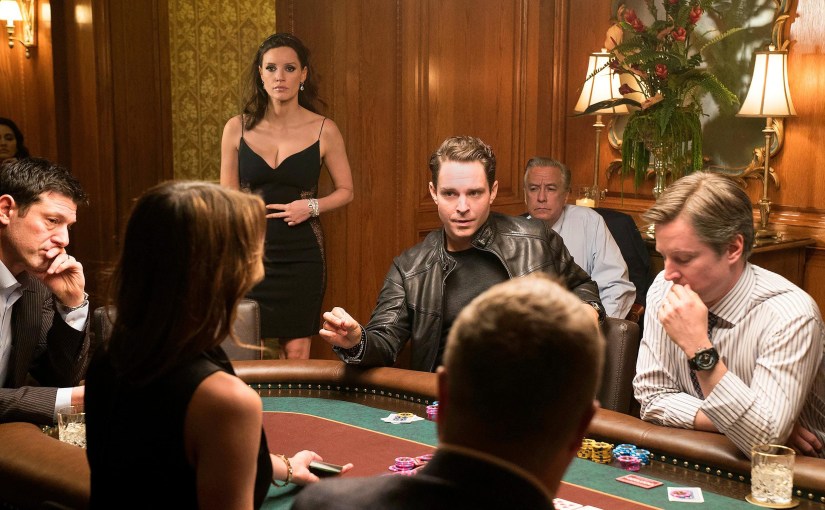
Despite being a little distracted by a drunk patron sitting next to me, I thought Molly’s Game was very good. It doesn’t measure up to The Social Network, and I feel justified in comparing the two because the sharp, fast dialogue follows what appears to be an intentionally similar narrative from writer, and here director, Aaron Sorkin.

Sorkin in his directorial debut uses great techniques for film editing to match the beats of his dialogue.  His opening voiceover of Jessica Chastain as Molly describing the ultimate worst sports experience will get your heartbeat racing.  It draws you into the film right away.

Chastain is good, but maybe a little over the top.  I needed a little more convincing that she was actually this brilliant, inventive and resourceful woman who was also considered one of the world’s greatest skiers.  Can’t put my finger on it but something was missing with her playing the Molly Bloom role.  Was she really holding her own against these high stakes guys who take big risks in her personally constructed poker ring?  I’m just not sure.

Felt the same about Kevin Costner in the role of her father.  He’s supposed to be an incredibly brilliant psychologist and an intimidating patriarch.  Yet Costner doesn’t fit that mold for me here.  Couldn’t feel the pressure from Dad on his daughter.  Someone else might have been stronger.

Michael Cera too.  I think he is playing a combination variation of Tobey Maguire & Leonardo DiCaprio, two of the most famous celebs that participated in the real Molly Bloom’s underground poker games, but Michael Cera?  Really?  He doesn’t carry the weight or looks of guys like that.  There just was not enough power or presence from him.

None of these actors were the worst options for this cast, I just think the film could have used more appropriate performers. There was more appropriate talent out there, I’m sure.

Idris Elba is great, however.  He’s blessed with an awesome Sorkin monologue in the 3rd act of the film, and he hits every note.

A great script.  A great story worthy of being a big screen film and it’s got me interested to learn more about the real Molly Bloom, including reading her novel.

SCHINDLER’S LIST

By Marc S. Sanders

Oskar Schindler was a handsome, well dressed man. A man of wealth, power, and influence. A successful businessman. He was a womanizer. And Oskar Schindler was a Nazi who saved 1100 Jews from the atrocities of the Holocaust.

On a filmmaking measure alone, Schindler’s List is one of the best pictures to ever be made. Steven Spielberg’s production value is incomparable. Nothing I can recall appears as grand (not sure that’s the appropriate word here???) and authentic as Schindler’s List. How did Spielberg pull off this feat? How did he direct hundreds, thousands maybe, of extras to reenact the vilest human suffering that a generation of people could ever encounter? I’m astounded. Positively astounded.

This evening was only my second time seeing the film. I always put off watching it over the last 30 years; reluctant maybe to see a horrifying truth. The first time I saw the film was on Christmas Day, 1993 at the Hyde Park cinemas in Tampa, Florida with my father. I didn’t realize it at the time, but I was in the beginning stages of the flu with a high fever. Midway through the film, I had to leave the theatre as my illness caught up with me. I mustered the strength to return to watching the remainder of the movie, as I recall I could not go without finishing this masterpiece. I was horrified and yet amazed; amazed that this moment in world history could have ever occurred.

To see a man like Amon Goth (brutally and uncompromisingly played by Ralph Fiennes), a high ranking Nazi, excuse himself from his nude mistress’ bed and perch himself on his balcony to sniper random Jewish prisoners as a means of sport was sickening and twisted to me. Twenty five years later, it is this moment that has always stayed with me, as much of the story and scenes left my memory from so long ago. This moment as well as Spielberg’s choice to highlight a young girl in a red coat amidst a most somber black and white picture have stayed with me all these years. The glimpse of red serves as a truth to Schindler’s naivety. Spielberg is a thinking director. He never follows the manual. He chooses to think outside the box. A glimpse of a child dressed in red in a sea of black and white where mutilated corpses and possessions are aimlessly strewn about. It’s a marvelously telling moment.

Liam Neeson plays Schindler. It will likely be the greatest role of his career. Schindler is a man who even fools the audience until the very end when he reveals that the war has ended and his salvation has rescued these 1100 souls. Finally, his humanity no longer hides and he weeps to his accountant and accomplice, Itzhak Stern (played subtly and beautifully by Ben Kingsley). Schindler weeps for he could have saved more. Neeson is superb in this moment. His commanding stature crumbles, his materialism and wealth have disappeared. Neeson translates all of that clearly, and finally my tears arrive. Prior to this moment, I was numb to the Nazi tactics of gas chambers, careless bloodshed and apathetic separation of families and friends; perhaps because I’ve extensively studied it during my years in Yeshiva. Before Schindler’s List, much of the history on the Holocaust seemed like textbook fare to me. Spielberg made its terrifying and tragic reality real.

Ben Kingsley’s performance is so important as well. The architect behind the list, his portrayal of Stern is countered with contained fear and leveled sensibilities amid the senseless intentions of a dominant force of evil. His instincts kept him alive so that only he could help keep his comrades alive.

Schindler’s List won the Best Picture Oscar for 1993, only 50-52 years following the events of the Holocaust. Many survivors thankfully remained to see Spielberg’s epic premiere. People who I share this planet with experienced the most insane and heinous evil ever encountered. They were well to do people living normally until they were violently pulled from their homes, stripped of their possessions, separated from their families, suffered at the threat of murder, witnesses to other murders and hate crimes, humiliated, beaten, forced into slave labor in tightly contained ghettos and eventually thrust into concentration camps. Yet, these few survivors lived to carry on with their lives and deliver new generations, beyond this morally ugly and evil historic episode.

I’m being redundant as I’ve said it many times before, but isn’t that the point? The Holocaust and the Nazi regime only occurred around 85 years ago. This happened before. This can happen again.

Thank you, Steven Spielberg for Schindler’s List.

I don’t consider myself to be very religious anymore. Because of moments like the Holocaust, I question how a God could ever be possible. Still, for the survivors and those that perished, I can only say Baruch Hashem, and L’Chaim. 

Peace.  Progress.  Love.

A CIVIL ACTION

By Marc S. Sanders

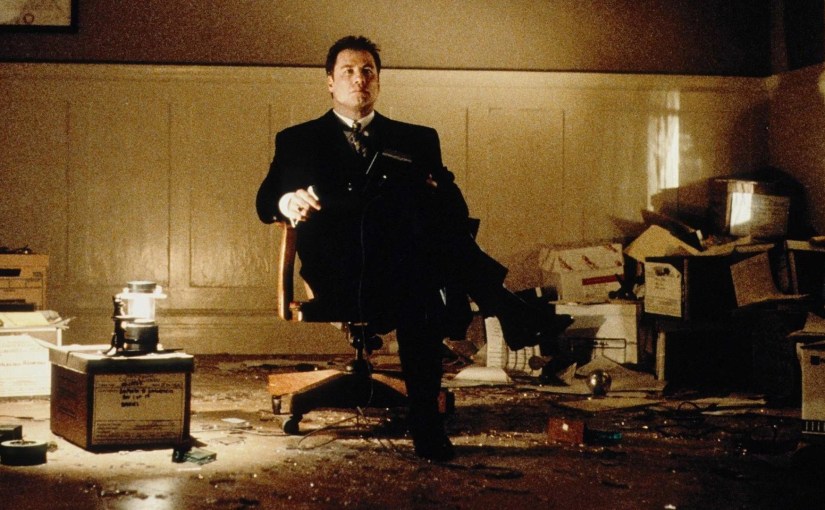
In A Civil Action, writer/director Steve Zaillian allows John Travolta to demonstrate the workings of a remorseless ambulance chasing lawyer with a pride for the finest in men’s wear and the title of one of the most eligible bachelors in Boston, Massachusetts.  Then, all of that crumbles apart when a self-effacing acknowledgment breaks through. 

Travolta portrays real-life attorney Jan Schlictmann, who heads a small personal injury law practice with three partners (Tony Shalhoub, William H Macy and Zeljko Ivanec).  They go after the cases that promise large settlements from hospitals, insurance companies and multi-million-dollar corporations.  The best cases are where the mid-30’s breadwinning male of the household has suffered irreparable damages.  The victim is not deceased, but permanently handicapped, unable to work and provide for his family.  A dead victim is not as theatrically attractive.   Better to put the poor soul in the wheelchair on stage for the winning cash settlement. 

When Jan is boxed into a corner to meet with the residents of a small New England town, he dismisses their case as an unwinnable nuisance.  The townsfolk believe that their children have taken ill, with some not surviving, due to locally contaminated drinking water.  Kathleen Quinlan is one mother who wants an apology and explanation from whoever is responsible.  An apology holds no tangible value for Jan though, until he observes who the primary suspects are likely to be; two large corporations that own well known brands like Peter Pan Peanut Butter, Tropicana Orange Juice, and Samonsite Luggage.  Now the pockets to collect from could go on forever, and Jan does not realize until it’s too late how much of a personal gamble he is undertaking with himself and his partners in tow.

A Civil Action has always left me thinking on so many different levels since I first saw it in theaters.  The value of a life, especially a child’s life, is not very significant when corporate America profits on dollar bills.  The priority of environmental protection and its most precious resource, water, is just as minimal, maybe more.  Zaillian uncovered a fantastic character arc from a very frighteningly sad and true story.   Jan Schlictmann proudly dons an appearance of false care for victims of botched surgeries and car accidents to advance his ego and materialistic nature.  However, then he found a conscience, as he realized that money doesn’t win cases for his clients.  Instead, the acceptance of responsibility triumphs.  That surrendering admittance, though, is not expected to come from these companies.  Not when the burden of proof only comes from a measly platoon of four small town attorneys, who could never bear the expenses of proving such gross negligence and wrong doing.  This is a David & Goliath confrontation. 

Beyond a cast of recognizable faces, there are scenes in this film that just stay with you.  Most especially for me is the unforgiving nature of Quinlan’s suffering maternal character.  She no longer has any care in the world for whatever sacrifices are made by the lawyers to reveal the truth of what happened.  I didn’t think that was fair of her, frankly.  Zaillian demonstrates what these four guys endure as the case prolongs itself.  However, people are unfair.  Sometimes they are unreasonable because they have been pushed down to a bottom they’ll never climb up from.  This movie and the circumstances at play are not here to please me and make me feel good with a tidy ending wrapped in a bow, however.  The script is brutally honest in its characterizations.

What’s also disturbing about this case is simply water.  Countless times, Steve Zaillian gets close up shots of glasses and pitchers of clear, crisp water.  Children are drinking water.  Water is spilled on tables.  Jan’s enemies in trial will indulge in a refreshing gulp from a glass as they finish a scene with him.  The movie reminds you time and again that water is the silent killer.

Robert Duvall is the shining talent on the other side of the aisle from Travolta as an attorney in a fifty-dollar suit with a beat up fifty-dollar briefcase representing one of the large companies that is being sued.  Duvall makes his shark of an attorney appear effortless.  He falls asleep in court.  He tucks away in a corner to listen to the Red Sox play on his transistor radio.  Yet, he’s wise enough to know how to derail an opposing counsel’s case with just his quiet, unspoken presence at the table.  He isn’t even so much a villain or an antagonist as he allows the hero of the film ample opportunity to settle rather than charge on.  His urgencies don’t work however because Jan has changed.  Where he once saw money, he now sees something much more valuable that is beyond any variance of negotiation.  The scenes shared between the handsome, fit and well-dressed John Travolta against the older, short, hunched yet astute Robert Duvall play beautifully here.  There is top notch stage performance work happening here.

It amazes me that A Civil Action is not available on Blu Ray or 4K.  Look at this cast and its direction.  It’s magnificent.  Zaillian’s film moves with a fast pace of easy-to-follow courtroom theatrics.  Additional performances from Sydney Pollack, James Gandolfini, Dan Hedaya, and John Lithgow are so engrossing.  William H Macy is very good too, as the desperate man trying to keep Jan’s cause afloat.  Why is this film not being granted the accessibility it deserves?  I actually had to pay for a streaming rental watch.  No matter, it was worth it.  For like Jan Schlictmann, money is not the most important commodity known to man.  Morality and decency will stretch further than money that’s been spent, never to be replenished.  A noble and most human thing you can do is to experience Steve Zaillian’s film, A Civil Action. Then you will understand what an unjust world any one of us could fall victim to.  Then maybe you will understand the loss a loving mother endures far outweighs any financial liability from a grocery food company.

ROB ROY

By Marc S. Sanders

In Scotland, in the year 1713, Robert Roy MacGregor, the chief of the Clan MacGregor, protects his people from cattle thieves while trying to endure against starvation and minimal resources. Rob Roy was a leader but never looking to herald a cause. He just wanted to live day by day with his clan, along with his wife Mary and their two children.

Michael Caton-Jones directs Rob Roy with Liam Neeson as the title character and Jessica Lange in a strong performance as Mary. The film doesn’t move with the sense of sweeping adventure that I was expecting. However, that’s the point. Caton-Jones shoots Alan Sharp’s screenplay as a Rob Roy reluctant to rebel or wage war against a selfish monarchy that rules Scotland.

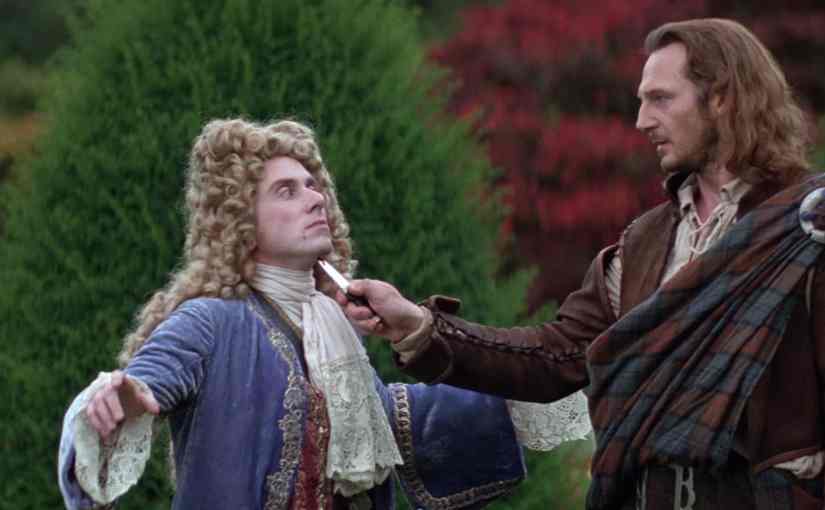
James Graham, Marquess of Montrose (the always effective John Hurt) agrees to lend Robert 1000 pounds to be paid back with interest. Rob is most grateful for the assistance that can help his clan. However, when Rob’s trusted friend Alan (Eric Stoltz) picks up the money, he is brutally murdered on his way back by Archibald Cunningham (Tim Roth, in maybe his best role ever).

Montrose, unaware of what has truly occurred, carries no sympathy for Rob’s predicament and obligates him to the original contract. Eventually, it becomes ugly as Montrose permits Archibald to carry out violent intimidation including slaughtering the clan’s cattle and burning down Rob’s home as well as raping Mary.

Rob Roy moves at a slow pace at times, but that doesn’t take away from brilliant characterizations. Roth as Archibald is a blazing villain. He’s introduced as a snobbish brat dressed to the nines though living off the prosperity of the mother who sent him to Montrose for a better royal upbringing. He carries an effeminate way about him in his long, curled, flowing wigs and garish pink and blue aristocratic wardrobes. He is a bastard though, yet a master swordsman. Like many great scene stealing performances before, Tim Roth has just the right timed expressions for the camera. Caton-Jones captures every best shot of Roth’s presence. Tim Roth, at the very least, deserved his Oscar nomination. I couldn’t get enough of him.

Jessica Lange gives another reason why she is such a celebrated actor for women. She picks smart roles over and over again. I was going into the film thinking she would be playing the dutiful wife and mere damsel. However, as Mary MacGregor she’s incredibly strong before and after she is victimized. She is torn with conflict to share the whole truth with Rob as to what has occurred to her. How will Rob respond? Will it make it worse for him with the monarchy? Will he feel ashamed of Mary? A fascinating character piece.

Brian Cox appears as Killearn, Montrose’s aid and factor. Yet, he is also secretly serving to Archibald’s underhandedness. He’s quite good in his role too.

Liam Neeson is fine as Robert Roy MacGregor; tall, built and athletic. He looks like a real hero. However, I’m not sure if I got a dense enough character from Alan Sharp’s script. Much of the film only comes alive when the other performers are on stage, like Hurt, Cox and especially Lange and Roth.

I was always aware of the famous sword fight in the film and it is quite spectacular. However, maybe hearing the hype over all these years watered down my expectations. The choreography is spectacular and often it really is Neeson and Roth in the moment; not stunt doubles. Yet, I remain more impressed with the work of Errol Flynn and scenes from The Princess Bride and The Empire Strikes Back.

Rob Roy takes some patience to watch. A very good film but not necessarily wall to wall action to consider it a popcorn flick. Watch the film for the performances and take in the gorgeous countryside footage.

I recommend it.

REVERSAL OF FORTUNE

By Marc S. Sanders

Claus Von Bülow was not a well liked man. In the 1980s he was put on trial for the attempted murder of his wife Sunny Von Bülow and was found guilty in a courtroom within the state of Rhode Island. However, even guilty men need a lawyer. Alan Dershowitz accepted Claus’ invitation to be his appellate attorney and successfully won the case with the assistance of the best students to come out of his law school classes. Reversal Of Fortune directed by Barbet Schroeder documents the month and a half that Dershowitz had to make a case for overturning Claus’ conviction. The film is based on Dershowitz’ book Reversal Of Fortune: Inside The Von Bülow Case.

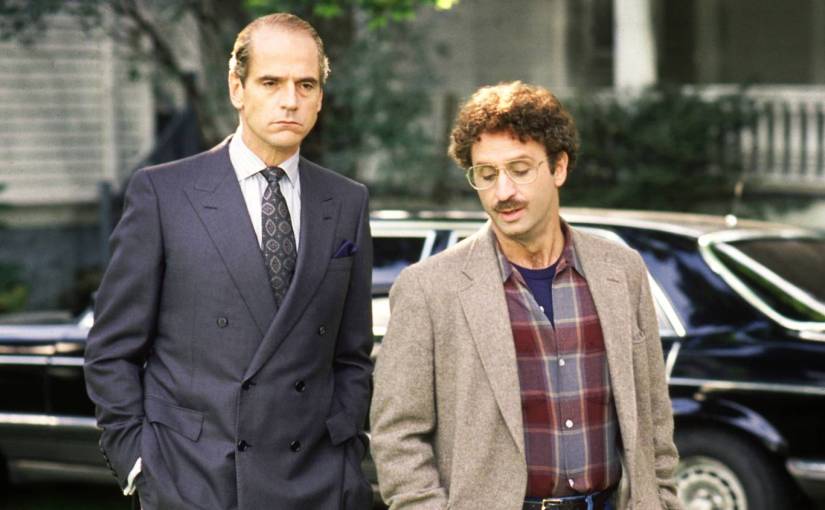
Jeremy Irons won the 1990 Best Actor Oscar for portraying the cold and cavalier Claus. He plays the part as if he looks so completely guilty that it’d be foolish to actually think he committed any sort of crime. It’s too obvious to seriously jump to that conclusion.

Glenn Close is Sunny, Claus’ wife. She serves as a narrator from her permanent, seemingly brain dead comatose state. She also appears in flashback moments that account for either her perspective, or Claus’, or the suppositions of Dershowitz (played very effectively by Ron Silver) and his young legal team. Sunny’s voiceover asks the viewer early on “What do you think?”

Sunny was hooked on various pills, chain smoked, ate an abundance of sweets and drank very heavily. She preferred to stay in bed for most of her days. One instance seems to show her in a comatose state lying next to an unalarmed Claus. The maid is disturbed by the nonchalance of the aristocratic husband. A doctor or the police have yet to be phoned. Sunny comes out of that episode but a year later falls into another comatose state. Flashbacks hint at the theory that perhaps Claus was poisoning Sunny to obtain her fortune and keep up with his extra marital affairs. Following her second coma, Sunny’s children hire a private investigator to obtain evidence that was eventually used against Claus in his trial. As an honorable servant of the law, this infuriated Alan Dershowitz who believed this private investigation was biased from the start. Schroeder uses a debate scene with a student (a young Felicity Huffman) for the lawyer to justify his choice to fight for such a hateful man’s appeal. Why were private investigators permitted in the trial? Where’s the public investigation? It also helps that Claus agrees to a large fee to help Dershowitz fund the defense of two brothers on death row for a crime they did not commit.

Schroeder’s film does not make its own claim on the case or the circumstances that accompany it. Rather, he shows you a process. Dershowitz knows that Claus Von Bülow is a “very strange man.” Claus responds to him by saying “You have no idea.” Yet, that doesn’t add up to guilt. A victim can be a victim by means of numerous possibilities and a court of law is fallible. Dershowitz wants to be sure.

Jeremy Irons’ performance is that of a gentleman of an aristocratic and well dressed nature. He finds the humor in being considered the villain. Irons plays the role with determined vagueness. Vague does not account for guilt.

Glenn Close is very good too. Her intoxicated episodes are so delirious that it seems to work in favor of Claus’ innocence. Yet her voiceover narration is sober and clear, but not necessarily accusatory. So it’s hard to know what to believe.

Ron Silver as Alan Dershowitz only focuses on the law and commanding a team of the best legal minds he ever taught. He turns his two story home into a headquarters where his students are compartmentalized into different aspects of the case from the drugs that Sunny took to the background of the Von Bulow’s turbulent marriage. As a means to keep them alert, the departments have basketball tournaments in his driveway. Dribbling the ball and slam dunking while still weighing evidence and legal precedents. Dershowitz is only interested in seeing if there is a case that shows Claus could have been innocent beyond a reasonable doubt. The case swept the nation and in the court of public opinion this creep was found guilty. Ironically, the one who is closest to him now is the one who does not see guilt, despite disturbances in his client.

Reversal Of Fortune is a different kind of mystery caught up in possible outcomes and nothing else. Barbet Schroeder with the help of Dershowitz’ case notes, book and public records made certain to offer all avenues for what really led to Sunny Von Bülow’s vegetative state.

The only concrete fact that this film does offer is that Claus Von Bülow was an untrustworthy creep draped in elegance and formality. There’s no crime in that. Is there?

MY WEEK WITH MARILYN

By Marc S. Sanders

Simon Curtis directs a glimpse into the life of Marilyn Monroe with an exquisitely cast Michelle Williams in the title role of My Week With Marilyn.

The film is told through the perspective of 23 year old Colin Clarke played under dream like naivety from Eddie Redmayne. Clarke embarks on joining the production crew of Sir Laurence Olivier’s (pompously over played by Kenneth Branagh) newest film that he is directing and starring in, opposite Monroe. When Marilyn’s new husband, playwright Arthur Miller, returns to the states, Colin is drawn into Marilyn’s seduction; protecting her from an intimidating Olivier and tolerating her drug and alcohol use.

This film features an outstanding cast of who’s who from Dame Judi Dench to Emma Watson to Dougray Scott, Julia Ormand (playing a past her prime Vivienne Leigh), Toby Jones and Dominic Cooper. An amazing cast and amazing performances all around.

Still, I just wasn’t wild about the film. With her life startlingly cut short, Marilyn Monroe is arguably one of the biggest enigmas to come out of Hollywood, and yet this tiny glimpse into her life just wasn’t interesting enough for me.

Fully aware of her impending doom to come, the sad foreshadowing of pills on her dresser, and her unfamiliar stupors didn’t drive anything for the character. It all becomes repetitious with nothing new to say. Colin’s virginal experience with this celebrity tryst never drives anywhere but back into Marilyn’s bed after he’s requested to appear at any given hour. This occurs again and again. The film just doesn’t progress past these moments. I found myself saying “I’ve seen this already!”

Did Marilyn learn anything from this fleeting moment in her lifetime? Did Colin? Maybe Colin got to witness the dichotomy of the privately ill Marilyn versus her ability to turn on the public charm with curvaceous ease and a wide lipstick smile. Yet, I have to wonder what came of it for Colin, thereafter.

Redmayne is quite good in his naive innocence. He inhabits nearly every scene since the story is told from Colin’s experience. Storywise though, what was the point of all this really?

Williams as Marilyn is astonishing. As good at playing a Hollywood legend as when Cate Blanchett deservedly won her Oscar for playing Katherine Hepburn in The Aviator. My one wish is that Williams accepted the role with a much more dimensional and nuanced script.

Perhaps because of the mystery that always seemed to surround Marilyn, Williams will never get the chance at playing the bombshell in something better. Marilyn’s life was so dubious and questionable. What filmmakers would be brave enough to truly make claim of how the starlet lived and how she died?

I can wish for another Marilyn portrayal to come one day, with Michelle Williams in the role, but alas I won’t hold my breath.

THE LAST EMPOROR

By Marc S. Sanders

Finally, I invested myself in watching Bernardo Bertolucci’s Oscar winning Best Picture The Last Emperor. Honestly, as breathtaking as the undertaking to make this sweeping epic is, it was the first and likely last time I will ever watch the film.

This three hour plus biographical picture focuses on a young child named Puyi, plucked from nowhere to become the next Emperor of China. He is destined to reside in Peking, The Forbidden City amid rich tapestries and deep Chinese culture at the start of the twentieth century. Oddly enough, the would be Emperor is a prisoner of his own surroundings for nearly his entire life. He is forbidden to go beyond the walls of Peking. Later in his adult life, he is a political prisoner and war criminal in the now regarded People’s Republic of China. Puyi was never granted an opportunity to think for himself or act upon his devices. He is forced to become an adaptable symbol to ongoing representations of the country that harbors him.

I watched this film with my wife. The next day we discussed it with my colleague Miguel who regards the picture as one of the best films he’s ever seen. I can not dismiss his viewpoint, but personally the depth of Betolucci’s efforts for maximum authenticity pushed my interest away from the film.

I embrace character arcs in films. It’s what keeps each passing moment of a movie refreshingly interesting. I do not deny the change in the Emperor’s story arc. Puyi changes as his country changes on both a political or militaristic platform. Yet, the film has vague segues in its changes as well.

Characters appear and disappear. Moments in history occur with no build up or explanation. It was challenging to follow who is who, and what has just happened.

Early on, we see how Puyi as a child interacts with his younger brother, Pujie. Much later in the film, Pujie reappears when they are adults. I am not going to pretend I’m a sophisticated enough moviegoer to realize this is the brother we saw as child over an hour earlier in the film. It took some time to realize who this guy was.

I’m also not going to pretend I know enough about Chinese history and culture to comprehend the traditional customs and ceremonies that occur, or China’s relationship that developed with Japan, or China’s significance during World War II.

That’s my problem with the film. Was I supposed to take a college course on Chinese history before watching The Last Emperor? The film is expository for sure, but it presumes the viewer will recollect at what point in history this moment or that moment occurs.

The film flashes forward and back to when Puyi was a prisoner of war in 1952. In prison, he eventually becomes reformed, but it became frustratingly complicated to understand exactly why he was even sentenced.

Following the film, I referenced Wikipedia to grasp the sequence of events. The historical change of this one man certainly merits a film to be made, much like Malcolm X or Born On The Fourth Of July. However, those films had a more comprehensive narration for me and the ongoing changes that the central figures experience are more well defined as the years pass and the people around them change.

The Last Emperor felt unclear to me in its storytelling while still immersing me in a land I’d imagine is unfamiliar to most viewers. For centuries “The Forbidden City” was not open for a public to encounter. If that’s the case, I believe Bertolucci needed to define what he captured much more clearly. Who’s to know what we are looking at, or what significance this setting has if most of the world population has yet to see what is here?

The Last Emperor requires a high threshold of patience and focus to grasp what it presents. It should be seen for the locales that are filmed, which were completely unseen by me personally. You’ll also get some tidbits of Chinese history, for sure.

All I can recommend is not to be so hard on yourself, when you find yourself lost at times in the film.

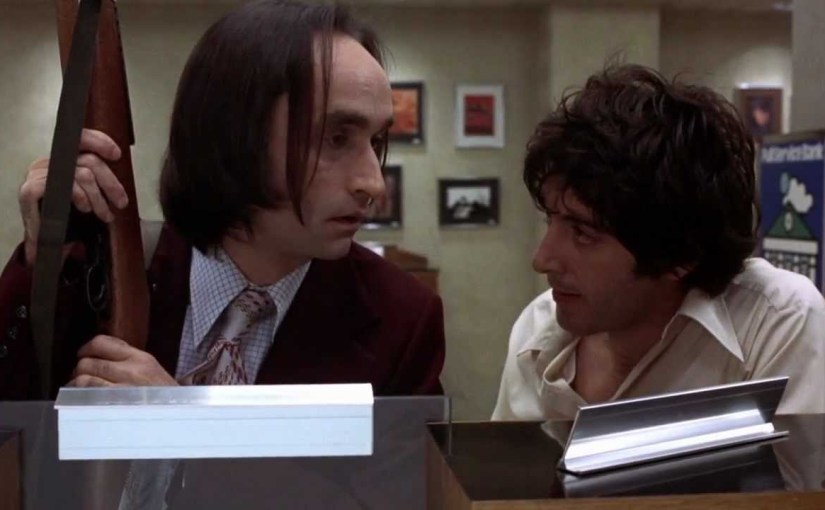
DOG DAY AFTERNOON

By Marc S. Sanders

Sidney Lumet uses his best strengths in this ridiculous Brooklyn bank robbery that is actually based on fact.

Here, Al Pacino and his cohort, John Cazale, play inadvertent stupidity without compromise. If two of the three stooges went on to do drama, this would be the material they’d use.

A simple bank robbery with little to no planning spirals out of control and into sheer pandemonium. Nothing goes right even when Pacino’s dimwit character, Sonny, is deluded enough to believe all is going in his favor. He immediately earns the support of the encroaching Brooklyn community only to lose them when he shows his true homosexual nature. Then he’s blindsided as to what happened. Layered in drenching sweat, Lumet wisely takes advantage of Pacino’s best up close facial expressions. Utter delirium!!!!!

Once again, Lumet’s camera moves while his best actors remain naturally in place. Al Pacino does his thing and trusts his director will find his shots. As the cop initially in charge, Charles Durning does as well. Pacino and Durning especially have great scenes together in the middle of a heavily populated New York Street as the robber shines off the cop, and the cop does his best to obtain some measure of control. It’s a scream fest for the ages. “Attica! Attica!” Pacino and Durning’s best career performances were always the ones where it looked like neither of them were ever acting. Dog Day Afternoon is one those better examples.

Frank Pierson’s jagged script of wild turns makes every person whose an extra like the pizza delivery man, for instance, caught up in the hysteria. The pizza kid shouts out to the crowd “I’m a star!!!” It’s great reason to applaud Sidney Lumet’s control over a crew and the entire company of extras he’s employed. This film is a rare example where all of the extras (seemingly the entire Brooklyn population) are as integral as the leads. The setting is the main antagonist from the media all the way to the observers who can’t look away and can only cheer, yet mock as well. Brooklyn, New York is a great character here.

Most fascinating about Dog Day Afternoon is that it is all based on fact from the media circus to dumb bank robbers with a need to steal in order to fund a lover’s sex change operation. It’s ridiculous. It’s funny. It’s frighteningly stressful and it’s all true.

This was released following the first two Godfather films and confirms the enormous range Al Pacino possesses with his performance talents. Hyperactive and dumb here as gay bank robber, Sonny; quietly contained, evil as Michael Corleone. His range was through the roof in the 70s before absorbing his loud, crackling, smokers voice. It was when the script outshined Pacino and before the current age of writing being catered to its bankable star.

Lumet also allows great moments for the hostages who become undone to the point of regretfully using foul language, to actually befriending their captors. He’s a director who efficiently leaves no stone untouched.

Chris Sarandon as Leon, Sonny’s male gay spouse is great here too. He’s full of melodrama, panic, worry, and a New York maternal despair. Another great scene is a phone exchange between Pacino and Sarandon. It might appear funny at first, especially in the 70s when homosexuality was lampooned often with the other F-word, but anyone who appreciates the filmmaking of Lumet will quickly contain their snickering when they realize a gay man is equal flesh, bone and feelings like anyone else.

Dog Day Afternoon is very telling of an out of the closet social media future. The story will always get grabbed regardless of danger or sensitivity. People will get swept up in the hoopla (a teller hostage quickly boasts her brief fame on television “Girls, I was on TV!”), police will overextend their privilege, helicopters will swarm, the criminals will demand their moment in the spotlight, and the public will serve as jury per the majority.

It’s a vicious cycle but considering it is a 1975 masterpiece, it’s all disturbingly valid and sensationally true.

THE INSIDER

By Marc S. Sanders

When I think of Michael Mann’s The Insider from 1999, I cannot get over how deep it is with its storytelling. Inspired by true events and based upon a Vanity Fair article, I consider the adjective “deep” because it’s really a one-story trajectory, but it covers so many different facets; so many different industries and how they operate and sometimes overlap with one another. The tobacco industry, journalism in both television and print, state law and even the deterioration of an American household. Michael Mann shows how one simple action can balloon into something bigger affecting others all at once. You gotta get through one thing before you swim deeper into the bottomless pool of policy, contracts, ethics and threats.

Russell Crowe portrays Jeffrey Wigand, a top leading chemist with the Brown & Williamson Tobacco Company. Upon realizing that he has detrimental information should it go public, the company fires him and compels him to sign a confidentiality agreement not to reveal any of his research or activities while in service to them. That won’t suffice for the incredibly powerful tobacco company though, as Dr. Wigand receives threats that include disturbing emails, possible prowlers and a bullet that mysteriously turns up in his mail box.

Wigand crosses paths with Lowell Bergman (Al Pacino), a producer with 60 Minutes at CBS Television. Bergman works often with famed interviewer Mike Wallace (Christopher Plummer, who should have been nominated, much less won an Oscar). Wigand gets more and more motivated to go on Bergman’s show and tell everything about how the tobacco industry manipulates cigarette manufacturing to make it all the more addicting.

Bergman wants the story but he wants to play it carefully. Toeing the the line of maintaining Wigand’s confidentiality agreement might require a deposition by the scientist in a state courtroom so that his testimony will be public record. In other words, get a state to subpoena him and then the interview can happen because what Wigand says in an interview is already public record.

It’s complicated. Not so much for the viewer though. It’s complicated for Jeffrey Wigand. Russell Crowe emotes his rock and hard place situation with terrible anguish and a short temper. Michael Mann gets great closeups that capture the stress like deep wrinkles and dark circles under the eyes along with pale white skin, a big gut, wrinkled dress shirts, and rough shaves. The stress also carries over to his southern gentile wife (Diane Venora in an entirely different role from Mann’s Heat) and his two girls. They are collateral damage here. Wigand could also lose medical coverage on top of his salary and the threats of civil liability. Jeffrey Wigand is an ant under the very large heel of Big Tobacco.

Lowell Bergman also has obstacles from within his own camp. Journalistic integrity is tested with Wigand’s interview. It’d almost be better if Wigand was lying. That way Big Tobacco could not sue CBS for breach of a confidentiality contract. The more truth he tells, the greater the liability. Considering that CBS Corporate is in the middle of a buyout that could be very profitable for a select few, CBS is disregarding Bergman’s reputation for bringing in experts and informants that have made 60 Minutes the most watched news program on television.

These are the dilemmas that comprise Mann’s near three-hour film. What’s as interesting is the in between material. With Mann sometimes shooting with a documentary like approach, we catch glimpses of how a journalist will pass a colleague in a rotating lobby door and they’ll make arrangements to exchange one story in a time slot for another. These are mere seconds, but it paints a colorful setting that the news never sleeps. We see how Big Tobacco (represented by a slimy Michael Gambon) can subtly intimidate one man in a corporate office. We see a trio of lawyers take a phone call from a private jet they are piloting to consider Wigand as a material witness. We see how one of those lawyers (Bruce McGill) will handle an objection during his questioning of a witness (an unforgettable scene). We see how Wigand must adjust with his family to downgrade to a smaller home with old dusty kitchen cabinets and how it all gradually weighs down his marriage. We see how Bergman has to be covert with meeting Wigand in a hotel lobby. We also see how Big Tobacco can issue a smear campaign and how Bergman has to go across the street to a newspaper colleague to first ask for a deadline of print to be pushed back, and later how he grants a story to the paper to reveal shady dealings and how to refute what’s already been falsely claimed. There’s even a deal that indirectly involves the infamous Unabomber. It’s these little details that keep the film’s pulse alive.

Even before all of this begins, Mann demonstrates the lengths Bergman and Wallace will go to for 60 Minutes. They go deep into the Middle East to get an exclusive interview with the Head Sheik for the Hezbollah terrorist group. Christopher Plummer as Mike Wallace is marvelous here as he stands up against an irate bodyguard strapped with a machine gun to argue about how close he will sit next to the Sheik. If you want the story, the true story, you have to be genuine and be fearless with risk.

I can’t say enough good things about The Insider. It’s truly an education to watch the film with blazing cinematography in blues and grey hues from Dante Spinotti. Mann is always known for his coolness with film, dating all the way back to the MTV vibe of Miami Vice to Thief with James Caan, and his LA crime drama Heat. The tradition carries on here.

As well, the dialogue is so crisp from a script by Mann and Eric Roth. Pacino is memorably given an opportunity to sum up the machinations of CBS corporate in the third act of the film. The Mike Wallace character is not written as a television personality with a cue card. He’s got real, good, seasoned intelligence in his words. Plummer just enhances the script.

The Insider ranks at the top of the list of films focused on journalism next to features like Sidney Lumet’s Network, Tom McCarthy’s Spotlight and Alan J Pakula’s All The President’s Men. It explores the danger that can come from truths that need to be told which others never want disclosed. It covers the methods by which parties are recruited to help get the truth and the lengths operatives will go to, to squash a story.

The Insider is a gripping, magnificent film.

THE SOCIAL NETWORK

By Marc S. Sanders

Power and knowledge can be a dangerous thing for a kid who is not necessarily as mature as his IQ would suggest. Mark Zuckerberg reinvented the way an entire planet functions from his Harvard dorm room. In the process, he couldn’t have cared less about the antagonism he was generating.

David Fincher’s The Social Network, with a brilliant screenplay by Aaron Sorkin captures kids with too much opportunity to seize, and the hubris they carry when they discover money, jealously, pride, and greed through a winning societal experiment.

The film features one of the best casts ever assembled, at least definitely within the confines of the 21st Century. Andrew Garfield, Justin Timberlake (should’ve been nominated), Armie Hammer (one of the best twin brothers’ portrayals in film), Rooney Mara, Brenda Song, and of course Jesse Eisenberg. Sorkin wrote the dialogue. It’s another thing to deliver it.

These people talk before they think, and it’s likely what caused them the aggravations of their own success and discovery. Watch the first scene between Eisenberg and Mara, as Zuckerberg and his girlfriend, Erica. Zuckerberg is already too smart for his own good. His failure with dating Erica is destined to be his undoing. He’ll never recover from this moment. Never! This is a kid with his hand on the nuclear button and he can’t stop pushing it. The other characters are all the same. Harvard geniuses with so much to gain, but how much will they lose?

Mark Zuckerberg, Cameron & Tyler Winklevoss (the self-absorbed twins of prestige and legacy), and Sean Parker (inventor of Napster) are prophets of a bigger picture. They foresaw the basic human desire for attention. People’s needs to be noticed are the commodities to monetarily profit from. These kids knew that better than anyone else. Ironically, Zuckerberg’s best friend and financial partner, Eduardo Saverin (Andrew Garfield), didn’t know it until he realized he was a large step behind. It cost a lot of money. Ironically, in the process of creating a new means of connecting with friends, it suffered the cost of a friendship, as well.

The Social Network will always be one of my ten favorite films. (Talk about huge Oscar upsets…excuse me The King’s Speech for Best Picture????) I’m always amazed at these kids with power. The knowledge they possess is bigger than anything within the confines of our historical governments, and yet they bicker and steal and betray like toddlers in a sandbox. Switch out “Facebook” for a Nerf football or a Barbie doll, and you can still apply this fast-paced wit of words. Sorkin pounced on that dichotomy. We’ve seen civil lawsuits on film with grand disputes and long speeches in front of arbitrators. We had yet to see college students dominate tables full of lawyers with crackling dialogue exchanged to prove their worth over one another. Amazingly enough, Sorkin used much of the dialogue from recorded transcripts he accessed. These guys actually spoke like this with each other. These technological pioneers gave the planet’s people the attention they wanted. Yet, what ultimately mattered to them was the credit for what they felt entitled to.

I’ll never tire of watching The Social Network, even if listening to Mark Zuckerberg is as exhausting as talking with a stair master.

One of best films ever made.