YOUNG GUNS

By Marc S. Sanders

In the late 1980s a novel idea hit the screens.  An MTV interpretation of the Old West with a rock anthem soundtrack of electric guitars and drums. A far separation from Ennio Morricone’s unbeatable spaghetti western approach.  

The film was Young Guns, featuring handsome stars like Emilio Estevez, Kiefer Sutherland, and Lou Diamond Phillips.  They were each different kind of gunslingers in their own right while delivering stand out personalities.  The film has some problems in editing, and some sequences do not work.  Yet, it remains stylish with impressive set designs, props, costume wear, and an especially appealing array of performances from the whole cast.  

Billy The Kid aka William H Bonney is one of the most notorious outlaws in American history.  Emilio Estevez brilliantly turns the gunslinger into a quick draw joker with an addictive cackle and an adorable smile.  William is taken in by the mentoring John Tunstall (Terence Stamp) who already oversees a collection of orphaned young men.  He’s teaching them to bear responsibility on his farm while they learn proper manners at the dinner table and how to read.

A neighboring industrial enemy, L.G. Murphy (Jack Palance) commissions his men to gun down Tunstall.  Billy and the rest of the gang are then deputized by the local Sheriff to issue warrants for the arrest of the killers.  However, Billy repeatedly exercises his own form of justice by killing one guy after another with his pair of six shooters.  Soon after, the boys are on the run by horseback while creating a whole bunch of mayhem.

I never considered Young Guns to be a perfect film, but I like it a whole heck of a lot.

There are moments that serve no purpose, like when the men get high on peyote, introduced by the Navajo, Chavez Y Chavez (Lou Diamond Phillips).  It’s not amusing.  It’s not quotable and the scene runs too long as we watch the cast walk and talk while in daze.  Frankly, most movie scenes of just watching people get high are boring.  Often, they go nowhere and I’m not sure how to respond. It’s like I’m the designated driver fiddling with my car keys at a drunken binge fest. This is no different.

As well, there seem to be gaps within the body of the story. I know it is inspired by the Lincoln County War, but it’s never entirely clear why Tunstall and Murphy are at odds with each other.  We just have to accept that the two elderly men of equal proportions are against one another.  Still, Palance versus Stamp is a very inviting conflict to look at. (Supposedly, the real John Tunstall was only in his mid-20s.)

Young Guns has a very cool polish.  These cowboys are downright attractive, sexy like Hollywood movies tend to offer, and I love how they handle each other, their horses and their pistols.  Every time a six shooter whips out of a holster and clicks, the movie becomes more alive.  The guys look well-worn within this environment, close to the Mexican border of the 1870s.  The image is just as effective as Clint Eastwood appears in his various assortment of westerns.  

Billy The Kid, over this film and its sequel, is Emilio Estevez’ best role of his career.  The actor has such a cocky, nervy way about him and his over-the-top laugh is impossible to forget.  A favorite scene in all of movies emerges when Billy toys with a bounty hunter in a saloon.  Estevez delivers much fun before gunning the guy down. I never tire of watching that moment.

Kiefer Sutherland is second in line with a graceful sensitivity as the educated and poetically romantic Doc Scurlock.  You worry about him and his courting affair with a young Chinese concubine that is owned by Murphy.  Lou Diamond Phillips specializes in knife throwing as Chavez, the token Navajo.  His presence belongs here as an unpredictable sidekick.  

The best surprise is delivered by Casey Siemaszko as the virginal, boyish illiterate Charlie.  Some gunslingers were afraid to ever become outlaws.  Charlie is ugly and dirty, bumbling and sweet, reminiscent of Fredo in The Godfather films.  Siemaszko never became as established as the others in the cast, but he’s a good performer who delivers panicked fear and brings the glamour of Young Guns down to a semblance of reality.  

Young Guns is a style over substance product.  It has potential for a stronger storyline, but the dialogue works and the cast is stellar, which also includes Dermot Mulroney, Terry O’Quinn and Charlie Sheen.  The sequel is actually better as it commits closer to the intrigue of Billy The Kid.  

Not perfect, but this is a fun escapist western experience.

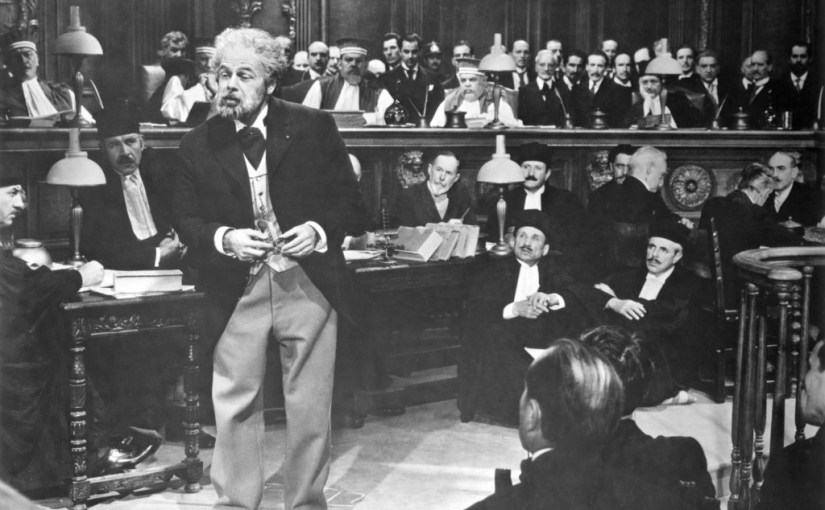
THE LIFE OF EMILE ZOLA (1937)

by Miguel E. Rodriguez

DIRECTOR: William Dieterle
CAST: Paul Muni, Gale Sondergaard, Joseph Schildkraut, Gloria Holden
MY RATING: 9/10
ROTTEN TOMATOMETER: 92% Certified Fresh

PLOT: Prolific novelist and muckraker Emile Zola becomes involved in fighting the injustice of the infamous Dreyfus affair.


If you want to get me angry at the movies, you can do one of two things (besides leaving your phone on): Make a really terrible movie that makes me sorry I’ll never get those two hours back…or make a really good movie about some kind of social injustice, where those in power are so empirically wrong that any fool can see it, except those in power.  Matewan (1987) comes to mind, as do I, Daniel Blake (2016) and Do the Right Thing (1989).  William Dieterle’s The Life of Emile Zola falls neatly into that category, as well.

I’m tempted to give a play-by-play summary, but that would take too long.  In short, novelist and muckraking author Emile Zola is approached by the wife of Alfred Dreyfus, a French officer wrongly convicted of espionage and sentenced to Devil’s Island.  Mme. Dreyfus convinces Zola of her husband’s innocence, and Zola pens the famous J’Accuse…! article, an open letter published in the paper accusing the French military of antisemitism (Dreyfus was Jewish) and conspiracy.  The last act of the film covers Zola’s trial for libel.

The scenes that really made me angry were the ones where French officers planted, suppressed, or burned incriminating evidence of their own treachery.  Outright lies were paraded as fact, and the actual spy was acquitted in a court-martial of his own, just so the French government could continue the façade of Dreyfus’s guilt.  When the comeuppance arrives for the parties involved, it is immensely satisfying.  No one is drawn and quartered, which is what I would have preferred, but it’s good enough.

While the actor playing Dreyfus himself (Joseph Schildkraut) won the Oscar for Best Supporting Actor, it seems incredible to me that Paul Muni did not win for Best Actor that same year.  It went to Spencer Tracy for Captains Courageous, and I’m sure Tracy’s performance was exceptional, but Muni as Zola is pretty amazing.  He ages convincingly with Zola, from starving artist to a well-fed member of respected Parisian society, never less than convincing while playing a man much older than himself for much of the film.  The highlight is a late courtroom monologue that runs about six minutes.  It’s not exactly subtle screenwriting, but Muni makes the most of it.

The same could be said about the film’s screenplay as a whole.  It’s not the kind of story where the two sides have equal validity, so the script doesn’t have to be coy about where its sympathies lie.  There may be a few moments that feel like the film is preaching to the choir, but it nevertheless has great power.  That might just be me, though, given my proclivity for rooting against social injustice at the movies.

On the whole, The Life of Emile Zola is the tale of a life well-lived, punctuated by an incident that made Zola’s name immortal, and contains one of the best courtroom sequences I’ve ever seen.  It’s biography at old Hollywood’s best, not 100% historically accurate (as stated in an opening title card), but capturing the emotional essence of the story in a way no history textbook ever could.

WALTZING WITH BRANDO

By Marc S. Sanders

You think you know someone, but then you learn a whole other side about the person.

I only know Marlon Brando from his achievements in The Godfather, Superman, A Streetcar Named Desire and On The Waterfront.  There’s also his final picture, The Score, with his Vito Corleone counterpart, Robert DeNiro.  I’ve seen him spoofed on Saturday Night Live and know that he’s even poked fun at himself in a film like The Freshman.  He was notoriously and proudly quirky.  I guess Brando was so content to appear odd to everyone else beyond the island of Tahiti, which became his escape to paradise, away from autograph hounds, environmental abuse and Hollywood barbarianism.  Brando simply endured his greatness as one of the most incredible movie actors ever to subsidize how he really wanted to live in utopian isolation.

Billy Zane seamlessly inhabits the persona and physical appearance of Marlon Brando in Waltzing With Brando.  The film presents a slice of the actor’s uncompromised efforts to build an ecological home, and maybe a hotel, on an uninhabited island next to Tahiti.  To bring this idea to fruition, Brando recruits a young, undaring Los Angeles architect named Bernie Judge (Jon Heder) to helm the project.  This will be an undertaking that Bernie could never expect and can hardly circumvent around impossible challenges in the face of proven scientific engineering, chemistry, and physics.  Brando seems to have an answer for everything though.

By breaking the fourth wall to speak to the viewer along with voiceover narration, Heder is charming about his unexpected adventures.  The white-collar shirt and necktie of city life is abandoned for shorts and conch shell necklaces.  Actually, as Brando demonstrates its better and less inhibited to just be nude like the rest of the cheerful islanders.  Despite his reservations, Bernie gets more and more accustomed to Brando’s perceptions but still he has to find ways to be practical to complete this unconscionable project.

Drinking water is needed.  Marlon’s answer is to filter it from his own urine.  Electricity needs to be installed on the island.  Though, is Marlon truly serious when he suggests that energy stem from a power source like electric eels?  Bernie soon learns that there will never be a client as unpredictable as Marlon Brando.  Money is not an obstacle he cares about.  Oscar trophies serve a menial, floor level purpose that is only a little more useful than resting on a mantle.  An upcoming gangster movie is not really his thing.  A paradise devoid of man-made contamination and pesky societal intrusions is where his focus lies.

Watching Bernie Judge struggle with being away from his wife and daughter, while working with islanders to start at the basics like building an airplane landing strip first, I was reminded of The Brutalist, the fictional period piece that centered on building a grand, outrageously expensive structure within a mountaintop.  That film watched its architect wither away into haunting madness.  The Mosquito Coast with Harrison Ford also came to mind.  Thankfully, Waltzing With Brando does not take these directions.  I know nothing about architecture or engineering or practically any kind of science.  Yet, I know that whatever Marlon Brando conjures up seems unheard of and impossible.  Brando’s friend, Bernie Judge, did not allow these considerations to stop him though.  Why shouldn’t we explore our ideal paradise no matter how exuberant it seems? (Mosquitos are also a problem to deal with and Brando frowns on using pesticides.  Hmm. What can be done?)

Still, we have to be realistic.  Richard Dreyfuss plays Brando’s money manager and represents the challenge of making resources obtainable.  Brando has to go back to work.  Judge needs more and more funds for material and labor.  He takes daring personal risks.  Even the banker does.  Utopia is expensive and never merciful. 

Director Bill Fishman wrote and adapted Bernard Judge’s biographical tales of his encounters with Marlon Brando.  His film is lighthearted, hardly stressful in any kind of dramatic weight.  Perhaps that is because Bernie Judge did not respond to Brando’s ideas with frustration like The Brutalist would have you believe.  While I was not entirely fond of the voiceover narration because I did not recognize its necessity, Jon Heder is magnetically likable.  He’s a cheerful friend telling a bedtime story that took place in a small corner of the world.  Most people never explored these crystal waters and white sands traversed only by Marlon Brando and the native islanders.  This is a civilization unaware of the burden of conflict and pressure. 

Billy Zane does not go over the top with his portrayal of Marlon Brando.  The more subtle and aloof he is in each scene, the more convinced and accustomed I became to his peculiarities.  With Fishman’s script, Zane delivers a handful of dynamics to Brando.  Early in the film, Brando tells Judge that his desire is to live in this Tahitian paradise forever.  He knows however that he must continue to make movies to eventually fund this lifestyle permanently.  Later in the film, it is easy to surmise why Brando feels that way.  While filming The Last Tango In Paradise, he is trapped in a phone booth where his fan base recognizes him.  It’s one of the few times when Billy Zane performs on Marlon Brando’s genuine discomfort, and it is terribly unsettling.  It’s awkwardly ironic that the most famous actor in the world is out of his element among a worldwide community of followers and devotees begging for pictures and autographs.

Like Marlon Brando and an eventual Bernie Judge, Waltzing With Brando wants you to leave the theater with a smirk on your face.  An attempt at achieving the impossible with absolute content does not have to be a miserable journey.  An effort to find ways to overcome challenges can deliver lifelong friendships and personal experiences that belong only to you.  Bernie Judge learned this through his friendship with Marlon Brando.

Waltzing With Brando is a thankfully rewarding experience, a brush with perfect happiness.

NOTE: Stay through the end credits because this “Marlon Brando” has a few treats in store for you.

SILKWOOD

By Marc S. Sanders

As the 1980s were setting its stride, Silkwood might have been one of the earliest in a line of films to focus on the union worker who fights back at the billion-dollar corporation.  Some might unfairly regard the movie as The China Syndrome, Part II. Other well-known pictures of this mold are even more familiar to me like Michael Mann’s The Insider.  However, director Mike Nichols, working with a first screenwriting effort from Nora Ephron who partnered with Alice Arlen, showcases the aggravation on not just Karen Silkwood, the real life potential whistleblower, but also her friends and co-workers in a one factory town just outside of Oklahoma City.

Karen (Meryl Streep) lives with her boyfriend Drew (Kurt Russell) and her best friend Dolly (Cher) in a run-down house in the middle of nowhere.  They ride to work together at the local plutonium manufacturing plant where they dress in scrubs and gloves. Punch in, punch out kind of days, and often they are expected to work double shifts and weekends.  Karen works an assembly line where she places her hands in rubber gloves and assembles dangerous combinations of chemicals in an enclosed box.  It’s also routine that before you leave your station you wave your hands over a sensor to ensure you have not been exposed to radiation.  There’s even sensors you walk through as you enter and leave the plant.  When those sensors go off, a calm kind of film seemingly turns into a horror movie.  The last thing anyone could ever want is to get “cooked.”

Karen does not live a perfect life.  Her three kids reside with their uncompromising father in Texas.  Money is not ideal.  Dolly is a slob and has also invited her girlfriend to live with them.  Karen can manage with all of this, but when she observes some unconventional activities around the factory she gets up the nerve to head the union for better protection and working conditions.  However, the further she goes looking at files and photos, jotting down notes of what people say and do, plus taking trips to Washington DC, and getting phone calls from attorneys at night, she becomes more and more isolated from Dolly and Drew, along with the rest of her close-knit workers.  Karen is not just risking her job, but everyone else’s jobs and worse her own life.

The attorneys lay it out to the townsfolk and the union of the horrifying statistics that go along with radiation exposure.  The tiniest fraction of a miniscule of exposure to the smallest crumb of chemicals could increase a human’s bearable limit towards radiation and cancer.  The sad irony is that the more that is learned, the more the people of this area smoke and smoke some more.  Granted, this story takes place in the early 1970s, though.    

The company is primarily represented by an intimidating Bruce McGill.  He’s great in everything he does and is worthy of an Oscar nomination somewhere.  M Emmet Walsh has no lines but his presence is enough to shake you; the slimy guy you easily recognize from every other movie you have seen.  While the company’s overbearing intrusion is shown plenty, the script for Silkwood focuses more on how these working people get by.  They are treated unfairly and in dangerous working conditions, but they also know this is the only place that offers steady income in the area.  Without this factory, the whole town would be left in dire straits.  Karen is repeatedly told or implied to leave well enough alone.

Meryl Streep notches another harrowing performance on her resume and bears such a departure from more sophisticated characters found in Sophie’s Choice and Kramer Vs Kramer.  Karen Silkwood is not educated and she bears an unmistakable white trash dialect but she’s also not stupid and the more progress she makes at exposing the plant’s shortcomings the more unfairly she is treated with department transfers and workplace shake ups that she is indirectly blamed for.  Potential threats on her life begin to build, but she only upholds a bravery.  You really observe the strength of Meryl Streep.  She’s at the top of an elite class of actresses at this time that also included Sally Field, Jessica Lange and Glenn Close.

Cher plays Dolly in her first on screen role.  The variety act performer probably subjected herself to a bigger departure than Streep.  She was not a professionally trained actress at the time.  Mike Nichols insisted on no makeup along with her hair unkept and flat, while dressed in green chino pants and baggy sweatshirts.  The new actress carries herself so well without the usual glitz that accompanies her.  Her scenes with Streep are workshops in acting technique. 

Kurt Russell delivers another understated performance.  One of the best actors out there who has never been enough of a critical darling.  Drew is likable and Kurt Russell plays him as a settled in match for Streep’s portrayal of Karen.  Watch how they tangle up in each other’s arms in bed or when he snaps at her as she carries on her crusade while he’d rather things be left alone.  His timing is perfect for the script.

Mike Nichols keeps his film calm, except when the go by the numbers narrative must be disturbed.  A radiation cleanse with high pressure hoses will make you wince.  The factory alarms will terrify you.  Meryl Streep accepts the physical taxations necessary for this setting.  Nichols gets in close with his camera to show how cleansers dressed in scrubs and masks rub Streep down until her skin is a burning red.  I distinctly remember how her right ear appears in this scene, getting flushed by something just short of a fire hose, and the aftermath of her sitting in a chair is so discomforting while a company doctor assures her that there’s not much to worry about as long she brings in her urine samples daily.  In fact, soon all of the employees are tasked with delivering their urine samples.  What kind of place is this?

While Silkwood is based on a true story with a burning question left behind, I do not want to reveal too much.  Many have seen Silkwood since it was released over forty years ago, but as the third act begins, the fallout only becomes more disturbing and Mike Nichols directs a horrifying sequence built primarily on the pealing of old wallpaper.  That’s all I want to suggest. 

Karen Silkwood was a very unlikely crusader.  She probably never envisioned what she would become and what she would fight for.  Yet, she uncovered horrible truths that should not have been occurring under the eye of billion-dollar corporate America.  After watching Silkwood, I can only imagine what else was there to turn over.

NOTE: Another good reason to watch Silkwood is to discover early performances from some amazing character actors who were either just starting their careers or continuing to hide in the crowd. 

Scavenger hunt for Anthony Heald, James Rebhorn, David Strathairn, Ron Silver, Fred Ward, Diana Scarwid, Bill Cobbs, M Emmet Walsh, Craig T Nelson, Tess Harper, Will Patton, Richard Hamilton and Josef Sommer.

SEPTEMBER 5

By Marc S. Sanders

September 5 is a sweeping account of how breaking news used to be assembled.  You had to be in the right place at the right time.  If you weren’t, then perhaps the sports department of your media conglomerate is, and they will get the story. 

The very first televised terrorist attack was broadcast at a sadly appropriate time.  The 1972 Olympics were being covered by the ABC television network.  For the first time, homes all across the world would be able to watch the games in color, from a satellite feed shared among the big three networks.  ABC had the broadcasting rights to the games though.  The setting is especially interesting to this story.  The Olympics are being hosted by Germany, primarily out of Munich.  This is an opportunity for the country to finally redeem itself, only twenty-seven years after World War II had come to an end and their country’s Nazi regime had been overthrown.  Germany had a lot to make up for.

The Sports Division of ABC news turn over in the wee hours of the morning of September 5.  Geoffrey Mason (John Magaro) slumps into the studio and relieves Roone Arlege (Peter Sarsgaard) following long hours of editing and covering competitions in swimming, volleyball, boxing, track and so on.  There’s minimal staff on shift as the athletes and coaches are asleep for the night, but then Geoffrey and crew believe they hear machine gun fire out of the direction of Olympic Park, and suddenly everyone is awakened and scrambling to put together the story fast. 

No other broadcasts are reporting on this alarming incident.  This is a story that comes at ABC Sports in their own time.  Had this happened today, amid an age of worldwide shrinkage with the existence of the internet, these guys would have been way behind.  In 1972 however, they can rely on Mariane Gebhardt (Leonie Benesch) a female German flunky of the sports division to translate the various radio communications between the terrorists and the German negotiators, and what plans are being put in place.  Nine Israeli athletes have been taken hostage in their hotel rooms with two believed to have already been killed.  The terrorists (believed to be a Palestinian militia group called Black September) demand that Israel release two hundred of their prisoners or they will kill a hostage every hour beginning at noon.

Forgive the cliché terminology, but September 5 is a taut, nail biting, documentary style thriller told only through the perspective of the ABC Sports division.  While the developments of the hostage situation feel urgent, for these unshaven guys in glasses and wrinkled shirts who are operating on little sleep and a lot of coffee, it is about getting the news out quickly and accurately, and just as importantly, first.  Geoffrey and Roone are constantly on the phones trying to learn whatever they can from Peter Jennings, the eventual famed ABC reporter, who is nearby the incident and at times hiding from the German police who are desperately trying to clear the area of the press.  The guys even send in a staff member with a smuggled camera and reels of film taped to his belly while he poses as an Olympic weightlifter.  The Germans forbid the press from trespassing but insist the games carry on.  So, the athletes and coaches are the only ones who can enter the area to prepare for competitions of the day.  Even Howard Cosell happens to be in a hotel staircase nearby and can provide feedback. 

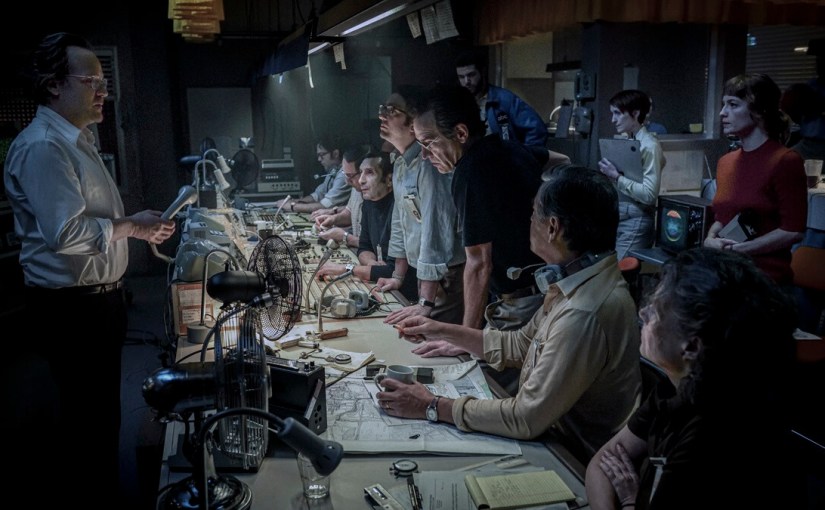
In the news control room, the guys are literally putting walkie talkies next to microphones that broadcast live on air with Jim McKay who is behind the desk, talking to the world.  This is bare bones news broadcasting with unsophisticated technology to aid them in this short window of time.  The director of this film, Tim Fehlbaum, brilliantly captures the desperate inconveniences of reporting this way. 

Roone and Geoffrey also have to contend within their own ranks.  This is not a sports story.  This is a news story and so Roone must insist on keeping the story.  They are the only ones there.  How much more effective would a news division located on the other side of the world fare?  Therefore, Roone’s team are the only ones qualified to cover this developing story.  ABC News will not have access to this. 

Roone also has to improvise how the satellite feed is shared with their competitor, CBS Sports.  It’s a pain in the ass inconvenience and yet the resourcefulness and quick thinking of the control room staff find a way to uphold their claim on this story.

While watching this account, it matters little if we know the outcome of the September 5, 1972, Munich attack.  This film’s purpose is covering how the first few who knew about the situation responded. By the time the ninety-five-minute film is over a lot has been shared.  Tim Fehlbaum, with an Oscar nominated screenplay written by him along with Moritz Binder cover quite a bit.  The pace moves as fast as these people in the control had to move on that terrible day.  So, the information comes quick.  With real life archived ABC footage spliced within the film, you feel as if you are standing in the corner of this dark room with various tv screens, microphones, and telephones. 

You watch John Magaro feed information to Jim McKay, and then the picture cuts to real life footage of McKay at the desk.  It’s quite inventive how the script is accommodated to work in line with what Jennings, Cosell, McKay and others literally said as the crisis was being reported.

Having seen all ten Best Picture nominees for 2024, it is disappointing that September 5 did not make the cut.  Tim Fehlbaum’s picture certainly deserves more recognition and a slot over other contenders this year.  Still, the screenplay is a well-deserved accolade.  To interweave a fresh script that hinges on what was literally said on television screens around the world at that time is a marvelous strategy. 

September 5 is a crackling thriller of a terribly sad day.

NICKEL BOYS

By Marc S. Sanders

Colson Whitehead’s Pulitzer Prize winning novel, Nickel Boys, is now an Oscar nominated film for Best Picture and Best Screenplay. It is based on a true story that needed the exposure of a film.  However, a better adaptation than what director RaMell Moss did with it should have been completed. 

The Nickel School of Southern Georgia is the setting for a boys school where various forms of abuse took place during the civil rights era.  Apollo 8 was making new discoveries in space, but racial prejudice and crimes of adolescent abuse were not being revealed to a greater public.

Elwood (Ethan Herisse) is a bright student who has been accepted to a prestigious school for gifted learning.  Upon walking to his destination, on the outskirts of Atlanta, Elwood inadvertently gets blamed for a crime he did not commit and is sent to the Nickel Reform School.  The black students are relegated “to the other side of the nickel” in less favorable quarters than the white students. 

At the school, Elwood develops a friendship with Turner (Brandon Wilson) and together they do their best to survive the harsh challenges that go with living at Nickel.  Elwood remains positive that he will be able to leave the school one day and return to his loving grandmother Hattie (Aunjanue Ellis-Taylor).  Turner knows differently.  These boys are never leaving, and they will be compelled to obey the harsh tyranny of living at the school.

What helped me get through the near two and a half hour running time is that sadly this is an all too familiar story, especially for black youth.  The challenge though is the construction of the film.  RaMell Moss takes an unconventional approach where the viewer is the point of view of the two boys.  For about the first third of the picture, we are seeing what Elwood sees.  When he nods his head to the floor, the viewer sees the floor.  When he looks up to the sky, we look to the sky above him.  When he is listening or speaking to another person, like Turner or Hattie for example, that’s who we see.  The viewer is restricted to a forced tunnel vision of only what Elwood’s eyes focus on.  Frankly, as soon as the film began, I said to myself, “Oy.  Two and a half hours of this!”

Shortly after Elwood arrives at Nickel and sits down for breakfast, the perspective finally changes to Turner when the boys meet for the first time.  Now we get to see what Elwood looks like because we are looking through the eyes of Turner.  At this point, I told myself to either fall asleep, walk out or get accustomed to this different way of watching a movie.  I selected option number three and I’m glad I did because I started to become engrossed in the picture.  It’s compelling and absorbing. Granted I was still unsure of what this story was about as the film keeps the viewer very limited as to what is seen and told.  Arbitrary moments are shown through the eyes of the boys that do not necessarily progress the story.  These adolescent boys are not directly tormented as much as they are simply living in a captivity they do not fully understand.

A third person perspective is eventually put upon us.  We are watching the film at a different time, during an internet age, as we see a black man with dreadlock hair surfing the internet and pulling up articles about the Nickel Boys School that once existed.  I had an idea of who I was standing behind as he spoke with his girlfriend, but still I was not entirely sure, and other than an attempt at inventiveness, it puzzled me why the film veers occasionally into this direction.

Nickel Boys has an eye-opening story to tell but the experimental narrative of this picture does not entirely work.  It’s more frustrating than admirable.  RaMell Moss works with a very good cast of young actors who are focused on upholding the first-person perspective.  They are speaking the language of his camera.  Nevertheless, that doesn’t mean as a viewer that I like it.  These young actors deserve a more conventional means of telling this story.  I am confident they can handle that kind of direction just as well.

Nickel Boys ends with a mild twist.  While it might not have seemed necessary, and with Moss’ unusual approach I was not even sure what happened, it’s interesting for at least a beat.  However, to be sure I understood what occurred I turned to my resident Cinemaniac, Thomas Pahl, for assurance that I was accurate in what I think happened. 

I also took issue with RaMell Moss breaking his own rule of filmmaking.  The film limits itself to three different kinds of perspectives: a first-person view from either Elwood or Turner, and a third person sight from a character we meet in a more modern time.  Yet, for one concluding and significant moment that occurs near the end of this story, Moss changes his camera angle for a standard conventional approach.  Why do this?  Was Moss finally at the end of his rope and could not fathom how to demonstrate the story’s end unless he broke away from his own unique approach?  For me this shows the filmmaker could not stay consistent all the way through with the final cut of his picture.

Forgive the presumption, but I recall the Academy considering nominating films only if there is a minority representation contained somewhere within the finished edit.  I’m uncertain if that remains an unspoken rule or if it is set in stone.  Honestly, I think it’s simply considered with a lack of justified merit. 

I do not find Nickel Boys to be worthy of the best of 2024.  A handful of films that were not as recognized did not get the accolades this film received.  Is the picture being honored because it depicted a black experience?  I cannot help but wonder.  It is not a terrible film because there are parallel ideas happening alongside the main storyline and the cast is especially good.  Real life tragic stories are especially appealing to The Academy.  The direction of the piece takes away from much of the benefits of the film though. 

Garner up your patience with the limited view you will have watching Nickel Boys.  I also say this without sarcasm, maybe take a Dramamine.  When watching a production in a first-person narrative, often people are prone to motion sickness.  Surprisingly, it did not happen for me this time.  It should have because I cannot play updated video games that rely on this angle.  Yet, a friend had a different experience with Nickel Boys, and he said it took all his strength not to get up and exit the film.

I’M STILL HERE (BRAZIL)

By Marc S. Sanders

Biographies of terrible truths are fascinating.  Haunting, yet fascinating that circumstances ever got as far as they did when unfairness, immorality and unspeakable tragedy occurs.  Walter Salles’ Brazilian film I’m Still Here recounts the abduction of Reubens Paiva in 1970 when Rio Di Janeiro was under the control of a militaristic dictatorship.  This is a moment in world history that I am completely unfamiliar with, and so I wished that Salles’ movie provided more backstory to paint a clearer picture.

Reubens Paiva (Selton Mello) is a father of four girls and a boy.  Despite a happy marriage to Eunice (Fernanda Torres) and a comfortable life across the street from the coast, the government stronghold of the island looms with planes flying overhead and check point searches at intersections.  Other than this dark overrule, life goes on for the Paiva family as they plan to build a new home, send their eldest off to London for college, and swim daily in the ocean blue.  Ice cream outings are also a treat.

Then Reubens is requested to go with a military escort.  He gets dressed in a jacket and tie and calmly leaves the home.  Eunice is also taken and placed in a dirty cell for days while being put towards intense questioning.  Their daughter, Verona (Valentina Herszage), is stopped at a checkpoint and searched while out with friends.  No explanations come their way for these encounters.  

Following a few weeks in captivity, Eunice is released back to her home.  Reubens is nowhere to be found and assumed to still be held prisoner.  The couple were friends with people much like them who apparently spoke out against the regime.  It is likely Reubens was taken due to his writings and vocal protests as a former Congressman.  It’s also concerning that foreign diplomats are rumored to be kidnapped as well.  There’s definitely an uneasy feeling happening. Now Eunice’s dilemma is to try keeping her children calm and sheltered from news of this arbitrary situation, including her worst fears about her missing husband.  

I’m Still Here is certainly an important story that needs to be told and was more than ready for the big screen.  I’m sorry to say though that Walter Salles’ picture is terribly boring.  Once the captivity sequence is over, Salles relies often on Eunice silently wondering what has become of her spouse.  Colleagues visit with rumblings of what they have heard and in between there is a lot of gazing at photographs and newspaper articles.  It’s challenging to embrace a character looking at documents and pictures over and over with no progress being introduced to the story.

There are moments of paranoia as Eunice observes people watching her and the family from across the street.  Tragedy befalls a loving pet as well.  Yet, I never felt the tension that I’m sure resided with this woman from one day to the next.  Eventually, the film takes two different leaps in time and an older Eunice is now played by Fernanda Montenegro (Fernanda Torres’ real life mother). 

I’m Still Here is very slow moving. I couldn’t help but feel lost with most of this story and it’s not until the second and final epilogue arrives that a televised newscast offers more clarity to what likely happened.  I was glad I walked away with a better understanding, but it does not make up for how lost I was during the first two thirds of the picture.  

I still do not understand how the military coup came into power. A prologue might have helped enhance the threat the family had to face.  I was never clear on what precisely Reubens stood for against this stronghold regime.  What was his platform?  What bothered him specifically?  Anyone could tell me it should be obvious, but again I know nothing about this story that arguably is not shared in schools and is hardly a current event.  Granted, Brazilians likely have a clearer idea.

Without enough knowledge, I’m Still Here is uninteresting.   Viewing characters staring at old photos is not stimulating enough on its own and I’m sure Eunice Paiva was at least a little more aggressive than Fernanda Torres’ performance implies.  I read that Eunice never cried in front of her children and that is demonstrated in Salles’ film.  So, I have to presume this real-life woman, who eventually earned a law degree she used to fight for human rights, would have been much more aggressive than what is on display in this movie.

I can only recommend watching I’m Still Here as another example of tragic unfairness towards human rights.  

Learn about the Paiva family.  However, instead of watching this film, it might be better to rely on the book it’s based on, written by Eunice and Reubens’ son Marcos Rubens Paiva.  I’d expect it to be much more insightful.

THE APPRENTICE

By Marc S. Sanders

No.  This is not a reality show.  This film feels much more authentic than the “reality” of a reality show.

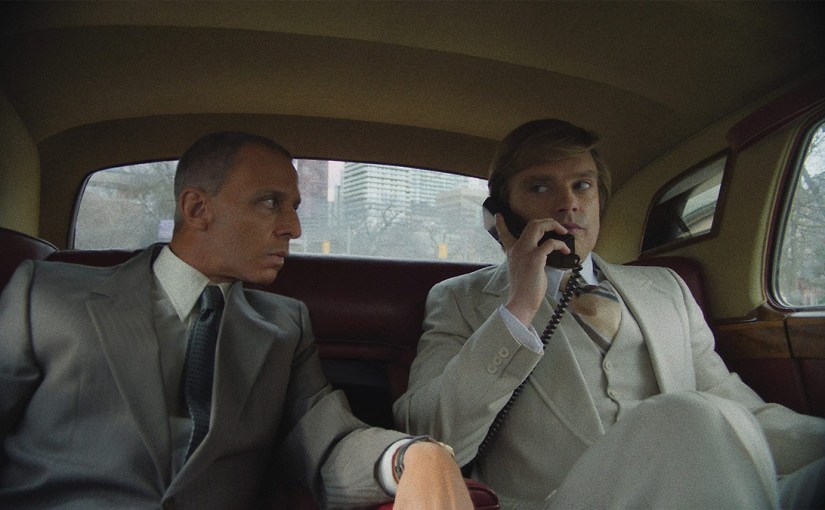
Ali Abassi is the director making broad strokes that cover the early career of one Donald J Trump (Sebastian Stan).  By the time I was finished with the picture, I gathered that Abassi was depicting how one monster created his own monster, and then that creation destroyed the original creator.  This might as well be the story of Darth Plagieus The Wise.  Watch a Star Wars movie for a change, would ya?

The original creator is the infamously corrupt attorney Roy Cohn (Jeremy Strong) who proudly knows how to dodge one indictment after another  while standing on the precipice of his historic conniving.  In a private New York City club one night in the early 1970s, Mr. Cohn will lock eyes with Mr. Trump across a crowded room.  Cohn will mentor this kid about the three rules of business which include denials when necessary and never admitting you’re wrong.  

Trump works for his uncompromising father Fred (Martin Donovan, bearing a striking resemblance to the real person, complete with the bushy mustache, bushy hair, and towering height).  The family is in the business of real estate while fighting accusations of forcing out lower class minorities from their run-down tenement buildings.  Donald is not even fearful of knocking door to door with late rent notices and threats of evictions.  Still, he knows they are up against a wall and if there’s anyone who can exonerate him and his father it is Roy Cohn.  Yet, Roy does not weaponize with legal research and law jargon to uphold a defense.  Instead, he digs up dirt on those figures that are in the way.  To keep skeletons from going public will mean a drop of the case. Thus, Donald has received his first lesson in cutthroat business operations.

From there, Trump gets the impression that with Roy there’s no limit on what can be achieved.  New York City is slum area, but Trump knows he can revitalize the streets with his invested infrastructures, beginning with Trump Tower on 5th Avenue.  It’s time to pressure Ed Koch for tax breaks even if there’s no justification.  If Ed doesn’t want to cooperate, it is to the press Donald J goes with how he truly feels about the Big Apple’s Mayor.

As the fast tracker gets more and more visionary, so does the recognition of a guy who…well may be crazy enough to become a game show host or even President of the United States.

Much of The Apprentice seems legitimate based on the very public image of Donald Trump.  The common gestures like the thumb and index finger held together to drive home a point or the repetitive adjectives that construct much of the man’s vernacular (“…tremendous, tremendous…”).  The junk food eating is covered.  Trump’s hyperactive ranting and slamming of those in his way work towards his drive along with his disregard for not honoring loan payments.  The growth of his empire in casinos and resorts break ground too.  None of this is slander.  The news showed how it happened.

Private moments are where skepticism could be merited.  The prenuptial agreement that Cohn drafts, and a supposed forcible rape on his first wife Ivana (Maria Baklova) by Trump are given attention.  The disdain he has for his alcoholic older brother reveal the workings of a family life never based on love, and only on platforms of business and prestige.  His sneaky approach to get his senile father to sign documents may or may not have happened.  I dunno. When his mother found out about it, she threw him out of the house. Perhaps? Doesn’t sound so farfetched.

Trump’s obsession with his appearance is also given attention.  A constant habit with fixing his hair is redundantly shown. I believe it. If he was not obsessed with his hair, he wouldn’t look like he does, and that haircut begs for some proper attention. If he’s not going to eat right and exercise, then his doctor will conduct surgery to preserve his youth, and a hair transplant will be completed to conceal a bald spot.  Apparently, Trump took diet pills as a means to offset his terrible nutrition. Doc insists they are amphetamines that his patient has to stop using, but for a guy like Donald Trump, he has to keep going and going. No time to sleep when there are worlds to conquer and beach front property to build upon. I don’t suppose any of these private activities away from the paparazzi can be validated with tangible proof beyond heresy. Nevertheless, again as the world knows Donald Trump today and for the last forty years, what is offered in Ali Abbasi’s account, with a screenplay by Gabriel Sherman, seems consistent from what the public sees regularly. Don’t get me started on the board game my dad got me for Hanukkah in the early 1990s, or the fact that Trump eats a filet mignon with ketchup.

As Trump goes up the scale, Cohn is quickly descending and the man who gave the kid access to everything is disregarded during the age of AIDS spreading in the early 1980s when Reagan seemed to inspire the use of disposable income for many middle-class yuppies.  Cohn is a victim of these prosperous, yet unexpected times. Being a closeted homosexual and contracting AIDS did not suit the cloth of this shark. Also, the mounting charges against the lawyer for his unseemly practices eventually caught up to him. Couldn’t have happened to a better guy, quite frankly.

Jeremy Strong is known for his literal method acting and he personifies Roy Cohn, the guy with chutzpah not just found in him but in everyone he associates with including criminal mob bosses.  This is a very powerful guy that no one should underestimate.  The only thing that could kill him is if Donald gets out control…along with Roy surrendering to the residual effects of a secret gay sex life in the early 80s.

This is not so much a polarizing film based on red and blue politics.  Donald Trump actually functions like the one depicted in The Apprentice.  Sebastian Stan wisely steers away from a Saturday Night Live impersonation.  You don’t hear Trump’s voice but with talented hair and makeup artists, you recognize the delivery of dialogue.  It changes from a polite young man who wants to be the emperor he sees in his father, only not as conservative and a lot more aggressive.  Later, with the help of an overly confident ego accompanied with a loud and brash mouth, do you see the person most of us are familiar with. 

The Apprentice has a documentary style narrative with Abbasi’s reliance on hand held cameras.  The grainy photography of the 1970s Nixon years enhance the crime and disruptive unsettling Northeastern America.  Donald Trump, in his beige linen suits and ties, does not fit in this environment.  There isn’t an authority to him yet. He looks too liberal actually. In the 1980s, with much accumulated for the mogul, the graininess changes to look like footage played back on a VCR.  Trump has the tuxedos and overcoats that do not hide his belly well enough.  The navy suit and red tie surface for the first time and his surroundings are often decorated in gaudy layers of gold.  The royalty he’s placed himself in is here to stay.  Roy Cohn used to go all out with his parties and sex orgy binges, but never like this.  This new Donald J Trump is so overinflated that even the great Roy Cohn is drowned out of existence.

Ali Abbasi allows some winks and nods at what we know will become of Donald Trump.  Name drops of other bigger than life businessmen enter the scenes and you nod your head when you see guys like Rupert Murdoch or Roger Stone arrive.  Trump’s brand has always been defined by the power pawns he associates with.

A side story glosses over Donald’s relationship with Ivanna.  I know why it has to be here.  It’s played well by Maria Baklova and Sebastian Stan.  Though in comparison to Donald’s relationships with his father and brother, plus Roy Cohn, the marriage storyline does not carry the same kind of weight.  Much of the material seems conjured up here and not as genuine.  Maybe that is because the general public has never seen how the husband and wife truly treated each behind closed doors.

The Apprentice declares that there are portions of the film that are fictionalized for dramatic effect.  Yet aren’t most biographies?  Sebastian Stan seems to have a lock on his portrayal.  If he judged his character at all, he lent credence to how the real man is satisfied with how he carries himself.  I don’t know how the actor sides politically or how he particularly feels about Donald Trump, but Stan grew a respect for the figure.  He doesn’t make the guy look like a buffoon.  This Trump is passionate about every new project he pursues and just as equally he’s focused on pushing obstacles and enemies out of his way. If he doesn’t push, then he steps on them. It doesn’t matter if it is his wife, his brother, his father, his mother or the one that got him everything he needed, his good friend Roy. Even a once respected mentor can become a casualty in the pursuit of greatness.

I can’t say how any one person might respond to The Apprentice.  A Trump follower, or even Donald J Trump himself, may feel very flattered by this reenactment and how the guy got to the top of his gold pyramid.  Others will be offended and exhausted over even more exposure of the largest ego the world has encountered.  Either way, I attribute my compliments for the outstanding pairing of Sebastian Stan and Jeremy Strong.  A partnership is at the center of this piece, and now we bear witness to how the connection between these two characters moved along, and then eventually very far away from each other.

CAPTAIN PHILLIPS

By Marc S. Sanders

“You had thirty thousand dollars, and a way to Somalia. It wasn’t enough?”

– Captain Richard Phillips

Paul Greengrass is a director with a documentary style technique.  Look no further than his salute to the hero hostages of United flight 93 on 9/11.  United 93 depicted an ordinary Tuesday of people going about their business on commercial airlines and in working in radio towers. Eventually, it was nothing but ordinary.  Greengrass reminded us of the day the world permanently changed.  He applied the same technique to his film Captain Phillips when a commercial cargo ship was hijacked by Somali pirates looking for a large amount of American dollars to bring back to their tribes. 

Tom Hanks is Captain Rich Phillips, an Irish American Naval captain residing in Vermont.  When the film starts, the captain is packing up one last bag and signing off his computer.  The screen shows a trajectory course that he will command the American cargo ship Maersk Alabama around the horn of Africa and make do on his delivery of hundreds of corporate cargo containers.  Though he’s well aware, he is given official warnings to be mindful of Somali pirates in the area.  When he rides with his wife (Catherine Keener) to the airport though, it is not international threats that concern him.  Rather it is whether their son is going to start taking his life seriously with grades and aspirations.  Whatever Captain Phillips does faces professionally is simply routine.  No matter how dangerous, it’s his family back home that concerns him most.

Even in this opening throw away scene, Greengrass looks like he’s shooting reality TV with a cameraman placed in the back seat of the characters’ SUV, getting shaky side shots of the husband and wife taking a drive to the airport.  The handheld technique will carry over the course of the film and sometimes it will relax itself when caution is of utmost importance.  Other times, it will emote frenzied chaos when desperation and time have overloaded the senses.

The film allows time for the Somali pirates led by an unknown, but eventual Oscar nominated actor named Barkhad Abdi to assemble a group of four to lead a charge into the deep waters seeking out a target to hijack and pillage.  They are armed with machine guns and foolish gusto, which will be hard to negotiate.  After one day’s failure, the pirates manage to overtake the ship and then Captain Phillips must subvert the pirates away from the majority of his crew hidden within the confines of the large engine room of the ship. 

As the second half of the film takes over, it becomes a claustrophobic encounter aboard a small lifeboat.  The pirates have taken Phillips as their hostage along with thirty thousand dollars in cash and their plan is to return to the shores of their country and negotiate with the United States for the Captain’s release.

With no navigation for the pirates to follow, the Navy intercepts the lifeboat with a battleship and an aircraft carrier in nearby waters. Now it becomes a strategic plan for Phillips to stay alive while the armed services try to peacefully end this conflict with no harm to the hostage.

The length of Captain Phillips is close to two and a half hours and you realize it because that is the point.  The main subject at the heart of this true story was held in this tiny boat with limited vision of what was occurring outside, fighting rough seas while constantly being berated in a foreign language by his captors.   It’s also never easy for any authority to negotiate with powers that are operating with dizzying confusion and helplessness.  The only advantage these pirates have is to hold on to their prized captive.  There is nowhere to run, or swim, or much less spread out in this tiny ocean vehicle that lacks any kind maritime direction or security.  Paul Greengrass makes sure you know this as he often points his camera upwards from tiny crevices on the floor, lining up at the pirate players along with Barkhad Abdi and Tom Hanks.  Sometimes a cameraman must have been standing and pointing a handheld down at Hanks watching his captors while he tries compute his next move.  Within these cramped quarters, you can smell the body odor and feel the desperate need for a shower, a drink of water or a morsel of food as these people remain contained within this floating box.

Elsewhere, I’m especially impressed with how Paul Greengrass observes the routines of the Navy and US Seals who are doing their best to end this situation.  The Seals, who are also sharpshooters, covertly parachute on to the nearby aircraft carrier, gear up and position themselves.  It’s so routine even though I know they are being especially careful.  Some tactics for easy movie narration are likely adopted here.  The commander makes clear that they need green targets, not red.  I’m sure it is more complex than that. How these military men speak and carry stoic expressions like it is another day at the office works in converse to the chaos occurring in the tiny boat that everyone has their eyes set upon.  Yet, Greengrass’ documentarian strategy remains consistent in both environments.  You are getting a “You Are There” experience to uphold the film’s authenticity.

Tom Hanks is great and easy to rely on as usual.  However, his performance does not seem so impressive until you finally witness his sensible and alert demeanor deteriorate and crumble to pieces.  You might know the ending to this heart pounding story, but I won’t spoil it here. A final scene bears the right side of an equal sign to all the hysteria you watched add up before. Tom Hanks’ penchant for improvisation is what strengthens the epilogue of the film, following a harrowing climax.  It might just be his best scene ever on film.  Knowing his celebrated career, I gave that declaration quite a bit of thought.

Captain Phillips is a taut, sensational thriller where common sense cannot easily win against irrational thinking. Still, that is exactly what took place. You involuntarily hold your breath until the film suddenly goes quiet, the director’s camera stops in place, and a sharp order is given.  Only then do you finally exhale and slowly sit back in your seat.  Paul Greengrass is a master at timing out the tension.

A BEAUTIFUL MIND

By Marc S. Sanders

The genius was always easier than living with the monsters in his mind.  So was the dilemma that consistently plagued Nobel Prize winning Professor John Nash.

Ahead of seeing A Beautiful Mind for the first time, what you don’t know about Professor Nash is what will dazzle you the most when Ron Howard uncovers the mysteries he lived with during graduate school and on through his fellowship at MIT and with his enduring and loving marriage to his wife Alicia (Jennifer Connelly in an Oscar winning role).  John Nash is masterfully portrayed by Russell Crowe in a celebrated, nominated performance.

Dr. Nash comes off like a genius savant when Howard’s film introduces him in 1947 at Princeton University.  The director adopts a technique of presenting much of Nash’s depths and highlighting patterns and numbers in magazines or on chalk boards or even within the reflections that appear before his eyes in bright sunlight.  On a clear night, see if you can find an umbrella within a starry sky. 

For many of us, I presume it’s hard to decipher what it means to live the life of a mathematical genius. Ron Howard with Akiva Goldsmith’s hailed adapted screenplay does not expect anyone to comprehend formulas or equations.  The filmmakers simply ask you to witness how discovery is processed.  Nash writes endlessly on his dorm room windows.  He fills up every inch of the chalk boards at his disposal.  He tears apart articles in magazines and wallpapers his room and office with them.  Even when he is not writing, he is computing how situations will end up best towards his and his peers’ advantage. There’s one curvaceous, blond woman standing in the center of a bar for one of the men to hopefully have a tryst with, but then who will be left to pair with the dark-haired ladies that surround her?  Nash finds the logic in all of the men abandoning the blond.  The genius realizes what none of us can see.  Go for what no one would ever expect to have occurred.

Despite the professor’s odd ticks, unwelcome vernacular and his lack of social skills, a well-established livelihood works out for him.  He falls in love with a former student that he marries, Alicia, and he obtains a fellowship for himself and two Princeton comrades to practice out their theories at MIT.  Personal companionship arrives with his former roommate, Charles (an energetic Paul Bettany), and his niece.  On the other hand, John has also been recruited to become a code decipherer for the government and he must answer to a mysterious gentleman named Parcher (Ed Harris) who is using John to stay a step ahead of the Soviets.   John’s work must remain top secret and as his clandestine activities become more threatening and intense, so does the paranoia get increasingly overwhelming.

I’ve only covered the first act of A Beautiful Mind because when the truth of John Nash’s purpose and how he is regarded is revealed, this biography becomes something much further from how it began.  Akiva Goldsmith’s trickery in his script is capable of surprising an audience when some veils are lifted for both the primary subject of this piece and those who come in and out of John Nash’s life.  This is a true story but it’s incredibly surprising that a mathematical wizard like John Nash could be living a whole other life that makes little sense at first.

Ron Howard is doing some fine work here reaching for material that might feel familiar with other cinematic geniuses in film ranging from the fictional Will Hunting to more recently real-life figures like Mark Zuckerberg. Characters like these stand out for their quirkiness and oddities.  With Russell Crowe’s brilliant characterization of awkwardness in his uneven walk and how he carries his papers and briefcase, it is not hard to adapt to the man on film.  What he says and how he speaks would leave any one of us to roll our eyes at his behavior.  You’d likely chortle at John just as his Princeton classmates do.  Later though, you understand how valuable his accomplishments are to a greater good, and at the same time you become alarmed at how Dr. Nash is being used both from his own perspective as well as by those figures who unexpectedly enter his life and will not just leave.

Jennifer Connelly’s role does not amount to much at first.  With her alluring looks that have graced other films in her earlier career, she initially comes off as a token spouse to the main character and you remind the person sitting next to you that is actress Jennifer Connelly who got her start in Labyrinth with David Bowie, and Once Upon A Time In America with Robert DeNiro.  Yet, as more dynamics are revealed about her husband does the character Alicia show through, and she has no choice but to survive with her spouse’s torment.  Connelly has a scene that will crush you when she must unleash her frustrations in the middle of the night as well as sporadically throughout the film. She has to be carefully observant of her husband’s behavior for the safety of their child and herself.  Ron Howard sets up scenes that haunt Alicia only, and his wide camera work is absolutely eye opening as it lends to her personal performance.

It’s fascinating to observe John Nash’s willpower as he persists to live with personal demons while upholding the demands of his genius.  This film works on so many levels of enhanced editing and perspective, but without unforgettable work from Russell Crowe, Jennifer Connelly, and a supporting cast of character actors like Christopher Plummer, Josh Charles, Judd Hirsh, Ed Harris and Paul Bettany it could not sustain its staying power. 

A Beautiful Mind is a thoroughly effective biography.