THE GUNS OF NAVARONE (United Kingdom, 1961)

by Miguel E. Rodriguez

DIRECTOR: J. Lee Thompson
CAST: Gregory Peck, David Niven, Anthony Quinn, Anthony Quayle, Irene Papas, Richard Harris
MY RATING: 8/10
ROTTEN TOMATOMETER: 92% Fresh

PLOT: A team of Allied saboteurs is assigned an impossible mission: infiltrate an impregnable Nazi-held Greek island and destroy two enormous long-range field guns preventing the rescue of 2,000 trapped British soldiers.


The Guns of Navarone is a “message” picture cleverly disguised as a World War II action-adventure/thriller.  No surprise there since the screenwriter was Carl Foreman, who also co-wrote 1957’s The Bridge on the River Kwai, another stirring wartime adventure with a strong anti-war message buried inside.  I found it interesting that, in the multiple behind-the-scenes documentaries on the Blu-ray, not one of them mentioned the one movie which I feel most resembles The Guns of Navarone: 1967’s The Dirty Dozen.  In both films, teams of men mount insurmountable odds to accomplish an insanely difficult mission, incurring casualties while ultimately succeeding.  In both films, there is a buried, or not-so-buried, subtext about the futility of the mission and/or war in general, while still gluing audiences to their seats.  However, given the timeframe of the release of The Guns of Navarone in the early 1960s, I find it to be the more surprising of the two, despite the foregone conclusion of the movie.

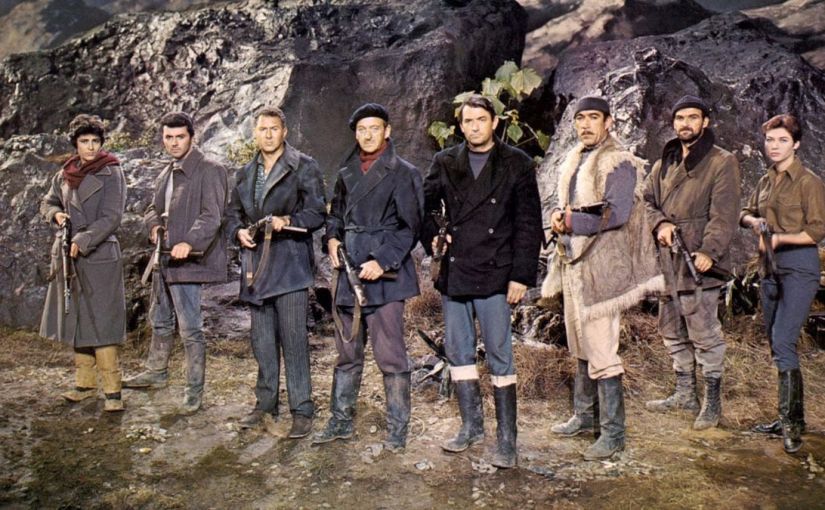
The movie’s narrated prologue tells us everything we need to know.  (Forget for a moment that there is not, and never was, a Greek island called Navarone.)  In 1943, two thousand British soldiers marooned on the island of Kheros must be evacuated before Germany convinces Turkey to join the Axis.  But the only sea lane to Kheros is defended by two massive German guns built into the sheer cliffs of the island of Navarone.  The guns must be knocked out of commission by a team of Allied saboteurs before any rescue attempts can be made.  This team will be led by Captain Mallory (Gregory Peck), Corporal Miller (David Niven), Colonel Stavros (Anthony Quinn), and Major Franklin (Anthony Quayle).  Along with the rest of the team, they must sneak on to Navarone, scale a steep cliff at night, and sneak across the island to the guns, hooking up with Greek resistance fighters along the way.  These details are laid out with admirable brevity, during which we are given just enough information about each of the three primary characters to understand their actions once the mission is underway.

The Guns of Navarone may be constructed almost entirely out of war movie cliches regarding desperate men behind enemy lines on a secret mission, staying undercover, close calls, and unexpected setbacks.  However, I enjoyed how much Navarone sort of “leans into” the material.  It’s almost as if the filmmakers said, “Okay, so this is a cliché, right?  We might as well embrace it and do it up right.”  For example, we find out that one of the squad commanders has a nickname: “Lucky.”  In the history of movies, any character in a war picture named “Lucky” has been anything but.  You know this, I know this.  Even so, as events transpired, I found myself thinking less and less about the most cliched material and just admiring how it was executed.  It’s a tribute to the director, J. Lee Thompson, that he found a way to present everything in such an uncomplicated fashion that its very directness pushes aside our suspension of disbelief.

That’s not to say there aren’t a couple of surprises.  Capt. Mallory devises an ingenious method of dealing with a man so injured he may have to be left behind.  A clandestine trip to a local doctor turns into something quite different, offering Anthony Quinn the opportunity to perform some amazing off-the-cuff histrionics that would make Nicolas Cage envious.  The Greek resistance fighters turn out to be two women who offer much more to the story than mere eye candy or comforting shoulders.  (One of them, played by the great Irene Papas, may even be the strongest member of the squad…discuss.)  David Niven’s character, Corporal Miller, is given two remarkable speeches that would have stopped a lesser film in its tracks, considering their anti-war and possibly even anarchic sentiments, including this exchange:

Mallory: And if Turkey comes into the war on the wrong side?
Miller: So what!  Let the whole bloody world come in and blow itself to pieces.  That’s what it deserves.
Mallory: And what about the 2,000 men on Kheros!
Miller: I don’t know the men on Kheros, but I do know the men on Navarone!

Was that kind of dialogue or sentiment even possible in a war movie made in the ‘50s?  (Aside from The Bridge on the River Kwai, of course.)  A war movie made in 1961, just fifteen years after The Greatest Generation rallied to defeat the worst dictator in history, and one of the main characters seems to be advocating desertion in order to survive the night?  Wow.

In my eagerness to describe how, I guess, subversive The Guns of Navarone is, I have yet to mention the action.  It’s top-notch.  Find it in your heart to forget how some of the effects are clearly matte paintings and models and miniatures and remember that this was top-of-the-line production values in 1961.  In fact, Navarone won the Oscar for Best Visual Effects that year.  There’s an impressive shipwreck sequence, attacks from dive-bombing airplanes, massive formations of tanks and troops (provided by the Greek monarchy), and the titular guns themselves, full-size props that dwarfed the actors and belched real fire when activated.  No expense was spared to provide audiences with true spectacle.

Is The Guns of Navarone perfect?  I mean, I personally could have done without the sequence where one of the soldiers sings along at a local wedding.  The story itself is ageless, but the film doesn’t quite feel timeless, despite its anachronistic tendency towards liberalism in the middle of a war zone.  There are one or two story decisions that I found questionable.  (One character’s death looked as if he was basically committing suicide, and I found no reason for it story-wise.)  But there’s no denying it’s a thumping good yarn.  And come on, who doesn’t enjoy watching Gregory Peck and Anthony Quinn tear up the screen for two-and-a-half hours?
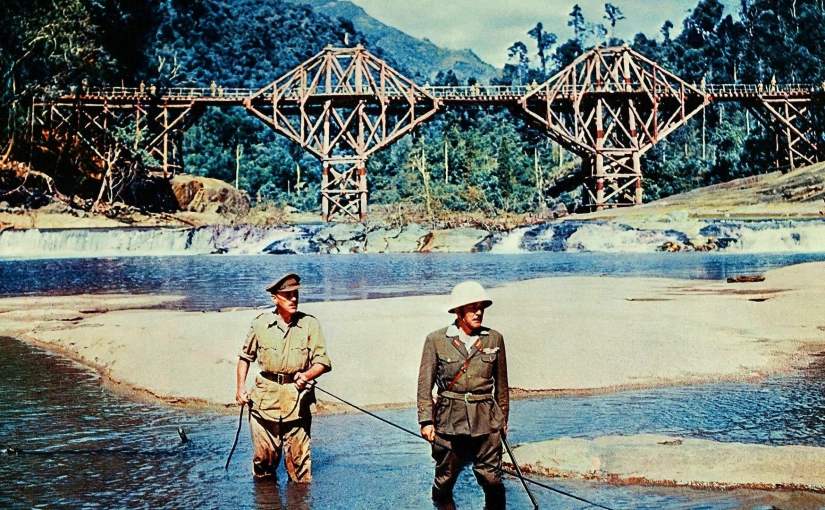
THE BRIDGE ON THE RIVER KWAI

By Marc S. Sanders

David Lean’s The Bridge On The River Kwai commits to a common theme.  The purpose of war means nothing to the pawns assigned to execute its actions.

The film primarily takes place in Japanese occupied Burma during World War II.  A prison has just acquired a British platoon of soldiers, and the Japanese have mandated this squad to construct a railway bridge that will run over the Kwai river benefiting the Axis efforts in the war.  Colonel Nicholson (Alec Guinness, in a celebrated early career role) respects the rules of war that come with his battalion being held as prisoners of the Japanese enemy, and he is prepared to have his men begin construction.  However, as his copy of the Geneva Convention Agreement dictates, his officers are not obliged to join in the assignment.  

This is a far off deserted jungle however, that does not even need to be fenced off because an attempted trek to escape is bound to fail.  Therefore, the Geneva Convention Agreement has no value of authority out here in this bug infested, stilted and sweltering heat with minimal resources of food, clothing or medicine.  The Japanese commander Colonel Saito (Sessue Hayakawa) does not hesitate to swat Nicholson’s copy in the Englishman’s face.  Now, since the politics of war are no longer a factor, the stamina of these two men are what’s at stake.

Saito forces Nicholson into a cramped, isolated hot box with next to no food or water.  He’s lucky because his remaining officers are forced to share the other box together.  Saito will force them to comply, or he may just have to kill himself.

The Bridge On The River Kwai explores how productivity, leadership and endurance thrive, but at a startling cost of madness.  Before you realize it, none of these characters are speaking of their respective war efforts or even the mandates of war.  As Nicholson persists in his stance as a defiant leader, a remarkable tide turns within this prison camp.  Soon, the question arises as to who is running this camp and overseeing this bridge project. The enforcers or the prisoners? 

A separate storyline involves an American prisoner named Shears (William Holden) – one of the last men in his platoon to survive, and now only here to bury his fallen comrades.  He’s introduced to describe the harsh reality of what Nicholson and his men can expect.  Yet once Shears escapes the camp, he is caught in a twisted irony, being forced to return to the prison camp where he must destroy the bridge under the command of a British special forces leader named Warden (Jack Hawkins).  Warden goes through his own form of madness.  A badly injured foot becomes something worse than a bloody stump and still he insists on leading his small brigade into the jungle.  

Meanwhile, as Nicholson develops more control over the camp, with Saito realizing his own pitiful ineptitude, a faction of the British are now likely to engage with Nicholson’s newfound achievement as a leader over his own squad, as well as the human Japanese resources he’s also recruited to complete this solid foundation.

David Lean had a reputation for never settling for less on his pictures and The Bridge On The River Kwai is a perfect example.  I recently watched the film, for a second time, with my fellow Cinemaniacs.  Thomas and Miguel assuredly pointed out that one less than sturdy bridge was constructed by Lean’s crew to demonstrate its weaknesses and the lack of engineering the Japanese possess, before Nicholson fully takes over.  That structure collapses on film and thus lends to the next plight in the story, when Nicholson proves to Saito that he is more capable than his enemy counterpart.

Later, the actual bridge is finished leading to a nail biting ending that elevates in suspense as an oncoming Japanese train is heard approaching with its signature whistle and chugging overheard as Colonel Nicholson proudly walks across his success, newly minted with a plaque carved with his name.  Elsewhere in the area are Stearns and Hawkins.  What began with Japanese antagonism has shifted to one side likely to do battle with itself.  

Who is fighting who?  More importantly, what are they fighting for?  War or persistent, delusional madness?

The Bridge On The River Kwai is a magnificent adventure produced with sensational filmmaking.  The investment and risk that David Lean took to assemble this picture is astounding.  It was filmed within the actual jungles.  (Miguel said somewhere around Sri Lanka.) The costumes worn by the thousands of extras are tattered dirty scraps that certainly does not invite the sex appeal you’d expect in a modern film of this kind.  Moreover, the audacity of the filmmaker at least matches the nerve of the story’s cast of characters.  

The cast is marvelous, but it is Sessue Hayakawa and Alec Guinness who serve the impact of Lean’s film.  The movie comes close to a three-hour running time.  The first half of the film has Hayakawa positioned as the leading antagonist, but the second half has Guinness filling that spot.  They almost seem to mirror one another as their character arcs move in parallel but opposite directions working to accomplish their goals, while shedding any kind of humane concern for their underlings or the countries they serve.  

I consider this film to be groundbreaking.  It’s a spectacle, but it allows much to be examined in mental acuity, military allegiance and endurance.  The Bridge On The River Kwai tests how effective war can be for any side that participates.  My Cinemaniac comrade, Thomas,  informed me that the story, adapted from a novel by Pierre Boulle, is entirely fictional.  Still, I believe it garners an important message.  Are we supposed to truly embrace “rules of war?”  This is not Risk the board game.

These men might carry the titles and rankings issued to them by their governments. However, isolate them in the middle of nowhere and who is going to uphold any semblance of regulation?  War functions on efforts of violence.  When was the last time anyone had respect for violence?

THE COMMUTER

By Marc S. Sanders

Sometimes it gets boring to have your suspension of disbelief tested with a movie.  Especially if it is a movie where there’s that eye in the sky that can see everything the hero does, thereby making his dilemma that much harder.  Downright impossible, actually.

You know what I mean when I say eye in the sky?  That’s where the villain or the antagonist can see everything the hero attempts to do to save the day, and every time he tries something like making a cell phone call or writing a secret message on a piece of paper (hidden next to his thigh under the table) for someone else to see, the bad guy always knows what he’s doing. It’s a wonder if the protagonist can even take a leak in private.

In The Commuter, Liam Neeson plays a former New York cop, now insurance salesman, who takes his morning and afternoon train from upstate into the city and then back after work.  Everyday, it’s the same regulars on the train while Neeson’s character, Michael MacCauley, reads the classic literature books that his son is assigned to cover for school.  I guess it’s the way they bond, and it’s pretty fortunate that this is Mike’s hobby because on the day he gets fired from his job, it might come in handy.  Go figure.  These bad guys messed with the wrong avid reader.  I mean he’s reading The Grapes Of Wrath for heaven’s sake.

Just before Mike enters the train, his wallet and cell phone are pickpocketed.  He defeatedly slumps down in his seat and shortly after an alluring woman named Joanna played by Vera Farmiga sits across from him and proposes a hypothetical.  Find twenty-five thousand in cash hidden somewhere in the bathroom.  Then seek out a passenger who identifies as Prynne and swipe the bag that person is holding.  Once that is done, he’ll collect an additional seventy-five thousand, but it must be done before the train reaches the Cold Spring station.  Joanna leaves the train making the offer sound so simple.

Considering Mike just lost his job and he’s got no cash savings as well as his son’s college tuition to pay for, he retrieves the hidden money and tries to make a clean getaway at the next stop.  However, he’s immediately halted by someone who gives him an envelope with his wife’s wedding ring in it.  Now, he knows this woman and whoever else is setting him up with his wife and son in possible danger.

As he finds a way to communicate with Joanna by phone, Mike tests just how serious she and her cohorts are, and that’s when a couple of people wind up dead.  Ultimately, the only way out of this conundrum is for Mike to find out which passenger is Prynne.

Much of the running time of The Commuter is occupied with red herrings.  Could Prynne be the punk girl with the nose ring (Florence Pugh)?  Is it the asshole Investment Banker with the phone earpiece?  Maybe it’s the guy all dressed in black?  Or the one with the guitar case?  Yeah.  It could be any one of these folks who Mike does not recognize as regular travelers.  I won’t even tell you if any of the people are the real Prynne or not, but I knew what to expect from this kind of storytelling pattern.  Mike finds a way to small talk some of them and seek out clues.  He uses the conductors by explaining that he sees something suspicious and suggests they look in their parcels.  At times, I felt like I was playing the Clue or Guess Who?  or Twenty Questions.  I dunno.  This kind of set up for a movie just seems too silly.

Sixty-year-old Mike also engages in hand-to-hand fist fights with some suspects.  I don’t know how old Liam Neeson is, but Mike says he’s sixty, and sixty-year-old Mike endures getting his head bashed through more than one speeding train window, plus a couple of knife slashes and some ass kickings, in his pursuit for the truth.  I know.  He’s a cop so he’s got fighting skills.  That’s okay.  I buy that, but to have your head bashed through doubled paned windows while this commuter train is going a hundred miles an hour? Well, that’s enough stretching for one day.

So how does Joanna stay one step ahead of Mike to ensure he’s playing by the rules?  Well, apparently there are cameras positioned in the overhead vents of every train car that can follow his every move.  C’mon now!  I’d rather the writers and director simply turn this into a sci fi cheapo and declare the villain omnipotent.  This train is at least six cars long.  Maybe seven, and the length of each one is maybe five yards if I’m being conservative, and I’m supposed to believe that these cameras cover every nook and cranny of every single train car?  Seriously, stop stretching.  You’re bound to pull something.

I stayed with The Commuter until the end because frankly I was curious who Prynne turned out to be and what the significance of this particular passenger was to the interests of Joanna. It actually works.  It’s Mike’s convenience in detective work and the powers operating against him that’s ridiculous. 

Moreover, the visuals are incredibly distracting in this picture.  The CGI could not be more apparent anytime Liam Neeson throws a punch or takes one across the chin or out a broken window.  The animation of the CGI appears terribly false.  It looks unfinished and rushed for editing as Neeson’s facial expressions of pain and struggle contort in odd ways.  The bad guys he gets into fisticuffs with appear to have the same problem.  Truly some of the worst action scenes I can remember watching in quite some time. 

The speed of the train looks false as well.  I read where Liam Neeson said that the settings within the train cars were shot on a soundstage.  Afterwards, director Juame Collet-Serra was challenged with changing the outdoor scenery of the train on a constant basis to simulate ongoing speed and movement.  I imagine this is all incredibly challenging.  I don’t know how to do it.  However, it just does not work.

The visuals for most of The Commuter fail tremendously.  Last year’s most recent installment of Mission: Impossible demonstrated how a speeding train should look in an action picture.  With this movie though, the finalized print was rushed for that all so busy January release in 2018.  Look, if you can’t do it right, then let somebody else handle the job, or better yet, make a better movie.

The Commuter would have been a much better and much shorter film had Mike never let his curiosity overtake him and go to the bathroom for that money.  Mike, why couldn’t you just stay in your seat and finish reading your Steinbeck?

CLEAR AND PRESENT DANGER

By Marc S. Sanders

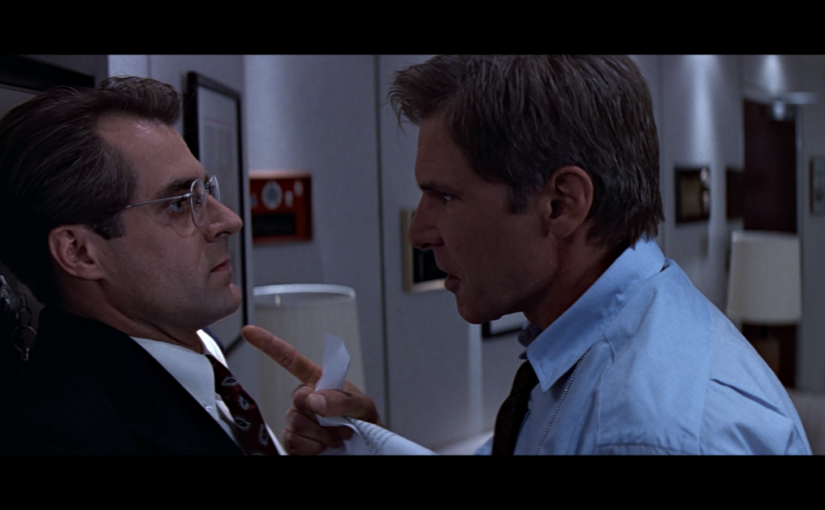
Tom Clancy’s Jack Ryan finds himself in an inadvertent private war between the United States and Colombian drug kingpins in Clear And Present Danger.  Harrison Ford returns as the heroic government operative. I like this film for much of the same reasons I liked the prior Jack Ryan pictures.  These movies give an inside view of internal politics within Congress, the CIA and inside the hallowed halls and Oval Office of The White House.  The Clancy adaptations are not just about action set ups and shootouts.  Though we are treated to plenty of that material as well.

The film opens with a luxury yacht being raided by the Coast Guard. They uncover Colombian killers that have murdered a wealthy American and his family for reasons of a failing partnership with drug dealers.  The incident can be bridged to the President played by Donald Moffat, a terrific character actor who also shared the screen with Ford in Mike Nichols’ Regarding Henry. He secretly initiates a retaliation for what has occurred while also insisting on collecting over six hundred and fifty million dollars he feels the US is entitled to, following his friend’s murder.  Henry Czerny, playing a carbon copy of his role in Mission: Impossible, headlines the covert plot and recruits a mercenary named John Clark (Willem Dafoe) to place a clandestine militant team into the South American jungles to take out the drug runners one by one.

The suit and tie formal dynamics fall on Jack Ryan when he swears testimony on the legitimacy of the country’s response.  However, the President’s armament exercises are unbeknownst to Jack.  When it finally dawns on him what has been occurring, into the field Jack Ryan goes to clean up the mess.

A lot of spinning plates structure the storytelling of Clear And Present Danger which is on par with Clancy’s thousand-page novels.  There’s an abundance of characters to address, betrayals to happen and even the mechanics of various weaponry and policy decisions that need exploring, despite the innate complexities of it all.  It can feel overwhelming.  However, with this film, as well as with The Hunt For Red October and Patriot Games, I feel included.  If you’re patient through the exposition and set ups, then these fictional controversies become very absorbing, and you feel like you’re there.  

There’s a great scene between Ford and Czerny racing to download vs delete some suspicious files on a computer.  These guys are in their boring offices, dressed in their boring suits and they’re clicking on the mouse pad and typing away on the keyboard.  Director Phillip Noyce gets nail biting back and forth closeups on each guy as they are off to the races trying to get ahead of each other.  Then it becomes a yelling match in the hallway with threats of prosecution between both men, and I feel I’m in on the whole thing.

There is also a good amount of internal conversations between the main drug czar (Miguel Sandoval) and his top henchman (Joaquim de Almeida).  Almeida’s role is written very well as we witness how smart and resourceful he is while protecting the best interests of his employer.

For the most part, the action is nothing special.  However, the highlight of the whole film involves an SUV convoy getting ambushed by Colombian terrorists mounted on rooftops firing missiles at the government vehicles below.  Harrison Ford prefers to do as much stunt work as possible and it definitely helps the ten-minute sequence.  This is an outstanding part of the picture with perfect editing of sound and photography. Later on, we see Ford leap on to the landing gear of an ascending helicopter. Very impressive. Harrison Ford always does his best to invest himself in his movies.

I also admire many of the explosions that went into the Special Forces’ continuing storyline of sabotaging the drug lords’ laboratories and various locales. Nothing is miniaturized here, and the resulting blasts are really big and eye opening. This movie did not shortchange on anything it was attempting to accomplish.

The film adaptation of Clancy’s fourth book takes some major liberties.  In the novel, the story is primarily focused on John Clark and his mission, with Jack Ryan not appearing until after the midway point.  However, at this stage of Harrison Ford’s career there was no way he’d accept just a supporting role.  The notable changes hold well within the screenplay though, and a showdown between Jack Ryan and the President is one for the ages.

Overall, Clear And Present Danger was a successful picture at the box office. Critics and Clancy fans alike had favorable responses to the picture.  So, it’s disappointing that producers decided to try numerous reinventions of the Jack Ryan franchise subsequentially.  Those other movies, along with a TV show, would prove well.  Yet, it is regrettable that Harrison Ford, or at least this interpretation of the hero, did not move on through Tom Clancy’s ongoing stories transcending within other areas of government and espionage.  If you have read the books, then maybe you recall the unbelievable ending to Without Remorse.  Boy, would I have loved to see what Harrison Ford did with the cliffhanger that closed out that book. Care to know? Then this Unpaid Movie Critic suggests you pick up a book.

NOTE OF TRIVIA: James Horner conducts the music for this film and he includes samples that were used in the beginning of Aliens. Interesting to catch this as the music works for both a science fiction piece, as well as for a political thriller.

PATRIOT GAMES

By Marc S. Sanders

You may remember Patriot Games as a tense thriller featuring the favorite hero Jack Ryan doing the wherewithal action that is demanding for the adaptation of Tom Clancy’s best-selling novel.  Harrison Ford (taking over the role from Alec Baldwin) plays the guy who will thwart an assassination attempt on the Royal Family or punch out a terrorist thug invading his home or on a speed boat during a dark and stormy night.  Only a small bit of the action sequences are flawed, but that doesn’t take away from what makes the picture truly special.  In the follow up to The Hunt For Red October, Jack Ryan goes back to the CIA to investigate who wants revenge against him and who was responsible for that assassination attempt.  What the picture serves as the covert halls of the Central Intelligence Agency is what is especially convincing and most fascinating.

On the surface, the Irish Republican Army appears to be the scapegoat for attempting to murder members of the Royal Family as they are pulling out of the front gates of Buckingham Palace.  Jack Ryan is in London vacationing with his wife Cathy (Anne Archer) and daughter Sally (Thora Birch) when he comes upon the incident just in time to foil the crime.  In the process, Ryan takes a bullet to the shoulder and kills the younger brother of the most dangerous squad member, Sean Miller (Sean Bean).  A quick trial puts Miller behind bars and Jack is recognized as a hero.

However, Sean Miller escapes with his surviving comrades and vows revenge on Jack and his family.  An attempt is made on the Ryans’ lives and Jack insists on getting back into the CIA to locate Miller and his team.

The revenge plot is the main thread and its pretty ho hum.  We’ve seen all that many times before.  However, what branches off are the conflicts within Irish politics and how Jack Ryan gradually uncovers who and where this small faction of terrorists may be.  Cold War commentary is delivered by an under the radar performance from one of my favorite character actors, Richard Harris.  He attempts to deny responsibility of these attacks and offer an olive branch to Ryan.  Ford and Harris have three good scenes together, two of which are minimal on dialogue but effective in sending their messages to one another. 

As well, Harrison Ford occupies another great heroic role.  I agree with a majority who believe he was too old to play the novice Jack Ryan described in Clancy’s early novels.  Many insist casting Baldwin was perfect.  It was. Yet, I am able to look past that as the character does not have the rookie appearance or regard in this picture.  With Harrison Ford, Jack Ryan is now at a point where he looks seasoned and experienced like the character eventually becomes in the book series.

Director Phillip Noyce is good at using the mysterious and quiet orchestral accompaniments of James Horner to follow Jack as he studies photographs or reflects on the day of the assassination attempt in order to piece together random clues.  In other films, this might get boring and tedious.  However, the director captures good closeups of Harrison Ford and quick flashbacks are edited to help identify what were important blink and miss it moments necessary to assemble the puzzle.  A simple visit to the restroom for Jack Ryan and a glance at a woman’s ponytail lead to a solid conclusion.

Sean Bean has the physical and quiet intensity to his role.  He’s the muscle of the terrorist group, not the leader (played by Patrick Bergen).  Bean serves the revenge element and his physique and weapon handling work well as a nice threat to the hero of the picture.

As the story progresses, the audience follows along with Ryan.  Satellite photographs are studied and zoomed in seeking some semblance of an image in a blur.  Sometimes Jack Ryan is moving in the right direction but in other times he’s unsure.  Even though we always know how the bad guys are doing and where they are, we empathize because Harrison Ford’s character does not.  Still, it’s a thrill to witness him eventually make his discoveries.

A nice approach occurs when the CIA sends in troops to what they believe is an enemy base camp.  We watch Jack Ryan and all of the government officials stare with intensity on a big screen as little black pixels drop down and move at a running pace from an overhead satellite shot.  We don’t have to endure one more machine gun battle.  This kind of intensity is much more interesting where lives are taken as a means of protection, but still a principled man like Jack Ryan does not feel good about what has to be done.

Patriot Games works well with its plays on espionage, spy activity, traitors, and government relations between America, Great Britain and Ireland.  The select action scenes are done well and hold their suspense for quite long.  However, the final sequence is challenging to sit through. 

As the enemy prepares a covert attack on the Ryans’ Virginia home where the Royal Family are guests, there is much running around upstairs and down, in the basement, and outside the roof and so on.  It’s pouring rain with the standard thunder and lightning in the middle of the night as well.  Once the villains and the hero make their way to some getaway boats, the film unravels.  The picture shakes like crazy against the waves and rain.  There’s little light on any of the shots as well and the sound goes loud due to the boat engines and the storm setting.  All of these elements make it challenging to get absorbed in the movie’s climactic ending. 

Hollywood pictures fall back on this approach often in films like Ang Lee’s Hulk and the first installment of The Hunger Games.  It’s dark and wet and shaky and rainy. So, it is hard to decipher who is hitting who and who is shooting at who and who is driving which boat and where are they now.  It’s a shame really because Patriot Games is a taut thriller that holds your attention for nearly two hours, but then you give up in the final few minutes to simply rely on your instincts for how the story is going to wrap itself up.

Jack Ryan’s second adventure is worth watching but oddly enough, maybe wait for your restroom break until the last ten minutes of the picture.

SUPERMAN II

By Marc S. Sanders

It’s time for the man in the red cape and blue tights to fall in love with Lois Lane, but wouldn’t you know it?  Three Krytonian criminals possessing the same powers as our hero have arrived on Earth with a means to dominate the planet and exact revenge on the son of their jailer.  Superman II picks up where Richard Donner’s original 1978 smash left off.  It remains a fantastically fun and breathless sequel.

Richard Lester (A Hard Day’s Night) gets the directing credit on this film following one of Hollywood’s most infamous behind-the-scenes stories.  While I’m a big admirer of Donner’s body of work, I think it was a blessing that Lester finished the job.  I’ve seen what Donner was intending to do on a special Blu Ray cut, and it just does not work. The characters make odd choices that seem inconsistent with how they were perceived in the first film.  That’s all I need to say about that comparison right now, though. 

In the original theatrical release, the story expands on the relationship between Superman & Lois (Christopher Reeve, Margot Kidder) as well as Clark Kent and Lois.  Eventually, both relationships intersect with one another, and Lois realizes the man she’s been admiring and the one she hardly takes notice of are one and the same.  The problem for Superman, known by his krypton name Kal-El, son of Jor-El, is if it is acceptable to be intimate with an earthling. 

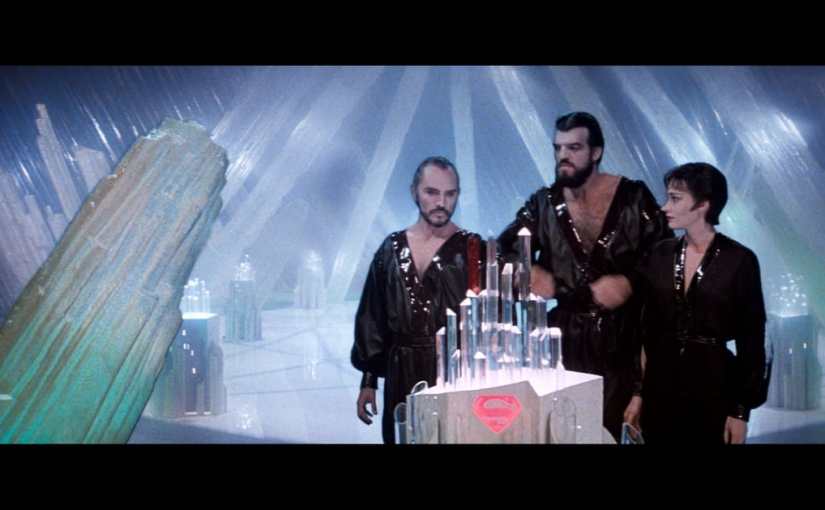
Meanwhile, Lex Luthor (Gene Hackman) has escaped prison to entice three villains from Krypton into a partnership that will allow them to take over the Earth and destroy Superman.  The trio is led by General Zod (Terence Stamp) with the wicked Ursa (Sarah Douglas) and the mindless and mute Non (Jack O’Halloran).  Following their attack on Houston, or as they call it the “Planet Huuston,” and the White House, it is on to Metropolis in search of Kal-El.

I’ve offered up quite a bit of what Superman II provides and I am not even close to sharing all it’s adventurous features and character dynamics.  This is a solid picture all the way through, and it begins with the casting.

I’ll be bold by declaring that Christopher Reeve as Clark Kent/Superman is one of the best casting decisions in film history.  Think about this for a moment.  As good as Henry Cavill was in Zach Snyder’s films, thirty years later, and how well some of the WB iterations have been, the contrary point that most people make is that none of them are Christopher Reeve.  From the smile, his handsome face, clear voice with perfect enunciation and even the signature hair curl over the forehead, no one has looked as good as a superhero come to life better than Mr. Reeve.  When he’s flying, even with outdated visual effect backgrounds, you are still convinced that Christopher Reeve knows exactly how to fly.

Following the director shake up on this picture, it is said Gene Hackman refused to shoot some scenes or do follow up edits.  You can tell when there is a double in place for him and you can hear the different vocal sound bites from Lex Luthor.  Nevertheless, what survived from Hackman’s participation is silly and twisted like you would expect from a modern-day, dastardly villain or as he declares himself to be “the greatest criminal mind of our age.” Some of these lines look hokey on paper, but Hackman invests his showmanship once again in the character.  I love it.  On all of those top ten lists, Gene Hackman as Lex Luthor is the one that everyone is regrettably forgetting about.

Margot Kidder is just as committed.  Lois Lane is best when she is the go-getter and Kidder is thoroughly convincing at not just being seen in the stunts and action but actually performing through Lois’ fears, sense of daring, and adoration for the love of her life.  Near the beginning of the film, there’s a great close up of Kidder looking up into the heights of the Eiffel Tower as Superman flies a hydrogen bomb out of danger.  No dialogue, but you can read it all over Margot Kidder’s face.  There goes my hero.  Watch him as he goes.  Few love interests in superhero films have ever matched what Margot Kidder accomplished in these pictures.

The action scenes are great set ups.  I get a chill down my spine every time I watch the showdown in Metropolis between the three baddies against the man in blue and red.  However, Richard Lester never neglects the acting throughout the whole two hours, particularly by the leads, as well as the Shakespearean maniacal performances from Stamp and Douglas.  Furthermore, the extras throughout Metropolis, Houston and even in Niagara Falls are performing very well and therefore turning the various settings into characters themselves.  Just as the fight over Metropolis is to begin, a cabbie declares “Man, this is gonna be good!”  Isn’t that guy speaking for the audience?  I remember the room applauding in the theater at that line.  When Superman rescues a child in Niagara Falls, a woman utters “What a nice man!” Clifton James, from a couple of James Bond movies, resurrects that redneck persona and it works better here as the guy who clashes with the imposing new visitors.  All of these walk on characters further shape the purpose of the visitors from space.  None of it depends on B-movie tripe like declaring “Peace!”  The personality of the folks meet the strangers from a strange land.  Sometimes it is done for means of slapstick, but it is always very entertaining.

Superman II is a perfect complement to the original film thanks especially to the cast.  Reeve gives multiple performances of Clark and Kal-El that could not be more different.  Kidder takes her character in new directions upon learning the surprises the script has in store for Lois.  Hackman is doing the same routine, but fortunately it’s welcome because I can not get enough of his antics.

This sequel really set the bar high and the next installments for Reeve came nowhere close. Though I actually have an affection for Superman III with that internal struggle depicted in the junk yard scene; one for the ages. 

The first two movies are legendary and Warner Bros/DC films realize they still have not superseded what was done over forty years ago.  The studios are not trying hard enough. However, more to the point, the filmmakers back then got it absolutely perfect, and you cannot beat Superman, nor can you beat perfection.

AQUAMAN AND THE LOST KINGDOM (2023)

by Miguel E. Rodriguez

DIRECTOR: James Wan
CAST: Jason Momoa, Patrick Wilson, Yahya Abdul-Mateen II, Amber Heard, Nicole Kidman, Randall Park, Temuera Morrison, Dolph Lundgren
MY RATING: 7/10
ROTTEN TOMATOMETER: 35%

PLOT: When Black Manta seeks revenge on Aquaman for his father’s death, Aquaman forges an uneasy alliance with his imprisoned brother to defend Atlantis and his family.


“They say everybody’s good at something.  Me?  I talk to fish.  …Some people think that makes me a joke.  But I don’t care.”

Those lines, spoken in narration by Aquaman at the beginning of Aquaman and the Lost Kingdom, admirably sum up just about every comic book fan’s opinion of Aquaman and his dubious powers over the course of his existence.  The genius move on the part of the DC Extended Universe was casting Jason Momoa as the King of Atlantis.  As I wrote in my review of Aquaman (2018): “Hell, I wouldn’t laugh at a guy who looks like that.  ‘You talkin’ to fish?  Ping away, Muscles!’”

So, you’ve got the right guy for the role, no worries there.  The problem now is how to use him.  Based on Aquaman and the Lost Kingdom, it would seem they used up all the best ideas in the first movie.  I wouldn’t call Lost Kingdom a rehash of Aquaman, necessarily, but it doesn’t exactly stake out new territory.  (Well, except for when they visit the underwater version of the Star Wars cantina, complete with a live band, seedy characters, and a pirate overlord who looks like Jabba the Hutt with fins for hands.  That was new.  I mean, sort of.)

Putting it another way, Aquaman and the Lost Kingdom does not transcend, or even seem to ATTEMPT to transcend, the boundaries of the comic-book-movie genre.  The filmmakers did add some witty banter between Arthur and his imprisoned brother, Orm (Patrick Wilson), that was a nice source of comic relief.  Orm’s almost complete ignorance of life on the surface world leads to some funny scenes involving such basic concepts of what to eat and how to run.  But aside from that, a rundown of the plot seems redundant because you’ve heard and seen it all before.  “Bad guy from first movie shows up, more powerful than before, threatens life on Earth for personal vendetta against good guy.  Good guy learns to get along with semi-bad-guy brother to defeat good guy.”

With that in mind, though, knowing full well that the movie followed the comic-book-movie formula step-by-step…I must truthfully report that I had a good time.  I enjoyed it.  I could intellectualize endlessly about the bankruptcy of the story, the bloated visual effects, the overly-preachy finger-wagging to climate-change deniers (Black Manta’s plan is to raise global temperatures in order to release an army of mutant henchmen from their icy prison in Antarctica; he has a line where he says something like, “I’m only continuing what we’ve been doing for decades.”  Shaaaame on us).  But…again, I must admit, I had fun.

At some point, when it comes to comic book movies, I have to start asking myself: what more do I want from a comic book movie?  If I expected every single comic book film to be as good as Superman or The Dark Knight or The Batman or even the first Shazam!, I would be sorely disappointed.  It’s impossible to have that kind of track record, quality-wise.  To be sure, there have been disappointments (Black Panther: Wakanda Forever, Venom, Wonder Woman 1984, and many others).  But none of those films were even close to being as much fun as Aquaman and the Lost Kingdom.  Others will no doubt disagree.  Understandable.

But I still had fun, and no amount of critical dismantling of the plot will change that.

IN THE LINE OF FIRE

By Marc S. Sanders

While watching Wolfgang Petersen’s In The Line Of Fire for about the umpteenth time, it occurred to me that good, solid action pictures work so well when there is at least one or two characters who suffer from a past trauma.  Recently, I wrote about John Rambo in First Blood where what haunts the character sets the story in motion.  In Petersen’s film, both the villain and the hero attack one another’s personal sufferings to stay ahead of a game that could result in the assassination of the President Of The United States.

Clint Eastwood is aging Secret Service agent Frank Horrigan.  He served on the team the day Kennedy was killed in Dallas.  A deranged lunatic who initially goes by the name of Booth (John Malkovich), a salute to Lincoln’s assassin, forces Frank to play hand after hand through disturbing phone calls he makes to Frank where he discusses his eventual rendezvous with death when he will finally kill the President.  Booth tests Frank mettle though.  Does Frank have the guts to take a bullet for the subject he is supposed to protect? 

In The Line Of Fire is a very effective thriller because of its lead performances from Eastwood and Malkovich – two actors of different ranges with very different personalities.  Eastwood is famous for being the quiet kind of hero in films like Dirty Harry and Unforgiven.  Malkovich is a character actor who hides within his roles, which is especially demanding of the character in this film.  It is hard to find two roles in his career that seem similar. 

Booth is a master of disguise.  Wolfgang Petersen takes more the one opportunity to show the endless possibilities of what Malkovich as Booth could do to alter his appearance.  The morphing of the digital composites-bald, hairy, thin, plump, glasses or no glasses-is a welcome disturbance.  Interestingly, the basic John Malkovich that audiences are familiar with does not even make an appearance until at least a third into the movie.  Prior to that he’s disguised as a hippie or Petersen has him concealed in dark corners where all that you are seeing are his eyes hiding behind a pair of binoculars. 

What holds your attention in a script from Jeff Maguire is that you learn more and more about the man called Booth as the story moves on, all the way to final act.  What would motivate someone to assassinate the most powerful leader of the free world?  The odds of accomplishing the act are enormous against the security and protection devoted to one person. 

You also witness the defeat that Horrigan endures as Booth stays ahead of him and torments him over his past transgressions. At first Frank is forced to recollect his past failures by what Booth brings up in one phone call after another.  Later, Frank gets the upper hand as his investigation uncovers more.  A later scene in the movie brings about a sensational exchange of dialogue between the two actors.  The agent also has to contend with a difficult supervisor (Gary Cole) and a Chief Of Staff (Fred Thompson) who carry no faith in Frank’s efforts and are more concerned with the President’s image versus saving his life. 

Clint Eastwood and John Malkovich are a terrific protagonist and antagonist. There are a few scenes the two actors share together but they arrive later.  Before those moments, much material depends on the phone calls they have.  So, they work well off each other without even being in the same room.  The characters come at one another with the demons they dig up and the responses from Eastwood and Malkovich appear very convincing.  Very effective work with script, direction, and performance.

The supporting cast is terrific too.  There’s a romantic angle that could have been filler, but thanks to a good matchup between Eastwood and Rene Russo, as another Secret Service agent, there are some humorous moments as well as tender scenes for the heroic agent who is approaching a dinosaur period.  Clint Eastwood is great to watch as a piano player in this film.  Watch as he plays As Time Goes By when Russo rejects his advances and wanders off for the elevator.   Shortly after, she succumbs and there’s a hilarious moment that pokes fun at what it takes to be an active agent.

Dylan McDermot is Frank’s younger partner.  He’s quite good, representing the fear that goes with being a man willing to take a bullet for someone else.  An opening scene presents a frightening moment for the character.  On a Clint Eastwood level, it works with the signature charm that most are familiar with, but from McDermott’s perspective it is something else entirely, helping to shape his character for the rest of the film.

The characters in In The Line Of Fire are not tough guys beyond dares.  They are conflicted.  They experience fear and hesitation.  They have pasts that haunt them as well, and the opponents use psychological warfare to weaken their enemy.

Because Maguire’s characters are so fleshed out, the suspense works nicely with Petersen’s direction and a recognizable Ennio Morricone soundtrack.  The ending is great, not just for the action and editing, but the tension is quite palpable as well.

In The Line Of Fire has magnificent performances. You get a clear picture of what is necessary to be in the Secret Service, all the way down from the department’s appearance while jogging next to a Presidential limousine while wearing a suit, to the process of preparations, and what heights Presidential protection strives for to stay ahead of endless threats that come their way.

Wolfgang Petersen’s film is thirty years old, and the technology and procedures within the governmental departments have assuredly been updated since its release, but this picture does not appear dated or out of touch.  This thriller still works.

FIRST BLOOD

By Marc S. Sanders

1982 was a significant year in Sylvester Stallone’s career.  He helped popularize a rock anthem from Survivor (Eye Of The Tiger) and he ushered in the pop icon figure with the mohawk and gold chains, known as Mr. T, when the third chapter of his Philadelphia sad sack boxer, Rocky,  became a huge hit at the box office.  More importantly, however, he initiated another, bloodier, franchise character.  

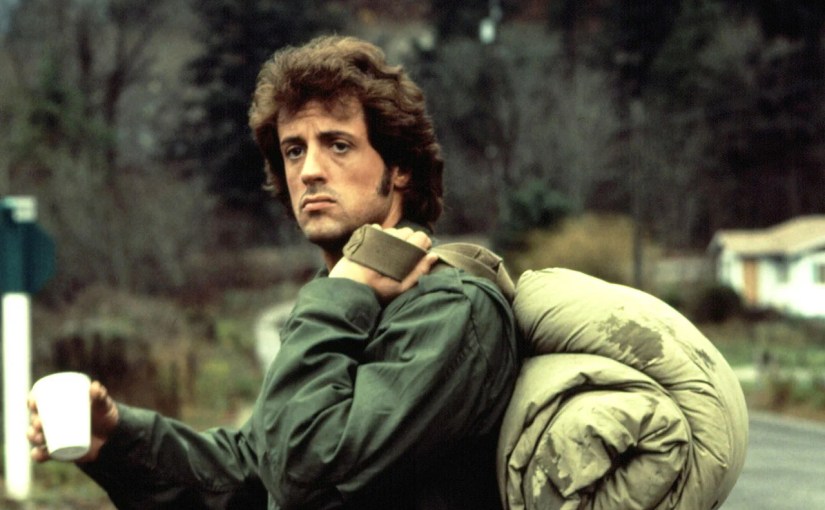
Vietnam Veteran John Rambo entered a small northwestern town to catch up with an old war buddy and grab a bite to eat in First Blood, based on a bestselling novel by David Morrell.  The film, with a screenplay co-written by Stallone, contains a simple plot.  The well-liked Sheriff Teasle (Brian Dennehy) of this community takes notice of Rambo, the drifter with an American flag patched on his army coat, and immediately does not take a liking to him or his appearance.  Teasle attempts to peacefully escort the stranger beyond the city limits.  As soon as he drops Rambo off on the other side of the bridge, the former Green Beret turns around and starts to walk back into town.  A conflict is now set off that will carry the rest of the picture.

After Teasle arrests Rambo, an abusive jail search and frisk awakens the post traumatic stress that the veteran appears to be haunted by from his experiences when he was held captive by the Viet Cong.  A thrilling action sequence is welcomed by Rambo’s escape into the wintery cold mountains.  Now a personal war pitting the tormented man against Teasle’s local law enforcement has been waged.  Perhaps the only way this will end peacefully is if Rambo’s former commander, Colonel Trautman (Richard Crenna), can reign the soldier in before there’s loss of life or any further injury.

The irony of First Blood, Rambo’s first cinematic adventure, is that there is only one fatality in the whole picture.  Rambo is not necessarily a cold blooded killer.  Just don’t push him.  Otherwise, the picture hinges quite a bit on the inventive booby traps that he sets up with only what accompanies his multipurpose six-inch bayonet knife and what can be uncovered within the dense woods.  The traps are quite daring and believable, and as an action picture, it makes for good entertainment.

First Blood may attempt to demonstrate the residual effects of returning home from a tortuous war, but I do not think it sends the best message.  I could never truly understand Teasle’s  immediate abhorrence for Rambo.  This is just a guy who’s walking on by.  Where does the alarm stem from in the Sheriff’s mind?  Maybe a reader can give me some insight that I have failed to recognize after repeated viewings of the film.  

The best part of First Blood is the ending which likely offers one of the best acting scenes in Sylvester Stallone’s enormously long career.  As the adventure is wrapping up, a well written and heartbreaking monologue is delivered that unleashes the terrible trauma the Veteran carries.  Stallone gets to such a manic state of tears and anxiety that it seems so natural.  His voice gets convincingly hoarse.  His face contorts into believable anguish.  At times it is hard to comprehend what he’s describing to Colonel Trautman, but it’s easy to see the distress the character has been living with.  It’s also a perfect summation of the film.  

In this first film, before the subsequent sequels focusing on sensationalized violence, it is apparent how John Rambo contains his heartache and resorts to release what he’s coping with by fighting back against a higher power and refusing to surrender.   The closing monologue perfectly demonstrates that.  It’s as if this man has been holding his breath under water and now, once all the ammunition is expended and the town is in flames, he can finally release what’s been buried in his gut, in his subconscious, for so long.  

1982 was an appropriate time to release First Blood.  It had been ten years since the United States pulled out of a long, losing war in Vietnam.  During the Reagan years, it is fair to argue that life had become quaint and peaceful in this country.  There were remnants of a Cold War still brewing, but there was not a violently long conflict any longer to report.  Pop culture and materialism were being embraced.  Cost of living was working well for the middle class.  Sadly though, there were plenty of people who served who could not put behind the mental scars they took home with them.  Many of these men and women remain forgotten.  Some never returned and some are still unaccounted for.  David Morrell’s story attempted to bring attention to these oversights.  Though the ending to the film adaptation is far different than Morrell’s book, the message is consistent.  

I do not think First Blood is a more effective narrative than The Deer Hunter or Oliver Stone’s well received Vietnam pictures to come out later in the decade.  After all, this is by and large an action adventure.  However, due to the popularity that Stallone carried with the Rambo character, it may have garnered attention for those that never should have been neglected.  

AVENGERS: INFINITY WAR

By Marc S. Sanders

Avengers: Infinity War is a really FAT movie. Like ORCA FAT (thank you Keyser Soze), because it is chock full of so much to see. If this equated to gorging on junk food, after two hours and forty minutes, I would have a diabetic cardiac arrest immediately following the credits. Is this a film that is worth that handicap, however? You bet it is.

There is an ensemble of top Hollywood talent portraying a huge cast of characters, once again, and thus another installment has surfaced in the franchise that allows them to have various moments to shine. Producer Kevin Feige with all of Disney’s support, has mastered the formula to ensemble casting and production, as good as when George Clooney and company performed under Steven Soderbergh’s direction in the Ocean’s 11 remake. Thousands of special effects shots do not overpower the stage presence of the actors. The Marvel movies succeed because a story is always written first. Then witty dialogue comes thereafter, and then valid, convincing shock value. The special effects are the final ingredient. This is what the Transformers franchise and (yes, I’ll even own up to it) the Star Wars prequel trilogy (about ¾ of it) failed to achieve. This successful formula gives merit to the (at the time) biggest opening weekend ever, worldwide, and Avengers: Infinity War deserves the accolades.

How good is it? Well, reflecting back to May 1980, when sitting in a crowded theatre watching the ending to The Empire Strikes Back, by comparison I think audiences have finally been served up a cliffhanger (10 years in the making) that is just as effective. How is this all going to wrap up from here? How is this all going to be resolved? Reader, I don’t know if the next chapter will be satisfying. I don’t know if we will feel cheated like Annie Wilkes from Stephen King’s Misery. Presently, however, I’m turning an ending like this over in my mind; the same way I did with my pals in 1980 debating the survival ratio of Han Solo and if Darth Vader has told the truth, and if that was Vader’s brain or head that I saw, and who is this “another” that Yoda referred to….and that, my friends, is what makes a spectacular film. I don’t care if it gets watered down in the hype and McDonald’s promotions and toys. If you can mull over a movie long after it has ended, for days, even months and years, then a film like The Empire Strikes Back and Avengers: Infinity War has more than served its purpose.

Josh Brolin provides a villain with a justification to his madness. He’s not just twirling his mustache to be mischievous and sinister. He has a destiny to fulfill, and his portrayal of the mad titan Thanos does not compromise. This is a beast of a purple villain with size 52 boots and gold-plated armor with a chin that looks like it was clawed by Wolverine. Thanos cries, actually cries, while committing his crimes. He’s not just cackling. He flat out says that he executes his actions all so that he can relax and retire. Isn’t that what we are all trying to do, anyway? Nothing wrong with that. Guy sounds like a CEO to a large corporation. Maybe Thanos is updated to resemble an Elon Musk. 

All of the other actors from main staple Robert Downey Jr to Chris Pratt to Chadwick Boseman to Zoe Saldana and Chris Hemsworth, and so on, remain consistent to what we’ve seen of various prior installments. Their gimmicks continue to avoid becoming stale. Audience applause is cued by their appearances. These are well loved characters.

As an avid comic book reader of the silver age (1980s), Avengers: Infinity War presents itself as of one those annual limited series runs that were special because they were MAIN EVENTS!!!! My favorite back then was Marvel’s Secret Wars. Typically, a comic book from the 1980s would average about 18-22 pages with advertisements sprinkled in. Nearly every scene in this film equates to one issue of a limited run of a main event. That is a why a fat movie like this succeeds. The cast of characters are separated in various story lines. The scenes are given their time to flesh out and develop to move the subplots and overall story along. Each scene is like reading a new 18 page issue comic book. If I’m watching a comic book film, by golly, I want to see how a comic book is brought to life in a cinematic medium. Marvel’s films succeed greatly over DC’s films (produced by Warner Bros) because they rely on the source material. They know they got the goods. Cast it right, adapt it properly and go with that. If it ain’t broke, don’t fix it. A wealth of material (nearly 70 years) and Marvel/Disney uses it all. (How does DC/Warner Bros miss the mark so often?)

Of all of the Avengers films, Infinity War is definitely the best one. Ironically, I wasn’t expecting it to be. I was waiting for this stuff to get old and tiring. It just hasn’t faltered yet. It hasn’t gotten lazy yet. It all seems so fresh still. It’s a fantastic cinematic accomplishment. Sure, its main story is a guy chasing down six different colorful MacGuffins. So what! It’s simple. It allows the characters to stand out from there. An organized plotline like this doesn’t take much effort or time to explain its purpose. It states its conflict early on, and then the show stopping moments present themselves. One after the other after the other until a monster of an ending that is so jaw dropping, head shaking, thrilling and gasping, satisfyingly arrives. 

More importantly, the MacGuffin search drives the motivations and fleshes out the film’s main character, Thanos. This Marvel installment belongs to Josh Brolin as Thanos. Everyone else serves as his antagonists. What matters is that the bad guy wins this time, just like demonstrating that an Empire will strike back. Ironic that Spider-Man makes a humorous correlation to that celebrated franchise from almost forty years ago.

Avengers: Infinity War ended up in my top 10 list of 2018, and still holds as the best film in the Marvel Cinematic Universe.