KILL BILL VOL. 1

By Marc S. Sanders

Kill Bill Vol. 1 is Quentin Tarantino’s love letter to the best in Kung Fu films. A cinematic celebration for the eyes amid swords, blood and feminine gusto.

I consider Tarantino a writer of two dimensional characters; people with roll off the tongue names like Elle Driver and the only depth he awards them is to provide a code name like a breed of a deadly snake (Black Mamba, Cottonmouth). Multi dimensional characters are an absolute must for me most of the time. The only time I forgive its absence is when I watch Han Solo, Indiana Jones (circa the original Raiders…) and anything introduced by way of QT. Why? Because with these examples it is the situation and depiction of action that offers more than what you see. A ball and chain with a saw blade is wielded by Gogo, the catholic school girl assassin, and we don’t care so much if it hits its target. Rather we care about its traveling trajectory. The ball will zing through the air, sever a wooden table into splinters and zing back to hit its target in the back of the head. QT can thank his loyal editor, the dearly departed Sally Menke for achievements like this.

None of this is serious. It’s a step-by-step storyline of vengeance by Uma Thurman as The Bride, who is vows payback on Bill and his underlings for having the nerve to crash her wedding, leaving her for dead.

Getting from place to place is the glorious fun of the picture, thanks to a rocking soundtrack and actors (Thurman, a stellar Lucy Liu and a brash Vivica A Fox) ready to recite heightened, forthright dialogue that a 10 year old might give to his favorite action figures. “The baseball diamond where I coach little league and we have ourselves a knife fight.” Only assassins from Quentin Tarantino’s glossary talk like this.

Action scenes are not only gorgeously crafted with knife choreography and plenty of martial arts, but there’s almost a slapstick element to it all, along with a comic book feel. Tarantino is a well-known Three Stooges fan and beyond being an admirer of cinematic heroes. The Bride doesn’t just spill the blood of her opponents (The Crazy 88), she severs limbs and heads, so arteries spray never-ending geysers of blood. By the time the showdown of 1 vs 88 is over, the blood is in such excess, it appears as if the most extreme of pie fights has occurred among the mess. If Wile E Coyote took it up a few notches against the Road Runner, it might border what’s presented in this film. This is Quentin Tarantino with free reign and an unlimited budget providing what Kung Fu cinema fondly remembered from the offerings of legends like Sonny Chiba (who appears as a sword maker here) and Bruce Lee.

Kill Bill Vol. 1 is a glory to behold. It’s a variety of clear cinematography through different lenses Black & white, red with siren sounds, quiet dual set ups in glowing blue, and the purity of Lucy Liu’s code in a snowy white setting. Following a prenote of “Our Feature Presentation” the picture is bright in color and crisp in sound. Cereal is spilled all over a kitchen floor following a knife fight, and you just adore the crunch beneath The Bride’s feet as she walks out.

Overhead crane shots give an outline of a locale’s interior. Scorsese did this for terrifying effect at the end of Taxi Driver. Tarantino uses it as a means for the viewer to be let in on everything The Bride considers or looks for. The 4th film from Quentin Tarantino is so well constructed and so well-orchestrated. You see something new with each repeat viewing.

KILL BILL VOL. 2

By Marc S. Sanders

Kill Bill Vol. 2 offers an entirely different narrative than Volume 1, and that is why Quentin Tarantino is an electrifying storyteller. No two moments seem similar, even if the elements of the scenes (or chapters) seem the same with samurai swords, quick close ups, snap of the finger changes in cinematography and gonzo music cues.

I do prefer Volume 1 over 2 simply because it is a leaner film. This installment has just a little too much fat layered in, such as a storyline focusing on Michael Madsen’s “Budd” character. Not sure it was necessary for a scene where he is getting docked work hours from his boss because he was late. Not sure I needed a scene close to the third act where The Bride meets up with a South American contact before going to meet Bill. The dialogue in a few scenes like these offers nothing and didn’t even bring me the typical smirk I naturally get from QT’s films. They seemed more catered for bathroom breaks during the run of the movie.

Still, there’s a lot of glee and atmosphere in this picture, from a rehearsal wedding in gorgeous black and white with a nice Samuel L Jackson appearance to an enclosed, flashlight lit interior of a buried coffin. Best of all is the centerpiece of the film, The Cruel Tutelage Of Pai Mei (the best scene of both volumes and the salute that sends Tarantino’s love letter for Kung Fu cinema home). I love the Kung Fu Master Pai Mei, easily one of Tarantino’s best characters in all of his films combined. Tarantino works in the extreme close ups that Japanese filmmakers might have used for EXTREME DRAMATIC effect. Everything about Pai Mei is graciously recognizable and hearken back to these movies I’d catch while flipping channels on Saturday afternoon. Frankly, I never stuck with those flicks until the end, but for the fleeting seconds I watched, I got a white robed Kung Fu master Pai Mei to now fully appreciate in Kill Bill Vol. 2.

The Bride could arguably be Uma Thurman’s best role of her career. She’s a great carrier of the Tarantino heroine. The fighting skills she offers and what are deceptively edited in (thanks to Sally Menke) look so natural with her at the lead. You can’t take your eyes off of her, and you love to look at her.

David Carradine is another attraction. It’s rumored that Warren Beatty was up for the role of the sadistic, yet charming, Bill. No way could I see that working out. Carradine was the star of the series Kung Fu. How do you go with anyone else but David Carradine???? Carradine has a gorgeous, gravely stiletto voice that sounds awesome in stereo; deep and guttural. His facial features lend to a history of a villainous, but wise leader.

SPOILER ALERT: I’d be remiss if I didn’t mention QT’s smart imagination for disarming Daryl Hannah’s one eyed deadly assassin, Elle Driver. Find me another movie where an enemy is left in a trailer located in the desert with her remaining eye ripped out while a deadly black mamba snake slithers somewhere nearby. Tarantino closes this storyline by leaving her screaming alone with no eyes…in a desert…WITH A DEADLY BLACK MAMBA SNAKE. Does the audience need to see her die? Definitely not. Use your imagination of this being worse than stranded, and worse than dead. Pardon me but that’s fucking brilliant!

Again, QT’s characters are two dimensional. The Bride and Bill might have a little history behind them but that’s about it. It’s okay though, because this is pulp fiction (pun intended) that comes alive on the screen. No writer/director has ever elevated this kind of material so well.

MAN OF STEEL

By Marc S. Sanders

The first time I saw Zack Snyder’s Man Of Steel, I was disappointed.  Very disappointed.  It was only after a second viewing about a year later that I realized I was simply biased and unfair with my perception of the film.  I grew up with the Richards’, Donner and Lester, films that featured Christopher Reeve in the role of Superman/Clark Kent.  Nothing could violate what was done in those films from the ’70s and ’80s. 

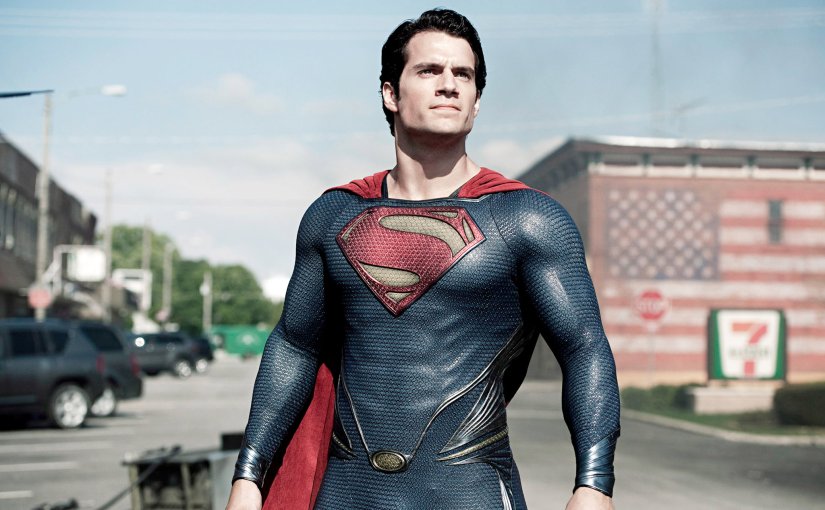
My impression of Man Of Steel now is that it is a marvelous film.  It’s an exploration of a stranger in a strange land questioning how to adapt to a living environment that he is not from, nor where anyone around him is genetically built like him either.  Henry Cavill fills the role of the title character.  What’s especially important is that he is not attempting to do what Reeve memorably did before him.  Actually, David S Goyer’s script really doesn’t allow for the hijinks of the prior films.  Clark Kent is not portrayed as a goofy and lovable klutz this time around.  Instead, the boy from Smallville, Kansas is challenged to limit his abilities at the behest of his Earthling father, Jonathan (Kevin Costner).  It’s dangerous for Clark to show all that he is capable of from his super strength to his heat vision.  Clark’s Earth mother, Martha (Diane Lane), is more protective of her son.  A really powerful scene occurs when young Clark is in the classroom and he has a bout with sensory overload of super hearing and super x-ray vision.  He can’t get the encompassing sounds and sights out of his head.  One of many CGI effects in the film come with Snyder showing the skeletal insides of Clark’s classmates and teachers.  It’s frightening; even to an innocent alien boy from another world.  This is good conflict.  Does the world need Clark Kent?  Would Clark Kent be better off someplace else?  Can he manage to live with daily life drowning out his sensibilities?

Another dilemma opens the film on Clark’s home planet of Krypton where he was born with the name Kal-el.  His father, Jor-el (Russell Crowe) has insisted to the governing body that the planet is expected to self destruct soon, and civilization needs to be relocated to another planet.  The politicians refuse to accept his theory.  Jor-el’s friend, the military leader General Zod (Michael Shannon) sides with his opinion.  Though his approach is violent insurrection of the Kryptonians.  Zod is punished for his crimes and sentenced to an eternal prison known as The Phantom Zone before baby Kal-el is shipped away, and the planet implodes with all its inhabitants.

Following this opening, Snyder cuts his film with flashbacks and forwards showing Clark in various different roles as either a fishing boat crewman or a bartender trying his best to remain undercover even when the temptation for use of his powers repeatedly shows itself.  Clark reflects on moments from his childhood when he and his Earth parents questioned how to present himself.  

Superman’s known love interest eventually shows herself, Pulitzer Prize winning reporter for the Daily Planet, Lois Lane (Amy Adams).  She’s following up on an alien ship that has been discovered in the arctic after 20,000 years.  Clark and Lois connect at this moment.  Of all the Superman angles that are familiar to so many of us, this is where Goyer and Snyder perhaps do not focus enough.  Man Of Steel is a satisfyingly long film, but there’s a lot of material and drawn out action to cover as well.  So the Lois and Clark relationship is somewhat sacrificed and not as nuanced as we have experienced in other iterations.

Zod arrives on Earth requesting that Kal-el reveal himself along with the intent to destructively turn Earth into a new Krypton at the sacrifice of the planet’s human population.  Naturally, a city wide battle will ensue. and lemme tell you reader you wanna talk about destroying the village just to save it….well…that’s what happens here.  When New York got destroyed in Marvel’s The Avengers or Ghostbusters, those pictures looked like spilled milk compared to what Superman and Zod do here.

Man Of Steel is the best film of the new Warner Bros/DC universe.  It might be Zack Snyder’s best film as well.  The assembly of the picture is masterful.  Hans Zimmer’s score has these great build ups as Clark discovers more of his capabilities.  It especially lends to when the character dons the cape and costume for the first time ready to leap in the sky and fly.  Snyder shows the efforts needed for Superman to carry out this talent.  The flying doesn’t come easy.  It looks like work on the super hero.  Zimmer’s score starts out quiet and then advances to these powerful notes as Superman soars higher and higher.  The boy from Kansas is making himself into something greater that he has no familiarity with.

Michael Shannon plays another of many kinds of villains and antagonists on his resume.  I’m not sick of this guy’s antics yet.  It’s time he become a James Bond villain.  He plays Zod with an uncompromising determination and disregard for anything else but to rule.  It’s all very sci fi like but I love how unforgiving he is with the role.  Much less Shakespearean than when Terrance Stamp played the part so well with Reeve as the hero.  Shannon is more direct and bloodthirsty.  Michael Shannon just knows how to be scary on film. This kind of personality would work great in a silly comedy from the Farrelly brothers as well.

Amy Adams is fine as Lois, but there’s not much here to work with honestly.  More details of her relationship with Superman come through in later films.  However, this story development soured me on my initial viewing.  The iconic irony of Superman pathos is that as sharp a reporter as Lois Lane is, she can not realize that the guy wearing the glasses who is working right next to her is actually Clark Kent?!?!?! Readers and viewers were always thankfully in on the joke.  On follow up viewings of Man Of Steel, I understand that Goyer and Snyder were never aiming for irony.  Lois knows who Clark really is from the get go. What was once an unforgivable departure for me, no longer is a concern.  There are deeper angles to question in Man Of Steel, like a purpose to others and the freedom to force a change because it can be done.

Snyder and Goyer broach on the well known Christ allegory with Superman.  The film takes place in Clark’s thirty third Earth year.  Jor-el is slain with with a stabbing to his rib.  There’s also the crucifixion  pose on a number of occasions.  I must admit, as a Jew raised conservatively with just the Old Testament, I am not very educated on the texts of Jesus Christ.  However, the basics are explored in Man Of Steel.  Is Superman a savior?  Snyder wisely even has Clark visit with his Smallville priest to question his obligations to Earth and to Zod’s calling, with window artwork of Christ in the background.  

One vice I have with Snyder’s picture is the shameless plugging.  How overt must signage from Sears, U-Haul, 7-Eleven and IHop be?  Granted, all of these summer blockbuster films have the inserts of brand labels going all the way back to the original Superman films.  Here though, the corporate advertising is a true eyesore.  Superman being thrown into the dining area of an IHop is not as memorably funny as when Zod’s underling, Non, crashed into New York’s famed Coca-Cola sign back in 1981.

The seemingly endless battle consuming about forty five minutes of the third act of the film are over the top outrageous.  I might normally be saying I’ve seen enough while casualties are never considered as buildings literally topple over into mushroom clouds of concrete dust.  Still, the cast keeps these moments alive.  Shannon and Cavill, along with Laurence Fishburne as Perry White, the Daily Planet editor, and Amy Adams, actually show risk and fear amid all of this bombastic action.  Still, Snyder is insistent on his freedom to go crazy with CGI effects.  It’s more than a bit much, but the characters up to this point keep me engaged with the film all the way through.  Later DC films in this franchise don’t do it so much for me, but that’s another column altogether.  

Again, what I especially like about Man Of Steel is how Snyder cuts back and forth with the film.  Heroic moments occur and then are reflected back to times in Clark’s childhood with Jonathan and Martha.  With Zimmer’s score, it seems to allow Clark to consider conversations and moments from his past as meaningful to what he is experiencing in the present.  When Zack Snyder stays on this trajectory it makes Man Of Steel more than just another comic book movie for summer box office.  There’s depth from Goyer’s script that Snyder wisely does not disregard.  

Man Of Steel is a new and unfamiliar kind of Superman, but its a very welcome Superman too.

BATMAN V. SUPERMAN: DAWN OF JUSTICE

By Marc S. Sanders

Zack Snyder may have been indulging in too many cookies from the jar when he made Batman v Superman: Dawn Of Justice.  I can not deny how ambitious this film is, but did it ever need to be this ambitious?  There are too many storylines, too many characters, and not enough thought provoking dialogue to really make any sense of the gobblety gook that’s splattered all over the screen.

Reader, my favorite super hero of all time is Batman.  Nearly any variation of Batman (including moments from the dreadful Joel Schumacher films) contains an element that I just love about the character.  Ben Affleck is cast as The Dark Knight here.  He’s fine in the role.  I knew since he had done Daredevil, that he could pull off this part.  He might be too long in the tooth, and too busy an actor/director, for a new series of super hero films, but I digress.  That being said, the movies have gone into overkill on the Batman character.  It’s time the Gotham crusader hide in his cave for a little while and let some of the other super heroes out to play.  Snyder’s film proves my theory.  After all, the true highlight is neither title character in this movie.  

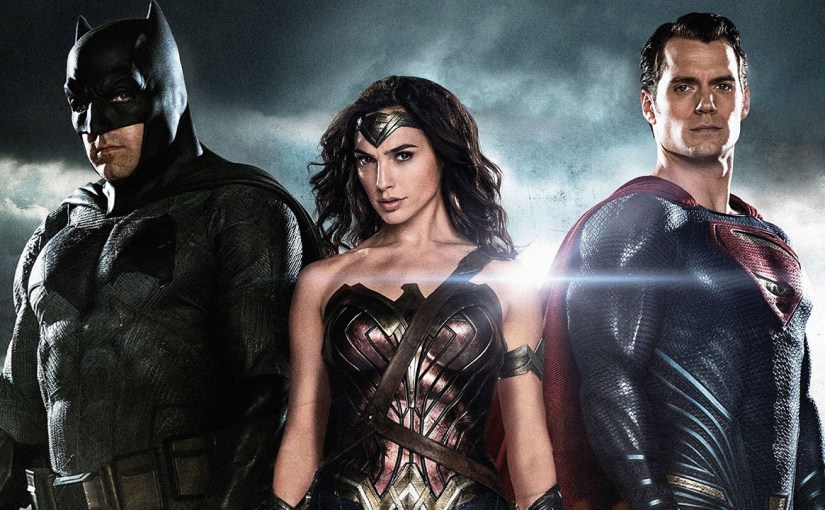
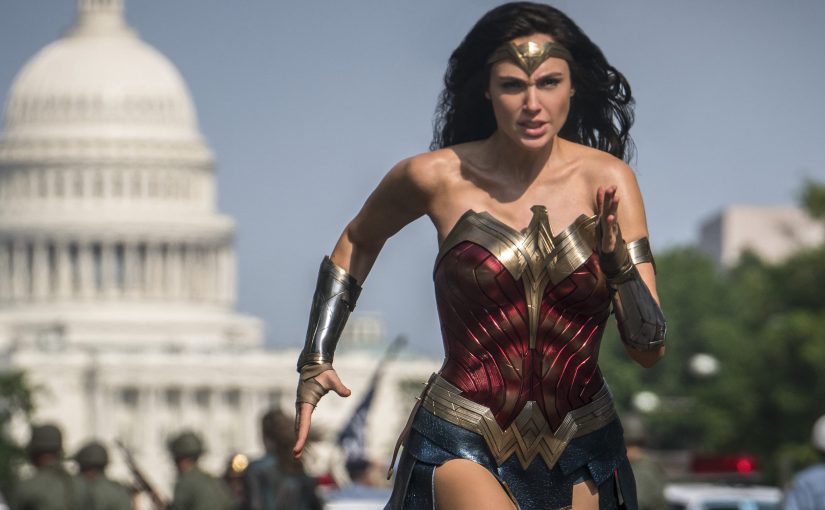
Actually Wonder Woman (Gal Godot) making her big screen debut is the draw above anything else here.  Even that is problematic, though.  I’ve seen this film twice now.  Can anyone tell me why Wonder Woman aka Diana Prince even makes an appearance in this film?  From a story perspective, what justifies Diana creeping into this film, other than to plaster her picture on DVD covers and merchandise a new action figure?

Events begin right after Snyder’s stellar Superman film, Man Of Steel.  An older and experienced Bruce Wayne is dubious of the benefits that Superman (Henry Cavill) can serve on Earth.  After all, his bout with the Krypton villain, General Zod, practically leveled Metropolis.  Heaven forbid if one day this powerful alien with the red cape goes out of control.  Bruce, as well as politicians led by Holly Hunter, ask a wise question.  Who on earth could ever stop him?  So Bruce, with assistance from Alfred (Jeremy Irons playing the well known sidekick more as a strategist, than a polite butler) begin preparing for a seemingly inevitable battle to eliminate the Kryptonian. 

Meanwhile, a young, brainy Lex Luthor (Jesse Eisenberg) is planning for his own undoing of both of these super heroes by living up to the film’s title; pitting the Bat of Gotham against the God of Metropolis; mano y mano.  Like most iterations, Luthor plays with defying the odds of nature.  In this case, he is experimenting with a green element sourced from Krypton which we all know is Kryptonite, as well as extracting blood from the corpse of Zod to create his own monster movie.  That last part feels like a side gig for the supposedly genius villain.

In addition, a mysteriously exotic and beautiful woman is turning up on various occasions.  Somehow, only Bruce seems to take notice of her.  Why?  I don’t know.  There’s really no purpose for him to scope out this person amid a sea of other extras attending a Luthor gala. 

There’s also Lois Lane (Amy Adams) and Martha Kent (Diane Lane).  There’s a retread of Bruce Wayne’s origin story that we’ve seen countless times before.  There’s a bitter and disabled former employee of Wayne Enterprises.  There’s a dream sequence showing vague plague like foreshadowing to come.  There’s an arms dealer/terrorist sequence in the desert for Lois to investigate, and another figure for Bruce to track.  There’s the eventual gladiator battle between the two heroes, and then there’s another battle thereafter for the two guys to team up with the the woman who carries a magic lasso to defeat a Doomsday monster; likely rejected sketches from the Harry Potter and Star Wars franchises.  Oh yeah.  There’s also some teaser material for what’s yet to come in the DC cinematic universe.

Do you see where I am going with all of this?  There’s just too much stuff here.  Eventually it all gets tedious.  A laundry list of storylines with little to no connection with one another feels burdensome.  I wish the screenwriters, Chris Terrio and David S Goyer, finished writing a script before starting another script.  As lengthy as all of these stories feel, they also seem unfinished, and, I can’t understand why.  

Forgive me.  It’s easy to compare the DC Comics film adaptations to the Marvel Comics films that Disney now owns.  The latter franchise seems well structured and outlined.  The former franchise helmed by Snyder seems rushed to catch up to everything that Marvel has already accomplished.  If the intent was to have a huge franchise of films, then why smash all of your material together in one sitting?

That gets back to my viewpoint on Batman.  Why Batman, all over again?  Snyder and the producers really aced it with the casting of Gal Godot.  She is Wonder Woman.  Snyder also struck gold on Man Of Steel with Cavill as Superman.  I wanted more exploration of that guy.  So why make this a Superman and Batman film?  We’ve seen enough Batman through the last thirty years.  Let’s give someone else a chance.  Much could have been accomplished had this installment been a Superman and Wonder Woman team up with maybe a teaser ending of a new Batman yet to come.  This Batman shows me nothing I hadn’t already seen.  There’s a new car and gadgets and cables to swing from.  It’s all been done before.  Lemme see some of what this Wonder Woman can do.  As well, if Wonder Woman is here, then tell me why she is here.  Again, she just comes out of nowhere and never explains why she’s there.  My wife and daughter tried to explain it to me.  Apparently, she wants to acquire a photograph of her with her war comrades from the first World War, and Lex Luthor is in possession of it.  Really?  That’s it?  She just needs to get a sentimental photograph back?  By the way, why does Lex have this photo, and how did she know he has it anyway?

Good stories always answer questions with more questions until it’s eventually tied off at the end.  Moments in Batman v Superman: Dawn Of Justice seem to begin in the middle of their stories with questions that did not answer questions that likely came before, and by the end of the picture, there’s no ending or answers in sight.

I had already reviewed Wonder Woman, and in that column I specifically noted that DC films with Warner Bros always seems to come close, but never gets it completely right.  This film boasts an impressive cast, and all are good in their respective roles.  My approach to this Lex Luthor from Eisenberg might have been different if I were in charge; make him more like a Steve Jobs kinda guy rather than a slight variation of the actor’s other famous role as Mark Zuckerberg.  Still, it’s not good enough and it’s hardly forgivable for what the filmmakers churned out with this picture.  The writers have an infinite wealth of source material to select from.  Pick up a comic book, guys!!!!  They have the funds and opportunity to divide up the best moments of these outstanding characters for the next ten years of film installments.  Nevertheless, they don’t take the time to think strategically, and flesh out the environments and the characters that inhabit these settings.  

Batman v Superman: Dawn Of Justice is just a sloppy mountain of peas, carrots, corn and green beans, with lumpy mashed potatoes and covered in lots of over seasoned gravy.

MAD MAX

By Marc S. Sanders

What is the fascination with George Miller’s original 1979 film, Mad Max?  I don’t get it.  I know this film shot in the Australian outback was made a on budget less valuable than even a shoestring.  The fast-paced camera shots of cars careening down long stretches of highway are high octane (pun, most certainly intended) and the crashes are completely in your face.  Yet, I need more than this. 

When the film pauses for albeit very brief moments of storytelling such as a motorcycle gang apparently out for revenge against dystopian future cop Max (Mel Gibson’s breakout role), how is this ever even learned among the characters?  When Max opts to resign from the police force and take his wife and young son on holiday, how does this motorcycle gang led by a savage named The Toecutter (great name) catch up with them, and then after a narrow escape, how do they catch up yet again with one another, while making a sudden appearance on the back of these noisy motorcycles?  Miller’s film never goes from A to B to C.  Rather it goes from W to S to Q and then Z.  It’s a mixed up mess.

I’m all for throwing logic out the window when watching a thrilling action piece…if it’s thrilling.  When it’s not, well then, I’m asking for the logic.  Miller’s film feels like a bunch of want ads cut out of old newspapers, and then scotch taped together into a film reel.  I’d be curious to see an original script.  I can only imagine it being no more than three pages long. 

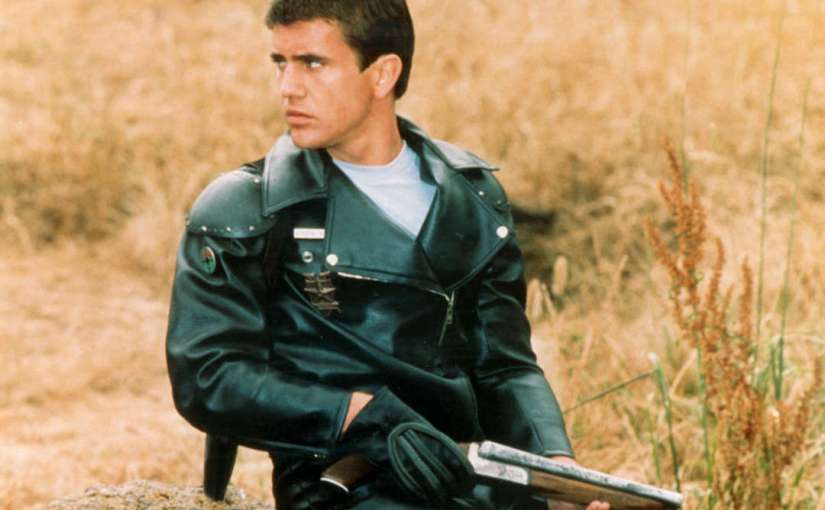
The appeal in 1979 and the years thereafter when the Max character blossomed into a franchise must have come from Gibson on film.  Yes, the stunts in this film with quick edit action pieces are daring.  I still think so forty years later.  This wasn’t CGI after all.  This was all the crunched up metal, rubber tires and flames that Miller could muster.  Still, the one artistic achievement had to be Mel Gibson’s image.  He wears the costume well.  A blue t-shirt enhancing his blue eyes under all black leather with a sawed off shotgun in his right hand while driving a souped up black Pursuit Special automobile with the engine sticking out of the hood.  Just writing that out reminds me of how iconic that image is, and this is before the similar looking Terminator that came along a few years later. Still, that’s where George Miller’s inventiveness stops. 

There is nary a character to consider.  The villains are nothing more than leather clad with bleached hair and dark mascara under the eyes riding Kawasaki bikes.  I know this was made with next to no money.  These guys don’t have to look like Darth Vader, but could they at least offer up something interesting to say?  Max has a couple of partners in the police squad.  They have no camaraderie.  One of them gets burned to a crisp.  Max takes a look at him in the hospital.  Why should I care though?  It’s not like I saw these guys share a Coke together.  Max is married.  They lie side by side each other in bed and their toddler sits on the floor nearby.  So?  Anything else?  Could one of them start a pillow fight or kiss or something, please?  A shoestring budget can still allow relationships to happen.  Miller doesn’t care about that though.  John Woo may show a nonstop bloodbath in any of his films with next to no story.  His films can work however, because he won’t get sidetracked with showing two people in their bedroom doing nothing.  He’ll remain focused on the mayhem.  Miller is not doing that here.  He shows a house with a bedroom.  Yet he doesn’t show the story in that bedroom that’s in that house.  That’s the difference.

I know the subsequent films in the franchise vastly improve upon the original Mad Max.  I’m just amazed they ever saw the light of day.  I’m more amazed that this became one of the most profitable films in worldwide history.  How did 1979’s Mad Max have the legs…no…the wheels…to maintain this ongoing velocity of interest?  What do I know?  I guess I’m a Debbie Downer for wanting people to talk to one another before handcuffing them to a gas guzzling fiery wreckage.  Is it too much to ask for a little sensitivity?

BEVERLY HILLS COP II

By Marc S. Sanders

I know. I know. I SHOULDN’T like this movie, but I do.

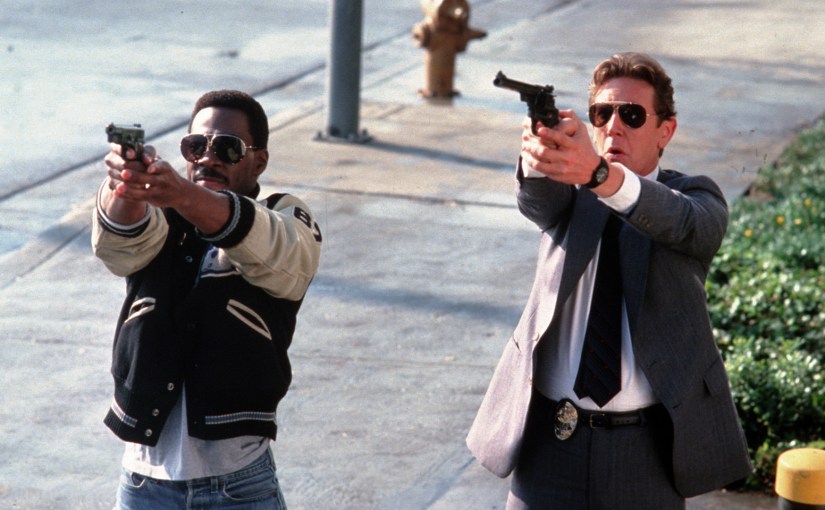
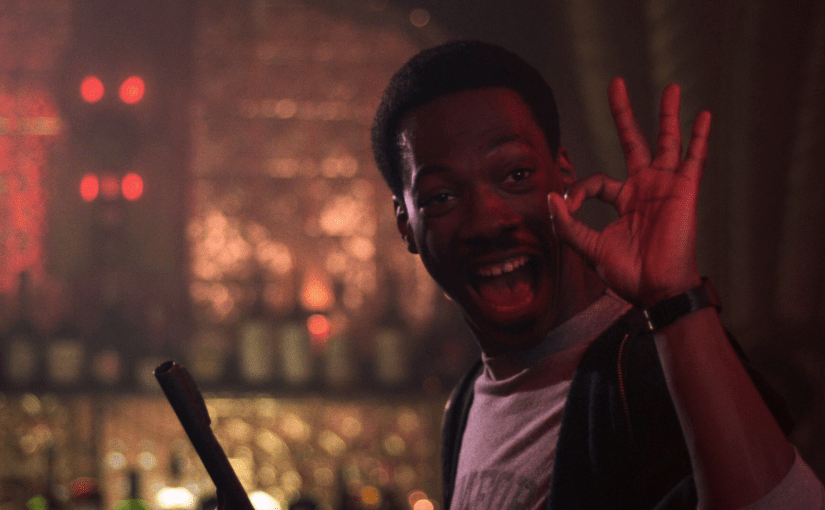
Beverly Hills Cop II is a sequel that is really an opportunity to see a wide variety of close ups of an Eddie Murphy who was well in his ‘80s prime, releasing one #1 movie after another. Here the viewer is treated to Murphy’s Axel Foley blowing a kiss to himself in the mirror, laughing to himself, tucking his crotch in his tailor made suit, flipping sunglasses on and off, driving a Ferrari, and shamelessly plugging the Detroit Lions all while trying to stop an “Alphabet Bandit” criminal in Beverly Hills, CA.

So there’s really not much here when all the vanity is on Murphy. Well, then what’s to like?

Considering I’m a fan of director Tony Scott, who uses great cinematography in all of his films with quick, tension filled editing, it’s hard to resist.  Most especially here Scott’s film is accompanied with an exceedingly cool and dangerous soundtrack from Harold Faltermeyer. Just the opening scene alone (without Murphy in it) belongs in a better movie. A robbery at a City Deposit bank and then later at a horse track are so well edited that you might tuck your knees into your chest and chew on your thumbnail. Great stuff from Tony Scott that would eventually carry over in films like Crimson Tide, Enemy Of The State, and one of my very favorites True Romance.

There are other good moments in Beverly Hills Cop II, especially a great scene with Gilbert Gottfried, and a few with Paul Reiser as well as a smirk inducing scene with Hugh Hefner.

I shouldn’t like this movie but sue me. It’s a guilty pleasure for me. However, watch the far superior first installment over this one any day of the week.

BEVERLY HILLS COP

By Marc S. Sanders

Who actually wrote the Oscar nominated script to Beverly Hills Cop? Daniel Petrie Jr and Danio Bach, or Eddie Murphy?

Murphy’s lines are delivered so fast and so naturally that it seems impossible they could ever rest on a page. Eddie Murphy is an enormous talent of word play and delivery. I miss this Eddie Murphy. I’m reluctant to welcome the Eddie Murphy of PG related fare of recent years. He just doesn’t look comfortable in that garb.

One of the first R rated films I ever saw in theatres (not THE first, as that honor belongs to the Clint Eastwood classic, Sudden Impact) still holds with its hilarity, and the credit does not belong to just Murphy but the whole cast including John Ashton, Judge Reinhold, Ronnie Cox and even early in career appearances from Jonathan Banks, Bronson Pinchot, and Damon Wayans.

I still haven’t forgotten this theatre experience when I joined my older brother, Brian and his friend Nick at the movie theatre in Ridgewood NJ. Never had I heard an entire packed room of people in the dark on a Saturday night laugh so hard together. It’s likely a moment that impressed my love for movies going forward. Movies could bring all sorts of joy and happiness and escape. Beverly Hills Cop was altogether another thing entirely.

Yes!!!! A foul mouthed cop from Detroit who becomes a stranger in a strange land while visiting Beverly Hills to solve his friend’s murder. That’s a film that’s had a great impact on me. As a writer, director Martin Brest’s film (later to do Midnight Run and Scent Of A Woman) offers a very simple blue print to allow Murphy to run wild. It cuts out a lot of complicated red herrings to just stay on a straight resolution. As Murphy’s Detective Axel Foley (great character name) comes across another development, in walks another great set up.

I compare the frame of Beverly Hills Cop and Eddie Murphy to the first Mission: Impossible film with Tom Cruise. The Cruise film makes a huge oversight. Early on it introduces a huge array of characters for an M:I team and then eliminates them all to hardly be used. It was wall to wall Tom Cruise. He was a producer on that film with much creative control and it felt to me as if he insisted on owning every scene, every line, every moment. It turned me off a little.

Murphy on the other hand plays along with his ensemble. Ashton and Reinhold have great moments all to themselves. I still die laughing out loud as Reinhold tries to subdue a situation by ordering an army of machine gun toting bad guys to lay down their weapons only to be silenced with another round of gunfire. The banana in the tailpipe! Ashton working with Murphy to stop a random robbery at strip joint, and then helping to save him later on from arrest. What about Ashton trying to climb a wall during a shootout?

Then there’s Murphy and Pinchot discussing a weird art piece (“Get the fuck outta here!”). Couldn’t you envision Pinchot and Murphy in another film together?  A shame it hasn’t happened.  (No, I won’t count the dreadful reunion in Beverly Hills Cop III.)

Brest provides great showpieces accompanied by one of the best film soundtracks ever. I will never not listen to “Neutron Dance” by the Pointer Sisters on Sirius XM’s 80s on 8 while recalling this film’s opening scene double rig truck chase. Brest directs a symphonic high energy blend of sight and sound. Plays like an awesome music video. Same goes for Glenn Frey’s “The Heat Is On.” If I ever get an opportunity to visit Detroit, that’s what will be playing in my head.

Orchestrator Harold Faltermeyer’s electronic keyboard deserves much credit as well. His covert, sneaky 5 note tune shaped the Axel Foley character. Faltermeyer only made Murphy even cooler during the heyday of “Miami Vice MTV Cops.”

Beverly Hills Cop remains one of the best films with the longest staying power of the 1980s. It’s a comedy. It’s an action picture. It’s music filled fun with great characters. It’ll always be Eddie Murphy’s best film. I can watch it again and again. I’ll never tire of it.

GOLDFINGER

By Marc S. Sanders

If From Russia With Love offered a promising future for James Bond, Guy Hamilton’s direction of Goldfinger solidified it. This is Sean Connery’s best representation of 007, and yet the only triumphant thing the character does is win a golf match against the title character, Goldfinger, played by Gert Frobe.

As good as the film is, ironically Bond does not succeed in any effort to thwart the diabolical plans of Auric Goldfinger, who intends to invade the gold depository located at Fort Knox. Bond doesn’t deactivate the bomb. He doesn’t successfully get his CIA allies on the right track. He doesn’t even do away with Mr. Goldfinger. Everything happens to occur circumstantially. James Bond just got lucky this time.

So then why is the third entry considered by many to be the best in the series?

Well, the movie is immense in its charm, and it pioneers the flavor of nearly ever Bond film released from here on out, at least until the coming of the blunt, brooding instrument of Daniel Craig.

The vile henchman, Oddjob, with his razor bowler hat introduced a staple needed for a winning film. Every bad guy had to have an unusual trait. Pussy Galore (Honor Blackman) set a more defined precedent for the Bond Girl. Even Shirley Bassey’s dangerously pounding title song carried a threat of the most sadistic villains to come.

Plus the gadgets are exceedingly fun. How do I know? Because time and again Bond returns toward using his classic Astin Martin DB5 with tricked out machine guns, oil slick and (I wouldn’t joke about this) ejector seat. 007’s moment with Q became a necessary ingredient in every Bond film following “Goldfinger.” Actually, I think Q is only missing from 2 or 3 films following this entry.

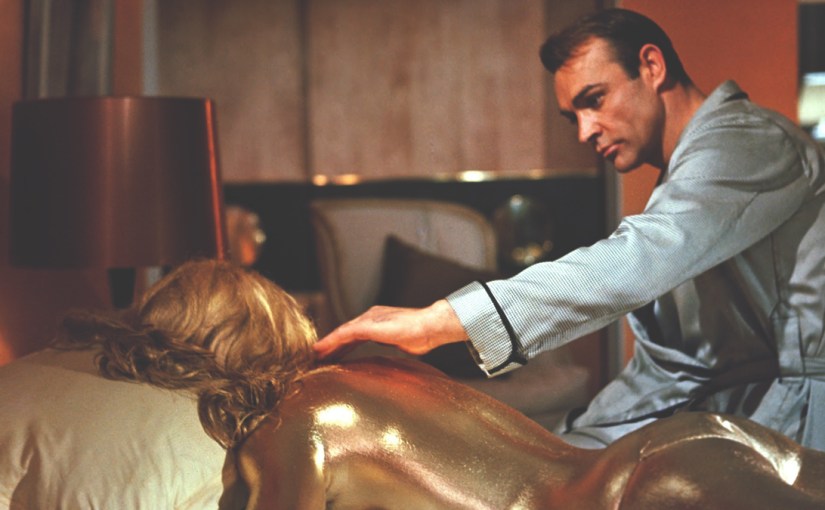
The tongue in cheek theme couldn’t be more apparent in this film thanks to Sean Connery. “Manners Oddjob. I thought you always took your hat off to a lady.” 007’s casual response to any threat, or what follows after subduing a bad guy, is such fun. What else would you say after you’ve electrocuted a guy in a bathtub?

“Shocking. Positively shocking.”