DR. NO

By Marc S. Sanders

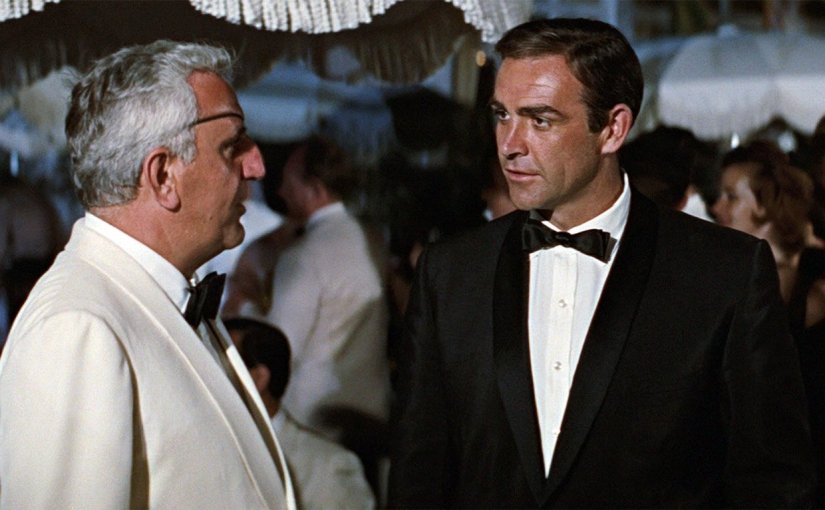
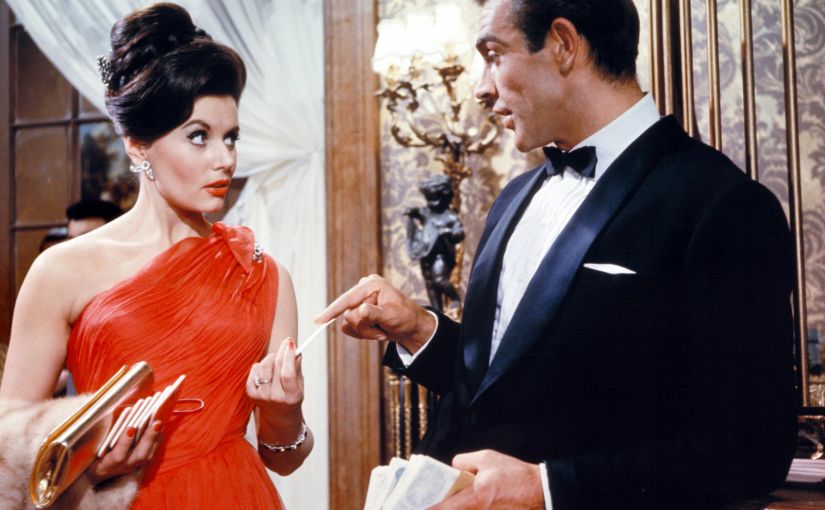
Sean Connery introduced the iconic James Bond, Agent 007, with a license to kill the way he should be (sorry Woody Allen); handsome, highly intelligent and perceptive, quick with fighting techniques and even faster with a beautiful woman.

However, one hero who gets overlooked is director Terence Young who must receive credit for changing the movie landscape. In 1962, sets like Dr. No’s Crab Key fortress were not often conceived in movies. Dr. No is a mysterious villain with limitless resources who serves a Dom Perignon ‘55 while revealing his sinister intent to Mr. Bond. To make him even more unnerving he is bestowed with a handicap of black steel hands to intimidate the hero. This is a scary villain.

Terence Young deserves much credit for a lot of this imagery. It would change how we see action/ adventure films for the latter half of the 20th century and thereafter. Bond’s first cinematic mission set a standard in adventure formula. Set up the threat or mystery, assign the hero to the job, cross him with an ally or two, give him a damsel in distress, interfere him with one bad guy after another. Indiana Jones, Luke Skywalker, Riggs & Murtaugh, Batman and even The Goonies follow this path time and again.

Dr. No doesn’t look so sophisticated a film these days in its cinematography and effects (a car chase consists of going around the same curve 3 times), but it’s storytelling still holds up and even managed to get my 10 year old daughter interested. That’s proof of its staying power.

NORTH BY NORTHWEST

By Marc S. Sanders

A story of mistaken identity becomes one of the grandest adventures on film with Alfred Hitchcock’s North By Northwest. The movie plays at such a fast pace, moving from one locale to the next and it all feels convincingly possible.

Before James Bond, there was the dashing Cary Grant in his sharp, fitted light grey suit (the best suit to ever be shown on film) portraying advertising executive Roger Thornhill who simply raises his hand in the air while meeting some colleagues at The Plaza Hotel in New York and is suddenly mistaken for a man named George Kaplan. Soon he’s forced into a car by two men and driven to an estate property belonging to someone named Townsend (James Mason) who implores “Mr. Kaplan” to cooperate or else. Suddenly, Thornhill who continues to insist he’s not Kaplan is on a cross country journey while escaping the authorities who want him for murder while he tries to prove his true identity and exonerate himself.

Cary Grant is dashingly fun with Hitchcock’s camera. It’s refreshing for a change to watch an innocent protagonist not lay on the heavy drama and panic so much. Hitchcock with Grant were going for a sweeping story of cat and mouse play.

What Alfred Hitchcock does best is put the viewer right in position of Thornhill. For the most part (definitely through the first forty minutes) the viewer only knows what Thornhill knows. We know he’s been mistaken for someone else and we are only given the opportunity to put a few names with faces and get a hold of a crumpled photograph. That’s all we and Thornhill have to go on.

Later on, it’s only fortunate that Thornhill comes upon one of Hitchcock’s celebrated blond actresses he was always reputed to cast. This time it is the incredibly striking Eva Marie Saint as Eve Kendall who becomes a willingly helpful train companion for Thornhill. Cary Grant and Eva Marie Saint make for a spectacular on screen couple. Their chemistry is so natural together.

Not much else should be said about the story of North By Northwest. The entertainment comes from what each new scene reveals. Hitchcock incorporates all the expected twists and makes sure to use a MacGuffin, of course. This time it involves a statue and microfilm. What’s on it? That does not so much matter really. It’s the need to pursue it that’s important. The pursuit is what drives the picture from New York City to the United Nations, all the way to a curious auction house for fine art and then on to the four famous faces of Mount Rushmore in South Dakota.

Naturally, Hitchcock is the master once again as he points his camera up close on Grant, Mason and Saint and then quickly will cut to one of their points of view to lengthen the suspense. Running after or away from something in the moment is where Hitchcock is very strong as a storyteller. It keeps you alert as a viewer. Very alert!!!

James Mason makes for a terrific villain as Townsend, or could he be someone else? He’s got that sneaky inflection in his voice and short build that makes for a great antagonist against Cary Grant’s tall stature. Mason’s sidekick, Leonard (a mysterious looking Martin Landau) is also a spooky guy to keep your distance from.

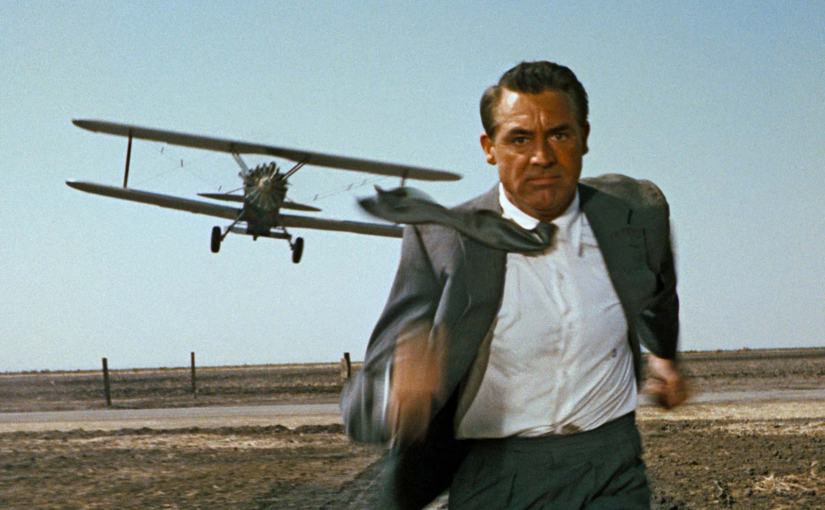
The most celebrated scene probably also contains one of the best captions caught in film. I speak of the very surprising crop duster chase. As Roger Thornhill finds himself in a quiet, Midwestern dirt road intersection, an airplane crop duster turns into a frightening menace. The best shot occurs as Grant runs quickly towards Hitchcock’s camera and the plane flies overhead rapidly getting closer in the upper left side of the screen. As Grant runs and runs, he fills more of the screen, but so does the crop duster. The editing alone is spectacular, as an oil rig eventually comes into play with Grant about to get run over. Story wise, I adore this scene as somehow the life of a man who routinely gets in taxicabs and hob nobs through New York City on a daily basis suddenly has found himself in a dusty field running for his life. What was never expected is suddenly all that matters to this ordinary man.

Hitchcock plays with what’s around to play with. Other than a quick gag in Superman II, l don’t recall many films incorporating Mount Rushmore as such an important element to its picture. Every crevice or ledge or finger hold is important to the edits of the climax in North By Northwest. When Eva Marie Saint is holding on for life, I truly believed she could actually fall. [SPOILER ALERT] Actually, Hitchcock wanted you to believe that as the very last scene doesn’t even truly reveal the solution to her predicament. I like his method of editing this way. Hitchcock seemingly offers no option for survival as Grant and Saint’s hands barely hold on to one another. The editing is just so damn good here.

I’d be remiss if I also didn’t recognize one of the greatest orchestral scores in film. Bernard Hermann’s stirring, fast paced rhythms keep the running man theme in play. The movie seems to play by the beats of Hermann’s conduction. Action films of the future seemed to adopt some measures from he did with this film.

North By Northwest will always remain as one Alfred Hitchcock’s best films. There is not one error in the picture. Every shot is done with deliberate intent to sustain the mystery of suspense. Humor is included even at times on a risqué and subtle measure. Alfred Hitchcock again invites the simplicity of storytelling to introduce the complexity of fear and mystery and outstanding suspense. Not many films compare to North By Northwest.

ETERNALS

By Marc S. Sanders

Was I dozing on and off during Marvel’s latest film, Eternals, or was I becoming interested and uninterested during a bloated running time of two and half hours?

As an avid comic book reader during the 70s and 80s, especially Marvel comics, I must admit I don’t know much about the team of gods known as The Eternals.  So, I went into this film kind of blind.  Reader, I don’t feel any more educated having seen the film.  These expressionless number of characters arrive on Earth 7000 years ago and apparently, they are assigned with protecting the planet’s course of events through history by fending off CGI monsters knowns as the Deviants, and that’s all they are supposed to do.  Allow the dinosaurs to perish.  Let Hitler do his thing.  Have Thanos snap his fingers.  Just take care of the Deviants. 

You know what the Deviants look like to me?  An early stage of computer graphics that we would see on a behind the scenes DVD documentary contained on the second disc of a Jurassic Park 25th anniversary edition.  The geeky visual effects wizard would show this deviant on his lap top as an early concept of a raptor or T-Rex.  I dunno.  Maybe it was the screening I saw at a Regal Cinema that soured me on the visuals in Eternals.  Everything seemed so dim and unlit at times.  When the Eternals are taking refuge in a woodsy campsite, that looks as simple as the Honey I Shrunk The Kids playground in Disney World, and a dino like Deviant roars and picks up a character with it’s tentacles only to toss the person into a wood shed, I felt like I was watching one of those 3D amusement park rides.  The computer animation blended with the human actors never flowed convincingly in this film.  This is maybe the worst looking special effects film in Marvel’s library of films. Nothing looks natural here. 

A small sect of the characters is interesting.  Most are quite boring actually.  Take Ikaris for example.  This guy, played by Richard Madden, flies and shoots powerful yellow laser blasts from his eyes.  Otherwise, there’s nothing I can say about his background.  He’s so unentertainingly morose and blah.  Sersi (Gemma Chan) is just the same, and yet she’s supposed to be more optimistic.  Almost twenty-four hours later and honestly, I forgot her powers or what she’s about.

Angelina Jolie is here too.  Moving on.  Salma Hayek is here as well, and yeah, moving on.

The most interesting character is the one causing controversy in the news over being the first Marvel super hero to have a gay kiss.  That’s only a fleeting moment and truly unworthy of causing any kind of uproar.  (Find something better to get pissed about people! Men fall in love with one another.  This is nothing new.) Brian Tyree Henry plays Phastos, who specializes in advancing technology over time that somehow becomes knowledge to the humans of Earth without him taking credit for it.  Phastos has a funny situation as he balances being a god on the planet for the last 7000 years, while also being a current day family man.  More so, he’s a tragically sad character.  The best moment (not scene, because regrettably it is not explored long enough) depicts Phastos gazing upon Hiroshima in 1945 following the dropping of the atomic bomb.  He can not help, as a god, to feel responsible for this outcome, while being consoled that this is not his responsibility to accept.  Remember Phastos, you’re just here to fend off dumb looking, unfinished monsters.

The other good character is Kingo (Kumail Nanjiani) – the god who eventually goes on to be a conceited and well-loved Bollywood actor/director.  Nanjiani is best used as the humor factor of the film with his tag along assistant cameraman (Harish Patel) who films all of the ongoing action for a possible documentary.  This is a good setup for a joke that doesn’t materialize well enough.

Marvel lent too much responsibility to its director Chloe Zhang, who to my knowledge does not have much experience with the big budget extravaganza films that’s expected of these installments.  Zhang was a large contributor to the script.  I’m going to take a guess and presume she’s not the comic book expert that say, Sam Raimi or Kevin Smith are.  She’s an Oscar winning director (Nomadland) who is a master photographer, but a film like Eternals tells me that if you take her out of the natural environments and put her in fantasy land computer graphics, you are not going to get the same thing.  This is like asking a guy who flips burgers at McDonald’s to prepare a $200 well aged Filet Mignon.  With Zhang directing this film, reader you are just not getting your money’s worth.

Everything seems very flat in Eternals.  The script is repetitive.  The narration of the story is that the team gradually reunites with one another following the unexpected death of one of their members.  When the characters do meet up with each other though, they explain the same news again and again and again.  This might be the way it is in real life when your 99-year-old grandfather kicks the bucket and you make one phone call after another.  However, in a film that luxury is not necessary to move the picture along.  Audiences are much more intelligent than this film gives credit.  They’ll make the safe assumption that when Phastos comes on the scene, he’ll have been caught up to date.  Yet, the picture ignores that opportunity of convenience, and just needlessly stretches the running time.

Eternals is not The Avengers.  These guys are boring.  They are written boring.  For the most part, they are acted boring.  There’s no sarcasm or biting insults among them.  There’s hardly any affection among them either, or even hate.  Think even beyond the Avengers for great team ups. Consider Daniel Radcliffe, Emma Watson and Rupert Grint in the first Harry Potter film, or Han, Luke and Leia in the original Star Wars trilogy.  There’s a chemistry to those characters that’s not in the Eternals; a love/hate relationship of jabs and hugs among the peers.  Even when they sit around a table for dinner, the most interesting thing the Eternals can talk about is who is going to take over the Avengers now that Iron Man and Steve Rogers are no longer around.  These folks have been separated from themselves for the last couple of thousand years or so.  Don’t they wanna catch up with one another, and maybe talk about themselves and what they’ve been up to?

The other issue with the film is the constant time jump from the times of B.C. to present day back to B.C. to early 20th century to present day and on and on.  This isn’t a Quentin Tarantino film where the fun is in piecing these moments together.  These time jumps have no impact.  I’d argue that it might have been more effective to just begin at the Eternals’ arrival on Earth and go through time chronologically.  Take me on a 7000-year journey.  Let me see what I can uncover.  For an observational director like Chloe Zhang, this is a missed opportunity here.  She could have demonstrated how the Eternal characters develop over time and get mixed up in side stories like becoming a private school teacher, or a loving dad or a film maker.  Then you have an arc to each of these misfits.  You’ll even have an arc to the planet Earth, and that could be very cool.  Don’t know what I mean?  Look at Zhang’s Nomadland from last year or Terrence Malick’s The Tree Of Life, or even Kubrick’s 2001: A Space Odyssey.  Eternals could have better demonstrated how history has an impact upon itself.

Within the Marvel lexicon, this is not a necessary film.  It quickly dismisses the biggest story that came down the pike with the Thanos character causing all kinds of trouble, and then settles into its own mire.  In other words, who asked for this picture?  I have to wonder if Marvel films are finally jumping the shark or crawling from under the dumpster (remember Glenn from The Walking Dead).  Have they used up all of the hot properties, that Disney owns at least, and are now settling for these minor characters?  Maybe or maybe not.  After all, the best parts of Eternals, for this comic book reader at least, were the post credit scenes.  Still, I didn’t pay $12.00 to wade through two and a half hours of sleep-inducing material just so I could catch a glimpse of two vague teaser moments either.

HARRY POTTER AND THE GOBLET OF FIRE (2005)

By Miguel E. Rodriguez

Director: Mike Newell
Cast: Daniel Radcliffe, Emma Watson, Rupert Grint, Ralph Fiennes, Brendan Gleeson
My Rating: 9/10
Rotten Tomatometer: 88% Certified Fresh

PLOT: A young wizard (Radcliffe) finds himself competing in a hazardous tournament between rival schools of magic, but he is distracted by recurring nightmares.


[DISCLAIMER: This review will more than likely contain spoilers, as well as Potterhead references galore.  I apologize in advance.]

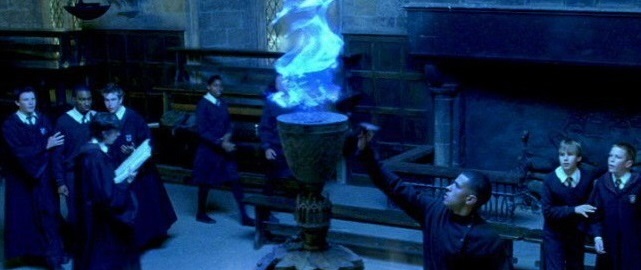
When I first saw this movie, I grieved over how much of the enormously entertaining book had been sacrificed on the altar of box office viability.  Why not make two films out of it?  (Which they did later on with the final book, of course.)  What happened to Winky?  What on earth is going on with the tournament scoring?  (Seriously, try to keep track of it…it makes no sense in the film.)  Where’s the subplot about how Rita Skeeter obtains her inside information?

Watching it again years later, for perhaps the 6th or 7th time, I think I’m a little mellower.  Comparing a movie to its source material is a fool’s errand.  There’s a great story about how, years ago, someone complained to Raymond Chandler how Hollywood had ruined his book, The Big Sleep.  Chandler calmly pointed to a bookshelf, and said, “Well, there’s my book right there.  Hollywood didn’t ruin it.  It still exists.”  (I’m paraphrasing, to be sure.)

So.  Movies and books, apples and oranges.  To quote Carl Weathers in Predator: “It comes with the job.  I can accept it.”

Having said all that, I think the best way to give my impression of the film of H.P.a.t.G.o.F. is to list what it gets right and what it gets wrong.

RIGHT: The second task, involving hidden treasures in the Black Lake.  I loved the look of the mermen and mermaids and the hinkypunks.  This scene managed to captured almost exactly what I saw in my head when I read the book.

WRONG: The first task, involving retrieving a golden egg.  We see FAR too little of how the other contestants fared in their attempts, jumping right past the first three just to see what Harry does.

RIGHT: “Mad-Eye” Moody.  I’ll never be able to read the books again without seeing Brendan Gleeson’s magnificent performance in my head.  That amazing enchanted eye, the facial tics, the glee with which he transforms a student into a ferret…it’s perfect.

WRONG: The Yule Ball.  As it appears in the film, it literally brings the movie to a halt.  It’s all about the interpersonal relationships between Ron, Hermione, and Harry, but nothing happens to move the plot forward.  I can’t help thinking there was a better way to stage this pivotal event.

RIGHT: The events in the graveyard.  I can recall vividly the moment when I read the words, “He was dead” in the book.  I sat up on the sofa, my eyes grew wide, and I exclaimed out loud, “Holy s**t!”  The movie gets this entire sequence right.  As I recall, the graveyard covered two or three entire chapters in the book, and the film condenses it nicely into a 10-minute sequence.  (Approximately.)  It’s the moment, in both the books and the films, when the franchise became much more than “kid stuff.”

WRONG: Snape’s role in the film.  The movie curiously omits the incredibly relevant moment in the book when, after Dumbledore observes the Dark Mark on Snape’s arm, he tells him, “You know what to do.”  And Snape nods curtly and leaves the room.  That comes into play to a GREAT degree in the latter stages of the franchise.  Ah well.

And I’ll leave it there.  I could go on.  All in all, it’s a good film, a great spectacle, and a turning point for the series.  They could have called it, Harry Potter and the Advancement of Maturity.

ZATHURA: A SPACE ADVENTURE (2005)

By Miguel E. Rodriguez

Director: Jon Favreau
Cast: Josh Hutcherson, Dax Shepard, Kristen Stewart, Tim Robbins
My Rating: 9/10
Rotten Tomatometer: 75% Certified Fresh

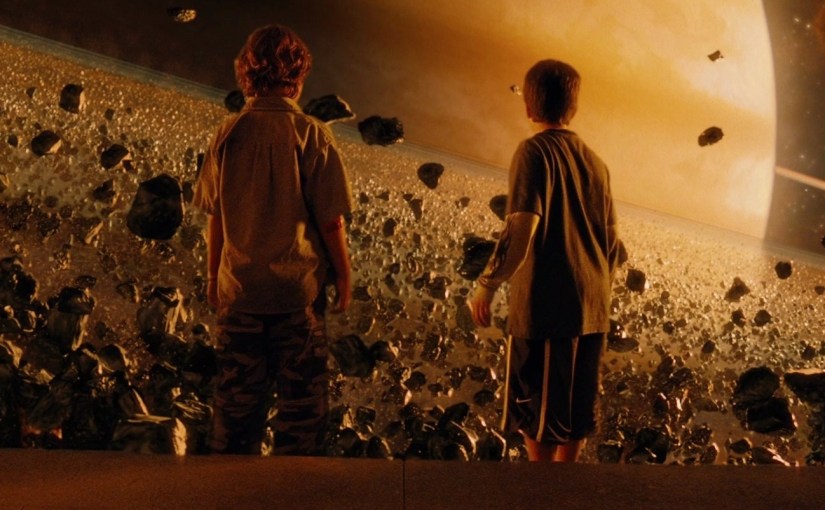
PLOT: Two young brothers (Hutcherson, Jonah Bobo) are drawn into an intergalactic adventure when their house is hurled through the depths of space by the magical board game they are playing.


If only all family movies were like this.

Too often, so-called family films are mealy-mouthed cream puffs that appeal to the short attention span of their target audience, leaving the parents either bored to tears or fatigued from sitting through 90 minutes of explosions.  The scripts are subpar and tend to treat kids as if they’re not all that bright.

Not Zathura.  With his third film (after the forgettable Made and the Christmas neo-classic Elf), director Jon Favreau proved that he’s the real deal.  Here’s a REAL family film with something for everybody: comedy, family drama, peril, thrills, a killer robot, fearsome aliens, and nostalgia.

The nostalgia part is especially notable.  The board game at the center of the film is constructed to look like something made in the ‘50s or ‘60s, which, to the kids in the film, is practically ancient history.  But for me, I found the film nostalgic in the way it captures the kind of fun I used to have at the movies.

Not that I don’t still have fun, mind you.  It’s just that, when I was a kid, sci-fi and fantasy films felt more real, you know?  It was so easy to imagine myself as a resident of the Goondocks, or discovering an alien in the cornfield behind my house, or building a spaceship in the backyard with my two best friends.  Zathura captures that kind of feeling like few other modern family films can.  It’s a movie that has the potential to live on in the imagination after countless other films have vacated your consciousness.

And the VISUALS.  I don’t know what kind of budget the movie had, but it looks like a $100 million movie.  The killer robot is absolutely convincing, as are the aliens.  Which brings up another great element of the film: danger.  The bad guys in this movie may occasionally look a little cartoony, but they are not to be trifled with.  That’s something a lot of kid’s movies tend to get wrong.  The filmmakers lose their nerve in creating real villains, for fear of pissing off too many parents.  In reality…dude, kids can handle it.  Give the bad guys fangs and spinning saw blades.  It just makes it that much more satisfying when the bad guys LOSE.

Zathura barely made its money back, and that’s including domestic AND worldwide grosses (okay, I looked it up).  I could be wrong, but I’ll bet too many people thought it was a Jumanji ripoff.  It IS based on a book by the same author as Jumanji (and The Polar Express, as it happens).  But it is possible, I think, to see Zathura in its own light.  It’s a fantastic movie that will please all ages.

QUICK TAKE: Serenity (2005)

By Miguel E. Rodriguez

Director: Joss Whedon
Cast: Nathan Fillion, Gina Torres, Alan Tudyk, Summer Glau, Adam Baldwin, Chiwetel Ejiofor
My Rating: 9/10
Rotten Tomatometer: 83% Certified Fresh

PLOT: The crew of the ship Serenity tries to evade an assassin sent to recapture one of their members who is telepathic…and perhaps something more…


In a perfect world, Han Solo would still have shot Greedo in cold blood, not self-defense.  Universal would have stopped with Jaws 2.  Heath Ledger would still be around for at least one more Dark Knight film.

And in that perfect world, Serenity would have spawned two more films, each better than the one before, for a trilogy that would be in the conversation for greatest science-fiction franchise ever.

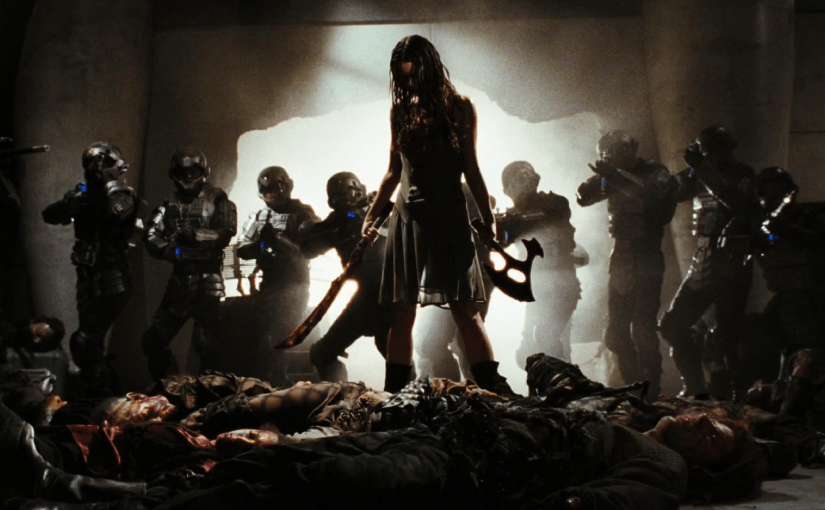
I do not say this as a fan of Firefly, the short-lived, devoutly-worshipped television show upon which Serenity is based.  When I first saw this movie in 2005, I had no idea why the pilot had dinosaurs on the cockpit dashboard.  I didn’t know why it was such a big deal to see River Tam, this wisp of a girl, performing intricate fight scenes right out of a Jackie Chan movie.  I didn’t know why the characters sprinkled Chinese or Japanese phrases in the middle of their dialogue (sometimes cursing in those languages).  Or why they talked like it was the old West instead of hundreds or thousands of years in the future.

Know what?  It didn’t matter.  Serenity is so well-made and well-written that, after the two main opening sequences, I rolled with it.  I had an immediate sense of the vast history of this “used” universe and the characters within it.  In this world (taking a cue from “Star Wars”), the good guys fly rust-buckets, not sterile starships.  It’s a pure visual pleasure from start to finish.

The great story, screenplay, acting (from actors who are clearly enjoying themselves), effective usage of visual effects, genuine surprises, and one bona fide shocker that had audiences gasping and yelling at the screen…it’s all here.  Shiny!

TRANSPORTER 2 (2005)

By Miguel E. Rodriguez

Director: Louis Leterrier
Cast: Jason Statham, Alessandro Gassman, Amber Valletta
My Rating: 6/10
Rotten Tomatometer: 51%

PLOT: An extremely skilled mercenary driver (Statham) is implicated in the kidnapping of the young son of a powerful USA drug official.


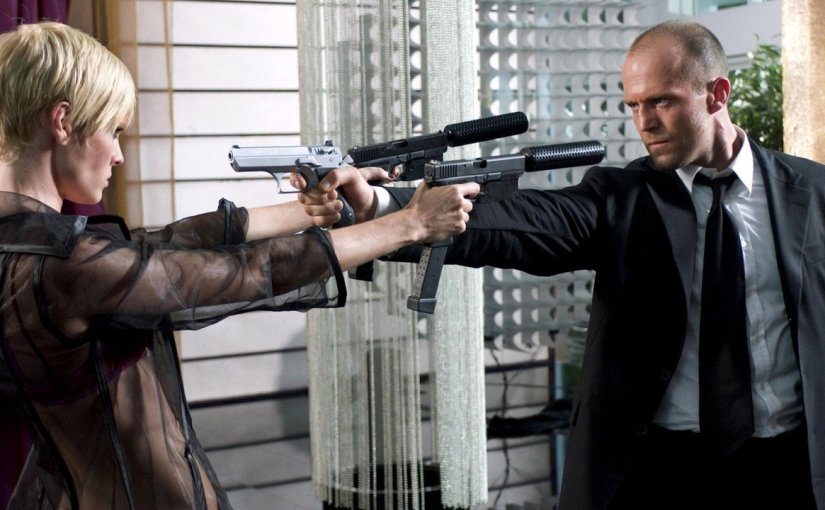
When an action film includes a shot of the good guy flipping his car off a ramp so a dangling crane hook can clip off a bomb stuck underneath the car mere SECONDS before it goes off…you either laugh and roll with it or scoff and leave the theater.  I laughed.

Transporter 2 is an example of a movie not really intended for American audiences.  From top to bottom, this is a European action movie, made in the States with the kind of budget unknown in foreign studios.  It was produced by none other than Luc Besson, director of cult classics like Léon: The Professional and The Fifth Element.  Here he farms out directing duties to Louis Leterrier, a genre specialist known for Jet Li’s Unleashed, the original Transporter, and, later on, an honest-to-God entry in the Marvel Cinematic Universe, The Incredible Hulk.

This movie is utter junk food.  It aspires to the kind of delirious cartoonish heights that would later be achieved by Shoot ‘Em Up (2007), but it fails due to too many breaks in the action.  And if you have too many breaks in a movie that’s barely 80 minutes long, something has gone wrong at the screenplay level.  In a movie like this, adding depth of character just gets in the way of the action.

The action itself, while mildly stunning visually, is too sparse.  There’s an extended fight scene in a basement that’s imaginative and well done, making creative use of a fire hose.  There’s a one-sided gun battle in a doctor’s office.  The lone car chase in the film sees the infamous building-to-building car jump from Lethal Weapon 2 and raises it.  And, of course, the bomb-removing flip to a crane.  (I can’t even discuss the finale aboard a plummeting private jet without wincing.)

Other than that, not much here, folks.  For me, this is an all-too-obvious guilty pleasure, something to toss into the player and jack the volume up so the gun battles rattle the walls.  The absurdity of the action allows the movie to flirt with camp classic status, but I usually just fast-forward to the parts where stuff gets blowed up real good.

SHANG CHI AND THE LEGEND OF THE TEN RINGS

By Marc S. Sanders

Marvel’s installment of Shang Chi And The Legend Of The Ten Rings boasts a good cast and set up for an Asian superhero and his band of allies.  I only have one question, couldn’t some of this stuff have waited for the sequel?

Dave Callaham and Andrew Lanham wrote an adventurous screenplay for Destin Daniel Cretton (Just Mercy) to direct.  It’s fun and frolicking with magnificent action set pieces that take place on an out of control metro bus on the streets of San Francisco (where every out of control vehicle or car chase work best) and later on a high rise scaffolding in Macau.  While some sequences easily reveal the CGI work at play, the edited choreography of these martial arts scenes work beautifully. 

During the bus sequence, spread eagle jumps and high kicks and low punches by Shang Chi (Simu Liu) are done like a fine dance number as he fights off a gang of thugs who are mysteriously after the pendant he wears around his neck.  Comedienne Awkwafina plays Shang’s best friend Katy who rides the bus crazier than Sandra Bullock ever did.  Later the pursuit of the MaGuffin pendant leads into a meet up with Shang’s equally capable sister Xu Xialing (Meng’er Zhang) and the high-rise scaffolding fight occurs.  Marvelous work in both of these scenes.  The CGI is certainly forgivable.

After that, the film calms itself down to bridge some exposition that was revealed in the prologue of the film.  Shang and Xialing seem to have some parental issues.  Their father Xu Wenwu (Tony Leung) somehow acquired a set of ten magically powerful rings that he wears on both forearms.  Like other rings in fantasy/adventure films, these items take out armies and do nothing but conquer.   For once, could these powerful items just make a cup of hot tea or a decent wax job on my car?  When Wenwu uncovers a hidden majestic location to take over, he meets and becomes smitten with Ying Li (Fala Chen).  They fall in love and you’d think they’d live happily ever after, but if that were the case then there would be no movie.    

Beyond what’s described here, not much else mattered to me with this film.  The rings might as well have been Thor’s hammer or Captain America’s shield, or a Maltese Falcon.  A large, epic and very, very long climactic battle takes place so that one of Hollywood’s better known Asian actresses (Michelle Yeoh) can come into the picture and fight.  There’s also a return of a relatively unfavorite character from the Marvel Cinematic Universe, Trevor Slattery (Ben Kingsley), the fake out terrorist from Iron Man 3, that pissed off a collection of die hard Marvel geeks yearning for an appearance of the known villain called The Mandarin.  Shang Chi reminds us that this once reputably “threatening” villain is named after an orange.  Yup!  Get over it.  He’s as scary as an orange.  Moving on!  Beyond these appearances, are kaleidoscopes of colorful fantasy creatures like flying serpent dragons and furballs with wings and no face, as well as lion like four legged creatures.  Plenty of stuff for Disney/Marvel to merchandise.

I was seeing a story in Shang Chi, and then I wasn’t.  The long battle sequence goes on and on and on as a means to show off new toys and stuffed animals for the kids.  It all looks very good but it doesn’t lend credence to any storytelling like say in The Lord Of The Rings fare, where an Org could progress a story.  Here, it’s all overkill. 

The strength of Shang Chi And The Legend Of The Ten Rings lies in an enthusiastically fun cast and the outstanding martial arts moments that are presented.  The fantasy material is too much icing on the cake.  The graphics are good and all but couldn’t that fantasy stuff have been held for another film later on perhaps?  Go with one thing first and then another thing next, because after a while I forgot what kind of movie I was watching and why.

The cast is fine in their roles.  Just fine though.  Simu Liu has the athletic build for the title character.  He looks sharp in the costumes and fight sequences.  Though the fantasy material really takes away from the ranges that we could have appreciated from as an actor.  It’s clear this script is not giving him the same rightful opportunities for good super hero acting that was awarded to Robert Downey Jr or Brie Larson.  Equally same goes for Tony Leung and Meng’er Zhang.  They kind of plain jane.  Awakwfina is given the most to play with for the escapist humor as a fun loving karaoke singer and crazy valet driver.  Later, she quickly becomes an expert archer.  Good stuff there. 

Let’s face it the Asian community sect within Hollywood is not as well represented as it should be by now.  Box office numbers of the past have more than justified a need for Asian culture to be front and center in mainstream films.  There’s been some highlights in the past, most namely with the work of Bruce Lee and Jackie Chan, and films of merit like Crouching Tiger, Hidden Dragon and Crazy Rich Asians.  It’s pleasing to know that Marvel Comics created a character like Shang Chi back in the late 1970’s.  It just wasn’t capitalized back then as a marquee name like the Hulk or Spider-Man.  Still, Disney and Marvel could have tried a little bit harder here.  Just when I thought we were getting some dimension and checkered past subject matter for Shang Chi and his family to struggle with, Cretton’s film diverts into visual CGI fantasy Candy Land with no depth or substance. 

My recommendation on the next installment, is for Marvel and Disney to dig deeper.  I know there’s a wealth of storytelling here.  So, use a bigger shovel that’ll dig itself all the way to China.

INGLOURIOUS BASTERDS

By Marc S. Sanders

If you are going to rewrite history then go crazy.  Go big and bloody.  Go for broke.  Don’t hold back.  Quentin Tarantino didn’t hold back when he penned and directed Inglourious Basterds, my personal favorite of his films.

To date of when this review is published, Tarantino has directed nine films and if ever the maturity of a director is so evident, it really shows with Basterds where three quarters of the picture is performed in either French or German.  English is secondary here, and Italian is limited to only a couple of “Bonjournos!”  and “Gorlamis!”

Tarantino presents early 1940s France when Germany occupied most of the country and practically rounded up all of the Jews.  In 1941, a cunning detective of a Nazi Colonel, Hans Landa (Christoph Waltz performing as one of the greatest villains of all time) visits a French dairy farmer to ensure there are no unaccounted-for Jews scurrying around; scurrying around like their beastly equivalent, the rat.  Landa is the hawk that will most assuredly find them.  This scene is the best written moment within Tarantino’s catalog of various scripts and dialogue exchanges.  The Landa character offers justification as to why a Jew needs to be exterminated to the point that he nearly had me (a conservative practicing Jewish man) believing in his hateful philosophy.  The lines crackle here with Waltz doing most of the talking while the sad dairy farmer can do no more than respond with certifying Landa’s interesting points.  Tarantino closes the peaceful discussion with horrifying violence though.  Hans Landa may be complimentary of a farmer’s milk and his three beautiful daughters.  He may be eloquent in his dialogue albeit French, German or English, but he is a ruthless enforcer of law …of Nazi law at least.  I also would like to note Tarantino’s tactful way of using props like the pipes the characters smoke, the glass of milk that is consumed by Landa and the ink pen and spreadsheet he uses for accounting of the Jews in the area.  There’s an uncomfortable intimidation in all of these items as they are handled by Waltz, the actor.  Later in the film, Waltz will send a chill down your spine as he happily enjoys a delicious strudel with whipped cream.  Inglourious Basterds is a great combination of directing, editing, cinematography and acting.

The film diverts into a few separate stories, namely the title characters led by Aldo “The Apache” Raines, played with Tennessee redneck glee by Brad Pitt.  The Basterds consist of mostly Jewish American soldiers tasked with going deep into enemy territory and literally killing and scalping one hundred Nazi soldiers, each.  However, keep at least one alive during each encounter with a carved souvenir on their forehead, to spread the word of the Basterds intent.  This is deliberate B movie Dirty Dozen material and it works because it doesn’t take itself seriously.  Tarantino maintains that pulpy fiction narrative.  A cut to an over-the-top crybaby Adolph Hitler asks, “What is a Hugo Stiglitz?” and then we get a quick pause with big black block letters across the screen spelling out HUGO STIGLITZ.  This guy is a bad ass; a German turncoat who only wants to kill fellow German Nazis.  He’ll shoot them up until they are dead three times over.  He’ll stab them in the face twenty times through a pillow.  He’s not a suave killer.  He likes it violent and bloody messy.  The Basterds are fans.

The heroine of the film is Shoshanna (Melanie Laurent), a Jewish girl who is living undercover as a cinema owner in France.  By implied force she is tasked with presenting Himmler’s proud film of Nazi Germany’s finest war hero, Fredrick Zoller (Daniel Bruhl), recreating his bird’s nest three day sniper battle against an army of three hundred men.  This is where Tarantino does best at writing what he knows, and what he knows best is anything about cinematic film.  He literally uses his knowledge of film and film reels to bridge his story while setting Shoshanna on a mission to actually end World War II in one swift motion.   

In addition, he captures the adoration of film lovers and celebrity status.  Zoller is as heroic a celebrity as John Wayne or Zorro.  When he is recognized in the coffee houses or on the street, he humbly stops his ongoing flirtation with an uninterested Shoshanna, to give an autograph or pose for a picture.

Furthermore, Tarantino applies the scientific knowledge of how 35mm film is more flammable than paper as well as how to edit a film reel to an unexpected moment for Shoshanna’s Nazi audience.  He knows the architecture of a European cinema with its lobby and balconies and seating capacities.  He allows his characters to speak on an intellectual level by discussing great film artists of the time – filmmakers not as well-known as Chaplin here in the United States, but just as great or even artistically better. The art direction of the cinema both inside and out is adorned with washed out, distressed classic noir films.  Shoshanna changes out the lettering of the curved marquee top of the theater as well.  It might sound mundane, but to me it’s all atmospheric.

Beyond the subject of cinematic art, a bad guy will weed out a spy disguised in Nazi garb by recognizing how he signals for three drinks with his hand.  There’s a right way and a wrong way to place an order with a bartender.  Inglourious Basterds may be a fictional historical piece, but it also will give you an education. All of this reminds me that Quentin Tarantino has graduated from the simplicity of Reservoir Dogs to something bigger and grander and glossier.  Production money with a large budget will lend to that status of course, but Tarantino still had to learn to truly know what he was doing.

I will not spoil the ending here.  It’s a bloody blast for sure.  Moreover, it’s shocking.  If anything, Inglourious Basterds introduces an exclusive universe that resides in the mind of Quentin Tarantino where the textbook is thrown away, burned, riddled with bullets and blown up; it is where something else altogether happened, and you know what? I really wish it did actually happen this way.

SPIDER-MAN: INTO THE SPIDER VERSE

By Marc S. Sanders

Spider-Man: Into The Spider Verse is a spectacular new take on a beloved American tradition.

You know you are in for something good when Peter Parker’s Spider-Man introduces himself by reminding the audience how we know his story and the impact his alter ego has had including a cheesy street dance (Spider-Man 3) and an awful looking popsicle stick from the neighborhood ice cream truck. Then it swiftly jumps to a Brooklyn kid named Miles Morales, a good student who loves art and loves his mom and dad as well, even if he gets embarrassed to be seen stepping out of his dad’s patrol car.

Miles resides in one universe that we soon learn is separate from other universes that each have a spider version of their own. Look out though, because the universes are about to collide thanks to the dastardly Kingpin.

I’ll save the rest of the storyline for you to check out. There are some terrific surprises embedded in Miles’ journey to becoming a Spider-Man mixed with tragedy and surprising humor.

The animation took me a little to get used to but it was not a challenge. It’s a slick rainbow of different splashes of color. The action moves fast and I even got chills when a variation of Peter Parker encourages Miles to take a leap of faith, a moment that is inspiring for any young kid no matter if they are a boy, girl, White, Black, Hispanic or whatever.

Spider-Man: Into The Spider Verse reminds you that you can be whatever you want to be. Nothing and no one can stop you. Sure, its lesson sounds trite and done before but this film allows you to soar through inspiration. It’s difficult to describe the exhilaration, really. You have to see it for yourself to understand. Some might not accept this interpretation of the wall crawler. Some will embrace it. I never expected to love this film as much as I did. I was reluctant to see it and only opted to do so, once the incredibly positive reviews came out. This film is worthy of its praise.

Spider-Man: Into The Spider Verse might just be the best animated film of 2018.