WALL·E

By Marc S. Sanders

There are some movies that seem to accurately predict what we can expect of our planet’s future.  Paddy Chayefsky was one such prophet with his script for Network and the rampant consumption of television influence and addiction.  Author Phillip K Dick might have also been a Nostrodomus of sorts when his writings were adapted into such films as Total Recall, Minority Report and Blade Runner which offered convincing convenience to lifestyles and evolved productivity.  Perhaps the imagineers behind PIXAR are also on to something because their adorable, futuristic WALL·E does not seem so farfetched.  

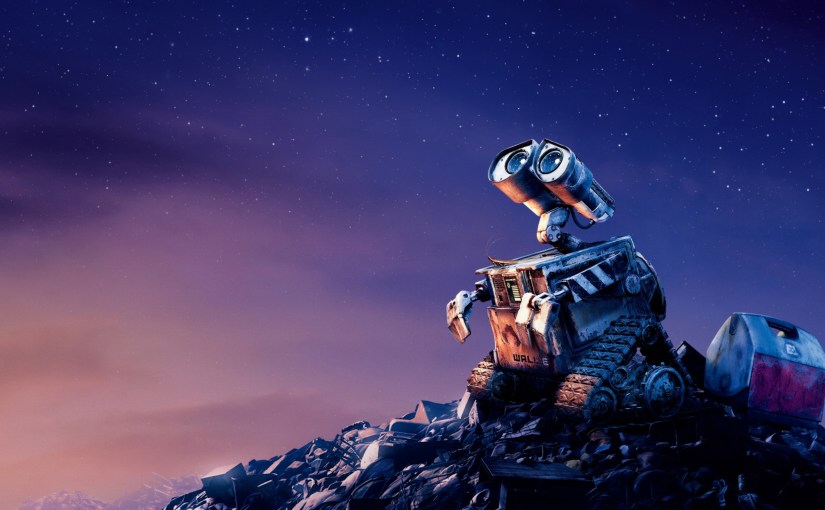
The robot title character is a trash collector on an abandoned planet Earth seven hundred years into the future.  A Wal-Mart/Sam’s Club amalgamation known as the fictional Buy N Large appeared to have become the main resource for any immediate need of the human population that once existed; what the coming of Amazon is turning into. This monopolized interpretation of absolute capitalism was run by a CEO and maybe Commander In Chief of the free world, played by Fred Willard, the one major flesh and blood actor to appear in this picture. 

WALL·E, along with a faithful cockroach, roams the wastelands.  The puppy dog, bug eyed robot wheels around on his tractor legs collecting the endless amounts of leftover trash and compacting it into neat, stackable boxes.  Piled on top of each other, these boxes get as high as skyscrapers.  These are the remnants from what Buy N Large left for the planet.

One day a rocket ship arrives and drops off a highly sophisticated and glossy white droid that we come to know as EVE.  For WALL·E, it’s almost love at first sight even though EVE has a treacherous laser cannon for an arm and intimidating blue cyborg eyes.

Eventually, the two bots hitch a ride into space when the rocket returns to pick up EVE.  They arrive on a galaxy cruise liner that’s floating through the solar system.  While the two get into a bunch of Looney Tunes shenanigans running through the corridors and piping of the ship, the audience bears witness to what exactly happened to planet Earth, and who has survived to carry on.  At this point a prophecy seems to be declared by writers Andrew Stanton, Pete Docter and Jim Reardon (all PIXAR regulars at the time).

Humans aboard this liner have become oversized, lazy blobs with no neck, fat arms, fingers and legs, and reclined to permanent seats while robotics cater to their hungers and comforts.  These people are cheerful but happily lazy and unproductive.  Remember when your mother would tell you to clean your room?  Well, the wasteland universe of WALL·E bears justification for mom’s aggravation and constant pestering.

The computerized animation of this PIXAR romantic adventure is dazzling in details and character expression.  There’s an unattractive sand like and earth tone mood to anyplace we explore on Earth.  Yet, the industrial sheen of the cruise liner appears to have all the comforts imaginable.  You can practically taste the colors and feel the balmy air conditioning within this ginormous vehicular city in space. Yet, the telling story of WALL·E has no problem convincing me that this is not right.  This is not a future I’d want to be a part of.

Disney and PIXAR follow that mentality of ensuring a soul of emotion drives their characters of fantasy and it’s easy to fall in love with the clunky lead robot.  You want WALL·E to be safe from sandstorms, while also keeping his only friend, the cockroach, by his side for companionship in an entirely lonely world.  His only other source of cheerfulness comes from watching the musical Hello, Dolly! on an old TV. Even playing ATARI’s Pong is not stimulating enough for this little guy.

Sound Effects Wizard Ben Burtt, who pioneered staple sci fi elements with the Star Wars films, performs the vocal expressions of chirps and beeps for WALL·E’s innocence.  There’s a language to the little fella and it’ll leave a lump in your throat when he calls for EVE.  Elissa Knight brings a more experienced, technologically up to date personality to EVE.  We worry when an organized entity like EVE robotically screams for WALL·E when she thinks he’s in danger.  She’s only supposed to follow a program, but the manufactured mind lends to a side effect of genuine emotion.  As the two get acquainted with each other, there’s a touching chemistry to them both.  A floating dance through space is as much silly as it is adorably romantic.  You cannot help but smile because by this point you are invested in this relationship as much you’d buy Rick and Ilsa’s affections towards one another, or Harry and Sally’s.

I really embrace the childlike love story connecting these two non-living beings.  Set against what appears like an apocalyptic wasteland, there are layered dynamics to this animated film, one of PIXAR’s best.  

I have to also salute the film’s nods to classic science fiction that also offer not so unrealistic possibilities.  An antagonist comes in the form of a robot similar in appearance to HAL-9000 from Kubrick’s 2001: A Space Odyssey.  He’s a nasty bugger with an all too familiar blood-red eye. It’s also a delight to recognize Sigourney Weaver’s voice as the cruise liner’s computer, a sort of slap in the face to monochromatic computers that would countdown a certain doom for the actress’s most famous role of Ellen Ripley in the Alien films.  PIXAR has always been brilliant with their wink and nod delights.

The film was released in 2008, a near generation ago maybe, when iPhones and Androids were not even as entirely sophisticated as today.  Yet PIXAR could telegraph what was to come.  The environments on Earth and on the cruiser tell us just how overly reliable we’ve become on technological conveniences for socializing or even one stop shopping.  

We are getting to a point where we might not even procreate with one another.  It’s a sad irony that it will take two self-thinking, yet designed for programing, robotic appliances to remind us how valuable the human touch is and what a purpose to life really serves ourselves and those we have to interactively live with.  

You might be embracing that cell phone tight in the palm of your hand, but will that device ever hold your hand in return?
WISH

By Marc S. Sanders

Disney’s Wish seems to stand out from many other films within the studio’s vault because the lack of filmmaking confidence appears so obvious.  What does it tell you when a newly original story is continuously guided by winks and nods from past successes?  We see this thing can’t stand on its own two feet.  So, let’s dress a character up like Peter Pan and literally name a random deer Bambi.

A sorcerer trained in the arts of magic oversees his newfound Mediterranean island kingdom known as Rosas.  He is King Magnifico (Chris Pine) and he has attracted people from all over the world to reside under his rule on the condition that he collects their wishes to be held by him in glittering, floating blue bubbles.  The people of Rosas lose all memory of their respective wishes and now live month to month with anticipation that Magnifico will award them the wishes he holds as a kind of equity or collateral.   

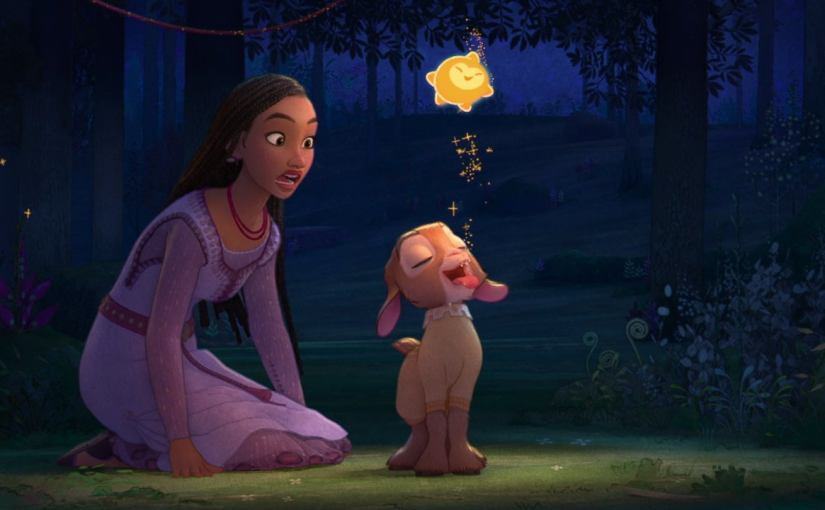
Asha (Ariana DeBose) is a seventeen-year-old who is eager to finally witness her grandfather Sabino’s (Victor Garber) wish come true as his 100th birthday finally approaches.  She also aspires to meet the great sorcerer and hopefully become his apprentice.  As soon as she meets the King though, Asha realizes Magnifico is a greedy, selfish individual who thrives off the admiration of the people of Rosas while savoring the wealth of everyone’s longings.  In other words, Magnifico is a cult leader.

Chris Pine does good voice work here.  He’s gleeful and manipulative and uncaring and evil all at the same time.  Disney’s colorful animation lends to his vocal performance of course with Maleficent inspired glows of green spells which the character conducts.  Yet, my adult mindset could not get past the fact that I’m looking at an animated inspiration of David Miscavage, long time head of the Church Of Scientology.  Magnifico’s wife Amaya (Angelique Cabral) is the quietly naïve representation of David’s wife, Shelly (who has not been accounted for in years).  The poor people of Rosas are the brainwashed disciples believing in this false prophet.  I guess it’s not a terrible concept to apply to a fantasy, but once I see the allegorical connection, Wish makes me feel uneasy.  My fault I guess for watching too many HBO documentaries and listening to former Scientologist Leah Remini too much.

Asha is the hero of this story who makes a wish upon a star.  Actually, a literal character named Star enters the picture.  Star squeaks like a precious darling, ready to be your children’s next plush toy acquisition.  He shoots sparkling trails of gold out of his pointed appendages.  With Star’s help, Asha will reach the standard showdown with the villain by the film’s end and the awakening of the people below.  It’s all trite material that’s been done before.

Wish relies on the vast history of fantastical stories, believing you can fly and be heroic or simply a sidekick tagging along with the protagonist.  Asha has seven friends.  One is referred to as grumpy.  Huh!  How do you like that? Must it be so apparent so often though?  Thanks to Star, forest animals talk and one even makes an inside gag to Zootopia.  You’re practically asked “Get it?  See what I did there?” Magnifico bears a striking resemblance to Jafar and even resides in a similar castle to the Aladdin villain with stone spiral staircases to explore.

The colors and animation are just as engaging as nearly any other Disney film.  A few songs work, but there’s nothing on the level on what was accomplished during the days of Rice and Menken, or even more updated fare like Frozen.  I can’t recall the title of a single number from Wish.  Magnifico sings.  Asha sings multiple times.  The two duet together and it’s not terrible. Ariana DeBose could sing the phone book and I’ll feel swooned.  The supporting people of Rosa sing in choral support as well.

Still, what tainted my experience was turning a very real epidemic of cultish culture into a fantasy catered for all ages to enjoy.  The wishes the people offer up are the endless “donations” that a cult mentality always requests.  While I appreciate being accepted into a fraternity of Disney loving storytelling, I did not need to be banged over the head with so much saluting either.  The end credits contain one classic Disney character after another appearing next to the ongoing scroll.  Hi Dumbo.  Hi Genie.  Hi Peter.  Hi Belle. 

Disney always reminds us to believe our wishes will come true and yet with Wish the studio chose to go with what is blatantly familiar.  It’s time for some fresh ideas again that especially do not source themselves from the reality of harmful sects spreading false doctrines. 

NOTE: I still have a fresh idea from a very popular legendary story that Disney, nor Universal or Warner Bros has yet to touch.  Maybe it’s time I get it down on paper.  Hmm.

ELEMENTAL

By Marc S. Sanders

Ember and Wade are perfect for one another.  They truly belong together.  Yet, science dictates that they have zero chemistry.

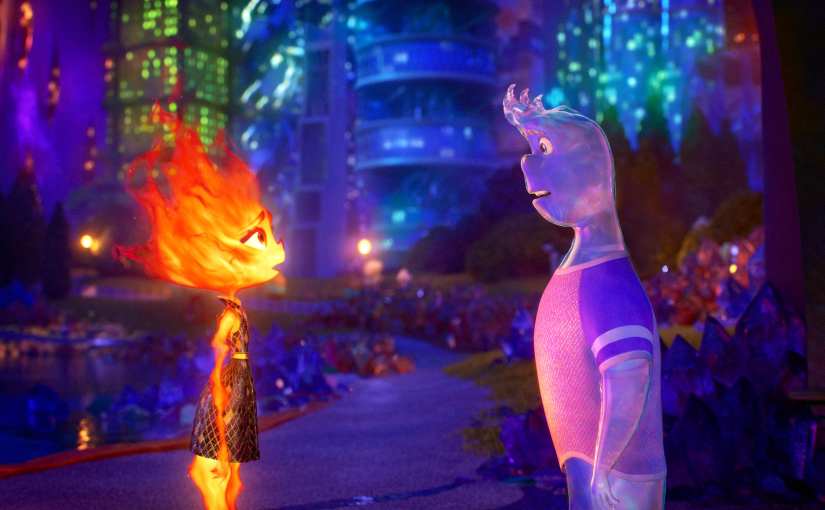
Ember is a figure of fire.  Wade is a bubbling, joyful standing puddle of water.  They reside in Element City along with people of earth and air, respectively.  Pixar with Disney Studios, has transitioned from emoting human feelings in lovably figurative toys, monsters, cars and colorful emotions to the primary elements of our planet.  Hence the title Elemental.  It’s a blessing that the storylines and messages of this digitally animated feature are a winning combination.

Ember (Leah Lewis) is the daughter of her fire immigrant parents, Bernie and Cinder (Ronnie Del Carmen, Shila Omni).  She loves to work with her dad in his mercantile shop that he built from nothing, known as The Fireplace.  She’s hardworking and dedicated, but she can suffer from a short temper that turns her firebrand orange disposition into a raging purple. Suddenly, she’s charred the shop interior and maybe some of the customers.  

Wade (Mamoudo Athie) is a water made building inspector who by unexpected circumstance comes upon the aftermath of a temper tantrum from Ember.  He works as a building inspector for the city and simply by doing his job he cites enough offenses with The Fireplace that could shut down the shop for good.  Now Ember must work with Wade to avoid that from happening, including haphazard water leaks that are stemming from a mysterious source within the city.

Elemental works because while it bursts with magnificent color, it has a story to tell in a brilliantly inventive and functional environment, much like the Monster World in Monsters, Inc. Pixar does not just stop at the marvelous animation. Their products continue working even beyond their well planned stories and conflicted characters.

With this film, the immigrant crisis that is a prevalent problem in the real world is addressed, but simplified for all ages to comprehend.  Fire based citizens, inspired by Asian/Eastern cultures, are typically restricted to only fraternizing within their area of the city, among only their demographic.  They are regarded as harmful and unsafe from the other three elements.

On the other hand, people of water, air and earth live in harmony.  Director Peter Sohn, with a highly informative script from John Hoberg, Kat Likkel and Brenda Hsueh, is consistent with this reflection.  Water, air and earth make up the first three iterations of Element City.  Fire gets no recognition.  Fire was not invented by a higher power.  It had to be discovered.  Therefore, they are sadly treated as a minority.  The film doesn’t go so extreme as segregating the fire community to literal internment camps, but the feeling of isolation seems quite authentic.  

Yet, fire serves an important purpose. Bernie might envision his daughter taking over the business as he is getting older and slower.  Still, with Wade’s help Ember is realizing that she has talents that will make her happier and more fulfilled.  She’s a natural at honing glass sculptures with merits in practicality and art.

At the same time Wade and Ember are becoming friends and maybe there is something more going on in their newfound relationship.  Problem is they dare not make contact with one another.  What would actually happen if fire and water mixed?  Bernie and Cinder would never approve of this relationship either.  As well, poor Wade and Ember may be frowned upon with prejudice if seen in public together.  

My colleague Miguel reminded me that Elemental gets 98% of its science accurate.   I definitely appreciate that.  However, I’m also grateful for the remaining 2% left for my suspension of disbelief that is quelled by insightful imagination.  Ember and Wade are such wonderful characters that they deserve the happiness they long for.  As I watched, I longed for their destinies to outlast the seemingly impossible.

This is a special film from the Pixar factory.  Elemental demonstrates that nothing should limit what any us of yearn for.  No shortsighted policy of any kind should bar us from our pleasures.  There’s a way for anything to work together.  It only takes some thought.  So you know what I say as I root for Ember and Wade?  SCIENCE/SCHMIENCE!!!!

THE LITTLE MERMAID (2023)

By Marc S. Sanders

Film remakes can go either way.  It’s even more of a challenge for it to succeed artistically if the original interpretation is such a favorite among the masses.  The 2023 updated version of Disney’s The Little Mermaid directed by Rob Marshall is fair, but it also never overcomes the challenge.

The new film primarily repeats the same story that many are familiar with.  A youthful mermaid girl named Ariel dreams about living among the humans above the surface.  Her father refuses the idea as he finds humans to be vile and dangerous.  Ariel makes a deal to trade in her beautiful voice to Ursula, the sea witch, in exchange for becoming a human.  She is granted three days to fall in love with Prince Eric.  If at the end of the three days she has not kissed the prince with a means of true love, she will turn back into a mermaid and will remain a prisoner of Ursula forever.

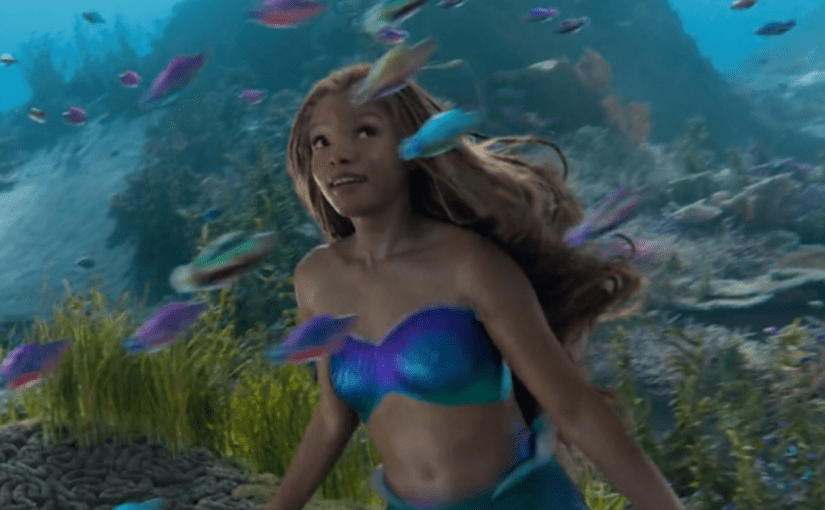
To call this new film adaptation of the Hans Christian Anderson fairy tale a live action film is only partially true.  If we are to witness the undersea life of mermaids and talking fish, well then, it’ll have to be animated somewhat, even if it is done digitally.  Therefore, to have the freedom to animate the sequences set to unforgettable numbers like “Part Of Your World” and “Under The Sea,” I wish the filmmakers were paying a little more attention. 

Consider some lyrics to “Under the Sea:”

Down here all the fish is happy…

Up there all the fish ain’t happy

They’re sad, cuz they’re in the bowl

It doesn’t win my attention if Sebastian the singing crab is singing about fish while the heroine of the story, Ariel, is swimming among dolphins who are scientifically regarded as mammals!!!!!!  You can show me any number of different colorfully prancing ocean dwellers, and you show me dolphins?????  In a musical number, the choreography must serve the purpose of the song.  In the original 1989 film, every animated image of any particular song lines up with the lyrics of numbers written by Alan Menken and Howard Ashman.  Regrettably, Rob Marshall seems to have turned the sound off while reinventing this moment. 

Sadly, I didn’t care for the updated composition of “Under The Sea” (an Oscar winning number) or “Part Of Your World.”  Why alter the notes and vocal delivery of some of the most famed pieces in Disney’s musical library?  Steven Spielberg’s update of West Side Story didn’t do that.  Spielberg knows that if ain’t broke, don’t fix it.  These are favorites!!!!  I can’t be the only one who doesn’t like it when the artists change everything about his/her/their greatest hits when I’m at their concerts.  The same accounts here. 

Still, it’s not all bad in this new The Little Mermaid.  Most of the cast is quite good.  Newcomer Halle Bailey (sure to be memorable in the upcoming musical version of The Color Purple) is sensational and she’s wonderful to look at as either the mermaid or the human version lacking a voice.  She has a wonderful singing voice and she’s a terrific actor against a CGI world of complicated water shots and imaginary creatures serving as her companions.  Melissa McCarthy is unrecognizable as Ursula, the sinister squid sea witch.  Her voice has a gruff intimidating edge to it and her torso and head donned in purple texture flow nicely with the CGI tentacles.  Javier Bardem is not doing his best work here because the script doesn’t demand it of him, but he fits in nicely as Triton, king of the undersea and father to Ariel.

Jacob Trembley lends a preteen personality to Flounder whose role is significantly diminished in this update.  That’s a mistake.  Instead, we get more of Scuttle who doesn’t look like a pelican any longer but is a bird who can somehow hold his breath under water for long periods of time to carry on panicked conversations with her pals.  Awkwafina voices Scuttle, and though I heard some laughter from the audience in response to her performance, it just didn’t win me over.  I found this Scuttle to be a nuisance that took me out of the film with each appearance.  The hip hop rap number (written by Lin Manuel Miranda) she performs was a very underwhelming substitute for comedy.  What was sacrificed was the hilariously silly, slapstick number from the original, where the French chef enthusiastically sang “Les Poisson,” as he torments poor Sebastian in a kitchen full of knives, boiling water and searing hot stoves.

Sebastian, the well-known sidekick, is just okay.  Daveed Diggs is a talented vocal performer, but I don’t think the final product served him well.  Often, I looked at this little guy and was not impressed, as remembrances of disappointment came back to me when I saw Jar Jar Binks for the first time.  Just like that Star Wars character, the googly eyes are detached from the head and Sebastian only evokes expression in that one area.  Nothing is done with the tiny mouth or cheekbones or ears.  Not even his claws or tiny legs offer much to do.  This crab lacked life.  As my colleague Miguel simply put it, the crab was not funny.  He just wasn’t funny in the slightest. 

A nice surprise comes from Jonah Hauer-King as the dashing Prince Eric, rescued from a shipwreck by a mysterious woman with a hypnotically, sensuous voice.  Eric’s role is thankfully expanded with the inclusion of his mother the island Queen (Noma Dumezweni).  Grimsby, the Prince’s aid, is also a welcome appearance (Art Malik) with more to do this time around.

I know for sure that I preferred the second half of the film over the first where new surprises are offered.  Rob Marshall’s film switches the influence of the story to a calypso/Caribbean vibe which is different from the slightly implied Greek environment of the 1989 piece.  This change allows a variety of different people of color and cultures to blend nicely together with believability.  After Ariel transforms into a human and Eric guides her across the island for a day of fun and escape, the story and settings come alive in color and calypso harmony.  In this area of the picture, much of the script is concentrated on Eric and his debates with his mother and her disapproval of the undersea colonies.  Confidant conversations also arise between Eric and Grimsby that I liked.  There’s more innocent flirtations between him and Ariel.  Hauer-King has good scenes with all of his co-stars from Halle Bailey to Noma Dumezweni and Art Malik.  The first half of the film is where much of the underwater life takes place, and it only convinced me so far, really taking me out of the film with the reinvention of the movie’s most famous songs.

Ultimately, like the live action interpretations of Aladdin and Beauty And The Beast this new version of The Little Mermaid is not a must watch and as much as I’m impressed with Melissa McCarthy, Halle Bailey and Jonah Hauer-King, I can’t recommend seeing it at $15 a ticket.  Why should you when the easily accessible and wholly original film is available?  This is just an unnecessary venture.

I’ve grown up as a Disney fan, but once again the Mouse House is demonstrating a lack of will to broaden its imagination.  They’d rather run in with another cash grab at the box office by issuing a substandard product repeat. 

THE LITTLE MERMAID (1989)

By Marc S. Sanders

What I hearken back to most when I watch The Little Mermaid is my junior year of high school in 1989.  If you were around at that time, then maybe you realized how much of an impact the characters of Ariel, Sebastian, Flounder, Scuttle and Ursula The Sea Witch had on kids, but teen pop culture as well.  Batman was big that year.  Disney’s underwater, romantic, musical adventure was at least as large.  Driving home from school, everyone I knew were singing along to celebrated numbers like Kiss The Girl, Les Poisson, Under The Sea and Part Of Your World.  My drama class couldn’t get enough of Poor Unfortunate Souls.  Oh, how overdramatic we would get in Mr. Locklair’s class while emulating Pat Carroll.  I still harmonize Ariel surrendering her voice.  Yes!  I can hold the tune!!!!  There is no denying The Little Mermaid cast a spell over the student body at Berkeley Preparatory School in Tampa, Florida.

The Little Mermaid is an important entry in the Disney lexicon.  Disney films were considered substandard, tired and stale before this release.  However, the adored fable based upon a story from Hans Christian Anderson awakened something that still carries on.  The music within the film from beloved writers Alan Menken and Howard Ashman were delivered like Broadway showstoppers.  The quality of the songs was elevated with gorgeous calypso and reggae harmonies, and vocal characterizations as colorful as the underwater life depicted on screen.

Ariel (Jodi Benson) is the title character who dreams of what life is like above the surface.  Her father, King Triton, strictly forbids her from going above the water.  In his eyes, humans are ghastly.  That’s a problem because his daughter is enamored with handsome Prince Eric (Christopher Daniel Barnes).  Like a sixteen-year-old who sneaks out of the house through a bedroom window, Ariel visits the nefarious and alluring sea witch, Ursula (a rapturous Pat Carroll in one of the best fantasy villain roles to ever appear in the movies).  The deal is Ursula will turn Ariel into a human for three days.  In exchange the little mermaid must surrender her gorgeous singing voice.  If Eric does not give Ariel a kiss of true love by the time the sun sets on the third day, then her soul belongs to Ursula for all eternity. Ariel gets some help from Sebastian the crab (also a sea-life orchestral conductor), innocent Flounder, and a zany seagull named Scuttle (Buddy Hackett).

The animators at Disney use everything at their disposal to burst wondrous color within the film.  There’s life brought to the sea life within the backgrounds from a blowfish who BLOWS, to the Octopus and the shrimp and swordfish.  Even the random bubbles that float around are marvelous to look at. Nothing is off limits and life under the sea seems so much more enticing compared to the ho hum activities that we humans endure each day with traffic jams and junk mail.

Other Disney productions like Alaadin and Beauty And The Beast that followed, offer some life lessons for the protagonists to consider.  The Little Mermaid doesn’t actually.  It rests upon wishes and dreams for Ariel.  I’m thankful for that.  It’s such a glorious picture that I coast through on the fantasy of it all.  Ariel takes me on adventures to explore shipwrecks and her grotto where her human collectibles are stashed.  I get to carefully approach the dark imagery of Ursula’s caverns where countless, slimy, pitiful souls suffer, while the tentacled monster delights in her vanity with Pat Carroll’s gleeful voiceover.  It’s just enough for me.  Disney doesn’t always have to preach, and I think it’s why The Little Mermaid is my favorite of all of their films. 

Every moment is beautifully drawn in shape and color.  Still for a film that came six years before the Pixar evolution, the expressions of the characters come off so naturally.  Look at Sebastian’s fear and frustration as he tries to keep up with an independent Ariel.  Pay attention to Ariel’s nervous reaction when she encounters Eric on the beach after she’s become human.  She’s animated to try and straighten her hair and grin her teeth because its as if the popular kid in school is walking across a disco lit gymnasium to ask her for a dance.  The animation is purely inspired by natural, human behavior that we are all too familiar with.  When drawn like this, we can’t help but be impressed.

The songs are the highlights though.  The compositions are so lively and easy to pick up and sing along to, like we all did in high school.  The lyrics are equally impressive like the most brilliant of dialogue.  When Ursula makes her campaign for why this trade would be advantageous for Ariel (Poor Unfortunate Souls), I can’t help but believe her.  She’ll have her looks and pretty face.  It’s only her voice!  You got a point there Ursula.  The best villains always have the most sound reasonings behind their motivations.

Sebastian (Samuel E Wright) makes a strong argument for why life Under The Sea is so much better than living on land.  His enthusiasm in song is completely convincing.  Life under the sea is nothing but a party.  Let’s go.

Jodi Benson gives a strong voiceover performance as Ariel.  I’m hearing a firm and independent young woman who stands her ground and will defy any orders to go after what she desires.  Her rendition of Part Of Your World is one of Disney’s most treasured and celebrated moments in film history when accompanied with the setting of Ariel’s towering grotto of props that we humans take for granted like fish hooks and dining utensils, especially a dinglehopper…you know…a fork!  This is what a kid dreams of becoming when alone in her room with no one there to judge her true feelings and desires.  It’s truly glorious.

The one scene that does give me pause is the dramatic discovery King Triton has of Ariel’s secret vault of collectibles.  By the end of the moment, his temper has grown so big, that he unleashes the power of his trident to destroy everything she’s treasured.  I’ve always said this looks brutally familiar to how a father might take a baseball bat to a kid and her room, teetering on domestic violence.  The scene is memorable but unnerving all the same.  Still, I have to remind myself that this is a fantasy, and this is only a movie. 

Nonetheless, The Little Mermaid is a timeless film filled with magic and whimsy and daring escapes and big laughs that are not just relegated for eight-year-olds.  As adults, we remember those butterfly feelings of our first crush and what held us back from pursuing it further.  We can relate to what the characters do for, and towards each other.  Again, everyone from the deliciously wicked villain down to the defiantly brave protagonist and her sidekicks have a point and very human understandings for why they exist and what they want out of life.  Being a mermaid or a crab or a sea monster doesn’t make any of these people any less human. 

WRECK-IT RALPH

By Marc S. Sanders

Walt Disney Studios is the granddaddy of animation. No one questions that. Yet when I watch a film like Wreck-It Ralph, I am enthralled at not just the imagination of story or the eye-popping visuals, but most importantly the made-up science the film’s video game characters interact with.

There are rules in play. All arcade game personalities can schmooze with each other after hours. Cross each other’s paths at “Cross Central Station” where a Pac Man cherry is offered up to a homeless Q-Bert, and even attend a Bad Guys Anonymous Group, moderated by the orange ghost Clyde (infamous rival of Pac Man). That last bit is one of my favorite parts of the movie. So inspired to have a Satan character console a dejected hulking, overalls wearing Ralph, aka Wreck-It Ralph. He’s the villain in the arcade game known as Fix-It Felix.

One rule to watch out for though, if you die in an arcade game you normally don’t inhabit, you can die permanently. When our title character gets overanxious, that’s a threat to not only himself but other important characters like Fix It Felix Jr (Ralph’s adversary), Calhoun (a first person shoot ’em up military woman) and Ralph’s inadvertent best pal Vanelloppe (the unfortunate glitch of a candy land racing game called Sugar Rush).

The jokes are great. The vocal cast of John C Reilly, Sarah Silverman, Jack McBryer, Jane Lynch and Alan Tudyk is perfectly assorted, as if the script was written specifically with these performers in mind.

There’s a lesson to be learned, because this is a Disney movie after all. It’s a pretty good lesson in knowing to love everything about yourself, glitches and all. Thankfully, the film does not patronize and melodramatically bash it over your head.

I love the arcade 80s relatability of the games and the settings of games like Fix It Felix, Heroes Duty, and especially Sugar Rush, looking as if ideas from Willy Wonka were swiped and polished to bring chocolate mud puddles, peppermint stick trees, Nesquik quicksand, and stalactites made of Mentos that drop into a lava like pit of diet cola that molten upon impact.

Soon after Ralph almost broke the arcade, he breaks the internet in a subsequent adventure, and that’s as endlessly hilarious and fun as his feature film debut.

TRON

By Marc S. Sanders

I was not raised on video games.  My father refused to allow us to have them in the house. While I was envious of every kid that owned an Atari 2600, dad didn’t want us to get addicted to them.  I wouldn’t know until later on how thankful I was for that rule he stood by.  I like arcade games for a once and a while escape, but once I reach the banana board (which isn’t often) on Ms. Pac Man, I’ve had my fill.

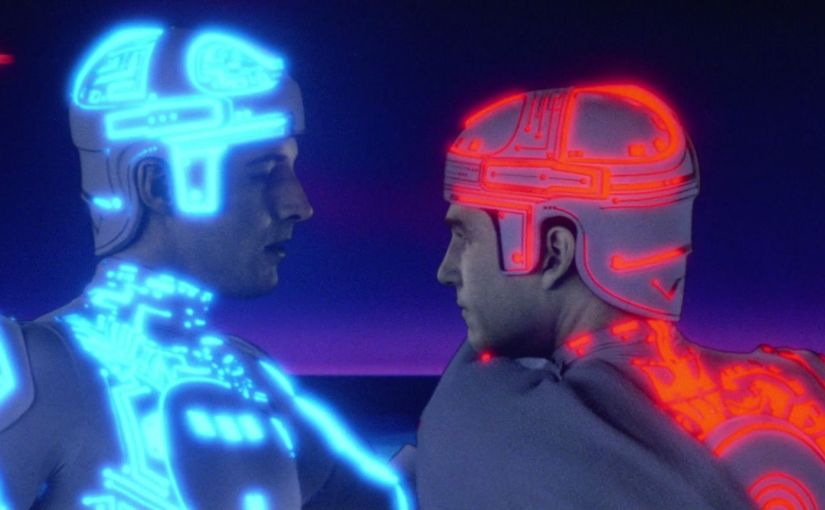
I recall seeing at least a few scenes of Walt Disney Studios’ Tron back when it was released on VHS.  Way back then, just like now, I just was never so impressed by it.  I can forgive the thin characterizations of really the only 5-7 actors with speaking roles.  Yet, the visuals and sound really do nothing for me.  What am I looking at?  Grids!  Just grids or endless squares.  A blank chess board looks more exciting to me.  The players in the film are dressed in what are presumed to be digitized armor that have carved out glowing blue and red lights.  Their human faces are grainy grays.  It all seems so flat to me, like that awful Pac Man adaptation Atari developed for their game consoles. 

Jeff Bridges plays Flynn, a game software developer done dirty by a corporate conglomerate led by a man named Dillinger (David Warner, the bad guy with the British accent).  Dillinger, along with a super computer intelligence known as the Master Control Program, have stolen Flynn’s intellectual property for dynamic new video games.  Since that time, Flynn has been making efforts to hack into the computer system and steal back what was originally his to begin with.  Master Control Program always fends him off, though.

A side story involves Bruce Boxleitner as Flynn’s colleague, Alan, working for the corporation. Alan has just developed a new security system known as TRON.  Dillinger puts a stop on the TRON program however.  Flynn, Alan and a third colleague named Lora (Cindy Morgan) break into the corporate computer lab one night, and before you know it, while attempting to hack in, Flynn is zapped right into the computer system, where he finds himself ensconced in a series of gladiator like games that were part of his original program write ups.

Master Control Program has the capability to erase Flynn from existence but insists on having him compete in the games that involve frisbees that deflect lasers and drive colorful racing cycles.  All of these games occur on this boring grid.

The actors mentioned above are utilized in the film much like The Wizard Of Oz.  They are introduced in the real world for the brief exposition portion of the film, and then later used to represent the TRON program (Boxleitner), as well as other elements that serve or perform under the eye of Master Control Program in the digital computer world.  The only real entity is known as a “user,” and that is Flynn.

I got sleepy watching Tron.  I think it is because like many video games it does not challenge me to figure things out or solve the dilemma. How can I envision Flynn escaping this world before he’s zapped out of existence?  I have no idea, because I’ve not been shown anything that demonstrates how this computer world functions.  Basic video games, at least from the early 1980s, were primarily about timing your button pushes and jerking the joystick accurately and timely.  Like the film Tron, they were never about application of the mind. 

No.  Movies are not meant for me to solve their riddles all the time.  Often, if I’m not trying to figure out how to resolve a story’s conflict, then I’m at least absorbed in the writing and performances of the cast.  The music might heighten the adventure or suspense.  The set designs will dazzle me.  Don’t get me wrong.  This Star Wars fanatic loves visual effects, but without any kind of story or suspense for the players and their outcome, what’s left to watch?  Tron is as dimensional as a blank index card for me. All these grids and lines are no more exciting than office stationery.

Tron from 1982 may seem very outdated, forty years later, but as a ten-year-old, I recall not being impressed either.  The sound design is annoying as when the digital players walk with clunk, clunk footsteps.  The objects on film are just sketched out, geometric glowing, colored lines on a black background. There is no depth, at all, to Flynn, Lora, Alan, Dillinger, or their computer counterparts.  In 1982, this might have been groundbreaking. For the Atari lovers this may have been the answer to many of their prayers.  I dunno.  Maybe I couldn’t relate or understand back then because my tyrant for a father denied me of an Atari game console.  I certainly don’t understand the fascination now. 

I have a 100-sheet pad of graph paper, here in my desk.  I’ll stand my Darth Vader action figure on a page and just stare at it for five minutes.  There!  Now, I can say I’ve watched Tron for a third time.

LIGHTYEAR

By Marc S. Sanders

It’s kind of neat to see the evolution of a classic film character when you are a fully aware adult.  In 1995, I had no idea what the term Pixar meant, or knew the impact it would have with the Disney brand as a whole or on the cinematic landscape.  Pixar is now as pioneering as Skywalker Sound or Industrial Light and Magic.  There’s Pixar, and then there’s everything else.  Back in ’95, I was age 23, and my intuition never perked up that I was watching a touchstone character like Buzz Lightyear who would become as grand today as Batman and Elvis turned out to be in an ever-changing pop culture lexicon. Buzz Lightyear is by far one of the company’s most inventive creations.

Jump to nearly thirty years later, with four Toy Story adventures, and endless amounts of merchandising the Space Ranger has been primed for a more personal adventure beyond the imagination of a young child possessing an action figure in his playroom.  Lightyear tells of the adventure that leant to merchandising of the toy depicted in the Toy Story fictional world.  (Try not to think too hardly on that description.)

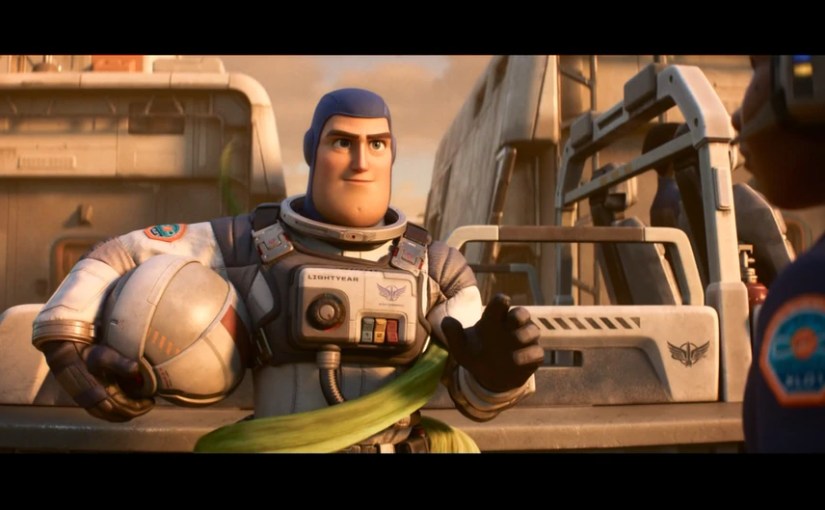
Buzz Lightyear (Chris Evans) is the eminent Space Ranger of Star Command, out to explore strange new worlds and seek out new life and– STOP! That’s another franchise.  When Captain Lightyear comes upon an unchartered planet, complications in unexpected science fiction adventure ensue.  Buzz and the small colony living on his global spaceship are marooned on this planet with no immediate solution for getting off and returning to Earth, 4.2 billion light years away.  Buzz makes it his mission to uncover a new kind of resource fuel that will eventually help the colony make its eventual return home.  Yet, with each experimental try, the minutes he spends in his super speed orbits around the planet equate to years for the colony who have set up habitation below.  His comrades on the ground below continue to age while Buzz does not.

I needed help with this picture.  My wife had to explain the staple lesson that usually comes with each Pixar film that I just didn’t catch while watching Lightyear.  I don’t think I’m spoiling anything, but the film reminds us to accept the hand dealt to us and appreciate what has come even if we never expected or planned on the circumstances in the first place.  It’s a good lesson.  I guess I just wish Lightyear made it a little clearer.  There’s a lot of mud on the windshield that I needed to wipe away before I realized what the message was about.

Maybe I was not fair with this film.  Tim Allen was not invited back to lend his recognizable voiceover to the character.  I guess Pixar is insistent that he’s reserved only for the toy version of the character.  Chris Evans is fine, mind you, and he doesn’t overdo it.  Yet, I could not help but think Tim Allen would have been just as capable and even more entitled to voice the role yet again.

Perhaps I was thinking that if Pixar wanted to go in another animated direction with the character, it just seemed completely fruitless.  How different could Lightyear be from the Toy Story films if the animated design is pretty similar in every frame?  Honestly, it doesn’t look like a new kind of device.  So that was a problem for me, as well.  It wasn’t inventive enough.  Maybe it’s time for a live action version of the space traveler.  Imagine Chris Evans wearing a live action and tactile version of the famous astronaut costume with the colorful buttons.  I still say that could work, and it’s what Disney/Pixar should have considered.

Maybe I’m getting bored with the time travel motif.  Isn’t everyone doing that these days?  Doesn’t it also seem like all our heroes are meeting their future selves and struggling to understand their current predicament?  Lightyear hinges on these story developments, and when the moments arrive my eyes rolled in the back of my head.  Time travel stories are very tricky for me to appreciate.  Often, the narrative paints itself into a corner, unable to explain itself back correctly.  Only two films that come to mind have worked their way out of it almost seamlessly – Back To The Future and 12 Monkeys.

So, while I love the lesson that Lightyear offers, the standard carbon copy plot outline left me unfocused at times.

The voiceover cast is well done with Keke Palmer, Taika Waititi and James Brolin.  The animation is gorgeous, most especially when Buzz is piloting his super jet around the planet’s sun. The atmosphere of the planet is fun when it becomes a nuisance with giant flying insects and vines that come alive to entangle the characters at any given moment.

Science Fiction can go to infinity and beyond with the directions it can take.  There is absolutely no limit.  With today’s technology in filmmaking and the endless resources that Disney provides, why didn’t the filmmakers try a little harder with Lightyear? Again, a live action interpretation would have allowed it to stand apart from the character’s prior Toy adventures, and some different avenues in space exploration would have opened a leaner and more entertaining story.  If Star Trek can do it, Lightyear can do it too.

I think Pixar tried to go the route of Christopher Nolan, by way of Interstellar.  However, Lightyear is designed for people of all ages where the brain of the show is in reminding us how to carry ourselves through life, and not to uncover the twists that a brilliant filmmaker like Nolan has become recognized for.  I didn’t want to resolve a puzzle in fictional science.  Lightyear is trying too hard to be to be brainy and thus we get distracted from its “The More You Know” lesson in self-effacement.

MALIFICENT

By Marc S. Sanders

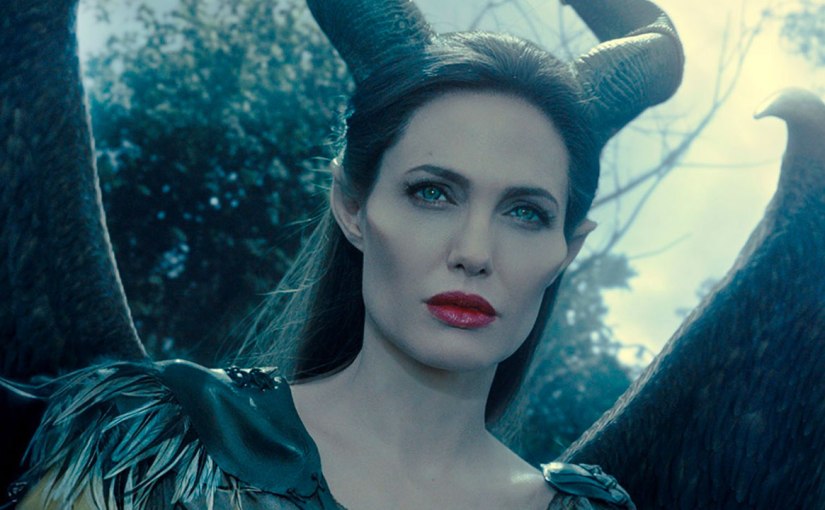
The wagon train of live action adaptations of Disney animated classics reached its pinnacle with 2014’s Maleficent. Much credit going towards Angelina Jolie’s portrayal of the title character. However, the visuals cannot be dismissed either. It’s a gorgeous film directed by Robert Stromberg.

Stromberg brings his wealth of experience in visual effects (Avatar and Master And Commander: The Far Side Of The World) to his directorial debut. The fantasy world of Maleficent’s forest, as well as the looming castle on its outskirts are dressed in gorgeous colors and vast dimension of pathways and caverns. The magical spells wafting in greens, golds, blues and reds, wielded by the characters, including the three protective fairies (led by a strong Imelda Staunton) is hypnotic and blends beautifully with the live actors’ performances. It’s as bold in the visual department as anything cropped up by Peter Jackson or James Cameron.

What makes this brisk 90 minute film special is a different point of view from the classic film Sleeping Beauty. Is there justification to a villain’s actions? Stromberg and Jolie certainly make a case for it. It’s a reminder that there are two sides to every story. Anyone ever consider that maybe Maleficent might have been betrayed at one point? I’ll be damned. At least that’s what I thought, after watching this film.

No one in life is born evil. I like to think people are made evil or perceived as evil. This film is a great example of that, much like the musical Wicked or the recent hit film Joker.

Jolie offers up the frightening aspects of the fairy dressed in black that we’ve been familiar with all these years. However, she’s fortunate that the capable script from Linda Woolverton offers up opportune moments to consider her soft, sensitive side. There are moments of no dialogue as Maleficent observes Princess Aurora (Sleeping Beauty) grow, and she develops a reluctant (it’s hard to resist calling her “Beasty”) affection for the child. Maleficent will even participate in a playful mud fight. There are more than just evil machinations going on here.

Unlike the other Disney live action iterations, Maleficent shows something new and unexpected. It harbors my appreciation for the film whereas Beauty And The Beast or Aladdin did not because they just churned out the same old thing.

If Stromberg’s film suffers from one weakness I’d say it could have used a stronger performance from Sharlto Copley (The A Team film adaptation) as the antagonist, Aurora’s father and Maleficent’s first love; the eventual king. There was not much threat from this guy. He was no match in character much less performance against Jolie.

Still, Maleficent is a great character film with lots of fun, whimsical visuals to explore.

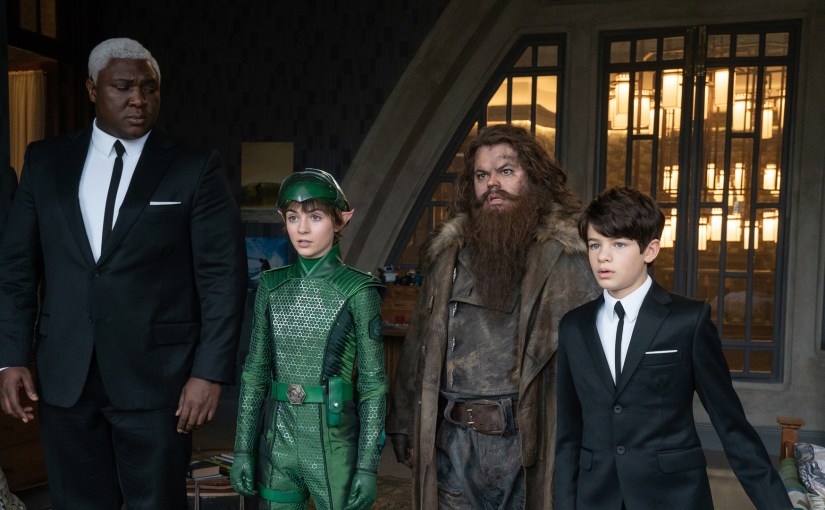
ARTEMIS FOWL

By Marc S. Sanders

Why can’t Disney adapt a good book anymore? They massacred A Wrinkle In Time. Now they’ve taken a hatchet to Artemis Fowl, a Disney + byproduct that was shamelessly shelled out during the height of the pandemic.

There had to have been a more fleshed out, extended film here. Scenes are taped together with no bridge. All I can imagine is some suit insisted on cutting the guts out of director Kenneth Branagh’s film to ensure that its target kid audience would sit still, at least for 95 minutes. The same line of thinking had to have been applied to Ava Duvernay’s A Wrinkle In Time. Both films introduce characters that serve no purpose or make no sense. One character here shows up just to shout “Artemis!”

Speaking of the title character, what is he really? We are told by the narrator known as Mulch Diggums (Josh Gad) that Artemis Jr (an uninteresting kid actor named Ferdia Shaw who must’ve gotten the part cuz he looks good with sunglasses) is one of the greatest twelve-year-old geniuses of all time. He literally has an answer for any question that comes his way. So we’re told! Fact is, all this kid does is shoot a laser gun and wear a black Tarantino suit and tie. Never once in this film did I see Artemis Fowl demonstrate any of his genius, mind bending abilities. He surfs in the ocean outside his Ireland mansion. Does that merit the aptitude of a genius?

Artemis Sr (Colin Farrell) is apparently believed to be a thief of rare, priceless collectibles. After telling his son about some tale involving fairies that live in an underworld, he is soon kidnapped. It is now up to Junior with his trusty butler (Nonso Anosi) to rescue him. This butler doesn’t measure up to Batman’s Alfred. All this butler does is introduce young Artemis to a basement he was never aware of. Mulch also explains that if you call him Butler, he’ll snap you in two. Too bad we never got to see that. (Why tell us, dammit????) Then….AND I AM GOING TO SPOIL THIS SURPRISE….he dies. Tears must flow of course, but all I ever thought of was that gee, I hardly knew this guy.

Artemis Jr must recover a MacGuffin called the “Auculus.” How many times must I hear the word Auculus in a span of an hour and a half? The Auculus. The Auculus. THE AUCULUS!!!!!! Enough already. The filmmakers must believe that the more you say it, well then the more important the Auculus must be. My question: WHAT IN THE HELL DOES THIS AUCULUS EVEN DO?????

Judi Dench is here but only for the purpose of wearing a green leather trench coat that appears to weigh her down and doing what I think is likely a terrible enunciation of an elderly Irish lady’s accent. She plays the General of the fairy army. Dench is awful in this role and appears as lost in the effects as I was. Half the time I didn’t know what was going on. All of the time Judi Dench didn’t know what was going on.

The one main fairy is Holly Short (Lara McDonald) sent on a mission to go to Artemis’ mansion. Once she gets there, I truly lost track of why she was there to begin with. However, she seemed to have more activities to do than the title character is ever given. Once again, the super genius Artemis just shoots a gun. Holly at least gets to fly around with her motorized wings; yes, this is a fairy with an engine to activate her wings.

Artemis Fowl is a gorgeous looking picture. The special CGI effects are truly dazzling to look at with incredible color, but only if I’m watching a fireworks display at Magic Kingdom. Within a story, I have no clue what purpose any of the visuals serve or what possible results could come of anything. Nothing is explained here; much like this Auculus I talked about earlier.

The culture of the film is a failure as well. We are shown that this story is rooted out of Ireland. Where’s the Irish inspiration though? There’s no sense of inspiring traditions to learn from or appreciate. The soundtrack is hardly Celtic. Truly criminal is casting a Jewish Josh Gad and an English Judi Dench. For authencity’s sake, couldn’t actual Irish talent have been used instead of terrible dialects from marquee names?

There had to be a better film here. I’m talking a 2 1/2 hour film with solid, interesting exposition with mystery and questions like the first Harry Potter film. Nothing is of any consequence or comprehension here. How could I be so lost with this film?

This is a pattern for Disney of late. They acquire the rights to some wonderful children’s stories and then just mix some kind of slop in a slow cooker. A Wrinkle In Time, John Carter, and now this dreck. I don’t understand though. If the studio is so committed to packing so much into Avengers and Star Wars movies then why can’t they do the same with its other properties? I promise that kids will sit engaged with a longer film if it’s constructed with care. I know it.

Artemis Fowl is a squandered opportunity. They had the beloved novel by Eoin Colfer to springboard off of, and I know, without even reading the book, that they disregarded almost everything that made this story so special. It couldn’t be more apparent.

Artemis Fowl is a textbook example of when Hollywood does a complete disservice to its author as well as its target audience. It’s a criminal adaptation. It’s a betrayal of the intelligence that kids really come equipped with. It’s a terrible violation of culture and it’s an awful, awful, awful film.