THE HEIRESS (1949)

by Miguel E. Rodriguez

DIRECTOR: William Wyler
CAST: Olivia de Havilland, Montgomery Clift, Ralph Richardson, Miriam Hopkins
MY RATING: 10/10
ROTTEN TOMATOMETER: 100% Fresh

PLOT: In the mid-1800s, a naïve young woman falls for a handsome young rogue whom her emotionally abusive father suspects is the male version of a gold-digger.


[Author’s note: If you have not seen this film, but intend to do so, I urge you not to seek out spoilers.  The final resolution of this movie deserves to be seen in a vacuum, if you know what I mean.]

The AFI’s list of the 50 Greatest Villains in American film does not include Dr. Austin Sloper, played with indifferent cruelty by the great Ralph Richardson in William Wyler’s The Heiress.  This is a miscarriage of justice, as Dr. Sloper is one of the most ruthlessly harsh characters I’ve seen in a movie in many years.  The fact that he is successfully upstaged by Olivia de Havilland as his daughter, Catherine, is a triumph of screenwriting, directing, and pitch-perfect acting from both performers.  The fact that both performances nearly overshadow a charismatic young Montgomery Clift is something that must be seen to be believed.

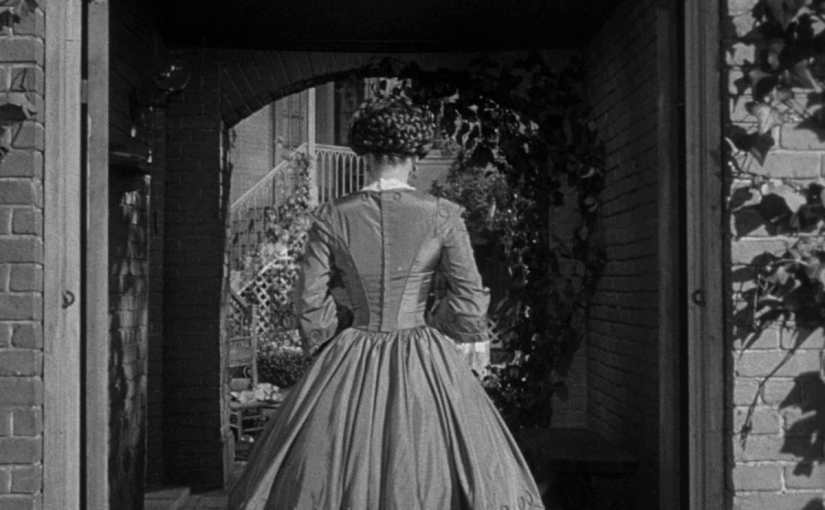
The film starts in the mid-1800s in the Washington Square area of New York City.  It’s a time of horse-drawn carriages, corsets, and garden parties.  Catherine Sloper is a very plain, very shy, single woman who lives in a three-story brownstone with her widowed aunt, Lavinia (Miriam Hopkins), and her father, a financially successful doctor who will bequeath a $30,000-a-year inheritance to Catherine upon his death.  In addition to the $10,000-a-year she already receives from her mother’s inheritance, Catherine will be financially comfortable for the rest of her life.  Alas, her social graces are virtually nonexistent, and she is quite plain when compared to her late mother…as Dr. Sloper casually mentions from time to time, utterly oblivious to the effect this has on Catherine.

At a garden party, during which Catherine is socially humiliated by a thoughtless gentleman, she meets the well-dressed, well-behaved, and nearly penniless Morris Townsend (Clift), who makes it clear that he is utterly taken with her and would like nothing more than to spend the rest of the evening talking or dancing with her and no one else.  Her aunt Lavinia is ecstatic the next day, but Dr. Sloper is skeptical.  In his mind, no gentleman in his right mind would express romantic intentions towards his socially unsuitable daughter unless he simply wanted the money that comes with her, and he says as much to Mr. Townsend AND to Catherine.  The callousness of Dr. Sloper’s behavior is abhorrent, and I found myself thinking, “If this guy were drawn and quartered by the end of the movie, that would still be too good for him.”

The brilliance of the screenplay becomes apparent when Morris boldly announces his love for Catherine, to her complete stupefaction.  And when he actually proposes, that pushes her over the edge, and she falls head over heels in love with him, because he’s the first man who has ever shown anything more than polite tolerance towards her…including her father.  Dr. Sloper lays out his case for what he believes Townsend’s true intentions are: to take control of or squander her inheritance after they marry.

Dr. Sloper’s brutality knows no bounds…but you find yourself thinking: what if he’s right?  Certainly, Townsend is completely genuine in his love for Catherine, or at least seems to be.  He knows exactly what to say, and when and how to say it.  Is it an act?  He’s handsome enough to be an eligible catch for any number of society women in the city, so why waste his time on such a plain-Jane girl as Catherine?

This conflict occupies the main thrust of at least the first half of the film.  What transpires and how and when, I will not say.  I will say that the story led me in one well-traveled direction, took a left turn, then took another unexpected turn that left me kind of breathless at its audacity.  The movie as a whole has been compared in some circles to Scorsese’s The Age of Innocence (1993), and deservedly so.

Olivia de Havilland’s performance as Catherine is one of the greatest performances I’ve seen in any film of that era.  It trumps even her powerful turn in The Snake Pit a year earlier.  Clearly, de Havilland was anything but plain and awkward in real life, but careful makeup and performance nuances helped her bring off one of the most commanding roles of her career.  There is an emotional transformation that occurs at one point where she is able to affect a complete one-eighty in her character, and it never once feels histrionic or gimmicky.  She shares a scene with her father in which she has “found [her] tongue at last,” as he puts it, that I would rank as one of the greatest two-handed scenes I’ve ever watched.  The surgical application of language to inflict harm on another person is breathtaking.  Neil LaBute or David Mamet couldn’t have written it any better.

The Heiress left me feeling a little wrung out at the final credits.  I remember watching this movie many years ago, but nothing stuck with me except that ending.  Despite this foreknowledge, the movie still worked its spell on me, leaving me with a dropped jaw and a blown mind.  The ending is somehow definite and ambiguous at the same time, a screenwriting miracle.  (And I don’t mean in a Sopranos kind of way, either.)  The Heiress is officially one of my new favorite films.
DODSWORTH (1936)

by Miguel E. Rodriguez

DIRECTOR: William Wyler
CAST: Walter Huston, Ruth Chatterton, Mary Astor, David Niven
MY RATING: 10/10
ROTTEN TOMATOMETER: 91% Fresh

PLOT: A retired auto manufacturer and his wife take a long-planned European vacation only to find that they want very different things from life.


Melodrama.  It gets a bad rap in some circles.  Synonymous with “soap opera.”  Do it right and you get masterpieces like Terms of Endearment (1983) or fan favorites like Beaches (1988).  Do it wrong and you’ve got a sappy, soppy, shamelessly manipulative mess like [too many to mention].  In days past, I would take what I thought was the high road and say it’s not my favorite genre at all, too schmaltzy, blech.

But then I started expanding my viewing habits a little and started watching some older films.  I discovered hidden jewels like Peter Ibbetson (1935), a shameless weepie about separated lovers who connect in the spirit world.  I finally watched The Blue Angel (1930) with Marlene Dietrich as the semi-willing agent of a snobbish professor’s emotional and professional destruction.  Soap opera, but done right and very effectively.

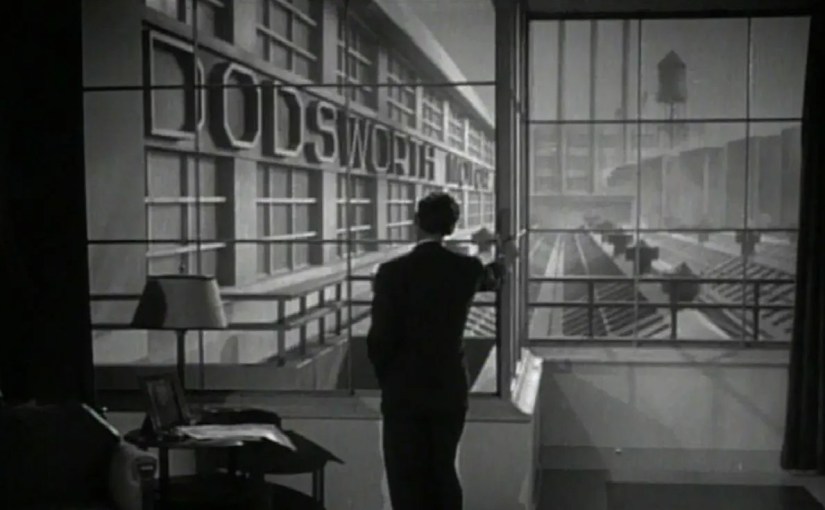
And now here’s Dodsworth, a domestic drama about a middle-aged couple where the husband, Sam (Walter Huston), has just retired from running his immensely successful car company.  He’s looking forward to relaxing with his rod and reel, his golf clubs, “with nothing more important to worry about than the temperature of the beer…if there is anything more important.”  But first, his wife, Fran (Ruth Chatterton), who is tired of spending her life in society circles, wants to see the world on a transatlantic cruise – on the Queen Mary, no less – to London, Paris, and wherever the spirit moves them.  “In Europe,” she says, “a woman of my age is just to the point where men begin to take a serious interest in her.”

At this stage, I felt like I was in the grip of a fairly standard plot whose signposts I could see a mile away: married couple on European vacation, wife going through midlife crisis is courted by a dashing young man who believes her husband is ignoring her, husband finds out, wife denies it, does some self-reflection, slightly farcical situations, some touching speeches on a moonlit balcony, and the married couple return home stronger than ever.  Even if this was going to be a well-made movie, I was pretty sure I would be bored.

Oh, how I do love being wrong.  Dodsworth takes this trope-ridden plot and drives it down some roads where I never expected a movie from the ‘30s to go, at least not when dealing with the sacrosanct institution of marriage.  Fran doesn’t get hit on when she gets to Europe, she gets hit on while still in transit in the Atlantic, by a British cad played by an indescribably young David Niven.  He makes no secret of his attraction to Fran, though later on it seems possible he was trying to take advantage of Fran’s situation.  He even kisses Fran, who offers no more than token resistance…after the fact.

During this semi-tryst, Sam is above deck enjoying the sea air when he has a kind of adult meet-cute with Edith Cortright (Mary Astor), an American divorcee who is younger than Sam by, oh, let’s say at least fifteen years, maybe more.  They have two conversations, and then circumstances send them on their separate ways, Sam to France with his wife and Edith to Naples.

A word about their two conversations.  This is some of the best adult, mature dialogue I’ve ever heard in a film, let alone one from the 1930s.  These are two mature adults who are speaking to each other, neither one with an agenda, but there is something intangible in the language and how the actors play it and how Wyler directed it.  The scene is pregnant with subtext, not sexual, but a sense of connection without being obvious about it.  I found myself starting to root for Sam and Edith to get together before their ship docked, but the movie played around with my own expectations multiple times.

In Paris, Fran and Sam’s relationship deteriorates.  Sam makes plans to sightsee, but Fran has made hair appointments and lunch appointments with her new French acquaintances, so he goes alone.  In her frantic desire to prove how cosmopolitan she is, as opposed to being a middle-aged woman from middle-America, Fran wants to spend more time on the town than being a tourist.  She meets another dashing European gentleman, this one a Frenchman named Arnold Iselin.  It seems as if Fran wants to have her cake and eat it, too: remain married to Sam while indulging in flirtations – flings? – with handsome men with foreign accents.

It all comes to a head one night when Fran suggests that Sam return to America without her.  She wants a “break.”  Sam fights for her, but in the end…but I’m not going to tell you what Sam decides.  Again, your predictions may or not be correct, but there are some deliciously written curveballs up this movie’s sleeve.

I should also mention the delightful discovery of Walter Huston as an actor.  Oh, sure, we’ve all seen him in The Treasure of the Sierra Madre, made twelve years later, featuring his deserving Oscar-winning performance as the prototypical prospector with his little jig and his forever-imitated accent, but that’s how I ALWAYS pictured him.  In Dodsworth, Huston is, quite frankly, a revelation.  His performance is as far removed from Sierra Madre as it’s possible to be.  Sam Dodsworth is a respectable man of business, especially handsome when he’s dressed to the nines, congenial, and smarter than the average bear.  He is what they call, dare I say, a silver fox, the kind of man other women might willingly set their cap for, whether they’re his age or not.  Huston’s delivery and portrayal of this character make Dodsworth immediately likable, which is important in later stages of the movie when he seems on the verge of making a questionable decision.

Then there’s Ruth Chatterton as Fran Dodsworth.  Chatterton was in a strange predicament as an actress for this film.  At the time, she was desperately trying to revive her career at an age when, unfortunately, Hollywood (and society) was ready to put her out to pasture…by which I mean early forties.  And she’s playing a character who is also desperately trying to hang on to her youth.  So, there is a layer of authenticity, and courage, to her performance that cannot be overstated.  Even when she engages in some questionable behavior, I was still able to empathize with her.  She isn’t doing anything out of pure spite.  She is responding to impulses she can’t explain or ignore.

Dodsworth is one of the best films from Hollywood’s first golden age that I’ve ever seen, and yet I don’t hear too many people mention it in their lists of favorite films from the ‘30s.  It deserves to be mentioned alongside the greats, because it IS one of the greats.  And it’s melodramatic as hell, in the beginning, the middle, and especially that shamefully schmaltzy final shot…but you know what?  Dodsworth makes it work.  Soap opera?  Meh, who cares?

MRS. MINIVER

By Marc S. Sanders

To watch a classic film, usually reserved for Turner Classic Movies, is to get a history lesson while realizing that people’s perceptions have hardly changed.    In the early 1940s as World War II was occurring, happiness in many corners of the world was still moving forward.  Presently, I believe that happens today.  For example, Israeli hostages are only now being released from Hamas.  Until the conflict is over though, a childhood friend of mine chooses to run every Sunday morning.  He declares that he runs because they can’t.  This friend is not a soldier bearing arms.  He is acknowledging a violent and frightening conflict that persists.  On the side, he’s a devoted New York Yankees fan.  In 1942, when William Wyler’s Oscar winning film Mrs. Miniver was released, the well to do characters were performing comparably as Europe was in the thick of staving off the Nazi militia.

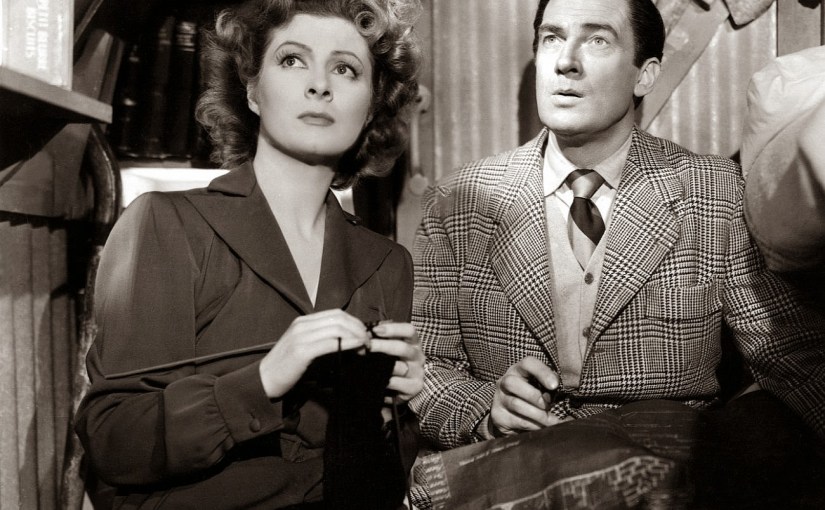
Mrs. Miniver opens on a bustling metropolitan district in England.  The title character, Kay Miniver (Greer Garson), is in a mad rush for something.  She hops on and off the double decker bus and weaves her way through the crowd.  Finally, she arrives at the destination.  The glamorous hat she’s had her eye on is still available to purchase.  Her only dilemma now is what will her husband think when he learns of the extravagant purchase.

Upon her arrival home, Clem Miniver (Walter Pidgeon) hides from his wife in a brand new convertible.  When she goes in the house, he makes a decision.  It’s expensive, but he must have the car and so he buys it.

In this tranquil part of England, the most immediate concern among these well to do people is deciding whether or not to treat themselves to gifts that will bring them joy.  Talk of a German invasion seems like a possibility, but the Minivers, with their two young children and their twenty-year-old son at Oxford, insist on living comfortably and happily.

Lady Beldon (May Whitty) is the elderly and intimidating aristocrat who suffers a terrible dilemma.  It seems the bell ringer, Mr. Ballard (Henry Travers), has grown a beautiful rose that looks like no other.  He cherishes it so much that he names the flower “Mrs. Miniver.”  The real person is honored for the personal recognition.  Yet, Lady Beldon’s concern is her yellow rose will not win this year’s prize trophy cup at the village flower festival.  Her granddaughter Carol (Teresa Wright) gracefully asks Kay if she’ll convince Mr. Ballard to withdraw his entry so that her grandmother can win once again.  She’s elderly, she’s accustomed to winning each year, and it would mean the world to her.

This request will also lead to a romance for Carol with the Minivers’ son Vin (Richard Ney), who has just enlisted in the Royal Air Force so he’s ready to fight the Axis forces of World War II.

All of this seems frivolous during the first half of Mrs. Miniver.  These people live comfortably but gradually grow a little more unsettled as they soon hear planes flying overhead their homes while the sounds of battle play off in the distance.   The possibilities of war coming to their front door seems to be an unlikely scenario.  The battles and bloodshed are out of sight, but only partially out of mind. 

I appreciate the editing of this film.  Clem is woken in the middle of the night to join the other neighboring husbands at the local saloon.  They are being requested to join the historic small boat rescue at the battle of Dunkirk.  The men down a drink and sail off without hesitation.  No one gives protest or stands behind their wealth or stature.

Midway through the picture, Kay is reading a bedtime story to her children in a dimly lit room.  We never see the entirety of this cramped space.  The scene simply begins with no transition.  The walls appear to be made of aluminum and then I realize the Minivers have taken shelter in an underground bunker.  Soon, they will be living through one unimaginable night of shelling and bomb dropping. Director William Wyler never turns off the camera through the extended sequence.  The bunker shakes and rattles.  The children cry in fear.  Dirt rains down them.  Books and belongings fall among the family. The pounding explosions carry on outside.  It seems to never end and the concern over a lady’s fashion hat or a beautiful new automobile are distant memories.

When Vin and Carol arrive home from a honeymoon, the Minivers home is wrecked.  So is Clem’s boat following the Dunkirk incident.  However, they happily remain living there with the youngest child playing a welcoming number on the piano.  

Amid all of these episodes, the people of this small English town uphold their positivity, but they never lose sight of what is nearby.  It’s just a house.  The Minivers are surviving and remain together.  Their biggest concern is that one day Vin won’t return from battle. Yet, time and again he does with hugs and kisses for everyone.

I’ve provided a lot of what occurs in Mrs. Miniver because I was not entirely sure of the purpose of all of these happenings until the final act is served and surprising outcomes arrive.  For much of the film, William Wyler delivers an impression of life away from the front lines.  These people live with a devotion to help their country and abandon comfort when necessary. Flower festivals, gleeful children, young romance and materialistic tranquility will carry on regardless of terrible interruptions of war.

Amid turmoil in our present state with political divides, unjust prejudice, natural disasters, and a resurgence of Cold War threats, I can’t help but wonder if many of us live like this family.  I believe we do, and I see nothing wrong with that.  We have to escape and live happily no matter what terrible future might befall us because otherwise what is the purpose of living?  Still, we choose to remain alert and especially empathetic and ready to aid our fellow neighbors when the need arises.

Visually, a shocking set design for the final scene of Mrs. Miniver sends a message that is only enhanced by a sermon delivered by the town minister.  I learned later that this speech was written at the last second by William Wyler and the actor portraying the minister (Henry Wilcoxon).  It perfectly demonstrates the overall purpose of the entire film.  Mrs. Miniver is the story of a fight for ongoing freedom; an independence to live and to treat oneself happily and lovingly.  People perish during the course of the picture.  The minister explains with convincing validity why they had to die so undeservedly and unexpectedly.  It’s an ending that really touched me, and upon the movie’s conclusion a message appears urging Americans to buy war bonds.  

This speech had such an impact at the time that it circulated in propaganda films and on radio airwaves as a means to deliver a shared triumph among the Allied masses.  It reminded people that simply because you live at home, does not mean you are exonerated of the fight for continued freedom.  The fight is not exclusive to hoisting a rifle or dropping bombs from planes.  A unified front of country must be upheld.  

Mrs. Miniver begins as a romanticized film of people living glamorously and happily but it effectively segues to a reality of uncertain times.  I went from questioning what is its purpose to an understanding of a reason to live and to strive.  

FUNNY GIRL (1968)

by Miguel E. Rodriguez

DIRECTOR: William Wyler
CAST: Barbra Streisand, Omar Sharif, Kay Medford, Walter Pidgeon
MY RATING: 7/10
ROTTEN TOMATOMETER: 94% Certified Fresh

PLOT: Barbra Streisand elevates this otherwise rote musical melodrama with her ultra-memorable star turn as real-life stage performer Fanny Brice.


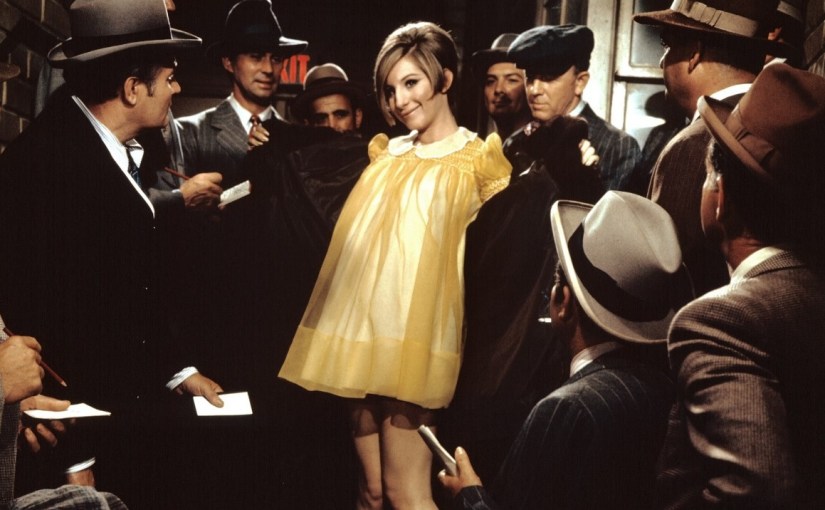
There is nothing wrong with Funny Girl that couldn’t have been fixed by the film not taking itself so seriously.  With its widescreen compositions and scores of extras and lavish stage productions featuring flocks of Ziegfeld girls in the most extravagant costumes imaginable, this should have been a romp, even with the serious bits in between.  Instead, the movie sinks under the weight of its pretentiousness, short-changing the funniest bits and wallowing in pathos way more than is necessary.  Thank goodness Barbra Streisand is there, giving a debut performance for the ages that is part Groucho Marx, part Debbie Reynolds, but mostly just Barbra.  Come for the spectacle, stay for the songs.

The story begins with Fanny Brice (Streisand) walking backstage at a theater and delivering her immortal opening line to a mirror: “Hello, gorgeous.”  From there, the rest of the movie is a flashback to the rise and rise of Fanny Brice, a plain-ish vaudeville chorus girl who is discovered by a roguish playboy, Nick Arnstein, played by Omar Sharif, who looks like a man whose last name would be anything BUT Arnstein.  He cleverly gets her boss to raise her pay to $50 a week (about $800 in today’s dollars, so not bad), and in the process captures Fanny’s heart.  Shortly after that, she’s invited to join Florenz Ziegfeld’s legendary troupe of dancing girls, where she manages to tweak his authority in probably the funniest number in the movie, “His Love Makes Me Beautiful.”

It’s in this number where the first tonal tug-of-war takes place between Streisand’s playfulness and the movie’s urgency to look “important.”  There is an earlier number, “I’m the Greatest Star”, that really showcases Streisand, but the movie never gets that tone right for the rest of the movie.  In “His Love Makes Me Beautiful”, she has these wonderful glances and occasional throwaway lines, but most of them are lost in medium or long shots that emphasize the extravagant Ziegfeld costumes and the expensive-looking set dressing.  It’s like watching a play where the lights are shining everywhere except the stage.

Arnstein comes and goes, sometimes for weeks or months at a stretch, always making sure to see Fanny when he’s in town but repeatedly pointing out that he doesn’t want to be tied down by a relationship.  Their “courtship” lasts through “People”, a song most people know without knowing what it’s from, and a curious number where Arnstein invites her to dinner in a private room upholstered entirely in red velvet, and we know and Fanny knows what’s going to happen, and she has a funny argument between her lust and her manners in “You Are Woman, I Am Man.”  The song also contains a duet with Arnstein, and brother, if you haven’t seen Omar Sharif crooning, you haven’t lived.

Everything comes to a head at the finale of Act One when Fanny learns Arnstein is sailing to Europe and decides to join him instead of going to the Ziegfeld girls’ next port of call.  Here is where Streisand really pours it on, proving her virtuosity with the classic “Don’t Rain on My Parade”, belting out note after note and ending on the iconic shot of her standing on a tugboat as it passes the Statue of Liberty.  If anyone ever doubted she was the real thing before that moment and this movie, their doubts were certainly erased by intermission.

Alas, all good things come to an end, and Act Two falls into a predictable series of economic rises and falls as Arnstein’s volatile income stream finally goes south permanently, while Fanny’s career continues arcing upwards without looking back.  It’s here where the pretentious sensibilities of the filmmakers finally take over for good.  In a second number that could have been downright hilarious, “The Swan”, the movie once again keeps its distance from Streisand’s (appropriate) mugging, asides, and pratfalls…although, being a ballet, it is interesting to see her doing all the dancing herself.

I found myself committing a critical sin by comparing this movie to another widescreen, elaborate movie musical from around the same era, My Fair Lady.  Here’s a movie shot on a grand scale with huge sets, lavish costumes, and big musical numbers, but instead of feeling ponderous, there is a lightness to it.  It zings along, even during the long stretches between songs, thanks to its crackling pace, and gives us just enough pathos to appreciate why we need glee and glamour.

Everything that’s wrong with Funny Girl could have been fixed by just lightening the mood, man.  You’ve got a star-making performance by an experienced theatre actress (Streisand is actually reprising the role she played on Broadway), you’ve got one of the most legendary directors of the time at the helm, William Wyler (Ben-Hur, Roman Holiday), and you’ve got some above-average songs that people can still hum over fifty years later.  Why cloak everything in this gloomy overcoat of affectation and heavy-handed emotional beats that we can see coming a mile away?

When all is said and done, Funny Girl is by no means a bad film.  Streisand is too good at what she does to let this movie fall by the wayside without recognition.  But without her, it’s easy to imagine this movie sinking into near-obscurity, yet another maudlin melodrama that crams 100 minutes of story into a 2-hour-and-35-minute film.  So, rather than mourn what could have been, let’s instead give thanks for what we’ve got: one of the last of the old-fashioned Hollywood musicals with a 24-karat-gold star at its center and a handful of memorable songs.  I suppose it could have been worse.  [insert shrug emoji here]

BEN-HUR (1959)

by Miguel E. Rodriguez

Director: William Wyler
Cast: Charlton Heston, Jack Hawkins, Haya Harareet, Stephen Boyd, Hugh Griffith
My Rating: 9/10
Rotten Tomatometer: 86% Certified Fresh

PLOT: After a Jewish prince is betrayed and sent into slavery by a Roman friend in 1st-century Jerusalem, he regains his freedom and returns for revenge.


For my money, 1959’s record-setting production of Ben-Hur would be a better pick for an annual Easter flick over C.B. de Mille’s overblown The Ten Commandments.  Certainly, Commandments shows the actual story of Passover and might lay claim to more special effects sequences, but Ben-Hur feels grander AND more intimate at the same time.  Plus it actually shows Christ and the crucifixion at the end, and what better symbols could you ask for in an Easter film?

Then, of course, there’s that chariot race.  Game, set, and match.

Ben-Hur was created in an era when Hollywood was watching its profits dwindle because of the advent of television, which was keeping more and more people glued to their sets at home instead of paying for a ticket at the box office.  One way to get people back into theaters was to take the “bigger-is-better” approach: do things that were impossible on a TV budget.

Consider these statistics: Three hundred separate sets were built for Ben-Hur.  The chariot race alone required 15,000 extras on 18 acres of backlot at Cinecitta Studios in Rome and took 10 weeks to shoot.  Over a million props were needed, and it took two years to amass them all before shooting.  Approximately 1.25 million feet of expensive 65mm film was exposed and developed at a cost of roughly a dollar per foot.  The budget for the film ballooned to nearly $15 million, equivalent to over $146 million in today’s dollars, an unthinkable amount in the late 1950s.

But when it was released, Ben-Hur made history by being the first film to win eleven Academy Awards, including Best Picture, Best Director, Best Actor, and Best Supporting Actor.  It remains the only film to date to win Best Picture and Best Visual Effects.  At the box office, it raked in $75 million ($731 million when adjusted for inflation), making it one of the most profitable films in Hollywood history at the time.  It remains popular today, ranked in the IMDb’s top 250 most popular movies and listed as the #2 epic film of all time by the American Film Institute.  (#1 is Lawrence of Arabia, naturally.)

How does a 63-year-old film, with a running time of 3 hours and 42 minutes, with a blatantly religious plotline culminating in the crucifixion of Christ and a shamelessly manipulative miracle, and featuring some of the hammiest acting this side of Bollywood, remain as popular as it is?  Because despite its shortcomings, it does what every film should do, long or short, sacred or secular: it tells a rollicking good story, and it does it extremely well.

After a solemn prologue depicting the first Nativity, we jump forward 26 years and meet Judah Ben-Hur (Charlton Heston), a wealthy Judean prince who enjoys a reunion with his old friend, Messala (Stephen Boyd).  They grew up together but went their separate ways, and now Messala is a Roman tribune assigned to keep the peace in Judea.  Poor Judah realizes just how far they’ve grown apart when an accident leads Messala to arrest Judah and his mother and sister, to demonstrate his power and loyalty to Rome.  Judah vows vengeance and is sentenced to die as a galley slave.  But fate intervenes in the form of Quintus Arrius (Jack Hawkins), a Roman general whose life Judah saves in battle.  Arrius befriends Judah and officially adopts him as his own son, giving Judah the means to return to his homeland, wreak his vengeance upon Messala, and rescue his mother and sister from prison.

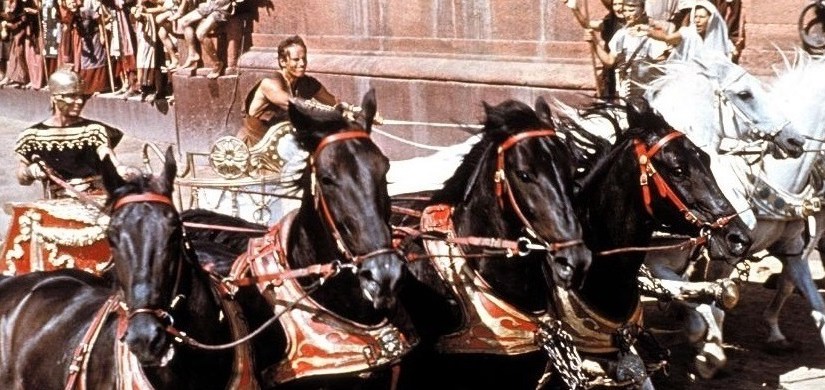
…and that’s just Act One.  Act Two focuses heavily on Judah’s revenge in the form of one of the greatest set pieces in Hollywood history: the chariot race.  Or, more properly, The Chariot Race.  If you’ve never seen it, Google/YouTube it.  Even viewed as a stand-alone scene, it is as breathtaking and thrilling as any car chase ever filmed.  It’s so good that George Lucas cribbed many of its beats for the pod-race sequence in Star Wars: Episode I – The Phantom Menace.  The crashes you see during the race were planned, but they were performed with real stuntmen in real danger.  Note especially one sensational stunt where a 2-wheeled chariot drawn by four horses, at full gallop, approach a crashed chariot in their path.  The horses leap the chariot, then the chariot dangerously rolls over the crash itself, hurling the stuntman so high into the air he nearly topples head over heels over the front of his own chariot.  I am at a loss to imagine how they could possibly accomplish this same scene today without the use of visual effects.

Peppered throughout the story are brief scenes featuring Jesus of Nazareth, although we never hear Him speak, and we never see His face.  In Act One, He offers water to Judah as he is being marched to the galleys, a compassionate act that will resonate through the years.  Later He is glimpsed from a distance delivering the Sermon on the Mount.  And later still, we see His trial, His journey to Golgotha, and His crucifixion.  Everyone involved in those scenes show the appropriate and expected levels of awe and sadness, while the score plays a mournful dirge.  It’s a little ham-handed by today’s standards, especially when compared to modern films like The Passion of the Christ, but it is still effective.

The movie’s highest level of filmmaking, apart from The Chariot Race, is on its best display in the first half of the movie.  Nearly two-and-a-half hours fly by, thanks to superb editing.  It’s never boring or soapy.  (Well…ALMOST never soapy.  The requisite love scenes between Judah and the slave girl Esther, played by the lovely Haya Harareet, are not as easy to watch as the rest of the film, but thankfully there aren’t that many of them.)  Every event and every scene feels crucial to the story.  There’s never a moment that drags.  Like the best epic films, watching Ben-Hur makes me feel like I’m reading a richly detailed novel.

If the film has a major downfall, it’s the story that follows The Chariot Race.  The movie doesn’t exactly grind to a halt, but it doesn’t offer the viewer any kind of climactic punches that can match the visceral effect of Judah’s capture, escape, and victory in the race.  (Sorry if I spoiled that for you, but if you seriously thought he lost that race, seek help.)  Sure, there’s the capture and crucifixion of Jesus and the miraculous aftermath, but while that satisfies the true arc of the story, I still, to this day, feel like the film deflates a little at the end.  There’s simply nothing it can offer that could possibly follow up that damn Chariot Race.  The race is the payoff.  Everything that follows feels anti-climactic.

That quibble aside, Ben-Hur is still as captivating as it ever was, with “old” Hollywood’s full power brought to bear to bring audiences a cinematic experience unlike any other at that time.  No matter where you might stand when it comes to its religious overtones, you can’t deny that the movie is exactly as respectful as it needs to be for this story.  And ultimately, the message of the film isn’t “An eye for an eye.”  It’s “Love thy enemy as thyself.”  It takes Judah Ben-Hur a little while to get there.  But he gets there.

WUTHERING HEIGHTS

By Marc S. Sanders

1939 is a pioneering year for film with timeless classics like Gone With The Wind, Stagecoach, and The Wizard Of Oz making their debuts on the silver screen. Arguably, it is one of best years ever for cinema. Finally, I was able to see another sampling from this period, William Wyler’s adaptation of Emily Brontë’s novel, Wuthering Heights.

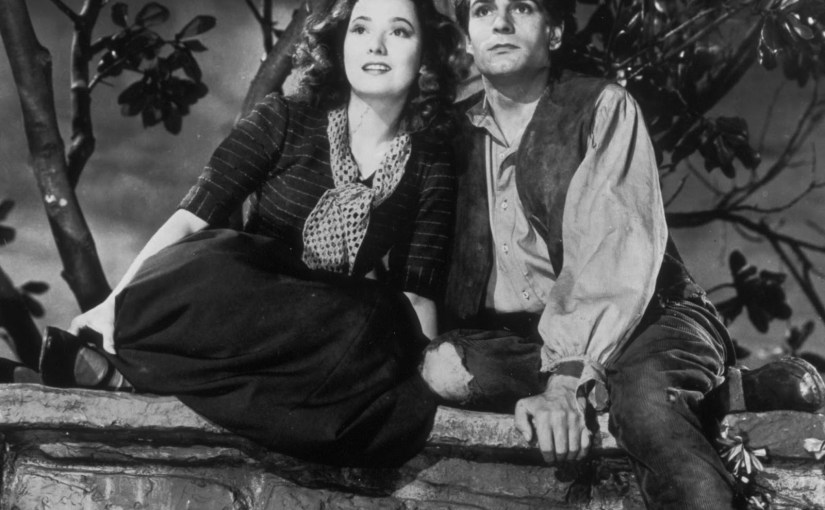
Laurence Olivier portrays Heathcliff, a wandering “gypsy boy” welcomed into the home where the story derives its title from. Over time, he develops animosity from Henry, the son of the landowner, while building a an affectionate relationship with the daughter, Cathy (Merle Oberon). Heathcliff and Cathy fantasize of royal, romanticized adventures along the neighboring rock side. Following a sneak away moment to observe a social gathering dance on a nearby estate, Cathy is tended to and welcomed by Edgar (David Niven), and eventually marrying him, much to Heathcliff’s dismay. From there, moments of melodrama, that likely served as a precursor for modern day soap operas, occurs.

Wuthering Heights caught my attention from the moment it began because I thought I was about to journey through a servant’s ghost story retelling of what became of the lovers never meant to end up together. A stranger wanders on to the property in the midst of a fierce snowstorm and swears he heard a woman’s voice outside and witnessed two shadows. Was this written by Brontë or Poe? Then the tale plays out.

Olivier is the most impressive of the cast, naturally. He’s very striking and handsome. While watching with friends, we all agreed that he might have made a good James Bond or Bond villain. Whether he’s the poor, oppressed Heathcliff or the later, wealthier property owner, Olivier offers a commanding presence that you can’t ignore.

The story doesn’t wow me as much as the the set design and camera work for 1939. Edgar’s grand ball room and foyer are a sight in wide measure with gorgeous, prominence ranging from large bookshelves and furnishings to a functioning fireplace. Was this a real home that Wyler’s camera moved through, or just a Hollywood set?

It was good to catch up with a classic. I’ll likely not watch on repeat, but Wuthering Heights is a treasured story in literature and film. I’m appreciative of the experience.